A charged particle is moving parallel to a uniform magnetic field. Then the force on the charged particle
- A
$qvB$
- B
$\frac{B}{qv}$
- C
$\frac{v^2 B}{q}$
- D
zero
Answer: (D) zero · The council's preliminary key
 PYQs · free, no adsOpen on the web (app.edloop.in)Get EdLoop – free on Google Play
Every Magnetic Effects of Current question from past AP EAPCET and TS EAPCET papers, with options and answers. Newest first.
Magnetic Effects of Current ranks as the third largest chapter in the physics curriculum for Class 12. Across the AP and TS EAPCET papers held in our archive between 2022 and 2026, the chapter contributed 150 questions across 77 papers.
Attempt every Magnetic Effects of Current question timed, see the step-by-step solution and track what you get wrong. Free.
A charged particle is moving parallel to a uniform magnetic field. Then the force on the charged particle
$qvB$
$\frac{B}{qv}$
$\frac{v^2 B}{q}$
zero
A toroid of 1000 turns has average radius of $\frac{\mu_0}{\pi}$ metre. If $1\,A$ current is flowing through it, then the magnetic field intensity inside the coil of the toroid is
$500\,T$
$100\,T$
$750\,T$
$1000\,T$
A circular coil connected to a battery of emf E produced a magnetic field at its centre. The coil is unwound, stretched to double its length and rewound into a coil of $\left(\frac{1}{3}\right)^{rd}$ of its initial radius. If this coil is connected to a battery of emf $E'$ to produce same magnetic field at its centre, then $E'$ is
$\frac{2E}{9}$
$\frac{3E}{7}$
$\frac{9E}{4}$
$\frac{E}{6}$
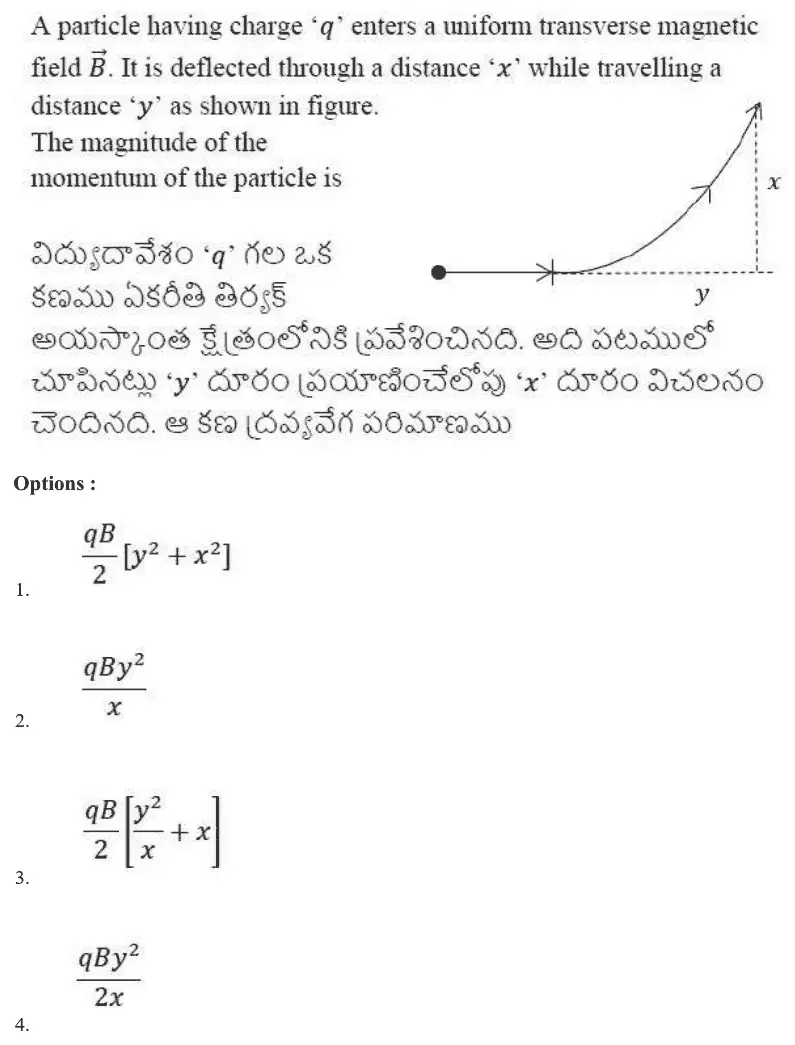
A particle having charge ‘$q$’ enters a uniform transverse magnetic field $\vec{B}$. It is deflected through a distance ‘$x$’ while travelling a distance ‘$y$’ as shown in figure. The magnitude of the momentum of the particle is
(see the figure above)
$\frac{qB}{2}\left[y^2 + x^2\right]$
$\frac{qBy^2}{x}$
$\frac{qB}{2}\left[\frac{y^2}{x} + x\right]$
$\frac{qBy^2}{2x}$
A current carrying circular coil of radius ‘$r$’ produces a magnetic induction of $1\,T$ at its centre. The magnetic induction at a distance of $\sqrt{3}\,r$ on its axis from its centre is
$\frac{1}{8}\,T$
$\frac{1}{16}\,T$
$\frac{1}{4}\,T$
$\frac{1}{12}\,T$
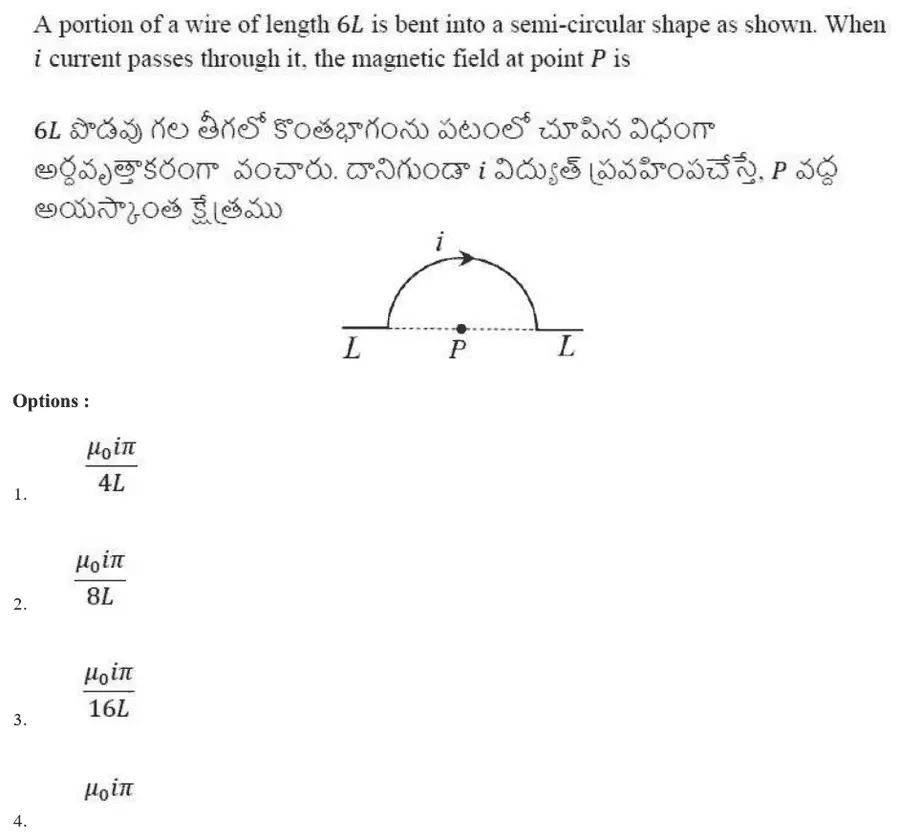
A portion of a wire of length $6L$ is bent into a semi-circular shape as shown. When $i$ current passes through it, the magnetic field at point $P$ is
(see the figure above)
$\frac{\mu_0 i\pi}{4L}$
$\frac{\mu_0 i\pi}{8L}$
$\frac{\mu_0 i\pi}{16L}$
$\mu_0 i\pi$
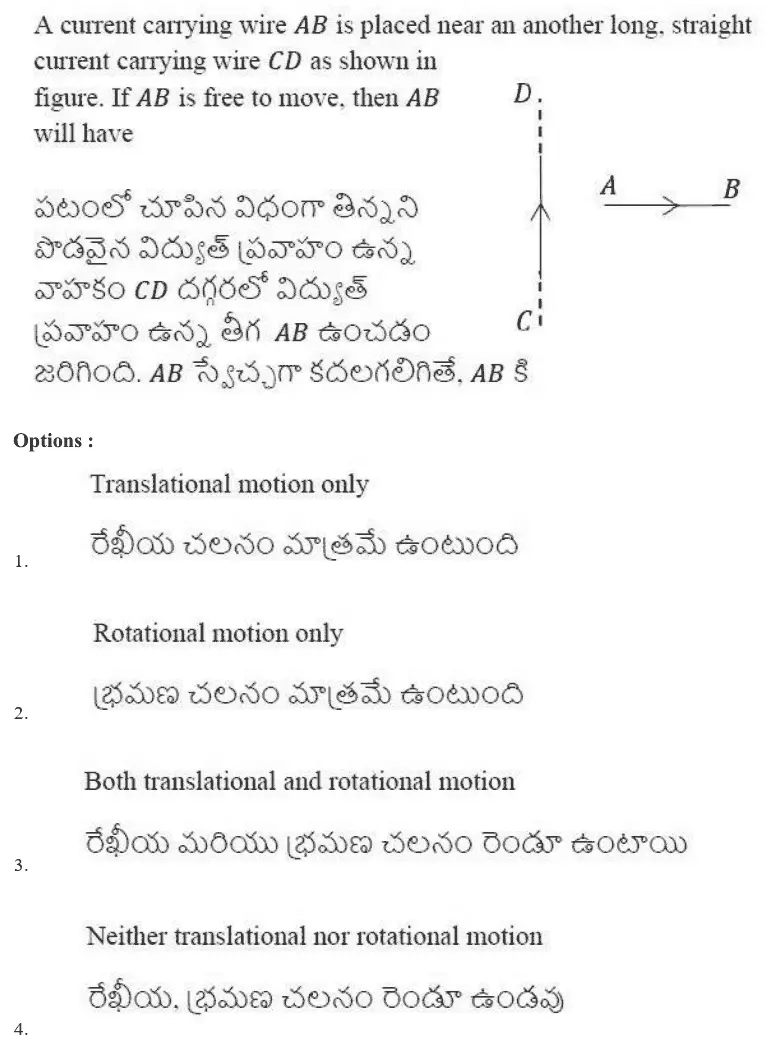
A current carrying wire $AB$ is placed near an another long, straight current carrying wire $CD$ as shown in figure. If $AB$ is free to move, then $AB$ will have
(see the figure above)
Translational motion only
Rotational motion only
Both translational and rotational motion
Neither translational nor rotational motion
If a current is passing in a spring, it
gets compressed
gets expanded
oscillates
remains unchanged
Magnetic moment of an electron moving in a circular orbit of radius ‘$r$’ with a speed ‘$v$’ is
$\frac{ev^2}{r}$
$evr$
$\frac{ev^2}{2r}$
$\frac{evr}{2}$
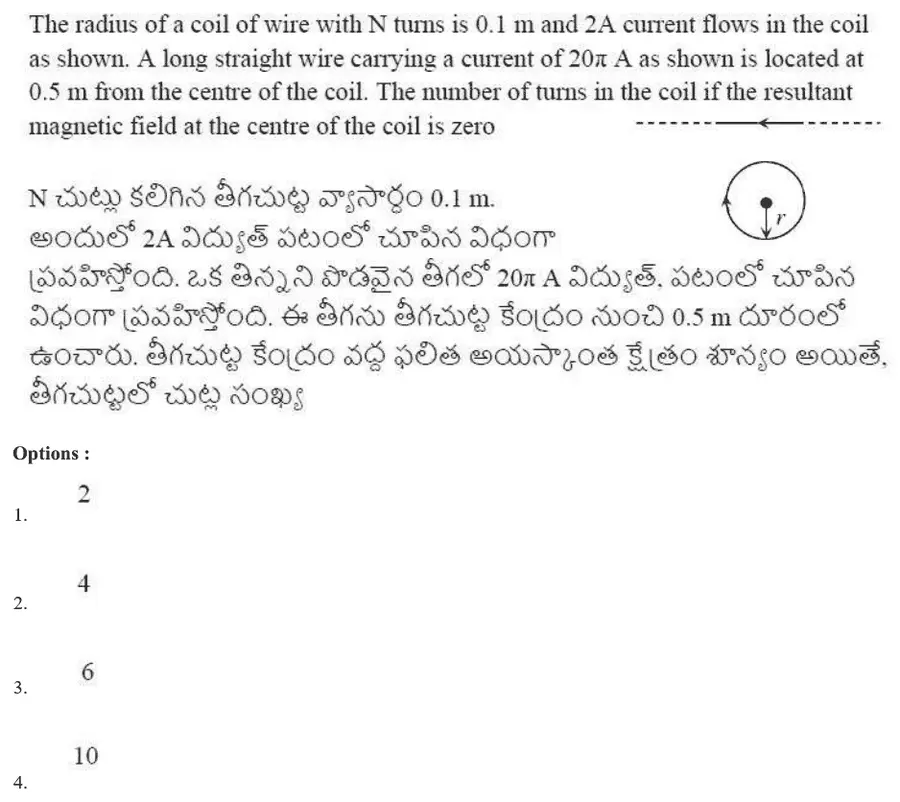
The radius of a coil of wire with N turns is 0.1 m and 2A current flows in the coil as shown. A long straight wire carrying a current of $20\pi$ A as shown is located at 0.5 m from the centre of the coil. The number of turns in the coil if the resultant magnetic field at the centre of the coil is zero
(see the figure above)
2
4
6
10
A charged particle moves in a region where there is a uniform electric field $E = 2 \times 10^{3}\hat{i}$ N C$^{-1}$ and a uniform magnetic field $B = 5 \times 10^{-2}\hat{j}$ T. The velocity of the particle (in ms$^{-1}$), if the particle moves without any acceleration.
$5 \times 10^{4}\,\hat{k}$
$2 \times 10^{3}\,\hat{k}$
$4 \times 10^{4}\,\hat{k}$
$4 \times 10^{4}\,(-\hat{k})$
A proton and a deuteron, both having the same kinetic energy, enter perpendicularly into a uniform magnetic field B. For motion of proton and deuteron on circular path of radius $R_p$ and $R_d$ respectively, the correct statement is
$R_d = \sqrt{2}R_p$
$R_d = \dfrac{R_p}{\sqrt{2}}$
$R_d = R_p$
$R_d = 2R_p$
A wire carrying current I and other parallel wire carrying current 2I in the same direction produces a magnetic field B at the midpoint between them. Then the magnitude of field at the same point, when the 2I wire is switched off
B/2
2 B
B
4 B
The current and voltage sensitivities of a moving coil galvanometer are 80 divisions per mA and 2 divisions per mV respectively. If the galvanometer has 100 divisions, then the resistance to be connected in series to the galvanometer to convert it into a voltmeter which can measure a maximum potential difference of 5 V is
$4040\ \Omega$
$3960\ \Omega$
$5040\ \Omega$
$4960\ \Omega$
A circular coil of radius 10 cm having 200 turns is carrying a current of 2A. If the magnetic field at a point on the axis of the coil which is at a distance of 20 cm from the center of the coil is B, then the magnetic field at a point on the axis which is at a distance of 5 cm from the center of the coil is
8B
4B
6B
2B
A proton with energy 2 MeV is moving perpendicular to a uniform magnetic field of 2.5 tesla. The force on the proton is
(mass of proton is $1.66 \times 10^{-27}$ kg)
$2.5 \times 10^{-10}$ N
$7.8 \times 10^{-11}$ N
$2.5 \times 10^{-11}$ N
$7.8 \times 10^{-12}$ N
An electron in the ground state of hydrogen atom is revolving in anti-clockwise direction in a circular orbit. The orbital magnetic moment of the electron is given by
$\frac{h}{2\pi}$
$\frac{eh}{2\pi m}$
$\frac{eh}{4\pi m}$
$\frac{h}{4\pi m}$
A particle, having a charge 100 times the charge of an electron, is rotating in a circular path of radius 0.8 m in 1 second. The value of the magnetic field produced at the centre of the circle will be
($\mu_o$ – permeability of free space)
$\frac{10^{-7}}{\mu_o}$
$10^{-17}\mu_o$
$10^{-6}\mu_o$
$10^{-7}\mu_o$
A long solenoid having 15 cm circumference and 70 turns per metre is carrying a current of 2A. The magnetic field inside the solenoid at a distance 1 cm from the surface and the magnetic field outside the solenoid respectively are
$0, 1.76 \times 10^{-4}$ T
$8.8 \times 10^{-3}$ T, 0
$1.76 \times 10^{-4}$ T, 0
$0, 8.8 \times 10^{-3}$ T
A proton and an alpha particle enter a uniform magnetic field with the same kinetic energy making the same angle of $30^\circ$ with the direction of the field. The ratio of the pitches of the paths of proton and alpha particle is
$2:1$
$1:1$
$1:2$
$8:1$
Two identical circular coils each of radius R and number of turns N are arranged coaxially with a separation of R between their centers. If the current through each coil is I, then the maximum resultant magnetic field induced at the midpoint of the line joining the centers of the two coils is
$\frac{2\mu_0 NI}{R}$
$\frac{4\mu_0 NI}{\sqrt{5}R}$
$\frac{8\mu_0 NI}{5\sqrt{5}R}$
$\frac{\mu_0 NI}{\pi R}$
The maximum kinetic energy of a proton ejected from a cyclotron with dees of radius 70 cm and oscillating frequency 5 MHz (in MeV) is
(Mass of proton = $1.67\times10^{-27}$ kg )
2.53
3.87
1.46
4.84
A circular coil of radius 10 cm is carrying a current. From the centre of the coil, the distance of a point on its axis where $\frac{dB}{dx}$ becomes maximum is
($\frac{dB}{dx}$ is the change in magnetic field with distance x from the centre of the coil)
40 cm
20 cm
10 cm
5 cm
The magnetic field required to accelerate deuterons in a cyclotron operated at a frequency of 28 MHz is
(Mass of proton $=1.67\times10^{-27}$ kg)
7.348 T
0.917 T
1.837 T
3.674 T
Two long straight parallel wires P and Q carrying currents of 10 A and 20 A respectively in the same direction are placed in air with a separation of 10 cm between them. Another long straight wire R carrying a current of 5 A in the opposite direction is placed between the wires P and Q and parallel to them at a distance of 5 cm from wire Q. Then the magnitude of the net force acting on wire R per unit length is
$6\times10^{-4}\ \mathrm{Nm^{-1}}$
$2\times10^{-4}\ \mathrm{Nm^{-1}}$
$4\times10^{-4}\ \mathrm{Nm^{-1}}$
$8\times10^{-4}\ \mathrm{Nm^{-1}}$
Photons of energy $4.2$ eV are incident on a photosensitive material of work function $1.7$ eV. If the emitted photoelectrons enter normally into a uniform magnetic field of $\sqrt{2}\times10^{-4}$ T, then the largest radius of the circular path described by the photoelectrons is nearly
3.75 cm
7.5 cm
2.5 cm
1.75 cm
If a thin conducting wire of length 12 m carrying a current of $2\sqrt{3}$ A is bent into a regular hexagonal loop and is placed in a uniform magnetic field of 2T, then the maximum torque acting on the loop is
36 N m
48 N m
72 N m
24 N m
A current of $\frac{1}{3\pi}$ A passes through an ideal toroid of 900 turns per metre. If the relative permeability of the material of the core of the toroid is 400, then the magnetic field inside the core of the toroid is
48 mT
24 mT
72 mT
96 mT
If an electron moving with a velocity of $4\times10^{6}\ \mathrm{ms^{-1}}$ enters a uniform magnetic field of $\frac{\pi}{2}\ \mathrm{mT}$ at an angle of $60^\circ$ with the direction of the magnetic field, then the pitch of the helical path of the electron is
(Mass of the electron $= 9\times10^{-31}\ \mathrm{kg}$)
1.5 cm
3 cm
4.5 cm
6 cm
A thin conducting wire of length L carrying a current of 2 A is bent into a square loop of 2 turns and another thin conducting wire of length 2L carrying a current of 3 A is bent into a circular loop of 3 turns. If the magnetic moment of the circular loop is $\frac{4}{\pi}\,\mathrm{A\,m^2}$, then the magnetic moment of the square loop is
$0.5\pi\,\mathrm{A\,m^2}$
$0.5\,\mathrm{A\,m^2}$
$0.25\pi\,\mathrm{A\,m^2}$
$0.25\,\mathrm{A\,m^2}$
If a wire of length 'L' carrying a current 'i' is bent in the shape of a semi-circular arc as shown in the figure, then the magnetic field at centre of the arc is
(see the figure above)
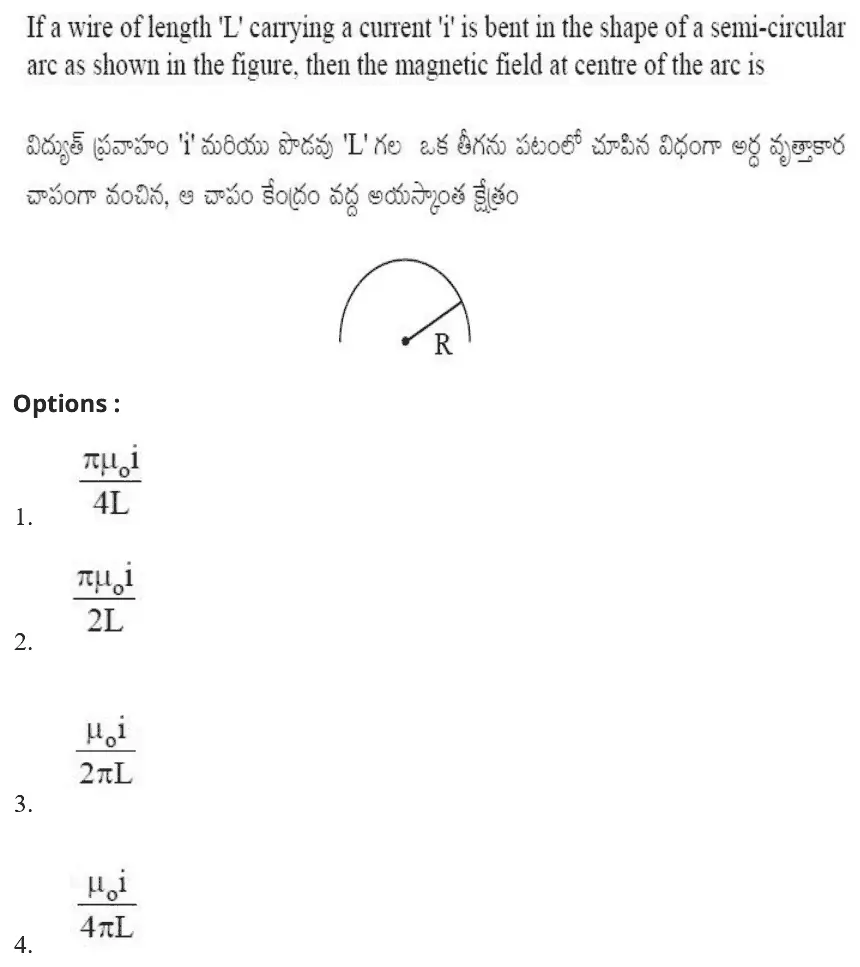
$\frac{\pi \mu_o i}{4L}$
$\frac{\pi \mu_o i}{2L}$
$\frac{\mu_o i}{2\pi L}$
$\frac{\mu_o i}{4\pi L}$
If a current of 15 A passes through a solenoid of length 25 cm, radius 2 cm and number of turns 500, then the magnetic moment of the solenoid is
$6\ \mathrm{J\,T^{-1}}$
$3\ \mathrm{J\,T^{-1}}$
$3\pi\ \mathrm{J\,T^{-1}}$
$6\pi\ \mathrm{J\,T^{-1}}$
The maximum magnetic field produced by a current of 12 A passing through a copper wire of diameter 1.2 mm is
2 mT
4 mT
1.5 mT
8 mT
Two moving coil galvanometers A and B having identical springs are placed in magnetic fields of $0.25\ \mathrm{T}$ and $0.5\ \mathrm{T}$ respectively. If the number of turns in A and B are repsectively 36 and 48, and the areas of the coils A and B are $2.4 \times 10^{-3}\ \mathrm{m^2}$ and $4.8 \times 10^{-3}\ \mathrm{m^2}$ respectively, then the ratio of the current sensitivities of the galvanometers A and B is
$3 : 16$
$16 : 3$
$4 : 3$
$3 : 4$
The magnetic field at the centre of a long solenoid having 400 turns per unit length and carrying a current 'i' is $6.24 \times 10^{-2}$ T. The magnetic field at the centre of another long solenoid having 200 turns per unit length and carrying a current $\frac{'i'}{2}$ is
$1.56\times10^{-2}$ T
$2.4\times10^{-2}$ T
$26\times10^{-2}$ T
$2.6\times10^{-2}$ T
If a proton of kinetic energy 8.35 MeV enters a uniform magnetic field of 10 T at right angles to the direction of the field, then the force acting on the proton is (Mass of proton $=1.67\times10^{-27}$ kg and charge of proton $=1.6\times10^{-19}$ C)
$48\times10^{-12}$ N
$16\times10^{-12}$ N
$64\times10^{-12}$ N
$32\times10^{-12}$ N
Two charged particles of specific charges in the ratio $2 : 1$ and masses in the ratio $1 : 4$ moving with same kinetic energy enter a uniform magnetic field at right angles to the direction of the field. The ratio of the radii of the circular paths in which the particles move under the influence of the magnetic field is
$2 : 1$
$1 : 1$
$4 : 1$
$8 : 1$
If a charged particle enters a uniform magnetic field normally with certain velocity, then the time period of revolution of the particle
decreases with increase of velocity of the particle
increases with increase of radius of the orbit
increases with increase of magnetic field
decreases with increase of specific charge of the particle
A long straight wire of circular cross-section of radius ‘a’ is carrying a steady current. The current is distributed uniformly across the cross-section of the wire. The ratio of the magnetic fields at points 0.5a and 1.5a from the centre of the wire is
$1:1$
$2:3$
$1:2$
$3:4$
The magnetic moment of an electron moving in a circular orbit of radius R with a time period T is
$\frac{2\pi Re}{T}$
$\frac{\pi eR}{T}$
$\frac{\pi eR^{2}}{T}$
$\pi R^{2}eT$
A solenoid of one meter length and 3.55 cm inner diameter carries a current of 5 A. If the solenoid consists of five closely packed layers each with 700 turns along its length, then the magnetic field at its centre is
22 mT
35 mT
44 mT
15 mT
The force per unit length on a straight wire carrying current of 8 A making an angle of $30^\circ$ with a uniform magnetic field of 0.15 T is
$1.2\ \mathrm{N\,m^{-1}}$
$1.02\ \mathrm{N\,m^{-1}}$
$0.6\ \mathrm{N\,m^{-1}}$
$2.4\ \mathrm{N\,m^{-1}}$
A wire of length 10 m carrying current of 1 A is bent in to a circular loop. If a magnetic field of $2\pi\times10^{-4}$ T is applied on the loop, then the maximum torque acting on it is
$100\times10^{-4}$ N m
$50\times10^{-4}$ N m
$25\times10^{-4}$ N m
$75\times10^{-4}$ N m
In a wire of radius 1 mm, a steady current of 2 A uniformly distributed across the cross-section of the wire is flowing. Then the magnetic field at a point 0.25 mm from the centre of the wire is
$100\ \mu\mathrm{T}$
$200\ \mu\mathrm{T}$
$300\ \mu\mathrm{T}$
$400\ \mu\mathrm{T}$
The magnetic field at the centre of a current carrying circular coil of radius R is $B_c$ and the magnetic field at a point on its axis at a distance R from its centre is $B_a$. The value of $\frac{B_c}{B_a}$ is
$\sqrt{2}$
$\frac{1}{2\sqrt{2}}$
$2\sqrt{2}$
$\frac{1}{\sqrt{2}}$
The magnetic field at a distance of 10 cm from a long straight thin wire carrying a current of 4 A is
$6\ \mu\mathrm{T}$
$16\ \mu\mathrm{T}$
$8\ \mu\mathrm{T}$
$4\ \mu\mathrm{T}$
A velocity selector is to be constructed to select ions with a velocity of $6\ \mathrm{km\ s^{-1}}$. If the electric field used is $400\ \mathrm{V\ m^{-1}}$, then the magnetic field to be used is
$\frac{11}{20}\ \mathrm{T}$
$\frac{2}{3}\ \mathrm{T}$
$\frac{1}{15}\ \mathrm{T}$
$\frac{2}{15}\ \mathrm{T}$
A closely wound solenoid of 1200 turns and area of cross-section $5\ \mathrm{cm^2}$ carries a current. If the magnetic moment of the solenoid is $1.2\ \mathrm{J\,T^{-1}}$, then the current through the solenoid is
$2.5\ \mathrm{A}$
$2\ \mathrm{A}$
$3\ \mathrm{A}$
$1.5\ \mathrm{A}$
If a straight current carrying wire of linear density $0.12\ \mathrm{kg\ m^{-1}}$ is suspended in mid air by a uniform horizontal magnetic field of $0.5\ \mathrm{T}$ normal to the length of the wire, then the current through the wire is
(Acceleration due to gravity $= 10\ \mathrm{m\ s^{-2}}$; Neglect earth's magnetic field)
$2.4\ \mathrm{A}$
$1.2\ \mathrm{A}$
$0.6\ \mathrm{A}$
$4.8\ \mathrm{A}$
Two concentric loops A and B of same radius $2\pi$ cm are placed at right angles to each other. If the currents flowing through A and B are 3 A and 4 A respectively, then the net magnetic field at their common centre is
$0.75 \times 10^{-5}$ T
$25 \times 10^{-5}$ T
$5 \times 10^{-5}$ T
$2.5 \times 10^{-5}$ T
The number of turns of two circular coils A and B are 300 and 200 respectively. The magnetic moments of the two coils A and B are in the ratio $1:2$. If the two coils carry equal currents, then the ratio of radii of coils A and B is
$2:\sqrt{3}$
$2:3$
$1:2$
$1:\sqrt{3}$
Two long straight parallel wires carry currents of 8 A and 10 A in opposite directions. If the distance of separation between the wires is 9 cm, then the net magnetic field at a point between the two wires, which is at a perpendicular distance of 4 cm from the wire carrying 8 A current is
Zero
$4\times10^{-5}$ T
$8\times10^{-5}$ T
$12\times10^{-5}$ T
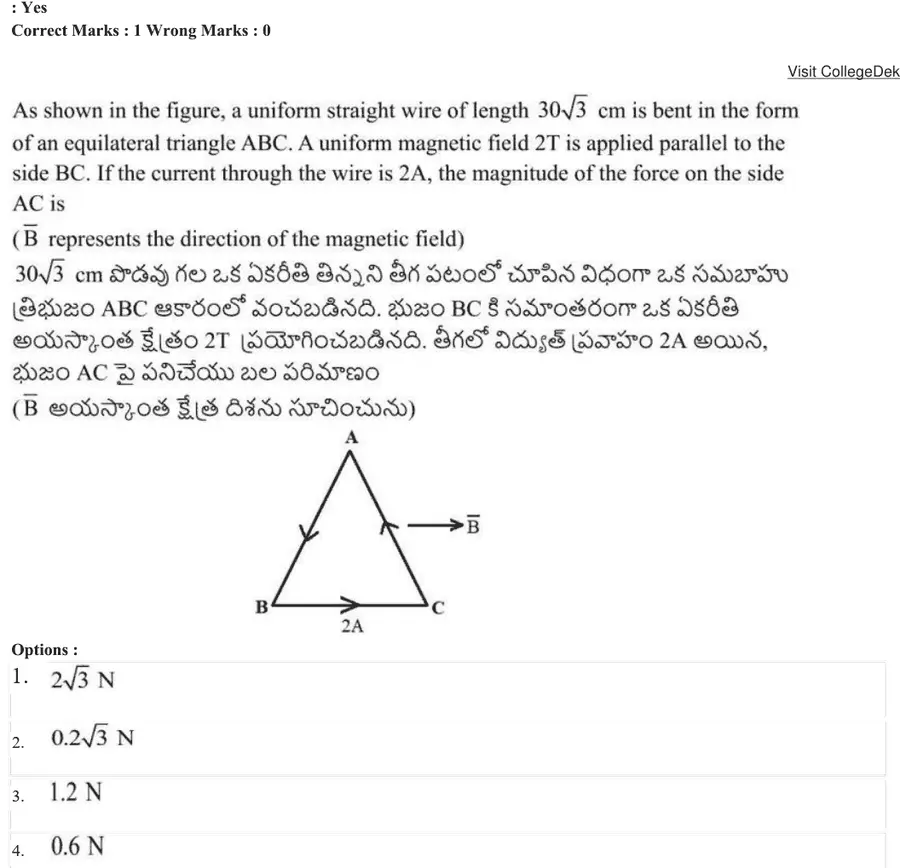
As shown in the figure, a uniform straight wire of length $30\sqrt{3}$ cm is bent in the form of an equilateral triangle ABC. A uniform magnetic field 2T is applied parallel to the side BC. If the current through the wire is 2A, the magnitude of the force on the side AC is
($\overline{\mathrm{B}}$ represents the direction of the magnetic field)
(see the figure above)
$2\sqrt{3}$ N
$0.2\sqrt{3}$ N
1.2 N
0.6 N
A proton moving with a velocity of $8\times10^{5}\ \mathrm{ms^{-1}}$ enters a uniform magnetic field normal to the direction of the magnetic field. If the radius of the circular path of the proton in the magnetic field is 8.3 cm, then the magnitude of the magnetic field is
(Charge of proton $=1.6\times10^{-19}\ \mathrm{C}$ and mass of the proton $=1.66\times10^{-27}\ \mathrm{kg}$)
500 mT
100 mT
200 mT
400 mT
The magnetic field due to a current carrying circular coil on its axis at a distance of $\sqrt{2}$ d from the centre of the coil is B. If d is the diameter of the coil, then the magnetic field at the centre of the coil is
18B
27B
3B
9B
A square coil of side 10 cm having 200 turns is placed in a uniform magnetic field of 2 T such that the plane of the coil is in the direction of magnetic field. If the current through the coil is 3 mA, then the torque acting on the coil is
$12\times10^{-3}$ Nm
$24\times10^{-3}$ Nm
$6\times10^{-3}$ Nm
Zero
An alpha particle moving with certain speed towards east enters a uniform magnetic field directed vertically up. The alpha particle will then move in
vertical circular path with the same speed
horizontal circular path with the same speed
vertical circular path with increased speed
vertical circular path with decreased speed
The ratios of the voltage sensitivities, resistances and areas of the coils of two moving coil galvanometers A and B are 4:3, 3:4 and 1:2 respectively. If the number of turns of the coil of galvanometer A is 200, then the number of turns of the coil of galvanometer B is
(All other quantities remain same in both the cases)
100
150
200
400
A solenoid of 1000 turns per metre has a core of material with relative permeability 400. The windings of the solenoid are insulated from the core and a current of 2 A is passed through the solenoid. Then the value of the magnetic intensity inside the solenoid is
$2\times10^{3}\ \mathrm{Am^{-1}}$
$1.0\ \mathrm{Am^{-1}}$
$8\times10^{5}\ \mathrm{Am^{-1}}$
$794\ \mathrm{Am^{-1}}$
A proton and an alpha particle moving with equal speeds enter normally into a uniform magnetic field. The ratio of times taken by the proton and the alpha particle to make one complete revolution in the magnetic field is
$1:\sqrt{2}$
$1:2$
$\sqrt{2}:1$
$2:1$
A solenoid of length 50 cm and radius 10 cm has two closely wound layers of windings 100 turns each. If a current of 2.5 A is passing through the windings, the magnetic field (in $10^{-4}$ T) at a point 5 cm from the axis is
$2\pi$
31.4
$4\pi$
Zero
Two identical wires, carrying equal currents are bent into circular coils A and B with 2 and 3 turns respectively. The ratio of the magnetic fields at the centres of the coils A and B is
$4:9$
$2:3$
$9:4$
$3:2$
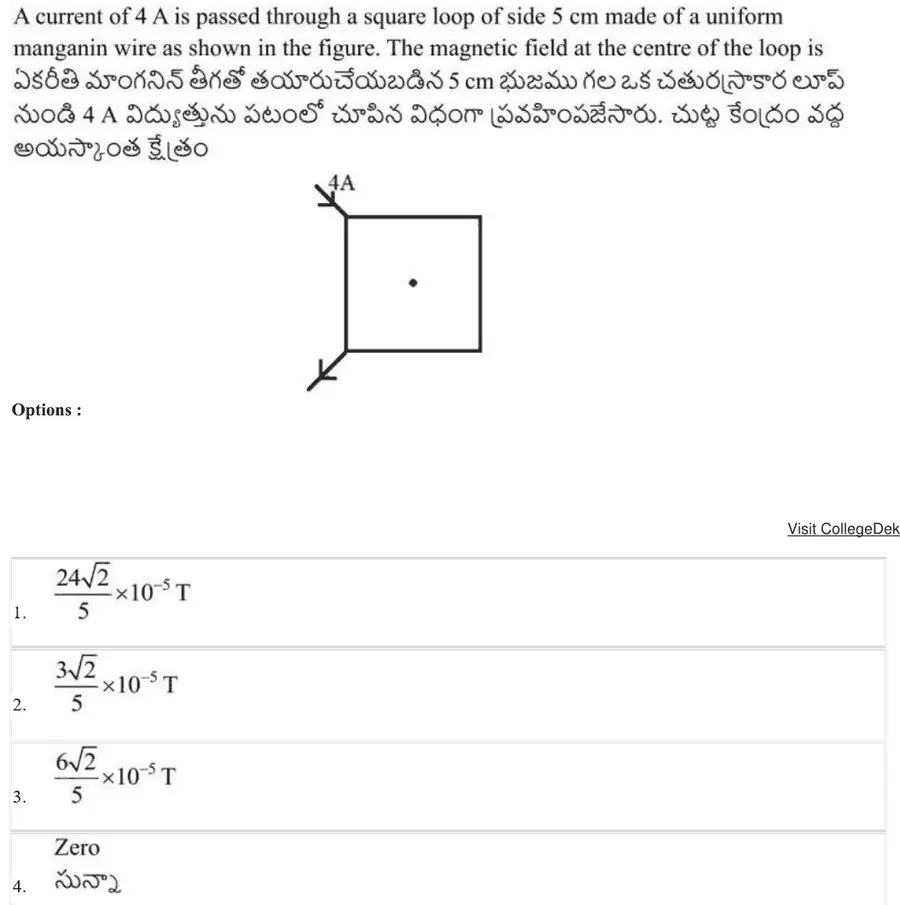
A current of 4 A is passed through a square loop of side 5 cm made of a uniform manganin wire as shown in the figure. The magnetic field at the centre of the loop is
(see the figure above)
$\frac{24\sqrt{2}}{5}\times 10^{-5}\ \mathrm{T}$
$\frac{3\sqrt{2}}{5}\times 10^{-5}\ \mathrm{T}$
$\frac{6\sqrt{2}}{5}\times 10^{-5}\ \mathrm{T}$
Zero
A charge 'q' is spread uniformly over an isolated ring of radius 'R'. The ring is rotated about its natural axis with angular speed 'ω'. The magnetic dipole moment of the ring is
$\frac{q\omega R}{2}$
$q\omega R^2$
$\frac{q\omega R^2}{2}$
$\frac{q\omega}{2R}$
Current sensitivities of two galvanometers $G_1$ and $G_2$ of resistances $100\ \Omega$ and $50\ \Omega$ are $10^8$ div/A and $0.5 \times 10^5$ div/A respectively. The galvanometer in which the voltage sensitivity is more is
Same in both galvanometers
More in $G_2$
Zero
More in $G_1$
Two toroids with number of turns 400 and 200 have average radii respectively 30 cm and 60 cm. If they carry the same current, the ratio of magnetic fields in these two toroids is
$2:1$
$1:4$
$2:3$
$4:1$
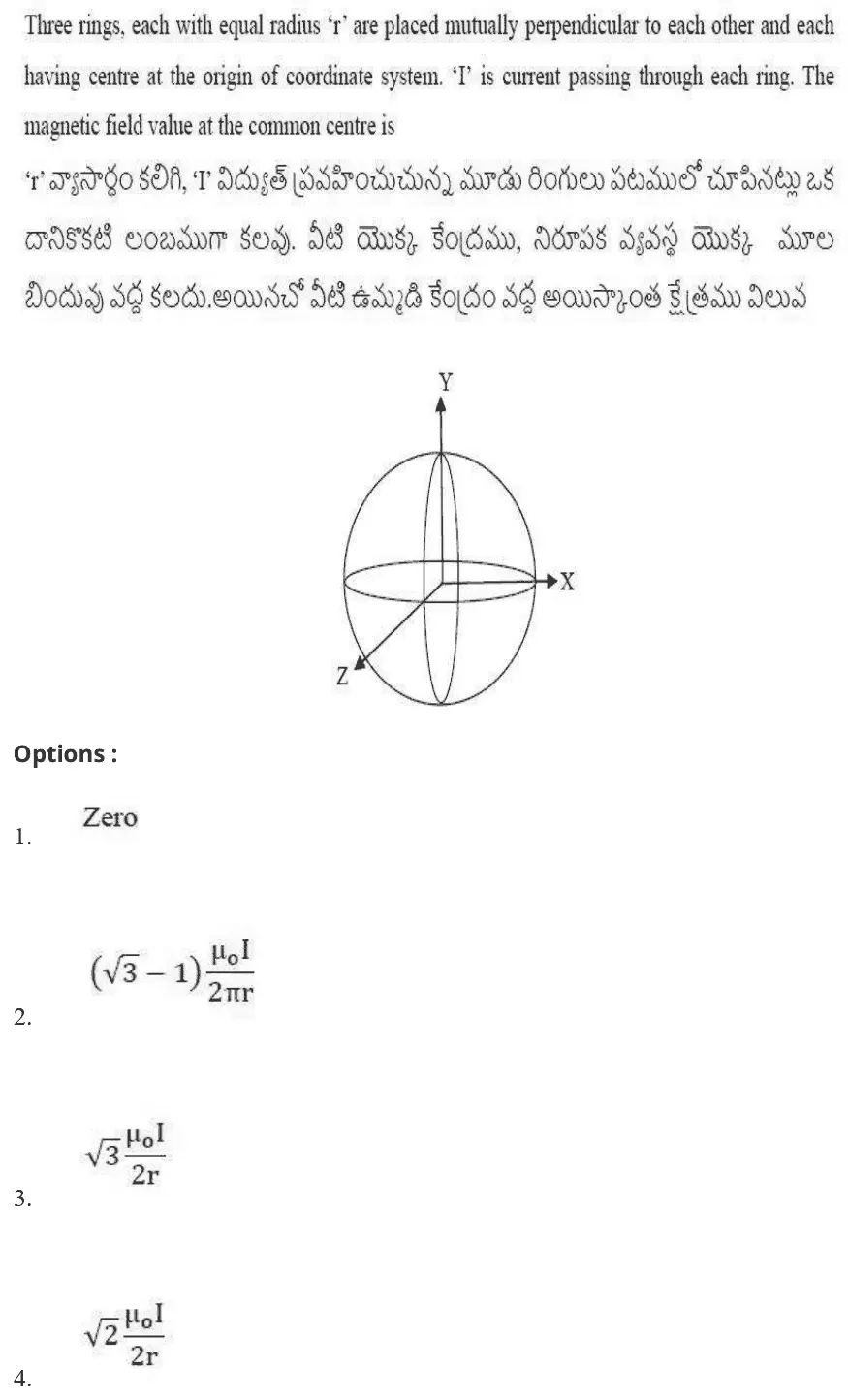
Three rings, each with equal radius 'r' are placed mutually perpendicular to each other and each having centre at the origin of coordinate system. 'I' is current passing through each ring. The magnetic field value at the common centre is
(see the figure above)
Zero
$(\sqrt{3}-1)\dfrac{\mu_0 I}{2\pi r}$
$\sqrt{3}\,\dfrac{\mu_0 I}{2r}$
$\sqrt{2}\,\dfrac{\mu_0 I}{2r}$
Current flows in a conductor from east to west. The direction of the magnetic field at a point below the conductor is towards
North
South
East
West
Two infinite length wires carry currents $8$ A and $6$ A respectively and are placed along $X$ and $Y$ axes respectively. Magnetic field at a point $P\,(0,0,d)$ will be
$\dfrac{7\,\mu_0}{\pi d}$
$\dfrac{10\,\mu_0}{\pi d}$
$\dfrac{14\,\mu_0}{\pi d}$
$\dfrac{5\,\mu_0}{\pi d}$
When an electron placed in a uniform magnetic field is accelerated from rest through a potential difference $V_1$, it experiences a force F. If the potential difference is changed to $V_2$, the force experienced by the electron in same magnetic field is 2F, then the ratio of potential differences $V_2/V_1$ is
$2:1$
$1:4$
$4:1$
$1:2$
A rectangular loop of sides 25 cm and 10 cm carrying a current of 10 A is placed with its longer side parallel to a long straight conductor 10 cm apart carrying current 25 A. The net force on the loop is
$6.25 \times 10^{-5}$ N
$5.5 \times 10^{-5}$ N
$3.75 \times 10^{-5}$ N
$8.75 \times 10^{-11}$ N
A proton and an alpha particle moving with energies in the ratio $1:4$ enter a uniform magnetic field of $3T$ at right angles to the direction of magnetic field. The ratio of the magnetic forces acting on the proton and the alpha particle is
$1:2$
$1:4$
$2:3$
$1:3$
A charged particle moving along a straight line path enters a uniform magnetic field of 4 mT at right angles to the direction of the magnetic field. If the specific charge of the charged particle is $8 \times 10^{7}\,\mathrm{C\,kg^{-1}}$, the angular velocity of the particle in the magnetic field is
$64 \times 10^{4}\ \mathrm{rad\,s^{-1}}$
$32 \times 10^{4}\ \mathrm{rad\,s^{-1}}$
$16 \times 10^{4}\ \mathrm{rad\,s^{-1}}$
$48 \times 10^{4}\ \mathrm{rad\,s^{-1}}$
In hydrogen atom an electron is making $6.6 \times 10^{15}$ rev/s around the nucleus of radius 0.47 Å. The magnetic field induction produced at the centre of the orbit is nearly
$0.14\ wb\ m^{-2}$
$1.4\ wb\ m^{-2}$
$14\ wb\ m^{-2}$
$140\ wb\ m^{-2}$
Two long straight parallel conductors A and B carrying currents 4.5 A and 8 A respectively are separated by 25 cm in air. The resultant magnetic field at a point which is at a distance of 15 cm from conductor A and 20 cm from conductor B is
$2 \times 10^{-5}$ N
$2 \times 10^{-4}$ N
$10^{-5}$ N
$10^{-4}$ N
Two concentric thin circular rings of radii 50 cm and 40 cm, each carry a current of 3.5 A in opposite directions. If the two rings are coplanar, the net magnetic field due to the two rings at their centre is
$11 \times 10^{-7}\ \mathrm{T}$
$22 \times 10^{-7}\ \mathrm{T}$
$17 \times 10^{-7}\ \mathrm{T}$
$8 \times 10^{-7}\ \mathrm{T}$
A wire shaped in a regular hexagon of side 2 cm carries a current of 4 A. The magnetic field at the centre of hexagon is.
(see the figure above)
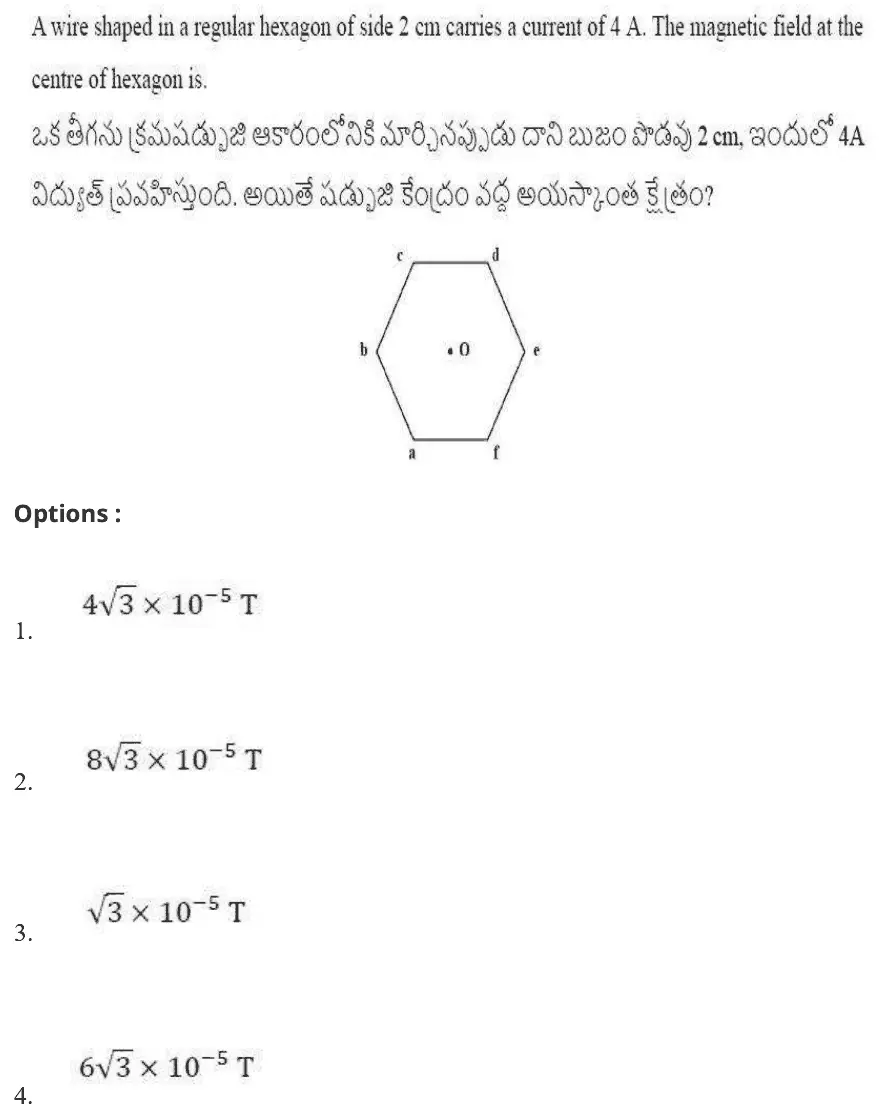
$4\sqrt{3}\times 10^{-5}\ \mathrm{T}$
$8\sqrt{3}\times 10^{-5}\ \mathrm{T}$
$\sqrt{3}\times 10^{-5}\ \mathrm{T}$
$6\sqrt{3}\times 10^{-5}\ \mathrm{T}$
A tightly wound coil of 200 turns and of radius 20 cm carrying current 5 A. Magnetic field at the centre of the coil is
$3.14 \times 10^{-3}$ T
$3.14 \times 10^{-2}$ T
$6.28 \times 10^{-4}$ T
$6.28 \times 10^{-3}$ T
A current carrying coil experiences a torque due to a magnetic field. The value of the torque is 80 % of the maximum possible torque. The angle between the magnetic field and the normal to the plane of the coil is
$30^\circ$
$45^\circ$
$\mathrm{Tan}^{-1}\left(\frac{3}{4}\right)$
$\mathrm{Tan}^{-1}\left(\frac{4}{3}\right)$
An electron is moving with a velocity $(2\bar{i} + 3\bar{j})\ \mathrm{ms^{-1}}$ in an electric field $(3\bar{i} + 6\bar{j} + 2\bar{k})\ \mathrm{Vs^{-1}}$ and a magnetic field $(2\bar{j} + 3\bar{k})\ \mathrm{T}$. Then the magnitude and direction (with x-axis) of the Lorentz force acting on the electron is
$9.6 \times 10^{-19}\ \mathrm{N}$, $\theta = \cos^{-1}\left(\frac{2}{\sqrt{5}}\right)$
$9.6 \times 10^{-19}\ \mathrm{N}$, $\theta = \cos^{-1}\left(\frac{5}{\sqrt{2}}\right)$
$2.15 \times 10^{-18}\ \mathrm{N}$, $\theta = \cos^{-1}\left(\frac{2}{\sqrt{5}}\right)$
$2.15 \times 10^{-18}\ \mathrm{N}$, $\theta = \cos^{-1}\left(\frac{5}{\sqrt{2}}\right)$
A magnetic field is applied in y-direction on an $\alpha$ -particle travelling along x-direction. The motion of the $\alpha$ -particle will be
along x-axis
a circle in xz plane
a circle in yz plane
a circle in xy plane
A straight wire carrying a current of $2\sqrt{2}$ A is making an angle of $45^\circ$ with the direction of uniform magnetic field of 3 T. The force per unit length on the wire due to the magnetic field is
$4\ \mathrm{Nm^{-1}}$
$8\ \mathrm{Nm^{-1}}$
$6\ \mathrm{Nm^{-1}}$
$3\ \mathrm{Nm^{-1}}$
A long straight rod of diameter 4 mm carries a steady current ‘i’. The current is uniformly distributed across its cross-section. The ratio of the magnetic fields at distances 1 mm and 4 mm from the axis of the rod is
$1:2$
$1:4$
$4:1$
$1:1$
A straight wire of length 20 cm carrying a current of $\frac{3}{\pi^2}$ A is bent in the form of a circle. The magnetic field at the centre of the circle is
$8\times10^{-6}$ T
$3\times10^{-6}$ T
$12\times10^{-6}$ T
$6\times10^{-6}$ T
An electron falling freely under the influence of gravity enters a uniform magnetic field directed towards south. The electron is initially deflected towards
east
west
north
south
Two long straight parallel wires A and B separated by 5 m carry currents 2 A and 6 A respectively in the same direction. The resultant magnetic field due to the two wires at a point of 2 m distance from the wire A in between the two wires is
$2\times10^{-6}$ T
$2\times10^{-7}$ T
$4\times10^{-7}$ T
$4\times10^{-6}$ T
A particle of charge 2 C is moving with a velocity of $\left|\left(3\hat{i}+4\hat{j}\right)\right|\ \mathrm{ms^{-1}}$ in the presence of magnetic and electric fields. If the magnetic field is $\left|\left(\hat{i}+2\hat{j}+3\hat{k}\right)\right|\ \mathrm{T}$ and the electric field is $\left|\left(-2\hat{k}\right)\right|\ \mathrm{NC^{-1}}$, then the Lorentz force on the particle is
50 N
20 N
30 N
40 N
A rectangular coil of 400 turns and $10^{-2}$ $\mathrm{m^2}$ area, carrying a current of 0.5 A is placed in a uniform magnetic field of 1 T such that the plane of the coil makes an angle of $60^\circ$ with the direction of the magnetic field. The initial moment of force acting on the coil in Nm is
$\sqrt{3}$
$\frac{1}{\sqrt{3}}$
$1$
$\frac{\sqrt{3}}{2}$
Two points A and B on the axis of a circular current loop are at distances of 4 cm and $3\sqrt{3}$ cm from the centre of the loop. If the ratio of the induced magnetic fields at points A and B is $216:125$, the radius of the loop is
3 cm
4 cm
5 cm
6 cm
Two charged particles A and B of masses m and 2m, charges 2q and 3q respectively moving with same velocity enter a uniform magnetic field such that both the particles make same angle ($<90^\circ$) with the direction of the magnetic field. Then the ratio of the pitches of the helical paths of the particles A and B is
$4:3$
$3:2$
$3:4$
$2:3$
Among the following, Ampere’s circuital law is represented by
$\oint B.dl = 0$
$\oint B.dl = \mu_0 I$
$\oint B.dl = \frac{\mu_0}{I}$
$\oint B.dl = \mu_0$
The radius of the path of an electron moving at a speed of $3.2 \times 10^{7}\ \mathrm{ms^{-1}}$ in a magnetic field of $6 \times 10^{-4}\ \mathrm{T}$ perpendicular to it is
(mass of electron is $9 \times 10^{-31}\ \mathrm{kg}$ and charge of electron is $1.6 \times 10^{-19}\ \mathrm{C}$)
22.4 cm
13 cm
30 cm
39 cm
For parallel conductors and steady currents, the results in accordance with Newton's third law are
Biot-Savart law and the Lorentz force
Biot-Savart law and Ampere's law
Ampere's law and the Lorentz force
Lenz's law and Lorentz force
Consider a tightly wound 100 turn coil of radius 10 cm carrying a current of 2A. The magnitude of the magnetic field at the centre of the coil is
$3.14 \times 10^{-4}$ T
$6.28 \times 10^{-4}$ T
$12.56 \times 10^{-4}$ T
0
If '$\mu$' is the magnetic moment of an electron revolving around hydrogen nucleus in an orbit of principal quantum number 'n', then
$\mu \propto n^2$
$\mu \propto n$
$\mu \propto \dfrac{1}{n}$
$\mu \propto \dfrac{1}{n^2}$
A cyclotron's oscillator frequency is 20 MHz. The operating magnetic field for accelerating protons is
(charge of proton = $1.6 \times 10^{-19}$ C, mass of proton = $1.67 \times 10^{-27}$ kg)
0.66 T
1.1 T
0.33 T
1.31 T
A straight wire carrying a current of 12 A is bent into a semi-circular arc of radius 2 cm as shown in the figure. Then the magnetic field due to the straight segments at the centre of the arc is
(see the figure above)
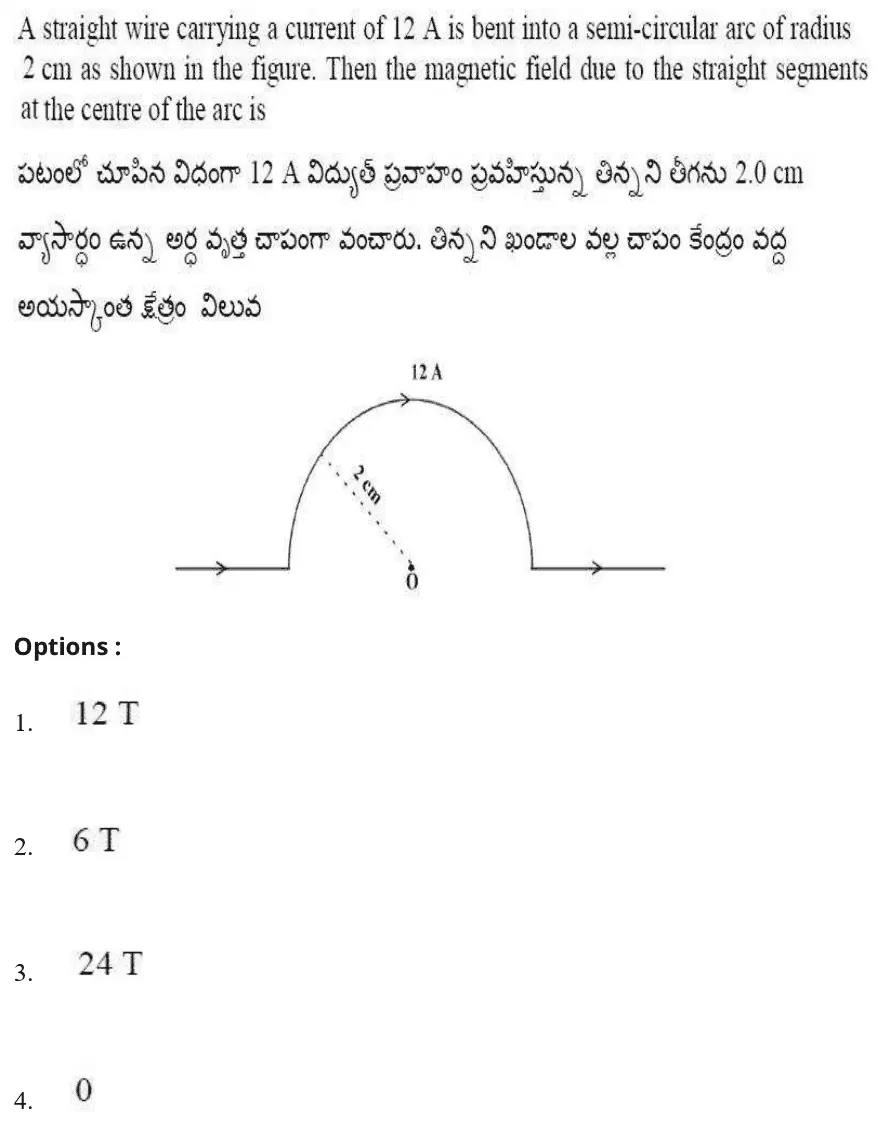
12 T
6 T
24 T
0
If ‘q’ is electric charge, B is magnetic field, ‘R’ is the dee radius and ‘m’ is the mass of ions, the kinetic energy of the ions in cyclotron is given by
$\frac{qBR}{2m}$
$\frac{qBR}{m}$
$\frac{q^2B^2R^2}{4\pi m}$
$\frac{q^2B^2R^2}{2m}$
A wire loop of irregular shape carrying current is placed in an external magnetic field. If the wire is flexible, the shape of the loop changes to
helical
circular
straight line
parabolic
The distance moved by a charged particle along the magnetic field (the component of velocity is parallel to the magnetic field) in one rotation is given by
( m – mass of the particle, v – velocity of the particle, q – charge of the particle, B – magnetic field)
$\frac{2\pi mv}{qB}$
$\frac{\pi mv}{qB}$
$\frac{4\pi mv}{qB}$
$\frac{2\pi mv}{qB^2}$
A charged particle when enters a uniform magnetic field moves in a helical path. If its angular velocity is $4\pi\times10^{6}$ rad s$^{-1}$ and its velocity in the direction of magnetic field is $3\times10^{5}$ ms$^{-1}$ then the pitch of the helix is
5 cm
10 cm
15 cm
20 cm
The force acting per unit length when a very long straight conductor is carrying a steady current of 1 A and the direction of the current is from south to north is
(The horizontal component of the earth's magnetic field at the place is $3\times10^{-5}$ T and the direction of the field is from the geographical south to geographical north.)
$3\times10^{-5}\ \mathrm{Nm^{-1}}$
$1\times10^{-5}\ \mathrm{Nm^{-1}}$
0
$1.5\times10^{-5}\ \mathrm{Nm^{-1}}$
A circular coil of 30 turns and radius 8 cm carrying a current of 6 A is suspended vertically in a uniform horizontal magnetic field of magnitude 1.0 T. The field lines make an angle of $30^\circ$ with the normal of the coil. The magnitude of the counter torque that must be applied to prevent the coil from turning is
5.4 Nm
7.2 Nm
3.6 Nm
1.8 Nm
A galvanometer has a deflection of 25 divisions for a current of 0.1 A flowing through it. Then the current sensitivity of the galvanometer is
25 div/A
250 div/A
2.5 div/A
0.25 div/A
A magnetic field intensity at the centre of a circular wire of radius 0.1 m carrying a current 0.2 A is
$2\pi \times 10^{-5}\,\mathrm{T}$
$\pi \times 10^{-7}\,\mathrm{T}$
$10^{-7}\,\mathrm{T}$
$4\pi \times 10^{-7}\,\mathrm{T}$
A wire is first bent in the form of a circular coil of 5 turns and the same wire is then bent in the form of another circular coil of 10 turns. If same current is passed in both the coils, then the ratio of the magnetic fields at their centres is
1:8
1:1
1:2
1:4
A solenoid has a core of a material with relative permeability 400. The windings of the solenoid are insulated from the core and carry a current of 4 A. If the number of turns is 500 per metre, then the magnetizing field is
$2\pi \times 10^{3}\ \mathrm{Am^{-1}}$
$1 \times 10^{3}\ \mathrm{Am^{-1}}$
$4 \times 10^{3}\ \mathrm{Am^{-1}}$
$2 \times 10^{3}\ \mathrm{Am^{-1}}$
The magnetic force q [v x B] is
parallel to both v and B
perpendicular to v
perpendicular to both v and B
parallel to B
It is found that a non-zero current element is unable to produce any magnetic field at a particular point. Then the angle between the current element and the position vector of that point with respect to the current element is
must be $45^\circ$
may be $0^\circ$ or $180^\circ$
must be $90^\circ$
may be $30^\circ$ or $60^\circ$
Three long, straight, parallel wires carrying different currents are arranged as shown in the diagram. In the given arrangement, let the net force per unit length on the wire ‘C’ be $\vec{F}$. If the wire ‘B’ is removed without disturbing the other two wires, then the force per unit length on wire ‘A’ is
(see the figure above)
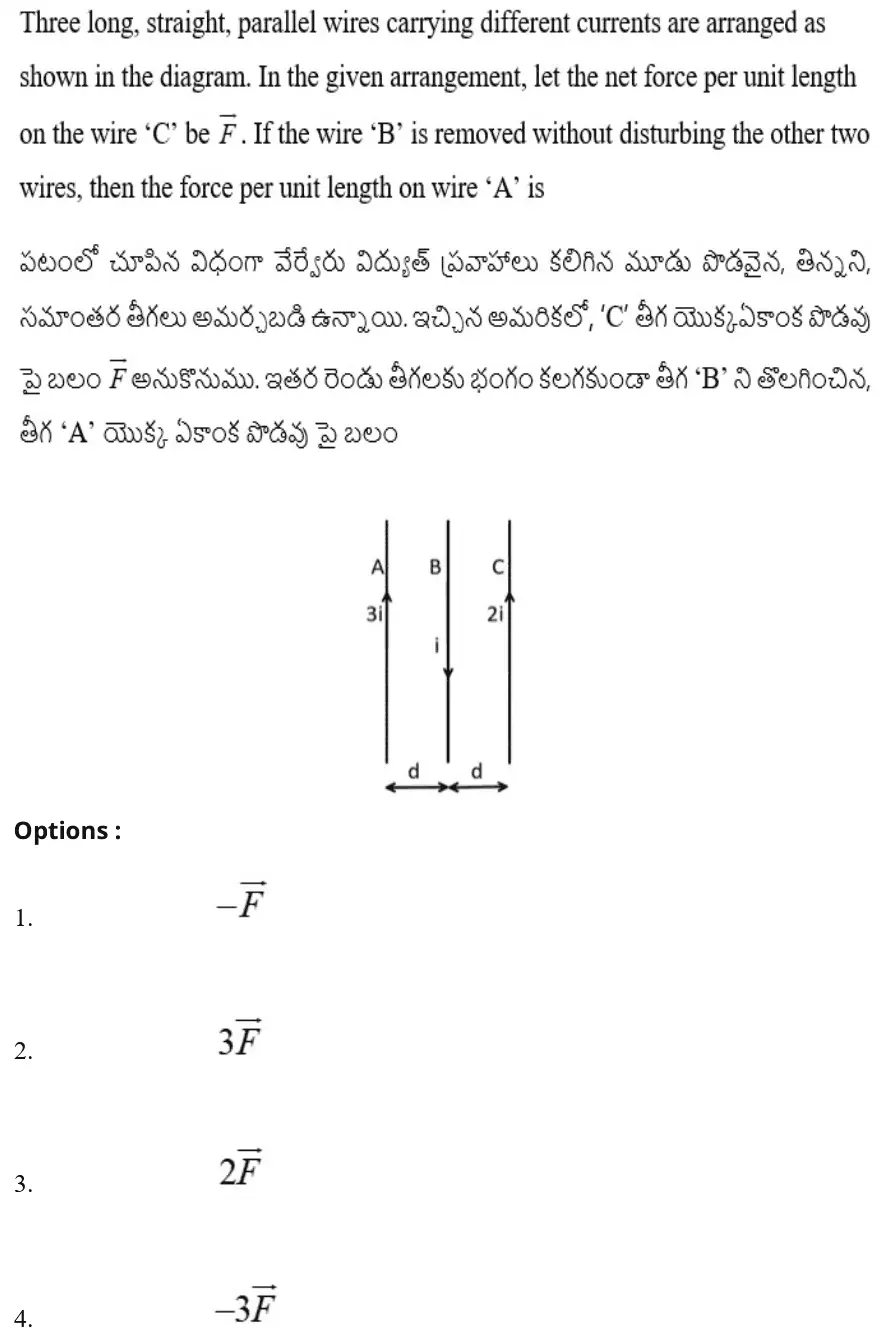
$-\vec{F}$
$3\vec{F}$
$2\vec{F}$
$-3\vec{F}$
A square loop of side ‘a’ and carrying a current ‘I’ is suspended from an insulating hanger of a spring balance as shown in the figure. The transverse magnetic field ‘B’ directed into the paper occurs only at the bottom side of the loop. When direction of current in the loop is reversed, the change in the reading of spring balance is
(see the figure above)
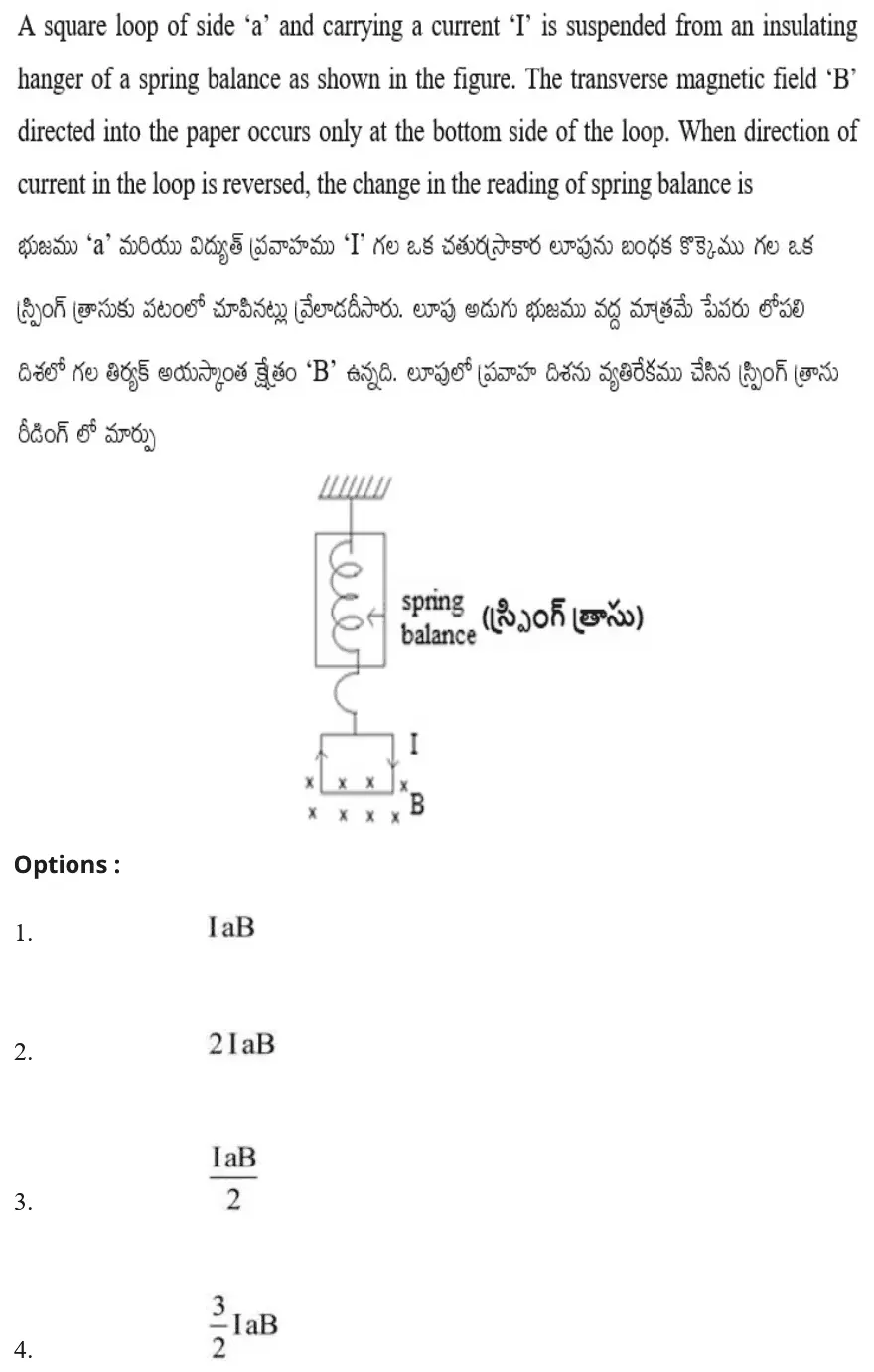
$IaB$
$2IaB$
$\frac{IaB}{2}$
$\frac{3}{2}IaB$
A current carrying loop is placed in a uniform magnetic field ‘B’ in different orientations I, II, III and IV as shown in the figure. The correct order of decreasing potential energy is
($\hat{n}$- unit vector normal to the plane of the loop)
(see the figure above)
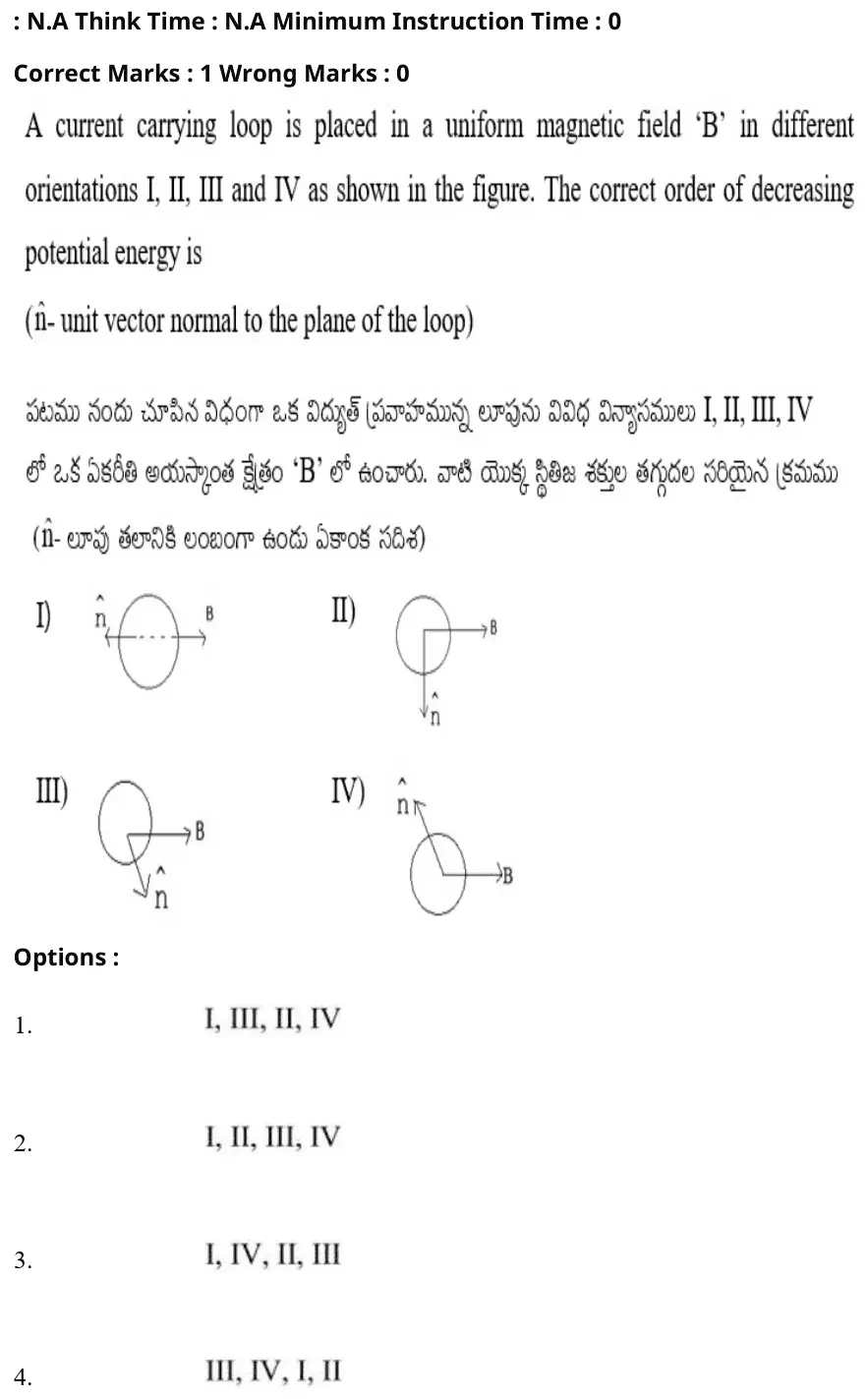
I, III, II, IV
I, II, III, IV
I, IV, II, III
III, IV, I, II
A current ‘i’ is flowing through a wire of length ‘L’. If it is made into a circular loop of one turn, then its magnetic moment is
$\frac{L^2 i}{4\pi}$
$\frac{L^2}{4\pi}$
$\frac{4\pi}{L^2 i}$
$4\pi L^2 i$
A charge 'q' moves with a velocity $2\ \mathrm{ms^{-1}}$ along x-axis in a uniform magnetic field $\vec{B}=(2\hat{i}+2\hat{j}+3\hat{k})\ \mathrm{T}$, then charge will experience a force
In y-z plane
Along – y axis
Along +z axis
Along -z axis
A current $i$ flows in an infinitely long, straight and thin walled pipe, then
the magnetic field at all the points inside the pipe is same, but not zero
the magnetic field at any point inside the pipe is zero
the magnetic field is zero only on the axis of the pipe
the magnetic field is different at different points inside the pipe
A closely wound solenoid of 80 cm long has 5 layers of windings of 400 turns each. The diameter of the solenoid is 1.8 cm. If the current carried is 8 A, then the magnitude of the magnetic field inside the solenoid near its centre is approximately
$1.5 \times 10^{-2}$ T
$2.5 \times 10^{-2}$ T
$3.5 \times 10^{-2}$ T
$4.5 \times 10^{-2}$ T
A conducting wire PQ carries a current 10 A as shown in the figure. It is placed in a uniform magnetic field 5 T which is acting normally outside from the paper. Then the net force experienced by it is
(see the figure above)
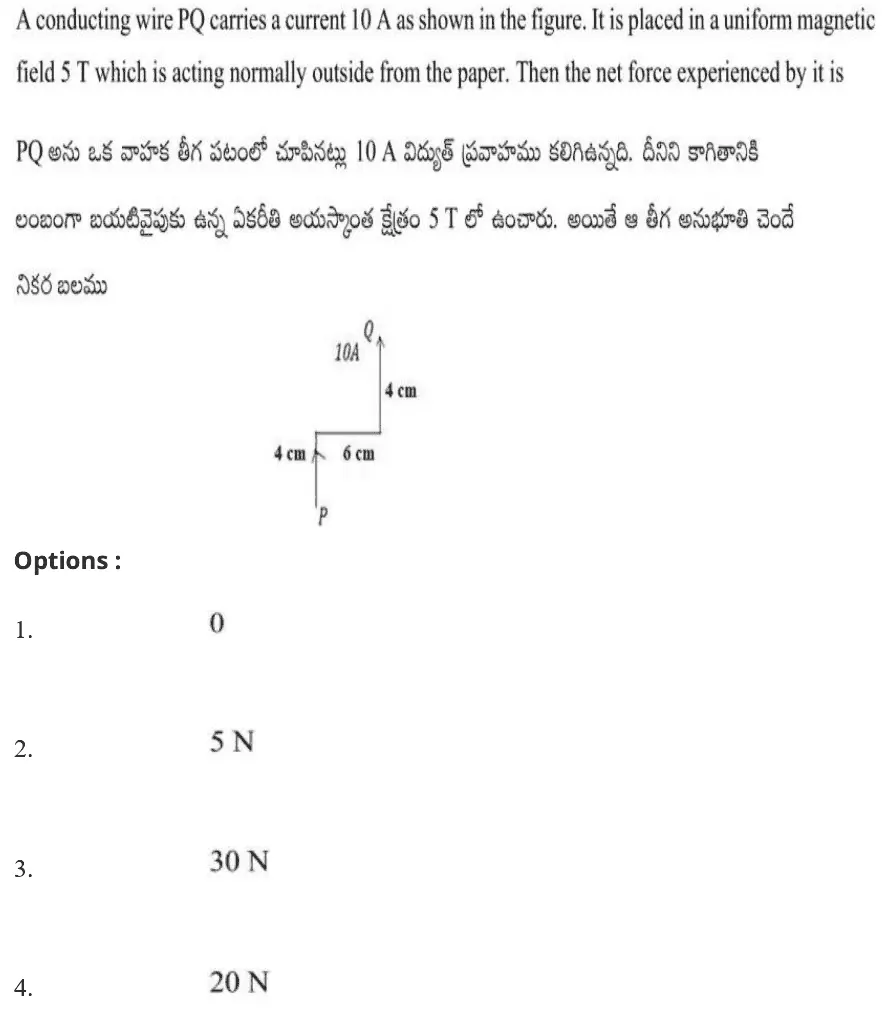
0
5 N
30 N
20 N
A long straight wire carries a current of 18 A. The magnitude of the magnetic field at a point 12 cm from it is
$1.5\times10^{-5}$ T
$2\times10^{-5}$ T
$3\times10^{-5}$ T
$1.8\times10^{-5}$ T
The magnetic field at a perpendicular distance of one metre from a wire carrying current of 1 A is
$2\times10^{-7}\ \mathrm{T}$
$2\times10^{-8}\ \mathrm{T}$
$2\times10^{-6}\ \mathrm{T}$
$2\times10^{-9}\ \mathrm{T}$
A circular coil of area $2\ \mathrm{cm^2}$ has 1000 turns. If the current through the coil is 1 A, then its magnetic moment is
$4\ \mathrm{Am^2}$
$0.2\ \mathrm{Am^2}$
$0.4\ \mathrm{Am^2}$
$2\ \mathrm{Am^2}$
A current carrying loop ABCD has two circular arcs AD and BC with radius 1 cm and 2 cm respectively as shown in the figure. The two arcs AD and BC subtend a common angle 30$^\circ$ at the centre O. If the current flowing in the loop is $\dfrac{1.2}{\pi}$ A ,then the magnitude of net magnetic field at O is (Given $\mu_0 = 4\pi \times 10^{-7}$ )
(see the figure above)
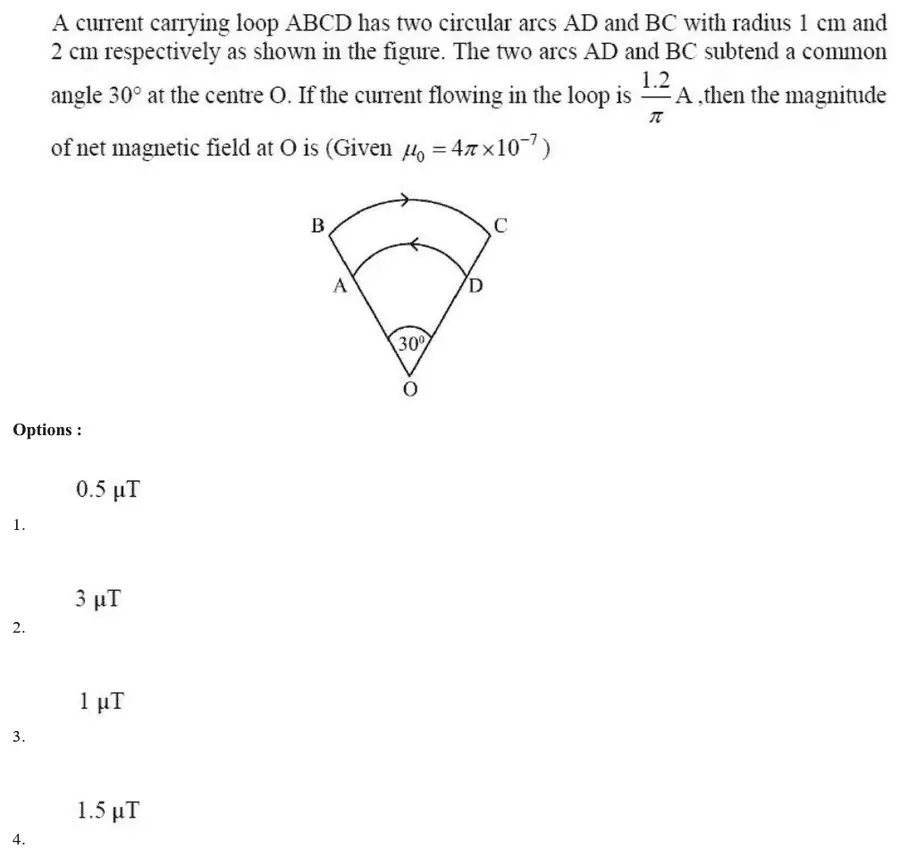
0.5 $\mu$T
3 $\mu$T
1 $\mu$T
1.5 $\mu$T
Three parallel wires a, b and c carrying currents $i_a, i_b$ and $i_c$ as shown in the figure are placed next to each other.
(see the figure above)
The magnitude force on a length $l$ of the wire a, if d$_2$=2d$_1$, i$_b$ = i$_a$ and i$_c$ = 4i$_a$ is
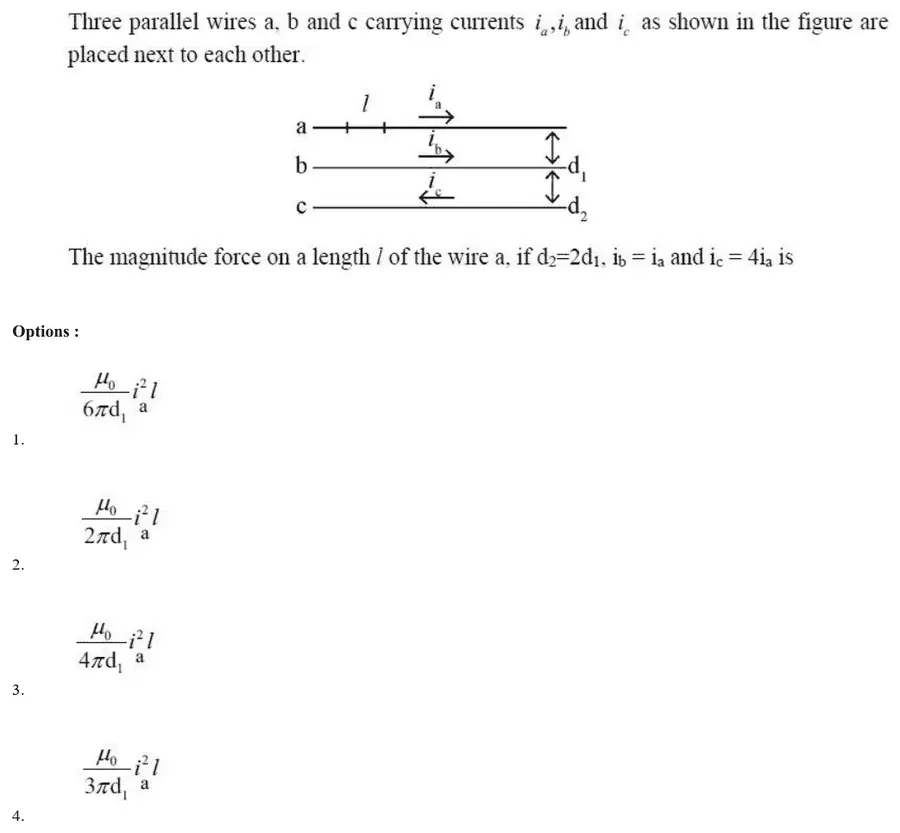
$\dfrac{\mu_0}{6\pi d_1} i_a^{2} l$
$\dfrac{\mu_0}{2\pi d_1} i_a^{2} l$
$\dfrac{\mu_0}{4\pi d_1} i_a^{2} l$
$\dfrac{\mu_0}{3\pi d_1} i_a^{2} l$
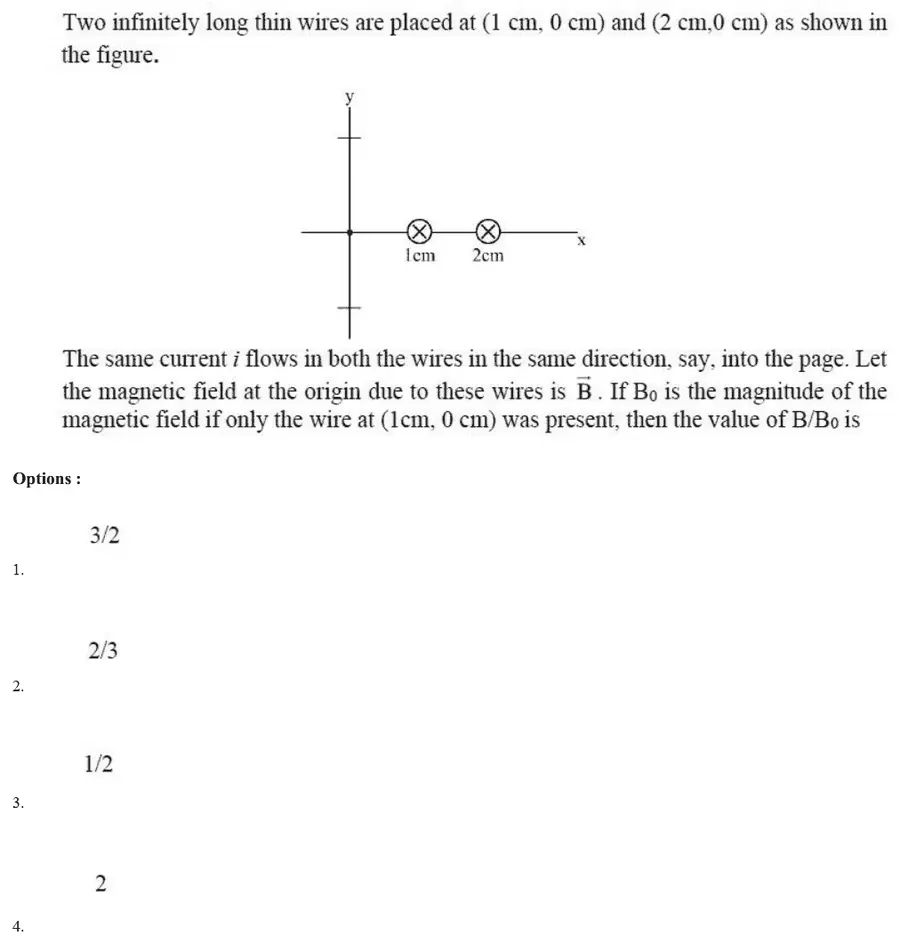
Two infinitely long thin wires are placed at (1 cm, 0 cm) and (2 cm,0 cm) as shown in the figure.
(see the figure above)
The same current $i$ flows in both the wires in the same direction, say, into the page. Let the magnetic field at the origin due to these wires is $\vec{B}$. If $B_0$ is the magnitude of the magnetic field if only the wire at (1cm, 0 cm) was present, then the value of $B/B_0$ is
3/2
2/3
1/2
2
A toroid core has inner radius of 0.24 m and outer radius of 0.26 m. A current of 10 A flows through the wire having 2500 turns around it. Find the magnetic field inside the core of the toroid.
$\pi\times10^{-2}\,\mathrm{T}$
$2\pi\times10^{-2}\,\mathrm{T}$
$2\times10^{-2}\,\mathrm{T}$
$20\times10^{-2}\,\mathrm{T}$
A long solenoid with 10.0 turn/cm and a radius of 8 cm carries a current of 7 mA. A current carrying straight conductor is located along the central axis of the solenoid. If the direction of resulting magnetic field is $60^\circ$ to axial direction at a point 5 cm from the axis of the solenoid along the radial direction, then the current in the conductor is
[Take $\sqrt{2}=1.4,\sqrt{3}=1.7$]
$3.41$ A
$4.21$ A
$3.74$ A
$4.5$ A
Statement I : A uniform electric field and a uniform magnetic field are pointed in the same direction. If an electron is projected in the same direction the electron velocity will decrease in magnitude.
Statement II : Two infinite long parallel wires are carrying current in the same direction. The magnetic field at a point midway between the wires is zero.
Statement III : No net force acts on a rectangular coil carrying a steady current when suspended in a uniform magnetic field.
Which of the following is correct?
Statements I, II, III are true
Statements I, II are true, but statement III is false
Statements II, III are true, but statement I is false
Statements I, II, III are false
Two parallel conductor each 50m long, separated by 0.2m experience a force of 1N. If the current in first conductor is twice that of the second conductor, then what is the current in the second conductor?
$\left(\mu_{o}=4\pi\times10^{-7}\right)$
100 A
200 A
120 A
50 A
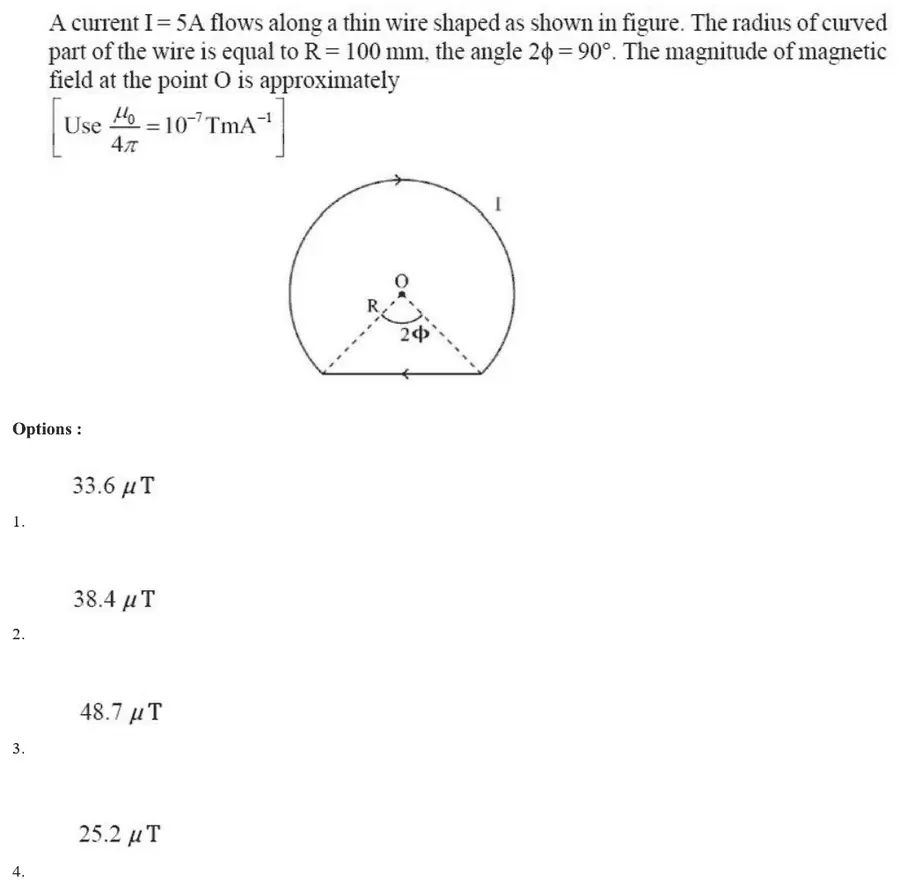
A current I = 5A flows along a thin wire shaped as shown in figure. The radius of curved part of the wire is equal to R = 100 mm, the angle $2\phi=90^{\circ}$. The magnitude of magnetic field at the point O is approximately
[Use $\dfrac{\mu_{0}}{4\pi}=10^{-7}\ \mathrm{TmA^{-1}}$]
(see the figure above)
$33.6\ \mu\mathrm{T}$
$38.4\ \mu\mathrm{T}$
$48.7\ \mu\mathrm{T}$
$25.2\ \mu\mathrm{T}$
A toroid has a core (non-ferro magnetic) of inner radius 24 cm and outer radius 26 cm around which 2000 turns of a wire is wound. If the current in the wire is 12 A, the magnetic field inside the core of the toroid is
$1.92\times10^{-2}\ \mathrm{T}$
$1.88\times10^{-2}\ \mathrm{T}$
$2.12\times10^{-2}\ \mathrm{T}$
$1.98\times10^{-2}\ \mathrm{T}$
A horizontal wire carries 160 A current below which another wire of linear density 10 g /m carrying a current is kept at 4 cm distance. If the wire is kept below hangs in air, what is the current in this wire when the direction of current in both the wires is same?
(g = 10 m/s$^{2}$ and $\mu_{0}=4\pi\times10^{-7}$)
125 A
140 A
110 A
100 A
A long solenoid has 70 turns/cm and carries current I. An electron moves within the solenoid in a circle of radius 2.5 cm perpendicular to the solenoid axis. If the speed of the electron is $4.4\times10^{6}$ m/s then the current I in the solenoid is
(Take $\mu_{0}=4\pi\times10^{-7}$ SI unit, mass of electron = $9\times10^{-31}$ kg, charge of electron = $1.6\times10^{-19}$ C )
98.5 mA
112.5 mA
125 mA
175.0 mA
A closely wound solenoid of length 1 m has 5 layers of 500 turns each. If the magnitude of magnetic field inside the solenoid near its centre is 4.4 mT, the current carried is
$1.4\ \mathrm{A}$
$1.5\ \mathrm{A}$
$1.6\ \mathrm{A}$
$1.8\ \mathrm{A}$
Two long wires carrying current is 8 A and 6 A along x axes and y axes respectively. The magnetic field at the point $(2\hat{i} + 4\hat{j})$ is
(Take $\mu_0 = 4\pi\times10^{-7}$ SI unit)
$1\times10^{-6}\ \mathrm{T}$
$2\times10^{-6}\ \mathrm{T}$
$1\times10^{-7}\ \mathrm{T}$
$2\times10^{-7}\ \mathrm{T}$
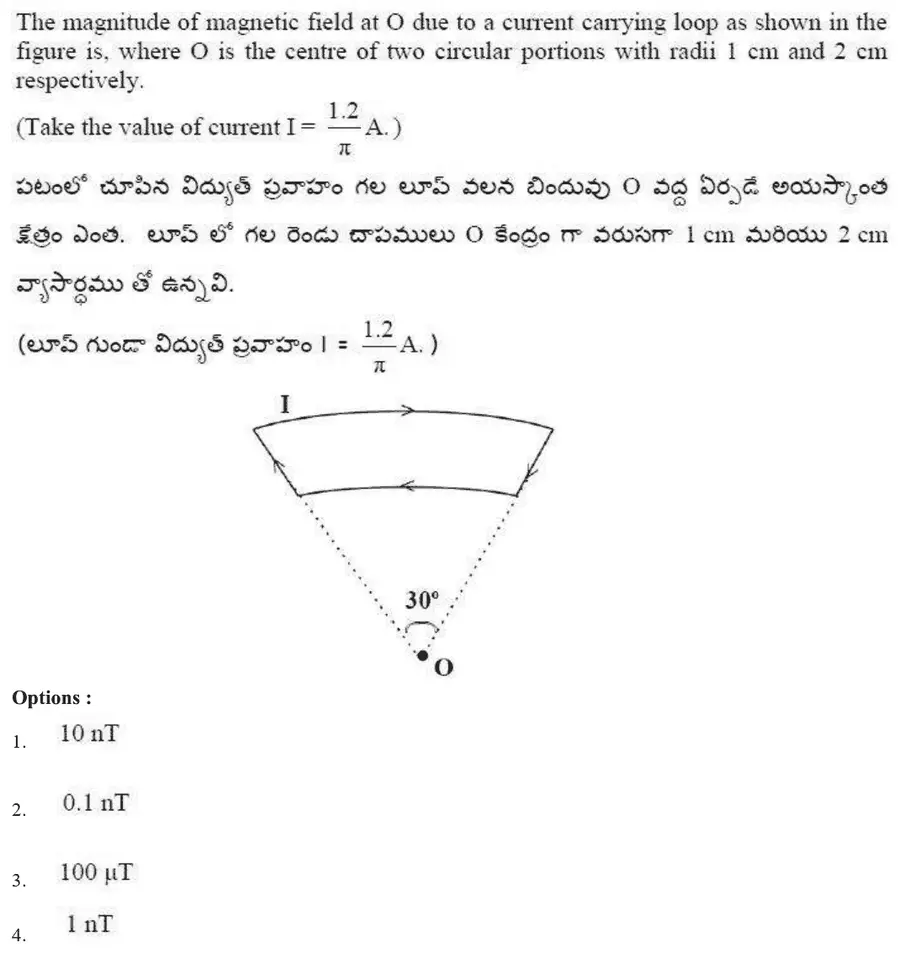
The magnitude of magnetic field at O due to a current carrying loop as shown in the figure is, where O is the centre of two circular portions with radii 1 cm and 2 cm respectively.
(Take the value of current $I = \dfrac{1.2}{\pi}$ A.)
(see the figure above)
$10\ \mathrm{nT}$
$0.1\ \mathrm{nT}$
$100\ \mu\mathrm{T}$
$1\ \mathrm{nT}$
A long wire lies along x-axis and carries a current of 40 A in positive x - direction. A second long wire is perpendicular to the xy plane, passes through point $(3.0\ \mathrm{m})\,\hat{j}$ and carries a current along positive z- direction. If the magnitude of resultant magnetic field at the point $(2.0\ \mathrm{m})\,\hat{j}$ is $5\times10^{-6}$ T, then the current in the second wire is
(Permeability of free space, $\mu_0 = 4\pi \times 10^{-7}$ SI unit)
$30\ \mathrm{A}$
$15\ \mathrm{A}$
$25\ \mathrm{A}$
$7.5\ \mathrm{A}$
A particle of charge $1.0 \times 10^{-16}$ C moves through a uniform magnetic field $\vec{B} = B_o(\hat{i} + 4\hat{j})$ T. The particle velocity at some instant is $\vec{V} = (2\hat{i} + 4\hat{j})\ \mathrm{m\,s^{-1}}$ and the magnetic force acting on it is $3 \times 10^{-16}\,\hat{k}$ N. The magnitude of $B_o$ is
$1.0$ T
$2.5$ T
$0.5$ T
$0.75$ T
The magnetic field due to current carrying circular loop of radius 6 cm at a point on the axis at a distance of 8 cm from centre is $27\ \mu\mathrm{T}$. The magnetic field at the centre of the current carrying loop is.
$75\ \mu\mathrm{T}$
$125\ \mu\mathrm{T}$
$150\ \mu\mathrm{T}$
$250\ \mu\mathrm{T}$
An infinitely long wire carrying 1 A current in the +Z direction is placed at (1 cm, 1 cm). Another wire carrying 1 A in +x direction is placed at y = 1 cm. If the magnetic field due to this configuration at the origin is $\vec{B}$. Let $B_o$ be the magnitude of the field if only the wire at (1 cm, 1 cm) was present, then $\frac{\vec{B}}{B_o}$ is
$\left(\frac{1}{\sqrt{2}}, -\frac{1}{\sqrt{2}}, -\sqrt{2}\right)$
$\left(\frac{1}{2}, \frac{1}{2}, -1\right)$
$\left(\sqrt{2}, \sqrt{2}, -\sqrt{2}\right)$
$\left(\frac{1}{2\sqrt{2}}, \frac{1}{2\sqrt{2}}, -\frac{1}{2}\right)$
An observer at rest experiences an electric field due to a static charge. Later he starts moving away from it then the observer experiences.
Only magnetic field
Only electric field
Electric and magnetic field
No field at all
Two long parallel straight metal wires A and B carrying currents 12 A and 36 A respectively, in the same direction are separated by 50 cm. The point relative to A, where the resultant magnetic induction between the two wires due to the currents is zero, will be
90 cm
7.5 cm
28 cm
12.5 cm
A long current carrying wire produces a magnetic field of 1 T at a distance of r. The magnetic field at (a) $\frac{r}{2}$ (b) 2r and (c) 3r is
(a) 2T, (b) $= \frac{1}{2}$ T, (c) $= \frac{1}{3}$ T
(a) 3T, (b) $= \frac{1}{3}$ T, (c) $= \frac{1}{6}$ T
(a) $\frac{3}{2}$ T, (b) $= \frac{1}{4}$ T, (c) $= \frac{1}{8}$ T
(a) $\frac{5}{2}$ T, (b) $= \frac{1}{2}$ T, (c) $= \frac{1}{3}$ T
Two infinitely long wires are placed at (1cm, 1cm) and (+1cm, $-$1cm) with 1A current in each and in the same directions perpendicular to x-y plane. Let the magnetic field due to these current carrying wires at the origin be $\vec{B}$. If $B_o$ is the magnitude of the field if only one of them was present, then $\dfrac{|\vec{B}|}{B_o}$ is
$\sqrt{2}$
$1$
$\dfrac{1}{\sqrt{2}}$
$\dfrac{1}{2\sqrt{2}}$
A particle of mass $1\times10^{-27}$ kg and charge $1\times10^{-16}$ C enters the uniform magnetic field within the solenoid, at speed $1000\ \mathrm{m\,s^{-1}}$. The velocity vector makes an angle $60^\circ$ with the axis of solenoid. The solenoid has 5000 turns along its length and carries current 5 A. The number of revolutions the particle makes along the helical path within the solenoid by the time it emerges from solenoid's opposite end is
$5\times10^{5}$
$1\times10^{6}$
$\pi\times10^{5}$
$3\times10^{6}$
An electron having kinetic energy of 100 eV circulates in a path of radius 10 cm in a magnetic field. The magnitude of magnetic field $|\vec{B}|$ is approximately [Mass of electron $= 0.5\ \mathrm{MeV\,C^{-2}}$, where C is the velocity of light].
$3.3\times10^{-4}\ \mathrm{T}$
$2.6\times10^{-4}\ \mathrm{T}$
$1.70\times10^{-4}\ \mathrm{T}$
$4.3\times10^{-4}\ \mathrm{T}$
A particle of mass $2.2\times10^{-30}$ kg and charge $1.6\times10^{-19}$ C is moving at a speed of $10\ \mathrm{km\,s^{-1}}$ in a circular path of radius 2.8 cm inside a solenoid. The solenoid has $25\ \frac{\mathrm{turns}}{\mathrm{cm}}$ and its magnetic field is perpendicular to the plane of the particle's path. The current in the solenoid is (Take $\mu_\circ = 4\pi\times10^{-7}\ \mathrm{H\,m^{-1}}$)
1.25 mA
10.20 mA
2.50 mA
1.56 mA
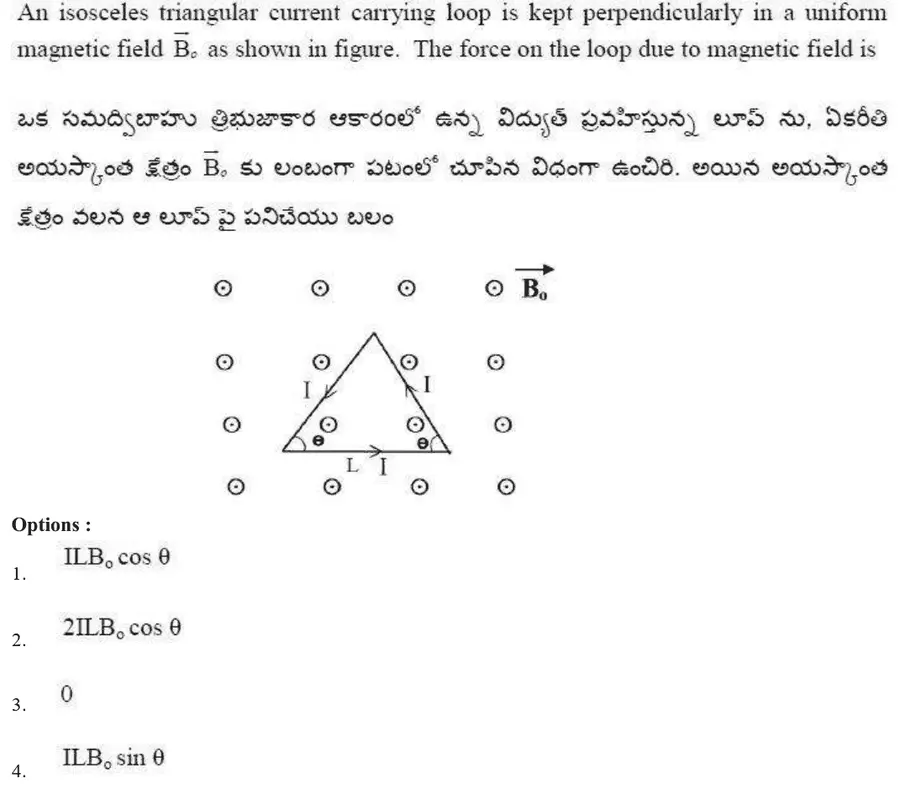
An isosceles triangular current carrying loop is kept perpendicularly in a uniform magnetic field $\vec{B}_o$ as shown in figure. The force on the loop due to magnetic field is
(see the figure above)
$ILB_o\cos\theta$
$2ILB_o\cos\theta$
$0$
$ILB_o\sin\theta$
A charged particle is moving in a uniform magnetic field penetrates a layer of lead and thereby loses half of its kinetic energy, then the radius of curvature of its path is
No change
Reduced by $\frac{1}{2}$ times of its initial values
Reduced to $\frac{1}{\sqrt{2}}$ times of its initial values
Reduce to $\frac{1}{4}$ times of its initial values
Two infinitely long wires each carrying the same current and pointing in +y direction are placed in the x y - plane, at x = $-$2 cm and x = 1 cm. An electron is fired with speed U from the origin making an angle of $+45°$ from the x - axis. The force on the electron at the instant it is fired is
[$B_o$ is the magnitude of the field at origin due to the wire at x= 1 cm alone].
$\dfrac{-eUB_o}{2\sqrt{2}}(\hat{i}-\hat{j})$
$\dfrac{-eUB_o}{2}(\hat{i}-\hat{j})$
$\dfrac{-eUB_o}{\sqrt{2}}(\hat{i}-\hat{j})$
$-eUB_o(\hat{i}-\hat{j})$
Two electrons, $e_1$ and $e_2$ of mass m and charge q are injected into the perpendicular direction of the magnetic field B such that the kinetic energy of $e_1$ is double than that of $e_2$. The relation of their frequencies of rotation, $f_1$ and $f_2$ is
$f_1 = f_2$
$f_1 = 2f_2$
$2f_1 = f_2$
$4f_1 = f_2$
A toroid has a non ferromagnetic core of inner radius 24 cm and outer radius 25 cm, around which 4900 turns of a wire are wound. If the current in the wire is 12 A, the magnetic field inside the core of the toroid is
$56$ mT
$54$ mT
$42$ mT
$48$ mT
Three long, straight and parallel wires carrying currents are arranged as shown in figure. The force experienced by 10 $cm$ length of wire 'Q' is ______
(see the figure above)
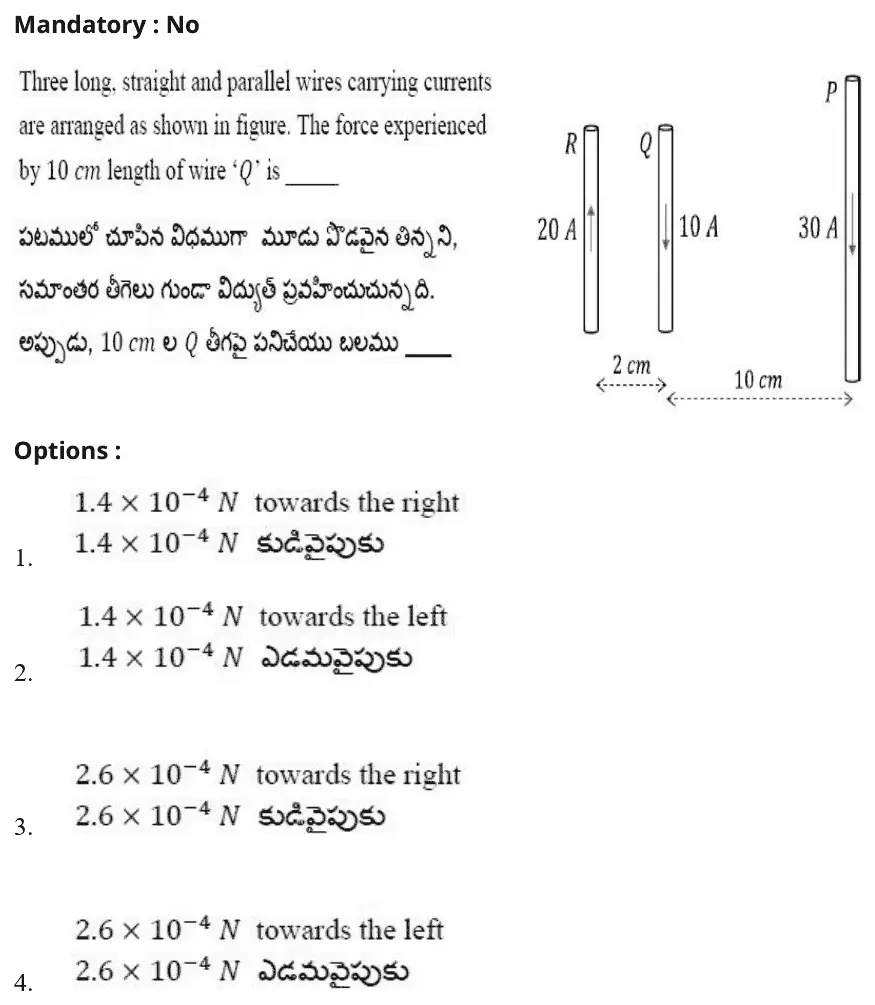
$1.4\times10^{-4}\ N$ towards the right
$1.4\times10^{-4}\ N$ towards the left
$2.6\times10^{-4}\ N$ towards the right
$2.6\times10^{-4}\ N$ towards the left
An electron having kinetic energy 'T' is moving in a circular orbit. If radius 'R' perpendicular to the uniform magnetic field in direction $\vec{B}$. If kinetic energy is doubled and magnetic field induction is tripled, the radius will become
$R\sqrt{\frac{9}{4}}$
$R\sqrt{\frac{3}{2}}$
$R\sqrt{\frac{2}{9}}$
$R\sqrt{\frac{4}{3}}$
A tangent galvanometer has a coil of 50 turns and a radius of 20 $cm$. The horizontal component of earth's magnetic field is $3\times10^{-5}\ T$. What will be the current which gives a deflection of 45°?
$\frac{3}{5\pi}\ A$
$\frac{5}{3\pi}\ A$
$\frac{3\pi}{5}\ A$
$\frac{5\pi}{3}\ A$
A coil wrapped around toroid has inner radius of $20\ \mathrm{cm}$ and an outer radius of $25\ \mathrm{cm}$. If the wire wrapping makes 800 turns and carries a current of $12\mathrm{A}$. The maximum and minimum values of the magnetic field with in the toroid are ______
$9.6\ \mathrm{mT},\ 7.68\ \mathrm{mT}$
$4\ \mathrm{mT},\ 2.5\ \mathrm{mT}$
$7\ \mathrm{mT},\ 5.6\ \mathrm{mT}$
$6.6\ \mathrm{mT},\ 3.3\ \mathrm{mT}$
Two circular coils 1 and 2 are made from the same wire. The radius of the 1st coil is twice that of the second coil. What is the ratio of potential difference applied across them $\frac{V_1}{V_2}$ so that the magnetic field at their centers is the same?
3
4
6
2
A thin flexible wire of length 'L' is connected to two adjacent fixed points and carries a current 'I' in the clockwise direction as shown. When the system is put in a uniform magnetic field of strength 'B' going into the plane of the paper, the wire takes the shape of a circle. The tension in the wire, after acquiring the circular shape is
(see the figure above)
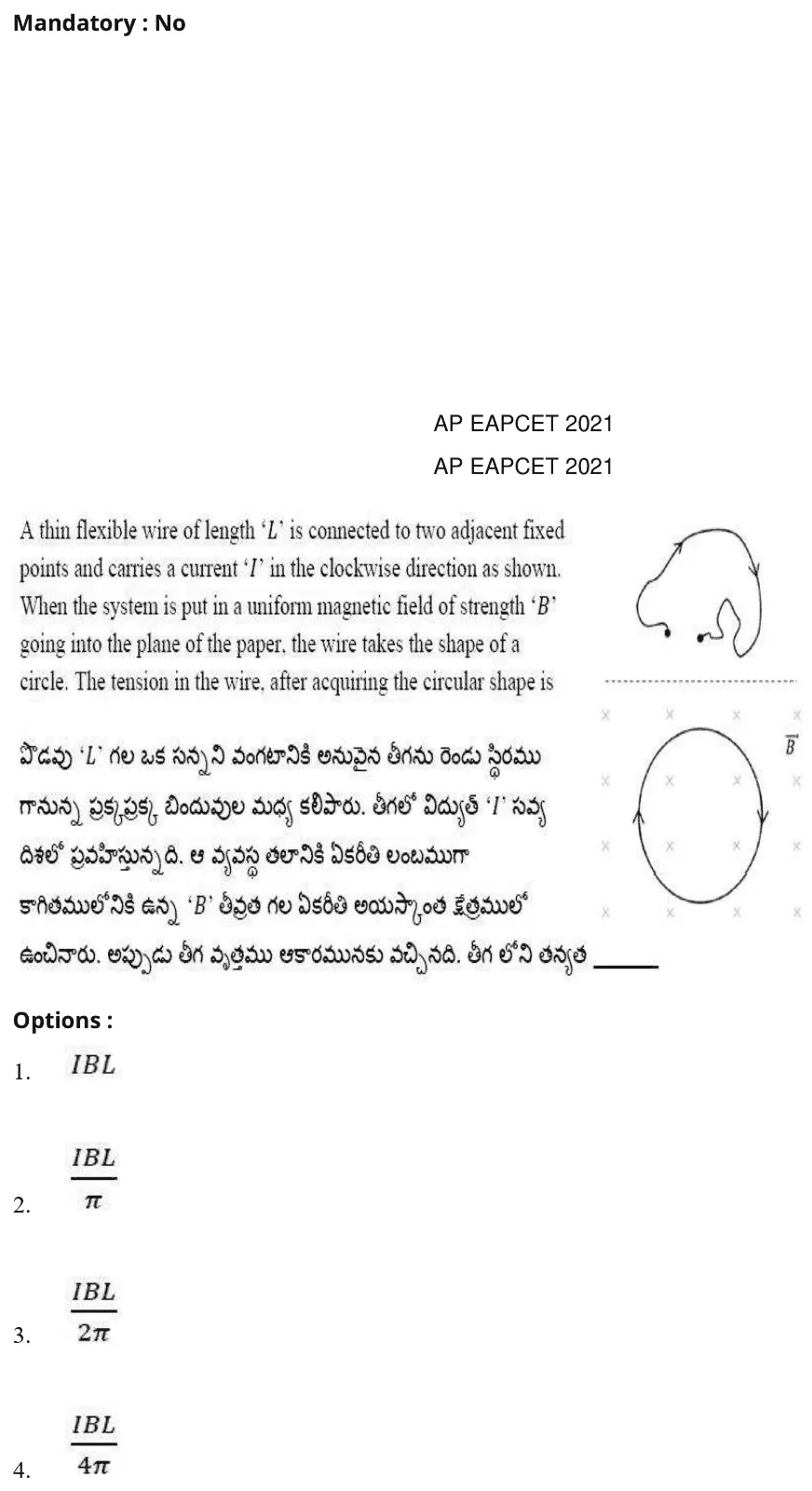
$IBL$
$\frac{IBL}{\pi}$
$\frac{IBL}{2\pi}$
$\frac{IBL}{4\pi}$
A toroid of $n$ turns, mean radius $R$ and cross-sectional radius $a$ carries current $I$. It is placed on a horizontal table taken as $xy$-plane. Its magnetic moment $m$ ______
is non–zero and points in the $z$-direction by symmetry
points along the axis of the toroid ($m = m\phi$)
is zero, otherwise there would be a field falling as $\frac{1}{r^3}$ at large distances outside the toroid
is pointing radially outwards
The magnetic field due to current carrying a circular loop of radius $5\ cm$ at a point on the axis at a distance of $12\ cm$ from the center is $250\ \mu T$. The magnetic field at the center of the loop is ______
$2529\ \mu T$
$4394\ \mu T$
$1759\ \mu T$
$2908\ \mu T$
The coil of a moving coil galvanometer has an effective area of $4 \times 10^{-2}\ m^2$. It is suspended in a magnetic field of $5 \times 10^{-2}\ wbm^{-2}$. If the deflection in the galvanometer coil is 0.2 $rad$ when a current of $5mA$ is passed through it, then
Torsional constant is $8 \times 10^{-5}\ Nmrad^{-1}$
Current sensitivity is $40\ rad\ A^{-1}$
Torsional constant is $3 \times 10^{-3}\ Nmrad^{-1}$
Current sensitivity is $40\ deg\ A^{-1}$
A square frame of side 1 $m$ carrying a current '$I$' produces a magnetic field '$B$' at its center. The same current is passed through a circular coil having the same perimeter as the square. The magnetic field at the center of the circular coil is $B'$. The ratio of $\frac{B}{B'}$ is ______
$\frac{8}{\pi^2}$
$\frac{8\sqrt{2}}{\pi^2}$
$\frac{16}{\pi^2}$
$\frac{16}{\sqrt{2}\pi^2}$
A wire of length 'L' $m$ carrying a current $I$ amp is bent in the form of a circle. Magnitude of its magnetic moment is ______.
$\frac{L^2 I^2}{4\pi}$
$\frac{L^2 I}{4\pi}$
$\frac{L I}{4\pi}$
$\frac{L I^2}{4\pi}$
What is the net force on the square coil?
(see the figure above)
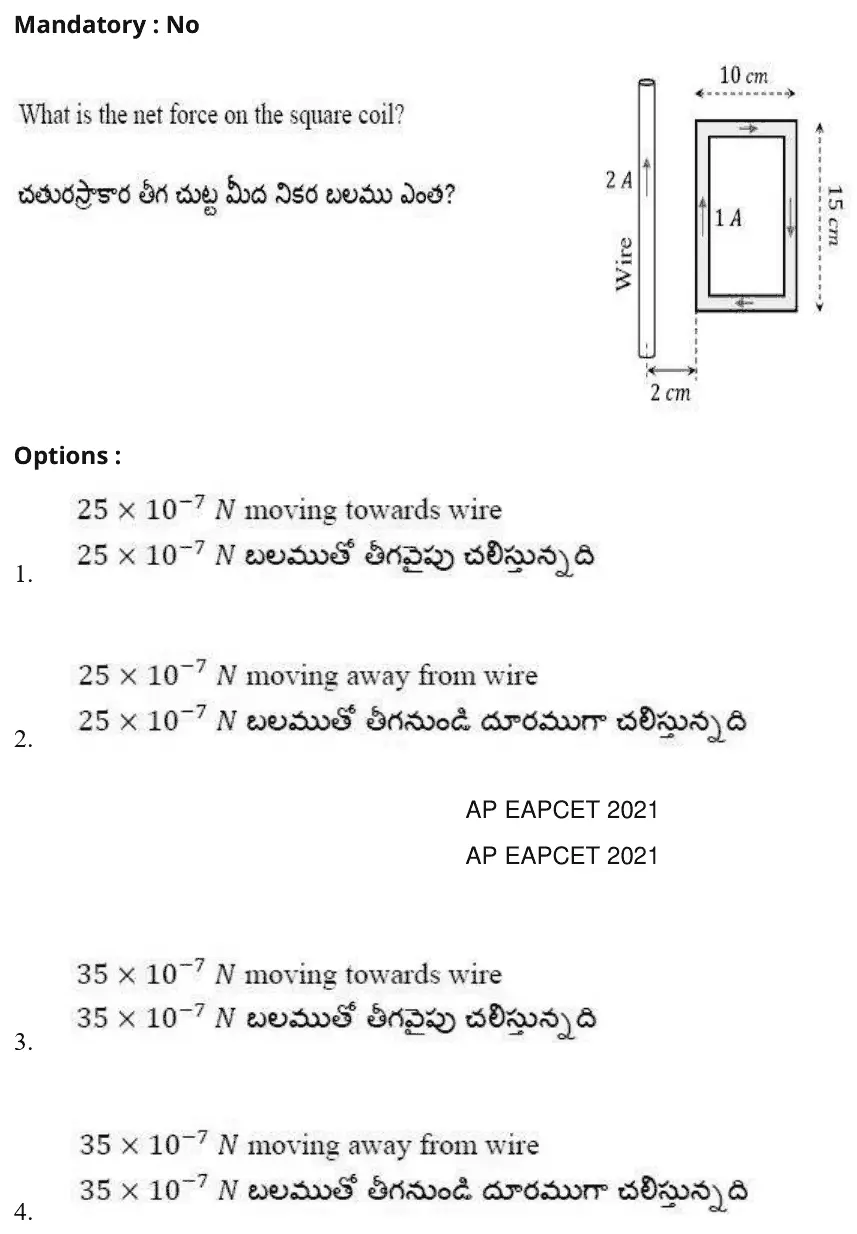
$25 \times 10^{-7}\ N$ moving towards wire
$25 \times 10^{-7}\ N$ moving away from wire
$35 \times 10^{-7}\ N$ moving towards wire
$35 \times 10^{-7}\ N$ moving away from wire
Torque required to hold a small circular coil of 10 turns, $2 \times 10^{-4}\ m^2$ area and carrying $0.5\ A$ current is the (sic) middle of a long solenoid of $10^{3}$ turns per meter carrying $3\ A$ current, with its axis perpendicular to the axis of the solenoid is ______
$12\pi \times 10^{-7}\ Nm$
$6\pi \times 10^{-7}\ Nm$
$4\pi \times 10^{-7}\ Nm$
$2\pi \times 10^{-7}\ Nm$
Two concentric coils each of radius equal to $4\pi\ cm$ are placed at right angles to each other. If $10\ A$ and $24\ A$ are the currents flowing through the coils, respectively, the magnetic induction at the center of the coils will be ______
$13 \times 10^{-5}\ wbm^{-2}$
$12 \times 10^{-5}\ wbm^{-2}$
$7 \times 10^{-5}\ wbm^{-2}$
$5 \times 10^{-5}\ wbm^{-2}$
In which of the following case no force exerted by a magnetic field on a charge?
Moving with constant velocity
Moving in a circle
At rest
Moving along a curved path
A long thin hollow metallic cylinder of radius $R$ has a current $i$ ampere. The magnetic induction $B$ away from the axis at a distance 'r' from the axis varies as shown in
(see the figure above)
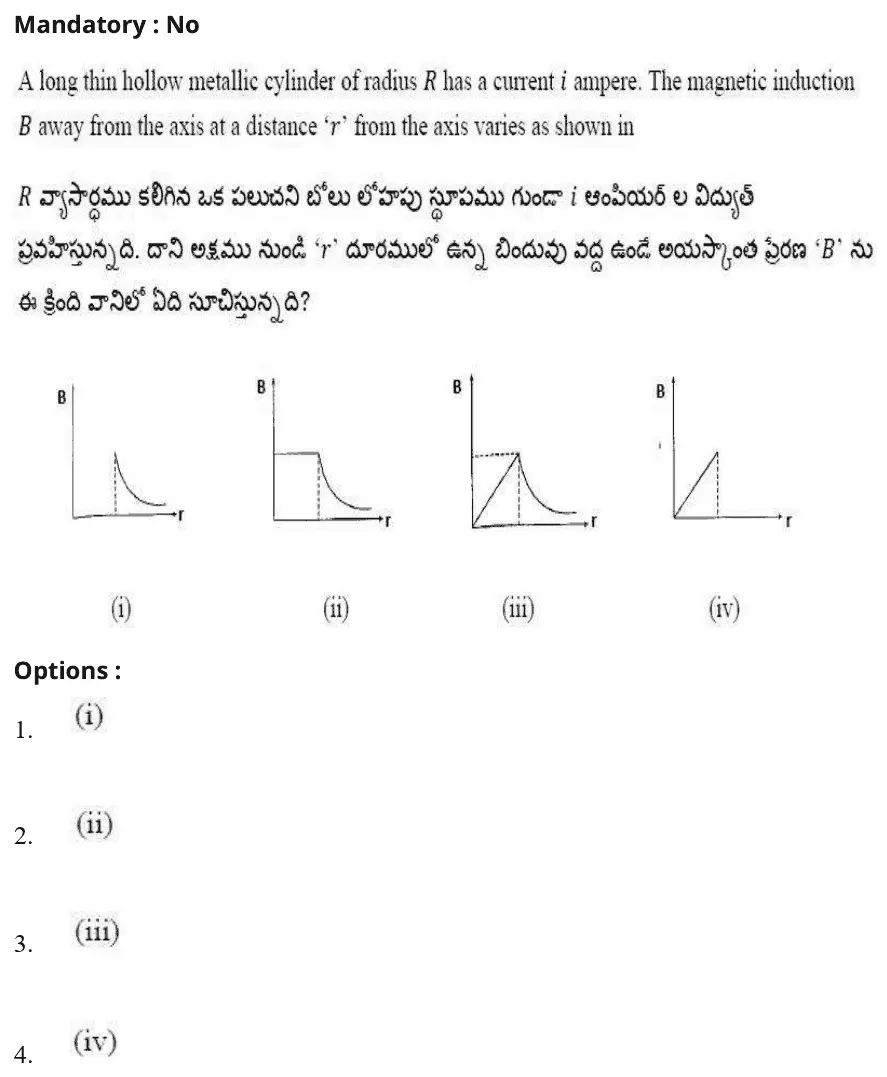
(i)
(ii)
(iii)
(iv)
In a co-axial, straight cable, the central conductor and the outer conductor carry equal currents in opposite directions. The magnetic field is zero ______
outside the cable
inside the inner conductor
inside the outer conductor
in between the two conductors
The magnetic field, of a given length of wire for single turn coil, at its center is 'B'. then its value for two turns coil for the same wire is ______
$\dfrac{B}{4}$
$\dfrac{B}{2}$
$4B$
$2B$
Force acting on an electron moving with velocity $\vec{V}$ in a magnetic field $\vec{B}$ is (e is the charge of electron)
$e(\vec{V}\times\vec{B})$
$e(\vec{V}.\vec{B})$
$e\frac{\vec{V}}{\vec{B}}$
$e\frac{\vec{B}}{\vec{V}}$
Two circular coils P and Q are made of two identical wires of the same length. The number of turns in the P and Q are 4 and 2, respectively. The magnetic inductions at the centre of P and Q are $B_p$ and $B_Q$ respectively. The ratio $\frac{B_p}{B_Q}$ is:
0.25
4
0.5
2
A coil having 2000 turns is wound tightly in the form of a spiral with inner and outer radii $1\ \mathrm{cm}$ and $3\ \mathrm{cm}$ respectively. When a current $\dfrac{1}{\pi}\ \mathrm{mA}$ passes through the coil the magnetic field at the centre is calculated to be $K\ln 3\times10^{-6}\ \mathrm{T}$. The value of K is
20
10
15
25
Two long parallel wires are separated by a distance of 2.50 cm. The force per unit length that each wire exerts on the other is $4\times10^{-5}$ N/m, and the wires repel each other. The current in one wire is 0.5A. What is the current in the second wire? (Take $\mu_0 = 4\pi\times10^{-7}$ SI Unit)
12 A
8 A
6 A
10 A
What is the magnetic moment of orbiting electron in simple hydrogen atom? Assume e = charge of electron, $m_e$ = Mass of electron and $\vec{L}$ = orbital angular momentum of electron
$\vec{\mu}=\left(\frac{e}{m_e}\right)\vec{L}$
$\vec{\mu}=\left(\frac{e}{2m_e}\right)\vec{L}$
$\vec{\mu}=\left(\frac{2e}{m_e}\right)\vec{L}$
$\vec{\mu}=\left(\frac{e}{4m_e}\right)\vec{L}$
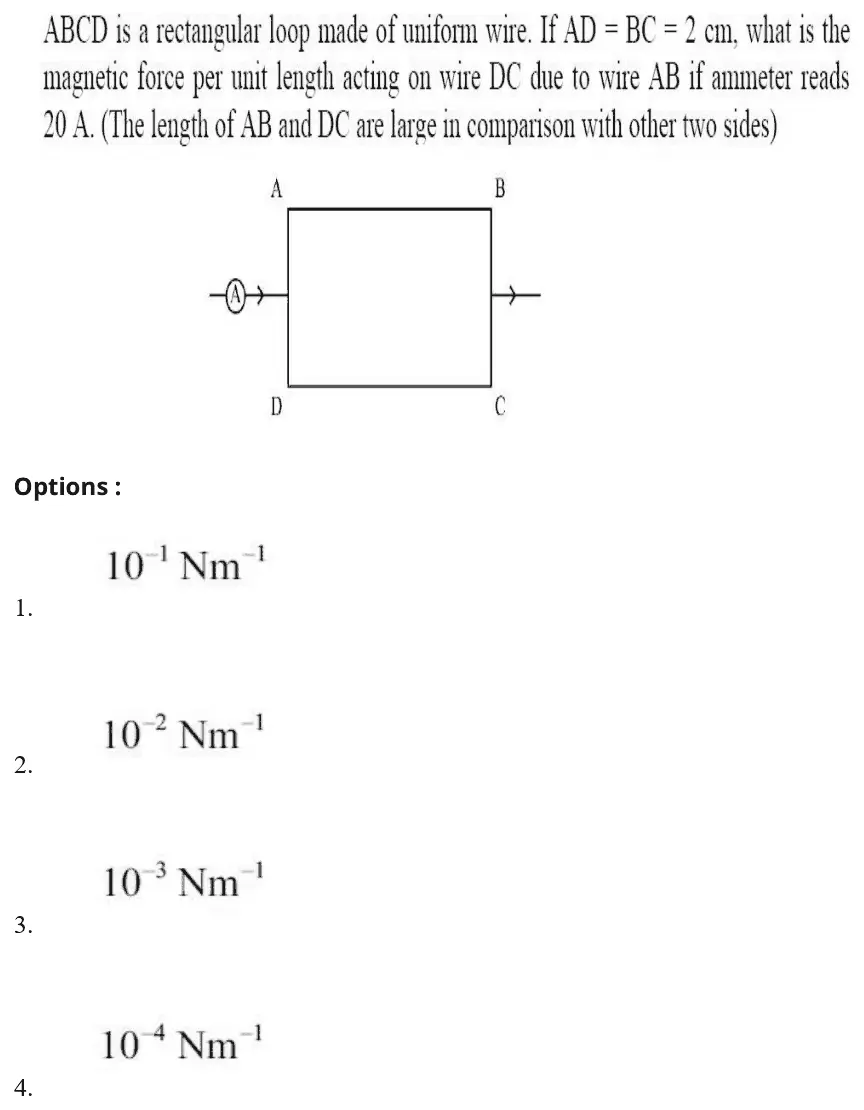
ABCD is a rectangular loop made of uniform wire. If AD = BC = 2 cm, what is the magnetic force per unit length acting on wire DC due to wire AB if ammeter reads 20 A. (The length of AB and DC are large in comparison with other two sides)
(see the figure above)
$10^{-1}\ \mathrm{Nm^{-1}}$
$10^{-2}\ \mathrm{Nm^{-1}}$
$10^{-3}\ \mathrm{Nm^{-1}}$
$10^{-4}\ \mathrm{Nm^{-1}}$
Given the fact that
A) Magnetic field exerts force only on a moving charge
B) Electric field exerts force on both stationary and moving charge
C) Magnetic field exerts force on charge moving parallel to the direction of the field.
Which of the following is true?
A and C
A and B
B and C
A, B and C
A wire of length $l$ carries a current I along the X- axis. The magnetic force acting on the wire is given by $\vec{F} = IB_0L(\hat{k} - \hat{j})$ T where $B_0$ is a constant. The existing magnetic field $\vec{B}$ is
$B_0(\hat{i})$
$B_0(\hat{i}+\hat{j}-\hat{k})$
$B_0(\hat{i}+\hat{j}+\hat{k})$
$B_0(\hat{i}-\hat{j}-\hat{k})$
Two long wires with no contact are placed perpendicular to each other. $i_1$ and $i_2$ are currents flowing through these wires respectively. The magnetic force on a small length 'dl' of the second wire situated at a distance 'l' from first wire is proportional to
$i_1 i_2$
$l$
$\frac{1}{i_1 i_2}$
$l^2$
The force acting on a current carrying wire joining two fixed points A and B in a uniform magnetic field
increases exponentially with increase in current
is inversely proportional to the magnitude of the magnetic field
is independent of the shape of the wire
is parallel to the direction of the magnetic field
If the number of turns per unit length of a solenoid is doubled, what happens to the magnetic field in the solenoid?
It remains unchanged
It becomes half
It doubles
It quadruples
The magnetic field intensity (H) at the centre of a long solenoid carrying a current of 2 A, is found to be 1000 A/M. The number of turns per centimetre of the solenoid is
(Use $\mu_0 = 4\pi \times 10^{-7}\ \mathrm{TM/A}$)
$500$
$50$
$5$
$100$
A small cube of side of 1 mm is placed at the centre of a circular loop of radius 20 cm. If the current in the loop is 2 A then the magnetic energy stored inside the cube is
(Assume $\mu_0 = 4\pi \times 10^{-7}$ SI units)
$1.57 \times 10^{-18}\ \mathrm{J}$
$2.57 \times 10^{-14}\ \mathrm{J}$
$1.57 \times 10^{-14}\ \mathrm{J}$
$4.57 \times 10^{-13}\ \mathrm{J}$
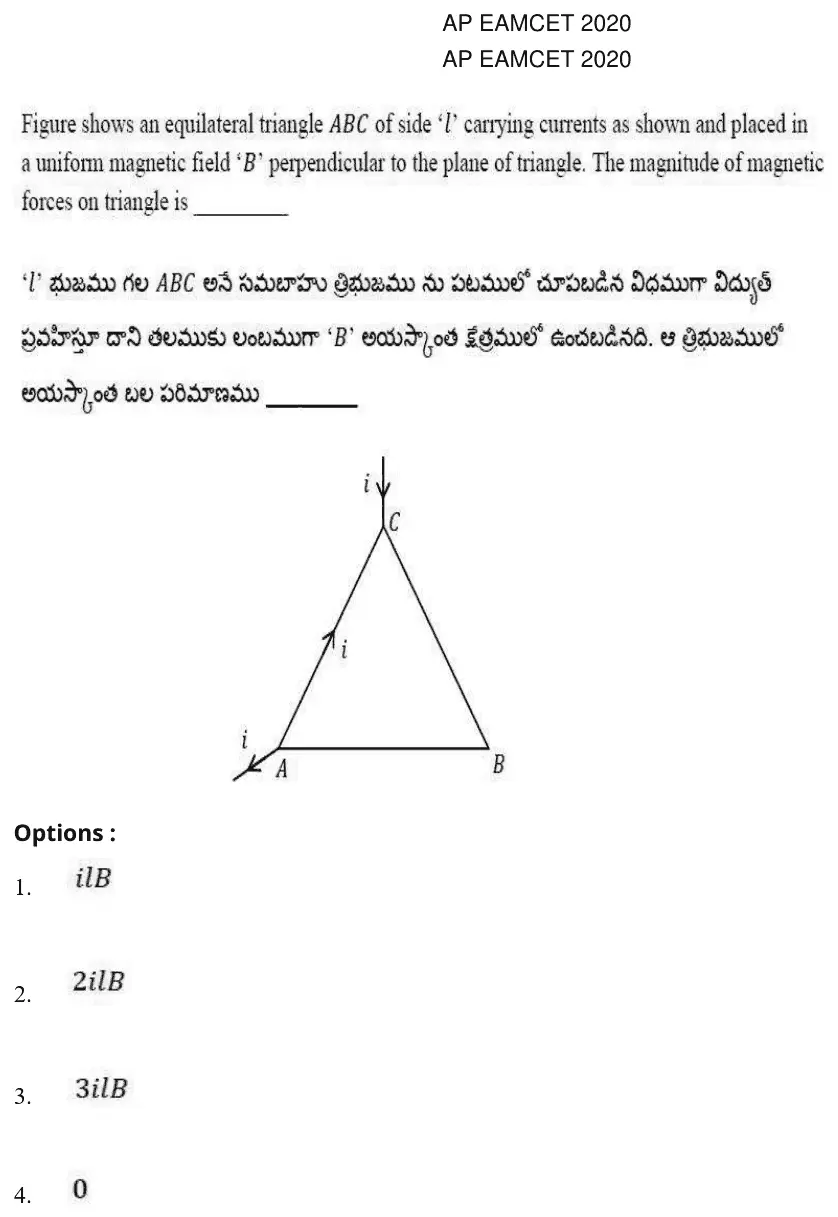
Figure shows an equilateral triangle $ABC$ of side '$l$' carrying currents as shown and placed in a uniform magnetic field '$B$' perpendicular to the plane of triangle. The magnitude of magnetic forces on triangle is ______
(see the figure above)
$ilB$
$2ilB$
$3ilB$
$0$
Magnetic lines of force due to a current in a circular conductor are ______
parallel to the plane of the coil
perpendicular to the plane of the coil at the center only
perpendicular to the plane of the coil everywhere
Zero
Magnetic field $dB$ to a current element at any point on its axis is ______
minimum
zero
varies between minimum and maximum
depends on the position of the point
An electron having charge $1.6 \times 10^{-19}\ \mathrm{C}$ and mass $9 \times 10^{-31}\ \mathrm{kg}$ is moving with $4 \times 10^{6}\ \mathrm{m.s^{-1}}$ speed in a magnetic field $2 \times 10^{-1}\ \mathrm{T}$ in a circular orbit. The force acting on electron and the radius of the circular orbit is ______
$12.8 \times 10^{-13}\ \mathrm{N},\ 1.1 \times 10^{-4}\ \mathrm{m}$
$1.28 \times 10^{-14}\ \mathrm{N},\ 1.1 \times 10^{-3}\ \mathrm{m}$
$1.28 \times 10^{-13}\ \mathrm{N},\ 1.1 \times 10^{-3}\ \mathrm{m}$
$1.28 \times 10^{-13}\ \mathrm{N},\ 1.1 \times 10^{-4}\ \mathrm{m}$
When a helium nucleus makes a full rotation of a circle of radius $0.8\ \mathrm{m}$ in $2.5$ seconds, the value of magnetic field $B$ at the centre of the circle will be
$4\pi\times10^{-25}\ \mathrm{T}$
$2\pi\times10^{-26}\ \mathrm{T}$
$4\pi\times10^{-26}\ \mathrm{T}$
$2\pi\times10^{-25}\ \mathrm{T}$
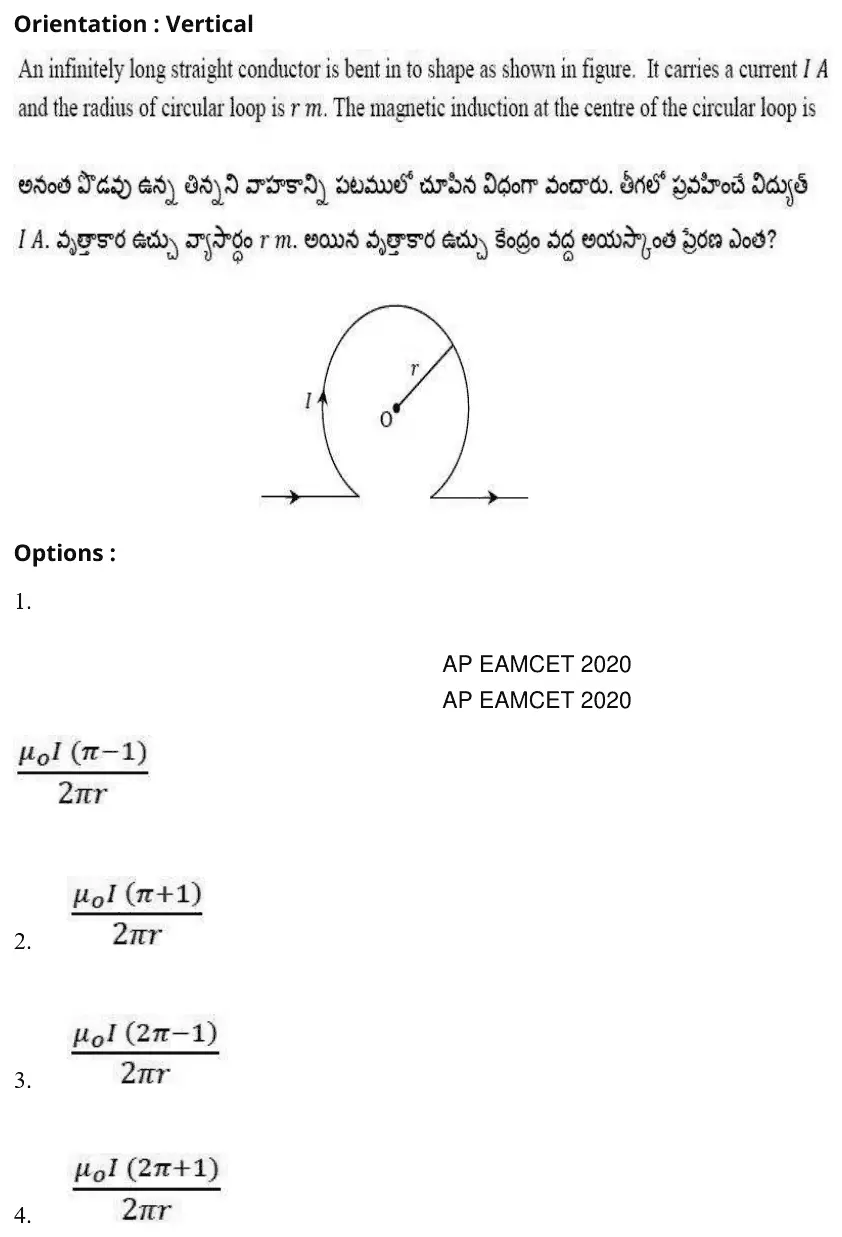
An infinitely long straight conductor is bent in to shape as shown in figure. It carries a current $I$ A and the radius of circular loop is $r$ m. The magnetic induction at the centre of the circular loop is (see the figure above)
$\frac{\mu_0 I(\pi-1)}{2\pi r}$
$\frac{\mu_0 I(\pi+1)}{2\pi r}$
$\frac{\mu_0 I(2\pi-1)}{2\pi r}$
$\frac{\mu_0 I(2\pi+1)}{2\pi r}$
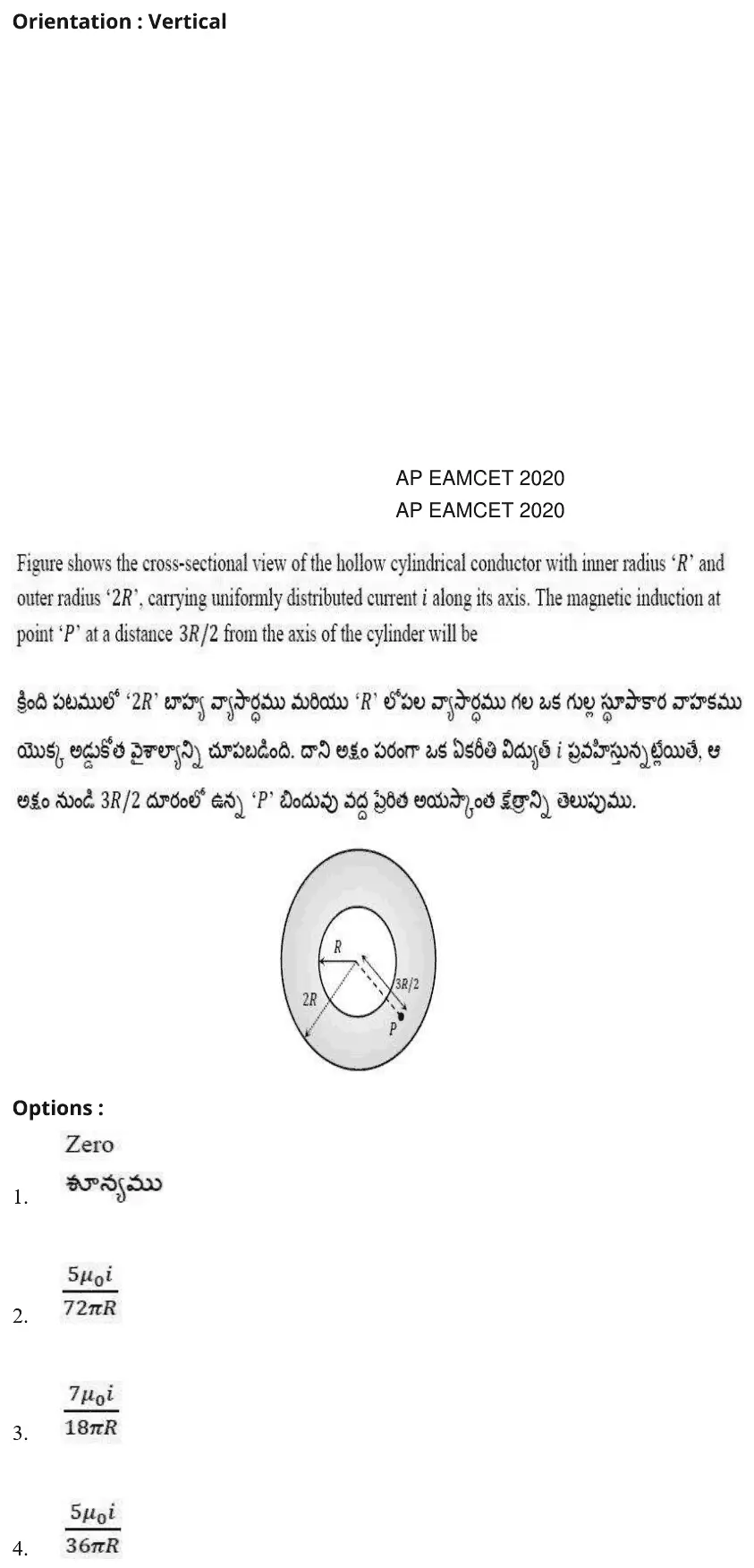
Figure shows the cross-sectional view of the hollow cylindrical conductor with inner radius 'R' and outer radius '2R', carrying uniformly distributed current $i$ along its axis. The magnetic induction at point 'P' at a distance $3R/2$ from the axis of the cylinder will be (see the figure above)
Zero
$\frac{5\mu_0 i}{72\pi R}$
$\frac{7\mu_0 i}{18\pi R}$
$\frac{5\mu_0 i}{36\pi R}$
Choose the wrong statement to complete: An ideal solenoid has ______
the turns widely separated
the turns closely wound
the length is very much greater than the radius
the magnetic field inside almost uniform
When a helium nucleus covers a circle of radius $0.8\,\mathrm{m}$ in 2 seconds, find the value of magnetic field $B$ at the centre of the circle.
$\frac{10^{-19}}{\mu_0}$
$\mu_0 \times 10^{-19}$
$2\,\mu_0 \times 10^{-10}$
$\frac{2 \times 10^{-19}}{\mu_0}$
A proton enters a magnetic field of flux density $1.5\,\mathrm{Wb.m^{-2}}$ with a velocity of $2 \times 10^{7}\,\mathrm{m.s^{-1}}$ at an angle of $30^\circ$ with the field. The force on the proton will be
$2.4 \times 10^{-12}\,N$
$24 \times 10^{-12}\,N$
$0.24 \times 10^{-12}\,N$
$0.024 \times 10^{-12}\,N$
A proton moving with a velocity, $2.5 \times 10^{7}\,\mathrm{m/sec}$ , enters a magnetic field of intensity $2.5\,\mathrm{T}$ making an angle $30^{\circ}$ with the magnetic field. The force on the proton is
$3 \times 10^{-12}\,\mathrm{N}$
$5 \times 10^{-12}\,\mathrm{N}$
$6 \times 10^{-12}\,\mathrm{N}$
$9 \times 10^{-12}\,\mathrm{N}$
A horizontal overhead powerline at a height of $5\,\mathrm{m}$ from the ground and carries a current of $150\,\mathrm{A}$ from East to West. The magnetic field directly below it on ground is
$6 \times 10^{-6}\,\mathrm{T}$ towards South
$6 \times 10^{-6}\,\mathrm{T}$ towards West
$7 \times 10^{-6}\,\mathrm{T}$ towards East
$8 \times 10^{-7}\,\mathrm{T}$ towards North
A charge $q\,C$ moving in a circle of radius '$r$' $m$ makes $n$ revolutions per second. Magnetic field at the centre of the circle is ______
$\frac{2\pi q}{nr}\times 10^{-7}\ \mathrm{N.amp^{-1}.m^{-1}}$
$\frac{2\pi q}{r}\times 10^{-7}\ \mathrm{N.amp^{-1}.m^{-1}}$
$\frac{2\pi nq}{r}\times 10^{-7}\ \mathrm{N.amp^{-1}.m^{-1}}$
$\frac{2\pi q}{r}\ \mathrm{N.amp^{-1}.m^{-1}}$
If $B_1$ is the magnetic field induction at a point on the axis of a circular coil of radius $R$ situated at distance $R\sqrt{3}$ and $B_2$ is the magnetic field at the center of the coil, then the ratio of $\frac{B_1}{B_2}$ is equal to
$\frac{1}{3}$
$\frac{1}{8}$
$\frac{1}{4}$
$\frac{1}{2}$
A straight wire carrying current ' $i$ ' is turned into a circular loop. If the magnitude of magnetic moment associated with it in M.K.S. units is $M$, the length of wire will be ______
$4\pi iM$
$\sqrt{\frac{4\pi M}{i}}$
$\sqrt{\frac{4\pi i}{M}}$
$\frac{M\pi}{4i}$
A current 'I' A flows in a circular arc of radius 'r' subtending an angle '$\theta$' as shown in the figure. Find the magnetic field at the center O of the circle.
(see the figure above)
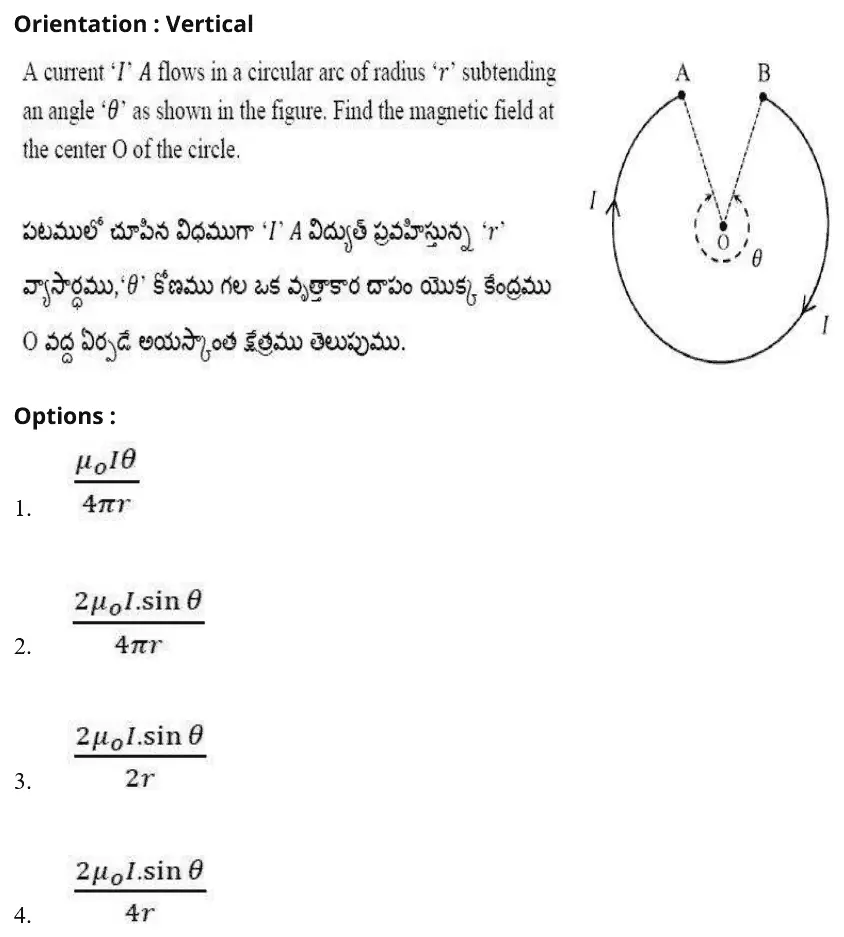
$\frac{\mu_o I\theta}{4\pi r}$
$\frac{2\mu_o I.\sin\theta}{4\pi r}$
$\frac{2\mu_o I.\sin\theta}{2r}$
$\frac{2\mu_o I.\sin\theta}{4r}$
Given figure shows the north and south poles of a permanent magnet in which an '$n$' turn coil of cross-sectional area '$A$' is resting, such that, when a current '$I$' is passed through the coil, the plane of the coil makes an angle '$\theta$' with respect to direction of magnetic field '$B$'. If the plane of magnetic field and the coil are horizontal and vertical respectively, the torque on the coil will be
$nIAB\ \cos\theta$
$nIAB\ \sin\theta$
$nIAB$
None of the above since the magnetic field is radial
Two similar coils which are separated by 2m are having radius of 1m and 80 turns have a common axis. Calculate the strength of magnetic field at a point midway between them on their common axis when a current is 0.2 A.
$0.04\sqrt{2}$
$\sqrt{2}$
$\dfrac{0.04}{\sqrt{2}}$
$\dfrac{\sqrt{2}}{0.04}$
A particle of mass m and charge Q moving with a speed in a circular path of radius R has magnetic moment $\mu$. If the mass of the particle is doubled and maintains the same speed while revolving in the same circular path then the magnetic moment will be.
doubled
halved
tripled
unchanged
Two infinite wires carrying opposite electrical currents I and i are placed a distance $x$ apart. A point P at a distance $y$ away from the wire carrying current i is shown in the figure. If the magnetic field is zero at point P then the magnitude of i is
(see the figure above)
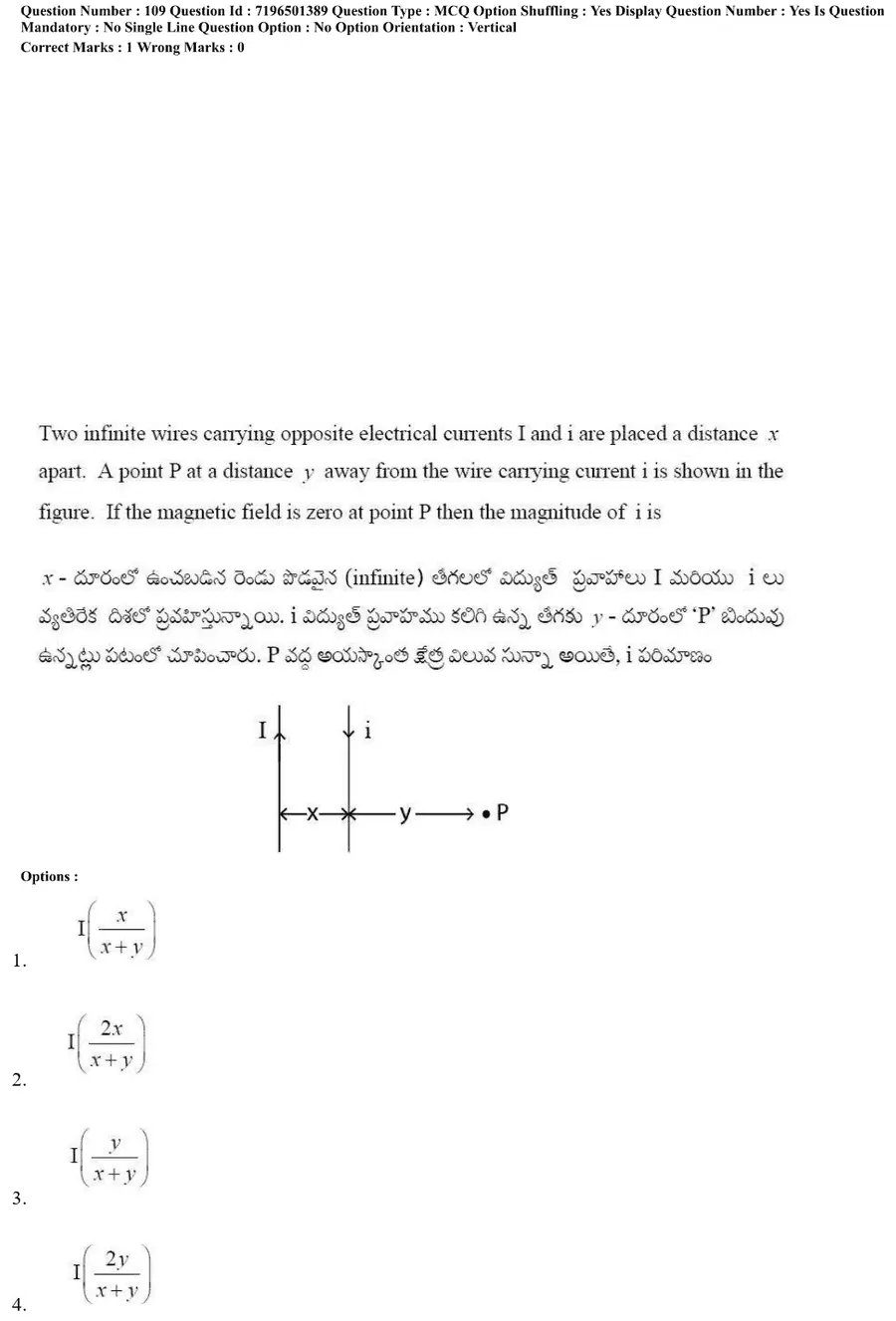
$\mathrm{I}\left(\dfrac{x}{x+y}\right)$
$\mathrm{I}\left(\dfrac{2x}{x+y}\right)$
$\mathrm{I}\left(\dfrac{y}{x+y}\right)$
$\mathrm{I}\left(\dfrac{2y}{x+y}\right)$
A solenoid of length $2\ \mathrm{m}$ carries a current of 20 Ampere. The diameter of the solenoid is 3cm. If the magnetic field inside the solenoid is 20mT, then the length of wire forming the solenoid is
(Assume $\mu_0 = 4\pi \times 10^{-7}\ \mathrm{H/m}$)
$100\ \mathrm{m}$
$125\ \mathrm{m}$
$175\ \mathrm{m}$
$150\ \mathrm{m}$
A conducting wire is in the shape of a regular hexagon which is inscribed inside an imaginary circle of radius R. If a current I flows the wire, the magnitude of magnetic field at the centre of the circle is
(see the figure above)
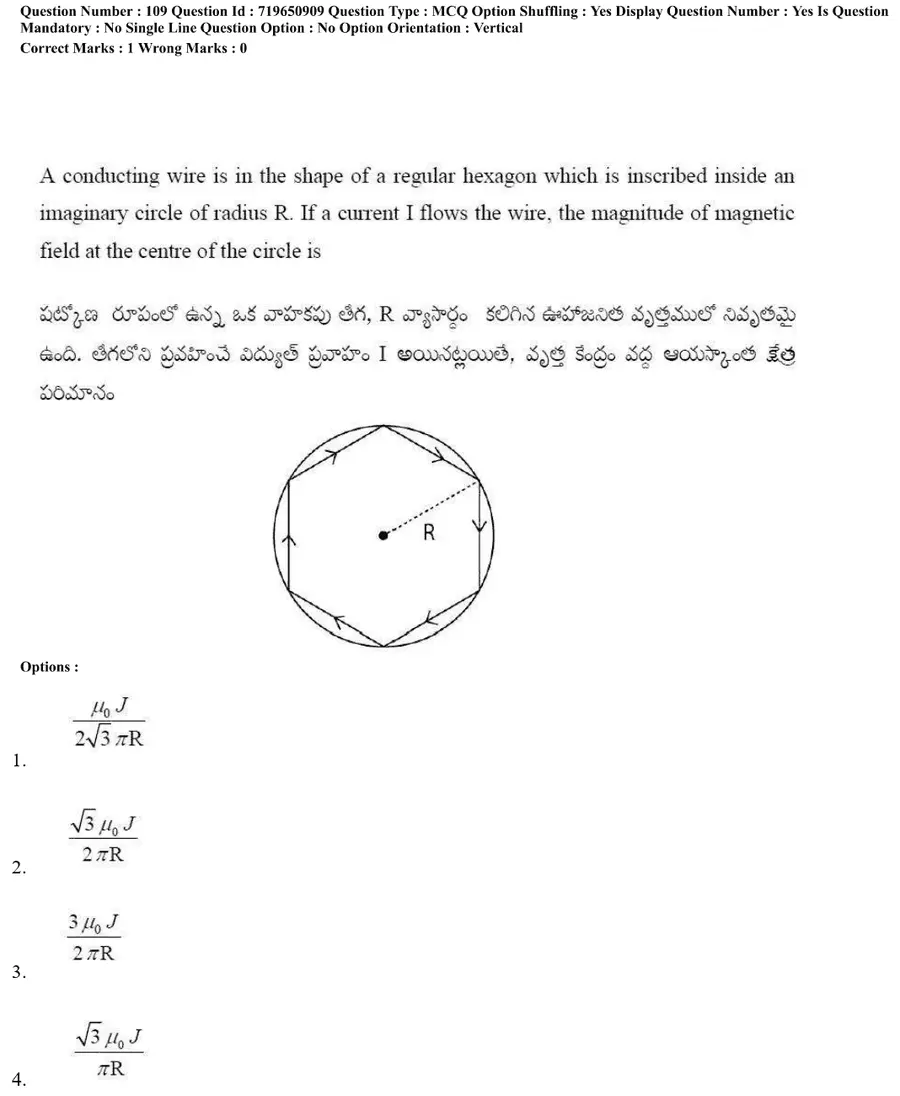
$\dfrac{\mu_0 J}{2\sqrt{3}\,\pi R}$
$\dfrac{\sqrt{3}\,\mu_0 J}{2\pi R}$
$\dfrac{3\,\mu_0 J}{2\pi R}$
$\dfrac{\sqrt{3}\,\mu_0 J}{\pi R}$
A coil having 100 turns is wound tightly in the form of a spiral with inner and outer radii 1 cm and 2 cm respectively. When a current 1A passes through the coil, the magnetic field at the centre of the coil is
$2\pi\,\ln(2)$ mT
$\dfrac{\pi}{2}\,\ln(2)$ mT
$\pi\,\ln(2)$ mT
$\sqrt{2}\pi\,\ln(2)$ mT
In the Bohr model an electron of mass $m$ moves in a circular orbit around the proton. Considering the orbiting electron to be a circular current loop, the magnetic moment of the hydrogen atom, when the electron is in $n^{th}$ excited state, is:
(Assume h = Planck's constant)
$\left(\dfrac{e}{2m}\,\dfrac{n^2h}{2\pi}\right)$
$\left(\dfrac{e}{m}\right)\dfrac{nh}{2\pi}$
$\left(\dfrac{e}{2m}\right)\dfrac{nh}{2\pi}$
$\left(\dfrac{e}{m}\right)\dfrac{n^2h}{2\pi}$
A straight wire of mass $0.2\,\mathrm{kg}$ and length $1.5\,\mathrm{m}$ carries a current $2\mathrm{A}$ is shown in the figure. It is suspended in mid-air by a uniform magnetic field B pointing to the plane of paper. The magnitude of magnetic field is nearly?
(Ignore earth's magnetic field and assume $\mathrm{g} = 10\,\mathrm{m/s^2}$).
(see the figure above)
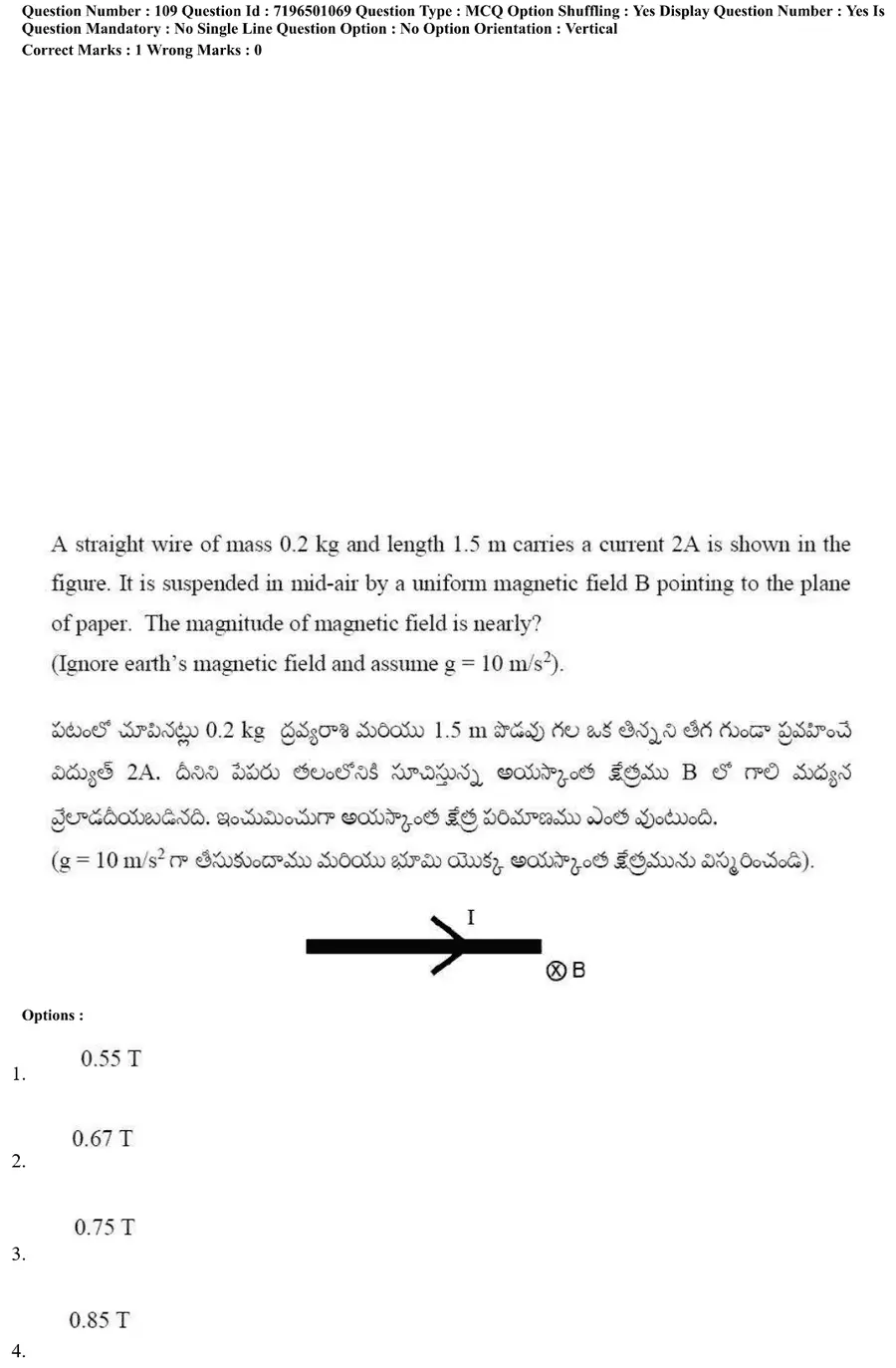
$0.55\,\mathrm{T}$
$0.67\,\mathrm{T}$
$0.75\,\mathrm{T}$
$0.85\,\mathrm{T}$
The ratio of the magnetic field inside a solenoid at an axial point well inside and at an axial end point is
$2$
$1/2$
$1$
$3/2$
A solenoid has a core of a material with relative permeability $\frac{800}{\pi}$. The windings of the solenoid are insulated from the core and carry current of $2\mathrm{A}$. If the number of turns is 1000 per metre, find the magnetic field B.
$640\,\mathrm{mT}$
$330\,\mathrm{mT}$
$480\,\mathrm{mT}$
$560\,\mathrm{mT}$
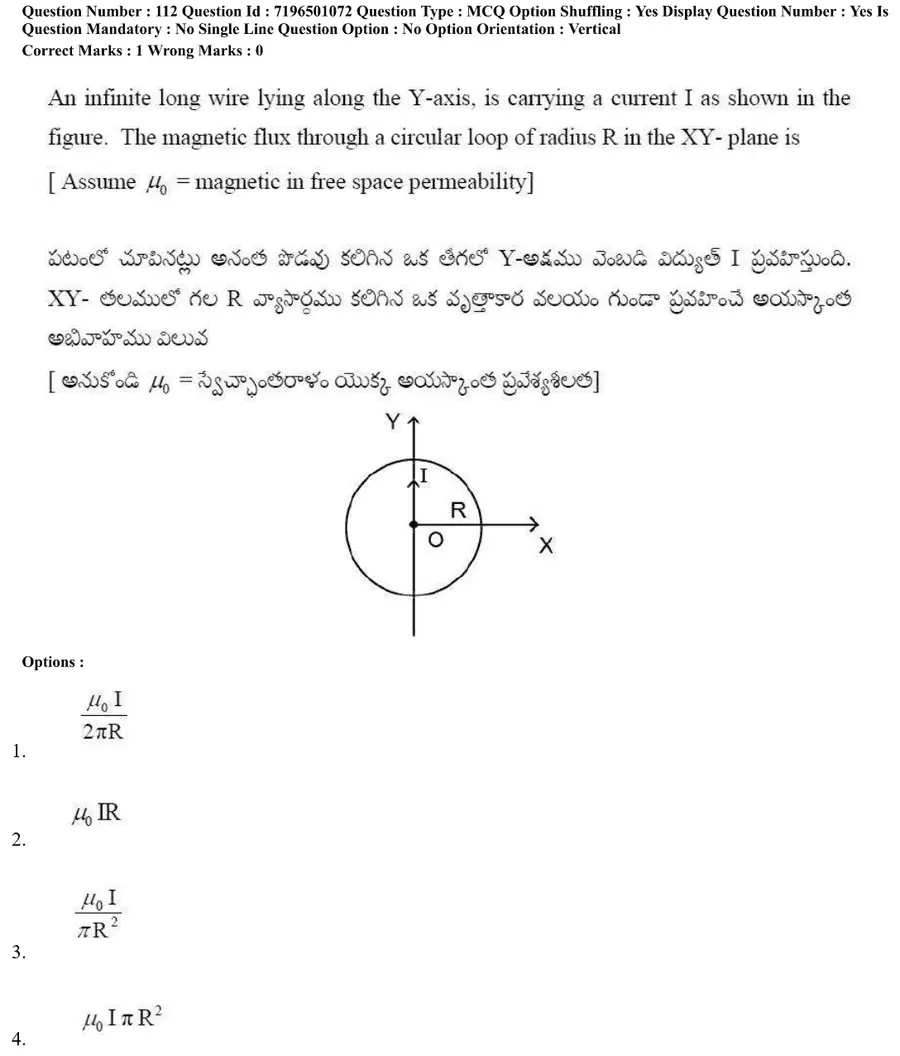
An infinite long wire lying along the Y-axis, is carrying a current I as shown in the figure. The magnetic flux through a circular loop of radius R in the XY- plane is
[ Assume $\mu_0$ = magnetic in free space permeability]
(see the figure above)
$\frac{\mu_0 I}{2\pi R}$
$\mu_0 \mathrm{IR}$
$\frac{\mu_0 I}{\pi R^2}$
$\mu_0 I \pi R^2$
A circular coil of 10 turns and radius 10 cm is placed in a uniform magnetic field of 0.1 T normal to the plane of the coil. If the current in the coil is 5A then the magnitude of the torque on the coil is
$500\pi$ N m
$0.05\pi$ N m
$0.005\pi$ N m
zero
A 50 cm long solenoid has winding of 400 turns. What current must pass through it to produce a magnetic field of induction $4\pi\times10^{-3}$ T at the center?
10.5 A
12.5 A
25.0 A
20.0 A
A particle of charge q and mass m moves in a circular orbit of radius r with angular speed $\omega$. The ratio of the magnitude of its magnetic moment to that of its angular momentum is
$\frac{q}{m\,\omega}$
$\frac{q}{2\,m\,r}$
$\frac{q}{2m}$
$\frac{2q}{m}$
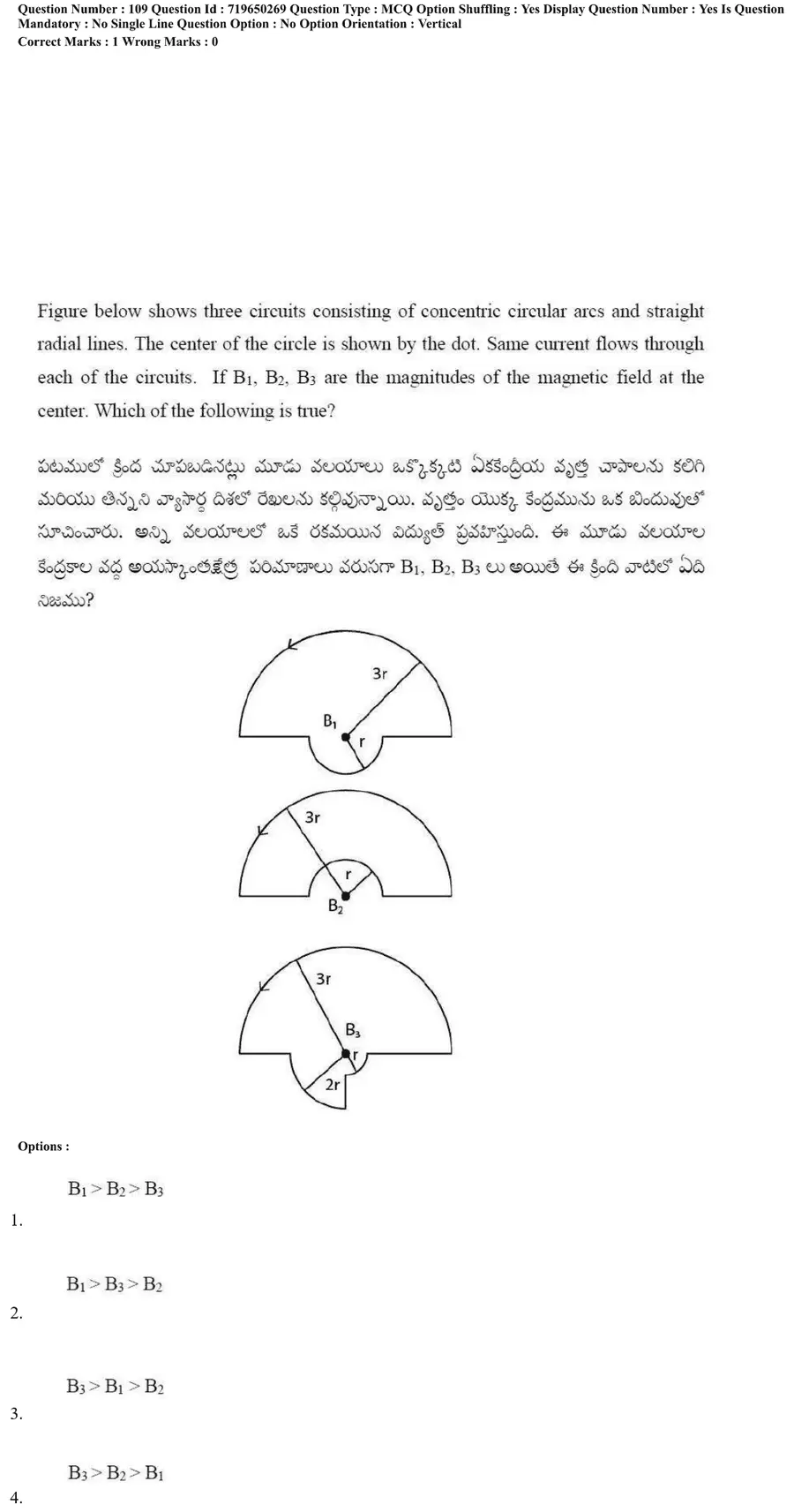
Figure below shows three circuits consisting of concentric circular arcs and straight radial lines. The center of the circle is shown by the dot. Same current flows through each of the circuits. If $B_1$, $B_2$, $B_3$ are the magnitudes of the magnetic field at the center. Which of the following is true?
(see the figure above)
$B_1 > B_2 > B_3$
$B_1 > B_3 > B_2$
$B_3 > B_1 > B_2$
$B_3 > B_2 > B_1$
A charged particle moves through a magnetic field perpendicular to its direction. Then
kinetic energy changes but the momentum is constant
the momentum changes but the kinetic energy is constant
both momentum and kinetic energy of the particle are not constant
both momentum and kinetic energy of the particle are constant
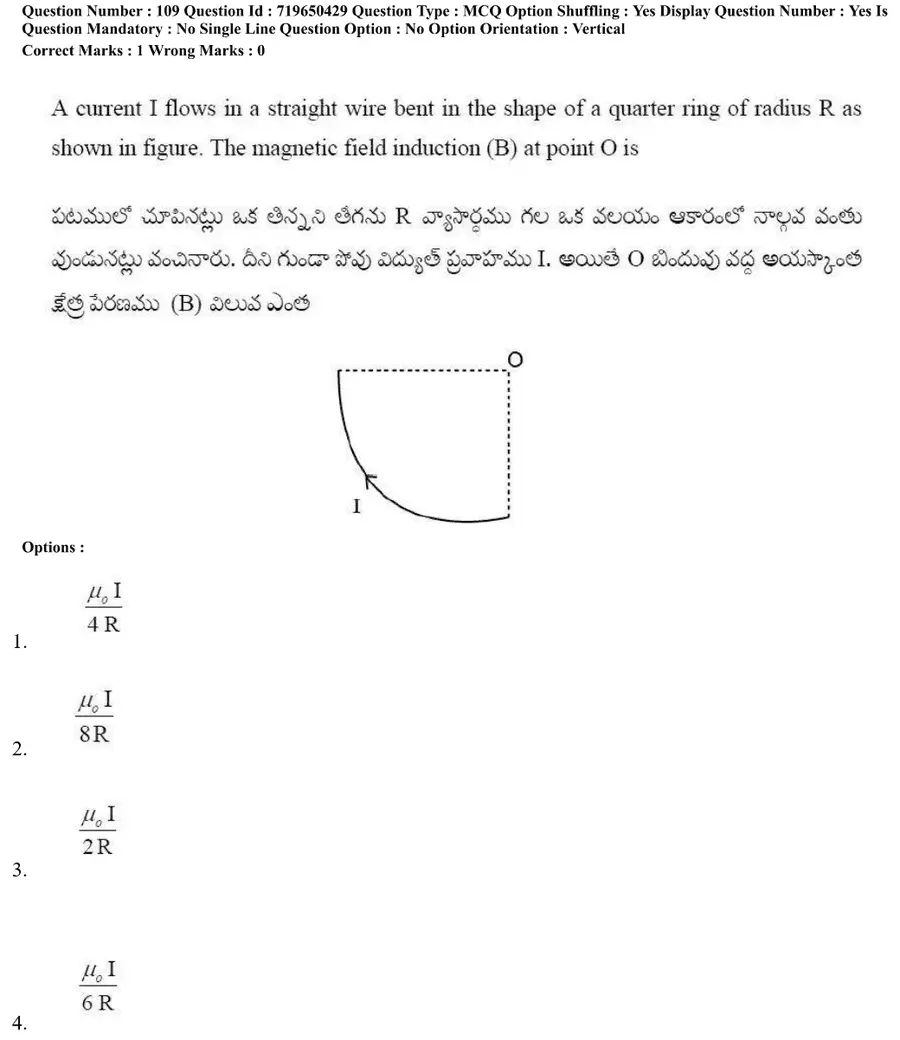
A current I flows in a straight wire bent in the shape of a quarter ring of radius R as shown in figure. The magnetic field induction (B) at point O is (see the figure above)
$\dfrac{\mu_0 I}{4R}$
$\dfrac{\mu_0 I}{8R}$
$\dfrac{\mu_0 I}{2R}$
$\dfrac{\mu_0 I}{6R}$
A particle of mass $m$ and charge $q$ is moving in a cyclotron with magnetic field $B$. The frequency of the circular motion of the particle is proportional to:
$\dfrac{qB}{m}$
$\dfrac{2m}{qB}$
$\dfrac{mB}{q}$
$\dfrac{mq}{B}$
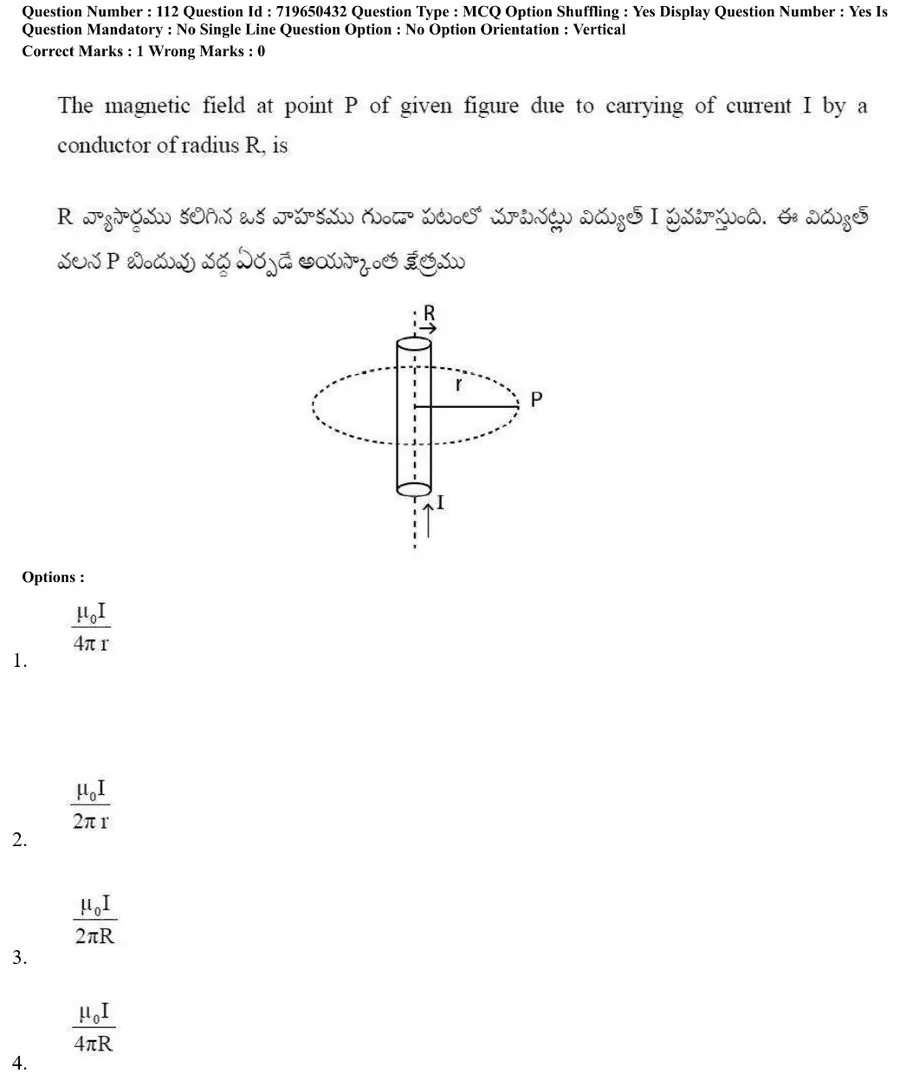
The magnetic field at point P of given figure due to carrying of current I by a conductor of radius R, is (see the figure above)
$\dfrac{\mu_0 I}{4\pi r}$
$\dfrac{\mu_0 I}{2\pi r}$
$\dfrac{\mu_0 I}{2\pi R}$
$\dfrac{\mu_0 I}{4\pi R}$
Two particles carrying equal charges move parallel to each other with speed 150 km/s. If $\vec{F_1}$ and $\vec{F_2}$ are magnetic and electric forces between two charged particles then, $\frac{|\vec{F_1}|}{|\vec{F_2}|}$ is
(Let $\mu_0\epsilon_0 = \frac{1}{9 \times 10^{16}}\ \mathrm{s^2/m^2}$)
$1.0 \times 10^{-6}$
$1.5 \times 10^{-7}$
$3.0 \times 10^{-6}$
$2.5 \times 10^{-7}$
A very long wire carrying a current $4\sqrt{2}$ A is bent at right angles. The magnitude of magnetic field ($|\vec{B}|$) at a point 'P' lying on a line perpendicular to the bent wire at a distance d = 20 cm from the point of bending will be (Let $\mu_0 = 4\pi \times 10^{-7}$ H/m)
(see the figure above)
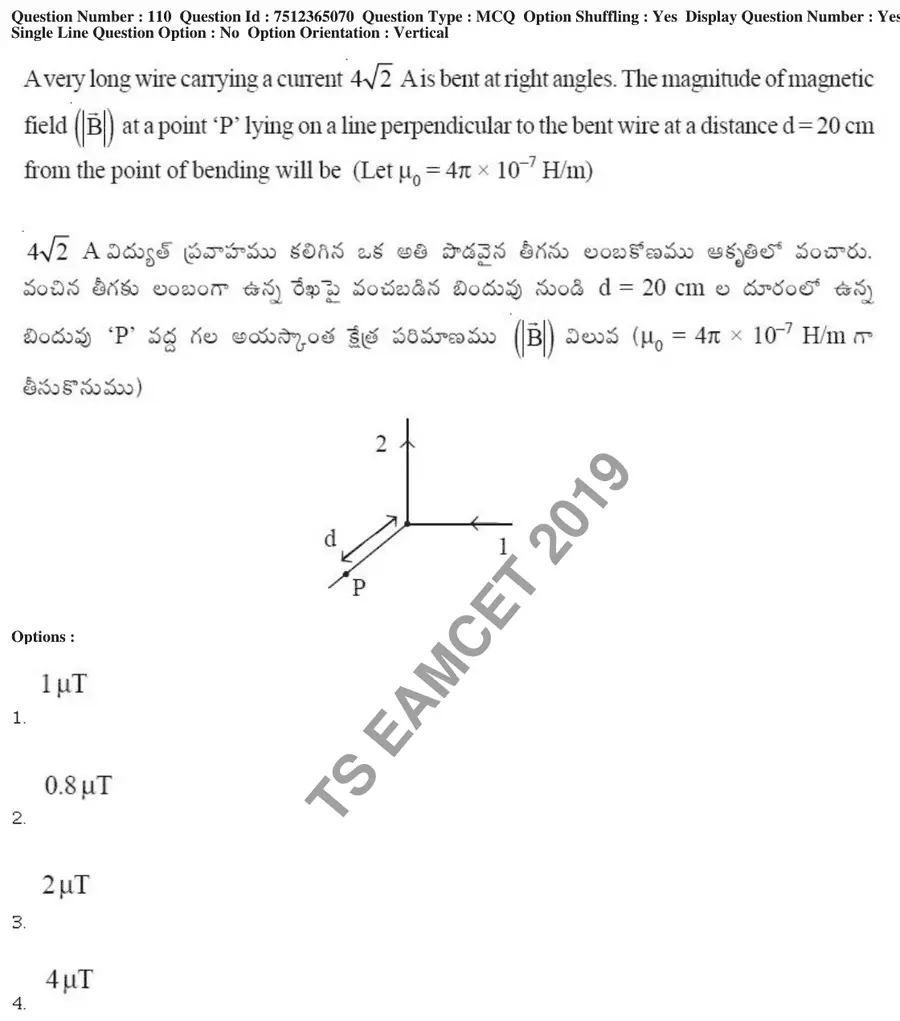
1 $\mu$T
0.8 $\mu$T
2 $\mu$T
4 $\mu$T
A semi circular loop of radius 30 cm wire carries current 6 A. An uniform magnetic field 0.5 T is present perpendicular to the plane of the loop. What is the magnitude of force exerted on the wire.
$0.9\ \mathrm{N}$
$1.8\ \mathrm{N}$
$0.8\ \mathrm{N}$
$1.4\ \mathrm{N}$
A dielectric circular disk of radius R carries a uniform surface charge density $\sigma$. If it rotates about its axis with angular velocity $\omega$, the magnetic field at the centre of disk is :
$\dfrac{\mu_0 \sigma \omega R^2}{2\pi}$
$\dfrac{\mu_0 \sigma \omega R}{2}$
$\dfrac{\mu_0 \sigma \omega \pi R^2}{4}$
$\dfrac{\mu_0 \sigma \omega R}{2\sqrt{2}}$
A magnetic field of $5 \times 10^{-5}$ T is produced at a perpendicular distance of 0.2 m from a long straight wire carrying electric current. If the permeability of free space is $4\pi \times 10^{-7}$ T m/A, the current passing through the wire in A is
45
40
50
30
A long wire carries a current of 18 A kept along the axis of a long solenoid of radius 1 cm. The field due to the solenoid is $8 \times 10^{-3}$ T. The magnitude of the resultant field at a point 0.6 mm from the solenoid axis is (Assume $\mu_0 = 4\pi \times 10^{-7}$ Tm/A)
$6 \times 10^{-3}$ T
$6 \times 10^{-4}$ T
$2\sqrt{7} \times 10^{-3}$ T
$10 \times 10^{-3}$ T
Two infinitely long straight wires A and B, each carrying current I are placed on x and y axis respectively. The current in wires A and B flow along $-\hat{i}$ and $\hat{j}$ directions respectively. The force on a charged particle having charge $q$ moving from position $\vec{r} = d(\hat{i} + \hat{j})$ with velocity $\vec{v} = v\hat{i}$ is
$\frac{\mu_0 I q v}{2\pi d}\hat{j}$
$\frac{\mu_0 I q v}{\pi d}\hat{j}$
$\frac{\mu_0 I q v}{\sqrt{2}\pi d}\hat{k}$
$0$
A long straight wire carrying current 16 A is bent at $90^\circ$ such that half of the wire lies along the positive x-axis and other half lies along the positive y-axis. What is the magnitude of magnetic field at the point $\vec{r} = (-2\hat{i} + 0\hat{j})$ mm. (Assume $\frac{\mu_0}{4\pi} = 10^{-7}\ \mathrm{H\,m^{-1}}$)
1.2 mT
0.8 mT
3.2 mT
1.6 mT
The magnitude of the force vector acting on a unit length of a thin wire carrying a current I = 8 A at a point O, if the wire is bent as shown in the figure with a radius R = 10 $\pi$ cm, is
(see the figure above)
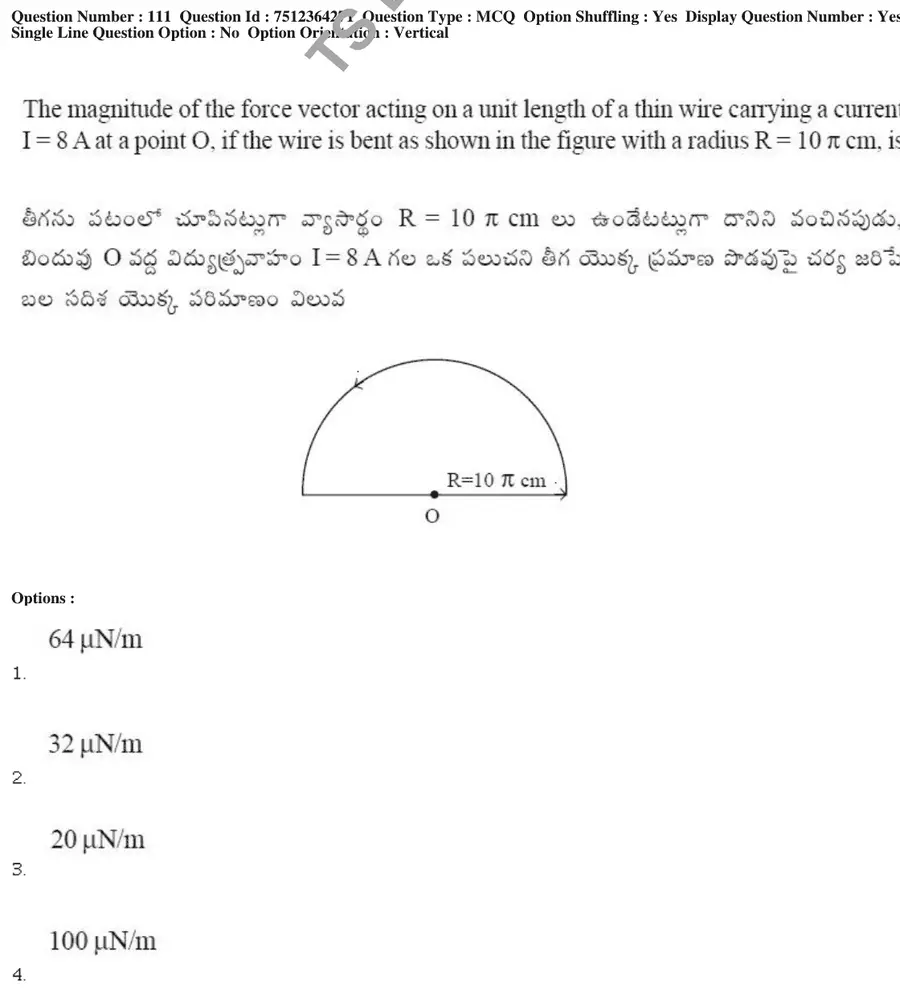
64 $\mu$N/m
32 $\mu$N/m
20 $\mu$N/m
100 $\mu$N/m
A proton accelerated by a potential difference $500\ \mathrm{kV}$ flies through a uniform transverse magnetic field $0.1\ \mathrm{T}$. The field is spread on a region of $1.0\ \mathrm{cm}$ thickness. The angle through which the proton gets deviated from its original direction is
(Proton mass $= 1.6\times10^{-27}\ \mathrm{kg}$ and charge of proton $= 1.6\times10^{-19}\ \mathrm{C}$)
$0.01\ \mathrm{rad}$
$0.1\ \mathrm{rad}$
$0.05\ \mathrm{rad}$
$0.08\ \mathrm{rad}$
A toroid has an iron core with internal magnetic field of $10\,\pi\ \mathrm{mT}$, when the current in the winding of 1500 turns per meter is $10\ \mathrm{A}$. Determine the field due to magnetization ($\mu_0 = 4\pi\times10^{-7}\ \mathrm{Hm^{-1}}$)
$(4\pi)\ \mathrm{mT}$
$(10\pi)\ \mathrm{mT}$
$\left(\dfrac{8}{\pi}\right)\ \mathrm{mT}$
$\left(\dfrac{\pi}{4}\right)\ \mathrm{mT}$
Magnetic field at the centre of a circular loop of area 'A' is 'B'. Then the magnetic moment of the loop is
($\mu_0$ - permeability of free space)
$\frac{BA^2}{\mu_0\pi}$
$\frac{BA\sqrt{A}}{\mu_0}$
$\frac{BA\sqrt{A}}{\mu_0\pi}$
$\frac{2BA\sqrt{A}}{\mu_0\sqrt{\pi}}$
A circular coil of radius $10\ \mathrm{cm}$ with 100 turns carrying a current of $0.5\ \mathrm{A}$ lies in a magnetic field of $2\ \mathrm{T}$ such that the normal drawn to the plane of the coil makes an angle '$\theta$' with the direction of the field. Work done in rotating the coil to change the angle '$\theta$' from $0^\circ$ to $180^\circ$ is
$\pi\ \mathrm{J}$
$2\pi\ \mathrm{J}$
$4\pi\ \mathrm{J}$
$8\pi\ \mathrm{J}$
The magnetic field normal to the plane of a coil of 'N' turns and radius '$r$' which carries a current '$i$' is measured on the axis of the coil at a distance '$h$' from the centre of the coil. This is smaller than the field at the centre by the fraction
$\dfrac{3h^{2}}{2r^{2}}$
$\dfrac{2h^{2}}{3r^{2}}$
$\dfrac{3r^{2}}{2h^{2}}$
$\dfrac{2r^{2}}{3h^{3}}$
A small block of mass 20 g and charge 4 mC is released on a long smooth inclined plane of inclination $45^\circ$. A uniform horizontal magnetic field of 1 T is acting parallel to the surface, as shown in the figure. The time from the start when the block loses contact with the surface of the plane is
(see the figure above)
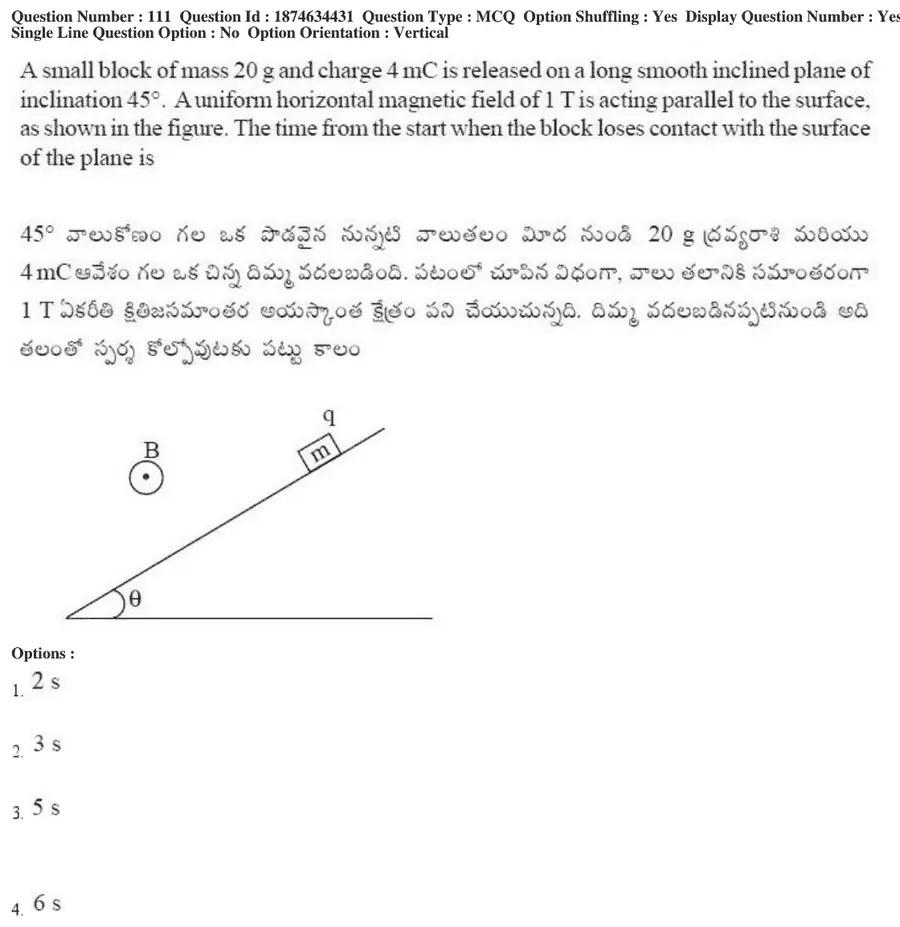
2 s
3 s
5 s
6 s
A wire of length $44\ \mathrm{cm}$ carrying a current of $2\ \mathrm{A}$ is bent and the two ends are joined. This shape is placed in a uniform magnetic field of $50\ \mathrm{mT}$. If the magnetic field is in north-south direction, then the maximum torque acting on the shape is
$1.54 \times 10^{-3}\ \mathrm{Nm}$
$0.77 \times 10^{-3}\ \mathrm{Nm}$
$3.08 \times 10^{-3}\ \mathrm{Nm}$
Zero
A toroid has a non-ferromagnetic core of inner radius $20.5\ \mathrm{cm}$ and outer radius $21.5\ \mathrm{cm}$, around which 4200 turns of a wire are wound. If the current in the wire is $10\ \mathrm{A}$, the magnetic field inside the core of the toroid is ($\mu_0 = 4\pi \times 10^{-7}\ \mathrm{Hm^{-1}}$)
$20\ \mathrm{mT}$
$40\ \mathrm{mT}$
$20\pi\ \mathrm{mT}$
$40\pi\ \mathrm{mT}$
A proton and an $\alpha$-particle are simultaneously projected in the same direction into a region of uniform magnetic field of 2 mT perpendicular to the direction of the field. After some time it is found that the velocity of proton has changed in direction by $90^\circ$. Then at this time, the angle between the velocity vectors of proton and $\alpha$-particle is
$60^\circ$
$90^\circ$
$45^\circ$
$180^\circ$
Magnetic moment due to the motion of the electron in $n^{\mathrm{th}}$ energy state of hydrogen atom is proportional to ______
$n^{-2}$
$n$
$n^2$
$n^3$
A circular coil connected to a battery of emf E produced a certain magnetic induction field at its centre. The coil is unwound, stretched to double its length rewound into a coil of $\frac{1}{3}^{\mathrm{rd}}$ of the original radius and connected to a battery of emf E' to produce same field at the centre. Then E' is
$\frac{2E}{9}$
$\frac{3E}{7}$
$\frac{9E}{4}$
$\frac{E}{6}$
Assertion (A): When a proton and a neutron enter into a transverse magnetic field with equal speeds, then they trace circular paths of equal radii.
Reason (R): In a transverse magnetic field, the period of revolution of a charged particle in a circular path is directly proportional to the mass of the partice (sic).
Both (A) and (R) are correct and (R) is the correct explanation of (A)
Both (A) and (R) are correct but (R) is not the correct explanation of (A)
(A) is correct but (R) is not correct
(A) is not correct but (R) is correct
The magnetic field at the centre C of the arrangement shown in figure is
(see the figure above)
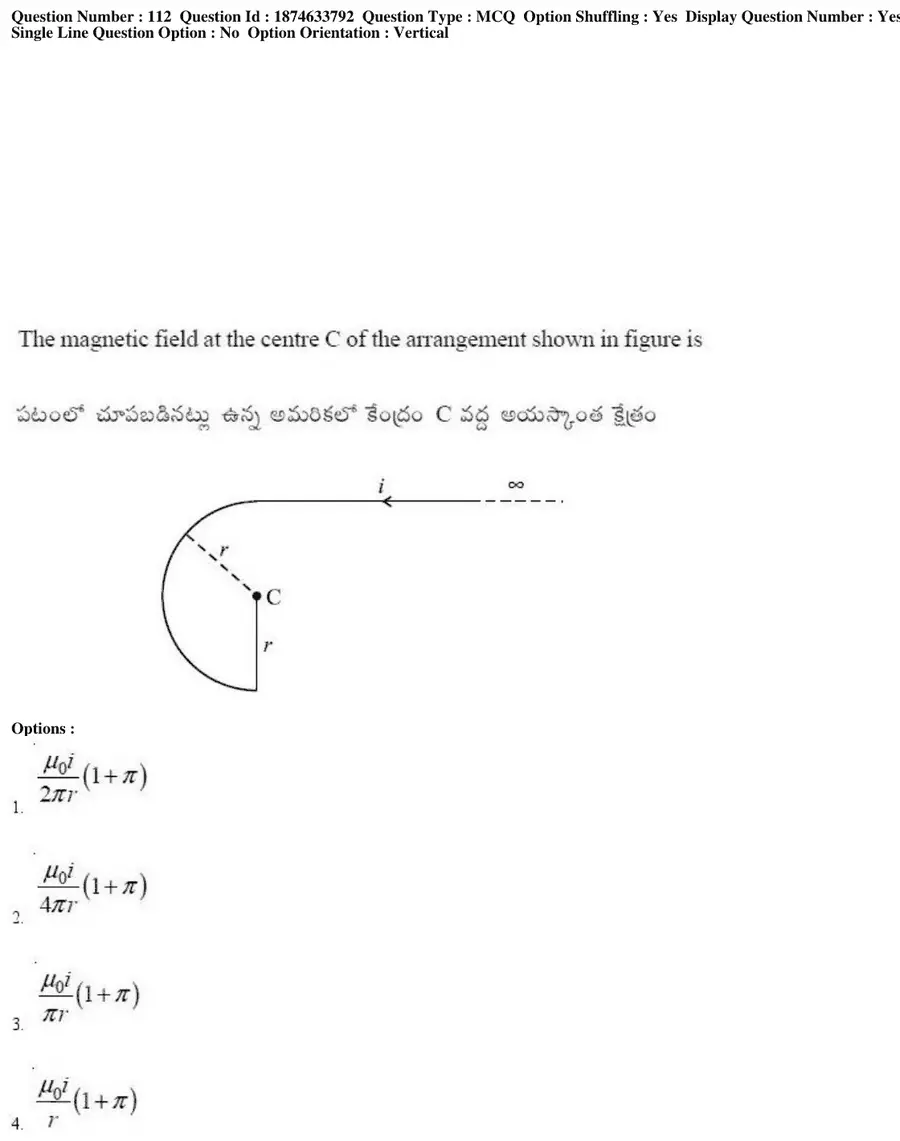
$\dfrac{\mu_0 i}{2\pi r}(1+\pi)$
$\dfrac{\mu_0 i}{4\pi r}(1+\pi)$
$\dfrac{\mu_0 i}{\pi r}(1+\pi)$
$\dfrac{\mu_0 i}{r}(1+\pi)$
An electron accelerated through a potential difference 'V', passes through a uniform transverse magnetic field and experiences a force 'F'. If the accelerating potential is increased to '2V', the electron in the same magnetic field will experience a force
$\mathrm{F}$
$\frac{\mathrm{F}}{2}$
$\sqrt{2}\,\mathrm{F}$
$2\mathrm{F}$
A coil in the shape of an equilateral triangle of side 2 cm is suspended from a vertex such that it hangs in a vertical plane between the poles of a permanent magnet producing a horizontal magnetic field of $100\times10^{-3}$ tesla. The magnetic field is parallel to the plane of the coil. For the moment of couple acting on the coil to be $2\sqrt{3}\times10^{-5}\ \mathrm{Nm}$, the current to be passed through the coil is
$0.5\ \mathrm{A}$
$1\ \mathrm{A}$
$2\ \mathrm{A}$
$4\ \mathrm{A}$
A square loop of length $L$ is placed with its edges parallel to the X-Y axes. The loop is carrying the current $I$. If the magnetic field in the region varies as $\vec{B} = B_0\left(1 + \frac{xy}{L^2}\right)\hat{k}$, then magnitude of the force on the loop will be :
$\mathrm{IB_0L}$
$\frac{\mathrm{IB_0L}}{2}$
$\frac{\mathrm{IB_0L}}{\sqrt{2}}$
$\sqrt{2}\,\mathrm{IB_0L}$
A non conducting disc of radius $R$ has surface charge density which varies with distance from the centre as $\sigma(r) = \sigma_0\left[1 + \sqrt{\frac{r}{R}}\right]$ where $\sigma_0$ is a constant. The disc rotates about its axis with angular velocity $\omega$. If $B$ is the magnitude of magnetic induction at the centre then $\frac{B}{\mu_0\sigma_0\omega R}$ will be
$\frac{3}{4}$
$\frac{4}{5}$
$\frac{5}{6}$
$\frac{6}{7}$
For a wire, as shown in the figure, carrying a current of 10 A, the magnetic induction field at the point '0' is : [ Use $\mu_0 = 4\pi\times10^{-7}$ H/m ] (see the figure above)
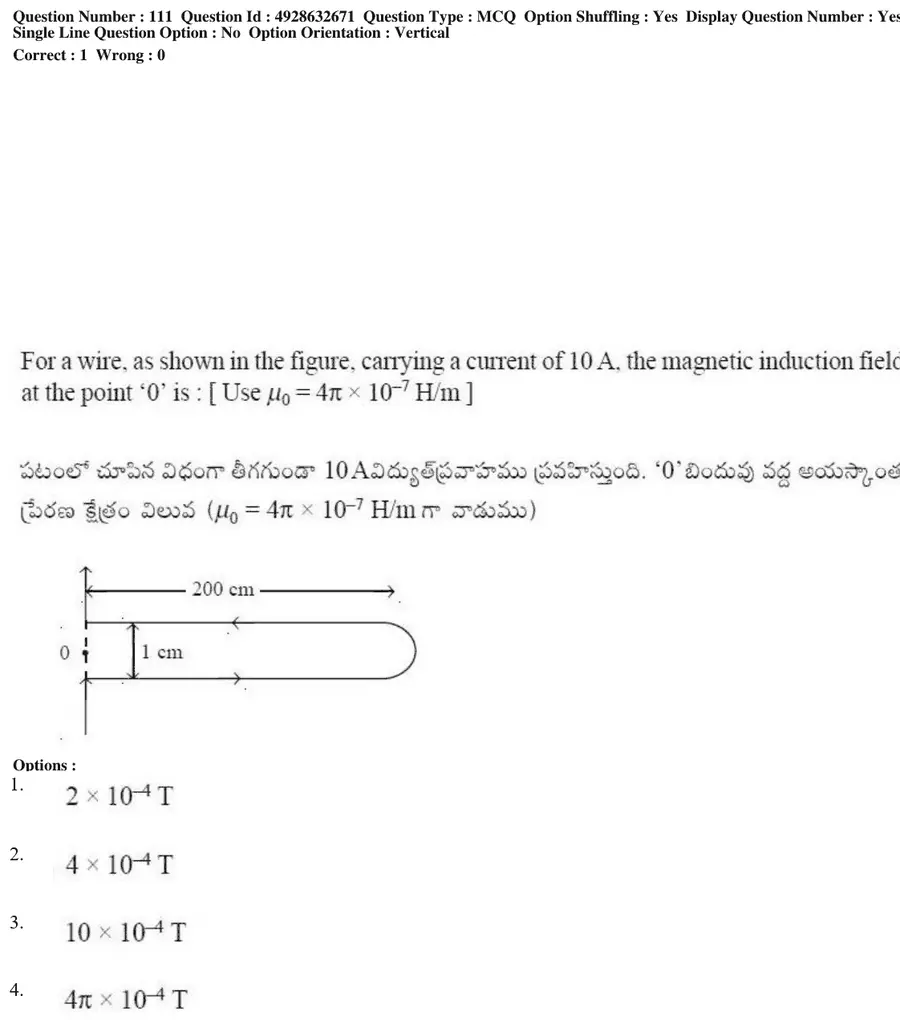
$2\times10^{-4}$ T
$4\times10^{-4}$ T
$10\times10^{-4}$ T
$4\pi\times10^{-4}$ T
A steady current $I$ flows through a wire with one end at $O$ and the other end extending upto infinity as shown in the figure. The magnetic field at a point $P$, located at a distance 'd' from $O$ is
$\dfrac{\mu_o I}{4\pi d\cos\alpha}\left(1-\sin\alpha\right)$
$\dfrac{\mu_o I}{2\pi d\cos\alpha}\left(1-\sin\alpha\right)$
$\dfrac{\mu_o I}{4\pi d}$
$\dfrac{\mu_o I}{4\pi d\sin\alpha}\left(1-\cos\alpha\right)$
The magnetic induction at point 'O' of the given infinitely long current carrying wire shown in the figure below is
$\dfrac{\mu_o I}{4\pi R}\left(1-\dfrac{3\pi}{2}\right)$
$\dfrac{\mu_o I}{2R(1+\pi)}$
$\dfrac{\mu_o I}{4\pi R}\left[1+\dfrac{3\pi}{2}\right]$
$\dfrac{\mu_o I}{4\pi R}$
Consider a current carrying wire shown in the figure. If the radius of the curved part of the wire is $R$ and the linear parts are assumed to be very long, the magnetic induction of the field at the point 'O' is
(see the figure above)
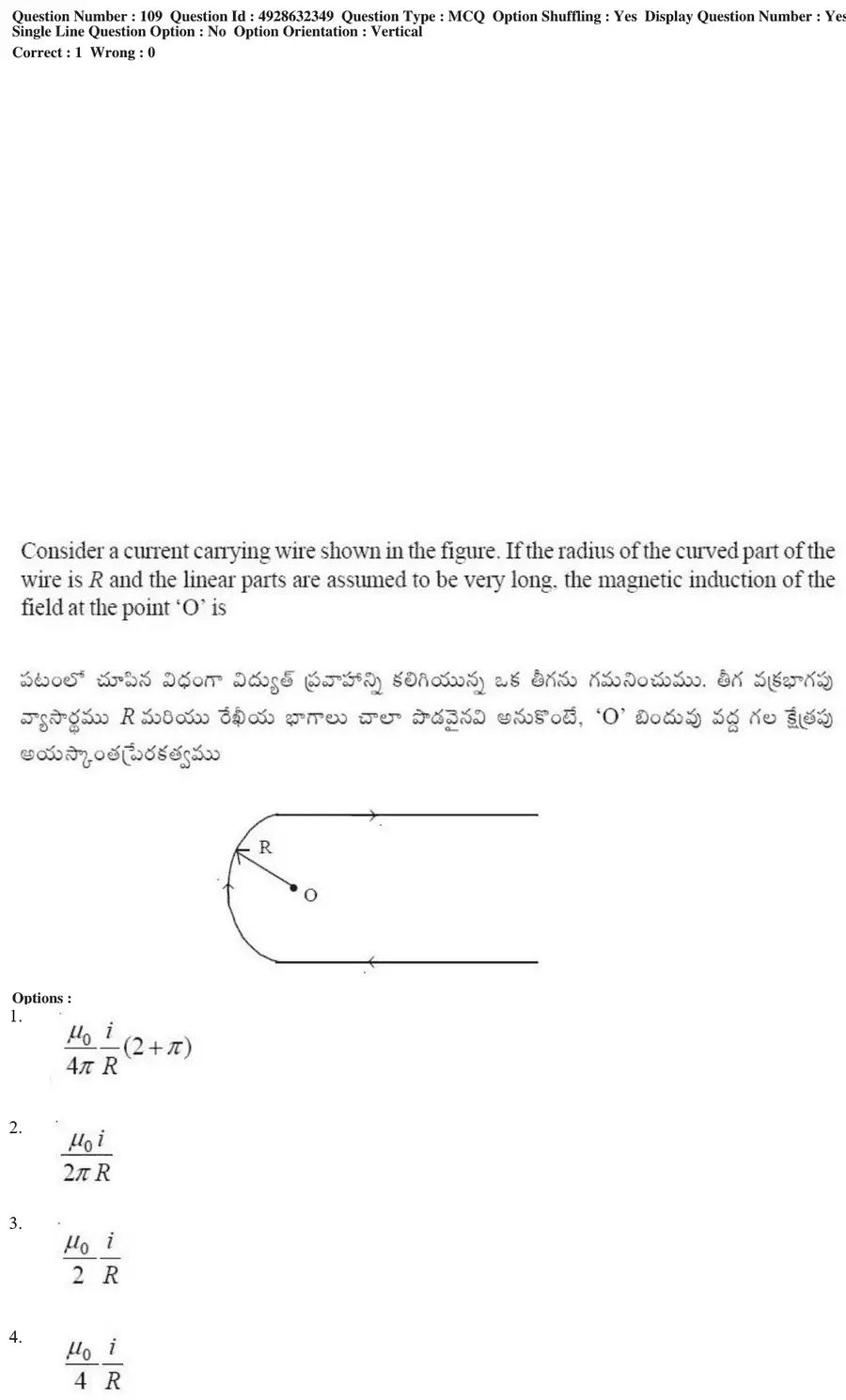
$\dfrac{\mu_0}{4\pi}\dfrac{i}{R}(2 + \pi)$
$\dfrac{\mu_0 i}{2\pi R}$
$\dfrac{\mu_0}{2}\dfrac{i}{R}$
$\dfrac{\mu_0}{4}\dfrac{i}{R}$
A charged particle moves with some initial velocity along the direction of external magnetic field $B$. Now if we apply uniform electric field perpendicular to the magnetic field, the trajectory of the charged particle will be
circle
helix
cycloid
straight line
Two circular loops $L_1$ and $L_2$ of wire carrying equal and opposite currents are placed parallel to each other with a common axis. The radius of loop $L_1$ is $R_1$ and that of $L_2$ is $R_2$. The distance between the centres of the loops is $\sqrt{3}R_1$. The magnetic field at the centre of $L_2$ shall be zero if
$R_2 = 4R_1$
$R_2 = 2R_1$
$R_2 = \sqrt{2}R_1$
$R_2 = 8R_1$
A non-conducting thin disc of radius $R$ rotates about its axis with an angular velocity $w$. The surface charge density on the disc varies with the distance $r$ from the center as $\sigma(r) = \sigma_0\left[1+\left(\frac{r}{R}\right)^{\beta}\right]$, where $\sigma_0$ and $\beta$ are constants. If the magnetic induction at the center is $B = \left(\frac{9}{10}\right)\mu_0\sigma_0 w R$, the value of $\beta$ is
$\frac{1}{4}$
4
$\frac{1}{2}$
2
Magnetic Effects of Current ranks as the third largest chapter in the physics curriculum for Class 12. Across the AP and TS EAPCET papers held in our archive between 2022 and 2026, the chapter contributed 150 questions across 77 papers. That yields an average rate of 1.9 questions per paper, making up 4.9% of all physics questions in that recent window. Taking in all years in our archive from 2010 to 2026, Magnetic Effects of Current provided 285 questions across 149 papers, maintaining an average of 1.9 questions per paper and a 4.8% subject share. Across the earlier testing period from 2010 to 2021, our archive records 135 questions across 72 papers (4.7% share). In the last three exam years from 2024 to 2026, the chapter delivered 90 questions across 46 papers, registering a 4.9% share. Comparing the last three years to early papers, the chapter's share of the subject is about the same, and compared to the recent five-year window it is also about the same.
State-wise breakdowns show very similar emphasis across regional papers. AP EAPCET papers between 2022 and 2026 contributed 92 questions across 48 papers in our set (1.9 per paper, 4.8% share). TS EAPCET contributed 58 questions across 29 papers in our set (2.0 per paper, 5.0% share). Magnetic Effects of Current has appeared every year since 2022 and was asked in every single paper across both states in the recent five-year window. The chapter ranks 3rd of 28 physics chapters by question share between 2022 and 2026. The busiest single sitting in our collection was 2020, which delivered 36 questions across 18 papers.
Questions fall into three major areas:
Biot-Savart field superpositions provide a constant source of numerical problems. A classic question presents a wire carrying current bent into circular arcs, semicircles, or polygons (such as squares or regular hexagons) with straight leads, asking students to calculate the net magnetic induction vector at the geometric center. Another standard setup examines an atomic electron or orbiting charged particle, asking for the equivalent orbital magnetic field generated at the orbit center.
Force and trajectory problems form the other main pillar. Examiners frequently project a charged particle into a uniform magnetic field at an oblique angle θ, asking for the radius of curvature, orbital time period, or the axial pitch of the resulting helix. Moving coil galvanometer problems test conversion into multi-range ammeters or voltmeters using series multipliers or parallel shunts, or evaluate torque on rectangular and hexagonal current loops placed in uniform magnetic fields.
Start by mastering field formulas from the Biot-Savart law. For a circular loop of radius R carrying current I, the on-axis magnetic field at distance x from the center is B = μ_zero I R² / [two (R² + x²)^(3/2)]. At the center where x = zero, this simplifies to B = μ_zero I / (two R). For an arc subtending angle θ radians at its center, B = μ_zero I θ / (four π R). For an infinitely long straight wire at perpendicular distance d, B = μ_zero I / (two π d).
Next, master the dynamics of charges in magnetic fields. The magnetic Lorentz force is F = q (v × B). When velocity v is perpendicular to uniform field B, the charge traces a circle of radius r = m v / (q B) = p / (q B) = √(two m K) / (q B). The period T = two π m / (q B) is notably independent of speed and radius. When velocity makes angle θ with field lines, the perpendicular component v sin θ provides circular motion while the parallel component v cos θ provides axial drift, giving helical pitch p = v cos θ × T = (two π m v cos θ) / (q B).
Finally, study forces on conductors and current loops. The force on a straight segment of length L carrying current I is F = I (L × B). The magnetic moment of a planar loop of N turns enclosing area A is M = N I A. The torque on the dipole is τ = M × B = M B sin θ, and its potential energy is U = - M · B = - M B cos θ.
Yes. In the papers we hold from 2022 to 2026, Magnetic Effects of Current appeared in every single paper across both AP and TS EAPCET, averaging nearly two questions per shift.
As the speed of the particle increases, the orbital radius expands in direct proportion to momentum, so the path length and speed scale equally, keeping the time period T = two π m / (q B) constant.
Two parallel wires separated by distance d carrying currents I₁ and I₂ exert a mutual magnetic force per unit length of f = μ_zero I₁ I₂ / (two π d), which is attractive for parallel currents and repulsive for antiparallel currents.
Step-by-step solutions for each one are in the EdLoop EAPCET app.