An inductor of inductance 5 henry is carrying an electric current of $4\ mA$. Then the energy stored in the inductor is
- A
$50\ \mu J$
- B
$1000\ \mu J$
- C
$40\ \mu J$
- D
$20\ \mu J$
Answer: (C) $40\ \mu J$ · The council's preliminary key
 PYQs · free, no adsOpen on the web (app.edloop.in)Get EdLoop – free on Google Play
Every Electromagnetic Induction question from past AP EAPCET and TS EAPCET papers, with options and answers. Newest first.
Electromagnetic Induction serves as an indispensable bridge connecting magnetic fields with alternating currents in Class 12 physics. Across AP and TS EAPCET papers spanning 2022 to 2026, the chapter contributed 86 questions across 77 papers.
Attempt every Electromagnetic Induction question timed, see the step-by-step solution and track what you get wrong. Free.
An inductor of inductance 5 henry is carrying an electric current of $4\ mA$. Then the energy stored in the inductor is
$50\ \mu J$
$1000\ \mu J$
$40\ \mu J$
$20\ \mu J$
The ratio of the turns per unit length in two inductors is $2:1$. Then the ratio of the impedances produced by the inductors is
$2$
$4$
$1/2$
$1/4$
A circular coil of radius 8 cm, 400 turns and resistance $2\Omega$ is placed with its plane perpendicular to the horizontal component of the earth's magnetic field. It is rotated about its vertical diameter through $180^0$ in 0.30 sec. Horizontal component of the earth's magnetic field at the place is $3 \times 10^{-5}$ T. The magnitude of current induced in the coil is approximately
$4 \times 10^{-2}$ A
$8 \times 10^{-4}$ A
$8 \times 10^{-2}$ A
$1.92 \times 10^{-3}$ A
A metal sheet is placed in a magnetic field whose magnitude changes from zero to maximum. The direction of eddy currents produced in the plate is shown in the figure. Then the direction of magnetic field is
(see the figure above)
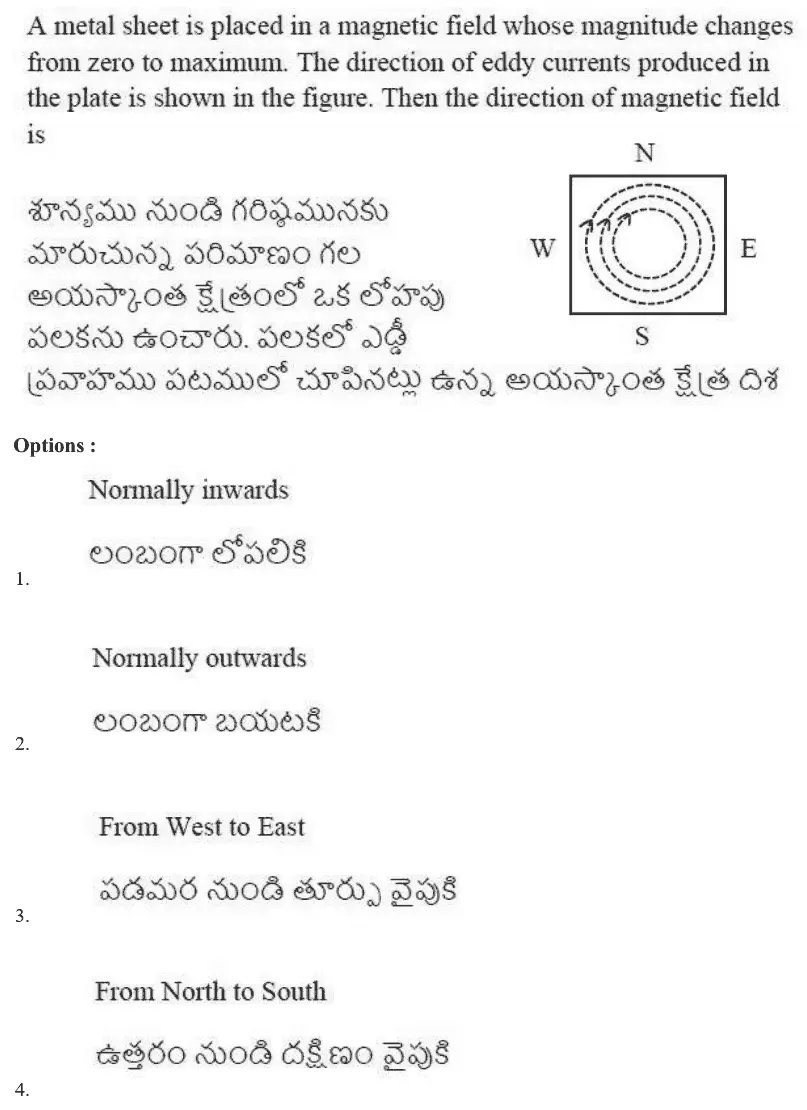
Normally inwards
Normally outwards
From West to East
From North to South
A current carrying loop is placed perpendicular to the direction of a uniform magnetic field of 40 mT. If the radius of the loop decreases at constant rate of $1.4\ \mathrm{mm\ s^{-1}}$, the induced emf when the radius of the loop becomes 2.5 cm is
$6.6\ \mu\mathrm{V}$
$2.2\ \mu\mathrm{V}$
$4.4\ \mu\mathrm{V}$
$8.8\ \mu\mathrm{V}$
In a coil the current varies from $-3\mathrm{A}$ to $+3\mathrm{A}$ in 4s, and induces an emf 0.2V. The self-inductance of the coil is
0.133 H
0.266 H
0.65 H
0.532 H
A loop moves towards a stationary magnet at constant speed $V$ resulting an induced $emf$ $E$ within the loop. If the magnet also moves away from the loop at the same speed $V$, the new induced $emf$ in the loop is
$E$
$\frac{E}{2}$
$2E$
$0$
A 2 m long solenoid with diameter 2 cm and 2000 turns has a secondary coil of 1000 turns wound closely near its midpoint. The mutual inductance between the two coils is
$2.4 \times 10^{-4}$ H
$3.9 \times 10^{-4}$ H
$1.28 \times 10^{-3}$ H
$3.14 \times 10^{-3}$ H
In a coil of resistance $10\,\Omega$, the induced current developed by changing magnetic flux through it is shown in figure as a function of time. The magnitude of charge in flux through the coil in weber is
(see the figure above)
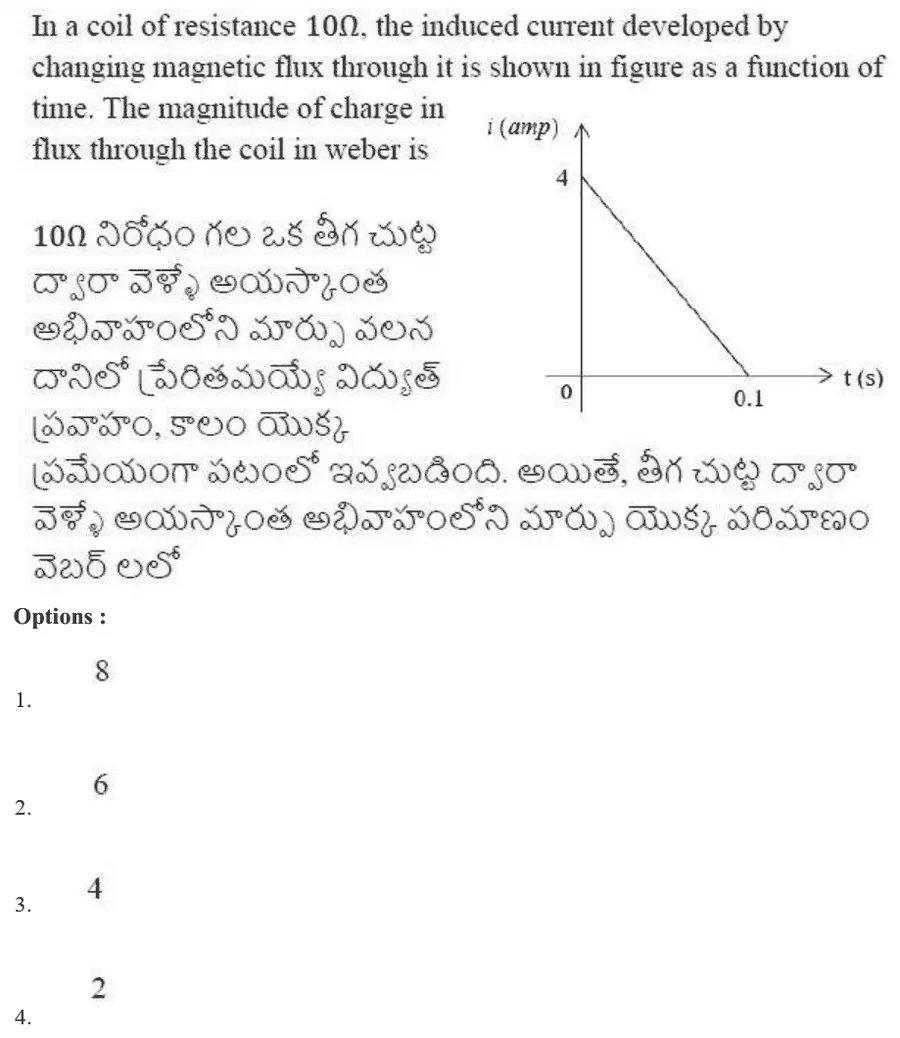
8
6
4
2
The current I in an induction coil is varying with time t as shown in the figure. Which one of the following graphs shows the variation of voltage in the coil with time?
(see the figure above)
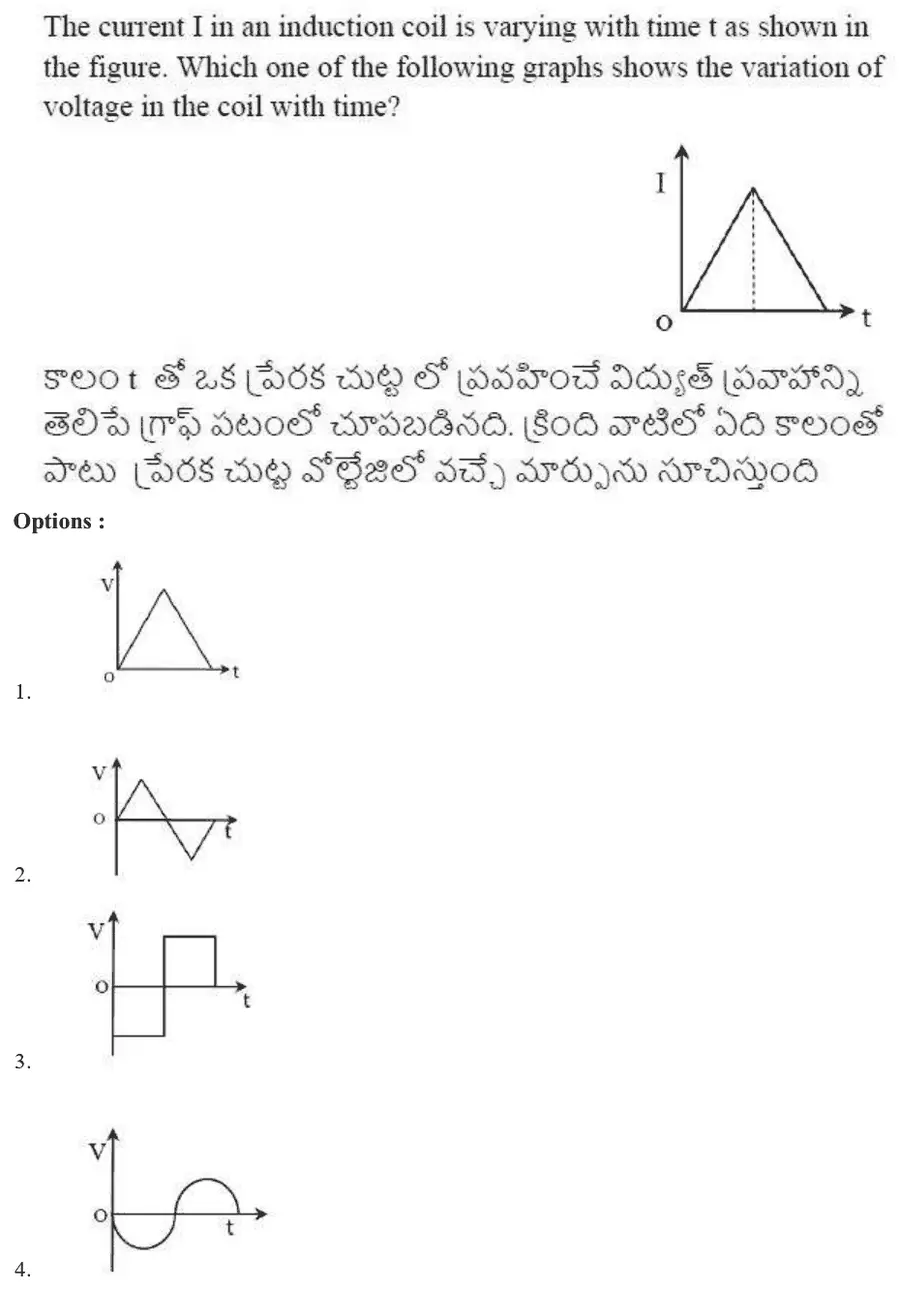
see figure V–t graph: a triangular pulse starting at the origin O, rising linearly to a peak and falling linearly back to the t-axis, entirely above the axis.
see figure V–t graph: the origin O is on the t-axis. A line rises linearly from O to a positive peak, then falls linearly through the axis to a negative trough of about the same size, then rises back to the axis (a triangular/zigzag wave: positive peak then negative peak).
see figure V–t graph: a square wave. For the first half the voltage is constant and negative (below the t-axis); for the second half it is constant and positive (above the t-axis) with the same magnitude.
see figure V–t graph: a sine-like curve. It starts at O on the t-axis, dips down in a negative half-cycle, then rises through the axis into a positive half-cycle and returns to the axis at t.
A pure inductor of inductance 3 H (negligible resistance) is connected to a time-varying voltage source such that v(t) = 4t volts. Here, $t$ is in seconds. If the voltage is applied at $t = 0$, calculate the energy stored in the inductor after 3 s.
24 J
36 J
48 J
54 J
The magnetic flux ($\phi$ in weber) linked with a coil varies with time (t in second) as per the equation $\phi = 2.5t^2 + 5t + 7$. If the induced electric power in the coil at a time 3 s is 2 W, then the induced electric power in the coil at a time 5 s is
5.5 W
3.5 W
2.5 W
4.5 W
If the current passing through a coil of self-inductance $50$ mH having $50$ turns is $5$ A, then the magnetic flux linked with the coil (in $10^{-3}$ Wb) is
5
20
10
250
In the given figure, the directions of induced current in a square loop as it enters and leaves a uniform magnetic field respectively are
(see the figure above)
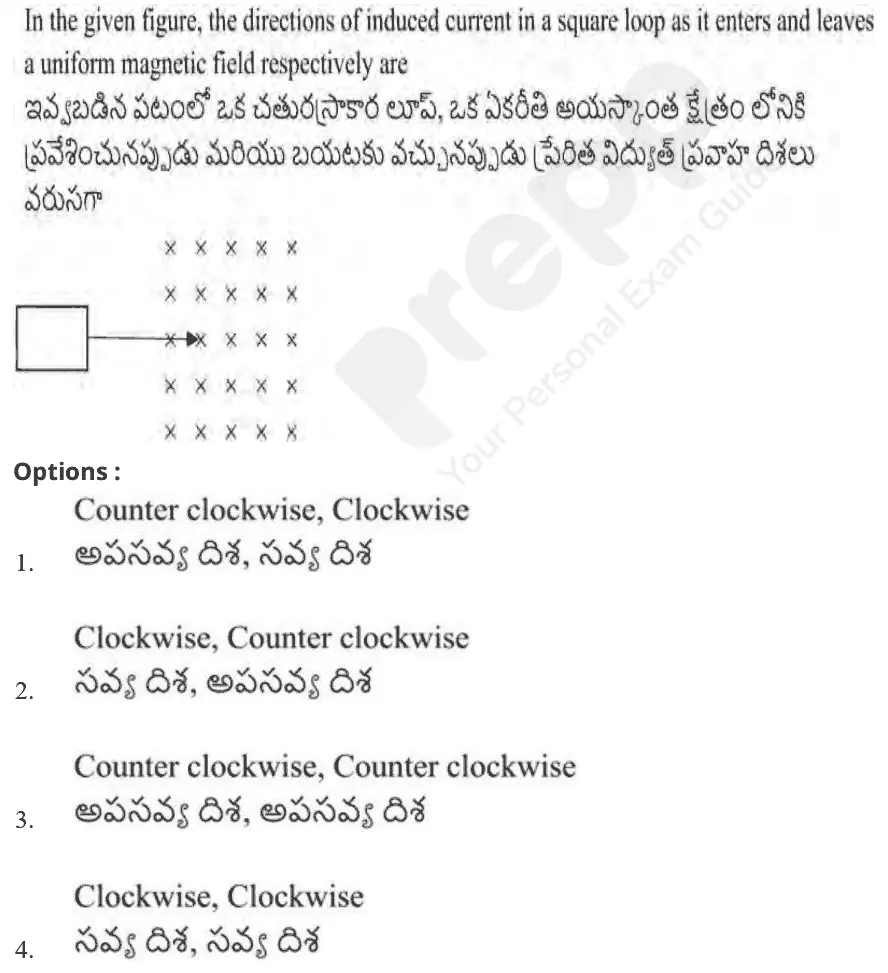
Counter clockwise, Clockwise
Clockwise, Counter clockwise
Counter clockwise, Counter clockwise
Clockwise, Clockwise
If the energy stored in an inductor is 18 mJ when a current of 3 A is passed through it, then the magnetic flux linked with the inductor is
36 mWb
24 mWb
18 mWb
12 mWb
The magnetic energy stored per unit volume in a solenoid with 1000 turns per metre carrying a current of 0.7 A is
$0.154\ \mathrm{J\,m^{-3}}$
$0.616\ \mathrm{J\,m^{-3}}$
$0.308\ \mathrm{J\,m^{-3}}$
$0.924\ \mathrm{J\,m^{-3}}$
An LC circuit with negligible resistance containing a 20 mH inductor and a 50 $\mu$F capacitor with an initial charge of 10 mC is closed at t = 0. Then the minimum time taken (in $\mu$s) for the total energy to be shared equally between the inductor and capacitor is
$375\pi$
$125\pi$
$500\pi$
$250\pi$
If a conducting rod of length 100 cm rotates about one of its ends with a constant frequency of 14 revolutions per second in a plane perpendicular to a uniform magnetic field of 2 T, then the induced emf between the two ends of the rod is
144 V
88 V
122 V
230 V
A coil having 100 square loops each of side 10 cm is placed such that its plane is normal to a magnetic field, which is changing at a rate of $0.7\ \mathrm{T\,s^{-1}}$. The emf induced in the coil is
0.2 V
0.4 V
0.7 V
1 V
The self inductance of an air-cored solenoid of length 40 cm, diameter 7 cm having 200 turns is nearly
$484\ \mu\mathrm{H}$
$242\ \mu\mathrm{H}$
$121\ \mu\mathrm{H}$
$968\ \mu\mathrm{H}$
When current in a coil changes from 2 A to 5 A in a time of 0.3 s, if the emf induced in the coil is 40 mV, then the self inductance of the coil is
4 H
4 mH
40 mH
4 $\mu$H
A coil of resistance $200\,\Omega$ is placed in a magnetic field. If the magnetic flux $\phi$ (in weber) linked with the coil varies with time 't' (in second) as per the equation $\phi = 50t^2 + 4$, then the current induced in the coil at a time t = 2 s is
2 A
1 A
0.5 A
0.1 A
If a wheel with 24 metallic spokes each 40 cm long is rotated with a speed of 180 rev/min in a plane normal to the horizontal component of earth’s magnetic field, the emf induced between the axle and the rim of the wheel is E. If the number of spokes is made 12 and the wheel is rotated with a speed of 90 rev/min in the same field, the induced emf is
E
2E
4E
0.5E
When a current of 4 mA passes through an inductor, if the flux linked with it is $32\times10^{-6}\ \mathrm{T\,m^2}$, then the energy stored in the inductor is
$64\times10^{-9}\ \mathrm{J}$
$32\times10^{-9}\ \mathrm{J}$
$128\times10^{-9}\ \mathrm{J}$
$96\times10^{-9}\ \mathrm{J}$
A coil of 45 turns and radius 4 cm is placed in a uniform magnetic field such that its plane is perpendicular to the direction of the field. If the magnetic field increases from 0 to 0.70 T at a constant rate in a time interval of 220 s, then the induced emf in the coil is
0.32 mV
0.50 mV
0.72 mV
0.96 mV
A metallic disc of radius $0.3$ m is rotating with a constant angular speed of $60$ rad s$^{-1}$ in a plane perpendicular to a uniform magnetic field of $5 \times 10^{-2}$ T. The emf induced between a point on the rim and centre of the disc is
0.06 V
0.612 V
1.35 V
0.135 V
If the magnetic field inside a solenoid is B, then the magnetic energy stored in it per unit volume is
(c - speed of light in vacuum and $\varepsilon_0$ is permittivity of free space)
$\varepsilon_0 c^2 B^2$
$\frac{\varepsilon_0 c^2 B^2}{2}$
$2\varepsilon_0 c^2 B^2$
$\frac{\varepsilon_0 c^2 B^2}{4}$
The resonant frequency of an LC circuit is $f_0$. If a dielectric slab of constant 16 is inserted completely between the plates of the capacitor, then the resonant frequency is
$\frac{f_0}{2}$
$2f_0$
$\frac{f_0}{4}$
$4f_0$
A horizontal telegraph wire of length 30 m spread east to west fell down freely from a height of 20 m. If the resistance of the wire is $40\,\Omega$ and the horizontal component of the earth's magnetic field at the place is $2 \times 10^{-5}$ T, then the induced current when the wire reaches the ground is
(Acceleration due to gravity = $10\ \mathrm{m\,s^{-2}}$)
0.3 mA
3 mA
3 A
0.03 A
The radius of a coil of N turns is R. If the plane of the coil is placed parallel to a uniform magnetic field B, then the flux linked with the coil is
$\pi BNR^2$
$2\pi BNR^2$
$\frac{\pi BNR^2}{2}$
Zero
A coil of resistance $16\ \Omega$ is placed with its plane perpendicular to a uniform magnetic field whose flux ($\phi$ in $10^{-3}$ weber) changes with time (t in second) as $\phi = 5t^2 + 4t + 2$. The induced current at time $t = 6$ seconds is
4 mA
2.12 mA
34 mA
74 mA
The small energy losses in transformers due to eddy currents can be reduced by
winding the primary and secondary coils one over the other
using thick wire
using a laminated core
using magnetic material with low hysteresis loss
A circular coil of area $3\times10^{-2}\ \mathrm{m^2}$, 900 turns and a resistance of $1.8\ \Omega$ is placed with its plane perpendicular to a uniform magnetic field of $3.5\times10^{-5}\ \mathrm{T}$. The current induced in the coil when it is rotated through $180^\circ$ in half a second is
$2.1\ \mathrm{mA}$
$1.8\ \mathrm{mA}$
$1.5\ \mathrm{mA}$
$2.7\ \mathrm{mA}$
An emf of 2.8 mV is induced in a rectangular loop of area $150\ \mathrm{cm}^2$ when the current in the loop changes from 3 A to 8 A in a time of 0.2 s. Then the self-inductance of the loop is
$112\ \mu\mathrm{H}$
$56\ \mu\mathrm{H}$
$28\ \mu\mathrm{H}$
$84\ \mu\mathrm{H}$
The plane of a circular coil of resistance $7.5\ \Omega$ is placed perpendicular to a uniform magnetic field. The flux $\phi$ (in weber) through the coil varies with time t (in second) as $\phi = 2t^2 + 3t - 2$. The induced power in the coil at time $t = 3\,\mathrm{s}$ is
7.5 W
15 W
30 W
20 W
A coil of resistance $8\ \Omega$, number of turns 250 and area $120\ \mathrm{cm^2}$ is placed in a uniform magnetic field of 2 T such that the plane of the coil makes an angle of $\frac{\pi}{6}$ with the direction of the magnetic field. In a time of 100 ms, the coil is rotated until its plane becomes parallel to the direction of the magnetic field. The current induced in the coil is
5.25 A
3.75 A
2.75 A
1.25 A
In a circuit the current falls from 14 A to 4 A in a time 0.2 ms. If the induced emf is 150 V, then the self inductance of the circuit is
6 H
6 mH
3 mH
3 H
A coil of inductance L is divided into 6 equal parts. All these parts are connected in parallel. The resultant inductance of this combination is
$\frac{L}{6}$
$\frac{L}{36}$
$\frac{L}{24}$
$6L$
A metallic wire loop of side ($l$) $0.1$ m and resistance of $1\Omega$ is moved with a constant velocity in a uniform magnetic field of $2\ \mathrm{Wm^{-2}}$ as shown in the figure. The magnetic field is perpendicular to the plane of the loop. The loop is connected to a network of resistors. The velocity of loop so as to have a steady current of $1\ mA$ in loop is
(see the figure above)
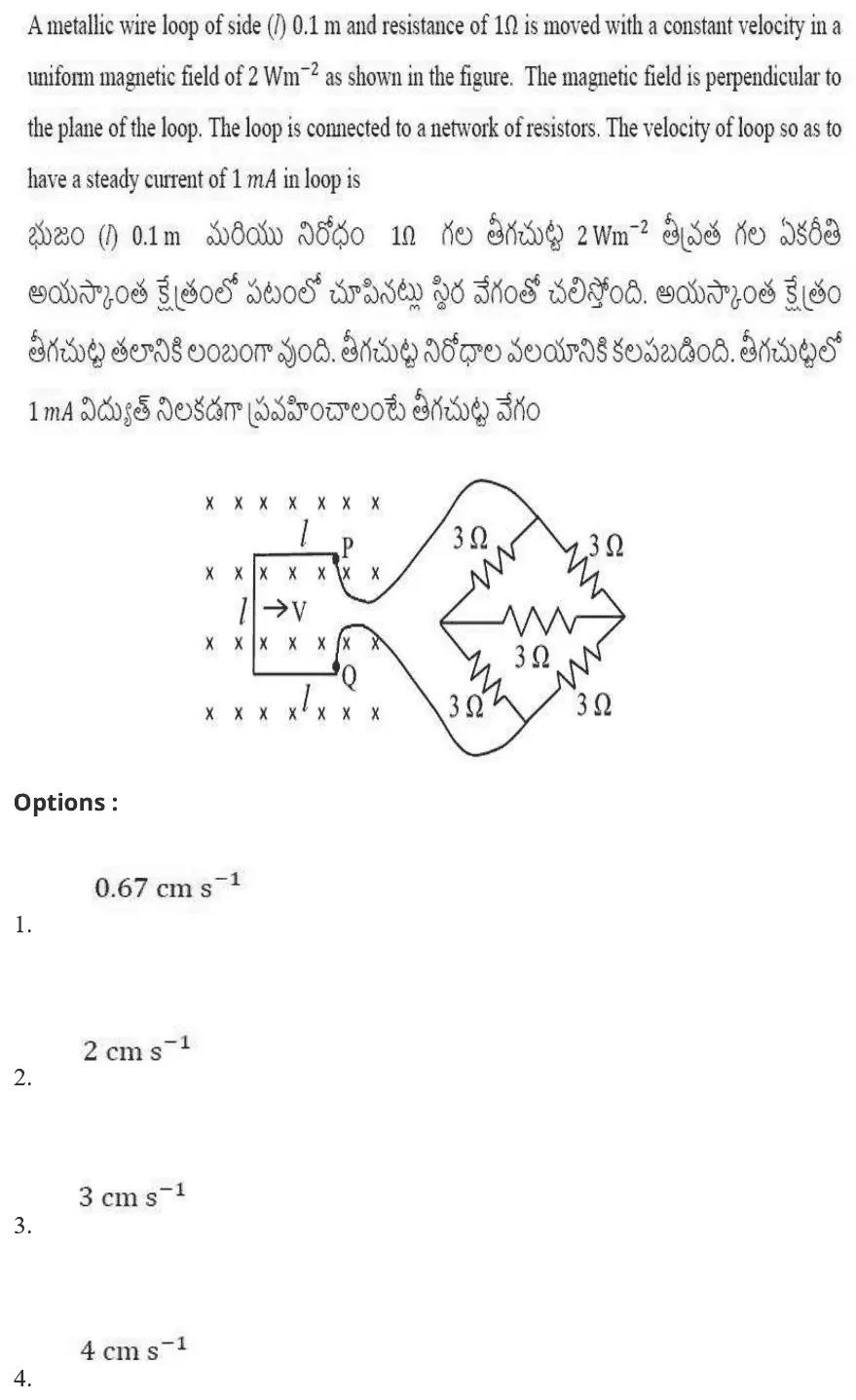
$0.67\ \mathrm{cm\ s^{-1}}$
$2\ \mathrm{cm\ s^{-1}}$
$3\ \mathrm{cm\ s^{-1}}$
$4\ \mathrm{cm\ s^{-1}}$
X and Y are two circuits having coefficient of mutual inductance $3\ \mathrm{mH}$ and resistances $10\ \Omega$ and $4\ \Omega$ respectively. To have induced current $60 \times 10^{-4}\ \mathrm{A}$ in circuit Y, the amount of current to be changed in circuit X in $0.02$ sec is
$1.6\ \mathrm{A}$
$0.16\ \mathrm{A}$
$0.32\ \mathrm{A}$
$3.2\ \mathrm{A}$
Two figures are shown as Fig. A and Fig. B. The time constant of Fig. A is $\tau_A$ and time constant of Fig. B is $\tau_B$. Then
(see the figure above)
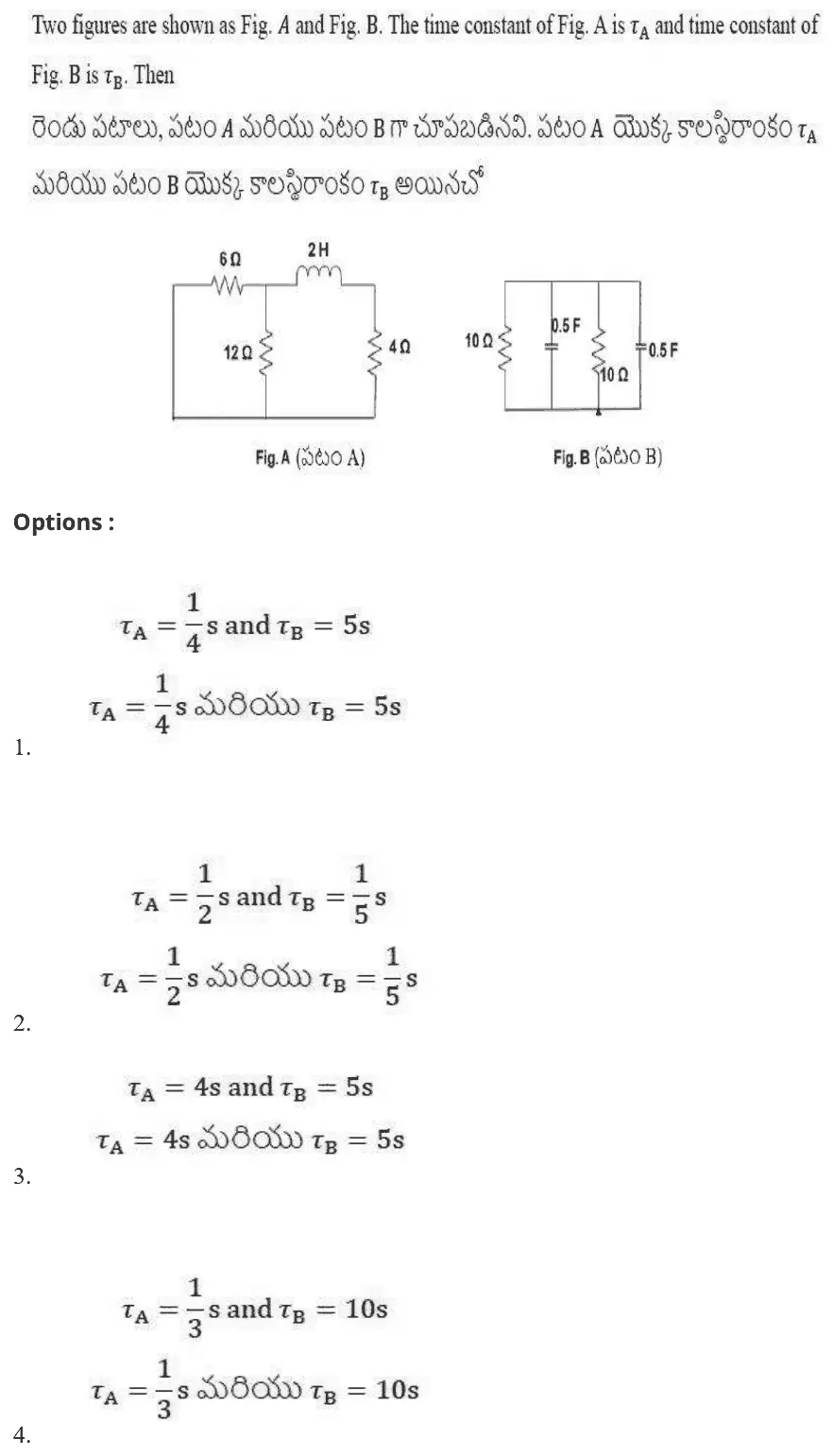
$\tau_A = \frac{1}{4}\mathrm{s}$ and $\tau_B = 5\mathrm{s}$
$\tau_A = \frac{1}{2}\mathrm{s}$ and $\tau_B = \frac{1}{5}\mathrm{s}$
$\tau_A = 4\mathrm{s}$ and $\tau_B = 5\mathrm{s}$
$\tau_A = \frac{1}{3}\mathrm{s}$ and $\tau_B = 10\mathrm{s}$
The current passing through a coil of 120 turns and inductance 40 mH is 30 mA. The magnetic flux linked with the coil is
$20 \times 10^{-6}$ Wb
$5 \times 10^{-6}$ Wb
$12 \times 10^{-6}$ Wb
$10 \times 10^{-6}$ Wb
When two coaxial coils having same current in same direction are brought to each other, then the value of current in both the coils
Increases
Decreases
Remains same
Increases in one coil and decreases in other coil
The ratio of the number of turns per unit length of two solenoids A and B is 1:3 and the lengths of A and B are in the ratio 1:2. If the two solenoids have same cross sectional area, the ratio of the self inductances of the solenoids A and B is
1:12
1:6
1:18
1:9
Magnetic field at a distance of r from z axis is $B = B_0 rt\hat{k}$ present in the region. '$B_0$' is constant and 't' is time. The magnitude of induced electric field at a distance of r from z-axis is.
$\frac{B_0 r^3}{3}$
$\frac{2\pi B_0 r}{3}$
$\frac{B_0 r^2}{2\pi}$
$\frac{B_0 r^2}{3}$
If the current through an inductor increases from 2 A to 3 A, the magnetic energy stored in the inductor increases by
125%
225%
50%
75%
The energy stored in a coil of inductance 80 mH carrying a current of 2.5 A is
1.25 J
0.75 J
0.25 J
0.50 J
The mutual inductance of two coils is 8 mH. The current in one coil changes according to the equation $I = 12\sin 100\,t$, where 'I' is in ampere and 't' is time in second. The maximum value of emf induced in the second coil is
9.6 V
4.8 V
3.2 V
12.8 V
Two circular coils of radii $r_1$ and $r_2$ ($r_1 \ll r_2$) are placed coaxially with their centers coinciding. The mutual inductance of the arrangement is
$\dfrac{\mu_0 \pi r_2^2}{2 r_1}$
$\dfrac{\mu_0 \pi r_1 r_2}{2(r_1+r_2)}$
$\dfrac{\mu_0 \pi r_1^2}{2 r_2}$
$\dfrac{\mu_0 \pi (r_1+r_2)}{2 r_1 r_2}$
A train with an axle of length $1.66$ m is moving towards north with a speed of $90\ \mathrm{kmh^{-1}}$. If the vertical component of the earth's magnetic field is $0.2\times10^{-4}$ T, the emf induced across the ends of the axle of the train is
$16.6$ mV
$1.66$ mV
$0.83$ mV
$8.3$ mV
The natural frequency of an LC circuit is 120 kHz. When the capacitor in the circuit is totally filled with a dielectric material, the natural frequency of the circuit decreases by 20 kHz. Dielectric constant of the material is
3.33
1.44
2.12
1.91
The shiny metal disk in the electric power meter (analog type) rotates due to
temperature change
eddy currents
an external motor
pressure change
If B is magnetic field and q is the charge then the following represents the Gauss’s law of magnetism
$\int \vec{B}\cdot d\vec{s} = 0$
$\int \vec{B}\cdot d\vec{s} = q$
$\int \vec{B}\cdot d\vec{s} = 4\pi$
$\int \vec{B}\cdot d\vec{s} = \mu_o q$
A circular coil of radius 10 cm and resistance of $2\ \Omega$ is placed with its plane perpendicular to the horizontal component of the earth's magnetic field. It is rotated about its vertical diameter through $180^\circ$ in 0.25 s. If the magnitude of the induced emf is $3.8\times10^{-3}\ \mathrm{V}$, then the number of turns of the coil is
(Horizontal component of earth's magnetic field at the place is $3\times10^{-5}\ \mathrm{T}$)
504 turns
458 turns
302 turns
608 turns
The self-inductance of a long solenoid of cross-sectional area A, length $l$ and n turns per unit length is given by
$\mu_o nAl$
$\mu_o n^2 Al$
$\mu_o n^2 A^2 l$
$\mu_o n^2 \pi A^2 l$
Physically, the self-inductance plays the role of
inertia
kinetic energy
potential energy
velocity
The total emf induced in a closely wound coil of N turns in which the magnetic flux linked with the coil changing at the rate $\frac{d\phi_B}{dt}$ is
$-N\frac{d\phi_B}{dt}$
$N\frac{d\phi_B}{dt}$
$-N\frac{d^2\phi_B}{dt^2}$
$-\frac{d\phi_B}{dt}$
When the current through an inductor is changed at from $2\ \mathrm{A}$ to $6\ \mathrm{A}$ in time $2\ \mathrm{s}$, emf induced in it is $3\ \mathrm{V}$. Then the inductance of the inductor is
$1.4\ \mathrm{H}$
$0.8\ \mathrm{H}$
$1.5\ \mathrm{H}$
$0.6\ \mathrm{H}$
The Lenz law is associated with
law of conservation of charge.
law of conservation of mass.
law of conservation of angular momentum.
law of conservation of energy.
Metal detector works on the principle of
Ohm's law
Coulomb's law
Electromagnetic induction
Stefan's law of radiation
A copper disc of radius 0.1 m rotates about an axis passing through its centre and perpendicular to its plane with 10 revolutions per second in a uniform transverse magnetic field of 0.1 T. The emf induced across the radius of the disc is
$\frac{\pi}{10}\ \mathrm{V}$
$\frac{2\pi}{10}\ \mathrm{V}$
$10\pi\ \mathrm{mV}$
$20\pi\ \mathrm{mV}$
A conducting rod is moving towards right with a velocity ‘V’ in a uniform magnetic field ‘B’.
If the direction of induced current ‘i’ is as shown in the figure, then the direction of ‘B’ is
(see the figure above)
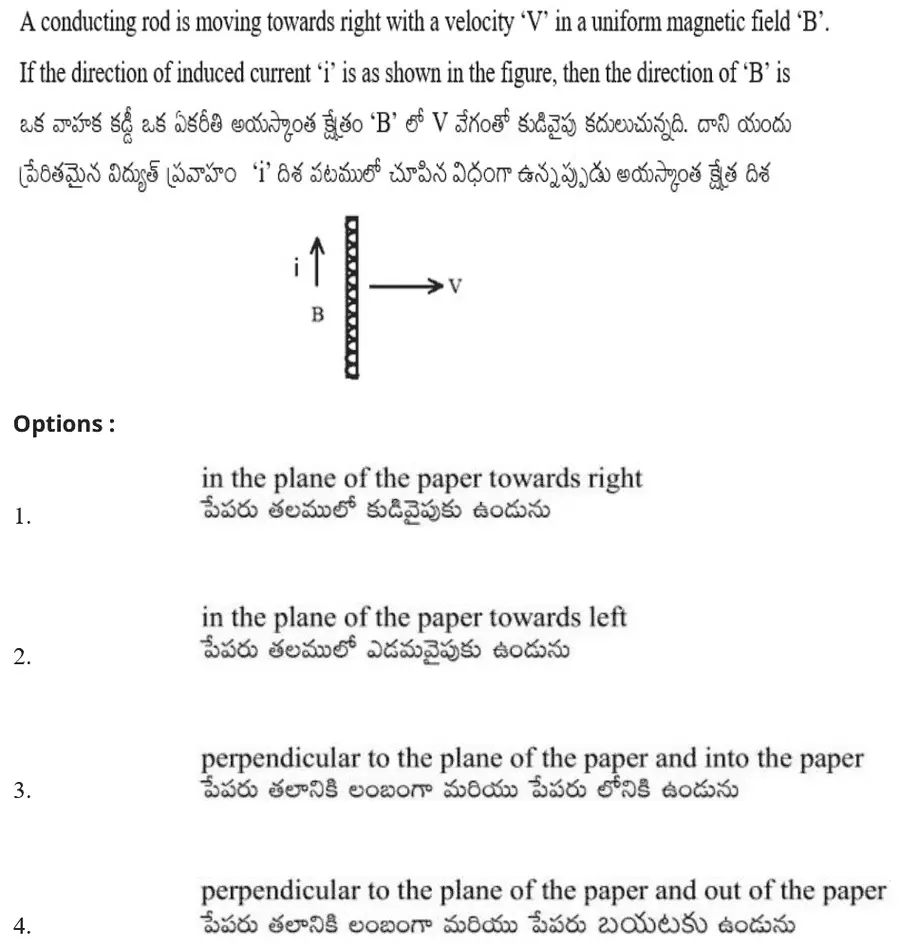
in the plane of the paper towards right
in the plane of the paper towards left
perpendicular to the plane of the paper and into the paper
perpendicular to the plane of the paper and out of the paper
The expression for the magnetic energy stored in a solenoid of length L, in terms of magnetic field B and area A is
$\frac{1}{2\mu_0}B^2AL$
$\frac{1}{2\epsilon_0}B^2AL$
$\frac{1}{2\mu_0}BA^2L$
$\frac{1}{2\epsilon_0}BA^2L$
An aeroplane is travelling horizontally towards west with a speed of $540\ \mathrm{kmh^{-1}}$. The wing span of the plane is 20 m. If the horizontal component of the earth's magnetic field at the location is $2.5\sqrt{3}\times10^{-4}\ \mathrm{T}$ and the dip angle is $30^\circ$, the potential difference developed between the ends of the wing is
1 V
1.5 V
0.75 V
0.5 V
The self-inductance of a coil depends on
number of turns of the coil only
size of the coil only
shape of the coil only
size, shape of the coil and number of turns in it
A conducting circular coil is placed in a uniform magnetic field with the magnetic field initially directed perpendicular to the plane of the coil. In step A, the coil is rotated from its initial position by $60^\circ$ about its diameters in time 't'. In step B, the coil is further rotated about the same axis in the same sense by another $120^\circ$ in time '2t'. Ratio of emf induced in the coil in step A to that in step B is
$1:1$
$1:2$
$1:3$
$2:3$
When a current ‘i’ through a solenoid is increasing at a constant rate then the induced current is
Constant and it will be in the direction of ‘i’
Constant and it will be in a direction opposite to the ‘i’
Increases with time and it will be in the direction of ‘i’
Increases with time and opposite to the direction of ‘i’
In a pair of adjacent coils if the current in one coil changes from 10 A to 2 A in a time 0.2 s, an emf of 120 V is induced in another coil. The mutual inductance of the pair of the coils is
2 H
3 H
6 H
9 H
If the vertical component of earth’s magnetic field is $0.5\times10^{-4}$ T at a point. When an aeroplane of wing span 4 m is moving horizontally at this place at 360 $\mathrm{kmh^{-1}}$, then the motional emf formed across the ends of the wings is
$20 \times 10^{-4}$ V
$20 \times 10^{-2}$ V
$20 \times 10^{-3}$ V
$2 \times 10^{-4}$ V
A boy is playing with the empty rim of a cycle wheel of radius 40 cm by rolling it along a horizontal road towards north with angular speed of 20 rad s$^{-1}$. Considering the effect of magnetic field of earth, the e.m.f induced in the rim is
(Horizontal component of earth's magnetic field = 0.26 G)
Zero
2 $\mu$V
2.4 mV
3 V
A metal disc of radius 30 cm rotates with a constant angular velocity $\omega = 100$ rad/s about its axis. Find the magnitude of potential difference between the centre and the rim of the disc of the external uniform magnetic field of induction B = 4 mT is directed perpendicular to the disc.
15 m V
18 m V
22 m V
20 m V
A wheel of 20 metallic spokes each 40 cm long is rotated with a speed of 180 rev/min in a plane normal to the horizontal component of earth's magnetic field $H_e$ at a place. If $H_e=0.4$ G (Gauss) at that place, the induced emf between the axle and the rim of the wheel is
$192\pi\times10^{-7}$ V
$256\pi\times10^{-7}$ V
$148\pi\times10^{-7}$ V
$110\pi\times10^{-7}$ V
A wire loop of area $0.2\mathrm{m}^2$ has a resistance of $20\ \Omega$. A magnetic field pointing normal to the loop has a magnitude of 0.25 T and is reduced to zero at a uniform rate in $10^{-4}$ sec. What is induced emf and resulting current?
$50$ V, $2.5$ A
$500$ V, $25$ A
$250$ V, $12.5$ A
$500$ V, $2.5$ A
The magnetic flux through the triangular loop shown in the figure below
(see the figure above)
where a uniform magnetic field of strength 2T points perpendicularly into the plane of the triangle.
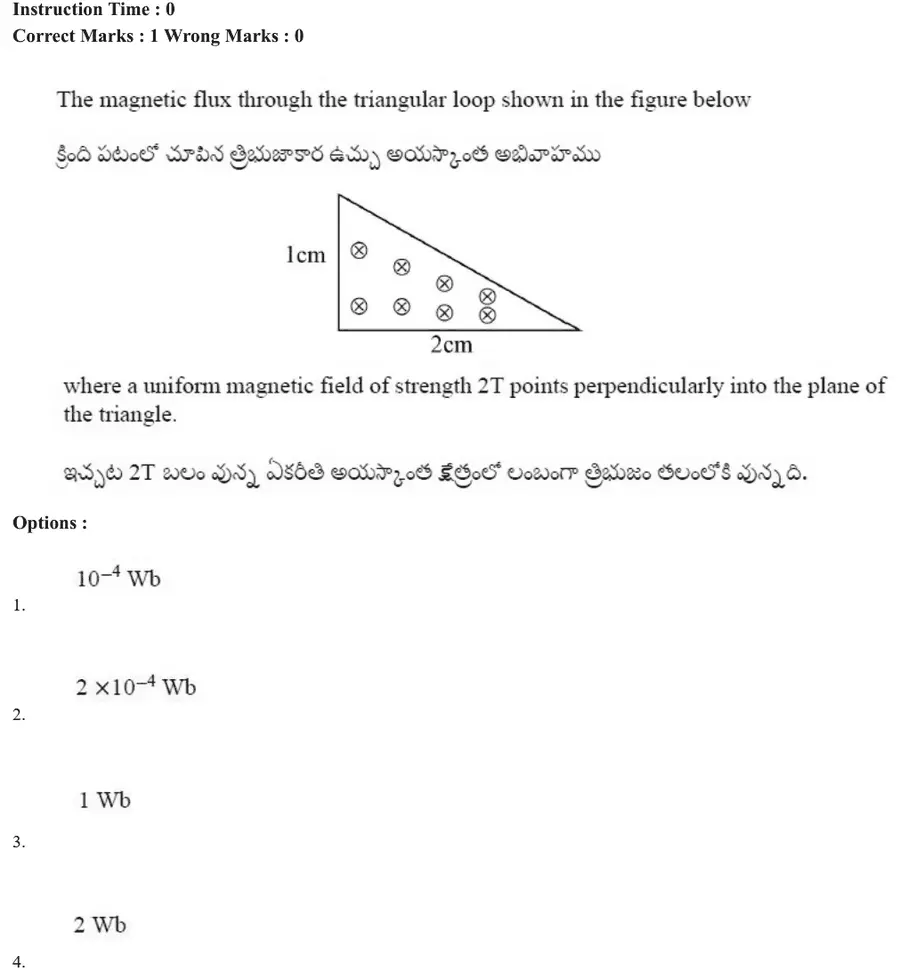
$10^{-4}$ Wb
$2\times10^{-4}$ Wb
1 Wb
2 Wb
A long solenoid has 20 turns per cm. A small loop of area $\dfrac{4}{\pi}\ \mathrm{cm^{2}}$ is placed inside the solenoid normal to its axis. If the current carried by the solenoid changes steadily from 1.0 A to 3.0A in 0.2 s, what is the magnitude of the induced emf in the loop while the current is changing?
$2.4\ \mu\mathrm{V}$
$3.2\ \mu\mathrm{V}$
$7.2\ \mu\mathrm{V}$
$4.8\ \mu\mathrm{V}$
A flat circular coil has 100 turns of wire of radius 10 cm. A uniform magnetic field exists in a direction perpendicular to the plane of the coil and it grows at a rate of 0.1 T/sec. the induced emf in the coil is:
$\pi$ V
$10\pi$ V
$\frac{\pi}{10}$ V
$2\pi$ V
A 2µF capacitor is charged to 50 V by a battery. The battery is removed after capacitor is fully charged. At time $t=0$, a 10 mH coil is connected in series with the capacitor. The maximum rate at which the current changes in the circuit is
2000 A/s
5000 A/s
2500 A/s
10000 A/s
A pair of adjacent coils having a mutual inductance, M. The current in one coil changes from 0 to 16 A in 0.3 s and the change of flux linkage with the other coil is 40 Wb. The value of M is
$0.4\ \mathrm{H}$
$0.12\ \mathrm{H}$
$2.5\ \mathrm{H}$
$8.3\ \mathrm{H}$
A long solenoid having 100 turns per cm carries a current of $\dfrac{4}{\pi}$ A. At the centre of it is placed a coil of 200 turns of cross sectional area $25\ \mathrm{cm}^2$ having its axis parallel to the field produced by the solenoid. When the direction of the current in the solenoid is reversed with in 0.04 s, the induced emf in the coil is
$0.2$ V
$0.4$ V
$0.002$ V
$0.016$ V
A solenoid has the length 1 m and the area of cross section $0.02\ \mathrm{m}^2$. If no. of turns in the solenoid is 5000 then the self inductance of the solenoid is
$0.2\pi$ henry
$0.4\pi$ henry
$0.02\pi$ henry
$0.04\pi$ henry
Assertion (A) : When a circular coil, placed in a region with its plane parallel to a magnetic field, expands radially outwards, no emf is induced in it.
Reason (R) : There is a constant magnet (sic) field in the perpendicular (to the plane of the coil) direction.
Both (A) and (R) are true. (R) is correct explanation of (A).
Both (A) and (R) are true. (R) is not correct explanation of (A).
(A) is true, (R) is false
(A) is false, (R) is true
A uniform magnetic field $\vec{B}$ is perpendicular to the plane of a circular loop of diameter 10 cm formed from wire of diameter 2 mm and resistivity $2\times10^{-8}\ \Omega\mathrm{m}$. If a current of 11 A is to be induced in the loop then the rate at which $\vec{B}$ is to be changed is
$2.8\ \mathrm{Ts^{-1}}$
$1.4\ \mathrm{Ts^{-1}}$
$3.2\ \mathrm{Ts^{-1}}$
$2.4\ \mathrm{Ts^{-1}}$
A long solenoid is carrying a current $I = I_o\sin(\omega t)$, having N turns per unit length and radius R. A square loop is placed inside the solenoid with its plane perpendicular to the solenoid axis, and its corners touching the solenoid. Now the e m f induced in the square coil
$\mu_o N I_o R^2\sin(\omega t)$
$2\mu_o N I_o R^2\sin(\omega t)$
$2\mu_o N I_o R^2\omega\cos(\omega t)$
$\mu_o N I_o R^2\pi\omega\cos(\omega t)$
A circular loop of wire of radius 14 cm is placed in a magnetic field directed perpendicular to the plane of the loop. If the field decreases at a steady rate of $0.05\ \mathrm{Ts^{-1}}$ in some interval, then the magnitude of the emf induced in the loop is
2.08 mV
3.08 mV
2.16 mV
3.24 mV
A metal loop of area $10\ \mathrm{cm^2}$ is placed in a region such that its area vector points along $\hat{k}$. The region contains a uniform magnetic field of magnitude 1.73 T that points in the direction $\hat{i}+\hat{j}+\hat{k}$. When the magnetic field is switched off, the field decreases to zero at a steady rate in 10 s, then the magnitude of emf induced in the loop is
$0.10\ \mathrm{mV}$
$0.17\ \mathrm{mV}$
$1\ \mathrm{mV}$
$1.7\ \mathrm{mV}$
A circular coil has 100 turns, radius 3 cm and resistance $4\ \Omega$. This coil is co-axial with a solenoid of 200 turns/cm and diameter 4 cm. If the solenoid current is decreased from 2 A to zero in 0.04 s, then the current induced in the coil is
$4\pi^2$ mA
$8\pi$ mA
$30.3$ mA
$45.5$ mA
Two horizontal wires of lengths $l_1$ and $l_2$, having the same mass $m$, are free to slide on different vertical rails with velocities $v_1$ and $v_2$ respectively, in the same magnetic field $\vec{B}$ as shown in the figure. If $a_1$ and $a_2$ are the accelerations of the two horizontal wires respectively, then the necessary condition for $a_1 > a_2$ is ______
(see the figure above)
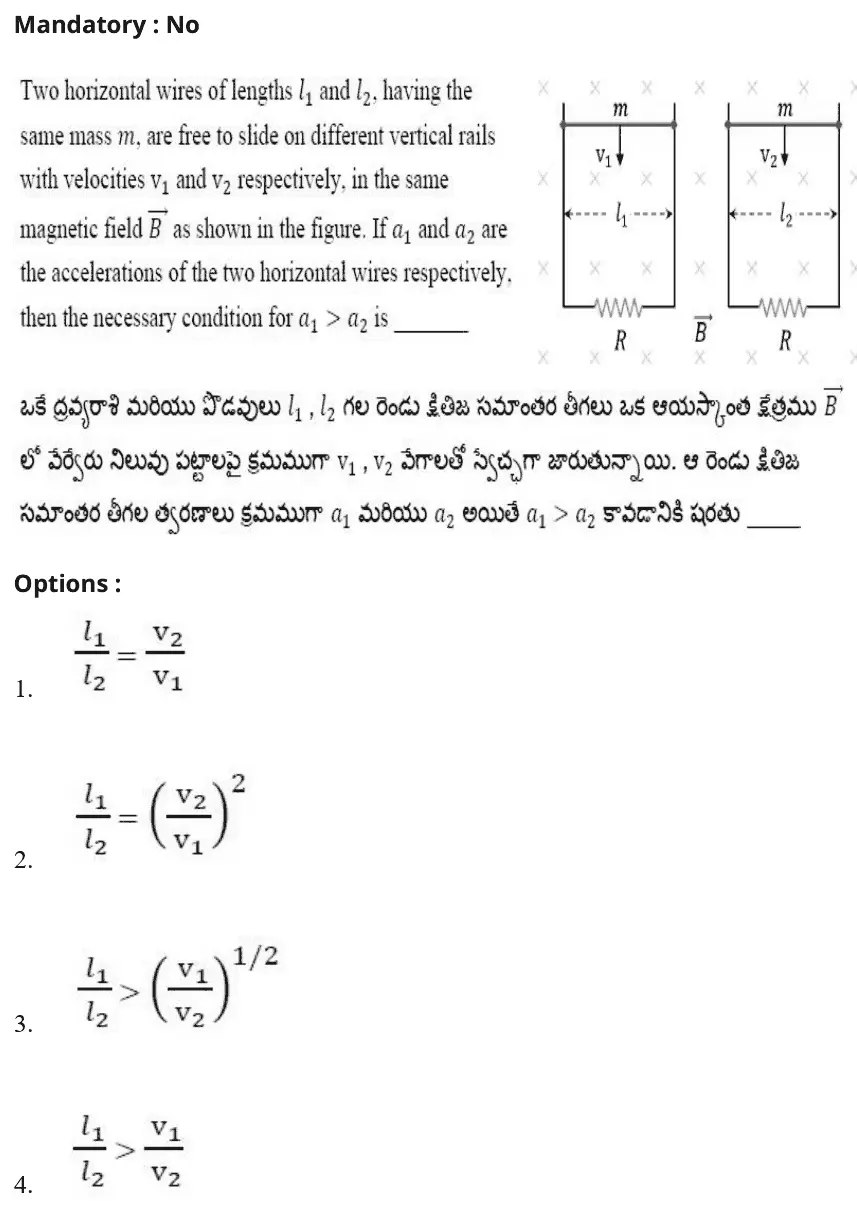
$\frac{l_1}{l_2} = \frac{v_2}{v_1}$
$\frac{l_1}{l_2} = \left(\frac{v_2}{v_1}\right)^{2}$
$\frac{l_2}{l_1} > \left(\frac{v_1}{v_2}\right)^{1/2}$
$\frac{l_1}{l_2} > \frac{v_1}{v_2}$
A small square loop of wire of side 'l' is placed inside a large square loop of wire if side 'L' ($L \gg l$). The loops are coplanar and their centers coincide. The mutual inductance of the system is proportional to ______
$\frac{l}{L}$
$\frac{l^{2}}{L}$
$\frac{L}{l}$
$\frac{L^{2}}{l}$
A copper rod is moved in a magnetic field. The charge developed across its ends will be proportional to ______
Magnetic flux
Rate of change of magnetic flux
1/ velocity of the rod
1/ magnitude of the magnetic field
Figure shows a straight wire placed between the pole pieces of a magnet. Induced $emf$ will be developed across the ends of the wire when it is moved towards (see the figure above)
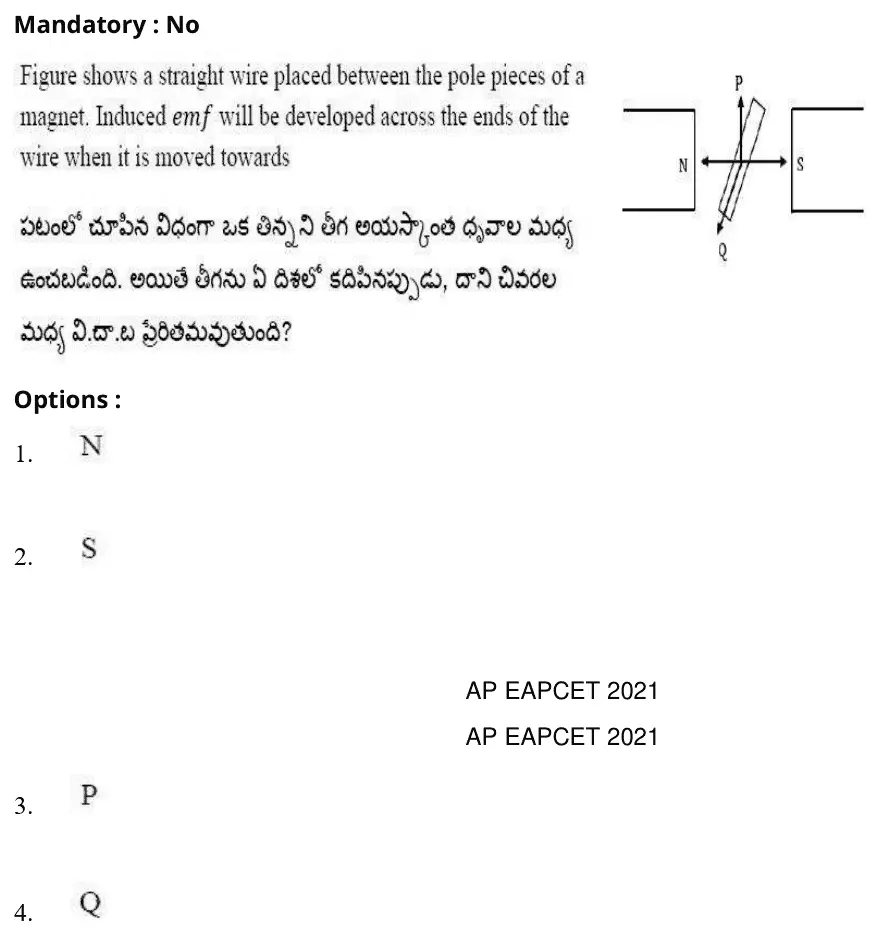
N
S
P
Q
A solenoid has 2000 turns wound over a length of $0.30\,\mathrm{m}$. The area of its cross-section is $1.2 \times 10^{-3}\,\mathrm{m}$ (sic). Around its central section, a coil of 300 turns is wound. If an initial current of $2\,\mathrm{A}$ in the solenoid is reversed in $0.25\,\mathrm{s}$, the e.m.f. induced in the coil is equal to:
$6 \times 10^{-4}\,\mathrm{V}$
$4.8 \times 10^{-2}\,\mathrm{V}$
$6 \times 10^{-2}\,\mathrm{V}$
$48\,\mathrm{kV}$
The initial rate of increase of current when a battery of emf $6\ \mathrm{V}$ is connected in series with an inductance of $2\ \mathrm{H}$ and resistance $12\ \Omega$ is ______
$0.5\ \mathrm{A\,s^{-1}}$
$1\ \mathrm{A\,s^{-1}}$
$3\ \mathrm{A\,s^{-1}}$
$4\ \mathrm{A\,s^{-1}}$
A magnetic field given by $B(t) = (0.2\,t - 0.05\,t^2)\ T$ is directed perpendicular to the plane of a circular coil containing 25 turns of radius $1.8\ cm$ and whose total resistance is $5\ \Omega$. The power dissipation at 3 seconds is nearly ______
$4\ \mu W$
$7\ \mu W$
$2.3\ \mu W$
$1.25\ \mu W$
A coil having 500 square loops each of side $10\ cm$ is placed normal to a magnetic flux which increases at a rate of $1\ Ts^{-1}$. The induced emf is ______
$0.1\ V$
$0.5\ V$
$1\ V$
$5\ V$
The self-inductance of a coil is $50\ mH$. When a current of $1\ A$ passing through the coil, reduces to zero at a steady rate in 0.1 second, then find the self-induced emf.
$5\ V$
$0.05\ V$
$50\ V$
$0.5\ V$
A conductor moving in the magnetic field 'B' the induced current is 'I'. If the magnetic field is doubled the induced current will ______
Remain the same
be half
be doubled
be four times
An LC circuit contains $196\ pF$ capacitor and a $441\ \mu H$ inductor. The frequency of electromagnetic radiation emitted by antenna coupled to the LC circuit is ______
$7.96 \times 10^{5}\ Hz$
$54.1 \times 10^{5}\ Hz$
$79.6 \times 10^{5}\ Hz$
$5.41 \times 10^{5}\ Hz$
A rectangular loop circuit has a sliding wire $PQ$ as shown in the figure. The loop is placed in a magnetic field '$B$', perpendicular to its plane. The resistance of the wire $PQ$ is $R$. If the wire moves with constant velocity '$v$', then find the current flowing through the wire $PQ$?
(see the figure above)
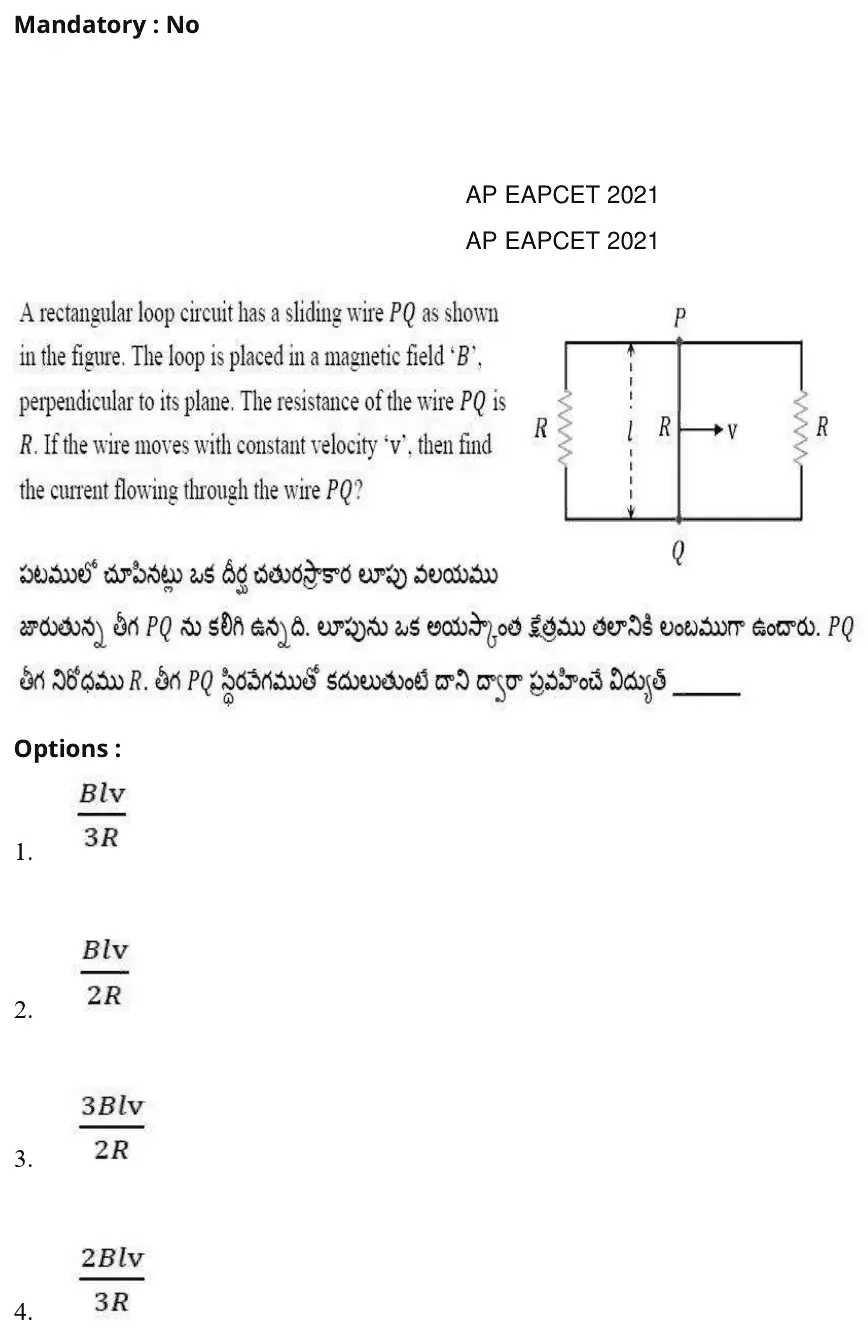
$\frac{Blv}{3R}$
$\frac{Blv}{2R}$
$\frac{3Blv}{2R}$
$\frac{2Blv}{3R}$
The current in an inductor of self-inductance $L = 40\ mH$ is to be increased uniformly from 2 $A$ to 12 $A$ in 8 $ms$. The emf induced in the inductor during this process is ______
50 $V$
0.4 $V$
40 $V$
100 $V$
The induced emf cannot be produced by:
Moving a magnet near a circuit
Moving a circuit near a magnet
Changing the current in one circuit placed near the other
Maintaining large but constant current in a circuit
Assertion (A): When plane of coil is perpendicular to magnetic field, magnetic flux linked with the coil is maximum, but induced $emf$ is zero
Reason (R): $\phi = nAB\cos\theta$ and $e = \frac{d\phi}{dt}$
Both A and R are true and R is a correct explanation for A
Both A and R are true but R is not a correct explanation for A
A is true, R is false
A is false, R is true
Assertion (A): Magnetic flux is a vector quantity.
Reason (R): Value of magnetic flux can be positive negative or zero.
Both A and R are true and R is a correct explanation for A
Both A and R are true but R is not a correct explanation for A
A is true, R is false
A is false, R is true
Assertion (A): It is more difficult to move a magnet into a coil with more loops
Reason (R): This is because $emf$ induced in each current loop resists the motion of the magnet
Both A and R are true and R is a correct explanation for A
Both A and R are true but R is not a correct explanation for A
A is true, R is false
A is false, R is true
Two inductors $A$ and $B$ when connected in parallel are equivalent to a single inductor of inductance $1.5\ H$, and when connected in series are equivalent to a single inductor of inductance $8\ H$. Find the difference in the inductances of $A$ and $B$.
$3\ H$
$7.5\ H$
$2\ H$
$4\ H$
A solenoid of length $60\ \mathrm{cm}$ with $15$ turns per cm and area of cross section $4 \times 10^{-3}\ \mathrm{m^2}$ completely surrounds another co-axial solenoid of same length and area of cross-section $2 \times 10^{-3}\ \mathrm{m^2}$ with $40$ turns per cm. Mutual inductance of the system is ______
$9\ \mathrm{mH}$
$6\ \mathrm{mH}$
$3\ \mathrm{mH}$
$10\ \mathrm{mH}$
A circular coil of area 100 $cm^2$ & 20 turns is kept in magnetic field of flux density 2 Wb- $m^2$. It rotates from a position where its plane makes an angle of $30^\circ$ with the field to a position perpendicular to the field in a time 0.2 sec. Find the magnitude of the emf induced in the coil due to its rotation
2 V
3 V
1.5 V
1 V
When a metal rod of length $\ell$ is placed in a magnetic field $\vec{B}$ and moved with velocity V perpendicular to the field, then the induced emf across its ends is
$B\ell V$
$\dfrac{B\ell}{V}$
$\dfrac{V}{B\ell}$
$eB\ell$
A long straight wire carrying current I and a rectangular frame with side lengths a and b lie in the same plane as shown in the figure. The mutual inductance of the wire and frame is
(see the figure above)
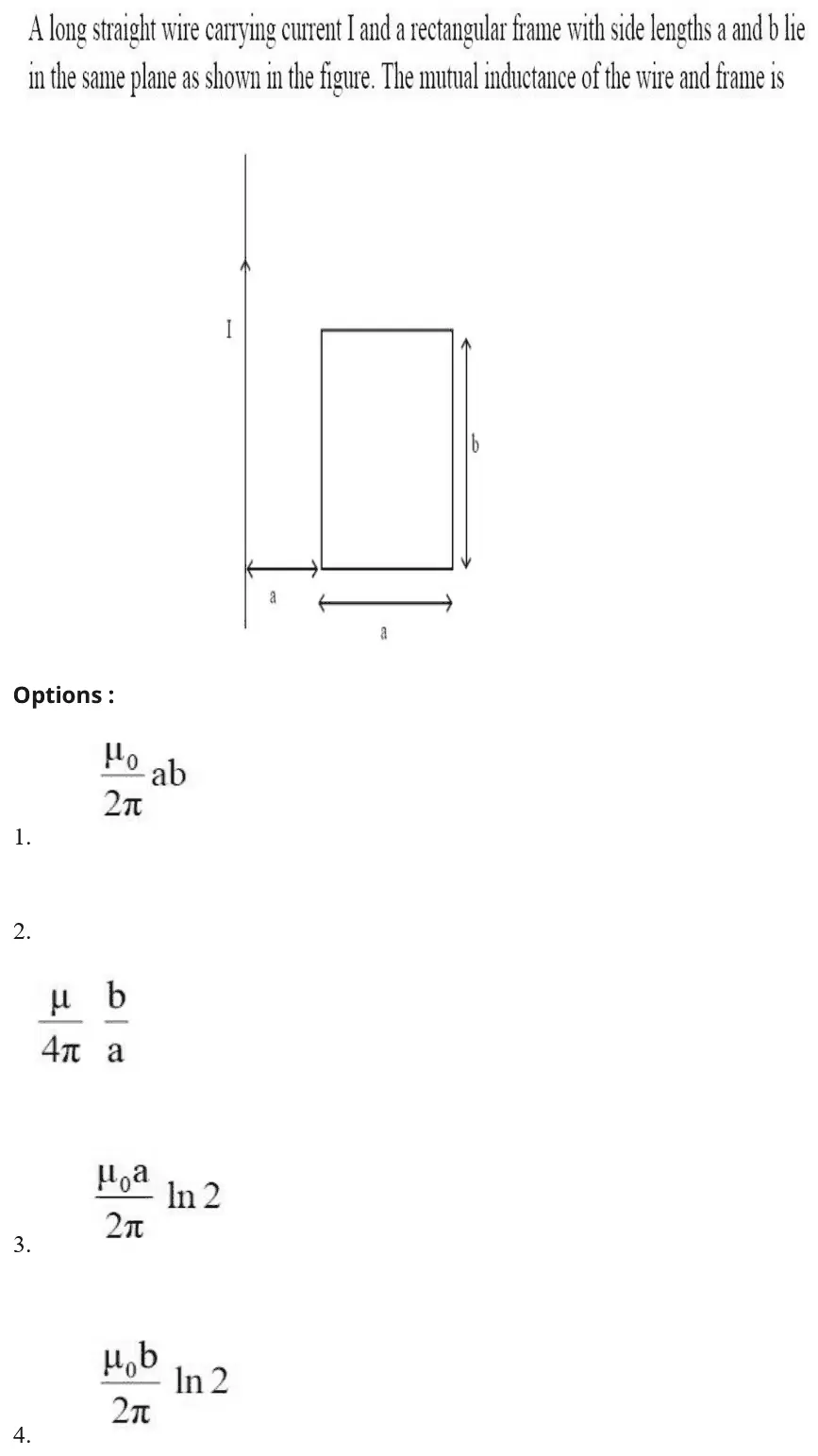
$\dfrac{\mu_0}{2\pi}ab$
$\dfrac{\mu}{4\pi}\dfrac{b}{a}$ (sic)
$\dfrac{\mu_0 a}{2\pi}\ln 2$
$\dfrac{\mu_0 b}{2\pi}\ln 2$
A coil of resistance $50\ \Omega$ is connected across a 5.0 V battery. If the current in the coil is found to be 50 mA after time t = 0.1 s battery is connected, then the inductance of the coil is
$\frac{5}{\ln(2)}$
$10\ln(2)$
$5e^{4}$
$\frac{10}{e^{4}}$
An infinitely long cylinder is kept parallel to an uniform magnetic field B directed along the positive z-axis. The direction of induced current as seen from the z-axis will be
zero
along the magnetic field
clockwise of the +ve z-axis
anti-clockwise of the +ve z-axis
A long straight solenoid with cross sectional radius 'a' and number of turns per unit length 'n' has a current varying with time as $I(\mathrm{As^{-1}})$. The magnitude of the electric field as a function of distance 'r' from the solenoid axis is
$\frac{n\mu_0 a^2 I}{2r}$
$\frac{\mu_0 In}{2a}$
$\frac{na^2 I}{2\mu_0 r}$
$\frac{\mu_0 Ia}{2n}$
The emf induced in the secondary coil due to unit rate of change of current in the primary is called ______
Impedance of two coils
Reactance of two coils
Mutual induction of two coils
Self induction of a coil
The magnetic flux through a circuit of resistance $R$ changes by an amount $\Delta\phi$ in time $\Delta t$. Then the total quantity of electric charge $Q$, which is passing during this time through any point of the circuit is given by ______
$Q = \dfrac{\Delta\phi}{\Delta t}$
$Q = \dfrac{\Delta\phi}{\Delta t} \times R$
$Q = -\dfrac{\Delta\phi}{\Delta t} + R$
$Q = \dfrac{\Delta\phi}{R}$
A coil of area $10\ \mathrm{m^2}$ is placed in a uniform magnetic field of $0.3\ k\ lb.m^{-2}$, with its plane perpendicular to the field. The coil rotates at a uniform rate to complete the revolution in $8\ \mathrm{s}$. find the average e.m.f. in the coil during intervals when the coil rotates from
i. $0^\circ$ to $90^\circ$ position
ii. $90^\circ$ to $180^\circ$ position
iii. $180^\circ$ to $270^\circ$ position
iv. $270^\circ$ to $360^\circ$ position
$^3/_2 V;\ ^3/_2 V;\ ^{-3}/_2 V;\ ^{-3}/_2 V$
$^3/_2 V;\ ^{-3}/_2 V;\ ^3/_2 V;\ ^{-3}/_2 V$
$0\ V;\ 0\ V;\ 0\ V;\ 0\ V$
$^{-3}/_2 V;\ ^{-3}/_2 V;\ ^3/_2 V;\ ^3/_2 V$
The Lenz's law gives
The direction of induced current
the quantity of charge flowing
the magnitude of the induced emf
motional emf in the circuit
Consider the situation shown in the figure. The wire $AB$ is sliding on the fixed rails with a constant velocity. If the wire $AB$ is replaced by semicircular wire, the magnitude of the induced current will ______
(see the figure above)
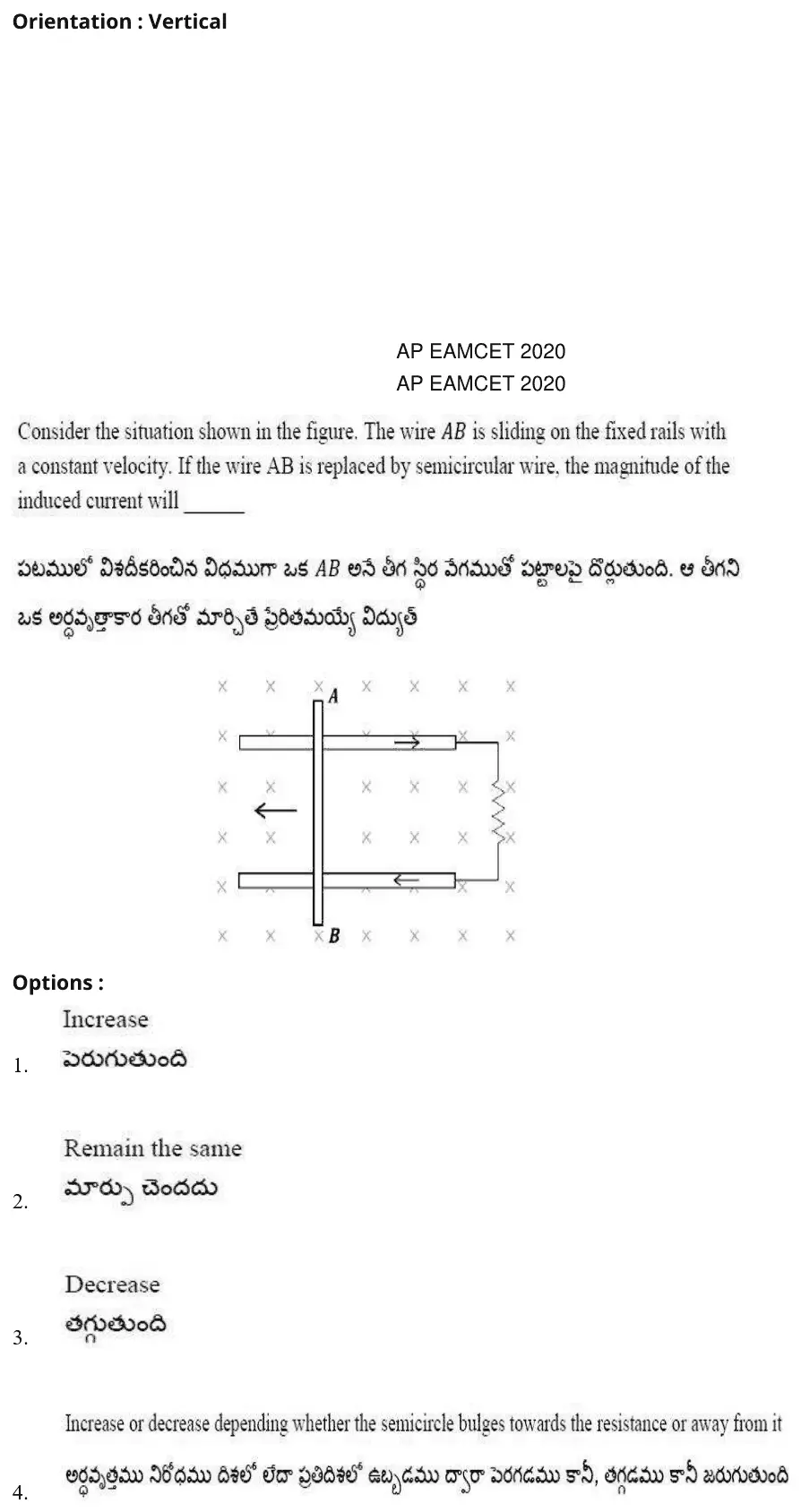
Increase
Remain the same
Decrease
Increase or decrease depending whether the semicircle bulges towards the resistance or away from it
Lenz's law is consequence of the law of conservation of ______
Charge
Momentum
Mass
Energy
A rod of length 1.0 $\mathrm{m}$ is rotated in a plane perpendicular to a uniform magnetic field of induction 0.25 $\mathrm{T}$ with a frequency of 12 rev/s. The induced emf across the ends of the rod is
18.89 $\mathrm{V}$
3 $\mathrm{V}$
15 $\mathrm{V}$
9.42 $\mathrm{V}$
The magnitude of induced emf is directly proportional to the rate of change of magnetic flux linked with the coil. This statement is known as ______
Ohm's law
Lenz's law
Faraday's law
Ampere's law
A tuned circuit of a transistor oscillator unit has an inductance of $5\,mH$ and a capacitance of $5\,pF$. The natural frequency of the oscillator is ______
$100\,kHz$
$1\,GHz$
$10\,MHz$
$1\,MHz$
A current $I = 10\,A$ is passed through the part of a circuit shown in the figure. What will be the potential difference between $A$ and $B$ when 'I' is decreased at constant rate of $10^2\,\mathrm{A.s^{-1}}$ at the beginning?
(see the figure above)
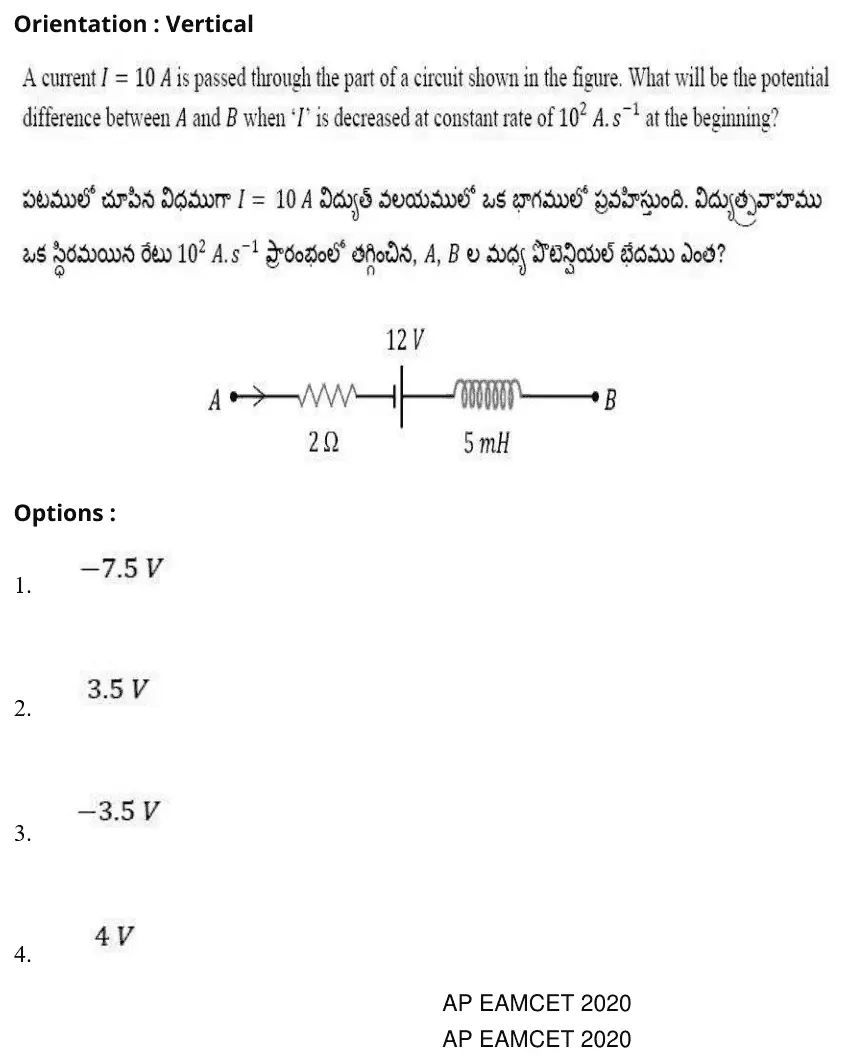
$-7.5\,V$
$3.5\,V$
$-3.5\,V$
$4\,V$
The energy stored in a $50\,\mathrm{mH}$ inductor carrying a current of $4\,\mathrm{A}$ is ______
0.4 J
4.0 J
0.8 J
0.04 J
The coefficient of mutual inductance between the primary and the secondary coil of a transformer is $0.2\,\mathrm{H}$. When the current in the primary changes by $5\,\mathrm{A.s^{-1}}$, the induced $e.m.f.$ in the secondary will be
$5\,\mathrm{V}$
$1\,\mathrm{V}$
$25\,\mathrm{V}$
$10\,\mathrm{V}$
What is the phase difference between the flux linked with a coil rotating in a magnetic field, and the induced $e.m.f.$ produced in it?
$0$
$\frac{\pi}{4}$
$\frac{\pi}{2}$
$\pi$
A coil of inductance $L$ is divided in to four equal parts and all the parts are connected in parallel. The effective inductance of the combination is ______
$\frac{L}{4}$
$\frac{L}{8}$
$\frac{L}{16}$
$4L$
The energy stored in a coil of inductance $L$, carrying a steady current $i$ is in the form
Magnetic
Electrical
Both magnetic and electrical
Heat
The current in a coil changes from 3 $A$ to 1 $A$ in 0.1 $s$ in a coil of self inductance 8 $mH$. The emf induced in the coil is
$16\ V$
$1.6 \times 10^{-2}\ V$
$16 \times 10^{-2}\ V$
$2\ V$
Lenz's law is a consequence of the law of conservation of ______
Energy
Charge
Linear momentary (sic)
Electric flux
Two concentric circular coils, one of small radius r and the other of large radius R are placed co-axially with centers coinciding. If the radius r is changed by 2%, then the change in mutual inductance of the arrangement is
(Assume r<<R)
2 %
1.5 %
4 %
0 %
Consider two solenoids X and Y such that the area and length of Y are twice that of X respectively, of the magnetic energy stored in both the solenoids is same, then the ratio of magnitude of magnetic fields of the two solenoids $\dfrac{|\vec{B}_X|}{|\vec{B}_Y|}$ is
1 : 4
2 : 1
1 : 2
4 : 1
A circular coil consists 70 closely wound turns and has a radius of 10 cm. An externally produced magnetic field of magnitude $2 \times 10^{-3}$ T is applied perpendicular to the coil. The net flux through the coil is found to vanish when the current in the coil is 2.2 A. The inductance of the coil is
2 mH
3 mH
4 mH
1.5 mH
A varying current in a coil changes from 10 A to zero in 1.5 sec. If the average emf induced in the coil is 200 V, the self inductance of the coil is
25 H
30 H
50 H
45 H
Two straight conducting rails form a right angle as shown below. A conducting bar in contact with the rails starts at the vertex at time t = 0 and moves with constant velocity of $v$ = 5 m/s along them. A magnetic field with B = 0.1 T is directed out of the page. The absolute value of the emf around the triangle at the time t = 4 s will be?
(see the figure above)
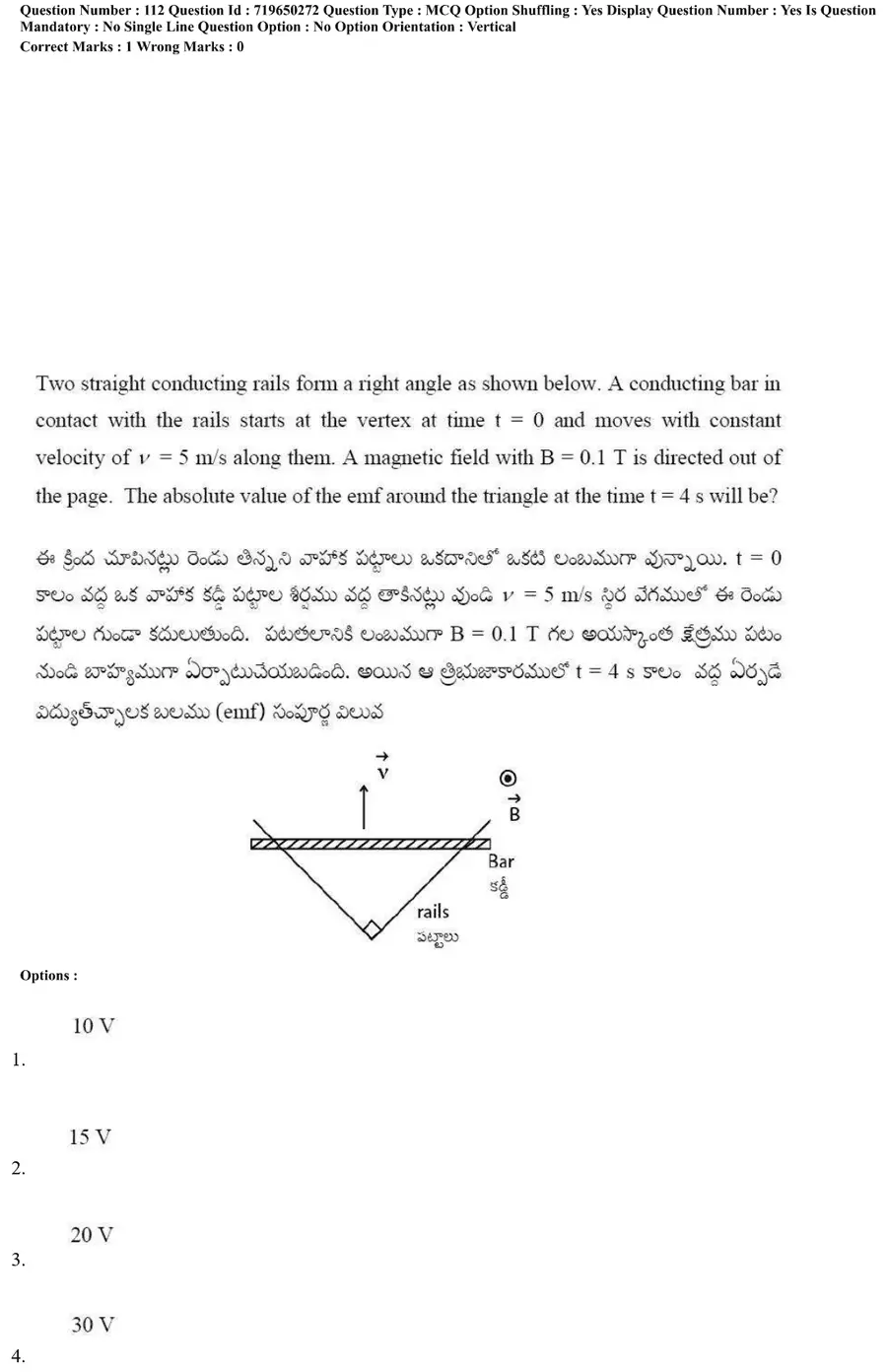
$10\ \mathrm{V}$
$15\ \mathrm{V}$
$20\ \mathrm{V}$
$30\ \mathrm{V}$
Consider a toroid with rectangular cross section, of inner radius 'a', outer radius 'b' and height 'h', carrying 'n' number of turns. Then the self inductance of the toroidal coil when current 'I' passing through the toroid is
(see the figure above)
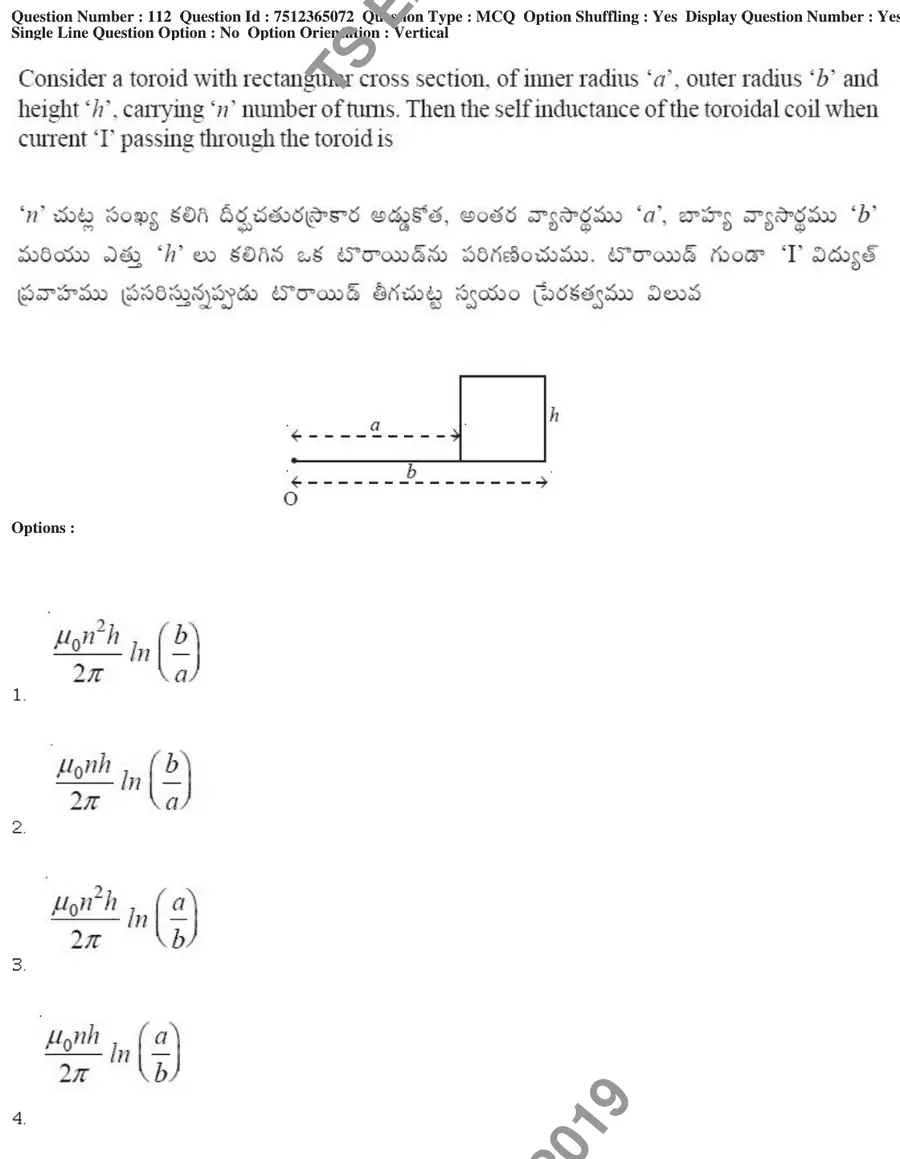
$\frac{\mu_0 n^2 h}{2\pi}\ ln\left(\frac{b}{a}\right)$
$\frac{\mu_0 n h}{2\pi}\ ln\left(\frac{b}{a}\right)$
$\frac{\mu_0 n^2 h}{2\pi}\ ln\left(\frac{a}{b}\right)$
$\frac{\mu_0 n h}{2\pi}\ ln\left(\frac{a}{b}\right)$
Consider a current in a circuit falls from 6.0 A to 1.0 A in 0.2 s. If an average emf of 150 V is induced by the circuit, then the self inductance of the circuit is:
$2\ \mathrm{H}$
$6\ \mathrm{H}$
$4\ \mathrm{H}$
$8\ \mathrm{H}$
The magnetic field of an Electromagnetic wave obeys the relation in a certain region is $B = 10^{-12}\sin(5 \times 10^{6} t)\ \mathrm{T}$, where t is the time. Then the induced emf, in a 300-turn coil of area $20\ \mathrm{cm}^2$ oriented perpendicular to the field is
$-2 \times 10^{-5}\cos(5 \times 10^{6} t)\ \mathrm{V}$
$-3 \times 10^{-6}\cos(5 \times 10^{6} t)\ \mathrm{V}$
$-2.5 \times 10^{-6}\cos(5 \times 10^{6} t)\ \mathrm{V}$
$-3.3 \times 10^{-6}\cos(5 \times 10^{6} t)\ \mathrm{V}$
A rod of length 80 cm rotates about its mid point with a frequency of 10 rev/s. The potential difference (in Volts) between two ends of the rod due to a magnetic field B $= 0.5$ T directed perpendicular to the rod is
$\pi$
$1.6\pi$
$2\pi$
$0.8\pi$
A 10 $\Omega$ coil of 180 turns and diameter 4 cm is placed in a uniform magnetic field so that the magnetic flux is maximum through the coil's cross-sectional area. When the field is suddenly removed a charge of 360 $\mu$C flows through a 618 $\Omega$ galvanometer connected to the coil, find the magnetic field:
12 T
6 T
1 T
8 T
A metal disc of radius $a = 10\ \mathrm{cm}$ rotates with a constant angular speed of $\omega = 200\ \mathrm{rad/s}$ about its axis. The potential difference between the centre and the rim of the disc under a uniform magnetic field $B = 5\ \mathrm{mT}$ directed perpendicular to the disc, is
$2\ \mathrm{mV}$
$5\ \mathrm{mV}$
$10\ \mathrm{mV}$
$15\ \mathrm{mV}$
A conducting wire bent in the shape of semicircle has length L and moves in its plane with constant velocity v. A uniform magnetic field B exists in the direction perpendicular to the plane of the wire. The velocity makes an angle $45^\circ$ to the diameter joining free ends and the emf induced between the ends of the wire is $\Phi = \alpha(BVL)$. The value of constant $\alpha$ is
$\sqrt{2}$
$\dfrac{2}{\pi}$
$\dfrac{1}{\sqrt{2}}$
$\dfrac{\sqrt{2}}{\pi}$
The concept of displacement current solves an ambiguity in
Gauss's law
Faraday's law
Ampere's law
Coulomb's law
A long solenoid with 2000 turns per metre has a small loop of radius $3\ \mathrm{cm}$ placed inside the solenoid normal to its axis. If the current through the solenoid increases steadily from $1.5\ \mathrm{A}$ to $5.5\ \mathrm{A}$ in $\frac{\pi^2}{100}\ \mathrm{s}$, the induced emf in the loop is
$0.144\ \mathrm{mV}$
$0.288\ \mathrm{mV}$
$0.072\ \mathrm{mV}$
$0.316\ \mathrm{mV}$
Two concentric coplanar circular conducting loops have radii R and $r$ ($\mathrm{R} \gg r$). Their mutual inductance is proportional to
$\dfrac{r}{\mathrm{R}}$
$\dfrac{\mathrm{R}}{r}$
$\dfrac{r^{2}}{\mathrm{R}}$
$\dfrac{\mathrm{R}^{2}}{r}$
A circular coil of area $0.1\ \mathrm{m^2}$ having 200 turns is placed in a magnetic field of $40\ \mathrm{T}$. The plane of the coil makes $30^\circ$ with the field. If the field is removed for $0.1\ \mathrm{s}$ then the induced emf in the coil is
$4000\ \mathrm{V}$
$4000\sqrt{3}\ \mathrm{V}$
$2000\ \mathrm{V}$
$2000\sqrt{3}\ \mathrm{V}$
A metal rod AB of length 50 cm is moving at a velocity $8\,\mathrm{ms^{-1}}$ in a magnetic field of 2 T. If the field is at $60^\circ$ with the plane of motion as shown in figure, then the potentials $V_A$ and $V_B$ are related by
(see the figure above)
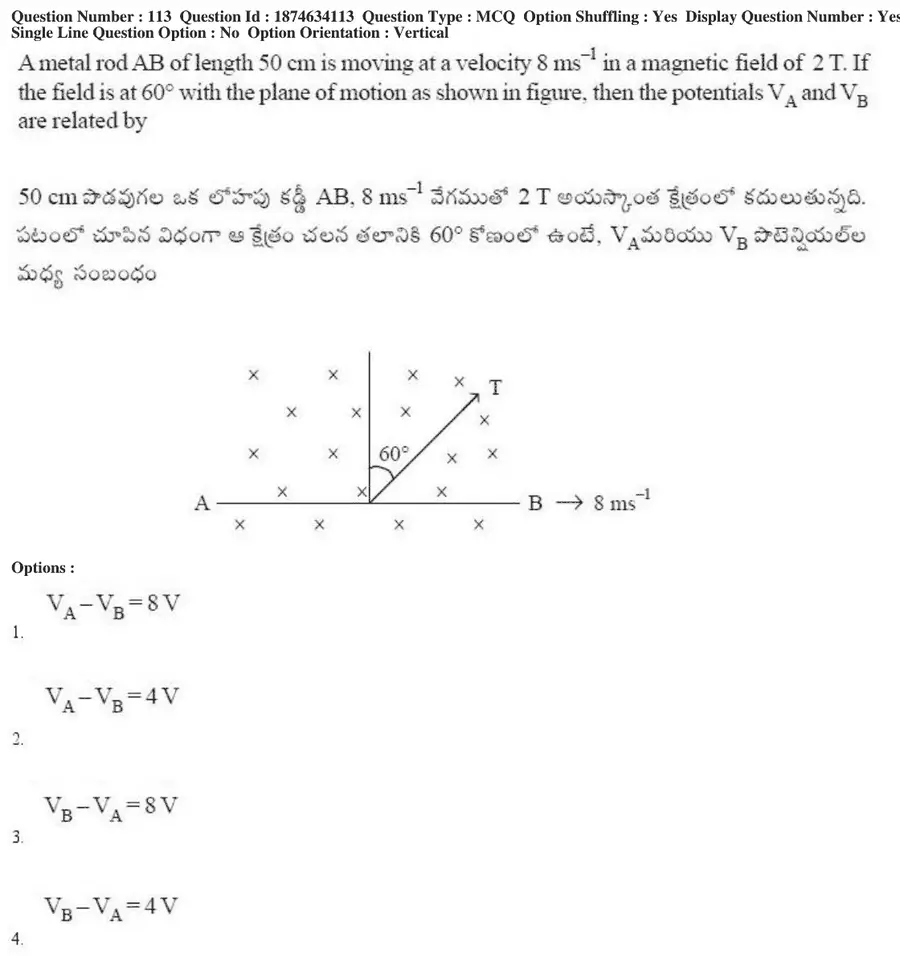
$V_A - V_B = 8\,\mathrm{V}$
$V_A - V_B = 4\,\mathrm{V}$
$V_B - V_A = 8\,\mathrm{V}$
$V_B - V_A = 4\,\mathrm{V}$
In the given electrical circuit, if the switch S is closed then the maximum energy stored in the inductor is
(see the figure above)
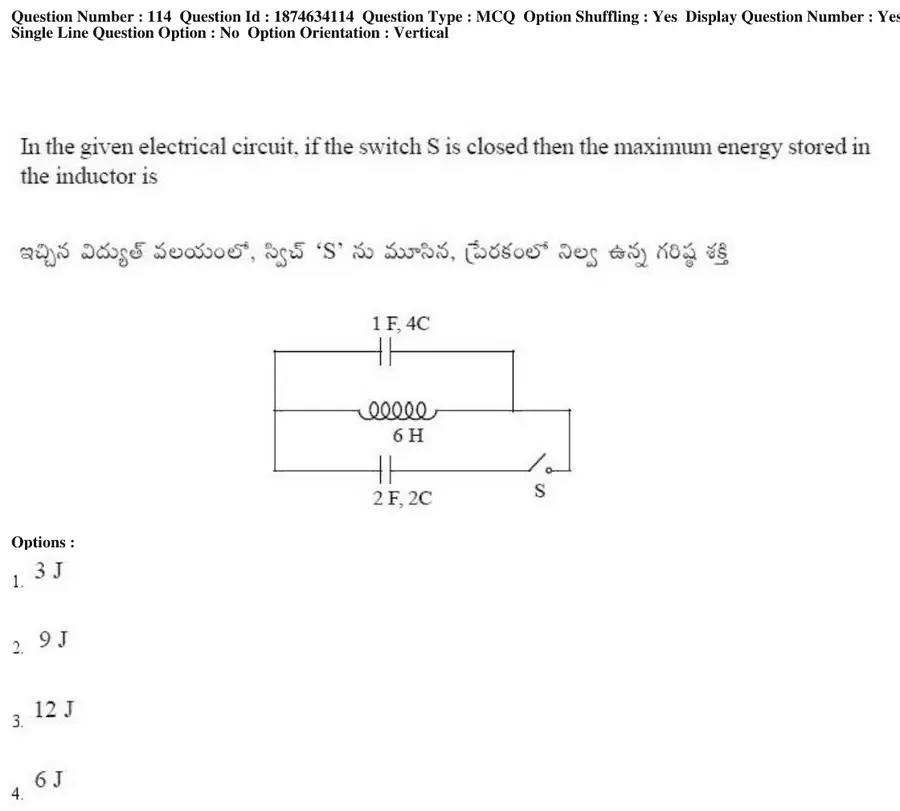
3 J
9 J
12 J
6 J
A coil of mean area $500\ \mathrm{cm^2}$ and having 1000 turns is held with its plane perpendicular to a uniform field of 0.4 G. If the coil is turned through $180^\circ$ in $\frac{1}{10}$ second, then the average induced emf is
($1\ \mathrm{G} = 10^{-4}\ \mathrm{T}$)
0.04 V
0.4 V
4 V
40 V
An emf of 15 V is applied to a circuit containing 5 H inductance and $10\ \Omega$ resistance. The ratio of currents at time $t = \infty$ and $t = 1\ \mathrm{s}$ is
$\frac{e}{e^2-1}$
$\frac{e^2}{e-1}$
$\frac{e}{1-e^2}$
$\frac{e^2}{e^2-1}$
To measure a magnetic field between the magnetic poles of a loud speaker, a small coil having 30 turns and $2.5\ \mathrm{cm^2}$ area is placed perpendicular to the field and removed immediately. If the total charge flown through the coil is $7.5 \times 10^{-3}$ C, and the total resistance of wire and galvanometer is 0.3 $\Omega$, then the magnitude of the magnetic field is
0.03 T
0.3 T
3 T
$3 \times 10^2$ T
In an oscillating LC circuit, the maximum charge on the capacitor is Q. The charge on the capacitor when the energy is stored equally between the electric and magnetic fields is
$\frac{Q}{2}$
$\frac{Q}{\sqrt{3}}$
Q
$\frac{Q}{\sqrt{2}}$
A coil is placed in a time varying magnetic field. The power dissipated due to current induced in the coil is $\mathrm{P_1}$. If the number of turns is doubled and radius of the wire is halved, the power dissipated is $\mathrm{P_2}$. Then $\mathrm{P_1 : P_2}$ is
$1:4$
$3:2$
$2:1$
$4:1$
A solenoid of radius $R$ has 'n' turns per unit length. The self-inductance of the solenoid per unit length is
$\mu_0 n\pi R^2$
$\mu_0 n R^2$
$\mu_0 n^2 R^2$
$\mu_0 n^2\pi R^2$
A rectangular loop of wire is placed in the XY plane with its side of length 3 cm parallel to the X-axis and the side of length 4 cm parallel to the Y - axis. It is moving in the positive X direction with the speed 10 cm/sec. A magnetic field exists in the space with its direction parallel to the Z - axis. The field decreases by $2\times10^{-3}$ T/cm along the positive X - axis and increases in time by $2\times10^{-2}$ T/sec. The induced emf in the wire is
$-4.8\times10^{-5}$ V
$4.8\times10^{-5}$ V
0
$3.6\times10^{-5}$ V
A wheel with radial metal spokes $1\ \mathrm{m}$ in length is rotated in a magnetic field of $0.5 \times 10^{-4}\ T$ normal to the plane of the wheel. If the emf induced between the rim and axle is $\pi/3000\ \mathrm{V}$, the rotational speed of the wheel in revolutions per minute is
$400$
$500$
$600$
$700$
An initially charged undriven LCR circuit having inductance $L$, capacitance $C$ and resistance $R$ will
Oscillate with frequency $\dfrac{1}{\sqrt{LC}}$
Oscillate without damping if $R^2 < \dfrac{4L}{C}$
Oscillate with damping if $R^2 > \dfrac{4L}{C}$
Oscillate with damping if $R^2 < \dfrac{4L}{C}$
A wire loop enclosing a semi-circle of radius '$R$' is located on the boundary of a uniform magnetic field of induction $\vec{B}$. At time $t = 0$, the loop is set into rotation with velocity '$\omega$' about its axis '0', coinciding with a line of vector $\vec{B}$ on the boundary as shown in the figure. The emf induced in the loop is
(see the figure above)
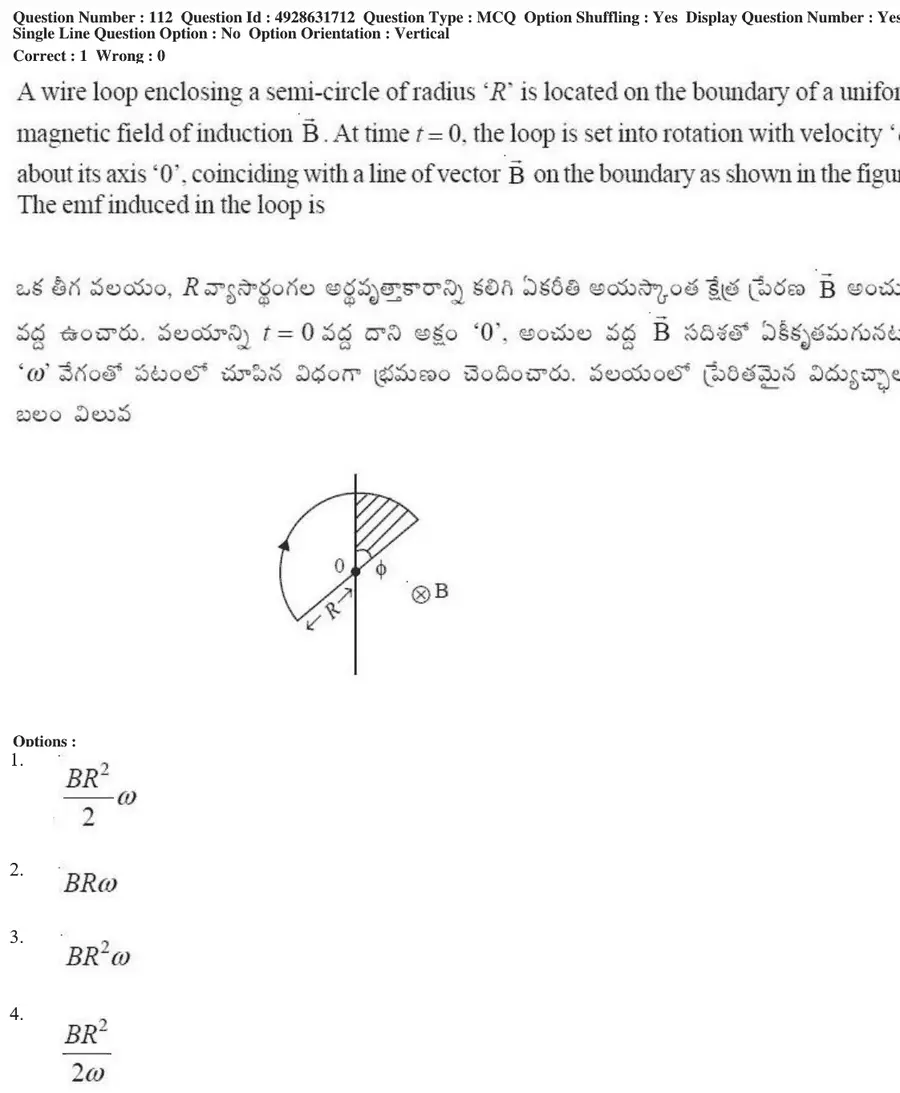
$\frac{BR^{2}}{2}\omega$
$BR\omega$
$BR^{2}\omega$
$\frac{BR^{2}}{2\omega}$
In the circuit given below, the capacitor $C$ is charged by closing the switch $S_1$ and opening the switch $S_2$. After charging, the switch $S_1$ is opened and $S_2$ is closed, then the maximum current in the circuit
(see the figure above)
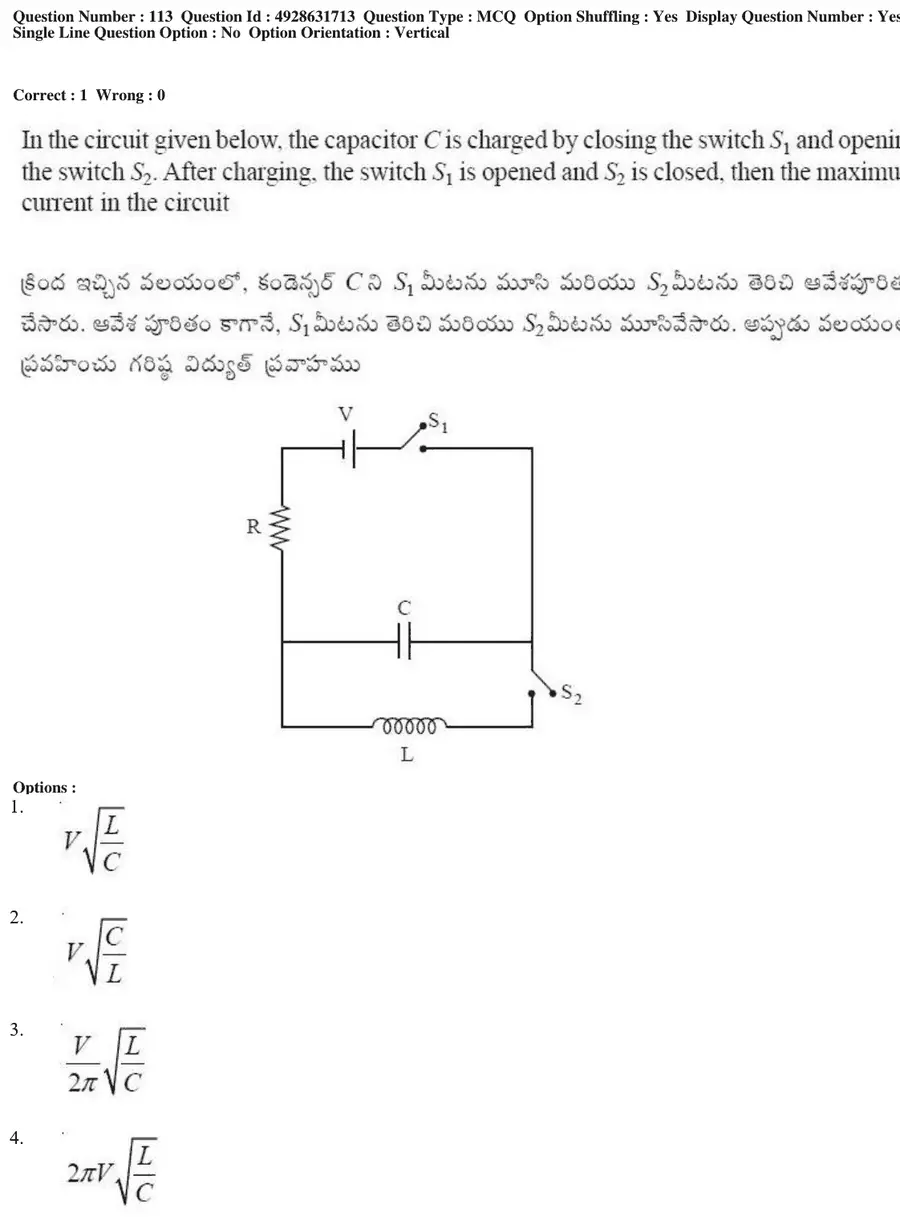
$V\sqrt{\frac{L}{C}}$
$V\sqrt{\frac{C}{L}}$
$\frac{V}{2\pi}\sqrt{\frac{L}{C}}$
$2\pi V\sqrt{\frac{L}{C}}$
A conducting rod of length L lies in X-Y plane and makes an angle $30^\circ$ with the X-axis. One end of the rod lies at origin initially. A magnetic field also exists in the region pointing along positive Z-direction. The magnitude of the magnetic field varies with $y$ as $B_0\left(\dfrac{y}{L}\right)^3$ where $B_0$ is a constants. At some instant the rod starts moving with a velocity $v_0$ along X-axis. The emf induced in the rod is
$\dfrac{B_0v_0L}{64}$
$\dfrac{B_0v_0L}{16}$
$B_0v_0L$
$64\,B_0v_0L$
Two circular loops of diameters 0.6 cm and 40 cm are kept coaxially with a separation of 15 cm between their centers. If a current 2 A flows through the smaller loop, the flux linked with the bigger loop is (approximately)
$9.0\times10^{-11}\ \mathrm{Wb}$
$0.9\times10^{-11}\ \mathrm{Wb}$
$1.8\times10^{-11}\ \mathrm{Wb}$
$2.7\times10^{-11}\ \mathrm{Wb}$
A current carrying circular loop is perpendicular to a magnetic field of induction $10^{-4}$ T. If the radius of the loop starts shrinking at a uniform rate of $2\ \mathrm{mms^{-1}}$, then the emf induced in the loop at the instant when its radius is 20 cm will be ________
$0.02\pi\ \mu\mathrm{V}$
$0.08\pi\ \mu\mathrm{V}$
$0.03\pi\ \mu\mathrm{V}$
$0.05\pi\ \mu\mathrm{V}$
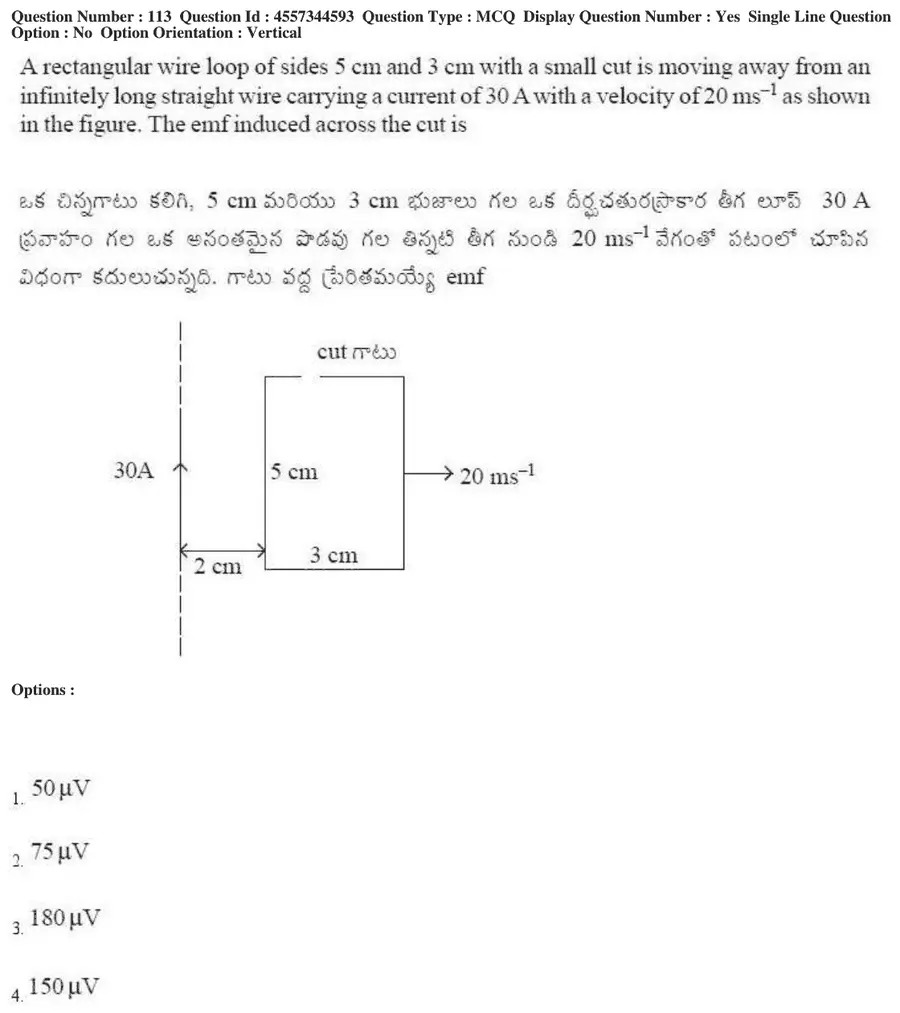
A rectangular wire loop of sides 5 cm and 3 cm with a small cut is moving away from an infinitely long straight wire carrying a current of 30 A with a velocity of $20\ \mathrm{ms^{-1}}$ as shown in the figure. The emf induced across the cut is
(see the figure above)
$50\ \mu\mathrm{V}$
$75\ \mu\mathrm{V}$
$180\ \mu\mathrm{V}$
$150\ \mu\mathrm{V}$
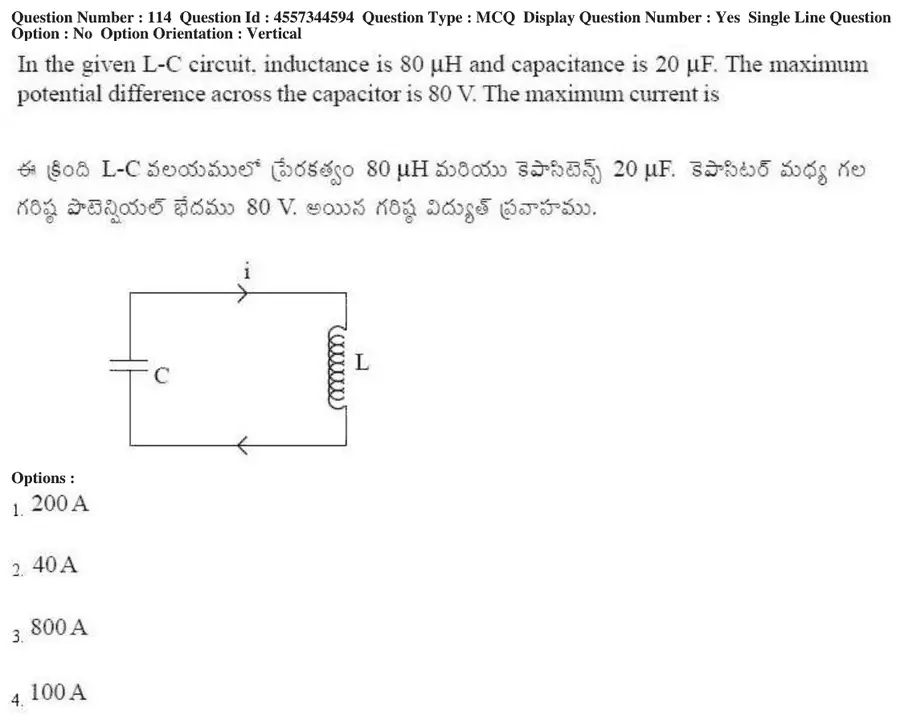
In the given L-C circuit, inductance is $80\ \mu\mathrm{H}$ and capacitance is $20\ \mu\mathrm{F}$. The maximum potential difference across the capacitor is 80 V. The maximum current is
(see the figure above)
$200\ \mathrm{A}$
$40\ \mathrm{A}$
$800\ \mathrm{A}$
$100\ \mathrm{A}$
A coil of wire of radius 'r' has 600 turns and self inductance of 108 mH. The self inductance of a coil with same radius and 500 turns is ______
80 mH
75 mH
108 mH
90 mH
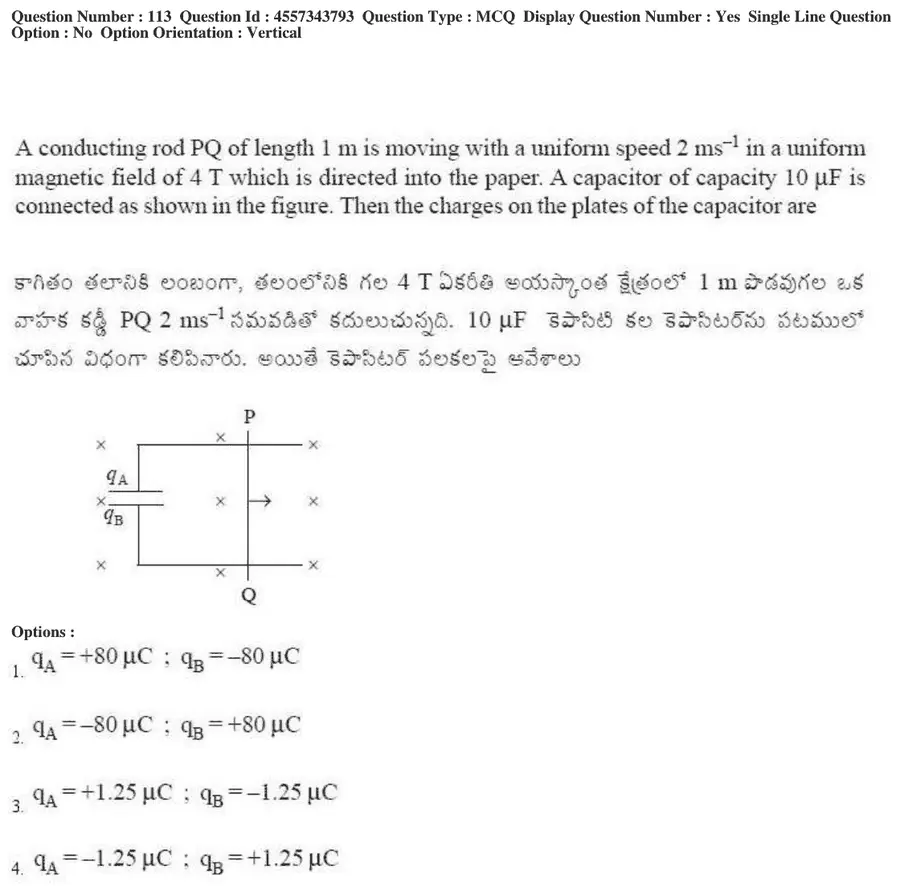
A conducting rod PQ of length $1\ \mathrm{m}$ is moving with a uniform speed $2\ \mathrm{ms^{-1}}$ in a uniform magnetic field of $4\ \mathrm{T}$ which is directed into the paper. A capacitor of capacity $10\ \mu\mathrm{F}$ is connected as shown in the figure. Then the charges on the plates of the capacitor are
(see the figure above)
$q_A=+80\ \mu\mathrm{C}\ ;\ q_B=-80\ \mu\mathrm{C}$
$q_A=-80\ \mu\mathrm{C}\ ;\ q_B=+80\ \mu\mathrm{C}$
$q_A=+1.25\ \mu\mathrm{C}\ ;\ q_B=-1.25\ \mu\mathrm{C}$
$q_A=-1.25\ \mu\mathrm{C}\ ;\ q_B=+1.25\ \mu\mathrm{C}$
The length of a wire required to make a solenoid of length 'l' and self induction 'L' is
$\sqrt{\frac{4\pi Ll}{\mu_0}}$
$\sqrt{\frac{Ll}{4\pi\mu_0}}$
$\sqrt{\frac{2\pi Ll}{\mu_0}}$
$\sqrt{\frac{\mu_0 Ll}{4\pi}}$
A coil having 'n' turns and resistance $R\,\Omega$ is connected with a galvanometer of resistance $4R\,\Omega$. This combination is moved in time 't' seconds from a magnetic flux $\phi_1$ Weber to $\phi_2$ Weber. The induced current in the circuit is
$\dfrac{\phi_2-\phi_1}{5Rnt}$
$-\dfrac{n(\phi_2-\phi_1)}{5Rt}$
$-\dfrac{(\phi_2-\phi_1)}{Rnt}$
$-\dfrac{n(\phi_2-\phi_1)}{Rt}$
Consider a metal ball of radius 'r' moving at a constant velocity 'v' in a uniform magnetic field of induction $\bar{B}$. Assuming that the direction of velocity forms an angle '$\alpha$' with the direction of $\bar{B}$, the maximum potential difference between points on the ball is
$r|\bar{B}||\bar{v}|\sin\alpha$
$|\bar{B}||\bar{v}|\sin\alpha$
$2r|\bar{B}||\bar{v}|\sin\alpha$
$2r|\bar{B}||\bar{v}|\cos\alpha$
Consider a solenoid carrying current supplied by a DC source with a constant emf containing iron core inside it. When the core is pulled out of the solenoid, the change in current will
remain same
decrease
increase
modulate
Assertion (A): It is more difficult to push a magnet into a coil with more number of turns
Reason (R): The emf induced in a coil opposes the motion of a magnet when it is moved towards the coil.
Both A and R are true. R is correct explanation of A.
Both A and R are true. R is not correct explanation of A
A is true, R is false
A is false, R is true
A circular wheel with 10 spokes with its plane vertical along East-West is rotating about its natural axis with a uniform speed 100 revolutions per minute in the earth's magnetic field. Radius of the wheel is 0.3 m. If the emf induced between the centre of the wheel and the rim is $3\pi\ \mu\mathrm{V}$, angle of dip at the place is
(Vertical component of the earth's magnetic field $B_V = 15\ \mu\mathrm{T}$)
$\tan^{-1}\left(\frac{1}{2}\right)$
$\tan^{-1}\left(\frac{4}{5}\right)$
$\tan^{-1}\left(\frac{3}{5}\right)$
$\tan^{-1}\left(\frac{3}{4}\right)$
The current (I) in an inductor is varying with time (t) as shown in the figure. Which of the following graphs shows the correct variation of voltage (V) with time (t) in the inductor?
(see the figure above)
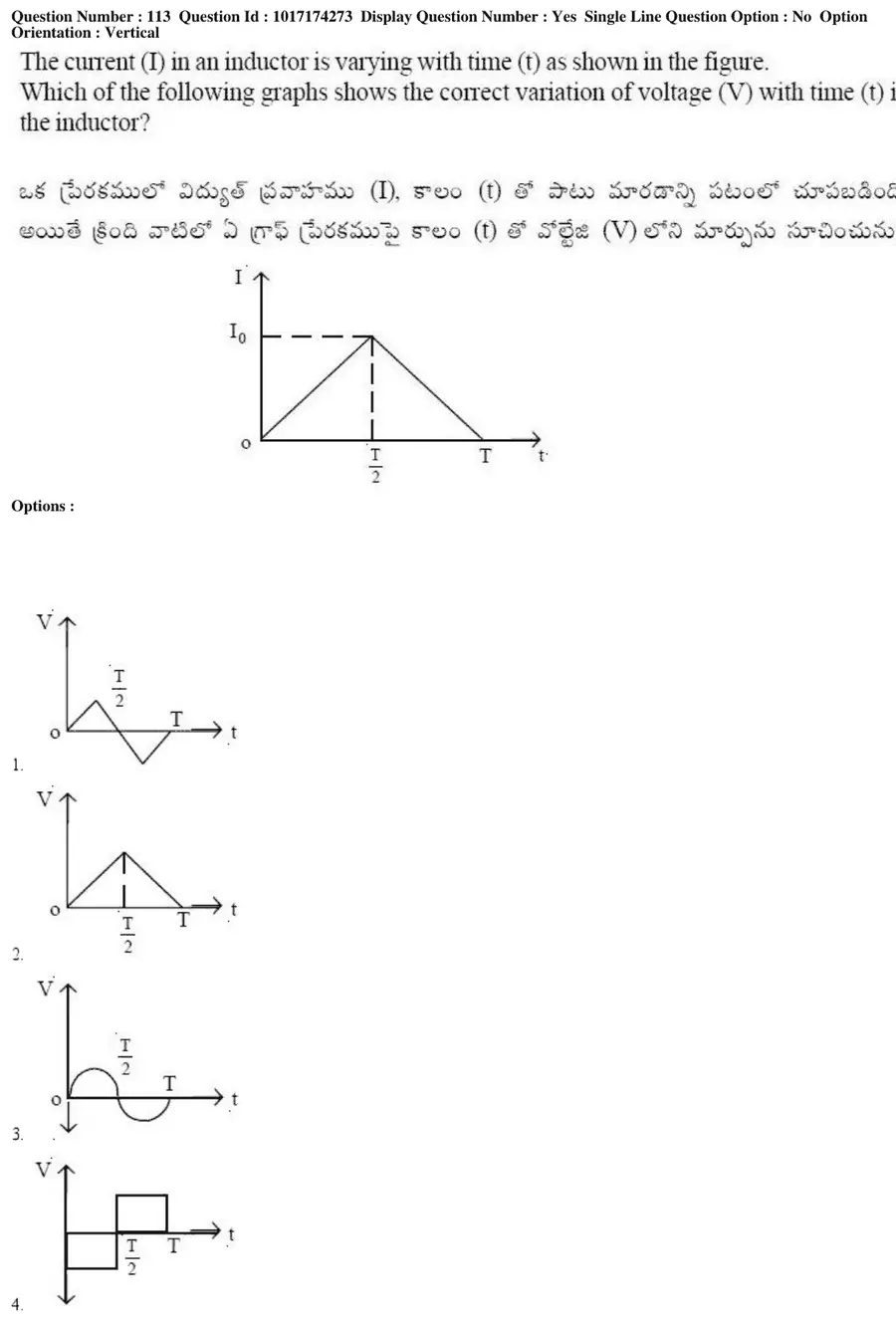
see figure V-t graph: a triangular wave that rises linearly from 0 to a positive peak at T/2, then falls linearly through zero to a negative minimum, returning to zero at T (continuous zigzag, both halves sloped).
see figure V-t graph: a triangle with straight rising line from origin to a peak at T/2 and straight falling line to zero at T (all positive).
see figure V-t graph: a sine-like curve, positive hump from 0 to T/2 then negative hump from T/2 to T.
see figure V-t graph: rectangular steps, a negative constant level from 0 to T/2 followed by a positive constant level from T/2 to T.
The magnetic flux linked with a closed coil is increased to a maximum value in 2 s and its relation with time is $\phi=at^2+bt+c$ then the relation between a, b and c is
$a=-b$
$a=\dfrac{-b}{4}$
$a+b=c$
$ac=\dfrac{b}{2}$
A circular loop made of thin copper wire of mass 'm' is placed in a uniform magnetic field such that the plane of the loop is perpendicular to the magnetic field. If 'd' and '$\rho$' are the density and resistivity of copper respectively and the magnetic field varies at a constant rate of $\dfrac{dB}{dt}$, then the induced current in the loop is ______
$\dfrac{4\pi m}{\rho d}\left(\dfrac{dB}{dt}\right)$
$\dfrac{4m}{\pi\rho d}\left(\dfrac{dB}{dt}\right)$
$\dfrac{\pi m}{4\rho d}\left(\dfrac{dB}{dt}\right)$
$\dfrac{m}{4\pi\rho d}\left(\dfrac{dB}{dt}\right)$
A rectangular loop is provided with sliding connector of length 1 m and resistance $2\ \Omega$. It is placed in a uniform magnetic field of 2 T perpendicular to the plane of the loop. The external force required to keep the connector moving with uniform velocity $2\ \mathrm{ms^{-1}}$ is
6 N
4 N
2 N
1 N
Two coils have mutual inductance 0.005 H. The current changes in the first coil according to equation $I = I_0 \sin \omega t$, where $I_0 = 10$ A and $\omega = 100\,\pi$ rad $\mathrm{s^{-1}}$. The maximum value of emf in the second coil is
5
$5\pi$
$0.5\pi$
$\pi$
A branch of a circuit is shown in the figure. If current is decreasing at the rate of $10^3\ \mathrm{As^{-1}}$, the potential difference between A and B is (see the figure above)
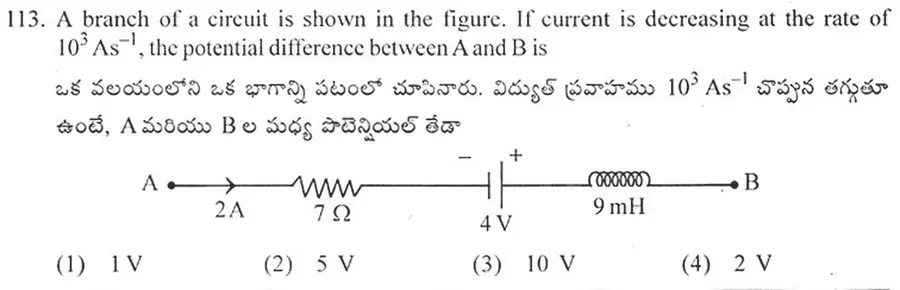
1 V
5 V
10 V
2 V
The natural frequency of an LC circuit is 125 kHz. When the capacitor is totally filled with a dielectric material, the natural frequency decreases by 25 kHz. Dielectric constant of the material is nearly
3.33
2.12
1.56
1.91
A coil of wire of radius r has 600 turns and a self inductance of 108 mH. The self inductance of a coil with same radius and 500 turns is
80 mH
75 mH
108 mH
90 mH
A primary coil and secondary coil are placed close to each other. A current, which changes at the rate of 25 amp in a millisecond, is present in the primary coil. If the mutual inductance is $92 \times 10^{-6}$ Henries, then the value of induced emf in the secondary coil is
4.6 V
2.3 V
0.368 mV
0.23 mV
A constant voltage of 25 V is applied to a series L-R circuit at $t = 0$, by closing a switch. What is the potential difference across the resistor and the inductor at time $t = 0$ ?
0 V, 25 V
12.5 V, 12.5 V
10 V, 15 V
25 V, 0 V
The time constant of inductance coil is 3 m sec. When a 90 $\Omega$ resistance is joined in series, then the time constant becomes 0.5 m sec. The inductance and the resistance of the coil are :
54 mH, 18 $\Omega$
14 mH, 42 $\Omega$
42 mH, 14 $\Omega$
14 mH, 60 $\Omega$
Electromagnetic Induction serves as an indispensable bridge connecting magnetic fields with alternating currents in Class 12 physics. Across AP and TS EAPCET papers spanning 2022 to 2026, the chapter contributed 86 questions across 77 papers. That gives an average frequency of 1.1 questions per paper, making up 2.8% of all physics questions in that recent window. Taking into account the complete archive from 2010 to 2026, Electromagnetic Induction brought 181 questions across 149 papers (1.2 questions per paper, 3.0% subject share). In the prior span between 2010 and 2021, we track 95 questions across 72 papers (3.3% share). In the last three exam years from 2024 to 2026, the chapter delivered 51 questions across 46 papers, registering a 2.8% share. Over the longer baseline, the share of the subject in the last three years compared to early papers is down, while compared to the recent five-year window it is about the same.
State-wise breakdowns reveal higher question density in Telangana compared with Andhra Pradesh. Between 2022 and 2026, AP EAPCET papers in our set contributed 49 questions across 48 papers, with 44 papers containing questions (1.0 per paper, 2.6% share). Over the same window, TS EAPCET papers provided 37 questions across 29 papers in our set, with 28 papers carrying questions (1.3 per paper, 3.2% share). Electromagnetic Induction has appeared every year since 2022, though across all 77 recent papers in our collection, five sittings omitted it, meaning it was not present in all 77 sittings. The chapter ranks 18th of 28 physics chapters by question share between 2022 and 2026. The busiest single sitting in our collection was 2021, which produced 25 questions across 17 papers.
Questions distribute across four distinct syllabus areas:
Motional electromotive force and rotating conductors provide standard numerical configurations. A frequent problem involves a conducting rod of length L pivoted at one end and rotating with steady angular velocity ω in a uniform perpendicular magnetic field B, requiring students to compute the potential difference developed between pivot and rim. Another common variant asks for the external mechanical power needed to pull a conducting bar at constant velocity along frictionless rails across a magnetic field, verifying that mechanical power input exactly equals Joule heating dissipation.
Faraday's law problems often connect graphical analysis with physical principles. Students are shown an induced current versus time graph or magnetic flux curve and asked to determine total circulating charge using Δq = ΔΦ / R, which does not depend on the duration of the flux change. Self and mutual inductance questions ask for coupling coefficients k = M / √(L₁ L₂) or energy stored inside an inductor when current ramps up linearly.
Start by mastering Faraday's law of induction and Lenz's law: induced emf is e = - dΦ/dt = - N d(B A cos θ)/dt. Emf can be generated by varying magnetic field B, area A, or orientation angle θ. The total electric charge circulating through a circuit of resistance R when magnetic flux changes by ΔΦ is q = |ΔΦ| / R, which does not depend on the rate of flux change.
Next, study motional emf formulas thoroughly. For a straight conductor of length L moving with velocity v perpendicular to magnetic field B, the motional emf is e = B v L. For a rod rotating about one end with angular speed ω, the induced potential difference between ends is e = (1/2) B ω L². For a metallic disc of radius R rotating about its central axis, the radial emf between center and rim is e = (1/2) B ω R².
Finally, master inductor relations and transients. Self-induced back emf is e = - L (dI/dt). Magnetic energy stored in an inductor carrying steady current I is U = (1/2) L I², with magnetic energy density per unit volume u_B = B² / (two μ_zero). In a series LR circuit connected to a DC source, current rises according to I(t) = I_zero [1 - exp(- t R / L)], where the inductive time constant is τ = L / R. In an undamped LC circuit, electromagnetic energy oscillates between electric and magnetic forms with natural frequency ω_zero = 1 / √(L C).
In the papers we hold from 2022 to 2026, Electromagnetic Induction averaged 1.1 questions per paper, with TS EAPCET papers averaging 1.3 questions per paper.
No. The total charge passing through a circuit depends solely on the net change in magnetic flux and the total loop resistance, q = ΔΦ / R, and is entirely independent of the time taken.
Lenz's law is a direct consequence of the law of conservation of energy applied to electromagnetic induction, ensuring that induced currents always oppose the change that produces them.
Step-by-step solutions for each one are in the EdLoop EAPCET app.