EdLoop PYQs · free, no ads · questions and answers here, step-by-step solutions in the EdLoop app
PYQs · free, no adsOpen on the web (app.edloop.in)Get EdLoop – free on Google Play
PhysicsGravitation

Gravitation: AP & TS EAPCET PYQs 2010–2026

Every Gravitation question from past AP EAPCET and TS EAPCET papers, with options and answers. Newest first.

167questions
143papers covered
2.5%of Physics questions, 2022–2026
2010–2026years

Guide at a glance

Gravitation provides regular, dependable marks across Intermediate Physics examinations. In the papers we hold from 2022 to 2026, it contributed 77 questions in 77 papers, averaging exactly 1.0 questions per paper.

Most asked sub-topics

Satellites71
Newton's Law of Gravitation50
Field & Potential33
Kepler's Laws13

Practise these in EdLoop

Attempt every Gravitation question timed, see the step-by-step solution and track what you get wrong. Free.

Start practice

All questions

167 questions
1AP EAPCET 2026 · 18 May · Shift 1MCQOpen question page ↗

An artificial satellite of mass $m$ revolves around a planet in a circular orbit of radius $R$ under the influence of an attractive central force given by $F \alpha R^{-5/2}$, How does the orbital velocity ($V_e$) and time period ($T$) depend on the orbital radius ($R$)?

  • A

    $V_e \propto R^{-3/4}$, $T \propto R^{7/4}$

  • B

    $V_e \propto R^{-5/4}$, $T \propto R^{3/2}$

  • C

    $V_e \propto R^{-1/2}$, $T \propto R^{5/4}$

  • D

    $V_e \propto R^{-3/4}$, $T \propto R^{-7/4}$

2AP EAPCET 2026 · 18 May · Shift 2MCQOpen question page ↗

If a body is thrown vertically upwards from a height of $0.5\,R$ ($R$ – radius of the earth) with a velocity equal to the escape velocity a body from the surface of the earth, then the velocity of the body when it escapes from the gravitational influence of the earth is ($g$ – acceleration due to gravity on the surface of the earth)

  • A

    $\sqrt{2gR}$

  • B

    $\sqrt{gR}$

  • C

    $\sqrt{\dfrac{2gR}{3}}$

  • D

    $\sqrt{\dfrac{2gR}{5}}$

3AP EAPCET 2026 · 15 May · Shift 1MCQOpen question page ↗

If a body is thrown vertically upwards from the surface of the earth with a speed equal to 75% of the escape speed from the surface of the earth, then the ratio of the maximum height reached by the body and the radius of the earth is

  • A

    $5:7$

  • B

    $9:7$

  • C

    $3:7$

  • D

    $11:7$

4AP EAPCET 2026 · 15 May · Shift 2MCQOpen question page ↗

A planet revolves around the sun in an elliptical orbit. The areal velocity of the planet is $4 \times 10^{16}\ m^2s^{-1}$. If the maximum distance between the planet and the sun is $4 \times 10^{12}\ m$, then the minimum speed of the planet is

  • A

    $2\ kms^{-1}$

  • B

    $8\ kms^{-1}$

  • C

    $20\ kms^{-1}$

  • D

    $24\ kms^{-1}$

5AP EAPCET 2026 · 14 May · Shift 1MCQOpen question page ↗

Work required to shift an artificial satellite from an orbit of radius ‘$r$’ to an orbit of radius ‘$2r$’ is

  • A

    $GMm/2r$

  • B

    $GMm/4r$

  • C

    $GMm/8r$

  • D

    zero

6AP EAPCET 2026 · 14 May · Shift 2MCQOpen question page ↗

When ‘$g$’ is acceleration due to gravity on earth, the gain in potential energy of an object of mass $m$ raised from the surface of earth to a height equal to the radius of earth ‘$R$’ is given by

  • A

    $\frac{mgR}{2}$

  • B

    $\frac{mgR}{4}$

  • C

    $mgR$

  • D

    $2mgR$

7AP EAPCET 2026 · 13 May · Shift 1MCQOpen question page ↗

A 1200 kg artificial satellite is in an orbit of radius $2R_E$ about the earth. The energy required to transfer it to an orbit of radius $3R_E$ is ($g = 10\,ms^{-2}$, $R_E = 6400\ km$)

  • A

    $1.2 \times 10^{9}\ J$

  • B

    $6.4 \times 10^{9}\ J$

  • C

    $6400 \times 10^{3}\ J$

  • D

    $3.2 \times 10^{9}\ J$

8AP EAPCET 2026 · 13 May · Shift 2MCQOpen question page ↗

The weight of a body decreases by 1% when it is raised to a small height ‘h’ above the earth’s surface. If the same body is taken to a depth ‘h’ in a mine, then its weight is

  • A

    Decreases by 0.5%

  • B

    Decreases by 2.0%

  • C

    Increases by 0.5%

  • D

    Increases by 1.0%

9AP EAPCET 2026 · 12 May · Shift 1MCQOpen question page ↗

If the gravitational force acting on a body due to earth at a height equal to twice the radius of the earth is 30 N, then the mass of the body is (Acceleration due to gravity on the surface of the earth = 10 $ms^{-2}$)

  • A

    27 kg

  • B

    54 kg

  • C

    30 kg

  • D

    60 kg

10AP EAPCET 2026 · 12 May · Shift 2MCQOpen question page ↗

For a planet having uniform density, the Gravitational field inside the planet varies with the distance from the centre as

  • A

    $1/r$

  • B

    $1/r^2$

  • C

    $r$

  • D

    Constant

11TS EAPCET 2026 · 11 May · Shift 1MCQOpen question page ↗

If two bodies A and B of masses 5 kg and 10 kg are thrown vertically upwards from the surface of the earth with velocities $\sqrt{0.5gR}$ and $\sqrt{0.2gR}$ respectively, then the ratio of maximum heights reached by the bodies A and B is
(R – Radius of the earth)

  • A

    $3:2$

  • B

    $5:2$

  • C

    $3:1$

  • D

    $2:1$

12TS EAPCET 2026 · 11 May · Shift 2MCQOpen question page ↗

The fundamental force that operates among all the objects in the universe is

  • A

    Electromagnetic force

  • B

    Strong nuclear force

  • C

    Weak nuclear force

  • D

    Gravitational force

13TS EAPCET 2026 · 11 May · Shift 2MCQOpen question page ↗

If a body of mass 100 kg is thrown vertically upwards from the surface of the earth with a velocity equal to $\frac{2}{3}$ times its escape velocity, then the maximum height reached by the body is
(Radius of the earth = 6400 km)

  • A

    3200 km

  • B

    5120 km

  • C

    8000 km

  • D

    12800 km

14TS EAPCET 2026 · 10 May · Shift 1MCQOpen question page ↗

The energy required to project a body of mass 2 kg so that it escapes from the gravitational influence of the earth is

(Acceleration due to gravity on the surface of the earth $=10\ \mathrm{ms^{-2}}$ and the radius of the earth $= 6400$ km)

  • A

    $96 \times 10^{6}\ \mathrm{J}$

  • B

    $32 \times 10^{6}\ \mathrm{J}$

  • C

    $128 \times 10^{6}\ \mathrm{J}$

  • D

    $64 \times 10^{6}\ \mathrm{J}$

15TS EAPCET 2026 · 10 May · Shift 2MCQOpen question page ↗

A comet at infinity starts moving towards the earth and passes the earth at a distance of 4R from the center of the earth, where R is the radius of the earth. If escape velocity of a body from the surface of earth is $11.2\ \mathrm{km\,s^{-1}}$, then the maximum velocity of the comet is

  • A

    $5.6\ \mathrm{km\,s^{-1}}$

  • B

    $2.8\ \mathrm{km\,s^{-1}}$

  • C

    $11.2\ \mathrm{km\,s^{-1}}$

  • D

    $22.4\ \mathrm{km\,s^{-1}}$

16TS EAPCET 2026 · 9 May · Shift 1MCQOpen question page ↗

A body is thrown vertically upwards from the surface of the earth with a velocity K times the orbital velocity of a satellite near the surface of the earth. If the maximum height reached by the body is 200% more than the radius of the earth, then the value of $K^2$ is

  • A

    4.5

  • B

    2.5

  • C

    1.5

  • D

    3.5

17TS EAPCET 2026 · 9 May · Shift 2MCQOpen question page ↗

The energy required to transfer a satellite of mass ‘m’ from an orbit of height 0.5R from the surface of the earth to an orbit of height 2R from the surface of the earth is
(g - acceleration due to gravity on the surface of the earth and R - radius of the earth)

  • A

    $\frac{mgR}{4}$

  • B

    $\frac{mgR}{2}$

  • C

    $\frac{mgR}{6}$

  • D

    $\frac{mgR}{3}$

18AP EAPCET 2025 · 27 May · Shift 1MCQOpen question page ↗

The escape velocity of a body from a planet of mass M and radius R is $14\ \mathrm{km\ s^{-1}}$. The escape velocity of the body from another planet having same mass and diameter 8R (in $\mathrm{km\ s^{-1}}$) is

  • A

    7

  • B

    10.5

  • C

    14

  • D

    28

19AP EAPCET 2025 · 26 May · Shift 1MCQOpen question page ↗

The acceleration due to gravity at a height of $(\sqrt{2}-1)R$ from the surface of the earth is
(Acceleration due to gravity on the surface of the earth = $10\ \mathrm{m\,s^{-2}}$ and $R$ is radius of the earth)

  • A

    $2.5\ \mathrm{m\,s^{-2}}$

  • B

    $7.5\ \mathrm{m\,s^{-2}}$

  • C

    $5\ \mathrm{m\,s^{-2}}$

  • D

    $10\ \mathrm{m\,s^{-2}}$

20AP EAPCET 2025 · 26 May · Shift 2MCQOpen question page ↗

The potential energy of a satellite of mass 'm' revolving around the earth at a height of $R_e$ from the surface of the earth is

($R_e$ - radius of earth; g - acceleration due to gravity)

  • A

    $-0.5\,mgR_e$

  • B

    $-mgR_e$

  • C

    $-2\,mgR_e$

  • D

    $-4\,mgR_e$

21AP EAPCET 2025 · 24 May · Shift 1MCQOpen question page ↗

If the escape velocity of a body from the surface of the earth is $11.2\ \mathrm{km\ s^{-1}}$, then the orbital velocity of a satellite in an orbit which is at a height equal to the radius of the earth is

  • A

    $11.2\ \mathrm{km\ s^{-1}}$

  • B

    $2.8\ \mathrm{km\ s^{-1}}$

  • C

    $22.4\ \mathrm{km\ s^{-1}}$

  • D

    $5.6\ \mathrm{km\ s^{-1}}$

22AP EAPCET 2025 · 23 May · Shift 1MCQOpen question page ↗

A mass of $6\times10^{24}\ \mathrm{kg}$ is to be compressed in the form of a solid sphere such that the escape velocity from its surface is $3\times10^{4}\ \mathrm{ms^{-1}}$. The radius of the sphere is (Universal gravitational constant = $6.66 \times 10^{-11}\ \mathrm{N\ m^2\ kg^{-2}}$)

  • A

    483 km

  • B

    575 km

  • C

    789 km

  • D

    888 km

23AP EAPCET 2025 · 22 May · Shift 1MCQOpen question page ↗

Two solid spheres each of radius ‘R’ made of same material are placed in contact with each other. If the gravitational force acting between them is F, then

  • A

    $F \alpha R^4$

  • B

    $F \alpha R^3$

  • C

    $F \alpha R^2$

  • D

    $F \alpha R$

24AP EAPCET 2025 · 22 May · Shift 2MCQOpen question page ↗

Two satellites A and B are revolving around the earth in orbits of heights $1.25R_E$ and $19.25R_E$ from the surface of earth respectively, where $R_E$ is the radius of the earth. The ratio of the orbital speeds of the satellites A and B is

  • A

    $5 : 1$

  • B

    $4 : 1$

  • C

    $9 : 1$

  • D

    $3 : 1$

25AP EAPCET 2025 · 21 May · Shift 1MCQOpen question page ↗

An infinite number of objects each 1 kg mass are placed on the x-axis on both sides of x = 0 at $\pm 1\,\mathrm{m}$, $\pm 2\,\mathrm{m}$, $\pm 4\,\mathrm{m}$, $\pm 8\,\mathrm{m}$ ... and so on. The magnitude of the resultant gravitational potential (in SI units) at x = 0 is
(G - Universal gravitational constant)

  • A

    $-G$

  • B

    $-2G$

  • C

    $-3G$

  • D

    $-4G$

26AP EAPCET 2025 · 21 May · Shift 2MCQOpen question page ↗

If the angular velocity of a planet about its axis is halved, the distance of the stationary satellite of this planet from the centre of the planet becomes $2^n$ times the initial distance. Then the value of 'n' is

  • A

    $\frac{2}{3}$

  • B

    $\frac{3}{2}$

  • C

    $\frac{1}{3}$

  • D

    $\frac{4}{3}$

27TS EAPCET 2025 · 4 May · Shift 1MCQOpen question page ↗

A meteor of mass ‘m’ having a speed ‘v’ at infinity reaches the surface of the earth with a speed of
($\mathrm{v_e}$ is escape speed from the earth’s surface)

  • A

    $\sqrt{2}\mathrm{v_e}$

  • B

    $\mathrm{v_e}$

  • C

    $2\sqrt{\mathrm{v}^2+\mathrm{v_e}^2}$

  • D

    $\sqrt{\mathrm{v}^2+\mathrm{v_e}^2}$

28TS EAPCET 2025 · 4 May · Shift 2MCQOpen question page ↗

Which of the following is incorrect about the gravitational force between two bodies?

  • A

    Conservative force

  • B

    Attractive force

  • C

    Not a central force

  • D

    Not a contact force

29TS EAPCET 2025 · 3 May · Shift 1MCQOpen question page ↗

A body is projected from the earth's surface with a speed $\sqrt{5}$ times the escape speed $(\mathrm{V_e})$. The speed of the body when it escapes from the gravitational influence of the earth is

  • A

    $2\mathrm{V_e}$

  • B

    $\mathrm{V_e}$

  • C

    $3\mathrm{V_e}$

  • D

    $5\mathrm{V_e}$

30TS EAPCET 2025 · 3 May · Shift 2MCQOpen question page ↗

If the orbital speed of a body revolving in a circular path near the surface of the earth is $8\ \mathrm{kms^{-1}}$, then the orbital speed of a body revolving around the earth in a circular orbit at height of 19,200 km from the surface of earth is

(Radius of the earth = 6400 km)

  • A

    $4\,\mathrm{kms^{-1}}$

  • B

    $6\,\mathrm{kms^{-1}}$

  • C

    $7.5\,\mathrm{kms^{-1}}$

  • D

    $9\,\mathrm{kms^{-1}}$

31TS EAPCET 2025 · 2 May · Shift 1MCQOpen question page ↗

If a body is projected vertically from the surface of the earth with a speed of $8000\ \mathrm{ms^{-1}}$, then the maximum height reached by the body is

(Radius of the earth $= 6400$ km and acceleration due to gravity $= 10\ \mathrm{ms^{-2}}$)

  • A

    $1600$ km

  • B

    $9600$ km

  • C

    $6400$ km

  • D

    $3200$ km

32AP EAPCET 2024 · 23 May · Shift 1MCQOpen question page ↗

The time period of revolution of a satellite close to planet's surface is 80 minutes. The time period of another satellite which is at a height of 3 times the radius of the planet from surface is

  • A

    64 minutes

  • B

    640 minutes

  • C

    320 minutes

  • D

    240 minutes

33AP EAPCET 2024 · 22 May · Shift 1MCQOpen question page ↗

A satellite moving round the earth in a circular orbit has kinetic energy ‘E’. Then, the minimum amount of energy to be added so that it escapes from the earth

  • A

    $E/4$

  • B

    $E$

  • C

    $E/2$

  • D

    $2E$

34AP EAPCET 2024 · 22 May · Shift 2MCQOpen question page ↗

The gravitational potential energy of a body on the surface of the earth is E. If the body is taken from the surface of the earth to a height equal to 150% of the radius of the earth, its gravitational potential energy is

  • A

    0.4 E

  • B

    0.2 E

  • C

    0.6 E

  • D

    0.3 E

35AP EAPCET 2024 · 21 May · Shift 1MCQOpen question page ↗

If the time period of revolution of a satellite is $T$, then its kinetic energy is proportional to

  • A

    $T^{-1}$

  • B

    $T^{-2}$

  • C

    $T^{-3}$

  • D

    $T^{-2/3}$

36AP EAPCET 2024 · 21 May · Shift 2MCQOpen question page ↗

A particle is projected from the surface of the earth with a velocity equal to twice the escape velocity. When particle is very far from the earth, its speed would be.

  • A

    $V_e$

  • B

    $2V_e$

  • C

    $\sqrt{3}\,V_e$

  • D

    $\sqrt{2}\,V_e$

37AP EAPCET 2024 · 20 May · Shift 1MCQOpen question page ↗

The acceleration due to gravity at a height of 6400 km from the surface of the earth is $2.5\ \mathrm{ms^{-2}}$. The acceleration due to gravity at a height of 12800 km from the surface of the earth is (Radius of the earth = 6400 km)

  • A

    $1.11\ \mathrm{ms^{-2}}$

  • B

    $1.5\ \mathrm{ms^{-2}}$

  • C

    $2.22\ \mathrm{ms^{-2}}$

  • D

    $1.25\ \mathrm{ms^{-2}}$

38AP EAPCET 2024 · 20 May · Shift 2MCQOpen question page ↗

What is the height from the surface of earth, where acceleration due to gravity will be $\frac{1}{4}$ of that of the earth? ($R_E = 6400$ km)

  • A

    6400 km

  • B

    3200 km

  • C

    1600 km

  • D

    640 km

39AP EAPCET 2024 · 19 May · Shift 2MCQOpen question page ↗

Maximum height reached by a rocket fired with a speed equal to 50% of the escape speed from the surface of the earth is (R – Radius of the earth)

  • A

    $\frac{R}{2}$

  • B

    $\frac{16R}{9}$

  • C

    $\frac{R}{3}$

  • D

    $\frac{R}{8}$

40AP EAPCET 2024 · 18 May · Shift 1MCQOpen question page ↗

Two satellites of masses $m$ and $1.5\,m$ are revolving around the earth with different speeds in two circular orbits of heights $\mathrm{R_E}$ and $2\mathrm{R_E}$ respectively, where $\mathrm{R_E}$ is the radius of the earth. The ratio of the minimum and maximum gravitational forces on the earth due to the two satellites is

  • A

    $2:5$

  • B

    $2:3$

  • C

    $1:2$

  • D

    $1:5$

41TS EAPCET 2024 · 11 May · Shift 1MCQOpen question page ↗

An object of mass ‘m’ at a distance of ‘20R’ from the centre of a planet of mass ‘M’ and radius ‘R’ has an initial velocity ‘u’. The velocity with which the object hits the surface of the planet is
(G-Universal gravitational constant)

  • A

    $\left[u^2+\frac{19\,\mathrm{GM}}{10\,\mathrm{R}}\right]^{1/2}$

  • B

    $\left[u^2+\frac{19\,\mathrm{Gm}}{10\,\mathrm{R}}\right]^{1/2}$

  • C

    $\left[u^2-\frac{19\,\mathrm{GM}}{10\,\mathrm{R}}\right]^{1/2}$

  • D

    $\left[u^2-\frac{19\,\mathrm{Gm}}{10\,\mathrm{R}}\right]^{1/2}$

42TS EAPCET 2024 · 10 May · Shift 1MCQOpen question page ↗

Two stars of masses ‘M’ and ‘2M’ that are at a distance ‘d’ apart, are revolving one around another. The angular velocity of the system of two stars is (G-Universal gravitational constant)

  • A

    $\sqrt{\dfrac{4GM}{d^3}}$

  • B

    $\sqrt{\dfrac{2GM}{d^3}}$

  • C

    $\sqrt{\dfrac{9GM}{d^3}}$

  • D

    $\sqrt{\dfrac{3GM}{d^3}}$

43TS EAPCET 2024 · 10 May · Shift 2MCQOpen question page ↗

The ratio of the radii of a planet and the earth is $1:2$, the ratio of their mean densities is $4:1$. If the acceleration due to gravity on the surface of the earth is $9.8\ \mathrm{ms^{-2}}$, then the acceleration due to gravity on the surface of the planet is

  • A

    $4.9\ \mathrm{ms^{-2}}$

  • B

    $8.9\ \mathrm{ms^{-2}}$

  • C

    $29.4\ \mathrm{ms^{-2}}$

  • D

    $19.6\ \mathrm{ms^{-2}}$

44TS EAPCET 2024 · 9 May · Shift 1MCQOpen question page ↗

The energy required to take a body from the surface of the earth to a height equal to the radius of the earth is ‘W’. The energy required to take this body from the surface of the earth to a height equal to twice the radius of the earth is

  • A

    $\frac{W}{3}$

  • B

    $\frac{2W}{3}$

  • C

    $W$

  • D

    $\frac{4W}{3}$

45TS EAPCET 2024 · 9 May · Shift 2MCQOpen question page ↗

The ratio of the accelerations due to gravity at heights 1280 km and 3200 km above the surface of the earth is
(Radius of the earth = 6400 km)

  • A

    25:16

  • B

    5:2

  • C

    1:1

  • D

    25:4

46AP EAPCET 2023 · 19 May · Shift 1MCQOpen question page ↗

The gravitational potential energy of a system of three masses m, 2m and 3m placed at three vertices of equilateral triangle of side ‘a’ is

  • A

    $-11\,\dfrac{Gm}{a}$

  • B

    $-11\,\dfrac{Gm^2}{a^2}$

  • C

    $-11\,\dfrac{Gm^2}{a}$

  • D

    $-11\,\dfrac{Gm}{a^2}$

47AP EAPCET 2023 · 18 May · Shift 1MCQOpen question page ↗

A satellite is placed in a circular orbit around the earth at an altitude of 1000 km. The time period of the satellite in minutes is approximately

(mass of the earth = $6\times10^{24}$ kg, radius of the earth = $6.4\times10^{6}$ m, G = $6.67\times10^{-11}\,\mathrm{Nm^2kg^{-2}}$)

  • A

    105

  • B

    200

  • C

    120

  • D

    62

48AP EAPCET 2023 · 18 May · Shift 2MCQOpen question page ↗

The vector form of universal law of gravitation

  • A

    $\vec{F} = G\frac{m_1 m_2}{r}\vec{r}$

  • B

    $\vec{F} = G\frac{m_1 m_2}{r^3}\hat{r}$

  • C

    $\vec{F} = G\frac{m_1 m_2}{r^2}\vec{r}$

  • D

    $\vec{F} = G\frac{m_1 m_2}{r^3}\vec{r}$

49AP EAPCET 2023 · 17 May · Shift 1MCQOpen question page ↗

A uniform solid sphere of mass M and radius 'a' is surrounded by a concentric uniform thin spherical shell of mass 0.5M and radius 1.5a. The gravitational potential energy of a unit mass kept at a distance of 2.5a from the center is

  • A

    $\frac{-3GM}{5a}$

  • B

    $\frac{3GM}{5a}$

  • C

    $\frac{2GM}{5a}$

  • D

    $\frac{-2GM}{5a}$

50AP EAPCET 2023 · 17 May · Shift 2MCQOpen question page ↗

The statements that are true about acceleration due to gravity, g

A. g is greater at poles.

B. g value decreases with height.

C. g value is same all over the earth.

D. g value is maximum at centre of earth.

  • A

    A and B

  • B

    A and D

  • C

    B and C

  • D

    C and D

51AP EAPCET 2023 · 16 May · Shift 1MCQOpen question page ↗

The time period of a 1500 kg satellite is equal to the time period of rotation of the earth. The altitude of the satellite is nearly

  • A

    42,211 km

  • B

    35,840 km

  • C

    6,400 km

  • D

    13,800 km

52AP EAPCET 2023 · 16 May · Shift 2MCQOpen question page ↗

Satellites which give high value data for remote sensing, meteorology and environmental studies are

  • A

    Geostationary satellites

  • B

    Polar satellites

  • C

    Communication satellites

  • D

    Radio satellites

53AP EAPCET 2023 · 15 May · Shift 1MCQOpen question page ↗

The value of acceleration due to gravity at a height of $4R_E$ from surface of earth is ($R_E$ is radius of earth and acceleration due to gravity on the surface of the earth = $10\ \mathrm{ms^{-2}}$)

  • A

    $0.2\ \mathrm{ms^{-2}}$

  • B

    $0.3\ \mathrm{ms^{-2}}$

  • C

    $0.4\ \mathrm{ms^{-2}}$

  • D

    $3\ \mathrm{ms^{-2}}$

54AP EAPCET 2023 · 15 May · Shift 2MCQOpen question page ↗

The orbital velocity of a body near the surface of a planet ‘A’ is equal to escape velocity of a body from the planet ‘B’. If the masses of planets A and B are same, the ratio of their radii is

  • A

    $1$

  • B

    $\frac{1}{2}$

  • C

    $\frac{1}{3}$

  • D

    $2$

55TS EAPCET 2023 · 14 May · Shift 2MCQOpen question page ↗

A body of mass m is at height R from the surface of the earth where R is the radius of the earth. If the body is taken from here to a height of 3R from the surface of the earth, the increase in the gravitational potential energy of the body is (g is acceleration due to gravity on the surface of the earth)

  • A

    $3\,mgR$

  • B

    $\frac{mgR}{3}$

  • C

    $4\,mgR$

  • D

    $\frac{mgR}{4}$

56TS EAPCET 2023 · 13 May · Shift 1MCQOpen question page ↗

The percentage increase in the energy for an artificial satellite to shift it from an orbit of radius r to an orbit of radius $\frac{3r}{2}$ is

  • A

    66.7

  • B

    50

  • C

    33.33

  • D

    25

57TS EAPCET 2023 · 13 May · Shift 2MCQOpen question page ↗

The ratio of orbital velocity of a body near to the surface of a planet and escape velocity of a body from the surface of the same planet is

  • A

    $\sqrt{2}:1$

  • B

    $\sqrt{5}:1$

  • C

    $1:\sqrt{2}$

  • D

    $1:\sqrt{5}$

58TS EAPCET 2023 · 12 May · Shift 1MCQOpen question page ↗

A ring has a mass M and radius R. The distance of the point on its geometric axis from its centre at which the gravitational field is strongest is

  • A

    $\frac{R}{2}$

  • B

    $\frac{R}{4}$

  • C

    $\frac{R}{\sqrt{3}}$

  • D

    $\frac{R}{\sqrt{2}}$

59TS EAPCET 2023 · 12 May · Shift 2MCQOpen question page ↗

The ratio of the radii of two planets is ‘$r$’ and the ratio of accelerations due to gravity on the planets is ‘$x$’. Then the ratio of the escape velocities from the planets is

  • A

    $xr$

  • B

    $\sqrt{\dfrac{r}{x}}$

  • C

    $\sqrt{rx}$

  • D

    $\sqrt{\dfrac{x}{r}}$

60TS EAPCET 2022 · 20 Jul · Shift 1MCQOpen question page ↗

Let the escape speed of an object on the earth's surface be $V_0$. The object is projected out with speed $5V_0$. The speed of the object far away from the earth will be

  • A

    $2\sqrt{6}\,V_0$

  • B

    $4V_0$

  • C

    $2\sqrt{3}\,V_0$

  • D

    $3\sqrt{2}\,V_0$

61TS EAPCET 2022 · 20 Jul · Shift 2MCQOpen question page ↗

Statement I : The force of attraction due to a hollow spherical shell of uniform density on a point mass situated inside it is always positive.
Statement II : The force of attraction between a hollow spherical shell of uniform density and a point mass situated outside is same just as if the entire mass of the shell is at the center of the shell.
Which of the following is correct?

  • A

    Both statement I and statement II are True

  • B

    Statement I is true, but statement II is false

  • C

    Statement II is true, but statement I is false

  • D

    Both statements, I and II are false

62TS EAPCET 2022 · 19 Jul · Shift 1MCQOpen question page ↗

A uniform sphere A with radius R exerts a force F on a small particle B situated at a distance 2R from the centre of the sphere. A spherical portion of diameter R is cut from the sphere A as shown in the figure. If $F'$ is the new gravitational force between the remaining part of the sphere A and the particle B then the correct relation between F and $F'$
(see the figure above)

The question and its figure as printed in TS EAPCET 2022 19th Jul 2022 Shift 1.
The question as printed in the paper.
  • A

    $F'=\dfrac{9}{14}F$

  • B

    $F'=\dfrac{14}{9}F$

  • C

    $F'=\dfrac{7}{9}F$

  • D

    $F'=\dfrac{9}{7}F$

63TS EAPCET 2022 · 19 Jul · Shift 2MCQOpen question page ↗

Four particles each of mass m are placed at four vertices of a rectangle having side length as $3l_{o}$ and $4l_{o}$. The potential energy of the system in $\frac{Gm^{2}}{l_{0}}$ is

  • A

    7/6

  • B

    47/30

  • C

    47/60

  • D

    7/12

64TS EAPCET 2022 · 18 Jul · Shift 1MCQOpen question page ↗

Three particles, each of mass M, situated at the vertices of an equilateral triangle of side length '$l$'. The only forces acting on the particles are their mutual gravitational forces. It is desired that each particle moves in a circle while maintaining the original separation '$l$'. The initial speed that should be given to each particle is

  • A

    $\sqrt{\dfrac{2GM}{l}}$

  • B

    $\sqrt{\dfrac{GM}{2l}}$

  • C

    $\sqrt{\dfrac{GM}{l}}$

  • D

    $\sqrt{\dfrac{3GM}{l}}$

65TS EAPCET 2022 · 18 Jul · Shift 2MCQOpen question page ↗

A rocket fired vertically with a speed of 4 km/s from the earth’s surface. How far from the earth does the rocket go before returning to the earth?
(Take radius of earth = $6.4\times10^{6}$ m and g = 10 m/s$^{2}$)

  • A

    500.24 km

  • B

    914.28 km

  • C

    1230.24 km

  • D

    1750.28 km

66AP EAPCET 2022 · 8 Jul · Shift 1MCQOpen question page ↗

The escape speed of an object on the surface of the earth is V. If the object is thrown out with speed 4V from the surface of the earth, the speed of the object far away from the earth is

  • A

    $3V$

  • B

    $\sqrt{15}\,V$

  • C

    $2.5V$

  • D

    $\sqrt{8}\,V$

67AP EAPCET 2022 · 8 Jul · Shift 2MCQOpen question page ↗

The escape velocity of an object from a planet is $16\ \mathrm{kms^{-1}}$. If the escape velocity of the object from another planet having twice the density and three times the radius of the planet is $V\sqrt{2}\ \mathrm{km\,s^{-1}}$, then the value of V is

  • A

    $12$

  • B

    $48$

  • C

    $18$

  • D

    $36$

68AP EAPCET 2022 · 7 Jul · Shift 1MCQOpen question page ↗

There is a planet which is 8 times massive and 27 times denser than the earth. If $g'$ and g are the accelerations due to gravity on the surfaces of the planet and the earth respectively then

  • A

    $g' = 8g$

  • B

    $g' = 27g$

  • C

    $g' = 18g$

  • D

    $g' = \dfrac{9}{4}g$

69AP EAPCET 2022 · 7 Jul · Shift 2MCQOpen question page ↗

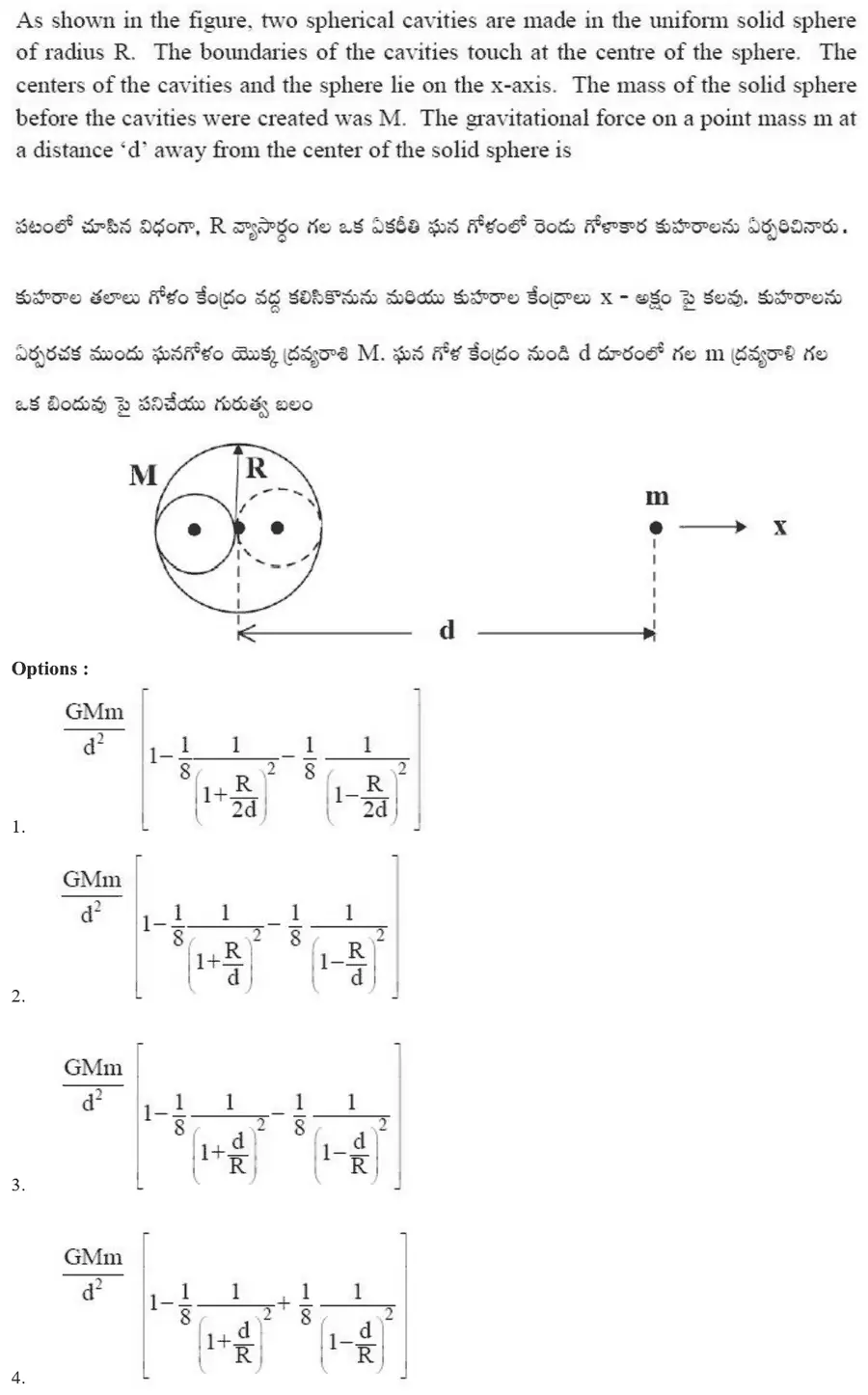
As shown in the figure, two spherical cavities are made in the uniform solid sphere of radius R. The boundaries of the cavities touch at the centre of the sphere. The centers of the cavities and the sphere lie on the x-axis. The mass of the solid sphere before the cavities were created was M. The gravitational force on a point mass m at a distance 'd' away from the center of the solid sphere is
(see the figure above)

The question and its figure as printed in AP EAPCET 2022 07th July2022 Shift2.
The question as printed in the paper.
  • A

    $\frac{GMm}{d^2}\left[1-\frac{1}{8}\frac{1}{\left(1+\frac{R}{2d}\right)^2}-\frac{1}{8}\frac{1}{\left(1-\frac{R}{2d}\right)^2}\right]$

  • B

    $\frac{GMm}{d^2}\left[1-\frac{1}{8}\frac{1}{\left(1+\frac{R}{d}\right)^2}-\frac{1}{8}\frac{1}{\left(1-\frac{R}{d}\right)^2}\right]$

  • C

    $\frac{GMm}{d^2}\left[1-\frac{1}{8}\frac{1}{\left(1+\frac{d}{R}\right)^2}-\frac{1}{8}\frac{1}{\left(1-\frac{d}{R}\right)^2}\right]$

  • D

    $\frac{GMm}{d^2}\left[1-\frac{1}{8}\frac{1}{\left(1+\frac{d}{R}\right)^2}+\frac{1}{8}\frac{1}{\left(1-\frac{d}{R}\right)^2}\right]$

71AP EAPCET 2022 · 6 Jul · Shift 2MCQOpen question page ↗

A satellite is orbiting the earth. It's orbital radius is reduced to half of its initial value then the change in its total energy is

  • A

    $100\%$

  • B

    $75\%$

  • C

    $50\%$

  • D

    $25\%$

72AP EAPCET 2022 · 6 Jul · Shift 2MCQOpen question page ↗

An object is thrown directly away from the surface of the earth with an initial speed V. The object reaches upto a height of $\dfrac{4}{5}R_E$ from earth's surface, where $R_E$ is radius of the earth. If the escape velocity of the object is $V_E$ then the value of $\dfrac{V}{V_E}$ is

  • A

    $\dfrac{4}{3}$

  • B

    $\dfrac{3}{4}$

  • C

    $\dfrac{2}{3}$

  • D

    $\dfrac{4}{5}$

73AP EAPCET 2022 · 5 Jul · Shift 1MCQOpen question page ↗

Statement (A): Two artificial satellites revolving in the same circular orbit have same period of revolution.
Statement (B): The orbital velocity is inversely proportional to the square root of radius of the orbit.
Statement (C): The escape velocity of the body is independent of the altitude of the point of projection.

  • A

    A, B, C are true

  • B

    A, B true C false

  • C

    A, C true B false

  • D

    B, C true A false

74AP EAPCET 2022 · 5 Jul · Shift 2MCQOpen question page ↗

When a ball is dropped from a height h it takes t sec to reach the ground. If the same experiment in done on a different planet having the mass 100 times the earth's mass and radius 10 times the earth's radius, then the time it will take to cover the same height in the new planet is

  • A

    $t\ \mathrm{s}$

  • B

    $100\,t\ \mathrm{s}$

  • C

    $\frac{t}{100}\ \mathrm{s}$

  • D

    $\frac{t}{10}\ \mathrm{s}$

75AP EAPCET 2022 · 5 Jul · Shift 2MCQOpen question page ↗

Two planets, A and B orbit around a star such that time period of A is 8 times the time period of B. The ratio of orbital velocities of the planets A and B is

  • A

    $4:1$

  • B

    $1:4$

  • C

    $2:1$

  • D

    $1:2$

76AP EAPCET 2022 · 4 Jul · Shift 1MCQOpen question page ↗

A projectile is thrown straight upward from the earth's surface with an initial speed V= $\alpha$ $V_E$ where $\alpha$ is a constant and $V_E$ is the escape speed. The projectile travels upto a height 800 km from earth's surface, before it comes to rest. The value of the constant $\alpha$ is
(Radius of the earth = 6400 km)

  • A

    $\dfrac{1}{3}$

  • B

    $\dfrac{1}{2}$

  • C

    $\dfrac{2}{3}$

  • D

    $\dfrac{3}{4}$

77AP EAPCET 2022 · 4 Jul · Shift 2MCQOpen question page ↗

A uniform solid sphere of radius R produces a gravitational acceleration of $a_o$ on its surface. The distance of the point from the centre of the sphere where the gravitational acceleration becomes $\frac{a_o}{4}$ is

  • A

    $4R$

  • B

    $\frac{3}{2}R$

  • C

    $2R$

  • D

    $3R$

78AP EAMCET 2021 · 5 Oct · Shift 1MCQOpen question page ↗

The escape velocity from the earth is $11.2\ \mathrm{km.s^{-1}}$. The escape velocity from a planet having twice the radius and the same mean density as the earth is:

  • A

    $22.4\ \mathrm{km.s^{-1}}$

  • B

    $11.2\ \mathrm{km.s^{-1}}$

  • C

    $5.6\ \mathrm{km.s^{-1}}$

  • D

    $15.8\ \mathrm{km.s^{-1}}$

79AP EAMCET 2021 · 5 Oct · Shift 1MCQOpen question page ↗

An object is projected upwards with a velocity of $89.6\ \mathrm{km.s^{-1}}$ from the surface of the earth. Velocity of the body when it escapes the gravitational pull of the earth is ________

  • A

    $11.2\ \mathrm{km.s^{-1}}$

  • B

    $(\sqrt{126}\times 11.2)\ \mathrm{km.s^{-1}}$

  • C

    $(\sqrt{63}\times 11.2)\ \mathrm{km.s^{-1}}$

  • D

    $(\sqrt{8}\times 11.2)\ \mathrm{km.s^{-1}}$

80AP EAMCET 2021 · 25 Aug · Shift 1MCQOpen question page ↗

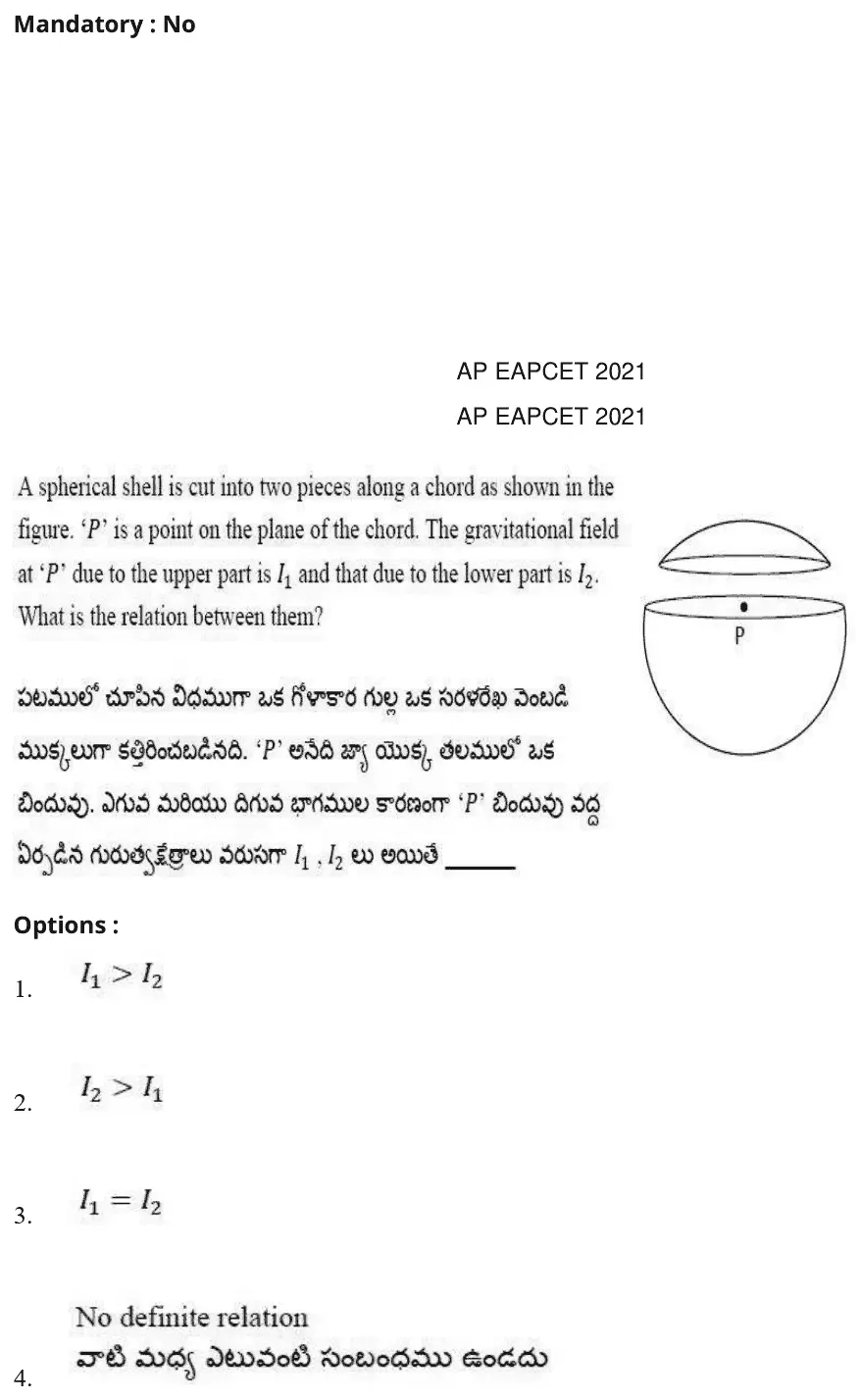
A spherical shell is cut into two pieces along a chord as shown in the figure. 'P' is a point on the plane of the chord. The gravitational field at 'P' due to the upper part is $I_1$ and that due to the lower part is $I_2$. What is the relation between them?
(see the figure above)

The question and its figure as printed in AP EAPCET 2021 25th Aug 2021 Shift 1.
The question as printed in the paper.
  • A

    $I_1 > I_2$

  • B

    $I_2 > I_1$

  • C

    $I_1 = I_2$

  • D

    No definite relation

81AP EAMCET 2021 · 25 Aug · Shift 1MCQOpen question page ↗

Work done in raising a body of mass 'm' from the surface of the earth to a height $\frac{R}{3}$ is ______. (Where $R$ is radius of earth, $M$ is mass of the earth and $G$ is gravitational constant)

  • A

    $\frac{GMm}{4R}$

  • B

    $\frac{4GMm}{R}$

  • C

    $\frac{3GMm}{4R}$

  • D

    $\frac{GMm}{3R}$

82AP EAMCET 2021 · 25 Aug · Shift 2MCQOpen question page ↗

An artificial satellite moving in a circular orbit at a distance $h$ from the centre of the earth has a total energy $E_0$. Then its Potential energy is ______

  • A

    $-E_0$

  • B

    $1.5\,E_0$

  • C

    $E_0$

  • D

    $2\,E_0$

83AP EAMCET 2021 · 25 Aug · Shift 2MCQOpen question page ↗

Find the angular speed of rotation of the earth so that the apparent-'g' at the equator becomes $(1/6)^{th}$ of its original value. ($R = 6.4 \times 10^{6}\ \mathrm{m}$)

  • A

    $1.3 \times 10^{-6}\ \mathrm{rad.s^{-1}}$

  • B

    $8.75 \times 10^{-4}\ \mathrm{rad.s^{-1}}$

  • C

    $1.14 \times 10^{-3}\ \mathrm{rad.s^{-1}}$

  • D

    $2.6 \times 10^{6}\ \mathrm{rad.s^{-1}}$

84AP EAMCET 2021 · 24 Aug · Shift 1MCQOpen question page ↗

A communication satellite of $500\ \mathrm{kg}$ revolves around the earth in a circular orbit of radius $4.0 \times 10^{7}\ \mathrm{m}$ in the equatorial plane of the earth from west to east. The magnitude of angular momentum of the satellite is ______

  • A

    $\approx 0.13 \times 10^{14}\ \mathrm{kg.m^2.s^{-1}}$

  • B

    $\approx 1.30 \times 10^{14}\ \mathrm{kg.m^2.s^{-1}}$

  • C

    $\approx 0.58 \times 10^{14}\ \mathrm{kg.m^2.s^{-1}}$

  • D

    $\approx 2.58 \times 10^{14}\ \mathrm{kg.m^2.s^{-1}}$

85AP EAMCET 2021 · 24 Aug · Shift 1MCQOpen question page ↗

The rotation of the earth (of radius $R$) about its axis speeds up to a value such that a man at latitude angle $45°$ feels weightlessness. The duration of a day in such a case is ______

  • A

    $\pi\left(\sqrt{\frac{R}{g}}\right)$

  • B

    $\pi\left(\sqrt{\frac{2R}{g}}\right)$

  • C

    $\frac{\pi}{2}\left(\sqrt{\frac{R}{g}}\right)$

  • D

    $\pi\left(\sqrt{\frac{g}{R}}\right)$

86AP EAMCET 2021 · 24 Aug · Shift 2MCQOpen question page ↗

If 'R' is the radius of orbit of a satellite, then the kinetic energy of the satellite is ______

  • A

    $\propto \frac{1}{R}$

  • B

    $\propto \frac{1}{\sqrt{R}}$

  • C

    $\propto R$

  • D

    $\propto \frac{1}{R^{3/2}}$

87AP EAMCET 2021 · 24 Aug · Shift 2MCQOpen question page ↗

If 'A' is the areal velocity of a planet of mass 'M', its angular momentum is:

  • A

    $\frac{M}{A}$

  • B

    $2MA$

  • C

    $A^{2}M$

  • D

    $AM^{2}$

88AP EAMCET 2021 · 23 Aug · Shift 1MCQOpen question page ↗

Find the gravitational force between two stones, each of mass $2\ kg$ and separated by a distance $1\ m$ in vacuum.

  • A

    $0\ N$

  • B

    $6.675 \times 10^{-5}\ N$

  • C

    $6.675 \times 10^{-11}\ N$

  • D

    $2.67 \times 10^{-10}\ N$

89AP EAMCET 2021 · 23 Aug · Shift 1MCQOpen question page ↗

Assertion (A): Angular speed, linear speed as Kinetic energy change with time but angular momentum remains constant for a planet orbiting the sun.
Reason (R): Angular momentum is constant as no torque acts on the planet.

  • A

    Both A and R are true and R is a correct explanation for A

  • B

    Both A and R are true but R is not a correct explanation for A

  • C

    A is true, R is false

  • D

    A is false, R is false

90AP EAMCET 2021 · 23 Aug · Shift 2MCQOpen question page ↗

The radius of earth is about 6400 $km$ and that of mars is 3200 $km$. And mass of the earth is about 10 times mass of mars. An object weighs 200 $N$ on the surface of earth. Then its weight on the surface of mars will be ______

  • A

    80 $N$

  • B

    40 $N$

  • C

    20 $N$

  • D

    8 $N$

91AP EAMCET 2021 · 23 Aug · Shift 2MCQOpen question page ↗

The gravitational field in a region is given by $\vec{I} = 5\hat{i} + 12\hat{j}\ N.kg^{-1}$. The change in the gravitational potential energy of an object of mass 3 $kg$ when it is taken from the origin to a point $(8m, -2m)$ is ______

  • A

    $1\ \mathrm{J}$

  • B

    $16\ \mathrm{J}$

  • C

    $48\ \mathrm{J}$

  • D

    $3\ \mathrm{J}$

92AP EAMCET 2021 · 20 Aug · Shift 1MCQOpen question page ↗

The gravity potential energy is maximum at ______.

  • A

    Infinity

  • B

    the earth's surface

  • C

    the centre of the earth

  • D

    twice the radius of the earth

93AP EAMCET 2021 · 20 Aug · Shift 1MCQOpen question page ↗

A geostationary satellite is taken to a new orbit such that its distance from centre of the earth is doubled. Then find the time period of this satellite in the new orbit.

  • A

    $24\ \mathrm{hrs}$

  • B

    $4.8\ \mathrm{hrs}$

  • C

    $48\sqrt{2}\ \mathrm{hrs}$

  • D

    $24\sqrt{2}\ \mathrm{hrs}$

94AP EAMCET 2021 · 20 Aug · Shift 2MCQOpen question page ↗

If the earth stops rotating in its orbit about the sun, there will be variation in the weight of our bodies at ______

  • A

    Equator

  • B

    $60^\circ$ latitude

  • C

    Poles

  • D

    Nowhere

95AP EAMCET 2021 · 20 Aug · Shift 2MCQOpen question page ↗

At what depth below surface of the earth, the acceleration due to gravity will be half its value of that at $1600\ \mathrm{km}$ above the surface of the earth?

  • A

    $4.3 \times 10^{6}\ \mathrm{m}$

  • B

    $3.19 \times 10^{6}\ \mathrm{m}$

  • C

    $1.59 \times 10^{6}\ \mathrm{m}$

  • D

    $5.5 \times 10^{6}\ \mathrm{m}$

96AP EAMCET 2021 · 19 Aug · Shift 1MCQOpen question page ↗

Assertion (A): Two identical trains move in opposite senses in equatorial plane with same speeds relative to the earth's surface. They have equal magnitude of normal reaction.
Reason (R): The trains have different centripetal accelerations due to different speeds.

  • A

    Both A and R are true and R is a correct explanation for A

  • B

    Both A and R are true but R is not a correct explanation for A

  • C

    A is true, R is false

  • D

    A is false, R is true

97AP EAMCET 2021 · 19 Aug · Shift 1MCQOpen question page ↗

A particle is kept on the surface of a uniform sphere of mass $1000\ kg$ and radius $1\ m$. The work done per unit mass against the gravitational force between them is ______ [$G = 6.67 \times 10^{-11}\ \mathrm{N.m^2.Kg^{-2}}$]

  • A

    $3.35 \times 10^{-10}\ \mathrm{J.kg^{-1}}$

  • B

    $-3.35 \times 10^{-10}\ \mathrm{J.kg^{-1}}$

  • C

    $6.67 \times 10^{-8}\ \mathrm{J.kg^{-1}}$

  • D

    $-3.35 \times 10^{-8}\ \mathrm{J.kg^{-1}}$

98AP EAMCET 2021 · 19 Aug · Shift 1MCQOpen question page ↗

The acceleration due to gravity at a height $(1/20)^{th}$ of the radius of earth above the earth's surface is $9\ \mathrm{m.s^{-2}}$. Its value at an equal depth below the surface of earth is

  • A

    $9\ \mathrm{m.s^{-2}}$

  • B

    $9.25\ \mathrm{m.s^{-2}}$

  • C

    $9.5\ \mathrm{m.s^{-2}}$

  • D

    $9.8\ \mathrm{m.s^{-2}}$

99AP EAMCET 2021 · 19 Aug · Shift 2MCQOpen question page ↗

The distance through which one has to dig the earth from its surface so as to reach the point where the acceleration due to gravity is reduced by $40\ \%$ of that at the surface of the earth, is ______ (radius of earth is $6400\ \mathrm{km}$)

  • A

    $2560\ \mathrm{km}$

  • B

    $3000\ \mathrm{km}$

  • C

    $3260\ \mathrm{km}$

  • D

    $1560\ \mathrm{km}$

100AP EAMCET 2021 · 19 Aug · Shift 2MCQOpen question page ↗

Infinite number of masses each of $3\ \mathrm{kg}$ are placed along a straight line at the distances of $1\ \mathrm{m}$, $2\ \mathrm{m}$, $4\ \mathrm{m}$, $8\ \mathrm{m}$, ... ... from a point $O$ on the same line. Ig (sic) $G$ is the universal gravitational constant, then the magnitude of gravitational field intensity at $O$ is ______

  • A

    $1.0\ G$

  • B

    $2.0\ G$

  • C

    $3.0\ G$

  • D

    $4.0\ G$

101TS EAMCET 2021 · 6 Aug · Shift 1MCQOpen question page ↗

A satellite revolving around the earth at a certain height experiences acceleration due to gravity equal to $\frac{16}{49}g_0$, when $g_0$ is the acceleration due to gravity on the earth's surface. If R is the radius of earth, then the square of time period of the satellite's revolution is equal to $K\left[\frac{\pi^2R^3}{GM}\right]$. The value of K is:

  • A

    $\frac{27}{36}R^3$

  • B

    $\frac{343}{16}R^3$

  • C

    $\frac{125}{64}R^3$

  • D

    $\frac{675}{81}R^3$

102TS EAMCET 2021 · 6 Aug · Shift 2MCQOpen question page ↗

Match the following

Column-1
A) Potential energy of satellite
B) Total energy of satellite
C) Kinetic energy of satellite
D) Gravitational potential energy of satellite at infinity

Column-2
I) Positive
II) Negative
III) Zero
IV) Infinity

The correct match is

  • A

    A-IV, B-II, C-I, D-III

  • B

    A-III, B-I, C-IV, D-II

  • C

    A-II, B-II, C-I, D-III

  • D

    A-II, B-I, C-IV, D-III

103TS EAMCET 2021 · 5 Aug · Shift 1MCQOpen question page ↗

Two stars of equal masses M are orbiting in a circle of radius R. Their orbital time period is proportional to

  • A

    $R^{3/2}$

  • B

    R

  • C

    $R^{2}$

  • D

    $R^{1/2}$

104TS EAMCET 2021 · 5 Aug · Shift 2MCQOpen question page ↗

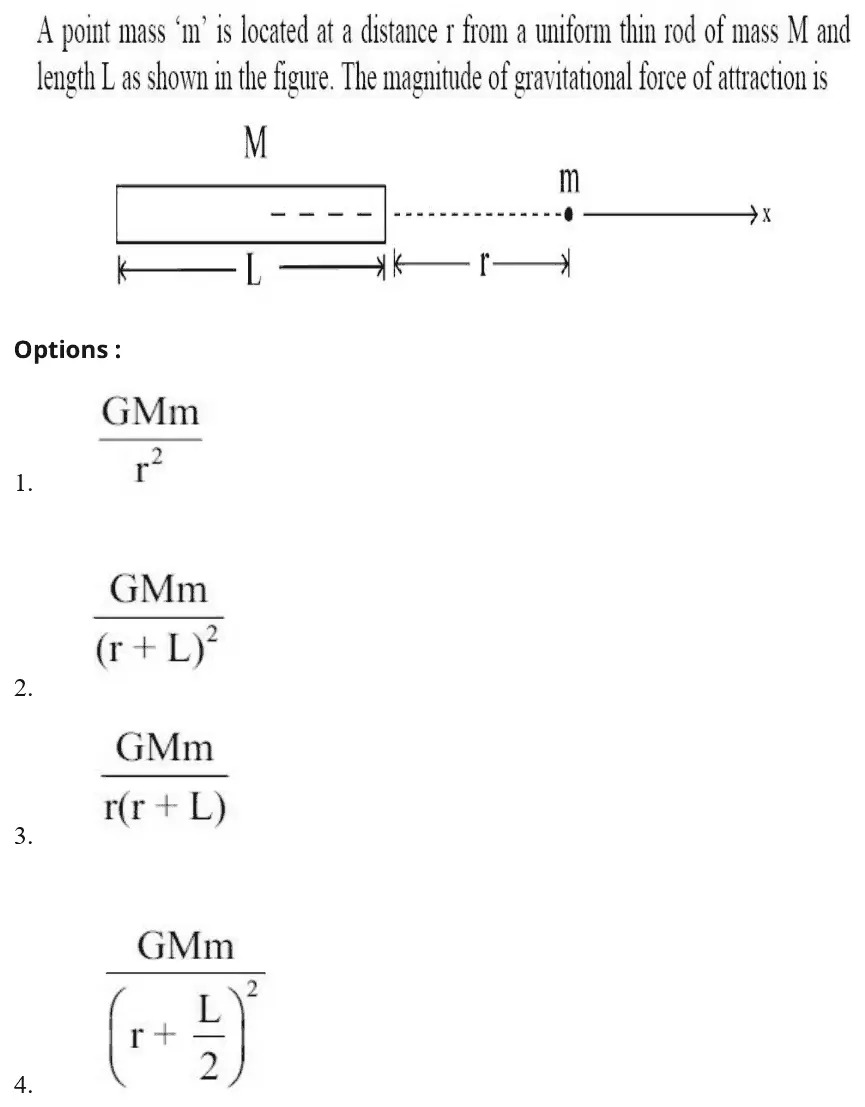
A point mass 'm' is located at a distance r from a uniform thin rod of mass M and length L as shown in the figure. The magnitude of gravitational force of attraction is
(see the figure above)

The question and its figure as printed in TS EAPCET 2021 English 5th Aug 2021 Shift 2.
The question as printed in the paper.
  • A

    $\frac{GMm}{r^2}$

  • B

    $\frac{GMm}{(r+L)^2}$

  • C

    $\frac{GMm}{r(r+L)}$

  • D

    $\frac{GMm}{\left(r+\frac{L}{2}\right)^2}$

105TS EAMCET 2021 · 4 Aug · Shift 1MCQOpen question page ↗

What is the change in mass of a body, when taken 64 km below the surface of the earth?
[Take radius of the earth as 6400 km]

  • A

    Increases by 2%

  • B

    Remain constant

  • C

    Increases by 1%

  • D

    Decrease by 1%

106TS EAMCET 2021 · 4 Aug · Shift 2MCQOpen question page ↗

Four identical masses of m are kept at corners of a square. If the gravitational force exerted on one of masses by the other masses is $\left(\dfrac{2\sqrt{2}+1}{32}\right)\dfrac{Gm^{2}}{L^{2}}$, then the length of the side of the square is

  • A

    $L$

  • B

    $2L$

  • C

    $4L$

  • D

    $L/2$

107AP EAMCET 2020 · 7 Oct · Shift 1MCQOpen question page ↗

The weight of a body at earth's surface is $w$. At a depth half way to the centre of the earth, it will be ______ (assuming of uniform density for earth)

  • A

    $w$

  • B

    $\frac{w}{4}$

  • C

    $\frac{w}{2}$

  • D

    $\frac{w}{16}$

108AP EAMCET 2020 · 7 Oct · Shift 1MCQOpen question page ↗

A geostationary satellite is taken from one orbit to another orbit, whose distance from the centre of earth is 2 times that of the earlier orbit. The time period in the second orbit is ______ hours

  • A

    $4.8$

  • B

    $48\sqrt{2}$

  • C

    $24$

  • D

    $24\sqrt{2}$

110AP EAMCET 2020 · 22 Sep · Shift 2MCQOpen question page ↗

A body of mass $m$ is placed on the earth's surface. It is taken from the earth's surface to a height $h = 3R$ ,($R$ is radius of earth). The change in gravitational potential energy of the body is ______

  • A

    $\left(\frac{2}{3}\right) mgR$

  • B

    $\left(\frac{3}{4}\right) mgR$

  • C

    $\left(\frac{1}{2}\right) mgR$

  • D

    $\left(\frac{1}{4}\right) mgR$

111AP EAMCET 2020 · 22 Sep · Shift 2MCQOpen question page ↗

The period of revolution of planet A around the sun is 8 times that of B. The distance of A from sun is how many times greater than that of B from the sun?

  • A

    2

  • B

    3

  • C

    4

  • D

    5

112AP EAMCET 2020 · 21 Sep · Shift 1MCQOpen question page ↗

A point mass of $10\ \mathrm{kg}$ is placed at the centre of earth. The weight of the point mass is

  • A

    Zero

  • B

    $98\ \mathrm{N}$

  • C

    $49\ \mathrm{N}$

  • D

    $10\ \mathrm{N}$

113AP EAMCET 2020 · 21 Sep · Shift 1MCQOpen question page ↗

A body is projected with a velocity greater than orbital velocity but less than escape velocity. Its path is ______

  • A

    circular

  • B

    elliptical

  • C

    parabolic

  • D

    hyperbolic

114AP EAMCET 2020 · 21 Sep · Shift 2MCQOpen question page ↗

The distance between the centers of moon and earth is $D$ and mass of earth is 81 times the mass of moon. At what distance from the centre of the earth, the gravitational force will be zero?

  • A

    $\frac{D}{2}$

  • B

    $\frac{2D}{3}$

  • C

    $\frac{4D}{3}$

  • D

    $\frac{9D}{10}$

115AP EAMCET 2020 · 21 Sep · Shift 2MCQOpen question page ↗

A ball is dropped from a spacecraft revolving around the earth at a height of $120\,\mathrm{km}$. What will happen to the ball?

  • A

    It will continue to move with same speed along the original orbit of spacecraft

  • B

    It will move with the same speed tangentially to the original orbit

  • C

    It will fall down to the earth gradually

  • D

    It will go very far in space.

116AP EAMCET 2020 · 21 Sep · Shift 2MCQOpen question page ↗

Acceleration due to gravity at a height 'h' is equal to that at a depth 'd' below the surface of the earth, if

  • A

    $d = h$

  • B

    $2d = h$

  • C

    $d = 2h$

  • D

    $3d = h$

117AP EAMCET 2020 · 18 Sep · Shift 1MCQOpen question page ↗

The escape velocity for a planet whose radius is $1.7 \times 10^{6}\,\mathrm{m}$ and acceleration due to gravity is $1.7\,\mathrm{m.s^{-2}}$ is ______

  • A

    $1.7\,\mathrm{km.s^{-1}}$

  • B

    $2.89\,\mathrm{km.s^{-1}}$

  • C

    $1.7\sqrt{2}\,\mathrm{km.s^{-1}}$

  • D

    $3.4\,\mathrm{km.s^{-1}}$

118AP EAMCET 2020 · 18 Sep · Shift 1MCQOpen question page ↗

At what height from surface of earth the value of acceleration due to gravity will fall to half that on the surface of the earth?

  • A

    $2625\,\mathrm{m}$

  • B

    $2625\,\mathrm{km}$

  • C

    $2526\,\mathrm{m}$

  • D

    $2526\,\mathrm{km}$

119AP EAMCET 2020 · 18 Sep · Shift 2MCQOpen question page ↗

A body is projected vertically upwards from the surface of a planet of radius $R$, with a velocity equal to half the escape velocity of that planet. Then, the maximum height attained by the body is

  • A

    $\frac{R}{3}$

  • B

    $\frac{R}{2}$

  • C

    $\frac{R}{4}$

  • D

    $\frac{R}{5}$

120AP EAMCET 2020 · 17 Sep · Shift 1MCQOpen question page ↗

Acceleration due to gravity ______

  • A

    increases with altitude

  • B

    decreases with altitude

  • C

    is independent of altitude

  • D

    first decreases and then increases with altitude

121AP EAMCET 2020 · 17 Sep · Shift 1MCQOpen question page ↗

Kepler's second law (law of areas) is nothing but a statement of

  • A

    Work energy theory

  • B

    Conservation of linear momentum

  • C

    Conservation of angular momentum

  • D

    Conservation of energy

122AP EAMCET 2020 · 17 Sep · Shift 2MCQOpen question page ↗

Using the data given below, find the height at which a communication satellite can reside.
($G = 6.67 \times 10^{-11}\ \mathrm{N.m^{2}.kg^{-2}}$, $M = 5.98 \times 10^{24}\ \mathrm{kg}$, $R = 6.4 \times 10^{6}\ \mathrm{m}$)

  • A

    35850 $\mathrm{km}$

  • B

    3585 $\mathrm{km}$

  • C

    358.5 $\mathrm{km}$

  • D

    35.85 $\mathrm{km}$

123TS EAMCET 2020 · 14 Sep · Shift 1MCQOpen question page ↗

If the escape velocity on earth is 11.2 km/s, its value for a planet having double the radius and 8 time the mass of earth is

  • A

    22.4 km/s

  • B

    24.3 km/s

  • C

    26.6 km/s

  • D

    44.8 km/s

124TS EAMCET 2020 · 14 Sep · Shift 2MCQOpen question page ↗

A mass M is split into two parts, $m_o$ and $M-m_o$. These two masses are then separated by a distance D. If the gravitational force between the parts is maximum, then the ratio $\frac{m_o}{M}$ is

  • A

    0.2

  • B

    0.4

  • C

    0.5

  • D

    0.6

125TS EAMCET 2020 · 11 Sep · Shift 2MCQOpen question page ↗

If the radius of the earth shrinks by 1 %, its mass remaining the same, the acceleration due to gravity on the earth surface would.

  • A

    Increase by 1 %

  • B

    remain unchanged

  • C

    Increase by 2 %

  • D

    decrease by 9.8 %

126TS EAMCET 2020 · 10 Sep · Shift 1MCQOpen question page ↗

Choose the correct statement

  • A

    acceleration due to gravity increases with increasing altitude

  • B

    acceleration due to gravity is independent of mass of earth

  • C

    a geostationary satellite can have a time period less than 24 hours

  • D

    acceleration due to gravity decreases with increasing depth assuming earth to be a sphere of uniform density

127TS EAMCET 2020 · 10 Sep · Shift 2MCQOpen question page ↗

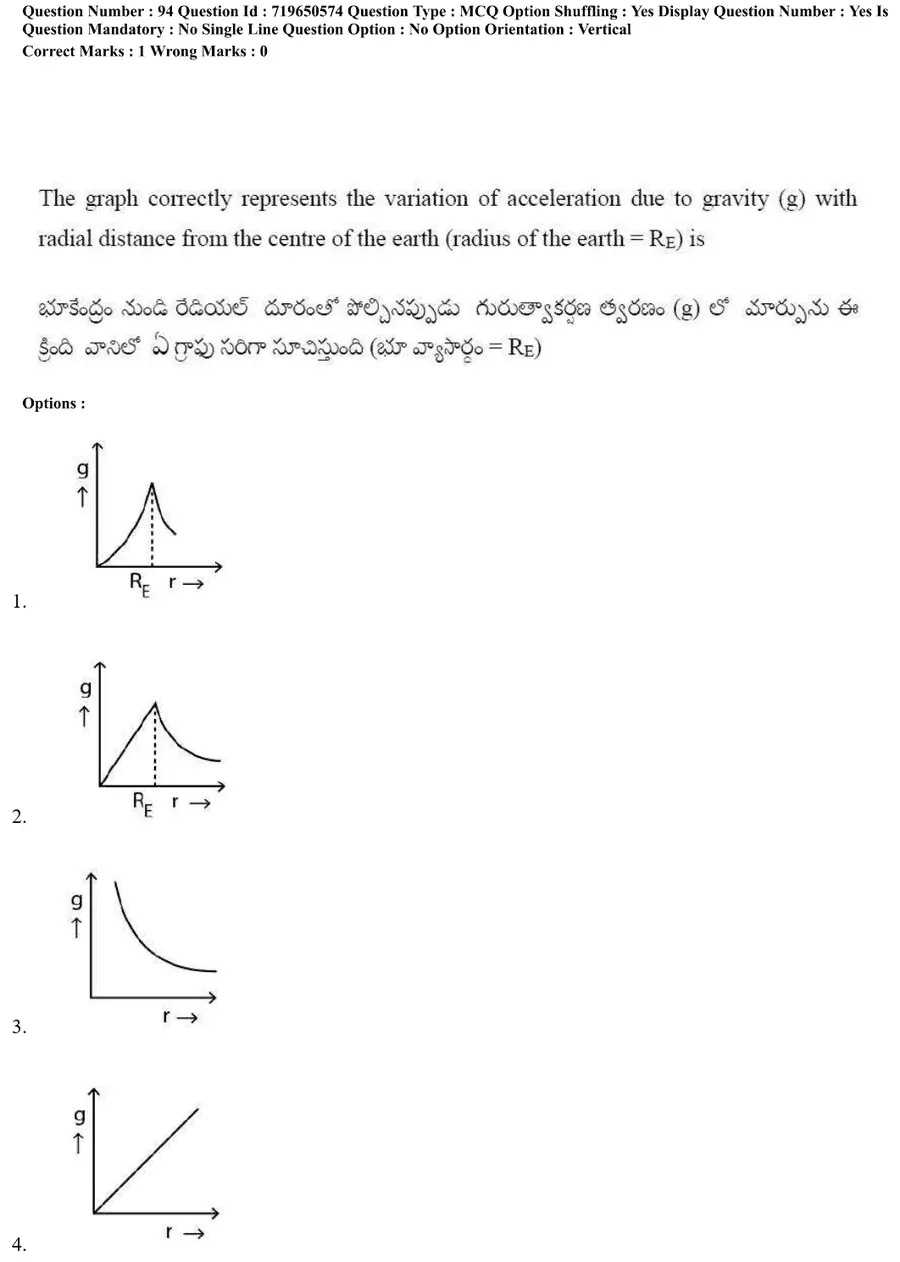
The graph correctly represents the variation of acceleration due to gravity (g) with radial distance from the centre of the earth (radius of the earth = $R_E$) is

The question and its figure as printed in TS EAMCET 2020 10 Sep AN. Option 1: g vs r: rises from origin, concave-up (curved) to a sharp peak at r = RE (dashed vertical line), then falls steeply, curved, beyond RE. Option 2: g vs r: rises linearly from origin to a peak at r = RE (dashed vertical line), then decreases as a smooth curve, asymptotically flattening toward the axis. Option 3: g vs r: starts high at left and decreases as a smooth curve flattening toward the r-axis (no RE marked). Option 4: g vs r: straight line rising from the origin (no RE marked).
The question as printed in the paper.
  • A

    see figure g vs r: rises from origin, concave-up (curved) to a sharp peak at r = $R_E$ (dashed vertical line), then falls steeply, curved, beyond $R_E$.

  • B

    see figure g vs r: rises linearly from origin to a peak at r = $R_E$ (dashed vertical line), then decreases as a smooth curve, asymptotically flattening toward the axis.

  • C

    see figure g vs r: starts high at left and decreases as a smooth curve flattening toward the r-axis (no $R_E$ marked).

  • D

    see figure g vs r: straight line rising from the origin (no $R_E$ marked).

128TS EAMCET 2020 · 9 Sep · Shift 1MCQOpen question page ↗

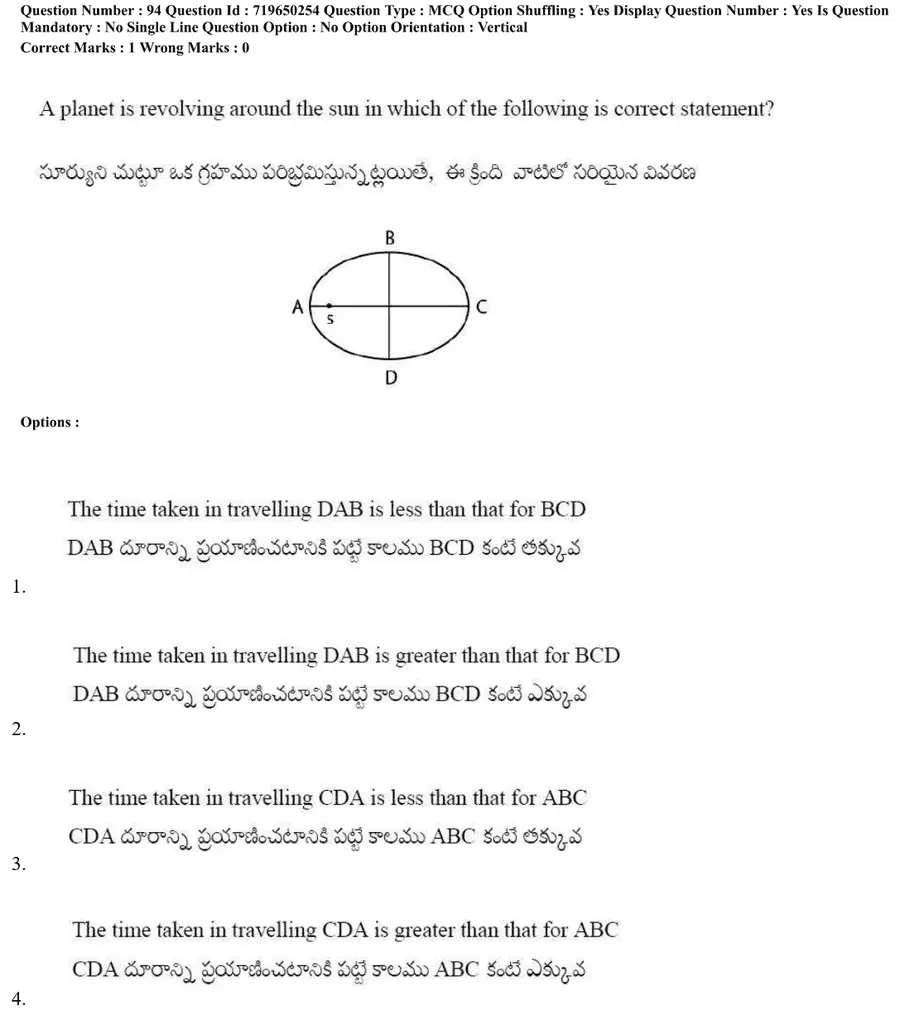
A planet is revolving around the sun in which of the following is correct statement?
(see the figure above)

The question and its figure as printed in TS EAMCET 2020 09 Sep FN.
The question as printed in the paper.
  • A

    The time taken in travelling DAB is less than that for BCD

  • B

    The time taken in travelling DAB is greater than that for BCD

  • C

    The time taken in travelling CDA is less than that for ABC

  • D

    The time taken in travelling CDA is greater than that for ABC

129TS EAMCET 2020 · 9 Sep · Shift 2MCQOpen question page ↗

Find the acceleration of our galaxy, due to the nearest comparably sized galaxy. The approximate mass of each galaxy is $8\times10^{11}$ solar masses and they are separated by 2 million light-years. Each galaxy has a diameter of 100,000 light years. (Assume 1 light year $\simeq 10^{16}$ m, Gravitational constant G$\simeq 10^{-10}\left(\dfrac{\mathrm{Nm^2}}{\mathrm{kg^2}}\right)$ and mass of sun = $2.0\times10^{30}$ Kg)

  • A

    $4\times10^{-13}\ m/s^2$

  • B

    $2\times10^{-13}\ m/s^2$

  • C

    $5\times10^{-15}\ m/s^2$

  • D

    $5\times10^{-13}\ m/s^2$

130TS EAMCET 2019 · 6 May · Shift 1MCQOpen question page ↗

A planet of mass $m$ moves around the Sun along an elliptical path with a period of revolution T. During the motion, the planet's maximum and minimum distance from Sun is R and $\frac{R}{3}$ respectively. If $T^2 = \alpha R^3$, then the magnitude of constant $\alpha$ will be

  • A

    $\frac{10\pi}{9\,Gm}$

  • B

    $\frac{20\pi^2}{27\,Gm}$

  • C

    $\frac{32\pi^2}{27\,Gm}$

  • D

    $\frac{\pi^2}{18\,Gm}$

131TS EAMCET 2019 · 4 May · Shift 1MCQOpen question page ↗

If a planet of mass $6.4 \times 10^{23}\ \mathrm{kg}$ can be compressed into a sphere such that the escape velocity from its surface is $8 \times 10^{4}\ \mathrm{m/s}$, then what should be the radius of the sphere? (Let $G = 6.6 \times 10^{-11}\ \mathrm{Nm^{2}\,kg^{-2}}$)

  • A

    $40.4\ \mathrm{km}$

  • B

    $13.2\ \mathrm{km}$

  • C

    $20.4\ \mathrm{km}$

  • D

    $6.8\ \mathrm{km}$

132TS EAMCET 2019 · 4 May · Shift 2MCQOpen question page ↗

If the acceleration due to gravity 'g' doubles and the radius of earth becomes half that of the present value, then the value of Escape velocity is (Assume $g = 10$ m/s$^2$ and R (radius of earth) $= 6400$ km)

  • A

    12 km/s

  • B

    $16\sqrt{2}$ km/s

  • C

    $8\sqrt{2}$ km/s

  • D

    $4\sqrt{2}$ km/s

133TS EAMCET 2019 · 3 May · Shift 1MCQOpen question page ↗

Consider a spherical planet which is rotating about its axis such that the speed of a point on its equator is 'V' and the effective acceleration due to gravity on the equator is $\frac{1}{3}$ of its value at the poles. What is the escape velocity for a particle at the pole of this planet.

  • A

    $3V$

  • B

    $2V$

  • C

    $\sqrt{3}\,V$

  • D

    $\sqrt{2}\,V$

134TS EAMCET 2019 · 3 May · Shift 2MCQOpen question page ↗

If a satellite has to orbit the earth in a circular path every 6 hrs, at what distance from the surface of the earth should the satellite be placed (radius of earth = 6400 km) (Assume $\dfrac{GM}{4\pi^2} = 8\times10^{12}\ \mathrm{Nm^2/kg}$, where G and M are gravitational constant and mass of earth and $10^{1/3} = 2.1$)

  • A

    15100 km

  • B

    8720 km

  • C

    20600 km

  • D

    5560 km

135AP EAMCET 2019 · 23 Apr · Shift 1MCQOpen question page ↗

The gravitational field in a region is given by $\vec{E} = (5\hat{i} + 12\hat{j})\ \mathrm{Nkg^{-1}}$. If a particle of mass $2\ \mathrm{kg}$ is moved from the origin to the point $(12\ \mathrm{m},\ 15\ \mathrm{m})$ in this region, the change in gravitational potential energy is

  • A

    $-450\ \mathrm{J}$

  • B

    $-480\ \mathrm{J}$

  • C

    $-240\ \mathrm{J}$

  • D

    $-500\ \mathrm{J}$

136AP EAMCET 2019 · 22 Apr · Shift 1MCQOpen question page ↗

A rocket is launched straight up from the surface of the earth. When its altitude is $\dfrac{1}{3}$ of the radius of the earth, its fuel runs out and therefore it coasts. If the rocket has to escape from the gravitational pull of the earth, the minimum velocity with which it should coast is (Escape velocity on the surface of the earth is $11.2\ \mathrm{kms^{-1}}$)

  • A

    $11.2\ \mathrm{kms^{-1}}$

  • B

    $10.7\ \mathrm{kms^{-1}}$

  • C

    $9.7\ \mathrm{kms^{-1}}$

  • D

    $8.7\ \mathrm{kms^{-1}}$

137AP EAMCET 2019 · 22 Apr · Shift 2MCQOpen question page ↗

The gravitational potential difference between the surface of a planet and a point $20\ \mathrm{m}$ above it is $16\ \mathrm{J\,kg^{-1}}$. The workdone in moving a $4\ \mathrm{kg}$ body by $8\ \mathrm{m}$ on a slope of $60^\circ$ from the horizontal is

  • A

    $22.17\ \mathrm{J}$

  • B

    $2.217\ \mathrm{J}$

  • C

    $221.7\ \mathrm{J}$

  • D

    $0.2217\ \mathrm{J}$

138AP EAMCET 2019 · 21 Apr · Shift 1MCQOpen question page ↗

Two masses 90 kg and 160 kg are separated by a distance of 5 m. The magnitude of intensity of the gravitational field at a point which is at a distance 3 m from the 90 kg mass and 4 m from the 160 kg mass is (Universal gravitational constant = $6.67 \times 10^{-11}\,\mathrm{Nm^2\,kg^{-2}}$)

  • A

    $94.3 \times 10^{-10}\,\mathrm{N\,kg^{-1}}$

  • B

    $9.43 \times 10^{-10}\,\mathrm{N\,kg^{-1}}$

  • C

    $9.43 \times 10^{-12}\,\mathrm{N\,kg^{-1}}$

  • D

    $94.3 \times 10^{-12}\,\mathrm{N\,kg^{-1}}$

139AP EAMCET 2019 · 20 Apr · Shift 1MCQOpen question page ↗

Two bodies of masses $m_1$ and $m_2$ initially at rest at infinite distance apart move towards each other under gravitational force of attraction. Their relative velocity of approach when they are separated by a distance 'r' is
(G-Universal gravitational constant)

  • A

    $\left[\dfrac{2G(m_1 - m_2)}{r}\right]^{1/2}$

  • B

    $\left[\dfrac{2G(m_1 + m_2)}{r}\right]^{1/2}$

  • C

    $\left[\dfrac{r}{2G(m_1 m_2)}\right]^{1/2}$

  • D

    $\left[\dfrac{2G}{r}\, m_1 m_2\right]^{1/2}$

140AP EAMCET 2019 · 20 Apr · Shift 1MCQOpen question page ↗

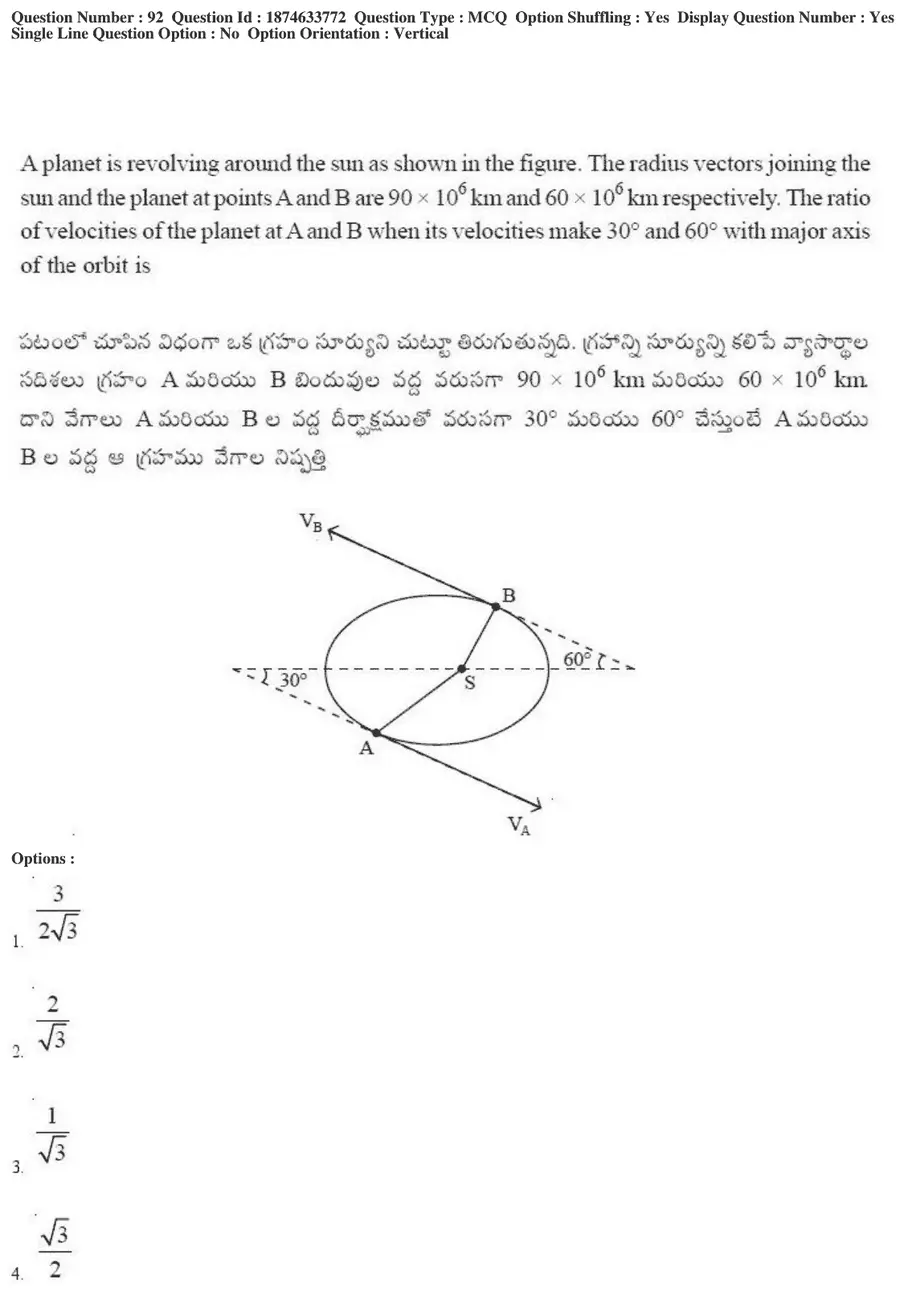
A planet is revolving around the sun as shown in the figure. The radius vectors joining the sun and the planet at points A and B are $90 \times 10^{6}$ km and $60 \times 10^{6}$ km respectively. The ratio of velocities of the planet at A and B when its velocities make $30^\circ$ and $60^\circ$ with major axis of the orbit is
(see the figure above)

The question and its figure as printed in AP EAPCET 2019 20th April 2019 Shift1.
The question as printed in the paper.
  • A

    $\dfrac{3}{2\sqrt{3}}$

  • B

    $\dfrac{2}{\sqrt{3}}$

  • C

    $\dfrac{1}{\sqrt{3}}$

  • D

    $\dfrac{\sqrt{3}}{2}$

141AP EAMCET 2019 · 20 Apr · Shift 2MCQOpen question page ↗

Two bodies each of mass 'm' are hung from a balance whose scale pans differ in a vertical height by h. If the mean density of the earth is $\rho$, the error in weighing is

  • A

    $\frac{4\pi\rho\,\mathrm{G}mh}{3}$

  • B

    $\frac{3\pi\rho\,\mathrm{G}mh}{4}$

  • C

    $\frac{8\pi\rho\,\mathrm{G}mh}{3}$

  • D

    $\frac{3\pi\rho\,\mathrm{G}mh}{8}$

142TS EAMCET 2018 · 7 May · Shift 1MCQOpen question page ↗

An artificial satellite of mass $m$ revolves around the Earth at a height $h$ with a speed v. How much power (Energy per second) will it require to keep itself moving with constant speed in the orbit of radius $r$ ?

  • A

    $\frac{mv^3}{r}$

  • B

    $\frac{1}{2}mv^2$

  • C

    $\frac{6mM_e}{(R_e+h)}$

  • D

    0

143TS EAMCET 2018 · 5 May · Shift 1MCQOpen question page ↗

From the pole of the earth, a body of mass 'm' is imparted a velocity '$v_o$' directed vertically up. If 'M' is the mass of the earth, 'R' its radius and 'g' free-fall acceleration on its surface, the height 'h' to which the body will ascent is
(Neglect air resistance)

  • A

    $\dfrac{Rv_o^2}{\left(2gR - v_o^2\right)}$

  • B

    $\dfrac{Rv_o^2}{2gR}$

  • C

    $R$

  • D

    $\dfrac{Rv_o^2}{\left(2gR + v_o^2\right)}$

144TS EAMCET 2018 · 5 May · Shift 2MCQOpen question page ↗

The mass density inside a solid sphere of radius $R$ varies as $\rho(r) = \rho_0\left(\dfrac{r}{R}\right)^\beta$, where $\rho_0$ and $\beta$ are constants and $r$ is the distance from the centre. Let $E_1$ and $E_2$ be gravitational fields due to sphere at distance $\dfrac{R}{2}$ and $2R$ from the centre of sphere. If $\dfrac{E_2}{E_1} = 4$, the value of $\beta$ is

  • A

    $2$

  • B

    $2.5$

  • C

    $3$

  • D

    $4$

145TS EAMCET 2018 · 4 May · Shift 1MCQOpen question page ↗

The ratio of the height above the surface of earth to the depth below the surface of earth for gravitational accelerations to be the same (assuming small heights), is

  • A

    0.25

  • B

    0.5

  • C

    1.0

  • D

    1.25

146TS EAMCET 2018 · 4 May · Shift 2MCQOpen question page ↗

The density of a solid sphere of radius $R$ is $\rho(r)=20\frac{r^2}{R^2}$, where $r$ is the distance from its center. If the gravitational field due to this sphere at a distance $4R$ from its center is $E$ and $G$ is the gravitational constant, the ratio $\frac{E}{GR}$ is

  • A

    $\frac{\pi}{5}$

  • B

    $3\pi$

  • C

    $\frac{3\pi}{2}$

  • D

    $\pi$

147AP EAMCET 2018 · 24 Apr · Shift 1MCQOpen question page ↗

A body is projected vertically upwards from the surface of the Earth with a velocity sufficient to carry it to infinity. The time taken by it to reach a height of three times the radius of the Earth is
(Acceleration due to gravity = $9.8\ \mathrm{ms^{-2}}$ and radius of the Earth = 6400 km)

  • A

    44.44 minutes

  • B

    22.22 minutes

  • C

    18.76 minutes

  • D

    37.52 minutes

148AP EAMCET 2018 · 24 Apr · Shift 2MCQOpen question page ↗

A satellite is to be placed in equatorial geostationary orbit around the earth for communication purpose. The height of such satellite is ______
($M_E = 6\times10^{24}\ \mathrm{kg}$, $R_E = 6400\ \mathrm{km}$)

  • A

    $3.57\times10^{8}\ \mathrm{m}$

  • B

    $3.57\times10^{7}\ \mathrm{m}$

  • C

    $3.57\times10^{5}\ \mathrm{m}$

  • D

    $3.57\times10^{6}\ \mathrm{m}$

149AP EAMCET 2018 · 23 Apr · Shift 1MCQOpen question page ↗

An artificial satellite of mass 'm' is moving along an elliptical path around the earth. The areal velocity of the satellite is proportional to

  • A

    $m$

  • B

    $m^{-1}$

  • C

    $m^{0}$

  • D

    $m^{1/2}$

150AP EAMCET 2018 · 23 Apr · Shift 2MCQOpen question page ↗

Two bodies of equal masses are some distance apart. If 20% of mass is transferred from the first body to the second body, the gravitational force between them

  • A

    Increases by 4%

  • B

    Increases by 14%

  • C

    Decreases by 4%

  • D

    Decreases by 14%

151AP EAMCET 2018 · 22 Apr · Shift 1MCQOpen question page ↗

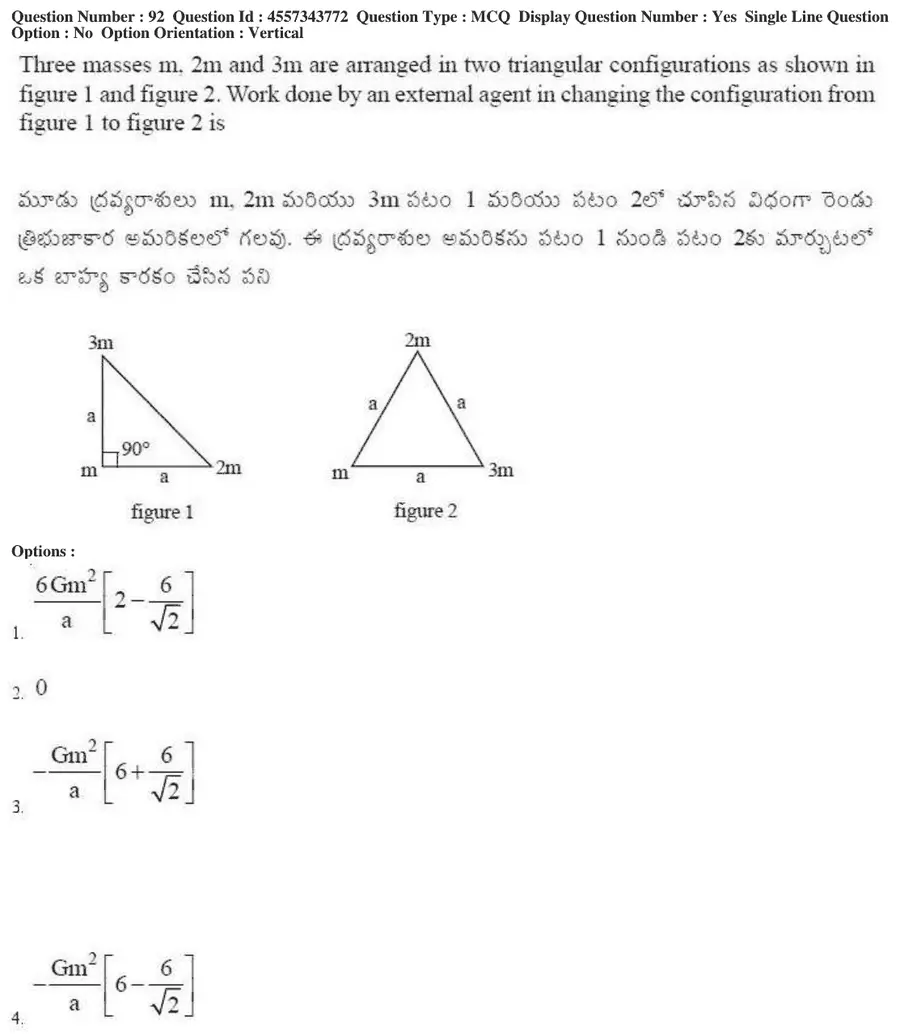
Three masses m, 2m and 3m are arranged in two triangular configurations as shown in figure 1 and figure 2. Work done by an external agent in changing the configuration from figure 1 to figure 2 is
(see the figure above)

The question and its figure as printed in AP EAPCET 2018 22nd April Shift 1.
The question as printed in the paper.
  • A

    $\frac{6Gm^2}{a}\left[2-\frac{6}{\sqrt{2}}\right]$

  • B

    $0$

  • C

    $-\frac{Gm^2}{a}\left[6+\frac{6}{\sqrt{2}}\right]$

  • D

    $-\frac{Gm^2}{a}\left[6-\frac{6}{\sqrt{2}}\right]$

152AP EAMCET 2018 · 22 Apr · Shift 2MCQOpen question page ↗

An object is thrown vertically upwards from the surface of the earth with a velocity $x$ times the escape velocity on the earth ($x<1$), the maximum height to which it rises from the centre of the earth is (radius of earth is R)

  • A

    $R(1-x^{2})$

  • B

    $\frac{R}{(1-x^{2})}$

  • C

    $\frac{1-x^{2}}{R}$

  • D

    $\frac{x^{2}}{1-R}$

153TS EAMCET 2017 · 12 May · OfflineMCQOpen question page ↗

A planet of mass '$m$' moves in an elliptical orbit around an unknown star of mass '$M$' such that its maximum and minimum distances from the star are equal to $r_1$ and $r_2$ respectively. The angular momentum of the planet relative to the centre of the star is

  • A

    $m\sqrt{\dfrac{2GMr_1r_2}{r_1+r_2}}$

  • B

    $0$

  • C

    $m\sqrt{\dfrac{2GM(r_1+r_2)}{r_1r_2}}$

  • D

    $\sqrt{\dfrac{2GMm\,r_1}{(r_1+r_2)r_2}}$

154AP EAMCET 2017 · 26 Apr · Shift 1MCQOpen question page ↗

Two bodies of masses 4 m and 9 m are seperated by a distance 'r'. The gravitational potential at a point on this line joining them where the gravitational field becomes zero is

  • A

    $\dfrac{-4Gm}{r}$

  • B

    $\dfrac{-25Gm}{r}$

  • C

    $\dfrac{-9Gm}{r}$

  • D

    $\dfrac{-13Gm}{r}$

155AP EAMCET 2017 · 26 Apr · Shift 2MCQOpen question page ↗

The masses of two fixed spheres are M and 2M and the radius of each sphere is R. Their centres are 10R apart. The minimum speed with which a particle of mass $\frac{M}{10}$ be projected from the mid-point of the line joining the centres of the two spheres so that it escapes to infinity is ______

  • A

    $\sqrt{\frac{6GM}{7R}}$

  • B

    $\sqrt{\frac{7GM}{5R}}$

  • C

    $\sqrt{\frac{5GM}{6R}}$

  • D

    $\sqrt{\frac{6GM}{5R}}$

156AP EAMCET 2017 · 25 Apr · Shift 1MCQOpen question page ↗

A particle is moving along a horizontal circle of radius 'r' under a centripetal force $\dfrac{-c}{r^2}$, where 'c' is a constant. Then, the total energy of the particle is

  • A

    $\dfrac{-c}{2r^2}$

  • B

    $\dfrac{c}{2r}$

  • C

    $\dfrac{-c}{2r}$

  • D

    $\dfrac{c}{2r^2}$

157AP EAMCET 2017 · 25 Apr · Shift 1MCQOpen question page ↗

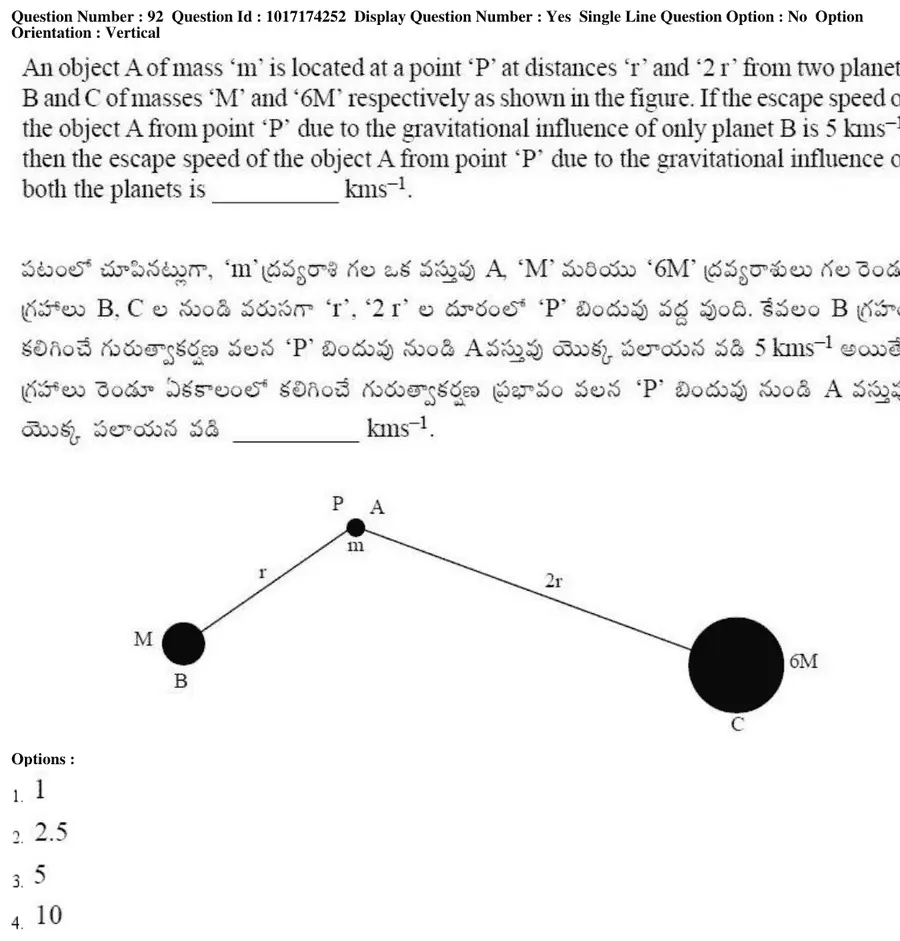
An object A of mass ‘m’ is located at a point ‘P’ at distances ‘r’ and ‘2 r’ from two planets B and C of masses ‘M’ and ‘6M’ respectively as shown in the figure. If the escape speed of the object A from point ‘P’ due to the gravitational influence of only planet B is 5 $\mathrm{kms^{-1}}$, then the escape speed of the object A from point ‘P’ due to the gravitational influence of both the planets is ______ $\mathrm{kms^{-1}}$.
(see the figure above)

The question and its figure as printed in AP EAPCET 2017 25th April 2017 Shift1.
The question as printed in the paper.
  • A

    1

  • B

    2.5

  • C

    5

  • D

    10

158AP EAMCET 2017 · 25 Apr · Shift 2MCQOpen question page ↗

Three solid spheres each of mass 1 kg and radius 2 m are arranged at the three corners of an equilateral triangle of side 10 m, such that centres of the spheres coincide with the corners of the triangle. When they are released from that position, the speed of any one sphere at the time of collision would be (G is universal gravitational constant).

  • A

    $\sqrt{\dfrac{3G}{10}}$

  • B

    $\sqrt{\dfrac{10G}{3}}$

  • C

    $\sqrt{30G}$

  • D

    $\sqrt{3G}$

159AP EAMCET 2017 · 24 Apr · Shift 1MCQOpen question page ↗

The required percentage increase in the energy of the earth's satellite to shift it from an orbit of radius r to $\dfrac{3r}{2}$.

  • A

    $16.67\%$

  • B

    $20.33\%$

  • C

    $66.67\%$

  • D

    $33.33\%$

160AP EAMCET 2017 · 24 Apr · Shift 2MCQOpen question page ↗

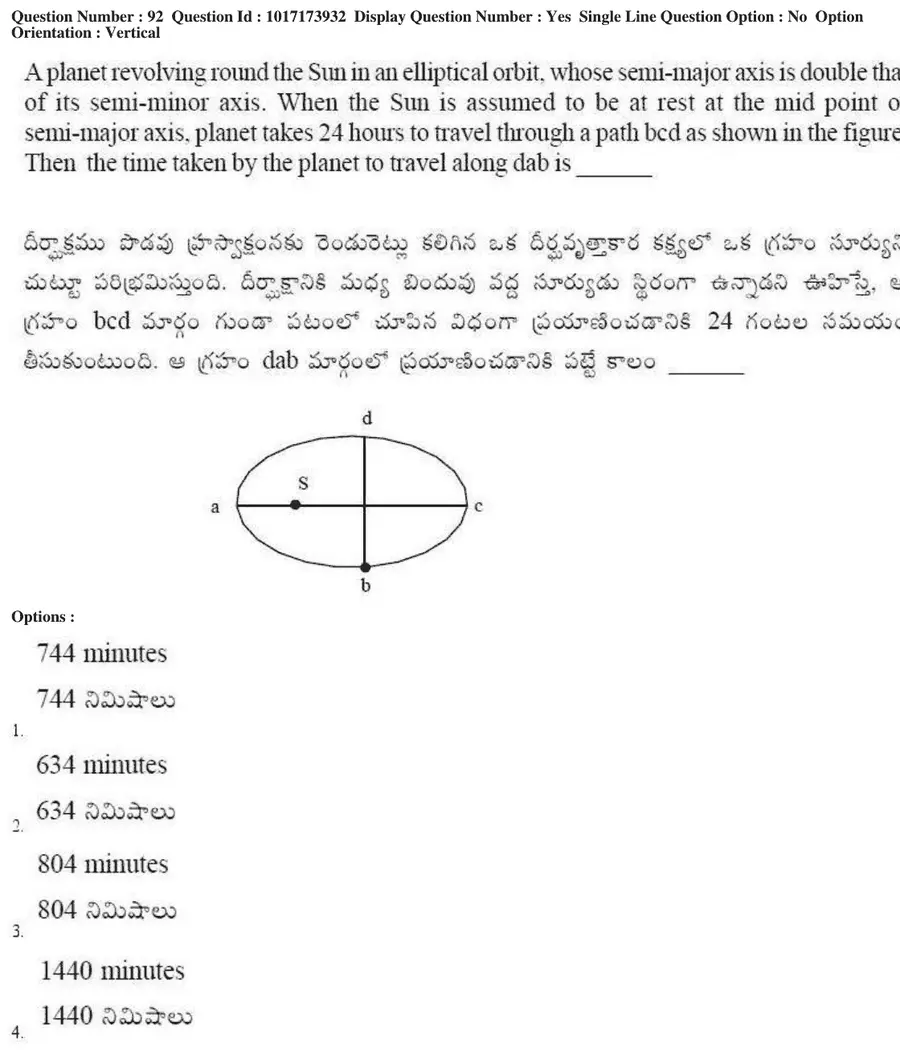
A planet revolving round the Sun in an elliptical orbit, whose semi-major axis is double that of its semi-minor axis. When the Sun is assumed to be at rest at the mid point of semi-major axis, planet takes 24 hours to travel through a path bcd as shown in the figure. Then the time taken by the planet to travel along dab is ______
(see the figure above)

The question and its figure as printed in AP EAPCET 2017 24th April 2017 Shift2.
The question as printed in the paper.
  • A

    744 minutes

  • B

    634 minutes

  • C

    804 minutes

  • D

    1440 minutes

161TS EAMCET 2016 · 15 May · OfflineMCQOpen question page ↗

The bodies of masses 100 kg and 8100 kg are held at a distance of 1 m. The gravitational field at a point on the line joining them is zero. The gravitational potential at that point in J/kg is ($G = 6.67\times10^{-11}\ \mathrm{N.m^2/kg^2}$)

  • A

    $-6.67\times10^{-7}$

  • B

    $-6.67\times10^{-10}$

  • C

    $-13.34\times10^{-7}$

  • D

    $-6.67\times10^{-9}$

162AP EAMCET 2016 · 29 Apr · OfflineMCQOpen question page ↗

Two bodies of masses 'm' and '9m' are placed at a distance 'r'. The gravitational potential at a point on the line joining them, where gravitational field is zero, is (G is universal gravitational constant)

  • A

    $\dfrac{-14Gm}{r}$

  • B

    $\dfrac{-16Gm}{r}$

  • C

    $\dfrac{-12Gm}{r}$

  • D

    $\dfrac{-8Gm}{r}$

163AP EAMCET 2014 · 22 May · OfflineMCQOpen question page ↗

A satellite is revolving very close to a planet of density $\rho$. The period of revolution of satellite is

  • A

    $\sqrt{\frac{3\pi\rho}{G}}$

  • B

    $\sqrt{\frac{3\pi}{2\rho G}}$

  • C

    $\sqrt{\frac{3\pi}{\rho G}}$

  • D

    $\sqrt{\frac{3\pi G}{\rho}}$

164AP EAMCET 2013 · 10 May · OfflineMCQOpen question page ↗

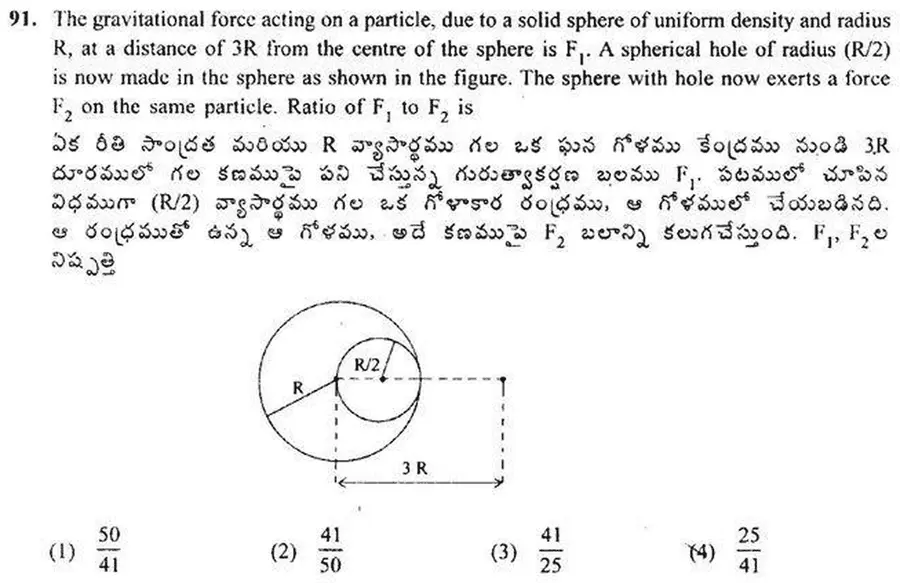
The gravitational force acting on a particle, due to a solid sphere of uniform density and radius R, at a distance of 3R from the centre of the sphere is $F_1$. A spherical hole of radius (R/2) is now made in the sphere as shown in the figure. The sphere with hole now exerts a force $F_2$ on the same particle. Ratio of $F_1$ to $F_2$ is
(see the figure above)

The question and its figure as printed in AP EAMCET 2013 10 May Offline.
The question as printed in the paper.
  • A

    $\frac{50}{41}$

  • B

    $\frac{41}{50}$

  • C

    $\frac{41}{25}$

  • D

    $\frac{25}{41}$

165AP EAMCET 2012 · 12 May · OfflineMCQOpen question page ↗

The gravitational field in a region is given by equation $\vec{E} = (5\hat{i} + 12\hat{j})$ N/kg. If a particle of mass 2 kg is moved from the origin to the point (12 m, 5 m) in this region, the change in gravitational potential energy is

  • A

    -225 J

  • B

    -240 J

  • C

    -245 J

  • D

    -250 J

166AP EAMCET 2011 · 8 May · OfflineMCQOpen question page ↗

Assertion (A) : An astronaut inside a massive spaceship orbiting around the earth will experience a finite but small gravitational force.
Reason (R) : The centripetal force necessary to keep the spaceship in orbit around the earth is provided by the gravitational force between the earth and the spaceship.

  • A

    Both (A) and (R) are true and (R) is the correct explanation of (A)

  • B

    Both (A) and (R) are true and (R) is not the correct explanation of (A)

  • C

    (A) is true but (R) is not true

  • D

    (A) is not true but (R) is true

167AP EAMCET 2010 · 30 May · OfflineMCQOpen question page ↗

A launching vehicle carrying an artificial satellite of mass 'm' is set for launch on the surface of the earth of mass 'M' and radius 'R'. If the satellite is intended to move in a circular orbit of radius 7R, the minimum energy required to be spent by the launching vehicle on the satellite is : (Gravitational constant = G)

  • A

    $\frac{\mathrm{GM}m}{\mathrm{R}}$

  • B

    $\frac{13\mathrm{GM}m}{14\mathrm{R}}$

  • C

    $\frac{\mathrm{GM}m}{7\mathrm{R}}$

  • D

    $\frac{\mathrm{GM}m}{14\mathrm{R}}$

How to prepare Gravitation for EAPCET

How often it comes up

Gravitation provides regular, dependable marks across Intermediate Physics examinations. In the papers we hold from 2022 to 2026, it contributed 77 questions in 77 papers, averaging exactly 1.0 questions per paper. During this period, the chapter showed up in 74 of those 77 papers. That places it as the 21st of 28 Physics chapters by question share, representing 2.5% of all Physics questions asked in those five years.

Looking across the complete archive from 2010 to 2026, our collection records 167 questions from 143 of the 149 papers, maintaining a 1.1 questions per paper average and a 2.8% share of the subject. In the early period from 2010 to 2021, the chapter held a share of 3.1% (90 questions in 72 papers, appearing in 69 papers, 1.3 per paper). Over the last three exam years from 2024 to 2026, it produced 45 questions in 46 papers (appearing in 44 papers, 1.0 per paper, 2.4% share). Compared to the early years, the chapter's share of Physics has fallen, whereas compared to the full recent window it has stayed about the same. Every year since 2022 has featured gravitation problems across our papers.

Between 2022 and 2026, the two states recorded identical question frequencies: AP EAPCET featured 49 questions across 48 papers (appearing in 47 papers, 1.0 per paper, 2.6% share), while TS EAPCET featured 28 questions across 29 papers (appearing in 27 papers, 1.0 per paper, 2.4% share).

Most-asked topics

During the 2022 to 2026 examination period, questions fell into four distinct topics:

  • Satellites: 41 questions. Across all years from 2010 to 2026, satellite mechanics leads the chapter with 71 questions.
  • Newton's Law of Gravitation: 22 questions recently, and 50 questions across the full archive.
  • Field & Potential: 12 questions in the recent window, totalling 33 questions overall.
  • Kepler's Laws: 2 questions recently, with 13 questions across the complete dataset.

Satellites and universal gravitation together account for over four-fifths of recent questions, making them the primary areas for focused revision.

What the questions look like

Satellite questions concentrate on orbital speed, escape velocity, and total orbital energy. Standard calculations involve finding the external work required to transfer an orbiting satellite from one circular orbit to a higher altitude. Another common scenario compares escape velocity from the surface of Earth to that from an arbitrary planet whose mass and radius scale by given factors. You will also see questions relating escape speed to orbital speed near the surface.

Newton's law questions frequently explore how acceleration due to gravity changes with height and depth. Problems often compare the reduction in effective gravity at altitude h with that at depth d, asking for the depth where the weight loss matches the weight loss at a given height. Other questions examine how Earth's diurnal rotation alters apparent weight at various latitudes through centrifugal reduction.

Field and potential questions investigate self-gravitating solid spheres and spherical shells. Questions ask for the gravitational intensity or potential at points inside a uniform planet, on its surface, and at external distances. Kepler's laws problems usually test the law of periods relating orbital period squared to semimajor axis cubed, or use conservation of angular momentum to link speeds at perihelion and aphelion.

Questions to try first

The following questions from 2026 council papers demonstrate typical gravitation problems:

How to practise it

Start by mastering the formulas for acceleration due to gravity at altitude h and depth d. Remember that the linear approximation for altitude holds only when height is negligible compared to planetary radius; for heights comparable to radius R, use the exact inverse-square relation.

Next, study satellite binding energy and orbital dynamics. Remember that kinetic energy equals half the magnitude of potential energy, and total mechanical energy is negative and equal in magnitude to kinetic energy. This energy relationship saves extensive calculation when finding binding energy or transfer work.

Finally, review Kepler's three laws, with special attention to areal velocity invariance resulting from central force torques being zero. Working through past paper questions will ensure you handle percentage changes in gravity and satellite altitude efficiently.

Frequently asked questions

How often does Gravitation appear in EAPCET?

In the papers we hold from 2022 to 2026, Gravitation produced 77 questions across 77 papers, appearing in 74 of those 77 papers and averaging 1.0 questions per paper. It ranks 21st among 28 Physics chapters by question share.

What is the most heavily tested topic in Gravitation?

Satellites is the dominant topic, contributing 41 questions between 2022 and 2026 and 71 questions across the full 2010 to 2026 collection. Newton's law of gravitation follows with 22 questions recently.

Are question counts similar in AP and TS exams?

Yes, the distribution is virtually identical. From 2022 to 2026 in our set, AP EAPCET featured 49 questions across 48 papers (1.0 per paper, 2.6% share), while TS EAPCET featured 28 questions across 29 papers (1.0 per paper, 2.4% share).

Where can I see the solutions?

Every question on this page opens with its options and answer. Step-by-step solutions for each one are in the EdLoop EAPCET app.

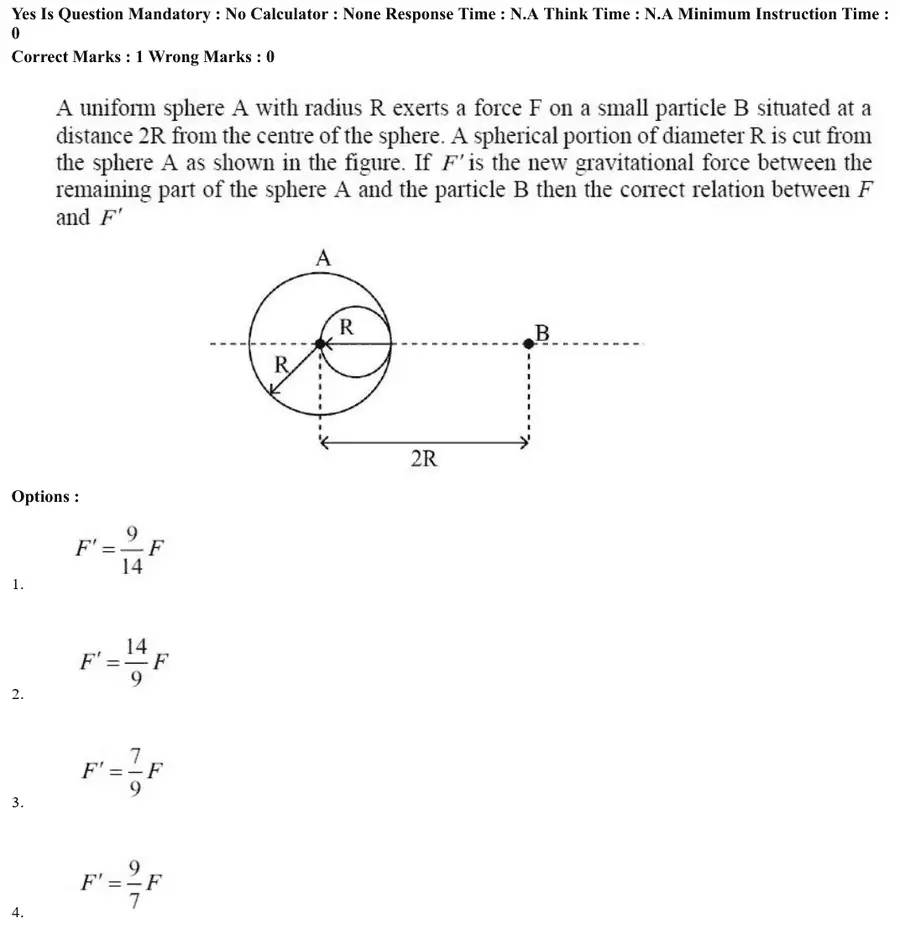
Get EdLoop – freeOpen on the web