Every Fluid Mechanics question from past AP EAPCET and TS EAPCET papers, with options and answers. Newest first.
216questions
146papers covered
3.7%of Physics questions, 2022–2026
2010–2026years
Guide at a glance
Fluid Mechanics is an active part of Class 11 physics in state engineering examinations. In the papers we hold for AP and TS EAPCET between 2022 and 2026, the chapter contributed 113 questions across 77 papers.
A long cylindrical vessel of glass having a hole of 0.5 mm radius at its bottom is slowly lowered vertically into a deep water bath. If the surface tension of water is $7 \times 10^{-2}\ Nm^{-1}$, then the maximum depth the vessel can be submerged without water entering through the hole is (Acceleration due to gravity = $10\ ms^{-2}$)
A capillary tube of inner radius 1.5 mm is dipped vertically in water. If the surface tension of water is $7 \times 10^{-2}\ Nm^{-1}$, then the volume of the water that rises in the capillary tube is (Acceleration due to gravity = $10\ ms^{-2}$)
A vessel contains oil of density $0.8\ gcm^{-3}$ over mercury of density $13.6\ gcm^{-3}$. A homogenous sphere floats with half of its volume immersed in mercury and the other half in oil. Then the density of the material of the sphere is
A large tank filled with water to a height ‘$h$’ is to be emptied through a small hole at the bottom. The ratio of times taken for the level of water to fall from $h$ to $\frac{h}{2}$ and from $\frac{h}{2}$ to zero is
A small sphere of radius ‘r’ is dropped in a viscous liquid. When it is moving with terminal velocity in the liquid, the relation between the rate of heat produced $\left(\frac{dQ}{dt}\right)$ and ‘r’ is
Calculate the amount of work done in spraying a drop of a liquid of radius 1 $mm$ into million identical droplets under isothermal conditions. [surface tension of liquid = $550 \times 10^{-3} Nm^{-1}$]
When a body floats in water and another liquid separately, it floats with one third of its volume outside water and $\frac{3}{4}$ of its volume outside another liquid. The density of the liquid is
An iceberg floats on sea water of density $\rho = 1.03 \times 10^{3} kg\, m^{-3}$. The percentage of total volume of ice above the surface of water is about (Density of ice $\sigma = 0.92 \times 10^{3} kg\, m^{-3}$)
A uniform cylindrical vessel is filled with two immiscible liquids A and B of densities $750\ \mathrm{kg\,m^{-3}}$ and $1000\ \mathrm{kg\,m^{-3}}$ respectively. The thickness of the liquid layer A is 10 m and the thickness of the liquid layer B which lies at the bottom is 15 m. If the atmospheric pressure is $10^5\ \mathrm{N\,m^{-2}}$, then the ratio of the absolute pressures at the bottom of the vessel and at the interface of the two liquids is (Acceleration due to gravity $=10\ \mathrm{ms^{-2}}$)
In a uniform U-tube containing water, if a liquid of density $800\ \mathrm{kg\,m^{-3}}$ is poured into one of its limbs to a height of 25 cm column of liquid, then the rise in water level in the other limb of the tube is
A spherical rain drop of mass ‘m’ falls vertically through air with a terminal velocity of $0.2\ \mathrm{ms^{-1}}$. If 27 such identical rain drops combine to form a bigger spherical drop, then the terminal velocity of the bigger drop if it falls vertically through air is
A liquid of density $800\,\mathrm{kg\,m^{-3}}$ rises 4 cm in a capillary tube of inner radius 0.2 mm. The capillary tube is dipped vertically in the liquid and the angle of contact between the capillary tube and the liquid is $0^\circ$. The excess pressure inside the spherical drop of diameter 2 cm of the same liquid is (Acceleration due to gravity $=10\,\mathrm{ms^{-2}}$)
A water drop when pressed between two parallel glass plates spreads in to a circle of diameter 10 cm. If the surface tension of water is $70\times10^{-3}\ \mathrm{N\,m^{-1}}$ and the force required to separate the two glass plates is 2.2 N, then the volume of the drop is nearly
A tank contains 140 cm height of water at the bottom and an oil of density $900\,\mathrm{kg\,m^{-3}}$ to a height of 200 cm above water. If the liquids are immiscible, then the initial velocity of efflux of water through a small opening at the bottom of the tank is (Acceleration due to gravity $= 10\,\mathrm{ms^{-2}}$ )
If the excess pressure inside a spherical mercury drop is $1240\,\mathrm{N\,m^{-2}}$, then the radius of the mercury drop is (Surface tension of mercury $= 0.465\,\mathrm{N\,m^{-1}}$)
Water is flowing through a horizontal pipe AB of non-uniform cross section. Water is entering the pipe at the end A having cross-sectional area of $4\ \mathrm{cm^2}$ at a pressure of $10^5\ \mathrm{N m^{-2}}$ with a velocity of $20\ \mathrm{ms^{-1}}$ and water is leaving the pipe at the end B having cross-sectional area $8\ \mathrm{cm^2}$. The pressure at the end B of the pipe is
A wire of length 20 cm is placed horizontally on the surface of water and is gently pulled up with a force of $1.456\times10^{-2}$ N to keep the wire in equilibrium. The surface tension of water is
A mercury drop of radius 1 cm is divided into $10^6$ droplets of equal size. If surface tension of mercury is $35\times10^{-3}\ \mathrm{Nm^{-1}}$, then the change in suface energy in the process is
If two soap bubbles A and B of radii $\mathrm{r_1}$ and $\mathrm{r_2}$ respectively are kept in vaccum at constant temperature, then the ratio of masses of air inside the bubbles A and B is
In a hydraulic lift, if the radius of the smaller piston is $5$ cm, and the radius of the larger piston is $50$ cm, then the weight that the larger piston can support when a force of $250$ N is applied to the smaller piston is
An aeroplane of mass $4.5\times10^{4}$ kg and total wing area of $600\ \mathrm{m^2}$ is travelling at a constant height. The pressure difference between the upper and lower surfaces of its wings is (Acceleration due to gravity = $10\ \mathrm{m\,s^{-2}}$)
If water flows with a velocity of $20\ \mathrm{cm\,s^{-1}}$ in a pipe of radius $2\ \mathrm{cm}$, then the flow is (The coefficient of viscosity of water is $10^{-3}\ \mathrm{kg\,m^{-1}\,s^{-1}}$ and density of water is $10^{3}\ \mathrm{kg\,m^{-3}}$).
A liquid drop of diameter D splits into 3375 small identical drops. If S is the surface tension of the liquid, then the change in the surface energy in the process is
A wooden block of outer volume 1 litre and specific gravity $\frac{3}{4}$ having a cavity floats with half of its volume immersed in water. Then the volume of the cavity is
A cube of side 40 cm is floating with $\frac{1}{4}$th of its volume immersed in water. When a circular disc is placed on the cube, it floats with $\frac{2}{5}$th of its volume immersed in water. The mass of the disc is
The maximum length of water column that can stay without falling in a vertically held capillary tube of diameter $1\,\mathrm{mm}$ and open at both the ends is
(Acceleration due to gravity $= 10\ \mathrm{ms^{-2}}$ and surface tension of water $= 0.07\,\mathrm{Nm^{-1}}$)
If $W_1$ is the work done in increasing the radius of a soap bubble from ‘r’ to ‘2r’ and $W_2$ is the work done in increasing the radius of the soap bubble from ‘2r’ to ‘3r’, then $W_1 : W_2 =$
A thin film of water is formed between two straight parallel wires each of length 8 cm separated by distance of 0.6 cm. The work done to increase the distance between the wires to 0.8 cm is
(Surface tension of water $=0.07\ \mathrm{Nm^{-1}}$ )
A rain drop of diameter $1$ mm falls with a terminal velocity of $0.7\,\mathrm{ms^{-1}}$ in air. If the coefficient of viscosity of air is $2\times10^{-5}$ Pa s, the viscous force on the rain drop is
If the terminal velocity of a metal sphere of mass 8 g falling through a liquid is $3\,\mathrm{cm\,s^{-1}}$, then the terminal velocity of another sphere of mass 64 g made of the same metal falling through same liquid is
Water is filled in a tank up to a height of 20 cm from the bottom of the tank. Water flows through a hole of area $1\,\mathrm{mm}^2$ at its bottom. The mass of the water coming out from the hole in a time of 0.6 s is (Density of water $=1000\,\mathrm{kg\,m^{-3}}$ and acceleration due to gravity $=10\,\mathrm{ms^{-2}}$)
Water flows from a tap of diameter 1.5 cm with $7.5 \times 10^{-5}\ \mathrm{m^3 s^{-1}}$. Coefficient of Viscosity of water is $10^{-3}$ Pas. The flow is
Water is flowing in streamline manner in a horizontal pipe. If the pressure at a point where cross-sectional area is $10\ \mathrm{cm^2}$ and velocity $1\ \mathrm{ms^{-1}}$ is $2000$ Pa, then the pressure of water at another point where the cross-sectional area $5\ \mathrm{cm^2}$ is
Two cylindrical vessels A and B of different areas of cross-section kept on same horizontal plane are filled with water to the same height. If the volume of water in vessel A is 3 times the volume of water in vessel B, then the ratio of the pressures at the bottom of the vessels A and B is
A large tank filled with water to a height $'h'$ is to be emptied through a small hole at the bottom. The ratio of the time taken for the level to fall from $'h'$ to $\frac{h}{2}$ and that taken for the level to fall from $\frac{h}{2}$ to '0' is
A spherical ball of radius $1 \times 10^{-4}$ m and of density $10^4$ $\mathrm{kgm^{-3}}$ falls freely under gravity through a distance 'h' before entering a tank of water. After entering water if the velocity of the ball does not change, then 'h' is (The coefficient of viscosity of water $9.8 \times 10^{-6}$ $\mathrm{Nsm^{-2}}$)
The radius of cross-section of the cylindrical tube of a spray pump is 2 cm. One end of the pump has 50 fine holes each of radius 0.4 mm. If the speed of flow of the liquid inside the tube is $0.04\ \mathrm{ms^{-1}}$, the speed of ejection of the liquid from the holes is
Two mercury drops, each with same radius r, merged to form a bigger drop. T is the surface tension of mercury, then the surface energy of bigger drop is given by
If $S_1$, $S_2$ and $S_3$ are the tensions at liquid-air, solid-air and solid-liquid interfaces respectively, and $\theta$ is the angle of contact at the solid-liquid interface, then
216 small identical liquid drops each of surface area A coalesce to form a bigger drop. If the surface tension of the liquid is T, the energy released in the process is
The velocities of air above and below the surfaces of a flying aeroplane wing are 50 $\mathrm{ms^{-1}}$ and 40 $\mathrm{ms^{-1}}$ respectively. If the area of the wing is 10 $\mathrm{m^2}$ and the mass of the aeroplane is 500 kg, then as time passes by (density of air = 1.3 $\mathrm{kg\,m^{-3}}$)
A wooden cube of side 10 cm floats at the interface between water and oil with its lower surface 3 cm below the interface. If the density of oil is $0.9\ \mathrm{g\ cm^{-3}}$, the mass of the wooden cube is
Three identical vessels are filled up to the same height with three different liquids A, B and C of densities $\rho_A$, $\rho_B$ and $\rho_C$ respectively. If $\rho_A > \rho_B > \rho_C$, then the pressure at the bottom of the vessels is
The height of water level in a tank of uniform cross-section is 5 m. The volume of the water leaked in 5 s through a hole of area $2.4\ \mathrm{mm^2}$ made at the bottom of the tank is (Assume the level of the water in the tank remains constant and acceleration due to gravity $=10\ \mathrm{ms^{-2}}$)
The work done in increasing the diameter of a soap bubble from 2 cm to 4 cm is (Surface tension of soap solution $= 3.5\times10^{-2}\ \mathrm{Nm^{-1}}$)
The excess pressure inside a soap bubble of radius $0.5$ cm is balanced by the pressure due to an oil column of height $4$ mm. If the density of the oil is $900\ \mathrm{kg\ m^{-3}}$, then the surface tension of the soap solution is (Acceleration due to gravity $= 10\ \mathrm{ms^{-2}}$)
Water flows through a horizontal pipe of variable cross-section at the rate of $12\pi$ litre per minute. The velocity of the water at the point where the diameter of the pipe becomes 2 cm is
A 20 g copper block is suspended by a vertical spring causing 1 cm elongation over the natural length of spring. If a beaker of water is placed below the block so that the copper block is completely immersed in the liquid, the elongation of the spring is
(Density of copper 9000 kg m$^{-3}$, Density of water 1000 kg m$^{-3}$, $g = 10$ ms$^{-2}$)
A large open top water tank is completely filled with water. A small hole of diameter 4 mm is made 10 m below the water level. The flow rate of water through the hole is
(Acceleration due to gravity = $10\ \mathrm{ms^{-2}}$)
A capillary tube of radius 0.1 mm is dipped in water. The water rises to a height of 2 cm in the tube. If the surface tension of water is $0.072\ \mathrm{Nm^{-1}}$, the contact angle between water and wall of the tube is
A person of height 1.65 m is standing upright. The additional external force required by blood vessel of length 1 cm, diameter 1 mm at feet to balance the pressure compared to similar blood vessel in head is
(Density of blood = $1.1\times10^{3}\ \mathrm{kg\,m^{-3}}$, g = $10\ \mathrm{ms^{-2}}$)
A cylindrical vessel, open at the top, contains 15 litres of water. Water drains out through a small opening at the bottom. 5 litre of water comes out in time $t_1$, the next 5 litre in further time $t_2$, and the last 5 litre in further time $t_3$, Then
A cylinder of mass m and material density $\rho$ hanging from a string is lowered into a vessel of cross-sectional area A containing a liquid of density $\sigma$ ($<\rho$) until it is fully immersed. The increase in pressure at the bottom of the vessel is
When a large bubble rises from the bottom of a lake to the surface, the volume of the bubble becomes 5 times its volume at the bottom of the lake. If H is the atmospheric pressure expressed in terms of water column height, then the depth of the lake is (The temperature of the water in the lake is same at all points)
A water drop breaks into 64 identical droplets of each surface area $10^{-7}\ \mathrm{m}^2$. If the surface tension of water is $0.07\ \mathrm{Nm}^{-1}$, the increase in the surface energy in the process is
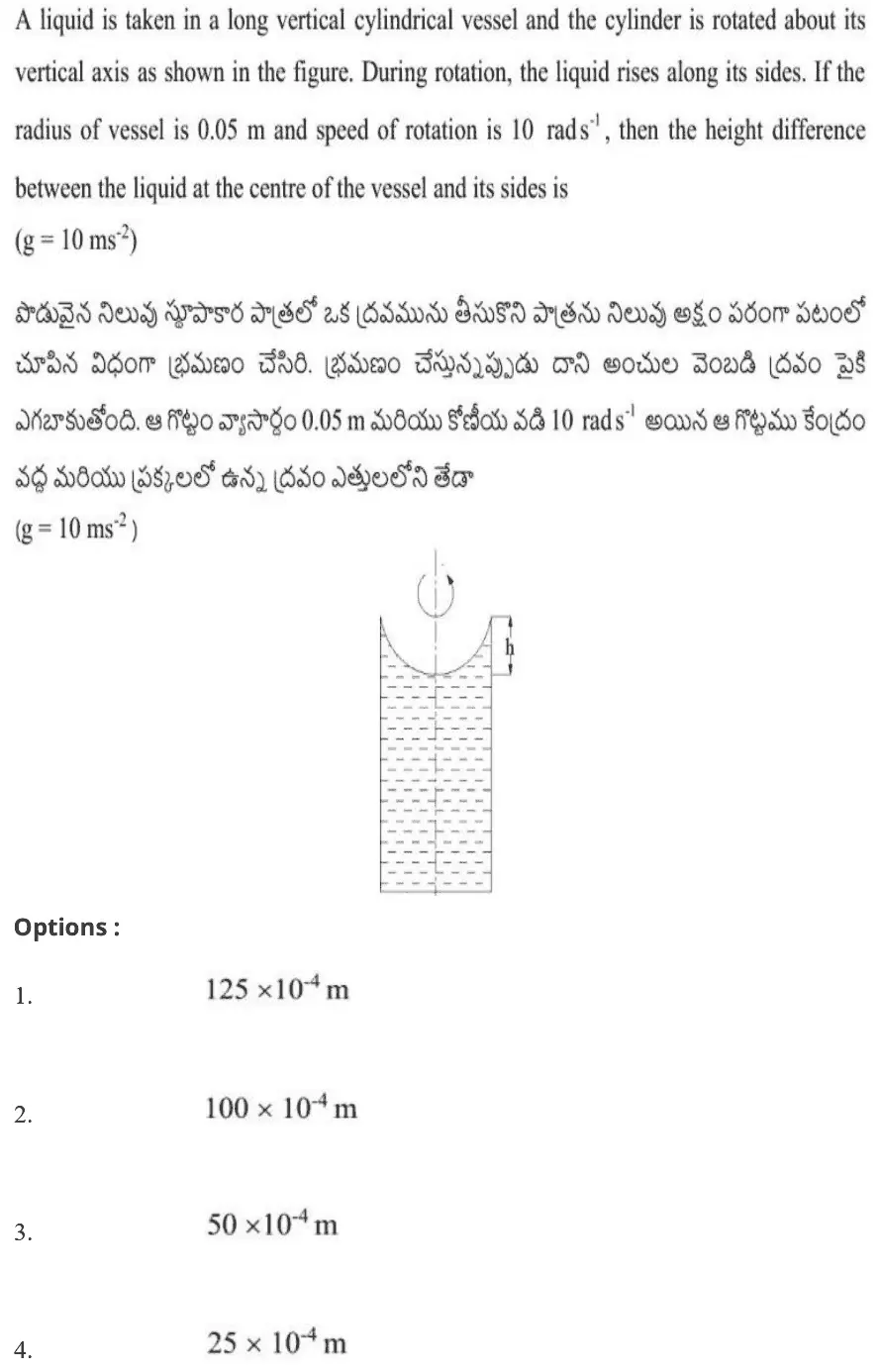
A liquid is taken in a long vertical cylindrical vessel and the cylinder is rotated about its vertical axis as shown in the figure. During rotation, the liquid rises along its sides. If the radius of vessel is 0.05 m and speed of rotation is $10\ \mathrm{rad\,s^{-1}}$, then the height difference between the liquid at the centre of the vessel and its sides is ($g = 10\ \mathrm{ms^{-2}}$)
The angle of contact is $120^\circ$ when a cylindrical rod is vertically placed in a liquid. If the same rod is placed horizontally in the liquid, then the angle of contact is
A straw of circular cross-section of radius R and negligible thickness is dipped vertically into a liquid of surface tension T. If the contact angle between the liquid and the straw material is 53°. The force acting on the straw due to surface tension of the liquid is
A solid metal sphere released in a vertical liquid column has attained terminal velocity in the downward direction. The magnitudes of viscous force, buoyant force and gravitational force acting on it are $F_V$, $F_B$ and $F_W$ respectively. Then the correct relation between them is
Three identical vessels are filled with three liquids A, B, and C with equal masses but having densities $\rho_A$, $\rho_B$ and $\rho_C$ respectively. If $\rho_A > \rho_B > \rho_C$ then the pressure at the bottom of the vessels will be
A venturimeter has a pipe diameter of 4 cm and a throat diameter of 2 cm. Velocity of water in the pipe section is 10 m/s. The pressure drop, between pipe section and the throat section is [use density of water = 1000 Kg/m$^3$]
A soap bubble of initial radius R is to be blown up. The surface tension of the soap film is T. The surface energy needed to double the diameter of the bubble is
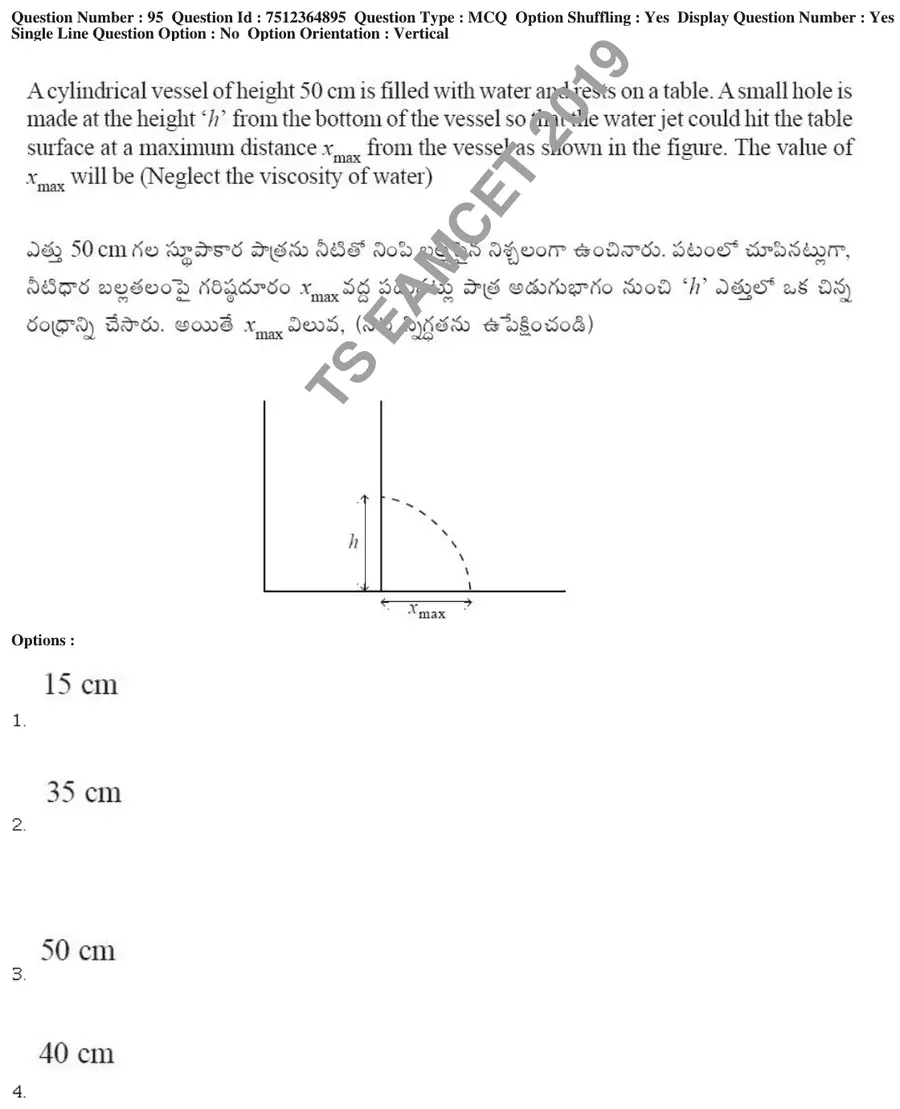
A wide cylindrical vessel 50 cm in height is filled with water and rests on a table. Assuming the viscosity to be negligible, find at what height from the bottom of the vessel a small hole should be made for the water jet coming out of it to hit the surface of the table at the maximum horizontal distance from the vessel.
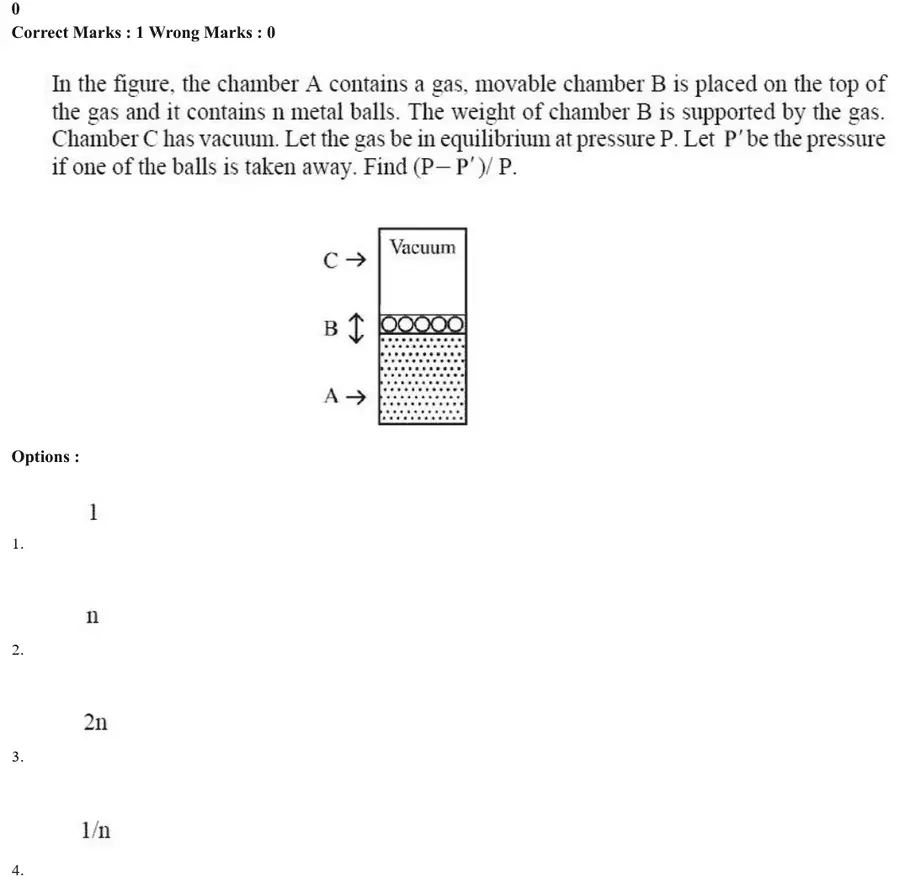
In the figure, the chamber A contains a gas, movable chamber B is placed on the top of the gas and it contains n metal balls. The weight of chamber B is supported by the gas. Chamber C has vacuum. Let the gas be in equilibrium at pressure P. Let $P'$ be the pressure if one of the balls is taken away. Find $(P-P')/P$. (see the figure above)
A liquid flows steadily through a cylindrical pipe having a radius 2R at a point A and radius R at point B farther along the flow direction. If the velocity at point B is $4v$, what will be the velocity at point A?
Consider an increase of 1% in each of radius of artery, viscosity of blood and density of blood respectively. The percentage change in flow rate of blood in artery is
A metal cube of side 10 cm rests on a film of a liquid of thickness 0.2 mm. If upon applying a horizontal force $\vec{F}$ of magnitude 0.1N the cube slides with a constant speed of 0.08 m/s, then the coefficient of viscosity is
A large storage tank, open to the atmosphere at top and filled with water, develops a small hole in its side at a point 20.0 m below the water level. If the rate of flow from the hole is $3.08\times10^{-5}\ \mathrm{m^{3}/s}$, then the diameter of the hole is [Take g = 10 m/s$^{2}$]
An air bubble of radius 1 mm is at a depth of 8 cm below the free surface of a liquid column. If the surface tension and density of the liquid is 0.1 N/m and 2000 Kg/m$^{3}$, respectively, by what amount is the pressure inside the bubble greater than the atmospheric pressure? (Take g = 10 m/s$^{2}$)
A hollow spherical body of outer and inner radii of 4 cm and 2 cm respectively floats half submerged in a liquid of density 2.0 g/cm$^{3}$. The density of the material of the sphere is
What is the terminal velocity of a rain drop of radius 0.02 mm ? [Note that the coefficient of viscosity of air is $1.8\times10^{-5}$ N/m$^{2}$, density of water is 1000 Kg/m$^{3}$. Use g = 10m/s$^{2}$ and density of air can be neglected in comparison with density of water]
The surface tension and vapour pressure of a liquid at $25\ ^\circ\mathrm{C}$ are $8\times10^{-2}\ \mathrm{Nm^{-1}}$ and $2.5\times10^{3}\ \mathrm{Pa}$ respectively. The radius of the smallest spherical water droplet which can form without evaporating at $25\ ^\circ\mathrm{C}$ is
A body of volume V floats on water with $\frac{1}{3}$ of its volume above the surface. The volume of the object above the surface when floating on a liquid of specific gravity 1.5 is
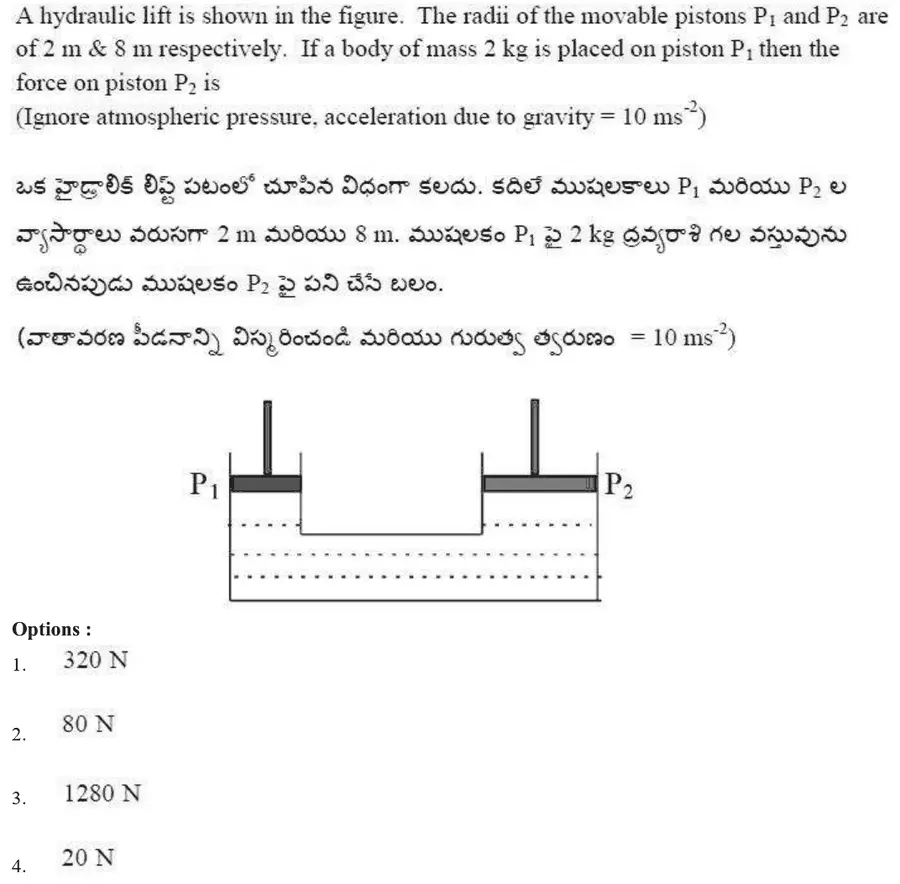
A hydraulic lift is shown in the figure. The radii of the movable pistons $P_1$ and $P_2$ are of 2 m & 8 m respectively. If a body of mass 2 kg is placed on piston $P_1$ then the force on piston $P_2$ is (Ignore atmospheric pressure, acceleration due to gravity = $10\ \mathrm{ms^{-2}}$) (see the figure above)
Consider a circular ring of radius 1.4 cm lying on the surface of a liquid. If a vertical force of 0.022 N greater than the weight of the ring is required to lift this ring from the liquid surface, then the surface tension of the liquid is
A large tank open to atmosphere at top and filled with water, develops a small hole in the side at a point 20 m below the water level. If the rate of flow of water from the hole is $3 \times 10^{-3}\ \mathrm{m^3/min}$ then the area of hole is (Acceleration due to gravity = $10\ \mathrm{m\,s^{-2}}$)
The movable cylindrical pistons $P_1$ and $P_2$ of a hydraulic lift are of radii 2 m and R respectively. A body of mass 32 kg on piston $P_2$ is supported by a body of mass 2 kg placed on piston $P_1$. The value of R is
A circular film of a liquid has an area of $10\ \mathrm{cm^2}$. If the work done in making its radius two times the initial radius is $8\times10^{-3}\ \mathrm{J}$, the surface tension of the liquid is $\left(1+\frac{1}{a}\right)\ \mathrm{Nm^{-1}}$. The value of $\alpha$ is
A cylindrical tank having large diameter is filled with water to a height H. A hole of cross-sectional area $5\ \mathrm{cm^2}$ in the tank allows water to drain out. If the water drains out at the rate of $2\times10^{-3}\ \mathrm{m^3 s^{-1}}$, then the value of H is (acceleration due to gravity = $10\ \mathrm{ms^{-2}}$)
A cylindrical metal box whose flat surface has an area of $0.01\ \mathrm{m^2}$ rests on liquid of 0.3 mm thickness. If upon applying a horizontal force of magnitude $\frac{1}{3}$ N, the box slides with a constant speed of $0.09\ \mathrm{m\,s^{-1}}$, the coefficient of viscosity of the liquid is nearly
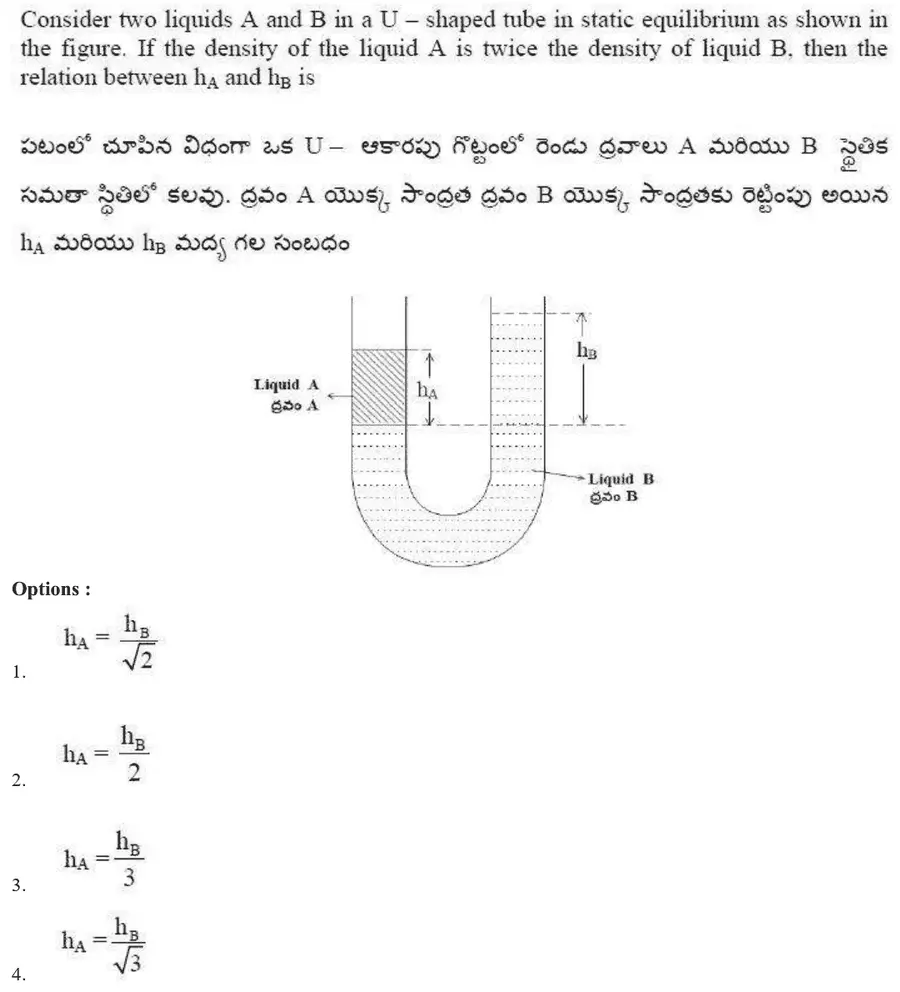
Consider two liquids A and B in a U - shaped tube in static equilibrium as shown in the figure. If the density of the liquid A is twice the density of liquid B, then the relation between $h_A$ and $h_B$ is (see the figure above)
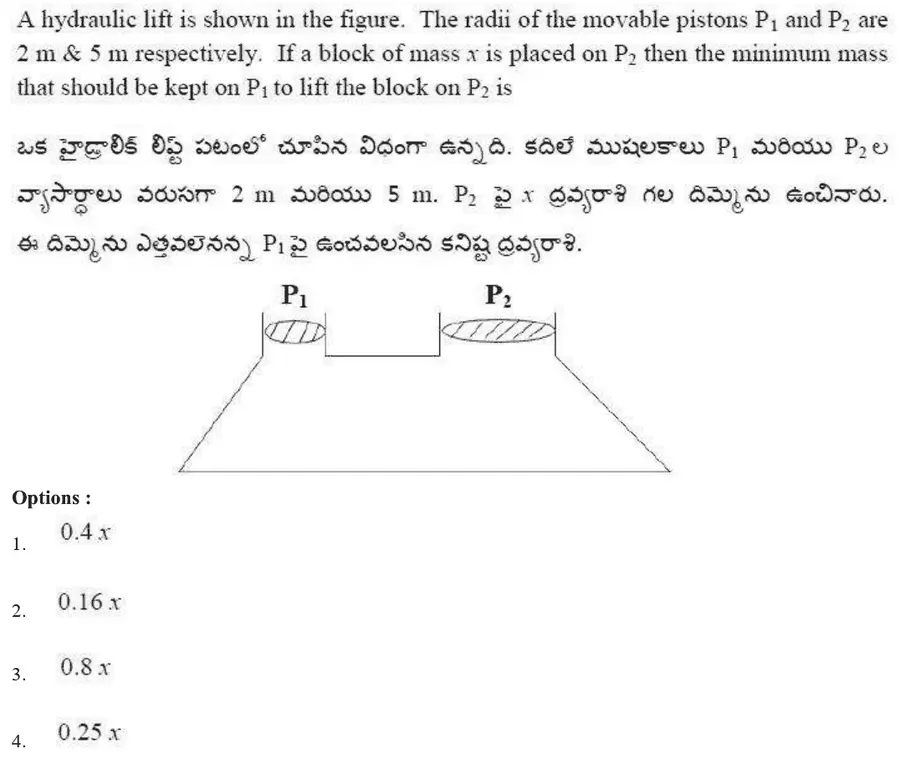
A hydraulic lift is shown in the figure. The radii of the movable pistons $P_1$ and $P_2$ are 2 m & 5 m respectively. If a block of mass $x$ is placed on $P_2$ then the minimum mass that should be kept on $P_1$ to lift the block on $P_2$ is (see the figure above)
A block of wood of volume V floats in water with half of its volume submerged. The same block floats in an oil with 0.8 V volume submerged. If the density of water is $1000\ \mathrm{kg\,m^{-3}}$, then the density of the oil is
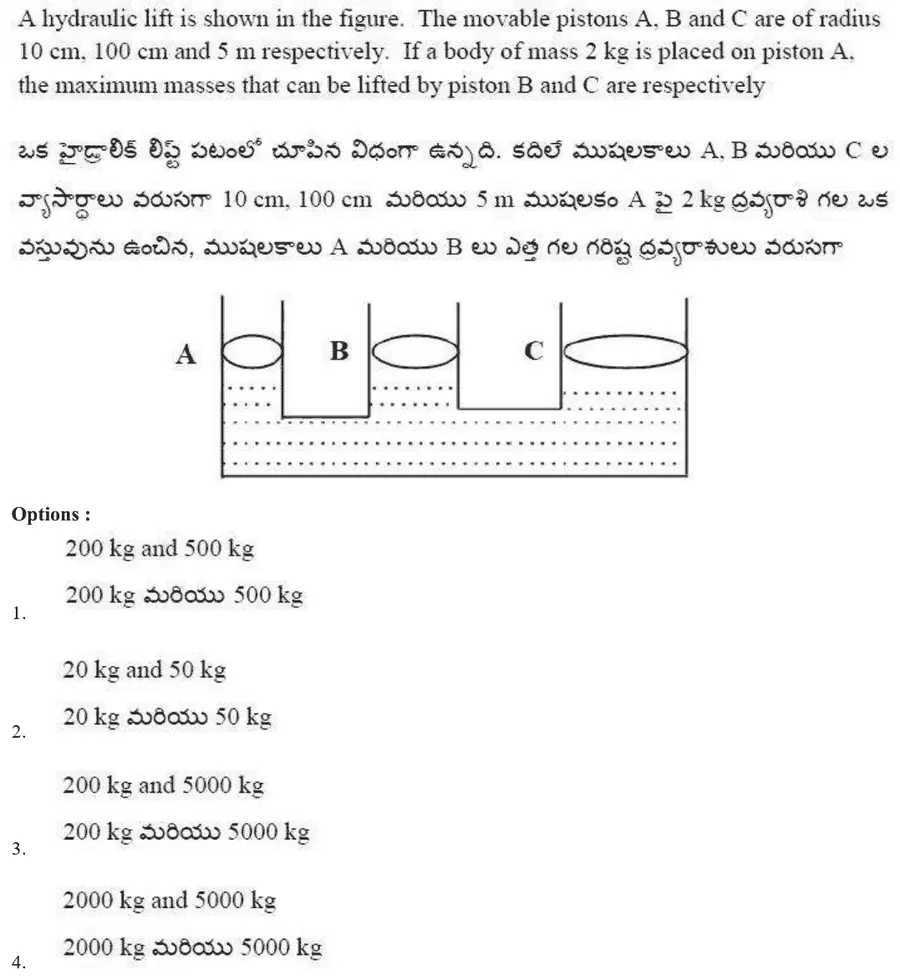
A hydraulic lift is shown in the figure. The movable pistons A, B and C are of radius 10 cm, 100 cm and 5 m respectively. If a body of mass 2 kg is placed on piston A, the maximum masses that can be lifted by piston B and C are respectively (see the figure above)
An object of mass 10 kg is released from rest in a liquid. If the object moves a distance of 2 m while sinking in time duration of 1s, then the mass of the liquid displaced by the submerged object is
(Acceleration due to gravity = $10\ \mathrm{m\,s^{-2}}$)
Statement (A) : When the temperature increases the viscosity of gases increases and the viscosity of liquids decreases. Statement (B) : Water does not wet an oily glass because cohesive force of oil is less than that of water. Statement (C) : A liquid will wet a surface of a solid if the angle of contact is greater than 90°.
In a hydraulic lift, compressed air exerts a force F on a small piston of radius 3 cm. Due to this pressure the second piston of radius 5 cm lifts a load of 1875 kg. The value of F is (Acceleration due to gravity = $10\ \mathrm{ms^{-2}}$)
In a U-shaped tube the radius of one limb is 2 mm and that of other limb is 4 mm. A liquid of surface tension $0.03\ \mathrm{Nm^{-1}}$, density $1500\ \mathrm{kgm^{-3}}$ and angle of contact zero is taken in the tube. The difference in the heights of the levels of the liquid in the two limbs is (Acceleration due to gravity = $10\ \mathrm{ms^{-2}}$)
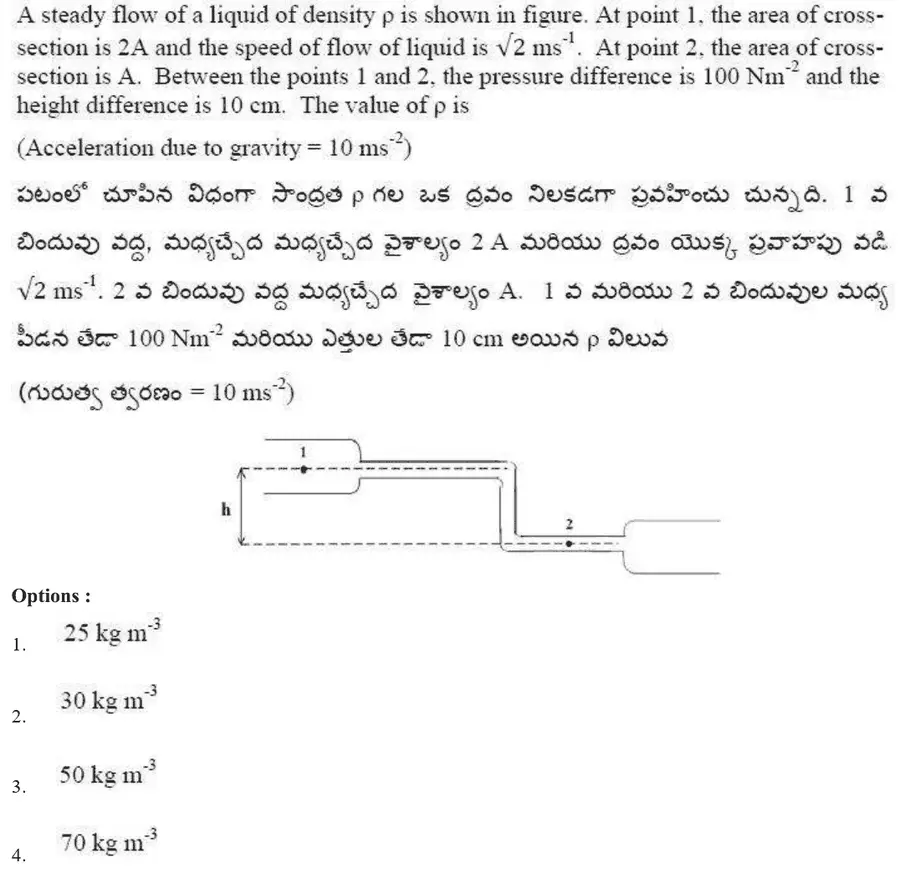
A steady flow of a liquid of density $\rho$ is shown in figure. At point 1, the area of cross-section is 2A and the speed of flow of liquid is $\sqrt{2}\ \mathrm{ms^{-1}}$. At point 2, the area of cross-section is A. Between the points 1 and 2, the pressure difference is $100\ \mathrm{Nm^{-2}}$ and the height difference is 10 cm. The value of $\rho$ is (Acceleration due to gravity = $10\ \mathrm{ms^{-2}}$) (see the figure above)
The flow rate of water from a tap of diameter $1.25\ \mathrm{cm}$ is 3 litres per minute. If coefficient of viscosity of water is $10^{-3}\ \mathrm{Pa.s}$, the nature of flow is ______
A cylindrical tank is filled with water to a level of $3\ \mathrm{m}$. A hole is opened at a height of $52.5\ \mathrm{cm}$ from the bottom. The ratio of the area of the hole to that of the cross-sectional area of the tank is 0.1. The square of the speed with which water will be coming out from the orifice is ______ ($g = 10\ \mathrm{m.s^{-2}}$)
In a vehicle lifter, the enclosed gas exerts a force 'F' on a small piston of $8\ \mathrm{cm}$ diameter. The pressure is transmitted to a second piston of diameter $24\ \mathrm{cm}$. If the mass of the vehicle to be lifted is $1400\ \mathrm{kg}$, then $F$ must at least be ______ ($g = 10\ \mathrm{m.s^{-2}}$)
A wooden block floating in a bucket of water has $(4/5)^{th}$ of its volume submerged. When certain amount of an oil is poured in to the bucket, it is found that the block is just under the oil surface, with half of its volume under water and the other half in oil. The density of oil used, relative to that of water is ____
Assertion (A): At critical temperature, surface tension of liquids become zero. Reason (R): At critical temperature, intermolecular forces for liquids and gases become equal. Thus, liquids can expand without restriction.
A
Both A and R are true and R is a correct explanation for A
B
Both A and R are true but R is not a correct explanation for A
A glass flask weighing $390\ g$, having internal volume $500\ cc$ just floats when half of it is filled with water. Specific gravity of the glass is ______.
Assertion (A): The upper surface of the wing of an aeroplane is made convex and the lower surface is made concave. Reason (R): The air currents at the top have smaller velocity and thus less pressure at the bottom than at the top.
A
Both A and R are true and R is a correct explanation for A
B
Both A and R are true but R is not a correct explanation for A
The lower end of a capillary tube is dipped into water and it is observed that the water in capillary tube rises by $7.5\ cm$. Find the radius of the capillary tube used, if surface tension of water is $7.5 \times 10^{-2}\ \mathrm{N.m^{-1}}$? Angle of contact between water and glass is $0^\circ$ and acceleration due to gravity is $10\ \mathrm{m.s^{-2}}$
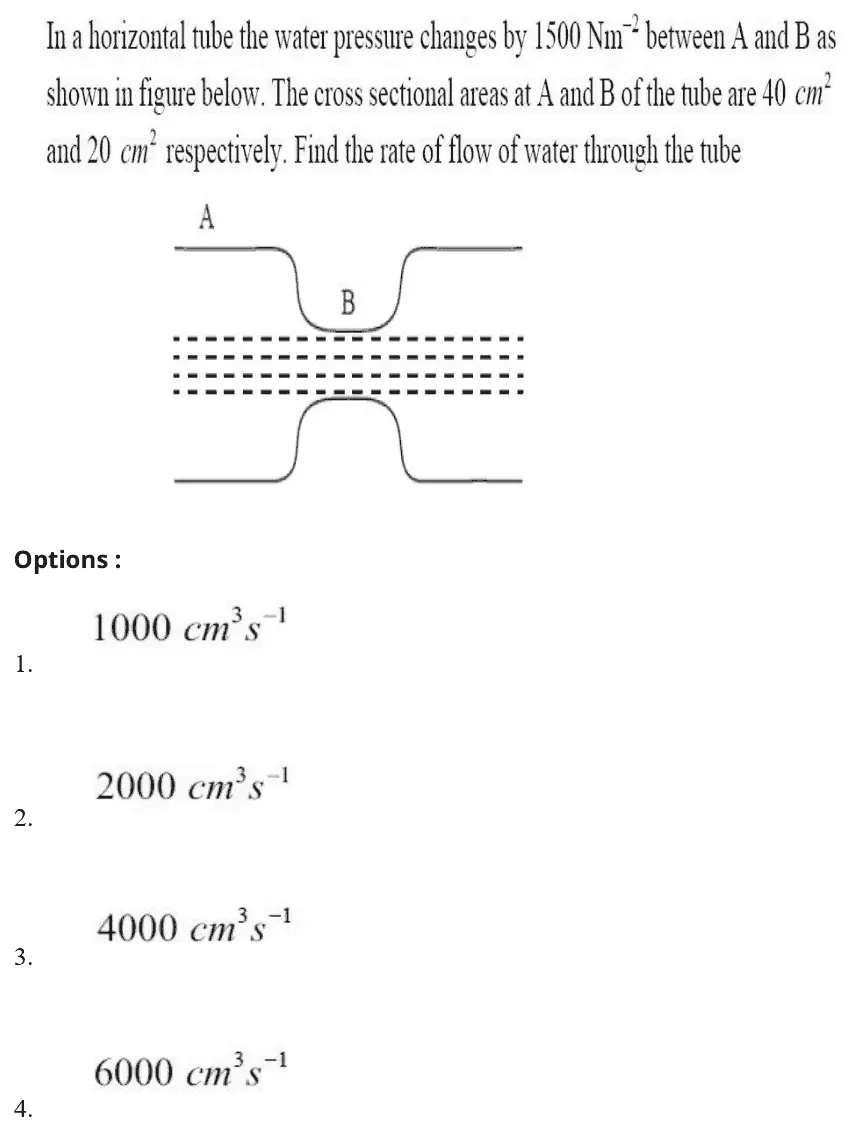
In a horizontal tube the water pressure changes by 1500 Nm$^{-2}$ between A and B as shown in figure below. The cross sectional areas at A and B of the tube are 40 $cm^2$ and 20 $cm^2$ respectively. Find the rate of flow of water through the tube (see the figure above)
A shower head has 25 circular openings, each with radius $1\ \mathrm{mm}$. The shower head is connected to a pipe with radius $2\ \mathrm{cm}$. If the speed of the water in the pipe is $25\ \mathrm{cm/sec}$, what is its speed as it exits the shower head openings?
A block of material with density $3\ \mathrm{gm/cc}$ is placed on a fluid of density $7\ \mathrm{gm/cc}$. The fraction of volume of the piece of material outside the fluid is
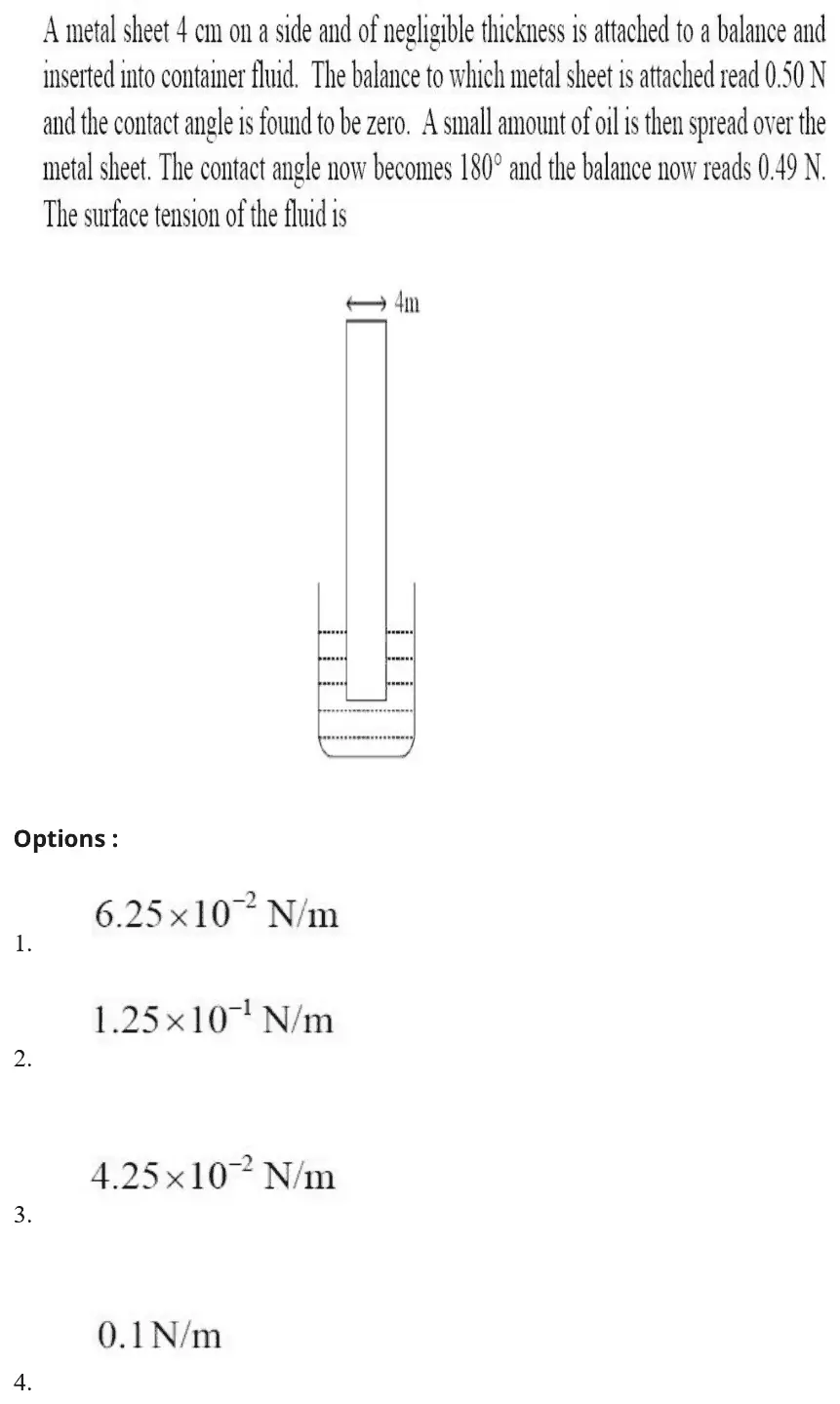
A metal sheet 4 cm on a side and of negligible thickness is attached to a balance and inserted into container fluid. The balance to which metal sheet is attached read 0.50 N and the contact angle is found to be zero. A small amount of oil is then spread over the metal sheet. The contact angle now becomes $180^\circ$ and the balance now reads 0.49 N. The surface tension of the fluid is (see the figure above)
Match the columns I and II A) Stoke's law I) Pressure and energy B) Turbulence II) Hydraulic lift C) Bernoulli's Principle III) Viscous drag D) Pascal's law IV) Reynold's number The correct match is
Liquid A rises to a height of 10 cm in a capillary tube and liquid B falls to a depth of 2 cm in the same tube. The density of A and B are 1 g/cm$^3$ and 10 g/cm$^3$ respectively. The contact angle of A and B with the tube is 0° and 135° respectively. If the surface tension of A and B are $S_A$ and $S_B$ then the ratio $\frac{S_B}{S_A}$ is
A wooden block of density 0.5 g/cc is tied to a string. The other end of the string is fixed to the bottom of a tank. The tank is filled with a liquid of density 1 g/cc. If the tension of the string is 20 N, then the mass of the block is (Take g = 10 m/s$^2$)
A U-shaped tube is partially filled with an incompressible liquid of density $1.2\ \mathrm{g/cm^3}$. Oil which does not mix with the liquid is next poured into left side of the U-tube until the liquid rises by 15 cm on the right side of U-tube. If the density of the oil is $0.9\ \mathrm{g/cm^3}$, the oil level will stand higher than the liquid level of right side of U-tube by
What is the terminal velocity of air bubble of 1.0 mm in diameter rising in liquid of viscosity $0.85\ \mathrm{Ns/m^2}$ and density $900\ \mathrm{kgm^{-3}}$? [air density $1.293\ \mathrm{kg/m^3}$, $g = 9\ \mathrm{m/s^2}$]
Two capillary tubes of radii $R$ and $2R$ are dipped in water. The water rises to heights $h_1$ and $h_2$ respectively in the two tubes. If $m_1$ and $m_2$ be the masses of water ascended in the tubes then $m_1 : m_2 =$
Two thin circular discs $A$ and $B$ of radii $2\ \mathrm{cm}$ and $4\ \mathrm{cm}$ are in a liquid at the same depth. $T_A$ is the thrust on $A$ and $T_B$ thrust on $B$. Then $T_A : T_B =$
Find the apparent weight of a metallic block of density 5 $\mathrm{g.cm^{-3}}$ and dimensions 5 $\mathrm{cm}$ $\times$ 5 $\mathrm{cm}$ $\times$ 5 $\mathrm{cm}$, in water.
Bottom of a cylindrical vessel has a hole of area 'A'. If water is filled up to a height 'h', it flows out in 't' seconds. If water is filled to a height '4h', it will flow out in time ______
A $0.5\ \mathrm{kg}$ block of brass (density $= 8 \times 10^{3}\ \mathrm{kg.m^{-3}}$) is suspended from a string. What is the tension in the string if the block is completely immersed in water? ($g = 10\ \mathrm{m.s^{-2}}$)
Water flows through a hose pipe whose internal diameter is $4\,\mathrm{cm}$ at a speed of $1\,\mathrm{m.s^{-1}}$. If water has to emerge at a speed of $4\,\mathrm{m.s^{-1}}$, the diameter of the nozzle should be
The radius of the bore of a capillary tube is 'r' and the angle of contact of the liquid is '$\theta$'. When the tube is dipped in the liquid, the radius of curvature of the meniscus of liquid rising in the tube is
Two water pipes of diameters $2\ cm$ and $4\ cm$ are separately connected to a main supply line. The velocity of flow of water in the pipe of $2\ cm$ diameter is ______
If a vessel containing a fluid of density $\rho$ upto height $h$ is accelerated vertically downwards with acceleration $a_0$. Then the pressure by fluid at the bottom of vessel is given by the equation ______ ($P_0$ denotes the atmospheric pressure and 'g' denotes the acceleration due to gravity)
A fully loaded Boeing air craft has a mass of $3.3 \times 10^{5}$ $\mathrm{kg}$. Its total wing area is 500 $\mathrm{m^2}$. It is in level flight with a speed of 960 $\mathrm{kmph}$. Estimate the pressure difference between the lower and upper surfaces of the wings.
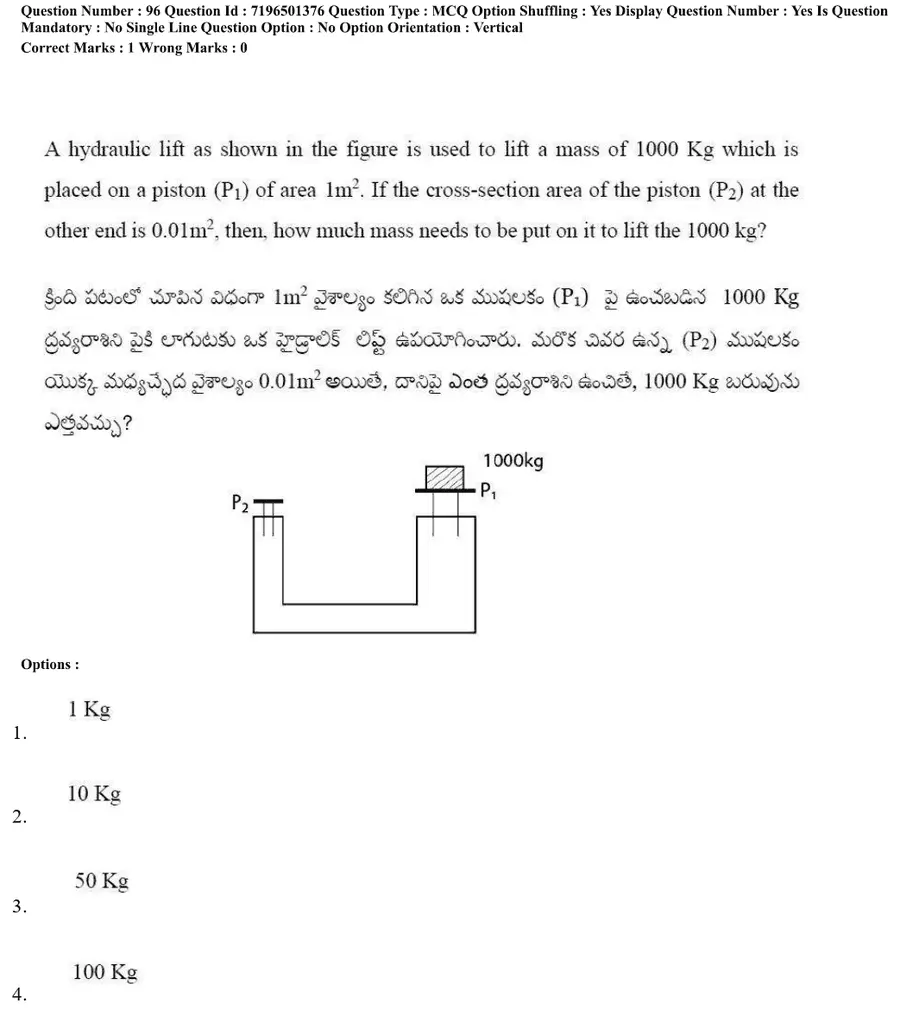
A hydraulic lift as shown in the figure is used to lift a mass of 1000 Kg which is placed on a piston ($P_1$) of area $1\,\mathrm{m}^2$. If the cross-section area of the piston ($P_2$) at the other end is $0.01\,\mathrm{m}^2$, then, how much mass needs to be put on it to lift the 1000 kg? (see the figure above)
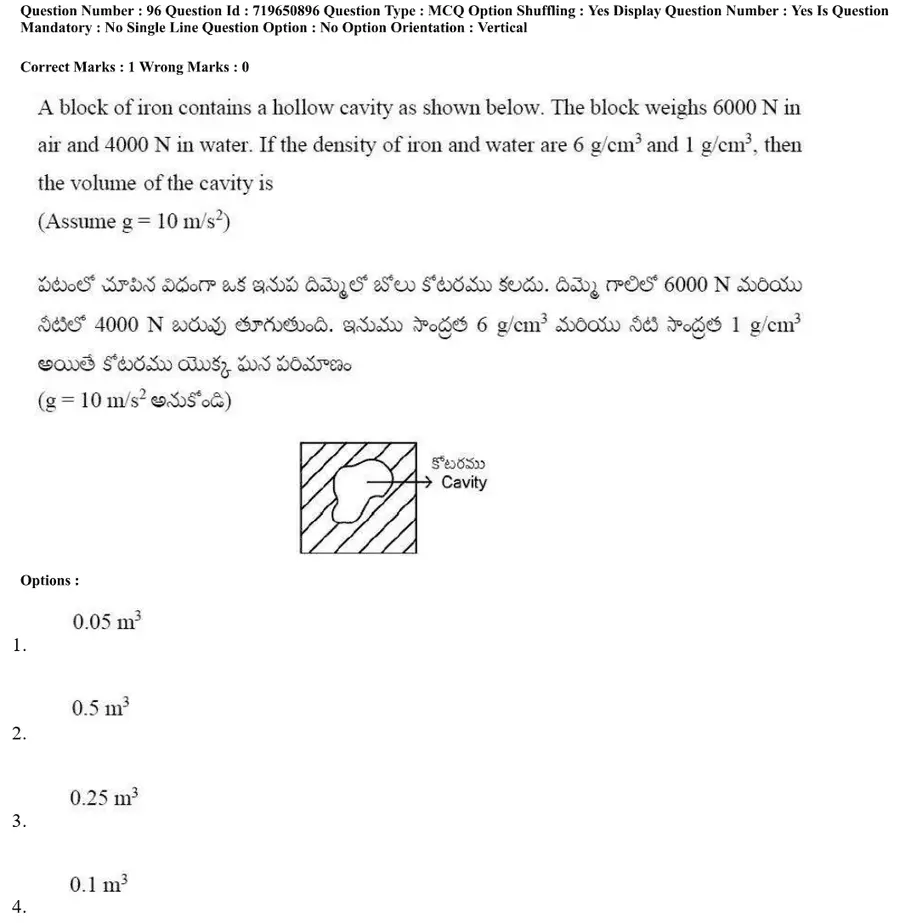
A block of iron contains a hollow cavity as shown below. The block weighs 6000 N in air and 4000 N in water. If the density of iron and water are 6 g/cm$^3$ and 1 g/cm$^3$, then the volume of the cavity is (Assume g = 10 m/s$^2$) (see the figure above)
A meniscus (sic) drop of radius 1 cm is sprayed into $10^6$ droplets of equal size. Calculate the energy expended if surface tension of mercury is $435 \times 10^{-3}$ N/m
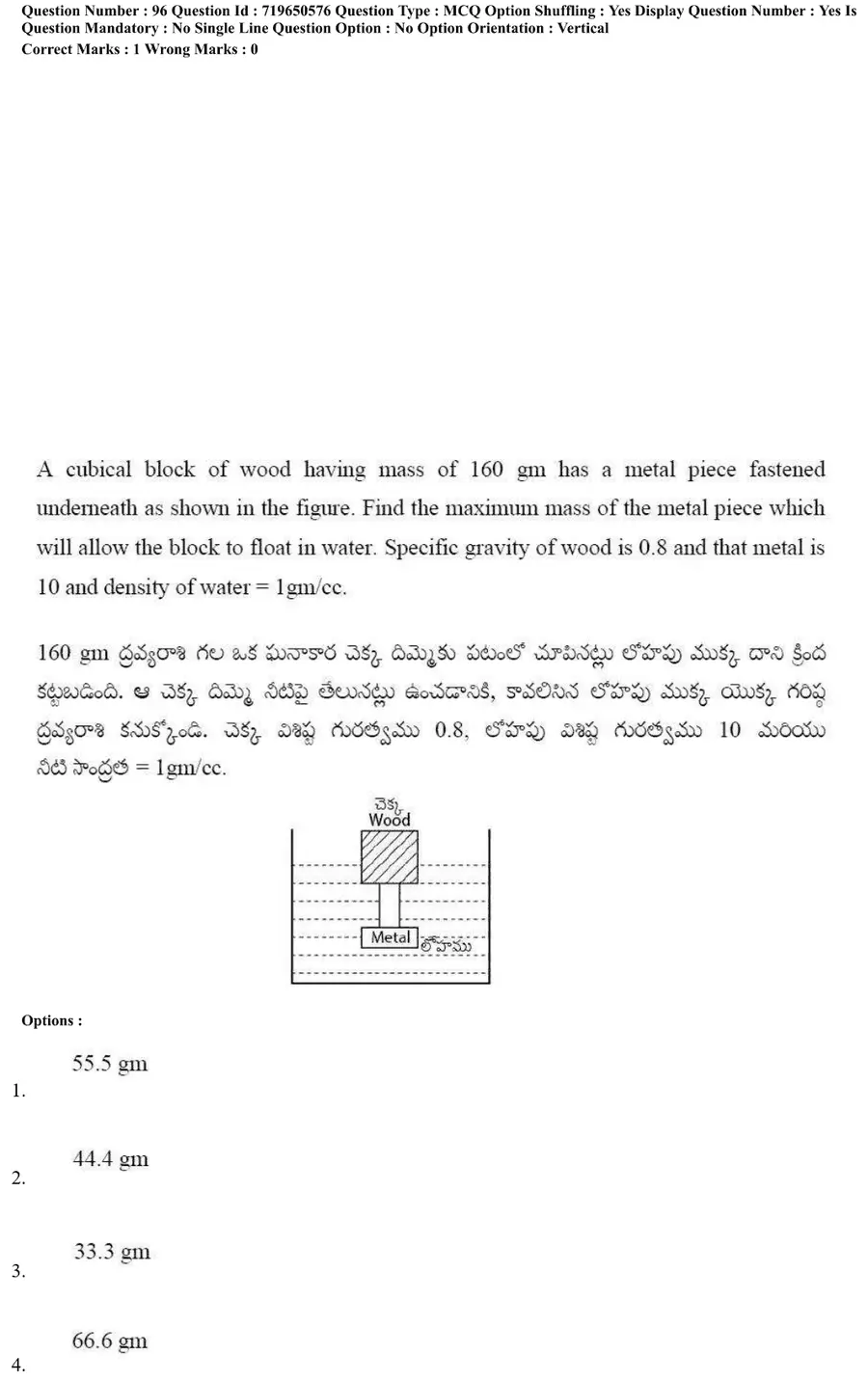
A cubical block of wood having mass of 160 gm has a metal piece fastened underneath as shown in the figure. Find the maximum mass of the metal piece which will allow the block to float in water. Specific gravity of wood is 0.8 and that metal is 10 and density of water = 1gm/cc. (see the figure above)
The speed of the water in a river is 'V' near the surface. If the coefficient of viscosity of water is '$\eta$' and the depth of the river is 'H', then the shearing stress between the horizontal layers of water is
Consider a steady flow of oil in a pipeline. The cross-sectional radius of the pipeline decreases gradually as $r=r_0e^{-\alpha x}$ where $\alpha=\dfrac{1}{3}m^{-1}$ and $x$ is the distance from the pipeline inlet. If R$_1$ is the Reynold's number for a certain pipeline cross-section at a distance $x_1$ meter from the inlet and R$_2$ is for distance $(x_1+3)$ metre, then the ratio $\dfrac{R_1}{R_2}$ is
Consider a water droplet of diameter 0.2 mm where the outside pressure is 1.5 N/cm$^2$ at 25 °C. The pressure inside the droplet, when the surface tension at 25 °C is 0.08 N/m, is
Pressure at the Earth's surface is $p_0 = 10^5$ Pa and the density of air at Earth's surface is $\rho_0 = 1.4$ kg/m$^3$. At height 'h' from the surface of Earth the density of air is reduced to $\frac{\rho_0}{2}$, the value of 'h' is (Assume that the temperature is constant through out the earth's atmosphere and let $\ln(2) = 0.7$
A water tank kept on the ground has an orifice of 2 mm diameter on the vertical side. What is the minimum height of the water above the orifice for which the output flow of water is found to be turbulent? (Assume $g = 10\ \mathrm{m/s^{2}}$, $\rho_{\mathrm{water}} = 10^{3}\ \mathrm{kg/m^{3}}$, viscosity = 1 centi poise)
A copper ball of radius 3.0 mm falls in an oil tank of viscosity 1 kg/m-s. Then, the terminal velocity of the copper ball will be (Density of oil = $1.5 \times 10^{3}\ \mathrm{kg/m^{3}}$, Density of Copper = $9 \times 10^{3}\ \mathrm{kg/m^{3}}$ and $g = 10\ \mathrm{m/s^{2}}$)
A cylindrical vessel of height 50 cm is filled with water and rests on a table. A small hole is made at the height 'h' from the bottom of the vessel so that the water jet could hit the table surface at a maximum distance $x_{max}$ from the vessel as shown in the figure. The value of $x_{max}$ will be (Neglect the viscosity of water) (see the figure above)
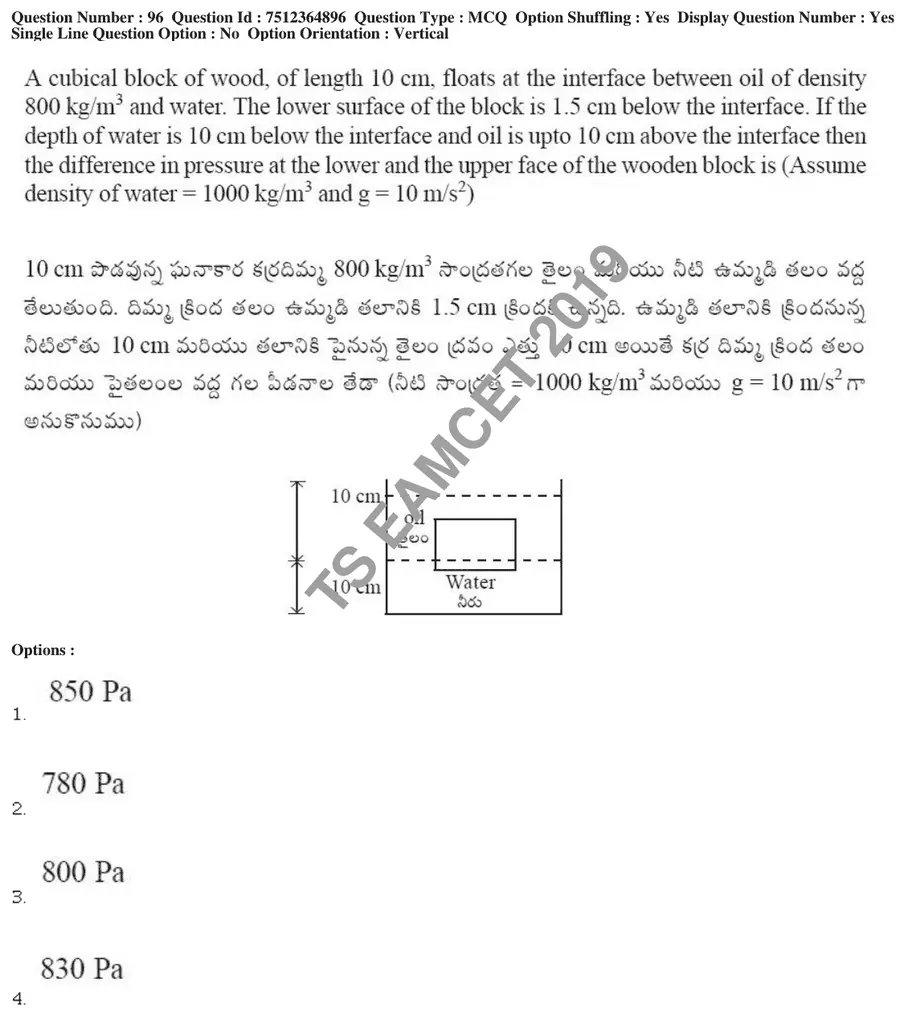
A cubical block of wood, of length 10 cm, floats at the interface between oil of density 800 kg/m$^3$ and water. The lower surface of the block is 1.5 cm below the interface. If the depth of water is 10 cm below the interface and oil is upto 10 cm above the interface then the difference in pressure at the lower and the upper face of the wooden block is (Assume density of water $= 1000$ kg/m$^3$ and $g = 10$ m/s$^2$) (see the figure above)
The tension in a massless cable connected to an iron ball of 100 kg when it is submerged in sea water is ($\rho_{\mathrm{iron}} = 8 \times 10^3\ \mathrm{kg/m^3}$ and $\rho_{\mathrm{sea\ water}} = 1000\ \mathrm{kg/m^3}$, $g = 10\ \mathrm{m/s^2}$)
A cylindrical tank with a large diameter is filled with water. Water drains out through a hole at a bottom of the tank. If the cross-sectional area of the hole is $6\ \mathrm{cm^2}$ then the drainage rate (in $\mathrm{m^3/s}$) when the depth of the water is 0.2 m, is
The surface tension of the soap water solution is $\frac{1}{10\pi}\ \mathrm{N/m}$. The free energy of the surface layer of a soap bubble of diameter 5 mm will be
Two tubes of same length and diameters $4\ \mathrm{mm}$ and $8\ \mathrm{mm}$ are joined together to form a U-shaped tube open at both the ends. If the U-tube contains water, then the difference between the levels of water in the two limbs of the tube is (Surface Tension of water at the temperature of experiment is $7.3\times10^{-2}\ \mathrm{Nm^{-1}}$, angle of contact $= 0^\circ$, density of water $= 1.0\times10^{3}\ \mathrm{kg\,m^{-3}}$ and acceleration due to gravity $= 10\ \mathrm{ms^{-2}}$)
A rain drop of radius $r$ is falling through air, starting from rest. The work done by all the forces on the drop, when it attains terminal velocity, is proportional to
A sphere of radius R has a concentric spherical cavity of radius $r$. The relative density of the material of the sphere is $\sigma$. It just floats when placed in tank full of water. The value of $\frac{R}{r}$ is
A liquid drop of density $\rho$ is floating half immersed in a liquid of surface tension S and density $\frac{\rho}{2}$. If the surface tension S of liquid is numerically equal to 10 times of acceleration due to gravity, then the diameter of the drop is
Two capillary tubes of same length each of 50 cm but of different radii 4 mm and 2 mm are connected in series. When water flows, the pressure difference between the ends of the arrangement is P. Then the pressure difference between the ends of the first tube is
A long cylindrical glass vessel has a pin hole of diameter 0.2 mm at its bottom. The depth to which the vessel can be lowered vertically in a deep water bath without the water entering into the vessel is (Surface tension of water $= 0.07\ \mathrm{Nm^{-1}}$, Acceleration due to gravity $= 10\ \mathrm{ms^{-2}}$)
The radius of a soap bubble is $r$ and the surface tension of the soap solution is S. The electric potential to which the soap bubble be raised by charging it so that the pressure inside the bubble becomes equal to the pressure outside the bubble is ($\epsilon_0$ - permittivity of free space)
A cylindrical tank has a hole of area $2\ \mathrm{cm^2}$ at its bottom. If water is poured into the tank from a tube above it at the rate of $100\ \mathrm{cm^3\,s^{-1}}$, then the maximum height upto which water can rise in the tank is (Acceleration due to gravity = $10\ \mathrm{ms^{-2}}$)
Consider an air bubble of radius 2 mm in a liquid at a depth of 5 cm below the free surface. The density of the liquid is 1000 $\mathrm{kg/m^3}$ and the surface tension is 0.1 N/m. The pressure inside the air bubble is greater than the pressure at the free surface of the liquid by (Take $g = 10\ \mathrm{m/sec^2}$)
A cylindrical vessel is filled with water upto the height 1 m from the base. A small orifice is opened at some height in the cylinder and the water level is reduced to height of orifice in 20 sec. If the base area of the cylinder is 100 times the area of orifice, then the height of orifice from the base is (Take $g = 10\ \mathrm{m/sec^2}$)
What is the rate at which a trapped bubble of 2.0 mm diameter rises slightly through a solution of density $13.6\times10^3\ \mathrm{kg/m^3}$ and coefficient of viscosity 1.5 centi poise. Assume the density of air is negligible and $g = 10\ \mathrm{m/s^2}$
Consider a vessel filled with a liquid upto height $H$. The bottom of the vessel lies in the $X$-$Y$ plane passing through the origin. The density of the liquid varies with $Z$-axis as $\rho(z) = \rho_0\left[2 - \left(\frac{z}{H}\right)^{2}\right]$. If $P_1$ and $P_2$ are the pressures at the bottom surface and top surface of the liquid, the magnitude of $(P_1 - P_2)$ is :
An air bubble rises from the bottom of a water tank of height 5 m. If the initial volume of the bubble is 3 mm$^3$. What will be its volume as it reaches the surface. Assume that its temperature does not change. [ $g = 9.8\ \mathrm{m/s^{2}}$, 1 atm $= 10^{5}$ Pa, density of water = 1 gm/cc]
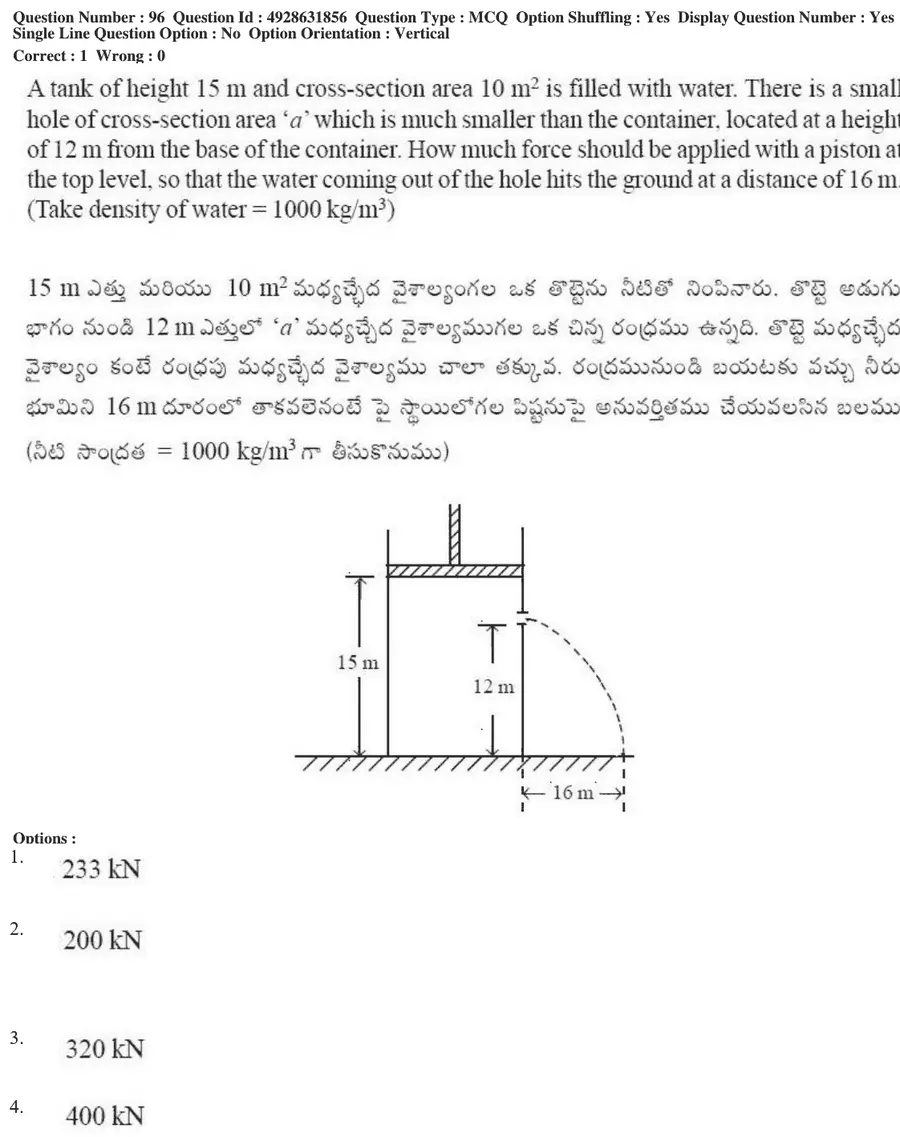
A tank of height 15 m and cross-section area $10\ \mathrm{m^2}$ is filled with water. There is a small hole of cross-section area 'a' which is much smaller than the container, located at a height of 12 m from the base of the container. How much force should be applied with a piston at the top level, so that the water coming out of the hole hits the ground at a distance of 16 m. (Take density of water = 1000 $\mathrm{kg/m^3}$) (see the figure above)
When a soap bubble of radius 0.2 mm is charged, it experiences an outward electrostatic pressure of magnitude $\dfrac{\sigma^2}{2\epsilon_0}$ where $\sigma = 20\ \mu\mathrm{Cm^{-2}}$ is the surface charge density. If the excess pressure inside the soap bubble due to the surface tension is same as this electrostatic pressure, then the surface tension of the soap solution is ($\epsilon_0 = 8.85\times10^{-12}\ \mathrm{C^2N^{-1}m^{-2}}$)
A liquid is filled in a tank up to a height of 5 m and the bottom of the tank is at 5 m height from the ground. A hole is punched to the tank so that the liquid comming out touches the ground at maximum horizontal distance. Then the maximum horizontal distance is
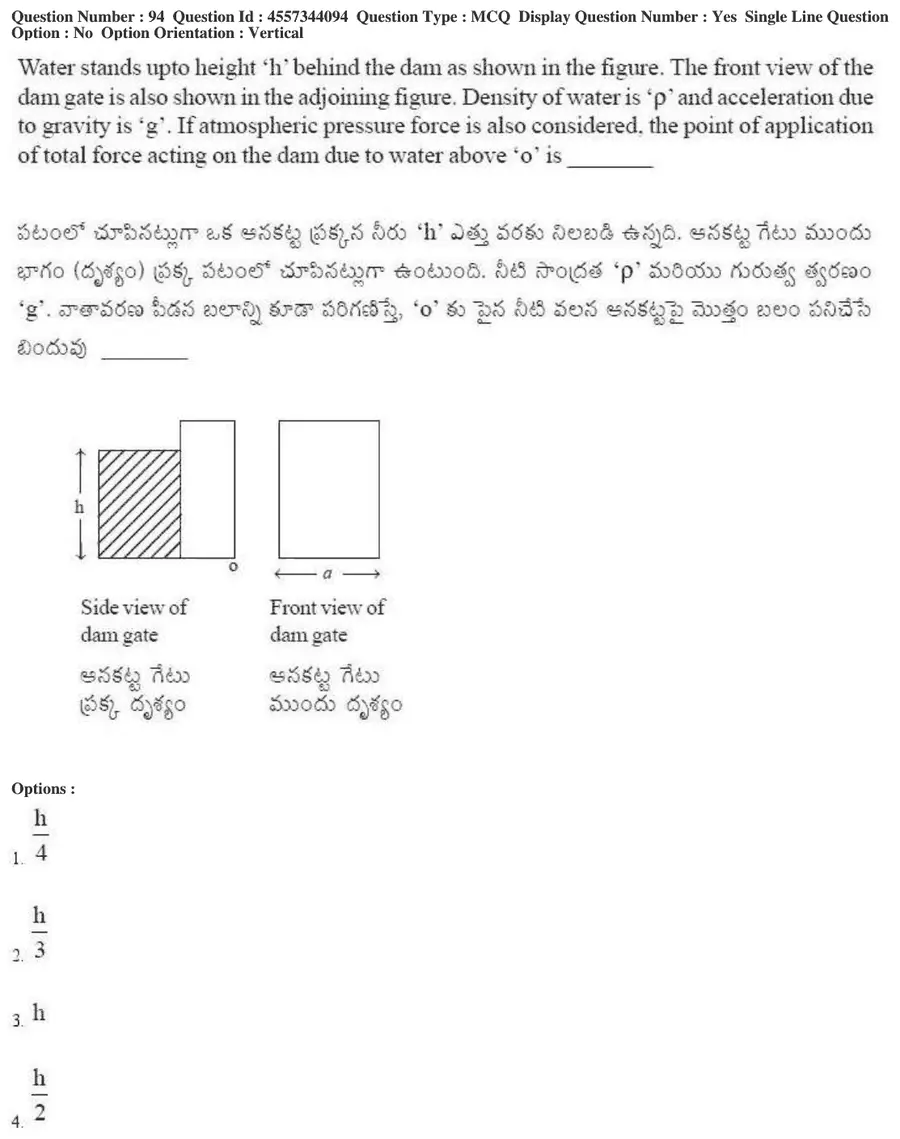
Water stands upto height 'h' behind the dam as shown in the figure. The front view of the dam gate is also shown in the adjoining figure. Density of water is '$\rho$' and acceleration due to gravity is 'g'. If atmospheric pressure force is also considered, the point of application of total force acting on the dam due to water above 'o' is ______ (see the figure above)
Two solid spheres of radii 2 mm and 4 mm are tied to the two ends of a light string and released in a liquid of specific gravity 1.3 and coefficient of viscosity 1 Pa s. The string is just taut when the two spheres are completely in the liquid. If the density of the materials of the two spheres is $2800\ \mathrm{kgm^{-3}}$, the terminal velocity of the system of the spheres is ($g = 10\ \mathrm{ms^{-2}}$)
A body is suspended by a light string. The tensions in the string when the body is in air, when the body is totally immersed in water and when the body is totally immersed in a liquid are respectively $40.2\ \mathrm{N}$, $28.4\ \mathrm{N}$ and $16.6\ \mathrm{N}$. The density of the liquid is ______
A spherical body of density $\rho$ is floating half immersed in a liquid of density d. If $\sigma$ is the surface tension of the liquid, then the diameter of the body is
A horizontal pipeline carrying gasoline has a cross-sectional diameter of $5\ \mathrm{mm}$. If the viscosity and density of the gasoline are $6 \times 10^{-3}$ Poise and $720\ \mathrm{kg/m^3}$ respectively, the velocity after which the flow becomes turbulent is
Fully filled open water tank has two holes on either sides of its walls. One is a square hole of side x cm at a depth of 2 m from the top, and the other hole is equilateral triangle of side 4 cm at a depth of 6 m from the top. If the rate of flow of water is same from both the holes, then 'x' is
In S.I. system, the total energy of the free surface of a liquid drop is $2\pi$ times the surface tension of the liquid. The diameter of the drop is ______
A large vessel with a small hole at the bottom is filled with water and kerosine with kerosine floating on water. The length of water column is 20 cm and that of kerosine is 25 cm. The velocity with which water flows out of the hole is (density of kerosine = 0.8 $\mathrm{g\ cm^{-3}}$, neglect viscous force).
In a cylinder provided with a piston, air is under pressure $P_1$ at a constant temperature 't'. A soap bubble with radius 'r' and surface tension 'T' is lying inside the cylinder. To reduce the radius of the soap bubble to half, the required air pressure inside the cylinder is
A number of small water droplets of surface tension 'T', each of radius 'r' are combined to form a single drop of radius 'R'. If the released energy is converted into kinetic energy, then the velocity acquired by the bigger drop is ______ ($\rho$ - density of water)
An aircraft of mass $3\times10^5$ kg with total wing area $400\ \mathrm{m^2}$ is in a level flight at a speed of $540\ \mathrm{km\ h^{-1}}$. The density of air at its height is $1.2\ \mathrm{kg\ m^{-3}}$. The fractional increase in the speed of the air on the upper surface of its wings relative to the lower surface is ______ ($g = 10\ \mathrm{ms^{-2}}$)
A soap bubble of radius 1.0 cm is formed inside another soap bubble of radius 2.0 cm. The radius of an another soap bubble which has the same pressure difference as that between the inside of the smaller and outside of large soap bubble, in meters is
A sphere of material of relative density 8 has a concentric spherical cavity and just sinks in water. If the radius of the sphere is 2 cm, then the volume of the cavity is
When a big drop of water is formed from n small drops of water, the energy loss is 3E, where E is the energy of the bigger drop. If R is the radius of the bigger drop and r is the radius of the smaller drop, then number of smaller drops (n) is
A capillary tube of radius 'r' is immersed in water and water rises to a height of 'h'. Mass of water in the capillary tube is $5\times10^{-3}\ \mathrm{kg}$. The same capillary tube is now immersed in a liquid whose surface tension is $\sqrt{2}$ times the surface tension of water. The angle of contact between the capillary tube and this liquid is $45^\circ$. The mass of liquid which rises into the capillary tube now is, (in kg)
The terminal velocity of a liquid drop of radius 'r' falling through air is v. If two such drops are combined to form a bigger drop, the terminal velocity with which the bigger drop falls through air is (Ignore any buoyant force due to air)
Drops of liquid of density 'd' are floating half immersed in a liquid of density $\rho$. If the surface tension of the liquid is T, then the radius of the drop is
A pipe having an internal diameter 'D' is connected to another pipe of same size. Water flows into the second pipe through 'n' holes, each of diameter 'd'. If the water in the first pipe has speed 'v', the speed of water leaving the second pipe is
A large open tank has two holes in the wall. One is a square hole of side 'L' at a depth 'y' from the top and the other is a circular hole of radius R at a depth '4y' from the top. When the tank is completely filled with water, the quantities of water flowing out per second from the two holes are the same. Then value of R is :
The excess pressure inside a spherical soap bubble of radius 1 cm is balanced by a column of oil (Sp. gr. = 0.8), 2 mm high, the surface tension of the bubble is :
Water from a tap emerges vertically downwards with initial velocity 4 ms$^{-1}$. The cross-sectional area of the tap is A. The flow is steady and pressure is constant throughout the stream of water. The distance $h$ vertically below the tap, where the cross-sectional area of the stream becomes $\left(\frac{2}{3}\right)$A, is ($g$ = 10 m/s$^2$) :
Fluid Mechanics is an active part of Class 11 physics in state engineering examinations. In the papers we hold for AP and TS EAPCET between 2022 and 2026, the chapter contributed 113 questions across 77 papers. That gives an overall rate of 1.5 questions per paper, representing 3.7% of all physics questions in that recent window. Across all years in our archive from 2010 to 2026, Fluid Mechanics delivered 216 questions across 149 papers, maintaining an average of 1.4 questions per paper and a 3.6% subject share. During the earlier period from 2010 to 2021, our archive records 103 questions across 72 papers (3.6% share). In the last three exam years from 2024 to 2026, the chapter provided 61 questions across 46 papers, registering a 3.3% share. The share of the subject in the last three years compared to early papers is about the same, and compared to the recent five-year window it is also about the same.
State-wise records show that TS papers lean more heavily into fluids than AP papers. Between 2022 and 2026, AP EAPCET papers in our set contributed 56 questions across 48 papers, with 47 papers containing at least one question (1.2 per paper, 2.9% subject share). Over the same period, TS EAPCET contributed 57 questions across 29 papers in our set, with all 29 papers featuring the chapter (2.0 per paper, 4.9% subject share). Fluid Mechanics has appeared every year since 2022, though across all 77 recent papers in our collection, one AP paper missed it, so it did not feature in all 77 sittings. The chapter ranks 12th of 28 physics chapters by question share between 2022 and 2026. The busiest single sitting in our collection was 2022, which delivered 31 questions across 16 papers.
Most-asked topics
Questions span four fundamental areas:
Surface Tension: 42 questions in the recent 2022–2026 window and 75 questions across all years in our archive. Major setups include capillary rise, excess pressure across spherical droplets and soap bubbles, work done blowing bubbles, and the coalescing of smaller droplets into a larger drop.
Fluid Statics: 33 questions between 2022 and 2026 and 61 questions across all years. This includes hydrostatic pressure variation with depth, Pascal's principle in hydraulic presses, Archimedes' principle, and floatation conditions for submerged or layered liquids.
Fluid Dynamics: 21 questions between 2022 and 2026 and 45 questions across all years. The continuity equation, Bernoulli's theorem, Torricelli's law of efflux, and Venturimeter flow measurements form the core of this section.
Viscosity: 17 questions in the recent period and 35 questions across all years. Key concepts test Stokes' law, terminal velocity of falling or rising spheres, Poiseuille's formula, and Reynolds number criteria.
What the questions look like
Surface tension questions provide the largest share of marks and follow familiar arithmetic formats. A classic problem asks for the temperature or work required to split a large liquid drop into thousands of tiny droplets, relying on surface energy conservation U = T ΔA. Capillary rise questions often check what happens when a tube of insufficient length is used or ask for the total mass of the elevated liquid column.
In fluid dynamics, examiners frequently combine Bernoulli's equation with the equation of continuity A₁ v₁ = A₂ v₂. You might be asked to find the gauge pressure at a constricted section of a horizontal water main or calculate the efflux speed and horizontal range of a jet issuing from an orifice punctured at depth h below the surface. Floating body problems from fluid statics ask for the fraction of an object's volume projecting above a liquid surface when submerged in multi-density fluids.
Begin with fluid statics and Archimedes' principle. Write buoyancy balance clearly: weight of the body W = mg must balance the upward buoyant force F_b = V_in ρ_liquid g. When working with U-tube manometers containing immiscible liquids, equate pressures at identical horizontal levels in continuous fluid columns.
For surface tension, remember the excess pressure relations: excess pressure is (two T) / R for a spherical liquid droplet or air bubble inside a liquid, and (four T) / R for a thin soap bubble having two liquid-air surfaces. For capillary rise, remember that height h = (2 T cos θ) / (r ρ g). Notice that the mass of fluid supported inside the tube is m = π r² h ρ = (2 π r T cos θ) / g, which is directly proportional to radius r, even though the column height h is inversely proportional to r.
Finally, master terminal velocity. The steady speed v_t is proportional to r² (ρ - σ) g / η with a prefactor of two-ninths. Pay close attention to whether the sphere sinks (ρ > σ) or rises as a bubble (ρ < σ), and remember that v_t scales with the square of the radius r².
Frequently asked questions
How many questions come from Fluid Mechanics on average?
In the papers we hold from 2022 to 2026, the chapter averages 1.5 questions per paper overall, rising to 2.0 questions per paper in TS EAPCET papers.
Which topic in Fluid Mechanics appears most often?
Surface tension accounts for 42 of the 113 recent questions in our set, making it the most frequently tested section, followed closely by fluid statics and buoyancy.
Do EAPCET questions require Reynolds number calculations?
Occasionally, straightforward questions ask whether flow is laminar, transitional, or turbulent based on Reynolds number values, or require setting up the critical velocity formula.
Where can I find worked solutions for EAPCET Fluid Mechanics questions?
Step-by-step solutions for each one are in the EdLoop EAPCET app.