
EdLoop PYQs · free, no ads · questions and answers here, step-by-step solutions in the EdLoop app
PYQs · free, no adsOpen on the web (app.edloop.in)Get EdLoop – free on Google Play
PhysicsLaws of Motion

TS EAMCET 2021 · 4 Aug · Shift 1 (EAPCET) Physics: Laws of Motion

Multiple choice, one correct option TS EAPCET paper Laws of Motion

TS EAMCET 2021 · 4 Aug · Shift 1PhysicsLaws of MotionMCQ

see figure What is the maximum force F that can be applied on block $m_1$, so that both $m_1$ & $m_2$ will move together? There is no friction between $m_1$ and the horizontal table. The coefficient of friction between '$m_1$' and '$m_2$' is $\mu$.
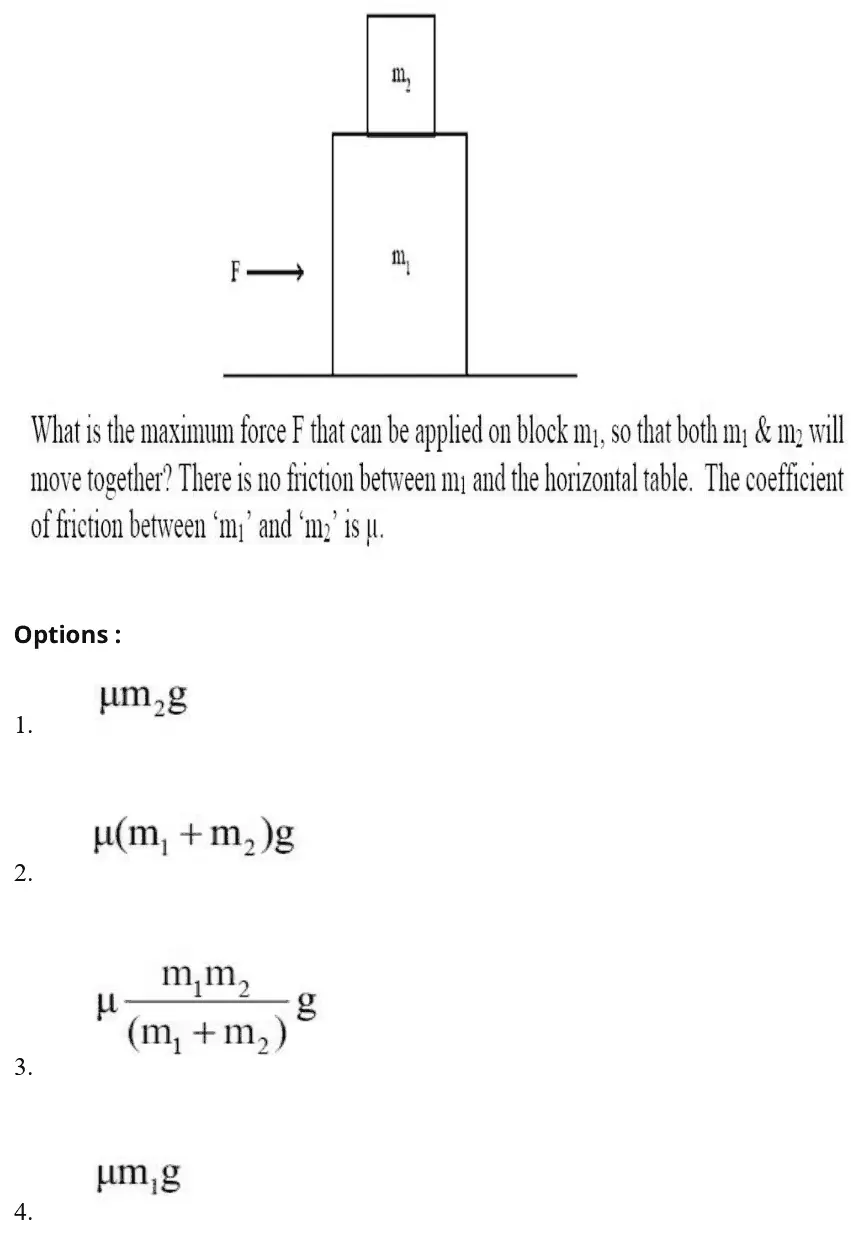
The question and its figure as printed in TS EAMCET 2021 · 4 Aug · Shift 1. Question: What is the maximum force F that can be applied on block m1, so that both m1 & m2 will move together? There is no friction between m1 and the horizontal table. The coefficient of friction between 'm1' and 'm2' is μ.
The question as printed in the paper.
  1. (1)

    $\mu m_2 g$

  2. (2)

    $\mu(m_1+m_2)g$

  3. (3)

    $\mu\frac{m_1 m_2}{(m_1+m_2)}g$

  4. (4)

    $\mu m_1 g$

Show answer

Option (2) is correct.

The council's preliminary key

Step-by-step solution and 298 more like it in EdLoop

The worked solution is in the EdLoop app, free on Android, with every other Laws of Motion question from 2010 to 2026.

More from this chapter

All 299 questions in Laws of Motion ›

Physics Laws of Motion question from TS EAMCET 2021 · 4 Aug · Shift 1 (TS EAPCET exam). This is the paper as TGCHE held it.

All EAPCET Laws of Motion PYQs (299 questions)

Get EdLoop – freeOpen on the web