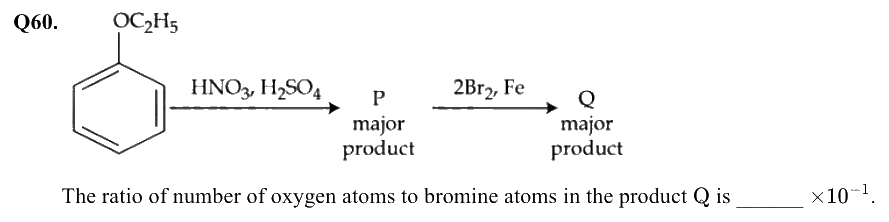
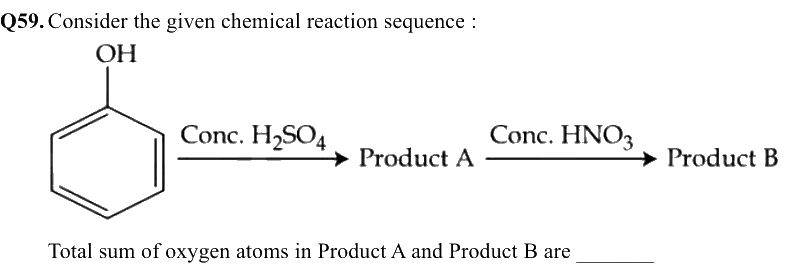
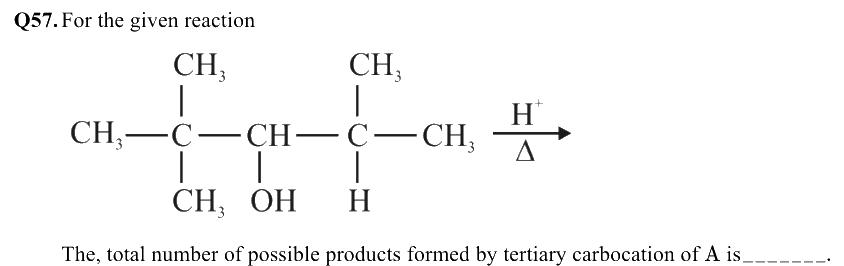
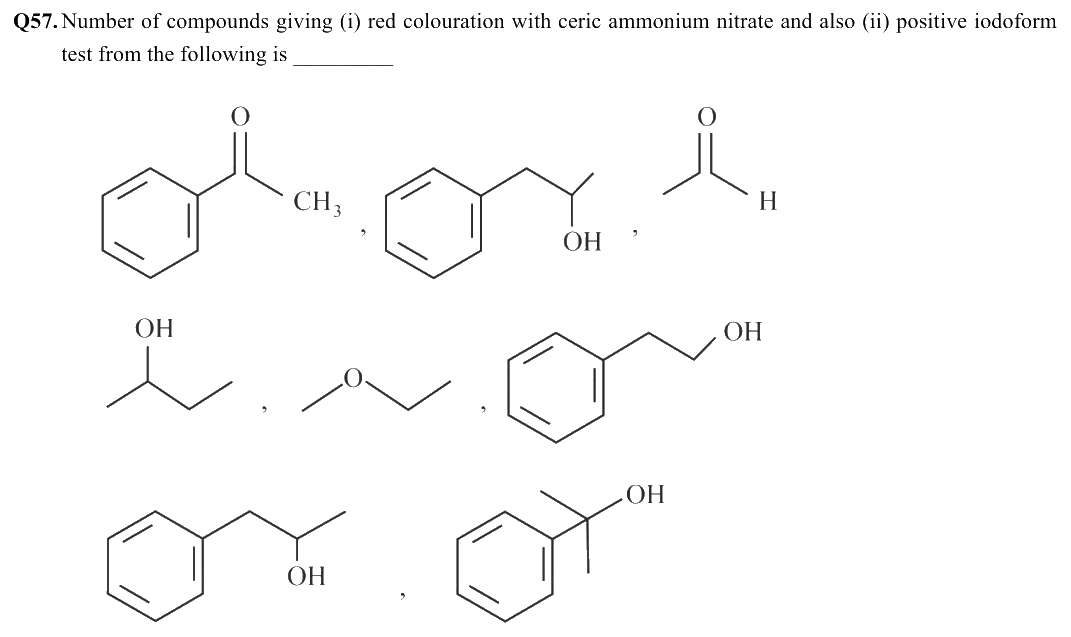
Alcohols, Phenols & Ethers: JEE Main PYQs 2003–2026
Every Alcohols, Phenols & Ethers question from past JEE Main and AIEEE papers, with options and answers. Newest first.
168questions
119papers covered
2.8%of Chemistry questions, 2019–2026
2003–2026years
Guide at a glance
Alcohols, phenols and ethers covers oxygen-containing functional groups under Unit 17: Organic Compounds Containing Oxygen in the Class 12 curriculum, holding rank 18 of 31 chapters with a 2.8% share of the chemistry section.
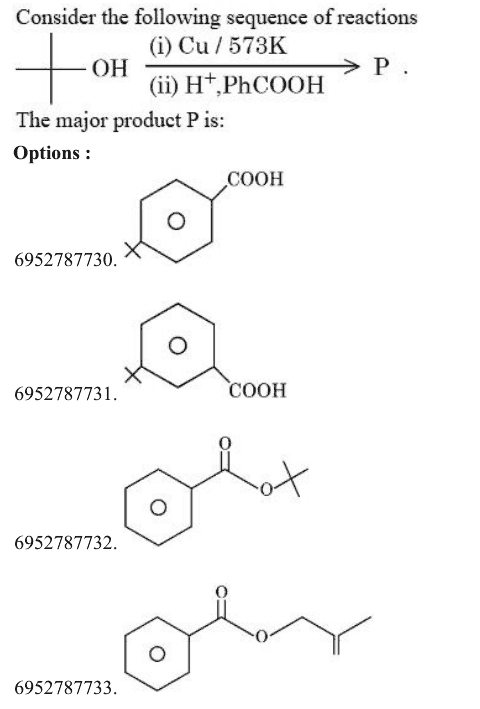
see figure a ring with a COOH group at the upper-right vertex (bond going up-right to 'COOH') and a short-stub carbon drawn as '×' at the lower-left vertex
B
see figure a ring with a COOH group at the lower-right vertex (bond going down-right to 'COOH') and a short-stub carbon drawn as '×' at the lower-left vertex
C
see figure a ring attached to a carbon C=O (O drawn above) which is bonded through 'O' to a short-stub carbon drawn as '×'
D
see figure a ring attached to a carbon C=O (O above) bonded through 'O' to a CH2 and then to a carbon bearing a CH3 and a double bond to a terminal CH2 (drawn as '-O-CH2-C(CH3)=CH2')
For the conversion of B from A, reagent (D) required is ________ and structural formula of product (E) obtained when C undergoes same reaction using excess reagent (D) is ________.
A hydroxy compound (X) with molar mass 122 g mol$^{-1}$ is acetylated with acetic anhydride, using a large excess of the reagent ensuring complete acetylation of all hydroxyl groups. The product obtained has a molar mass of 290 g mol$^{-1}$. The number of hydroxyl groups present in compound (X) is:
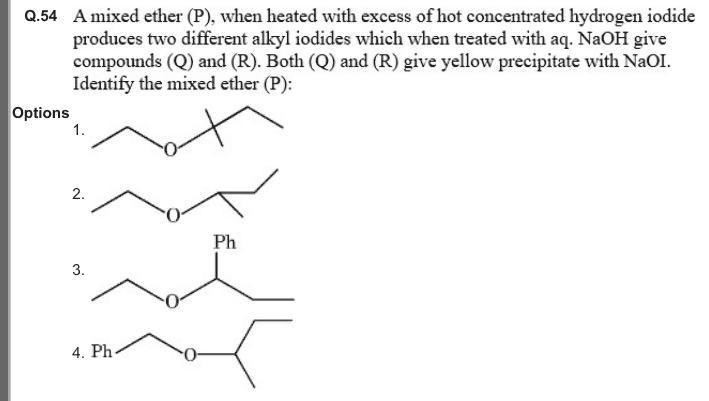
A mixed ether (P), when heated with excess of hot concentrated hydrogen iodide produces two different alkyl iodides which when treated with aq. NaOH give compounds (Q) and (R). Both (Q) and (R) give yellow precipitate with NaOI. Identify the mixed ether (P):
The question as printed in the paper.
A
see figure a zigzag of two bonds (up-right then down-right) from the left ending at 'O'; from O a bond goes up-right to a carbon that has two short plain bonds (one up-left, one down-right) and a bond going up-right then down-right (a two-bond chain).
B
see figure a zigzag of two bonds from the left ending at 'O'; from O a bond goes up-right to a carbon that has a short plain bond down-right and a bond going right then up-right (a two-bond chain).
C
see figure a zigzag of two bonds from the left ending at 'O'; from O a bond goes up-right to a carbon that has 'Ph' on a bond straight up and a bond going down-right then straight right (a two-bond chain).
D
see figure 'Ph' at the left on a zigzag of two bonds (up-right then down-right) ending at 'O'; from O a horizontal bond goes right to a carbon that has a bond up-right then right (a two-bond chain) and a bond down-right.
Statement I: Phenol on treatment with $\mathrm{CHCl_3}$/aq. KOH under refluxing condition, followed by acidification produces $p$-hydroxy benzaldehyde as the major product and $o$-hydroxy benzaldehyde as the minor product.
Statement II: The mixture of $p$-hydroxybenzaldehyde and $o$-hydroxybenzaldehyde can be easily separated through steam distillation.
In the light of the above statements, choose the correct answer from the options given below
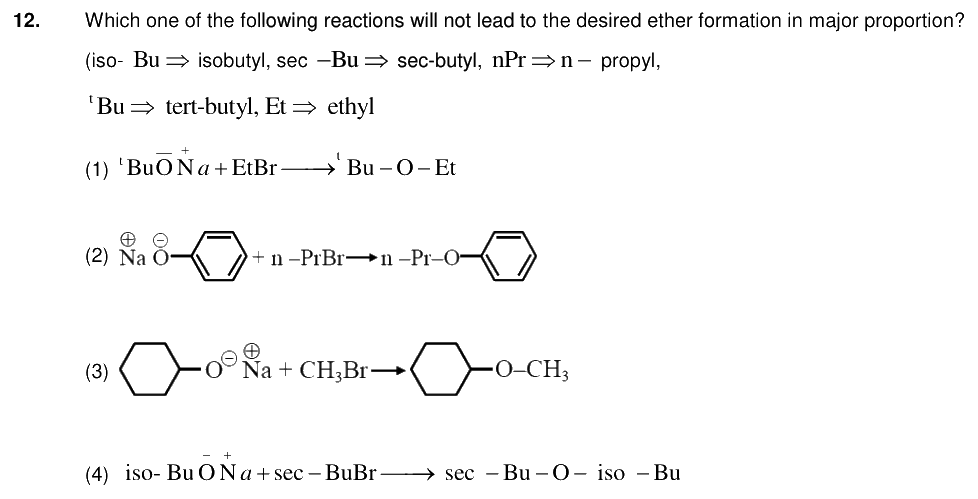
Which one of the following reactions will not lead to the desired ether formation in major proportion?
(iso- Bu $\Rightarrow$ isobutyl, sec $-$Bu $\Rightarrow$ sec-butyl, nPr $\Rightarrow$ n $-$ propyl, $^t$Bu $\Rightarrow$ tert-butyl, Et $\Rightarrow$ ethyl
The question as printed in the paper.
A
$^tBuO^-Na^+ + EtBr \longrightarrow {}^tBu - O - Et$
B
see figure sodium phenoxide (Na with a circled plus, O with a circled minus, attached to a benzene ring) $+$ n-PrBr $\longrightarrow$ n-Pr-O- attached to a benzene ring
C
see figure sodium cyclohexoxide (a cyclohexane ring attached to O with a circled minus and Na with a circled plus) $+ CH_3Br \longrightarrow$ a cyclohexane ring attached to $-O-CH_3$
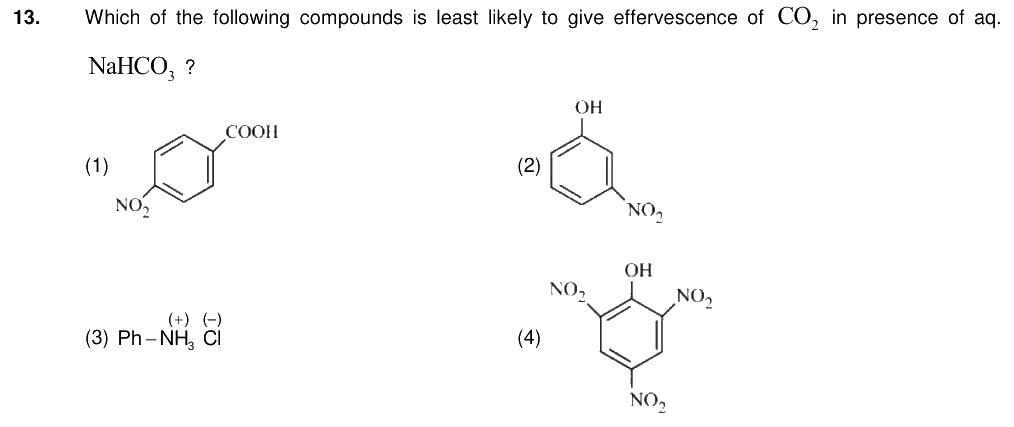
Which of the following compounds is least likely to give effervescence of $CO_2$ in presence of aq. $NaHCO_3$ ?
The question as printed in the paper.
A
see figure a benzene ring (alternating double bonds, no circle) with 'COOH' on the upper-right vertex and 'NO2' on the opposite (lower-left) vertex.
B
see figure a benzene ring (alternating double bonds, no circle) with 'OH' on the top vertex and 'NO2' on the lower-right vertex (meta to the OH).
C
$Ph - \overset{(+)}{N}H_3\ \overset{(-)}{Cl}$
D
see figure a benzene ring (alternating double bonds, no circle) with 'OH' on the top vertex, 'NO2' on the upper-left vertex, 'NO2' on the upper-right vertex and 'NO2' on the bottom vertex.
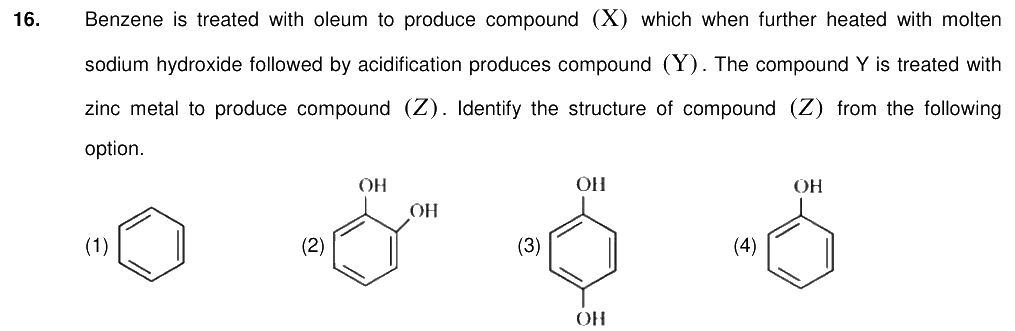
Benzene is treated with oleum to produce compound $(X)$ which when further heated with molten sodium hydroxide followed by acidification produces compound $(Y)$. The compound Y is treated with zinc metal to produce compound $(Z)$. Identify the structure of compound $(Z)$ from the following option.
The question as printed in the paper.
A
see figure a plain benzene ring (alternating double bonds).
B
see figure a benzene ring with 'OH' on the top vertex and a second 'OH' on the upper-right vertex (next to the first).
C
see figure a benzene ring with 'OH' on the top vertex and a second 'OH' on the bottom vertex (opposite).
D
see figure a benzene ring with a single 'OH' on its top vertex.
A toxic compound "A" when reacted with NaCN in aqueous acidic medium yields an edible cooking component and food preservative "B". "B" is converted to "C" by diborane and can be used as an additive to petrol to reduce emission. "C" upon reaction with oleum at $140^\circ C$ yields an inhalable anesthetic "D". Identify "A", "B", "C" & "D", respectively :
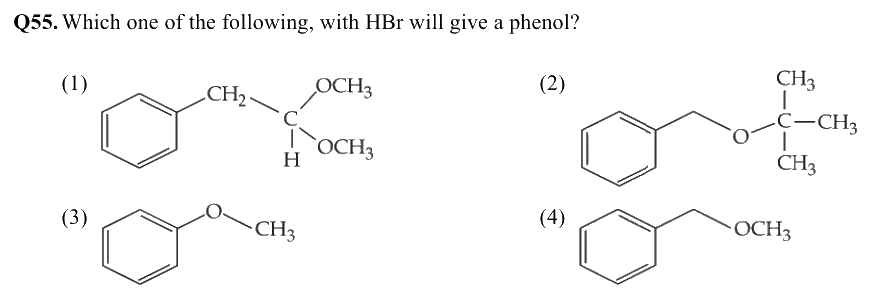
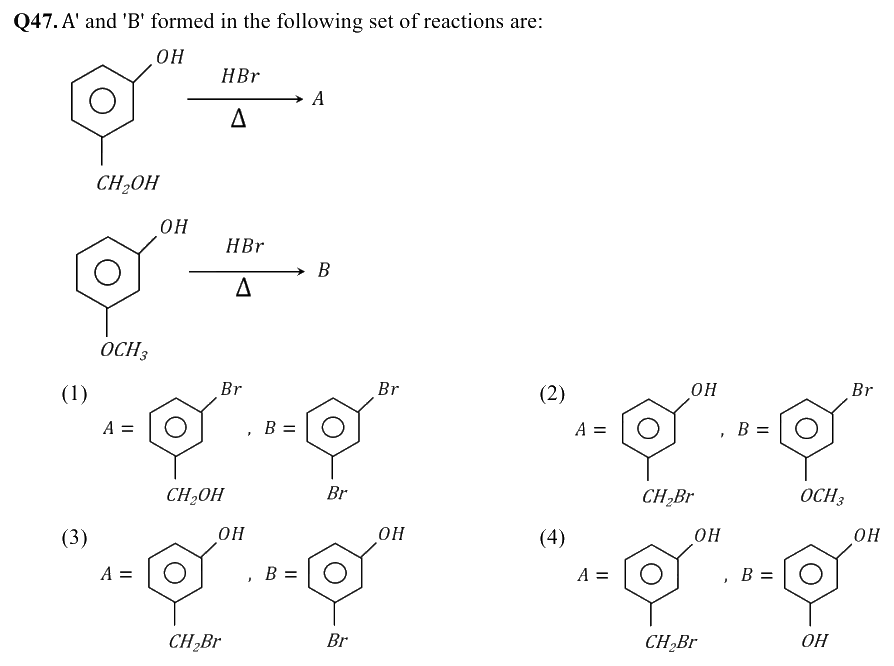
Which one of the following, with HBr will give a phenol?
The question as printed in the paper.
A
see figure a benzene ring with a CH2 on a bond going up-right, joined to a carbon that carries 'OCH3' above-right and 'OCH3' below (with an 'H' under the carbon): ring–CH2–CH(OCH3)(OCH3).
B
see figure a benzene ring with a CH2 going up-right, then an 'O', then a carbon carrying 'CH3' above, '–CH3' to the right and 'CH3' below: ring–CH2–O–C(CH3)3.
C
see figure a benzene ring with an 'O' on a bond going up-right, then 'CH3' on a bond going down-right: ring–O–CH3.
D
see figure a benzene ring with a CH2 going up-right, then 'OCH3' to the right: ring–CH2–OCH3.
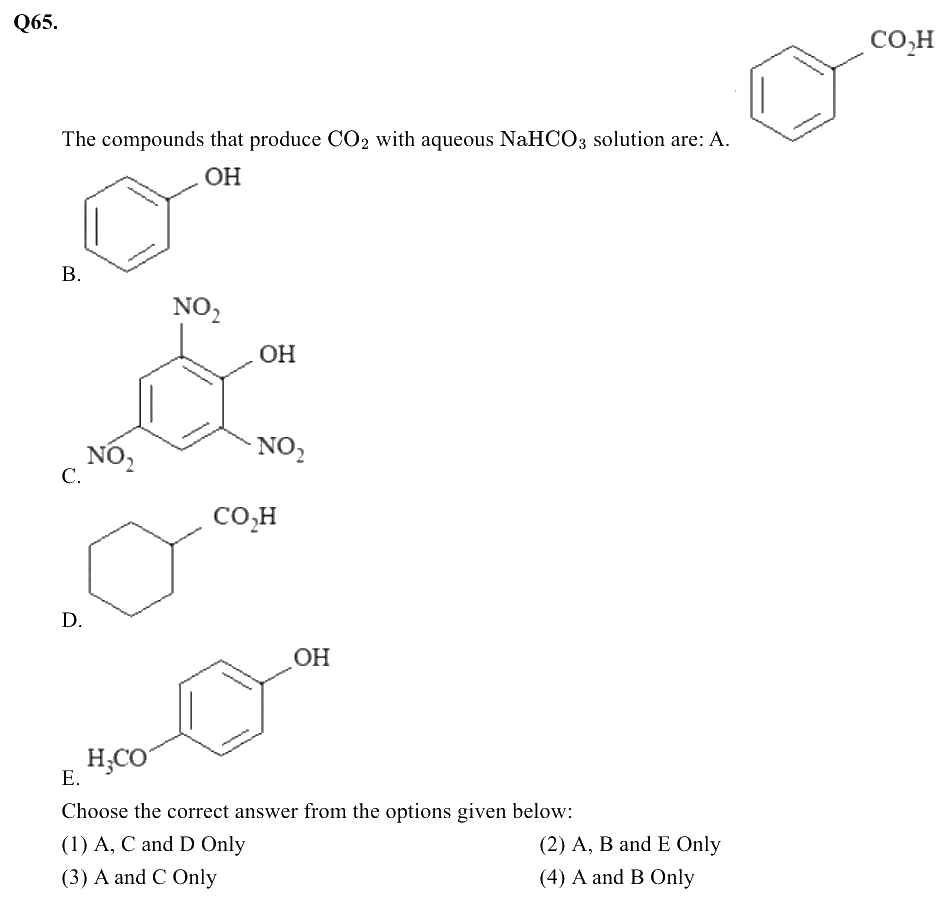
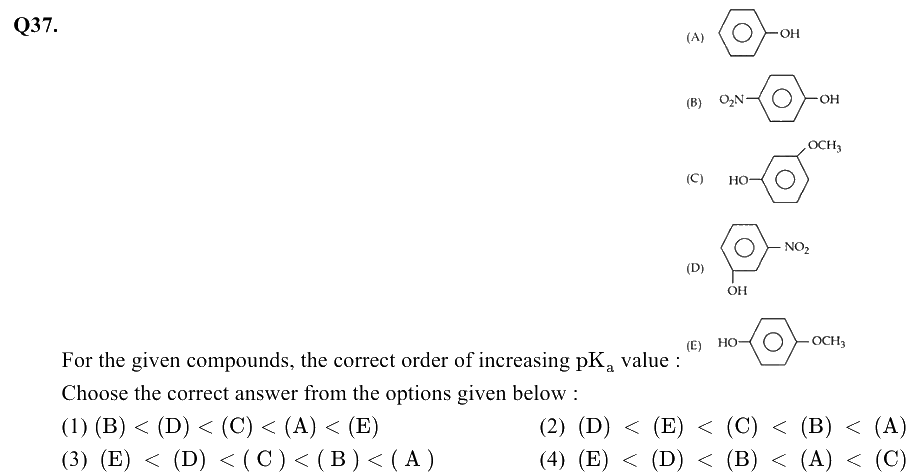
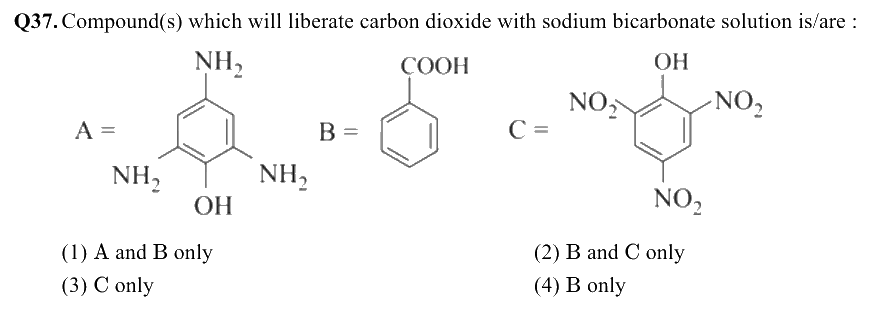
see figure The compounds that produce $\mathrm{CO_2}$ with aqueous $\mathrm{NaHCO_3}$ solution are: A. B. C. D. E. Choose the correct answer from the options given below:
What amount of bromine will be required to convert 2 g of phenol into 2,4,6-tribromophenol? (Given molar mass in $\mathrm{gmol^{-1}}$ of C, H, O, Br are 12, 1, 16, 80 respectively )
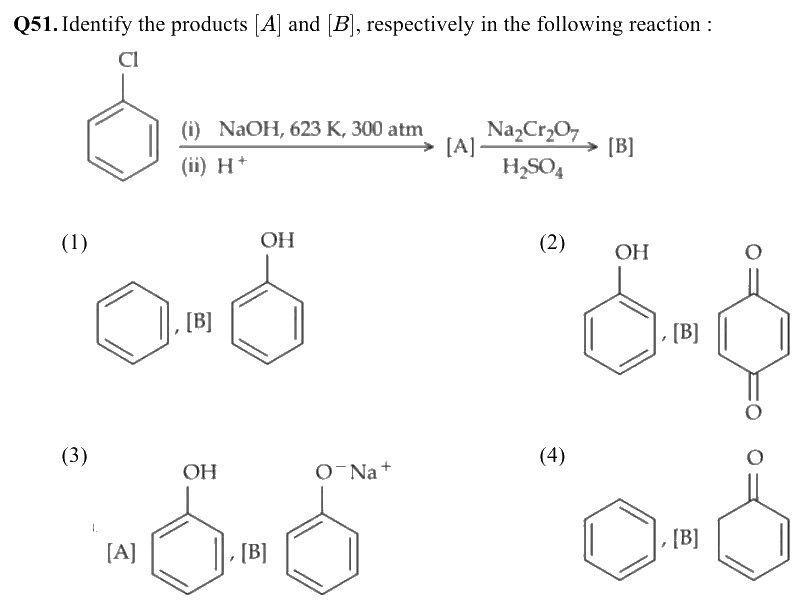
see figure Identify the products $[A]$ and $[B]$, respectively in the following reaction :
The question as printed in the paper.
A
see figure [A]: a benzene ring (alternating double bonds) with no substituent; [B]: a benzene ring with 'OH' on a bond going up.
B
see figure [A]: a benzene ring with 'OH' on a bond going up; [B]: a six-membered ring with two double-bonded 'O' atoms, one at the top and one at the bottom (a para-quinone ring drawn with two C=C bonds on its sides).
C
see figure [A]: a benzene ring with 'OH' on a bond going up; [B]: a benzene ring with 'O⁻ Na⁺' on a bond going up.
D
see figure [A]: a benzene ring with no substituent; [B]: a six-membered ring with a double-bonded 'O' at the top and two C=C bonds in the ring.
Given below are two statements : Statement (I) : The boiling points of alcohols and phenols increase with increase in the number of C-atoms. Statement (II) : The boiling points of alcohols and phenols are higher in comparison to other class of compounds such as ethers, haloalkanes. In the light of the above statements, choose the correct answer from the options given below :
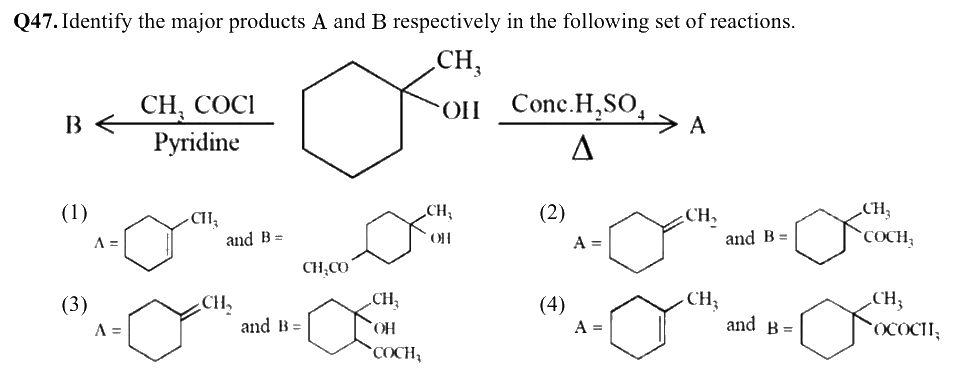
Identify the major products A and B respectively in the following set of reactions.
(see the figure above)
The question as printed in the paper.
A
see figure A = a cyclohexene ring with a CH3 on the double-bond carbon (1-methylcyclohexene) and B = a cyclohexane ring with CH3 and OH on one carbon and a CH3CO group on the carbon opposite (para) to it.
B
see figure A = a cyclohexane ring with an exocyclic double bond to CH2 (methylenecyclohexane) and B = a cyclohexane ring with CH3 and COCH3 on the same carbon.
C
see figure A = methylenecyclohexane (exocyclic =CH2) and B = a cyclohexane ring with CH3 and OH on one carbon and a COCH3 group on the adjacent ring carbon.
D
see figure A = a cyclohexene ring with a CH3 on the double-bond carbon (1-methylcyclohexene) and B = a cyclohexane ring with CH3 and OCOCH3 on the same carbon.
Given below are two statements : Statement I : Piciric acid is 2,4,6 - trinitrotoluene. Statement II : Phenol - 2,4 - disulphonic acid is treated with Conc. $HNO_3$ to get picric acid. In the light of the above statements, choose the most appropriate answer from the options given below :
A
Statement I is incorrect but Statement II is correct
B
Both Statement I and Statement II are incorrect
C
Statement I is correct but Statement II is incorrect
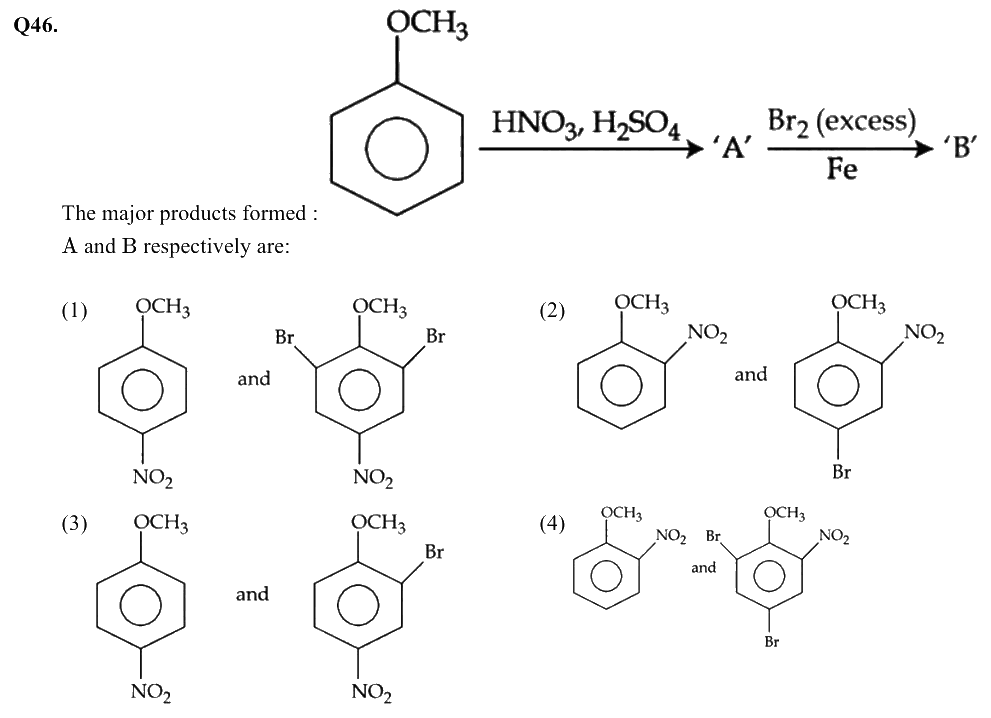
see figure The major products formed :
A and B respectively are:
The question as printed in the paper.
A
see figure two benzene rings (each a hexagon with an inner circle) separated by 'and'. Left: OCH3 at the top and NO2 at the bottom. Right: OCH3 at the top, Br at the upper left, Br at the upper right and NO2 at the bottom.
B
see figure two benzene rings separated by 'and'. Left: OCH3 at the top and NO2 at the upper right. Right: OCH3 at the top, NO2 at the upper right and Br at the bottom.
C
see figure two benzene rings separated by 'and'. Left: OCH3 at the top and NO2 at the bottom. Right: OCH3 at the top, Br at the upper right and NO2 at the bottom.
D
see figure two benzene rings separated by 'and' (drawn smaller). Left: OCH3 at the top and NO2 at the upper right. Right: OCH3 at the top, Br at the upper left, NO2 at the upper right and Br at the bottom.
Given below are two statement: Statements I : Bromination of phenol in solvent with low polarity such as $\mathrm{CHCl_3}$ or $\mathrm{CS_2}$ requires Lewis acid catalyst. Statements II : The Lewis acid catalyst polarises the bromine to generate $\mathrm{Br^+}$. In the light of the above statements, choose the correct answer from the options given below :
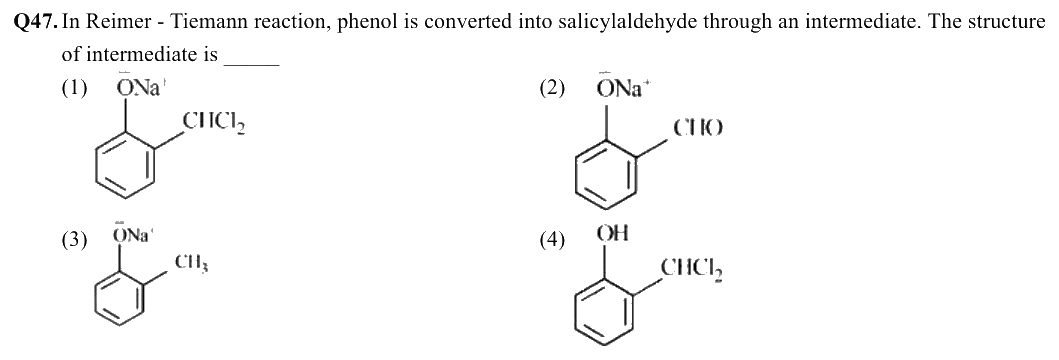
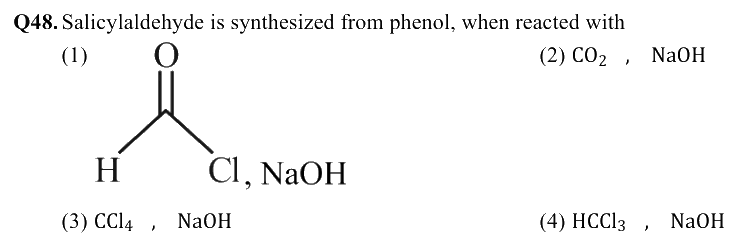
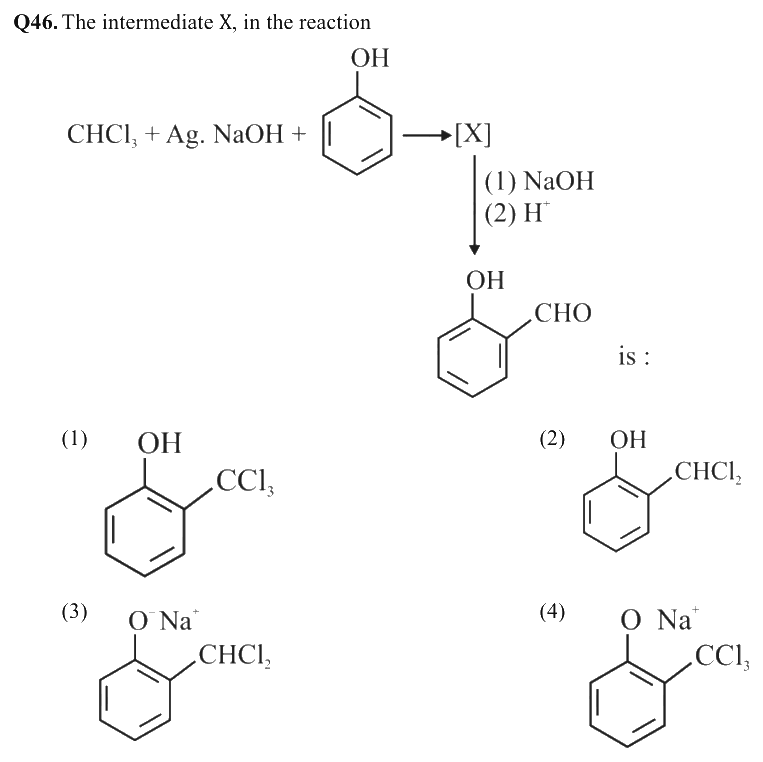
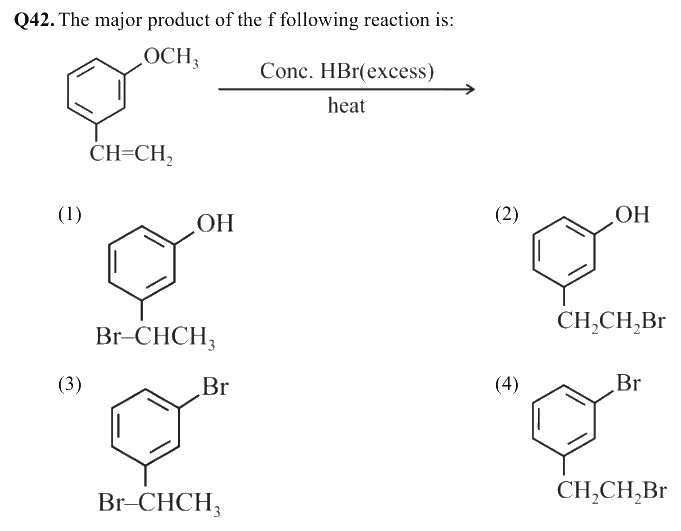
Salicylaldehyde is synthesized from phenol, when reacted with
The question as printed in the paper.
A
see figure Structure drawn with O at the top double-bonded to a central carbon, which carries H at the lower left and Cl at the lower right; followed by ', NaOH' (printed 'Cl, NaOH' on the same line as the Cl).
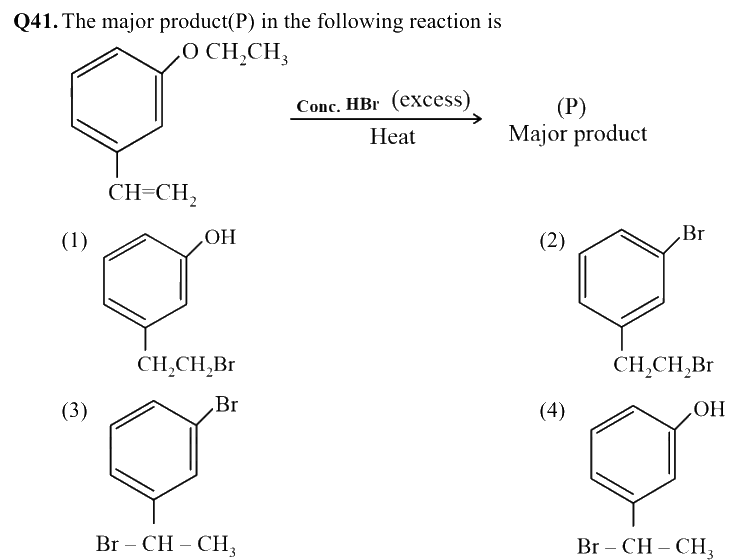
see figure A benzene ring with OH on the upper-right vertex and CH$_2$CH$_2$Br on the bottom vertex (the two substituents are meta to each other).
B
see figure A benzene ring with Br on the upper-right vertex and CH$_2$CH$_2$Br on the bottom vertex (meta).
C
see figure A benzene ring with Br on the upper-right vertex and Br $-$ CH $-$ CH$_3$ on the bottom vertex (meta); the CH carbon is the one bonded to the ring.
D
see figure A benzene ring with OH on the upper-right vertex and Br $-$ CH $-$ CH$_3$ on the bottom vertex (meta); the CH carbon is the one bonded to the ring.
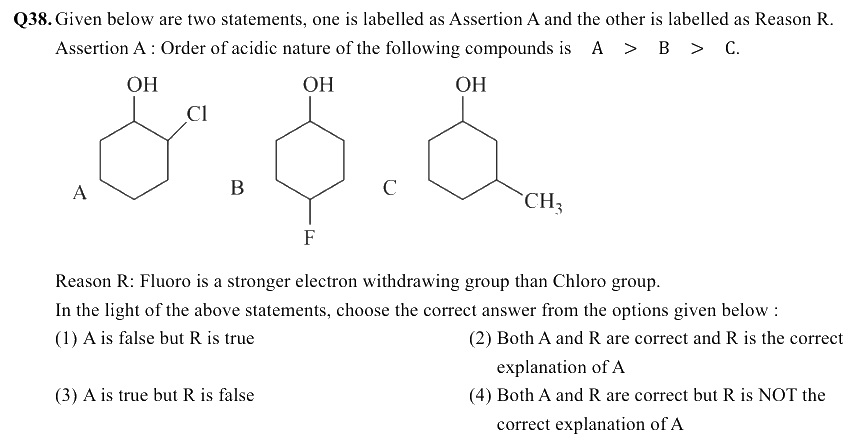
Given below are two statements, one is labelled as Assertion A and the other is labelled as Reason R. Assertion A : Order of acidic nature of the following compounds is A $>$ B $>$ C.
(see the figure above) Reason R: Fluoro is a stronger electron withdrawing group than Chloro group. In the light of the above statements, choose the correct answer from the options given below :
The question as printed in the paper.
A
A is false but R is true
B
Both A and R are correct and R is the correct explanation of A
C
A is true but R is false
D
Both A and R are correct but R is NOT the correct explanation of A
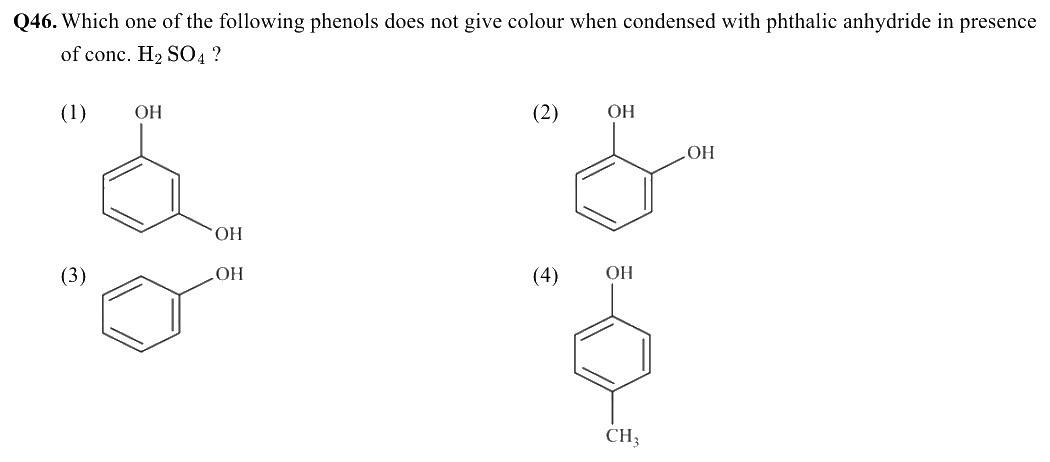
A compound 'X' when treated with phthalic anhydride in presence of concentrated $\mathrm{H_2SO_4}$ yields 'Y'. 'Y' is used as an acid/base indicator. 'X' and 'Y' are respectively
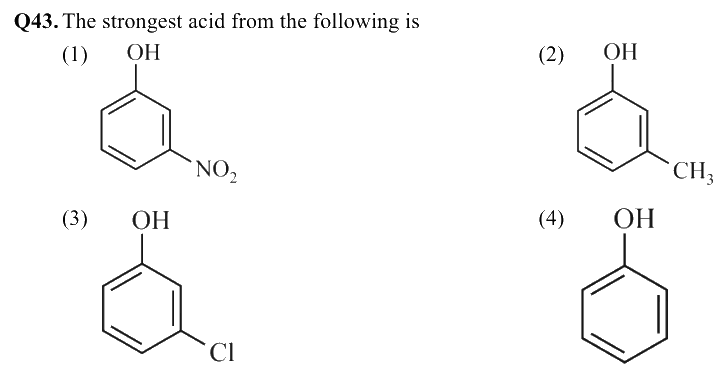
see figure Phenol (benzene ring with OH on the top carbon) with an NO2 group on the lower-right ring carbon (two positions from the OH carbon, i.e. meta).
B
see figure Phenol (benzene ring with OH on the top carbon) with a CH3 group on the lower-right ring carbon (meta to OH).
C
see figure Phenol (benzene ring with OH on the top carbon) with a Cl atom on the lower-right ring carbon (meta to OH).
D
see figure Unsubstituted phenol (benzene ring with OH on the top carbon).
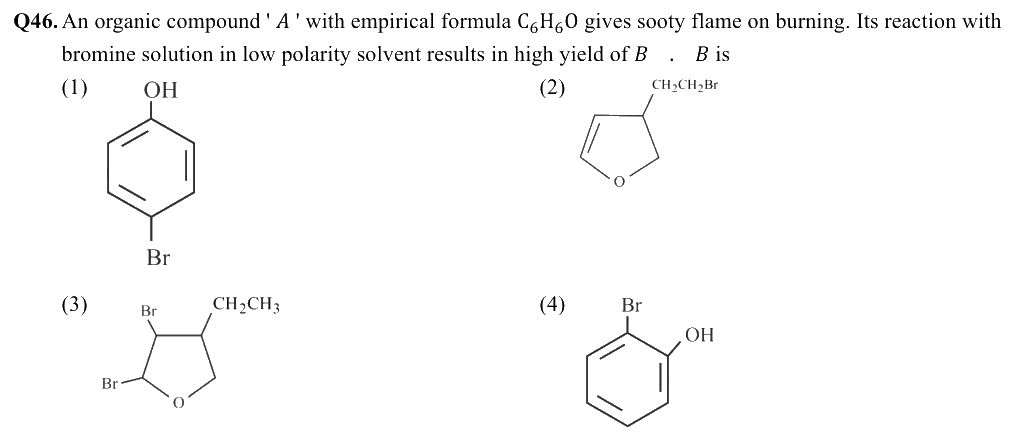
An organic compound ' $A$ ' with empirical formula $\mathrm{C_6H_6O}$ gives sooty flame on burning. Its reaction with bromine solution in low polarity solvent results in high yield of $B$. $B$ is
The question as printed in the paper.
A
see figure benzene ring with OH at the top and Br at the bottom (para).
B
see figure five-membered ring containing O (at the bottom) with one C=C double bond on its left side, and a $\mathrm{CH_2CH_2Br}$ group on the upper right carbon.
C
see figure five-membered ring containing O (at the bottom) with Br on the upper left carbon, Br on the carbon at the left of the O, and a $\mathrm{CH_2CH_3}$ group on the upper right carbon.
D
see figure benzene ring with OH at the upper right and Br at the upper left (adjacent, ortho).
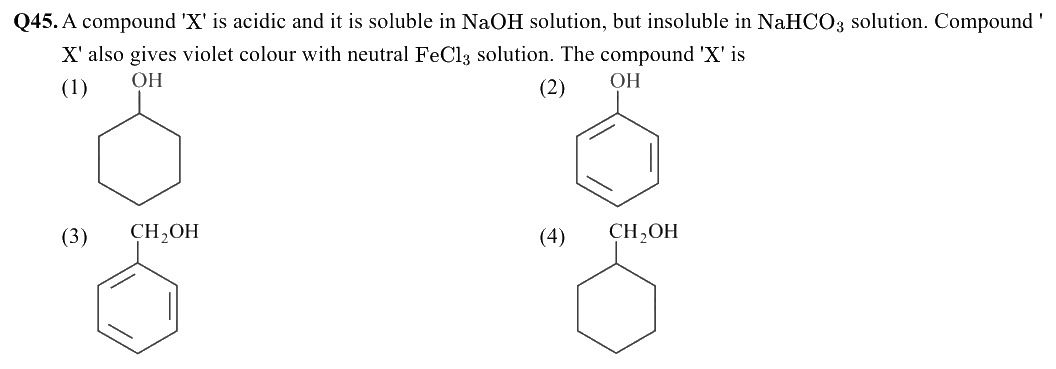
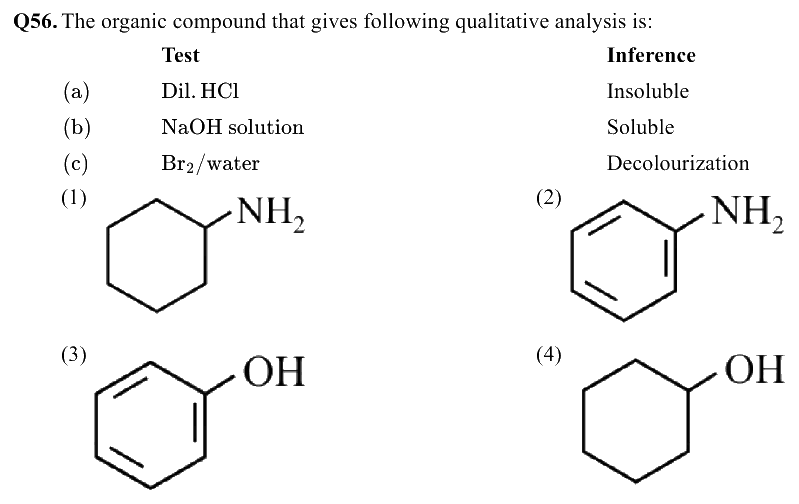
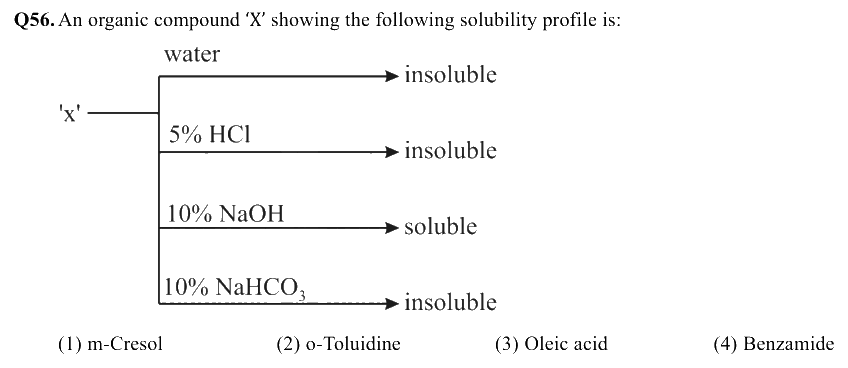
A compound 'X' is acidic and it is soluble in NaOH solution, but insoluble in $\mathrm{NaHCO_3}$ solution. Compound 'X' also gives violet colour with neutral $\mathrm{FeCl_3}$ solution. The compound 'X' is
The question as printed in the paper.
A
see figure cyclohexanol: a cyclohexane ring bearing OH
B
see figure phenol: a benzene ring bearing OH
C
see figure benzyl alcohol: a benzene ring bearing $\mathrm{CH_2OH}$
D
see figure cyclohexylmethanol: a cyclohexane ring bearing $\mathrm{CH_2OH}$
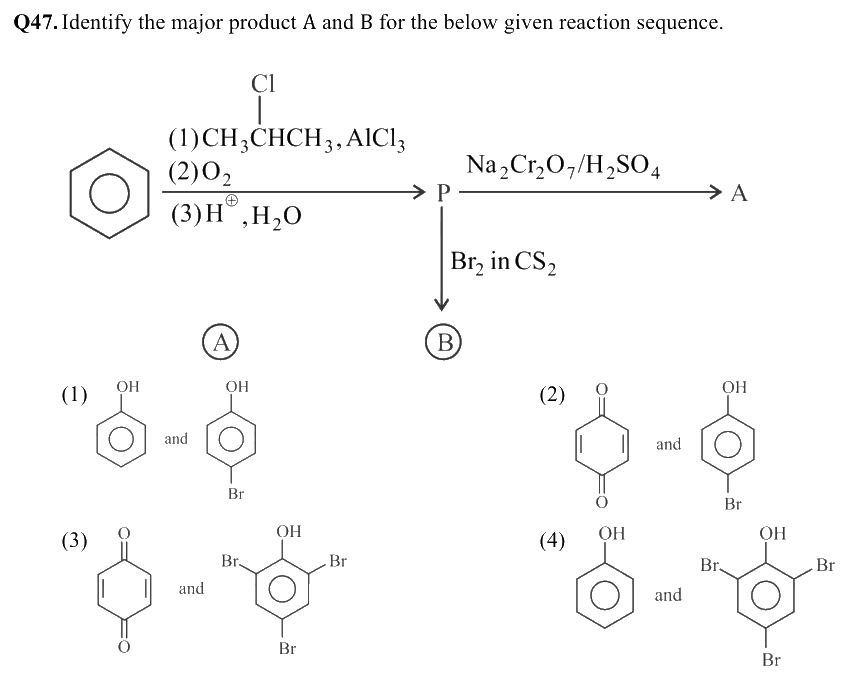
Identify the major product A and B for the below given reaction sequence.
(see the figure above)
The question as printed in the paper.
A
$\mathrm{A=}$ (see the figure above) phenol (benzene ring with OH), $\mathrm{B=}$ (see the figure above) 4-bromophenol (benzene ring with OH and Br on opposite carbons)
B
$\mathrm{A=}$ (see the figure above) para-benzoquinone (six-membered ring with two C=O on opposite carbons), $\mathrm{B=}$ (see the figure above) 4-bromophenol (benzene ring with OH and Br on opposite carbons)
C
$\mathrm{A=}$ (see the figure above) para-benzoquinone (six-membered ring with two C=O on opposite carbons), $\mathrm{B=}$ (see the figure above) 2,4,6-tribromophenol (benzene ring with OH and three Br at the two ortho and the para positions)
D
$\mathrm{A=}$ (see the figure above) phenol (benzene ring with OH), $\mathrm{B=}$ (see the figure above) 2,4,6-tribromophenol (benzene ring with OH and three Br at the two ortho and the para positions)
Answer: (B) $\mathrm{A=}$ (see the figure above) para-benzoquinone (six-membered ring with two C=O on opposite carbons), $\mathrm{B=}$ (see the figure above) 4-bromophenol (benzene ring with OH and Br on opposite carbons)· Key from source paper
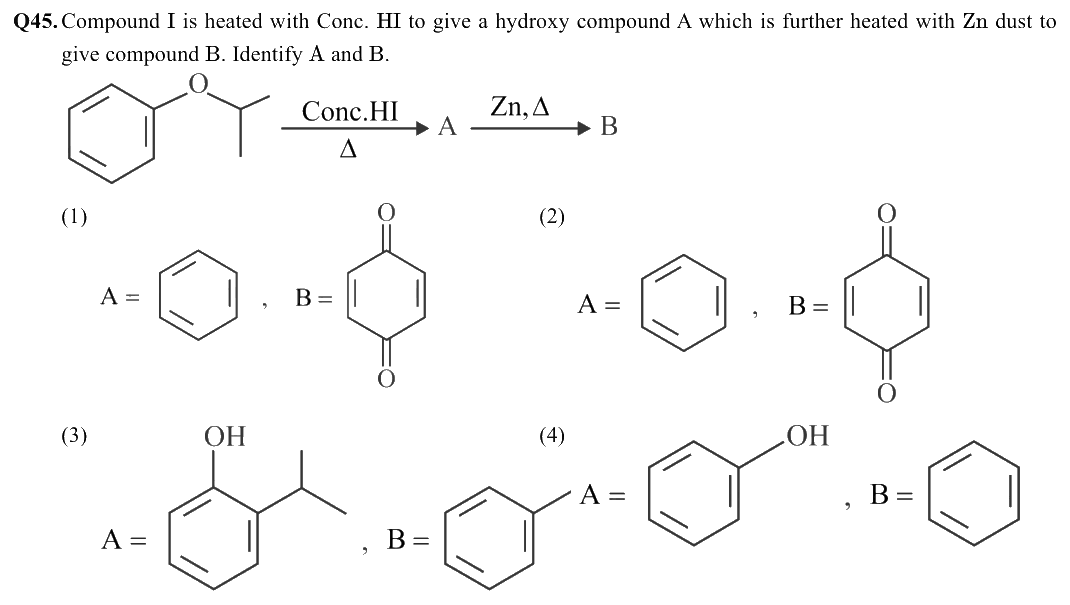
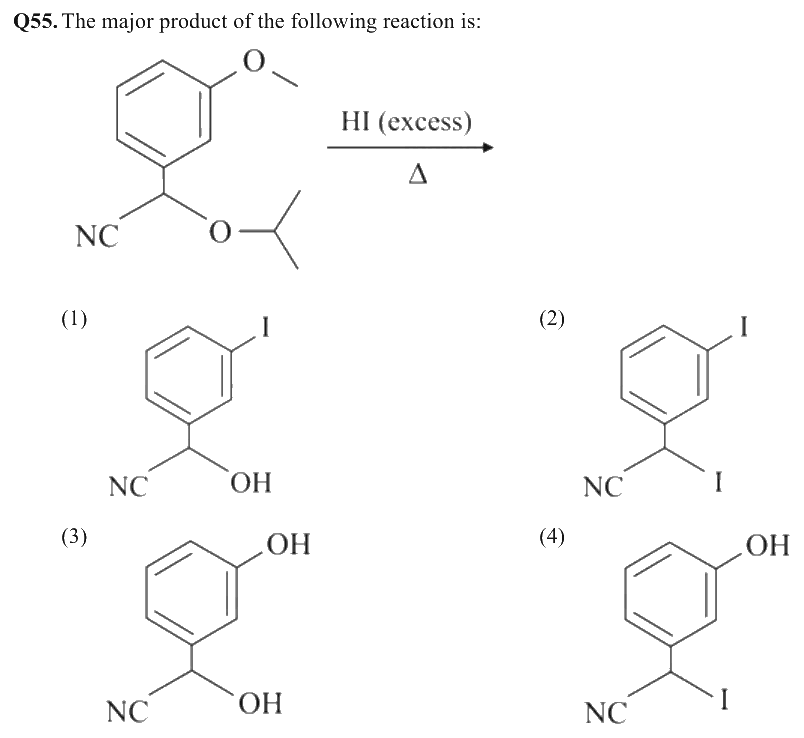
Compound I is heated with Conc. HI to give a hydroxy compound A which is further heated with Zn dust to give compound B. Identify A and B.
(see the figure above)
The question as printed in the paper.
A
$\mathrm{A=}$ (see the figure above) benzene ring, $\mathrm{B=}$ (see the figure above) para-benzoquinone (six-membered ring with two C=O at opposite positions, two C=C)
B
$\mathrm{A=}$ (see the figure above) benzene ring, $\mathrm{B=}$ (see the figure above) para-benzoquinone (six-membered ring with two C=O at opposite positions, two C=C)
C
$\mathrm{A=}$ (see the figure above) benzene ring with OH and an isopropyl group on neighbouring ring carbons, $\mathrm{B=}$ (see the figure above) benzene ring with one methyl group (toluene)
D
$\mathrm{A=}$ (see the figure above) phenol (benzene ring with OH), $\mathrm{B=}$ (see the figure above) benzene ring
Answer: (D) $\mathrm{A=}$ (see the figure above) phenol (benzene ring with OH), $\mathrm{B=}$ (see the figure above) benzene ring· Key from source paper
Given below are two statements : Statement I : On heating with $\mathrm{KHSO_4}$, glycerol is dehydrated and acrolein is formed. Statement II : Acrolein has fruity odour and can be used to test glycerol's presence. Choose the correct option.
A
Both Statement I and Statement II are correct.
B
Both Statement I and Statement II are incorrect
C
Statement I is correct but Statement II is incorrect
D
Statement I is incorrect but Statement II is correct
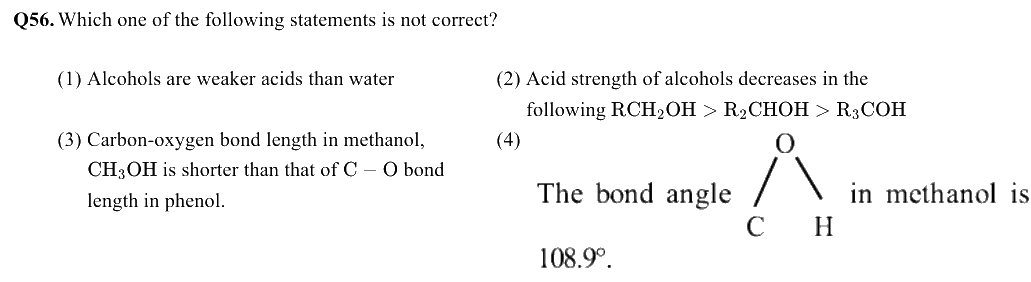
Given below are two statements. Statement I : Phenols are weakly acidic. Statement II : Therefore they are freely soluble in NaOH solution and are weaker acids than alcohols and water. Choose the most appropriate option
A
Both Statement I and Statement II are correct.
B
Statement I is correct but Statement II is incorrect.
C
Statement I is incorrect but Statement II is correct.
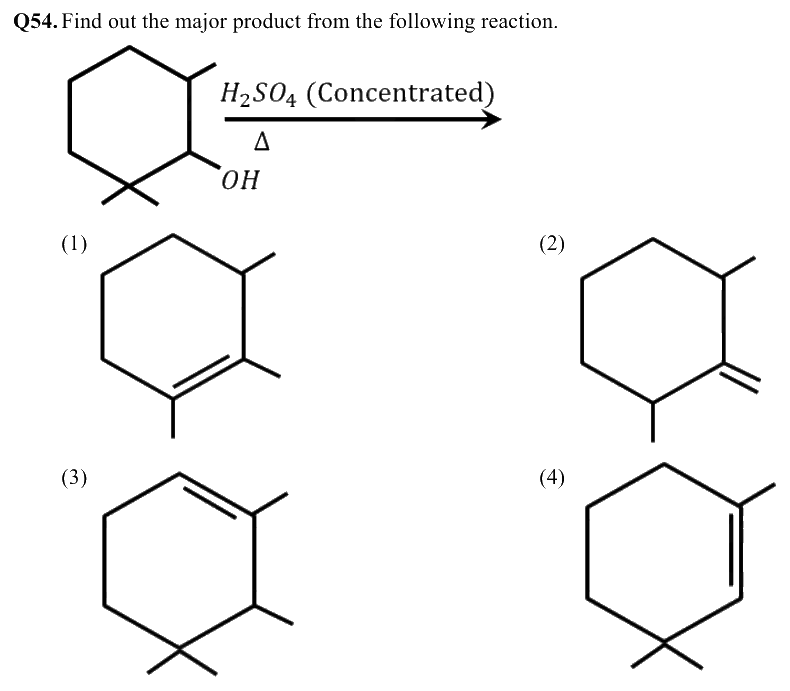
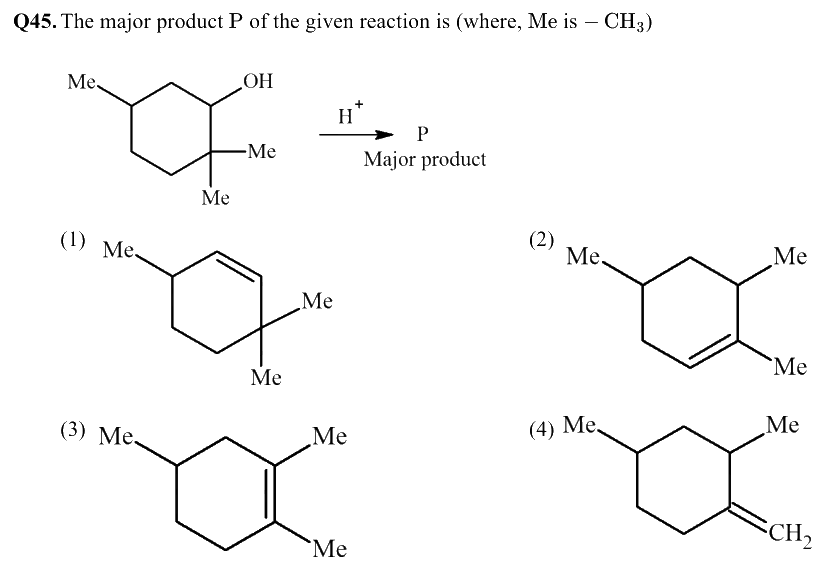
The major product P of the given reaction is (where, Me is $-\ \mathrm{CH_3}$) (see the figure above)
The question as printed in the paper.
A
see figure A six-membered ring with a double bond, Me on the carbon at the upper left, and two Me groups (gem-dimethyl) on the carbon at the lower right next to the double bond.
B
see figure A six-membered ring with Me at the upper left, and a double bond at the lower right between two carbons each carrying a Me (one Me drawn upward, one downward).
C
see figure A six-membered ring with Me at the upper left, and a double bond on the right-hand side between two carbons each carrying a Me (one Me drawn upward, one downward); drawn as a vertical double bond.
D
see figure A six-membered ring with Me at the upper left, Me on the carbon at the upper right, and an exocyclic =CH2 on the carbon at the lower right.
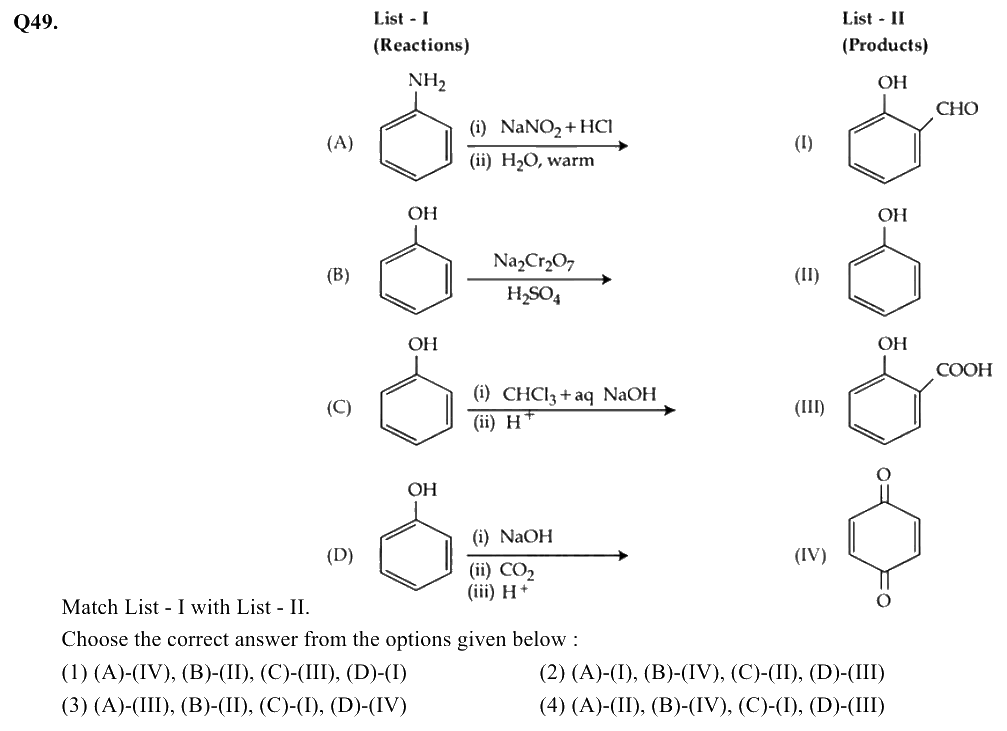
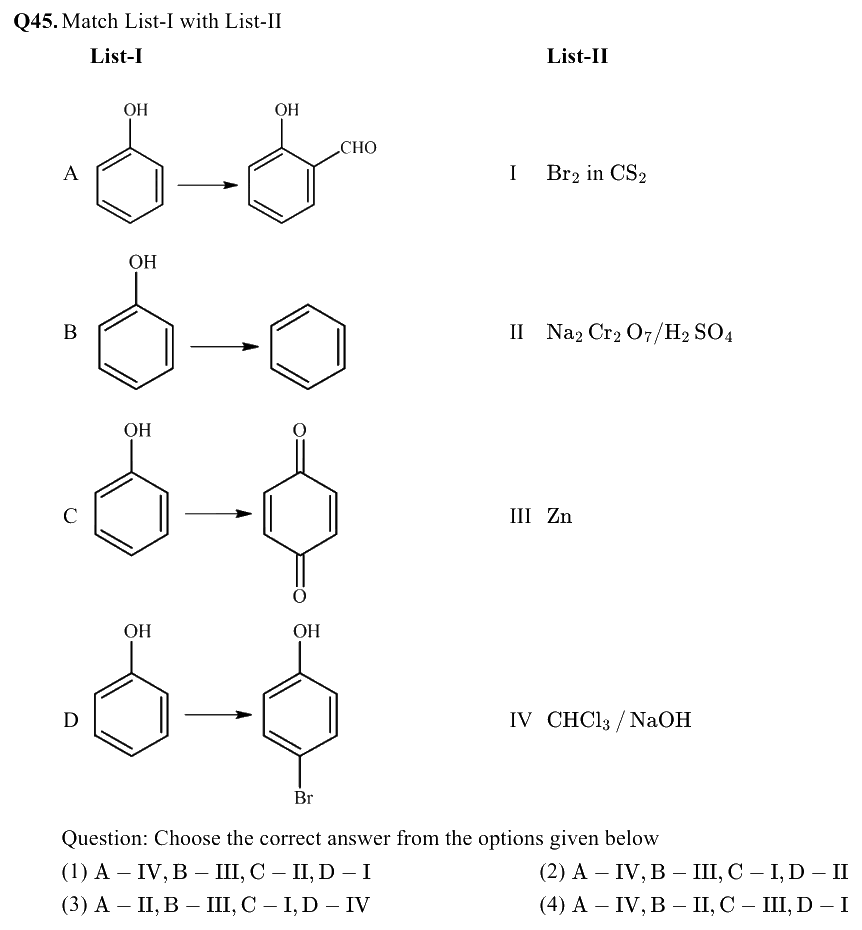
Match List-I with List-II List-I A (see the figure above) B (see the figure above) C (see the figure above) D (see the figure above) List-II I $\mathrm{Br_2}$ in $\mathrm{CS_2}$ II $\mathrm{Na_2Cr_2O_7/H_2SO_4}$ III Zn IV $\mathrm{CHCl_3 / NaOH}$ Question: Choose the correct answer from the options given below
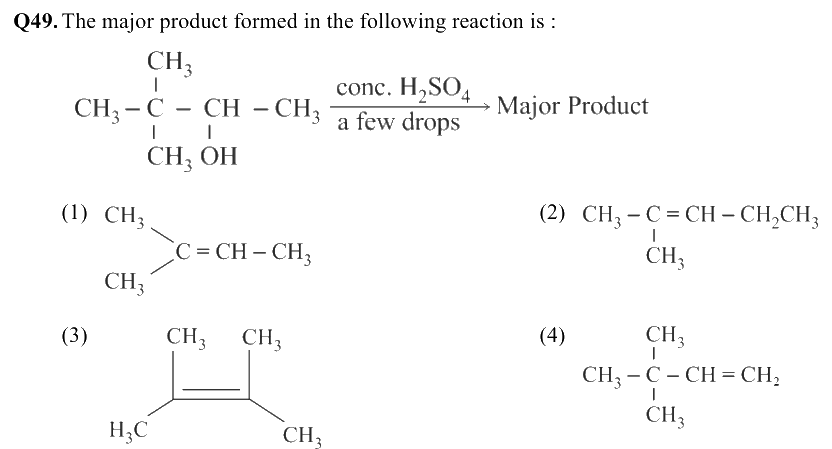
The major product formed in the following reaction is : (see the figure above)
The question as printed in the paper.
A
see figure skeletal formula: a carbon carrying two CH3 groups (one drawn at the upper left, one at the lower left) double-bonded to CH-CH3 on the right, i.e. $\mathrm{(CH_3)_2C{=}CH-CH_3}$.
B
$\mathrm{CH_3-C(CH_3){=}CH-CH_2CH_3}$ (the CH3 branch hangs below the second carbon)
C
see figure skeletal formula: a C=C double bond with CH3 groups on each of its two carbons at the top and two further methyl groups (H3C and CH3) on the lower side, i.e. a tetra-substituted alkene with four methyl groups.
D
$\mathrm{CH_3-C(CH_3)(CH_3)-CH{=}CH_2}$ (the carbon bearing three CH3 groups, with the CH3 above and below it, joined to $\mathrm{CH{=}CH_2}$)
Given below are two statements : one is labelled as Assertion (A) and the other is labelled as Reason (R). Assertion (A) : Synthesis of ethyl phenyl ether may be achieved by Williamson synthesis. Reason (R): Reaction of bromobenzene with sodium ethoxide yields ethyl phenyl ether. In the light of the above statements, choose the most appropriate answer from the options given below.
A
Both (A) and (R) are correct but (R) is NOT the correct explanation of (A)
B
(A) is correct but (R) is not correct
C
(A) is not correct but (R) is correct
D
Both (A) and (R) are correct and (R) is the correct explanation of (A)
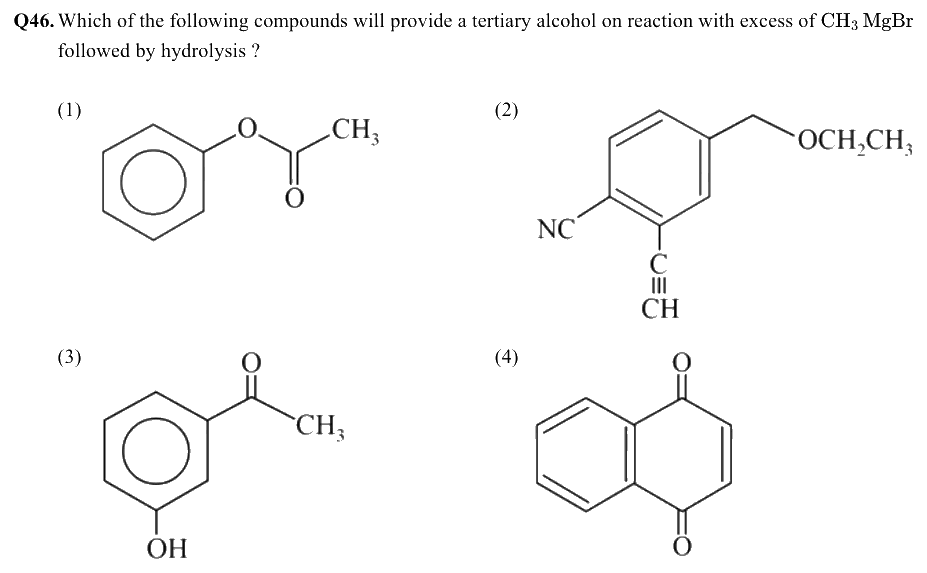
Given below are two statements : Statement I : Ethyl pent-4-yn-oate on reaction with $\mathrm{CH_3\,MgBr}$ gives a $3^\circ$-alcohol. Statement II : In this reaction one mole of ethyl pent-4-yn-oate utilizes two moles of $\mathrm{CH_3\,MgBr}$. In the light of the above statements, choose the most appropriate answer from the options given below :
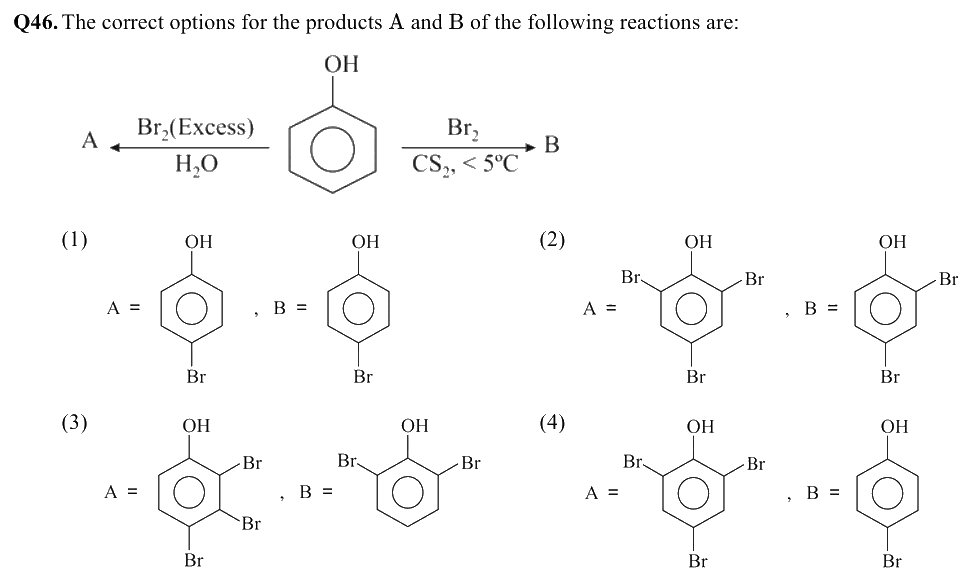
The correct options for the products A and B of the following reactions are: (see the figure above)
The question as printed in the paper.
A
A = (see the figure above) phenol with Br at the para position (4-bromophenol), B = (see the figure above) phenol with Br at the para position (4-bromophenol)
B
A = (see the figure above) phenol with Br at both ortho positions and at the para position (2,4,6-tribromophenol), B = (see the figure above) phenol with Br at one ortho position and at the para position (2,4-dibromophenol)
C
A = (see the figure above) phenol with Br at one ortho position, at the neighbouring meta position and at the para position (2,3,4-tribromophenol as drawn), B = (see the figure above) phenol with Br at both ortho positions (2,6-dibromophenol)
D
A = (see the figure above) phenol with Br at both ortho positions and at the para position (2,4,6-tribromophenol), B = (see the figure above) phenol with Br at the para position (4-bromophenol)
Answer: (D) A = (see the figure above) phenol with Br at both ortho positions and at the para position (2,4,6-tribromophenol), B = (see the figure above) phenol with Br at the para position (4-bromophenol)· Key from source paper
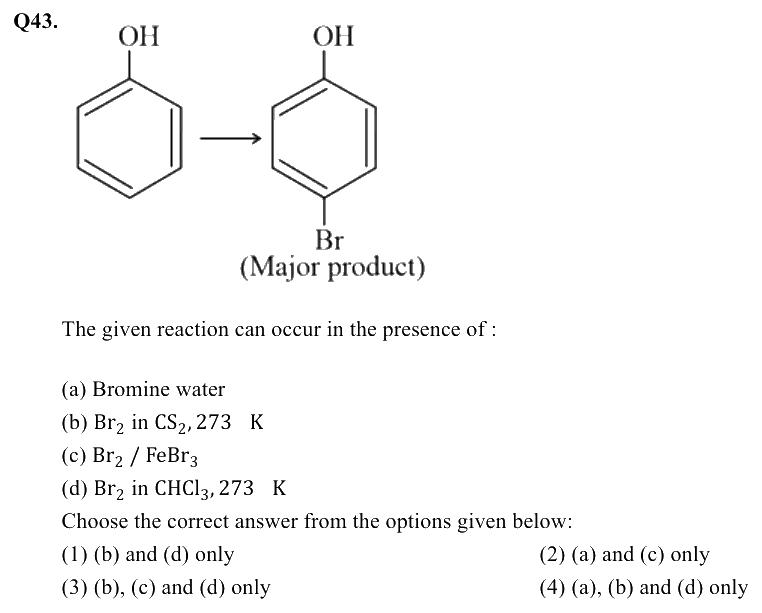
see figure The given reaction can occur in the presence of : (a) Bromine water (b) $\mathrm{Br_2}$ in $\mathrm{CS_2}$, $273\ \mathrm{K}$ (c) $\mathrm{Br_2}$ / $\mathrm{FeBr_3}$ (d) $\mathrm{Br_2}$ in $\mathrm{CHCl_3}$, $273\ \mathrm{K}$ Choose the correct answer from the options given below:
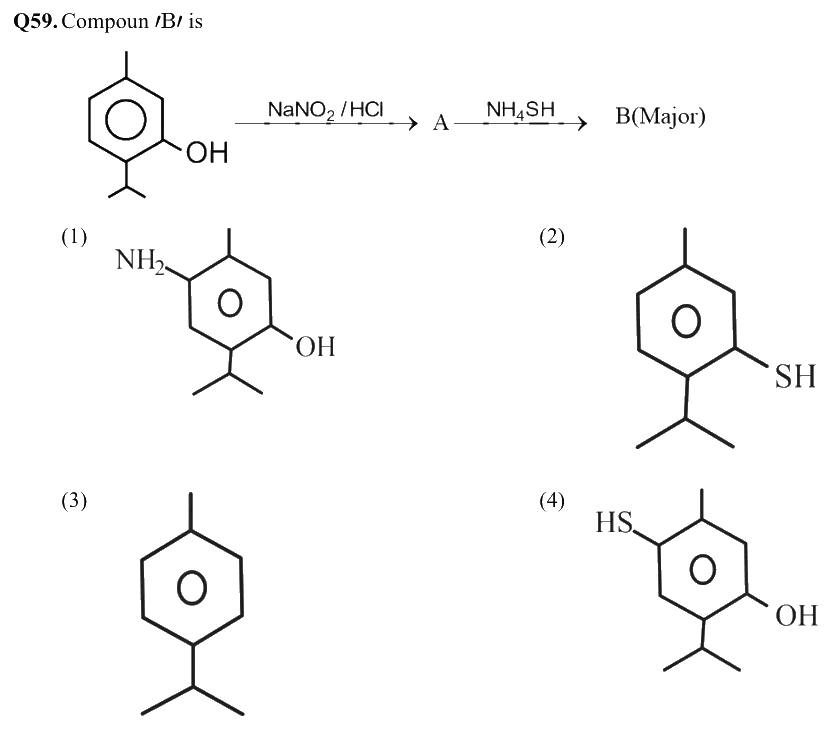
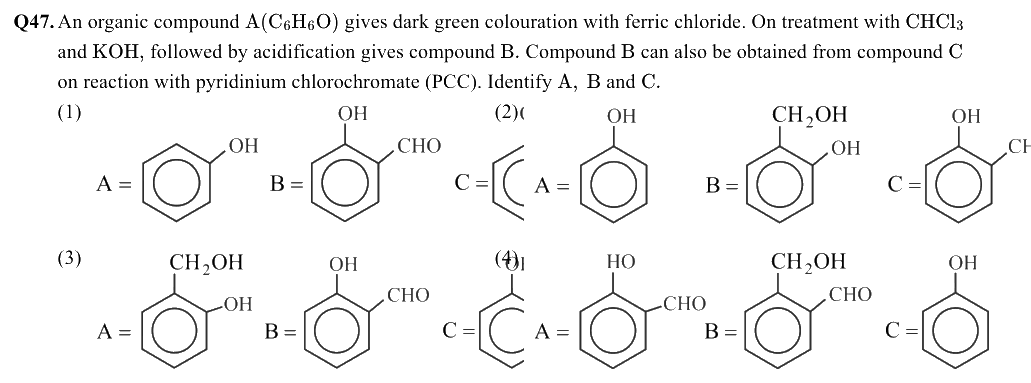
An organic compound A($\mathrm{C_6H_6O}$) gives dark green colouration with ferric chloride. On treatment with $\mathrm{CHCl_3}$ and KOH, followed by acidification gives compound B. Compound B can also be obtained from compound C on reaction with pyridinium chlorochromate (PCC). Identify A, B and C.
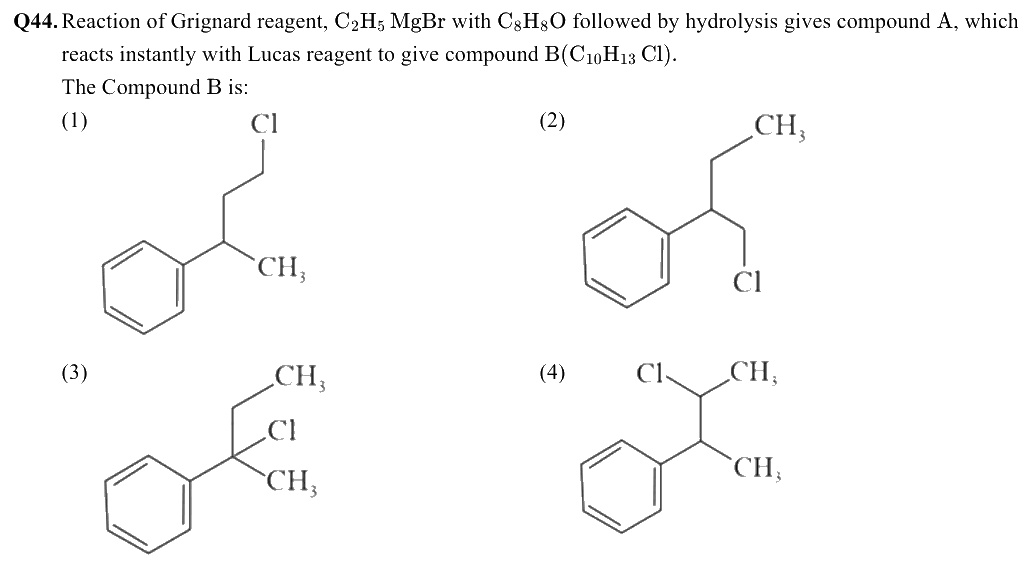
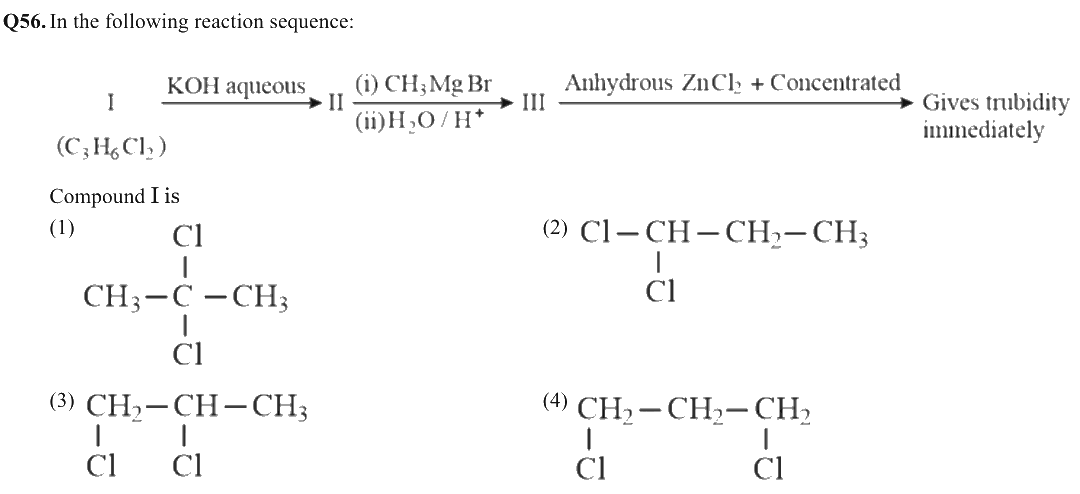
Reaction of Grignard reagent, $\mathrm{C_2H_5\,MgBr}$ with $\mathrm{C_8H_8O}$ followed by hydrolysis gives compound A, which reacts instantly with Lucas reagent to give compound $\mathrm{B(C_{10}H_{13}\,Cl)}$. The Compound B is:
The question as printed in the paper.
A
see figure Benzene ring bonded to a CH carbon that bears a CH3 group (below) and a chain of two CH2 groups ending in Cl (Ph-CH(CH3)-CH2-CH2-Cl).
B
see figure Benzene ring bonded to a CH carbon that carries an ethyl group (going up, ending in CH3) and a CH2-Cl group (going down) (Ph-CH(CH2CH3)-CH2Cl).
C
see figure Benzene ring bonded to a carbon bearing Cl, a CH3 group (below) and an ethyl chain going up-right, ending in CH3 (Ph-C(Cl)(CH3)-CH2CH3).
D
see figure Benzene ring bonded to a CH carbon that bears a CH3 group (below) and, on the next carbon, Cl (up-left) and CH3 (up-right) (Ph-CH(CH3)-CH(Cl)-CH3).
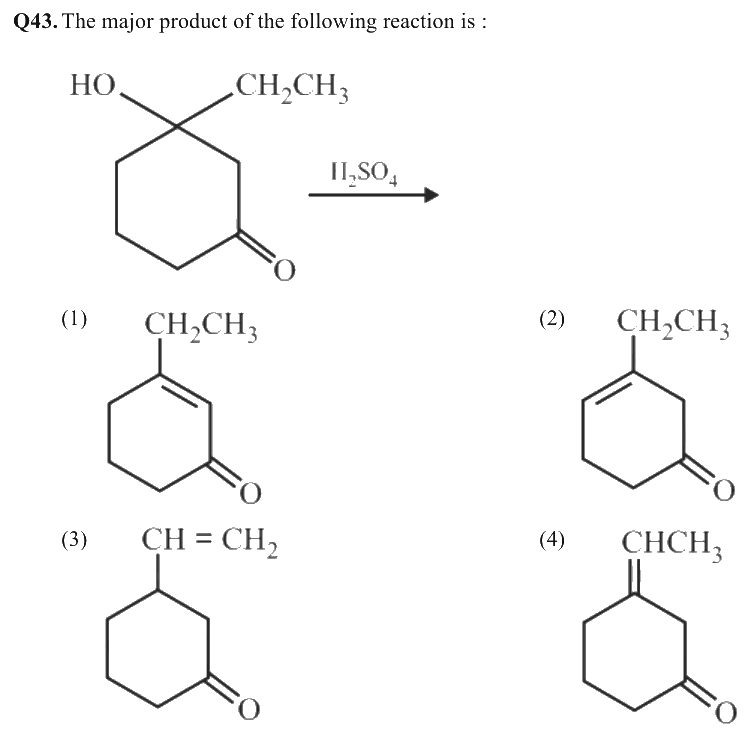
The major product of the following reaction is : (see the figure above)
The question as printed in the paper.
A
see figure cyclohexenone: CH2CH3 on a ring carbon that has a C=C to the neighbouring ring carbon on the side nearer the C=O; the C=O is on the ring carbon next to that alkene carbon (conjugated enone).
B
see figure cyclohexenone: CH2CH3 on a ring carbon that has a C=C to the neighbouring ring carbon on the side away from the C=O; one CH2 lies between the C=C and the C=O.
C
see figure cyclohexanone with a CH=CH2 substituent at the 3-position.
D
see figure cyclohexanone with a =CHCH3 (ethylidene) at the 3-position.
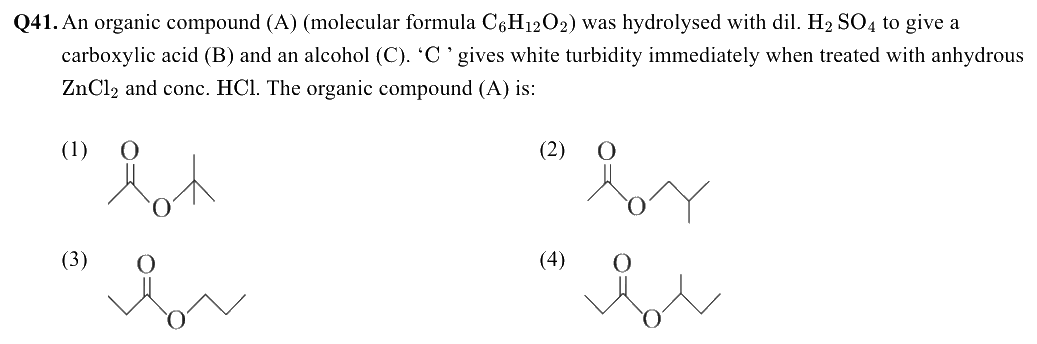
An organic compound (A) (molecular formula $\mathrm{C_{6}H_{12}O_{2}}$) was hydrolysed with dil. $\mathrm{H_{2}\ SO_{4}}$ to give a carboxylic acid (B) and an alcohol (C). 'C ' gives white turbidity immediately when treated with anhydrous $\mathrm{ZnCl_{2}}$ and conc. HCl. The organic compound (A) is: (see the figure above)
The question as printed in the paper.
A
see figure ester drawn with a C=O carbon bearing one single bond (to CH3) and O bonded to a carbon carrying three single bonds (tert-butyl)
B
see figure ester drawn with a C=O carbon bearing one single bond (CH3) and O-CH2-CH(CH3)-CH3 (isobutyl-type chain)
C
see figure ester drawn with a C=O carbon bearing a two-bond chain (ethyl) and O-CH2-CH2-CH3 (three-bond chain from O)
D
see figure ester drawn with a C=O carbon bearing a two-bond chain (ethyl) and O-CH(CH3)-CH2-CH3 (a branched four-carbon group on O)
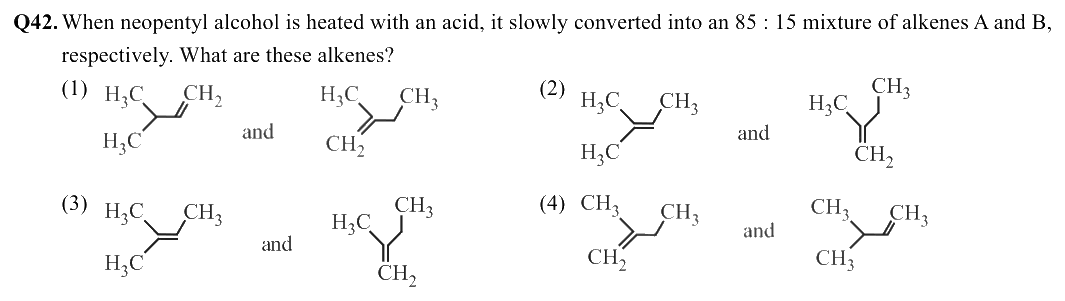
When neopentyl alcohol is heated with an acid, it slowly converted into an 85 : 15 mixture of alkenes A and B, respectively. What are these alkenes? (see the figure above)
The question as printed in the paper.
A
see figure (CH3)2C=CH2 and CH2=C(CH3)-CH2CH3
B
see figure (CH3)2C=CH-CH3 and CH2=C(CH3)-CH2CH3
C
see figure (CH3)2C=CH-CH3 and CH2=C(CH3)-CH2CH3
D
see figure CH2=C(CH3)-CH2CH3 and (CH3)2C=CH3 as printed
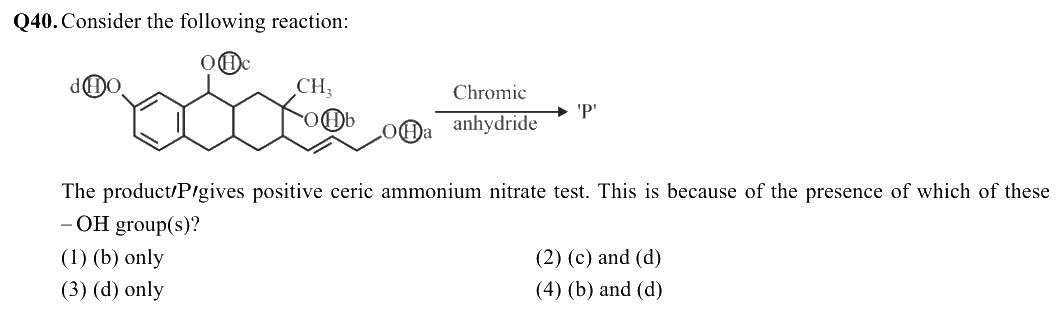
Consider the following reaction: (see the figure above) The product 'P' gives positive ceric ammonium nitrate test. This is because of the presence of which of these –OH group(s)?
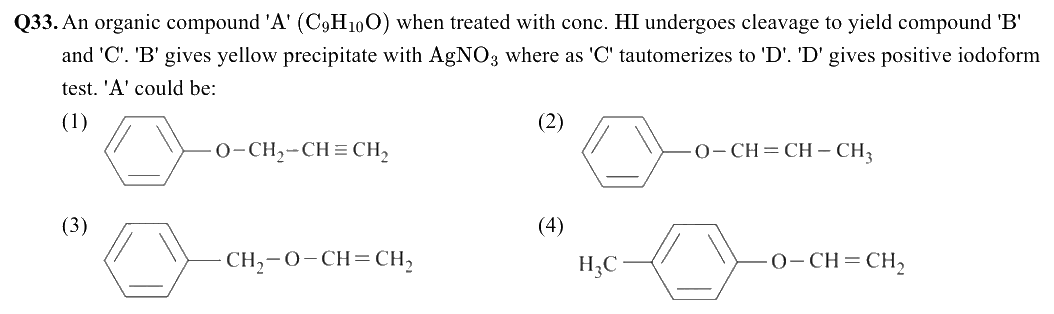
An organic compound 'A' ($\mathrm{C}_{9}\mathrm{H}_{10}\mathrm{O}$) when treated with conc. HI undergoes cleavage to yield compound 'B' and 'C'. 'B' gives yellow precipitate with $\mathrm{AgNO}_{3}$ where as 'C' tautomerizes to 'D'. 'D' gives positive iodoform test. 'A' could be:
The question as printed in the paper.
A
see figure Benzene ring with $-\mathrm{O}-\mathrm{CH}_{2}-\mathrm{CH}\equiv\mathrm{CH}_{2}$ attached.
B
see figure Benzene ring with $-\mathrm{O}-\mathrm{CH}=\mathrm{CH}-\mathrm{CH}_{3}$ attached.
C
see figure Benzene ring with $-\mathrm{CH}_{2}-\mathrm{O}-\mathrm{CH}=\mathrm{CH}_{2}$ attached.
D
see figure Benzene ring bearing $\mathrm{H}_{3}\mathrm{C}-$ at one position and, at the para position, $-\mathrm{O}-\mathrm{CH}=\mathrm{CH}_{2}$.
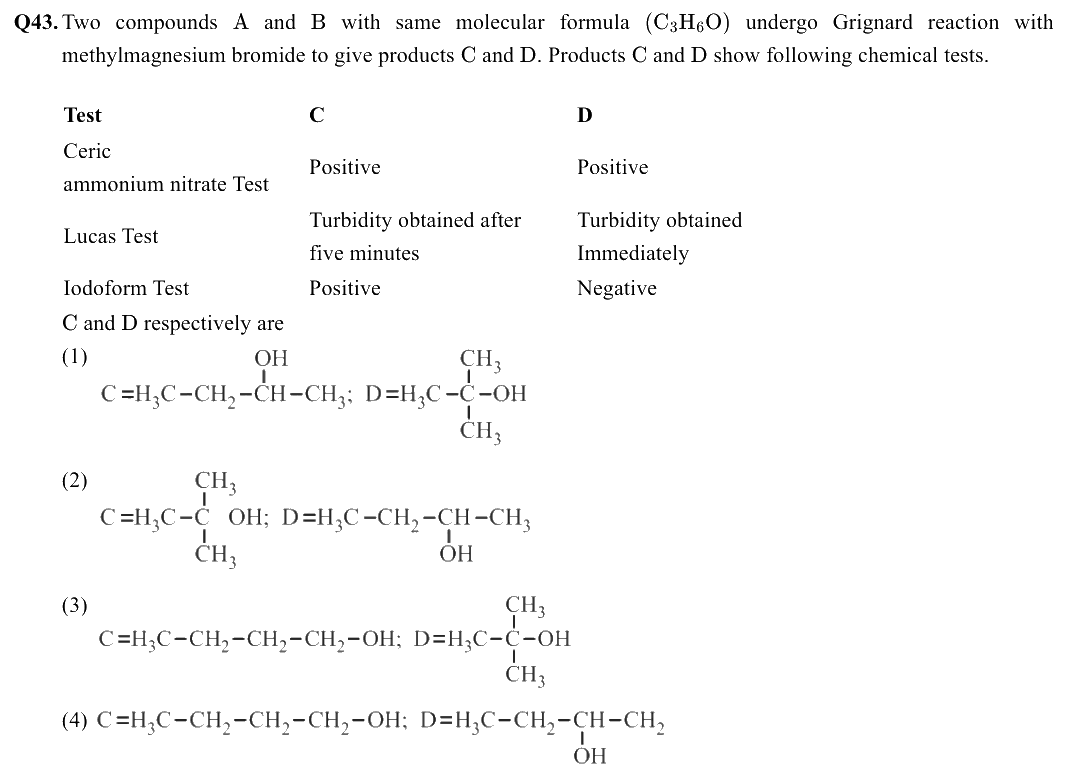
Two compounds A and B with same molecular formula ($\mathrm{C}_{3}\mathrm{H}_{6}\mathrm{O}$) undergo Grignard reaction with methylmagnesium bromide to give products C and D. Products C and D show following chemical tests. $\begin{array}{lll} \textbf{Test} & \textbf{C} & \textbf{D} \\ \text{Ceric ammonium nitrate Test} & \text{Positive} & \text{Positive} \\ \text{Lucas Test} & \text{Turbidity obtained after five minutes} & \text{Turbidity obtained Immediately} \\ \text{Iodoform Test} & \text{Positive} & \text{Negative} \end{array}$ C and D respectively are
The question as printed in the paper.
A
see figure $\mathrm{C} = \mathrm{H}_{3}\mathrm{C}-\mathrm{CH}_{2}-\mathrm{CH}-\mathrm{CH}_{3}$ with OH on a vertical bond above the CH; $\mathrm{D} = \mathrm{H}_{3}\mathrm{C}-\mathrm{C}-\mathrm{OH}$ with $\mathrm{CH}_{3}$ above and $\mathrm{CH}_{3}$ below the C.
B
see figure $\mathrm{C} = \mathrm{H}_{3}\mathrm{C}-\mathrm{C}\ \mathrm{OH}$ with $\mathrm{CH}_{3}$ above and $\mathrm{CH}_{3}$ below the C; $\mathrm{D} = \mathrm{H}_{3}\mathrm{C}-\mathrm{CH}_{2}-\mathrm{CH}-\mathrm{CH}_{3}$ with OH on a vertical bond below the CH.
C
see figure $\mathrm{C} = \mathrm{H}_{3}\mathrm{C}-\mathrm{CH}_{2}-\mathrm{CH}_{2}-\mathrm{CH}_{2}-\mathrm{OH}$; $\mathrm{D} = \mathrm{H}_{3}\mathrm{C}-\mathrm{C}-\mathrm{OH}$ with $\mathrm{CH}_{3}$ above and $\mathrm{CH}_{3}$ below the C.
D
see figure $\mathrm{C} = \mathrm{H}_{3}\mathrm{C}-\mathrm{CH}_{2}-\mathrm{CH}_{2}-\mathrm{CH}_{2}-\mathrm{OH}$; $\mathrm{D} = \mathrm{H}_{3}\mathrm{C}-\mathrm{CH}_{2}-\mathrm{CH}-\mathrm{CH}_{2}$ with OH on a vertical bond below the CH.
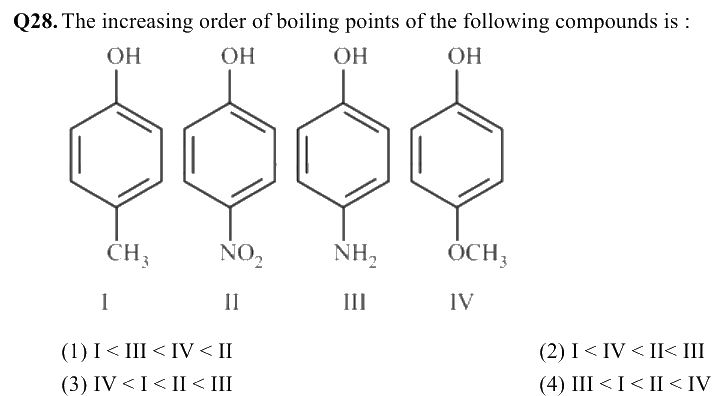
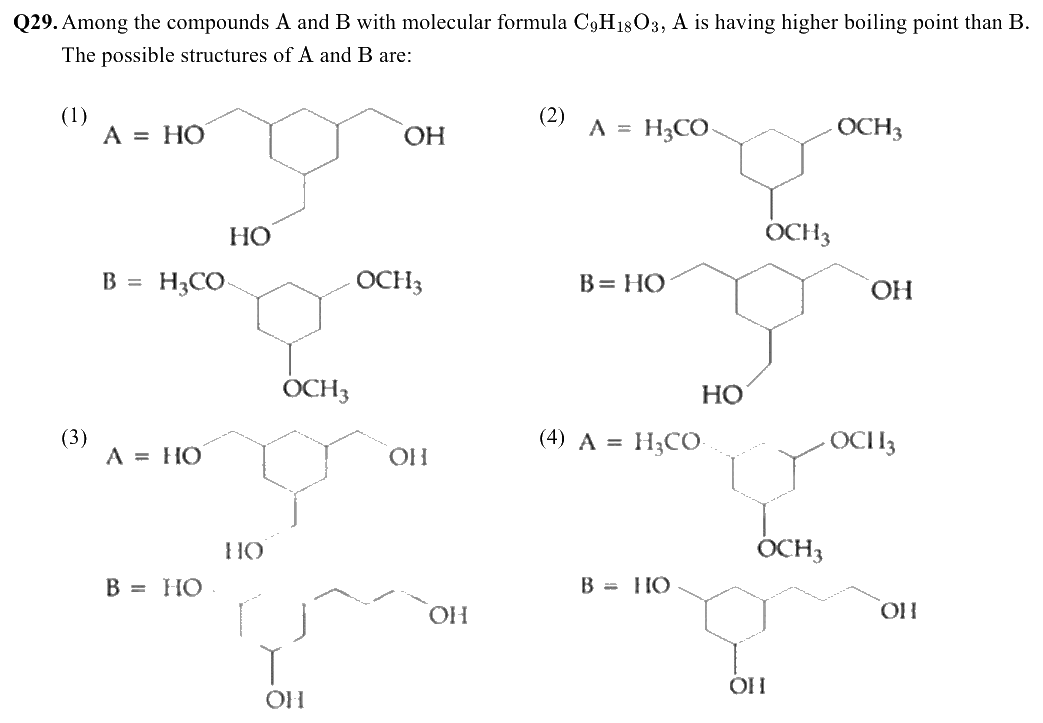
Among the compounds A and B with molecular formula $\mathrm{C_9H_{18}O_3}$, A is having higher boiling point than B. The possible structures of A and B are:
The question as printed in the paper.
A
see figure A: cyclohexane ring with three $\mathrm{CH_2OH}$-type arms (HO, OH and HO); B: cyclohexane ring with three $\mathrm{OCH_3}$ groups
B
see figure A: cyclohexane ring with three $\mathrm{OCH_3}$ groups; B: cyclohexane ring with three hydroxy-ended arms
C
see figure A: cyclohexane ring with three $\mathrm{CH_2OH}$ groups; B: cyclohexane ring with two OH groups directly on the ring and one $\mathrm{CH_2CH_2CH_2OH}$ arm
D
see figure A: cyclohexane ring with three $\mathrm{OCH_3}$ groups; B: cyclohexane ring with two OH groups directly on the ring and one $\mathrm{CH_2CH_2CH_2OH}$ arm
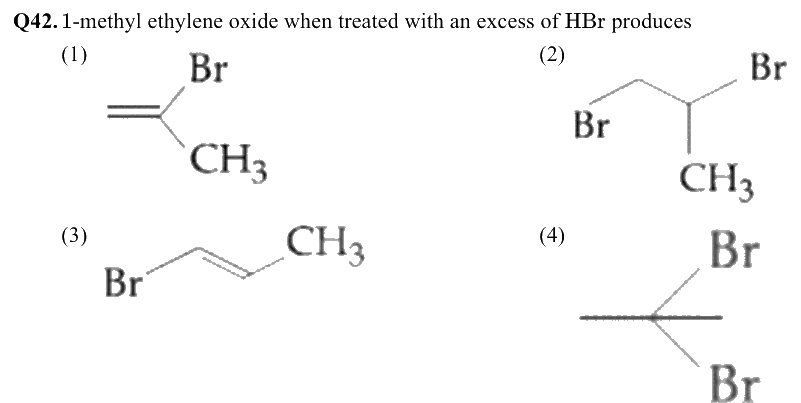
1-methyl ethylene oxide when treated with an excess of HBr produces (see the figure above)
The question as printed in the paper.
A
see figure skeletal structure: CH2=C(Br)-CH3 (a terminal C=C with Br and CH3 on the same carbon)
B
see figure skeletal structure: BrCH2-CH(Br)-CH3 (a chain with a Br at the left end, Br on the middle carbon and CH3 below)
C
see figure skeletal structure: Br-CH=CH-CH3 (a C=C with Br at one end and CH3 at the other)
D
see figure skeletal structure: a single carbon carrying two Br (one up, one down) and a line to the left and a line to the right (a gem-dibromide, drawn with plain lines for the other two groups)
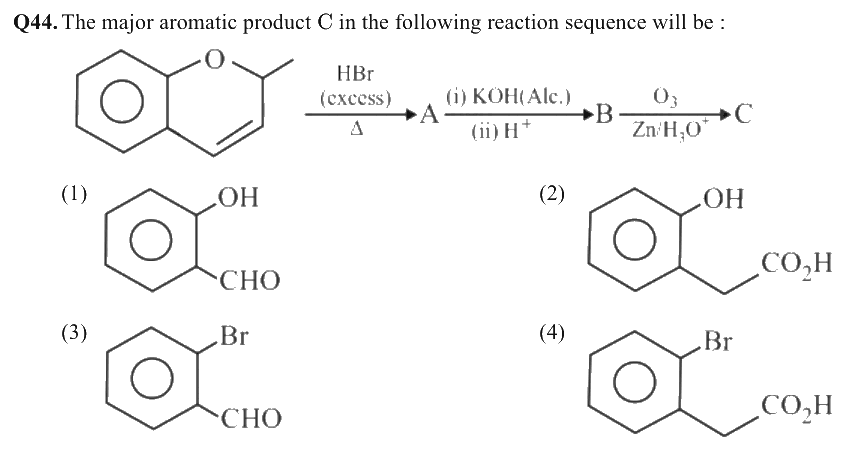
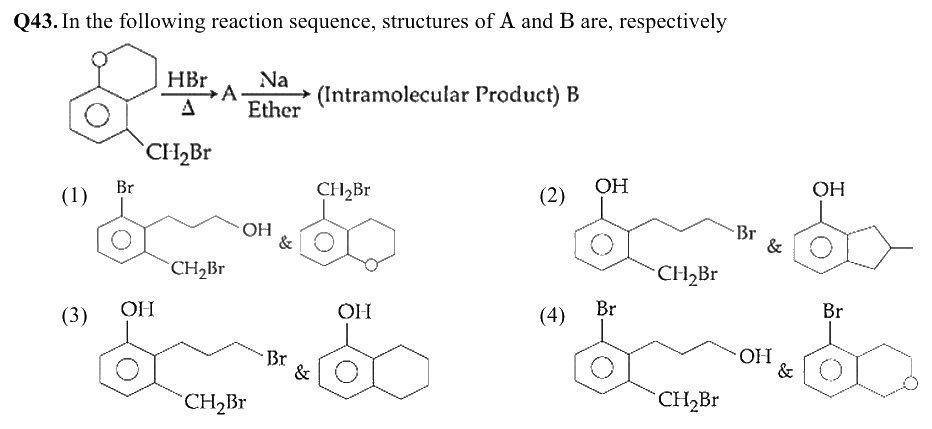
In the following reaction sequence, structures of A and B are, respectively (see the figure above)
The question as printed in the paper.
A
A: Br on the ring, side chain ending in OH, CH2Br on the ring; B: chroman skeleton with CH2Br (see the figure above)
B
A: OH on the ring, side chain ending in Br, CH2Br on the ring; B: OH-substituted ring fused to a five-membered ring with a methyl (see the figure above)
C
A: OH on the ring, side chain ending in Br, CH2Br on the ring; B: OH-substituted tetralin-type skeleton (see the figure above)
D
A: Br on the ring, side chain ending in OH, CH2Br on the ring; B: Br-substituted ring fused to an O-containing six-membered ring (see the figure above)
Answer: (C) A: OH on the ring, side chain ending in Br, CH2Br on the ring; B: OH-substituted tetralin-type skeleton (see the figure above)· Key from source paper
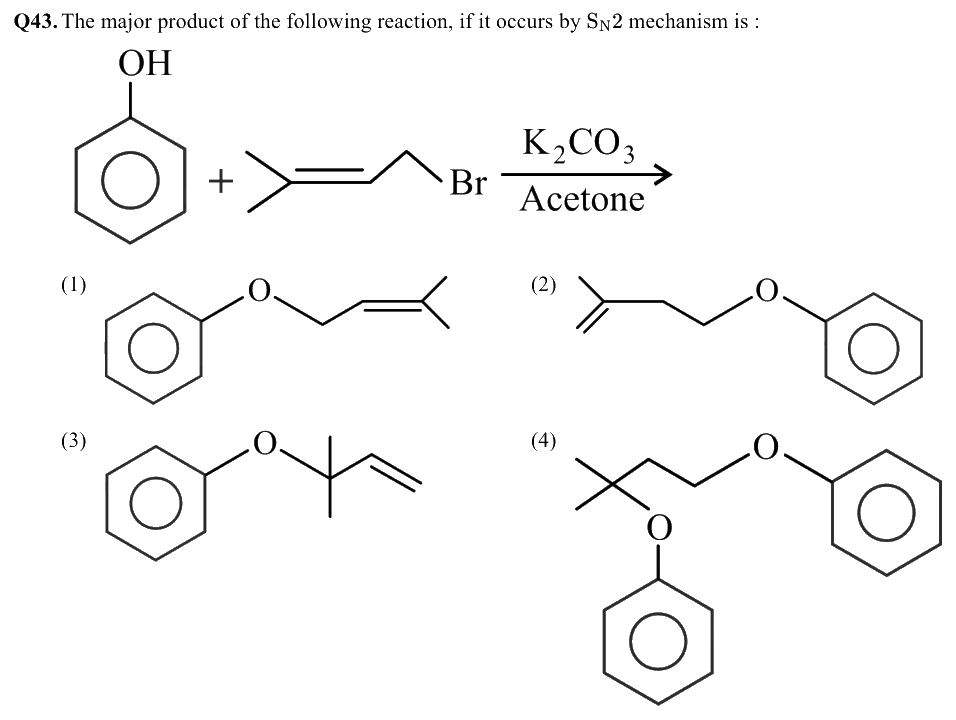
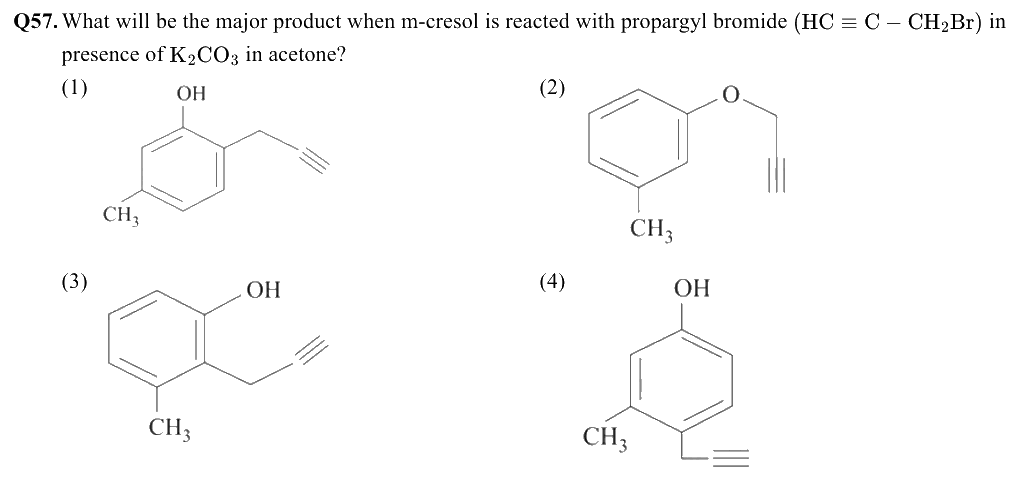
What will be the major product when m-cresol is reacted with propargyl bromide $(\mathrm{HC \equiv C - CH_2Br})$ in presence of $\mathrm{K_2CO_3}$ in acetone?
The question as printed in the paper.
A
see figure benzene ring with OH at the top carbon, a propargyl group ($\mathrm{CH_2-C\equiv CH}$) on the adjacent carbon to its right, and $\mathrm{CH_3}$ at the lower left
B
see figure benzene ring with an ether oxygen at the upper right carrying $\mathrm{O-CH_2-C\equiv CH}$ and $\mathrm{CH_3}$ at the bottom (meta to the oxygen)
C
see figure benzene ring with OH at the upper right, the propargyl group ($\mathrm{CH_2-C\equiv CH}$) on the carbon below it, and $\mathrm{CH_3}$ on the next carbon at the lower left (propargyl between OH and CH3)
D
see figure benzene ring with OH at the top, $\mathrm{CH_3}$ at the lower left, and an alkyne group (a short line ending in a triple bond, drawn as C$\equiv$CH) on the bottom carbon, para to the OH; whether a CH2 precedes the triple bond is not clear in the drawing
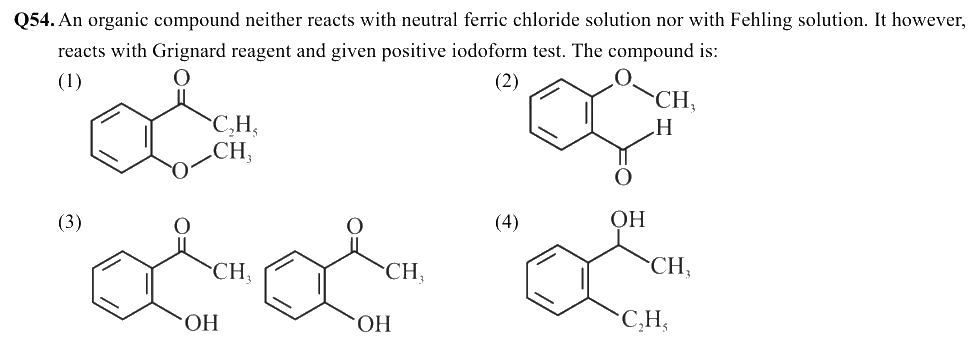
An organic compound neither reacts with neutral ferric chloride solution nor with Fehling solution. It however, reacts with Grignard reagent and given positive iodoform test. The compound is:
The question as printed in the paper.
A
see figure Benzene ring with a C(=O)C2H5 group and, ortho to it, an OCH3 group.
B
see figure Benzene ring with a CHO group and, ortho to it, an OCH3 group.
C
see figure Benzene ring with a C(=O)CH3 group and, ortho to it, an OH group (the structure is printed twice side by side in the copy).
D
see figure Benzene ring with a CH(OH)CH3 group and, ortho to it, a C2H5 group.
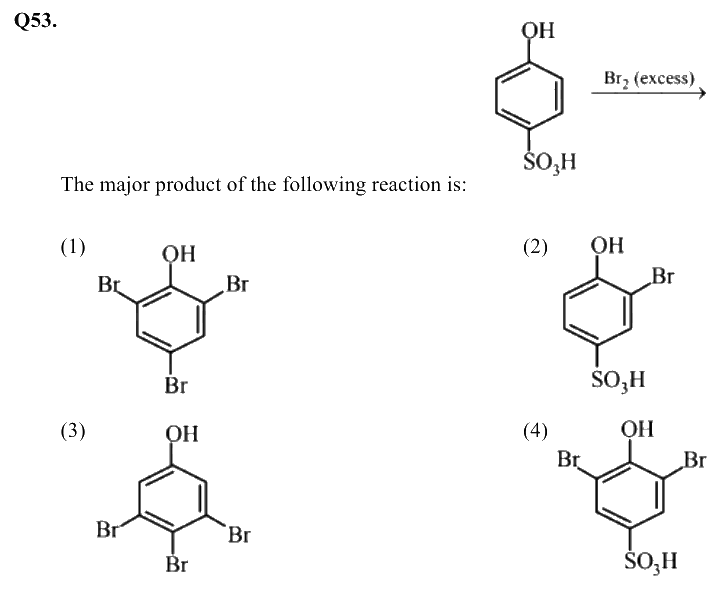
see figure The major product of the following reaction is:
The question as printed in the paper.
A
see figure 2,4,6-tribromophenol: OH at the top with Br on both ortho carbons and on the para (bottom) carbon
B
see figure ring with OH at the top, one Br on an ortho carbon (upper right) and SO3H at the bottom (para)
C
see figure ring with OH at the top and three Br on the lower carbons (meta, meta and para-position positions as drawn: lower left, lower right and bottom)
D
see figure ring with OH at the top, Br on both ortho carbons and SO3H at the bottom (para)
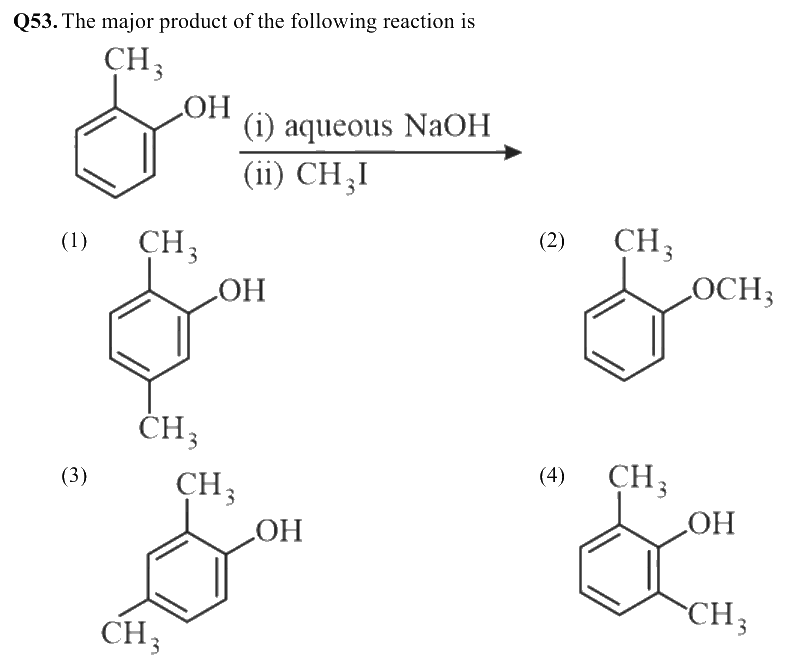
The major product of the following reaction is (see the figure above)
The question as printed in the paper.
A
see figure A benzene ring with CH3 on the top ring carbon, OH on the neighbouring carbon at the upper right, and a second CH3 on the carbon at the bottom of the ring.
B
see figure A benzene ring with CH3 on the top ring carbon and OCH3 on the neighbouring carbon at the upper right.
C
see figure A benzene ring with CH3 on the top ring carbon, OH on the neighbouring carbon at the upper right, and a second CH3 on the carbon at the lower left.
D
see figure A benzene ring with CH3 on the top ring carbon, OH on the neighbouring carbon at the upper right, and a second CH3 on the carbon at the bottom right (on the other side of the carbon bearing OH).
Which is the most suitable reagent for the following transformation? $\mathrm{CH_3{-}CH{=}CH{-}CH_2{-}CH(OH){-}CH_3} \longrightarrow \mathrm{CH_3{-}CH{=}CH{-}CH_2CO_2H}$
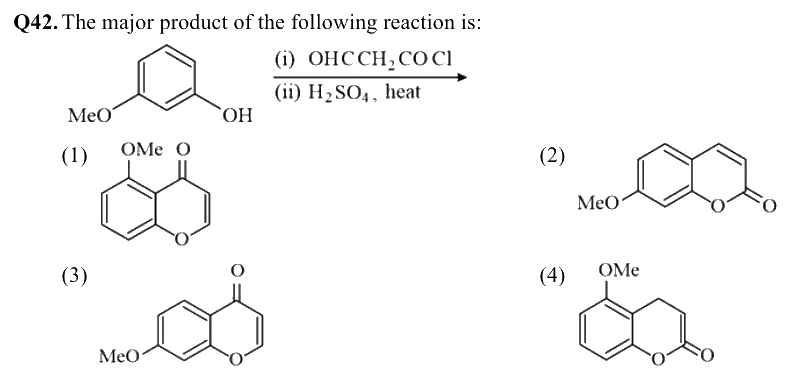
The major product of the following reaction is: (see the figure above)
The question as printed in the paper.
A
see figure chromone (benzopyran-4-one) with OMe at the benzene carbon next to the ring-fusion carbon bearing C=O
B
see figure coumarin (benzopyran-2-one) with MeO on the benzene ring, para to the ring-fusion carbon bearing C=C
C
see figure chromone (benzopyran-4-one) with MeO on the benzene ring at the lower left
D
see figure benzopyran-2-one type lactone with OMe at the benzene carbon next to the upper ring-fusion carbon; ring CH2 at C4, a C=C drawn between C3 and the carbonyl carbon C2, which also bears exocyclic =O (as printed)
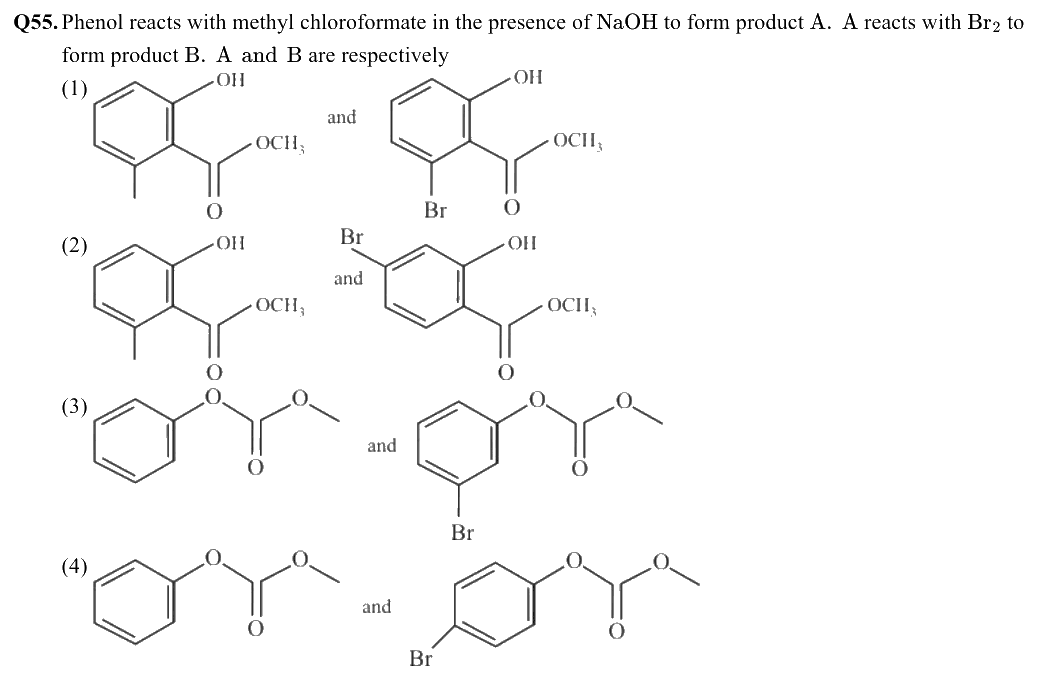
Phenol reacts with methyl chloroformate in the presence of NaOH to form product A. A reacts with $\mathrm{Br_2}$ to form product B. A and B are respectively (see the figure above)
The question as printed in the paper.
A
see figure A: benzene ring with OH and a $\mathrm{C(=O)OCH_3}$ group on adjacent ring carbons and an unlabelled short bond on another ring carbon; and B: the same with Br on that carbon
B
see figure A: the same as in (1); and B: ring with OH, $\mathrm{C(=O)OCH_3}$ on adjacent carbons and Br on the carbon para to the ester carbon (drawn at the far upper-left of the ring)
C
see figure A: phenyl methyl carbonate ($\mathrm{C_6H_5{-}O{-}C(=O){-}OCH_3}$); and B: the same with Br at the meta position
D
see figure A: phenyl methyl carbonate ($\mathrm{C_6H_5{-}O{-}C(=O){-}OCH_3}$); and B: the same with Br at the para position
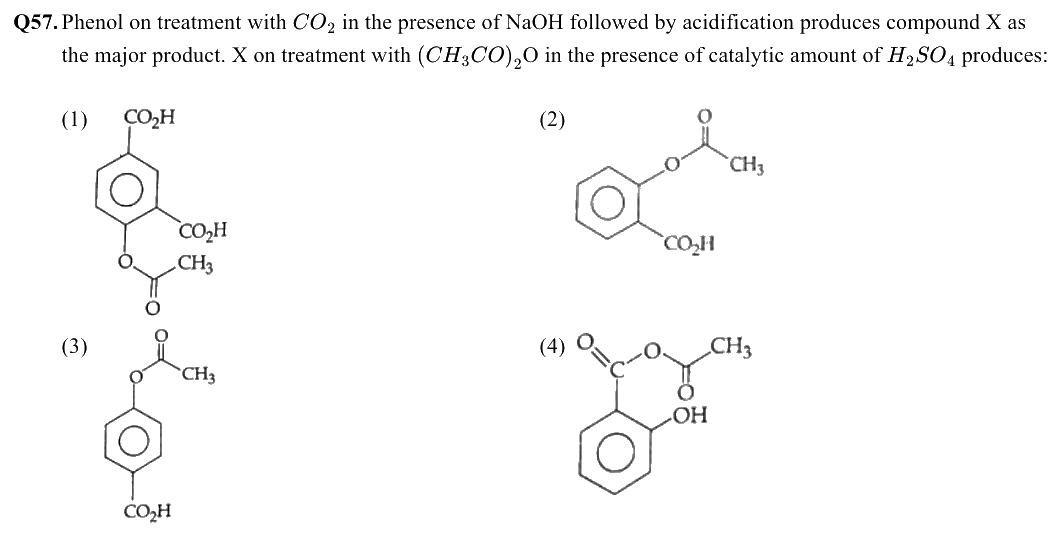
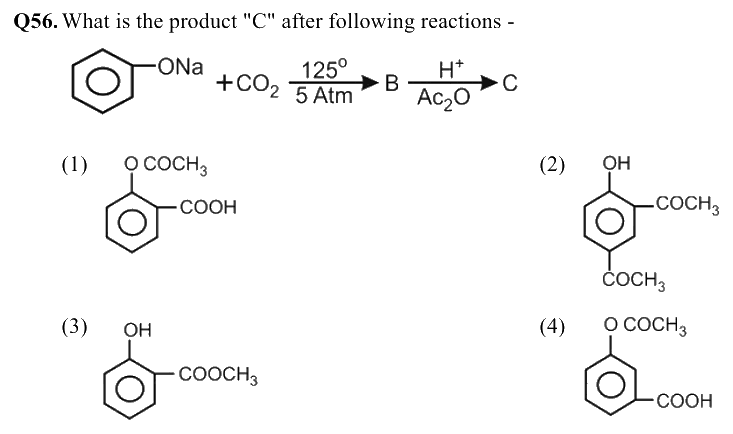
Phenol on treatment with $CO_2$ in the presence of NaOH followed by acidification produces compound X as the major product. X on treatment with $(CH_3CO)_2$O in the presence of catalytic amount of $H_2SO_4$ produces: (see the figure above)
The question as printed in the paper.
A
see figure benzene ring with CO2H at the top (para to the bottom substituent), another CO2H at the lower right and $\mathrm{O{-}C(=O)CH_3}$ at the bottom (three substituents as drawn)
B
see figure benzene ring with $\mathrm{O{-}C(=O)CH_3}$ and $\mathrm{CO_2H}$ on adjacent (ortho) ring carbons
C
see figure benzene ring with $\mathrm{O{-}C(=O)CH_3}$ at the top and $\mathrm{CO_2H}$ at the bottom (para)
D
see figure benzene ring with OH and $\mathrm{C(=O){-}O{-}C(=O)CH_3}$ (mixed anhydride) on adjacent (ortho) ring carbons
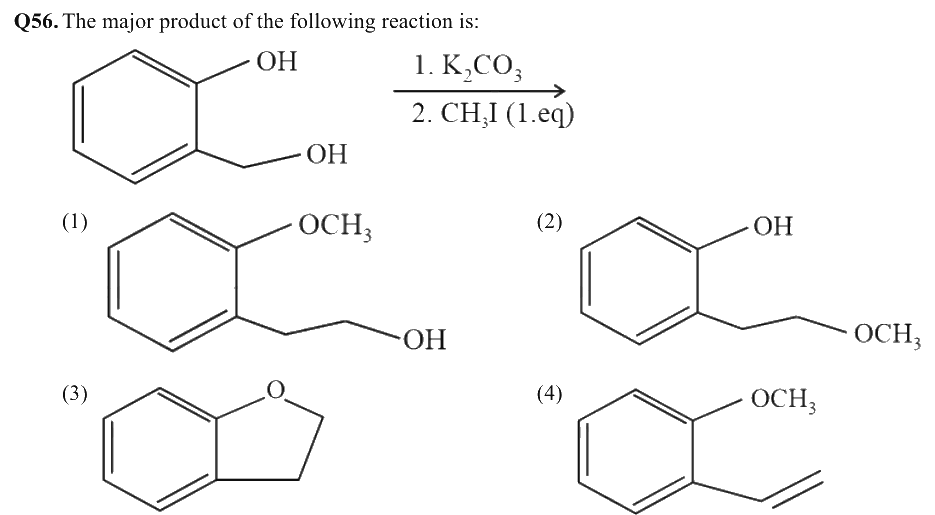
The major product of the following reaction is: (see the figure above)
The question as printed in the paper.
A
see figure benzene ring with OCH3 on one ring carbon and, on the neighbouring ring carbon, a two-carbon zig-zag chain ending in OH (ring-CH2-CH2-OH)
B
see figure benzene ring with OH on one ring carbon and, on the neighbouring ring carbon, a two-carbon zig-zag chain ending in OCH3 (ring-CH2-CH2-OCH3)
C
see figure 2,3-dihydrobenzofuran-type fused bicycle: benzene ring fused to a five-membered ring containing O at the top (O joined to the ring carbon, then CH2, then CH2 back to the ring)
D
see figure benzene ring with OCH3 on one ring carbon and, on the neighbouring ring carbon, a vinyl group (CH=CH2)
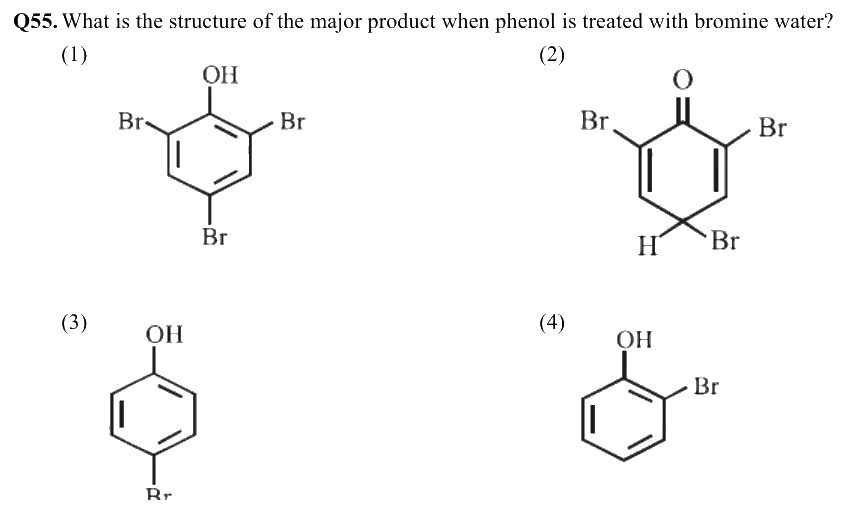
What is the structure of the major product when phenol is treated with bromine water? (see the figure above)
The question as printed in the paper.
A
see figure Benzene ring with OH at the top carbon, Br on the two carbons next to it (upper left and upper right) and Br at the bottom carbon (para to OH); three Br in total.
B
see figure Six-membered ring with C=O (double-bonded O) at the top carbon; Br on the upper-left and upper-right carbons, each of which is joined by a ring double bond to the carbon below it; the bottom carbon is sp3 and carries H (to the left) and Br (to the right).
C
see figure Benzene ring with OH at the top carbon and a single Br at the bottom carbon (para to OH).
D
see figure Benzene ring with OH at the top carbon and a single Br on the adjacent carbon at upper right (ortho to OH).
An ether (A), $\mathrm{C_5H_{12}O}$, when heated with excess of hot concentrated HI produced two alkyl halides which when treated with NaOH yielded compounds (B) and (C). Oxidation of (B) and (C) gave a propanone and an ethanoic acid respectively. The IUPAC name of the ether (A) is :
An unknown alcohol is treated with the "Lucas reagent" to determine whether the alcohol is primary, secondary or tertiary. Which alcohol reacts fastest and by what mechanism:
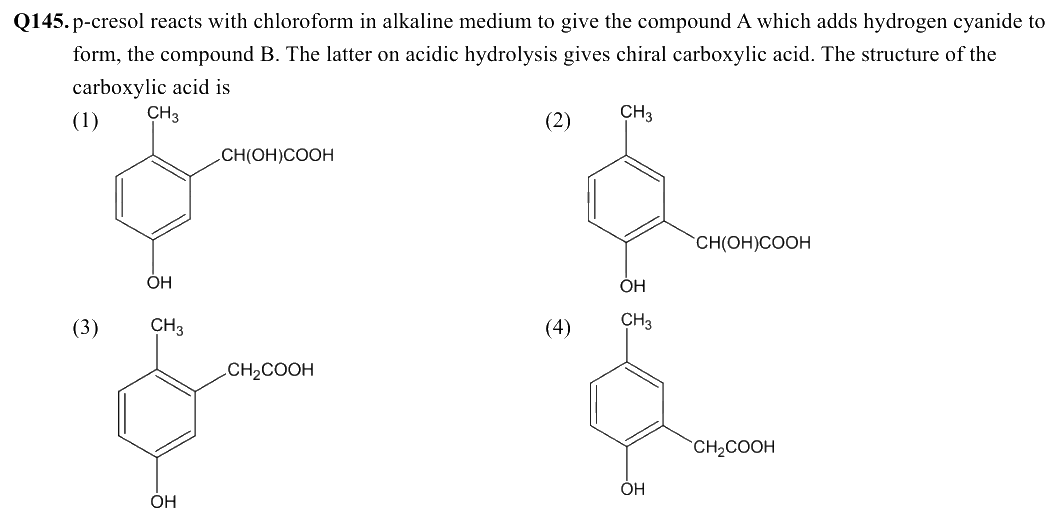
p-cresol reacts with chloroform in alkaline medium to give the compound A which adds hydrogen cyanide to form, the compound B. The latter on acidic hydrolysis gives chiral carboxylic acid. The structure of the carboxylic acid is
The question as printed in the paper.
A
see figure benzene ring with CH3, CH(OH)COOH and OH
B
see figure benzene ring with CH3, CH(OH)COOH and OH
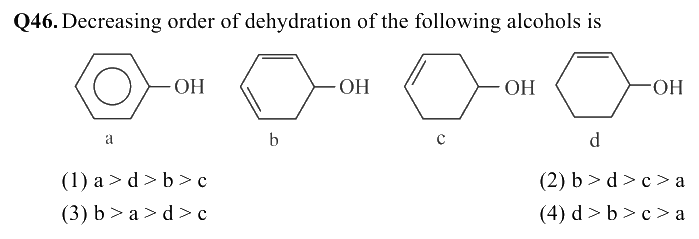
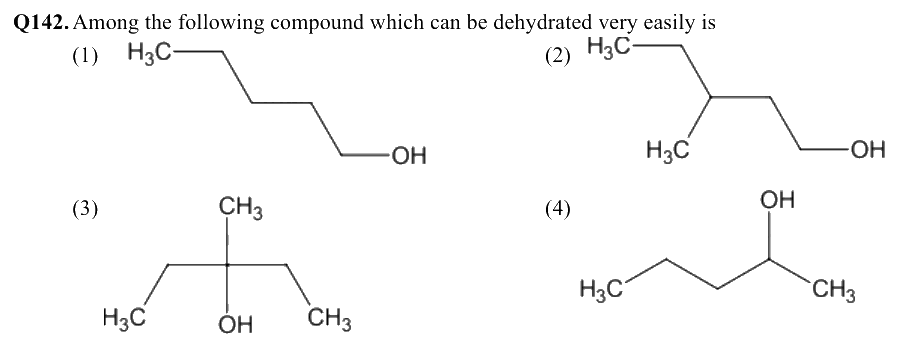
Among the following compound which can be dehydrated very easily is
The question as printed in the paper.
A
see figure skeletal structure of pentan-1-ol: H3C at the top left, horizontal bond, then a zigzag of bonds running down to the right, ending with a horizontal bond to OH at the bottom right (H3C-CH2-CH2-CH2-CH2-OH, five carbons, OH on the end carbon)
B
see figure skeletal structure of 3-methylpentan-1-ol: H3C at the top left, horizontal bond, a bond down to a branching carbon that carries a methyl (H3C, drawn down-left), then a bond to the right and down, ending with a horizontal bond to OH (H3C-CH2-CH(CH3)-CH2-CH2-OH)
C
see figure skeletal structure of 3-methylpentan-3-ol: a central carbon bearing CH3 (up) and OH (down), with a bond to the left going down to H3C and a bond to the right going down to CH3 (the two arms are ethyl groups: (CH3CH2)2C(CH3)OH)
D
see figure skeletal structure of pentan-2-ol: H3C at the left, a zigzag up and down to a carbon bearing OH (up) and CH3 (down-right) (H3C-CH2-CH2-CH(OH)-CH3)
4.7 g of phenol is heated with Zn to give product X. If this reaction goes to 60% completion then the number of moles of compound X formed will be ________ $\times10^{-2}$.(Nearest Integer) (Given molar mass in g mol$^{-1}$ : H:1, C:12, O:16)
Numerical answer type: type your answer in EdLoop to check it
One mole of phenol is treated with dilute $\mathrm{HNO_3}$ at 298 K to give a mixture of products. The mixture is separated by steam distillation. The steam volatile compound (X) is separated. The increase in percentage of oxygen in (X) with respect to phenol is ________ $\times10^{-1}$ %
(Given molar mass in g mol$^{-1}$ H:1, C:12, N:14, O:16)
Numerical answer type: type your answer in EdLoop to check it
A trisubstituted compound 'A', $\mathrm{C_{10}H_{12}O_2}$ gives neutral $\mathrm{FeCl_3}$ test positive. Treatment of compound 'A' with NaOH and $\mathrm{CH_3Br}$ gives $\mathrm{C_{11}H_{14}O_2}$, with hydroiodic acid gives methyl iodide and with hot conc. NaOH gives a compound B, $\mathrm{C_{10}H_{12}O_2}$. Compound 'A' also decolorises alkaline $\mathrm{KMnO_4}$. The number of $\pi$ bond/s present in the compound 'A' is ______ .
Numerical answer type: type your answer in EdLoop to check it
A sample of 4.5 mg of an unknown monohydric alcohol, R $-$ OH was added to methylmagnesium iodide. A gas is evolved and is collected and its volume measured to be 3.1 mL. The molecular weight of the unknown alcohol is g/ mol.
Numerical answer type: type your answer in EdLoop to check it
$\mathrm{C_6H_{12}O_6} \xrightarrow{\text{Zymase}} \mathrm{A} \xrightarrow[\Delta]{\text{NaOI}} \mathrm{B + CHI_3}$ The number of carbon atoms present in the product B is
Numerical answer type: type your answer in EdLoop to check it
Compound 'P' on nitration with dil. $\mathrm{HNO}_3$ yields two isomers (A) and (B). These isomers can be separated by steam distillations. Isomers (A) and (B) show the intramolecular and intermolecular hydrogen bonding respectively. Compound (P) on reaction with conc. $\mathrm{HNO}_3$ yields a yellow compound 'C', a strong acid. The number of oxygen atoms is present in compound 'C'
Numerical answer type: type your answer in EdLoop to check it
Consider the following reactions $\mathrm{A}\xrightarrow[\mathrm{(ii)H_3O^+}]{\mathrm{(i)CH_3MBr}}\mathrm{B}\xrightarrow[573K]{Cu}\mathrm{2 - methyl - 2 - butene}$ . The mass percentage of carbon in A is ______.
Numerical answer type: type your answer in EdLoop to check it
How to prepare Alcohols, Phenols & Ethers for JEE Main
How often it comes up
Alcohols, phenols and ethers covers oxygen-containing functional groups under Unit 17: Organic Compounds Containing Oxygen in the Class 12 curriculum, holding rank 18 of 31 chapters with a 2.8% share of the chemistry section. During the 2019 to 2026 examination span, Alcohols, Phenols & Ethers contributed 128 questions across 162 exam papers, delivering 2.8% of the chemistry section and holding rank 18 of 31 chapters. In the earlier testing era from 2002 to 2018, it registered 40 questions across 38 papers with a 3.0% share. Over the recent 2024 to 2026 testing sessions, it produced 49 questions across 58 papers, accounting for a 3.2% share. Comparing both earlier testing periods against 2024 to 2026, its testing share has remained about the same.
The chapter has appeared every year from 2019 to 2026. Across 2019 to 2026, it averaged 0.8 questions per paper, consistent with the 0.8 questions per paper observed between 2024 and 2026. Twelve numerical answer questions were presented from 2019 to 2026, frequently involving acetylation stoichiometry or molecular mass calculations.
Most-asked topics
The syllabus divides across three functional classes:
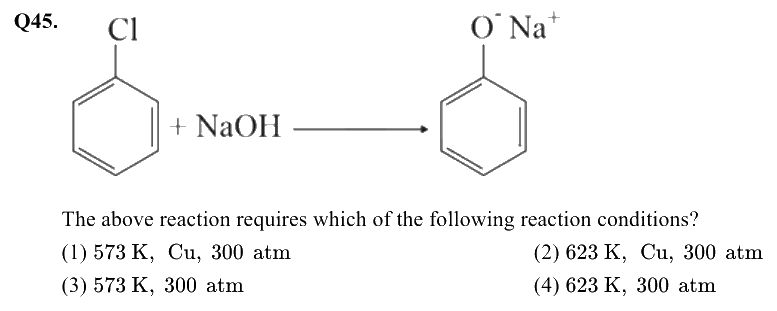
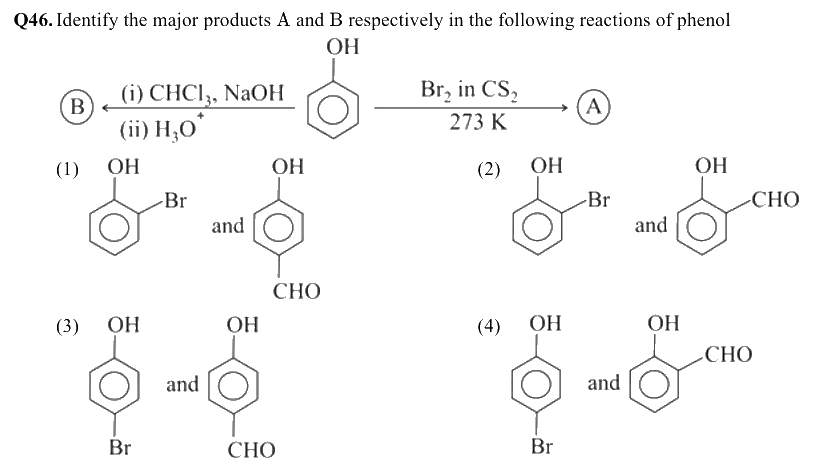
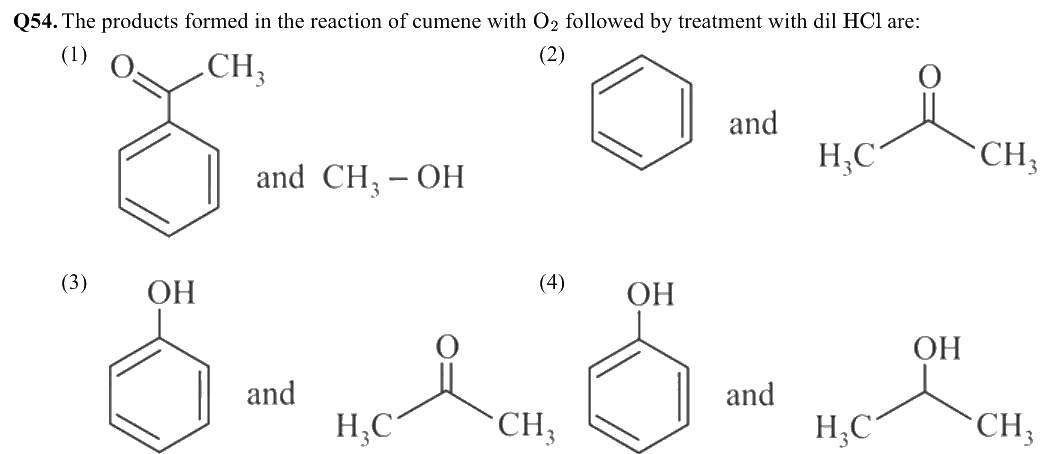
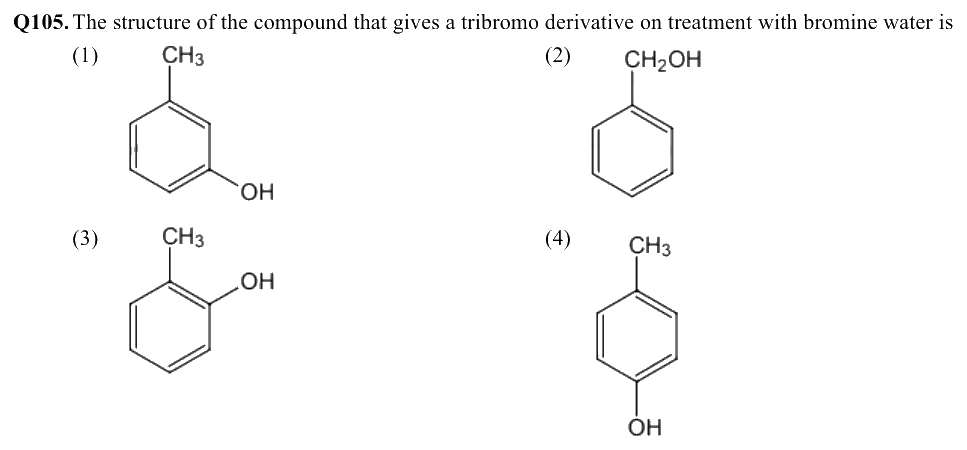
Phenols: The largest topic with 81 total questions (63 in 2019 to 2026), evaluated consistently through 2026. Core themes involve electrophilic substitution on activated benzene rings: Reimer-Tiemann formylation yielding salicylaldehyde, Kolbe-Schmitt carboxylation yielding salicylic acid, bromination in polar versus non-polar solvents (aqueous bromine giving 2,4,6-tribromophenol), nitration yielding steam-volatile ortho-nitrophenol, and industrial synthesis from cumene with acetone as an equimolar by-product.
Alcohols: Contributed 58 total questions (41 in 2019 to 2026), examined through 2026. Focuses on acid-catalyzed dehydration into alkenes with carbocation rearrangements, oxidation with pyridinium chlorochromate (PCC) versus Jones reagent, dehydrogenation over heated copper, Lucas test turbidity rates, and the iodoform reaction.
Ethers: Generated 29 total questions (24 in 2019 to 2026), active through 2026. Major areas include Williamson ether synthesis (SN2 attack of alkoxide on primary alkyl halides to avoid E2 elimination) and acidic cleavage with hydroiodic acid (HI), noting mechanism shifts between SN2 for primary/secondary alkyl groups and SN1 when stable tertiary or benzylic carbocations form.
What the questions look like
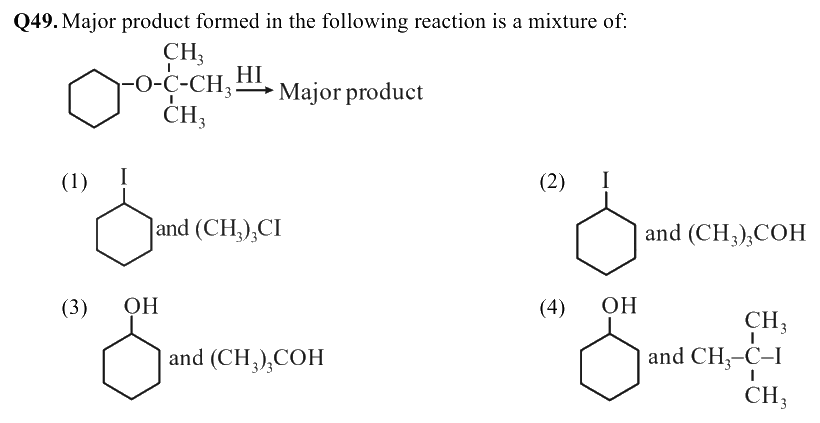
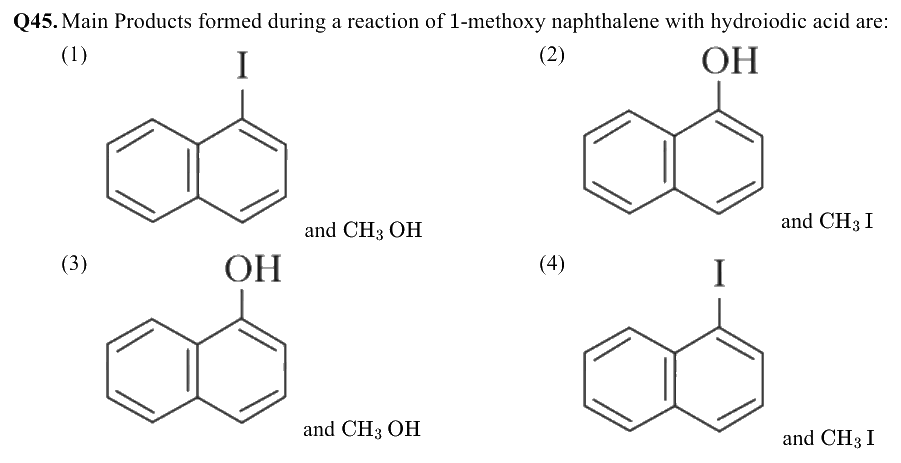
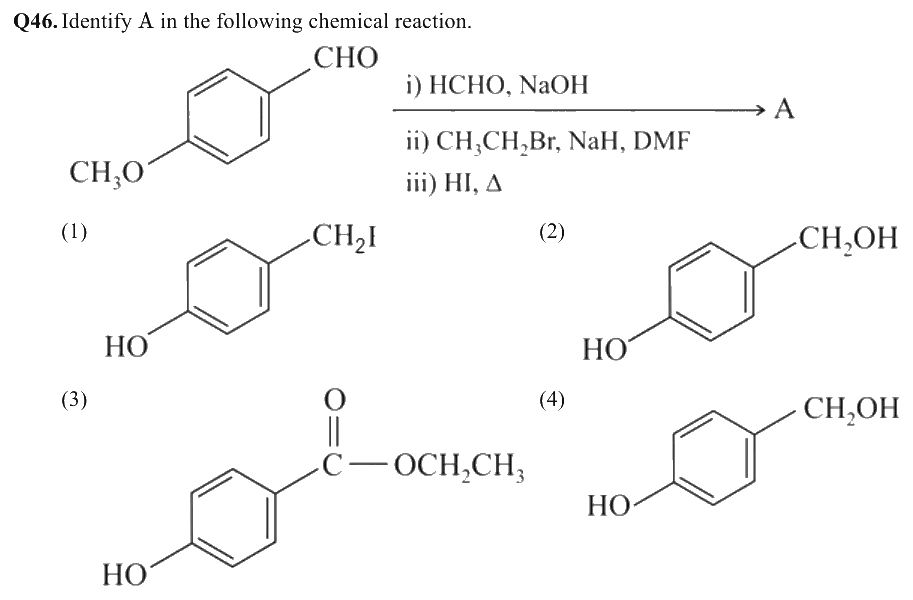
Examiners emphasize reaction pathways and distinguishing tests. A typical question tests acidic cleavage of mixed ethers with excess hydroiodic acid, requiring candidates to recognize that the alkyl-oxygen bond cleaves while the phenyl-oxygen bond resists cleavage due to partial double-bond character, yielding phenol and alkyl iodide.
Phenol questions regularly assess Reimer-Tiemann or Kolbe reaction mechanisms, asking students to identify intermediate dichlorocarbene species or explain why ortho-nitrophenol separates cleanly from para-nitrophenol via steam distillation due to intramolecular hydrogen bonding.
Questions to try first
Strengthen your preparation with these authentic recent exam questions:
Alcohol synthetic routes: Evaluating alternative chemical routes and carbocation rearrangements in alcohol preparation.
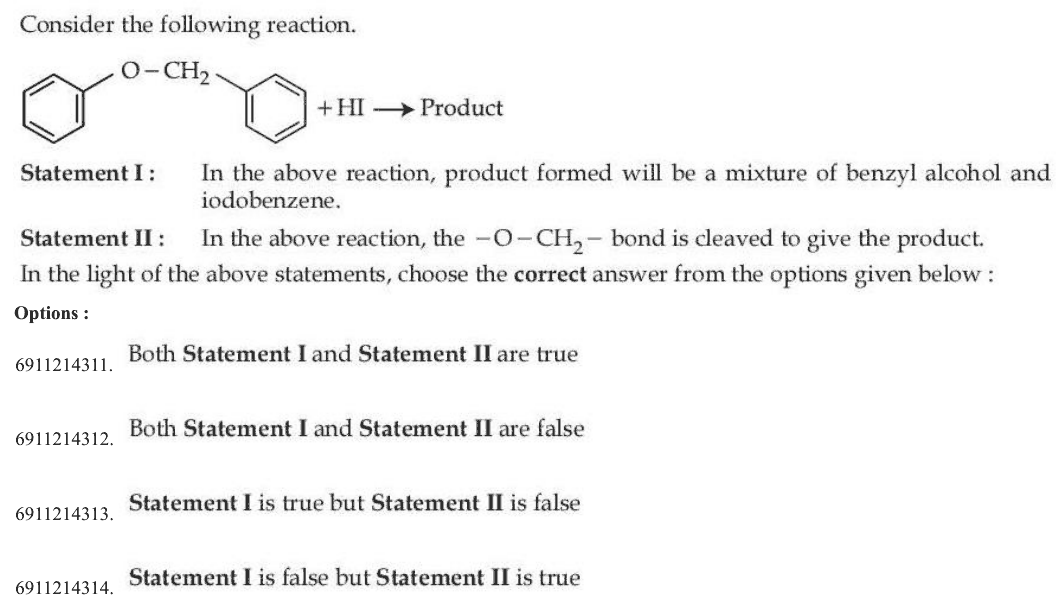
Benzyl phenyl ether acidic cleavage: Determining products and identifying the cleaved carbon-oxygen bond when treating benzyl phenyl ether with hydroiodic acid.
How to practise it
Prepare for oxygen-containing mechanisms through systematic reaction classification:
1. Master acidic cleavage of ethers: With primary and secondary alkyl groups, iodide attacks the less hindered carbon via SN2; if one alkyl group is tertiary or benzylic, reaction proceeds via SN1 carbocation formation at that substituted carbon. 2. Remember Williamson ether synthesis constraints: The alkyl halide must be primary; using a tertiary alkyl halide with an alkoxide yields an alkene via exclusive E2 elimination rather than an ether. 3. Distinguish Reimer-Tiemann from Kolbe synthesis: Reimer-Tiemann uses chloroform and aqueous alkali with dichlorocarbene electrophile to form salicylaldehyde; Kolbe uses sodium hydroxide and carbon dioxide under pressure to form salicylic acid. 4. Separate nitrophenols by steam distillation: Ortho-nitrophenol has intramolecular hydrogen bonding, lowering its boiling point and making it steam-volatile; para-nitrophenol has intermolecular hydrogen bonding, making it non-volatile. 5. Memorize Lucas test timing: Tertiary alcohols show instantaneous cloudiness; secondary alcohols react in five minutes; primary alcohols show no cloudiness at room temperature.
Frequently asked questions
Why does cleavage of anisole with hydroiodic acid yield phenol and methyl iodide rather than iodobenzene and methanol?
The phenyl-oxygen bond possesses partial double-bond character due to resonance and the sp2 hybridized aromatic carbon holds the oxygen tightly, preventing nucleophilic displacement on the aromatic ring. Therefore, iodide attacks the sp3 methyl carbon via an SN2 displacement.
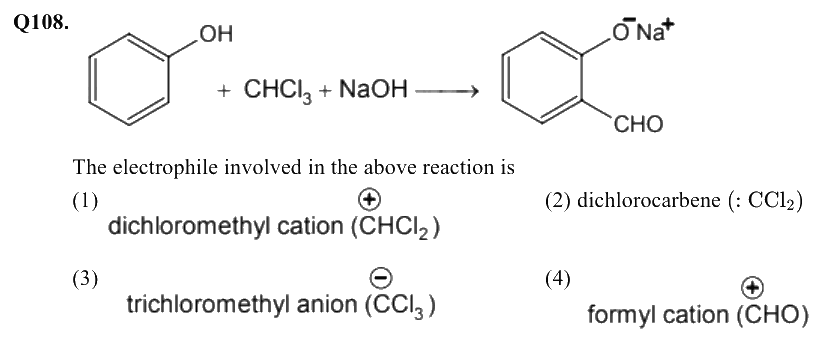
What is the electrophile in the Reimer-Tiemann reaction?
The electrophile is neutral dichlorocarbene (:CCl₂), formed through alpha-elimination of hydrogen chloride from chloroform by strong hydroxide base.
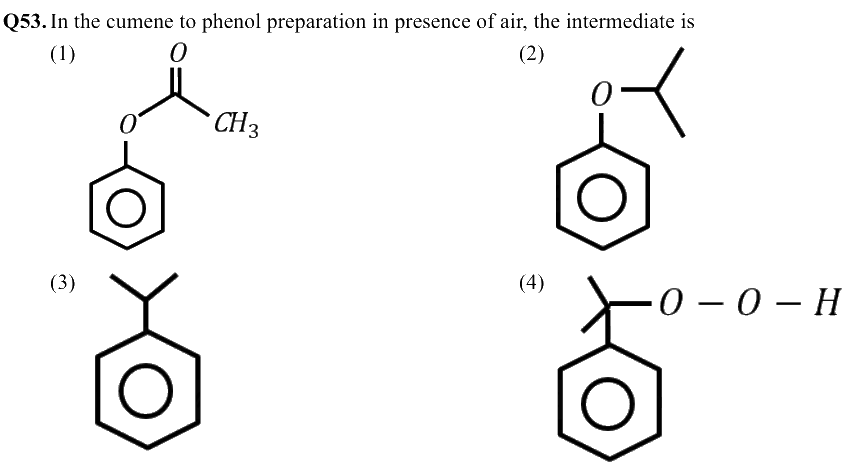
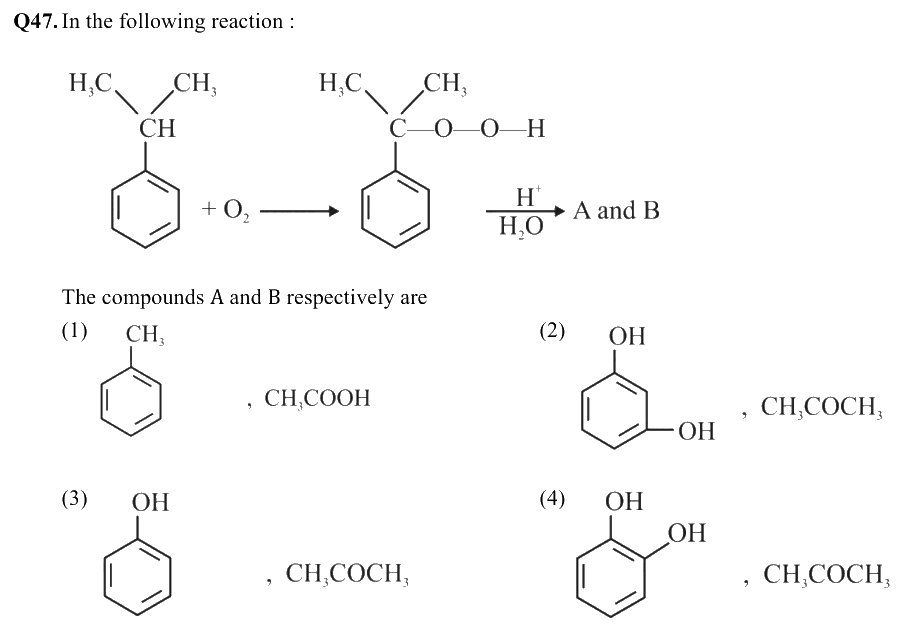
Why is cumene oxidation preferred for industrial phenol synthesis?
Air oxidation of cumene generates cumene hydroperoxide, which upon acid hydrolysis yields two high-value industrial chemicals in equimolar amounts: phenol and acetone. Step-by-step solutions for each one are in the EdLoop app.