EdLoop PYQs · free, no ads · questions and answers here, step-by-step solutions in the EdLoop app
PYQs · free, no adsOpen on the web (app.edloop.in)Get EdLoop – free on Google Play
ChemistryCoordination Compounds

Coordination Compounds: JEE Main PYQs 2002–2026

Every Coordination Compounds question from past JEE Main and AIEEE papers, with options and answers. Newest first.

359questions
195papers covered
6.3%of Chemistry questions, 2019–2026
2002–2026years

Guide at a glance

Coordination compounds encompasses Werner's coordination theory and Crystal Field Theory under Unit 12: Coordination Compounds in the Class 12 curriculum, commanding rank 1 of 31 chapters with a 6.3% share of all chemistry questions.

Most asked sub-topics

Bonding Theories199
Basics & Nomenclature67
Isomerism58
Stability & Applications35

Practise these in EdLoop

Attempt every Coordination Compounds question timed, see the step-by-step solution and track what you get wrong. Free.

Start practice

MCQ, single correct

283 questions
1JEE Main 2026 · 6 Apr · Shift 1MCQOpen question page ↗

Match the LIST-I with LIST-II

List-I Electronic configuration of tetrahedral metal ionList-II Crystal Field Stabilization Energy ($\Delta_t$)
A. $\mathrm{d^2}$I. $-0.6$
B. $\mathrm{d^4}$II. $-0.8$
C. $\mathrm{d^6}$III. $-1.2$
D. $\mathrm{d^8}$IV. $-0.4$

Choose the *correct* answer from the options given below:

  • A

    A-III, B-IV, C-II, D-I

  • B

    A-III, B-I, C-IV, D-II

  • C

    A-III, B-IV, C-I, D-II

  • D

    A-II, B-I, C-IV, D-III

2JEE Main 2026 · 6 Apr · Shift 1MCQOpen question page ↗

Which of the following are true about the energy of the given d-orbitals of a tetrahedral complex?

A. $d_{xy} = d_{xz} > d_{x^2-y^2}$

B. $d_{xy} = d_{yz} > d_{z^2}$

C. $d_{x^2-y^2} > d_{z^2} > d_{xz}$

D. $d_{x^2-y^2} = d_{z^2} < d_{xz}$

Choose the correct answer from the given below:

  • A

    A, B and D only

  • B

    A and B only

  • C

    B and D only

  • D

    B, C and D only

3JEE Main 2026 · 6 Apr · Shift 2MCQOpen question page ↗

Which of the following sequences of hybridisation, geometry and magnetic nature are correct for the given coordination compounds ?

A. $[\mathrm{NiCl_4}]^{2-}$ $-$ $\mathrm{sp^3}$, tetrahedral, paramagnetic

B. $[\mathrm{Ni(NH_3)_6}]^{2+}$ $-$ $\mathrm{sp^3d^2}$, octahedral, paramagnetic

C. $[\mathrm{Ni(CO)_4}]$ $-$ $\mathrm{sp^3}$, tetrahedral, paramagnetic

D. $[\mathrm{Ni(CN)_4}]^{2-}$ $-$ $\mathrm{dsp^2}$, square planar, diamagnetic

Choose the correct answer from the options given below :

  • A

    A, B, C and D

  • B

    B, C and D only

  • C

    A, C and D only

  • D

    A, B and D only

4JEE Main 2026 · 5 Apr · Shift 1MCQOpen question page ↗

The correct statements about metal carbonyls are

A. The metal-carbon bonds in metal carbonyls possess both $\sigma$ and $\pi$-character.

B. Due to synergic bonding interactions between metal and CO ligand, the metal-carbon bond becomes weak.

C. The metal-carbon $\sigma$ bond is formed by the donation of lone pair of electrons on the carbonyl carbon into a vacant orbital of metal.

D. The metal-carbon $\pi$ bond is formed by the donation of electrons from filled d-orbital of metal into vacant $\pi^*$ orbital of CO.

Choose the correct answer from the options given below:

  • A

    A and B Only

  • B

    A, C and D Only

  • C

    B and C Only

  • D

    A and D Only

5JEE Main 2026 · 5 Apr · Shift 1MCQOpen question page ↗

Given below are two statements:

Statement I: Each electron in $\mathrm{e_g}$ orbitals destabilizes the orbitals by $+0.6\ \Delta_o$ and each electron in the $\mathrm{t_{2g}}$ orbitals stabilizes the orbitals by $-0.4\ \Delta_o$ in an octahedral field on the basis of crystal field theory.

Statement II: All the d - orbitals of the transition metals have the same energy in their free atomic state but when a complex is formed the ligands destroy the degeneracy of these orbitals on the basis of crystal field theory.

In the light of the above statements, choose the *correct* answer from the options given below

  • A

    Both Statement I and Statement II are correct

  • B

    Both Statement I and Statement II are incorrect

  • C

    Statement I is correct but Statement II is incorrect

  • D

    Statement I is incorrect but Statement II is correct

6JEE Main 2026 · 5 Apr · Shift 2MCQOpen question page ↗

Identify the correct statements from the following

A. $[\mathrm{Fe(C_2O_4)_3}]^{3-}$ is the most stable complex among $[\mathrm{Fe(OH)_6}]^{3-}$, $[\mathrm{Fe(C_2O_4)_3}]^{3-}$ and $[\mathrm{Fe(SCN)_6}]^{3-}$

B. The stability of $[\mathrm{Cu(NH_3)_4}]^{2+}$ is greater than that of $[\mathrm{Cu(en)_2}]^{2+}$

C. The hybridization of Fe in $\mathrm{K_4[Fe(CN)_6]}$ is $\mathrm{d^2sp^3}$

D. $[\mathrm{Fe(NO_2)_3Cl_3}]^{3-}$ exhibits linkage isomerism

E. $\mathrm{NO_2^-}$ and $\mathrm{SCN^-}$ ligands are NOT ambidentate ligands

Choose the correct answer from the options given below :

  • A

    A, B, C, D and E

  • B

    B, C and D only

  • C

    A, C and D only

  • D

    A, C and E only

7JEE Main 2026 · 4 Apr · Shift 1MCQOpen question page ↗

Match the LIST-I with LIST-II

List-I Complex ionList-II Calculated spin only magnetic moment (BM)
A. $[\mathrm{Cr(H_2O)_6}]^{2+}$I. 3.87
B. $[\mathrm{Co(H_2O)_6}]^{2+}$II. 5.92
C. $[\mathrm{Cu(H_2O)_6}]^{2+}$III. 4.90
D. $[\mathrm{Mn(H_2O)_6}]^{2+}$IV. 1.73

Choose the *correct* answer from the options given below:

  • A

    A-I, B-III, C-IV, D-II

  • B

    A-II, B-I, C-III, D-IV

  • C

    A-IV, B-II, C-I, D-III

  • D

    A-III, B-I, C-IV, D-II

8JEE Main 2026 · 4 Apr · Shift 2MCQOpen question page ↗

Consider the metal complexes $[\mathrm{Ni(en)_3}]^{2+}$ (A), $[\mathrm{NiCl_4}]^{2-}$ (B) and $[\mathrm{Ni(NH_3)_6}]^{2+}$ (C). Choose the CORRECT option by considering the number of unpaired electrons present in (A), (B) and (C) respectively and the order of frequency of absorption.

  • A

    2, 2, 2 and (A) > (C) > (B)

  • B

    0, 2, 0 and (A) > (C) > (B)

  • C

    2, 2, 0 and (B) > (C) > (A)

  • D

    2, 2, 2 and (C) > (A) > (B)

9JEE Main 2026 · 2 Apr · Shift 1MCQOpen question page ↗

Match List - I with List - II.

List - I Chromium (III) Complexes (en = ethylene diamine)List - II $\Delta_o$ (cm$^{-1}$)
A. $[\mathrm{Cr(CN)_6}]^{3-}$I. 15,060
B. $[\mathrm{CrF_6}]^{3-}$II. 17,400
C. $[\mathrm{Cr(H_2O)_6}]^{3+}$III. 22,300
D. $[\mathrm{Cr(en)_3}]^{3+}$IV. 26,600

Choose the correct answer from the options given below :

  • A

    A-I, B-II, C-III, D-IV

  • B

    A-II, B-III, C-IV, D-I

  • C

    A-III, B-IV, C-I, D-II

  • D

    A-IV, B-I, C-II, D-III

10JEE Main 2026 · 2 Apr · Shift 2MCQOpen question page ↗

Given below are two statements :

Statement I : Among Zn, Mn, Sc and Cu, the energy required to remove the third valence electron is highest for Zn and lowest for Sc.

Statement II : The correct order of the following complexes in terms of CFSE is $[\mathrm{Co(H_2O)_6}]^{2+} < [\mathrm{Co(H_2O)_6}]^{3+} < [\mathrm{Co(en)_3}]^{3+}$.

In the light of the above statements, choose the correct answer from the options given below :

  • A

    Both Statement I and Statement II are true

  • B

    Both Statement I and Statement II are false

  • C

    Statement I is true but Statement II is false

  • D

    Statement I is false but Statement II is true

11JEE Main 2026 · 2 Apr · Shift 2MCQOpen question page ↗

Which of the following complexes will show coordination isomerism ?

A. $[\mathrm{Ag(NH_3)_2}][\mathrm{Ag(CN)_2}]$

B. $[\mathrm{Co(NH_3)_6}][\mathrm{Cr(CN)_6}]$

C. $[\mathrm{Co(NH_3)_6}][\mathrm{Co(CN)_6}]$

D. $[\mathrm{Fe(NH_3)_6}][\mathrm{Co(CN)_6}]$

E. $[\mathrm{Co(NH_3)_6}][\mathrm{Fe(CN)_6}]$

Choose the correct answer from the options given below :

  • A

    B, C and D Only

  • B

    B, D and E Only

  • C

    A, C and D Only

  • D

    C, D and E Only

12JEE Main 2026 · 28 Jan · Shift 1MCQOpen question page ↗

The correct statement among the following is:

  • A

    $\mathrm{Ni(CO)_4}$ is diamagnetic and $[\mathrm{NiCl_4}]^{2-}$ and $[\mathrm{Ni(CN)_4}]^{2-}$ are paramagnetic.

  • B

    $\mathrm{Ni(CO)_4}$ and $[\mathrm{NiCl_4}]^{2-}$ are diamagnetic and $[\mathrm{Ni(CN)_4}]^{2-}$ is paramagnetic.

  • C

    $[\mathrm{Ni\,(CN)_4}]^{2-}$ and $[\mathrm{NiCl_4}]^{2-}$ are diamagnetic and $\mathrm{Ni(CO)_4}$ is paramagnetic.

  • D

    $\mathrm{Ni(CO)_4}$ and $[\mathrm{Ni(CN)_4}]^{2-}$ are diamagnetic and $[\mathrm{NiCl_4}]^{2-}$ is paramagnetic.

13JEE Main 2026 · 28 Jan · Shift 2MCQOpen question page ↗

The correct increasing order of spin-only magnetic moment values of the complex ions $[\mathrm{MnBr_4}]^{2-}$ (A), $[\mathrm{Cu(H_2O)_6}]^{2+}$ (B), $[\mathrm{Ni(CN)_4}]^{2-}$ (C) and $[\mathrm{Ni(H_2O)_6}]^{2+}$ (D) is :

  • A

    A = B $<$ C $<$ D

  • B

    A = B $<$ D $<$ C

  • C

    C = D $<$ B $<$ A

  • D

    C $<$ B $<$ D $<$ A

14JEE Main 2026 · 24 Jan · Shift 1MCQOpen question page ↗

Given below are two statements:

Statement I: Hybridisation, shape and spin only magnetic moment of $\mathrm{K_3[Co(CO_3)_3]}$ is $\mathrm{sp^3d^2}$, octahedral and 4.9 BM respectively.

Statement II: Geometry, hybridisation and spin only magnetic moment values (BM) of the ions $[\mathrm{Ni(CN)_4}]^{2-}$, $[\mathrm{MnBr_4}]^{2-}$ and $[\mathrm{CoF_6}]^{3-}$ respectively are square planar, tetrahedral, octahedral; $\mathrm{dsp^2}$, $\mathrm{sp^3}$, $\mathrm{sp^3d^2}$ and 0, 5.9, 4.9.

In the light of the above statements, choose the *correct* answer from the options given below

  • A

    Statement I is false but Statement II is true

  • B

    Statement I is true but Statement II is false

  • C

    Both Statement I and Statement II are true

  • D

    Both Statement I and Statement II are false

15JEE Main 2026 · 24 Jan · Shift 1MCQOpen question page ↗

Consider a mixture 'X' which is made by dissolving 0.4 mol of $[\mathrm{Co(NH_3)_5SO_4}]\mathrm{Br}$ and 0.4 mol of $[\mathrm{Co(NH_3)_5Br}]\mathrm{SO_4}$ in water to make 4 L of solution. When 2 L of mixture 'X' is allowed to react with excess of $\mathrm{AgNO_3}$, it forms precipitate 'Y'. The rest 2 L of mixture 'X' reacts with excess $\mathrm{BaCl_2}$ to form precipitate 'Z'. Which of the following statements is CORRECT?

  • A

    'Y' is $\mathrm{BaSO_4}$ and 'Z' is AgBr.

  • B

    0.1 mol of 'Y' is formed.

  • C

    0.2 mol of 'Z' is formed.

  • D

    0.4 mol of 'Z' is formed.

16JEE Main 2026 · 24 Jan · Shift 1MCQOpen question page ↗

Given below are two statements:

Statement I: The number of paramagnetic species among $[\mathrm{CoF_6}]^{3-}$, $[\mathrm{TiF_6}]^{3-}$, $\mathrm{V_2O_5}$ and $[\mathrm{Fe(CN)_6}]^{3-}$ is 3.

Statement II:

$\mathrm{K_4[Fe(CN)_6]} < \mathrm{K_3[Fe(CN)_6]} < [\mathrm{Fe(H_2O)_6}]\mathrm{SO_4{\cdot}H_2O} < [\mathrm{Fe(H_2O)_6}]\mathrm{Cl_3}$ is the correct order in terms of number of unpaired electron(s) present in the complexes.

In the light of the above statements, choose the *correct* answer from the options given below

  • A

    Both Statement I and Statement II are false

  • B

    Statement I is false but Statement II is true

  • C

    Statement I is true but Statement II is false

  • D

    Both Statement I and Statement II are true

17JEE Main 2026 · 24 Jan · Shift 2MCQOpen question page ↗

The wavelength of light absorbed for the following complexes are in the order

$[\mathrm{Co(NH_3)_6}]^{3+}$ ; $[\mathrm{Co(H_2O)_6}]^{3+}$ ; $[\mathrm{Co(CN)_6}]^{3-}$ ; $[\mathrm{Co(NH_3)_5(H_2O)}]^{3+}$; $[\mathrm{CoF_6}]^{3-}$

(I) (II) (III) (IV) (V)

  • A

    III < I < IV < II < V

  • B

    III < I < II < IV < V

  • C

    III < IV < I < II < V

  • D

    III < I < IV < V < II

18JEE Main 2026 · 23 Jan · Shift 1MCQOpen question page ↗

Given below are two statements :

Statement I : $[\mathrm{CoBr_4}]^{2-}$ ion will absorb light of lower energy than $[\mathrm{CoCl_4}]^{2-}$ ion.

Statement II : In $[\mathrm{CoI_4}]^{2-}$ ion, the energy separation between the two set of d-orbitals is more than $[\mathrm{CoCl_4}]^{2-}$ ion.

In the light of the above statements, choose the correct answer from the options given below :

  • A

    Both Statement I and Statement II are true

  • B

    Statement I is false but Statement II is true

  • C

    Statement I is true but Statement II is false

  • D

    Both Statement I and Statement II are false

19JEE Main 2026 · 23 Jan · Shift 1MCQOpen question page ↗

The statements that are incorrect about the nickel(II) complex of dimethylglyoxime are :

A. It is red in colour.

B. It has a high solubility in water at pH$=9$.

C. The Ni ion has two unpaired d-electrons.

D. The N$-$Ni$-$N bond angle is almost close to $90°$.

E. The complex contains four five-membered metallacycles (metal containing rings).

Choose the correct answer from the options given below :

  • A

    C and E Only

  • B

    B, C and E Only

  • C

    A, D and B Only

  • D

    C and D Only

20JEE Main 2026 · 23 Jan · Shift 2MCQOpen question page ↗

Identify the CORRECT set of details from the following:

A. $[\mathrm{Co(NH_3)_6}]^{3+}$ : Inner orbital complex; $\mathrm{d^2sp^3}$ hybridized

B. $[\mathrm{MnCl_6}]^{3-}$ : Outer orbital complex; $\mathrm{sp^3d^2}$ hybridized

C. $[\mathrm{CoF_6}]^{3-}$ : Outer orbital complex; $\mathrm{d^2sp^3}$ hybridized

D. $[\mathrm{FeF_6}]^{3-}$ : Outer orbital complex; $\mathrm{sp^3d^2}$ hybridized

E. $[\mathrm{Ni(CN)_4}]^{2-}$ : Inner orbital complex; $\mathrm{sp^3}$ hybridized

Choose the correct answer from the options given below:

  • A

    A, B, C, D & E

  • B

    C & D Only

  • C

    A, B & D Only

  • D

    A, C & E Only

21JEE Main 2026 · 22 Jan · Shift 1MCQOpen question page ↗

Consider the transition metal ions $\mathrm{Mn^{3+}}$, $\mathrm{Cr^{3+}}$, $\mathrm{Fe^{3+}}$ and $\mathrm{Co^{3+}}$ and all form low spin octahedral complexes. The correct decreasing order of unpaired electrons in their respective d-orbitals of the complexes is

  • A

    $\mathrm{Cr^{3+}} > \mathrm{Mn^{3+}} > \mathrm{Fe^{3+}} > \mathrm{Co^{3+}}$

  • B

    $\mathrm{Fe^{3+}} > \mathrm{Co^{3+}} > \mathrm{Mn^{3+}} > \mathrm{Cr^{3+}}$

  • C

    $\mathrm{Mn^{3+}} > \mathrm{Fe^{3+}} > \mathrm{Co^{3+}} > \mathrm{Cr^{3+}}$

  • D

    $\mathrm{Cr^{3+}} > \mathrm{Fe^{3+}} > \mathrm{Co^{3+}} > \mathrm{Mn^{3+}}$

22JEE Main 2026 · 22 Jan · Shift 1MCQOpen question page ↗

A first row transition metal (M) does not liberate $\mathrm{H_2}$ gas from dilute HCl. 1 mol of aqueous solution of $\mathrm{MSO_4}$ is treated with excess of aqueous KCN and then $\mathrm{H_2S(g)}$ is passed through the solution. The amount of MS (metal sulphide) formed from the above reaction is ________ mol.

  • A

    1

  • B

    0

  • C

    2

  • D

    3

23JEE Main 2026 · 22 Jan · Shift 2MCQOpen question page ↗

$[\mathrm{Ni(PPh_3)_2Cl_2}]$ is a paramagnetic complex. Identify the INCORRECT statements about this complex.

A. The complex exhibits geometrical isomerism.

B. The complex is white in colour.

C. The calculated spin-only magnetic moment of the complex is 2.84 BM.

D. The calculated CFSE (Crystal Field Stabilization Energy) of Ni in this complex is $-0.8\,\Delta_o$.

E. The geometrical arrangement of ligands in this complex is similar to that in $\mathrm{Ni(CO)_4}$.

Choose the correct answer from the options given below :

  • A

    C, D and E Only

  • B

    A and B Only

  • C

    A, B and D Only

  • D

    C and D Only

24JEE Main 2026 · 21 Jan · Shift 1MCQOpen question page ↗

Given below are two statements :

Statement I : Among $[\mathrm{Cu(NH_3)_4}]^{2+}$, $[\mathrm{Ni(en)_3}]^{2+}$, $[\mathrm{Ni(NH_3)_6}]^{2+}$ and $[\mathrm{Mn(H_2O)_6}]^{2+}$, $[\mathrm{Mn(H_2O)_6}]^{2+}$ has the maximum number of unpaired electrons.

Statement II : The number of pairs among $\{[\mathrm{NiCl_4}]^{2-}, [\mathrm{Ni(CO)_4}]\}$, $\{[\mathrm{NiCl_4}]^{2-}, [\mathrm{Ni(CN)_4}]^{2-}\}$ and $\{[\mathrm{Ni(CO)_4}], [\mathrm{Ni(CN)_4}]^{2-}\}$ that contain only diamagnetic species is two.

In the light of the above statements, choose the correct answer from the options given below :

  • A

    Statement I is false but Statement II is true

  • B

    Statement I is true but Statement II is false

  • C

    Both Statement I and Statement II are true

  • D

    Both Statement I and Statement II are false

25JEE Main 2026 · 21 Jan · Shift 2MCQOpen question page ↗

Given below are two statements :

Statement I : Crystal Field Stabilization Energy (CFSE) of $[\mathrm{Cr(H_2O)_6}]^{2+}$ is greater than that of $[\mathrm{Mn(H_2O)_6}]^{2+}$.

Statement II : Potassium ferricyanide has a greater spin-only magnetic moment than sodium ferrocyanide.

In the light of the above statements, choose the correct answer from the options given below :

  • A

    Statement I is true but Statement II is false

  • B

    Statement I is false but Statement II is true

  • C

    Both Statement I and Statement II are true

  • D

    Both Statement I and Statement II are false

26JEE Main 2025 · 8 Apr · Shift 2MCQOpen question page ↗

Given below are two statements:

Statement I : A homoleptic octahedral complex, formed using monodentate ligands, will not show stereoisomerism

Statement II : cis- and trans - platin are heteroleptic complexes of Pd .

In the light of the above statements, choose the correct answer from the options given below

  • A

    Both Statement I and Statement II are false

  • B

    Both Statement I and Statement II are true

  • C

    Statement I is false but Statement II is true

  • D

    Statement I is true but Statement II is false

27JEE Main 2025 · 8 Apr · Shift 2MCQOpen question page ↗

Match the LIST-I with LIST-II

LIST-I (Complex/Species)LIST-II (Shape & magnetic moment)
A.$[Ni(CO)_4]$I.Tetrahedral, 2.8 BM
B.$[Ni(CN)_4]^{2-}$II.Square planar, 0 BM
C.$[NiCl_4]^{2-}$III.Tetrahedral, 0 BM
D.$[MnBr_4]^{2-}$IVTetrahedral, 5.9 BM

Choose the correct answer from the options given below:

  • A

    A-IV, B-I, C-III, D-II

  • B

    A-III, B-IV, C-II, D-I

  • C

    A-III, B-II, C-I, D-IV

  • D

    A-I, B-II, C-III, D-IV

28JEE Main 2025 · 8 Apr · Shift 2MCQOpen question page ↗

The number of species from the following that are involved in $sp^3d^2$ hybridization is

$\left[Co(NH_3)_6\right]^{3+}, SF_6, \left[CrF_6\right]^{3-}, \left[CoF_6\right]^{3-}, \left[Mn(CN)_6\right]^{3-}$ and $\left[MnCl_6\right]^{3-}$

  • A

    4

  • B

    6

  • C

    5

  • D

    3

29JEE Main 2025 · 7 Apr · Shift 1MCQOpen question page ↗

An octahedral complex having molecular composition $Co.5NH_3 \cdot Cl^2.SO_4$ has two isomers A and B. The solution of A gives a white precipitate with $AgNO_3$ solution and the solution of B gives white precipitate with $BaCl_2$ solution. The type of isomerism exhibited by the complex is,

  • A

    Co-ordinate isomerism

  • B

    Ionisation isomerism

  • C

    Linkage isomerism

  • D

    Geometrical isomerism

30JEE Main 2025 · 7 Apr · Shift 2MCQOpen question page ↗

Match List - I with List - II.

List-I (Complex)List-II (Primary valency and Secondary valency)
(A)$[Co(en)_2Cl_2]Cl$(I)36
(B)$[Pt(NH_3)_2Cl(NO_2)]$(II)34
(C)$Hg[Co(SCN)_4]$(III)26
(D)$[Mg(EDTA)]^{2-}$(IV)24

Choose the correct answer from the options given below :

  • A

    (A)-(II), (B)-(III), (C)-(IV), (D)-(I)

  • B

    (A)-(I), (B)-(III), (C)-(II), (D)-(IV)

  • C

    (A)-(III), (B)-(I), (C)-(II), (D)-(IV)

  • D

    (A)-(I), (B)-(IV), (C)-(II), (D)-(III)

31JEE Main 2025 · 7 Apr · Shift 2MCQOpen question page ↗

The number of unpaired electrons responsible for the paramagnetic nature of the following complex species are respectively :

$\left[Fe(CN)_6\right]^{3-}, \left[FeF_6\right]^{3-}, \left[CoF_6\right]^{3-}, \left[Mn(CN)_6\right]^{3-}$

  • A

    1,1,4,2

  • B

    1,4,4,2

  • C

    1,5,4,2

  • D

    1,5,5,2

32JEE Main 2025 · 4 Apr · Shift 1MCQOpen question page ↗

Number of stereoisomers possible for the complexes, $\left[CrCl_3(py)_3\right]$ and $\left[CrCl_2(ox)_2\right]^{3-}$ are respectively (py = pyridine, ox = oxalate)

  • A

    2 & 3

  • B

    2 & 2

  • C

    3 & 3

  • D

    1 & 2

33JEE Main 2025 · 4 Apr · Shift 1MCQOpen question page ↗

Which one of the following complexes will have $\Delta_o = 0$ and $\mu = 5.96$ B.M?

  • A

    $\left[FeF_6\right]^{4-}$

  • B

    $\left[Fe(CN)_6\right]^{4-}$

  • C

    $\left[Co(NH_3)_6\right]^{3+}$

  • D

    $\left[Mn(SCN)_6\right]^{4-}$

34JEE Main 2025 · 4 Apr · Shift 2MCQOpen question page ↗

The correct order of $\left[FeF_6\right]^{3-}, \left[CoF_6\right]^{3-}, \left[Ni(CO)_4\right]$ and $\left[Ni(CN)_4\right]^{2-}$ complex species based on the number of unpaired electrons present is :

  • A

    $\left[Ni(CN)_4\right]^{2-} > \left[FeF_6\right]^{3-} > \left[CoF_6\right]^{3-} > \left[Ni(CO)_4\right]$

  • B

    $\left[FeF_6\right]^{3-} > \left[CoF_6\right]^{3-} > \left[Ni(CN)_4\right]^{2-} > \left[Ni(CO)_4\right]$

  • C

    $\left[FeF_6\right]^{3-} > \left[CoF_6\right]^{3-} > \left[Ni(CN)_4\right]^{2-} = \left[Ni(CO)_4\right]$

  • D

    $\left[CoF_6\right]^{3-} > \left[FeF_6\right]^{3-} > \left[Ni(CO)_4\right] > \left[Ni(CN)_4\right]^{2-}$

35JEE Main 2025 · 4 Apr · Shift 2MCQOpen question page ↗

'X' is the number of electrons in $t_{2g}$ orbitals of the most stable complex ion among $\left[Fe(NH_3)_6\right]^{3+}, \left[FeCl_6\right]^{3-}, \left[Fe(C_2O_4)_3\right]^{3-}$ and $\left[Fe(H_2O)_6\right]^{3+}$. The nature of oxide of vanadium of the type $V_2O_X$ is :

  • A

    Neutral

  • B

    Basic

  • C

    Acidic

  • D

    Amphoteric

36JEE Main 2025 · 3 Apr · Shift 1MCQOpen question page ↗

The correct order of the complexes

$\left[Co(NH_3)_5(H_2O)\right]^{3+}$ (A), $\left[Co(NH_3)_6\right]^{3+}$ (B), $\left[Co(CN)_6\right]^{3-}$ (C) and $\left[CoCl(NH_3)_5\right]^{2+}$ (D) in terms of wavelength of light absorbed is

  • A

    C > B > A > D

  • B

    D > C > B > A

  • C

    C > B > D > A

  • D

    D > A > B > C

37JEE Main 2025 · 3 Apr · Shift 2MCQOpen question page ↗

Identify the diamagnetic octahedral complex ions from below ;

A. $\left[Mn(CN)_6\right]^{3-}$ B. $\left[Co(NH_3)_6\right]^{3+}$ C. $\left[Fe(CN)_6\right]^{4-}$ D. $\left[Co(H_2O)_3F_3\right]$

Choose the correct answer from the options given below:

  • A

    A and D Only

  • B

    A and C Only

  • C

    B and C Only

  • D

    B and D Only

38JEE Main 2025 · 2 Apr · Shift 1MCQOpen question page ↗

Given below are two statements :

Statement (I): In octahedral complexes, when $\Delta_o < P$ high spin complexes are formed. When $\Delta_0 > P$ low spin complexes are formed.

Statement (II) : In tetrahedral complexes because of $\Delta_t < P$, low spin complexes are rarely formed.

In the light of the above statements, choose the most appropriate answer from the options given below :

  • A

    Statement I is incorrect but Statement II is correct

  • B

    Both Statement I and Statement II are incorrect

  • C

    Both Statement I and Statement II are correct

  • D

    Statement I is correct but Statement II is incorrect

39JEE Main 2025 · 2 Apr · Shift 2MCQOpen question page ↗

The type of hybridization and the magnetic property of $\left[MnCl_6\right]^{3-}$ are,

  • A

    $d^2sp^3$, paramagnetic with two unpaired electrons.

  • B

    $d^2s^3$, paramagnetic with four unpaired electrons.

  • C

    $sp^3d^2$, paramagnetic with four unpaired electrons.

  • D

    $sp^3d^2$, paramagnetic with two unpaired electrons.

40JEE Main 2025 · 2 Apr · Shift 2MCQOpen question page ↗

The d-orbital electronic configuration of the complex among $\left[Co(en)_3\right]^{3+}, \left[CoF_6\right]^{3-}, \left[Mn\left(H_2O\right)_6\right]^{2+}$ and $\left[Zn\left(H_2O\right)_6\right]^{2+}$ that has the highest CFSE is :

  • A

    $t_{2g}^{\ 4}e_g^{\ 2}$

  • B

    $t_{2g}^{\ 6}e_g^{\ 4}$

  • C

    $t_{2g}^{\ 3}e_g^{\ 2}$

  • D

    $t_{2g}^{\ 6}e_g^{\ 0}$

41JEE Main 2025 · 29 Jan · Shift 1MCQOpen question page ↗

Match List - I with List - II.

List - I (Complex)List - II (Hybridisation & Magnetic characters)
(A)$[\mathrm{MnBr_4}]^{2-}$(I)$d^2s^3$ & diamagnetic
(B)$[\mathrm{FeF_6}]^{3-}$(II)$\mathrm{sp^3\ d^2}$ & paramagnetic
(C)$[\mathrm{Co(C_2O_4)_3}]^{3-}$(III)$\mathrm{sp^3}$ & diamagnetic
(D)$[\mathrm{Ni(CO)_4}]$(IV)$\mathrm{sp^3}$ & paramagnetic

Choose the correct answer from the options given below :

  • A

    (A) –(IV), (B) – (II), (C) – (I), (D) – (III)

  • B

    (A) – (III), (B) – (I), (C) – (II), (D) – (IV)

  • C

    (A) –(IV), (B) – (I), (C) – (II), (D) – (III)

  • D

    (A) – (III), (B) – (II), (C) – (I), (D) – (IV)

42JEE Main 2025 · 29 Jan · Shift 1MCQOpen question page ↗

The correct increasing order of stability of the complexes based on $\Delta_\mathrm{o}$ value is : I. $[\mathrm{Mn(CN)_6}]^{3-}$ II. $[\mathrm{Co(CN)_6}]^{4-}$ III. $[\mathrm{Fe(CN)_6}]^{4-}$ IV. $[\mathrm{Fe(CN)_6}]^{3-}$

  • A

    IV < III < II < I

  • B

    I < II < IV < III

  • C

    III < II < IV < I

  • D

    II < III < I < IV

43JEE Main 2025 · 29 Jan · Shift 2MCQOpen question page ↗

Identify the homoleptic complexes with odd number of d electrons in the central metal : (A) $[\mathrm{FeO_4}]^{2-}$ (B) $[\mathrm{Fe(CN)_6}]^{3-}$ (C) $[\mathrm{Fe(CN)_5NO}]^{2-}$ (D) $[\mathrm{CoCl_4}]^{2-}$ (E) $[\mathrm{Co(H_2O)_3\,F_3}]$ Choose the correct answer from the options given below :

  • A

    (A), (B) and (D) only

  • B

    (C) and (E) only

  • C

    (B) and (D) only

  • D

    (A), (C) and (E) only

44JEE Main 2025 · 29 Jan · Shift 2MCQOpen question page ↗

The calculated spin-only magnetic moments of $\mathrm{K_3\,[Fe(OH)_6]}$ and $\mathrm{K_4\,[Fe(OH)_6]}$ respectively are :

  • A

    3.87 and 4.90 B.M.

  • B

    4.90 and 5.92 B.M.

  • C

    4.90 and 4.90 B.M.

  • D

    5.92 and 4.90 B.M.

45JEE Main 2025 · 28 Jan · Shift 2MCQOpen question page ↗

Match List - I with List - II.

List - I (Complex)List - II (Hybridisation of central metal ion)
(A)$[\mathrm{CoF_6}]^{3-}$(I)$\mathrm{d^2sp^3}$
(B)$[\mathrm{NiCl_4}]^{2-}$(II)$\mathrm{sp^3}$
(C)$[\mathrm{Co(NH_3)_6}]^{3+}$(III)$\mathrm{sp^3d^2}$
(D)$[\mathrm{Ni(CN)_4}]^{2-}$(IV)$\mathrm{dsp^2}$

Choose the correct answer from the options given below :

  • A

    (A)-(I), (B)-(IV), (C)-(III), (D)-(II)

  • B

    (A)-(I), (B)-(II), (C)-(III), (D)-(IV)

  • C

    (A)-(III), (B)-(IV), (C)-(I), (D)-(II)

  • D

    (A)-(III), (B)-(II), (C)-(I), (D)-(IV)

46JEE Main 2025 · 24 Jan · Shift 1MCQOpen question page ↗

One mole of the octahedral complex compound $\mathrm{Co(NH_3)_5Cl_3}$ gives 3 moles of ions on dissolution in water. One mole of the same complex reacts with excess of $\mathrm{AgNO_3}$ solution to yield two moles of $\mathrm{AgCl_{(s)}}$. The structure of the complex is:

  • A

    $[\mathrm{Co(NH_3)_4Cl_2}] \cdot \mathrm{Cl \cdot NH_3}$

  • B

    $[\mathrm{Co(NH_3)_3Cl_3}] \cdot 2\mathrm{NH_3}$

  • C

    $[\mathrm{Co(NH_3)_5Cl}]\mathrm{Cl_2}$

  • D

    $[\mathrm{Co(NH_3)_4Cl}] \cdot \mathrm{Cl_2} \cdot \mathrm{NH_3}$

47JEE Main 2025 · 24 Jan · Shift 2MCQOpen question page ↗

When Ethane-1,2-diamine is added progressively to an aqueous solution of Nickel (II) chloride, the sequence of colour change observed will be :

  • A

    Violet $\rightarrow$ Blue $\rightarrow$ Pale Blue $\rightarrow$ Green

  • B

    Pale Blue $\rightarrow$ Blue $\rightarrow$ Green $\rightarrow$ Violet

  • C

    Green $\rightarrow$ Pale Blue $\rightarrow$ Blue $\rightarrow$ Violet

  • D

    Pale Blue $\rightarrow$ Blue $\rightarrow$ Violet $\rightarrow$ Green

48JEE Main 2025 · 24 Jan · Shift 2MCQOpen question page ↗

The conditions and consequence that favours the $t_{2gg}e_g{}^1$ configuration in a metal complex are

  • A

    weak field ligand, low spin complex

  • B

    weak field ligand, high spin complex

  • C

    strong field ligand, high spin complex

  • D

    strong field ligand, low spin complex

49JEE Main 2025 · 23 Jan · Shift 1MCQOpen question page ↗

The complex that shows Facial - Meridional isomerism is:

  • A

    $[\mathrm{Co(en)_2Cl_2}]^+$

  • B

    $[\mathrm{Co(en)_3}]^{3+}$

  • C

    $[\mathrm{Co(NH_3)_3Cl_3}]$

  • D

    $[\mathrm{Co(NH_3)_4Cl_2}]^+$

50JEE Main 2025 · 23 Jan · Shift 1MCQOpen question page ↗

The d- electronic configuration of an octahedral Co(II) complex having magnetic moment of 3.95 BM is:

  • A

    $\mathrm{t_{2\,g}}^3\mathrm{e_g}^0$

  • B

    $\mathrm{t_{2\,g}}^6\mathrm{e_g}^1$

  • C

    $\mathrm{t_{2\,g}}^5\mathrm{e_g}^2$

  • D

    $\mathrm{e}^4\mathrm{t_2}^3$

51JEE Main 2025 · 23 Jan · Shift 2MCQOpen question page ↗

Identify the coordination complexes in which the central metal ion has $d^4$ configuration.

(A) $[\mathrm{FeO_4}]^{2-}$

(B) $[\mathrm{Mn(CN)_6}]^{3-}$

(C) $[\mathrm{Fe(CN)_6}]^{3-}$

(D) $\mathrm{Cr_2(O - \overset{\overset{\mathrm{O}}{\|}}{\mathrm{C}} - Me)_4\,(H_2O)_2}$

(E) $[\mathrm{NiF_6}]^{2-}$

Choose the correct answer from the options given below :

  • A

    (B), (C) and (D) only

  • B

    (C) and (E) only

  • C

    (B) and (D) only

  • D

    (A), (B) and (E) only

52JEE Main 2025 · 22 Jan · Shift 1MCQOpen question page ↗

In which of the following complexes the CFSE, $\Delta_{\mathrm{o}}$ will be equal to zero?

  • A

    $[\mathrm{Fe(en)_3}]\mathrm{Cl_3}$

  • B

    $\mathrm{K_4}\,[\mathrm{Fe(CN)_6}]$

  • C

    $[\mathrm{Fe(NH_3)_6}]\mathrm{Br_2}$

  • D

    $\mathrm{K_3}\,[\mathrm{Fe(SCN)_6}]$

53JEE Main 2025 · 22 Jan · Shift 1MCQOpen question page ↗

From the magnetic behaviour of $[\mathrm{NiCl_4}]^{2-}$ (paramagnetic) and $[\mathrm{Ni(CO)_4}]$ (diamagnetic), choose the correct geometry and oxidation state.

  • A

    $[\mathrm{NiCl_4}]^{2-}$ : $\mathrm{Ni^{II}}$, tetrahedral $[\mathrm{Ni(CO)_4}]$ : $\mathrm{Ni^{II}}$, square planar

  • B

    $[\mathrm{NiCl_4}]^{2-}$ : $\mathrm{Ni^{II}}$, square planar $[\mathrm{Ni(CO)_4}]$ : Ni(0) , square planar

  • C

    $[\mathrm{NiCl_4}]^{2-}$ : $\mathrm{Ni^{II}}$, tetrahedral $[\mathrm{Ni(CO)_4}]$ : Ni(0), tetrahedral

  • D

    $[\mathrm{NiCl_4}]^{2-}$ : Ni(0), tetrahedral $[\mathrm{Ni(CO)_4}]$ : Ni(0), square planar

54JEE Main 2025 · 22 Jan · Shift 2MCQOpen question page ↗

The correct order of the following complexes in terms of their crystal field stabilization energies is :

  • A

    $[\mathrm{Co(NH_3)_4}]^{2+} < [\mathrm{Co(NH_3)_6}]^{2+} < [\mathrm{Co(en)_3}]^{3+} < [\mathrm{Co(NH_3)_6}]^{3+}$

  • B

    $[\mathrm{Co(NH_3)_6}]^{2+} < [\mathrm{Co(NH_3)_6}]^{3+} < [\mathrm{Co(NH_3)_4}]^{2+} < [\mathrm{Co(en)_3}]^{3+}$

  • C

    $[\mathrm{Co(en)_3}]^{3+} < [\mathrm{Co(NH_3)_6}]^{3+} < [\mathrm{Co(NH_3)_6}]^{2+} < [\mathrm{Co(NH_3)_4}]^{2+}$

  • D

    $[\mathrm{Co(NH_3)_4}]^{2+} < [\mathrm{Co(NH_3)_6}]^{2+} < [\mathrm{Co(NH_3)_6}]^{3+} < [\mathrm{Co(en)_3}]^{3+}$

55JEE Main 2025 · 22 Jan · Shift 2MCQOpen question page ↗

Identify the homoleptic complex(es) that is/are low spin. (A) $[\mathrm{Fe(CN)_5NO}]^{2-}$ (B) $[\mathrm{CoF_6}]^{3-}$ (C) $[\mathrm{Fe(CN)_6}]^{4-}$ (D) $[\mathrm{Co(NH_3)_6}]^{3+}$ (E) $[\mathrm{Cr(H_2O)_6}]^{2+}$ Choose the correct answer from the options given below :

  • A

    (C) only

  • B

    (C) and (D) only

  • C

    (A) and (C) only

  • D

    (B) and (E) only

56JEE Main 2024 · 9 Apr · Shift 1MCQOpen question page ↗

Given below are two statements : one is labelled as Assertion (A) and the other is labelled as Reason (R). Assertion (A) : The total number of geometrical isomers shown by $\mathrm{[Co(en)_2Cl_2]^+}$ complex ion is three. Reason (R): $\mathrm{[Co(en)_2Cl_2]^+}$ complex ion has an octahedral geometry. In the light of the above statements, choose the most appropriate answer from the options given below :

  • A

    Both (A) and (R) are correct but (R) is not the correct explanation of (A)

  • B

    (A) is not correct but (R) is correct

  • C

    Both (A) and (R) are correct and (R) is the correct explanation of (A)

  • D

    (A) is correct but (R) is not correct

57JEE Main 2024 · 9 Apr · Shift 2MCQOpen question page ↗

Match List I with List II

List - IList - II
A.$\mathrm{K_2\,[Ni(CN)_4]}$I.$sp^3$
B.$\mathrm{[Ni(CO)_4]}$II.$sp^3\,d^2$
C.$\mathrm{[Co(NH_3)_6]Cl_3}$III.$dsp^2$
D.$\mathrm{Na_3\,[CoF_6]}$IV.$d^2sp^3$

Choose the correct answer from the options given below:

  • A

    A-III, B-I, C-IV, D-II

  • B

    A-III, B-I, C-II, D-IV

  • C

    A-I, B-III, C-II, D-IV

  • D

    A-III, B-II, C-IV, D-I

58JEE Main 2024 · 9 Apr · Shift 2MCQOpen question page ↗

The coordination environment of $\mathrm{Ca^{2+}}$ ion in its complex with $\mathrm{EDTA^{4-}}$ is :

  • A

    tetrahedral

  • B

    trigonal prismatic

  • C

    octahedral

  • D

    square planar

59JEE Main 2024 · 8 Apr · Shift 1MCQOpen question page ↗

Given below are two statements: Statement I: $\mathrm{N(CH_3)_3}$ and $\mathrm{P(CH_3)_3}$ can act as ligands to form transition metal complexes. Statement II: As N and P are from same group, the nature of bonding of $\mathrm{N(CH_3)_3}$ and $\mathrm{P(CH_3)_3}$ is always same with transition metals. In the light of the above statements, choose the most appropriate answer from the options given below:

  • A

    Statement I is correct but Statement II is incorrect.

  • B

    Statement I is incorrect but Statement II is correct.

  • C

    Both Statement I and Statement II are correct.

  • D

    Both Statement I and Statement II are incorrect.

60JEE Main 2024 · 8 Apr · Shift 1MCQOpen question page ↗

Number of Complexes with even number of electrons in $t_{2g}$ orbitals is -

$\mathrm{[Fe(H_2O)_6]^{2+},\ [Co(H_2O)_6]^{2+},\ [Co(H_2O)_6]^{3+},\ [Cu(H_2O)_6]^{2+},\ [Cr(H_2O)_6]^{2+}}$

  • A

    2

  • B

    3

  • C

    1

  • D

    5

61JEE Main 2024 · 8 Apr · Shift 1MCQOpen question page ↗

An octahedral complex with the formula $\mathrm{CoCl_3 \cdot nNH_3}$ upon reaction with excess of $\mathrm{AgNO_3}$ solution gives 2 moles of AgCl. Consider the oxidation state of Co in the complex is ' $x$ '. The value of " $x + n$ " is ______

  • A

    6

  • B

    8

  • C

    3

  • D

    5

62JEE Main 2024 · 8 Apr · Shift 2MCQOpen question page ↗

Match List - I with List - II. Choose the correct answer from the options given below :

List - I (Complex ion)List - II (Spin only magnetic moment in B.M.)
(A)$\mathrm{[Cr(NH_3)_6]^{3+}}$(I)4.90
(B)$\mathrm{[NiCl_4]^{2-}}$(II)3.87
(C)$\mathrm{[CoF_6]^{3-}}$(III)0.0
(D)$\mathrm{[Ni(CN)_4]^{2-}}$(IV)2.83
  • A

    (A)-(II), (B)-(III), (C)-(I), (D)-(IV)

  • B

    (A)-(II), (B)-(IV), (C)-(I), (D)-(III)

  • C

    (A)-(I), (B)-(IV), (C)-(II), (D)-(III)

  • D

    (A)-(IV), (B)-(III), (C)-(I), (D)-(II)

63JEE Main 2024 · 6 Apr · Shift 1MCQOpen question page ↗

The following complexes $[CoCl(NH_3)_5]^{2+}$, $[Co(CN)_6]^{3-}$, $[Co(NH_3)_5(H_2O)]^{3+}$, $[Cu(H_2O)_4]^{2+}$ The correct order of A, B, C and D in terms of wavenumber of light absorbed is :

  • A

    C < D < A < B

  • B

    B < C < A < D

  • C

    A < C < B < D

  • D

    D < A < C < B

64JEE Main 2024 · 6 Apr · Shift 2MCQOpen question page ↗

The correct IUPAC name of $[PtBr_2(PMe_3)_2]$ is :

  • A

    dibromodi(trimethylphosphine)platinum(II)

  • B

    bis(trimethylphosphine)dibromoplatinum(II)

  • C

    dibromobis(trimethylphosphine)platinum(II)

  • D

    bis[bromo(trimethylphosphine)]platinum(II)

65JEE Main 2024 · 6 Apr · Shift 2MCQOpen question page ↗

Match List - I with List - II.

List - I ReactionList - II Type of redox reaction
(A)$TiCl_4$(I)$e^2, t_2^0$
(B)$[FeO_4]^{2-}$(II)$e^4, t_2^3$
(C)$[FeCl_4]^{-}$(III)$e^0, t_2^0$
(D)$[CoCl_4]^{2-}$(IV)$e^2, t_2^3$

Choose the correct answer from the options given below :

  • A

    (A)-(III), (B)-(IV), (C)-(II), (D)-(I)

  • B

    (A)-(IV), (B)-(III), (C)-(I), (D)-(II)

  • C

    (A)-(III), (B)-(I), (C)-(IV), (D)-(II)

  • D

    (A)-(I), (B)-(III), (C)-(IV), (D)-(II)

66JEE Main 2024 · 5 Apr · Shift 1MCQOpen question page ↗

Which one of the following complexes will exhibit the least paramagnetic behaviour? [Atomic number, Cr = 24, Mn = 25, Fe = 26, Co = 27 ]

  • A

    $\mathrm{[Cr(H_2O)_6]^{2+}}$

  • B

    $\mathrm{[Fe(H_2O)_6]^{2+}}$

  • C

    $\mathrm{[Co(H_2O)_6]^{2+}}$

  • D

    $\mathrm{[Mn(H_2O)_6]^{2+}}$

67JEE Main 2024 · 5 Apr · Shift 1MCQOpen question page ↗

The correct order of ligands arranged in increasing field strength.

  • A

    $\mathrm{F^-} < \mathrm{Br^-} < \mathrm{I^-} < \mathrm{NH_3}$

  • B

    $\mathrm{Br^-} < \mathrm{F^-} < \mathrm{H_2O} < \mathrm{NH_3}$

  • C

    $\mathrm{H_2O} < \mathrm{-OH} < \mathrm{CN^-} < \mathrm{NH_3}$

  • D

    $\mathrm{Cl^-} < \mathrm{-OH} < \mathrm{Br^-} < \mathrm{CN^-}$

68JEE Main 2024 · 5 Apr · Shift 2MCQOpen question page ↗

The number of complexes from the following with no electrons in the $t_2$ orbital is

$\mathrm{TiCl_4}$, $\mathrm{[MnO_4]^-}$, $\mathrm{[FeO_4]^{2-}}$, $\mathrm{[FeCl_4]^-}$, $\mathrm{[CoCl_4]^{2-}}$

  • A

    1

  • B

    4

  • C

    3

  • D

    2

69JEE Main 2024 · 5 Apr · Shift 2MCQOpen question page ↗

The metal atom present in the complex MABXL (where A, B, X and L are unidentate ligands and M is metal) involves $\mathrm{sp^3}$ hybridization. The number of geometrical isomers exhibited by the complex is:

  • A

    2

  • B

    0

  • C

    4

  • D

    3

70JEE Main 2024 · 4 Apr · Shift 1MCQOpen question page ↗

Number of complexes from the following with even number of unpaired " d " electrons is

$\mathrm{[V(H_2O)_6]^{3+}}$, $\mathrm{[Cr(H_2O)_6]^{2+}}$, $\mathrm{[Fe(H_2O)_6]^{3+}}$, $\mathrm{[Ni(H_2O)_6]^{3+}}$, $\mathrm{[Cu(H_2O)_6]^{2+}}$ [Given atomic numbers : V = 23, Cr = 24, Fe = 26, Ni = 28Cu = 29]

  • A

    2

  • B

    1

  • C

    4

  • D

    5

71JEE Main 2024 · 4 Apr · Shift 1MCQOpen question page ↗

The correct sequence of ligands in the order of decreasing field strength is :

  • A

    $\mathrm{NCS^-} > \mathrm{EDTA^{4-}} > \mathrm{CN^-} > \mathrm{CO}$

  • B

    $\mathrm{CO} > \mathrm{H_2O} > \mathrm{F^-} > \mathrm{S^{2-}}$

  • C

    $\mathrm{S^{2-}} > {}^{-}\mathrm{OH} > \mathrm{EDTA^{4-}} > \mathrm{CO}$

  • D

    ${}^{-}\mathrm{OH} > \mathrm{F^-} > \mathrm{NH_3} > \mathrm{CN^-}$

72JEE Main 2024 · 4 Apr · Shift 2MCQOpen question page ↗

If an iron (III) complex with the formula $\mathrm{[Fe(NH_3)_x(CN)_y]^-}$ has no electron in its $e_g$ orbital, then the value of $x + y$ is

  • A

    4

  • B

    5

  • C

    6

  • D

    3

74JEE Main 2024 · 1 Feb · Shift 1MCQOpen question page ↗

Which of the following complex is homoleptic?

  • A

    $\mathrm{Ni(CN)_4^{2-}}$

  • B

    $\mathrm{NiNH_{3\,2}Cl_2}$

  • C

    $\mathrm{FeNH_{3\,4}Cl_2^{+}}$

  • D

    $\mathrm{CoNH_{3\,4}Cl_2^{+}}$

75JEE Main 2024 · 1 Feb · Shift 1MCQOpen question page ↗

Given below are two statements:

Statement (I): A solution of $\mathrm{NiH_2O_6^{2+}}$ is green in colour.

Statement (II): A solution of $\mathrm{Ni(CN)_4^{2-}}$ is colourless.

In the light of the above statements, choose the most appropriate answer from the options given below:

  • A

    Both Statement I and Statement II are incorrect

  • B

    Both Statement I and Statement II are correct

  • C

    Statement I is incorrect but Statement II is correct

  • D

    Statement I is correct but Statement II is incorrect

76JEE Main 2024 · 1 Feb · Shift 2MCQOpen question page ↗

Given below are two statements :

Statement (I) : Dimethyl glyoxime forms a six membered covalent chelate when treated with $\mathrm{NiCl_2}$ solution in presence of $\mathrm{NH_4OH}$.

Statement (II) : Prussian blue precipitate contains iron both in +2 and +3 oxidation states.

In the light of the above statements, choose the most appropriate answer from the options given below:

  • A

    Statement I is false but Statement II is true

  • B

    Both Statement I and Statement II are true

  • C

    Both Statement I and Statement II are false

  • D

    Statement I is true but Statement II is false

77JEE Main 2024 · 1 Feb · Shift 2MCQOpen question page ↗

$\mathrm{CoNH_{3\,6}^{\,3+}}$ and $\mathrm{CoF_6^{3-}}$ are respectively known as:

  • A

    Spin free Complex, Spin paired Complex

  • B

    Spin paired Complex, Spin free Complex

  • C

    Outer orbital Complex, Inner orbital Complex

  • D

    Inner orbital Complex, Spin paired Complex

78JEE Main 2024 · 31 Jan · Shift 1MCQOpen question page ↗

The correct statements from the following are:

A. The strength of anionic ligands can be explained by crystal field theory.

B. Valence bond theory does not give a quantitative interpretation of kinetic stability of coordination compounds.

C. The hybridization involved in formation of $[Ni(CN)_4]^{2-}$ complex is dsp$^2$.

D. The number of possible isomer(s) of cis-$[PtCl_2\ (en)_2]^{2+}$ is one

Choose the correct answer from the options given below:

  • A

    A, D only

  • B

    A, C only

  • C

    B, D only

  • D

    B, C only

79JEE Main 2024 · 31 Jan · Shift 2MCQOpen question page ↗

Select the option with correct property:

  • A

    $NiCO_4$ and $NiCl_4^{2-}$ both diamagnetic

  • B

    $NiCO_4$ and $NiCl_4^{2-}$ both paramagnetic

  • C

    $NiCl_4^{2-}$ diamagnetic, $NiCO_4$ paramagnetic

  • D

    $NiCO_4$ diamagnetic, $NiCl_4^{2-}$ paramagnetic

80JEE Main 2024 · 31 Jan · Shift 2MCQOpen question page ↗

Match List I with List II

LIST – I (Complex ion)LIST – II (Electronic Configuration)
A.$CrH_2O_6^{3+}$I. $t_{2g}^{2}e_g^{0}$
B.$FeH_2O_6^{3+}$II. $t_{2g}^{3}e_g^{0}$
C.$NiH_2O_6^{2+}$III. $t_{2g}^{3}e_g^{2}$
D.$VH_2O_6^{3+}$IV. $t_{2g}^{6}e_g^{2}$

Choose the correct answer from the options given below :

  • A

    A-III, B-II, C-IV, D-I

  • B

    A-IV, B-I, C-II, D-III

  • C

    A-IV, B-III, C-I, D-II

  • D

    A-II, B-III, C-IV, D-I

81JEE Main 2024 · 30 Jan · Shift 1MCQOpen question page ↗

Choose the correct Statements from the following:

(A) Ethane – 1 , 2 – diamine is a chelating ligand.

(B) Metallic aluminium is produced by electrolysis of aluminium oxide in presence of cryolite.

(C) Cyanide ion is used as ligand for leaching of silver.

(D) Phosphine act as a ligand in Wilkinson catalyst.

(E) The stability constants of $\mathrm{Ca^{2+}}$ and $\mathrm{Mg^{2+}}$ are similar with EDTA complexes.

Choose the correct answer from the options given below:

  • A

    (B), (C), (E) only

  • B

    (C), (D), (E) only

  • C

    (A), (B), (C) only

  • D

    (A), (D), (E) only

82JEE Main 2024 · 30 Jan · Shift 2MCQOpen question page ↗

The coordination geometry around the manganese in decacarbonyldimanganese0

  • A

    Octahedral

  • B

    Trigonal bipyramidal

  • C

    Square pyramidal

  • D

    Square planar

83JEE Main 2024 · 29 Jan · Shift 1MCQOpen question page ↗

In which one of the following metal carbonyls, CO forms a bridge between metal atoms?

  • A

    $\mathrm{[Co_2(CO)_8]}$

  • B

    $\mathrm{[Mn_2(CO)_{10}]}$

  • C

    $\mathrm{[Os_3(CO)_{12}]}$

  • D

    $\mathrm{[Ru_3(CO)_{12}]}$

84JEE Main 2024 · 29 Jan · Shift 1MCQOpen question page ↗

Match List I with List II

List I (Substances)List II (Element Present)
A.Ziegler catalystI.Rhodium
B.Blood PigmentII.Cobalt
C.Wilkinson catalystIII.Iron
D.Vitamin B12IV.Titanium

Choose the correct answer from the options given below:

  • A

    A-II, B-IV, C-I, D-III

  • B

    A-II, B-III, C-IV, D-I

  • C

    A-III, B-II, C-IV, D-I

  • D

    A-IV, B-III, C-I, D-II

85JEE Main 2024 · 29 Jan · Shift 2MCQOpen question page ↗

The correct IUPAC name of $\mathrm{K_2\,MnO_4}$ is:

  • A

    Potassium tetraoxopermanganate (VI)

  • B

    Potassium tetraoxidomanganate (VI)

  • C

    Dipotassium tetraoxidomanganate (VII)

  • D

    Potassium tetraoxidomanganese (VI)

86JEE Main 2024 · 27 Jan · Shift 1MCQOpen question page ↗

Consider the following complex ions

P $=$ $[\mathrm{FeF_6}]^{3-}$, Q $=$ $[\mathrm{V(H_2O)\ _6}]^{2+}$, R $=$ $[\mathrm{Fe(H_2O)_6}]^{2+}$

The correct order of the complex ions, according to their spin only magnetic moment values (in B.M.) is :

  • A

    R $<$ Q $<$ P

  • B

    R $<$ P $<$ Q

  • C

    Q $<$ R $<$ P

  • D

    Q $<$ P $<$ R

87JEE Main 2024 · 27 Jan · Shift 2MCQOpen question page ↗

Identify from the following species in which $d^2sp^3$ hybridization is shown by central atom:

  • A

    $\mathrm{CoNH_{3\,6}^{\ 3+}}$

  • B

    $\mathrm{BrF_5}$

  • C

    $\mathrm{Pt(Cl)_4^{\ 2-}}$

  • D

    $\mathrm{SF_6}$

88JEE Main 2023 · 13 Apr · Shift 1MCQOpen question page ↗

The mismatched combinations are
A. Chlorophyll- Co
B. Water hardness- EDTA
C. Photography-$\left[\mathrm{Ag(CN)_2}\right]^{-}$
D. Wilkinson catalyst-$\left[(\mathrm{Ph_3\,P})_3\,\mathrm{RhCl}\right]$
E. Chelating ligand-D-Penicillamine
Choose the correct answer from the options given below.

  • A

    A, C and E only

  • B

    A and C only

  • C

    A and E only

  • D

    D and E only

89JEE Main 2023 · 13 Apr · Shift 2MCQOpen question page ↗

Which of the following complexes will exhibit maximum attraction to an applied magnetic field?

  • A

    $[\mathrm{Ni(H_2O)_6}]^{2+}$

  • B

    $[\mathrm{Co(en)_3}]^{3+}$

  • C

    $[\mathrm{Zn(H_2O)_6}]^{2+}$

  • D

    $[\mathrm{Co(H_2O)_6}]^{2+}$

91JEE Main 2023 · 12 Apr · Shift 1MCQOpen question page ↗

Match List I with List II
List I Complex
A. $[Cu(NH_3)_6]^{2+}$
B. $[Ti(H_2O)_6]^{3+}$
C. $[Fe(CN)_6]^{3-}$
D. $[NiF_6]^{4-}$
List II $CFSE\ (\Delta_0)$
I. $-0.6$
II. $-2.0$
III. $-1.2$
IV. $-0.4$
Choose the correct answer from the options below:

  • A

    A(III), B(IV), C(I), D(II)

  • B

    A(I), B(IV), C(II), D(III)

  • C

    A(I), B(II), C(IV), D(III)

  • D

    A(II), B(III), C(I), D(IV)

92JEE Main 2023 · 11 Apr · Shift 1MCQOpen question page ↗

The complex that dissolves in water is

  • A

    $\mathrm{NH_{43}AsMo_3O_{104}}$

  • B

    $\mathrm{Fe_4Fe(CN)_{63}}$

  • C

    $\mathrm{K_3CoNO_{26}}$

  • D

    $\mathrm{Fe_3(OH)_2(OAc)_6Cl}$

93JEE Main 2023 · 11 Apr · Shift 1MCQOpen question page ↗

The set which does not have ambidentate ligand(s) is

  • A

    $\mathrm{C_2O_4^{2-}}$, ethylene diammine, $\mathrm{H_2O}$

  • B

    $\mathrm{EDTA^{4-}}$, $\mathrm{NCS^-}$, $\mathrm{C_2O_4^{2-}}$

  • C

    $\mathrm{NO_2^-}$, $\mathrm{C_2O_4^{2-}}$, $\mathrm{EDTA^{4-}}$

  • D

    $\mathrm{C_2O_4^{2-}}$, $\mathrm{NO_2^-}$, $\mathrm{NCS^-}$

94JEE Main 2023 · 11 Apr · Shift 1MCQOpen question page ↗

Which of the following complex has a possibility to exist as meridional isomer?

  • A

    $[\mathrm{Co(NH_3)_3(NO_2)_3}]$

  • B

    $[\mathrm{Pt(NH_3)_2Cl_2}]$

  • C

    $[\mathrm{Co(en)_2Cl_2}]$

  • D

    $[\mathrm{Co(en)_3}]$

95JEE Main 2023 · 11 Apr · Shift 2MCQOpen question page ↗

If $\mathrm{Ni^{2+}}$ is replaced by $\mathrm{Pt^{2+}}$ in the complex $[\mathrm{NiCl_2\ Br_2}]^{2-}$, which of the following properties are expected to get changed?
A. Geometry
B. Geometrical isomerism
C. Optical isomerism
D. Magnetic properties

  • A

    A and D

  • B

    A, B and C

  • C

    B and C

  • D

    A, B and D

96JEE Main 2023 · 11 Apr · Shift 2MCQOpen question page ↗

Given below are two statements, one is labelled as assertion A and the other is labelled as Reason R.
assertion A : $[\mathrm{CoCl\ (NH_3)_5}]^{2+}$ absorbs at lower wavelength of light with respect to $[\mathrm{Co\ (NH_3)_5(H_2O)}]^{3+}$
Reason R: It is because the wavelenght of light absorbed depends on the oxidation state of the metal ion.
In the light of the above statements, choose the correct answer from the options given below:

  • A

    A is false but R is true

  • B

    A is true but R is false

  • C

    Both A and R are true and R is the correct explaination of A

  • D

    Both A and R are true and R is NOT the correct explaination of A

97JEE Main 2023 · 11 Apr · Shift 2MCQOpen question page ↗

The magnetic moment is measured in Bohr Magneton (BM). Spin only magnetic moment of Fe in $[\mathrm{Fe\ (H_2O)_6}]^{3+}$ and $[\mathrm{Fe\ (CN)_6}]^{3-}$ complexes respectively is:

  • A

    6.92 B.M. in both

  • B

    3.87 B.M. and1.732 B.M.

  • C

    5.92 B.M. and 1.732 B.M.

  • D

    4.89 B.M. and 6.92 B.M.

98JEE Main 2023 · 10 Apr · Shift 1MCQOpen question page ↗

The octahedral diamagnetic low spin complex among the following is

  • A

    $\mathrm{CoNH_{36}^{3+}}$

  • B

    $\mathrm{CoF_6^{3-}}$

  • C

    $\mathrm{CoCl_6^{3-}}$

  • D

    $\mathrm{NiCl_4^{2}}$

99JEE Main 2023 · 10 Apr · Shift 2MCQOpen question page ↗

Match List-I with List-II.
List-I Complex List-II Crystal Field splitting energy ($\Delta_o$)
A. $[\mathrm{Ti(H_2O)_6}]^{2+}$ I. $-1.2$
B. $[\mathrm{V(H_2O)_6}]^{2+}$ II. $-0.6$
C. $[\mathrm{Mn(H_2O)_6}]^{3+}$ III. $0$
D. $[\mathrm{Fe(H_2O)_6}]^{3+}$ IV. $-0.8$
Choose the correct answer from the options given below:

  • A

    A-II, B-IV, C-I, D-III

  • B

    A-IV, B-I, C-III, D-II

  • C

    A-IV, B-I, C-II, D-III

  • D

    A-II, B-IV, C-III, D-I

100JEE Main 2023 · 10 Apr · Shift 2MCQOpen question page ↗

The correct order of the number of unpaired electrons in the given complexes is
(A) $[\mathrm{Fe(CN)_6}]^{3-}$
(B) $\mathrm{FeF_6^{3-}}$
(C) $\mathrm{CoF_6^{3-}}$
(D) $\mathrm{Cr(oxalate)_3^{3-}}$
(E) $\mathrm{Ni(CO)_4}$
Choose the correct answer from the options given below:

  • A

    $\mathrm{E} < \mathrm{A} < \mathrm{D} < \mathrm{C} < \mathrm{B}$

  • B

    $\mathrm{E} < \mathrm{A} < \mathrm{B} < \mathrm{D} < \mathrm{C}$

  • C

    $\mathrm{A} < \mathrm{E},\ \mathrm{C} < \mathrm{B} < \mathrm{D}$

  • D

    $\mathrm{A} < \mathrm{E} < \mathrm{D} < \mathrm{C} < \mathrm{B}$

101JEE Main 2023 · 8 Apr · Shift 1MCQOpen question page ↗

Which of the following complex is octahedral, diamagnetic and the most stable?

  • A

    $\mathrm{Na_3[CoCl_6]}$

  • B

    $[\mathrm{Ni(NH_3)_6}]\mathrm{Cl_2}$

  • C

    $\mathrm{K_3[Co(CN)_6]}$

  • D

    $[\mathrm{Co(H_2O)_6}]\mathrm{Cl_2}$

102JEE Main 2023 · 8 Apr · Shift 1MCQOpen question page ↗

The correct order of spin only magnetic moments for the following complex ions is

  • A

    $[\mathrm{Fe(CN)_6}]^{3-} < [\mathrm{CoF_6}]^{3-} < [\mathrm{MnBr_4}]^{2-} < [\mathrm{Mn(CN)_6}]^{3-}$

  • B

    $[\mathrm{CoF_6}]^{3-} < [\mathrm{MnBr_4}]^{2-} < [\mathrm{Fe(CN)_6}]^{3-} < [\mathrm{Mn(CN)_6}]^{3-}$

  • C

    $[\mathrm{Fe(CN)_6}]^{3-} < [\mathrm{Mn(CN)_6}]^{3-} < [\mathrm{CoF_6}]^{3-} < [\mathrm{MnBr_4}]^{2-}$

  • D

    $[\mathrm{MnBr_4}]^{2-} < [\mathrm{CoF_6}]^{3-} < [\mathrm{Fe(CN)_6}]^{3-} < [\mathrm{Mn(CN)_6}]^{3-}$

103JEE Main 2023 · 8 Apr · Shift 2MCQOpen question page ↗

Match List-I with List-II

LIST-I Coordination ComplexLIST-II Number of unpaired electrons
A.$[\mathrm{Cr(CN)_6}]^{3-}$I.0
B.$[\mathrm{Fe(H_2O)_6}]^{2+}$II.3
C.$[\mathrm{Co(NH_3)_6}]^{3+}$III.2
D.$[\mathrm{Ni(NH_3)_6}]^{2+}$IV.4

Choose the correct answer from the options given below:

  • A

    A-II, B-IV, C-I, D-III

  • B

    A-III, B-IV, C-I, D-II

  • C

    A-II, B-I, C-IV, D-III

  • D

    A-IV, B-III, C-II, D-I

104JEE Main 2023 · 6 Apr · Shift 1MCQOpen question page ↗

Given below are two statements, one is labelled as Assertion A and the other is labelled as Reason R.

Assertion A: The spin only magnetic moment value for $\mathrm{Fe(CN)_6^{3-}}$ is 1.74 BM, whereas for [Fe(H2O)6] $\mathrm{FeH_2O_6^{3+}}$ is 5.92 BM.

Reason R: In both complexes, Fe is present in +3 oxidation state.

In the light of the above statements, choose the correct answer from the options given below:

  • A

    A is false but R is true

  • B

    A is true but R is false

  • C

    Both A and R are true but R is NOT the correct explanation of A

  • D

    Both A and R are true andR is the correct explanation of A

105JEE Main 2023 · 6 Apr · Shift 2MCQOpen question page ↗

The IUPAC name of $\mathrm{K_3[Co(C_2O_4)_3]}$ is:

  • A

    Potassium tris(oxalato)cobaltate(III)

  • B

    Potassium tris(oxalato)cobalt(III)

  • C

    Potassium trioxalatocobalt(III)

  • D

    Potassium trioxalatocobaltate(III)

106JEE Main 2023 · 6 Apr · Shift 2MCQOpen question page ↗

Given below are two statements: one is labelled as "Assertion A" and the other is labelled as "Reason R"

Assertion A : In the complex $\mathrm{Ni(CO)_4}$ and $\mathrm{Fe(CO)_5}$, the metals have zero oxidation state.

Reason R : Low oxidation states are found when a complex has ligands capable of $\pi$-donor character in addition to the $\sigma$-bonding.

In the light of the above statements, choose the most appropriate answer from the options given below

  • A

    A is correct but R is not correct

  • B

    A is not correct but R is correct

  • C

    Both A and R are correct but R is NOT the correct explanation of A

  • D

    Both A and R are correct and R is the correct explanation of A

107JEE Main 2023 · 1 Feb · Shift 1MCQOpen question page ↗

Which of the following complex will show largest splitting of d-orbitals?

  • A

    $\mathrm{FeC_2O_{43}^{3-}}$

  • B

    $\mathrm{FeF_6^{3-}}$

  • C

    $\mathrm{Fe(CN)_6^{3-}}$

  • D

    $\mathrm{FeNH_{36}^{3+}}$

108JEE Main 2023 · 1 Feb · Shift 1MCQOpen question page ↗

Which of the following are the example of double salt?
(A) $\mathrm{FeSO_4 \cdot NH_{4_2}SO_4 \cdot 6H_2O}$
(B) $\mathrm{CuSO_4 \cdot 4NH_3 \cdot H_2O}$
(C) $\mathrm{K_2SO_4 \cdot Al_2SO_{4_3} \cdot 24H_2O}$
(D) $\mathrm{Fe(CN)_2 \cdot 4KCN}$
Choose the correct answer.

  • A

    A and C only

  • B

    A and B only

  • C

    A, B and D only

  • D

    B and D only

109JEE Main 2023 · 1 Feb · Shift 2MCQOpen question page ↗

The complex cation which has two isomers is:

  • A

    $[\mathrm{Co}\,(\mathrm{H_2O})_6]^{3+}$

  • B

    $[\mathrm{Co}\,(\mathrm{NH_3})_5\,\mathrm{Cl}]^{2+}$

  • C

    $[\mathrm{Co}\,(\mathrm{NH_3})_5\,\mathrm{NO_2}]^{2+}$

  • D

    $[\mathrm{Co}\,(\mathrm{NH_3})_5\,\mathrm{Cl}]^{+}$

110JEE Main 2023 · 31 Jan · Shift 1MCQOpen question page ↗

Cobalt chloride when dissolved in water forms pink colored complex X which has octahedral geometry. This solution on treating with cone HCl forms deep blue complex, Y which has a Z geometry. X, Y and Z, respectively, are

  • A

    X = $\mathrm{CoH_2O_6^{2+}}$, Y = $\mathrm{CoCl_4^{2-}}$, Z = Tetrahedral

  • B

    X = $\mathrm{CoH_2O_6^{2+}}$, Y = $\mathrm{CoCl_6^{3-}}$, Z = Octahedral

  • C

    X = $\mathrm{CoH_2O_6^{3+}}$, Y = $\mathrm{CoCl_6^{3-}}$, Z = Octahedral

  • D

    X = $\mathrm{CoH_2O_4Cl_2^{+}}$, Y = $\mathrm{CoCl_4^{2-}}$, Z = Tetrahedral

111JEE Main 2023 · 30 Jan · Shift 1MCQOpen question page ↗

Which of the following is correct order of ligand field strength?

  • A

    $\mathrm{CO < en < NH_3 < C_2O_4^{2-} < S^{2-}}$

  • B

    $\mathrm{S^{2-} < C_2O_4^{2-} < NH_3 < en < CO}$

  • C

    $\mathrm{NH_3 < en < CO < S^{2-} < C_2O_4^{2-}}$

  • D

    $\mathrm{S^{2-} < NH_3 < en < CO < C_2O_4^{2-}}$

112JEE Main 2023 · 30 Jan · Shift 1MCQOpen question page ↗

To inhibit the growth of tumours, identify the compounds used from the following:
(A) EDTA
(B) Coordination Compounds of Pt
(C) D-Penicillamine
(D) Cis - Platin
Choose the correct answer from the option given below:

  • A

    B and D Only

  • B

    C and D Only

  • C

    A and B Only

  • D

    A and C Only

113JEE Main 2023 · 30 Jan · Shift 2MCQOpen question page ↗

Match List I with List II:

List I (Complexes)
(A) $\mathrm{[Ni(CO)_4]}$
(B) $\mathrm{[Cu\,(NH_3)_4]^{2+}}$
(C) $\mathrm{[Fe\,(NH_3)_6]^{2+}}$
(D) $\mathrm{[Fe\,(H_2O)_6]^{2+}}$

List II (Hybridisation)
I $\mathrm{sp^3}$
II $\mathrm{dsp^2}$
III $\mathrm{sp^3\,d^2}$
IV $\mathrm{d^2\,sp^3}$

  • A

    A - II, B - I, C - III, D - IV

  • B

    A - I, B - II, C - III, D - IV

  • C

    A - II, B - I, C - IV, D - III

  • D

    A - I, B- II, C - IV, D - III

114JEE Main 2023 · 30 Jan · Shift 2MCQOpen question page ↗

1 L, 0.02M solution of $\mathrm{[Co\,(NH_3)_5\,SO_4]\,Br}$ is mixed with 1 L, 0.02M solution of $\mathrm{[Co\,(NH_3)_5\,Br]\,SO_4}$. The resulting solution is divided into two equal parts (X) and treated with excess $\mathrm{AgNO_3}$ solution and $\mathrm{BaCl_2}$ solution respectively as shown below:
1 L Solution (X) + $\mathrm{AgNO_3}$ solution (excess) $\rightarrow$ Y
1 L Solution (X) + $\mathrm{BaCl_2}$ solution (excess) $\rightarrow$ Z
The number of moles of Y and Z respectively are

  • A

    0.02, 0.02

  • B

    0.01, 0.01

  • C

    0.02, 0.01

  • D

    0.01, 0.02

115JEE Main 2023 · 30 Jan · Shift 2MCQOpen question page ↗

The Cl $-$ Co $-$ Cl bond angle values in a fac- $\mathrm{[Co\,(NH_3)_3\,Cl_3]}$ complex is/are:

  • A

    90$^\circ$ & 180$^\circ$

  • B

    90$^\circ$

  • C

    180$^\circ$

  • D

    90$^\circ$ & 120$^\circ$

116JEE Main 2023 · 29 Jan · Shift 1MCQOpen question page ↗

Chiral complex from the following is :
Here en = ethylene diamine

  • A

    cis $-[\mathrm{PtCl_2(en)_2}]^{2+}$

  • B

    trans $-[\mathrm{PtCl_2(en)_2}]^{2+}$

  • C

    cis $-[\mathrm{PtCl_2\,(NH_3)_2}]$

  • D

    trans $-[\mathrm{Co\,(NH_3)_4\,Cl_2}]^{+}$

117JEE Main 2023 · 29 Jan · Shift 2MCQOpen question page ↗

Correct order of spin only magnetic moment of the following complex ions is:
(Given At. No. Fe : 26, Co : 27)

  • A

    $[\mathrm{FeF_6}]^{3-} > [\mathrm{CoF_6}]^{3-} > [\mathrm{Co\,(C_2O_4)_3}]^{3-}$

  • B

    $[\mathrm{Co\,(C_2O_4)_3}]^{3-} > [\mathrm{CoF_6}]^{3-} > [\mathrm{FeF_6}]^{3-}$

  • C

    $[\mathrm{FeF_6}]^{3-} > [\mathrm{Co\,(C_2O_4)_3}]^{3-} > [\mathrm{CoF_6}]^{3-}$

  • D

    $[\mathrm{CoF_6}]^{3-} > [\mathrm{FeF_6}]^{3-} > [\mathrm{Co\,(C_2O_4)_3}]^{3-}$

118JEE Main 2023 · 25 Jan · Shift 2MCQOpen question page ↗

Match List I with List II

List I Coordination entityList II Wavelength of light absorbed in nm
A. $\mathrm{[CoCl(NH_3)_5]^{2+}}$I. 310
B. $\mathrm{[Co(NH_3)_6]^{3+}}$II. 475
C. $\mathrm{[Co(CN)_6]^{3-}}$III. 535
D. $\mathrm{[Cu(H_2O)_4]^{2+}}$IV. 600

Choose the correct answer from the options given below :-

  • A

    A $-$ IV, B $-$ I, C $-$ III, D $-$ II

  • B

    A $-$ III, B $-$ II, C $-$ I, D $-$ IV

  • C

    A $-$ III, B $-$ I, C $-$ II, D $-$ IV

  • D

    A $-$ II, B $-$ III, C $-$ IV, D $-$ I

119JEE Main 2023 · 24 Jan · Shift 1MCQOpen question page ↗

The primary and secondary valencies of cobalt respectively in $\mathrm{Co(NH_3)_5ClCl_2}$ are:

  • A

    3 and 5

  • B

    2 and 6

  • C

    2 and 8

  • D

    3 and 6

120JEE Main 2023 · 24 Jan · Shift 2MCQOpen question page ↗

Which of the following cannot be explained by crystal field theory?

  • A

    The order of spectrochemical series

  • B

    Magnetic properties of transition metal complexes

  • C

    Colour of metal complexes

  • D

    Stability of metal complexes

121JEE Main 2023 · 24 Jan · Shift 2MCQOpen question page ↗

The hybridization and magnetic behaviour of cobalt ion in $[\mathrm{Co(NH_3)_6}]^{3+}$ complex, respectively is

  • A

    $sp^3d^2$ and diamagnetic

  • B

    $d^2sp^3$ and paramagnetic

  • C

    $d^2sp^3$ and diamagnetic

  • D

    $sp^3d^2$ and paramagnetic

122JEE Main 2022 · 29 Jul · Shift 2MCQOpen question page ↗

Octahedral complexes of copper II undergo structural distortion (Jahn-Teller). Which one of the given copper II complexes will show the maximum structural distortion?
(en-ethylenediamine; $\mathrm{H_2N - CH_2 - CH_2 - NH_2}$)

  • A

    $\mathrm{CuH_2O_6SO_4}$

  • B

    $\mathrm{CuenH_2O_4SO_4}$

  • C

    cis-$\mathrm{Cuen_2Cl_2}$

  • D

    trans-$\mathrm{Cuen_2Cl_2}$

123JEE Main 2022 · 28 Jul · Shift 2MCQOpen question page ↗

Match List-I with List-II
List-I (Complex)
A. $\mathrm{Ni\,(CO)_4}$
B. $\mathrm{[Ni\,(CN)_4]^{2-}}$
C. $\mathrm{[Co\,(CN)_6]^{3-}}$
D. $\mathrm{[CoF_6]^{3-}}$
List-II (Hybridization)
I. $\mathrm{sp^3}$
II. $\mathrm{sp^3\,d^2}$
III. $\mathrm{d^2\,sp^3}$
IV. $\mathrm{dsp^2}$
Choose the correct answer from the options given below

  • A

    A – IV, B – I, C – III, D – II

  • B

    A – I, B – IV, C – III, D – II

  • C

    A – I, B – IV, C – II, D – III

  • D

    A – IV, B – I, C – II, D – III

124JEE Main 2022 · 27 Jul · Shift 2MCQOpen question page ↗

Low oxidation state of metals in their complexes are common when ligands

  • A

    have good $\pi$-accepting character

  • B

    have good $\sigma$-donor character

  • C

    are havind good $\pi$-donating ability

  • D

    are havind poor $\sigma$-donating ability

125JEE Main 2022 · 26 Jul · Shift 2MCQOpen question page ↗

The metal complex that is diamagnetic is (Atomic number : Fe, 26; Cu, 29)

  • A

    $\mathrm{K_3CuCN_4}$

  • B

    $\mathrm{K_2CuCN_4}$

  • C

    $\mathrm{K_3FeCN_4}$

  • D

    $\mathrm{K_4FeCl_6}$

126JEE Main 2022 · 25 Jul · Shift 2MCQOpen question page ↗

The correct order of energy of absorption for the following metal complexes is
$\mathrm{A : [Ni(en)_3]^{2+}}$, $\mathrm{B : [Ni(NH_3)_6]^{2+}}$, $\mathrm{C : [Ni(H_2O)_6]^{2+}}$

  • A

    $\mathrm{C < B < A}$

  • B

    $\mathrm{B < C < A}$

  • C

    $\mathrm{C < A < B}$

  • D

    $\mathrm{A < C < B}$

127JEE Main 2022 · 29 Jun · Shift 2MCQOpen question page ↗

Given below are two statements .
Statement I : In $\mathrm{CuSO_4 \cdot 5H_2O}$, Cu $-$ O bonds are present.
Statement II : In $\mathrm{CuSO_4.\ 5H_2O}$, ligands coordinating with Cu (II) ion are O-and S-based ligands.
In the light of the above statements, choose the correct answer from the options given below

  • A

    Both Statement I and Statement II are correct

  • B

    Both Statement I and Statement II are incorrect

  • C

    Statement I is correct but Statement II is incorrect

  • D

    Statement I is incorrect but Statement II is correct

128JEE Main 2022 · 28 Jun · Shift 1MCQOpen question page ↗

Given below are two statements :
Statement I: $\mathrm{[Ni(CN)_4]^{2-}}$ is square planar and diamagnetic complex, with $\mathrm{dsp^2}$ hybridization for Ni but $\mathrm{[Ni(CO)_4]}$ is tetrahedral, paramagnetic and with $\mathrm{sp^3}$ hybridication for Ni.
Statement II : $\mathrm{[NiCl_4]^{2-}}$ and $\mathrm{[Ni(CO)_4]}$ both have same d-electron configuration, have same geometry and are paramagnetic.
In light of the above statements, choose the correct answer form the options given below

  • A

    Both Statement I and Statement II are true.

  • B

    Statement I is correct but statement II is false.

  • C

    Statement I is incorrect but statement II is true.

  • D

    Both Statement I and Statement II are false.

129JEE Main 2022 · 27 Jun · Shift 1MCQOpen question page ↗

Which of the following will have maximum stabilization due to crystal field?

  • A

    $\mathrm{[Ti\,(H_2O)_6]^{3+}}$

  • B

    $\mathrm{[Co\,(H_2O)_6]^{2+}}$

  • C

    $\mathrm{[Co\,(CN)_6]^{3-}}$

  • D

    $\mathrm{[Cu\,(NH_3)_4]^{2+}}$

130JEE Main 2022 · 27 Jun · Shift 2MCQOpen question page ↗

Arrange the following coordination compounds in the increasing order of magnetic moments. (Atomic numbers: Mn $= 25$; Fe $= 26$)
A. $\mathrm{[FeF_6]^{3-}}$
B. $\mathrm{[Fe\,(CN)_6]^{3-}}$
C. $\mathrm{[MnCl_6]^{3-}}$ (high spin)
D. $\mathrm{[Mn\,(CN)_6]^{3-}}$
Choose the correct answer from the options given below

  • A

    A < B < D < C

  • B

    B < D < C < A

  • C

    A < C < D < B

  • D

    B < D < A < C

131JEE Main 2022 · 25 Jun · Shift 1MCQOpen question page ↗

White precipitate of AgCl dissolves in aqueous ammonia solution due to formation of

  • A

    $\mathrm{AgNH}_{34}\mathrm{Cl}_2$

  • B

    $\mathrm{AgCl}_2\mathrm{NH}_{32}$

  • C

    $\mathrm{AgNH}_{32}\mathrm{Cl}$

  • D

    $\mathrm{AgNH}_3\mathrm{ClCl}$

132JEE Main 2022 · 24 Jun · Shift 1MCQOpen question page ↗

Match List - I with List - II :

List-IList-II
(A) $[\mathrm{PtCl_4}]^{2-}$(I) $\mathrm{sp^3d}$
(B) $\mathrm{BrF_5}$(II) $\mathrm{d^2sp^3}$
(C) $\mathrm{PCl_5}$(III) $\mathrm{dsp^2}$
(D) $[\mathrm{Co(NH_3)_6}]^{3+}$(IV) $\mathrm{sp^3d^2}$

Choose the most appropriate answer from the options given below

  • A

    (A) $-$ (II), (B) $-$ (IV), (C) $-$ (I), (D) $-$ (III)

  • B

    (A) $-$ (III), (B) $-$ (IV), (C) $-$ (I), (D) $-$ (II)

  • C

    (A) $-$ (III), (B) $-$ (I), (C) $-$ (IV), (D) $-$ (II)

  • D

    (A) $-$ (II), (B) $-$ (I), (C) $-$ (IV), (D) $-$ (III)

133JEE Main 2022 · 24 Jun · Shift 2MCQOpen question page ↗

Transition metal complex with highest value of crystal field splitting $(\Delta_0)$ will be

  • A

    $[\mathrm{Mo(H_2O)_6}]^{3+}$

  • B

    $[\mathrm{Cr(H_2O)_6}]^{3+}$

  • C

    $[\mathrm{Os(H_2O)_6}]^{3+}$

  • D

    $[\mathrm{Fe(H_2O)_6}]^{3+}$

134JEE Main 2021 · 1 Sep · Shift 2MCQOpen question page ↗

The Crystal Field Stabilization Energy (CFSE) and magnetic moment (spin-only) of an octahedral aqua complex of a metal ion $\mathrm{M^{Z+}}$ are $-0.8\Delta_0$ and $3.87$ BM, respectively. Identify $\mathrm{M^{Z+}}$ :

  • A

    $\mathrm{V^{3+}}$

  • B

    $\mathrm{Co^{2+}}$

  • C

    $\mathrm{Cr^{3+}}$

  • D

    $\mathrm{Mn^{4+}}$

137JEE Main 2021 · 26 Aug · Shift 2MCQOpen question page ↗

Arrange the following Cobalt complexes in the order of increasing Crystal Field Stabilization Energy (CFSE) value.
Complexes: $\mathrm{[CoF_6]^{3-}}$, $\mathrm{[Co(H_2O)_6]^{2+}}$, $\mathrm{[Co(NH_3)_6]^{3+}}$ and $\mathrm{[Co(en)_3]^{3+}}$ (labelled A, B, C and D respectively)
Choose the correct option :

  • A

    B < C < D < A

  • B

    B < A < C < D

  • C

    A < B < C < D

  • D

    C < D < B < A

138JEE Main 2021 · 26 Aug · Shift 2MCQOpen question page ↗

Indicate the complex/complex ion which did not show any geometrical isomerism :

  • A

    $\mathrm{[Co(NH_3)_4Cl_2]^+}$

  • B

    $\mathrm{[Co(NH_3)_3(NO_2)_3]}$

  • C

    $\mathrm{[Co(CN)_5(NC)]^{3-}}$

  • D

    $\mathrm{[CoCl_2(en)_2]}$

139JEE Main 2021 · 27 Jul · Shift 1MCQOpen question page ↗

The type of hybridisation and magnetic property of the complex $\mathrm{[MnCl_6]^{3-}}$, respectively, are:

  • A

    $\mathrm{sp^3\,d^2}$ and diamagnetic

  • B

    $\mathrm{d^2\,sp^3}$ and diamagnetic

  • C

    $\mathrm{d^2\,sp^3}$ and paramagnetic

  • D

    $\mathrm{sp^3\,d^2}$ and paramagnetic

140JEE Main 2021 · 27 Jul · Shift 1MCQOpen question page ↗

The number of geometrical isomers found in the metal complexes $\mathrm{[PtCl_2\,(NH_3)_2]}$, $\mathrm{[Ni(CO)_4]}$, $\mathrm{[Ru\,(H_2O)_3\,Cl_3]}$ and $\mathrm{[CoCl_2\,(NH_3)_4]^+}$ respectively, are:

  • A

    1, 1, 1, 1

  • B

    2, 0, 2, 2

  • C

    2, 1, 2, 2

  • D

    2, 1, 1, 2

141JEE Main 2021 · 27 Jul · Shift 2MCQOpen question page ↗

Given below are two statements :
Statement I: $\mathrm{[Mn(CN)_6]^{3-}}$, $\mathrm{[Fe(CN)_6]^{3-}}$ and $\mathrm{[Co(C_2O_4)_3]^{3-}}$ are $\mathrm{d^2sp^3}$ hybridised.
Statement II : $\mathrm{[MnCl_6]^{3-}}$ and $\mathrm{[FeF_6]^{3-}}$ are paramagnetic and have 4 and 5 unpaired electrons, respectively.
In the light of the above statements, choose the correct answer from the options given below:

  • A

    Statement I is correct but statement II is false

  • B

    Both statement I and statement II are false

  • C

    Statement I is incorrect but statement II is true

  • D

    Both statement I and statement II are are true

142JEE Main 2021 · 25 Jul · Shift 1MCQOpen question page ↗

Which one of the following species responds to an external magnetic field?

  • A

    $\mathrm{FeH_2O_6^{3+}}$

  • B

    $\mathrm{NiCN_4^{2-}}$

  • C

    $\mathrm{CoCN_6^{3-}}$

  • D

    $\mathrm{NiCO_4}$

143JEE Main 2021 · 25 Jul · Shift 2MCQOpen question page ↗

Which one of the following metal complexes is most stable?

  • A

    $\mathrm{[Co(en)(NH_3)_4]\,Cl_2}$

  • B

    $\mathrm{[Co(en)_3]\,Cl_2}$

  • C

    $\mathrm{[Co(en)_2(NH_3)_2]\,Cl_2}$

  • D

    $\mathrm{[Co\,(NH_3)_6]\,Cl_2}$

144JEE Main 2021 · 20 Jul · Shift 1MCQOpen question page ↗

According to the valence bond theory the hybridization of central metal atom is $\mathrm{dsp^2}$ for which one of the following compounds?

  • A

    $\mathrm{NiCl_2 \cdot 6H_2O}$

  • B

    $\mathrm{K_2[Ni(CN)_4]}$

  • C

    $\mathrm{[Ni(CO)_4]}$

  • D

    $\mathrm{Na_2[NiCl_4]}$

145JEE Main 2021 · 20 Jul · Shift 1MCQOpen question page ↗

The correct order of intensity of colors of the compounds is:

  • A

    $\mathrm{[Ni(CN)_4]^{2-}} > \mathrm{[NiCl_4]^{2-}} > \mathrm{[Ni(H_2O)_6]^{2+}}$

  • B

    $\mathrm{[Ni(H_2O)_6]^{2+}} > \mathrm{[NiCl_4]^{2-}} > \mathrm{[Ni(CN)_4]^{2-}}$

  • C

    $\mathrm{[NiCl_4]^{2-}} > \mathrm{[Ni(H_2O)_6]^{2+}} > \mathrm{[Ni(CN)_4]^{2-}}$

  • D

    $\mathrm{[NiCl_4]^{2-}} > \mathrm{[Ni(CN)_4]^{2-}} > \mathrm{[Ni(H_2O)_6]^{2+}}$

146JEE Main 2021 · 20 Jul · Shift 2MCQOpen question page ↗

Spin only magnetic moment of an octahedral complex of $\mathrm{Fe^{2+}}$ in the presence of a strong field ligand in BM is:

  • A

    4.89

  • B

    2.82

  • C

    0

  • D

    3.46

147JEE Main 2021 · 18 Mar · Shift 1MCQOpen question page ↗

Match List$-$I with List$-$ II
List$-$I
List$-$ II
(a) Chlorophyll (i) Ruthenium
(b) Vitamin$-\mathrm{B_{12}}$ (ii) Platinum
(c) Anticancer drug (iii) Cobalt
(d) Grubbs catalyst (iv) Magnesium
Choose the most appropriate answer from the options given below:

  • A

    a $-$ iii , b $-$ ii, c $-$ iv, d $-$ i

  • B

    a $-$ iv, b $-$ iii , c $-$ ii, d $-$ i

  • C

    a $-$ iv, b $-$ iii, c $-$ i, d $-$ ii

  • D

    a $-$ iv, b $-$ ii, c $-$ iii, d $-$ i

148JEE Main 2021 · 18 Mar · Shift 1MCQOpen question page ↗

The correct structures of trans $-\left[\mathrm{NiBr\,_2(PPh_3)_2}\right]$ and meridional $-\left[\mathrm{Co\,(NH_3)_3(NO_2)_3}\right]$ respectively, are:

The question and its figure as printed in JEE Main 2021 18 Mar Shift 1. Option 1: Ni complex drawn as a flat cross with Ph3P at top-left, Br at top-right, Br at bottom-left, PPh3 at bottom-right (the two PPh3 diagonally opposite, the two Br diagonally opposite); and, after "and", a Co octahedral drawing with NO2 on top, H3N upper-left, NO2 upper-right, H3N lower-left, NO2 lower-right, NH3 at the bottom. Option 2: Ni complex with Ph3P at top-left, Br at top-right, Ph3P at bottom-left, Br at bottom-right (the two Ph3P on the left, the two Br on the right); and a Co octahedral drawing with NO2 on top, O2N upper-left, NH3 upper-right, O2N lower-left, NH3 lower-right, NH3 at the bottom. Option…
The question as printed in the paper.
  • A

    see figure Ni complex drawn as a flat cross with Ph3P at top-left, Br at top-right, Br at bottom-left, PPh3 at bottom-right (the two PPh3 diagonally opposite, the two Br diagonally opposite); and, after "and", a Co octahedral drawing with NO2 on top, H3N upper-left, NO2 upper-right, H3N lower-left, NO2 lower-right, NH3 at the bottom.

  • B

    see figure Ni complex with Ph3P at top-left, Br at top-right, Ph3P at bottom-left, Br at bottom-right (the two Ph3P on the left, the two Br on the right); and a Co octahedral drawing with NO2 on top, O2N upper-left, NH3 upper-right, O2N lower-left, NH3 lower-right, NH3 at the bottom.

  • C

    see figure Ni complex with Ph3P at top-left, Br at top-right, Ph3P at bottom-left, Br at bottom-right (the two Ph3P on the left, the two Br on the right); and a Co octahedral drawing with NH3 on top, O2N upper-left, NH3 upper-right, O2N lower-left, NO2 lower-right, NH3 at the bottom.

  • D

    see figure Ni complex with Ph3P at top-left, Br at top-right, Br at bottom-left, PPh3 at bottom-right (the two PPh3 diagonally opposite, the two Br diagonally opposite); and a Co octahedral drawing with NO2 on top, H3N upper-left, NO2 upper-right, O2N lower-left, NH3 lower-right, NH3 at the bottom.

149JEE Main 2021 · 18 Mar · Shift 2MCQOpen question page ↗

The secondary valency and the number of hydrogen bonded water molecule(s) in $\mathrm{CuSO_4 \cdot 5H_2O}$, respectively, are

  • A

    6 and 4

  • B

    4 and 1

  • C

    6 and 5

  • D

    5 and 1

150JEE Main 2021 · 17 Mar · Shift 2MCQOpen question page ↗

Match List-I with List-II :
List-I : a $[\mathrm{Co}(\mathrm{NH}_3)_6][\mathrm{Cr}(\mathrm{CN})_6]$, b $[\mathrm{Co}(\mathrm{NH}_3)_3(\mathrm{NO}_2)_3]$, c $[\mathrm{Cr}(\mathrm{H}_2 \mathrm{O})_6] \mathrm{Cl}_3$, d $cis-[\mathrm{CrCl}_2(\mathrm{ox})_2]^{3-}$
List-II : i Linkage isomerism, ii Solvate isomerism, iii Co-ordination isomerism, iv Optical isomerism
Choose the correct answer from the options given below:

  • A

    (a) $-$ (iii), (b) $-$ (i), (c) $-$ (ii), (d) $-$ (iv)

  • B

    (a) $-$ (iv), (b) $-$ (ii), (c) $-$ (iii), (d) $-$ (i)

  • C

    (a) $-$ (ii), (b) $-$ (i), (c) $-$ (iii), (d) $-$ (iv)

  • D

    (a) $-$ (i), (b) $-$ (ii), (c) $-$ (iii), (d) $-$ (iv)

151JEE Main 2021 · 25 Feb · Shift 1MCQOpen question page ↗

The hybridization and magnetic nature of $[\mathrm{Mn\,(CN)_6}]^{4-}$ and $[\mathrm{Fe\,(CN)_6}]^{3-}$, respectively are :

  • A

    $\mathrm{sp^3\ d^2}$ and diamagnetic

  • B

    $\mathrm{d^2\ sp^3}$ and paramagnetic

  • C

    $\mathrm{sp^3\ d^2}$ and paramagnetic

  • D

    $\mathrm{d^2\ sp^3}$ and diamagnetic

152JEE Main 2021 · 25 Feb · Shift 2MCQOpen question page ↗

In which of the following order the given complex ions are arranged correctly with respect to their decreasing spin only magnetic moment?
(i) $[\mathrm{FeF_6}]^{3-}$
(ii) $[\mathrm{Co\,(NH_3)_6}]^{3+}$
(iii) $[\mathrm{NiCl_4}]^{2-}$
(iv) $[\mathrm{Cu\,(NH_3)_4}]^{2+}$

  • A

    (ii) $>$ (i) $>$ (iii) $>$ (iv)

  • B

    (iii) $>$ (iv) $>$ (ii) $>$ (i)

  • C

    (i) $>$ (iii) $>$ (iv) $>$ (ii)

  • D

    (ii) $>$ (iii) $>$ (i) $>$ (iv)

153JEE Main 2021 · 25 Feb · Shift 2MCQOpen question page ↗

Given below are two statements:
Statement I : The identification of $\mathrm{Ni^{2+}}$ is carried out by dimethyl glyoxime in the presence of $\mathrm{NH_4\,OH}$.
Statement II :The dimethyl glyoxime is a bidentate neutral ligand.
In the light of the above statements, choose the correct answer from the options given below:

  • A

    Statement I is false but Statement II is true.

  • B

    Statement I is true but Statement II is false.

  • C

    Both Statement I and Statement II are true.

  • D

    Both Statement I and Statement II are false.

154JEE Main 2021 · 24 Feb · Shift 2MCQOpen question page ↗

The calculated magnetic moments (spin only value) for species $[\mathrm{FeCl_4}]^{2-}$, $[\mathrm{Co\,(C_2O_4)_3}]^{3-}$ and $\mathrm{MnO_4^{2-}}$ respectively are:

  • A

    $4.90$, $0$ and $1.73$ BM

  • B

    $4.90$, $0$ and $2.83$ BM

  • C

    $5.82$, $0$ and $0$ BM

  • D

    $5.92$, $4.90$ and $0$ BM

155JEE Main 2020 · 6 Sep · Shift 1MCQOpen question page ↗

The species that has a spin-only magnetic moment of 5.9 BM, is :
($\mathrm{T_d}$ =tetrahedral)

  • A

    $[\mathrm{Ni(CN)_4}]^{2-}$ (square planar)

  • B

    $[\mathrm{NiCl_4}]^{2-}$ ($\mathrm{T_d}$)

  • C

    $\mathrm{Ni(CO)_4}$($\mathrm{T_d}$)

  • D

    $[\mathrm{MnBr_4}]^{2-}$ ($\mathrm{T_d}$)

156JEE Main 2020 · 6 Sep · Shift 2MCQOpen question page ↗

For a $\mathrm{d^4}$ metal ion in an octahedral field, the correct electronic configuration is :

  • A

    $\mathrm{t_{2g}^3\ e_g^1}$ when $\Delta_\mathrm{O} < \mathrm{P}$

  • B

    $\mathrm{t_{2g}^3\ e_g^1}$ when $\Delta_\mathrm{O} > \mathrm{P}$

  • C

    $\mathrm{t_{2g}^4\ e_g^0}$ when $\Delta_\mathrm{O} < \mathrm{P}$

  • D

    $\mathrm{e_g^2\ t_{2g}^2}$ when $\Delta_\mathrm{O} < \mathrm{P}$

157JEE Main 2020 · 5 Sep · Shift 1MCQOpen question page ↗

The values of the crystal field stabilization energies for a high spin $d^6$ metal ion in octahedral and tetrahedral fields, respectively, are:

  • A

    $-0$ .4 $\Delta_o$ and $-0.6\Delta_t$

  • B

    $-2$ .4 $\Delta_o$ and $-0.6$ $\Delta_t$

  • C

    $-1$ .6 $\Delta_o$ and $-0.4\Delta_t$

  • D

    $-0$ .4 $\Delta_o$ and $-0$ .27 $\Delta_t$

158JEE Main 2020 · 5 Sep · Shift 2MCQOpen question page ↗

Consider the complex ions, trans- $[\mathrm{Co(en)_2Cl_2}]^{+}$ (A) and cis – $[\mathrm{Co(en)_2Cl_2}]^{+}$ (B). The correct statement regarding them is :

  • A

    both (A) and (B) cannot be optically active.

  • B

    (A) can be optically active, but (B) cannot be optically active.

  • C

    both (A) and (B) can be optically active.

  • D

    (A) cannot be optically active, but (B) can be optically active.

160JEE Main 2020 · 4 Sep · Shift 1MCQOpen question page ↗

The pair in which both the species have the same magnetic moment (spin only) is:

  • A

    $\mathrm{[Cr\ (H_{2}O)_{6}]^{2+}}$ and $\mathrm{[Fe\ (H_{2}O)_{6}]^{2+}}$

  • B

    $\mathrm{[Co\ (OH)_{4}]^{2-}}$ and $\mathrm{[Fe\ (NH_{3})_{6}]^{2+}}$

  • C

    $\mathrm{[Mn\ (H_{2}O)_{6}]^{2+}}$ and $\mathrm{[Cr\ (H_{2}O)_{6}]^{2+}}$

  • D

    $\mathrm{[Cr\ (H_{2}O)_{6}]^{2+}}$ and $\mathrm{[CoCl_{4}]^{2-}}$

161JEE Main 2020 · 4 Sep · Shift 2MCQOpen question page ↗

The molecule in which hybrid MOs involve only one d-robital of the central atom is :

  • A

    $\mathrm{[Ni(CN)_{4}]^{2-}}$

  • B

    $\mathrm{BrF_{5}}$

  • C

    $\mathrm{XeF_{4}}$

  • D

    $\mathrm{[CrF_{6}]^{3-}}$

162JEE Main 2020 · 4 Sep · Shift 2MCQOpen question page ↗

The Crystal Field Stabilization Energy (CFSE) of $\mathrm{[CoF_{3}(H_{2}O)_{3}]}(\Delta_{0} < \mathrm{P})$ is :

  • A

    $-0.8\ \Delta_{0} + 2\mathrm{P}$

  • B

    $-0.4\ \Delta_{0}$

  • C

    $-0.8\ \Delta_{0}$

  • D

    $-0.4\ \Delta_{0} + \mathrm{P}$

163JEE Main 2020 · 4 Sep · Shift 2MCQOpen question page ↗

The one that can exhibit highest paramagnetic behaviour among the following is : gly = glycinato; bpy = 2, 2' $-$bipyridine

  • A

    $\mathrm{[Pd(gly)_{2}]}$

  • B

    $\mathrm{[Fe(en)(bpy)(NH_{3})_{2}]^{2+}}$

  • C

    $\mathrm{[Co(OX)_{2}(OH)_{2}]^{-}}(\Delta_{0} > \mathrm{P})$

  • D

    $\mathrm{[Ti(NH_{3})_{6}]^{3+}}$

164JEE Main 2020 · 3 Sep · Shift 1MCQOpen question page ↗

The electronic spectrum of $[\mathrm{Ti\ (H_2O)_6}]^{3+}$ shows a single broad peak with a maximum at $20,300\ \mathrm{cm^{-1}}$. The crystal field stabilization energy (CFSE) of the complex ion, in $\mathrm{kJmol^{-1}}$, is : $(1\ \mathrm{kJmol^{-1}} = 83.7\ \mathrm{cm^{-1}})$

  • A

    145.5

  • B

    242.5

  • C

    83.7

  • D

    97

165JEE Main 2020 · 3 Sep · Shift 1MCQOpen question page ↗

The complex that can show optical activity is :

  • A

    trans $-[\mathrm{Cr\ (Cl_2)(Ox)_2}]^{3-}$

  • B

    trans $- [\mathrm{Fe\ (NH_3)_2(CN)_4}]^{-}$

  • C

    cis $-[\mathrm{Fe\ (NH_3)_2(CN)_4}]^{-}$

  • D

    cis $- [\mathrm{CrCl_2\ (ox)_2}]^{3-}$ (ox = oxalate)

166JEE Main 2020 · 3 Sep · Shift 2MCQOpen question page ↗

Complex A has a composition of $\mathrm{H_{12}O_6Cl_3}\ Cr$. If the complex on treatment with conc. $\mathrm{H_2\ SO_4}$ loses $13.5\%$ of its original mass, the correct molecular formulas of A is: [Given : atomic mass of $Cr = 52$ amu and $CI = 35$ amu]

  • A

    $[\mathrm{Cr(H_2O_6]\ Cl_3}$

  • B

    $[\mathrm{Cr\ (H_2O)_3\ Cl_3]\cdot 3H_2O}$

  • C

    $[\mathrm{Cr\ (H_2O)_5\ Cl]\ Cl_2\cdot H_2O}$

  • D

    $[\mathrm{Cr\ (H_2O)_4\ Cl_2]Cl\cdot 2H_2O}$

167JEE Main 2020 · 3 Sep · Shift 2MCQOpen question page ↗

The d-electron configuration of $[\mathrm{Ru(en)_3}]\ \mathrm{Cl_2}$, and $[\mathrm{Fe\ (H_2O)_6}]\ \mathrm{Cl_2}$ respectively are:

  • A

    $\mathrm{t_{2g}^{6}e_{g}^{0}}$ and $\mathrm{t_{2g}^{6}e_{g}^{0}}$

  • B

    $\mathrm{t_{2g}^{4}e_{g}^{2}}$ and $\mathrm{t_{2g}^{6}e_{g}^{0}}$

  • C

    $\mathrm{t_{2g}^{6}e_{g}^{0}}$ and $\mathrm{t_{2g}^{4}e_{g}^{2}}$

  • D

    $\mathrm{t_{2g}^{4}e_{g}^{2}}$ and $\mathrm{t_{2g}^{4}e_{g}^{2}}$

168JEE Main 2020 · 2 Sep · Shift 1MCQOpen question page ↗

Consider that $\mathrm{d}^{6}$ metal ion ($\mathrm{M}^{2+}$) forms a complex with aqua ligands, and the spin only magnetic moment of the complex is $4.90\ \mathrm{BM}$. The geometry and the crystal field stabilization energy of the complex is :

  • A

    octahedral and $-2.4\Delta_{0} + 2P$

  • B

    tetrahedral and $-0.6\ \Delta_{\mathrm{t}}$

  • C

    octahedral and $-1.6\Delta_{0}$

  • D

    tetrahedral and $-1.6\Delta_{\mathrm{t}} + 1P$

169JEE Main 2020 · 2 Sep · Shift 1MCQOpen question page ↗

For octahedral Mn(II) and tetrahedral Ni(II) complexes, consider the following statements :
(I) both the complexes can be high spin.
(II) Ni(II) complex can very rarely be of low spin.
(III) with strong field ligands, Mn(II) complexes can be low spin.
(IV) aqueous solution of Mn(II) ions is yellow in color.
The correct statements are :

  • A

    (I) and (II) only

  • B

    (I), (II) and (IV) only

  • C

    (I), (II) and (III) only

  • D

    (II), (III) and (IV) only

170JEE Main 2020 · 2 Sep · Shift 2MCQOpen question page ↗

Simplified absorption spectra of three complexes ((i) and (ii) and (iii)) of $\mathrm{M}^{+n}$ ion are provided below; their $\lambda_{\max}$ values are marked as A, B and C respectively. The correct match between the complexes and their $\lambda_{\max}$ values is:
(see the figure above)
(i) $[\mathrm{M}(\mathrm{NCS})_{6}]^{(-6+n)}$
(ii) $[\mathrm{MF}_{6}]^{(-6+n)}$
(iii) $[\mathrm{M}(\mathrm{NH}_{3})_{6}]^{n+}$

The question and its figure as printed in JEE Main 2020 02 Sep Shift 2.
The question as printed in the paper.
  • A

    A – (iii), (B) – (i), C – (ii)

  • B

    A – (ii), (B) – (i), C – (iii)

  • C

    A – (ii), (B) – (iii), C – (i)

  • D

    A – (i), (B) – (ii), C – (iii)

171JEE Main 2020 · 2 Sep · Shift 2MCQOpen question page ↗

The one that is not expected to show isomerism is:

  • A

    $[\mathrm{Ni}\ (\mathrm{NH}_{3})_{4}(\mathrm{H}_{2}\mathrm{O})_{2}]^{2+}$

  • B

    $[\mathrm{Ni}(\mathrm{en})_{3}]^{2+}$

  • C

    $[\mathrm{Ni}\ (\mathrm{NH}_{3})_{2}\ \mathrm{Cl}_{2}]$

  • D

    $[\mathrm{Pt}\ (\mathrm{NH}_{3})_{2}\ \mathrm{Cl}_{2}]$

172JEE Main 2020 · 9 Jan · Shift 1MCQOpen question page ↗

Complex X Of composition $\mathrm{Cr(H_2O)_6Cl_n}$ Has a spin only magnetic moment of 3.83 B. M. It reacts with $\mathrm{AgNO_3}$ And shows geometrical isomerism. The IUPAC nomenclature of X Is:

  • A

    Hexaaqua chromium(III) chloride

  • B

    Tetraaquadichlorido chromium(IV) chloride dihydrate

  • C

    Dichloridotetraaqua chromium(IV) chloride dihydrate

  • D

    Tetraaquadichlorido chromium(III) chloride dihydrate

173JEE Main 2020 · 9 Jan · Shift 1MCQOpen question page ↗

$\mathrm{[Pd(F)(Cl)(Br)(I)]^{2-}}$ has n number of geometrical isomers. Then, the spin-only magnetic moment and crystal field stabilization energy [CFSE] of $\mathrm{[Fe(CN)_6]^{n-6}}$ , respectively, are:
[Note: Ignore the pairing energy]

  • A

    2.84 BM and $-16\Delta_0$

  • B

    5.92 BM and 0

  • C

    1.73 BM and $-2.0\Delta_0$

  • D

    0 BM and $-2.4\Delta_0$

174JEE Main 2020 · 9 Jan · Shift 2MCQOpen question page ↗

The correct order of the spin-only magnetic moments of the following complexes is:
(I) $\mathrm{[Cr(H_2O)_6]Br_2}$
(II) $\mathrm{Na_4[Fe(CN)_6]}$
(III) $\mathrm{Na_3[Fe(C_2O_4)_3]}$($\Delta_0 > P$)
(IV) $\mathrm{(Et_4N)_2[CoCl_4]}$

  • A

    (III) > (I) > (IV) > (II)

  • B

    (III) > (I) > (II) > (IV)

  • C

    (I) > (IV) > (III) > (II)

  • D

    (II) $\approx$ (I) > (IV) > (III)

175JEE Main 2020 · 9 Jan · Shift 2MCQOpen question page ↗

The isomer(s) of $\mathrm{[Co(NH_3)_4Cl_2]}$ that has/ have a $\mathrm{Cl - Co - Cl}$ angle of $90^\circ$, is/are:

  • A

    meridional and trans

  • B

    cis and trans

  • C

    trans only

  • D

    cis only

Numerical value

76 questions
176JEE Main 2026 · 8 Apr · Shift 2NumericalOpen question page ↗

Number of paramagnetic complexes among the following is ________.

$[\mathrm{MnBr_4}]^{2-}$, $[\mathrm{NiCl_4}]^{2-}$, $[\mathrm{Ni(CN)_4}]^{2-}$, $[\mathrm{Ni(CO)_4}]$, $[\mathrm{CoF_6}]^{3-}$, $[\mathrm{Fe(CN)_6}]^{4-}$, $[\mathrm{Mn(CN)_6}]^{3-}$, $[\mathrm{Ti(CN)_6}]^{3-}$, $[\mathrm{Cu(H_2O)_6}]^{2+}$, $[\mathrm{Co(C_2O_4)_3}]^{3-}$

Numerical answer type: type your answer in EdLoop to check it
177JEE Main 2026 · 6 Apr · Shift 2NumericalOpen question page ↗

An excess of $\mathrm{AgNO_3}$ is added to 100 mL of a 0.05 M solution of tetraaquadichloridochromium (III) chloride. The number of moles of AgCl precipitated will be ________ $\times10^{-3}$. (Nearest integer)

Numerical answer type: type your answer in EdLoop to check it
178JEE Main 2026 · 5 Apr · Shift 2NumericalOpen question page ↗

The total number of unpaired electrons present in the $\mathrm{d^3}$, $\mathrm{d^4}$ (low spin) $\mathrm{d^5}$ (high spin), $\mathrm{d^6}$ (high spin) and $\mathrm{d^7}$ (low spin) octahedral complex systems is ________.

Numerical answer type: type your answer in EdLoop to check it
179JEE Main 2026 · 2 Apr · Shift 1NumericalOpen question page ↗

5.33 g of $\mathrm{CrCl_3{\cdot}6H_2O}$, which is a 1 : 3 electrolyte, is dissolved in water and is passed through a cation exchanger. The chloride ions in the eluted solution, on treatment with $\mathrm{AgNO_3}$ results in 8.61 g of AgCl. The ratio of moles of complex reacted and moles of AgCl formed is ________ $\times 10^{-2}$. (Nearest integer)
[Molar mass in g mol$^{-1}$ Cr : 52, Ag : 108, Cl : 35.5, H : 1, O : 16]

Numerical answer type: type your answer in EdLoop to check it
180JEE Main 2026 · 28 Jan · Shift 1NumericalOpen question page ↗

X is the number of geometrical isomers exhibited by $[\mathrm{Pt(NH_3)(H_2O)BrCl}]$.

Y is the number of optically inactive isomer(s) exhibited by $[\mathrm{CrCl_2(ox)_2}]^{3-}$

Z is the number of geometrical isomers exhibited by $[\mathrm{Co(NH_3)_3(NO_2)_3}]$.

The value of X + Y + Z is ________.

Numerical answer type: type your answer in EdLoop to check it
181JEE Main 2026 · 28 Jan · Shift 2NumericalOpen question page ↗

The number of isoelectronic species among $\mathrm{Sc^{3+}}$, $\mathrm{Cr^{2+}}$, $\mathrm{Mn^{3+}}$, $\mathrm{Co^{3+}}$ and $\mathrm{Fe^{3+}}$ is 'n'. If 'n' moles of AgCl is formed during the reaction of complex with formula $\mathrm{CoCl_3(en)_2NH_3}$ with excess of $\mathrm{AgNO_3}$ solution, then the number of electrons present in the $\mathrm{t_{2g}}$ orbital of the complex is ________.

Numerical answer type: type your answer in EdLoop to check it
182JEE Main 2026 · 24 Jan · Shift 2NumericalOpen question page ↗

A chromium complex with a formula $\mathrm{CrCl_3 \cdot 6H_2O}$ has a spin only magnetic moment value of 3.87 BM and its solution conductivity corresponds to 1 : 2 electrolyte. 2.75 g of the complex solution was initially passed through a cation exchanger. The solution obtained after the process was reacted with excess of $\mathrm{AgNO_3}$. The amount of AgCl formed in the above process is ________ g. (Nearest integer)

[Given: Molar mass in g mol$^{-1}$ Cr : 52; Cl: 35.5, Ag:108, O:16, H:1]

Numerical answer type: type your answer in EdLoop to check it
183JEE Main 2026 · 23 Jan · Shift 1NumericalOpen question page ↗

The crystal field splitting energy of $[\mathrm{Co(oxalate)_3}]^{3-}$ complex is 'n' times that of the $[\mathrm{Cr(oxalate)_3}]^{3-}$ complex. Here 'n' is ________. (Assume $\Delta_o >> P$)

Numerical answer type: type your answer in EdLoop to check it
184JEE Main 2026 · 23 Jan · Shift 2NumericalOpen question page ↗

Total number of unpaired electrons present in the central metal atoms/ions of $[\mathrm{Ni(CO)_4}]$, $[\mathrm{NiCl_4}]^{2-}$, $[\mathrm{PtCl_2(NH_3)_2}]$, $[\mathrm{Ni(CN)_4}]^{2-}$ and $[\mathrm{Pt(CN)_4}]^{2-}$ is ________.

Numerical answer type: type your answer in EdLoop to check it
185JEE Main 2025 · 7 Apr · Shift 1NumericalOpen question page ↗

The number of paramagnetic complexes among $\left[FeF_6\right]^{3-}, \left[Fe(CN)_6\right]^{3-}, \left[Mn(CN)_6\right]^{3-}, \left[Co(C_2O_4)_3\right]^{3-}, \left[MnCl_6\right]^{3-}$, and $\left[CoF_6\right]^{3-}$, which involved $d^2sp^3$ hybridization is

Numerical answer type: type your answer in EdLoop to check it
186JEE Main 2025 · 7 Apr · Shift 2NumericalOpen question page ↗

The number of paramagnetic metal complex species among $\left[Co(NH_3)_6\right]^{3+}, \left[Co(C_2O_4)_3\right]^{3-}$, $\left[MnCl_6\right]^{3-}, \left[Mn(CN)_6\right]^{3-}, \left[CoF_6\right]^{3-}, \left[Fe(CN)_6\right]^{3-}$ and $\left[FeF_6\right]^{3-}$ with same number of unpaired electrons is ______ .

Numerical answer type: type your answer in EdLoop to check it
187JEE Main 2025 · 4 Apr · Shift 2NumericalOpen question page ↗

A metal complex with a formula $MCl_4 \cdot 3NH_3$ is involved in $sp^3d^2$ hybridisation. It upon reaction with excess of $AgNO_3$ solution gives ' $x$ ' moles of AgCl . Consider ' $x$ ' is equal to the number of lone pairs of electron present in central atom of $BrF_5$. Then the number of geometrical isomers exhibited by the complex is ______ .

Numerical answer type: type your answer in EdLoop to check it
188JEE Main 2025 · 3 Apr · Shift 1NumericalOpen question page ↗

The number of optical isomers exhibited by the iron complex (A) obtained from the following reaction is ______

$FeCl_3 + KOH + H_2C_2O_4 \rightarrow A$

Numerical answer type: type your answer in EdLoop to check it
189JEE Main 2025 · 2 Apr · Shift 1NumericalOpen question page ↗

A transition metal (M) among Mn, Cr, Co and Fe has the highest standard electrode potential $\left(M^{3+} / M^{2+}\right)$. It forms a metal complex of the type $\left[M(CN)_6\right]^{4-}$. The number of electrons present in the $e_g$ orbital of the complex is ______

Numerical answer type: type your answer in EdLoop to check it
190JEE Main 2025 · 2 Apr · Shift 2NumericalOpen question page ↗

The spin-only magnetic moment value of $M^{n+}$ ion formed among Ni, Zn, Mn and Cu that has the least enthalpy of atomisation is ______ . (in nearest integer) Here n is equal to the number of diamagnetic complexes among $K_2\left[NiCl_4\right], \left[Zn\left(H_2O\right)_6\right]Cl_2, K_3\left[Mn(CN)_6\right]$ and $\left[Cu\left(PPh_3\right)_3I\right]$

Numerical answer type: type your answer in EdLoop to check it
191JEE Main 2025 · 29 Jan · Shift 2NumericalOpen question page ↗

Consider the following low-spin complexes $\mathrm{K_3\,[Co(NO_2)_6]}$, $\mathrm{K_4\,[Fe(CN)_6]}$, $\mathrm{K_3\,[Fe(CN)_6]}$, $\mathrm{Cu_2\,[Fe(CN)_6]}$ and $\mathrm{Zn_2\,[Fe(CN)_6]}$ The sum of the spin-only magnetic moment values of complexes having yellow colour is. ______ B.M. (answer in nearest integer)

Numerical answer type: type your answer in EdLoop to check it
192JEE Main 2025 · 22 Jan · Shift 2NumericalOpen question page ↗

The complex of $\mathrm{Ni^{2+}}$ ion and dimethyl glyoxime contains ______ number of Hydrogen (H) atoms.

Numerical answer type: type your answer in EdLoop to check it
193JEE Main 2024 · 9 Apr · Shift 1NumericalOpen question page ↗

Number of ambidentate ligands among the following is ______ $\mathrm{NO_2^-, SCN^-, C_2O_4^{2-}, NH_3, CN^-, SO_4^{2-}, H_2O}$.

Numerical answer type: type your answer in EdLoop to check it
194JEE Main 2024 · 8 Apr · Shift 2NumericalOpen question page ↗

Total number of unpaired electrons in the complex ions $\mathrm{[Co(NH_3)_6]^{3+}}$ and $\mathrm{[NiCl_4]^{2-}}$ is ______

Numerical answer type: type your answer in EdLoop to check it
195JEE Main 2024 · 6 Apr · Shift 2NumericalOpen question page ↗

Consider the following reactions $NiS + HNO_3 + HCl \rightarrow A + NO + S + H_2O$

$A + NH_4OH + H_3C - C = N - OH$

$\qquad\qquad\qquad\qquad\ |$

$\qquad\qquad\quad H_3C - C = N - OH \rightarrow B + NH_4Cl + H_2O$ The number of protons that do not involve in hydrogen bonding in the product $B$ is ______.

Numerical answer type: type your answer in EdLoop to check it
196JEE Main 2024 · 31 Jan · Shift 1NumericalOpen question page ↗

The 'Spin only' Magnetic moment for $[Ni(NH_3)_6]^{2+}$ is ______ $\times\ 10^{-1}$ BM. (given = Atomic number of Ni : 28)
Round off your answer to the nearest integer.

Numerical answer type: type your answer in EdLoop to check it
197JEE Main 2024 · 30 Jan · Shift 2NumericalOpen question page ↗

Number of complexes which show optical isomerism among the following is ______.

cis - $\mathrm{Cr(ox)_2Cl_2^{3-}}$, $\mathrm{Co(en)_3^{3+}}$, cis - $\mathrm{Pt(en)_2Cl_2^{2+}}$, cis - $\mathrm{Co(en)_2Cl_2^{+}}$, trans - $\mathrm{Pt(en)_2Cl_2^{2+}}$, trans - $\mathrm{Cr(ox)_2Cl_2^{3-}}$

Numerical answer type: type your answer in EdLoop to check it
198JEE Main 2024 · 29 Jan · Shift 2NumericalOpen question page ↗

Oxidation state of Fe(Iron) in complex formed in Brown ring test.

Numerical answer type: type your answer in EdLoop to check it
199JEE Main 2024 · 27 Jan · Shift 2NumericalOpen question page ↗

The Spin only magnetic moment value of square planar complex $\mathrm{Pt{NH_3}_2ClNH_2CH_3Cl}$ is ______ B.M.

(Nearest integer)

( Given atomic number for Pt = 78 )

Numerical answer type: type your answer in EdLoop to check it
200JEE Main 2023 · 15 Apr · Shift 1NumericalOpen question page ↗

The volume (in mL) of 0.1 M $\mathrm{AgNO_3}$ required for complete precipitation of chloride ions present in 20 mL of 0.01 M solution of $\left[\mathrm{Cr\,(H_2O)_5\,Cl}\right]\mathrm{Cl_2}$ as silver chloride is ______

Numerical answer type: type your answer in EdLoop to check it
201JEE Main 2023 · 15 Apr · Shift 1NumericalOpen question page ↗

The homoleptic and octahedral complex of $\mathrm{Co^{2+}}$ and $\mathrm{H_2O}$ has ______ unpaired electron(s) in the $\mathrm{t_{2g}}$ set of orbitals.

Numerical answer type: type your answer in EdLoop to check it
202JEE Main 2023 · 11 Apr · Shift 1NumericalOpen question page ↗

The ratio of spin-only magnetic moment values $\mu_{\mathrm{eff}}\mathrm{Cr(CN)_6^{3-}} / \mu_{\mathrm{eff}}\mathrm{CrH_2O_6^{3+}}$ is ______

Numerical answer type: type your answer in EdLoop to check it
203JEE Main 2023 · 10 Apr · Shift 1NumericalOpen question page ↗

In potassium ferrocyanide, there are ______ pairs of electrons in the $\mathrm{t_{2g}}$ set of orbitals.

Numerical answer type: type your answer in EdLoop to check it
204JEE Main 2023 · 8 Apr · Shift 2NumericalOpen question page ↗

The observed magnetic moment of the complex $[\mathrm{Mn(NCS)_6}]^{x-}$ is 6.06 BM. The numerical value of x is

Numerical answer type: type your answer in EdLoop to check it
205JEE Main 2023 · 6 Apr · Shift 1NumericalOpen question page ↗

Number of ambidentate ligands in a representative metal complex $\mathrm{M(en)(SCN)_4}$ is ______ . [en = ethylenediamine]

Numerical answer type: type your answer in EdLoop to check it
206JEE Main 2023 · 1 Feb · Shift 2NumericalOpen question page ↗

The spin only magnetic moment of $[\mathrm{Mn}\,(\mathrm{H_2O})_6]^{2+}$ complexes is ______ B. M. (Nearest integer)
(Given atomic number of Mn = 25)

Numerical answer type: type your answer in EdLoop to check it
207JEE Main 2023 · 31 Jan · Shift 2NumericalOpen question page ↗

If the CFSE of $\mathrm{[Ti\,(H_2O)_6]^{3+}}$ is $-96.0$ kJ / mol, this complex will absorb maximum at wavelength nm. (nearest integer)
Assume Planck' constant (h) = $6.4 \times 10^{-34}$ Js, Speed of light (c) = $3.0 \times 10^8$ m/s and Avogadro's constant ($\mathrm{N_A}$) = $6 \times 10^{23}$ / mol.

Numerical answer type: type your answer in EdLoop to check it
208JEE Main 2023 · 29 Jan · Shift 1NumericalOpen question page ↗

The sum of bridging carbonyls in $\mathrm{W(CO)_6}$ and $\mathrm{Mn_2\,(CO)_{10}}$ is ______ .

Numerical answer type: type your answer in EdLoop to check it
209JEE Main 2023 · 29 Jan · Shift 2NumericalOpen question page ↗

The denticity of the ligand present in the Fehling's reagent is ______ .

Numerical answer type: type your answer in EdLoop to check it
210JEE Main 2023 · 25 Jan · Shift 1NumericalOpen question page ↗

The number of paramagnetic species from the following is
$\mathrm{[Ni(CN)_4]^{2-}}$, $\mathrm{[Ni(CO)_4]}$, $\mathrm{[NiCl_4]^{2-}}$
$\mathrm{[Fe(CN)_6]^{4-}}$, $\mathrm{[Cu(NH_3)_4]^{2+}}$
$\mathrm{[Fe(CN)_6]^{3-}}$ and $\mathrm{[Fe(H_2O)_6]^{2+}}$

Numerical answer type: type your answer in EdLoop to check it
211JEE Main 2023 · 25 Jan · Shift 2NumericalOpen question page ↗

Total number of moles of AgCl precipitated on addition of excess of $\mathrm{AgNO_3}$ to one mole each of the following complexes $\mathrm{[Co(NH_3)_4Cl_2]Cl}$, $\mathrm{[Ni(H_2O)_6]Cl_2}$, $\mathrm{[Pt(NH_3)_2Cl_2]}$ and $\mathrm{[Pd(NH_3)_4]Cl_2}$ is

Numerical answer type: type your answer in EdLoop to check it
212JEE Main 2023 · 24 Jan · Shift 1NumericalOpen question page ↗

The d-electronic configuration of $\mathrm{CoCl_4^{2-}}$ in tetrahedral crystal field is $e^{m}t_2^{n}$. The sum of m and number of unpaired electrons is

Numerical answer type: type your answer in EdLoop to check it
213JEE Main 2022 · 29 Jul · Shift 1NumericalOpen question page ↗

$\mathrm{[Fe(CN)_6]^{3-}}$ should be an inner orbital complex. Ignoring the pairing energy, the value of crystal field stabilization energy for this complex is ($-$) ______ $\Delta_0$.

Numerical answer type: type your answer in EdLoop to check it
214JEE Main 2022 · 29 Jul · Shift 2NumericalOpen question page ↗

Sum of oxidation state (magnitude) and coordination number of cobalt in $\mathrm{NaCobpyCl_4}$ is
(Given bpy = (see the figure above) )

The question and its figure as printed in JEE Main 2022 29 Jul Shift 2.
The question as printed in the paper.
Numerical answer type: type your answer in EdLoop to check it
215JEE Main 2022 · 28 Jul · Shift 1NumericalOpen question page ↗

Total number of relatively more stable isomer(s) possible for octahedral complex $\mathrm{Cuen_2SCN_2}$ will be ______

Numerical answer type: type your answer in EdLoop to check it
216JEE Main 2022 · 27 Jul · Shift 1NumericalOpen question page ↗

The conductivity of a solution of complex with formula $\mathrm{CoCl_3\ (NH_3)_4}$ corresponds to 1 : 1 electrolyte, then the primary valency of central metal ion is

Numerical answer type: type your answer in EdLoop to check it
217JEE Main 2022 · 27 Jul · Shift 2NumericalOpen question page ↗

The spin only magnetic moment of the complex present in Fehling's reagent is ______ B.M. (Round off your answer to the nearest integer)

Numerical answer type: type your answer in EdLoop to check it
218JEE Main 2022 · 26 Jul · Shift 1NumericalOpen question page ↗

The difference between spin only magnetic moment values of $[\mathrm{Co\,(H_2O)_6}]\,\mathrm{Cl_2}$ and $[\mathrm{Cr\,(H_2O)_6}]\,\mathrm{Cl_3}$ is

Numerical answer type: type your answer in EdLoop to check it
219JEE Main 2022 · 25 Jul · Shift 1NumericalOpen question page ↗

Consider the following metal complexes :
$\mathrm{CoNH_3^{\ 3+}}$
$\mathrm{CoClNH_{35}^{\ 2+}}$
$\mathrm{Co(CN)_6^{\ 3-}}$
$\mathrm{CoNH_{35}H_2O^{3+}}$
The spin-only magnetic moment value of the complex that absorbs light with shortest wavelength is B.M. (Nearest integer)

Numerical answer type: type your answer in EdLoop to check it
220JEE Main 2022 · 29 Jun · Shift 2NumericalOpen question page ↗

For the reaction given below:
$\mathrm{CoCl_3.\ xNH_3 + AgNO_3(aq)} \rightarrow$
If two equivalents of AgCl precipitate out, then the value of x will be ______

Numerical answer type: type your answer in EdLoop to check it
221JEE Main 2022 · 29 Jun · Shift 2NumericalOpen question page ↗

Spin only magnetic moment of $\mathrm{[MnBr_6]^{4-}}$ is ______ B.M. (round off to the closest integer)

Numerical answer type: type your answer in EdLoop to check it
222JEE Main 2022 · 28 Jun · Shift 1NumericalOpen question page ↗

Number of complexes which will exhibit synergic bonding amongst, $\mathrm{[Cr(CO)_6]}$, $\mathrm{[Mn(CO)_5]}$ and $\mathrm{[Mn_2(CO)_{10}]}$ is

Numerical answer type: type your answer in EdLoop to check it
223JEE Main 2022 · 28 Jun · Shift 2NumericalOpen question page ↗

$\mathrm{[Fe\,(CN)_6]^{4-}}$
$\mathrm{[Fe\,(CN)_6]^{3-}}$
$\mathrm{[Ti\,(CN)_6]^{3-}}$
$\mathrm{[Ni\,(CN)_4]^{2-}}$
$\mathrm{[Co\,(CN)_6]^{3-}}$
Among the given complexes, number of paramagnetic complexes is

Numerical answer type: type your answer in EdLoop to check it
224JEE Main 2022 · 28 Jun · Shift 2NumericalOpen question page ↗

(a) $\mathrm{CoCl_3.\ 4NH_3}$,
(b) $\mathrm{CoCl_3 \cdot 5\,NH_3}$,
(c) $\mathrm{CoCl_3 \cdot 6\,NH_3}$ and
(d) $\mathrm{CoCl\,(NO_3)_2 \cdot 5\,NH_3}$
Number of complex(es) which will exist in cis-trans form is/are

Numerical answer type: type your answer in EdLoop to check it
225JEE Main 2022 · 26 Jun · Shift 1NumericalOpen question page ↗

The spin-only magnetic moment value of an octahedral complex among $\mathrm{CoCl}_3 \cdot 4\mathrm{NH}_3$, $\mathrm{NiCl}_2 \cdot 6\mathrm{H}_2\mathrm{O}$ and $\mathrm{PtCl}_4 \cdot 2\mathrm{HCl}$, which upon reaction with excess of $\mathrm{AgNO}_3$ gives 2 moles of AgCl is ______ B.M. (Nearest Integer)

Numerical answer type: type your answer in EdLoop to check it
226JEE Main 2022 · 26 Jun · Shift 2NumericalOpen question page ↗

Reaction of $[\mathrm{Co(H_2O)_6}]^{2+}$ with excess ammonia and in the presence of oxygen results into a diamagnetic product. Number of electrons present in $\mathrm{t}_{2g}$-orbitals of the product is

Numerical answer type: type your answer in EdLoop to check it
227JEE Main 2022 · 25 Jun · Shift 1NumericalOpen question page ↗

If $\mathrm{CuH}_2\mathrm{O}_4^{2+}$ absorbs a light of wavelength $600 \mathrm{~nm}$ for d - d transition, then the value of octahedral crystal field splitting energy for $\mathrm{CuH}_2\mathrm{O}_6^{2+}$ will be ______ $\times 10^{-21}$ J [Nearest integer]
(Given : $h = 6.63 \times 10^{-34} \mathrm{Js}$ and $c = 3.08 \times 10^8 \mathrm{~ms}^{-1}$)

Numerical answer type: type your answer in EdLoop to check it
228JEE Main 2022 · 25 Jun · Shift 2NumericalOpen question page ↗

Amongst $\mathrm{FeCl_3 \cdot 3H_2O}$, $\mathrm{K_3FeCN_6}$ and $\mathrm{CoNH_{3\,6}Cl_3}$, the spin-only magnetic moment value of the inner-orbital complex that absorbs light at shortest wavelength is ______ B.M. [nearest integer]

Numerical answer type: type your answer in EdLoop to check it
229JEE Main 2022 · 24 Jun · Shift 1NumericalOpen question page ↗

In the cobalt-carbonyl complex : $[\mathrm{Co_2(CO)_8}]$, number of Co $-$ Co bonds is "X" and terminal CO ligands is "Y". X $+$ Y $=$ ______

Numerical answer type: type your answer in EdLoop to check it
230JEE Main 2021 · 1 Sep · Shift 2NumericalOpen question page ↗

The sum of oxidation states of two silver ions in $\mathrm{[Ag(NH_3)_2][Ag(CN)_2]}$ complex is ______.

Numerical answer type: type your answer in EdLoop to check it
231JEE Main 2021 · 27 Aug · Shift 1NumericalOpen question page ↗

The number of moles of $\mathrm{NH_3}$, that must be added to $2$ L of $0.80$ M$\mathrm{AgNO_3}$ in order to reduce the concentration of $\mathrm{Ag^+}$ ions to $5.0 \times 10^{-8}$M($K_{\text{formation}}$ for $[\mathrm{Ag(NH_3)_2}]^+ = 1.0 \times 10^8$) is ______. (Nearest integer) [Assume no volume change on adding $\mathrm{NH_3}$]

Numerical answer type: type your answer in EdLoop to check it
232JEE Main 2021 · 27 Aug · Shift 1NumericalOpen question page ↗

$1$ mol of an octahedral metal complex with formula $\mathrm{MCl_3 \cdot 2L}$ on reaction with excess of $\mathrm{AgNO_3}$ gives $1$ mol of AgCl. The denticity of Ligand L is ______ (Integer answer)

Numerical answer type: type your answer in EdLoop to check it
233JEE Main 2021 · 27 Aug · Shift 2NumericalOpen question page ↗

The number of optical isomers possible for $\mathrm{[Cr\,(C_2O_4)_3]^{3-}}$ is:

Numerical answer type: type your answer in EdLoop to check it
234JEE Main 2021 · 26 Aug · Shift 2NumericalOpen question page ↗

The overall stability constant of the complex ion $\mathrm{[Cu(NH_3)_4]^{2+}}$ is $2.1\times10^{13}$. The overall dissociation constant is $y\times10^{-14}$. Then $y$ is (Nearest integer)

Numerical answer type: type your answer in EdLoop to check it
235JEE Main 2021 · 27 Jul · Shift 1NumericalOpen question page ↗

The number of geometrical isomers possible in triamminetrinitrocobalt (III) is X and in trioxalatochromate (III) is Y. Then the value of X + Y is ______.

Numerical answer type: type your answer in EdLoop to check it
236JEE Main 2021 · 27 Jul · Shift 2NumericalOpen question page ↗

3 moles of metal complex with formula $\mathrm{Co(en)_2Cl_3}$ gives 3 moles of silver chloride on treatment with excess of silver nitrate. The secondary valency of Co in the complex is (Round off to the nearest integer)

Numerical answer type: type your answer in EdLoop to check it
237JEE Main 2021 · 25 Jul · Shift 1NumericalOpen question page ↗

Three moles of AgCl get precipitated when one mole of an octahedral co-ordination compound with empirical formula $\mathrm{CrCl_3 . 3NH_3 . 3H_2O}$ reacts with excess of silver nitrate. The number of chloride ions satisfying the secondary valency of the metal ion is ______.

Numerical answer type: type your answer in EdLoop to check it
238JEE Main 2021 · 22 Jul · Shift 1NumericalOpen question page ↗

The total number of unpaired electrons present in $\mathrm{[Co(NH_3)_6]Cl_2}$ and $\mathrm{[Co(NH_3)_6]Cl_3}$ is

Numerical answer type: type your answer in EdLoop to check it
239JEE Main 2021 · 20 Jul · Shift 1NumericalOpen question page ↗

The spin-only magnetic moment value for the complex $\mathrm{[Co(CN)_6]^{4-}}$ is...... BM. (nearest integer value) [At. no. of Co $= 27$]

Numerical answer type: type your answer in EdLoop to check it
240JEE Main 2021 · 20 Jul · Shift 2NumericalOpen question page ↗

An aqueous solution of $\mathrm{NiCl_2}$ was heated with excess sodium cyanide in presence of strong oxidizing agent to form $\left[\mathrm{Ni(CN)_6}\right]^{2-}$. The total change in number of unpaired electrons on metal centre is ______ .

Numerical answer type: type your answer in EdLoop to check it
241JEE Main 2021 · 18 Mar · Shift 1NumericalOpen question page ↗

The total number of unpaired electrons present in the complex $\mathrm{K_3[Cr(oxalate)_3]}$ is ______ .

Numerical answer type: type your answer in EdLoop to check it
242JEE Main 2021 · 17 Mar · Shift 2NumericalOpen question page ↗

On complete reaction of $\mathrm{FeCl}_3$ with oxalic acid in aqueous solution containing KOH, resulted in the formation of product A. The secondary valency of Fe in the product A is ______. (Round off to the Nearest Integer).

Numerical answer type: type your answer in EdLoop to check it
243JEE Main 2021 · 16 Mar · Shift 1NumericalOpen question page ↗

The equivalents of ethylene diamine required to replace the neutral ligands from the coordination sphere of the trans-complex of $\mathrm{CoCl}_3 \cdot 4 \mathrm{NH}_3$ is ______. (Round off to the Nearest Integer).

Numerical answer type: type your answer in EdLoop to check it
244JEE Main 2021 · 16 Mar · Shift 2NumericalOpen question page ↗

$[\mathrm{Ti\,(H_2O)_6}]^{3+}$ absorbs light of wavelength $498\ \mathrm{nm}$ during a d $-$ d transition. The octahedral splitting energy for the above complex is ______ $\times 10^{-19}$ J. (Round off to the Nearest Integer).
$h = 6.626 \times 10^{-34}\ \mathrm{Js};\ c = 3 \times 10^8\ \mathrm{ms^{-1}}$

Numerical answer type: type your answer in EdLoop to check it
245JEE Main 2021 · 26 Feb · Shift 1NumericalOpen question page ↗

Number of bridging CO ligands in $[\mathrm{Mn_2(CO)_{10}}]$ is ______

Numerical answer type: type your answer in EdLoop to check it
246JEE Main 2021 · 26 Feb · Shift 2NumericalOpen question page ↗

The number of stereo isomers possible for $[\mathrm{Co\,(ox)_2(Br)(NH_3)}]^{2-}$ is ______. [ox = oxalate]

Numerical answer type: type your answer in EdLoop to check it
247JEE Main 2021 · 24 Feb · Shift 1NumericalOpen question page ↗

The stepwise formation of $\mathrm{CuNH_{3}}_{4}^{2+}$ is given below:
$\mathrm{Cu^{2+} + NH_3 \overset{K_1}{\rightleftharpoons} CuNH_3^{2+}}$
$\mathrm{CuNH_3^{2+} + NH_3 \overset{K_2}{\rightleftharpoons} CuNH_{3}}_{2}^{2+}$
$\mathrm{CuNH_{3}}_{2}^{2+} + \mathrm{NH_3} \overset{K_3}{\rightleftharpoons} \mathrm{CuNH_{3}}_{3}^{2+}$
$\mathrm{CuNH_{3}}_{3}^{2+} + \mathrm{NH_3} \overset{K_4}{\rightleftharpoons} \mathrm{CuNH_{3}}_{4}^{2+}$
The value of stability constants $\mathrm{K_1}$, $\mathrm{K_2}$, $\mathrm{K_3}$ and $\mathrm{K_4}$ are $10^4$, $1.58 \times 10^3$, $5 \times 10^2$ and $10^2$ respectively. The overall equilibrium constants for dissociation of $\mathrm{CuNH_{3}}_{4}^{2+}$ is $x \times 10^{-12}$. The value of x is ______ (Rounded off to the nearest integer)

Numerical answer type: type your answer in EdLoop to check it
248JEE Main 2020 · 5 Sep · Shift 1NumericalOpen question page ↗

The total number of coordination sites in ethylenediaminetetraacetate ( $\mathrm{EDTA^{4-}}$) is ....................

Numerical answer type: type your answer in EdLoop to check it
249JEE Main 2020 · 5 Sep · Shift 2NumericalOpen question page ↗

Considering that $\Delta_0 > P$, the magnetic moment (in BM) of $[\mathrm{Ru(H_2O)_6}]^{2+}$ would be

Numerical answer type: type your answer in EdLoop to check it
250JEE Main 2020 · 2 Sep · Shift 1NumericalOpen question page ↗

The oxidation states of iron atoms in compounds (A), (B) and (C), respectively, are x, y and z. Then sum of x, y and z is .......... $\mathrm{Na}_{4}[\mathrm{Fe}\ (\mathrm{CN})_{5}(\mathrm{NOS})]\ \mathrm{Na}_{4}[\mathrm{FeO}_{4}]\ [\mathrm{Fe}_{2}\ (\mathrm{CO})_{9}]$

Numerical answer type: type your answer in EdLoop to check it

Older questions

109 more, each opens its own page

2019

JEE Main 2019 · 12 Apr · Shift 1

JEE Main 2019 · 12 Apr · Shift 2

JEE Main 2019 · 10 Apr · Shift 1

JEE Main 2019 · 10 Apr · Shift 2

JEE Main 2019 · 9 Apr · Shift 1

JEE Main 2019 · 9 Apr · Shift 2

JEE Main 2019 · 8 Apr · Shift 1

JEE Main 2019 · 8 Apr · Shift 2

JEE Main 2019 · 12 Jan · Shift 1

JEE Main 2019 · 12 Jan · Shift 2

JEE Main 2019 · 11 Jan · Shift 1

JEE Main 2019 · 11 Jan · Shift 2

JEE Main 2019 · 10 Jan · Shift 1

JEE Main 2019 · 10 Jan · Shift 2

JEE Main 2019 · 9 Jan · Shift 1

JEE Main 2019 · 9 Jan · Shift 2

How to prepare Coordination Compounds for JEE Main

How often it comes up

Coordination compounds encompasses Werner's coordination theory and Crystal Field Theory under Unit 12: Coordination Compounds in the Class 12 curriculum, commanding rank 1 of 31 chapters with a 6.3% share of all chemistry questions. During the 2019 to 2026 testing cycle, Coordination Compounds contributed 288 questions across 162 exam papers, making up 6.3% of all chemistry questions and commanding rank 1 of 31 chapters. In the earlier 2002 to 2018 dataset, it yielded 71 questions across 38 papers with a 5.3% share. In the recent 2024 to 2026 window, question volume surged to 111 questions across 58 papers, capturing a massive 7.2% share. The chapter's weight has trended up across recent sessions.

Questions have appeared every year from 2019 to 2026. Students faced an average of 1.8 questions per paper across 2019 to 2026, and 1.9 questions per paper in the 2024 to 2026 interval, meaning most test sessions feature one or two questions from this unit. Additionally, it produced 76 numerical answer questions between 2019 and 2026.

Most-asked topics

The syllabus organizes into four distinct areas:

  • Bonding Theories: The dominant area with 199 total questions (169 in 2019 to 2026), examined extensively through 2026. Questions explore Crystal Field Splitting Energy (CFSE) in octahedral and tetrahedral environments, high-spin versus low-spin configurations, pairing energy comparisons, spectrochemical series, inner versus outer orbital complexes (d²sp³ versus sp³d²), and magnetic moments.
  • Basics & Nomenclature: Accounted for 67 total questions (49 in 2019 to 2026), evaluated continuously through 2026. Focuses on Werner's primary and secondary valencies, precipitation reactions with silver nitrate or barium chloride, denticity of ligands (such as oxalate and EDTA), and systematic IUPAC naming rules.
  • Isomerism: Generated 58 total questions (41 in 2019 to 2026), active through 2026. Core concepts evaluate structural isomerism (ionisation, linkage, hydrate, and coordination isomers) and stereoisomerism (geometrical cis-trans and facial-meridional forms, optical activity of bis- and tris-chelated complexes).
  • Stability & Applications: Provided 35 total questions (29 in 2019 to 2026), asked up through 2026. Explores stability constants, the chelate effect, metal extraction processes, and biological complexes like hemoglobin and chlorophyll.

What the questions look like

Test problems in this unit are predominantly conceptual applications of Crystal Field Theory. Examiners routinely provide four metal complexes and ask students to order them by CFSE, spin-only magnetic moments, or wavelengths of light absorbed.

Questions also test Werner's precipitation logic, where passing a coordination compound through silver nitrate yields specific moles of silver chloride precipitate, revealing how many chloride ions reside outside the coordination sphere. Geometrical and optical isomerism problems require counting total stereoisomers for octahedral complexes containing symmetrical or unsymmetrical bidentate ligands.

Questions to try first

Begin with these representative recent exam problems:

How to practise it

Because Coordination Compounds ranks first in chemistry weight, invest dedicated time into systematic practice:

1. Memorize the spectrochemical series: Know ligand field strengths accurately (halides < oxygen donors < nitrogen donors < carbon donors) to quickly discern pairing behavior. 2. Calculate CFSE confidently: Practise splitting diagrams for octahedral and tetrahedral ligand fields, tracking stabilization and destabilization contributions relative to the barycenter. 3. Distinguish geometrical and optical isomers: Draw cis and trans isomers for complexes like [M(AA)₂B₂] and [MA₃B₃] (fac-mer). Remember that trans-[M(AA)₂B₂] possesses a plane of symmetry and is optically inactive, while the cis form is chiral. 4. Master linkage isomerism: Recognize ambidentate ligands such as SCN⁻/NCS⁻ and NO₂⁻/ONO⁻. 5. Solve numerical PYQs on magnetic moments: With 76 numerical problems recorded from 2019 to 2026, be ready to quickly calculate the spin-only formula.

Frequently asked questions

Why does Coordination Compounds carry the highest weight in JEE Main chemistry?

It bridges fundamental inorganic bonding principles with d-block electronic configurations, analytical qualitative analysis, and stereochemistry, making it an ideal topic for multi-concept questions.

How do I know whether an octahedral complex is high-spin or low-spin?

Compare the crystal field splitting energy with the electron pairing energy. If the ligand is strong (splitting exceeds pairing energy), electrons pair in the lower t2g set to form a low-spin complex; if the ligand is weak, electrons populate the higher eg set first to form a high-spin complex.

How many stereoisomers does [Co(en)₂Cl₂]⁺ have?

It has three stereoisomers: a trans isomer (optically inactive) and a cis isomer which exists as an enantiomeric pair of non-superimposable mirror images. Step-by-step solutions for each one are in the EdLoop app.

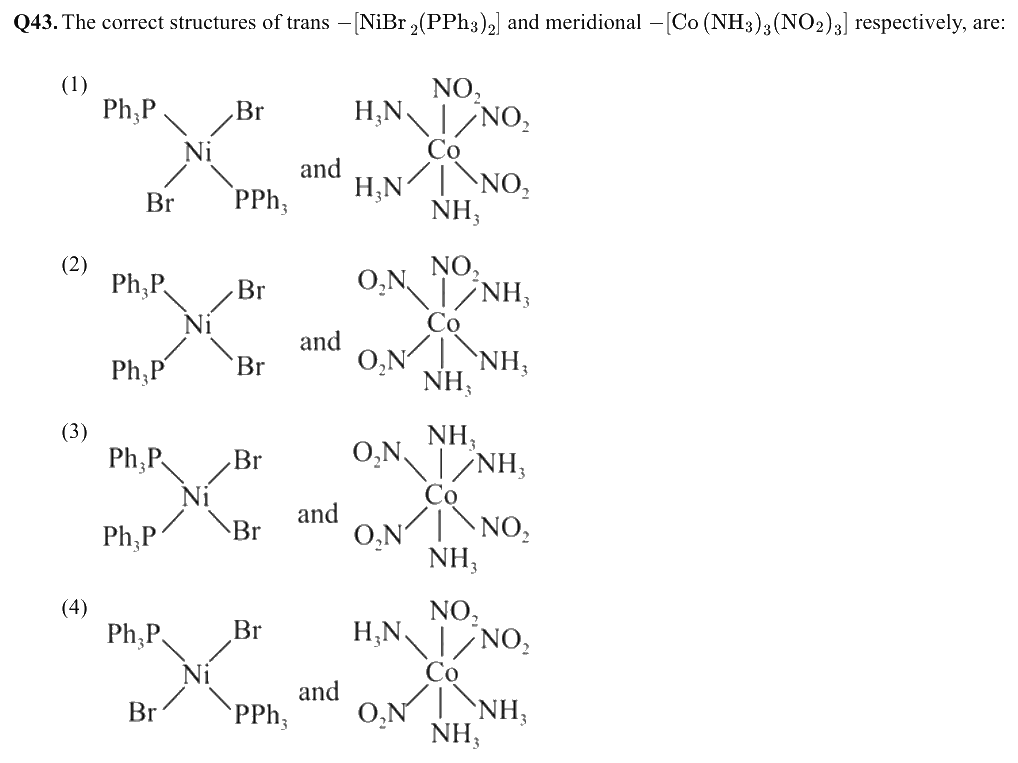
Get EdLoop – freeOpen on the web