EdLoop PYQs · free, no ads · questions and answers here, step-by-step solutions in the EdLoop app
PYQs · free, no adsOpen on the web (app.edloop.in)Get EdLoop – free on Google Play
ChemistryGeneral Principles of Metallurgy

General Principles of Metallurgy: JEE Main PYQs 2002–2023

Every General Principles of Metallurgy question from past JEE Main and AIEEE papers, with options and answers. Newest first.

124questions
116papers covered
2.1%of Chemistry questions, 2019–2026
2002–2023years

Guide at a glance

General principles of metallurgy covers the chemical extraction of metals and was formerly in the Class 12 curriculum before being removed in 2024, standing at rank 25 of 31 chapters with a 2.1% share of the chemistry section.

Most asked sub-topics

Extraction of Metals124

Practise these in EdLoop

Attempt every General Principles of Metallurgy question timed, see the step-by-step solution and track what you get wrong. Free.

Start practice

MCQ, single correct

120 questions
1JEE Main 2023 · 15 Apr · Shift 1MCQOpen question page ↗

Which one of the following is not an example of calcination?

  • A

    $\mathrm{CaCO_3 \xrightarrow{\Delta} CaO + CO_2}$

  • B

    $\mathrm{Fe_2\,O_3.xH_2\,O \xrightarrow{\Delta} Fe_2\,O_3 + xH_2\,O}$

  • C

    $\mathrm{2PbS + 3O_2 \xrightarrow{\Delta} 2PbO + 2\,SO_2}$

  • D

    $\mathrm{CaCO_3.MgCO_3 \xrightarrow{\Delta} CaO + MgO + 2\,CO_2}$

2JEE Main 2023 · 13 Apr · Shift 1MCQOpen question page ↗

Which one of the following is most likely a mismatch?

  • A

    Zinc-Liquation

  • B

    Copper-Electrolysis

  • C

    Nickel-Mond process

  • D

    Titanium-van Arkel Method

3JEE Main 2023 · 13 Apr · Shift 2MCQOpen question page ↗

Given below are two statements related to Ellingham diagram :
Statement I : Ellingham diagrams can be constructed for formation of oxides, sulphides and halides of metals.
Statement II : It consists of plots of $\Delta H°$ vs T for formation of oxides of elements.
In the light of the above statements, choose the most appropriate answer from the options given below :

  • A

    Both Statement I and Statement II are correct

  • B

    Both Statement I and Statement II are incorrect

  • C

    Statement I is correct but Statement II is incorrect

  • D

    Statement I is incorrect but Statement II is correct

4JEE Main 2023 · 12 Apr · Shift 1MCQOpen question page ↗

Given below are two statements: one is labelled as Assertion A and the other is labelled as Reason R
Assertion A: In the Ellingham diagram, a sharp change in slope of the line is observed from Mg $\rightarrow$ MgO at ~1120$^\circ$C
Reason R: There is a large change of entropy associated with the change of state
In the light of the above statements, choose the correct answer from the options given below

  • A

    Both A and R are true but R is NOT the correct explanation of A

  • B

    A is false but R is true

  • C

    Both A and R are true and R is the correct explanation of A

  • D

    A is true but R is false

5JEE Main 2023 · 11 Apr · Shift 1MCQOpen question page ↗

In the extraction process of copper, the product obtained after carrying out the reactions
(i) $2\mathrm{Cu_2S} + 3\mathrm{O_2} \rightarrow 2\mathrm{Cu_2O} + 2\mathrm{SO_2}$
(ii) $2\mathrm{Cu_2O} + \mathrm{Cu_2S} \rightarrow 6\mathrm{Cu} + \mathrm{SO_2}$ is called

  • A

    Blister copper

  • B

    Reduced copper

  • C

    Copper scrap

  • D

    Copper matte

6JEE Main 2023 · 11 Apr · Shift 2MCQOpen question page ↗

Given below are two statements:
Statement I: In the metallurgy process, sulphide ore is converted to oxide before reduction.
Statement II: Oxide ores in general are easier to reduce.
In the light of the above statements, choose the most appropriate answer from the options given below:

  • A

    Statement I is correct but Statement II is incorrect

  • B

    Both Statement I and Statement II are incorrect

  • C

    Statement I is incorrect but Statement II is correct

  • D

    Both Statement I and Statement II are correct

7JEE Main 2023 · 10 Apr · Shift 1MCQOpen question page ↗

Which of the following is used as a stabilizer during the concentration of sulphide ores?

  • A

    Pine oils

  • B

    Fatty acids

  • C

    Xanthates

  • D

    Cresols

8JEE Main 2023 · 10 Apr · Shift 2MCQOpen question page ↗

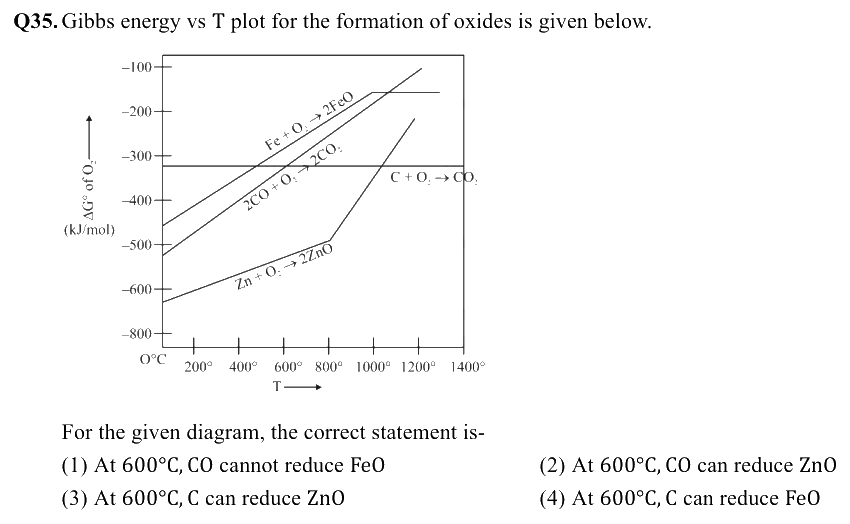
Gibbs energy vs T plot for the formation of oxides is given below.
(see the figure above)
For the given diagram, the correct statement is-

The question and its figure as printed in JEE Main 2023 10 Apr Shift 2.
The question as printed in the paper.
  • A

    At $600^\circ\mathrm{C}$, CO cannot reduce FeO

  • B

    At $600^\circ\mathrm{C}$, CO can reduce ZnO

  • C

    At $600^\circ\mathrm{C}$, C can reduce ZnO

  • D

    At $600^\circ\mathrm{C}$, C can reduce FeO

10JEE Main 2023 · 8 Apr · Shift 2MCQOpen question page ↗

In Hall-Heroult process, the following is used for reducing $\mathrm{Al_2O_3}$ :-

  • A

    Magnesium

  • B

    $\mathrm{Na_3AlF_6}$

  • C

    Graphite

  • D

    $\mathrm{CaF_2}$

11JEE Main 2023 · 1 Feb · Shift 1MCQOpen question page ↗

Given below are two statements: one is labelled as Assertion A and the other is labelled as Reason $R$
Assertion A: In an Ellingham diagram, the oxidation of carbon to carbon monoxide shows a negative slope with respect to temperature.
Reason R: CO tends to get decomposed at higher temperature.
In the light of the above statements, choose the correct answer from the options given below

  • A

    Both A and R are correct and R is the correct explanation of A

  • B

    A is not correct but R is correct

  • C

    Both A and R are correct but R is NOT the correct explanation of A

  • D

    A is correct but R is not correct

12JEE Main 2023 · 31 Jan · Shift 1MCQOpen question page ↗

The methods NOT involved in concentration of ore are
(A) Liquation
(B) Leaching
(C) Electrolysis
(D) Hydraulic washing
(E) Froth floatation
Choose the correct answer from the options given below:

  • A

    B, D and C only

  • B

    C, D and E only

  • C

    A and C only

  • D

    B, D and E only

13JEE Main 2023 · 31 Jan · Shift 2MCQOpen question page ↗

Which one of the following statements is incorrect ?

  • A

    van Arkel method is used to purify tungsten.

  • B

    The malleable iron is prepared from cast iron by oxidising impurities in a reverberatory furnace.

  • C

    Cast iron is obtained by melting pig iron with scrap iron and coke using hot air blast.

  • D

    Boron and Indium can be purified by zone refining method.

14JEE Main 2023 · 30 Jan · Shift 1MCQOpen question page ↗

In the extraction of copper, its sulphide ore is heated in a reverberatory furnace after mixing with silica to:

  • A

    separate CuO as $\mathrm{CuSiO_3}$

  • B

    remove calcium as $\mathrm{CaSiO_3}$

  • C

    decrease the temperature needed for roasting of $\mathrm{Cu_2S}$

  • D

    remove FeO as $\mathrm{FeSiO_3}$

15JEE Main 2023 · 30 Jan · Shift 2MCQOpen question page ↗

Given below are two statements:
Statement I: During Electrolytic refining, the pure metal is made to act as anode and its impure metallic form is used as cathode.
Statement II: During the Hall-Heroult electrolysis process, purified $\mathrm{Al_2\,O_3}$ is mixed with $\mathrm{Na_3\,AlF_6}$ to lower the melting point of the mixture.
In the light of the above statements, choose the most appropriate answer from the options given below:

  • A

    Statement I is incorrect but Statement II is correct

  • B

    Both Statement I and Statement II are incorrect

  • C

    Statement I is correct but Statement II is incorrect

  • D

    Both Statement I and Statement II are correct

16JEE Main 2023 · 29 Jan · Shift 1MCQOpen question page ↗

The reaction representing the Mond process for metal refining is ______

  • A

    $\mathrm{Ni + 4CO \xrightarrow{\Delta} Ni\left(CO\right)_4}$

  • B

    $\mathrm{2K[Au(CN)_2] + Zn \xrightarrow{\Delta} K_2[Zn(CN)_4] + 2\,Au}$

  • C

    $\mathrm{Zr + 2I_2 \xrightarrow{\Delta} ZrI_4}$

  • D

    $\mathrm{ZnO + C \xrightarrow{\Delta} Zn + CO}$

17JEE Main 2023 · 29 Jan · Shift 2MCQOpen question page ↗

The major component of which of the following ore is sulphide based mineral?

  • A

    Calamine

  • B

    Siderite

  • C

    Sphalerite

  • D

    Malachite

18JEE Main 2023 · 25 Jan · Shift 1MCQOpen question page ↗

Which one of the following reactions does not occur during extraction of copper ?

  • A

    $2\,\mathrm{Cu_2S} + 3\mathrm{O_2} \to 2\,\mathrm{Cu_2O} + 2\,\mathrm{SO_2}$

  • B

    $2\mathrm{FeS} + 3\mathrm{O_2} \to 2\mathrm{FeO} + 2\,\mathrm{SO_2}$

  • C

    $\mathrm{CaO} + \mathrm{SiO_2} \to \mathrm{CaSiO_3}$

  • D

    $\mathrm{FeO} + \mathrm{SiO_2} \to \mathrm{FeSiO_3}$

19JEE Main 2023 · 25 Jan · Shift 2MCQOpen question page ↗

Given below are two statements:-

Statement I:- In froth floatation method a rotating paddle agitates the mixture to drive air out of it.

Statement II:- Iron pyrites are generally avoided for extraction of iron due to environmental reasons.

In the light of the above statements, choose the correct answer from the options given below:-

  • A

    Both Statement I and Statement II are true

  • B

    Statement I is false but Statement II is true

  • C

    Statement I is true but Statement II is false

  • D

    Both Statement I and Statement II are false

20JEE Main 2023 · 24 Jan · Shift 1MCQOpen question page ↗

Match List I with List II.

List IList II
A. Reverberatory furnaceI. Pig iron
B. Electrolytic cellII. Aluminium
C. Blast furnaceIII. Silicon
D. Zone refining furnaceIV. Copper
  • A

    A - IV, B - II, C - I, D - III

  • B

    A - I, B - IV, C - II, D - III

  • C

    A - I, B - III, C - II, D - IV

  • D

    A - III, B - IV, C - I, D - II

22JEE Main 2022 · 29 Jul · Shift 1MCQOpen question page ↗

In metallurgy the term "gangue" is used for

  • A

    Contamination of undesired earthy materials.

  • B

    Contamination of metals, other than desired metal

  • C

    Minerals which are naturally occuring in pure form

  • D

    Magnetic impurities in an ore.

23JEE Main 2022 · 29 Jul · Shift 2MCQOpen question page ↗

In liquation process used for tin Sn, the metal

  • A

    is reacted with acid

  • B

    is dissolved in water

  • C

    is brought to molten form which is made to flow on a slope

  • D

    is fused with NaOH,

24JEE Main 2022 · 28 Jul · Shift 1MCQOpen question page ↗

Which of the reaction is suitable for concentrating ore by leaching process?

  • A

    $\mathrm{2Cu_2S+3O_2\rightarrow2Cu_2O+2SO_2}$

  • B

    $\mathrm{Fe_3O_4+CO\rightarrow3FeO+CO_2}$

  • C

    $\mathrm{Al_2O_3+2NaOH+3H_2O\rightarrow2NaAlOH_4}$

  • D

    $\mathrm{Al_2O_3+6Mg\rightarrow6MgO+4Al}$

25JEE Main 2022 · 28 Jul · Shift 2MCQOpen question page ↗

Given below are two statements: One is labelled as Assertion A and the other is labelled as Reason R
Assertion A : The reduction of a metal oxide is easier if the metal formed is in liquid state than solid state.
Reason R : The value of $\Delta G^{\Theta}$ becomes more on negative side as entropy is higher in liquid state than solid state.
In the light of the above statements. Choose the most appropriate answer from the options given below

  • A

    Both A and R are correct and R is the correct explanation of A

  • B

    Both A and R are correct but R is NOT correct explanation of A

  • C

    A is correct but R is not correct

  • D

    A is not correct but R is correct

26JEE Main 2022 · 27 Jul · Shift 1MCQOpen question page ↗

Which of the following methods are not used to refine any metal?
(A) Liquation
(B) Calcination
(C) Electrolysis
(D) Leaching
(E) Distillation
Choose the correct answer from the options given below

  • A

    B and D only

  • B

    A, B, D and E only

  • C

    B, D and E only

  • D

    A, C and E only

27JEE Main 2022 · 26 Jul · Shift 1MCQOpen question page ↗

Refining using liquation method is the most suitable for metals with

  • A

    Low melting point

  • B

    High boiling point

  • C

    High electrical conductivity

  • D

    Less tendency to be soluble in melts than impurities

28JEE Main 2022 · 26 Jul · Shift 2MCQOpen question page ↗

The metal that is not extracted from its sulphide ore is

  • A

    Aluminium

  • B

    Iron

  • C

    Lead

  • D

    Zinc

29JEE Main 2022 · 25 Jul · Shift 1MCQOpen question page ↗

The compound(s) that is(are) removed as slag during the extraction of copper is :
(1) CaO
(2) FeO
(3) $\mathrm{Al_2O_3}$
(4) ZnO
(5) NiO
Choose the correct answer from the options given below

  • A

    3, 4 only

  • B

    2 only

  • C

    1, 2, 5 Only

  • D

    1, 2 only

30JEE Main 2022 · 25 Jul · Shift 2MCQOpen question page ↗

Given below are two statements.
Statement I : Pig iron is obtained by heating cast iron with scrap iron.
Statement II : Pig iron has a relatively lower carbon content than that of cast iron.
In the light of the above statements, choose the correct answer from the options given below.

  • A

    Both Statement I and Statement II are correct.

  • B

    Both Statement I and Statement II are not correct.

  • C

    Statement I is correct but Statement II is not correct

  • D

    Statement I is not correct but Statement II is correct.

31JEE Main 2022 · 29 Jun · Shift 1MCQOpen question page ↗

In isolation of which one of the following metals from their ores, the use of cyanide salt is commonly not involved?

  • A

    Zinc

  • B

    Silver

  • C

    Gold

  • D

    Copper

32JEE Main 2022 · 29 Jun · Shift 2MCQOpen question page ↗

Match List I with List II.
List I With Ore
A.Siderite
B.Malachite
C.Sphalerite
D.Calamine
List II Composition
I.$\mathrm{FeCO_3}$
II.$\mathrm{CuCO_3 \cdot Cu(OH)_2}$
III.$\mathrm{ZnS}$
IV.$\mathrm{ZnCO_3}$
Choose the correct answer from the options given below:

  • A

    A-I, B-II, C-III, D-IV

  • B

    A-III, B-IV, C-E, D-I

  • C

    A-IV, B-III, C-I, D-II

  • D

    A-I, B-II, C-IV, D-III

33JEE Main 2022 · 28 Jun · Shift 1MCQOpen question page ↗

Given are two statements one is labelled as Assertion and other is labelled as Reason.
Assertion: Magnesium can reduce $\mathrm{Al_2O_3}$ at a temperature below $1350\ ^\circ\mathrm{C}$, while above $1350\ ^\circ\mathrm{C}$ aluminium can reduce $\mathrm{MgO}$.
Reason: The melting and boiling points of magnesium are lower than those of aluminium.
In light of the above statements, choose most appropriate answer from the options given below

  • A

    Both Assertion and Reason are correct, and Reason is correct explanation of Assertion.

  • B

    Both Assertion and Reason are correct, but Reason is NOT the correct explanation of Assertion.

  • C

    Assertion is correct Reason is not correct.

  • D

    Assertion is not correct, Reason is correct.

34JEE Main 2022 · 28 Jun · Shift 2MCQOpen question page ↗

In the metallurgical extraction of copper, following reaction is used :
$\mathrm{FeO + SiO_2 \rightarrow FeSiO_3}$
$\mathrm{FeO}$ and $\mathrm{FeSiO_3}$ respectively are.

  • A

    gangue and flux.

  • B

    flux and slag

  • C

    slag and flux.

  • D

    Gauge and slag

35JEE Main 2022 · 27 Jun · Shift 1MCQOpen question page ↗

Match List - I with List - II.
List-I
A Concentration of gold ore
B Leaching of alumina
C Froth stabiliser
D Blister copper
List-II
I Aniline
II NaOH
III $\mathrm{SO_2}$
IV NaCN
Choose the correct answer from the options given below.

  • A

    (A) $-$ (IV), (B) $-$ (III), (C) $-$ (II), (D) $-$ (I)

  • B

    (A) $-$ (IV), (B) $-$ (II), (C) $-$ (I), (D) $-$ (III)

  • C

    (A) $-$ (III), (B) $-$ (II), (C) $-$ (I), (D) $-$ (IV)

  • D

    (A) $-$ (II), (B) $-$ (IV), (C) $-$ (III), (D) $-$ (I)

36JEE Main 2022 · 27 Jun · Shift 2MCQOpen question page ↗

Statement I: Leaching of gold with cyanide ion in absence of air / $\mathrm{O_2}$ leads to cyano complex of Au(III).
Statement II: Zinc is oxidized during the displacement reaction carried out for gold extraction.
In the light of the above statements, choose the correct answer from the options given below.

  • A

    Both Statement 1 and statement 2 are correct

  • B

    Both Statement 1 and statement 2 are incorrect

  • C

    Statement 1 is correct but statement 2 is incorrect

  • D

    Statement 1 is incorrect but statement 2 is correct

37JEE Main 2022 · 26 Jun · Shift 1MCQOpen question page ↗

Given below are two statements :
Statement I : According to the Ellingham diagram, any metal oxide with higher $\Delta G^\circ$ is more stable than the one with lower $\Delta G^\circ$.
Statement II : The metal involved in the formation of oxide placed lower in the Ellingham diagram can reduce the oxide of a metal placed higher in the diagram.
In the light of the above statements, choose the most appropriate answer from the options given below

  • A

    Both Statement I and Statement II are correct.

  • B

    Both Statement I and Statement II are incorrect.

  • C

    Statement I is correct but Statement II is incorrect.

  • D

    Statement I is incorrect but Statement II is correct.

38JEE Main 2022 · 26 Jun · Shift 2MCQOpen question page ↗

The role of depressants in 'Froth Floation method' is to

  • A

    selectively prevent one component of the ore from coming to the froth.

  • B

    reduce the consumption of oil for froth formation.

  • C

    stabilize the froth.

  • D

    enhance non-wettability of the mineral particles.

39JEE Main 2022 · 25 Jun · Shift 1MCQOpen question page ↗

Leaching of gold with dilute aqueous solution of NaCN in presence of oxygen gives complex A, which on reaction with zinc forms the elemental gold and another complex B. A and B, respectively are

  • A

    $\mathrm{AuCN}_2^-$ and $\mathrm{ZnCN}_4^{2-}$

  • B

    $\mathrm{AuCN}_4^-$ and $\mathrm{ZnCN}_2\mathrm{OH}_2^{2-}$

  • C

    $\mathrm{AuCN}_2^-$ and $\mathrm{ZnOH}_4^{2-}$

  • D

    $\mathrm{AuCN}_4^{2-}$ and $\mathrm{ZnCN}_6^{4-}$

40JEE Main 2022 · 25 Jun · Shift 2MCQOpen question page ↗

Given below are two statements.
Statement I: During electrolytic refining. blister copper deposits precious metals.
Statement II: In the process of obtaining pure copper by electrolysis method, copper blister is used to make the anode.
In the light of the above statements, choose the correct answer from the options given below.

  • A

    Both Statement I and Statement II are true.

  • B

    Both Statement I and Statement II are false.

  • C

    Statement I is true but Statement II is false.

  • D

    Statement I is false but Statement II is true.

41JEE Main 2022 · 24 Jun · Shift 1MCQOpen question page ↗

Match List - I with List - II :

List-IList-II
(A) Sphalerite(I) $\mathrm{FeCO_3}$
(B) Calamine(II) PbS
(C) Galena(III) $\mathrm{ZnCO_3}$
(D) Siderite(IV) ZnS

Choose the most appropriate answer from the options given below :

  • A

    (A) $-$ (IV), (B) $-$ (I), (C) $-$ (II), (D) $-$ (III)

  • B

    (A) $-$ (IV), (B) $-$ (III), (C) $-$ (II), (D) $-$ (I)

  • C

    (A) $-$ (II), (B) $-$ (II), (C) $-$ (I), (D) $-$ (IV)

  • D

    (A) $-$ (III), (B) $-$ (IV), (C) $-$ (II), (D) $-$ (I)

42JEE Main 2022 · 24 Jun · Shift 2MCQOpen question page ↗

Which of the following chemical reactions represents Hall-Heroult Process?

  • A

    $\mathrm{Cr_2O_3} + 2\mathrm{Al} \rightarrow \mathrm{Al_2O_3} + 2\mathrm{Cr}$

  • B

    $2\,\mathrm{Al_2O_3} + 3\mathrm{C} \rightarrow 4\mathrm{Al} + 3\,\mathrm{CO_2}$

  • C

    $\mathrm{FeO} + \mathrm{CO} \rightarrow \mathrm{Fe} + \mathrm{CO_2}$

  • D

    $2[\mathrm{Au(CN)_2}]^{-}(\mathrm{aq}) + \mathrm{Zn(s)} \rightarrow 2\,\mathrm{Au(s)} + [\mathrm{Zn(CN)_4}]^{2-}$

43JEE Main 2021 · 1 Sep · Shift 2MCQOpen question page ↗

Calamine and Malachite, respectively, are the ores of :

  • A

    Copper and Iron

  • B

    Zinc and Copper

  • C

    Aluminium and Zinc

  • D

    Nickel and Aluminium

44JEE Main 2021 · 31 Aug · Shift 1MCQOpen question page ↗

Given below are two statements : one is labelled as Assertion (A) and the other is labelled as Reason (R).
Assertion (A) : Aluminium is extracted from bauxite by the electrolysis of molten mixture of $\mathrm{Al_2O_3}$ with cryolite.
Reason (R) : The oxidation state of Al in cryolite is $+3$.
In the light of the above statements, choose the most appropriate answer from the options given below :

  • A

    Both (A) and (R) are correct and (R) is the correct explanation of (A).

  • B

    (A) is true but (R) is false.

  • C

    Both (A) and (R) are correct but (R) is not the correct explanation of (A).

  • D

    (A) is false but (R) is true.

45JEE Main 2021 · 27 Aug · Shift 1MCQOpen question page ↗

Which refining process is generally used in the purification of low melting metals?

  • A

    Chromatographic method

  • B

    Electrolysis

  • C

    Zone refining

  • D

    Liquation

46JEE Main 2021 · 27 Aug · Shift 2MCQOpen question page ↗

Match List-I with List-II :
List-I
(Name of ore/mineral)
a Calamine
b Malachite
c Siderite
d Sphalerite
List-I
(Chemical formula)
i $\mathrm{ZnS}$
ii $\mathrm{FeCO_3}$
iii $\mathrm{ZnCO_3}$
iv $\mathrm{CuCO_3\cdot Cu(OH)_2}$
Choose the most appropriate answer from the options given below :

  • A

    (a) $-$ (iv), (b) $-$ (iii), (c) $-$ (i), (d) $-$ (ii)

  • B

    (a) $-$ (iii), (b) $-$ (ii), (c) $-$ (iv), (d) $-$ (i)

  • C

    (a) $-$ (iii), (b) $-$ (iv), (c) $-$ (i), (d) $-$ (ii)

  • D

    (a) $-$ (iii), (b) $-$ (iv), (c) $-$ (ii), (d) $-$ (i)

47JEE Main 2021 · 26 Aug · Shift 1MCQOpen question page ↗

Given below are two statements.
Statement I: The choice of reducing agents for metals extraction can be made by using the Ellingham diagram, a plot of $\Delta$G vs temperature.
Statement II: The value of $\Delta$S increases from left to right in the Ellingham diagram.
In the light of the above statements, choose the most appropriate answer from the options given below:

  • A

    Statement I is false but Statement II is true

  • B

    Both Statement I and Statement II are true

  • C

    Statement I is true but Statement II is false

  • D

    Both Statenent I and Statement II are false

48JEE Main 2021 · 26 Aug · Shift 2MCQOpen question page ↗

Given below are two statements:
Statement I : Sphalerite is a sulphide ore of zinc and copper glance is a sulphide ore of copper.
Statement II : It is possible to separate two sulphide ores by adjusting proportion of oil to water or by using 'depressants' in a froth flotation method.
Choose the most appropriate answer from the options given below :

  • A

    Statement I is true but Statement II is false.

  • B

    Both Statement I and Statement II are true.

  • C

    Both Statement I and Statement II are false.

  • D

    Statement I is false but Statement II is true.

49JEE Main 2021 · 27 Jul · Shift 1MCQOpen question page ↗

The statement that is INCORRECT about Ellingham diagram is

  • A

    provides idea about the reaction rate.

  • B

    provides idea about free energy change.

  • C

    provides idea about changes in the phases during the reaction.

  • D

    provides idea about reduction of metal oxide.

50JEE Main 2021 · 27 Jul · Shift 2MCQOpen question page ↗

The addition of silica during the extraction of copper from its sulphide ore :-

  • A

    converts copper sulphide into copper silicate

  • B

    converts iron oxide into iron silicate

  • C

    reduces copper sulphide into metallic copper

  • D

    reduces the melting point of the reaction mixture

51JEE Main 2021 · 25 Jul · Shift 1MCQOpen question page ↗

In the leaching of alumina from bauxite, the ore expected to leach out in the process by reacting with NaOH is :

  • A

    $\mathrm{TiO_2}$

  • B

    $\mathrm{Fe_2O_3}$

  • C

    $\mathrm{ZnO}$

  • D

    $\mathrm{SiO_2}$

52JEE Main 2021 · 25 Jul · Shift 2MCQOpen question page ↗

Match List I with List II : (Both having metallurgical terms)
List-I | List-II
(a) Concentration of Ag ore | (i) Reverberatory furnace
(b) Blast furnace | (ii) Pig iron
(c) Blister copper | (iii) Leaching with dilute NaCN solution
(d) Froth floatation method | (iv) Sulfide ores
Choose the correct answer from the options given below.

  • A

    (a) – (iii), (b) – (ii), (c) – (i), (d) – (iv)

  • B

    (a) – (iii), (b) – (iv), (c) – (i), (d) – (ii)

  • C

    (a) – (iv), (b) – (i), (c) – (iii), (d) – (ii)

  • D

    (a) – (iv), (b) – (ii), (c) – (i), (d) – (iii)

53JEE Main 2021 · 22 Jul · Shift 1MCQOpen question page ↗

Sulphide ion is soft base and its ores are common for metals
(a) Pb (b) Al (c) Ag (d) Mg
Choose the correct answer from the options given below

  • A

    a and c only

  • B

    a and d only

  • C

    a and b only

  • D

    c and d only

55JEE Main 2021 · 20 Jul · Shift 2MCQOpen question page ↗

Consider two chemical reactions (A) and (B) that take place during metallurgical process:
(A) $\mathrm{ZnCO_{3(s)}} \xrightarrow{\Delta} \mathrm{ZnO_{(s)}} + \mathrm{CO_{2(g)}}$
(B) $2\,\mathrm{ZnS_{(s)}} + 3\mathrm{O_{2(g)}} \xrightarrow{\Delta} 2\,\mathrm{ZnO_{(s)}} + 2\,\mathrm{SO_{2(g)}}$
The correct option of names given to them respectively is:

  • A

    (A) is calcination and (B) is roasting

  • B

    Both (A) and (B) are producing same product so both are roasting

  • C

    Both (A) and (B) are producing same product so both are calcination

  • D

    (A) is roasting and (B) is calcination

56JEE Main 2021 · 18 Mar · Shift 1MCQOpen question page ↗

The chemical that is added to reduce the melting point of the reaction mixture during the extraction of aluminium is:

  • A

    Cryolite

  • B

    Bauxite

  • C

    Calamine

  • D

    Kaolite

57JEE Main 2021 · 18 Mar · Shift 2MCQOpen question page ↗

Match list-I with list-II :
List-I
List-II
(a) Mercury (i) Vapour phase refining
(b) Copper (ii) Distillation refining
(c) Silicon (iii) Electrolytic refining
(d) Nickel (iv) Zone refining
Choose the most appropriate answer from the option given below :

  • A

    a $-$ i, b $-$ iv, c $-$ ii, d $-$ iii

  • B

    a $-$ ii, b $-$ iii, c $-$ i, d $-$ iv

  • C

    a $-$ ii, b $-$ iii, c $-$ iv, d $-$ i

  • D

    a $-$ ii, b $-$ iv, c $-$ iii, d $-$ i

58JEE Main 2021 · 17 Mar · Shift 1MCQOpen question page ↗

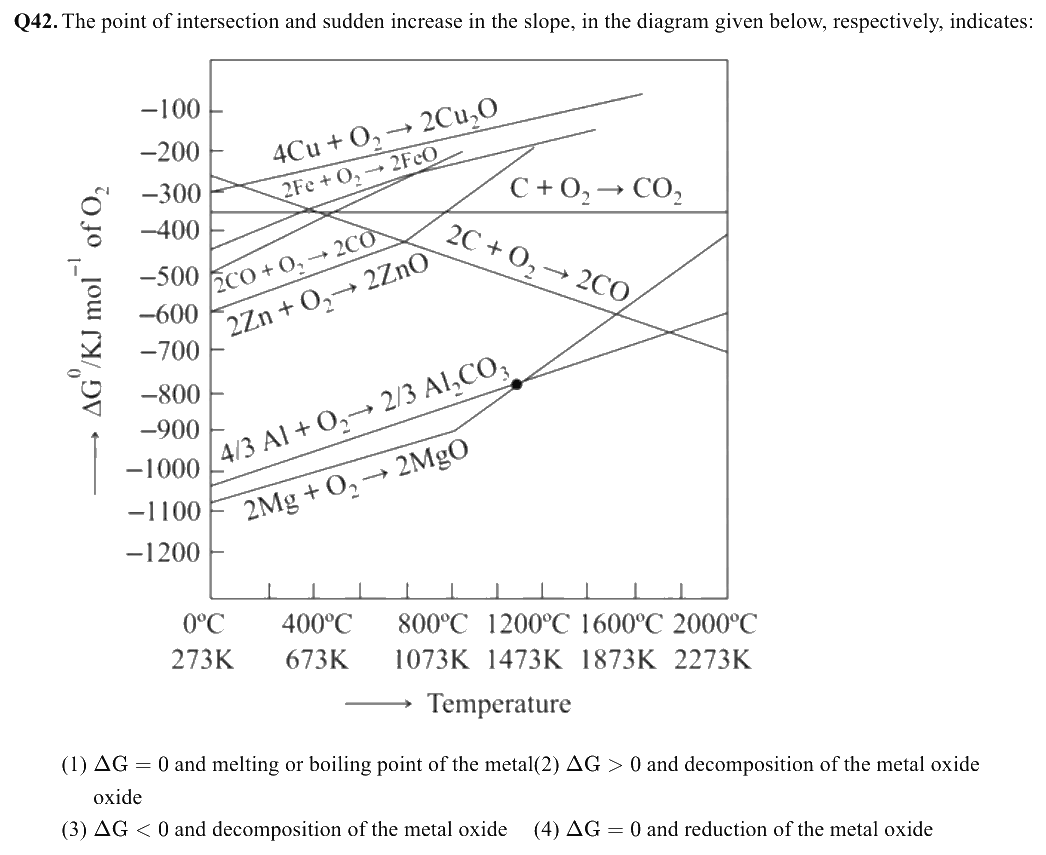
The point of intersection and sudden increase in the slope, in the diagram given below, respectively, indicates:
(see the figure above)

The question and its figure as printed in JEE Main 2021 17 Mar Shift 1.
The question as printed in the paper.
  • A

    $\Delta \mathrm{G}=0$ and melting or boiling point of the metal oxide

  • B

    $\Delta \mathrm{G}>0$ and decomposition of the metal oxide

  • C

    $\Delta \mathrm{G}<0$ and decomposition of the metal oxide

  • D

    $\Delta \mathrm{G}=0$ and reduction of the metal oxide

59JEE Main 2021 · 17 Mar · Shift 2MCQOpen question page ↗

Match List-I and List-II :
List-I : a Haematite, b Bauxite, c Magnetite, d Malachite
List-II : i $\mathrm{Al}_2 \mathrm{O}_3 \cdot x \mathrm{H}_2 \mathrm{O}$, ii $\mathrm{Fe}_2 \mathrm{O}_3$, iii $\mathrm{CuCO}_3 \cdot \mathrm{Cu}(\mathrm{OH})_2$, iv $\mathrm{Fe}_3 \mathrm{O}_4$
Choose the correct answer from the options given below :

  • A

    (a) $-$ (ii), (b) $-$ (iii), (c) $-$ (i), (d) $-$ (iv)

  • B

    (a) $-$ (iv), (b) $-$ (i), (c) $-$ (ii), (d) $-$ (iii)

  • C

    (a) $-$ (i), (b) $-$ (iii), (c) $-$ (ii), (d) $-$ (iv)

  • D

    (a) $-$ (ii), (b) $-$ (i), (c) $-$ (iv), (d) $-$ (iii)

61JEE Main 2021 · 16 Mar · Shift 2MCQOpen question page ↗

Which of the following reduction reaction CANNOT be carried out with coke?

  • A

    $\mathrm{Al_2O_3} \rightarrow \mathrm{Al}$

  • B

    $\mathrm{ZnO} \rightarrow \mathrm{Zn}$

  • C

    $\mathrm{Fe_2O_3} \rightarrow \mathrm{Fe}$

  • D

    $\mathrm{Cu_2O} \rightarrow \mathrm{Cu}$

62JEE Main 2021 · 26 Feb · Shift 1MCQOpen question page ↗

Match List-I with List-II.

List-I (Ore)List-II (Element Present)
(a) Kernite(p) Tin
(b) Cassiterite(q) Boron
(c) Calamine(r) Fluorine
(d) Cryolite(s) Zinc

Choose the most appropriate answer from the options given below:

  • A

    (a) $\rightarrow$ (r), (b) $\rightarrow$ (p), (c) $\rightarrow$ (q), (d) $\rightarrow$ (s)

  • B

    (a) $\rightarrow$ (q), (b) $\rightarrow$ (s), (c) $\rightarrow$ (p), (d) $\rightarrow$ (r)

  • C

    (a) $\rightarrow$ (p), (b) $\rightarrow$ (r), (c) $\rightarrow$ (s), (d) $\rightarrow$ (q)

  • D

    (a) $\rightarrow$ (q), (b) $\rightarrow$ (p), (c) $\rightarrow$ (s), (d) $\rightarrow$ (r)

63JEE Main 2021 · 26 Feb · Shift 2MCQOpen question page ↗

Match List-I with List-II.

List-IList-II
(a) Siderite(i) Cu
(b) Calamine(ii) Ca
(c) Malachite(iii) Fe
(d) Cryolite(iv) Al
(v) Zn

Choose the correct answer from the options given below:

  • A

    (a) $\rightarrow$ (iii), (b) $\rightarrow$ (i), (c) $\rightarrow$ (v), (d) $\rightarrow$ (ii)

  • B

    (a) $\rightarrow$ (i), (b) $\rightarrow$ (ii), (c) $\rightarrow$ (v), (d) $\rightarrow$ (iii)

  • C

    (a) $\rightarrow$ (iii), (b) $\rightarrow$ (v), (c) $\rightarrow$ (i), (d) $\rightarrow$ (iv)

  • D

    (a) $\rightarrow$ (i), (b) $\rightarrow$ (ii), (c) $\rightarrow$ (iii), (d) $\rightarrow$ (iv)

64JEE Main 2021 · 25 Feb · Shift 1MCQOpen question page ↗

Ellingham diagram is a graphical representation of :

  • A

    $\Delta G$ vs P

  • B

    $(\Delta G - T\Delta S)$ vs T

  • C

    $\Delta H$ vs T

  • D

    $\Delta G$ vs T

65JEE Main 2021 · 25 Feb · Shift 2MCQOpen question page ↗

The method used for the purification of Indium is:

  • A

    vapour phase refining

  • B

    liquation

  • C

    zone refining

  • D

    van Arkel method

66JEE Main 2021 · 24 Feb · Shift 1MCQOpen question page ↗

$\mathrm{Al_2O_3}$ was leached with alkali to get X. The solution of X on passing of gas Y, forms Z.
X, Y and Z respectively are

  • A

    $X = \mathrm{AlOH_3}$, $Y = \mathrm{CO_2}$, $Z = \mathrm{Al_2O_3}$

  • B

    $X = \mathrm{NaAlOH_4}$, $Y = \mathrm{SO_2}$, $Z = \mathrm{Al_2O_3}$

  • C

    $X = \mathrm{AlOH_3}$, $Y = \mathrm{SO_2}$, $Z = \mathrm{Al_2O_3 \cdot xH_2O}$

  • D

    $X = \mathrm{NaAlOH_4}$, $Y = \mathrm{CO_2}$, $Z = \mathrm{Al_2O_3}$, $\mathrm{xH_2O}$

68JEE Main 2021 · 24 Feb · Shift 2MCQOpen question page ↗

Match List - I with List - II.
List-I (Metal)
(a) Aluminium
(b) Iron
(c) Copper
(d) Zinc
List-II (Ores)
(i) Siderite
(ii) Calamine
(iii) Kaolinite
(iv) Malachite
Choose the correct answer from the options given below:

  • A

    (a)-(ii), (b)-(iv), (c)-(i), (d)-(iii)

  • B

    (a)-(iv), (b)-(iii), (c)-(ii), (d)-(i)

  • C

    (a)-(i), (b)-(ii), (c)-(iii), (d)-(iv)

  • D

    (a)-(iii), (b)-(i), (c)-(iv), (d)-(ii)

69JEE Main 2020 · 6 Sep · Shift 2MCQOpen question page ↗

For a reaction $4\ \mathrm{M(s)} + n\mathrm{O_2(g)} \rightarrow 2\mathrm{M_2O_n(s)}$
The free energy change is plotted as a function of temperature. The temperature below which the oxide is stable could be inferred from the plot as the point at which :

  • A

    the slope change from negative to positive

  • B

    the free energy change show a change from negative to positive value

  • C

    the slope changes from positive to negative

  • D

    the slope changes from positive to zero

71JEE Main 2020 · 5 Sep · Shift 1MCQOpen question page ↗

An Ellingham diagram provides information about:

  • A

    the conditions of pH and potential under which a species is thermodynamically stable.

  • B

    the temperature dependence of the standard Gibbs energies of formation of some metal oxides.

  • C

    the pressure dependence of the standard electrode potentials of reduction reactions involved in the extraction of metals.

  • D

    the kinetics of the reduction process.

72JEE Main 2020 · 5 Sep · Shift 2MCQOpen question page ↗

Boron and silicon of very high purity can be obtained through :

  • A

    liquation

  • B

    zone refining

  • C

    vapour phase refining

  • D

    electrolytic refining

73JEE Main 2020 · 4 Sep · Shift 1MCQOpen question page ↗

Among statements (a) $-$ (d), the correct ones are :
(a) Lime stone is decomposed to CaO during the extraction of iron from its oxides.
(b) In the extraction of silver, silver is extracted as an anionic complex.
(c) Nickel is purified by Mond's process.
(d) Zr and Ti are purified by Van Arkel method.

  • A

    (a), (b), (c) and (d)

  • B

    (a), (c) and (d) only

  • C

    (b), (c) and (d) only

  • D

    (c) and (d) only

74JEE Main 2020 · 2 Sep · Shift 2MCQOpen question page ↗

Cast iron is used for the manufacture of :

  • A

    wrought iron and pig iron

  • B

    pig iron, scrap iron and steel

  • C

    wrought iron, pig iron and steel

  • D

    wrought iron and steel

75JEE Main 2020 · 9 Jan · Shift 1MCQOpen question page ↗

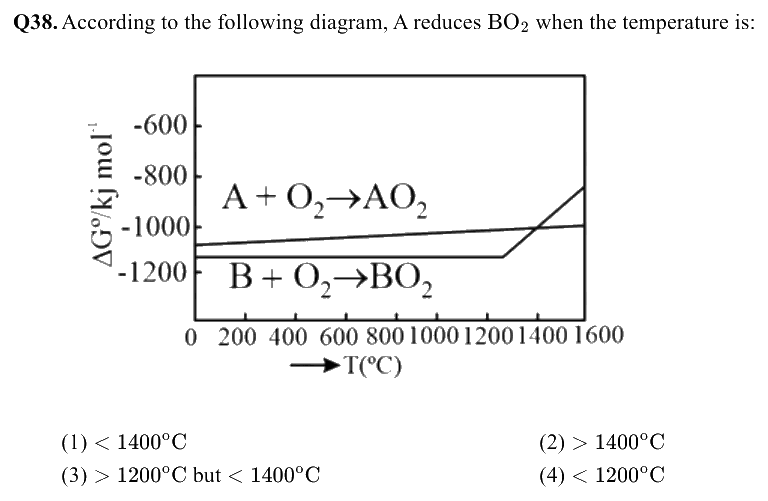
According to the following diagram, A reduces $\mathrm{BO_2}$ when the temperature is:
(see the figure above)

The question and its figure as printed in JEE Main 2020 09 Jan Shift 1.
The question as printed in the paper.
  • A

    $< 1400^o\mathrm{C}$

  • B

    $> 1400^o\mathrm{C}$

  • C

    $> 1200^o\mathrm{C}$ but $< 1400^o\mathrm{C}$

  • D

    $< 1200^o\mathrm{C}$

76JEE Main 2020 · 8 Jan · Shift 2MCQOpen question page ↗

Among the reactions (a) $-$ (d), the reaction(s) that does/do not occur in the blast furnace during the extraction of iron is/are:
$(a)\ CaO + SiO_2 \to CaSiO_3$
$(b)\ 3Fe_2O_3 + CO \to 2Fe_3O_4 + CO_2$
$(c)\ FeO + SiO_2 \to FeSiO_3$
$(d)\ FeO \to Fe + \frac{1}{2}O_2$

  • A

    $a$

  • B

    $a$ and $d$

  • C

    $c$ and $d$

  • D

    $d$

78JEE Main 2020 · 7 Jan · Shift 2MCQOpen question page ↗

The refining method used when the metal and the impurities have low and high melting temperatures, respectively, is

  • A

    liquation.

  • B

    vapour phase refining.

  • C

    zone refining.

  • D

    distillation.

79JEE Main 2019 · 12 Apr · Shift 1MCQOpen question page ↗

The idea of froth flotation method came from a person X and this method is related to the process Y of ores. X and Y, respectivity, are:

  • A

    Washer man and reduction

  • B

    Fisher women and concentration

  • C

    Fisher man and reduction

  • D

    Washer woman and concentration

80JEE Main 2019 · 12 Apr · Shift 2MCQOpen question page ↗

The correct statement is:

  • A

    Pig iron is obtained from cast iron.

  • B

    The Hall-Heroult process is used for the production of aluminium and iron.

  • C

    leaching of bauxite using concentrated NaOH solution gives sodium aluminate and sodium silicate.

  • D

    the blistered appearance of copper during the metallurgical process is due to the evolution of $\mathrm{CO_2}$.

81JEE Main 2019 · 10 Apr · Shift 1MCQOpen question page ↗

Match the refining methods (Column I) with metals (Column II).
Column I
(Refining methods)
(I) Liquation
(II) Zone Refining
(III) Mond Process
(IV) Van Arkel Method
Column II
(Metals)
(a) Zr
(b) Ni
(c) Sn
(d) Ga

  • A

    (I) – (b); (II) – (c); (III) – (d); (IV) – (a)

  • B

    (I) – (b); (II) – (d); (III) – (a); (IV) – (c)

  • C

    (I) – (c); (II) – (d); (III) – (b); (IV) – (a)

  • D

    (I) – (c); (II) – (a); (III) – (b); (IV) – (d)

82JEE Main 2019 · 10 Apr · Shift 2MCQOpen question page ↗

The correct statement is:

  • A

    Aniline is a froth stabilizer.

  • B

    Zone refining process is used for the refining of titanium.

  • C

    Zincite is a carbonate ore.

  • D

    Sodium cyanide cannot be used in the metallurgy of silver.

83JEE Main 2019 · 9 Apr · Shift 1MCQOpen question page ↗

The ore that contains the metal in the form of fluoride is known as which of the following?

  • A

    cryolite

  • B

    magnetite

  • C

    malachite

  • D

    sphalerite

85JEE Main 2019 · 9 Apr · Shift 2MCQOpen question page ↗

Assertion: For the extraction of iron, haematite ore is used.
Reason: Haematite is a carbonate ore of iron.

  • A

    Only the assertion is correct.

  • B

    Only the reason is correct.

  • C

    Both the assertion and reason are correct and the reason is the correct explanation for the assertion.

  • D

    Both the assertion and reason are correct, but the reason is not the correct explanation for the assertion.

86JEE Main 2019 · 8 Apr · Shift 1MCQOpen question page ↗

Which respect to an ore, Ellingham diagram helps to predict the feasibility of its

  • A

    Electrolysis

  • B

    Zone refining

  • C

    Vapour phase refining

  • D

    Thermal reduction

87JEE Main 2019 · 8 Apr · Shift 2MCQOpen question page ↗

The Mond process is used for the:

  • A

    Purification of Zr and Ti

  • B

    Purification of Ni

  • C

    Extraction of Zn

  • D

    Extraction of Mo

88JEE Main 2019 · 12 Jan · Shift 1MCQOpen question page ↗

In the Hall-Heroult process, aluminium is formed at the cathode. The cathode is made out of:

  • A

    Platinum

  • B

    Carbon

  • C

    Copper

  • D

    Pure aluminium

89JEE Main 2019 · 12 Jan · Shift 2MCQOpen question page ↗

The pair that does not require calcination is

  • A

    ZnO and $\mathrm{Fe_2\,O_3.\,xH_2\,O}$

  • B

    ZnO and MgO

  • C

    $\mathrm{ZnCO_3}$ and CaO

  • D

    $\mathrm{Fe_2\,O_3}$ and $\mathrm{CaCO_3.\,MgCO_3}$

90JEE Main 2019 · 11 Jan · Shift 1MCQOpen question page ↗

Match the ores (column A) with the metals (column B) :
(Column A) Ores
(I) Siderite
(II) Kaolinite
(III) Malachite
(IV) Calamine
(Column B) Metals
(a) Zinc
(b) Copper
(c) Iron
(d) Aluminium

  • A

    (I) - (a); (II) - (b); (III) - (c); (IV) - (d)

  • B

    (I) - (c); (II) - (d); (III) - (b); (IV) - (a)

  • C

    (I) - (c); (II) - (d); (III) - (a); (IV) - (b)

  • D

    (I) - (b); (II) - (c); (III) - (d); (IV) - (a)

91JEE Main 2019 · 11 Jan · Shift 2MCQOpen question page ↗

The reaction that does NOT define calcination is:

  • A

    Fe$_2$O$_3 \cdot$ xH$_2$O $\xrightarrow{\Delta}$ Fe$_2$O$_3$ + xH$_2$O

  • B

    2Cu$_2$ S + 3O$_2$ $\xrightarrow{\Delta}$ 2Cu$_2$O + 2SO$_2$

  • C

    ZnCO$_3$ $\xrightarrow{\Delta}$ ZnO + CO$_2$

  • D

    CaCO$_3 \cdot$ MgCO$_3$ $\xrightarrow{\Delta}$ CaO + MgO + 2CO$_2$

92JEE Main 2019 · 10 Jan · Shift 1MCQOpen question page ↗

Hall Heroult's process is given by:

  • A

    $Cr_2O_3 + 2Al \rightarrow Al_2O_3 + Cr$

  • B

    $2Al_2O_3 + 3C \rightarrow 4Al + 3CO_2$

  • C

    $Cu^{2+}(aq) + H_2(g) \rightarrow Cu(s) + 2H^+(aq)$

  • D

    $ZnO + C \xrightarrow{\text{Coke,1673}} Zn + CO$

94JEE Main 2019 · 9 Jan · Shift 2MCQOpen question page ↗

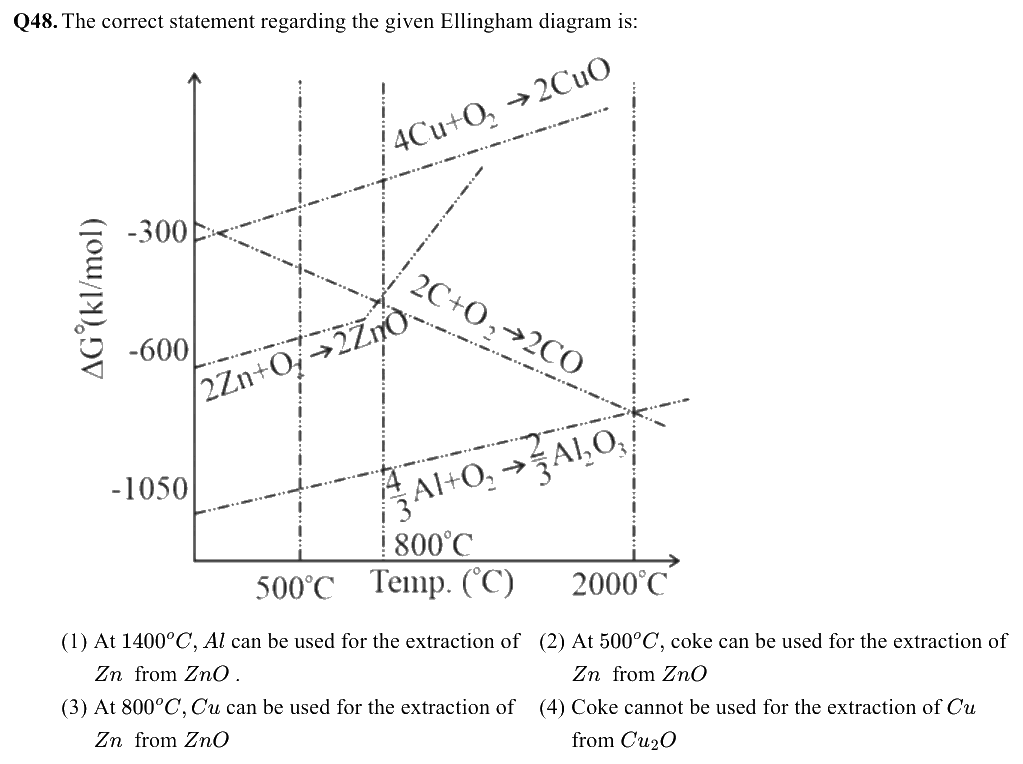
The correct statement regarding the given Ellingham diagram is:
(see the figure above)

The question and its figure as printed in JEE Main 2019 09 Jan Shift 2.
The question as printed in the paper.
  • A

    At $1400^oC$, $Al$ can be used for the extraction of $Zn$ from $ZnO$ .

  • B

    At $500^oC$, coke can be used for the extraction of $Zn$ from $ZnO$

  • C

    At $800^oC$, $Cu$ can be used for the extraction of $Zn$ from $ZnO$

  • D

    Coke cannot be used for the extraction of $Cu$ from $Cu_2O$

95JEE Main 2018 · 16 Apr · OnlineMCQOpen question page ↗

In the extraction of copper from its sulphide ore, metal is finally obtained by the oxidation of cuprous sulphide with:

  • A

    $\mathrm{SO_2}$

  • B

    $\mathrm{Fe_2\,O_3}$

  • C

    $\mathrm{Cu_2\,O}$

  • D

    $\mathrm{CO}$

96JEE Main 2018 · 15 Apr · Shift 2MCQOpen question page ↗

In the leaching method, bauxite ore is digested with a concentrated solution of NaOH that produces ' X '. When $\mathrm{CO_2}$ gas is passed through the aqueous solution of ' $X'$, a hydrated compound ' Y' ' is precipitated. ' X ' and ' Y ' respectively are.

  • A

    $\mathrm{Na\,[Al(OH)_4]}$ and $\mathrm{Al_2(CO_3)_3\cdot xH_2O}$

  • B

    $\mathrm{Al(OH)_3}$ and $\mathrm{Al_2O_3\cdot xH_2O}$

  • C

    $\mathrm{NaAlO_2}$ and $\mathrm{Al_2(CO_3)_3\cdot xH_2O}$

  • D

    $\mathrm{Na\,[Al(OH)_4]}$ and $\mathrm{Al_2O_3\cdot xH_2O}$

97JEE Main 2016 · 10 Apr · OnlineMCQOpen question page ↗

Extraction of copper by smelting uses silica as an additive to remove.

  • A

    $\mathrm{Cu_2O}$

  • B

    $\mathrm{FeS}$

  • C

    $\mathrm{FeO}$

  • D

    $\mathrm{Cu_2S}$

98JEE Main 2016 · 9 Apr · OnlineMCQOpen question page ↗

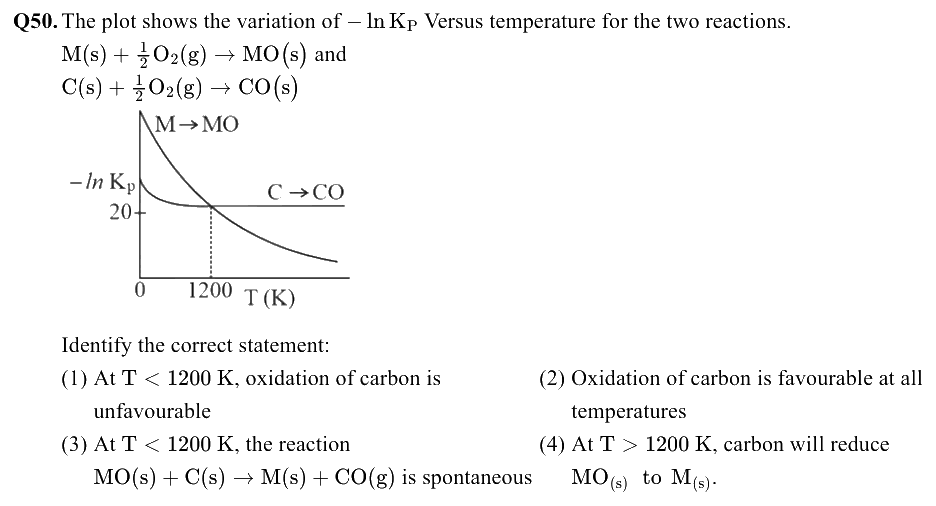
The plot shows the variation of $-\ln \mathrm{K_P}$ Versus temperature for the two reactions.
$\mathrm{M(s) + \frac{1}{2}O_2(g) \rightarrow MO(s)}$ and
$\mathrm{C(s) + \frac{1}{2}O_2(g) \rightarrow CO(s)}$
(see the figure above)
Identify the correct statement:

The question and its figure as printed in JEE Main 2016 09 Apr Online.
The question as printed in the paper.
  • A

    At T < 1200 K, oxidation of carbon is unfavourable

  • B

    Oxidation of carbon is favourable at all temperatures

  • C

    At T < 1200 K, the reaction $\mathrm{MO(s) + C(s) \rightarrow M(s) + CO(g)}$ is spontaneous

  • D

    At T > 1200 K, carbon will reduce $\mathrm{MO_{(s)}}$ to $\mathrm{M_{(s)}}$.

101JEE Main 2015 · 10 Apr · OnlineMCQOpen question page ↗

In the isolation of metals, calcination process usually results in:

  • A

    Metal oxide

  • B

    Metal carbonate

  • C

    Metal sulphide

  • D

    Metal hydroxide

102JEE Main 2015 · 4 Apr · OfflineMCQOpen question page ↗

In the context of the Hall-Heroult process for the extraction of Al, which of the following statements is false?

  • A

    $\mathrm{Na_3AlF_6}$ serves as the electrolyte.

  • B

    $\mathrm{CO}$ and $\mathrm{CO_2}$ are produced in this process.

  • C

    $\mathrm{Al_2O_3}$ is mixed with $\mathrm{CaF_2}$ which lowers the melting point of the mixture and brings conductivity.

  • D

    $\mathrm{Al^{3+}}$ is reduced at the cathode to form Al.

103JEE Main 2014 · 19 Apr · OnlineMCQOpen question page ↗

Which one of the following ores is known as Malachite:

  • A

    $\mathrm{Cu_2\,S}$

  • B

    $\mathrm{Cu_2\,O}$

  • C

    $\mathrm{Cu\,(OH)_2.\,CuCO_3}$

  • D

    $\mathrm{CuFeS_2}$

105JEE Main 2014 · 6 Apr · OfflineMCQOpen question page ↗

Which series of reactions correctly represents the chemical relations related to iron and its compound?

  • A

    $\mathrm{Fe} \xrightarrow{\text{dilute } \mathrm{H_2SO_4}} \mathrm{FeSO_4} \xrightarrow{\mathrm{H_2SO_4,O_2}} \mathrm{Fe_2(SO_4)_3} \xrightarrow{\text{heat}} \mathrm{Fe}$

  • B

    $\mathrm{Fe} \xrightarrow{\mathrm{O_2,\ heat}} \mathrm{FeO} \xrightarrow{\text{dilute } \mathrm{H_2SO_4}} \mathrm{FeSO_4} \xrightarrow{\text{heat}} \mathrm{Fe}$

  • C

    $\mathrm{Fe} \xrightarrow{\mathrm{Cl_2,\ heat}} \mathrm{FeCl_3} \xrightarrow{\text{heat, air}} \mathrm{FeCl_2} \xrightarrow{\mathrm{Zn}} \mathrm{Fe}$

  • D

    $\mathrm{Fe} \xrightarrow{\mathrm{O_2,\ heat}} \mathrm{Fe_3O_4} \xrightarrow{\mathrm{CO,\ 600^\circ C}} \mathrm{FeO} \xrightarrow{\mathrm{CO,\ 700^\circ C}} \mathrm{Fe}$

106JEE Main 2013 · 22 Apr · OnlineMCQOpen question page ↗

In Goldschmidt aluminothermic process which of the following reducing agents is used :

  • A

    calcium

  • B

    coke

  • C

    Al-powder

  • D

    sodium

107JEE Main 2013 · 9 Apr · OnlineMCQOpen question page ↗

Calcination is the process in which:

  • A

    ore is heated above its melting point to expel $\mathrm{H_2O}$ or $\mathrm{CO_2}$ or $\mathrm{SO_2}$

  • B

    ore is heated below its melting point to expel volatile impurities

  • C

    ore is heated above its melting point to remove S, As and Sb as $\mathrm{SO_2}$, $\mathrm{As_2O_3}$ and $\mathrm{Sb_2O_3}$ respectively

  • D

    ore is heated below its melting point to expel $\mathrm{H_2O}$ or $\mathrm{CO_2}$

108AIEEE 2012 · 26 May · OnlineMCQOpen question page ↗

The substance used as froth stabilisers in forth-floatation process is

  • A

    Potassium ethyl xanthate

  • B

    Aniline

  • C

    Sodium cyanide

  • D

    Copper sulphate

109AIEEE 2012 · 19 May · OnlineMCQOpen question page ↗

Extraction of zinc from zinc blende is achieved by

  • A

    roasting followed by self-reduction

  • B

    electrolytic reduction

  • C

    roasting followed by reduction with carbon

  • D

    roasting followed by reduction with another metal

110AIEEE 2012 · 12 May · OnlineMCQOpen question page ↗

In the electrolysis of alumina to obtain aluminium metal, cryolite is added mainly to

  • A

    lower the melting point of alumina

  • B

    dissolve alumina in molten cryolite

  • C

    remove the impurities of alumina

  • D

    increase the electrical conductivity

111AIEEE 2012 · 7 May · OnlineMCQOpen question page ↗

Which of the oxide groups among the following cannot be reduced by carbon?

  • A

    $\mathrm{Cu_2O}, \mathrm{SnO_2}$

  • B

    $\mathrm{CaO}, \mathrm{K_2O}$

  • C

    $\mathrm{PbO}, \mathrm{Fe_3O_4}$

  • D

    $\mathrm{Fe_2O_3}, \mathrm{ZnO}$

112AIEEE 2012 · OfflineMCQOpen question page ↗

Which method of purification is represented by the following equation:
$\mathrm{Ti(s)} + 2\mathrm{I_2(g)} \xrightarrow{523\ \mathrm{K}} \mathrm{TiI_4(g)} \xrightarrow{1700\ \mathrm{K}} \mathrm{Ti(s)} + 2\mathrm{I_2(g)}$

  • A

    zone refining

  • B

    cupellation

  • C

    Poling

  • D

    Van Arkel

113AIEEE 2008MCQOpen question page ↗

Which of the following factors is of no significance for roasting sulphide ores to the oxides and not subjecting the sulphide ores to carbon reduction directly?

  • A

    Metal sulphides are thermodynamically more stable than $\mathrm{CS_2}$

  • B

    $\mathrm{CO_2}$ is thermodynamically more stable than $\mathrm{CS_2}$

  • C

    Metal sulphides are less stable than the corresponding oxides

  • D

    $\mathrm{CO_2}$ is more volatile than $\mathrm{CS_2}$

114AIEEE 2005MCQOpen question page ↗

During the process of electrolytic refining of copper, some metals present as impurity settle as 'anode mud' These are

  • A

    Sn and Ag

  • B

    Pb and Zn

  • C

    Ag and Au

  • D

    Fe and Ni

115AIEEE 2005MCQOpen question page ↗

Heating mixture of $\mathrm{Cu_2O}$ and $\mathrm{Cu_2\,S}$ will give

  • A

    $\mathrm{Cu + SO_2}$

  • B

    $\mathrm{Cu + SO_3}$

  • C

    $\mathrm{CuO + CuS}$

  • D

    $\mathrm{Cu_2SO_3}$

117AIEEE 2002MCQOpen question page ↗

When the sample of copper with zinc impurity is to be purified by electrolysis, the appropriate electrodes are

  • A

    cathode - pure zinc anode - pure copper

  • B

    cathode - impure sample anode - pure copper

  • C

    cathode - impure zinc anode - impure sample

  • D

    cathode - pure copper anode - impure sample

118AIEEE 2002MCQOpen question page ↗

Aluminium is extracted by the electrolysis of

  • A

    bauxite

  • B

    alumina

  • C

    alumina mixed with molten cryolite

  • D

    molten cryolite

Numerical value

4 questions
121JEE Main 2023 · 1 Feb · Shift 2NumericalOpen question page ↗

Among following compounds, the number of those present in copper matte is
A. $\mathrm{CuCO_3}$
B. $\mathrm{Cu_2\ S}$
C. $\mathrm{Cu_2\ O}$
D. FeO

Numerical answer type: type your answer in EdLoop to check it
122JEE Main 2022 · 27 Jul · Shift 2NumericalOpen question page ↗

Among the following ores Bauxite, Siderite, Cuprite, Calamine, Haematite, Kaolinite, Malachite, Magnetite, Sphalerite, Limonite, Cryolite, the number of principal ores of iron is

Numerical answer type: type your answer in EdLoop to check it
123JEE Main 2022 · 24 Jun · Shift 2NumericalOpen question page ↗

(a) Baryte, (b) Galena, (c) Zinc blende and (d) Copper pyrites. How many of these minerals are sulphide based?

Numerical answer type: type your answer in EdLoop to check it
124JEE Main 2021 · 31 Aug · Shift 2NumericalOpen question page ↗

In the electrolytic refining of blister copper, the total number of main impurities, from the following, removed as anode mud is ______.
Pb, Sb, Se, Te, Ru, Ag, Au and Pt

Numerical answer type: type your answer in EdLoop to check it

How to prepare General Principles of Metallurgy for JEE Main

How often it comes up

General principles of metallurgy covers the chemical extraction of metals and was formerly in the Class 12 curriculum before being removed in 2024, standing at rank 25 of 31 chapters with a 2.1% share of the chemistry section. In the 2019 to 2026 test series, General Principles of Metallurgy yielded 98 questions across 162 exam papers, accounting for 2.1% of the chemistry section and standing at rank 25 of 31 chapters. During the 2002 to 2018 period, it produced 26 questions across 38 papers with a 1.9% share. Across the 2024 to 2026 seasons, it recorded 0 questions across 58 papers, resulting in a 0.0% share. The chapter's appearance frequency has trended down following curriculum deletion.

Due to its removal, the chapter was not asked in 2024, 2025, or 2026. Across the 2019 to 2026 span, it averaged 0.6 questions per paper, with only 4 numerical answer questions recorded.

Most-asked topics

Historic test items fall under one comprehensive topic:

  • Extraction of Metals: Composed 124 total questions (98 during 2019 to 2026), last tested in 2023. Core themes focused on mineral matching (such as sphalerite, calamine, malachite, and bauxite), concentration by froth flotation and leaching, Ellingham diagram Gibbs free energy curves, metallurgy of copper (matte formation and blister copper), blast furnace reduction of hematite, Hall-Héroult process for aluminum, and refining via Mond process and van Arkel method.

What the questions look like

Previous exam questions were largely descriptive and factual. Common problems asked candidates to match mineral names with their chemical formulas, identify the role of depressants like sodium cyanide in separating galena from zinc blende, or explain why Ellingham curves exhibit a positive slope as temperature rises.

Refining methods appeared very frequently, testing which pure metals correspond to specific techniques such as zone refining for semiconductors (silicon and germanium), Mond process for nickel, or van Arkel method for zirconium and titanium.

Questions to try first

Students reviewing past papers for broader inorganic chemistry intuition can explore these historical questions:

How to practise it

Because metallurgy has been dropped from the active syllabus, optimize your study plan accordingly:

1. Dedicate time to current inorganic units: Concentrate your preparation hours on active syllabus topics such as Coordination Compounds and d- and f-Block Elements. 2. Maintain basic mineral formula recall: Knowing common ore names like bauxite, hematite, and copper pyrites occasionally supports practical chemistry questions. 3. Understand Ellingham fundamentals: Grasping that lower lines on free energy plots reduce metal oxides located higher up reinforces core thermodynamic principles.

Frequently asked questions

Is Metallurgy included in the current JEE Main curriculum?

No, the National Testing Agency removed Isolation of Metals in 2024, with zero questions appearing in 2024, 2025, and 2026.

Are refining processes like the Mond process still relevant?

The Mond process involves nickel tetracarbonyl, which remains an important coordination complex under the active Coordination Compounds chapter.

Where can I review full solutions to past metallurgy questions?

Past questions remain accessible for historical reference and foundational chemistry. Step-by-step solutions for each one are in the EdLoop app.

Get EdLoop – freeOpen on the web