EdLoop PYQs · free, no ads · questions and answers here, step-by-step solutions in the EdLoop app
PYQs · free, no adsOpen on the web (app.edloop.in)Get EdLoop – free on Google Play
ChemistryPurification & Characterisation

Purification & Characterisation: JEE Main PYQs 2004–2026

Every Purification & Characterisation question from past JEE Main and AIEEE papers, with options and answers. Newest first.

161questions
134papers covered
3.1%of Chemistry questions, 2019–2026
2004–2026years

Guide at a glance

Purification and characterisation covers laboratory separation methods and elemental analysis under Unit 13: Purification and Characterisation of Organic Compounds in the Class 11 curriculum, holding rank 17 of 31 chapters with a 3.1% share of the chemistry section.

Most asked sub-topics

Quantitative Analysis74
Purification Methods61
Qualitative Analysis26

Practise these in EdLoop

Attempt every Purification & Characterisation question timed, see the step-by-step solution and track what you get wrong. Free.

Start practice

MCQ, single correct

112 questions
1JEE Main 2026 · 8 Apr · Shift 2MCQOpen question page ↗

Given below are two statements :

Statement I : Vapours of the liquid with higher boiling point condense before vapours of the liquid with lower boiling points in fractional distillation.

Statement II : The vapours rising up in the fractionating column become richer in high boiling component of the mixture.

In the light of the above statements, choose the correct answer from the options given below :

  • A

    Both Statement I and Statement II are true

  • B

    Both Statement I and Statement II are false

  • C

    Statement I is true but Statement II is false

  • D

    Statement I is false but Statement II is true

2JEE Main 2026 · 6 Apr · Shift 1MCQOpen question page ↗

$\mathrm{R_f}$ value for 2-methylpropene in a solvent system (Ethyl acetate + ether) is 0.42. 2-methylpropene is treated with dilute $\mathrm{H_2SO_4}$ to give major organic product (X). $\mathrm{R_f}$ value for (X) in the same solvent system under identical condition will be:

  • A

    0.42

  • B

    0.82

  • C

    0.62

  • D

    0.12

3JEE Main 2026 · 6 Apr · Shift 2MCQOpen question page ↗

Given below are two statements :

Statement I : A mixture of $\mathrm{C_{12}H_{22}O_{11}}$ (sugar) and NaCl can be separated by dissolving sugar in alcohol, due to differential solubility.

Statement II : Rose essence from rose petals is seperated by steam distillation due to its high volatility and insolubility in $\mathrm{H_2O}$.

In the light of the above statements, choose the correct answer from the options given below :

  • A

    Both Statement I and Statement II are true

  • B

    Both Statement I and Statement II are false

  • C

    Statement I is true but Statement II is false

  • D

    Statement I is false but Statement II is true

4JEE Main 2026 · 5 Apr · Shift 2MCQOpen question page ↗

Match List - I with List - II.

List - I Purification techniqueList - II Used to separate
A. Simple distillationI. Steam volatile compound
B. Fractional distillationII. Two liquids with large difference in boiling points
C. Steam distillationIII. Liquid decomposing at its boiling point
D. Distillation under reduced pressureIV. Two liquids with close boiling points

Choose the correct answer from the options given below :

  • A

    A-II, B-III, C-I, D-IV

  • B

    A-II, B-IV, C-I, D-III

  • C

    A-II, B-IV, C-III, D-I

  • D

    A-IV, B-III, C-II, D-I

5JEE Main 2026 · 2 Apr · Shift 1MCQOpen question page ↗

Given below are two statements :

Statement (I) : 1,2,3-Trihydroxypropane can be separated from water by simple distillation.

Statement (II) : An azeotropic mixture cannot be separated by fractional distillation.

In the light of the above statements, choose the correct answer from the options given below :

  • A

    Both Statement I and Statement II are true

  • B

    Both Statement I and Statement II are false

  • C

    Statement I is true but Statement II is false

  • D

    Statement I is false but Statement II is true

6JEE Main 2026 · 2 Apr · Shift 2MCQOpen question page ↗

Complete combustion of X g of an organic compound gave 0.25 g of $\mathrm{CO_2}$ and 0.12 g of $\mathrm{H_2O}$. If the % of carbon is 25% and of hydrogen is 4.89%, then X = ________ $\times10^{-3}$ g. (Nearest integer)
(Molar mass of C, H and O are 12, 1 and 16 g mol$^{-1}$ respectively.)

  • A

    273

  • B

    27

  • C

    2730

  • D

    227

7JEE Main 2026 · 28 Jan · Shift 1MCQOpen question page ↗

Method used for separation of mixture of products (B and C) obtained in the following reaction is

(see the figure above)

The question and its figure as printed in JEE Main 2026 28 Jan Shift 1.
The question as printed in the paper.
  • A

    simple distillation

  • B

    sublimation

  • C

    fractional distillation

  • D

    steam distillation

8JEE Main 2026 · 28 Jan · Shift 2MCQOpen question page ↗

A student has been given 0.314 g of an organic compound and asked to estimate Sulphur. During the experiment, the student has obtained 0.4813 g of barium sulphate. The percentage of sulphur present in the compound is ________. (Given Molar mass in g mol$^{-1}$ S : 32, BaSO$_4$ : 233)

  • A

    21.05%

  • B

    48.24%

  • C

    42.10%

  • D

    63.15%

9JEE Main 2026 · 23 Jan · Shift 1MCQOpen question page ↗

Given below are two statements :

Statement I : Sublimation is used for the separation and purification of compounds with low melting point.

Statement II : The boiling point of a liquid increases as the external pressure is reduced.

In the light of the above statements, choose the correct answer from the options given below :

  • A

    Both Statement I and Statement II are false

  • B

    Statement I is false but Statement II is true

  • C

    Statement I is true but Statement II is false

  • D

    Both Statement I and Statement II are true

10JEE Main 2026 · 23 Jan · Shift 2MCQOpen question page ↗

In Carius method 0.2425 g of an organic compound gave 0.5253 g silver chloride. The percentage of chlorine in the organic compound is

  • A

    37.57%

  • B

    34.79%

  • C

    53.58%

  • D

    87.65%

11JEE Main 2026 · 22 Jan · Shift 2MCQOpen question page ↗

When 1 g of compound (X) is subjected to Kjeldahl's method for estimation of nitrogen, 15 mL 1 M $\mathrm{H_2SO_4}$ was neutralized by ammonia evolved. The percentage of nitrogen in compound (X) is :

  • A

    21

  • B

    42

  • C

    0.21

  • D

    0.42

12JEE Main 2026 · 21 Jan · Shift 1MCQOpen question page ↗

In Carius method, 0.75 g of an organic compound gave 1.2 g of barium sulphate, find percentage of sulphur (molar mass 32 g mol$^{-1}$). Molar mass of barium sulphate is 233 g mol$^{-1}$.

  • A

    16.48%

  • B

    10.30%

  • C

    21.97%

  • D

    4.55%

13JEE Main 2026 · 21 Jan · Shift 2MCQOpen question page ↗

By usual analysis, 1.00 g of compound (X) gave 1.79 g of magnesium pyrophosphate. The percentage of phosphorus in compound (X) is : (nearest integer)
(Given, molar mass in g mol$^{-1}$ : O = 16, Mg = 24, P = 31)

  • A

    20

  • B

    40

  • C

    30

  • D

    50

14JEE Main 2025 · 8 Apr · Shift 2MCQOpen question page ↗

On combustion 0.210 g of an organic compound containing C, H and O gave $0.127\,g\,H_2O$ and $0.307\,g\,CO_2$. The percentages of hydrogen and oxygen in the given organic compound respectively are:

  • A

    6.72, 53.41

  • B

    6.72, 39.87

  • C

    7.55, 43.85

  • D

    53.41, 39.6

15JEE Main 2025 · 7 Apr · Shift 2MCQOpen question page ↗

Mixture of 1 g each of chlorobenzene, aniline and benzoic acid is dissolved in 50 mL ethyl acetate and placed in a separating funnel. 5M NaOH (30 mL) was added in the same funnel. The funnel was shaken vigorously and then kept aside. The ethyl acetate layer in the funnel contains :

  • A

    benzoic acid and aniline

  • B

    benzoic acid and chlorobenzene

  • C

    benzoic acid

  • D

    chlorobenzene and aniline

16JEE Main 2025 · 4 Apr · Shift 2MCQOpen question page ↗

Match List - I with List - II.

List - I (Separation of)List - II (Separation Technique)
(A)Aniline from aniline-water mixture(I)Simple distillation
(B)Glycerol from spent-lye in soap industry(II)Fractional distillation
(C)Different fractions of crude oil in petroleum industry(III)Distillation at reduced pressure
(D)Chloroform-Aniline mixture(IV)Steam distillation

Choose the correct answer from the options given below :

  • A

    (A)-(III), (B)-(IV), (C)-(I), (D)-(II)

  • B

    (A)-(IV), (B)-(III), (C)-(II), (D)-(I)

  • C

    (A)-(II), (B)-(I), (C)-(IV), (D)-(III)

  • D

    (A)-(I), (B)-(II), (C)-(III), (D)-(IV)

17JEE Main 2025 · 3 Apr · Shift 2MCQOpen question page ↗

In Dumas' method for estimation of nitrogen 0.4 g of an organic compound gave 60 mL of nitrogen collected at 300 K temperature and 715 mm Hg pressure. The percentage composition of nitrogen in the compound is

(Given : Aqueous tension at $300K = 15mmHg$ )

  • A

    17.46%

  • B

    7.85%

  • C

    20.95%

  • D

    15.71%

18JEE Main 2025 · 2 Apr · Shift 2MCQOpen question page ↗

In Dumas' method for estimation of nitrogen, 0.5 gram of an organic compound gave 60 mL of nitrogen collected at 300 K temperature and 715 mm Hg pressure. The percentage composition of nitrogen in the compound (Aqueous tension at 300 K =15 mm Hg) is ______ %

  • A

    20.87

  • B

    18.67

  • C

    12.57

  • D

    1.257

19JEE Main 2025 · 2 Apr · Shift 2MCQOpen question page ↗

Match List - I with List - II.

List - I (Purification technique)List - II (Mixture of organic compounds)
(A)Distillation (simple)(I)Diesel + Petrol
(B)Fractional distillation(II)Aniline + Water
(C)Distillation under reduced pressure(III)Chloroform + Aniline
(D)Steam distillation(IV)Glycerol + Spent-lye

Choose the correct answer from the options given below :

  • A

    (A)-(III),(B)-(IV),(C)-(II),(D)-(I)

  • B

    (A)-(II), (B)-(IV), (C)-(I), (D)-(III)

  • C

    (A)-(II),(B)-(II),(C)-(IV),(D)-(I)

  • D

    (A) -(III),(B)-(I),(C)-(IV),(D)-(II)

20JEE Main 2025 · 29 Jan · Shift 1MCQOpen question page ↗

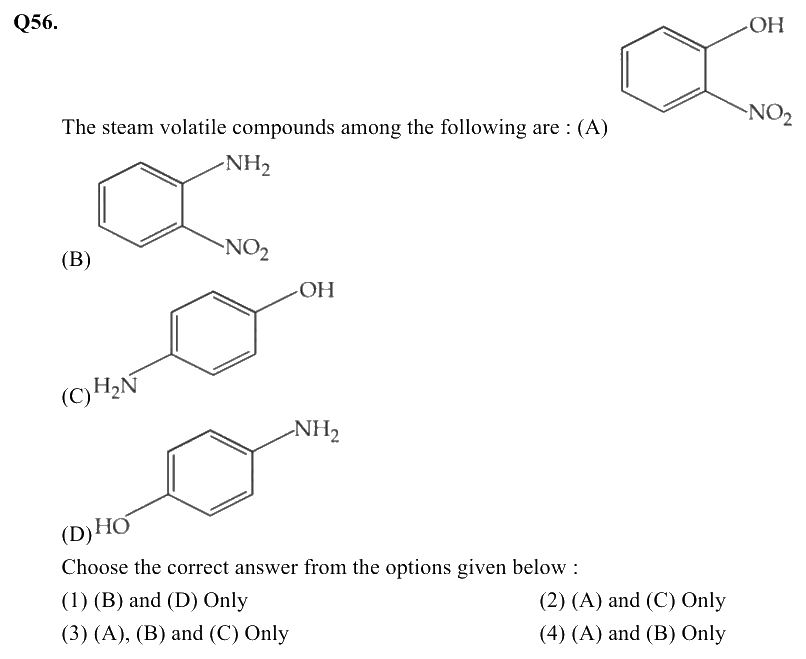
The steam volatile compounds among the following are : (A) (B) (C) (D) Choose the correct answer from the options given below :

(see the figure above)

The question and its figure as printed in JEE Main 2025 29 Jan Shift 1.
The question as printed in the paper.
  • A

    (B) and (D) Only

  • B

    (A) and (C) Only

  • C

    (A), (B) and (C) Only

  • D

    (A) and (B) Only

21JEE Main 2025 · 29 Jan · Shift 2MCQOpen question page ↗

Given below are two statements : Statement (I): In partition chromatography, stationary phase is thin film of liquid present in the inert support. Statement (II) : In paper chromatography, the material of paper acts as a stationary phase. In the light of the above statements, choose the correct answer from the options given below :

  • A

    Statement I is true but Statement II is false

  • B

    Statement I is false but Statement II is true

  • C

    Both Statement I and Statement II are false

  • D

    Both Statement I and Statement II are true

22JEE Main 2025 · 28 Jan · Shift 2MCQOpen question page ↗

The purification method based on the following physical transformation is :

$\underset{(\mathrm{X})}{\text{Solid}} \xrightarrow{\text{Heat}} \underset{(\mathrm{X})}{\text{Vapour}} \xrightarrow{\text{Cool}} \underset{(\mathrm{X})}{\text{Solid}}$

  • A

    Distillation

  • B

    Extraction

  • C

    Sublimation

  • D

    Crystallization

23JEE Main 2025 · 24 Jan · Shift 1MCQOpen question page ↗

Given below are two statements I and II. Statement I: Dumas method is used for estimation of "Nitrogen" in an organic compound. Statement II: Dumas method involves the formation of ammonium sulphate by heating the organic compound with conc $\mathrm{H_2SO_4}$. In the light of the above statements, choose the correct answer from the options given below

  • A

    Statement I is true but Statement II is false

  • B

    Both Statement I and Statement II are false

  • C

    Statement I is false but Statement II is true

  • D

    Both Statement I and Statement II are true

24JEE Main 2025 · 23 Jan · Shift 1MCQOpen question page ↗

Given below are two statements: Statement I: In Lassaigne's test, the covalent organic molecules are transformed into ionic compounds. Statement II: The sodium fusion extract of an organic compound having N and S gives prussian blue colour with $\mathrm{FeSO_4}$ and $\mathrm{Na_4}\,[\mathrm{Fe(CN)_6}]$ In the light of the above statements, choose the correct answer from the options given below.

  • A

    Statement I is true but Statement II is false

  • B

    Both Statement I and Statement II are false

  • C

    Both Statement I and Statement II are true

  • D

    Statement I is false but Statement II is true

25JEE Main 2025 · 22 Jan · Shift 2MCQOpen question page ↗

Given below are two statements : Statement (I) : Nitrogen, sulphur, halogen and phosphorus present in an organic compound are detected by Lassaigne's Test. Statement (II) : The elements present in the compound are converted from covalent form into ionic form by fusing the compound with Magnesium in Lassaigne's test. In the light of the above statements, choose the correct anower from the options given below :

  • A

    Statement I is false but Statement II is true

  • B

    Both Statement I and Statement II are true

  • C

    Both Statement I and Statement II are false

  • D

    Statement I is true but Statement II is false

26JEE Main 2024 · 9 Apr · Shift 1MCQOpen question page ↗

Methods used for purification of organic compounds are based on :

  • A

    nature of compound and presence of impurity.

  • B

    neither on nature of compound nor on the impurity present.

  • C

    nature of compound only.

  • D

    presence of impurity only.

27JEE Main 2024 · 8 Apr · Shift 1MCQOpen question page ↗

Match List I with List II Choose the correct answer from the options given below:

List-I (Molecule)List-II (Shape)
A.$\mathrm{Fe_4[Fe(CN)_6]_3 \cdot xH_2O}$I.Violet
B.$\mathrm{[Fe(CN)_5NOS]^{4-}}$II.Blood Red $A$
C.$\mathrm{[Fe(SCN)]^{2+}}$III.Prussian Blue
D.$\mathrm{(NH_4)_3PO_4 \cdot 12MoO_3}$IV.Yellow
  • A

    A-III, B-I, C-II, D-IV

  • B

    A-I, B-II, C-III, D-IV

  • C

    A-IV, B-I, C-II, D-III

  • D

    A-II, B-III, C-IV, D-I

28JEE Main 2024 · 8 Apr · Shift 2MCQOpen question page ↗

Given below are two statements : Statement (I) : Kjeldahl method is applicable to estimate nitrogen in pyridine. Statement (II) : The nitrogen present in pyridine can easily be converted into ammonium sulphate in Kjeldahl method. In the light of the above statements, choose the correct answer from the options given below

  • A

    Both Statement I and Statement II are true

  • B

    Both Statement I and Statement II are false

  • C

    Statement I is false but Statement II is true

  • D

    Statement I is true but Statement II is false

29JEE Main 2024 · 8 Apr · Shift 2MCQOpen question page ↗

In qualitative test for identification of presence of phosphorous, the compound is heated with an oxidising agent. Which is further treated with nitric acid and ammonium molybdate respectively. The yellow coloured precipitate obtained is :

  • A

    $\mathrm{Na_3PO_4 \cdot 12MoO_3}$

  • B

    $\mathrm{(NH_4)_3PO_4 \cdot 12MoO_3}$

  • C

    $\mathrm{MoPO_4.21NH_4NO_3}$

  • D

    $\mathrm{(NH_4)_3PO_4 \cdot 12(NH_4)_2MoO_4}$

30JEE Main 2024 · 6 Apr · Shift 1MCQOpen question page ↗

Which of the following statements are correct? A. Glycerol is purified by vacuum distillation because it decomposes at its normal boiling point. B. Aniline can be purified by steam distillation as aniline is miscible in water. C. Ethanol can be separated from ethanol water mixture by azeotropic distillation because it forms azeotrope. D. An organic compound is pure, if mixed M.P. is remained same. Choose the most appropriate answer from the options given below :

  • A

    A, B, C only

  • B

    A, C, D only

  • C

    A, B, D only

  • D

    B, C, D only

31JEE Main 2024 · 6 Apr · Shift 2MCQOpen question page ↗

The correct statement among the following, for a "chromatography" purification method is :

  • A

    Organic compounds run faster than solvent in the thin layer chromatographic plate.

  • B

    $R_f$ is an integral value.

  • C

    $R_f$ of a polar compound is smaller than that of a non-polar compound.

  • D

    Non-polar compounds are retained at top and polar compounds come down in column chromatography.

32JEE Main 2024 · 4 Apr · Shift 1MCQOpen question page ↗

Which of the following nitrogen containing compound does not give Lassaigne's test?

  • A

    Urea

  • B

    Phenyl hydrazine

  • C

    Glycene

  • D

    Hydrazine

33JEE Main 2024 · 4 Apr · Shift 2MCQOpen question page ↗

The adsorbent used in adsorption chromatography is/are - A. silica gel B. alumina C. quick lime D. magnesia Choose the most appropriate answer from the options given below :

  • A

    A only

  • B

    B only

  • C

    C and D only

  • D

    A and B only

34JEE Main 2024 · 1 Feb · Shift 1MCQOpen question page ↗

In Kjeldahl's method for estimation of nitrogen, $\mathrm{CuSO_4}$ acts as :

  • A

    Reducing agent

  • B

    Catalytic agent

  • C

    Hydrolysis agent

  • D

    Oxidising agent

35JEE Main 2024 · 1 Feb · Shift 2MCQOpen question page ↗

Lassaigne's test is used for detection of:

  • A

    Nitrogen and Sulphur only

  • B

    Nitrogen, Sulphur and Phosphorous Only

  • C

    Phosphorous and halogens only

  • D

    Nitrogen, Sulphur, and halogens

36JEE Main 2024 · 31 Jan · Shift 1MCQOpen question page ↗

'Adsorption' principle is used for which of the following purification method?

  • A

    Extraction

  • B

    Chromatography

  • C

    Distillation

  • D

    Sublimation

37JEE Main 2024 · 31 Jan · Shift 1MCQOpen question page ↗

Match List I with List II

LIST I (Technique)LIST II (Application)
A. DistillationI. Separation of glycerol from spent-lye
B. Fractional distillationII. Aniline - Water mixture
C. Steam distillationIII. Separation of crude oil fractions
D. Distillation under reduced pressureIV. Chloroform-Aniline

Choose the correct answer from the options given below:

  • A

    A-IV, B-I, C-II, D-III

  • B

    A-IV, B-III, C-II. D-I

  • C

    A-I. B-II, C-IV, D-III

  • D

    A-II, B-III. C-I, D-IV

38JEE Main 2024 · 31 Jan · Shift 2MCQOpen question page ↗

The fragrance of flowers is due to the presence of some steam volatile organic compounds called essential oils. These are generally insoluble in water at room temperature but are miscible with water vapour in the vapour phase. A suitable method for the extraction of these oils from the flowers is:

  • A

    crystallisation

  • B

    distillation under reduced pressure

  • C

    distillation

  • D

    steam distillation

39JEE Main 2024 · 30 Jan · Shift 1MCQOpen question page ↗

The Lassiagne's extract is boiled with dil $\mathrm{HNO_3}$ before testing for halogens because,

  • A

    $\mathrm{AgCN}$ is soluble in $\mathrm{HNO_3}$

  • B

    Silver halides are soluble in $\mathrm{HNO_3}$

  • C

    $\mathrm{Ag_2S}$ is soluble in $\mathrm{HNO_3}$

  • D

    $\mathrm{Na_2S}$ and NaCN are decomposed by $\mathrm{HNO_3}$

40JEE Main 2024 · 30 Jan · Shift 2MCQOpen question page ↗

Which among the following purification methods is based on the principle of "Solubility" in two different solvents?

  • A

    Column Chromatography

  • B

    Sublimation

  • C

    Distillation

  • D

    Differential Extraction

41JEE Main 2024 · 29 Jan · Shift 1MCQOpen question page ↗

Appearance of blood red colour, on treatment of the sodium fusion extract of an organic compound with $\mathrm{FeSO_4}$ in presence of concentrated $\mathrm{H_2\,SO_4}$ indicates the presence of element/s

  • A

    Br

  • B

    N

  • C

    N and S

  • D

    S

42JEE Main 2024 · 29 Jan · Shift 2MCQOpen question page ↗

Chromatographic technique/s based on the principle of differential adsorption is/are

A. Column chromatography B. Thin layer chromatography C. Paper chromatography

Choose the most appropriate answer from the options given below:

  • A

    $B$ only

  • B

    $A$ only

  • C

    $A$ & $B$ only

  • D

    $C$ only

43JEE Main 2024 · 27 Jan · Shift 2MCQOpen question page ↗

The technique used for purification of steam volatile water immiscible substance is:

  • A

    Fractional distillation

  • B

    Fractional distillation under reduced pressure

  • C

    Distillation

  • D

    Steam distillation

44JEE Main 2023 · 15 Apr · Shift 1MCQOpen question page ↗

Which of the following statement is correct for paper chromatography?

  • A

    Water present in the pores of the paper forms the stationary phase.

  • B

    Paper sheet forms the stationary phase.

  • C

    Water present in the mobile phase gets absorbed by the paper which then forms the stationary phase.

  • D

    Paper and water present in its pores together form the stationary phase.

45JEE Main 2023 · 11 Apr · Shift 1MCQOpen question page ↗

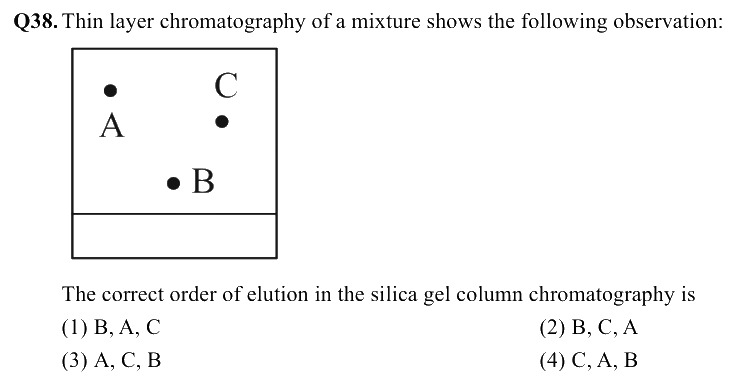
Thin layer chromatography of a mixture shows the following observation:
(see the figure above)
The correct order of elution in the silica gel column chromatography is

The question and its figure as printed in JEE Main 2023 11 Apr Shift 1.
The question as printed in the paper.
  • A

    B, A, C

  • B

    B, C, A

  • C

    A, C, B

  • D

    C, A, B

46JEE Main 2023 · 10 Apr · Shift 1MCQOpen question page ↗

Using column chromatography, mixture of two compounds 'A' and 'B' was separated. 'A' eluted first, this indicates 'B' has

  • A

    low Rf, stronger adsorption

  • B

    high Rf, weaker adsorption

  • C

    high Rf, stronger adsorption

  • D

    low Rf, weaker adsorption

47JEE Main 2023 · 10 Apr · Shift 2MCQOpen question page ↗

In Carius tube, an organic compound 'X' is treated with sodium peroxide to form a mineral acid 'Y'. The solution of $\mathrm{BaCl_2}$ is added to 'Y' to form a precipitate 'Z'. 'Z' is used for the quantitative estimation of an extra element. 'X' could be

  • A

    Cytosine

  • B

    A nucleotide

  • C

    Methionine

  • D

    Chloroxylenol

48JEE Main 2023 · 6 Apr · Shift 1MCQOpen question page ↗

Match List-I with List-II.

List-I Element detectedList-II Reagent used/Product formed
ANitrogenI$\mathrm{Na_2FeCN_5NO}$
BSulphurII$\mathrm{AgNO_3}$
CPhosphorusIII$\mathrm{Fe_4FeCN_{63}}$
DHalogenIV$\mathrm{NH_{42}MoO_4}$

Choose the correct answer from the options given below:

  • A

    A $\rightarrow$ III; B $\rightarrow$ I; C $\rightarrow$ IV; D $\rightarrow$ II

  • B

    A $\rightarrow$ II; B $\rightarrow$ IV; C $\rightarrow$ I; D $\rightarrow$ III

  • C

    A $\rightarrow$ IV; B $\rightarrow$ II; C $\rightarrow$ I; D $\rightarrow$ III

  • D

    A $\rightarrow$ II; B $\rightarrow$ I; C $\rightarrow$ IV; D $\rightarrow$ III

49JEE Main 2023 · 6 Apr · Shift 2MCQOpen question page ↗

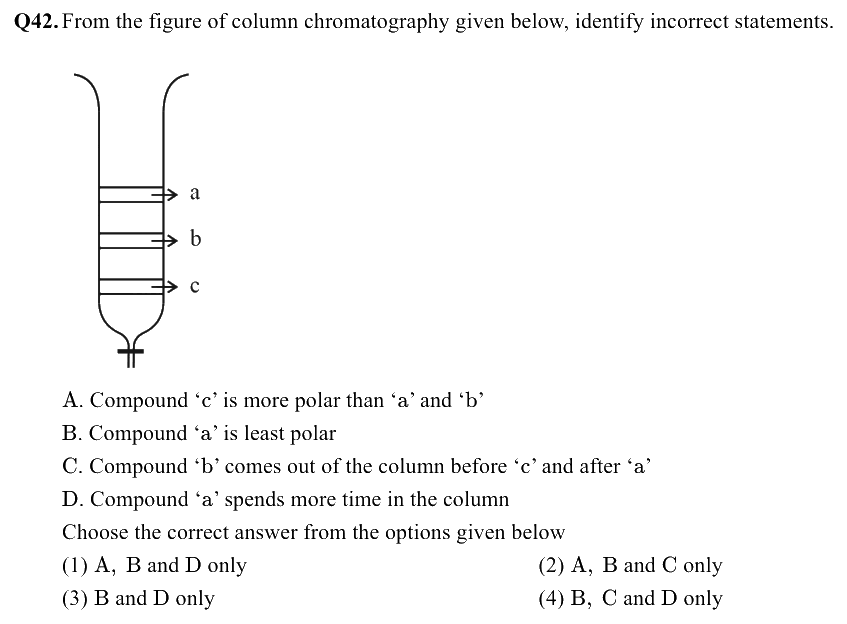
From the figure of column chromatography given below, identify incorrect statements.

(see the figure above)

A. Compound 'c' is more polar than 'a' and 'b'

B. Compound 'a' is least polar

C. Compound 'b' comes out of the column before 'c' and after 'a'

D. Compound 'a' spends more time in the column

Choose the correct answer from the options given below

The question and its figure as printed in JEE Main 2023 06 Apr Shift 2.
The question as printed in the paper.
  • A

    A, B and D only

  • B

    A, B and C only

  • C

    B and D only

  • D

    B, C and D only

50JEE Main 2023 · 1 Feb · Shift 2MCQOpen question page ↗

Given below are two statements:
Statement I: Sulphanilic acid gives esterification test for carboxyl group.
Statement II: Sulphanilic acid gives red colour in Lassigne's test for extra element detection.
In the light of the above statements, choose the most appropriate answer from the options given below:

  • A

    Statement I is correct but Statement II is incorrect.

  • B

    Both Statement I and Statement II are incorrect

  • C

    Both Statement I and Statement II are correct

  • D

    Statement I is incorrect but Statement II is correct.

51JEE Main 2023 · 31 Jan · Shift 1MCQOpen question page ↗

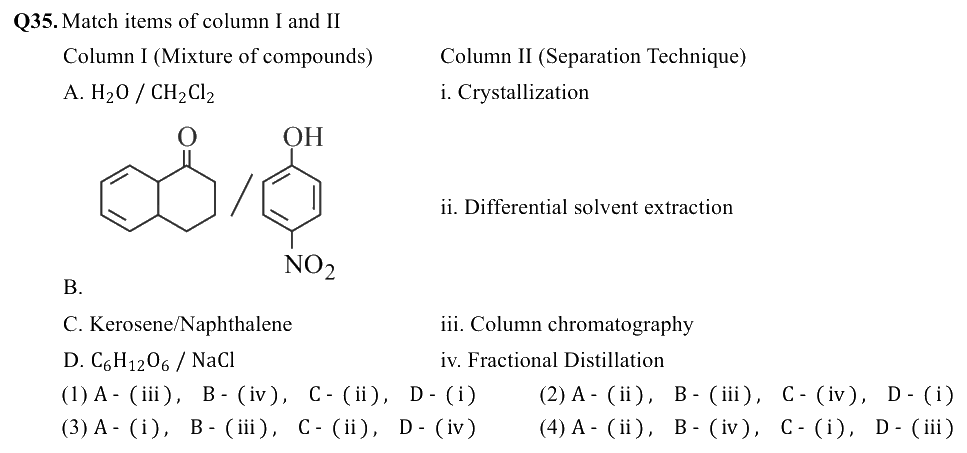
Match items of column I and II

Column I (Mixture of compounds)Column II (Separation Technique)
A.$\mathrm{H_2O}$ / $\mathrm{CH_2Cl_2}$i.Crystallization
B.(see the figure above)ii.Differential solvent extraction
C.Kerosene/Naphthaleneiii.Column chromatography
D.$\mathrm{C_6H_{12}O_6}$ / NaCliv.Fractional Distillation
The question and its figure as printed in JEE Main 2023 31 Jan Shift 1.
The question as printed in the paper.
  • A

    A - (iii), B - (iv), C - (ii), D - (i)

  • B

    A - (ii), B - (iii), C - (iv), D - (i)

  • C

    A - (i), B - (iii), C - (ii), D - (iv)

  • D

    A - (ii), B - (iv), C - (i), D - (iii)

52JEE Main 2023 · 31 Jan · Shift 2MCQOpen question page ↗

In Dumas method for the estimation of $\mathrm{N_2}$, the sample is heated with copper oxide and the gas evolved is passed over:

  • A

    Copper gauze

  • B

    Pd

  • C

    Ni

  • D

    Copper oxide

53JEE Main 2023 · 30 Jan · Shift 1MCQOpen question page ↗

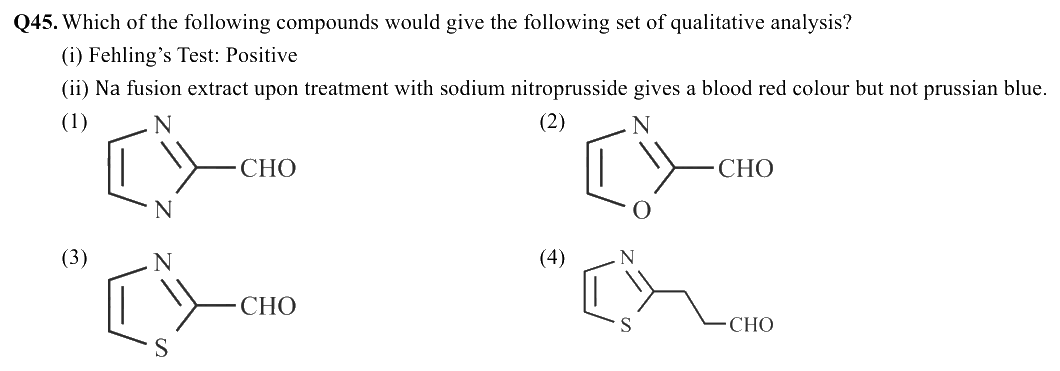
Which of the following compounds would give the following set of qualitative analysis?
(i) Fehling's Test: Positive
(ii) Na fusion extract upon treatment with sodium nitroprusside gives a blood red colour but not prussian blue.

(see the figure above)

The question and its figure as printed in JEE Main 2023 30 Jan Shift 1.
The question as printed in the paper.
  • A

    see figure

  • B

    see figure

  • C

    see figure

  • D

    see figure

54JEE Main 2023 · 30 Jan · Shift 2MCQOpen question page ↗

Match List I with List II:

List I (Mixture)
(A) $\mathrm{CHCl_3 + C_6H_5\,NH_2}$
(B) $\mathrm{C_6H_{14} + C_5H_{12}}$
(C) $\mathrm{C_6H_5\,NH_2 + H_2O}$
(D) Organic compound in $\mathrm{H_2O}$

List II (Separation Technique)
I Steam distillation
II Differential extraction
III Distillation
IV Fractional distillation

  • A

    A-IV, B-I, C-III, D-II

  • B

    A-III, B-IV, C-I, D-II

  • C

    A-II, B-I, C-III, D-IV

  • D

    A-III, B-I, C-IV, D-II

55JEE Main 2023 · 29 Jan · Shift 1MCQOpen question page ↗

Compound that will give positive Lassaigne's test for both nitrogen and halogen is

  • A

    $\mathrm{N_2H_4 \cdot HCl}$

  • B

    $\mathrm{CH_3\,NH_2.HCl}$

  • C

    $\mathrm{NH_4\,Cl}$

  • D

    $\mathrm{NH_2\,OH.HCl}$

56JEE Main 2022 · 28 Jul · Shift 2MCQOpen question page ↗

Given below are two statements: One is labelled as Assertion A and the other is labelled as Reason R
Assertion A : Thin layer chromatography is an adsorption chromatography.
Reason R : A thin layer of silica gel is spread over a glass plate of suitable size in thin layer chromatography which acts as an adsorbent. In the light of the above statements, choose the correct answer from the options given below

  • A

    Both A and R are true and R is the correct explanation of A

  • B

    Both A and R are true but R is NOT the correct explanation of A

  • C

    A is true but R is false

  • D

    A is false but R is true

57JEE Main 2022 · 27 Jul · Shift 1MCQOpen question page ↗

In Carius method of estimation of halogen. 0.45 g of an organic compound gave 0.36 g of AgBr. Find out the percentage of bromine in the compound.
(Molar masses : AgBr = 188 g $\mathrm{mol^{-1}}$ : Br = 80 g $\mathrm{mol^{-1}}$)

  • A

    34.04%

  • B

    40.04%

  • C

    36.03%

  • D

    38.04%

58JEE Main 2022 · 27 Jul · Shift 2MCQOpen question page ↗

Match List-I with List-II

List-I (Mixture)List-II (Purification Process)
AChloroform & AnilineISteam distillation
BBenzoic acid & NapthaleneIISublimation
CWater & AnilineIIIDistillation
DNapthalene & Sodium chlorideIVCrystallisation
  • A

    A – IV, B – III, C – I, D – II

  • B

    A – III, B – I, C – IV, D – II

  • C

    A – III, B – IV, C – II, D – I

  • D

    A – III, B – IV, C – I, D – II

59JEE Main 2022 · 26 Jul · Shift 1MCQOpen question page ↗

Which technique among the following, is most appropriate in separation of a mixture of 100 mg of p-nitrophenol and picric acid?

  • A

    Steam distillation

  • B

    2 – 5 ft long column of silica gel

  • C

    Sublimation

  • D

    Preparative TLC (Thin Layer Chromatography)

60JEE Main 2022 · 28 Jun · Shift 1MCQOpen question page ↗

Which one of the following techniques is not used to spot components of a mixture separated on thin layer chromatographic plate?

  • A

    $\mathrm{I_2}$ (Solid)

  • B

    U.V. Light

  • C

    Visualisation agent as a component of mobile phase

  • D

    Spraying of an appropriate reagent

61JEE Main 2022 · 28 Jun · Shift 1MCQOpen question page ↗

The formula of the purple colour formed in Laissaigne's test for sulphur using sodium nitroprusside is

  • A

    $\mathrm{Na_4[Fe(CN)_5(NOS)]}$

  • B

    $\mathrm{NaFe[Fe(CN)_6]}$

  • C

    $\mathrm{Na[Cr(NH_3)_2(NCS)_4]}$

  • D

    $\mathrm{Na_2[Fe(CN)_5(NO)]}$

62JEE Main 2022 · 27 Jun · Shift 1MCQOpen question page ↗

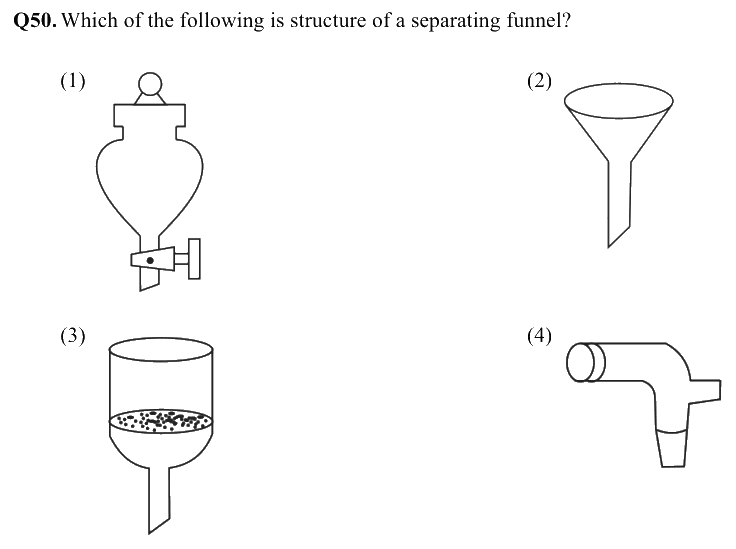
Which of the following is structure of a separating funnel?
(see the figure above)

The question and its figure as printed in JEE Main 2022 27 Jun Shift 1. Option 1: A pear-shaped (teardrop) funnel with a stopper (small ball) at the top and a stopcock (tap) with a short outlet at the bottom. Option 2: A plain conical funnel with a short straight stem. Option 3: A cylindrical funnel with a flat perforated plate (shown with dots) near the bottom, narrowing to a stem (a Buchner-type funnel). Option 4: A bent glass piece (an elbow) with a wide open end at the upper left, a short side arm at the right and a narrow ground joint at the bottom.
The question as printed in the paper.
  • A

    see figure A pear-shaped (teardrop) funnel with a stopper (small ball) at the top and a stopcock (tap) with a short outlet at the bottom.

  • B

    see figure A plain conical funnel with a short straight stem.

  • C

    see figure A cylindrical funnel with a flat perforated plate (shown with dots) near the bottom, narrowing to a stem (a Buchner-type funnel).

  • D

    see figure A bent glass piece (an elbow) with a wide open end at the upper left, a short side arm at the right and a narrow ground joint at the bottom.

63JEE Main 2022 · 26 Jun · Shift 1MCQOpen question page ↗

Given below are two statements :
Statement I : In 'Lassaigne's Test', when both nitrogen and sulphur are present in an organic compound, sodium thiocyanate is formed.
Statement II : If both nitrogen and sulphur are present in an organic compound, then the excess of sodium used in sodium fusion will decompose the sodium thiocyanate formed to give NaCN and $\mathrm{Na}_2\mathrm{S}$.
In the light of the above statements, choose the most appropriate answer from the options a: given below

  • A

    Both Statement I and Statement II are correct.

  • B

    Both Statement I and Statement II are incorrect.

  • C

    Statement I is correct but Statement II is incorrect.

  • D

    Statement I is incorrect but Statement II is correct.

64JEE Main 2022 · 25 Jun · Shift 1MCQOpen question page ↗

Phenol on reaction with dilute nitric acid, gives two products. Which method will be most efficient for large scale separation?

  • A

    Chromatographic separation

  • B

    Steam distillation

  • C

    Fractional Crystallisation

  • D

    Sublimation

65JEE Main 2022 · 25 Jun · Shift 2MCQOpen question page ↗

Given below are two statements: one is labelled as Assertion and the other is labelled as Reason.
Assertion: A mixture contains benzoic acid and napthalene. The pure benzoic acid can be separated out by the use of benzene.
Reason: Benzoic acid is soluble in hot water.
In the light of the above statements, choose the most appropriate answer from the options given below.

  • A

    Both Assertion and Reason are true and Reason is the correct explanation of Assertion.

  • B

    Both Assertion and Reason are true but Reason is not the correct explanation of Assertion.

  • C

    Assertion is true but Reason is false.

  • D

    Assertion is false but Reason is true.

66JEE Main 2022 · 25 Jun · Shift 2MCQOpen question page ↗

During halogen test, sodium fusion extract is boiled with concentrated $\mathrm{HNO_3}$ to

  • A

    remove unreacted sodium

  • B

    decompose cyanide or sulphide of sodium

  • C

    extract halogen from organic compound

  • D

    maintain the pH of extract.

67JEE Main 2022 · 24 Jun · Shift 2MCQOpen question page ↗

$120 \mathrm{~g}$ of an organic compound which contains only carbon and hydrogen on complete combustion gives $330 \mathrm{~g}$ of $\mathrm{CO_2}$ and $270 \mathrm{~g}$ of water. The percentage of carbon and hydrogen in the organic compound are respectively

  • A

    $25$ and $75$

  • B

    $40$ and $60$

  • C

    $60$ and $40$

  • D

    $75$ and $25$

68JEE Main 2021 · 31 Aug · Shift 1MCQOpen question page ↗

Given below are two statements : one is labelled as Assertion (A) and the other is labelled as
Assertion (A): A simple distillation can be used to separate a mixture of propanol and propanone.
Reason (R): Two liquids with a difference of more than $20^\circ$C in their boiling points can be separated by simple distillations.
In the light of the above statements, choose the most appropriate answer from the options given below :

  • A

    Both (A) and (R) are correct but (R) is not the correct explanation of (A).

  • B

    Both (A) and (R) are correct and (R) is the correct explanation of (A).

  • C

    (A) is true but (R) is false.

  • D

    (A) is false but (R) is true.

69JEE Main 2021 · 26 Aug · Shift 1MCQOpen question page ↗

Which one of the following complexes is violet in colour?

  • A

    $\mathrm{Fe_4\,[Fe(CN)_6]_3\cdot H_2O}$

  • B

    $\mathrm{[Fe(CN)_5\,NOS]^{4-}}$

  • C

    $\mathrm{[Fe(SCN)_6]^{4-}}$

  • D

    $\mathrm{[Fe(CN)_6]^{4-}}$

70JEE Main 2021 · 27 Jul · Shift 2MCQOpen question page ↗

Which one of the following set of elements can be detected using sodium fusion extract?

  • A

    Sulfur, Nitrogen, Phosphorus, Halogens

  • B

    Phosphorus, Oxygen, Nitrogen, Halogens

  • C

    Nitrogen, Phosphorus, Carbon, Sulfur

  • D

    Halogens, Nitrogen, Oxygen, Sulfur

71JEE Main 2021 · 22 Jul · Shift 1MCQOpen question page ↗

Which purification technique is used for high boiling organic liquid compound (decomposes near its boiling point) ?

  • A

    Simple distillation

  • B

    Steam distillation

  • C

    Fractional distillation

  • D

    Reduced pressure distillation

72JEE Main 2021 · 20 Jul · Shift 2MCQOpen question page ↗

In Carius method, halogen containing organic compound is heated with fuming nitric acid in the presence of:

  • A

    $\mathrm{HNO_3}$

  • B

    $\mathrm{AgNO_3}$

  • C

    $\mathrm{CuSO_4}$

  • D

    $\mathrm{BaSO_4}$

73JEE Main 2021 · 17 Mar · Shift 1MCQOpen question page ↗

Given below are two statements:
Statement-I: Retardation factor $\left(\mathrm{R}_{\mathrm{f}}\right)$ can be measured in meter/centimetre.
Statement-II: $\mathrm{R}_{\mathrm{f}}$ value of a compound remains constant in all solvents.
Choose the most appropriate answer from the options given below:

  • A

    Statement-I is true but statement-II is false

  • B

    Both statement-I and statement-II are true

  • C

    Both statement-I and statement-II are false

  • D

    Statement-I is false but statement-II is true

74JEE Main 2021 · 17 Mar · Shift 2MCQOpen question page ↗

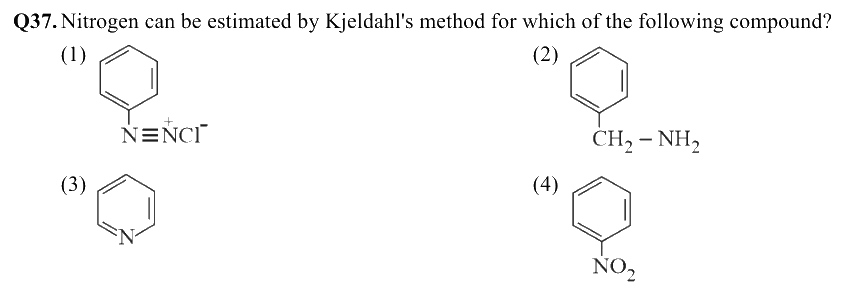
Nitrogen can be estimated by Kjeldahl's method for which of the following compound?

The question and its figure as printed in JEE Main 2021 17 Mar Shift 2. Option 1: Benzene ring bearing a diazonium chloride group, N^+Cl^- (benzenediazonium chloride) Option 2: Benzene ring bearing CH2-NH2 (benzylamine) Option 3: Pyridine (six-membered aromatic ring with one N in the ring) Option 4: Benzene ring bearing a nitro group, NO2 (nitrobenzene)
The question as printed in the paper.
  • A

    see figure Benzene ring bearing a diazonium chloride group, $\mathrm{N}\equiv\mathrm{N}^{+}\mathrm{Cl}^{-}$ (benzenediazonium chloride)

  • B

    see figure Benzene ring bearing $\mathrm{CH_2-NH_2}$ (benzylamine)

  • C

    see figure Pyridine (six-membered aromatic ring with one N in the ring)

  • D

    see figure Benzene ring bearing a nitro group, $\mathrm{NO_2}$ (nitrobenzene)

75JEE Main 2021 · 16 Mar · Shift 1MCQOpen question page ↗

In chromatography technique, the purification of a compound is independent of:

  • A

    Mobility or flow of solvent system

  • B

    Solubility of the compound

  • C

    Length of the column or TLC Plate

  • D

    Physical state of the pure compound

76JEE Main 2021 · 16 Mar · Shift 2MCQOpen question page ↗

Match List-I with List-II

List-I (Test/Reagents/Observation(s))List-II (Species detected)
(a) Lassaigne's Test(i) Carbon
(b) Cu(II) oxide(ii) Sulphur
(c) Silver nitrate(iii) N, S, P, and halogen
(d) The sodium fusion extract gives black precipitate with acetic acid and lead acetate(iv) Halogen Specifically

The correct match is :

  • A

    (a) $-$ (iii), (b) $-$ (i), (c) $-$ (ii), (d) $-$ (iv)

  • B

    (a) $-$ (i), (b) $-$ (iv), (c) $-$ (iii), (d) $-$ (ii)

  • C

    (a) $-$ (iii), (b) $-$ (i), (c) $-$ (iv), (d) $-$ (ii)

  • D

    (a) $-$ (i), (b) $-$ (ii), (c) $-$ (iv), (d) $-$ (iii)

77JEE Main 2021 · 26 Feb · Shift 1MCQOpen question page ↗

Given below are two statements:
Statement I: A mixture of chloroform and aniline can be separated by simple distillation.
Statement II: When separating aniline from a mixture of aniline and water by steam distillation aniline boils below its boiling point.
In the light of the above statements, choose the most appropriate answer from the options given below:

  • A

    Both Statement I and Statement II are true

  • B

    Statement I is true but Statement II is false

  • C

    Statement I is false but Statement II is true

  • D

    Both Statement I and Statement II are false

78JEE Main 2021 · 26 Feb · Shift 1MCQOpen question page ↗

Which of the following is a FALSE statement?

  • A

    Carius tube is used in the estimation of sulphur in an organic compound.

  • B

    Phosphoric acid produced on oxidation of phosphorus present in an organic compound is precipitated as $\mathrm{Mg_2P_2O_7}$ by adding magnesia mixture.

  • C

    Carius method is used for the estimation of nitrogen in an organic compound.

  • D

    Kjeldahl's method is used for the estimation of nitrogen in an organic compound.

79JEE Main 2021 · 25 Feb · Shift 1MCQOpen question page ↗

Complete combustion of $1.80\ \mathrm{g}$ of an oxygen containing compound $(\mathrm{C_xH_yO_z})$ gave $2.64\ \mathrm{g}$ of $\mathrm{CO_2}$ and $1.08\ \mathrm{g}$ of $\mathrm{H_2O}$. The percentage of oxygen in the organic compound is :

  • A

    $53.33$

  • B

    $50.33$

  • C

    $51.63$

  • D

    $63.53$

80JEE Main 2021 · 25 Feb · Shift 2MCQOpen question page ↗

Which of the following compound is added to the sodium extract before addition of silver nitrate for testing of halogens?

  • A

    Nitric acid

  • B

    Sodium hydroxide

  • C

    Ammonia

  • D

    Hydrochloric acid

81JEE Main 2020 · 6 Sep · Shift 2MCQOpen question page ↗

Match the following :
Test/Method Reagent
(i) Lucas Test (a) $\mathrm{C_6H_5SO_2Cl}$ / aq. KOH
(ii) Dumas method (b) $\mathrm{HNO_3}$ / $\mathrm{AgNO_3}$
(iii) Kjeldahl's method (c) CuO / $\mathrm{CO_3}$
(iv) Hinsberg Test (d) Conc. HCl and $\mathrm{ZnCl_2}$
(e) $\mathrm{H_2\ SO_4}$

  • A

    (i)-(d), (ii)-(c), (iii)-(b), (iv)-(e)

  • B

    (i)-(b), (ii)-(d), (iii)-(e), (iv)-(a)

  • C

    (i)-(d), (ii)-(c), (iii)-(e), (iv)-(a)

  • D

    (i)-(b), (ii)-(a), (iii)-(c), (iv)-(d)

82JEE Main 2020 · 3 Sep · Shift 1MCQOpen question page ↗

Glycerol is separated in soap industries by :

  • A

    Fractional distillation

  • B

    Differential distillation

  • C

    Steam distillation

  • D

    Distillation under reduced pressure

83JEE Main 2020 · 3 Sep · Shift 1MCQOpen question page ↗

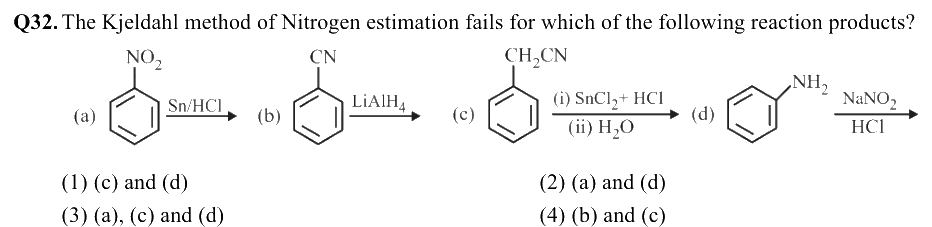
The Kjeldahl method of Nitrogen estimation fails for which of the following reaction products?
(see the figure above)

The question and its figure as printed in JEE Main 2020 03 Sep Shift 1.
The question as printed in the paper.
  • A

    (c) and (d)

  • B

    (a) and (d)

  • C

    (a), (c) and (d)

  • D

    (b) and (c)

84JEE Main 2020 · 2 Sep · Shift 1MCQOpen question page ↗

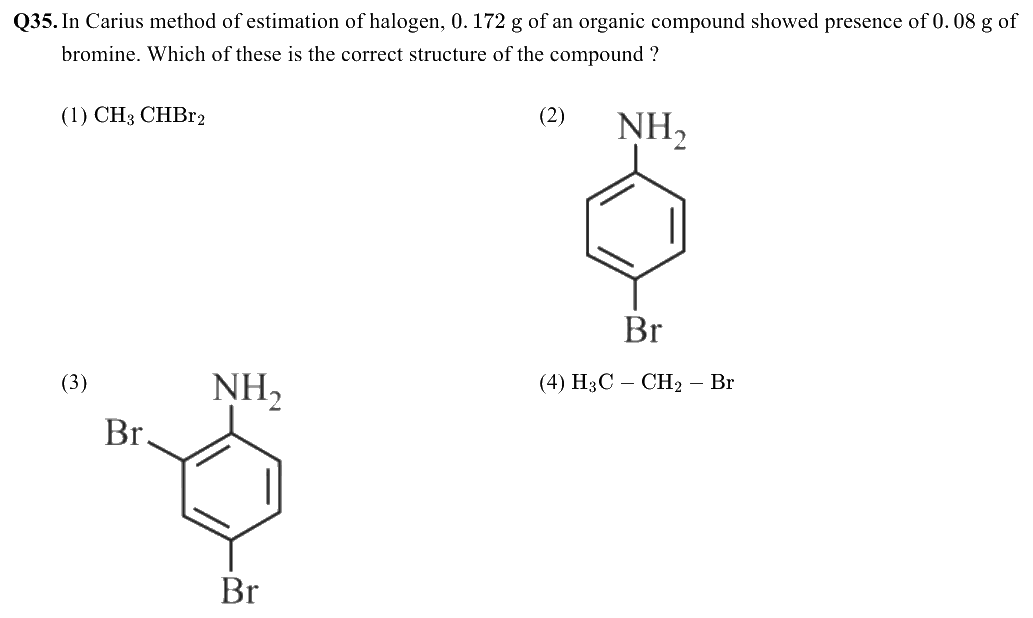
In Carius method of estimation of halogen, $0.172\ \mathrm{g}$ of an organic compound showed presence of $0.08\ \mathrm{g}$ of bromine. Which of these is the correct structure of the compound ?

The question and its figure as printed in JEE Main 2020 02 Sep Shift 1. Option 2: Benzene ring with NH2 at the top and Br at the bottom (para-bromoaniline). Option 3: Benzene ring with NH2 at the top, Br at the upper left (ortho to NH2) and Br at the bottom (para to NH2).
The question as printed in the paper.
  • A

    $\mathrm{CH}_{3}\ \mathrm{CHBr}_{2}$

  • B

    see figure Benzene ring with NH2 at the top and Br at the bottom (para-bromoaniline).

  • C

    see figure Benzene ring with NH2 at the top, Br at the upper left (ortho to NH2) and Br at the bottom (para to NH2).

  • D

    $\mathrm{H}_{3}\mathrm{C} - \mathrm{CH}_{2} - \mathrm{Br}$

85JEE Main 2020 · 8 Jan · Shift 1MCQOpen question page ↗

A flask contains a mixture of isohexane and 3 -methylpentane. One of the liquids boils at $63^\circ\mathrm{C}$ while the other boils at $60^\circ\mathrm{C}$. What is the best way to separate the two liquids and which one will be distilled out first?

  • A

    fractional distillation, isohexane

  • B

    simple distillation, 3 -methylpentane

  • C

    simple distillation, isohexane

  • D

    fractional distillation, 3 -methylpentane

86JEE Main 2020 · 8 Jan · Shift 2MCQOpen question page ↗

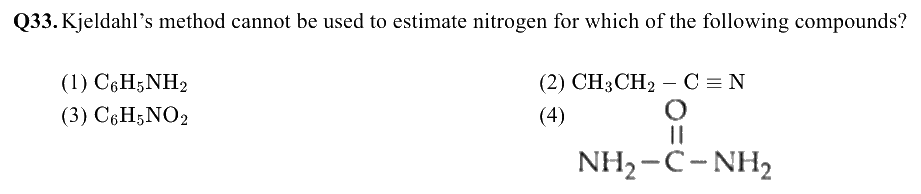
Kjeldahl's method cannot be used to estimate nitrogen for which of the following compounds?

The question and its figure as printed in JEE Main 2020 08 Jan Shift 2. Option 4: NH2 - C(=O) - NH2 (urea)
The question as printed in the paper.
  • A

    $\mathrm{C_6H_5NH_2}$

  • B

    $\mathrm{CH_3CH_2 - C \equiv N}$

  • C

    $\mathrm{C_6H_5NO_2}$

  • D

    see figure $\mathrm{NH_2 - C(=O) - NH_2}$ (urea)

87JEE Main 2020 · 7 Jan · Shift 1MCQOpen question page ↗

A solution of m$-$ chloroaniline, m$-$ chlorophenol and m$-$ chlorobenzoic acid in ethyl acetate was extracted initially with a saturated solution of $\mathrm{NaHCO_3}$ to give fraction A . The left over organic phase was extracted with dilute $\mathrm{NaOH}$ solution to give fraction B . The final organic layer was labelled as fraction C . Fractions A, B and C, contain respectively:

  • A

    m$-$ chlorobenzoic acid, m$-$ chloroaniline and m$-$ chlorophenol

  • B

    m$-$ chlorobenzoic acid, m$-$ chlorophenol and m$-$ chloroaniline

  • C

    m$-$ chlorophenol, m$-$ chlorobenzoic acid and m$-$ chloroanilinc

  • D

    m$-$ chloroaniline, m$-$ chlorobenzoic acid and m$-$ chlorophenol

88JEE Main 2020 · 7 Jan · Shift 2MCQOpen question page ↗

A chromatography column, packed with silica gel as stationary phase, was used to separate a mixture of compounds consisting of (A) benzanilide (B) aniline and (C) acetophenone. When the column is eluted with a mixture of solvents, hexane:ethyl acetate $(20 : 80)$, the sequence of obtained compounds is:

  • A

    (B), (C) and (A)

  • B

    (B), (A) and (C)

  • C

    (C), (A) and (B)

  • D

    (A), (B) and (C)

89JEE Main 2019 · 12 Apr · Shift 1MCQOpen question page ↗

An organic compound 'A' is oxidized with $\mathrm{Na_2O_2}$ followed by boiling with $\mathrm{HNO_3}$ . The resultant solution is then treated with ammonium molybdate to yield a yellow percipitate. Based on a above observation, the element present in the given compound is:

  • A

    Fluorine

  • B

    Phosphorus

  • C

    Nitrogen

  • D

    Sulphur

90JEE Main 2019 · 10 Apr · Shift 1MCQOpen question page ↗

The principle of column chromatography is:

  • A

    Differential adsorption of the substances on the solid phase.

  • B

    Differential absorption of the substances on the solid phase.

  • C

    Gravitational force.

  • D

    Capillary action

91JEE Main 2019 · 10 Apr · Shift 2MCQOpen question page ↗

In chromatography, which of the following statements is incorrect for $R_f$?

  • A

    Higher $R_f$ value means higher adsorption.

  • B

    The value of $R_f$ cannot be more than one.

  • C

    $R_f$ depends on the type of chromatography.

  • D

    $R_f$ value of dependent on the mobile phase.

92JEE Main 2019 · 11 Jan · Shift 1MCQOpen question page ↗

The correct match between items I and II is :
Item - I (Mixture)
(A) H$_2$O : Sugar
(B) H$_2$O : Aniline
(C) H$_2$O : Toluene
Item - II (Separation method)
(P) Sublimation
(Q) Recrystallization
(R) Steam distillation
(S) Differential extraction

  • A

    (A) $\rightarrow$ (S); (B) $\rightarrow$ (R); (C) $\rightarrow$ (P)

  • B

    (A) $\rightarrow$ (Q); (B) $\rightarrow$ (R); (C) $\rightarrow$ (S)

  • C

    (A) $\rightarrow$ (R); (B) $\rightarrow$ (P); (C) $\rightarrow$ (S)

  • D

    (A) $\rightarrow$ (Q); (B) $\rightarrow$ (R); (C) $\rightarrow$ (P)

93JEE Main 2019 · 11 Jan · Shift 1MCQOpen question page ↗

An organic compound is estimated through Dumas method and was found to evolve 6 moles of CO$_2$, 4 moles of H$_2$O and 1 mole of nitrogen gas. The formula of the compound is:

  • A

    C$_{12}$H$_8$ N

  • B

    C$_{12}$H$_8$ N$_2$

  • C

    C$_6$H$_8$ N$_2$

  • D

    C$_6$H$_8$ N

94JEE Main 2019 · 10 Jan · Shift 1MCQOpen question page ↗

If Dichloromethane (DCM) and water $H_2O$ are used for differential extraction, which one of the following statements is correct?

  • A

    DCM and $H_2O$ would stay as upper and lower layer respectively in the separating funnel (S.F.)

  • B

    DCM and $H_2O$ will be miscible clearly

  • C

    DCM and $H_2O$ would stay as lower and upper layer respectively in the S.F

  • D

    DCM and $H_2O$ will make turbid/colloidal mixture

95JEE Main 2019 · 9 Jan · Shift 2MCQOpen question page ↗

The correct match between Item I and Item II is:
Item I
$(A)$ Benzaldehyde
$(B)$ Alumina
$(C)$ Acetonitrile
Item II
$(P)$ Mobile phase
$(Q)$ Adsorbent
$(R)$ Adsorbate

  • A

    $(A) \rightarrow (P); (B) \rightarrow (R); (C) \rightarrow (Q)$

  • B

    $(A) \rightarrow (R); (B) \rightarrow (Q); (C) \rightarrow (P)$

  • C

    $(A) \rightarrow (Q); (B) \rightarrow (P); (C) \rightarrow (R)$

  • D

    $(A) \rightarrow (Q); (B) \rightarrow (R); (C) \rightarrow (P)$

96JEE Main 2018 · 15 Apr · Shift 1MCQOpen question page ↗

The correct match between items of List-I and List-II is :
List-I
A. Coloured impurity
B. Mixture of $o$-nitrophenol and $p$-nitrophenol
C. Crude naphtha
D. Mixture of glycerol and sugars
List-II
(p) Steam distillation
(q) Fractional distillation
(r) Charcoal treatment
(s) Distillation under reduced pressure

  • A

    (A)-(r),(B)-(s), (C)-(p),(D)-(q)

  • B

    (A)-(p),(B)-(s), (C)-(r),(D)-(q)

  • C

    (A)-(r), (B)-(p), (C)-(q), (D)-(s)

  • D

    (A)-(r),(B)-(p), (C)-(s),(D)-(q)

97JEE Main 2018 · 15 Apr · Shift 2MCQOpen question page ↗

Two compounds I and II are eluted by column chromato-graphy(adsorption of I > II). Which one of the following is a correct statement?

  • A

    II moves slower and has higher $\mathrm{R_f}$ value than I

  • B

    II moves faster and has higher $\mathrm{R_f}$ value than I

  • C

    I moves faster and has higher $\mathrm{R_f}$ value than II

  • D

    I moves slower and has higher $\mathrm{R_f}$ value than I

98JEE Main 2018 · 8 Apr · OfflineMCQOpen question page ↗

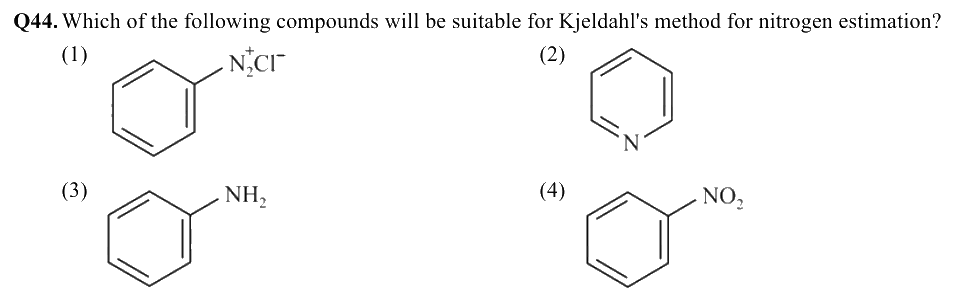
Which of the following compounds will be suitable for Kjeldahl's method for nitrogen estimation?

The question and its figure as printed in JEE Main 2018 08 Apr. Option 1: benzene ring bearing N2^+Cl^- (benzenediazonium chloride) Option 2: pyridine (six-membered aromatic ring containing one N, shown at the bottom) Option 3: benzene ring bearing NH2 (aniline) Option 4: benzene ring bearing NO2 (nitrobenzene)
The question as printed in the paper.
  • A

    see figure benzene ring bearing $\mathrm{N_2^{+}Cl^{-}}$ (benzenediazonium chloride)

  • B

    see figure pyridine (six-membered aromatic ring containing one N, shown at the bottom)

  • C

    see figure benzene ring bearing $\mathrm{NH_2}$ (aniline)

  • D

    see figure benzene ring bearing $\mathrm{NO_2}$ (nitrobenzene)

99JEE Main 2017 · 8 Apr · OnlineMCQOpen question page ↗

Which of the following statements is not true about partition chromatography?

  • A

    Stationary phase is a finely divided solid adsorbent.

  • B

    Separation depends upon equilibration of solute between a mobile and a stationary phase.

  • C

    Mobile phase can be a gas.

  • D

    Paper chromatography is an example of partition chromatography.

100JEE Main 2016 · 10 Apr · OnlineMCQOpen question page ↗

Sodium extract is heated with concentrated $\mathrm{HNO_3}$ before testing for halogens because :

  • A

    $\mathrm{Ag_2S}$ and $\mathrm{AgCN}$ are soluble in acidic medium.

  • B

    Silver halides are totally insoluble in nitric acid.

  • C

    $\mathrm{S^{2-}}$ and $\mathrm{CN^-}$, if present, are decomposed by conc. $\mathrm{HNO_3}$ and hence do not interfere in the test.

  • D

    Ag reacts faster with halides in acidic medium

101JEE Main 2016 · 3 Apr · OfflineMCQOpen question page ↗

The distillation technique most suited for separating glycerol from spent - lye in the soap industry is:

  • A

    Steam distillation

  • B

    Distillation under reduced pressure

  • C

    Simple distillation

  • D

    Fractional distillation

102JEE Main 2015 · 11 Apr · OnlineMCQOpen question page ↗

Match the organic compounds in column - I with the Lassaigne's test result in column - II appropriately:
Column – I
A. Aniline
B. Benzene sulfonic acid
C. Thiourea
Column - II
i. Red colour with FeCl$_3$
ii. Violet color with sodium nitroprusside
iii. Blue color with and acidic solution of FeSO$_4$

  • A

    A - ii ; B - iii ; C - i

  • B

    A - iii ; B - ii ; C - i

  • C

    A - ii ; B - i ; C - iii

  • D

    A - iii ; B - i ; C - ii

103JEE Main 2015 · 10 Apr · OnlineMCQOpen question page ↗

1.4 g of an organic compound was digested according to Kjeldahl's method and the ammonia evolved was absorbed in 60 mL of M/10 $\mathrm{H_2SO_4}$ solution. The excess sulphuric acid required 20 mL of M/10 NaOH solution for neutralization. The percentage of nitrogen in the compound is:

  • A

    24

  • B

    3

  • C

    5

  • D

    10

104JEE Main 2015 · 4 Apr · OfflineMCQOpen question page ↗

In Carius method of estimation of halogens, $250\ \mathrm{mg}$ of an organic compound gave $141\ \mathrm{mg}$ $\mathrm{AgBr}$. What is the percentage of bromine in the compound (atomic mass of $\mathrm{Ag} = 108$ and atomic number (sic) of $\mathrm{Br} = 80$)?

  • A

    $60$

  • B

    $24$

  • C

    $36$

  • D

    $48$

105JEE Main 2014 · 6 Apr · OfflineMCQOpen question page ↗

For the estimation of nitrogen, 1.4 g of an organic compound was digested by the Kjeldahl method and the evolved ammonia was absorbed in 60 ml of $\frac{M}{10}$ sulphuric acid. The unreacted acid required 20 ml of $\frac{M}{10}$ sodium hydroxide for complete neutralization. The percentage of nitrogen in the compound is

  • A

    6%

  • B

    10%

  • C

    3%

  • D

    5%

106JEE Main 2013 · 22 Apr · OnlineMCQOpen question page ↗

For which of the following compounds Kjeldahl method can be used to determine the percentage of Nitrogen?

  • A

    Nitrobenzene

  • B

    Pyridine

  • C

    Alanine

  • D

    Diazomethane

107JEE Main 2013 · 9 Apr · OnlineMCQOpen question page ↗

Which of the following compounds is not expected to show Lassaignes' test for nitrogen ?

  • A

    Propanenitrile

  • B

    Hydroxylamine hydrochloride

  • C

    Nitromethane

  • D

    Ethanamine

110AIEEE 2010MCQOpen question page ↗

29.5mg of an organic compound containing nitrogen was digested according to Kjeldahl's method and the evolved ammonia was absorbed in 20 mL of 0.1MHCl solution. The excess of the acid required 15 mL of 0.1MNaOH solution for complete neutralization. The percentage of nitrogen in the compound is

  • A

    59.0

  • B

    47.4

  • C

    23.7

  • D

    29.5

111AIEEE 2004MCQOpen question page ↗

The compound formed in the positive test for nitrogen with the Lassaigne solution of an organic compound is

  • A

    $\mathrm{Fe_4[Fe(CN)_6]_3}$

  • B

    $\mathrm{Na_4\ [Fe(CN)_5NOS]}$

  • C

    $\mathrm{Fe(CN)_3}$

  • D

    $\mathrm{Na_3\ [Fe(CN)_6]}$

112AIEEE 2004MCQOpen question page ↗

The ammonia evolved from the treatment of 0.30 g of an organic compound for the estimation of nitrogen was passed in 100 mL of 0.1M sulphuric acid. The excess of acid required 20 mL of 0.5M sodium hydroxide solution hydroxide solutio for complete neutralization. The organic compound is

  • A

    acetamide

  • B

    thiourea

  • C

    urea

  • D

    benzamide

Numerical value

49 questions
113JEE Main 2026 · 5 Apr · Shift 1NumericalOpen question page ↗

In an estimation of sulphur by Carius method 0.2 g of the substance gave 0.6 g of $\mathrm{BaSO_4}$. The percentage of sulphur in the substance is ________ %.

(Given molar mass in g mol$^{-1}$ S : 32, $\mathrm{BaSO_4}$ : 231)

Numerical answer type: type your answer in EdLoop to check it
114JEE Main 2026 · 4 Apr · Shift 1NumericalOpen question page ↗

2.0 g of a bromo hydrocarbon (X) was subjected to Carius analysis, gave 3.36 g of AgBr. The percentage of carbon in the compound (X) is 26.7%. Total number of carbon atoms in the empirical formula for compound (X) is ________.
(Given molar mass in g mol$^{-1}$ H:1, C:12, Br : 80, Ag : 108)

Numerical answer type: type your answer in EdLoop to check it
115JEE Main 2026 · 4 Apr · Shift 2NumericalOpen question page ↗

In sulphur estimation, $2.0\times10^{-3}$ mol of an organic compound (X) (molar mass 76 g mol$^{-1}$) gave 0.4813 g of barium sulphate (molar mass 233 g mol$^{-1}$). The percentage of sulphur in the compound (X) is ________ $\times10^{-1}$ % (Nearest integer)

Numerical answer type: type your answer in EdLoop to check it
116JEE Main 2026 · 28 Jan · Shift 1NumericalOpen question page ↗

0.53 g of an organic compound (x) when heated with excess of nitric acid (concentrated) and then with silver nitrate gave 0.75 g of silver bromide precipitate. 1.0 g of (x) gave 1.32 g of $\mathrm{CO_2}$ gas on combustion. The percentage of hydrogen in the compound (x) is ____%. [Nearest Integer]

[Given: Molar mass in g mol$^{-1}$ H : 1, C : 12, Br : 80, Ag : 108, O : 16 ;

Compound (x) : $\mathrm{C_xH_yBr_z}$]

Numerical answer type: type your answer in EdLoop to check it
117JEE Main 2026 · 24 Jan · Shift 1NumericalOpen question page ↗

In Dumas method for estimation of nitrogen, 0.50 g of an organic compound gave 70 mL of nitrogen collected at 300 K and 715 mm pressure. The percentage of nitrogen in the organic compound is ________ %.

(Aqueous tension at 300 K is 15 mm).

Numerical answer type: type your answer in EdLoop to check it
118JEE Main 2026 · 24 Jan · Shift 2NumericalOpen question page ↗

0.25 g of an organic compound "A" containing carbon, hydrogen and oxygen was analysed using the combustion method. There was an increase in mass of $\mathrm{CaCl_2}$ tube and potash tube at the end of the experiment. The amount was found to be 0.15 g and 0.1837 g, respectively. The percentage of oxygen in compound A is ________ %. (Nearest integer)

(Given: molar mass in g mol$^{-1}$ H : 1, C : 12, O : 16)

Numerical answer type: type your answer in EdLoop to check it
119JEE Main 2026 · 22 Jan · Shift 1NumericalOpen question page ↗

Sodium fusion extract of an organic compound (Y) with $\mathrm{CHCl_3}$ and chlorine water gives violet color to the $\mathrm{CHCl_3}$ layer. 0.15g of (Y) gave 0.12 g of the silver halide precipitate in Carius method. Percentage of halogen in the compound (Y) is ________. (Nearest integer)

(Given : molar mass g mol$^{-1}$ C : 12, H : 1, Cl : 35.5, Br : 80, I : 127)

Numerical answer type: type your answer in EdLoop to check it
120JEE Main 2025 · 7 Apr · Shift 1NumericalOpen question page ↗

An organic compound weighing 500 mg, produced 220 mg of $CO_2$, on complete combustion. The percentage composition of carbon in the compound is ______ %. (nearest integer) (Given molar mass in $g\,mol^{-1}$ of $C:12, O:16$ )

Numerical answer type: type your answer in EdLoop to check it
121JEE Main 2025 · 7 Apr · Shift 2NumericalOpen question page ↗

In Dumas' method 292 mg of an organic compound released 50 mL of nitrogen gas $(N_2)$ at 300 K temperature and 715 mm Hg pressure. The percentage composition of ' N ' in the organic compound is ______ % (Nearest integer) (Aqueous tension at $300K = 15mm\,Hg$ )

Numerical answer type: type your answer in EdLoop to check it
122JEE Main 2025 · 4 Apr · Shift 1NumericalOpen question page ↗

In Dumas' method for estimation of nitrogen 1 g of an organic compound gave 150 mL of nitrogen collected at 300 K temperature and 900 mm Hg pressure. The percentage composition of nitrogen in the compound is ______ % (nearest integer)

(Aqueous tension at $300K = 15mm\,Hg$ )

Numerical answer type: type your answer in EdLoop to check it
123JEE Main 2025 · 3 Apr · Shift 1NumericalOpen question page ↗

0.5 g of an organic compound on combustion gave 1.46 g of $CO_2$ and 0.9 g of $H_2O$. The percentage of carbon in the compound is ______ . (Nearest integer)

[Given : Molar mass $(in\ gmol^{-1})$ C:12,H:1,O:16 ]

Numerical answer type: type your answer in EdLoop to check it
124JEE Main 2025 · 3 Apr · Shift 1NumericalOpen question page ↗

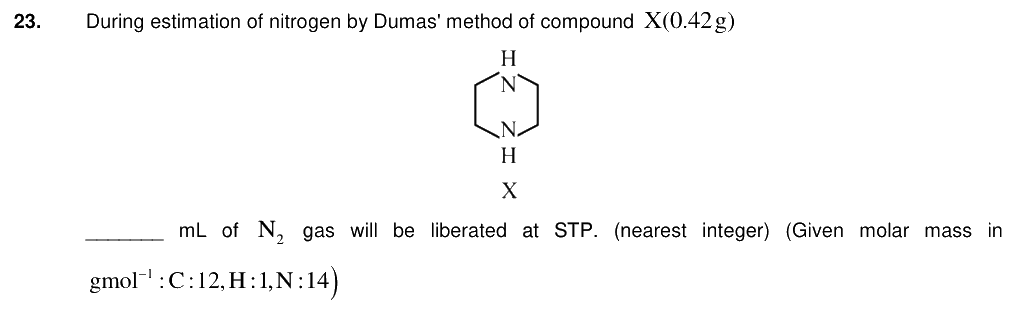
During estimation of nitrogen by Dumas' method of compound $X(0.42g)$

(see the figure above)

______ mL of $N_2$ gas will be liberated at STP. (nearest integer) (Given molar mass in $gmol^{-1}$ : C:12, H:1, N:14)

The question and its figure as printed in JEE Main 2025 03 Apr Shift 1.
The question as printed in the paper.
Numerical answer type: type your answer in EdLoop to check it
125JEE Main 2025 · 29 Jan · Shift 2NumericalOpen question page ↗

In the sulphur estimation, 0.20 g of a pure organic compound gave 0.40 g of barium sulphate. The percentage of sulphur in the compound is ______ $\times 10^{-1}$%. (Molar mass : O = 16, S = 32, Ba = 137 in $\mathrm{gmol^{-1}}$ )

Numerical answer type: type your answer in EdLoop to check it
126JEE Main 2025 · 24 Jan · Shift 2NumericalOpen question page ↗

In Carius method of estimation of halogen, 0.25 g of an organic compound gave 0.15 g of silver bromide (AgBr). The percentage of Bromine in the organic compound is ______ $\times 10^{-1}\%$ (Nearest integer). (Given : Molar mass of Ag is 108 and Br is 80 g $\mathrm{mol^{-1}}$ )

Numerical answer type: type your answer in EdLoop to check it
127JEE Main 2025 · 23 Jan · Shift 1NumericalOpen question page ↗

During " S " estimation, 160 mg of an organic compound gives 466 mg of barium sulphate. The percentage of Sulphur in the given compound is ______ %. (Given molar mass in $\mathrm{gmol^{-1}}$ of Ba : 137, S : 32, O : 16 )

Numerical answer type: type your answer in EdLoop to check it
128JEE Main 2025 · 22 Jan · Shift 1NumericalOpen question page ↗

In Carius method for estimation of halogens, 180 mg of an organic compound produced 143.5 mg of AgCl . The percentage composition of chlorine in the compound is ______ \%. (Given : molar mass in $\mathrm{gmol^{-1}}$ of Ag : 108, Cl : 35.5 )

Numerical answer type: type your answer in EdLoop to check it
129JEE Main 2024 · 9 Apr · Shift 2NumericalOpen question page ↗

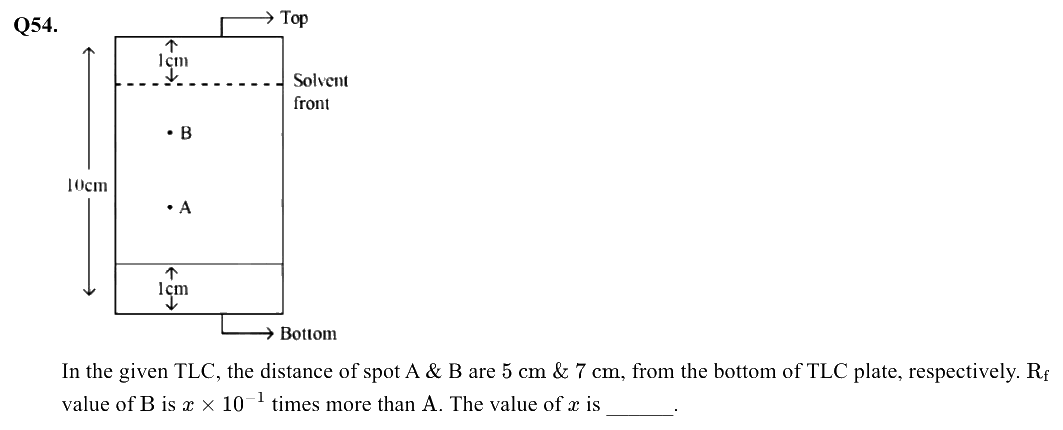
see figure In the given TLC, the distance of spot A & B are 5 cm & 7 cm, from the bottom of TLC plate, respectively. $\mathrm{R_f}$ value of B is $x \times 10^{-1}$ times more than A. The value of $x$ is ______.

The question and its figure as printed in JEE Main 2024 09 Apr Shift 2. Question: In the given TLC, the distance of spot A & B are 5 cm & 7 cm, from the bottom of TLC plate, respectively. Rf value of B is x × 10^-1 times more than A. The value of x is .
The question as printed in the paper.
Numerical answer type: type your answer in EdLoop to check it
130JEE Main 2024 · 5 Apr · Shift 2NumericalOpen question page ↗

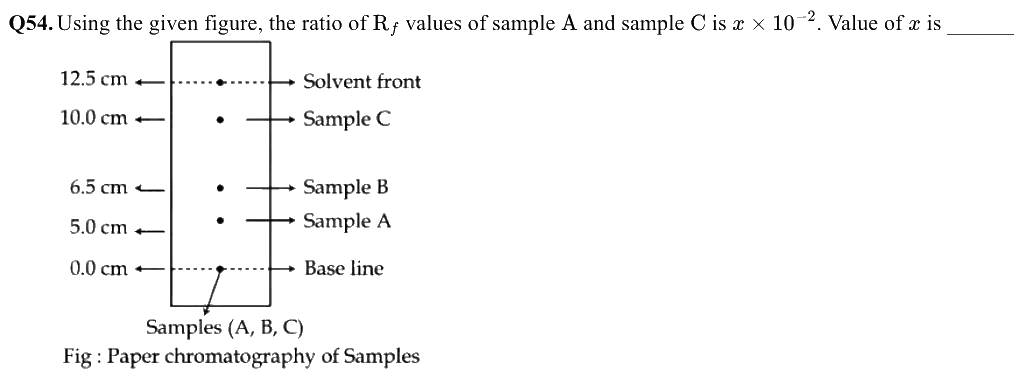
Using the given figure, the ratio of $\mathrm{R}_f$ values of sample A and sample C is $x \times 10^{-2}$. Value of $x$ is ______

(see the figure above)

The question and its figure as printed in JEE Main 2024 05 Apr Shift 2.
The question as printed in the paper.
Numerical answer type: type your answer in EdLoop to check it
131JEE Main 2024 · 1 Feb · Shift 2NumericalOpen question page ↗

Following Kjeldahl's method, 1 g of organic compound released ammonia, that neutralised 10 mL of 2M$\mathrm{H_2SO_4}$. The percentage of nitrogen in the compound is ______ % .

Numerical answer type: type your answer in EdLoop to check it
132JEE Main 2024 · 30 Jan · Shift 1NumericalOpen question page ↗

On a thin layer chromatographic plate, an organic compound moved by 3. 5 cm, while the solvent moved by 5 cm. The retardation factor of the organic compound is ______ $\times 10^{-1}$

Numerical answer type: type your answer in EdLoop to check it
133JEE Main 2023 · 13 Apr · Shift 1NumericalOpen question page ↗

An organic compound gives 0.220 g of $\mathrm{CO_2}$ and 0.126 g of $\mathrm{H_2O}$ on complete combustion. If the % of carbon is 24 then the % of hydrogen is ______ $\times 10^{-1}$. (Nearest integer)

Numerical answer type: type your answer in EdLoop to check it
134JEE Main 2023 · 13 Apr · Shift 2NumericalOpen question page ↗

0.400 g of an organic compound (X) gave 0.376 g of AgBr in Carius method for estimation of bromine. % of bromine in the compound (X) is (Given: Molar mass AgBr = 188 g mol$^{-1}$ Br = 80 g mol$^{-1}$

Numerical answer type: type your answer in EdLoop to check it
135JEE Main 2023 · 12 Apr · Shift 1NumericalOpen question page ↗

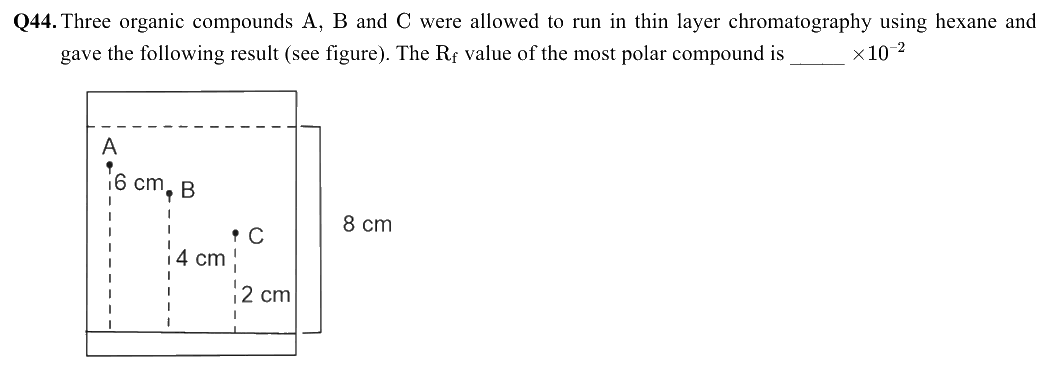
Three organic compounds A, B and C were allowed to run in thin layer chromatography using hexane and gave the following result (see figure). The $\mathrm{R_f}$ value of the most polar compound is ______ $\times 10^{-2}$
(see the figure above)

The question and its figure as printed in JEE Main 2023 12 Apr Shift 1.
The question as printed in the paper.
Numerical answer type: type your answer in EdLoop to check it
136JEE Main 2023 · 8 Apr · Shift 1NumericalOpen question page ↗

$0.5$ g of an organic compound (X) with $60\%$ carbon will produce ______ $\times 10^{-1}$ g of $\mathrm{CO_2}$ on complete combustion.

Numerical answer type: type your answer in EdLoop to check it
137JEE Main 2023 · 31 Jan · Shift 1NumericalOpen question page ↗

On complete combustion, 0.492 $\mathrm{g}$ of an organic compound gave 0.792 $\mathrm{g}$ of $\mathrm{CO_2}$. The % of carbon in the organic compound is (Nearest integer)

Numerical answer type: type your answer in EdLoop to check it
138JEE Main 2023 · 29 Jan · Shift 1NumericalOpen question page ↗

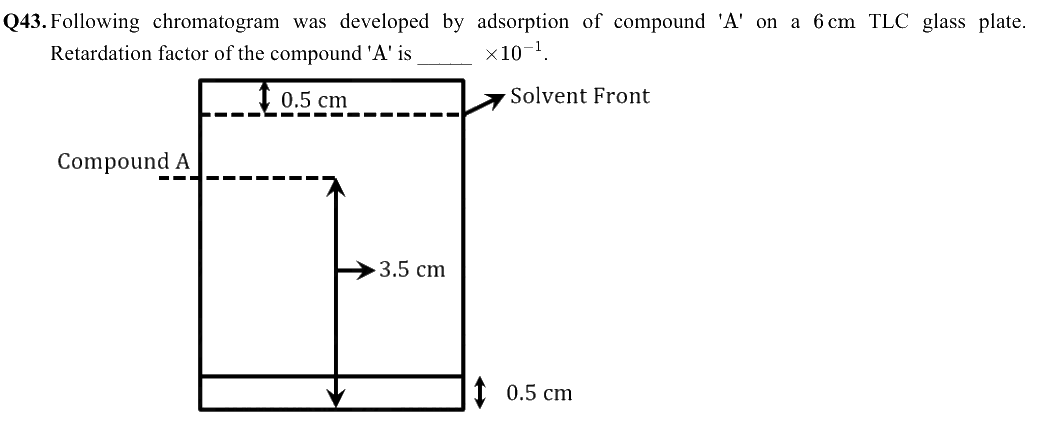
Following chromatogram was developed by adsorption of compound 'A' on a $6\ \mathrm{cm}$ TLC glass plate. Retardation factor of the compound 'A' is ______ $\times 10^{-1}$.

(see the figure above)

The question and its figure as printed in JEE Main 2023 29 Jan Shift 1.
The question as printed in the paper.
Numerical answer type: type your answer in EdLoop to check it
139JEE Main 2023 · 25 Jan · Shift 1NumericalOpen question page ↗

In sulphur estimation. 0.471 g of an organic compound gave 1.4439 g of barium sulphate. The percentage of sulphur in the compound is ______ (Nearest Integer)
(Given: Atomic mass Ba: 137u : S : 32u, O : 16u )

Numerical answer type: type your answer in EdLoop to check it
140JEE Main 2022 · 28 Jul · Shift 1NumericalOpen question page ↗

On complete combustion of $0.492\ \mathrm{g}$ of an organic compound containing C, H and O, $0.7938\ \mathrm{g}$ of $\mathrm{CO_2}$ and $0.4428\ \mathrm{g}$ of $\mathrm{H_2O}$ was produced. The % composition of oxygen in the compound is ______. (Nearest Integer)

Numerical answer type: type your answer in EdLoop to check it
141JEE Main 2022 · 28 Jul · Shift 2NumericalOpen question page ↗

A sample of $0.125\ \mathrm{g}$ of an organic compound when analysed by Duma's method yields $22.78\ \mathrm{mL}$ of nitrogen gas collected over KOH solution at $280\ \mathrm{K}$ and $759\ \mathrm{mmHg}$. The percentage of nitrogen in the given organic compound is ______
(a) The vapour pressure of water at $280\ \mathrm{K}$ is $14.2\ \mathrm{mmHg}$
(b) $\mathrm{R}=0.082\ \mathrm{L\ atm\ K^{-1}\ mol^{-1}}$

Numerical answer type: type your answer in EdLoop to check it
142JEE Main 2022 · 25 Jul · Shift 1NumericalOpen question page ↗

While estimating the nitrogen present in an organic compound by Kjeldahl's method, the ammonia evolved from $0.25$ g of the compound neutralized $2.5$ mL of $2\mathrm{M\ H_2SO_4}$. The percentage of nitrogen present in organic compound is ______.

Numerical answer type: type your answer in EdLoop to check it
143JEE Main 2022 · 25 Jul · Shift 2NumericalOpen question page ↗

The separation of two coloured substances was done by paper chromatography. The distances travelled by solvent front, substance A and substance B from the base line are $3.25\ \mathrm{cm}$, $2.08\ \mathrm{cm}$ and $1.05\ \mathrm{cm}$ respectively. The ratio of $\mathrm{R_f}$ values of A to B is (Answer the nearest integer)

Numerical answer type: type your answer in EdLoop to check it
144JEE Main 2022 · 29 Jun · Shift 1NumericalOpen question page ↗

Kjeldahl's method was used for the estimation of nitrogen in an organic compound. The ammonia evolved from $0.55\ \mathrm{g}$ of the compound neutralised $12.5\ \mathrm{mL}$ of $1\mathrm{M\ H_2SO_4}$ solution. The percentage of nitrogen in the compound is (Nearest integer)

Numerical answer type: type your answer in EdLoop to check it
145JEE Main 2022 · 28 Jun · Shift 1NumericalOpen question page ↗

In the estimation of bromine, $0.5\ \mathrm{g}$ of an organic compound gave $0.40\ \mathrm{g}$ of silver bromide. The percentage of bromine in the given compound is ______ % (nearest integer)
(Relative atomic masses of Ag and Br are 108u and 80u, respectively).

Numerical answer type: type your answer in EdLoop to check it
146JEE Main 2022 · 28 Jun · Shift 2NumericalOpen question page ↗

The complete combustion of 0.492 g of an organic compound containing 'C', 'H' and 'O' gives 0.793 g of $\mathrm{CO_2}$ and 0.442 g of $\mathrm{H_2O}$. The percentage of oxygen composition in the organic compound is ______ .(nearest integer)

Numerical answer type: type your answer in EdLoop to check it
147JEE Main 2022 · 27 Jun · Shift 2NumericalOpen question page ↗

0.25 g of an organic compound containing chlorine gave 0.40 g of silver chloride in Carius estimation. The percentage of chlorine present in the compound is [in nearest integer]
(Given: Molar mass of Ag is $108\ \mathrm{g\ mol^{-1}}$ and that of Cl is $35.5\ \mathrm{g\ mol^{-1}}$)

Numerical answer type: type your answer in EdLoop to check it
148JEE Main 2022 · 26 Jun · Shift 1NumericalOpen question page ↗

On complete combustion $0.30 \mathrm{~g}$ of an organic compound gave $0.20 \mathrm{~g}$ of carbon dioxide and $0.10 \mathrm{~g}$ of water. The percentage of carbon in the given organic compound is ______ (Nearest Integer)

Numerical answer type: type your answer in EdLoop to check it
149JEE Main 2022 · 24 Jun · Shift 1NumericalOpen question page ↗

A $0.166 \mathrm{~g}$ sample of an organic compound was digested with conc. $\mathrm{H_2SO_4}$ and then distilled with NaOH. The ammonia gas evolved was passed through $50.0 \mathrm{~mL}$ of $0.5 \mathrm{~N~H_2SO_4}$. The used acid required $30.0 \mathrm{~mL}$ of $0.25 \mathrm{~N}$ NaOH for complete neutralization. The mass percentage of nitrogen in the organic compound is

Numerical answer type: type your answer in EdLoop to check it
150JEE Main 2022 · 24 Jun · Shift 2NumericalOpen question page ↗

$0.2 \mathrm{~g}$ of an organic compound was subjected to estimation of nitrogen by Dumas method in which volume of $\mathrm{N_2}$ evolved (at STP) was found to be $22.400 \mathrm{~mL}$. The percentage of nitrogen in the compound is - [nearest integer] (Given: Molar mass of $\mathrm{N_2}$ is $28 \mathrm{~g~mol^{-1}}$, Molar volume of $\mathrm{N_2}$ at STP : $22.4 \mathrm{~L}$)

Numerical answer type: type your answer in EdLoop to check it
151JEE Main 2021 · 31 Aug · Shift 2NumericalOpen question page ↗

The transformation occurring in Duma's method is given below
$\mathrm{C_2H_7\ N} + 2x + \frac{y}{2}\mathrm{CuO} \rightarrow x\mathrm{CO_2} + \frac{y}{2}\mathrm{H_2O} + \frac{z}{2}\ \mathrm{N_2} + 2x + \frac{y}{2}\mathrm{Cu}$
The value of y is (Integer answer)

Numerical answer type: type your answer in EdLoop to check it
152JEE Main 2021 · 27 Aug · Shift 1NumericalOpen question page ↗

The number of moles of CuO, that will be utilized in Dumas method for estimating nitrogen in a sample of $57.5$ g of N, N-dimethylaminopentane is ______$\times 10^{-2}$. (Nearest integer)

Numerical answer type: type your answer in EdLoop to check it
153JEE Main 2021 · 27 Aug · Shift 1NumericalOpen question page ↗

In Carius method for estimation of halogens, $0.2$ g of an organic compound gave $0.188$ g of AgBr. The percentage of bromine in the compound is ______. (Nearest integer)
[Atomic mass: Ag = 108, Br = 80]

Numerical answer type: type your answer in EdLoop to check it
154JEE Main 2021 · 26 Aug · Shift 2NumericalOpen question page ↗

In the sulphur estimation, $0.471\ \mathrm{g}$ of an organic compound gave $1.44\ \mathrm{g}$ of barium sulfate. The percentage of sulphur in the compound is. (Nearest integer) (Atomic Mass of $\mathrm{Ba}=137\mathrm{u}$ )

Numerical answer type: type your answer in EdLoop to check it
155JEE Main 2021 · 27 Jul · Shift 1NumericalOpen question page ↗

An organic compound is subjected to chlorination to get compound A using 5.0 g of chlorine. When 0.5 g of compound A is reacted with $\mathrm{AgNO_3}$ [Carius Method], the percentage of chlorine in compound A is when it forms 0.3849 g of AgCl. (Round off to the Nearest Integer)
(Atomic masses of Ag and Cl are 107.87 and 35.5 respectively)

Numerical answer type: type your answer in EdLoop to check it
156JEE Main 2021 · 25 Jul · Shift 2NumericalOpen question page ↗

$0.8\ \mathrm{g}$ of an organic compound was analysed by Kjeldahl's method for the estimation of nitrogen. If the percentage of nitrogen in the compound was found to be $42\%$, then ______ mL of $1\mathrm{M}\ \mathrm{H_2\ SO_4}$ would have been neutralized by the ammonia evolved during the analysis.

Numerical answer type: type your answer in EdLoop to check it
157JEE Main 2021 · 20 Jul · Shift 2NumericalOpen question page ↗

When $0.15$ g of an organic compound was analyzed using Carius method for estimation of bromine, $0.2397$ g of $\mathrm{AgBr}$ was obtained. The percentage of bromine in the organic compound is ______ .(Nearest integer)
[Atomic mass : Silver = 108, Bromine = 80]

Numerical answer type: type your answer in EdLoop to check it
158JEE Main 2021 · 16 Mar · Shift 1NumericalOpen question page ↗

Complete combustion of 750 g of an organic compound provides 420 g of $\mathrm{CO}_2$ and 210 g of $\mathrm{H}_2 \mathrm{O}$. The percentage composition of carbon and hydrogen in organic compound is 15.3 and ______ respectively. (Round off to the Nearest Integer)

Numerical answer type: type your answer in EdLoop to check it
159JEE Main 2021 · 16 Mar · Shift 2NumericalOpen question page ↗

In Duma's method of estimation of nitrogen, $0.1840\ \mathrm{g}$ of an organic compound gave $30\ \mathrm{mL}$ of nitrogen collected at $287\ \mathrm{K}$ and $758\ \mathrm{mm}$ of Hg pressure. The percentage composition of nitrogen in the compound is ______. (Round off to the Nearest Integer).
[Given : Aqueous tension at $287\ \mathrm{K} = 14\ \mathrm{mm}$ of Hg]

Numerical answer type: type your answer in EdLoop to check it
160JEE Main 2021 · 25 Feb · Shift 1NumericalOpen question page ↗

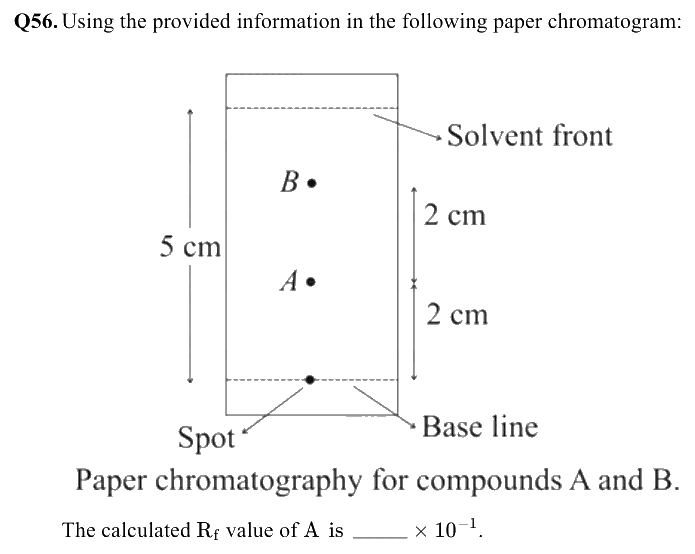
Using the provided information in the following paper chromatogram:
(see the figure above)
Paper chromatography for compounds A and B.
The calculated $\mathrm{R_f}$ value of A is ______ $\times 10^{-1}$.

The question and its figure as printed in JEE Main 2021 25 Feb Shift 1.
The question as printed in the paper.
Numerical answer type: type your answer in EdLoop to check it
161JEE Main 2020 · 6 Sep · Shift 1NumericalOpen question page ↗

In an estimation of bromine by Carius method, 1.6g of an organic compound gave 1.88g of AgBr. The mass percentage of bromine in the compound is ______
(Atomic mass, Ag = 108, Br = 80 $\mathrm{gmol^{-1}}$)

Numerical answer type: type your answer in EdLoop to check it

How to prepare Purification & Characterisation for JEE Main

How often it comes up

Purification and characterisation covers laboratory separation methods and elemental analysis under Unit 13: Purification and Characterisation of Organic Compounds in the Class 11 curriculum, holding rank 17 of 31 chapters with a 3.1% share of the chemistry section. In the 2019 to 2026 testing window, Purification & Characterisation accounted for 144 questions across 162 exam papers, delivering a 3.1% share of the chemistry section and standing at rank 17 of 31 chapters. During the 2002 to 2018 phase, it contributed 17 questions across 38 papers with a 1.3% share. Between 2024 and 2026, question volume expanded to 63 questions across 58 papers, capturing a 4.1% share. The chapter's appearance frequency has trended up across recent shifts.

The chapter has appeared every year from 2019 to 2026. Across 2019 to 2026, it averaged 0.9 questions per paper, rising to 1.1 questions per paper in the 2024 to 2026 interval. It produces a remarkably large number of numerical problems: 49 numerical answer questions were set between 2019 and 2026, mostly testing percentage compositions.

Most-asked topics

The syllabus divides across three core topics:

  • Quantitative Analysis: The largest topic with 74 total questions (67 in 2019 to 2026), examined continuously through 2026. This area centers on elemental estimations: Dumas and Kjeldahl methods for nitrogen, Carius method for halogens and sulfur, and precipitation as magnesium pyrophosphate for phosphorus.
  • Purification Methods: Yielded 61 total questions (57 in 2019 to 2026), tested through 2026. Focuses on distillation techniques (steam distillation for aniline, vacuum distillation for glycerol decomposition prevention), paper and thin layer chromatography (Rf values), and column chromatography.
  • Qualitative Analysis: Contributed 26 total questions (20 in 2019 to 2026), evaluated through 2025. Covers sodium fusion extract preparation (Lassaigne's test), detection of nitrogen via Prussian blue, sulfur via sodium nitroprusside (purple coloration), and halogens via silver nitrate precipitates.

What the questions look like

Examiners heavily favor direct arithmetic calculations for elemental percentages. A classic numerical question gives sample mass, volume and normality of standardized acid consumed by evolved ammonia, and asks for the nitrogen percentage via the Kjeldahl formula.

In purification, questions describe physical property differences between mixture components (such as boiling point gaps or steam volatility) and ask candidates to choose the correct separation procedure. Lassaigne extract questions test why sodium metal is used and which nitrogenous compounds (like hydrazine or diazonium salts) fail the test.

Questions to try first

Work through these authentic recent exam questions:

How to practise it

Mastering this chapter requires memorizing elemental formulas alongside purification criteria:

1. Memorize quantitative estimation formulas: Be fluent with percentage equations for Carius halogens, Carius sulfur, Kjeldahl nitrogen, Dumas nitrogen (using dry nitrogen volume at STP), and phosphorus. 2. Remember exceptions to Kjeldahl's method: Nitrogen in nitro groups, azo groups, and pyridine rings does not convert into ammonium sulfate under Kjeldahl conditions. 3. Classify distillation techniques: Know exact classic examples: aniline purifies by steam distillation; glycerol purifies by distillation under reduced pressure; petroleum fractions separate by fractional distillation. 4. Learn Lassaigne test colors: Prussian blue for nitrogen, violet for sulfur with nitroprusside, and yellow precipitate soluble in excess ammonia for phosphate. 5. Practise rapid arithmetic: With 49 numerical questions recorded between 2019 and 2026, calculation speed without calculator aid is critical.

Frequently asked questions

Why does hydrazine give a negative Lassaigne test for nitrogen?

Hydrazine contains nitrogen but lacks carbon, so it cannot form sodium cyanide upon sodium fusion, leading to a negative Prussian blue test.

What is the principle behind steam distillation?

Immature boiling occurs when the sum of vapor pressures of water and the immiscible organic liquid equals atmospheric pressure, allowing high boiling heat-sensitive compounds like aniline to distill below their normal boiling point.

Are numerical questions common in this chapter?

Yes, elemental estimation problems are among the most frequent numerical questions in chemistry, with 49 numerical questions set between 2019 and 2026. Step-by-step solutions for each one are in the EdLoop app.

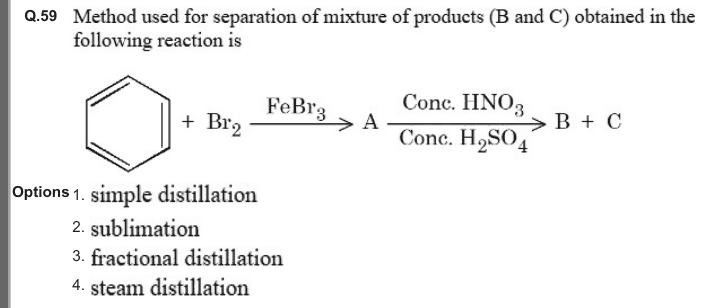
Get EdLoop – freeOpen on the web