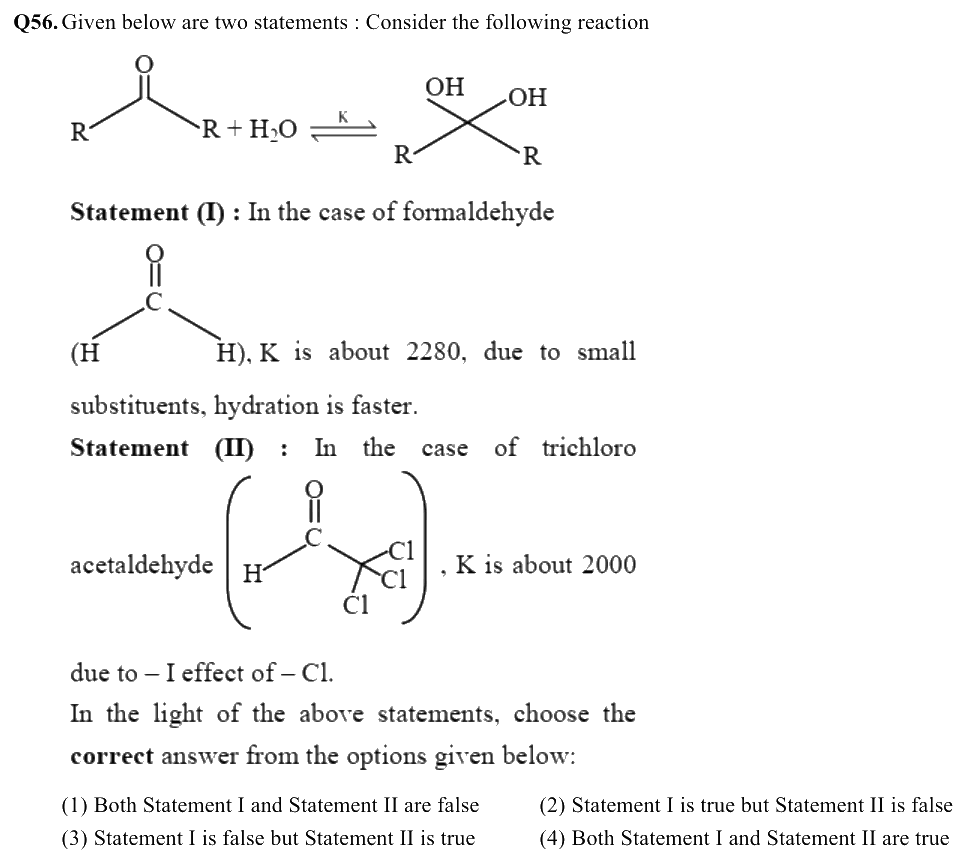
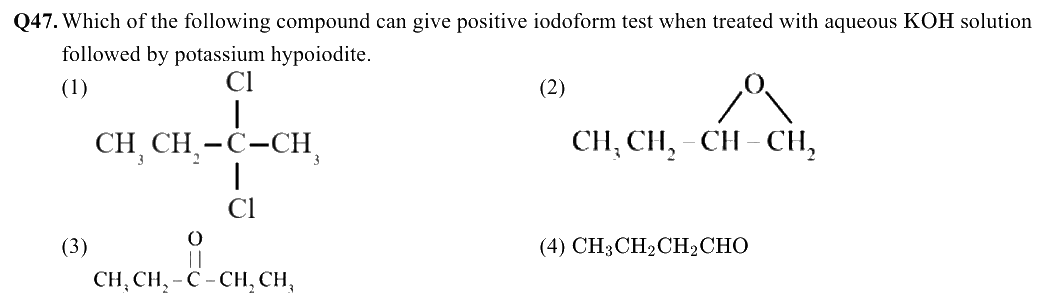
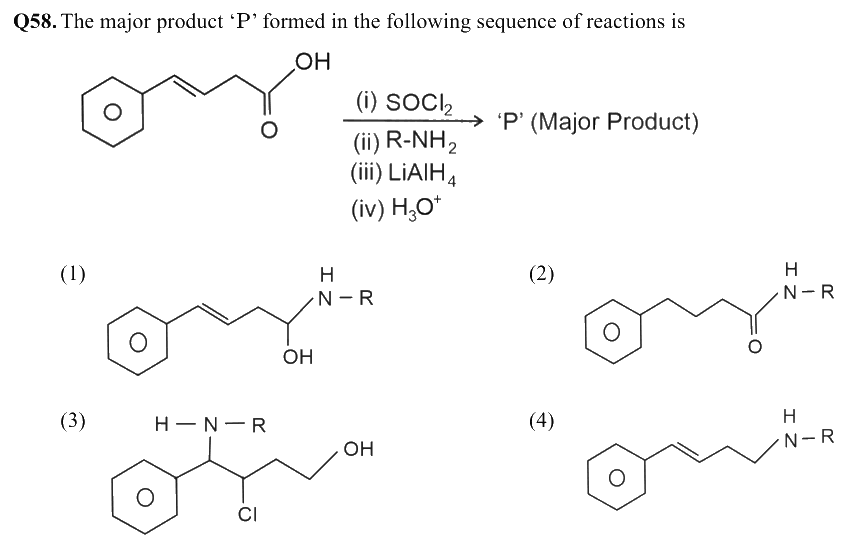
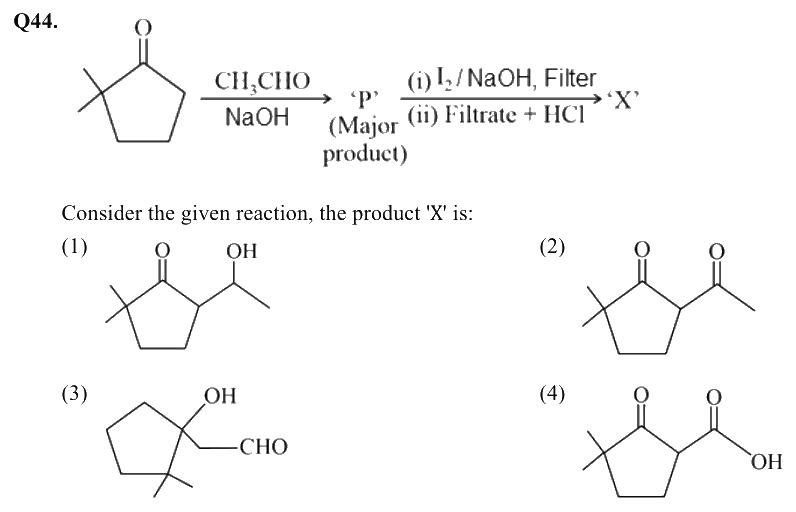
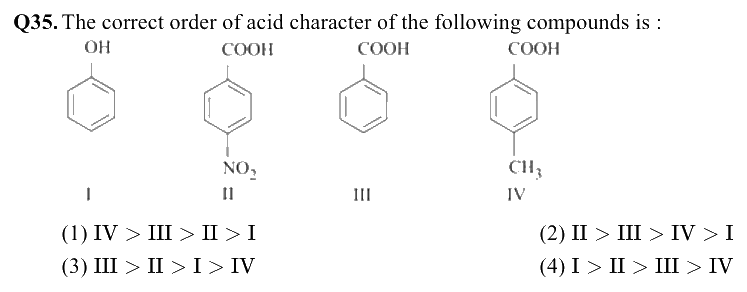
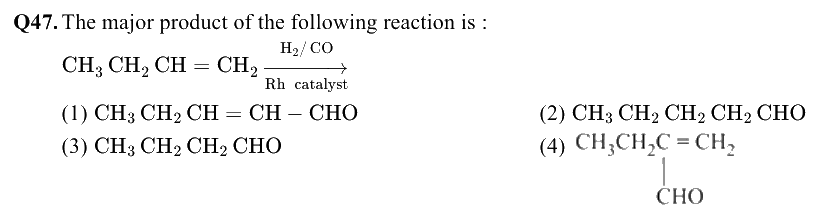
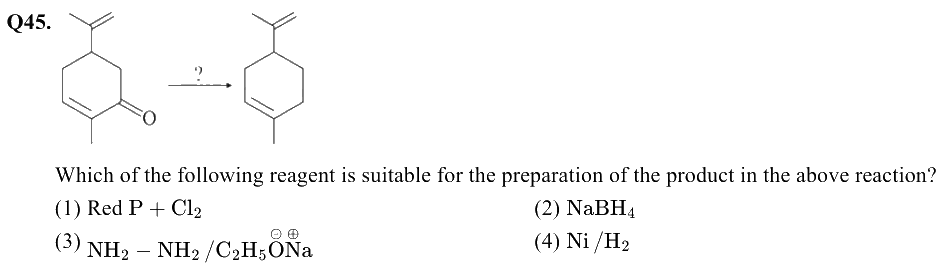
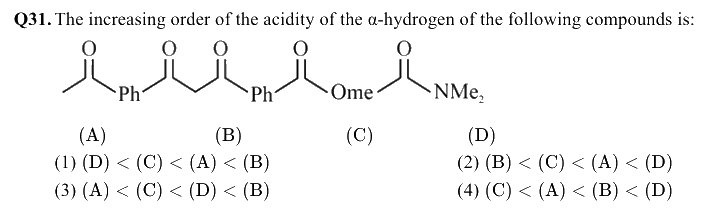
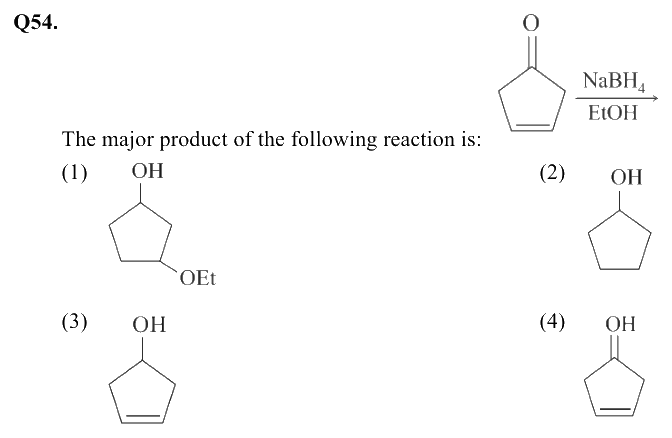
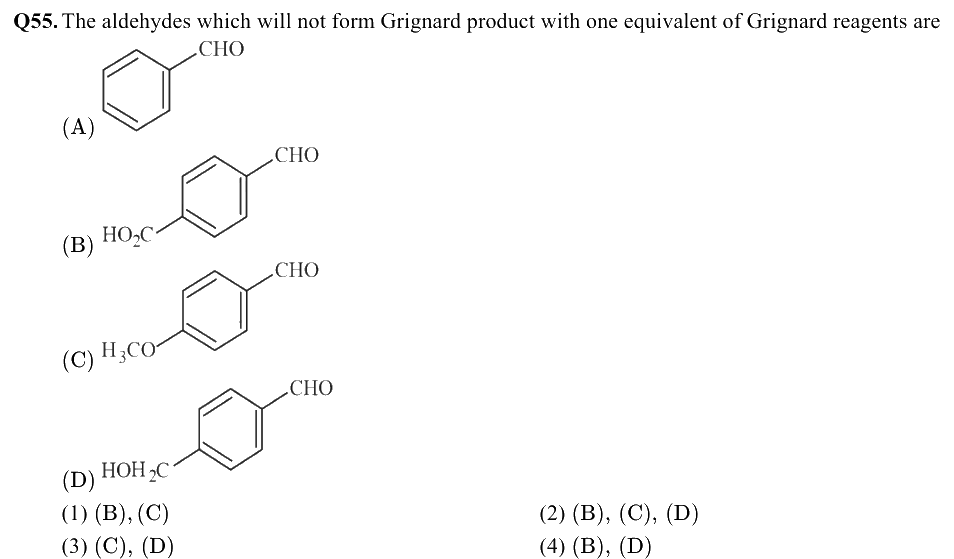
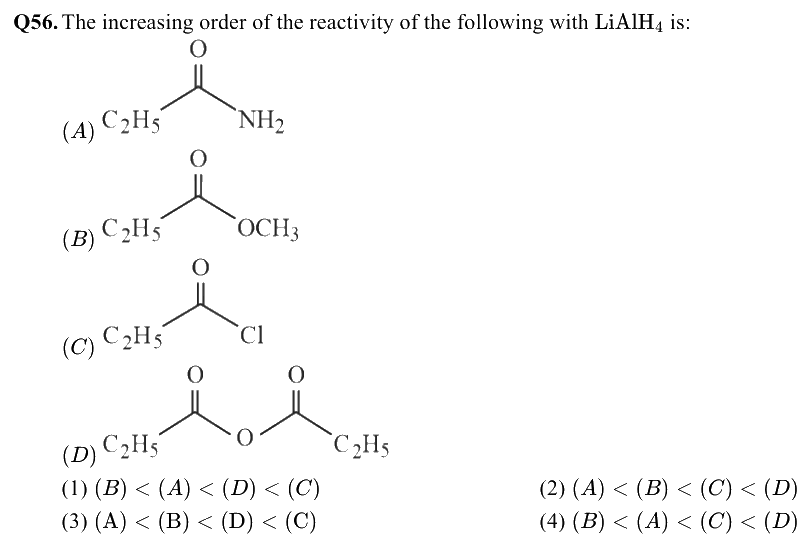
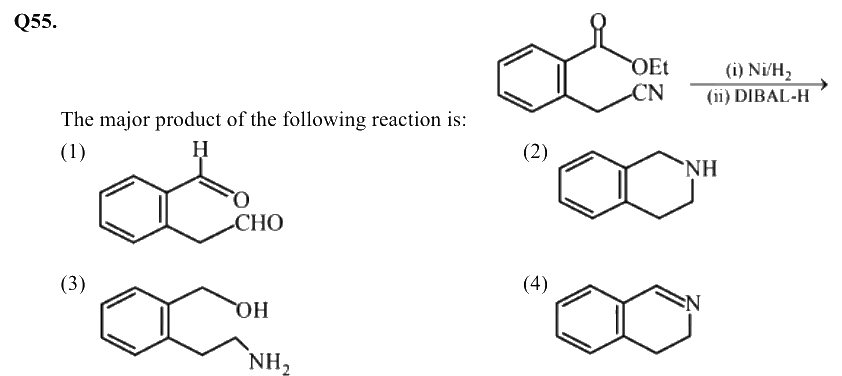
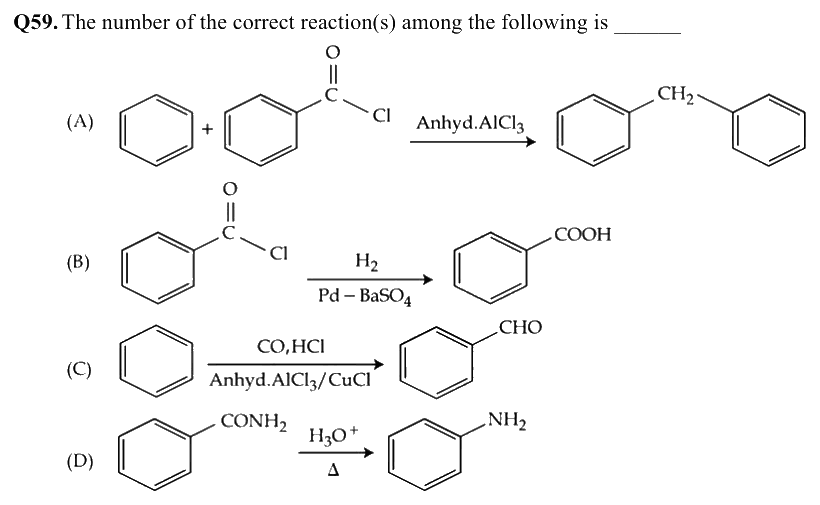
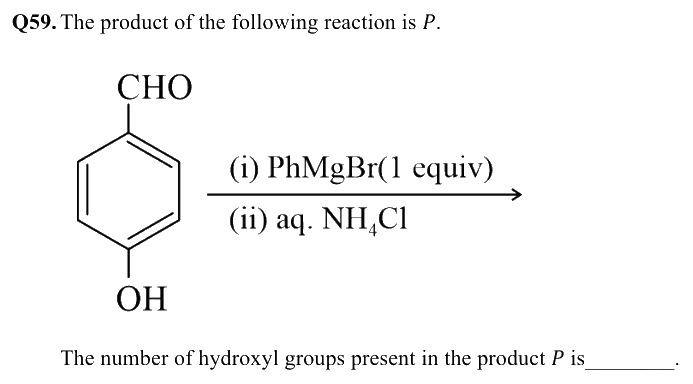
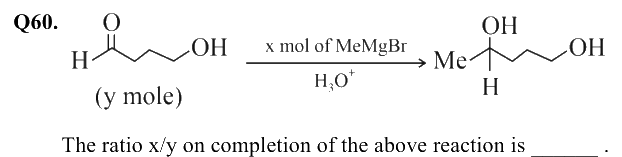
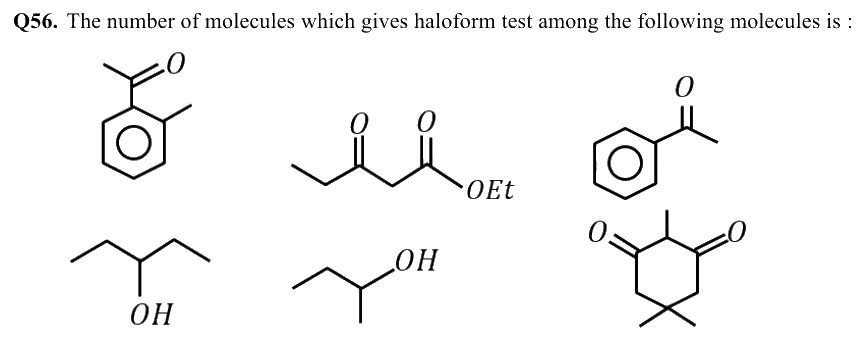
Aldehydes, Ketones & Carboxylic Acids: JEE Main PYQs 2002–2026
Every Aldehydes, Ketones & Carboxylic Acids question from past JEE Main and AIEEE papers, with options and answers. Newest first.
265questions
158papers covered
4.7%of Chemistry questions, 2019–2026
2002–2026years
Guide at a glance
Aldehydes, ketones and carboxylic acids forms the core carbonyl unit under Unit 17: Organic Compounds Containing Oxygen in the Class 12 curriculum, holding rank 5 of 31 chapters with a 4.7% share of the chemistry section.
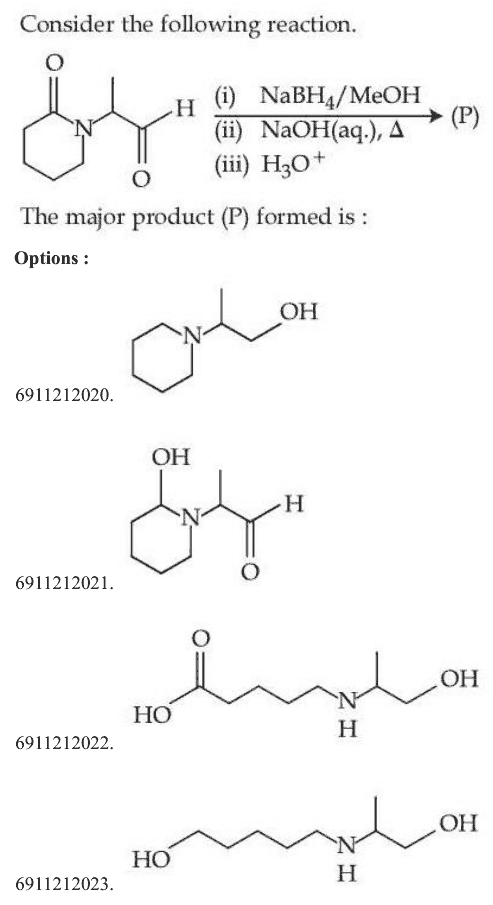
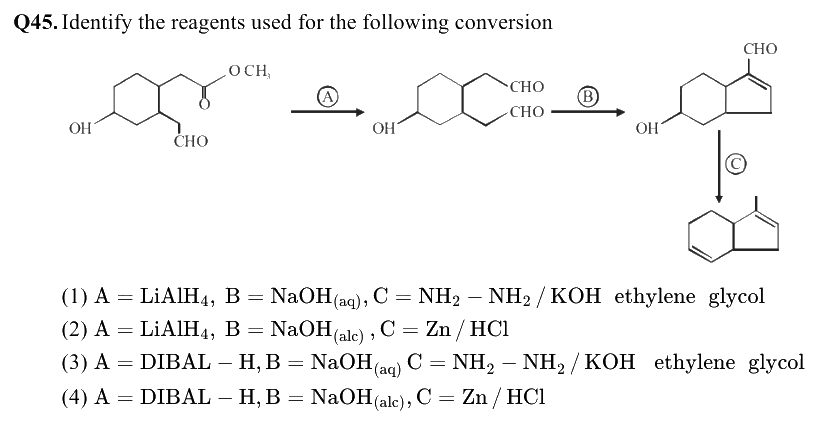
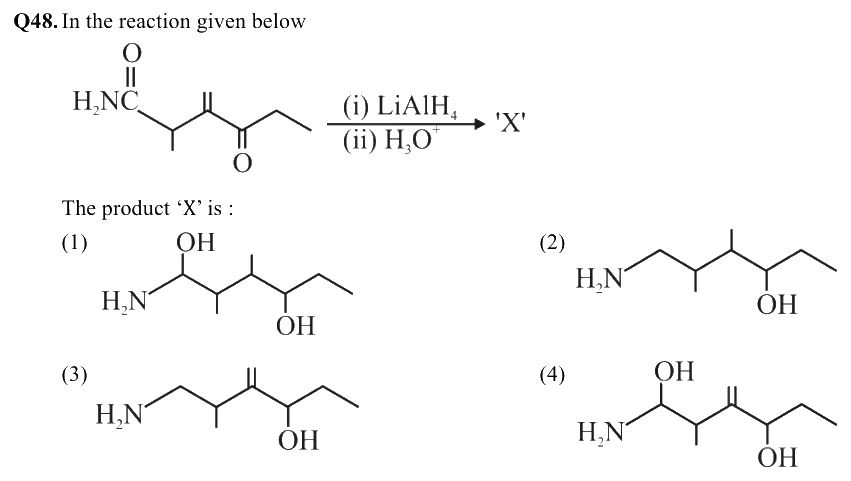
see figure a six-membered ring containing N (single bonds only), N bonded to a carbon with a stub up, then a CH2, ending in 'OH'.
B
see figure the same ring as in the starting material but with an 'OH' on the ring carbon next to N (upper left) in place of the carbonyl O; the side chain is unchanged (a carbon with a stub up, then a carbon with 'H' at the end and a double-bonded 'O' below).
C
see figure open chain: 'HO' and a double-bonded 'O' (drawn above) on the left-end carbon, then a zigzag of four more carbons to 'N' (with 'H' below), then a carbon with a stub up and a CH2 ending in 'OH'.
D
see figure open chain: 'HO' at the left end, a zigzag of five carbons to 'N' (with 'H' below), then a carbon with a stub up and a CH2 ending in 'OH'.
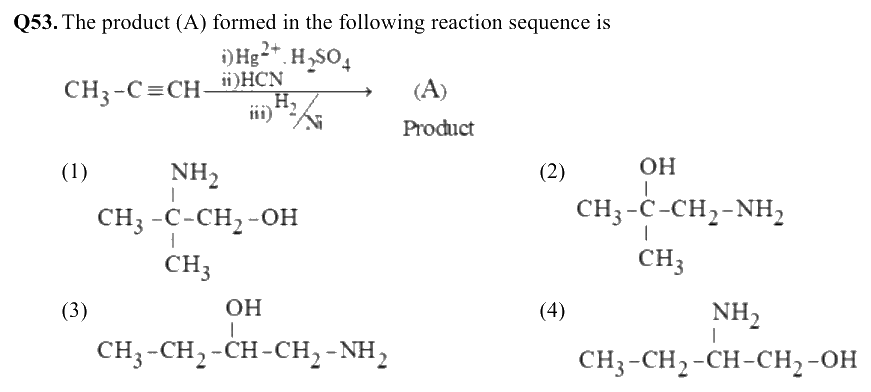
'x' is the product which is obtained by the hydrolysis of prop-1-yne in the presence of mercuric sulphate under dilute acidic medium at 333 K. 'y' is the product which is obtained by the reaction of ethane nitrile with methyl magnesium bromide in dry ether followed by hydrolysis. IUPAC name of product obtained from 'x' and 'y' in the presence of barium hydroxide followed by heating is :
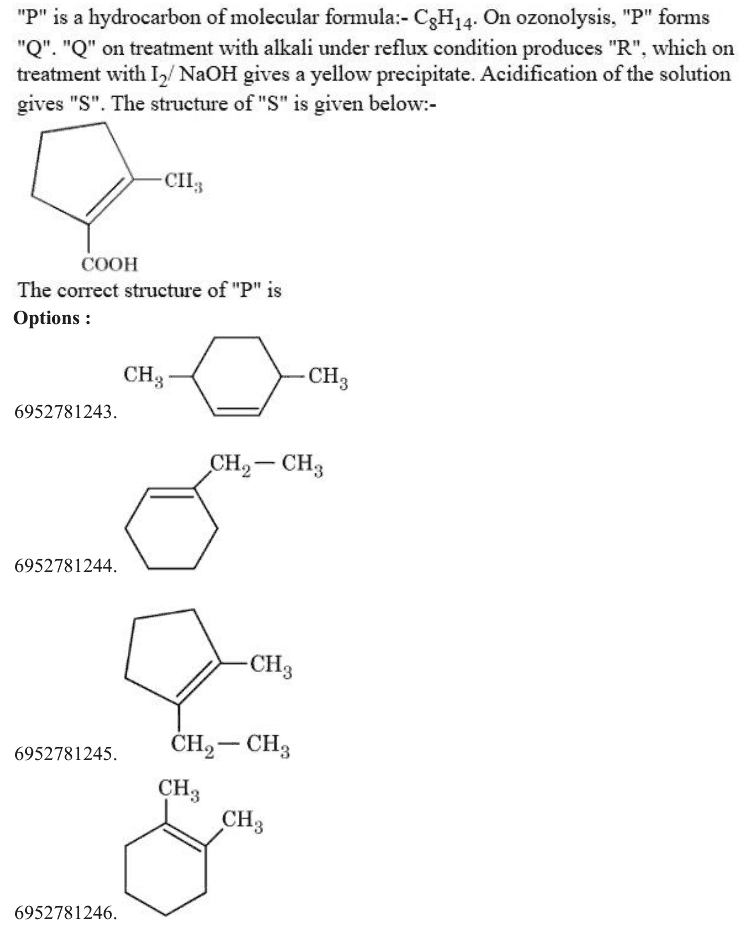
"P" is a hydrocarbon of molecular formula:- $\mathrm{C_8H_{14}}$. On ozonolysis, "P" forms "Q". "Q" on treatment with alkali under reflux condition produces "R", which on treatment with $\mathrm{I_2}$/ NaOH gives a yellow precipitate. Acidification of the solution gives "S". The structure of "S" is given below:-
(see the figure above)
The correct structure of "P" is
The question as printed in the paper.
A
see figure a six-membered ring with a C=C double bond on its bottom edge; a CH3 group is attached by a short bond at the left vertex and another CH3 at the right vertex.
B
see figure a six-membered ring with a C=C double bond on its upper-left edge; the ring carbon at the top bears a CH2-CH3 group
C
see figure a five-membered ring with a ring C=C double bond on its lower-right edge, a CH3 on the right ring carbon and a CH2-CH3 on the bottom ring carbon
D
see figure a six-membered ring with a C=C double bond on its upper-right edge; each of the two double-bond carbons bears a CH3
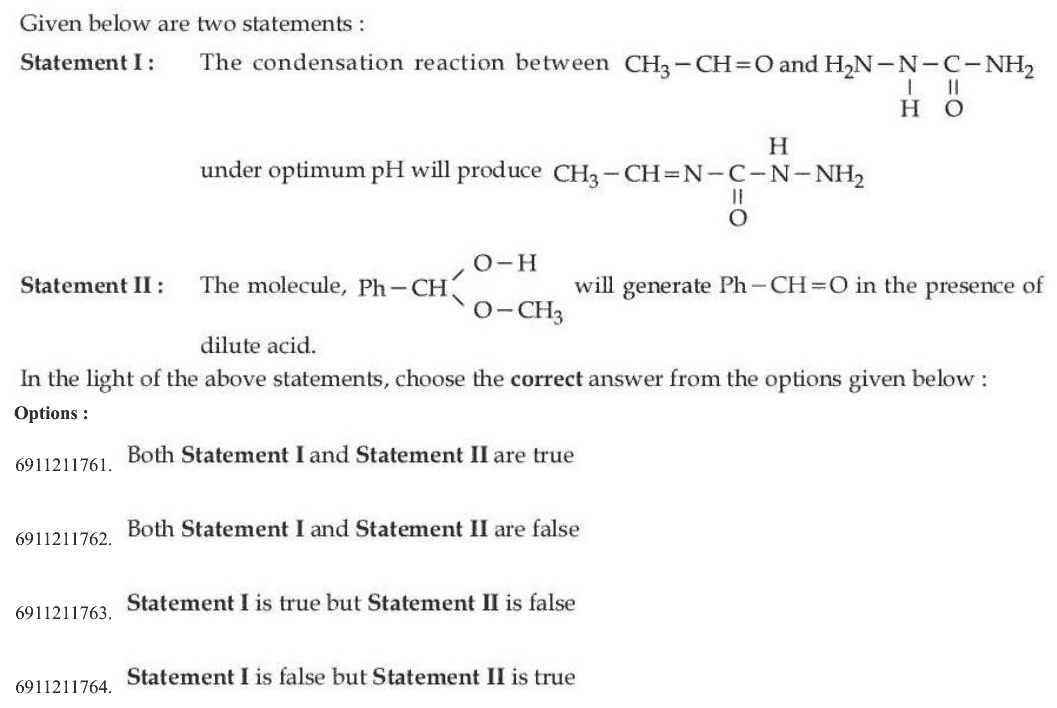
Statement I : The condensation reaction between $\mathrm{CH_3{-}CH{=}O}$ and $\mathrm{H_2N{-}N{-}C{-}NH_2}$ (the N bearing an H below it and the C bearing an =O below it) under optimum pH will produce $\mathrm{CH_3{-}CH{=}N{-}C{-}N{-}NH_2}$ (the C bearing an =O below it and the second N bearing an H above it).
Statement II : The molecule, $\mathrm{Ph{-}CH}$ with an $\mathrm{O{-}H}$ and an $\mathrm{O{-}CH_3}$ attached to the CH, will generate $\mathrm{Ph{-}CH{=}O}$ in the presence of dilute acid.
In the light of the above statements, choose the correct answer from the options given below :
An organic compound "$x$" where molar ratio of C, O and H are equal, on treatment with 50% KOH under reflux followed by acidification produced "$y$". The most likely structure of "$y$" is : [Molar mass of '$x$' is 58 g mol$^{-1}$]
A
$\mathrm{CH_2{=}CH{-}C(=O){-}OH}$
B
$\mathrm{CH_3 - CH = CH - CH = O}$
C
$\mathrm{O{=}C{-}OH}$ with $\mathrm{CH_2{-}OH}$ attached below the carbon (drawn vertically)
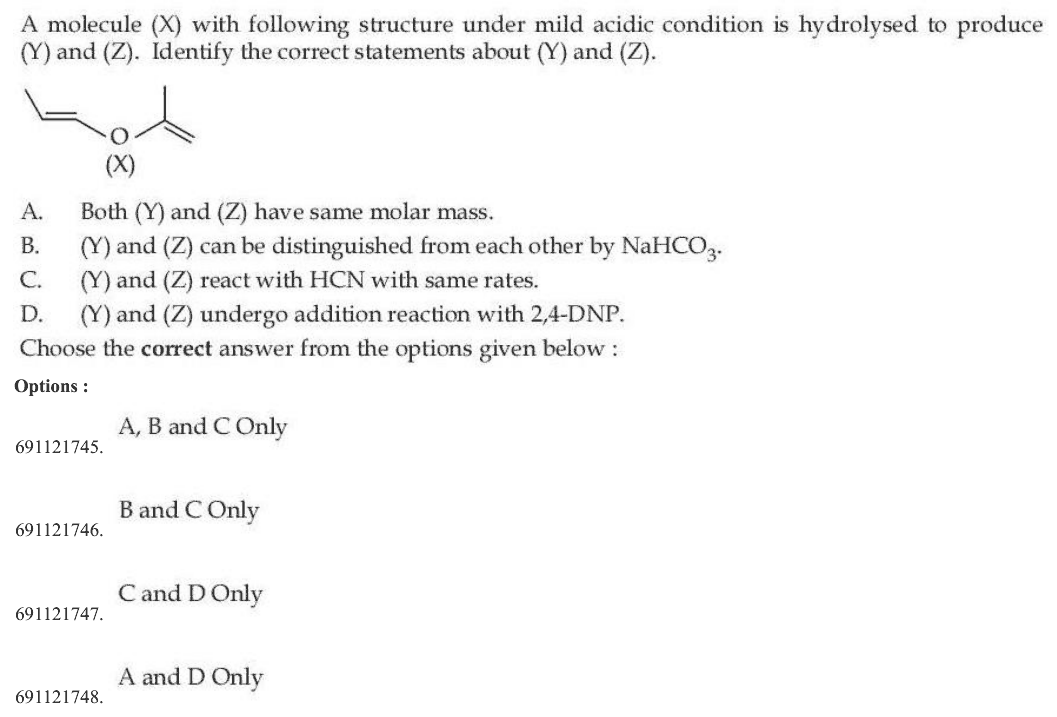
A molecule (X) with following structure under mild acidic condition is hydrolysed to produce (Y) and (Z). Identify the correct statements about (Y) and (Z).
(see the figure above)
A. Both (Y) and (Z) have same molar mass.
B. (Y) and (Z) can be distinguished from each other by $\mathrm{NaHCO_3}$.
C. (Y) and (Z) react with HCN with same rates.
D. (Y) and (Z) undergo addition reaction with 2,4-DNP.
Choose the correct answer from the options given below :
Statement I: Cross aldol condensation between two different aldehydes will always produce four different products.
Statement II: When semicarbazide reacts with a mixture of benzaldehyde and acetophenone under optimum pH, it forms a condensation product with acetophenone only.
In the light of the above statements, choose the *correct* answer from the options given below
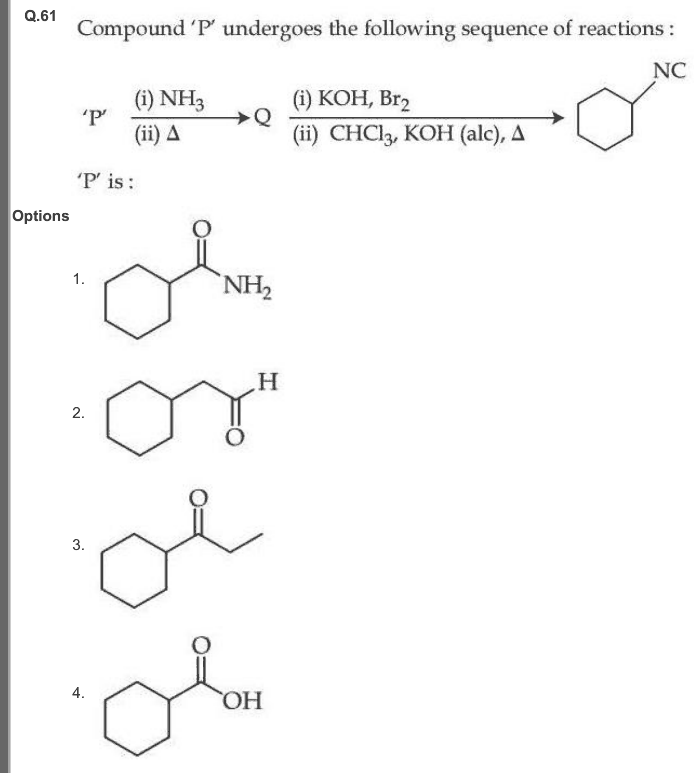
Compound 'P' undergoes the following sequence of reactions :
(see the figure above)
'P' is :
The question as printed in the paper.
A
see figure a cyclohexane ring with a bond up-right to a carbon that has a double bond to 'O' above and a bond down-right to 'NH2'.
B
see figure a cyclohexane ring with a bond up-right then a bond right to a carbon that has a double bond to 'O' below and 'H' on a bond up-right (an aldehyde).
C
see figure a cyclohexane ring with a bond up-right to a carbon that has a double bond to 'O' above and a bond down-right then up-right (an ethyl group).
D
see figure a cyclohexane ring with a bond up-right to a carbon that has a double bond to 'O' above and a bond down-right to 'OH'.
'x' is the product which is obtained from propanenitrile and stannous chloride in the presence of hydrochloric acid followed by hydrolysis. 'y' is the product which is obtained from the but-2-ene by the ozonolysis followed by hydrolysis. From the following, which product is not obtained when one mole of 'x' and one mole of 'y' react with each other in the presence of alkali followed by heating ?
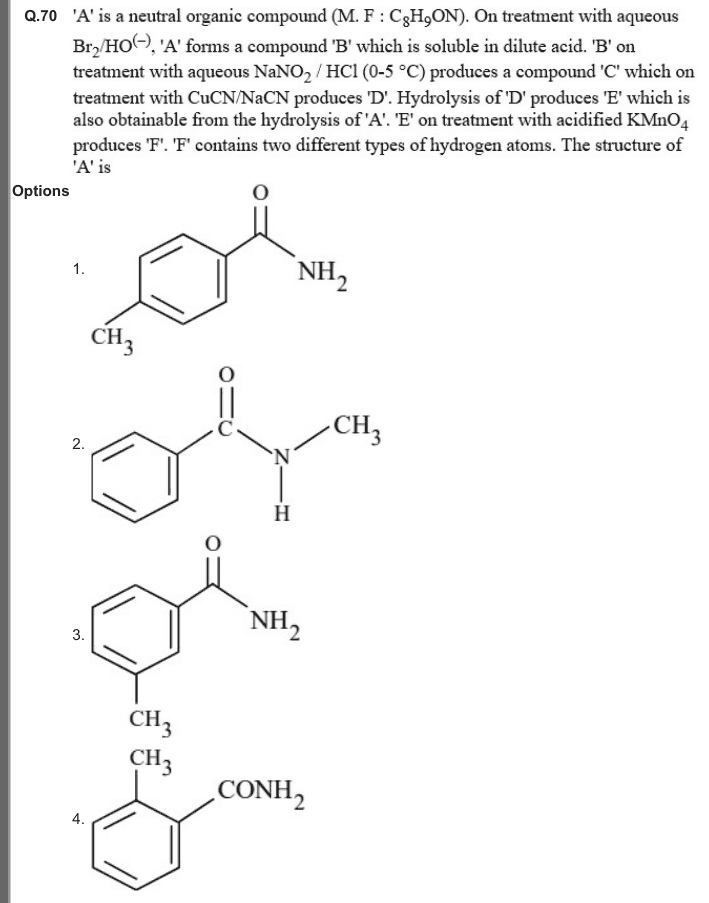
'A' is a neutral organic compound (M. F : $\mathrm{C_8H_9ON}$). On treatment with aqueous $\mathrm{Br_2/HO^{(-)}}$, 'A' forms a compound 'B' which is soluble in dilute acid. 'B' on treatment with aqueous $\mathrm{NaNO_2}$ / HCl (0-5 °C) produces a compound 'C' which on treatment with CuCN/NaCN produces 'D'. Hydrolysis of 'D' produces 'E' which is also obtainable from the hydrolysis of 'A'. 'E' on treatment with acidified $\mathrm{KMnO_4}$ produces 'F'. 'F' contains two different types of hydrogen atoms. The structure of 'A' is
The question as printed in the paper.
A
see figure a six-membered ring with alternating double bonds; a bond from its upper-right vertex goes up-right to a carbon with a double bond to 'O' above and a bond down-right to 'NH2'; a bond from its lower-left vertex goes down-left to 'CH3'.
B
see figure a six-membered ring with alternating double bonds, bonded to an atom printed 'C' that has a double bond to 'O' above and a bond down-right to 'N'; N has 'H' on a bond straight down and a bond up-right to 'CH3'.
C
see figure a six-membered ring with alternating double bonds; a bond from its upper-right vertex goes up-right to a carbon with a double bond to 'O' above and a bond down-right to 'NH2'; 'CH3' hangs on a bond straight down from the ring's bottom vertex.
D
see figure a six-membered ring with alternating double bonds; 'CH3' on a bond straight up from its upper-left vertex and 'CONH2' on a bond going up-right from the adjacent upper-right vertex.
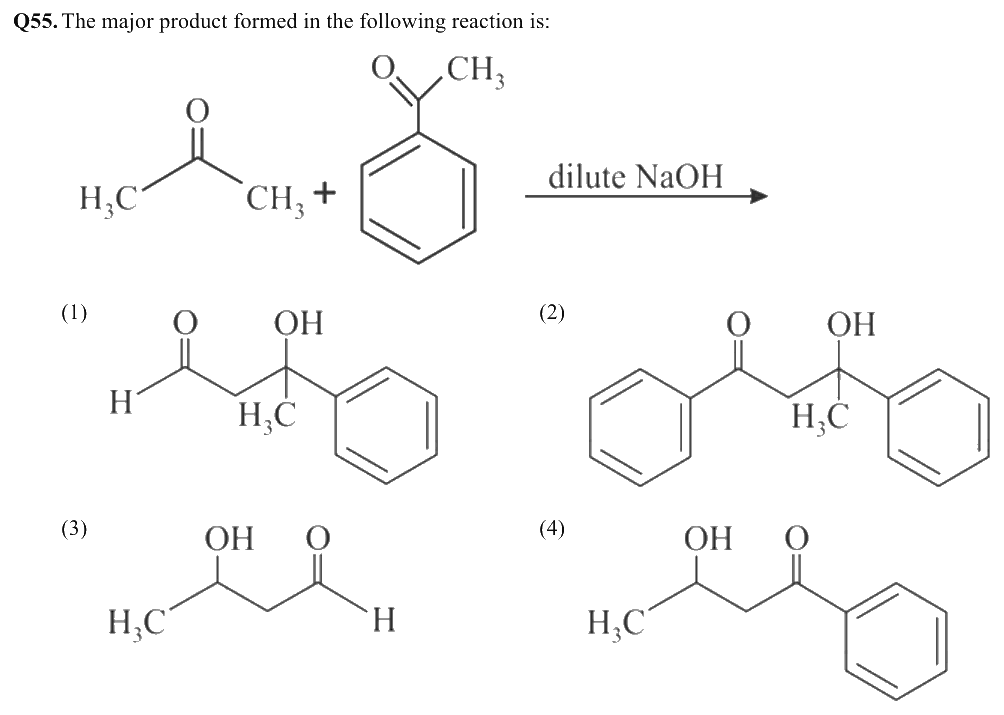
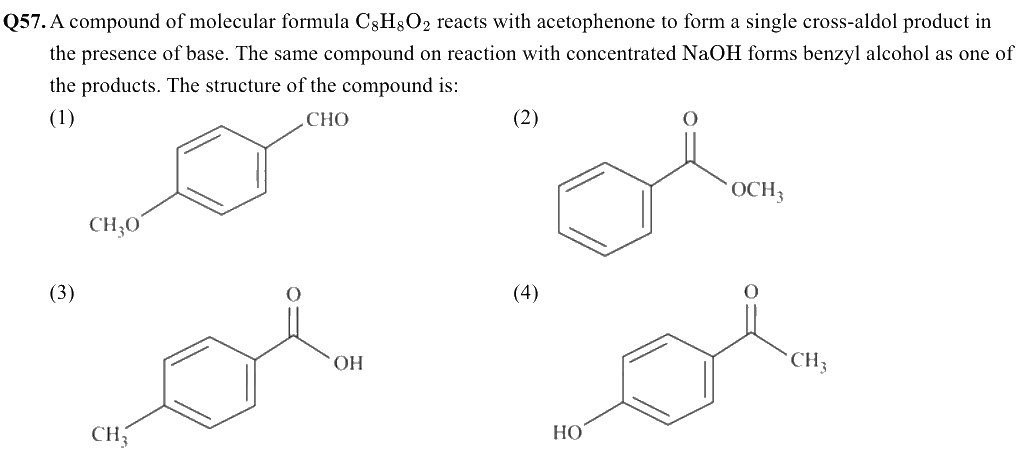
The compound A, $\mathrm{C_8H_8O_2}$ reacts with acetophenone to form a single product via cross-Aldol condensation. The compound A on reaction with conc. NaOH forms a substituted benzyl alcohol as one of the two products. The compound A is :
An organic compound (P) on treatment with aqueous ammonia under hot condition forms compound (Q) which on heating with $\mathrm{Br_2}$ and KOH forms compound (R) having molecular formula $\mathrm{C_6H_7N}$. Names of P, Q and R respectively are.
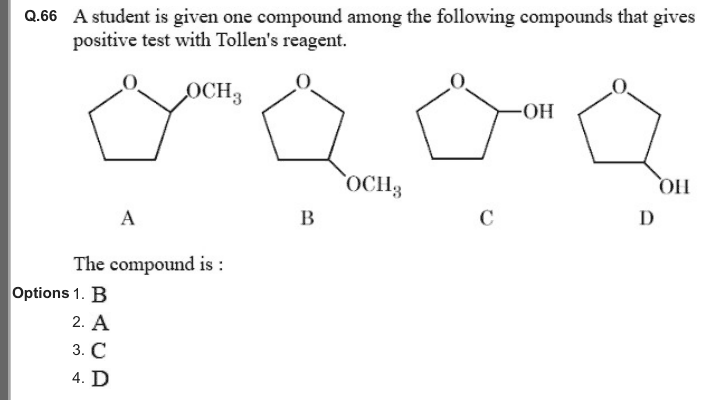
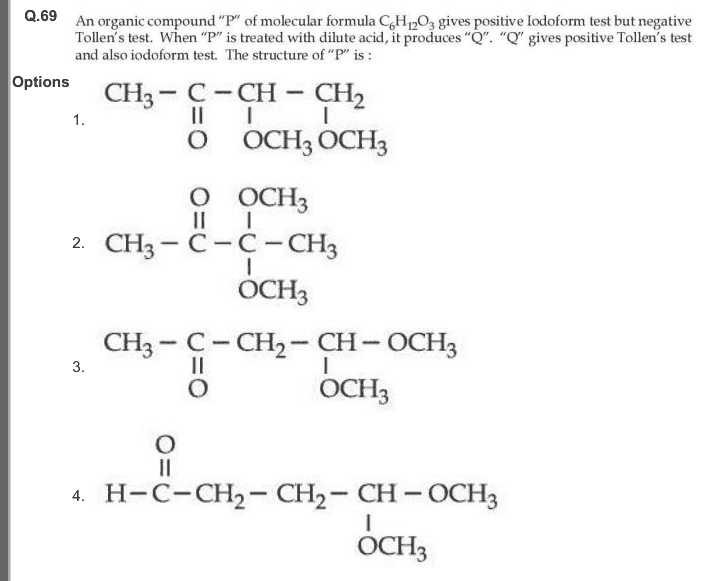
An organic compound "P" of molecular formula $\mathrm{C_6H_{12}O_3}$ gives positive Iodoform test but negative Tollen's test. When "P" is treated with dilute acid, it produces "Q". "Q" gives positive Tollen's test and also iodoform test. The structure of "P" is :
The question as printed in the paper.
A
see figure CH3 - C - CH - CH2 in a line; an O double-bonded below the first C, and OCH3 below the CH and OCH3 below the CH2 (the two OCH3 printed side by side).
B
see figure CH3 - C - C - CH3 in a line; O double-bonded above the first C, OCH3 above the second C, and OCH3 below the second C.
C
see figure CH3 - C - CH2 - CH - OCH3 in a line; an O double-bonded below the first C and OCH3 below the CH.
D
see figure H - C - CH2 - CH2 - CH - OCH3 in a line; an O double-bonded above the first C and OCH3 below the CH.
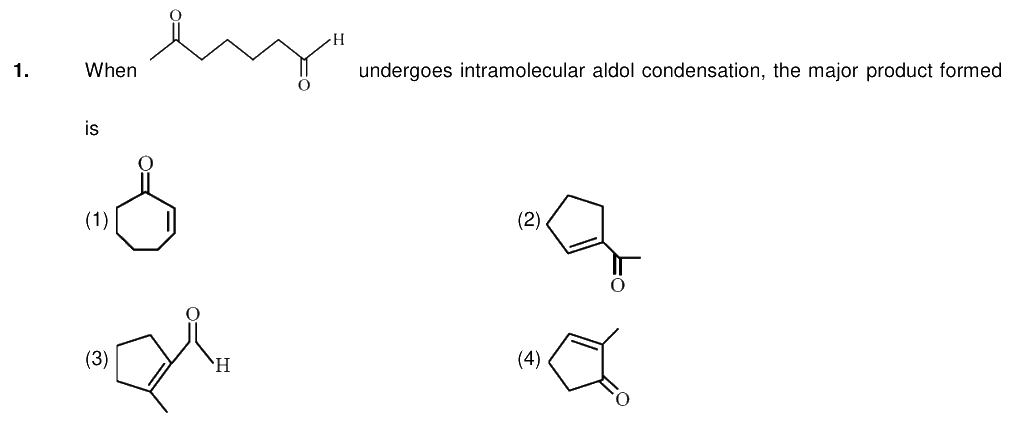
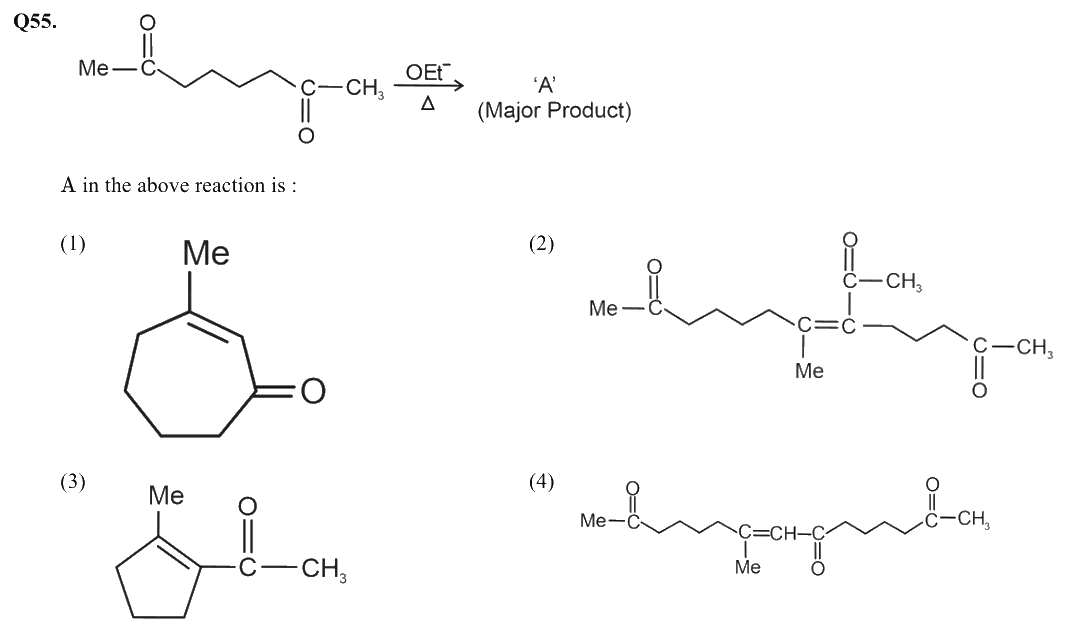
When (see the figure above) undergoes intramolecular aldol condensation, the major product formed is
The question as printed in the paper.
A
see figure a seven-membered ring with a C=O at the top and a C=C on the right-hand side next to the carbonyl carbon (cyclohept-2-en-1-one).
B
see figure a five-membered ring with a C=C at the lower edge; the lower-right alkene carbon carries an acetyl group (C=O with the O below and a CH3 to the right).
C
see figure a five-membered ring with a C=C at the lower right; the right alkene carbon carries a CHO group (C=O with the O above, H at the lower right) and the lower alkene carbon carries a CH3 group hanging down.
D
see figure a five-membered ring with a C=O at the lower right (O at the bottom right) and a C=C along the top edge; the alkene carbon next to the carbonyl carbon carries a CH3 group pointing up-right.
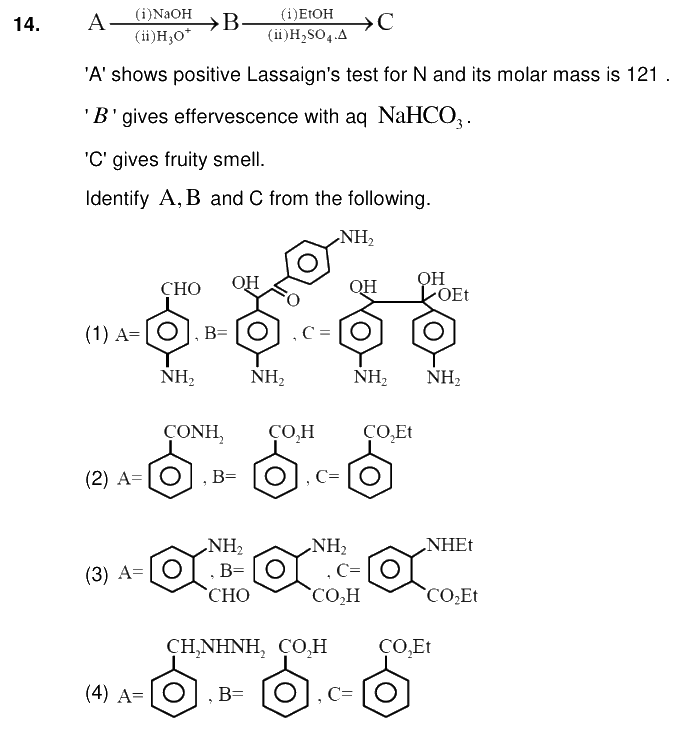
$A \xrightarrow[\text{(ii) H}_3\text{O}^+]{\text{(i) NaOH}} B \xrightarrow[\text{(ii) H}_2\text{SO}_4, \Delta]{\text{(i) EtOH}} C$
'A' shows positive Lassaign's test for N and its molar mass is 121 .
'$B$' gives effervescence with aq $NaHCO_3$.
'C' gives fruity smell.
Identify $A, B$ and C from the following.
The question as printed in the paper.
A
see figure A = 4-aminobenzaldehyde (benzene ring with CHO on top and NH2 at the bottom); B = a benzoin-type compound: a benzene ring with NH2 at the bottom whose top carbon carries CH(OH), joined to a C=O (O below) that is bonded to a second benzene ring carrying NH2 at its top; C = two benzene rings each with NH2 at the bottom, the left top carbon carries CH(OH), the right top carbon carries C(OH)(OEt), and the two are joined by a single bond.
B
see figure A = benzene ring with CONH2; B = benzene ring with CO2H; C = benzene ring with CO2Et.
C
see figure A = benzene ring with NH2 (upper right) and CHO (lower right), adjacent; B = benzene ring with NH2 and CO2H adjacent; C = benzene ring with NHEt and CO2Et adjacent.
D
see figure A = benzene ring with CH2NHNH2; B = benzene ring with CO2H; C = benzene ring with CO2Et.
"P" is an optically active compound with molecular formula $C_6H_{12}O$. When 'P' is treated with 2, 4-dinitrophenylhydrazine, it gives a positive test. However, in presence of Tollens reagent, "P" gives a negative test. Predict the structure of "P".
A
$CH_3 - C(=O) - CH_2 - CH_2 - CH_2 - CH_3$ (the double-bonded O hangs above the carbonyl C)
B
$CH_3 - C(=O) - CH(CH_3) - CH_2 - CH_3$ (the double-bonded O is above the carbonyl C; the $CH_2 - CH_3$ group hangs below the CH)
C
$H - C(=O) - CH_2 - CH(CH_3) - CH_2 - CH_3$ (the double-bonded O is above the carbonyl C; the $CH_2 - CH_3$ group hangs below the CH)
D
$CH_3 - C(=O) - CH_2 - CH(CH_3) - CH_3$ (the double-bonded O is above the carbonyl C; a $CH_3$ hangs below the CH)
Answer: (B) $CH_3 - C(=O) - CH(CH_3) - CH_2 - CH_3$ (the double-bonded O is above the carbonyl C; the $CH_2 - CH_3$ group hangs below the CH)· Key from source paper
An organic compound (X) with molecular formula $C_3H_6O$ is not readily oxidised. On reduction it gives $C_3H_8O(Y)$ which reacts with HBr to give a bromide (Z) which is converted to Grignard reagent. This Grignard reagent on reaction with (X) followed by hydrolysis give 2,3-dimethylbutan-2-ol. Compounds (X), (Y) and (Z) respectively are :
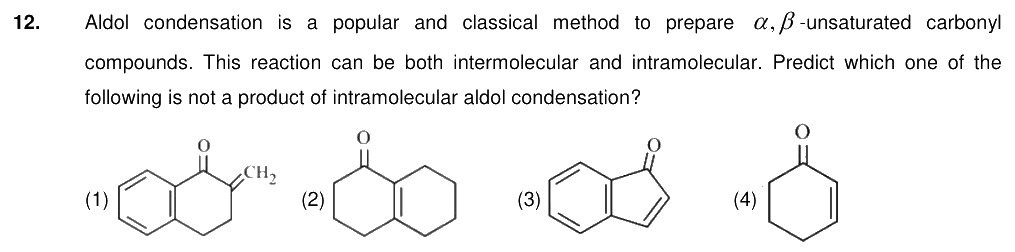
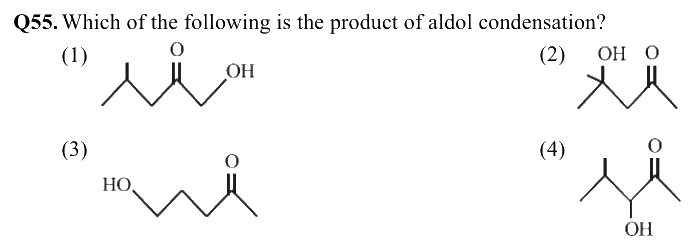
Aldol condensation is a popular and classical method to prepare $\alpha, \beta$ -unsaturated carbonyl compounds. This reaction can be both intermolecular and intramolecular. Predict which one of the following is not a product of intramolecular aldol condensation?
(see the figure above)
The question as printed in the paper.
A
see figure a benzene ring fused to a six-membered ring that has a carbonyl (C=O, the O up) next to the fusion carbon and, on the next ring carbon, an exocyclic double bond to a CH2 (written '=CH2').
B
see figure two fused six-membered rings (a decalin skeleton) with a carbonyl (C=O, the O up) on the left ring next to the fusion carbon, and a C=C at the fusion bond between the two rings.
C
see figure a benzene ring fused to a five-membered ring that has a carbonyl (C=O, the O up) next to the fusion carbon and a C=C in the five-membered ring on its far side (conjugated with the carbonyl).
D
see figure a six-membered ring with a carbonyl (C=O, the O up) at the top and a C=C on the right side next to the carbonyl carbon (a cyclohexenone).
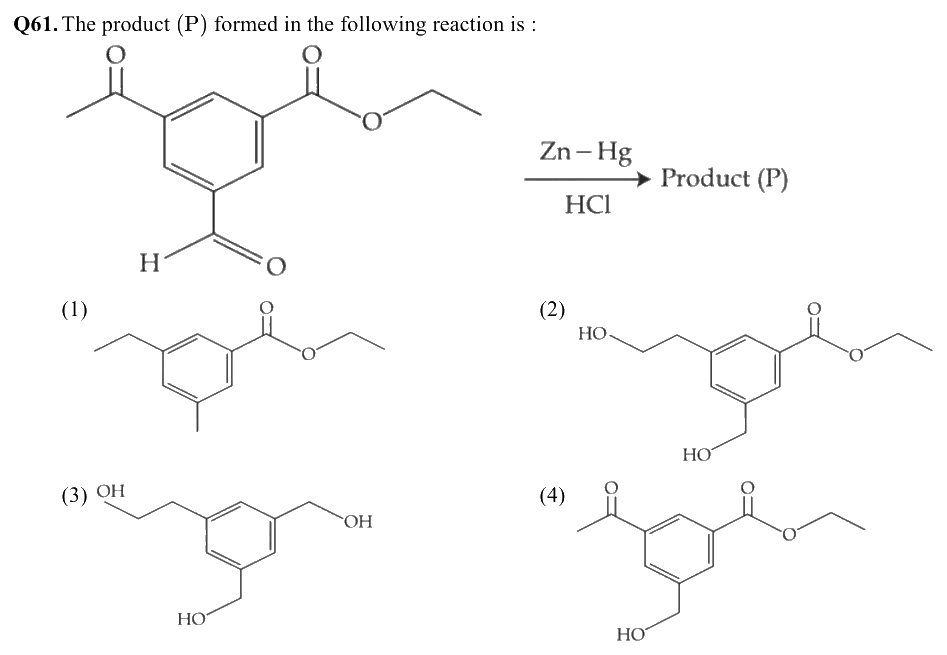
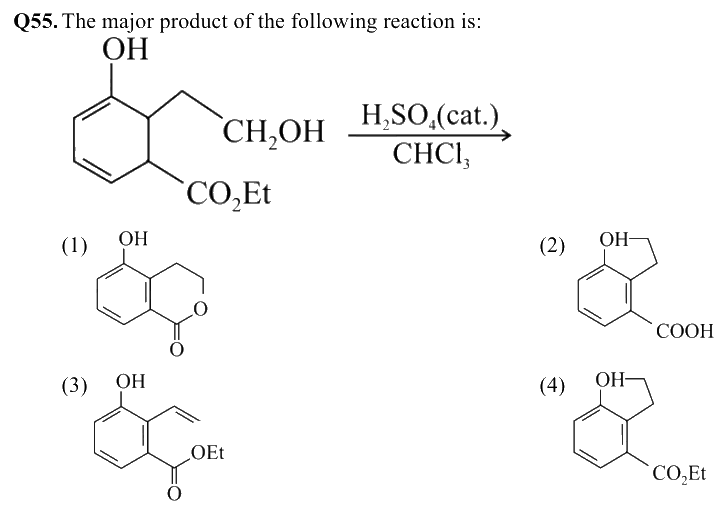
The product (P) formed in the following reaction is :
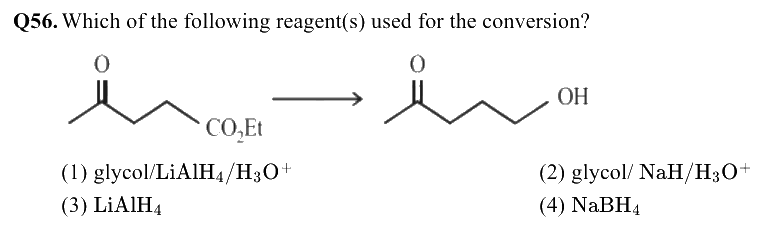
(see the figure above)
The question as printed in the paper.
A
see figure a benzene ring with an ethyl group at the upper left, a methyl group at the bottom, and an ethyl ester group (C(=O)–O–CH2CH3) at the upper right.
B
see figure a benzene ring with a CH2–CH2–OH chain at the upper left, a CH2–OH group at the bottom, and an ethyl ester group (C(=O)–O–CH2CH3) at the upper right.
C
see figure a benzene ring with a CH2–CH2–OH chain at the upper left, a CH2–OH group at the right and a CH2–OH group at the bottom (three CH2OH-type groups, no ester).
D
see figure a benzene ring with an acetyl group (C(=O)–CH3) at the upper left, an ethyl ester group (C(=O)–O–CH2CH3) at the upper right and a CH2–OH group at the bottom.
Both acetaldehyde and acetone (individually) undergo which of the following reactions? A. Iodoform Reaction B. Cannizaro Reaction C. Aldol Condensation D. Tollen's Test E. Clemmensen Reduction Choose the correct answer from the options given below:
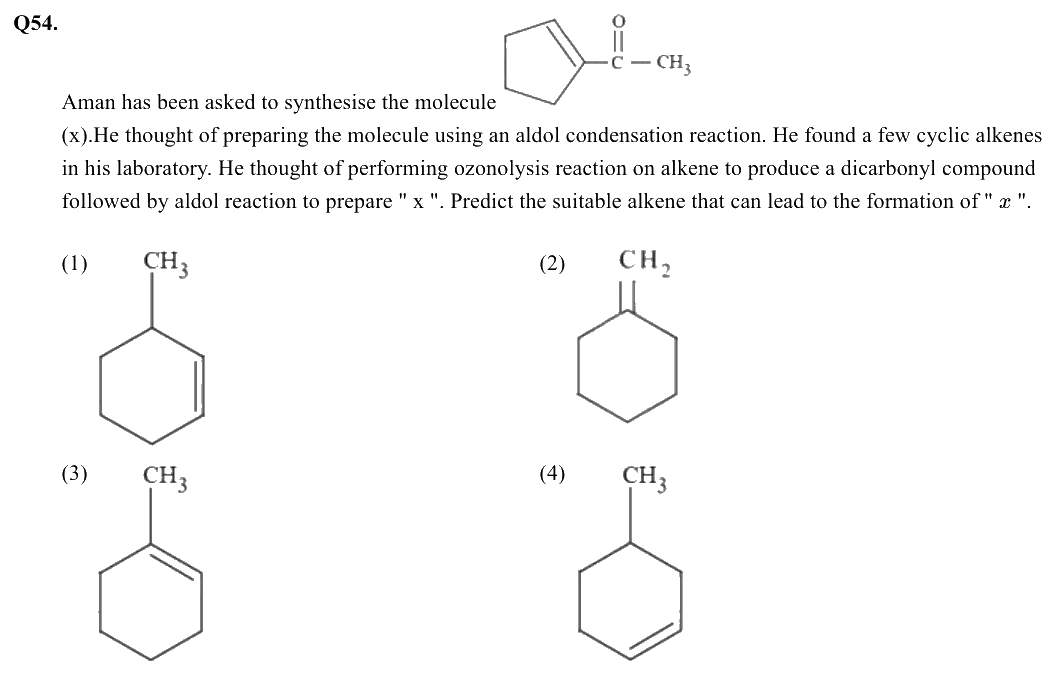
see figure Aman has been asked to synthesise the molecule (x).He thought of preparing the molecule using an aldol condensation reaction. He found a few cyclic alkenes in his laboratory. He thought of performing ozonolysis reaction on alkene to produce a dicarbonyl compound followed by aldol reaction to prepare " x ". Predict the suitable alkene that can lead to the formation of " $x$ ".
The question as printed in the paper.
A
see figure a six-membered ring with 'CH3' on a bond going up from the top vertex; the ring double bond is on the right-hand side, between the upper-right and lower-right vertices.
B
see figure a six-membered ring with a double-bonded 'CH2' on the top vertex (exocyclic double bond); no double bond inside the ring.
C
see figure a six-membered ring with 'CH3' on a bond going up from the top vertex; the ring double bond runs from that top vertex to the upper-right vertex.
D
see figure a six-membered ring with 'CH3' on a bond going up from the top vertex; the ring double bond is at the bottom, between the bottom and lower-right vertices.
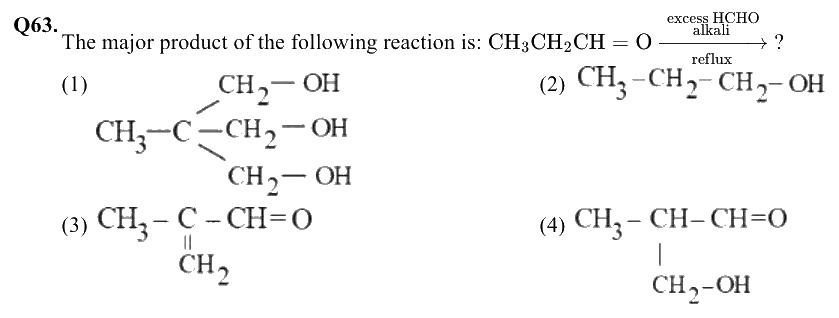
The major product of the following reaction is: $\mathrm{CH_3CH_2CH = O} \xrightarrow[\text{reflux}]{\text{excess HCHO alkali}} ?$
The question as printed in the paper.
A
see figure a carbon with 'CH3–' on its left and three '–CH2–OH' groups: one drawn up ('CH2–OH' above), one to the right ('–CH2–OH') and one below ('CH2–OH'), all joined to the central carbon.
B
$\mathrm{CH_3 - CH_2 - CH_2 - OH}$
C
see figure 'CH3 – C – CH=O' with a double-bonded 'CH2' hanging below the central carbon.
D
see figure 'CH3 – CH – CH=O' with a vertical bond down from the CH to 'CH2–OH'.
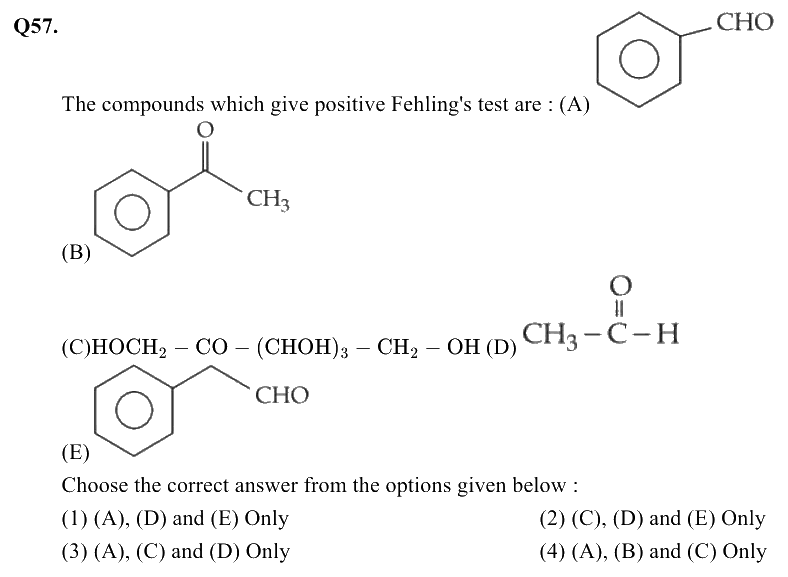
The compounds which give positive Fehling's test are : (A) (see the figure above) (B) (see the figure above) (C) $\mathrm{HOCH_2 - CO - (CHOH)_3 - CH_2 - OH}$ (D) (see the figure above) (E) (see the figure above) Choose the correct answer from the options given below :
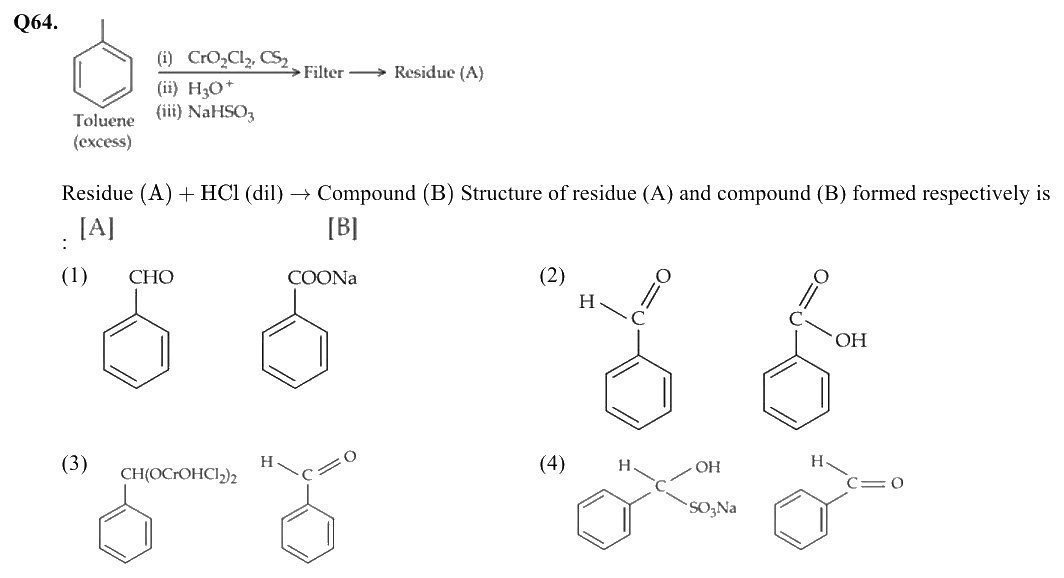
see figure Residue (A) + HCl (dil) $\rightarrow$ Compound (B) Structure of residue (A) and compound (B) formed respectively is :
[A] [B]
The question as printed in the paper.
A
see figure [A]: a benzene ring with CHO on a bond going up; [B]: a benzene ring with COONa on a bond going up.
B
see figure [A]: a benzene ring bonded to a carbon that has 'H' on its left and a double bond to 'O' above it (benzaldehyde drawn with the H shown); [B]: a benzene ring bonded to a carbon with a double bond to 'O' above and 'OH' to its lower right.
C
see figure [A]: a benzene ring with 'CH(OCrOHCl2)2' on a bond going up; [B]: a benzene ring bonded to a carbon with 'H' on its left and a double bond to 'O' at its upper right.
D
see figure [A]: a benzene ring bonded to a carbon that carries 'H' above-left, 'OH' to its upper right and 'SO3Na' below; [B]: a benzene ring bonded to a carbon with 'H' above-left and a double bond to 'O' on its right.
Which of the following compounds will give silver mirror with ammoniacal silver nitrate? A. Formic acid B. Formaldehyde C. Benzaldehyde D. Acetone Choose the correct answer from the options given below :
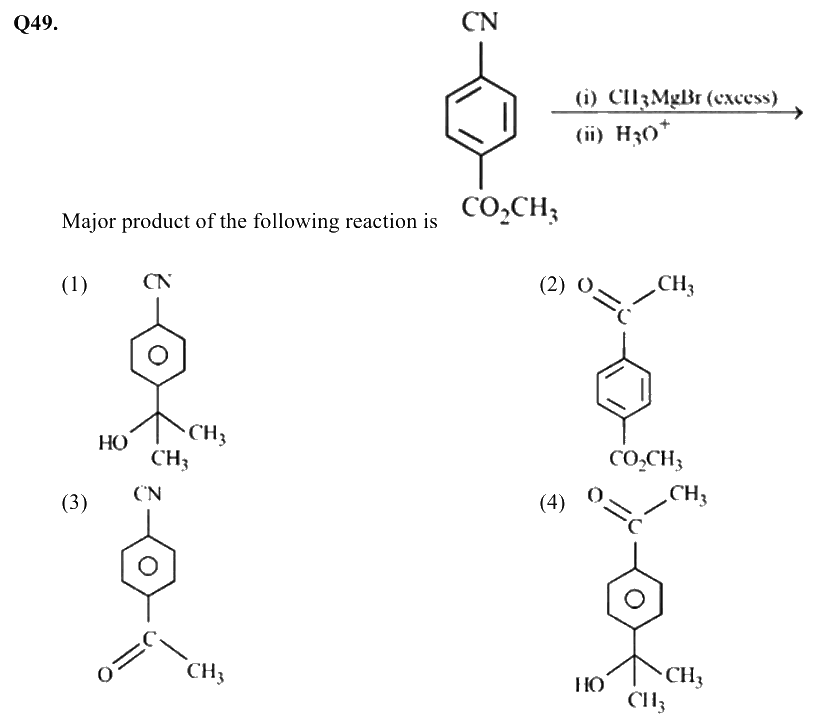
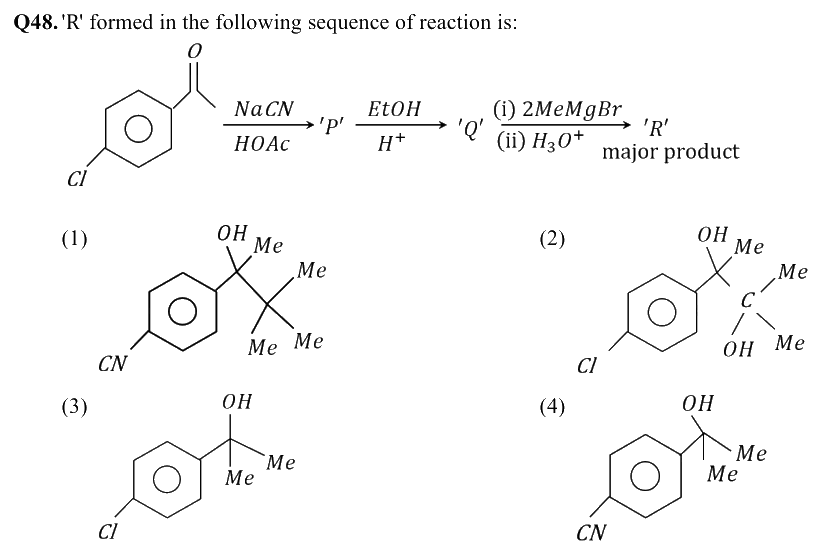
see figure Major product of the following reaction is
The question as printed in the paper.
A
see figure a benzene ring (drawn with a circle inside) with CN at the top and, at the bottom, a carbon bearing HO (left), CH3 (right) and CH3 (below).
B
see figure a benzene ring (drawn with alternating double bonds) with an acetyl group at the top (C=O with O to the upper left, CH3 to the upper right) and CO2CH3 at the bottom.
C
see figure a benzene ring (drawn with a circle inside) with CN at the top and an acetyl group at the bottom (C=O with O to the lower left, CH3 to the lower right).
D
see figure a benzene ring (drawn with a circle inside) with an acetyl group at the top (C=O with O to the upper left, CH3 to the upper right) and, at the bottom, a carbon bearing HO (left), CH3 (right) and CH3 (below).
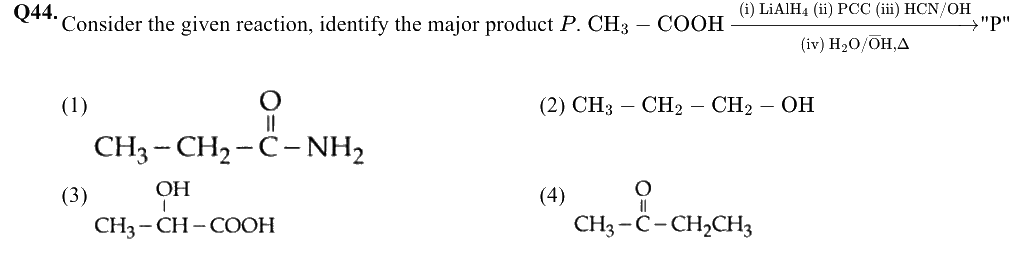
Consider the given reaction, identify the major product $P$. $CH_3 - COOH$ $\xrightarrow[\text{(iv) } H_2O/\overline{O}H,\Delta]{\text{(i) } LiAlH_4 \text{ (ii) PCC (iii) HCN/}\overline{O}H}$ "P"
The question as printed in the paper.
A
see figure CH3-CH2-C(=O)-NH2, drawn with the carbonyl O above the carbon.
B
see figure CH3-CH2-CH2-OH written as a straight chain.
C
see figure CH3-CH(OH)-COOH, with the OH on a vertical bond above the CH.
D
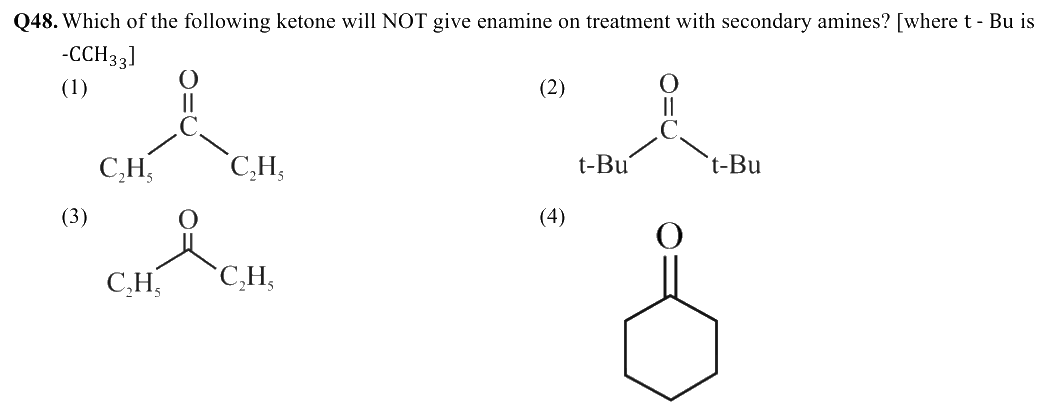
see figure CH3-C(=O)-CH2CH3, drawn with the carbonyl O above the carbon.
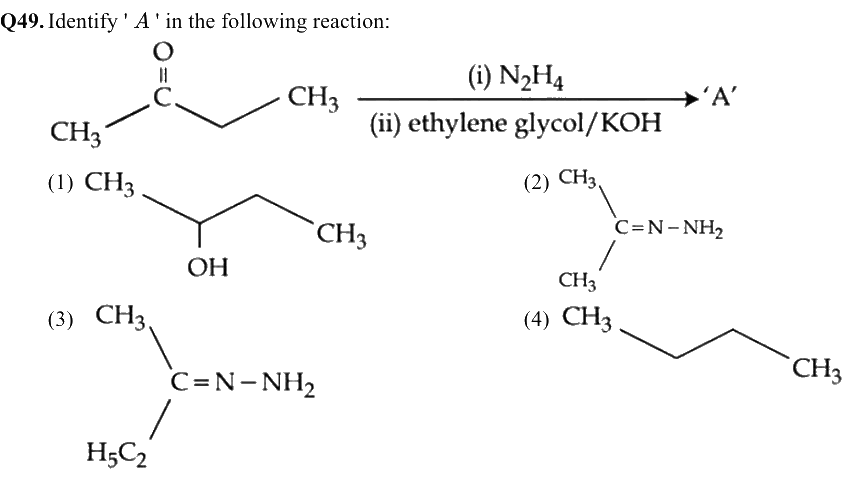
see figure a skeletal structure with CH$_3$ at the upper left, a carbon bearing OH below it, then a bond up to a vertex and down to CH$_3$ at the lower right
B
see figure a carbon bearing =N–NH$_2$ with CH$_3$ at the upper left and CH$_3$ at the lower left
C
see figure a carbon bearing =N–NH$_2$ with CH$_3$ at the upper left and H$_5$C$_2$ at the lower left
D
see figure a zigzag skeletal chain with CH$_3$ at the upper left and CH$_3$ at the lower right, with two vertices between them
Given below are two statements : Statements I : Acidity of $\alpha$-hydrogens of aldehydes and ketones is responsible for Aldol reaction. Statement II : Reaction between benzaldehyde and ethanal will NOT give Cross - Aldol product. In the light of the above statements, choose the most appropriate answer from the options given below :
A
Statement I is correct but Statement II is incorrect
B
Both Statement I and Statement II are correct
C
Both Statement I and Statement II are incorrect
D
Statement I is incorrect but Statement II is correct
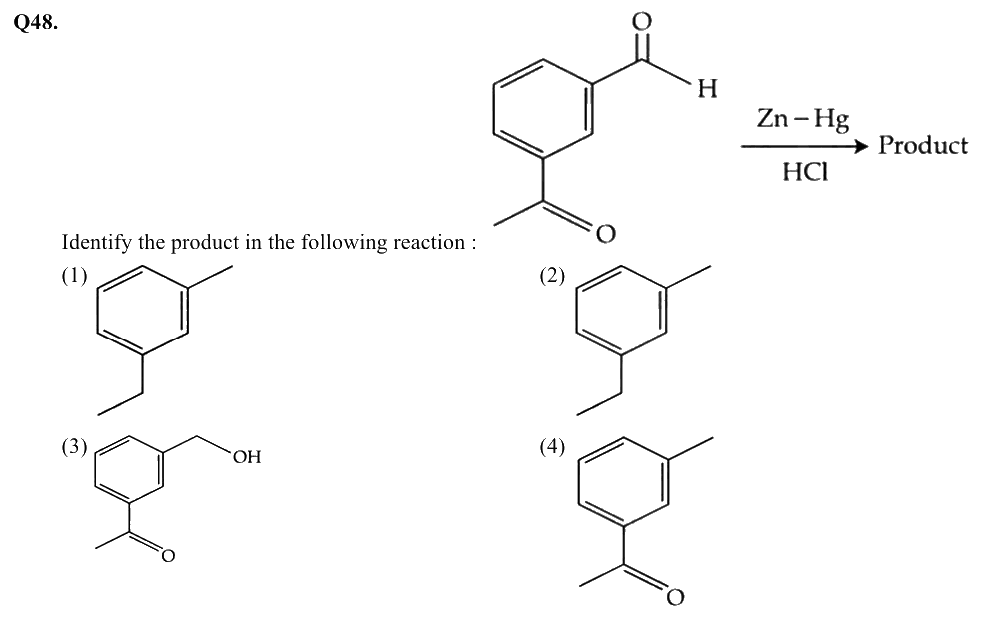
see figure Identify the product in the following reaction :
The question as printed in the paper.
A
see figure Benzene ring (alternating double bonds drawn) with a methyl line at the upper-right carbon and, from the lower carbon, an ethyl group (a line down, then a line to the lower left).
B
see figure Benzene ring (alternating double bonds drawn) with a methyl line at the upper-right carbon and, from the lower carbon, an ethyl group (a line down, then a line to the lower left); drawn the same as option 1.
C
see figure Benzene ring with, at the upper-right carbon, a CH2OH group (a line up-right then a line down-right to 'OH'), and at the lower carbon an acetyl group (C with a double-bonded O at the lower right and a methyl line to the lower left).
D
see figure Benzene ring with a methyl line at the upper-right carbon and, from the lower carbon, an acetyl group (C with a double-bonded O at the lower right and a methyl line to the lower left).
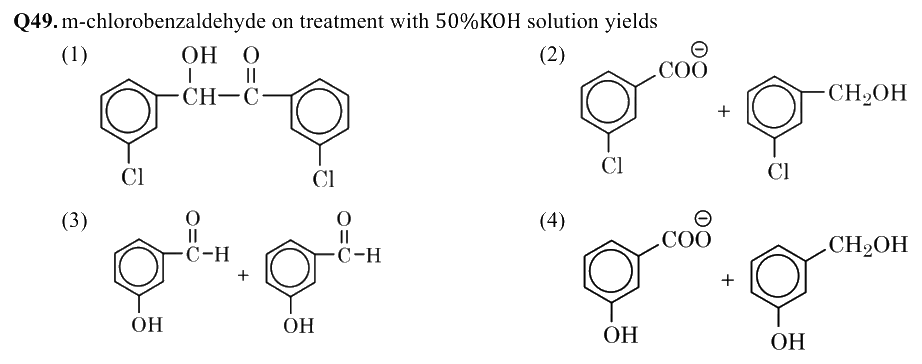
m-chlorobenzaldehyde on treatment with 50%KOH solution yields
(see the figure above)
The question as printed in the paper.
A
see figure A single molecule: two benzene rings joined through a chain CH(OH)–C(=O); the carbon bearing OH is attached to the left ring and the carbonyl carbon to the right ring; each ring carries a Cl at the position drawn at the bottom of the ring (meta to the chain attachment as drawn).
B
see figure Two molecules joined by '+': a benzene ring with a $\mathrm{COO^-}$ group (upper right) and Cl at the bottom; and a benzene ring with a $\mathrm{CH_2OH}$ group (upper right) and Cl at the bottom.
C
see figure Two identical drawings joined by '+': a benzene ring with a CHO group (C double-bonded to O, single bond to H) at the upper right and OH at the bottom.
D
see figure Two molecules joined by '+': a benzene ring with a $\mathrm{COO^-}$ group (upper right) and OH at the bottom; and a benzene ring with a $\mathrm{CH_2OH}$ group (upper right) and OH at the bottom.
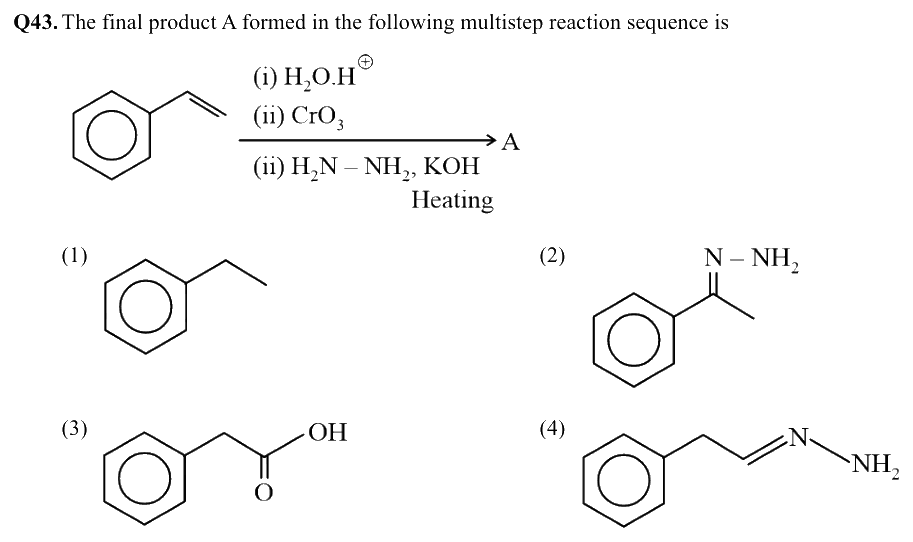
The final product A formed in the following multistep reaction sequence is
(see the figure above)
The question as printed in the paper.
A
see figure Ethylbenzene: a benzene ring (drawn with an inner circle) bonded to a two-carbon chain (ethyl).
B
see figure A benzene ring (inner circle) bonded to a carbon that is double-bonded to N$-$NH$_2$ (drawn above it) and also bonded to a methyl line.
C
see figure A benzene ring (inner circle) bonded to a CH$_2$ which is bonded to a carbon carrying a double-bonded O (below) and an OH (right): a carboxylic acid group.
D
see figure A benzene ring (inner circle) bonded to a two-carbon chain whose terminal carbon is double-bonded to N, which is bonded to NH$_2$ (drawn down-right).
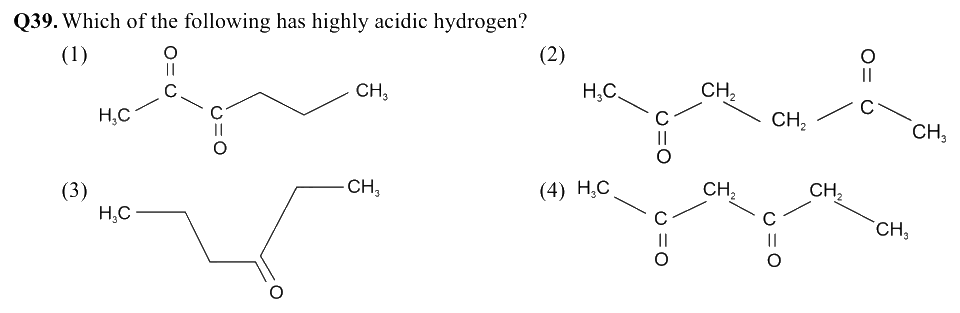
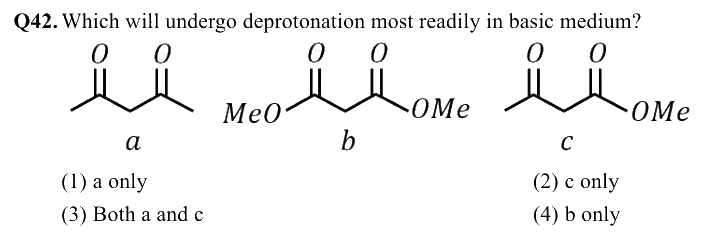
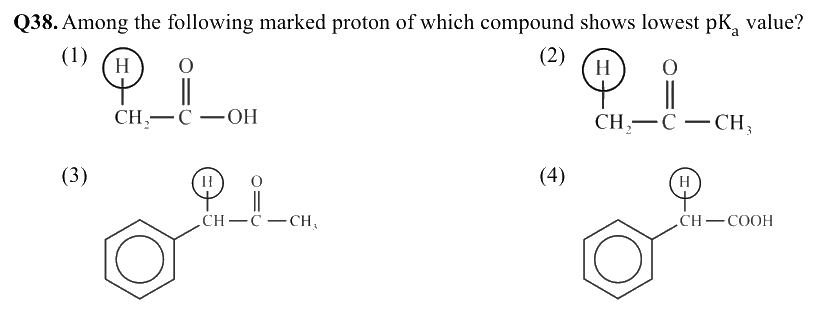
Which of the following has highly acidic hydrogen?
The question as printed in the paper.
A
see figure H3C-C(=O)-C(=O) with two adjacent carbonyl carbons (first O above, second O below), then a zigzag chain of two bonds to CH3 on the right
B
see figure H3C-C(=O)-CH2-CH2-C(=O)-CH3: H3C at the upper left, a carbonyl carbon with O below, then CH2 (up), CH2 (down), a second carbonyl carbon with O above, then CH3 at the lower right
C
see figure Zigzag chain with H3C at the left, a carbonyl carbon at the bottom with O at its lower right, and CH3 at the upper right
D
see figure H3C-C(=O)-CH2-C(=O)-CH2-CH3: H3C at the upper left, a carbonyl carbon with O below, CH2 (up), a second carbonyl carbon with O below, CH2 (up), then CH3 at the lower right
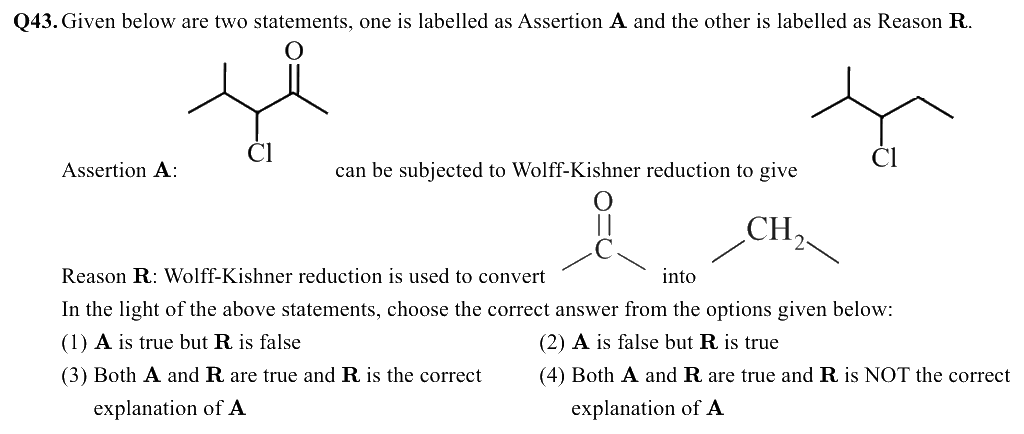
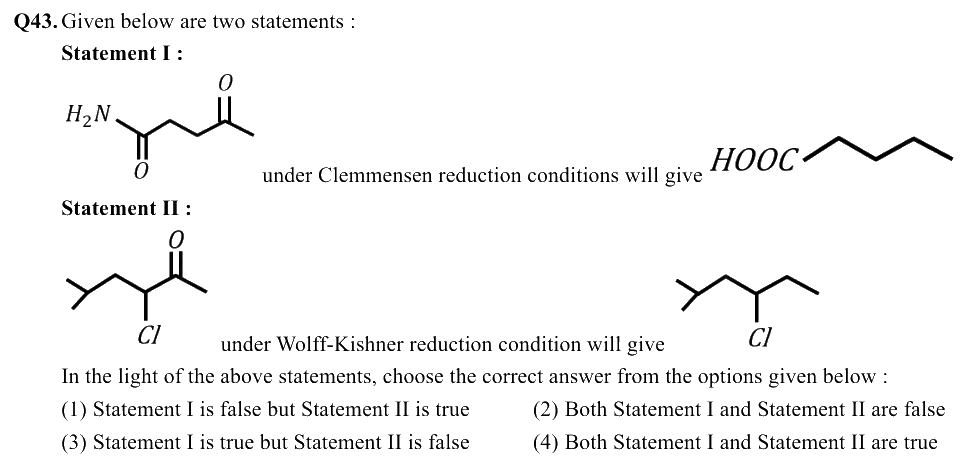
Given below are two statements, one is labelled as Assertion A and the other is labelled as Reason R. Assertion A: (see the figure above) can be subjected to Wolff-Kishner reduction to give (see the figure above) Reason R: Wolff-Kishner reduction is used to convert (see the figure above) into (see the figure above) In the light of the above statements, choose the correct answer from the options given below:
The question as printed in the paper.
A
A is true but R is false
B
A is false but R is true
C
Both A and R are true and R is the correct explanation of A
D
Both A and R are true and R is NOT the correct explanation of A
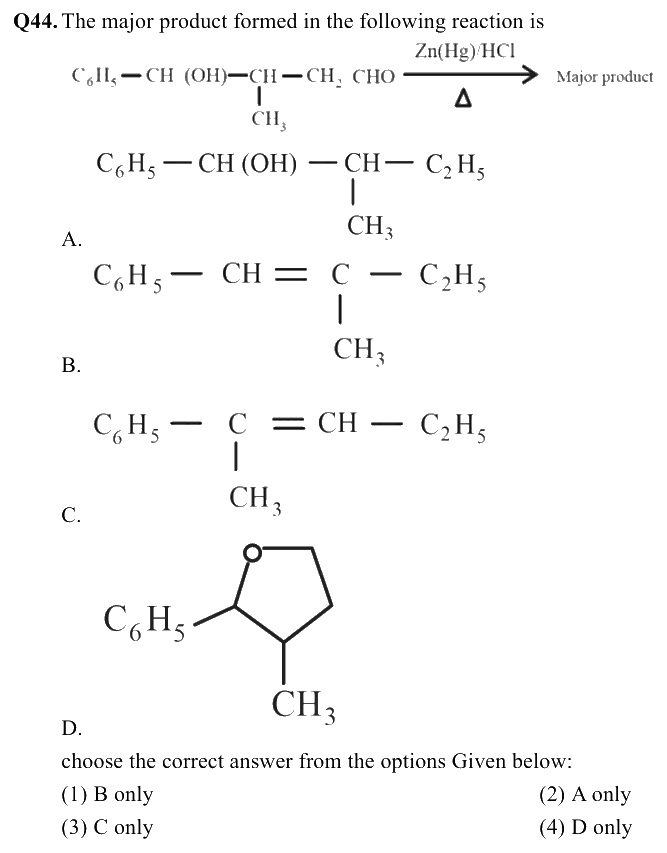
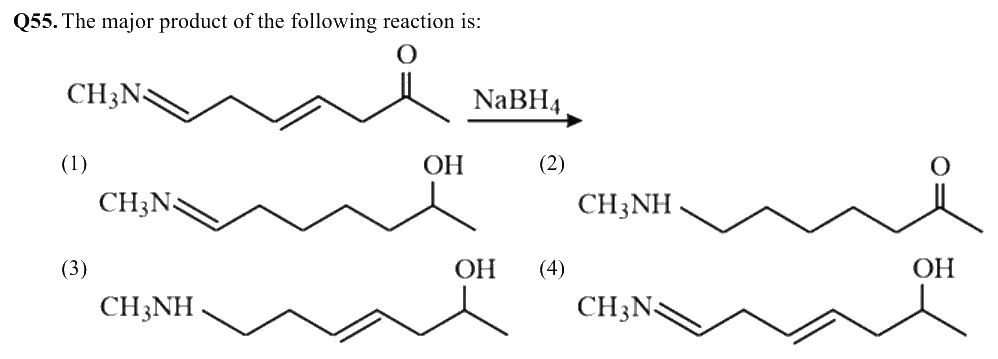
The major product formed in the following reaction is (see the figure above) A. $\mathrm{C_6H_5-CH(OH)-CH-C_2H_5}$ with $\mathrm{CH_3}$ below the second CH B. $\mathrm{C_6H_5-CH=C-C_2H_5}$ with $\mathrm{CH_3}$ below the C C. $\mathrm{C_6H_5-C=CH-C_2H_5}$ with $\mathrm{CH_3}$ below the C D. (see the figure above) choose the correct answer from the options Given below:
Given below are two statements, one is labelled as Assertion A and the other is labelled as Reasom R. Assertion A: A solution of the product obtained by heating a mole of glycine with a mole of chlorine in presence of red phosphorous generates chiral carbon atom. Reason R: A molecule with 2 chiral carbons is always optically active. In the light of above statements, chose the correct answer from the options given below:
A
A is true but R is false
B
Both A and R are true but R is the correct explaination of A
C
A is false but R is true
D
Both A and R are true but R is NOT the correct explaination of A
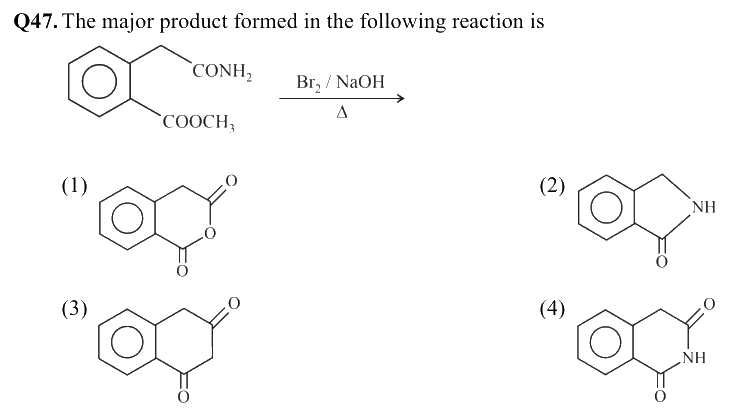
The major product formed in the following reaction is
(see the figure above)
The question as printed in the paper.
A
see figure Benzene ring fused to a six-membered ring containing CH2, a ring C=O, a ring O and a second ring C=O (a cyclic anhydride-type ring: O between the two carbonyl carbons).
B
see figure Benzene ring fused to a five-membered ring containing CH2, NH and one C=O (isoindolinone type).
C
see figure Benzene ring fused to a six-membered carbocyclic ring with two C=O groups separated by a CH2 (naphthalene-dione type).
D
see figure Benzene ring fused to a six-membered ring containing CH2, a C=O, NH and a second C=O (the NH sits between the two carbonyls; isoquinoline-dione type).
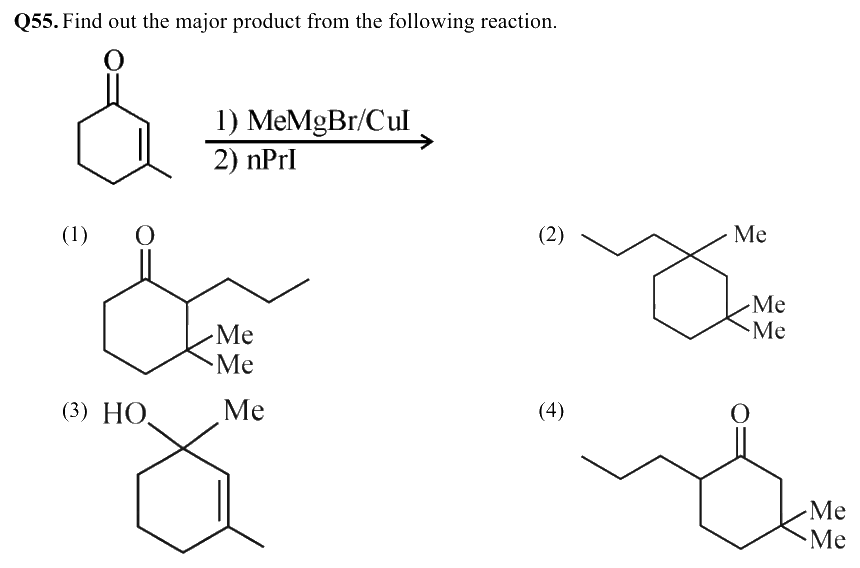
Find out the major product from the following reaction.
(see the figure above)
The question as printed in the paper.
A
see figure Cyclohexanone with C=O at the top left; the adjacent ring carbon carries an n-propyl chain; the next ring carbon carries two methyl groups (Me, Me).
B
see figure Cyclohexane (no C=O) with a ring carbon at the top carrying a methyl (Me) and an n-propyl chain; the ring carbon after one CH2 carries two methyl groups (Me, Me).
C
see figure Cyclohexene with HO and a methyl (Me) on the same top ring carbon; the C=C is on the right side, and the alkene carbon at its lower end carries a methyl group.
D
see figure Cyclohexanone with C=O at the top; the adjacent ring carbon on the left carries an n-propyl chain; on the other side of the ring, the carbon after one CH2 from the C=O carbon carries two methyl groups (Me, Me).
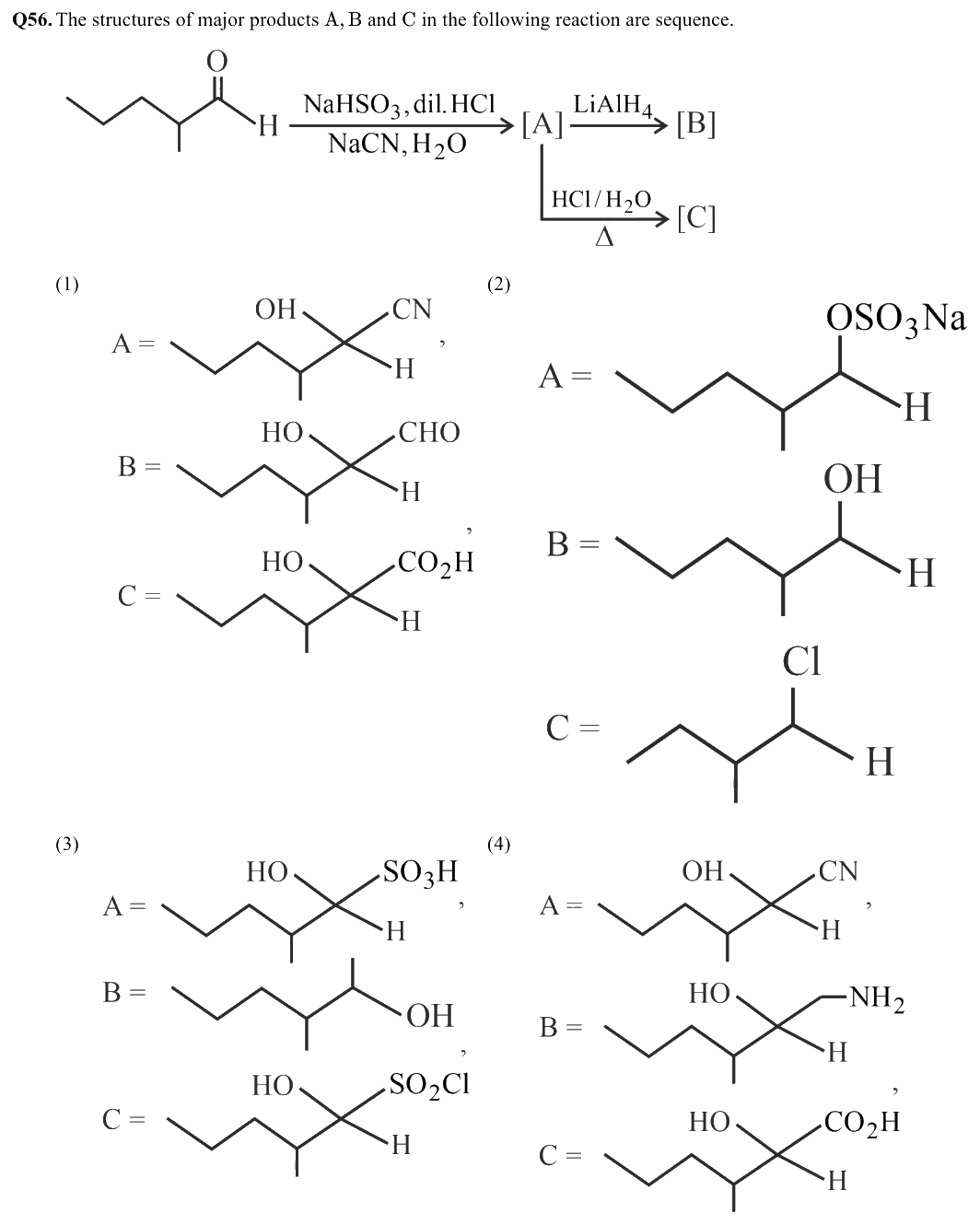
The structures of major products A, B and C in the following reaction are sequence.
(see the figure above)
The question as printed in the paper.
A
see figure A = skeletal chain with a carbon carrying OH, CN and H (cyanohydrin); B = the same carbon carrying HO, CHO and H; C = the same carbon carrying HO, $\mathrm{CO_2H}$ and H.
B
see figure A = skeletal chain ending in a carbon carrying $\mathrm{OSO_3Na}$ and H; B = the chain ending in a carbon carrying OH and H; C = the chain ending in a carbon carrying Cl and H.
C
see figure A = skeletal chain with a carbon carrying HO, $\mathrm{SO_3H}$ and H; B = the chain ending in a carbon carrying OH; C = the chain with a carbon carrying HO, $\mathrm{SO_2Cl}$ and H.
D
see figure A = skeletal chain with a carbon carrying OH, CN and H; B = the same carbon carrying HO, a bond to $\mathrm{NH_2}$ (drawn as a line ending in $-\mathrm{NH_2}$) and H; C = the same carbon carrying HO, $\mathrm{CO_2H}$ and H.
Consider the following reaction Propanal + Methanal = $\xrightarrow[\text{(ii) }\Delta\text{ (iii) NaCN (iv) }\mathrm{H_3O^+}]{\text{(i) dil. NaOH}}$ Product $B$ ($\mathrm{C_5H_8O_3}$) The correct statement for product $B$ is. It is
A
optically active and adds one mole of bromine
B
racemic mixture and is neutral
C
racemic mixture and gives a gas with saturated $\mathrm{NaHCO_3}$ solution
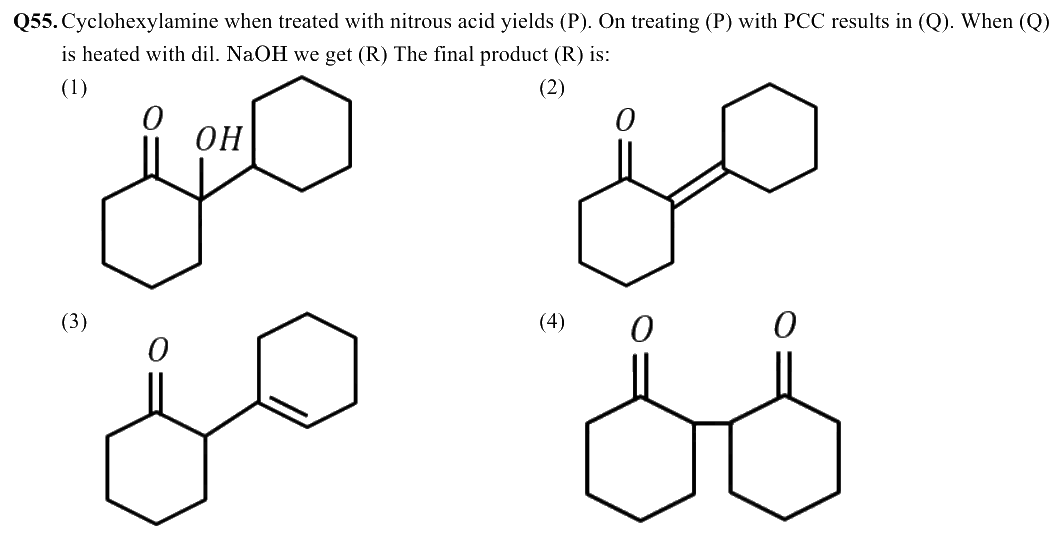
Cyclohexylamine when treated with nitrous acid yields (P). On treating (P) with PCC results in (Q). When (Q) is heated with dil. NaOH we get (R) The final product (R) is:
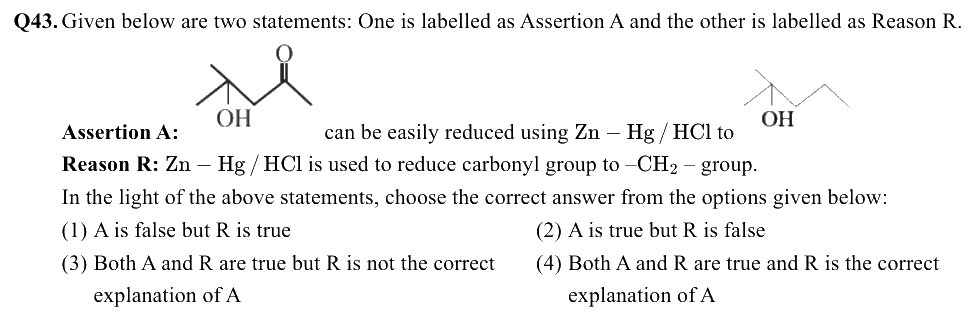
Given below are two statements: One is labelled as Assertion A and the other is labelled as Reason R.
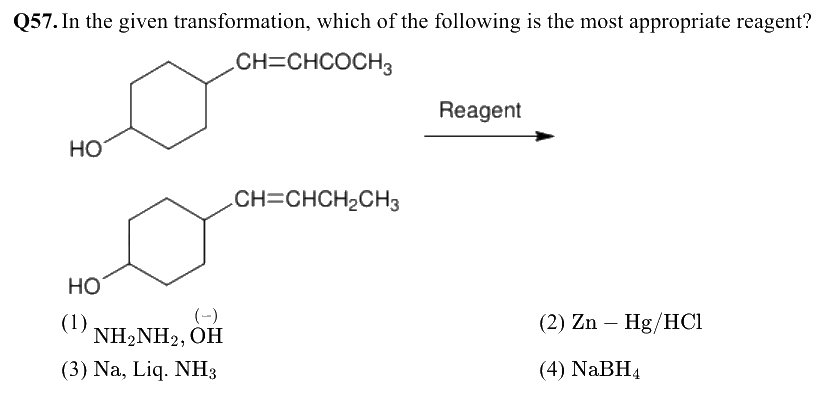
Assertion A: (see the figure above) can be easily reduced using Zn $-$ Hg / HCl to (see the figure above) Reason R: Zn $-$ Hg / HCl is used to reduce carbonyl group to $-\mathrm{CH_2}-$ group. In the light of the above statements, choose the correct answer from the options given below:
The question as printed in the paper.
A
A is false but R is true
B
A is true but R is false
C
Both A and R are true but R is not the correct explanation of A
D
Both A and R are true and R is the correct explanation of A
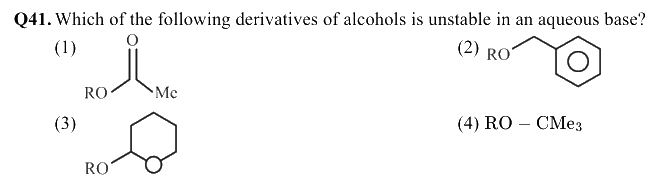
Given below are two statements: one is labelled as Assertion A and the other is labelled as Reason R: Assertion A: Acetal/Ketal is stable in basic medium. Reason R: The high leaving tendency of alkoxide ion gives the stability to acetal/ketal in basic medium. In the light of the above statements, choose the correct answer from the options given below:
A
A is true but R is false
B
A is false but R is true
C
Both A and R are true and R is the correct explanation of A
D
Both A and R are true but R is NOT the correct explanation of A
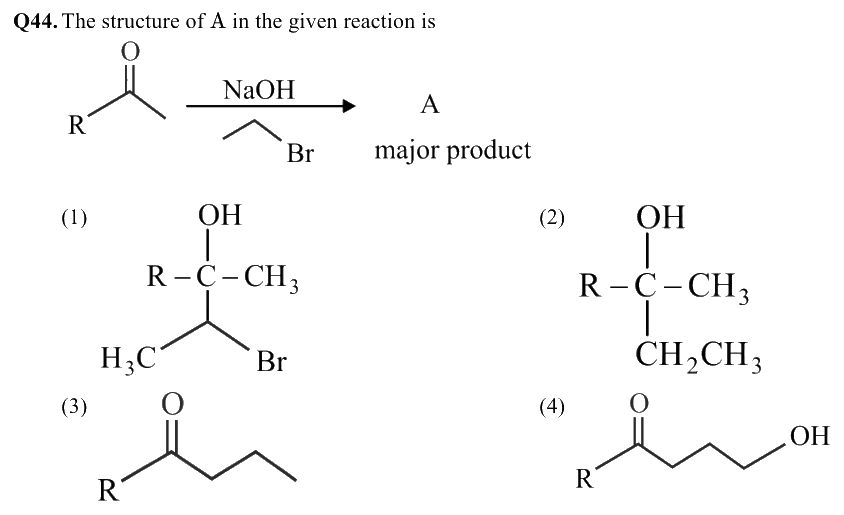
The structure of A in the given reaction is (see the figure above)
The question as printed in the paper.
A
see figure $\mathrm{R-C(OH)(CH_3)-CH(CH_3)Br}$: a central carbon bearing OH (up), R (left) and $\mathrm{CH_3}$ (right), joined below to a CH carbon that carries $\mathrm{H_3C}$ (left) and Br (right).
B
see figure $\mathrm{R-C(OH)(CH_3)-CH_2CH_3}$: central carbon with OH (up), R (left), $\mathrm{CH_3}$ (right) and $\mathrm{CH_2CH_3}$ (down).
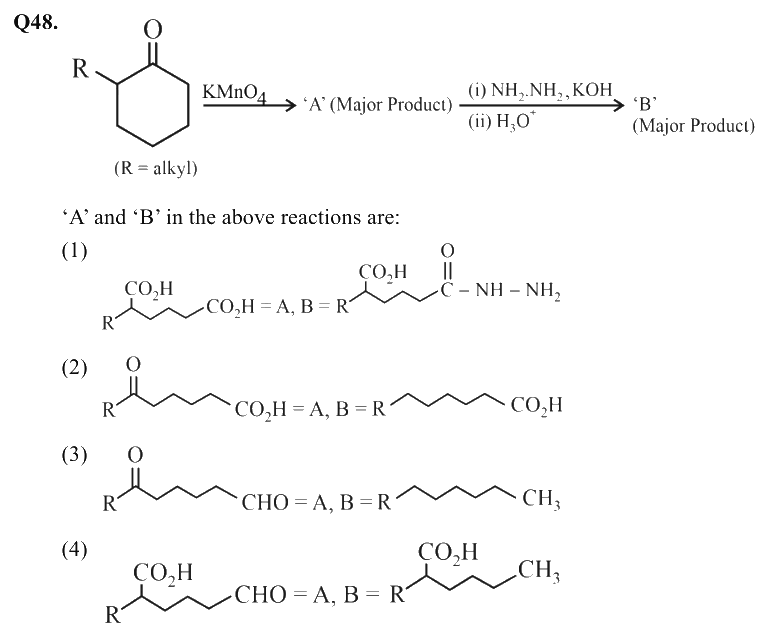
C
see figure Skeletal ketone: R attached to a C=O carbon, followed by a zigzag of three more carbons (R-CO-CH2-CH2-CH3, as drawn).
D
see figure Skeletal ketone: R attached to a C=O carbon, followed by a zigzag of three more carbons, the last of which carries OH (R-CO-CH2-CH2-CH2-OH, as drawn).
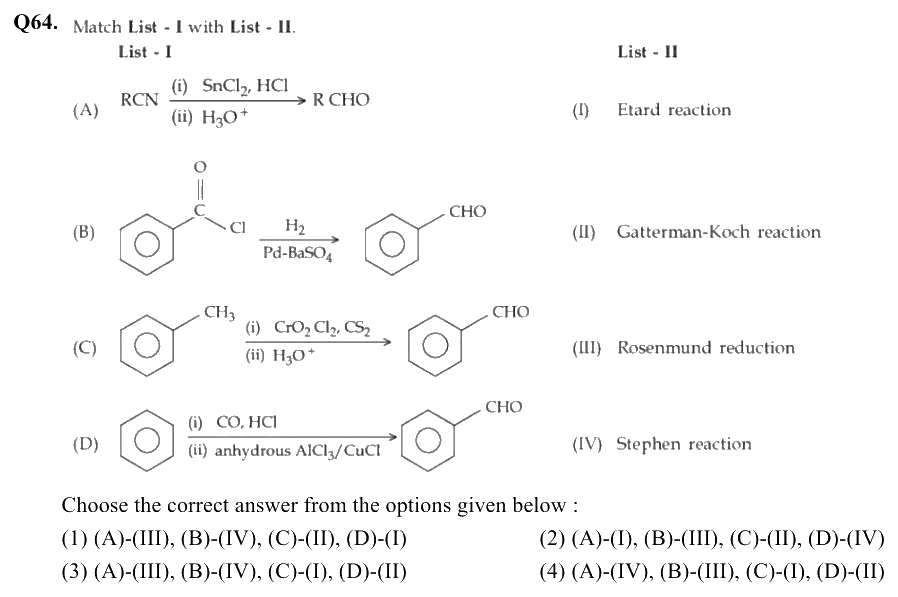
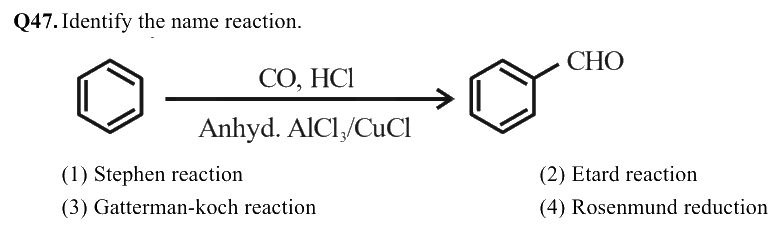
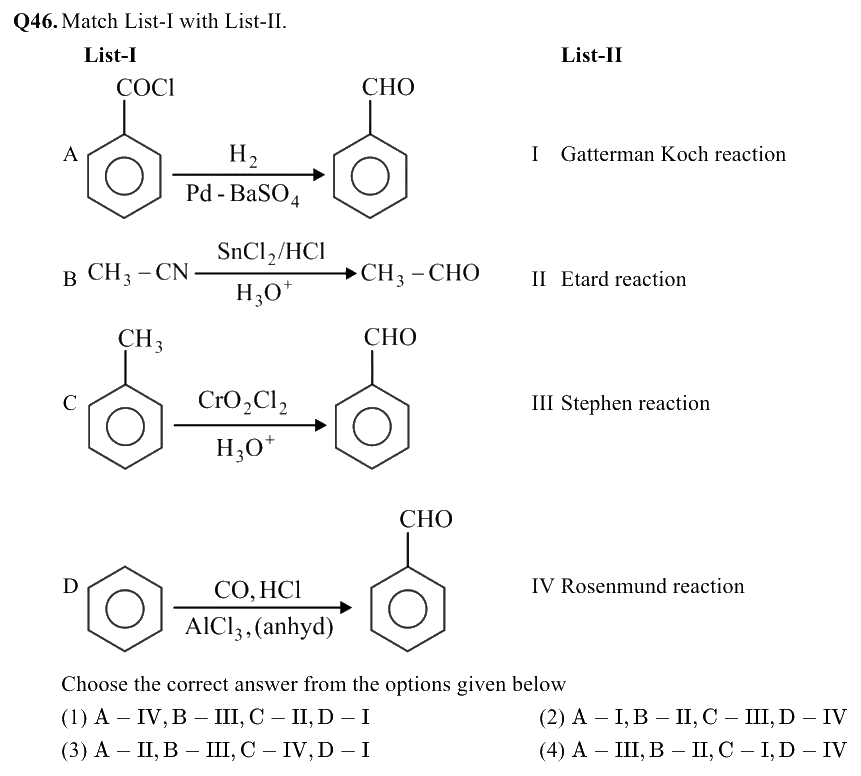
Match List-I with List-II. (see the figure above) List-I List-II I Gatterman Koch reaction II Etard reaction III Stephen reaction IV Rosenmund reaction Choose the correct answer from the options given below
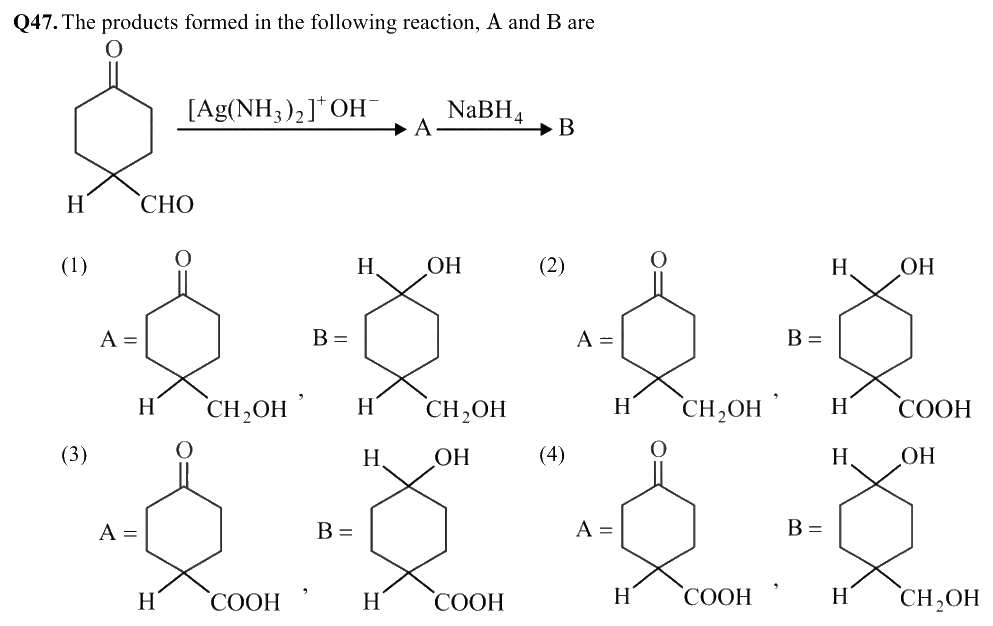
The products formed in the following reaction, A and B are (see the figure above)
The question as printed in the paper.
A
see figure A = cyclohexanone ring with H and $\mathrm{CH_2OH}$ on the carbon opposite the C=O; B = cyclohexane ring with H and OH on the top carbon and H and $\mathrm{CH_2OH}$ on the bottom carbon.
B
see figure A = cyclohexanone ring with H and $\mathrm{CH_2OH}$ on the carbon opposite the C=O; B = cyclohexane ring with H and OH on the top carbon and H and $\mathrm{COOH}$ on the bottom carbon.
C
see figure A = cyclohexanone ring with H and $\mathrm{COOH}$ on the carbon opposite the C=O; B = cyclohexane ring with H and OH on the top carbon and H and $\mathrm{COOH}$ on the bottom carbon.
D
see figure A = cyclohexanone ring with H and $\mathrm{COOH}$ on the carbon opposite the C=O; B = cyclohexane ring with H and OH on the top carbon and H and $\mathrm{CH_2OH}$ on the bottom carbon.
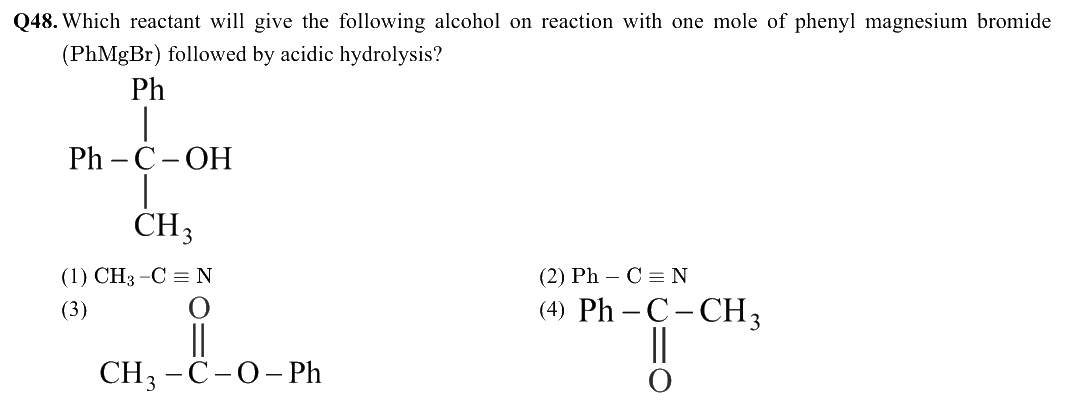
Which reactant will give the following alcohol on reaction with one mole of phenyl magnesium bromide ($\mathrm{PhMgBr}$) followed by acidic hydrolysis? (see the figure above)
The question as printed in the paper.
A
$\mathrm{CH_3 - C \equiv N}$
B
$\mathrm{Ph - C \equiv N}$
C
see figure Ethanoate ester of phenol: $\mathrm{CH_3}$ attached to a carbonyl carbon (C=O drawn upward) which is bonded to O and then Ph, i.e. $\mathrm{CH_3-C(=O)-O-Ph}$.
D
see figure $\mathrm{Ph - C(=O) - CH_3}$ with the C=O drawn downward (acetophenone).
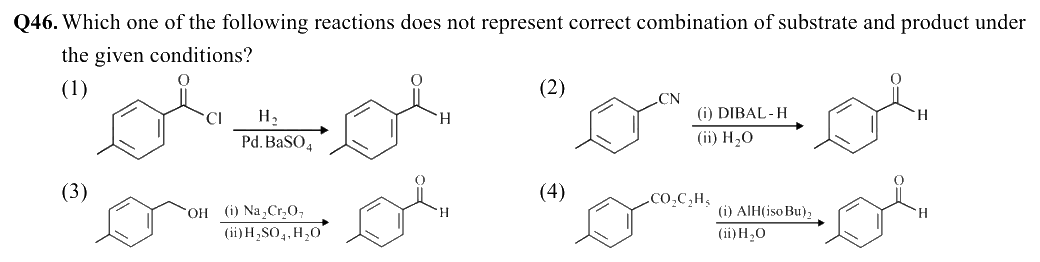
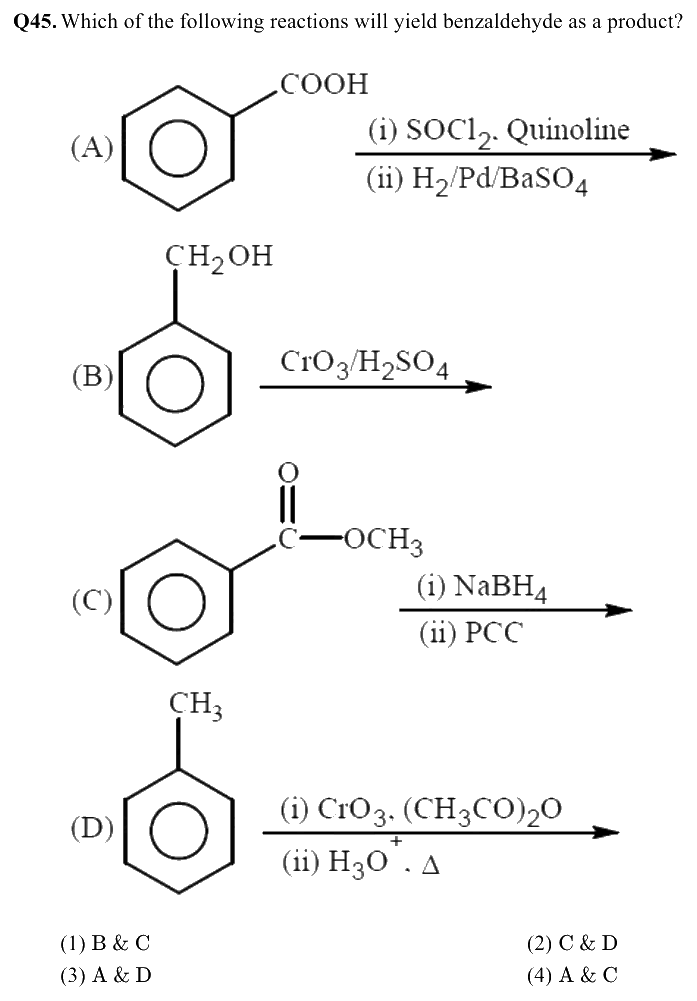
Which one of the following reactions does not represent correct combination of substrate and product under the given conditions?
(see the figure above)
The question as printed in the paper.
A
see figure 4-methyl-substituted benzoyl chloride (ring with Cl and C=O) with $\mathrm{H_2}$, $\mathrm{Pd.BaSO_4}$ giving the 4-methyl-substituted benzaldehyde.
B
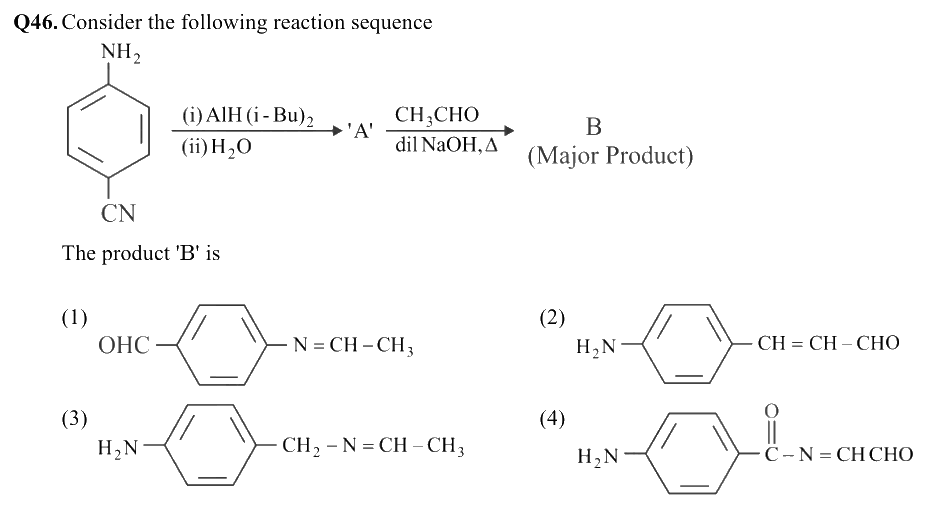
see figure 4-methyl-substituted benzonitrile (ring with CN) with (i) DIBAL-H, (ii) $\mathrm{H_2O}$ giving the 4-methyl-substituted benzaldehyde.
C
see figure 4-methyl-substituted benzyl alcohol (ring with CH2OH) with (i) $\mathrm{Na_2Cr_2O_7}$, (ii) $\mathrm{H_2SO_4, H_2O}$ giving the 4-methyl-substituted benzaldehyde.
D
see figure 4-methyl-substituted ethyl benzoate (ring with $\mathrm{CO_2C_2H_5}$) with (i) AlH(iso Bu)$_2$, (ii) $\mathrm{H_2O}$ giving the 4-methyl-substituted benzaldehyde.
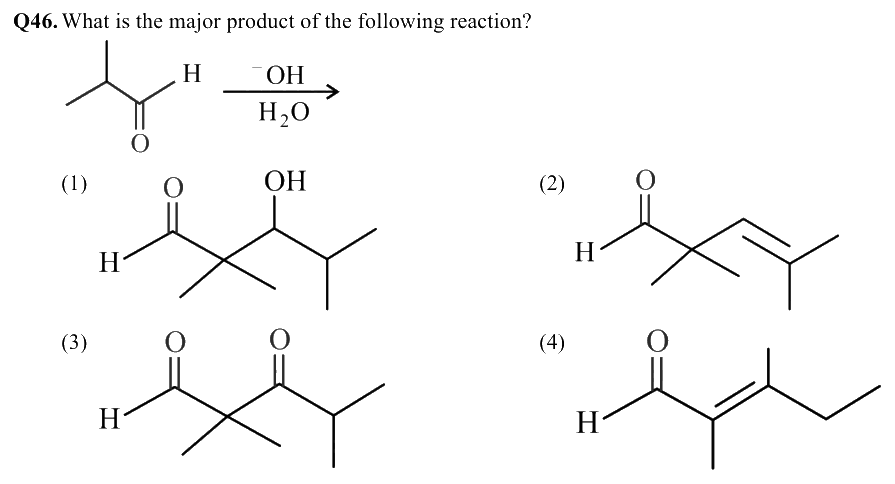
What is the major product of the following reaction?
(see the figure above)
The question as printed in the paper.
A
see figure skeletal structure: CHO (H with C=O) on a quaternary carbon carrying two methyls, then CH(OH), then an isopropyl group.
B
see figure skeletal structure: CHO on a quaternary carbon carrying two methyls, then CH=C(CH3)2 (a C=C followed by a carbon with two methyls).
C
see figure skeletal structure: CHO on a quaternary carbon carrying two methyls, then a C=O ketone, then an isopropyl group.
D
see figure skeletal structure: CHO (H with C=O) on a carbon bearing a methyl, double bonded to a carbon that bears a methyl and an ethyl group (CHO-C(CH3)=C(CH3)-CH2CH3 as drawn).
$\mathrm{CH_3-CH_2-CN} \xrightarrow[\text{Ether}]{\mathrm{CH_3MgBr}} \mathrm{A} \xrightarrow{\mathrm{H_3O^+}} \mathrm{B} \xrightarrow[\mathrm{HCl}]{\mathrm{Zn-Hg}} \mathrm{C}$. The correct structure of C is
A
$\mathrm{CH_3-CH_2-CH_2-CH_3}$
B
$\mathrm{CH_3-CH_2-C(=O)-CH_3}$ (the C=O drawn on top of the central carbon)
C
$\mathrm{CH_3-CH_2-CH(OH)-CH_3}$ (the OH drawn on top of the CH)
Given below are two statements : Statement I: The esterification of carboxylic acid with an alcohol is a nucleophilic acyl substitution. Statement II: Electron withdrawing groups in the carboxylic acid will increase the rate of esterification reaction. Choose the most appropriate option
A
Statement I is correct but Statement II is incorrect.
B
Both Statement I and Statement II are incorrect.
C
Both Statement I and Statement II are correct.
D
Statement I is incorrect but Statement II is correct.
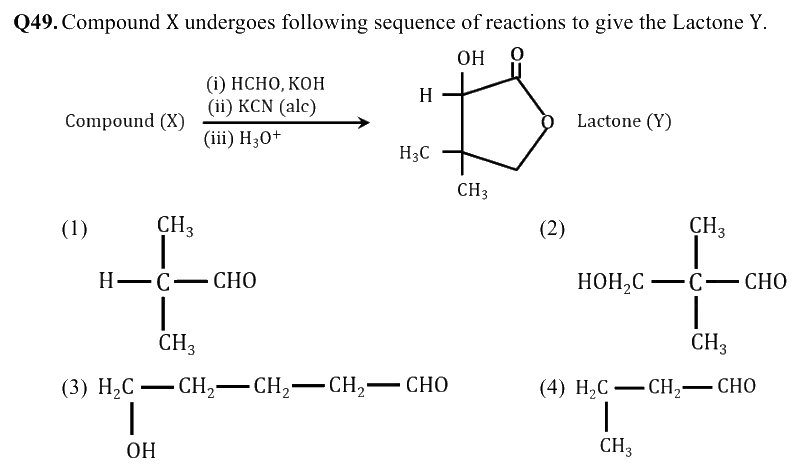
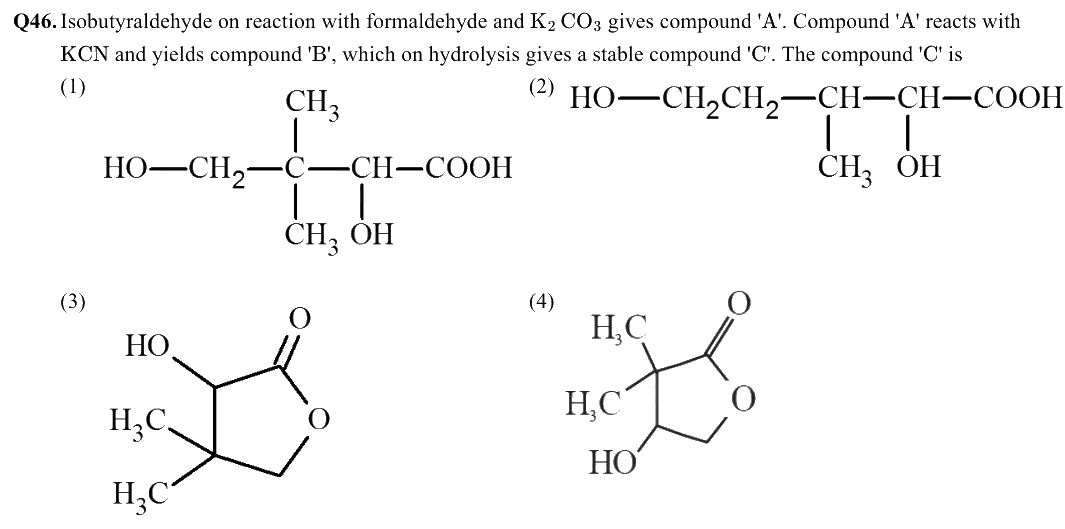
Isobutyraldehyde on reaction with formaldehyde and $\mathrm{K_2\,CO_3}$ gives compound 'A'. Compound 'A' reacts with KCN and yields compound 'B', which on hydrolysis gives a stable compound 'C'. The compound 'C' is
The question as printed in the paper.
A
see figure $\mathrm{HO-CH_2-C(CH_3)(CH_3)-CH(OH)-COOH}$ drawn in full: HO, CH2, then a carbon with CH3 above and CH3 below, then CH with OH below, then COOH.
B
see figure $\mathrm{HO-CH_2CH_2-CH(CH_3)-CH(OH)-COOH}$ drawn in full: CH(CH3) with CH3 below and the next CH with OH below, ending in COOH.
C
see figure A five-membered lactone ring (C=O at the upper right, ring O at the right), with HO on the carbon next to the carbonyl carbon at the upper left and two H3C groups on the carbon below it.
D
see figure A five-membered lactone ring (C=O at the top, ring O at the right), with two H3C groups on the carbon next to the carbonyl carbon and HO on the next carbon.
Decarboxylation of all six possible forms of diaminobenzoic acids $\mathrm{C_6H_3(NH_2)_2COOH}$ yields three products A, B and C. Three acids give a product 'A', two acids gives a product 'B' and one acid give a product 'C'. The melting point of product 'C' is
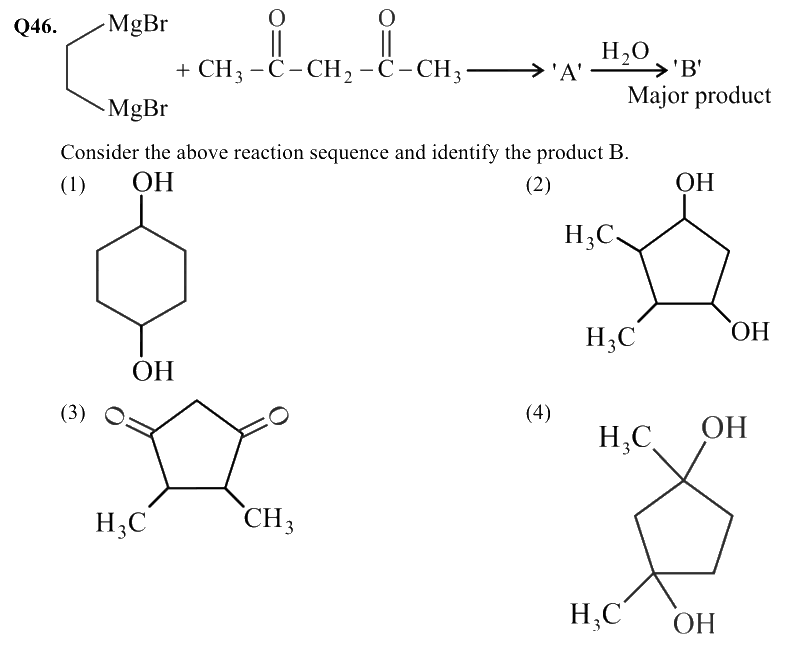
see figure Consider the above reaction sequence and identify the product B.
The question as printed in the paper.
A
see figure cyclohexane-1,4-diol: six-membered ring with OH at the top and OH at the bottom
B
see figure cyclopentane ring with OH on the top-right carbon, H3C on the adjacent top-left carbon, H3C on the lower-left carbon and OH on the lower-right carbon (2,3-dimethylcyclopentane-1,4-diol-type arrangement as drawn)
C
see figure cyclopentane-1,3-dione ring: C=O at the two upper carbons with a CH2 between them at the top, H3C on each of the two lower ring carbons
D
see figure cyclopentane ring with C(OH)(CH3) at the upper right and C(OH)(CH3) at the lower left (1,3-dimethylcyclopentane-1,3-diol)
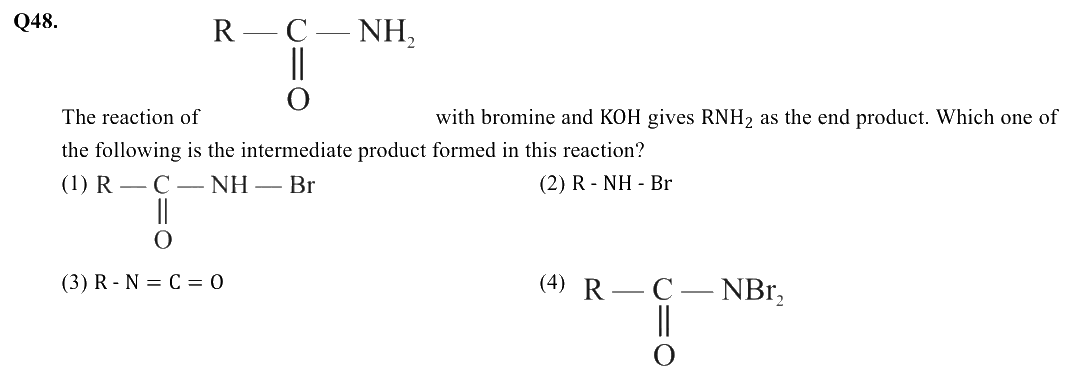
see figure The reaction of (see the figure above) with bromine and KOH gives $\mathrm{RNH}_2$ as the end product. Which one of the following is the intermediate product formed in this reaction?
The question as printed in the paper.
A
see figure R-C(=O)-NH-Br: carbonyl carbon with O drawn below, bonded to R and to NH-Br
B
$\mathrm{R - NH - Br}$
C
$\mathrm{R - N = C = O}$
D
see figure R-C(=O)-NBr2: carbonyl carbon with O drawn below, bonded to R and to NBr2
Two statements are given belwo : Statement I : The melting point of monocarboxylic acid with even number of carbon atoms is higher than that of with odd number of carbon atoms acid immediately below and above it in the series. Statement II : The solubility of monocarboxylic acids in water decreases with increase in molar mass. Choose the most appropriate option :
A
Both Statement I and Statement II are correct.
B
Both Statement I and Statement II are incorrect.
C
Statement I is correct but Statement II is incorrect.
D
Statement I is incorrect but Statement II is correct.
Hex-4-ene-2-ol on treatment with PCC gives 'A'. 'A' on reaction with sodium hypoiodite gives 'B', which on further heating with soda lime gives 'C'. The compound 'C' is
In the following sequence of reactions, $\mathrm{C_3H_6} \xrightarrow{\mathrm{H^+/H_2O}} \mathrm{A} \xrightarrow[\mathrm{dilKOH}]{\mathrm{KIO}} \mathrm{B} + \mathrm{C}$. The compounds B and C respectively are :
Given below are two statements : Statement I : The nucleophilic addition of sodium hydrogen sulphite to an aldehyde or a ketone involves proton transfer to form a stable ion. Statement II : The nucleophilic addition of hydrogen cyanide to an aldehyde or a ketone yields amine as final product. In the light of the above statements, choose the most appropriate answer from the options given below :
In the following sequence of reactions a compound A, (molecular formula $\mathrm{C_6H_{12}O_2}$ ) with a straight chain structure gives a $\mathrm{C_4}$ carboxylic acid. A is : $\mathrm{A} \xrightarrow[\mathrm{H_3O^+}]{\mathrm{LiAlH_4}} \mathrm{B} \xrightarrow{\text{Oxidation}} \mathrm{C_4}$ - carboxylic acid
A
$\mathrm{CH_3-CH_2-CH(OH)-CH_2-O-CH=CH_2}$ (the OH hangs above the third carbon)
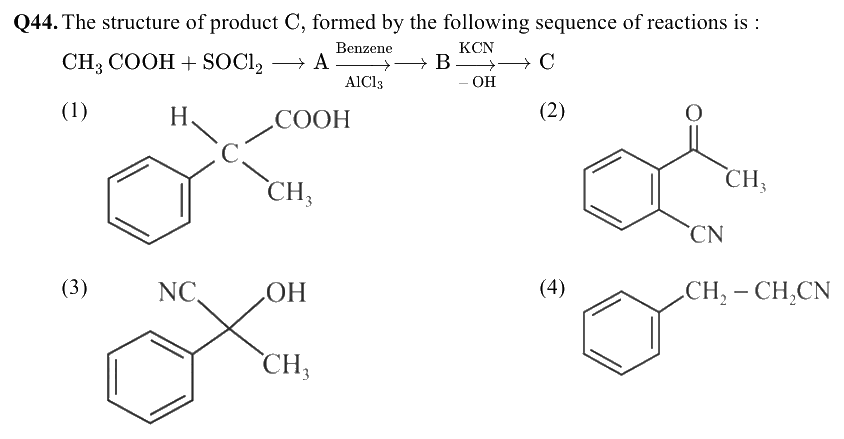
The structure of product C, formed by the following sequence of reactions is : $\mathrm{CH_3\ COOH + SOCl_2} \longrightarrow \mathrm{A} \xrightarrow[\mathrm{AlCl_3}]{\mathrm{Benzene}} \mathrm{B} \xrightarrow[-\mathrm{OH}]{\mathrm{KCN}} \mathrm{C}$
The question as printed in the paper.
A
see figure a benzene ring joined to a carbon that carries H, COOH and CH3.
B
see figure a benzene ring carrying, on neighbouring ring carbons, a C(=O)CH3 group and a CN group.
C
see figure a benzene ring joined to a carbon that carries NC, OH and CH3.
D
see figure a benzene ring carrying a $\mathrm{CH_2-CH_2CN}$ group.
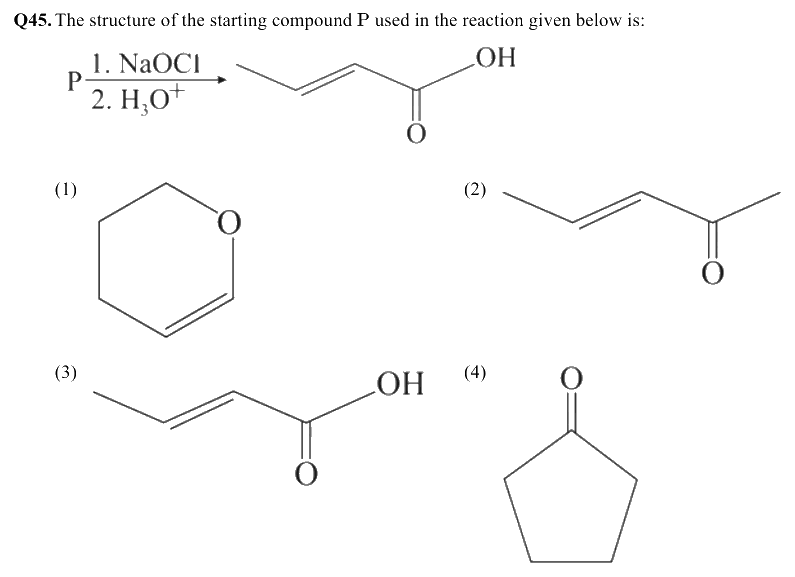
The structure of the starting compound P used in the reaction given below is: (see the figure above)
The question as printed in the paper.
A
see figure six-membered ring containing one ring oxygen (at the top right) and one C=C double bond on the right-hand side, no other substituent.
B
see figure open zig-zag chain: a C=C double bond, then a carbon carrying C=O (oxygen below), followed by one more line at the right end (a methyl group).
C
see figure open zig-zag chain: a C=C double bond, then a carbon carrying C=O (oxygen below) and OH at the right end (a carboxylic acid).
D
see figure cyclopentanone: a five-membered ring with a C=O (oxygen at the top).
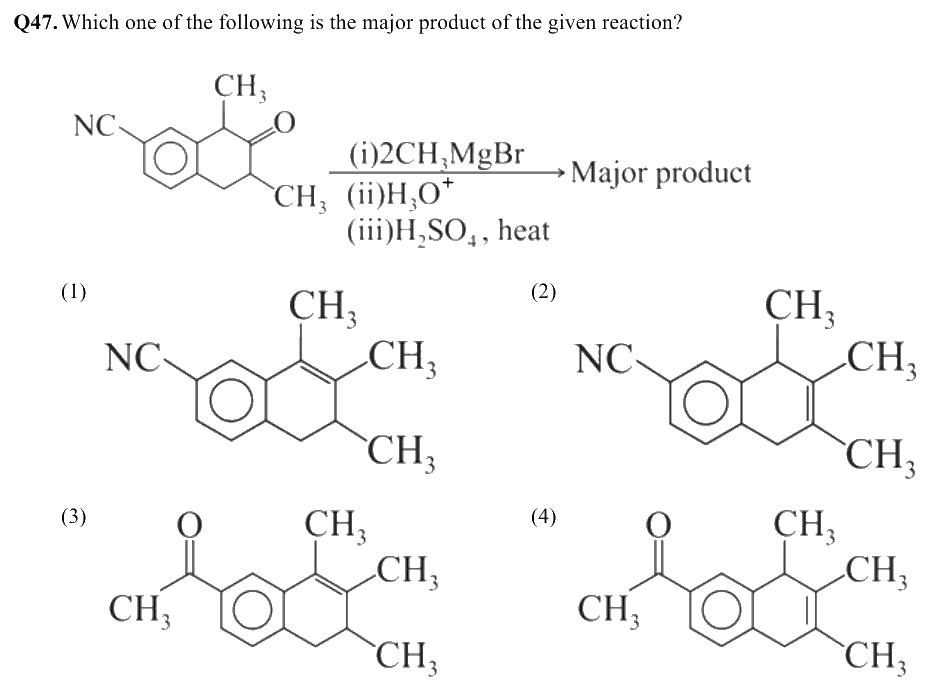
Which one of the following is the major product of the given reaction? (see the figure above)
The question as printed in the paper.
A
see figure Tetralin-type structure with NC on the benzene ring; the saturated ring carries a CH3 on the top carbon and two CH3 groups at the right, with a double bond in the ring drawn at the top-right bond.
B
see figure The same as option 1 but with the ring double bond drawn on the right-hand side (between the two right-hand carbons bearing the CH3 groups).
C
see figure Tetralin-type structure with an acetyl group (O=C-CH3) in place of the NC on the benzene ring; the ring has the same CH3 pattern and the double bond drawn at the top-right bond as in option 1.
D
see figure The same as option 3 but with the ring double bond drawn on the right-hand side as in option 2.
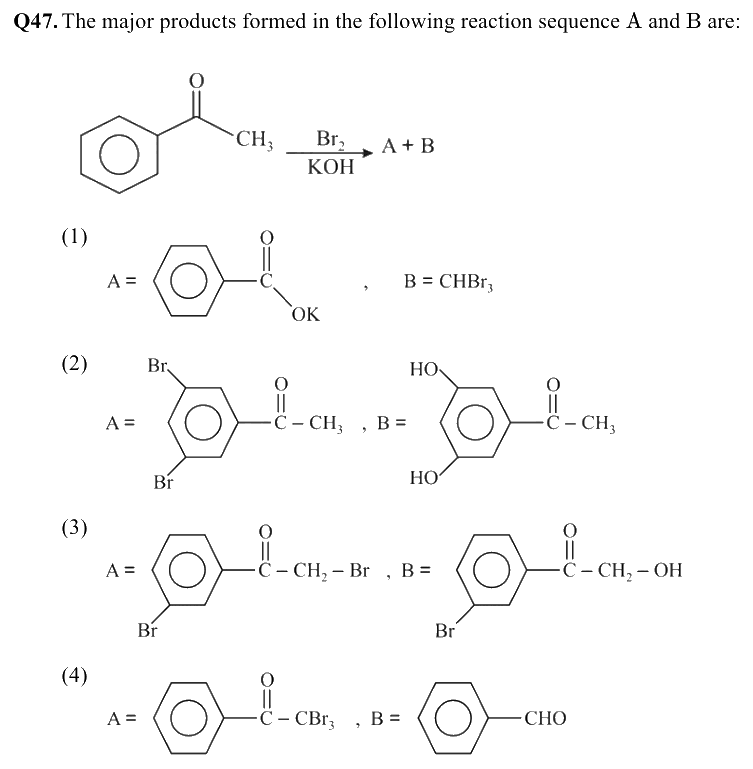
The major products formed in the following reaction sequence A and B are: (see the figure above)
The question as printed in the paper.
A
A = (see the figure above) sodium benzoate (benzene ring bearing C(=O)OK), B = $\mathrm{CHBr_3}$
B
A = (see the figure above) acetophenone with Br at both meta positions (3,5-dibromoacetophenone, ring with C(=O)-CH3), B = (see the figure above) acetophenone with OH at both meta positions (3,5-dihydroxyacetophenone)
C
A = (see the figure above) ring with Br at the meta position and C(=O)-CH2-Br, B = (see the figure above) ring with Br at the meta position and C(=O)-CH2-OH
D
A = (see the figure above) benzene ring bearing C(=O)-CBr3, B = (see the figure above) benzaldehyde (benzene ring bearing CHO)
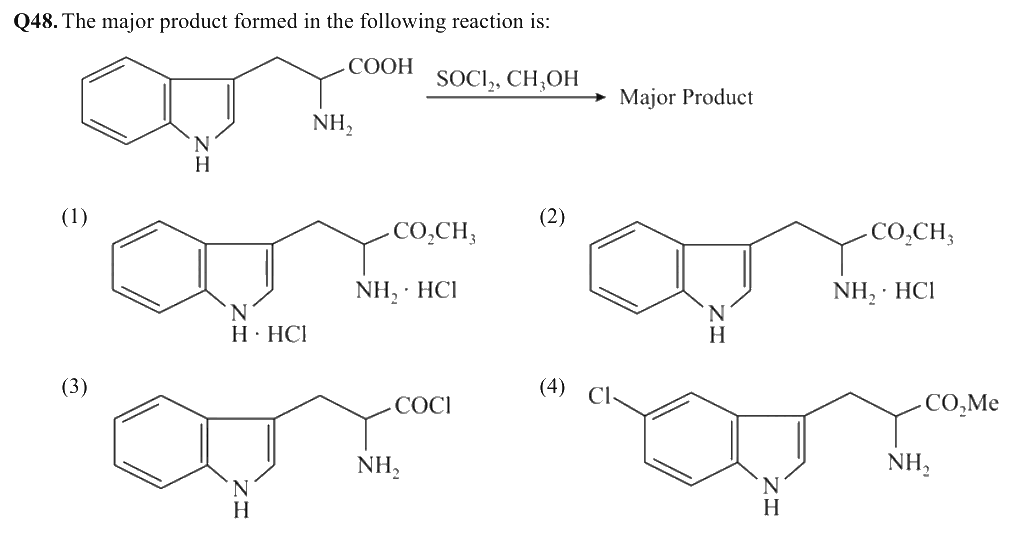
The major product formed in the following reaction is: (see the figure above)
The question as printed in the paper.
A
see figure methyl ester of tryptophan with the hydrochloride salt: indole with a CH2-CH(NH2.HCl)-CO2CH3 side chain at C3, and the indole N-H drawn as N H.HCl
B
see figure methyl ester of tryptophan as the amine hydrochloride: indole (N-H) with a CH2-CH(NH2.HCl)-CO2CH3 side chain at C3
C
see figure acid chloride of tryptophan: indole (N-H) with a CH2-CH(NH2)-COCl side chain at C3
D
see figure 5-chloro substituted tryptophan methyl ester: indole (N-H) with Cl on the benzene ring and a CH2-CH(NH2)-CO2Me side chain at C3
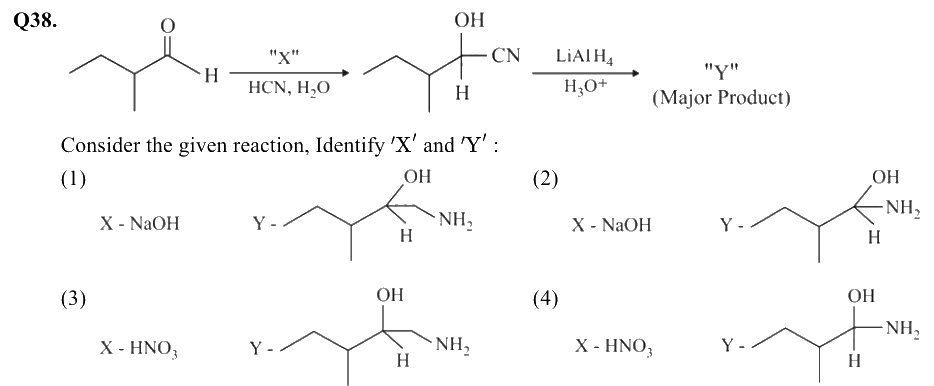
see figure Consider the given reaction, Identify 'X' and 'Y' :
The question as printed in the paper.
A
X - $\mathrm{NaOH}$; Y - (see the figure above) skeletal chain with a branch (methyl) and a CH(OH) carbon (OH up, H down) followed by CH2-NH2
B
X - $\mathrm{NaOH}$; Y - (see the figure above) skeletal chain with a branch (methyl) and a carbon bearing OH (up), NH2 (right) and H (down) on the same carbon
C
X - $\mathrm{HNO_3}$; Y - (see the figure above) skeletal chain with a branch (methyl) and a CH(OH) carbon (OH up, H down) followed by CH2-NH2
D
X - $\mathrm{HNO_3}$; Y - (see the figure above) skeletal chain with a branch (methyl) and a carbon bearing OH (up), NH2 (right) and H (down) on the same carbon
Answer: (A) X - $\mathrm{NaOH}$; Y - (see the figure above) skeletal chain with a branch (methyl) and a CH(OH) carbon (OH up, H down) followed by CH2-NH2· Key from source paper
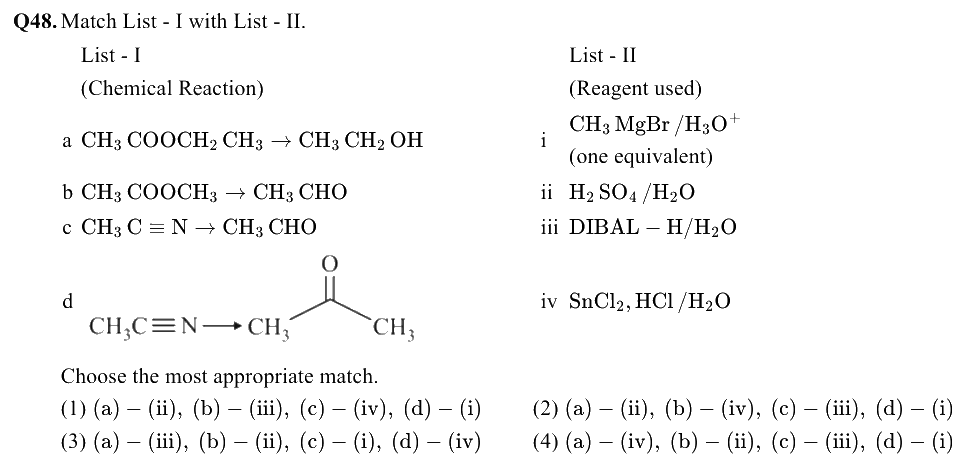
Match List - I with List - II. List - I (Chemical Reaction) a $\mathrm{CH_3COOCH_2CH_3\rightarrow CH_3CH_2OH}$ b $\mathrm{CH_3COOCH_3\rightarrow CH_3CHO}$ c $\mathrm{CH_3C\equiv N\rightarrow CH_3CHO}$ d $\mathrm{CH_3C\equiv N\rightarrow}$ (see the figure above) List - II (Reagent used) i $\mathrm{CH_3MgBr/H_3O^+}$ (one equivalent) ii $\mathrm{H_2SO_4/H_2O}$ iii $\mathrm{DIBAL-H/H_2O}$ iv $\mathrm{SnCl_2, HCl/H_2O}$ Choose the most appropriate match.
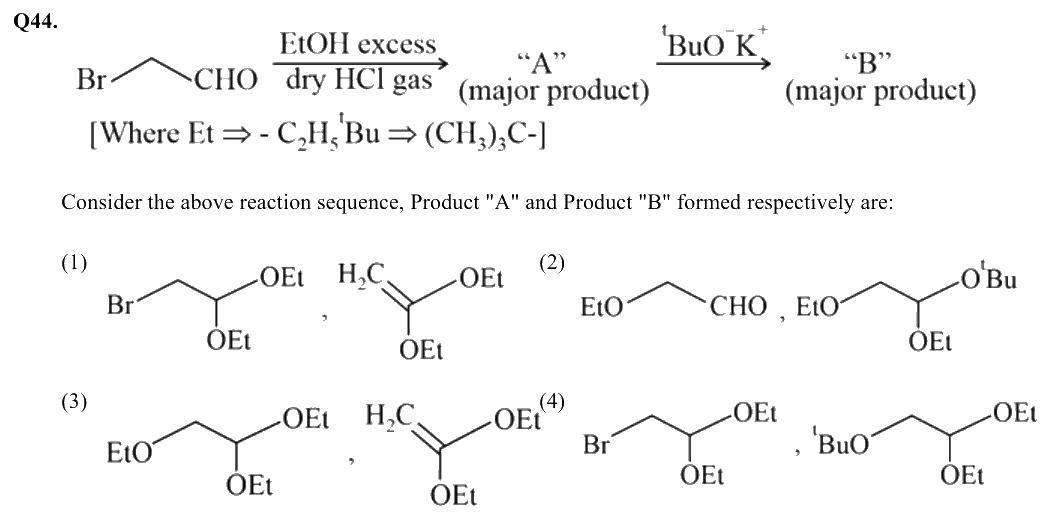
see figure [Where $\mathrm{Et} \Rightarrow -\mathrm{C_2H_5}$, ${}^t\mathrm{Bu} \Rightarrow (\mathrm{CH_3})_3\mathrm{C}-$] Consider the above reaction sequence, Product "A" and Product "B" formed respectively are:
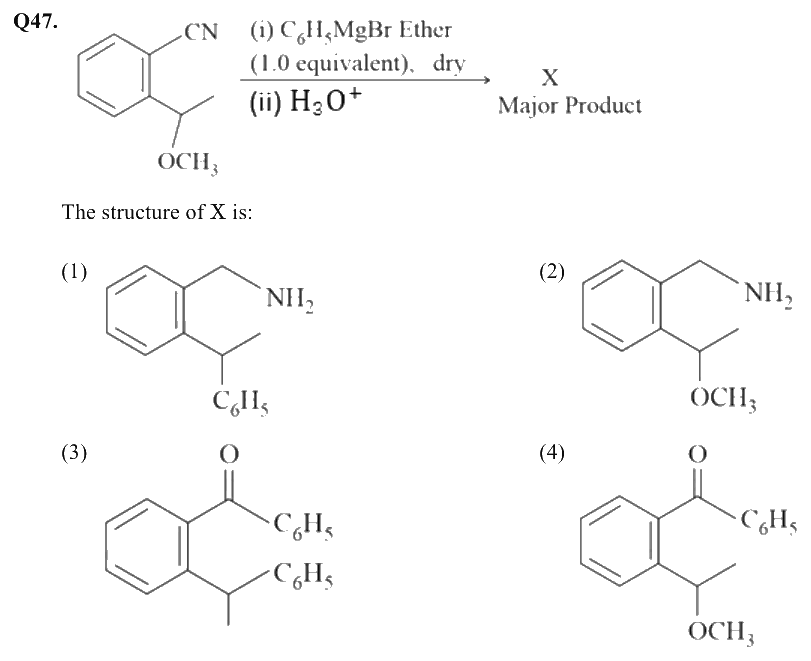
A reaction of benzonitrile with one equivalent $\mathrm{CH_3\ MgBr}$ followed by hydrolysis produces a yellow liquid "P". The compound "P" will give positive ______
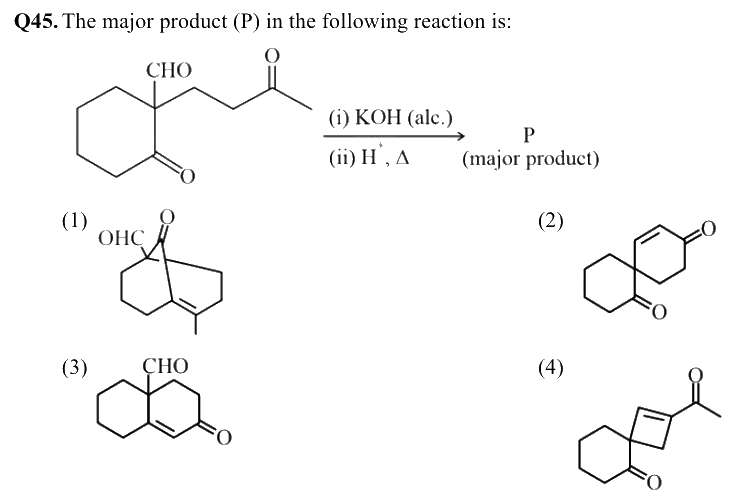
The major product (P) in the following reaction is: (see the figure above)
The question as printed in the paper.
A
see figure a bridged bicyclic compound: a six-membered ring and a five-membered ring containing a C=C, linked through a bridging C=O (O at the top); an OHC (aldehyde) group is on the left at a bridgehead; a short vertical line at the bottom of the five-membered ring (a methyl substituent on the alkene)
B
see figure a spiro compound: a cyclohexanone ring (C=O at the bottom) joined at a spiro carbon to a cyclohexenone ring (ring C=C and C=O at the top right)
C
see figure a fused bicyclic (decalin-type) compound with CHO on the ring-fusion carbon and, in the right ring, a C=C and a ketone C=O (O at the right)
D
see figure a spiro compound: a cyclohexanone ring (C=O at the bottom) joined at a spiro carbon to a cyclobutene ring that carries an acetyl group (C(=O)CH3)
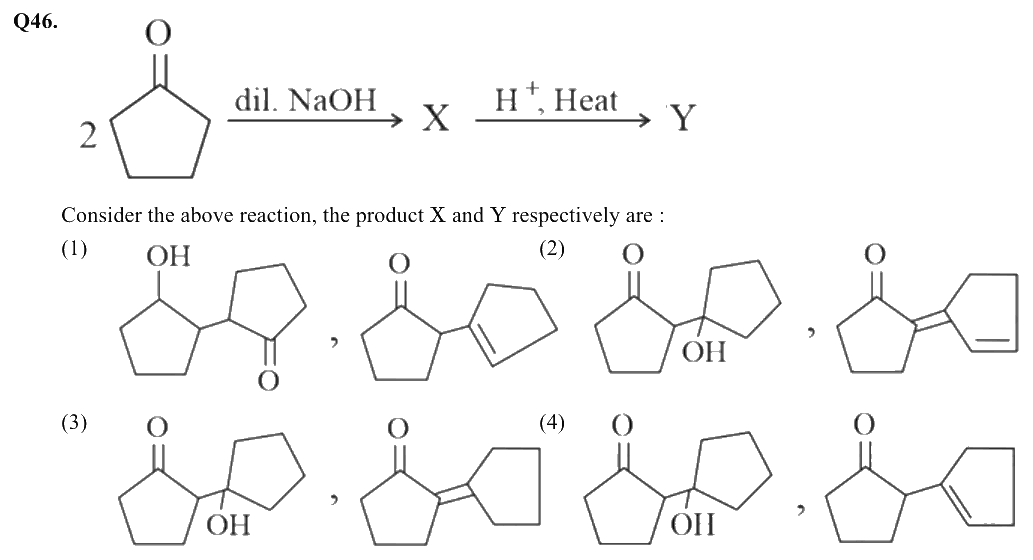
see figure Consider the above reaction, the product X and Y respectively are :
The question as printed in the paper.
A
see figure X: two linked cyclopentane rings, one carrying OH on the carbon next to the link, the other carrying C=O on the carbon next to the link; Y: cyclopentanone bonded at its alpha carbon to a cyclopentene ring (ring C=C at the linking carbon, inside the second ring)
B
see figure X: cyclopentanone linked at the alpha carbon to a second cyclopentane ring that carries OH on the linking carbon (1-hydroxycyclopentyl); Y: cyclopentanone with an exocyclic C=C double bond at the alpha carbon to a cyclopentene ring (the second ring also shows a ring double bond at its bottom right)
C
see figure X: cyclopentanone linked at the alpha carbon to a second cyclopentane ring that carries OH on the linking carbon (1-hydroxycyclopentyl); Y: 2-cyclopentylidenecyclopentanone (cyclopentanone with an exocyclic C=C to a saturated cyclopentane ring)
D
see figure X: cyclopentanone linked at the alpha carbon to a second cyclopentane ring that carries OH on the linking carbon (1-hydroxycyclopentyl); Y: cyclopentanone linked by a single bond at its alpha carbon to a cyclopentene ring (ring C=C inside the second ring)
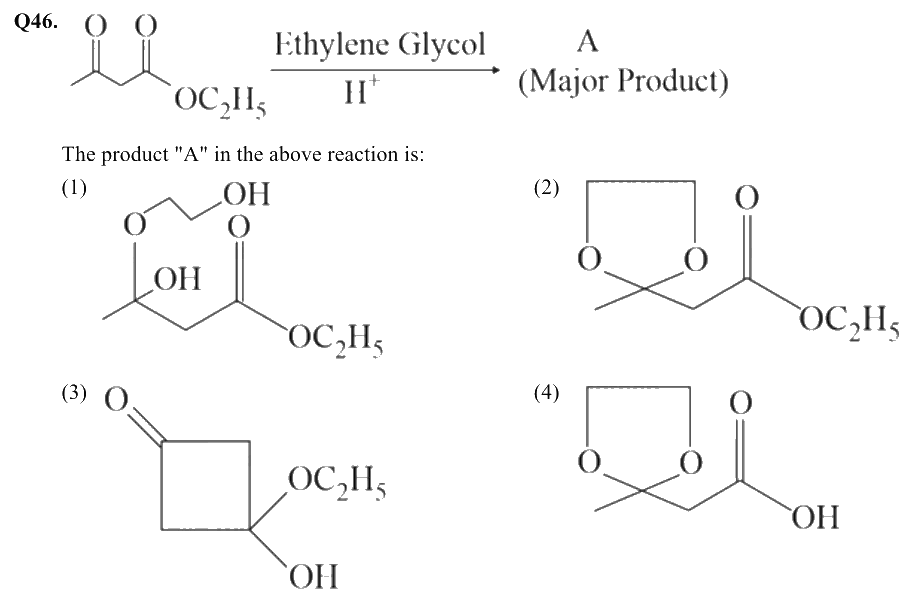
see figure The product "A" in the above reaction is:
The question as printed in the paper.
A
see figure Open-chain hemiketal: $\mathrm{CH_3-C(OH)(O-CH_2CH_2-OH)-CH_2-C(=O)-OC_2H_5}$
B
see figure A five-membered ring ketal (1,3-dioxolane with two ring O atoms) whose C2 carries a $\mathrm{CH_3}$ and a $\mathrm{CH_2-C(=O)-OC_2H_5}$ group
C
see figure A cyclobutane ring with a C=O on one carbon and, on the adjacent carbon, both $\mathrm{OC_2H_5}$ and OH
D
see figure A five-membered ring ketal (1,3-dioxolane with two ring O atoms) whose C2 carries a $\mathrm{CH_3}$ and a $\mathrm{CH_2-C(=O)-OH}$ group
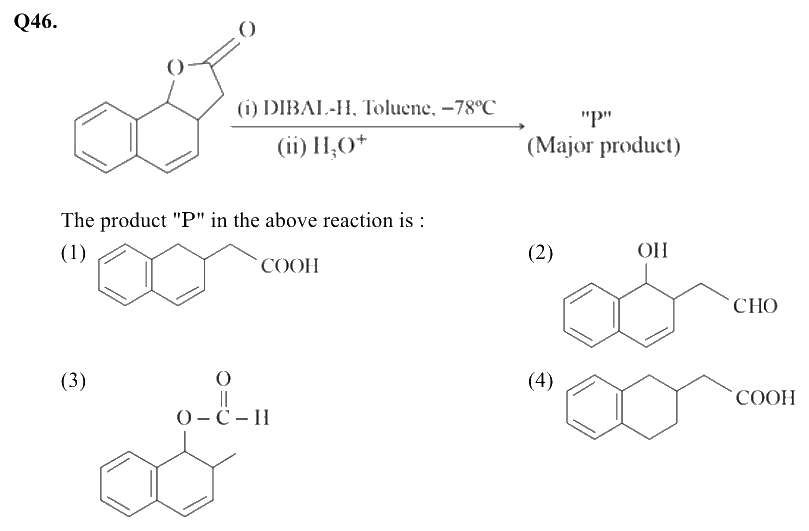
see figure The product "P" in the above reaction is :
The question as printed in the paper.
A
see figure A bicyclic ring system (benzene ring fused to a six-membered ring containing one C=C) with a $\mathrm{CH_2COOH}$ side chain on the non-aromatic ring
B
see figure A benzene ring fused to a six-membered ring containing one C=C; an OH on the ring carbon next to the benzene ring and a $\mathrm{CH_2CHO}$ side chain on the adjacent ring carbon
C
see figure A benzene ring fused to a six-membered ring containing one C=C; a formate ester group $\mathrm{O-C(=O)-H}$ on the ring carbon next to the benzene ring and a methyl group on the adjacent ring carbon
D
see figure Tetralin (benzene ring fused to a fully saturated six-membered ring) with a $\mathrm{CH_2COOH}$ side chain on the saturated ring
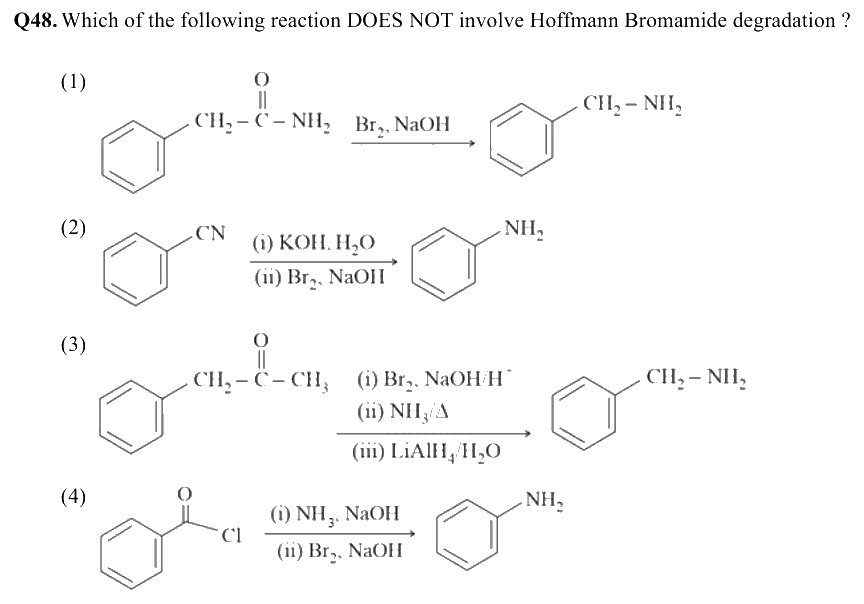
Which of the following reaction DOES NOT involve Hoffmann Bromamide degradation ?
The question as printed in the paper.
A
see figure $\mathrm{C_6H_5-CH_2-C(=O)-NH_2}$ with $\mathrm{Br_2, NaOH}$ gives $\mathrm{C_6H_5-CH_2-NH_2}$
B
see figure benzonitrile ($\mathrm{C_6H_5-CN}$) with (i) KOH, $\mathrm{H_2O}$ (ii) $\mathrm{Br_2}$, NaOH gives aniline ($\mathrm{C_6H_5-NH_2}$)
C
see figure $\mathrm{C_6H_5-CH_2-C(=O)-CH_3}$ with (i) $\mathrm{Br_2}$, $\mathrm{NaOH/H^{+}}$ (ii) $\mathrm{NH_3/\Delta}$ (iii) $\mathrm{LiAlH_4/H_2O}$ gives $\mathrm{C_6H_5-CH_2-NH_2}$
D
see figure benzoyl chloride ($\mathrm{C_6H_5-C(=O)Cl}$) with (i) $\mathrm{NH_3}$, NaOH (ii) $\mathrm{Br_2}$, NaOH gives aniline ($\mathrm{C_6H_5-NH_2}$)
$\mathrm{A} \xrightarrow[373\ \mathrm{K}]{\text{Hydrolysis}} \mathrm{B}$ ($\mathrm{A}$: $\mathrm{C_4H_8Cl_2}$; $\mathrm{B}$: $\mathrm{C_4H_8O}$) B reacts with Hydroxyl amine but does not give Tollen's test. Identify A and B.
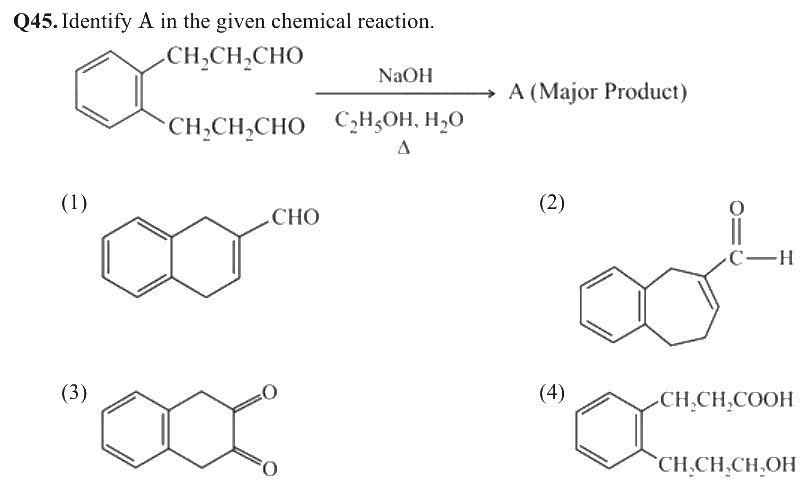
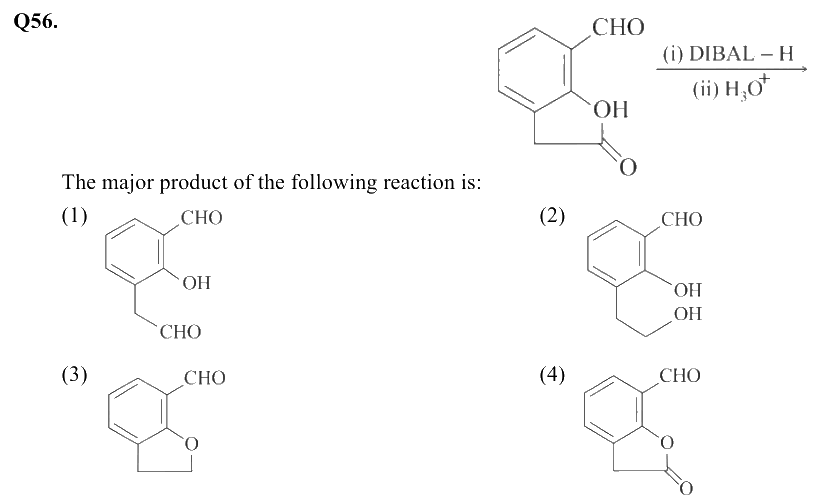
Identify A in the given chemical reaction. (see the figure above)
The question as printed in the paper.
A
see figure Bicyclic: benzene ring fused to a six-membered ring that contains one C=C double bond, with a CHO group on the double bond carbon.
B
see figure Bicyclic: benzene ring fused to a seven-membered ring that contains one C=C double bond, with a CHO group (C(=O)H) on the double bond carbon.
C
see figure Bicyclic: benzene ring fused to a six-membered ring with two adjacent C=O groups (a 1,2-dione) in the saturated ring.
D
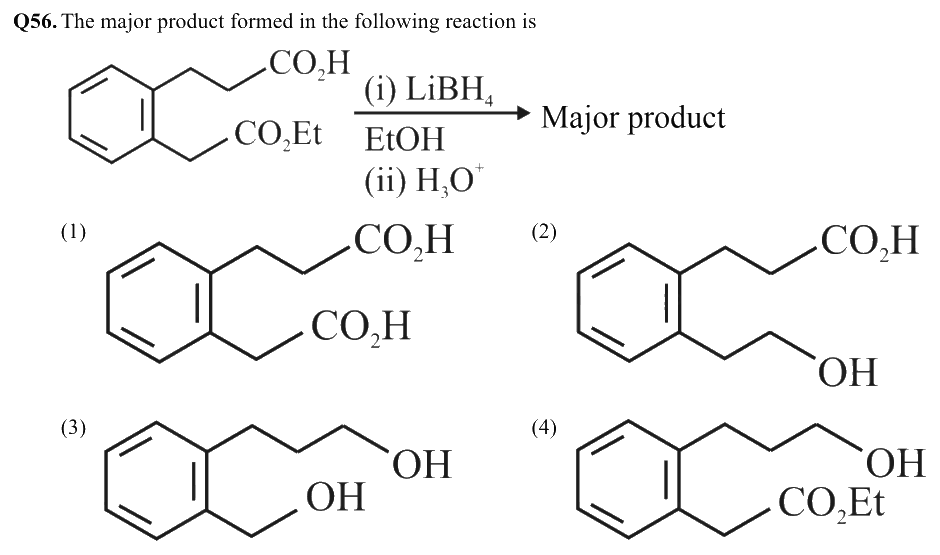
see figure Benzene ring with two ortho substituents: CH2CH2COOH and CH2CH2CH2OH.
The major product of the following chemical reaction is : $\mathrm{CH_3CH_2CN \xrightarrow[(3)\ Pd/BaSO_4,\ H_2]{(1)\ H_3O^+,\ \Delta\ ;\ (2)\ SOCl_2}} ?$
The correct match between Item-I (starting material) and Item-II (reagent) for the preparation of benzaldehyde is : Item-I Item-II (I) Benzene (P) $\mathrm{HCl}$ and $\mathrm{SnCl_2}$, $\mathrm{H_3O+}$ (II) Benzonitrile (Q) $\mathrm{H_2}$, $\mathrm{Pd - BaSO_4}$, S and quinoline (III) Benzoyl Chloride (R) Co, HCl and $\mathrm{AlCl_3}$
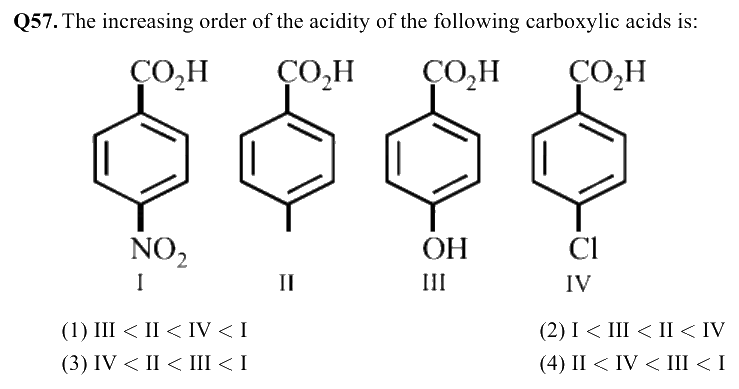
The decreasing order of electrical conductivity of the following aqueous solutions is: (A) 0.1 M Formic acid, (B) 0.1 M Acetic acid, (C) 0.1 M Benzoic acid.
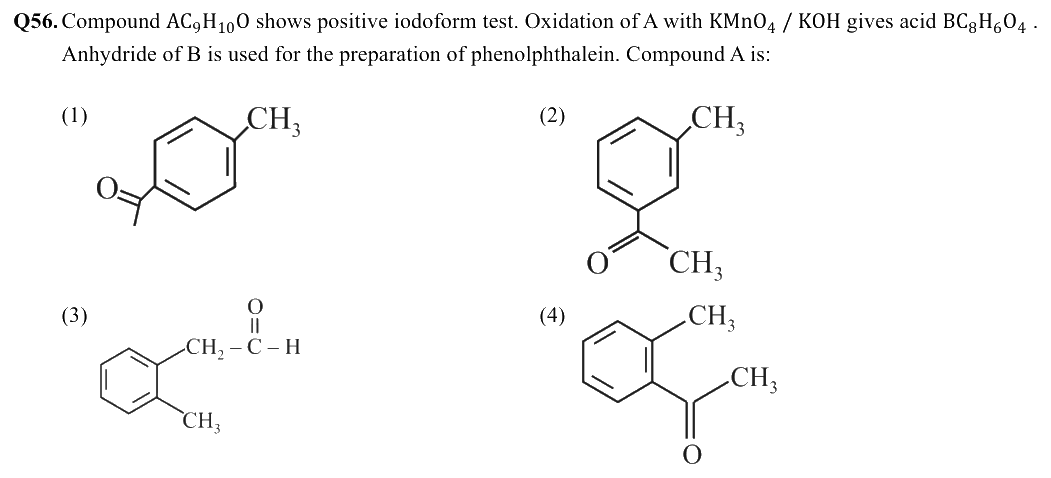
Compound A $\mathrm{C_9H_{10}O}$ shows positive iodoform test. Oxidation of A with $\mathrm{KMnO_4}$ / KOH gives acid B $\mathrm{C_8H_6O_4}$ . Anhydride of B is used for the preparation of phenolphthalein. Compound A is:
(see the figure above)
The question as printed in the paper.
A
see figure benzene ring with CH3 at the top right and C(=O)CH3 at the bottom left (para)
B
see figure benzene ring with CH3 at the top right and C(=O)CH3 below (meta)
C
see figure benzene ring with CH2-C(=O)-H and CH3 on adjacent (ortho) positions
D
see figure benzene ring with CH3 and C(=O)CH3 on adjacent (ortho) positions
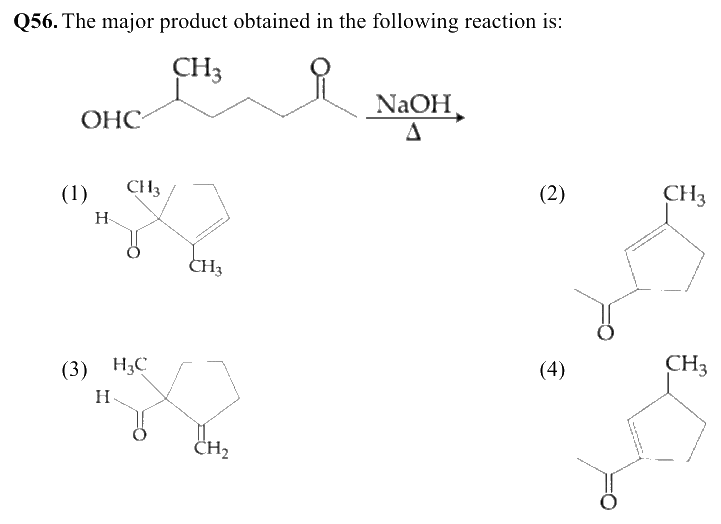
The major product obtained in the following reaction is:
(see the figure above)
The question as printed in the paper.
A
see figure five-membered ring with a ring C=C, a $\mathrm{CH_3}$ and an H-C=O group on one carbon (quaternary) and a $\mathrm{CH_3}$ on the other end of the C=C
B
see figure five-membered ring with a ring C=C bearing $\mathrm{CH_3}$ and an acetyl group (C=O with CH3) on the ring carbon
C
see figure five-membered ring with an exocyclic $\mathrm{CH_2{=}}$, and a $\mathrm{H_3C}$ and H-C=O group on a quaternary carbon
D
see figure five-membered ring with a ring C=C and a $\mathrm{CH_3}$ on a ring carbon, and an acetyl group (C=O with a CH3 line) on the double-bonded carbon
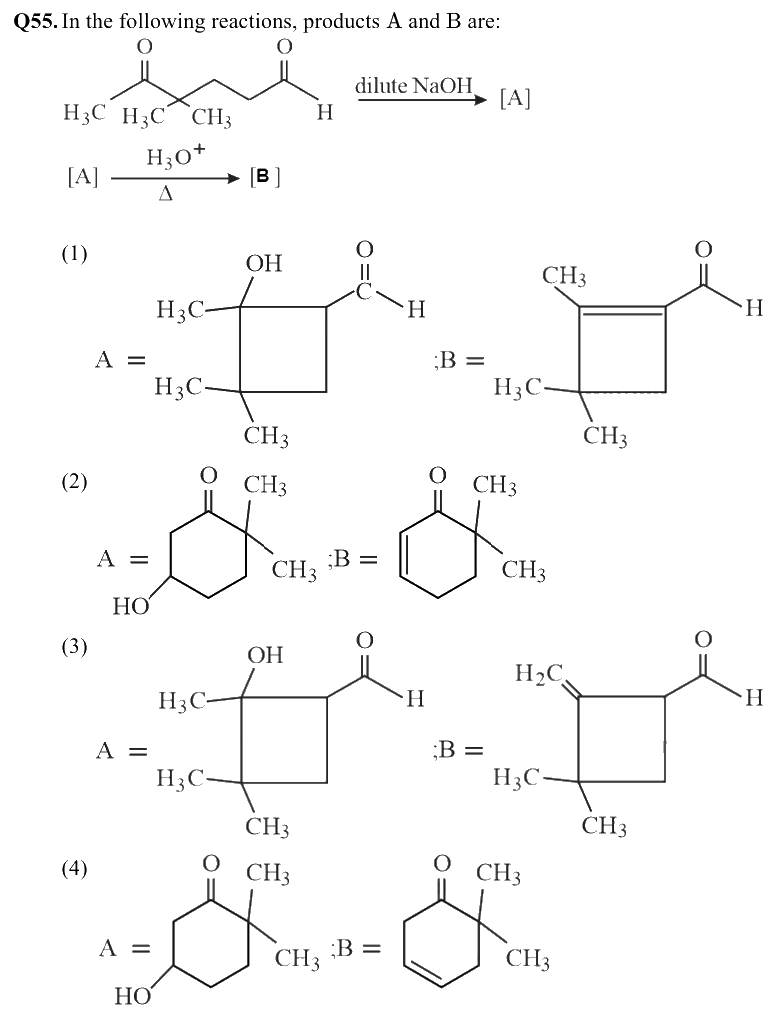
see figure A = four-membered ring with OH, two $\mathrm{H_3C}$ and $\mathrm{CH_3}$ groups and a CHO; B = four-membered ring with a ring C=C bearing $\mathrm{CH_3}$ and a CHO
B
see figure A = six-membered ring with C=O, $\mathrm{CH_3}$, $\mathrm{CH_3}$ and HO; B = six-membered ring with C=O, $\mathrm{CH_3}$, $\mathrm{CH_3}$ and a ring C=C
C
see figure A = four-membered ring with OH, two $\mathrm{H_3C}$ and $\mathrm{CH_3}$ groups and a CHO; B = four-membered ring with an exocyclic $\mathrm{H_2C{=}}$ and a CHO
D
see figure A = six-membered ring with C=O, $\mathrm{CH_3}$, $\mathrm{CH_3}$ and HO; B = six-membered ring with C=O, $\mathrm{CH_3}$, $\mathrm{CH_3}$ and a ring C=C
In the following reaction Aldehyde + Alcohol $\overset{\mathrm{HCl}}{\longrightarrow}$ Acetal Aldehyde: HCHO, $\mathrm{CH_3\ CHO}$ Alcohol: $\mathrm{t - BuOH}$, MeOH The best combination is:
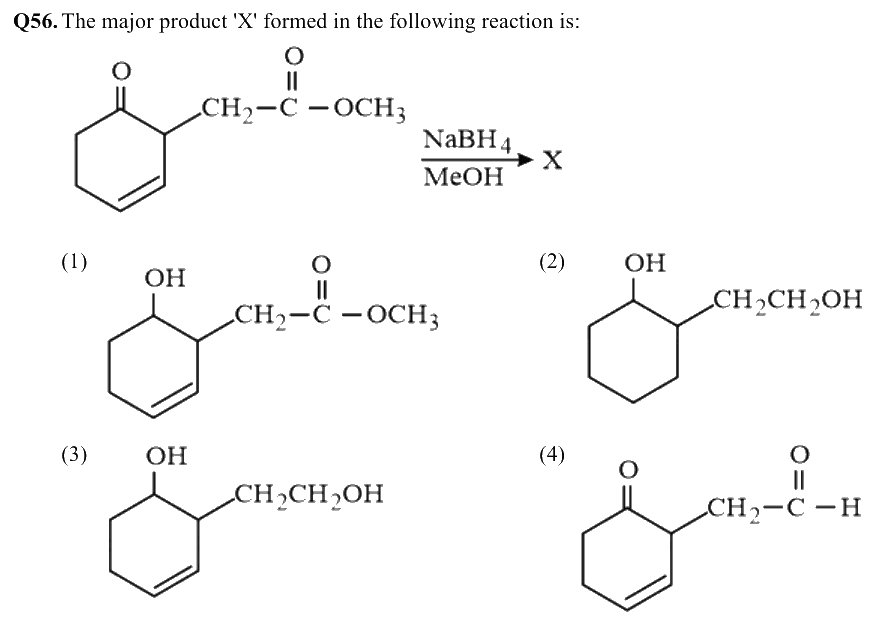
The major product 'X' formed in the following reaction is: (see the figure above)
The question as printed in the paper.
A
see figure Cyclohexene ring bearing OH on the carbon that was C=O and, on the next carbon, the side chain CH2-C(=O)-OCH3 (ester kept), ring double bond kept
B
see figure Saturated cyclohexane ring bearing OH and a CH2CH2OH side chain
C
see figure Cyclohexene ring (double bond kept) bearing OH and a CH2CH2OH side chain
D
see figure Cyclohexenone (C=O kept, double bond kept) bearing a side chain CH2-C(=O)-H (aldehyde)
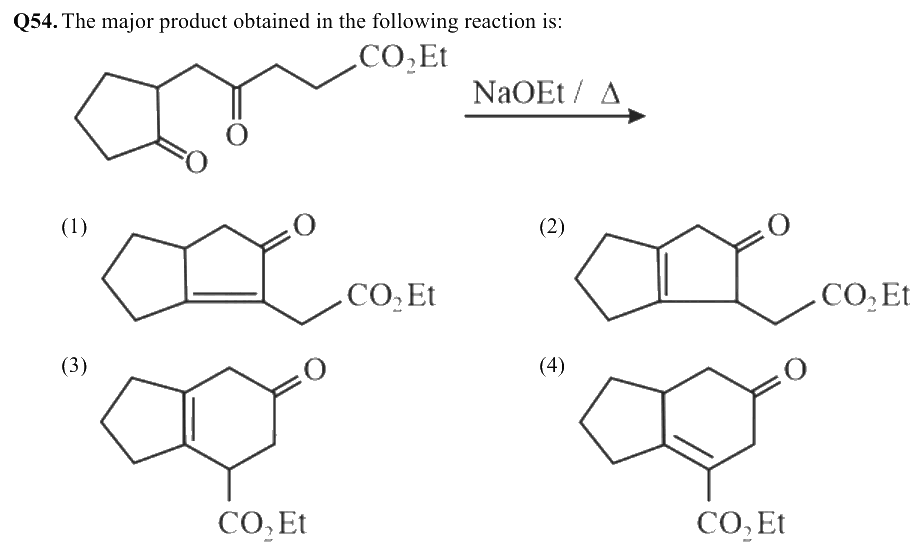
The major product obtained in the following reaction is: (see the figure above)
The question as printed in the paper.
A
see figure Two fused five-membered carbocycles (bicyclic); the right ring has C=O at its upper right, a C=C at the lower edge of the right ring and a CH2-CO2Et substituent at its lower right carbon.
B
see figure Two fused five-membered carbocycles with a C=C at the ring-fusion bond; the right ring has C=O at its upper right and a CH2-CO2Et substituent on its lower right carbon.
C
see figure A five-membered ring fused to a six-membered ring; the six-membered ring has C=O at the top right, a C=C at the ring-fusion bond on its left, and CO2Et on the saturated carbon at the bottom.
D
see figure A five-membered ring fused to a six-membered ring; the six-membered ring has C=O at the top right and a C=C in the ring at the lower left that carries CO2Et at the bottom.
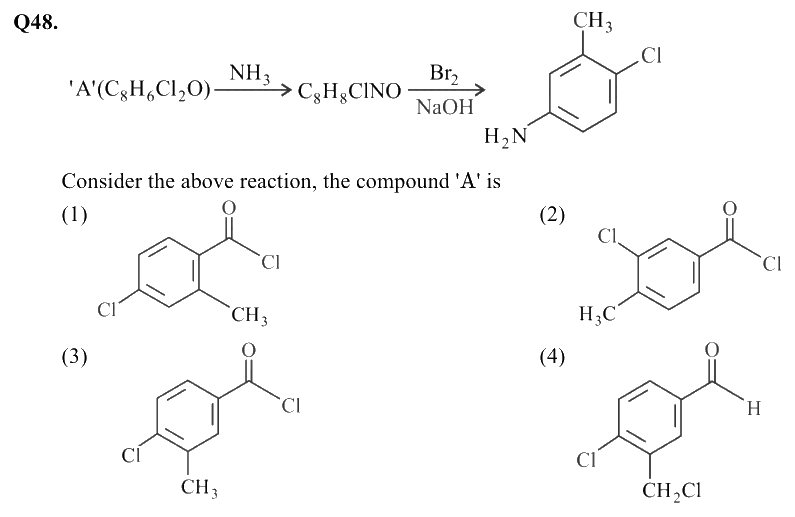
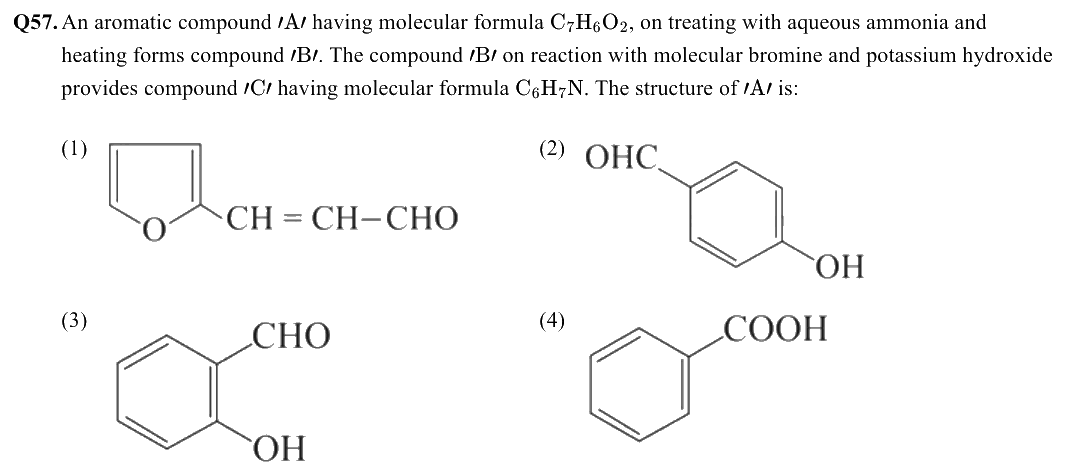
An aromatic compound 'A' having molecular formula $\mathrm{C_7H_6O_2}$, on treating with aqueous ammonia and heating forms compound 'B'. The compound 'B' on reaction with molecular bromine and potassium hydroxide provides compound 'C' having molecular formula $\mathrm{C_6H_7N}$. The structure of 'A' is: (see the figure above)
The question as printed in the paper.
A
see figure Furan ring (O at the lower right of the ring) carrying CH=CH-CHO.
B
see figure OHC on the top-left carbon and OH on the bottom carbon of a benzene ring (para-hydroxybenzaldehyde).
C
see figure CHO on the top carbon and OH on the neighbouring bottom-right carbon of a benzene ring (salicylaldehyde type).
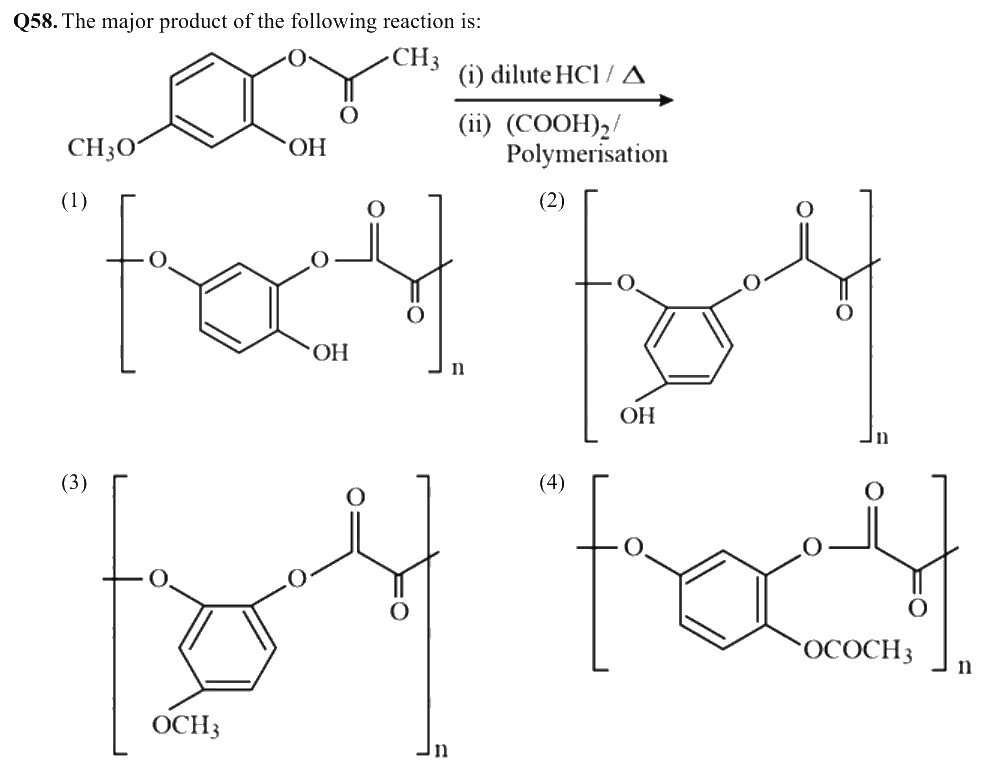
The major product of the following reaction is: (see the figure above)
The question as printed in the paper.
A
see figure Polymer repeat unit in square brackets (n): -O-(benzene ring with OH at the bottom)-O-C(=O)-C(=O)-, with an O at the left end and the oxalyl group at the upper right.
B
see figure Polymer repeat unit in square brackets (n): -O-(benzene ring with OH at the bottom, ring drawn with its OH para to the left O)-O-C(=O)-C(=O)-.
C
see figure Polymer repeat unit in square brackets (n): -O-(benzene ring with OCH3 at the bottom left)-O-C(=O)-C(=O)-.
D
see figure Polymer repeat unit in square brackets (n): -O-(benzene ring with OCOCH3 at the bottom right)-O-C(=O)-C(=O)-.
The major product formed in the following reaction is: (see the figure above)
The question as printed in the paper.
A
see figure H-C(=O)-$CH_2$-C(OH)($CH_3$)-phenyl: an aldehyde (H with C=O) joined through a CH2 to a carbon bearing OH, $H_3C$ and a phenyl ring.
B
see figure phenyl-C(=O)-$CH_2$-C(OH)($CH_3$)-phenyl: a ketone with a phenyl on the carbonyl, a CH2, and a carbon bearing OH, $H_3C$ and a second phenyl ring.
C
see figure $H_3C$-CH(OH)-$CH_2$-C(=O)-H: a hydroxy aldehyde (H with C=O on the right).
D
see figure $H_3C$-CH(OH)-$CH_2$-C(=O)-phenyl: a hydroxy ketone with a phenyl ring on the carbonyl.
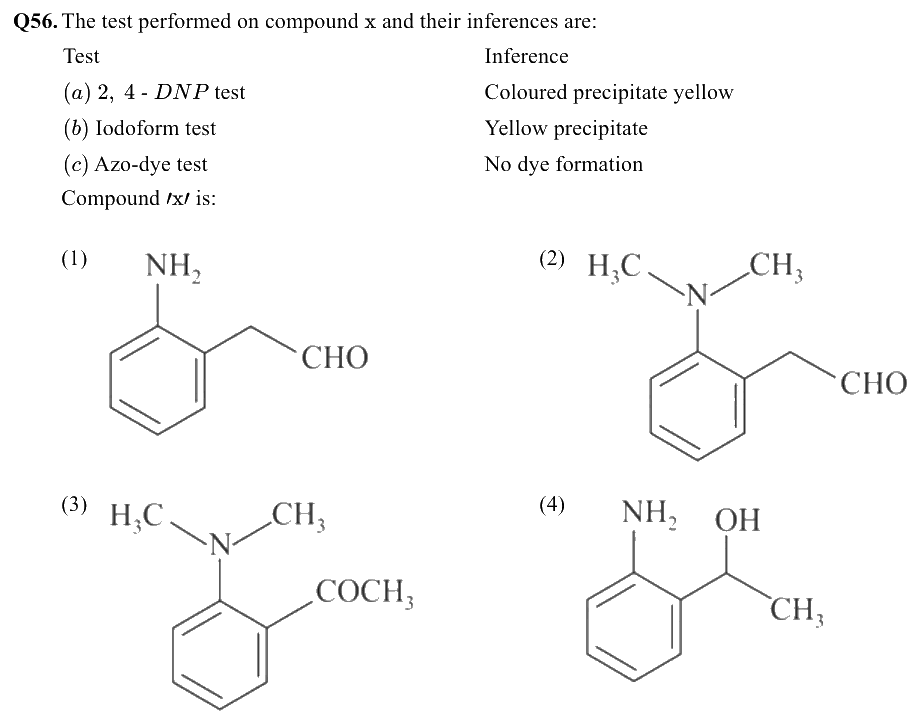
The test performed on compound $x$ and their inferences are: Test | Inference $(a)$ $2,\ 4 - DNP$ test | Coloured precipitate yellow $(b)$ Iodoform test | Yellow precipitate $(c)$ Azo-dye test | No dye formation Compound $x$ is: (see the figure above)
The question as printed in the paper.
A
see figure Benzene ring with NH2 on the top ring carbon and, on the neighbouring ring carbon, a CH2-CHO side chain.
B
see figure Benzene ring with N(CH3)2 (N with H3C and CH3) on the top ring carbon and, on the neighbouring ring carbon, a CH2-CHO side chain.
C
see figure Benzene ring with N(CH3)2 (N with H3C and CH3) on the top ring carbon and, on the neighbouring ring carbon, a COCH3 group.
D
see figure Benzene ring with NH2 on the top ring carbon and, on the neighbouring ring carbon, a CH(OH)-CH3 side chain.
A compound of molecular formula $\mathrm{C_8H_8O_2}$ reacts with acetophenone to form a single cross-aldol product in the presence of base. The same compound on reaction with concentrated NaOH forms benzyl alcohol as one of the products. The structure of the compound is:
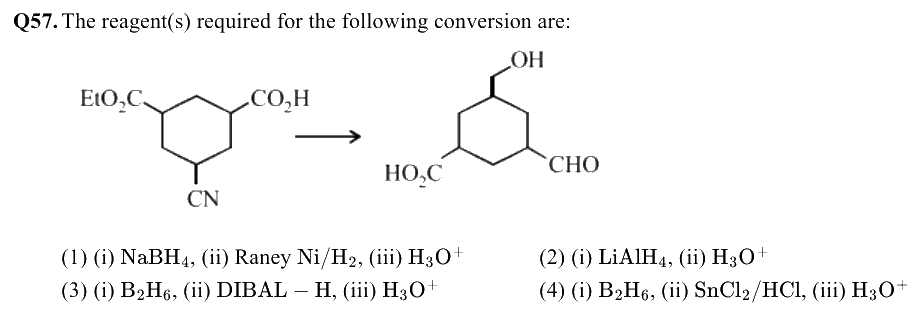
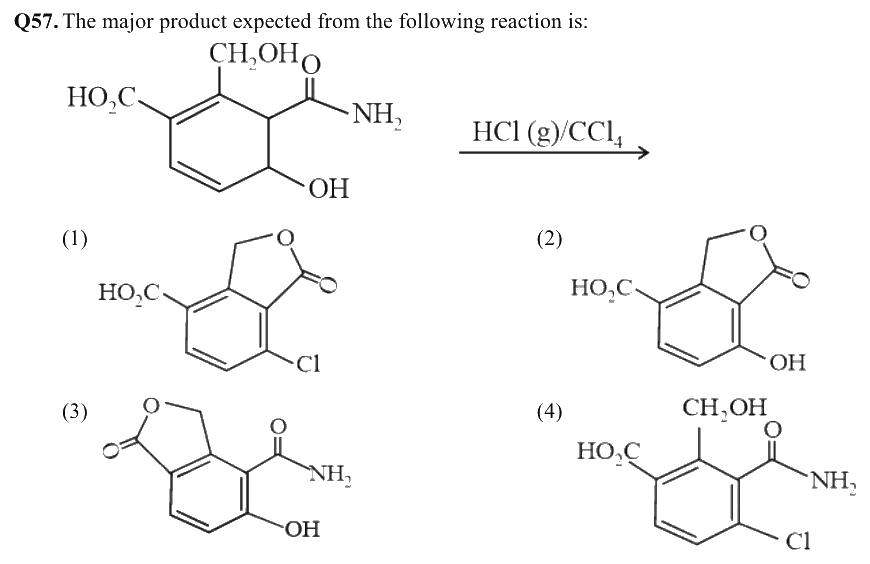
The major product expected from the following reaction is: (see the figure above)
The question as printed in the paper.
A
see figure fused bicycle: benzene ring fused to a five-membered lactone (ring CH2 at top left, ring O at top right, C=O at far right), with HO2C on the left benzene carbon and Cl on the lower right benzene carbon
B
see figure the same fused lactone as option 1 (CH2, ring O, C=O) with HO2C on the left benzene carbon and OH (instead of Cl) on the lower right benzene carbon
C
see figure fused bicycle with the lactone on the left (ring O at top left, C=O at far left, CH2 at the top), benzene ring with C(=O)NH2 on the upper right benzene carbon and OH on the lower right benzene carbon
D
see figure benzene ring (not a lactone) with HO2C at upper left, CH2OH at the top, C(=O)NH2 at upper right and Cl at the lower right
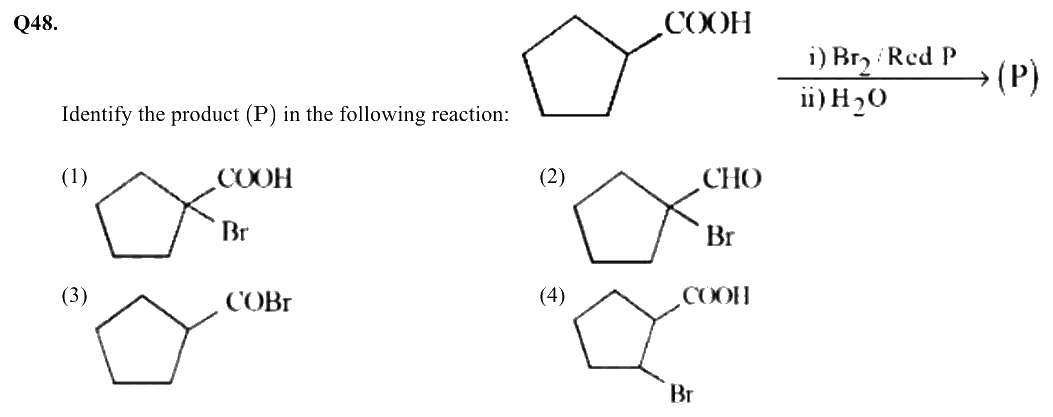
In the presence of a small amount of phosphorous, aliphatic carboxylic acid reacts with chlorine or bromine to yield a reaction in which, $\alpha-$hydrogen is been replaced by halogen. This reaction is known as
In the following sequence of reactions: Toluene $\xrightarrow{\mathrm{KMnO_4}}$ A $\xrightarrow{\mathrm{SOCl_2}}$ B $\xrightarrow[\mathrm{BaSO_4}]{\mathrm{H_2/Pd}}$ C The Product C is:
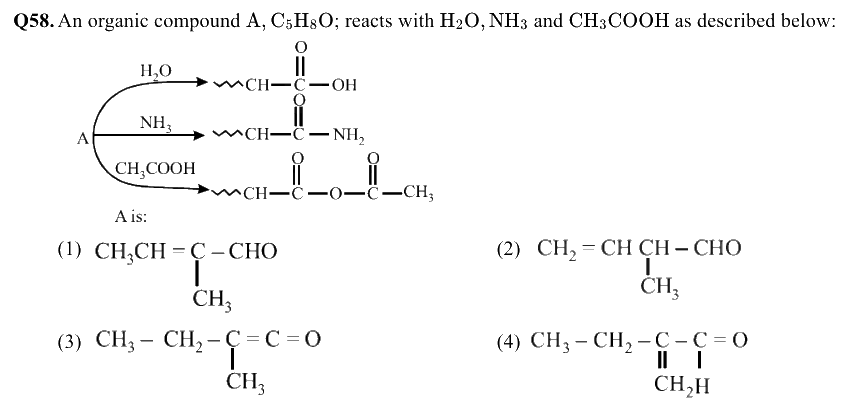
An organic compound A, $\mathrm{C_5H_8O}$; reacts with $\mathrm{H_2O}$, $\mathrm{NH_3}$ and $\mathrm{CH_3COOH}$ as described below: (see the figure above) A is:
The question as printed in the paper.
A
$\mathrm{CH_3CH = C - CHO}$, with $\mathrm{CH_3}$ drawn below the middle carbon (the carbon bearing CHO)
B
$\mathrm{CH_2 = CH\ CH - CHO}$, with $\mathrm{CH_3}$ drawn below the second CH (the carbon bearing CHO)
C
$\mathrm{CH_3 - CH_2 - C = C = O}$, with $\mathrm{CH_3}$ drawn below the first of the two doubly bonded carbons
D
$\mathrm{CH_3 - CH_2 - C - C = O}$, with a double bond from the first of these carbons down to $\mathrm{CH_2}$ and a single bond from the carbon of C=O down to H (drawn as "$\mathrm{CH_2H}$" under the two carbons)
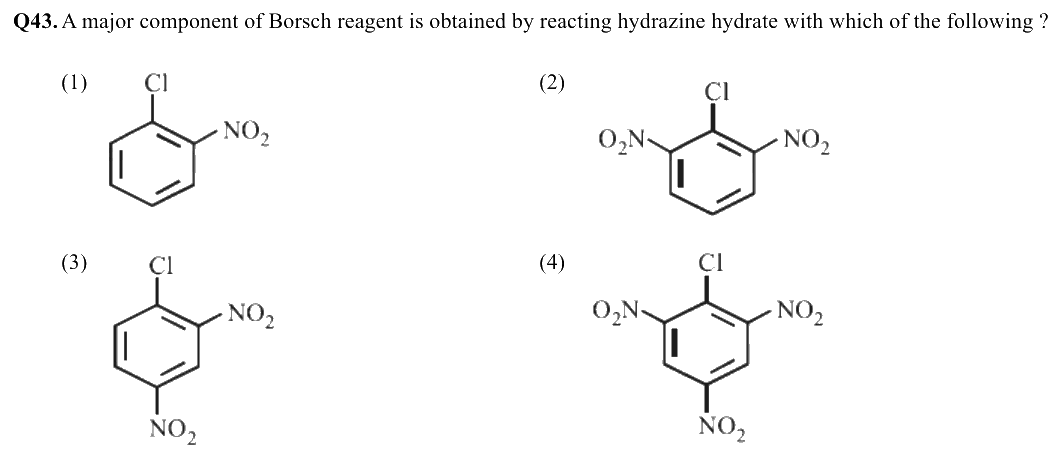
A major component of Borsch reagent is obtained by reacting hydrazine hydrate with which of the following ?
The question as printed in the paper.
A
see figure Benzene ring with Cl at the top carbon and NO2 on the adjacent carbon at upper right (Cl and one NO2 on neighbouring carbons).
B
see figure Benzene ring with Cl at the top carbon, O2N on the upper left carbon and NO2 on the upper right carbon (both neighbours of the C-Cl carbon carry NO2).
C
see figure Benzene ring with Cl at the top carbon, NO2 on the adjacent carbon at upper right, and NO2 at the bottom carbon (para to Cl).
D
see figure Benzene ring with Cl at the top carbon, O2N on the upper left carbon, NO2 on the upper right carbon, and NO2 at the bottom carbon (para to Cl).
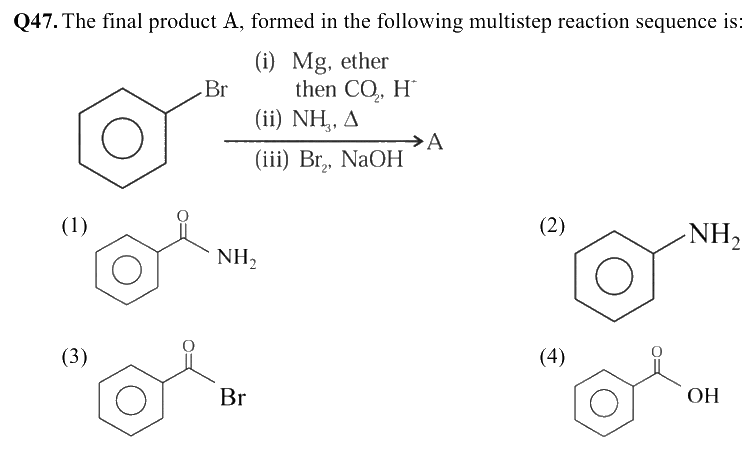
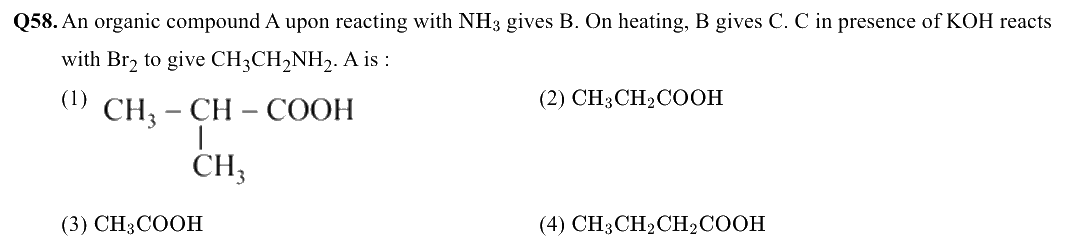
An organic compound A upon reacting with $\mathrm{NH_3}$ gives B. On heating, B gives C. C in presence of KOH reacts with $\mathrm{Br_2}$ to give $\mathrm{CH_3CH_2NH_2}$. A is :
Trichloroacetaldehyde was subjected to Cannizzaro's reaction by using NaOH. The mixture of the products contains sodium trichloroacetate and another compound. The other compound is :
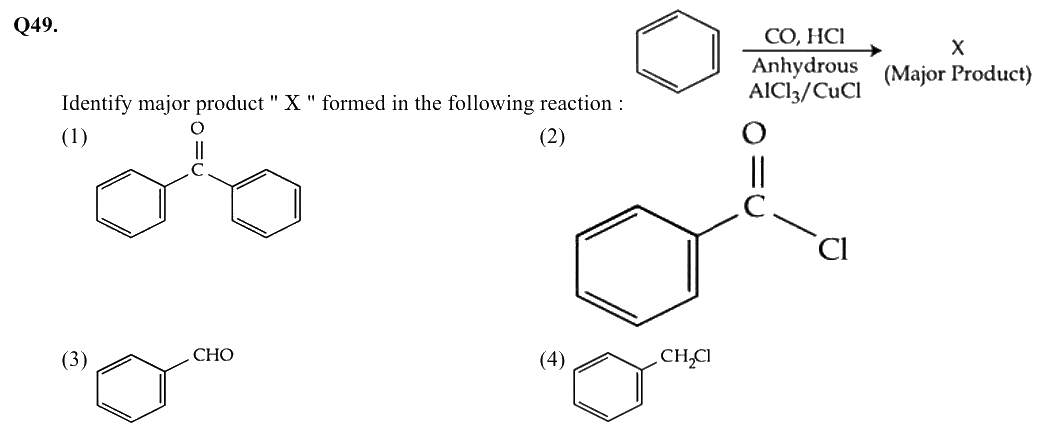
'x' is the product which is obtained from benzene by reacting it with carbon monoxide and hydrogen chloride in the presence of cuprous chloride. 'y' is the major product obtained from the benzene by reacting it with ethanoyl chloride in the presence of anhydrous $\mathrm{AlCl_3}$. Product (major) obtained by heating $x$ and $y$ in the presence of alkali is $z$. Total number of $\pi$ (pi) electrons in $z$ is ________.
Numerical answer type: type your answer in EdLoop to check it
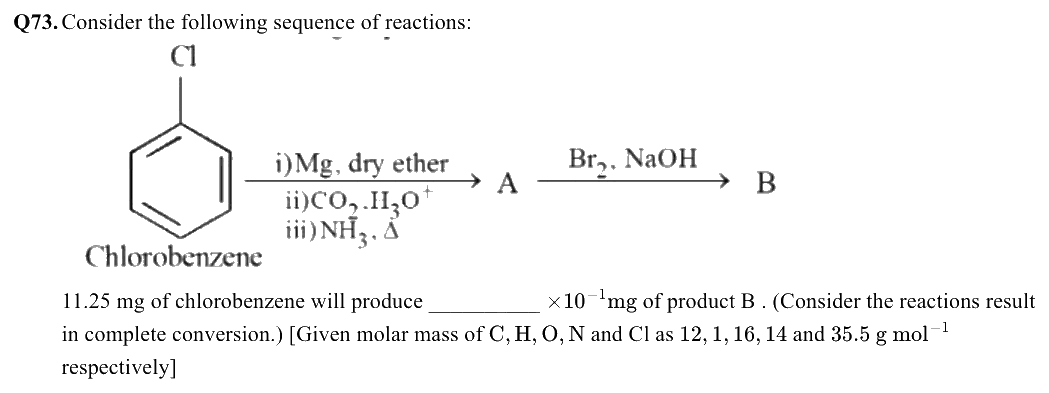
11.25 mg of chlorobenzene will produce ______ $\times 10^{-1}$mg of product B . (Consider the reactions result in complete conversion.) [Given molar mass of C, H, O, N and Cl as 12, 1, 16, 14 and 35.5 g $\mathrm{mol^{-1}}$ respectively]
The question as printed in the paper.
Numerical answer type: type your answer in EdLoop to check it
Two moles of benzaldehyde and one mole of acetone under alkaline conditions using aqueous NaOH after heating gives $x$ as the major product. The number of $\pi$ bonds in the product $x$ is ______
Numerical answer type: type your answer in EdLoop to check it
The mass of $\mathrm{NH_3}$ produced when 131.8 kg of cyclohexane carbaldehyde undergoes Tollen's test is ______ kg. (Nearest Integer) Molar mass of C = 12 g/mol N = 14 g/mol O = 16 g/mol
Numerical answer type: type your answer in EdLoop to check it
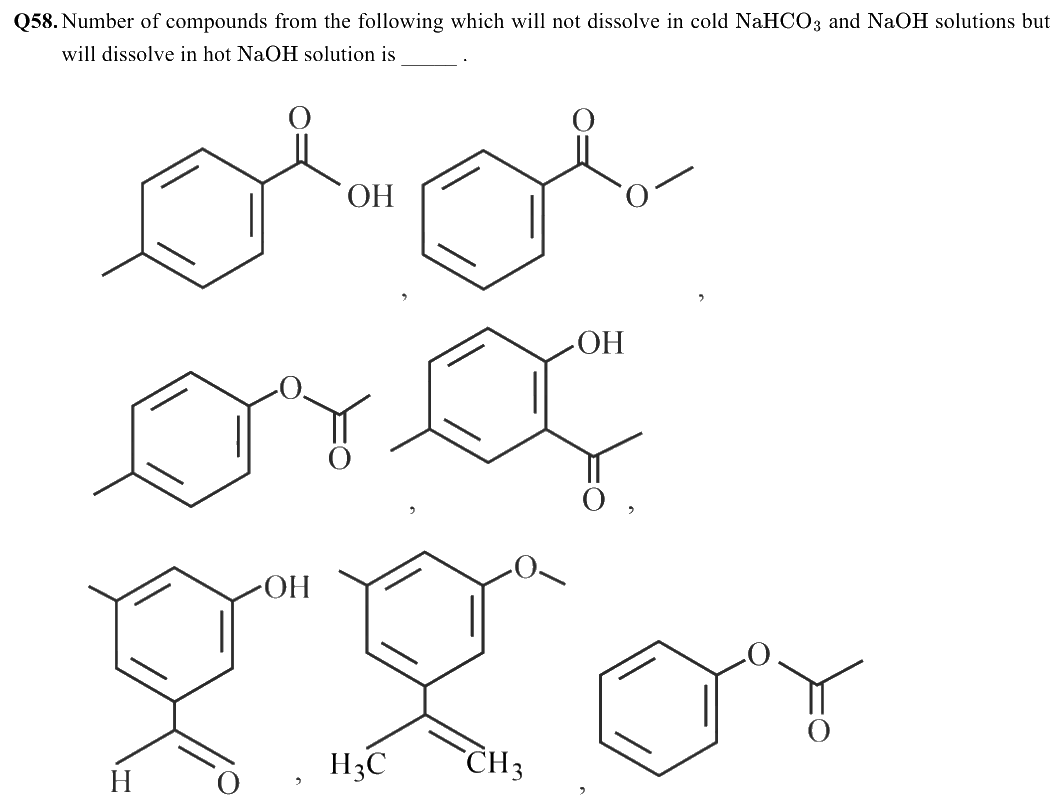
Number of compounds from the following which will not dissolve in cold $\mathrm{NaHCO_3}$ and NaOH solutions but will dissolve in hot NaOH solution is ______ .
(see the figure above)
The question as printed in the paper.
Numerical answer type: type your answer in EdLoop to check it
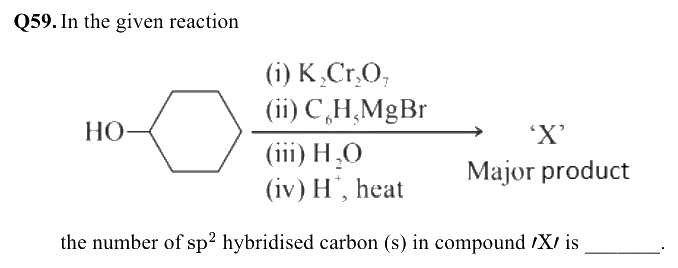
(see the figure above) $\xrightarrow{\text{(i) }\mathrm{K_2Cr_2O_7}\ \text{(ii) }\mathrm{C_6H_5MgBr}\ \text{(iii) }\mathrm{H_2O}\ \text{(iv) }\mathrm{H^+},\ \text{heat}}$ 'X' Major product the number of $\mathrm{sp^2}$ hybridised carbon (s) in compound 'X' is ______.
The question as printed in the paper.
Numerical answer type: type your answer in EdLoop to check it
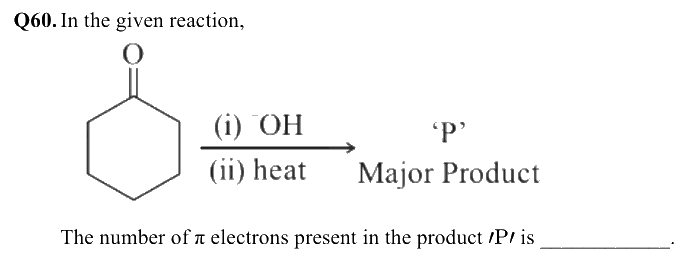
(see the figure above) $\xrightarrow{\text{(i) }^{-}\mathrm{OH}\ \text{(ii) heat}}$ 'P' Major Product The number of $\pi$ electrons present in the product 'P' is ______.
The question as printed in the paper.
Numerical answer type: type your answer in EdLoop to check it
In Tollen's test for aldehyde, the overall number of electron(s) transferred to the Tollen's reagent formula $[\mathrm{Ag\,(NH_3)_2}]^+$ per aldehyde group to form silver mirror is ______ .(Round off to the Nearest integer)
Numerical answer type: type your answer in EdLoop to check it
The number of compound/s given below which contain/s $-$ COOH group is ______ . (Integer answer) (A) Sulphanilic acid (B) Picric acid (C) Aspirin (D) Ascorbic acid
Numerical answer type: type your answer in EdLoop to check it
How to prepare Aldehydes, Ketones & Carboxylic Acids for JEE Main
How often it comes up
Aldehydes, ketones and carboxylic acids forms the core carbonyl unit under Unit 17: Organic Compounds Containing Oxygen in the Class 12 curriculum, holding rank 5 of 31 chapters with a 4.7% share of the chemistry section. In the 2019 to 2026 test timeframe, Aldehydes, Ketones & Carboxylic Acids produced 214 questions across 162 exam papers, making up 4.7% of the chemistry section and holding rank 5 of 31 chapters. During the 2002 to 2018 period, it accounted for 51 questions across 38 papers with a 3.8% share. Over the recent 2024 to 2026 window, the chapter yielded 71 questions across 58 papers, capturing a 4.6% share. Comparing 2002 to 2018 against 2024 to 2026, the trend is up, whereas comparing 2019 to 2026 against 2024 to 2026, its testing share has remained about the same.
The chapter has appeared every year from 2019 to 2026. Students faced an average of 1.3 questions per paper across 2019 to 2026, and 1.2 questions per paper in the 2024 to 2026 cycle. Twenty numerical answer questions were set between 2019 and 2026.
Most-asked topics
The syllabus organizes across six key topics:
Nucleophilic Addition Reactions: The leading topic with 78 total questions (64 in 2019 to 2026), examined continuously through 2026. Evaluates nucleophilic addition of HCN, sodium bisulfite, Grignard reagents, alcohols forming hemiacetals and acetals, and ammonia derivatives (hydroxylamine, hydrazine, semicarbazide, and 2,4-dinitrophenylhydrazine).
Alpha-Hydrogen & Named Reactions: Produced 70 total questions (57 in 2019 to 2026), tested through 2026. Centers on aldol and cross-aldol condensations with enolate intermediates, Cannizzaro disproportionation of non-enolizable aldehydes in concentrated alkali, and the haloform reaction on methyl ketones.
Carboxylic Acids: Contributed 40 total questions (26 in 2019 to 2026), evaluated through 2026. Focuses on acid strengths, resonance stabilization of carboxylate anions, Hell-Volhard-Zelinsky (HVZ) alpha-bromination, and soda lime decarboxylation.
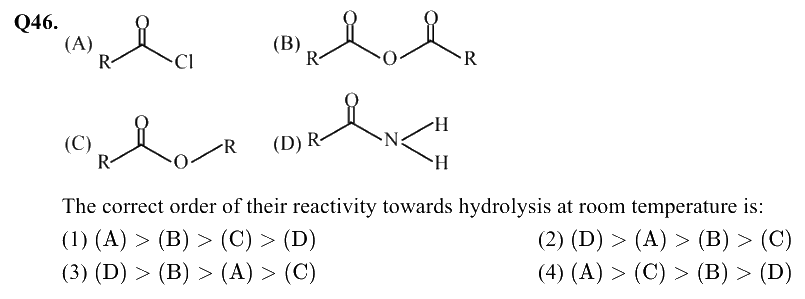
Acid Derivatives: Yielded 30 total questions (26 in 2019 to 2026), active through 2026. Evaluates nucleophilic acyl substitution on acid chlorides, anhydrides, esters, and amides, alongside Hofmann bromamide degradation.
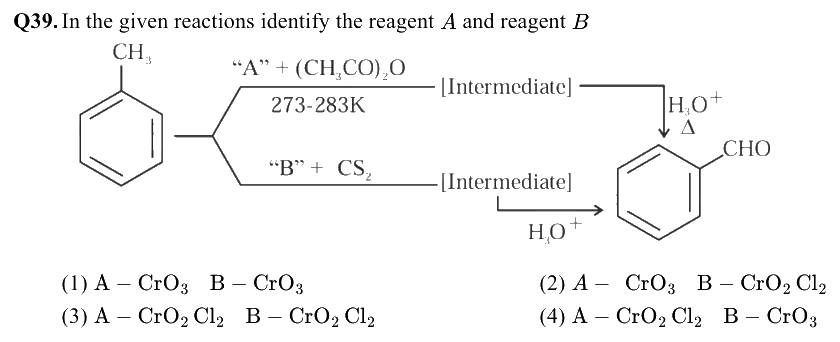
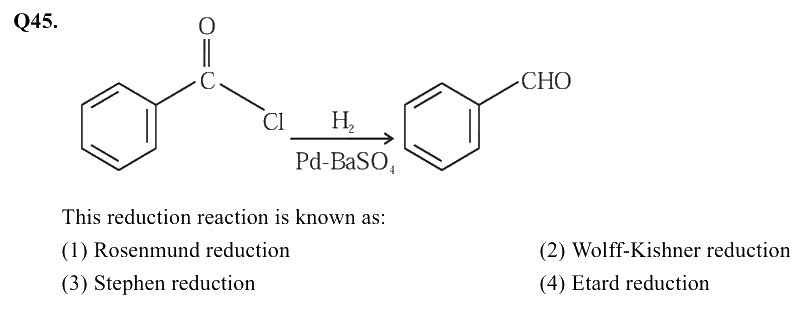
Preparation of Aldehydes & Ketones: Accounted for 29 total questions (26 in 2019 to 2026), tested through 2026. Covers Rosenmund reduction of acyl chlorides, Stephen reduction of nitriles, Etard reaction using chromyl chloride, and Gattermann-Koch formylation.
Oxidation & Distinguishing Tests: Contributed 18 total questions (15 in 2019 to 2026), active through 2026. Evaluates silver mirror Tollens test, red cuprous oxide precipitation with Fehling solution, and Schiff's reagent tests.
What the questions look like
Examiners emphasize multi-step roadmap puzzles. A typical problem presents an unknown organic formula, states that it forms a 2,4-DNP derivative and gives a positive haloform test, but gives a negative Tollens reaction, pinpointing a methyl ketone.
In named reactions, questions frequently test cross-aldol condensation between two different carbonyls, asking students to determine the maximum count of possible aldol products or identify the major product formed when one partner lacks alpha-hydrogens (such as benzaldehyde reacting with acetophenone).
Questions to try first
Work through these representative recent problems:
Carbonyl diagnostic testing and acetals: Deducing an organic structure that responds positively to haloform oxidation and acquires Tollens reactivity only after acidic hydrolysis.
Aldol and Cannizzaro discrimination: Identifying an aromatic carbonyl that undergoes cross-aldol condensation and gives benzyl alcohol under strongly basic conditions.
Because this unit ranks fifth in chemistry weight, organize revision around reaction mechanisms:
1. Master addition-elimination mechanisms: Understand how ammonia derivatives (NH₂–G) condense with carbonyls to form imines, oximes, hydrazones, and semicarbazones under weakly acidic conditions. 2. Differentiate Aldol from Cannizzaro: Aldehydes and ketones with alpha-hydrogens undergo aldol condensation; aldehydes lacking alpha-hydrogens (like benzaldehyde and formaldehyde) undergo Cannizzaro disproportionation in concentrated alkali. 3. Understand haloform requirements: Compounds containing a CH₃–C=O group or a CH₃–CH(OH) group oxidize with halogen and alkali to yield yellow iodoform (CHI₃) precipitate. 4. Compare reducing agents: Clemmensen reduction uses zinc amalgam and concentrated hydrochloric acid (avoid with acid-sensitive groups); Wolff-Kishner reduction uses hydrazine and potassium hydroxide in ethylene glycol (avoid with base-sensitive groups). 5. Review Hell-Volhard-Zelinsky bromination: Red phosphorus and bromine selectively substitute the alpha-hydrogen of aliphatic carboxylic acids.
Frequently asked questions
Why does semicarbazide react through only one of its two nitrogen atoms?
Semicarbazide (NH₂–NH–CONH₂) contains three nitrogens, but the two nitrogens adjacent to the carbonyl group have their lone pairs delocalized into the carbonyl pi system via resonance. Only the hydrazine terminal NH₂ nitrogen maintains an available, localized lone pair to act as an effective nucleophile.
What is the purpose of acid catalysis in the formation of oximes and hydrazones?
Acid protonates the carbonyl oxygen, making the carbonyl carbon substantially more electrophilic. However, the solution must not be too acidic, or the amine nucleophile becomes protonated into an unreactive ammonium ion.
Which carboxylic acid can reduce Tollens reagent?
Formic acid (methanoic acid) uniquely possesses both a carboxylic acid group and an aldehyde hydrogen, allowing it to reduce Tollens and Fehling reagents just like an aldehyde. Step-by-step solutions for each one are in the EdLoop app.