Which of the following material is not a semiconductor.
- A
Silicon
- B
Copper oxide
- C
Germanium
- D
Graphite
Answer: (D) Graphite · Key from source paper
 PYQs · free, no adsOpen on the web (app.edloop.in)Get EdLoop – free on Google Play
Every States of Matter question from past JEE Main and AIEEE papers, with options and answers. Newest first.
States of matter was formerly in the Class 11 chemistry curriculum before being removed in 2024, holding rank 22 among 31 chemistry chapters with a 2.2 percent share of total chemistry questions.
Attempt every States of Matter question timed, see the step-by-step solution and track what you get wrong. Free.
Which of the following material is not a semiconductor.
Silicon
Copper oxide
Germanium
Graphite
Which of the following expressions is correct in case of a CsCl unit cell (edge length 'a')?
$\mathrm{r_{Cs^+} + r_{Cl^-}} = \frac{a}{2}$
$\mathrm{r_{Cs^+} + r_{Cl^-}} = \frac{\sqrt{3}}{2}a$
$\mathrm{r_{Cs^+} + r_{Cl^-}} = \frac{a}{\sqrt{2}}$
$\mathrm{r_{Cs^+} + r_{Cl^-}} = a$
Which one of the following pairs is an example of polar molecular solids?
$\mathrm{SO_2(s), CO_2(s)}$
$\mathrm{SO_2(s), NH_3(s)}$
$\mathrm{MgO(s), SO_2(s)}$
$\mathrm{HCl(s), AlN(s)}$
The correct relationships between unit cell edge length 'a' and radius of sphere 'r' for face-centred and body-centred cubic structures respectively are:
$2\sqrt{2}\,r = a$ and $\sqrt{3}\,r = 4a$
$r = 2\sqrt{2}\,a$ and $4r = \sqrt{3}\,a$
$r = 2\sqrt{2}\,a$ and $\sqrt{3}\,r = 4a$
$2\sqrt{2}\,r = a$ and $4r = \sqrt{3}\,a$
Arrange the following gases in increasing order of van der Waals constant $a$
(A) Ar
(B) $\mathrm{CH_4}$
(C) $\mathrm{H_2O}$
(D) $\mathrm{C_6H_6}$
Choose the correct option from the following.
D, C, B and A
B, C, D and A
C, D, B and A
A, B, C and D
A compound is formed by two elements X and Y. The element Y forms cubic close packed arrangement and those of element X occupy one third of the tetrahedral voids. What is the formula of the compound?
$\mathrm{X_2Y_3}$
$\mathrm{X_3Y_2}$
$\mathrm{X_3Y}$
$\mathrm{XY_3}$
Which of the following represents the lattice structure of $\mathrm{A_{0.95}O}$ containing $\mathrm{A^{2+}}$, $\mathrm{A^{3+}}$ and $\mathrm{O^{2-}}$ ions?
Legend: green circle $\mathrm{A^{2+}}$, red circle $\mathrm{A^{3+}}$, black circle $\mathrm{O^{2-}}$
A.
(see the figure above)
B.
(see the figure above)
C.
(see the figure above)
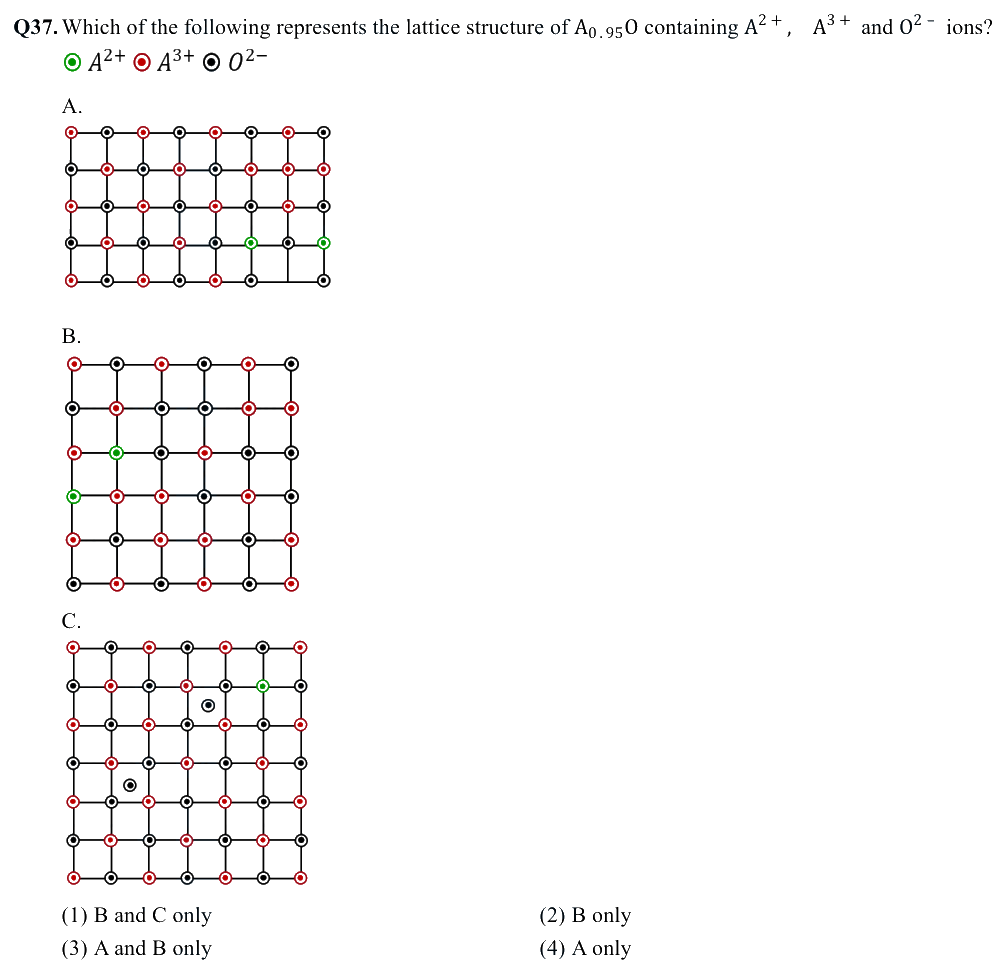
B and C only
B only
A and B only
A only
For 1 mol of gas, the plot of pV vs p is shown below. p is the pressure and V is the volume of the gas.
(see the figure above)
What is the value of compressibility factor at point $A$?
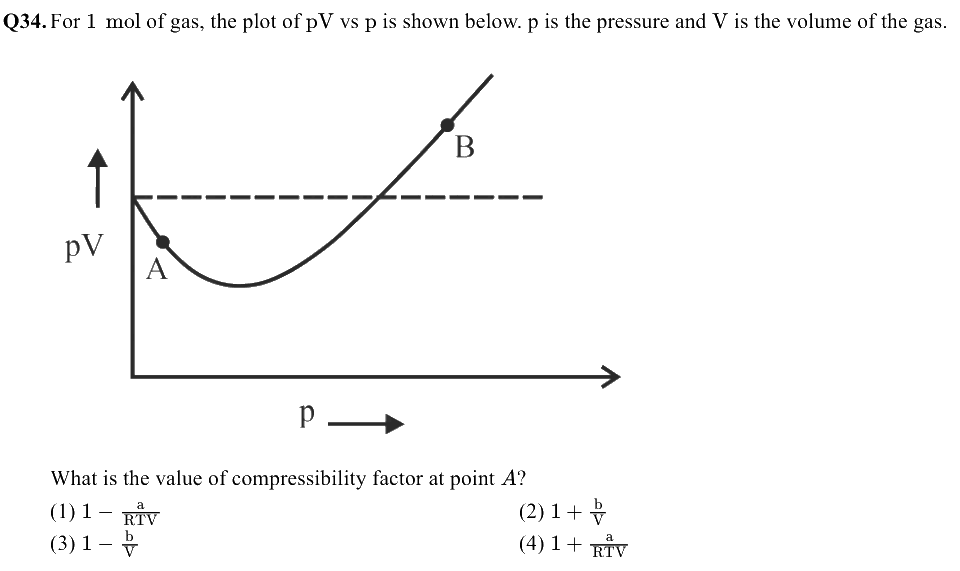
$1 - \frac{\mathrm{a}}{\mathrm{RTV}}$
$1 + \frac{\mathrm{b}}{\mathrm{V}}$
$1 - \frac{\mathrm{b}}{\mathrm{V}}$
$1 + \frac{\mathrm{a}}{\mathrm{RTV}}$
A cubic solid is made up of two elements X and Y. Atoms of X are present on every alternate corner and one at the center of cube. Y is at $\frac{1}{3}^{rd}$ of the total faces. The empirical formula of the compound is
$\mathrm{X_2Y_{1.5}}$
$\mathrm{X_{1.5}Y}$
$\mathrm{XY_{2.5}}$
$\mathrm{X_{1.5}Y_2}$
Given below are two statements.
Statement I : $\mathrm{O_2}$, $\mathrm{Cu^{2+}}$ and $\mathrm{Fe^{3+}}$ are weakly attracted by magnetic field and are magnetized in the same direction as magnetic field.
Statement II : NaCl and $\mathrm{H_2O}$ are weakly magnetized in opposite direction to magnetic field.
In the light of the above statements, choose the most appropriate answer form the options given below
Both Statement I and Statement II are correct.
Both Statement I and Statement II are incorrect.
Statement I is correct but Statement II is incorrect.
Statement I is incorrect but Statement II is correct.
The incorrect statement about the imperfections in solids is
Schottky defect decreases the density of the substance.
Frenkel defect does not alter the density of the substance.
Interstitial defect increases the density of the substance.
Vacancy defect increases the density of the substance.
Which amongst the given plots is the correct plot for pressure (p) vs density (d) for an ideal gas?
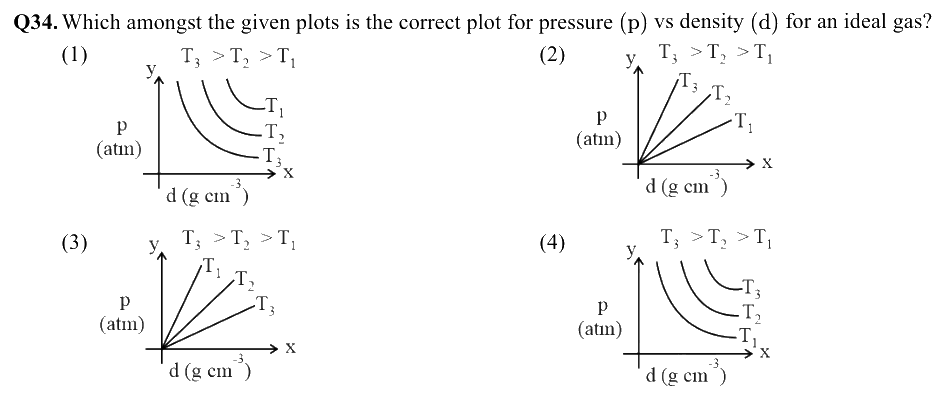
see figure Plot with p (atm) on the vertical axis (axis labelled y) and d (g cm^-3) on the horizontal axis (axis labelled x), heading "T_3 > T_2 > T_1": three falling curves (hyperbola-like) that do not touch the axes, nested one inside another; the labels T_1, T_2, T_3 stand at the right-hand ends of the curves from top to bottom (T_1 on the highest curve, T_3 on the lowest).
see figure Plot with p (atm) on the vertical axis and d (g cm^-3) on the horizontal axis, heading "T_3 > T_2 > T_1": three straight lines rising from the origin; T_3 is the steepest (top), T_2 in the middle, T_1 the least steep (bottom).
see figure Plot with p (atm) on the vertical axis and d (g cm^-3) on the horizontal axis, heading "T_3 > T_2 > T_1": three straight lines rising from the origin; T_1 is the steepest (top), T_2 in the middle, T_3 the least steep (bottom).
see figure Plot with p (atm) on the vertical axis and d (g cm^-3) on the horizontal axis, heading "T_3 > T_2 > T_1": three falling curves (hyperbola-like) nested one inside another; the labels are at the right-hand ends of the curves from top to bottom: T_3 on the highest curve, T_2 in the middle, T_1 on the lowest.
An evacuated glass vessel weighs $40.0 \mathrm{~g}$ when empty, $135.0 \mathrm{~g}$ when filled with a liquid of density $0.95 \mathrm{~g} \mathrm{~mL}^{-1}$ and $40.5 \mathrm{~g}$ when filled with an ideal gas at $0.82 \mathrm{~atm}$ at $250 \mathrm{~K}$. The molar mass of the gas in $\mathrm{g} \mathrm{mol}^{-1}$ is : (Given : $\mathrm{R} = 0.082 \mathrm{~L} \mathrm{~atm} \mathrm{K}^{-1} \mathrm{~mol}^{-1}$)
35
50
75
125
Which one of the following is the correct PV vs P plot at constant temperature for an ideal gas ? ( P and V stand for pressure and volume of the gas respectively)
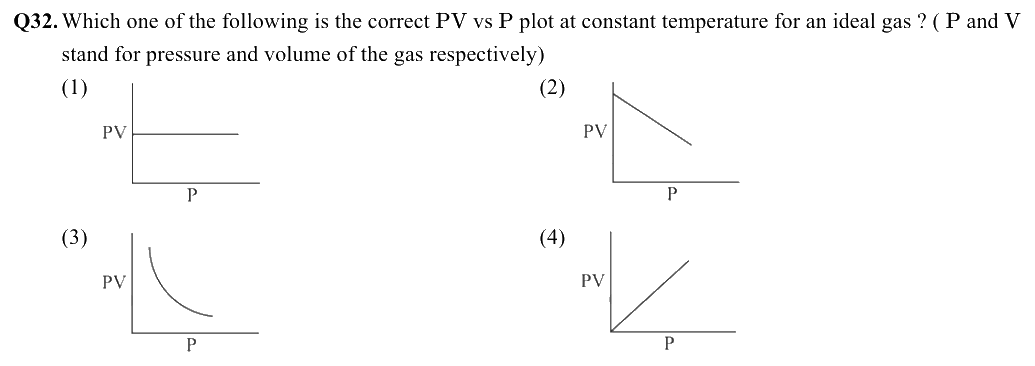
see figure PV against P; a horizontal straight line.
see figure PV against P; a straight line falling from the PV axis down to the right.
see figure PV against P; a curve starting high on the PV axis and falling steeply, then more gently (decay curve).
see figure PV against P; a straight line rising from the origin.
The unit of the van der Waals gas equation parameter 'a' in $\left(P + \frac{an^2}{V^2}\right)(V - nb) = nRT$ is:
$\mathrm{dm^3\ mol^{-1}}$
$\mathrm{kg\ ms^{-1}}$
$\mathrm{atm\ dm^6\ mol^{-2}}$
$\mathrm{kg\ ms^{-2}}$
Match List - I with List - II:
List-I (Property)
(a) Diamagnetism
(b) Ferrimagnetism
(c) Paramagnetism
(d) Antiferromagnetism
List-II (Example)
(i) $\mathrm{MnO}$
(ii) $\mathrm{O_2}$
(iii) $\mathrm{NaCl}$
(iv) $\mathrm{Fe_3O_4}$
Choose the most appropriate answer from the options given below:
(a) - (iv), (b) - (ii), (c) - (i), (d) - (iii)
(a) - (ii), (b) - (i), (c) - (iii), (d) - (iv)
(a) - (i), (b) - (iii), (c) - (iv), (d) - (ii)
(a) - (iii), (b) - (iv), (c) - (ii), (d) - (i)
Given below are two statements:
Statement I : Frenkel defects are vacancy as well as interstitial defects.
Statement II : Frenkel defect leads to colour in ionic solids due to presence of F-centres.
Choose the most appropriate answer for the statements from the options given below:
Statement I is false but Statement II is true
Both Statement I and Statement II are false
Statement I is true but Statement II is false
Both Statement I and Statement II are true
The parameters of the unit cell of a substance are a = 2.5, b = 3.0, c = 4.0, $\alpha = 90^\circ$, $\beta = 120^\circ\gamma = 90^\circ$. The crystal system of the substance is :
Hexagonal
Orthorhombic
Monoclinic
Triclinic
Select the correct statements.
(A) Crystalline solids have long range order.
(B) Crystalline solids are isotropic.
(C) Amorphous solid are sometimes called pseudo solids.
(D) Amorphous solids soften over a range of temperatures.
(E) Amorphous solids have a definite heat of fusion. Choose the most appropriate answer from the options given below.
(A), (B), (E) only
(B), (D) only
(C), (D) only
(A), (C), (D) only
Given below are two statements. One is labelled as Assertion A and the other is labelled as Reason R.
Assertion A : Sharp glass edge becomes smooth on heating it up to its melting point.
Reason R : The viscosity of glass decreases on melting.
Choose the most appropriate answer from the options given below.
A is true but R is false
Both A and R are true but R is NOT the correct explanation of A.
A is false but R is true.
Both A and R are true and R is the correct explanation of A.
In a binary compound, atoms of element A form a hcp structure and those of element M occupy 2/3 of the tetrahedral voids of the hcp structure. The formula of the binary compound is:
$\mathrm{M_2\,A_3}$
$\mathrm{M_4\,A_3}$
$\mathrm{M_4\,A}$
$\mathrm{MA_3}$
The oxide that shows magnetic property is:
$\mathrm{SiO_2}$
$\mathrm{Mn_3\,O_4}$
$\mathrm{Na_2\,O}$
$\mathrm{MgO}$
A hard substance melts at high temperature and is an insulator in both solid and in molten state. This solid is most likely to be a / an :
Ionic solid
Molecular solid
Metallic solid
Covalent solid
A crystal is made up of metal ions 'M$_1$' and 'M$_2$' and oxide ions. Oxide ions form a ccp lattice structure. The cation 'M$_1$' occupies 50% of octahedral voids and the cation 'M$_2$' occupies $12.5\ \%$ of tetrahedral voids of oxide lattice. The oxidation numbers of 'M$_1$' and 'M$_2$' are respectively :
$+2,\ +4$
$+1,\ +3$
$+3,\ +1$
$+4,\ +2$
A diatomic molecule $\mathrm{X_2}$ has a body-centred cubic (bcc) structure with a cell edge of 300 pm. The density of the molecule is 6. 17 $\mathrm{gcm^{-3}}$. The number of molecules present in 200 g of $\mathrm{X_2}$ is :
(Avogadro constant ($\mathrm{N_A}$) = 6 $\times 10^{23}$ $\mathrm{mol^{-1}}$)
40 $\mathrm{N_A}$
8 $\mathrm{N_A}$
4 $\mathrm{N_A}$
2 $\mathrm{N_A}$
An element crystallises in a face–centred cubic (fcc) unit cell with cell edge a. The distance between the centres of two nearest octahedral voids in the crystal lattice is:
$\frac{a}{\sqrt{2}}$
$a$
$\sqrt{2}a$
$\frac{a}{2}$
A mixture of one mole each of $\mathrm{H_2}$ , He and $\mathrm{O_2}$ each are enclosed in a cylinder of volume V at temperature T. If the partial pressure of $\mathrm{H_2}$ is $2\ \mathrm{atm}$, the total pressure of the gases in the cylinder is:
$6\ \mathrm{atm}$
$38\ \mathrm{atm}$
$14\ \mathrm{atm}$
$22\ \mathrm{atm}$
Which one of the following graphs is not correct for ideal gas?
d = Density, P = Pressure, T =Temperature
(see the figure above)
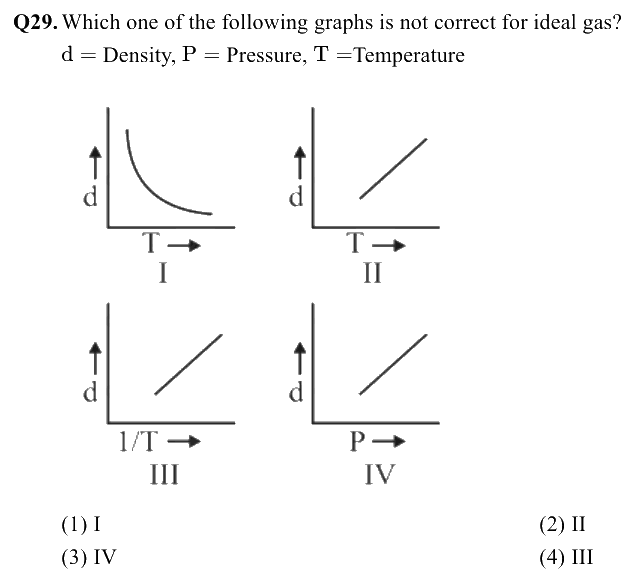
I
II
IV
III
' X ' melts at low temperature and is a bad conductor of electricity in both liquid and solid state. X is:
zinc sulphide
Mercury
Silicon carbide
Carbon tetrachloride
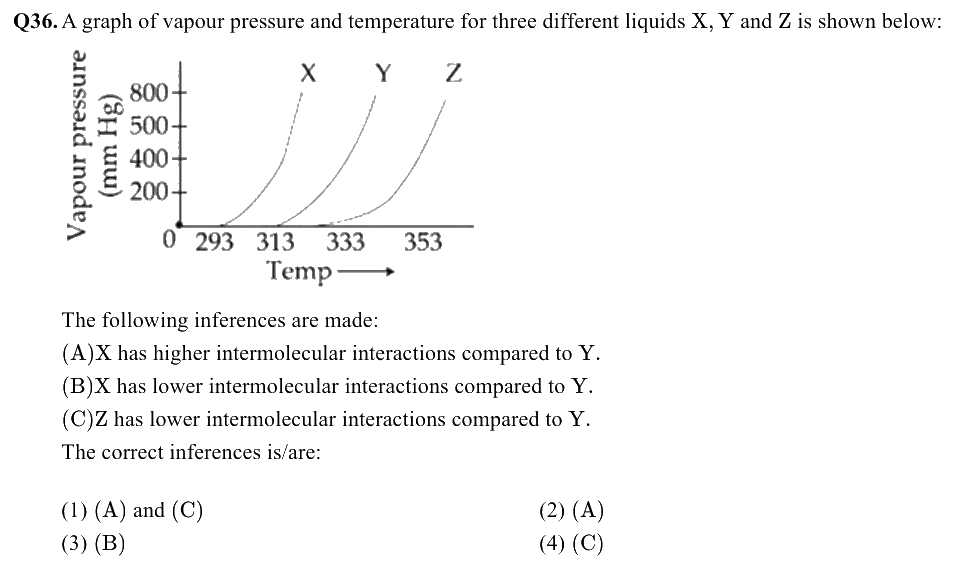
A graph of vapour pressure and temperature for three different liquids X, Y and Z is shown below:
(see the figure above)
The following inferences are made:
(A)X has higher intermolecular interactions compared to Y.
(B)X has lower intermolecular interactions compared to Y.
(C)Z has lower intermolecular interactions compared to Y.
The correct inferences is/are:
(A) and (C)
(A)
(B)
(C)
Which of the following compounds is likely to show both Frenkel and Schottky defects in its crystalline form?
$\mathrm{AgBr}$
$\mathrm{CsCl}$
$\mathrm{KBr}$
$\mathrm{ZnS}$
Identify the correct labels of A, B and C in the following graph from the options given below:
(see the figure above)
Root mean square speed $(\mathrm{V_{rms}})$; most proable speed $(\mathrm{V_{mp}})$; Average speed $(\mathrm{V_{av}})$
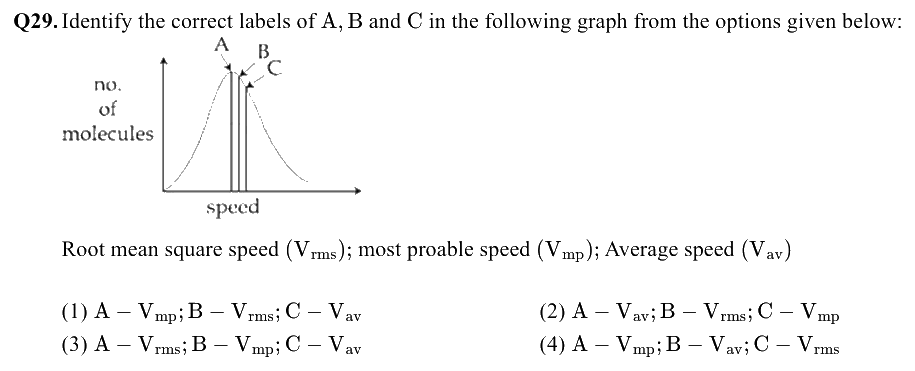
$\mathrm{A - V_{mp}; B - V_{rms}; C - V_{av}}$
$\mathrm{A - V_{av}; B - V_{rms}; C - V_{mp}}$
$\mathrm{A - V_{rms}; B - V_{mp}; C - V_{av}}$
$\mathrm{A - V_{mp}; B - V_{av}; C - V_{rms}}$
An element has a face-centered cubic fcc structure with a cell edge of a. The distance between the centres of two nearest tetrahedral voids in the lattice is
$\frac{a}{2}$
$\frac{3}{2}$a
a
$\sqrt{2}$a
The ratio of number of atoms present in a simple cubic, body centered cubic and face centered cubic structure are, respectively :
4 : 2 : 1
1 : 2 : 4
4 : 2 : 3
8 : 1 : 6
Consider the following table:
Gas | $a/\left(\mathrm{k\ Pa\ dm^{6}mol^{-1}}\right)$ | $b/\left(\mathrm{dm^{3}mol^{-1}}\right)$
A | 642.32 | 0.05196
B | 155.21 | 0.04136
Gas | $a/\left(\mathrm{k\ Pa\ dm^{6}mol^{-1}}\right)$ | $b/\left(\mathrm{dm^{3}mol^{-1}}\right)$
C | 431.91 | 0.05196
D | 155.21 | 0.4382
a and b are vander Waals constants. The correct statement about the gases is:
Gas C will occupy more volume than gas A ; gas B will be lesser compressible than gas D
Gas C will occupy lesser volume than gas A ; gas B will be lesser compressible than gas D
Gas C will occupy more volume than gas A ; gas B will be more compressible than gas D
Gas C will occupy lesser volume than gas A ; gas B will be more compressible than gas D
Points I, II and III in the following plot respectively correspond to ($V_{mp}$: most probable velocity)
(see the figure above)
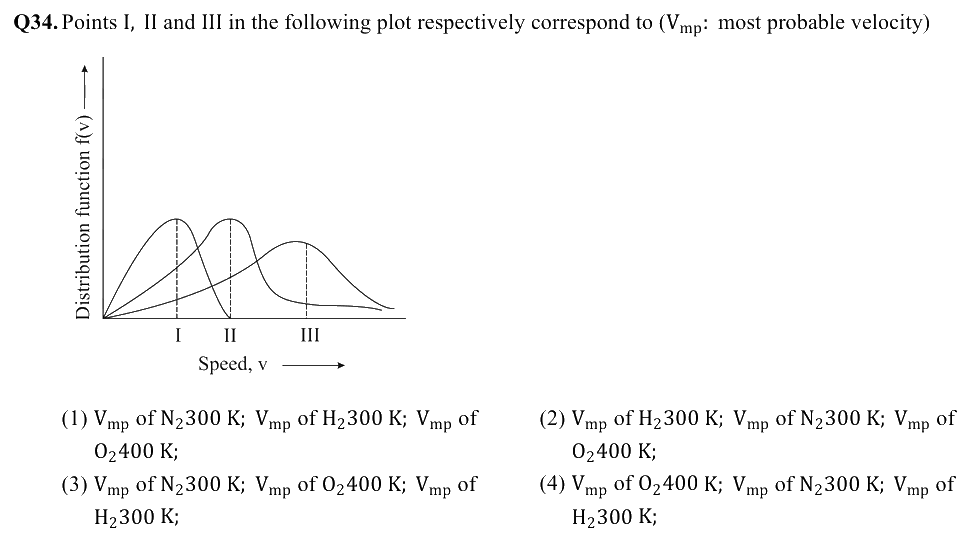
$V_{mp}$ of $\mathrm{N_2}$ 300 K; $V_{mp}$ of $\mathrm{H_2}$ 300 K; $V_{mp}$ of $\mathrm{O_2}$ 400 K;
$V_{mp}$ of $\mathrm{H_2}$ 300 K; $V_{mp}$ of $\mathrm{N_2}$ 300 K; $V_{mp}$ of $\mathrm{O_2}$ 400 K;
$V_{mp}$ of $\mathrm{N_2}$ 300 K; $V_{mp}$ of $\mathrm{O_2}$ 400 K; $V_{mp}$ of $\mathrm{H_2}$ 300 K;
$V_{mp}$ of $\mathrm{O_2}$ 400 K; $V_{mp}$ of $\mathrm{N_2}$ 300 K; $V_{mp}$ of $\mathrm{H_2}$ 300 K;
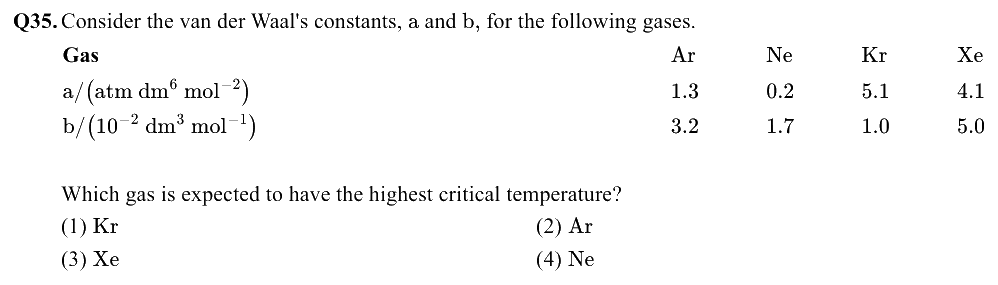
Consider the van der Waal's constants, a and b, for the following gases.
(see the figure above)
Which gas is expected to have the highest critical temperature?
Kr
Ar
Xe
Ne
At a given temperature T, gases Ne, Ar, Xe and Kr are found to deviate from ideal gas behaviour. Their equation of state is given as $\mathrm{p = \dfrac{RT}{V - b}}$ at T. Here, b is the van der Waals constant. Which gas will exhibit steepest increase in the plot of Z (compression factor) vs p?
Ne
Kr
Ar
Xe
Element B forms ccp structure and A occupies half of the octahedral voids, while oxygen atoms occupy all the tetrahedral voids. The structure of bimetallic oxide is:
$\mathrm{A_2BO_4}$
$\mathrm{AB_2O_4}$
$\mathrm{A_2B_2O}$
$\mathrm{A_4B_2O}$
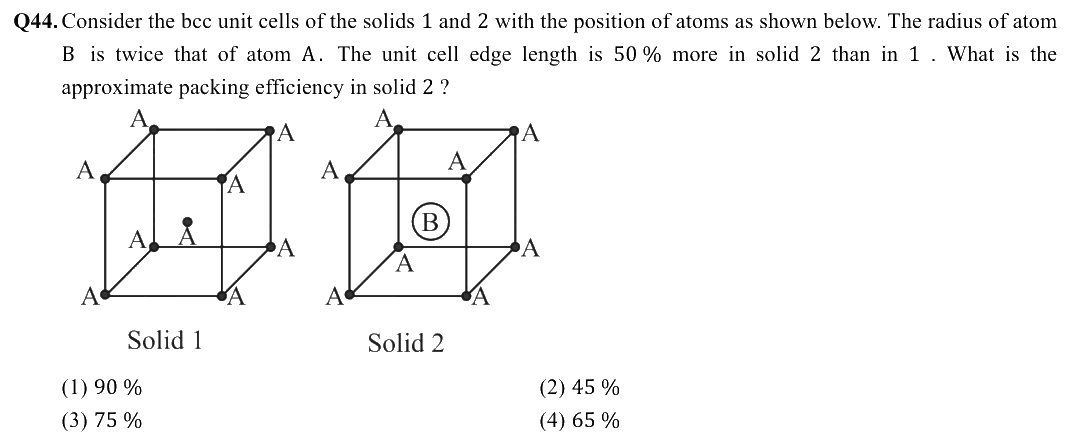
Consider the bcc unit cells of the solids 1 and 2 with the position of atoms as shown below. The radius of atom B is twice that of atom A. The unit cell edge length is 50 % more in solid 2 than in 1 . What is the approximate packing efficiency in solid 2 ?
(see the figure above)
90 %
45 %
75 %
65 %
The volume of gas A is twice than that of gas B. The compressibility factor of gas A is thrice than that of gas B at same temperature. What are the pressures of the gases for equal number of moles?
$2\mathrm{P_A} = 3\mathrm{P_B}$
$\mathrm{P_A} = 2\mathrm{P_B}$
$3\mathrm{P_A} = 2\mathrm{P_B}$
$\mathrm{P_A} = 3\mathrm{P_B}$
An open vessel at $27^oC$ is heated until two fifth of the air (assumed as an ideal gas) in it has escaped from the vessel. Assuming that the volume of the vessel remains constant, the temperature to which the vessel has heated is:
$750^oC$
$500^oC$
$750K$
$500K$
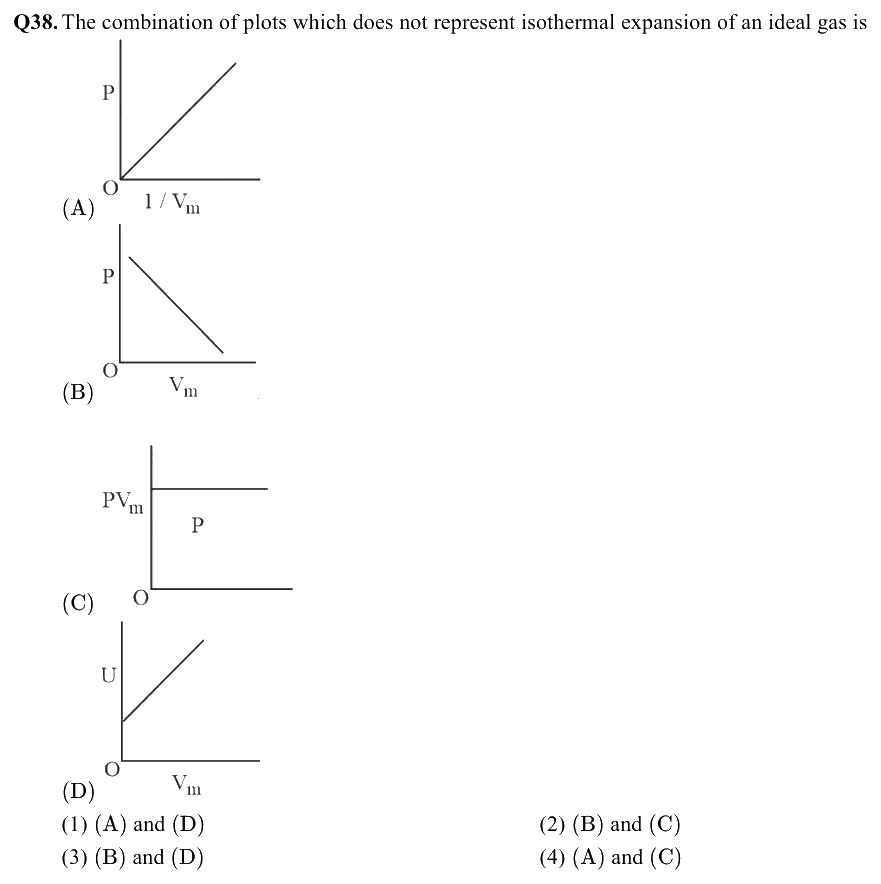
The combination of plots which does not represent isothermal expansion of an ideal gas is
(A) (see the figure above)
(B) (see the figure above)
(C) (see the figure above)
(D) (see the figure above)
(A) and (D)
(B) and (C)
(B) and (D)
(A) and (C)
A solid having density of $9 \times 10^3$ kg m$^{-3}$ forms face centred cubic crystals of edge length $200\sqrt{2}$pm. What is the molar mass of the solid? [Avogadro constant $\approx 6 \times 10^{23}$ mol$^{-1}$, $\pi \approx 3$]
0.0432 kg mol$^{-1}$
0.0216 kg mol$^{-1}$
0.0305 kg mol$^{-1}$
0.4320 kg mol$^{-1}$
The radius of the largest sphere which fits properly at the centre of the edge of a body centred cubic unit cell is : (Edge length is represented by 'a')
0.027 a
0.047 a
0.134a
0.067 a
Which primitive unit cell has unequal edge lengths $(a \neq b \neq c)$ and all axial angles different from $90^o$
Hexagonal
Monoclinic
Triclinic
Tetragonal
A compound of formula $\mathrm{A_2B_3}$ has the HCP lattice. Which atom forms the HCP lattice and what fraction of the tetrahedral voids are occupied by the other atoms?
HCP lattice - B, $\dfrac{2}{3}$ tetrahedral voids - A
HCP lattice - A, $\dfrac{1}{3}$ tetrahedral voids - B
HCP lattice - B, $\dfrac{1}{3}$ tetrahedral voids - A
HCP lattice - A, $\dfrac{2}{3}$ tetrahedral voids - B
$0.5$ moles of gas A and x moles of gas B exert a pressure of $200\ \mathrm{Pa}$ in a container of volume $10\ \mathrm{m^3}$ at $1000\ \mathrm{K}$ . Given, R is the gas constant in $\mathrm{JK^{-1}mol^{-1}}$, x is:
$\dfrac{4 + \mathrm{R}}{2\mathrm{R}}$
$\dfrac{2\mathrm{R}}{4 + \mathrm{R}}$
$\dfrac{4 - \mathrm{R}}{2\mathrm{R}}$
$\dfrac{2\mathrm{R}}{4 - \mathrm{R}}$
The one that is extensively used as a piezoelectric material is:
Tridymite
Quartz
Amorphous silica
Mica
At $100^oC$, copper $(Cu)$ has $FCC$ unit cell structure with cell edge length of $x\ \AA$ . What is the approximate density of $Cu$ (in $g\ cm^{-3}$ ) at this temperature?
$[\text{Atomic Mass of } Cu = 63.55\ u]$
$\dfrac{105}{x^3}$
$\dfrac{205}{x^3}$
$\dfrac{422}{x^3}$
$\dfrac{211}{x^3}$
Assuming ideal gas behavior, the ratio of density of ammonia to that of hydrogen chloride at same temperature and pressure is: (Atomic weight of Cl is 35.5 u)
$1.46$
$1.64$
$0.46$
$0.64$
Which of the following arrangements shows the schematic alignment of magnetic moments of antiferromagnetic substance?
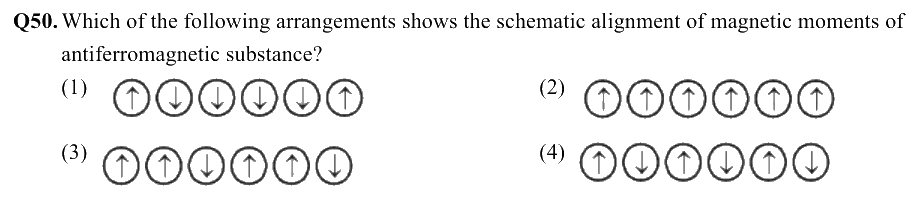
see figure six circled arrows: up, down, down, down, down, up
see figure six circled arrows: all up
see figure six circled arrows: up, up, down, up, up, down
see figure six circled arrows: up, down, up, down, up, down
All of the following share the same crystal structure except.
$\mathrm{RbCl}$
$\mathrm{NaCl}$
$\mathrm{CsCl}$
$\mathrm{LiCl}$
Which type of 'defect' has the presence of cations in the interstitial sites?
Metal deficiency defect
Schottky defect
Vacancy defect
Frenkel defect
At 300 K, the density of a certain gaseous molecule at 2 bar is double to that of dinitrogen ($\mathrm{N_2}$) at 4 bar. The molar mass of the gaseous molecule is
$224\ \mathrm{g\,mol^{-1}}$
$112\ \mathrm{g\,mol^{-1}}$
$56\ \mathrm{g\,mol^{-1}}$
$28\ \mathrm{g\,mol^{-1}}$
Among the following, the incorrect statement is:
at low pressure, real gases show ideal behaviour.
at very low temperature, real gases show ideal behaviour.
at Boyle's temperature, real gases show ideal behaviour.
at very large volume, real gases show ideal behaviour.
A metal crystallizes in a face centred cubic structure. If the edge length of its unit cell is 'a', the closest approach between two atoms in the metallic crystal will be
$2\sqrt{2}\,\mathrm{a}$
$\sqrt{2}\,\mathrm{a}$
$\frac{\mathrm{a}}{\sqrt{2}}$
$2\mathrm{a}$
Initially, the root-mean-square (RMS) velocity of $\mathrm{N_2}$ molecules at certain temperature is u. If this temperature is doubled and all the nitrogen molecules dissociate into nitrogen atoms, then the new RMS velocity will be:
$2\ \mathrm{u}$
$14\ \mathrm{u}$
$4\ \mathrm{u}$
$\mathrm{u}/2$
At very high pressures, the compressibility factor of one mole of a gas is given by:
$1 + \frac{\mathrm{Pb}}{\mathrm{RT}}$
$\frac{\mathrm{Pb}}{\mathrm{RT}}$
$1 - \frac{\mathrm{Pb}}{\mathrm{RT}}$
$1 - \frac{\mathrm{b}}{(\mathrm{VRT})}$
Two closed bulbs of equal volume (V) containing an ideal gas initially at pressure $p_i$ and temperature $T_1$ are connected through a narrow tube of negligible volume, as shown in the figure below. The temperature of one of the bulbs is then raised to $T_2$. The final pressure $P_f$ is:
(see the figure above)
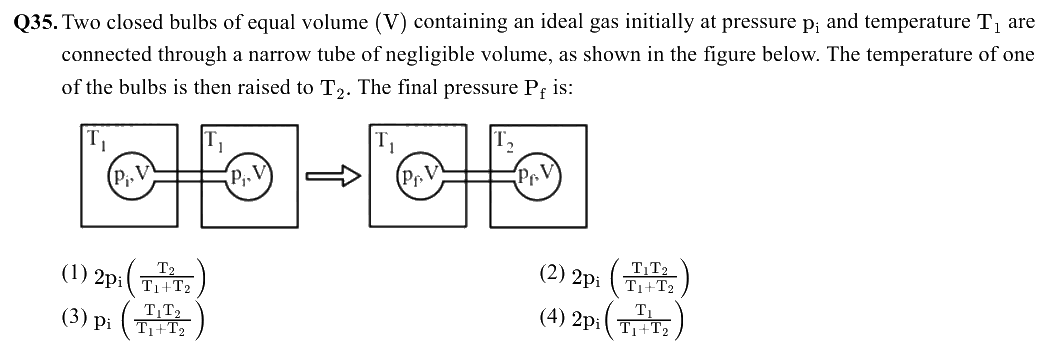
$2p_i\left(\frac{T_2}{T_1+T_2}\right)$
$2p_i\left(\frac{T_1T_2}{T_1+T_2}\right)$
$p_i\left(\frac{T_1T_2}{T_1+T_2}\right)$
$2p_i\left(\frac{T_1}{T_1+T_2}\right)$
When does a gas deviate the most from its ideal behavior?
At low pressure and high temperature
At high pressure and high temperature
At low pressure and low temperature
At high pressure and low temperature
Which of the following is not an assumption of the kinetic theory of gases?
Collisions of gas particles are perfectly elastic.
A gas consists of many identical particles which are in continual motion.
At high pressure, gas particles are difficult to compress.
Gas particles have negligible volume.
Sodium metal crystallizes in a body centred cubic lattice with a unit cell edge of $4.29\ \text{Å}$. The radius of sodium atom is approximately:
$0.93\ \text{Å}$
$1.86\ \text{Å}$
$3.22\ \text{Å}$
$5.72\ \text{Å}$
Sulphur dioxide and oxygen were allowed to diffuse through a porous partition. $20\ \mathrm{dm^3}$ of $\mathrm{SO_2}$ diffuses through the porous partition in 60 seconds. The volume of $\mathrm{O_2}$ in $\mathrm{dm^3}$ which diffuses under the similar condition in 30 seconds will be (atomic mass of sulphur$=$ $32\ \mathrm{u}$);
$28.2$
$10.0$
$14.1$
$7.09$
The total number of octahedral void (s) per atom present in a cubic close packed structure is :
$1$
$2$
$3$
$4$
Choose the correct statement with respect to the vapour pressure of a liquid among the following :
Increases non-linearly with increasing temperature
Decreases non-linearly with increasing temperature
Decreases linearly with increasing temperature
Increases linearly with increasing temperature
In a monoclinic unit cell, the relation of sides and angles are respectively:
$\mathrm{a} = \mathrm{b} \neq \mathrm{c}$ and $\alpha = \beta = \gamma = 90^{\circ}$
$\mathrm{a} \neq \mathrm{b} \neq \mathrm{c}$ and $\alpha = \beta = \gamma = 90^{\circ}$
$\mathrm{a} \neq \mathrm{b} \neq \mathrm{c}$ and $\beta = \gamma = 90^{\circ} \neq \alpha$
$\mathrm{a} \neq \mathrm{b} \neq \mathrm{c}$ and $\alpha \neq \beta \neq \gamma \neq 90^{\circ}$
The initial volume of a gas cylinder is $750.0\ \mathrm{mL}$. If the pressure of gas inside the cylinder changes from $840.0\ \mathrm{mmHg}$ to $360.0\ \mathrm{mmHg}$, the final volume the gas will be:
$1.750\ \mathrm{L}$
$3.60\ \mathrm{L}$
$4.032\ \mathrm{L}$
$7.50\ \mathrm{L}$
The appearance of colour in solid alkali metal halides is generally due to:
Schottky defect
Frenkel defect
Interstitial position
F-centres
The temperature at which oxygen molecules have the same root mean square speed as helium atoms have at 300 K is : (Atomic masses : He = 4 u, O = 16 u)
600 K
2400 K
1200 K
300 K
Van der Waal's equation for a gas is stated as,
$\mathrm{P} = \frac{\mathrm{nRT}}{\mathrm{V-nb}} - \mathrm{a}\left(\frac{\mathrm{n}}{\mathrm{V}}\right)^2$.
This equation reduces to the perfect gas equation, $\mathrm{P} = \frac{\mathrm{nRT}}{\mathrm{V}}$ When,
temperature is sufficiently high and pressure is low.
both temperature and pressure are very low.
both temperature and pressure are very high.
temperature is sufficiently low and pressure is high.
In a face centered cubic lattice atoms A are at the corner points and atoms B at the face centered points. If atom B is missing from one of the face centered points, the formula of the ionic compound is :
$\mathrm{A_2B_3}$
$\mathrm{AB_2}$
$\mathrm{A_5B_2}$
$\mathrm{A_2B_5}$
If Z is the compressibility factor, then Van der Waal's equation at low pressure can be written as:
$Z = 1 + \frac{RT}{Pb}$
$Z = 1 - \frac{a}{VRT}$
$Z = 1 - \frac{Pb}{RT}$
$Z = 1 + \frac{Pb}{RT}$
CsCl crystallises in body centred cubic lattice. If 'a' is its edge length then which of the following expressions is correct?
$\mathrm{r_{Cs^+} + r_{Cl^-}} = 3a$
$\mathrm{r_{Cs^+} + r_{Cl^-}} = \frac{3a}{2}$
$\mathrm{r_{Cs^+} + r_{Cl^-}} = \frac{\sqrt{3}}{2}$ a
$\mathrm{r_{Cs^+} + r_{Cl^-}} = \sqrt{3}$a
Which one of the following is the wrong assumption of kinetic theory of gases ?
Momentum and energy always remain conserved.
Pressure is the result of elastic collision of molecules with the container's wall.
Molecules are separated by great distances compared to their sizes.
All the molecules move in straight line between collision and with same velocity.
Copper crystallises in fcc with a unit length of 361 pm. What is the radius of copper atom ?
157 pm
128 pm
108 pm
181 pm
The correct order of viscosity of the following liquids will be :
Water < methyl alcohol < dimethyl ether < glycerol
methyl alcohol < glycerol < water < dimethyl ether
dimethyl ether < methyl alcohol < water < glycerol
glycerol < dimethyl ether < water < methyl alcohol
In a face centred cubic lattice, atoms of A form the corner points and atoms of B form the face centred points. If two atoms of A are missing from the corner points, the formula of the ionic compound is :
$\mathrm{AB_3}$
$\mathrm{AB_4}$
$\mathrm{A_2\ B_5}$
$\mathrm{AB_2}$
Which one of the following statements about packing in solids is incorrect ?
Coordination number in bcc mode of packing is 8
Coordination number in hep (sic) mode of packing is 12 .
Void space in hcp mode of packing is 32%.
Void space in ccp mode of packing is 26%.
By how many folds the temperature of a gas would increase when the root mean square velocity of the gas molecules in a container of fixed volume is increased from $5 \times 10^4$ cm/s to $10 \times 10^4$ cm/s ?
Two
Three
Six
Four
An element having an atomic radius of 0.14 nm crystallizes in an $f_{cc}$ unit cell. What is the length of a side of the cell ?
0.56 nm
0.24 nm
0.96 nm
0.4 nm
Experimentally it was found that a metal oxide has formula $\mathrm{M_{0.98}O}$. Metal M, is present as $\mathrm{M^{2+}}$ and $\mathrm{M^{3+}}$ in its oxide. Fraction of the metal which exists as $\mathrm{M^{3+}}$ would be:
6.05%
5.08%
7.01%
4.08%
For gaseous state, if most probable speed is denoted by $\mathrm{C^{*}}$, average speed by $\overline{\mathrm{C}}$ and root mean square speed by C, then for many molecules, what is the ratios of these speeds?
$\mathrm{C^{*}} : \overline{\mathrm{C}} : \mathrm{C} = 1 : 1.128 : 1.225$
$\mathrm{C^{*}} : \overline{\mathrm{C}} : \mathrm{C} = 1 : 1.225 : 1.128$
$\mathrm{C^{*}} : \overline{\mathrm{C}} : \mathrm{C} = 1.225 : 1.128 : 1$
$\mathrm{C^{*}} : \overline{\mathrm{C}} : \mathrm{C} = 1.128 : 1.225 : 1$
Which of the following exists as covalent crystals in the solid state ?
Sulphur
Phosphorus
Iodine
Silicon
The relationship among most probable velocity, average velocity and root mean square velocity is respectively
$\sqrt{2} : \sqrt{3} : \sqrt{8/\pi}$
$\sqrt{2} : \sqrt{8/\pi} : \sqrt{3}$
$\sqrt{8/\pi} : \sqrt{3} : \sqrt{2}$
$\sqrt{3} : \sqrt{8/\pi} : \sqrt{2}$
Among the following the incorrect statement is
Density of crystals remains unaffected due to Frenkel defect.
In BCC unit cell the void space is 32%.
Density of crystals decreases due to Schottky defect.
Electrical conductivity of semiconductors and metals increases with increase in temperature.
An open vessel at $300\ \mathrm{K}$ is heated till $2/5^{\text{th}}$ of the air in it is expelled. Assuming that the volume of the vessel remains constant, the temperature to which the vessel is heated, is
$1500\ \mathrm{K}$
$400\ \mathrm{K}$
$500\ \mathrm{K}$
$750\ \mathrm{K}$
Ammonium chloride crystallizes in a body centred cubic lattice with edge length of unit cell of $390\ \mathrm{pm}$. If the size of chloride ion is $180\mathrm{pm}$, the size of ammonium ion would be
$174\mathrm{pm}$
$158\mathrm{pm}$
$142\mathrm{pm}$
$126\mathrm{pm}$
$\alpha$, $v$ and $u$ represent most probable velocity, average velocity and root mean square velocity respectively of a gas at a particular temperature. The correct order among the following is
$u > v > \alpha$
$v > u > \alpha$
$\alpha > u > v$
$u > \alpha > v$
The radius of a calcium ion is 94pm and of the oxide ion is 146pm. The possible crystal structure of calcium oxide will be
tetrahedral
trigonal
octahedral
pyramidal
For 1 mol of an ideal gas at a constant temperature $T$, the plot of $(\log P)$ against $(\log V)$ is a ( $P$ : Pressure, $V$ : Volume)
Straight line parallel to $x$-axis.
Straight line with a negative slope.
Curve starting at origin.
Straight line passing through origin.
Among the following which is the best description of water in the solid phase?
Covalent solid
Molecular solid
Ionic solid
Network solid
A solid has a ' $bcc$ ' structure. If the distance of nearest approach between two atoms is $1.73\mathrm{\AA}$, the edge length of the cell is
314.20pm
1.41pm
200pm
216pm
The compressibility factor for a real gas at high pressure is :
$1 + \mathrm{RT/pb}$
$1$
$1 + \mathrm{pb/RT}$
$1 - \mathrm{pb/RT}$
Lithium forms body centred cubic structure. The length of the side of its unit cell is $351\mathrm{pm}$. Atomic radius of the lithium will be:
$75\ \mathrm{pm}$
$300\ \mathrm{pm}$
$240\ \mathrm{pm}$
$152\ \mathrm{pm}$
'a' and 'b' are van der Waals' constants for gases. Chlorine is more easily liquefied than ethane because
a and $b$ for $\mathrm{Cl_2}$ < a and b for $\mathrm{C_2H_6}$
a for $\mathrm{Cl_2}$ < a for $\mathrm{C_2H_6}$ but b for $\mathrm{Cl_2}$ > b for $\mathrm{C_2H_6}$
a for $\mathrm{Cl_2}$ > a for $\mathrm{C_2H_6}$ but $b$ for $\mathrm{Cl_2}$ < b for $\mathrm{C_2H_6}$
a and $b$ for $\mathrm{Cl_2}$ > $a$ and $b$ for $\mathrm{C_2H_6}$
In a face centred cubic lattice, atom A occupies the corner positions and atom B occupies the face centre positions. If one atom of $B$ is missing from one of the face centred points, the formula of the compound is
$\mathrm{AB_2}$
$\mathrm{A_2B_3}$
$\mathrm{A_2\ B_5}$
$\mathrm{A_2B}$
The edge length of a face centered cubic cell of an ionic substance is 508pm. If the radius of the cation is 110pm, the radius of the anion is
288pm
398pm
618pm
144pm
Percentage of free space in cubic close packed structure and in body centred packed structure are respectively
30% and 26%
26% and 32%
32% and 48%
48% and 26%
If $10^{-4}\mathrm{dm^3}$ of water is introduced into a $1.0\mathrm{dm^3}$ flask to 300 K, how many moles of water are in the vapour phase when equilibrium is established? (Given : Vapour pressure of $\mathrm{H_2O}$ at 300 K is 3170 Pa; $\mathrm{R} = 8.314\ \mathrm{J\,K^{-1}\,mol^{-1}}$ )
$5.56 \times 10^{-3}$ mol
$1.53 \times 10^{-2}$ mol
$4.46 \times 10^{-2}$ mol
$1.27 \times 10^{-3}$ mol
Copper crystallizes in fcc with a unit cell length of 361pm. What is the radius of copper atom ?
108pm
127pm
157 pm
181pm
In a compound atoms of element $Y$ from ccp lattice and those of element $X$ occupy $2/3^{\mathrm{rd}}$ of tetrahedral voids. The formula of the compound will be
$X_4Y_3$
$X_2Y_3$
$X_2Y$
$\mathrm{X_3Y_4}$
Equal masses of methane and oxygen are mixed in an empty container at $25^\circ$C. The fraction of the total pressure exerted by oxygen is
$\frac{2}{3}$
$\frac{1}{3} \times \frac{273}{298}$
$\frac{1}{3}$
$\frac{1}{2}$
Total volume of atoms present in a face-centre cubic unit cell of a metal is ( $r$ is atomic radius)
$\frac{20}{3}\pi r^3$
$\frac{24}{3}\pi r^3$
$\frac{12}{3}\pi r^3$
$\frac{16}{3}\pi r^3$
Which one of the following statements is NOT true about the effect of an increase in temperature on the distribution of molecular speeds in a gas?
The most probable speed increases
The fraction of the molecules with the most probable speed increases
The distribution becomes broader
The area under the distribution curve remains the same as under the lower temperature
An ionic compound has a unit cell consisting of A ions at the corners of a cube and B ions on the centres of the faces of the cube. The empirical formula for this compound would be
$\mathrm{A\,B}$
$\mathrm{A_2\,B}$
$\mathrm{A\,B_3}$
$\mathrm{A_3\,B}$
As the temperature is raised from $20^\circ\mathrm{C}$ to $40^\circ\mathrm{C}$, the average kinetic energy of neon atoms changes by a factor of which of the following?
$1/2$
2
$\frac{313}{293}$
$\sqrt{\frac{313}{293}}$
In Vander Waals equation of state of the gas law, the constant ' $b$ ' is a measure of
intermolecular repulsions
intermolecular collisions per unit volume
Volume occupied by the molecules
intermolecular attraction
What type of crystal defect is indicated in the diagram below? $\mathrm{Na^+\,Cl^-\,Na^+\,Cl^-\,Na^+\,Cl^-}$
$\mathrm{Cl^-}\,\square\,\mathrm{Cl^-}\,\square\,\mathrm{Na^+}\,\square\,\mathrm{Na^+}\ \ \mathrm{Na^+\,Cl^-}\,\square\,\mathrm{Cl^-\,Na^+\,Cl^-}\ \ \mathrm{Cl^-\,Na^+\,Cl^-\,Na^+}\,\square\,\mathrm{Na^+}$
(see the figure above)

Frenkel defect
Frenkel and Schottky defects
Interstitial defect
Schottky defect
According to the kinetic theory of gases, in an ideal gas, between two successive collisions a gas molecule travels
in a wavy path
in a straight line path
with an accelerated velocity
in a circular path
Glass is a
super-cooled liquid
gel
polymeric mixture
micro-crystalline solid
How many unit cells are present in a cubeshaped ideal crystal of NaCl of mass 1.00 g ? [Atomic masses: Na = 23, Cl = 35.5 ]
$5.14 \times 10^{21}$ unit cells
$1.28 \times 10^{21}$ unit cells
$1.71 \times 10^{21}$ unit cells
$2.57 \times 10^{21}$ unit cells
A pressure cooker reduces cooking time for food because
boiling point of water involved in cooking is increased
the higher pressure inside the cooker crushes the food material
cooking involves chemical changes helped by a rise in temperature
heat is more evenly distributed in the cooking space
For an ideal gas, number of moles per litre in terms of its pressure P, gas contant R and temperature T is
PT/R
PRT
P/RT
RT/P
Value of gas constant R is
0.082 litre atm
$0.987 \mathrm{cal\ mol^{-1}\ K^{-1}}$
$8.3 \mathrm{\ J\ mol^{-1}\ K^{-1}}$
$83 \mathrm{\ erg\ mol^{-1}\ K^{-1}}$
Kinetic theory of gases proves
only Boyle's law
only Charles' law
only Avogadro's law
all of these
Na and Mg crystallize in BCC and FCC type crystals respectively, then the number of atoms of Na and Mg present in the unit cell of their respective crystal is
4 and 2
9 and 14
14 and 9
2 and 4
A certain quantity of real gas occupies a volume of 0.15 dm$^{3}$ at 100 atm and 500 K when its compressibility factor is 1.07. Its volume at 300 atm and 300 K (When its compressibility factor is 1.4) is ______ $\times 10^{-4}$ dm$^{3}$ (Nearest integer)
Sodium metal crystallises in a body centred cubic lattice with unit cell edge length of 4 Å. The radius of sodium atom is ______ $\times 10^{-1}$ Å. (Nearest integer)
At 600 K, the root mean square (rms) speed of gas X (molar mass = 40) is equal to the most probable speed of gas Y at 90 K. The molar mass of the gas Y is ______ $\mathrm{g\ mol^{-1}}$. (Nearest integer)
An atomic substance A of molar mass $12\ \mathrm{g\ mol^{-1}}$ has a cubic crystal structure with edge length of 300 pm. The no. of atoms present in one unit cell of A is (Nearest integer)
Given the density of A is $3.0\ \mathrm{g\ m\ m^{-1}}$ and $N_A = 6.02 \times 10^{23}\ \mathrm{mol^{-1}}$
At constant temperature, a gas is at a pressure of $940.3$ mm Hg. The pressure at which its volume decreases by $40\%$ is ______ mm Hg. (Nearest integer)
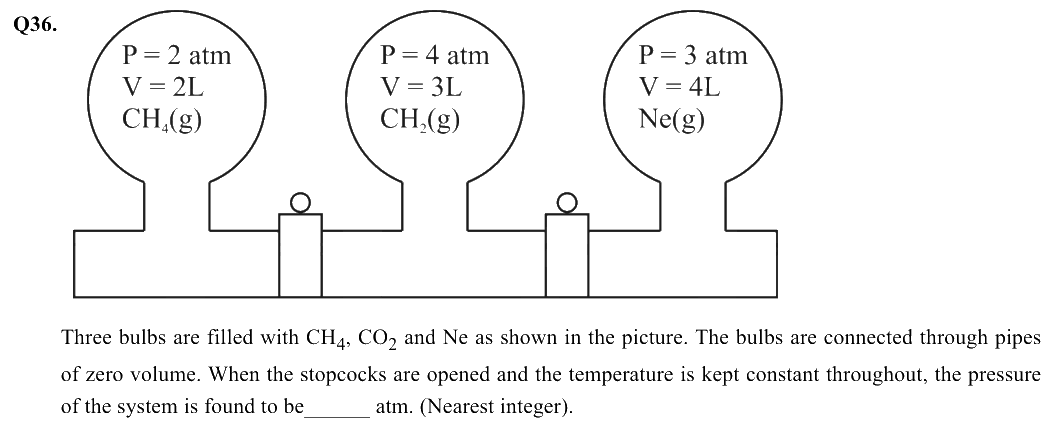
see figure Three bulbs are filled with $\mathrm{CH_4}$, $\mathrm{CO_2}$ and Ne as shown in the picture. The bulbs are connected through pipes of zero volume. When the stopcocks are opened and the temperature is kept constant throughout, the pressure of the system is found to be ______ atm. (Nearest integer).
Number of crystal systems from the following where body centred unit cell can be found, is ______ .
Cubic, tetragonal, orthorhombic, hexagonal, rhombohedral, monoclinic, triclinic
A metal M crystallizes into two lattices :- face centred cubic (fcc) and body centred cubic (bcc) with unit cell edge length of 2. 0 and 2. 5$\mathrm{\AA}$ respectively. The ratio of densities of lattices fcc to bcc for the metal M is ______ (Nearest integer)
The total pressure of a mixture of non-reacting gases X (0.6 $\mathrm{g}$) and Y (0.45 $\mathrm{g}$) in a vessel is 740 $\mathrm{mm}$ of Hg. The partial pressure of the gas X is ______ mm of Hg. (Nearest Integer)
(Given : molar mass X = 20 and Y = 45 $\mathrm{g\ mol^{-1}}$)
A sample of a metal oxide has formula $\mathrm{M_{0.83}O_{1.00}}$. The metal M can exist in two oxidation states +2 and +3. In the sample of $\mathrm{M_{0.83}O_{1.00}}$, the percentage of metal ions existing in +2 oxidation state is %. (nearest integer)
Iron oxide FeO, crystallises in a cubic lattice with a unit cell edge length of 5.0$\mathrm{\AA}$. If density of the FeO in the crystal is 4.0 g cm$^{-3}$, then the number of FeO units present per unit cell is ______ (Nearest integer)
Given : Molar mass of Fe and O is 56 and 16 g mol$^{-1}$ respectively.
$\mathrm{N_A}$ = 6.0 $\times$ $10^{23}$ mol$^{-1}$
A metal M forms hexagonal close-packed structure. The total number of voids in 0.02 mol of it is ______ $\times 10^{21}$ (Nearest integer)
(Given $\mathrm{N_A} = 6.02 \times 10^{23}$)
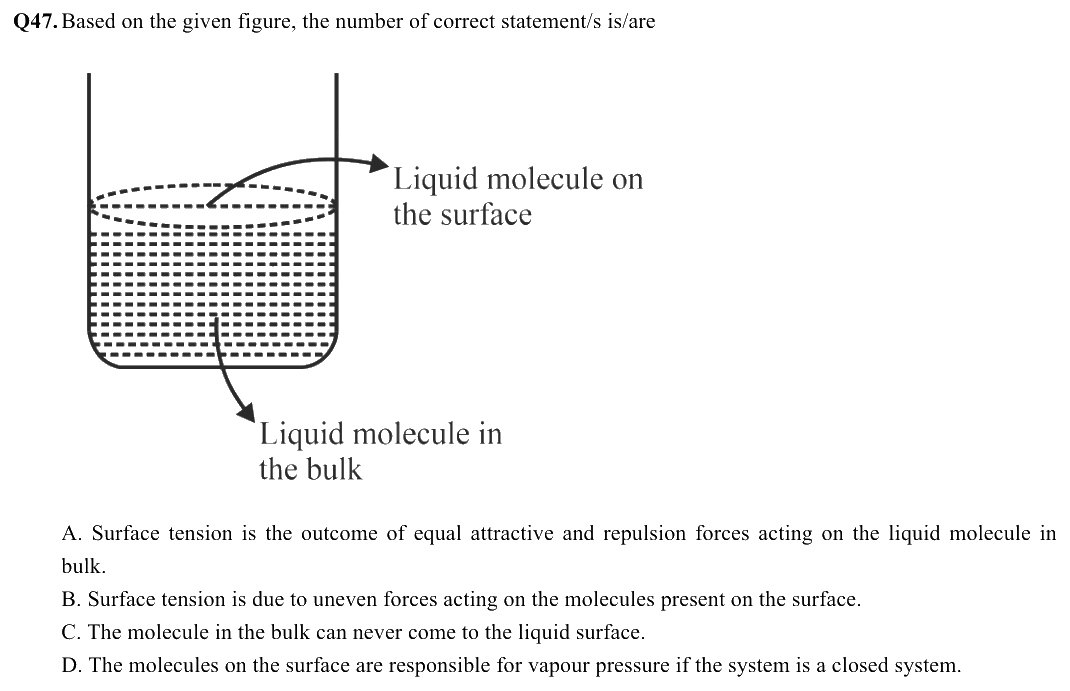
Based on the given figure, the number of correct statement/s is/are
(see the figure above)
A. Surface tension is the outcome of equal attractive and repulsion forces acting on the liquid molecule in bulk.
B. Surface tension is due to uneven forces acting on the molecules present on the surface.
C. The molecule in the bulk can never come to the liquid surface.
D. The molecules on the surface are responsible for vapour pressure if the system is a closed system.
When $\mathrm{Fe_{0.93}O}$ is heated in presence of oxygen, it converts to $\mathrm{Fe_2O_3}$. The number of correct statement/s from the following is ______.
A. The equivalent weight of $\mathrm{Fe_{0.93}O}$ is $\frac{\text{Molecular weight}}{0.79}$
B. The number of moles of $\mathrm{Fe^{2+}}$ and $\mathrm{Fe^{3+}}$ in 1 mole of $\mathrm{Fe_{0.93}O}$ is 0.79 and 0.14 respectively.
C. $\mathrm{Fe_{0.93}O}$ is metal deficient with lattice comprising of cubic closed packed arrangement of $\mathrm{O^{2-}}$ ions.
D. The % composition of $\mathrm{Fe^{2+}}$ and $\mathrm{Fe^{3+}}$ in $\mathrm{Fe_{0.93}O}$ is 85% and 15% respectively.
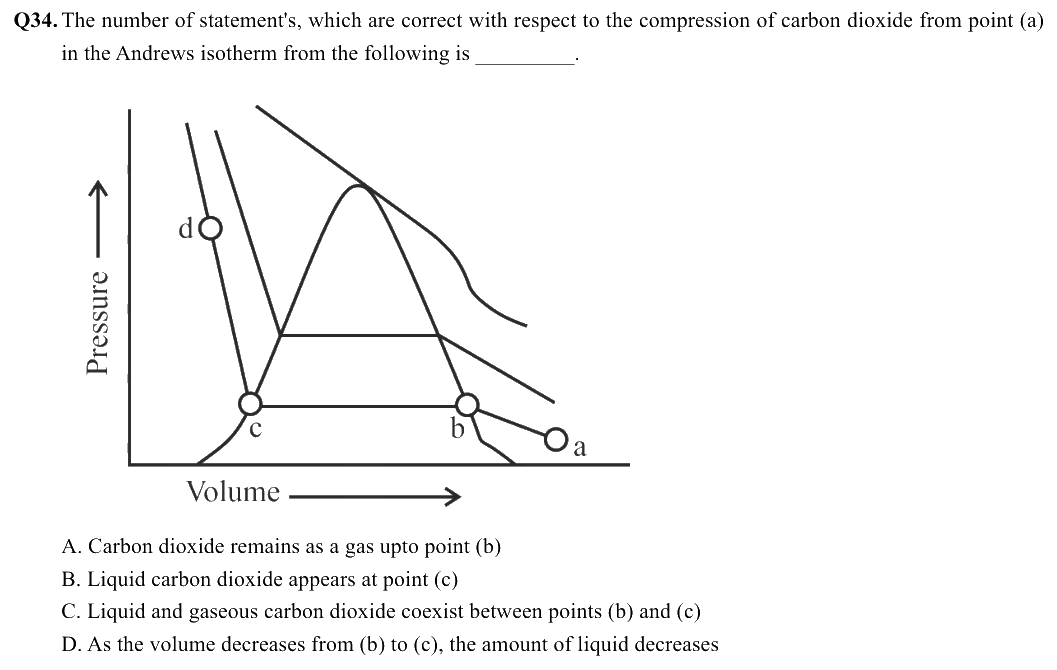
The number of statement's, which are correct with respect to the compression of carbon dioxide from point (a) in the Andrews isotherm from the following is ______.
(see the figure above)
A. Carbon dioxide remains as a gas upto point (b)
B. Liquid carbon dioxide appears at point (c)
C. Liquid and gaseous carbon dioxide coexist between points (b) and (c)
D. As the volume decreases from (b) to (c), the amount of liquid decreases
Ionic radii of cation $\mathrm{A^+}$ and anion $\mathrm{B^-}$ are 102 and 181 pm respectively. These ions are allowed to crystallize into an ionic solid. This crystal has cubic close packing for $\mathrm{B^-}$. $\mathrm{A^+}$ is present in all octahedral voids. The edge length of the unit cell of the crystal AB is ______ pm.
'x' g of molecular oxygen $\mathrm{O_2}$ is mixed with 200 g of neon Ne. The total pressure of the nonreactive mixture of $\mathrm{O_2}$ and Ne in the cylinder is 25 bar. The partial pressure of Ne is 20 bar at the same temperature and volume. The value of 'x' is
[Given: Molar mass of $\mathrm{O_2}$ = 32 $\mathrm{g\ mol^{-1}}$. Molar mass of Ne = 20 $\mathrm{g\ mol^{-1}}$]
An element M crystallises in a body centred cubic unit cell with a cell edge of $300\mathrm{pm}$. The density of the element is $6.0\ \mathrm{g\ cm^{-3}}$. The number of atoms present in $180\ \mathrm{g}$ of the element is ______ $\times10^{23}$. (Nearest integer)
Metal M crystallizes into a FCC lattice with the edge length of $4.0\times10^{-8}\ \mathrm{cm}$. The atomic mass of the metal is g/ mol.
(Use : $\mathrm{N_A}=6.02\times10^{23}\ \mathrm{mol^{-1}}$, density of metal, $\mathrm{M}=9.03\ \mathrm{g\ cm^{-3}}$)
for a real gas at 25 $^\circ$C temperature and high pressure (99 bar) the value of compressibility factor is 2, so the value of Van 1der Waal's constant 'b' should be ______ $\times 10^{-2}$ L $\mathrm{mol^{-1}}$ (Given R = 0.083 L bar $\mathrm{K^{-1}}$ $\mathrm{mol^{-1}}$)
A mixture of hydrogen and oxygen contains 40% hydrogen by mass when the pressure is 2.2 bar. The partial pressure of hydrogen is bar.
A 10 g mixture of hydrogen and helium is contained in a vessel of capacity $0.0125\ \mathrm{m^3}$ at 6 bar and $27\ ^\circ$C. The mass of helium in the mixture is ______ g.
(Given : R = $8.3\mathrm{JK^{-1}\ mol^{-1}}$ (Atomic masses of H and He are 1u and 4u, respectively)
The pressure of a moist gas at $27^\circ$C is 4 atm. The volume of the container is doubled at the same temperature. The new pressure of the moist gas is ______ $\times\,10^{-1}$ atm. (Nearest integer)
(Given: The vapour pressure of water at $27^\circ$C is $0.4$ atm)
A sealed flask with a capacity of $2\ \mathrm{dm^3}$ contains 11 g of propane gas. The flask is so weak that it will burst if the pressure becomes 2 MPa. The minimum temperature at which the flask will burst is $^\circ$C. [Nearest integer]
(Given: $\mathrm{R} = 8.3\ \mathrm{J\,K^{-1}\,mol^{-1}}$. Atomic masses of C and H are 12u and 1u respectively.) (Assume that propane behaves as an ideal gas.)
Geraniol, a volatile organic compound, is a component of rose oil. The density of the vapour is $0.46\ \mathrm{g\,L^{-1}}$ at $257\ ^\circ\mathrm{C}$ and $100\ \mathrm{mmHg}$. The molar mass of geraniol is (Nearest Integer)
[Given R $= 0.082\ \mathrm{L\ atm\ K^{-1}\ mol^{-1}}$]
A box contains $0.90\ \mathrm{g}$ of liquid water in equilibrium with water vapour at $27^\circ\mathrm{C}$. The equilibrium vapour pressure of water at $27^\circ\mathrm{C}$ $32.0$ Torr. When the volume of the box is increased, some of the liquid water evaporates to maintain the equilibrium pressure. If all the liquid water evaporates, then the volume of the box must be ______ litre. [nearest integer]
(Given: $\mathrm{R} = 0.082\ \mathrm{L\ atm\ K^{-1}\ mol^{-1}}$)
(Ignore the volume of the liquid water and assume water vapours behave as an ideal gas.)
100 g of an ideal gas is kept in a cylinder of 416 L volume at $27\ ^{\circ}\mathrm{C}$ under 1.5 bar pressure. The molar mass of the gas is $\mathrm{g\ mol^{-1}}$. (Nearest integer)
(Given : R = 0.083 L bar $\mathrm{K^{-1}\ mol^{-1}}$)
Metal deficiency defect is shown by $\mathrm{Fe_{0.93}\,O}$. In the crystal, some $\mathrm{Fe^{2+}}$ cations are missing and loss of positive charge is compensated by the presence of $\mathrm{Fe^{3+}}$ ions. The percentage of $\mathrm{Fe^{2+}}$ ions in the$\mathrm{Fe_{0.93}\,O}$ crystals is ______ (Nearest integer)
In a solid AB, A atoms are in ccp arrangement and B atoms occupy all the octahedral sites. If two atoms from the opposite faces are removed, then the resultant stoichiometry of the compound is $\mathrm{A}_x\mathrm{B}_y$. The value of x is [nearest integer]
The distance between $\mathrm{Na}^+$ and $\mathrm{Cl}^-$ ions in solid NaCl of density $43.1 \mathrm{~g} \mathrm{~cm}^{-3}$ is ______ $\times 10^{-10} \mathrm{~m}$. (Nearest Integer)
(Given : $\mathrm{N}_\mathrm{A} = 6.02 \times 10^{23} \mathrm{~mol}^{-1}$)
A rigid nitrogen tank stored inside a laboratory has a pressure of $30 \mathrm{~atm}$ at $06:00 \mathrm{~am}$ when the temperature is $27\ ^\circ\mathrm{C}$. At $03:00 \mathrm{pm}$, when the temperature is $45\ ^\circ\mathrm{C}$, the pressure in the tank will be ______ atm. [nearest integer]
Atoms of element X form hcp lattice and those of element Y occupy $\frac{2}{3}$ of its tetrahedral voids. The percentage of element X in the lattice is (Nearest integer)
At $300 \mathrm{~K}$, a sample of $3.0 \mathrm{~g}$ of gas A occupies the same volume as $0.2 \mathrm{~g}$ of hydrogen at $200 \mathrm{~K}$ at the same pressure. The molar mass of gas A is g $\mathrm{mol^{-1}}$. (nearest integer) Assume that the behaviour of gases as ideal. (Given: The molar mass of hydrogen $(\mathrm{H_2})$ gas is $2.0 \mathrm{~g~mol^{-1}}$.)
An empty LPG cylinder weighs $14.8$ kg. When full, it weighs $29.0$ kg and shows a pressure of $3.47$ atm. In the course of use at ambient temperature, the mass of the cylinder is reduced to $23.0$ kg. The final pressure inside the cylinder is ______ atm. (Nearest integer)
(Assume LPG to be an ideal gas)
The empirical formula for a compound with a cubic close packed arrangement of anions and with cations occupying all the octahedral sites in $\mathrm{A_x\ B}$. The value of x is (Integer answer)
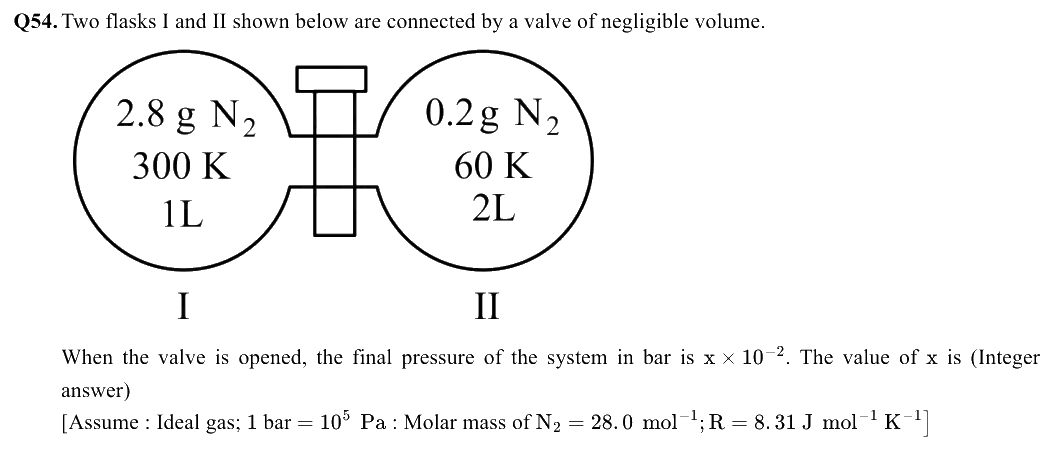
Two flasks I and II shown below are connected by a valve of negligible volume.
(see the figure above)
When the valve is opened, the final pressure of the system in bar is $\mathrm{x}\times10^{-2}$. The value of x is (Integer answer)
[Assume : Ideal gas; $1\ \mathrm{bar}=10^{5}\ \mathrm{Pa}$ : Molar mass of $\mathrm{N_2}=28.0\ \mathrm{mol^{-1}}$; $\mathrm{R}=8.31\ \mathrm{J\ mol^{-1}\ K^{-1}}$]
A home owner uses $4.00 \times 10^{3}\ \mathrm{m^3}$ of methane $\mathrm{CH_4}$ gas, (assume $\mathrm{CH_4}$ is an ideal gas) in a year to heat his home. Under the pressure of $1.0\ \mathrm{atm}$ and $300\ \mathrm{K}$, mass of gas used is $\mathrm{x} \times 10^{5}\ \mathrm{g}$. The value of x is ______. (Nearest integer)
(Given R = $0.083\ \mathrm{L\ atm\ K^{-1}\ mol^{-1}}$)
An LPG cylinder contains gas at a pressure of $300\ \mathrm{kPa}$ at $27^\circ\mathrm{C}$. The cylinder can withstand the pressure of $1.2 \times 10^6\ \mathrm{Pa}$. The room in which the cylinder is kept catches fire. The minimum temperature at which the bursting of cylinder will take place is ______ $^\circ\mathrm{C}$. (Nearest integer)
A copper complex crystallising in a CCP lattice with a cell edge of $0.4518\ \mathrm{nm}$ has been revealed by employing X-ray diffraction studies. The density of a copper complex is found to be $7.62\ \mathrm{g\ cm^{-3}}$. The molar mass of copper complex is ______ $\mathrm{gmol^{-1}}$
(Nearest integer): [ Given : $\mathrm{N_A} = 6.022 \times 10^{23}\ \mathrm{mol^{-1}}$]
Diamond has a three dimensional structure of C atoms formed by covalent bonds. The structure of diamond has face centred cubic lattice where 50% of the tetrahedral voids are also occupied by carbon atoms. The number of carbon atoms present per unit cell of diamond is ______ .
The pressure exerted by a non-reactive gaseous mixture of 6.4 g of methane and 8.8 g of carbon dioxide in a 10 L vessel at $27^{\circ} \mathrm{C}$ is ______ kPa. (Round off to the Nearest Integer).
[Assume gases are ideal, $\mathrm{R}=8.314 \mathrm{~J} \mathrm{~mol}^{-1} \mathrm{~K}^{-1}$ Atomic masses: C : 12.0 u, H : 1.0 u, O : 16.0 u]
KBr is doped with $10^{-5}$ mole percent of $\mathrm{SrBr}_2$ The number of cationic vacancies in 1 g of KBr crystal is $10^{14}$ . (Round off to the Nearest Integer). [Atomic Mass : $\mathrm{K}=39.1 \mathrm{u}, \mathrm{Br}=79.9 \mathrm{u}, \mathrm{N}_{\mathrm{A}}=6.023 \times 10^{23}$]
A certain element crystallises in a bcc lattice of unit cell edge length $27 \mathrm{~\AA}$. If the same element under the same conditions crystallises in the fcc lattice, the edge length of the unit cell in $\mathrm{\AA}$ will be ______. (Round off to the Nearest Integer).
[Assume each lattice point has a single atom]
[Assume $\sqrt{3}=1.73, \sqrt{2}=1.41$]
Ga (atomic mass 70 u) crystallizes in a hexagonal close packed structure. The total number of voids in $0.581\ \mathrm{g}$ of Ga is ______ $\times 10^{21}$. (Round off to the Nearest Integer).
A certain gas obeys $\mathrm{P(V_m - b) = RT}$. The value of $\left(\frac{\partial Z}{\partial P}\right)_T$ is $\frac{xb}{RT}$. The value of x is ______ (Integer answer) (Z : compressibility factor)
The number of octahedral voids per lattice site in a lattice is ______. (Rounded off to the nearest integer)
A car tyre is filled with nitrogen gas at $35$ psi at $27\ ^\circ\mathrm{C}$. It will burst if pressure exceeds $40$ psi. The temperature in $^\circ\mathrm{C}$ at which the car tyre will burst is (Rounded-off to the nearest integer)
The unit cell of copper corresponds to a face centered cube of edge length $3.596\ \mathrm{\AA}$ with one copper atom at each lattice point. The calculated density of copper in $\mathrm{kg\,/m^3}$ is ______. [Molar mass of Cu : $63.54\ \mathrm{g}$; Avogadro Number = $6.022 \times 10^{23}$ J]
The coordination number of an atom in a body-centered cubic structure is ______. [Assume that the lattice is made up of atoms.]
The volume occupied by $4.75\ \mathrm{g}$ of acetylene gas at $50^\circ\mathrm{C}$ and $740\ \mathrm{mm\ Hg}$ pressure is ______ L.
(Rounded off to the nearest integer)
[Given $\mathrm{R} = 0.0826\ \mathrm{L\ atm\ K^{-1}\ mol^{-1}}$]
A spherical balloon of radius $3\ \mathrm{cm}$ containing helium gas has a pressure of $48 \times 10^{-3}$ bar. At the same temperature, the pressure, of a spherical balloon of radius$12\ \mathrm{cm}$ containing the same amount of gas will be ______ $\times 10^{-6}$ bar.
An element with molar mass $2.7\times 10^{-2}\ \mathrm{kg\ mol^{-1}}$ forms a cubic unit cell with edge length $405\ \mathrm{pm}$. If its density is $2.7\times 10^{3}\ \mathrm{kg\ m^{-3}}$, the radius of the element is approximately ______ $\times 10^{-12}\mathrm{m}$ (to the nearest integer).
States of matter was formerly in the Class 11 chemistry curriculum before being removed in 2024, holding rank 22 among 31 chemistry chapters with a 2.2 percent share of total chemistry questions. Throughout the computerized testing period from 2019 to 2026, candidates tackled 102 questions across 162 papers, giving an average frequency of 0.6 questions per shift. The chapter featured in 98 of those 162 papers. Because it was removed from the official syllabus in 2024, testing declined sharply: only 1 question appeared across 58 papers in the 2024 to 2026 stretch, representing a 0.1 percent share and registering zero questions in 2025 and 2026. The chapter's share is down compared to both the 5.0 percent share in the 2002 to 2018 window and the 2.2 percent share across 2019 to 2026. Between 2019 and 2026, 52 questions were set in numerical answer format, reflecting heavy historical testing on unit cell densities, void numbers, and partial gas pressures.
Questions in this chapter divide across three physical states:
Past examination questions from this chapter featured structured crystal geometry and equation-of-state calculations:
Review these representative past exam questions:
Because states of matter has been removed from the JEE Main syllabus, aspirants should not devote core preparation time to this chapter.
If preparing for other competitive examinations that still include gaseous state or solid state, focus on unit cell density calculations using edge length a and formula units Z. Understand that face-centered cubic lattices contain four formula units with octahedral and tetrahedral voids in one-to-two ratios.
For real gases, practice evaluating van der Waals equations at low pressures where intermolecular attractions dominate and compressibility factor Z is less than one, and at very high pressures where molecular volume dominates and Z exceeds one.
No, states of matter was removed from the syllabus in 2024, recording only 1 question across all 58 papers between 2024 and 2026, and zero questions in 2025 and 2026.
Solid state was an independent, major chapter in senior secondary chemistry before recent syllabus rationalizations merged and subsequently removed these topics from the JEE Main syllabus.
Yes, ideal gas equations, molecular speeds, and kinetic energy distributions remain fully active in the physics syllabus under kinetic theory of gases, even though removed from the chemistry section. Step-by-step solutions for each one are in the EdLoop app.