Every Electrochemistry question from past JEE Main and AIEEE papers, with options and answers. Newest first.
228questions
180papers covered
3.7%of Chemistry questions, 2019–2026
2002–2026years
Guide at a glance
Electrochemistry explores galvanic cells and electrolytic conductance under Unit 7: Redox Reactions and Electrochemistry in the Class 12 chemistry syllabus, holding rank 13 among all 31 chemistry chapters with a 3.7 percent share of total chemistry questions.
$\mathrm{BaSO_4}$ is sparingly soluble in water. If the conductivity of the saturated $\mathrm{BaSO_4}$ solution is $x$ S cm$^{-1}$ then the solubility product of $\mathrm{BaSO_4}$ can be given as (Here $\Lambda_m = \Lambda^\circ_m$)
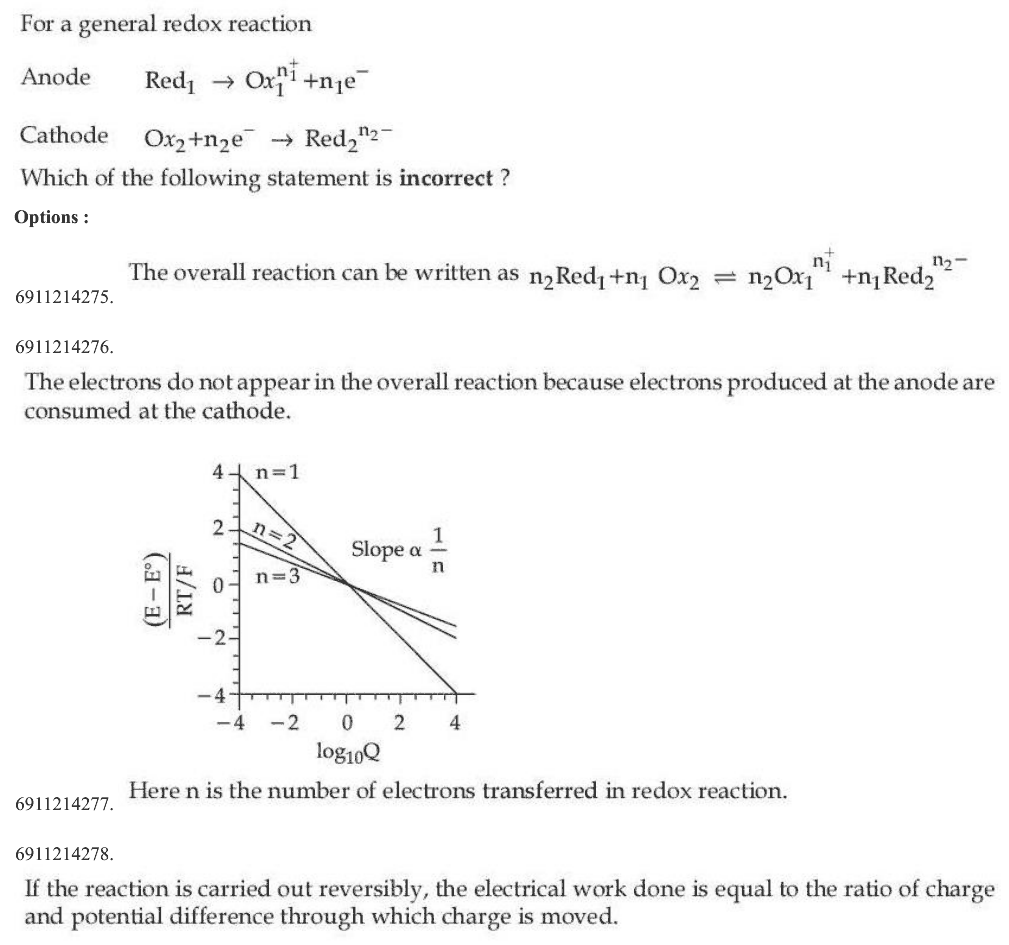
The overall reaction can be written as $n_2\mathrm{Red_1} + n_1\,\mathrm{Ox_2} \rightleftharpoons n_2\mathrm{Ox_1^{n_1+}} + n_1\mathrm{Red_2^{n_2-}}$
B
The electrons do not appear in the overall reaction because electrons produced at the anode are consumed at the cathode.
C
see figure Here n is the number of electrons transferred in redox reaction.
D
If the reaction is carried out reversibly, the electrical work done is equal to the ratio of charge and potential difference through which charge is moved.
Answer: (D) If the reaction is carried out reversibly, the electrical work done is equal to the ratio of charge and potential difference through which charge is moved.· Official NTA final key
One half cell in a voltaic cell is constructed by dipping silver rod in $\mathrm{AgNO_3}$ solution of unknown concentration, other half cell is Zn rod dipped in 1 molar solution of $\mathrm{ZnSO_4}$.
A voltage of 1.60 V is measured at 298 K for this cell. What is the concentration of $\mathrm{Ag^+}$ ions used in terms of $\log x$ ($x = [\mathrm{Ag^+}]$) ?
In the given electrochemical cell, Ag(s) | AgCl(s) | $\mathrm{FeCl_2}$(aq), $\mathrm{FeCl_3}$(aq) | Pt(s) at 298 K, the cell potential ($\mathrm{E_{cell}}$) will increase when :
A. Concentration of $\mathrm{Fe^{2+}}$ is increased.
B. Concentration of $\mathrm{Fe^{3+}}$ is decreased.
C. Concentration of $\mathrm{Fe^{2+}}$ is decreased.
D. Concentration of $\mathrm{Fe^{3+}}$ is increased.
E. Concentration of $\mathrm{Cl^-}$ is increased.
Choose the correct answer from the options given below :
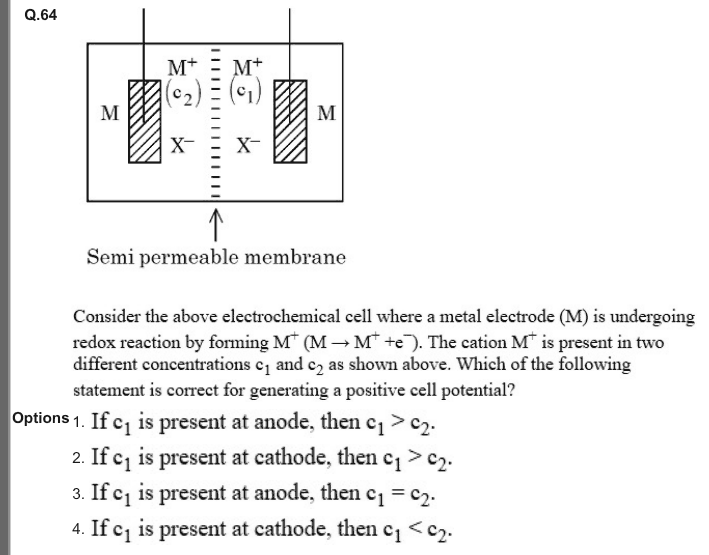
see figure Consider the above electrochemical cell where a metal electrode (M) is undergoing redox reaction by forming $\mathrm{M^+}$ ($\mathrm{M} \rightarrow \mathrm{M^+} + e^-$). The cation $\mathrm{M^+}$ is present in two different concentrations $\mathrm{c_1}$ and $\mathrm{c_2}$ as shown above. Which of the following statement is correct for generating a positive cell potential?
The question as printed in the paper.
A
If $\mathrm{c_1}$ is present at anode, then $\mathrm{c_1} > \mathrm{c_2}$.
B
If $\mathrm{c_1}$ is present at cathode, then $\mathrm{c_1} > \mathrm{c_2}$.
C
If $\mathrm{c_1}$ is present at anode, then $\mathrm{c_1} = \mathrm{c_2}$.
D
If $\mathrm{c_1}$ is present at cathode, then $\mathrm{c_1} < \mathrm{c_2}$.
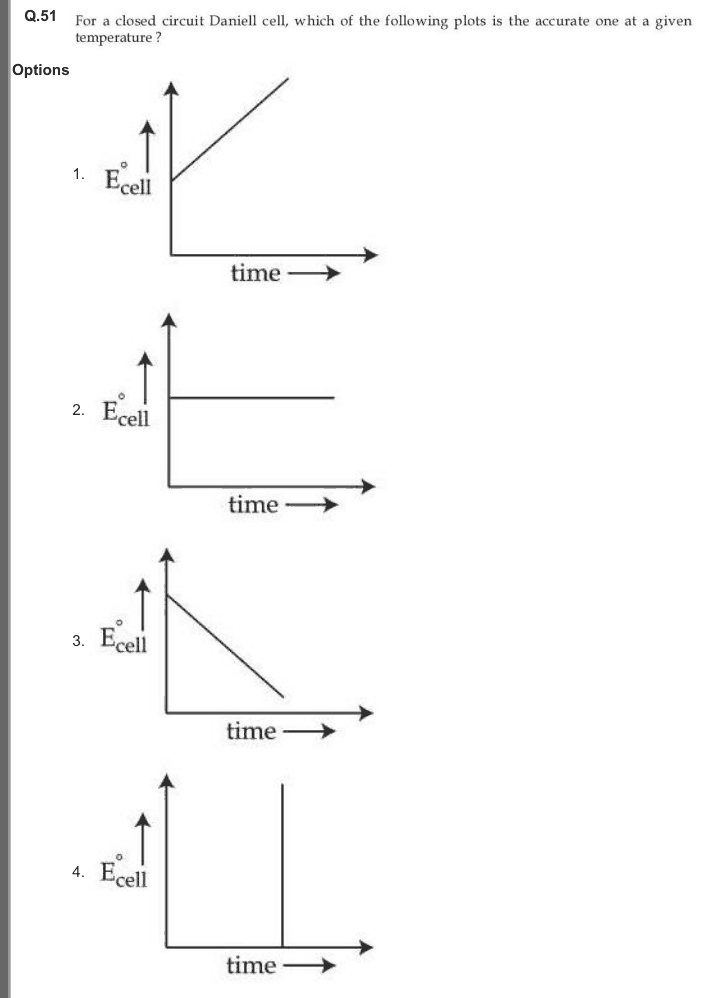
For a closed circuit Daniell cell, which of the following plots is the accurate one at a given temperature ?
The question as printed in the paper.
A
see figure axes with vertical label 'E°cell' (a degree sign above the E) and horizontal label 'time →'; a straight line starting on the vertical axis part-way up (about one third of the way up the axis, well above the time axis) and rising steadily to the upper right, ending near the top of the graph.
B
see figure same axes; a horizontal straight line at constant height, about halfway up the vertical axis, starting at the vertical axis and ending before the end of the time axis.
C
see figure same axes; a straight line starting high on the vertical axis (near its top) and falling steadily to the lower right, ending just above the time axis.
D
see figure same axes; no line from the vertical axis; a single vertical line standing on the time axis at a point well to the right of the origin and rising from the time axis to about the full height of the graph.
Statement I: Mohr's salt is composed of only three types of ions-ferrous, ammonium and sulfate.
Statement II: If the molar conductance at infinite dilution for ferrous, ammonium and sulfate ions are $x_1, x_2$ and $x_3 Scm^2mol^{-1}$, respectively then the molar conductance for Mohr's salt solution at infinite dilution would be given by $x_1 + x_2 + 2x_3$
In the light of the given statements, choose the correct answer from the options given below:
1 M aqueous solutions of each of $Cu(NO_3)_2, AgNO_3, Hg_2(NO_3)_2; Mg(NO_3)_2$ are electrolysed using inert electrodes. Given : $E^\theta_{Ag^+/Ag} = 0.80V, E^\theta_{Hg_2^{2+}/Hg} = 0.79V, E^\theta_{Cu^{2+}/Cu} = 0.24V$ and $E^\theta_{Mg^{2+}/Mg} = -2.37V$.
Statement (I): With increasing voltage, the sequence of deposition of metals on the cathode will be Ag, Hg and Cu .
Statement (II) : Magnesium will not be deposited at cathode instead oxygen gas will be evolved at the cathode.
In the light of the above statements, choose the most appropriate answer from the options given below :
A
Both Statement I and Statement II are correct
B
Statement I is incorrect but Statement II is correct
C
Statement I is correct but Statement II is incorrect
On charging the lead storage battery, the oxidation state of lead changes from $x_1$ to $y_1$ at the anode and from $x_2$ to $y_2$ at the cathode. The values of $x_1, y_1, x_2, y_2$ are respectively :
The standard cell potential ( $E^\ominus_{cell}$ ) of a fuel cell based on the oxidation of methanol in air that has been used to power television relay station is measured as 1.21 V . The standard half cell reduction potential for $O_2$, $\left(E^\circ_{O_2/H_2O}\right)$ is 1.229 V .
Choose the correct statement:
A
Oxygen is formed at the anode.
B
The standard half cell reduction potential for the reduction of $CO_2$, $\left(E^\circ_{CO_2/CH_3OH}\right)$ is 19 mV
Answer: (B) The standard half cell reduction potential for the reduction of $CO_2$, $\left(E^\circ_{CO_2/CH_3OH}\right)$ is 19 mV· Key from source paper
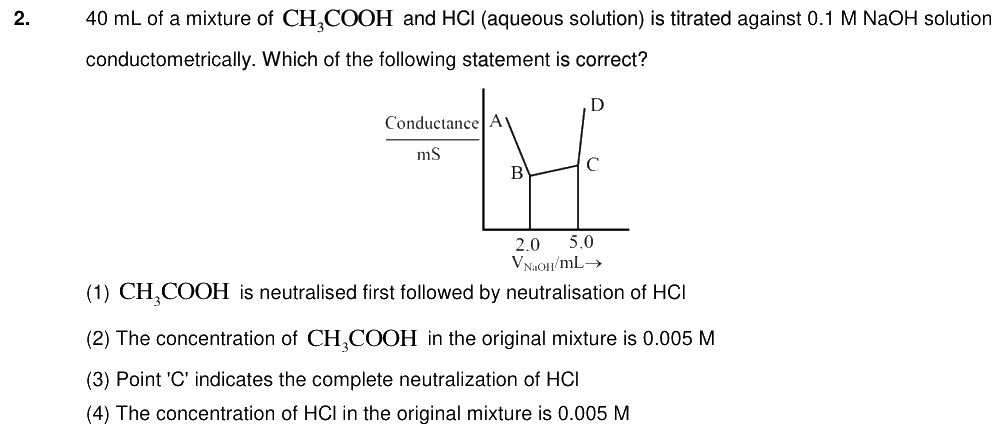
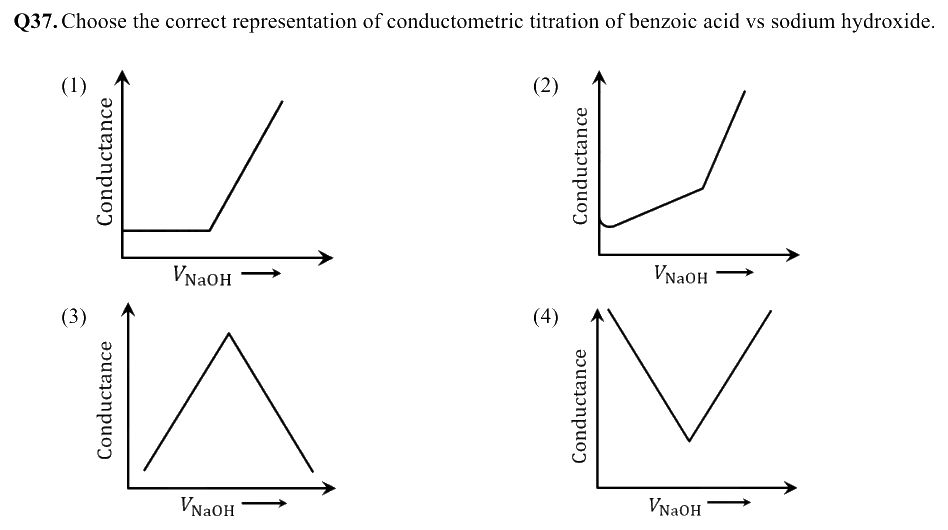
40 mL of a mixture of $CH_3COOH$ and HCl (aqueous solution) is titrated against 0.1 M NaOH solution conductometrically. Which of the following statement is correct?
(see the figure above)
The question as printed in the paper.
A
$CH_3COOH$ is neutralised first followed by neutralisation of HCl
B
The concentration of $CH_3COOH$ in the original mixture is 0.005 M
C
Point 'C' indicates the complete neutralization of HCl
D
The concentration of HCl in the original mixture is 0.005 M
The molar conductivity of a weak electrolyte when plotted against the square root of its concentration, which of the following is expected to be observed ?
A
A small decrease in molar conductivity is observed at infinite dilution.
B
Molar conductivity decreases sharply with increase in concentration.
C
A small increase in molar conductivity is observed at infinite dilution.
D
Molar conductivity increases sharply with increase in concentration.
$\mathrm{O_2}$ gas will be evolved as a product of electrolysis of : (A) an aqueous solution of $\mathrm{AgNO_3}$ using silver electrodes. (B) an aqueous solution of $\mathrm{AgNO_3}$ using platinum electrodes. (C) a dilute solution of $\mathrm{H_2SO_4}$ using platinum electrodes. (D) a high concentration solution of $\mathrm{H_2SO_4}$ using platinum electrodes. Choose the correct answer from the options given below :
Based on the data given below : $\mathrm{E^\circ_{Cr_2O_7^{2-}/Cr^{3+}}} = 1.33$ V $\mathrm{E^\circ_{Cl_2/Cl^{(-)}}} = 1.36$ V $\mathrm{E^\circ_{MnO_4^-/Mn^{2+}}} = 1.51$ V $\mathrm{E^\circ_{Cr^{3+}/Cr}} = -0.74$ V the strongest reducing agent is :
$\mathrm{FeO_4^{2-}} \xrightarrow{+2.0\mathrm{v}} \mathrm{Fe^{3+}} \xrightarrow{0.8\mathrm{v}} \mathrm{Fe^{2+}} \xrightarrow{-0.5\mathrm{v}} \mathrm{Fe^0}$ In the above diagram, the standard electrode potentials are given in volts (over the arrow). The value of $\mathrm{E^O_{FeO_4^{2-}/Fe^{2+}}}$ is
Standard electrode potentials for a few half cells are mentioned below : $\mathrm{E^\circ_{Cu^{2+}/Cu}} = 0.34$ V, $\mathrm{E^\circ_{Zn^{2+}/Zn}} = -0.76$ V $\mathrm{E^\circ_{Ag^+/Ag}} = 0.80$ V, $\mathrm{E^\circ_{Mg^{2+}/Mg}} = -2.37$ V Which one of the following cells gives the most negative value of $\Delta\mathrm{G}^\circ$ ?
A solution of aluminium chloride is electrolysed for 30 minutes using a current of 2 A . The amount of the aluminium deposited at the cathode is [Given : molar mass of aluminium and chlorine are 27 g $\mathrm{mol^{-1}}$ and 35.5 g $\mathrm{mol^{-1}}$ respectively. Faraday constant $= 96500\mathrm{Cmol^{-1}}$]
Given below are two statements : Statement (I) : Corrosion is an electrochemical phenomenon in which pure metal acts as an anode and impure metal as a cathode. Statement (II) : The rate of corrosion is more in alkaline medium than in acidic medium. In the light of the above statements, choose the correct answer from the options given below :
Which out of the following is a correct equation to show change in molar conductivity with respect to concentration for a weak electrolyte, if the symbols carry their usual meaning :
A
$\Lambda_m - \Lambda_m^0 + AC^{\frac{1}{2}} = 0$
B
$\Lambda_m^2 C - K_a\Lambda_m^{\circ 2} + K_a\Lambda_m\Lambda_m = 0$
C
$\Lambda^2{}_m C + K_a\Lambda_m^{\circ 2} - K_a\Lambda_m\Lambda_m^{\circ} = 0$
The reaction; $\frac{1}{2}\mathrm{H_{2\,(g)} + AgCl_{(s)} \rightarrow H^{+}_{(aq)} + Cl^{-}_{(aq)} + Ag_{(s)}}$ occurs in which of the following galvanic cell :
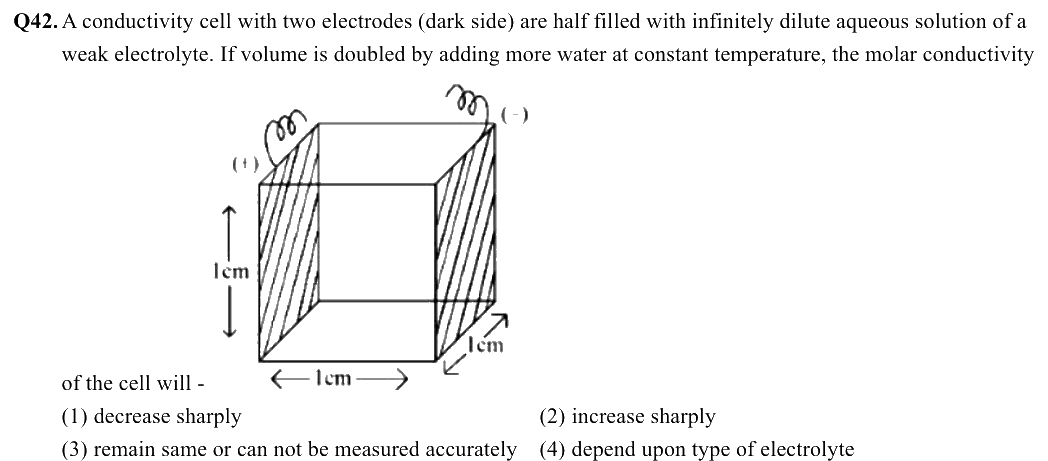
A conductivity cell with two electrodes (dark side) are half filled with infinitely dilute aqueous solution of a weak electrolyte. If volume is doubled by adding more water at constant temperature, the molar conductivity of the cell will -
Molar ionic conductivities of divalent cation and anion are 57 S $\mathrm{cm^2\,mol^{-1}}$ and 73 S $\mathrm{cm^2\,mol^{-1}}$ respectively. The molar conductivity of solution of an electrolyte with the above cation and anion will be :
For a strong electrolyte, a plot of molar conductivity against (concentration)$^{1/2}$ is a straight line, with a negative slope, the correct unit for the slope is
Fuel cell, using hydrogen and oxygen as fuels, A. has been used in spaceship B. has as efficiency of 40% to produce electricity C. uses aluminum as catalysts D. is eco-friendry E. is actually a type of Galvanic cell only Choose the correct answer from the options given below:
For lead storage battery pick the correct statements A. During charging of battery, $\mathrm{PbSO_4}$ on anode is converted into $\mathrm{PbO_2}$ B. During charging of battery, $\mathrm{PbSO_4}$ on cathode is converted into $\mathrm{PbO_2}$ C. Lead storage battery consists of grid of lead packed with $\mathrm{PbO_2}$ as anode D. Lead storage battery has ~38% solution of sulphuric acid as an electrolyte Choose the correct answer from the options given below:
The reaction occurs in which of the given galvanic cell? $\frac{1}{2}\mathrm{H_2(g)} + \mathrm{AgCl(s)} \rightleftharpoons \mathrm{H^+(aq)} + \mathrm{Cl^-(aq)} + \mathrm{Ag(s)}$
Match List-I with List-II. List-I A. $\mathrm{Cds+2NiOH_3s\rightarrow CdOs+2NiOH_2s+H_2Ol}$ B. $\mathrm{ZnHg+HgOs\rightarrow ZnOs+Hgl}$ C. $\mathrm{2PbSO_4s+2H_2Ol\rightarrow Pbs+PbO_2s+2H_2SO_4aq}$ D. $\mathrm{2H_2g+O_2g\rightarrow2H_2Ol}$ List-II I. Primary battery II. Discharging of secondary battery III. Fuel cell IV. Charging of secondary battery Choose the correct answer from the options given below
Given below are two statements: Statement I: For KI, molar conductivity increases steeply with dilution. Statement II: For carbonic acid, molar conductivity increases slowly with dilution. In the light of the above statements, choose the correct answer from the options given below
A
Statement I is correct and Statement II is incorrect
The molar conductivity of a conductivity cell filled with 10 moles of 20 mL NaCl solution is $\Lambda_{m1}$ and that of 20 moles another identical cell heaving 80 mL NaCl solution is $\Lambda_{m2}$, The conductivities exhibited by these two cells are same. The relationship between $\Lambda_{m2}$ and $\Lambda_{m1}$ is
The $\left(\frac{\partial E}{\partial T}\right)_P$ of different types of half cells are as follows : A B C D $1 \times 10^{-4}$ $2 \times 10^{-4}$ $0.1 \times 10^{-4}$ $0.2 \times 10^{-4}$ (Where E is the electromotive force). Which of the above half cells would be preferred to be used as reference electrode
The correct order of reduction potentials of the following pairs is A. $\mathrm{Cl_2 / Cl^-}$ B. $\mathrm{I_2 / I^-}$ C. $\mathrm{Ag^+ / Ag}$ D. $\mathrm{Na^+ / Na}$ E. $\mathrm{Li^+ / Li}$ Choose the correct answer from the options given below.
Match List - I with List - II : List - I (Parameter) (a) Cell constant (b) Molar conductivity (c) Conductivity (d) Degree of dissociation of electrolyte List - II (Unit) (i) $\mathrm{S\ cm^2\ mol^{-1}}$ (ii) Dimensionless (iii) $\mathrm{m^{-1}}$ (iv) $\Omega^{-1}\ \mathrm{m^{-1}}$
Given below are two statements: Statement I : The limiting molar conductivity of KCl (strong electrolyte) is higher compared to that of $\mathrm{CH_3COOH}$ (weak electrolyte). Statement II : Molar conductivity decreases with decrease in concentration of electrolyte. In the light of the above statements, choose the most appropriate answer from the options given below:
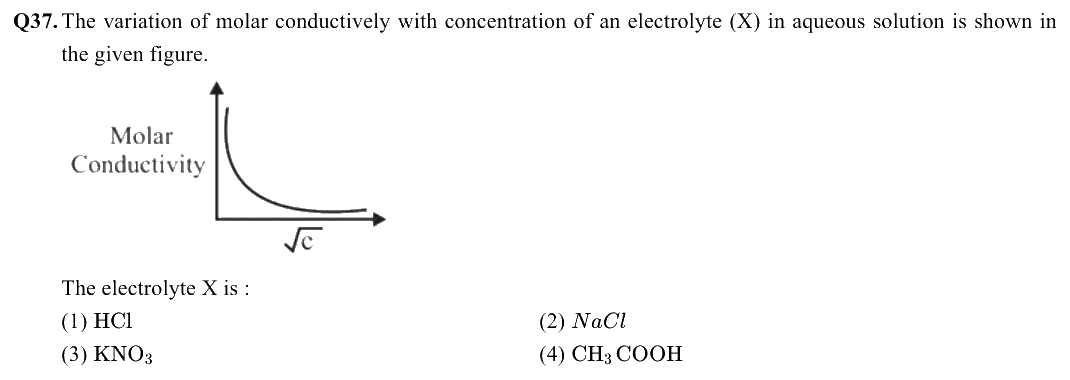
The variation of molar conductively (sic) with concentration of an electrolyte (X) in aqueous solution is shown in the given figure. (see the figure above) The electrolyte X is :
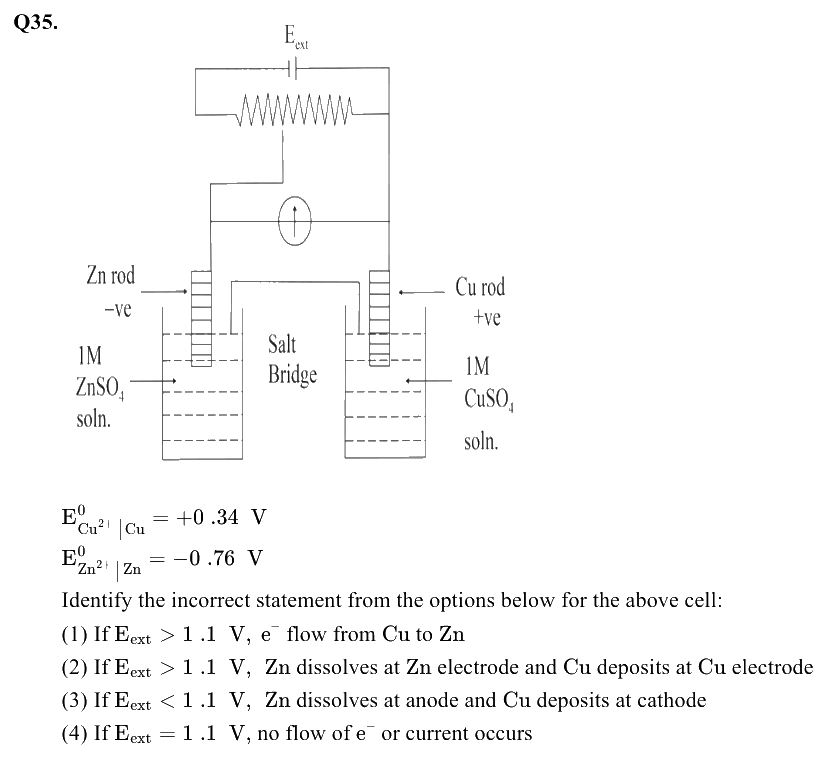
see figure Identify the incorrect statement from the options below for the above cell: $\mathrm{E^{0}_{Cu^{2+}\,|\,Cu}} = +0.34\ \mathrm{V}$ $\mathrm{E^{0}_{Zn^{2+}\,|\,Zn}} = -0.76\ \mathrm{V}$
The question as printed in the paper.
A
If $\mathrm{E_{ext}} > 1.1\ \mathrm{V}$, $\mathrm{e^{-}}$ flow from Cu to Zn
B
If $\mathrm{E_{ext}} > 1.1\ \mathrm{V}$, Zn dissolves at Zn electrode and Cu deposits at Cu electrode
C
If $\mathrm{E_{ext}} < 1.1\ \mathrm{V}$, Zn dissolves at anode and Cu deposits at cathode
D
If $\mathrm{E_{ext}} = 1.1\ \mathrm{V}$, no flow of $\mathrm{e^{-}}$ or current occurs
250 mL of a waste solution obtained from the workshop of a goldsmith contains $0.1\ \mathrm{M\ AgNO_{3}}$ and $0.1\mathrm{M\ AuCl}$. The solution was electrolyzed at 2 V by passing a current of 1 A for 15 minutes. The metal/metals electrodeposited will be : $\left(\mathrm{E^{0}_{Ag^{+}/Ag}} = 0.80\mathrm{V}, \mathrm{E^{0}_{Au^{+}/Au}} = 1.69\mathrm{V}\right)$
A
only gold
B
silver and gold in proportion to their atomic weights
Given that the standard potentials $(\mathrm{E^o})$ of $\mathrm{Cu^{2+}}$ / $\mathrm{Cu}$ and $\mathrm{Cu^{+}}$ / $\mathrm{Cu}$ are $0.34\mathrm{V}$ and $0.522\mathrm{V}$ respectively, the $\mathrm{E^o}$ of $\mathrm{Cu^{2+}}$ / $\mathrm{Cu^{+}}$ is:
Consider the statements S1 and S2 : S1 : Conductivity always increases with decreases in the concentration of electrolyte. S2 : Molar conductivity always increases with decreases in the concentration of electrolyte. The correct option among the following
The standard Gibbs energy for the given cell reaction in kJ $\mathrm{mol^{-1}}$ at 298 K is: $\mathrm{Zn(s) + Cu^{2+}(aq) \longrightarrow Zn^{2+}(aq) + Cu(s)}$ , $\mathrm{E^0}$ = 2 V at 298 K (Faraday's constant , F = 96000 C $\mathrm{mol^{-1}}$)
A solution of $\mathrm{Ni(NO_3)_2}$ is electrolyzed between platinum electrode 0.1 Faraday electricity. How many mole of Ni will be deposited at the cathode?
Given that, $E^\circ_{O_2/H_2O} = +1.23$ V; $E^\circ_{S_2O_8^{2-}/SO_4^{2-}} = 2.05$ V $E^\circ_{Br_2/Br^-} = +1.09$ V; $E^\circ_{Au^{3+}/Au} = 1.4$ V The strongest oxidizing agent is
Calculate the standard cell potential (in V) of the cell in which the following reaction takes place: $\mathrm{Fe^{2+}\ aq + Ag^+aq \rightarrow Fe^{3+}\ aq + Ag(s)}$ Given that $\mathrm{E^o_{Ag^+/Ag}}$ = x V $\mathrm{E^o_{Fe^{2+}/Fe}}$ = y V $\mathrm{E^o_{Fe^{3+}/Fe}}$ = z V
The standard electrode potential $\mathrm{E^o}$ and its temperature coefficient $\left(\frac{dE}{dT}\right)$ for a cell are 2 V and $-5 \times 10^{-4}$ $\mathrm{V\ K^{-1}}$ at 300 K, respectively. The reaction is $\mathrm{Zn\ (s) + Cu^{2+}\ (aq) \rightarrow Zn^{2+}\ (aq) + Cu\ (s)}$. The standard reaction enthalpy ($\Delta_r\mathrm{H^{-}}$) at 300 K in $\mathrm{mol^{-1}}$ is [Use R = 8 J $\mathrm{K^{-1}}$ $\mathrm{mol^{-1}}$ and F =96,500 C $\mathrm{mol^{-1}}$]
$\Lambda_m^o$ for NaCl, HCl and NaA are 126.4, 425.9 and 100 .5 S $\mathrm{cm^2\ mol^{-1}}$ respectively. If the conductivity of 0 .001 M HA is $5 \times 10^{-5}$S $\mathrm{cm^{-1}}$, degree of dissociation of HA is
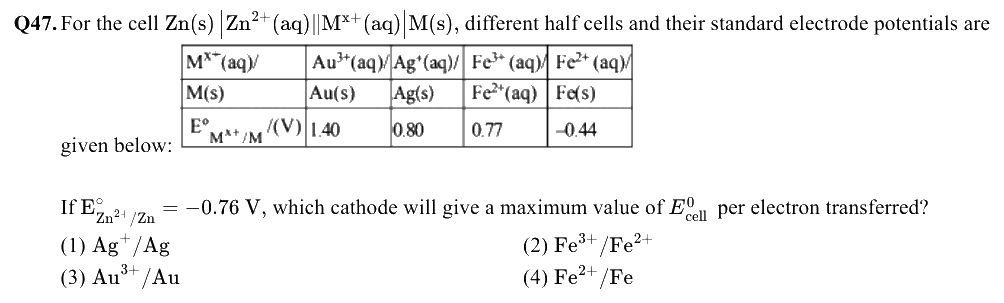
For the cell Zn(s) $|$Zn$^{2+}$(aq)$\|$M$^{x+}$(aq)$|$M(s), different half cells and their standard electrode potentials are given below: (see the figure above) If E$^{\circ}_{Zn^{2+}/Zn}$ = $-0.76$ V, which cathode will give a maximum value of $E^0_{cell}$ per electron transferred?
Given the equilibrium constant: K$_C$ of the reaction: Cu(s) + 2Ag$^+$(aq) $\rightarrow$ Cu$^{2+}$(aq) + 2Ag(s) is $10 \times 10^{15}$ calculate the $E^0_{cell}$ of this reaction at 298 K $\left[2.303\frac{RT}{F}\text{ at 298 K = 0.059 V}\right]$
Consider the following reduction processes: $Zn^{2+} + 2e^- \rightarrow Zn(s); E^o = -0.76$ V $Ca^{2+} + 2e^- \rightarrow Ca(s); E^o = -2.87$ V $Mg^{2+} + 2e^- \rightarrow Mg(s); E^o = -2.36$ V $Ni^{2+} + 2e^- \rightarrow Ni(s); E^o = -0.25$ V The reducing power of the metals increases in the order:
In the cell, $\mathrm{Pt(s)|H_2(g,\ 1\ bar)|\ HCl\ (aq)|AgCl(s)|\ Ag(s)|Pt(s)}$,the cell potential is $0.92\ \mathrm{V}$ when a $10^{-6}$ molar HCl solution is used. The standard electrode potential of $\mathrm{Ag\,|\,AgCl\,|\,Cl^-}$ electrode is: (Given, $\dfrac{2.303\mathrm{RT}}{\mathrm{F}} = 0.06\ \mathrm{V}$ at $298\ \mathrm{K}$)
The anodic half-cell of lead-acid battery is recharged using electricity of $0.05$ Faraday. The amount of $\mathrm{PbSO_4}$ electrolyzed in g during the process is: (Molar mass of $\mathrm{PbSO_4} = 303\mathrm{g\ mol^{-1}}$)
If the standard electrode potential for a cell is $2\ V$ at $300\ K$, the equilibrium constant $(K)$ for the reaction. $Zn(s) + Cu^{2+}(aq) \rightleftharpoons Zn^{2+}(aq) + Cu(s)$ at $300\ K$ is approximately: $(R = 8\ JK^{-1}mol^{-1}, F = 96000\ C\ mol^{-1})$
When an electric current is passes (sic) through acidified water, $112\ \mathrm{mL}$ of hydrogen gas at N.T.P. was collected at the cathode in $965$ seconds. The current passed, in ampere, is :
How long (approximate) should water be electrolysed by passing through 100 amperes current so that the oxygen released can completely burn $27 .66\ \mathrm{g}$ of diborane? (Atomic weight of $\mathrm{B} = 10 .8\ \mathrm{u}$)
To find the standard potential of $\mathrm{M^{3+}/M}$ electrode, the following cell is constituted: $\mathrm{Pt\,/M/M^{3+}}$ ($0.001\ \mathrm{mol\ L^{-1}}$)$/\mathrm{Ag^{+}}$ ($0.01\ \mathrm{mol\ L^{-1}}$)$/\mathrm{Ag}$ The emf of the cell is found to be 0.421 volt at 298 K. The standard potential of half-reaction $\mathrm{M^{3+} + 3e^{-} \rightarrow M}$ at 298 K will be: (Given: $E^{\ominus}_{\mathrm{Ag^{+}/Ag}}$ at 298 K = 0.80 volt)
What is the standard reduction potential ($\mathrm{E^o}$) for $\mathrm{Fe^{3+}} \to \mathrm{Fe}$? Given that: $\mathrm{Fe^{2+}} + 2\mathrm{e^-} \to \mathrm{Fe}$; $\mathrm{E^o_{Fe^{2+}/Fe}} = -0.47$ V $\mathrm{Fe^{3+}} + \mathrm{e^-} \to \mathrm{Fe^{2+}}$; $\mathrm{E^o_{Fe^{3+}/Fe^{2+}}} = +0.77$ V
Given $\mathrm{E^{o}_{Cl_2/Cl^{-}}} = 1.36\ \mathrm{V}$, $\mathrm{E^{o}_{Cr^{3+}/Cr}} = -0.74\ \mathrm{V}$ $\mathrm{E^{o}_{Cr_2O_7^{2-}/Cr^{3+}}} = 1.33\ \mathrm{V}$, $\mathrm{E^{o}_{MnO_4^{-}/Mn^{2+}}} = 1.51\ \mathrm{V}$. Among the following, the strongest reducing agent is:
Oxidation of succinate ion produces ethylene and carbon dioxide gases. On passing $0.2$ Faraday electricity through an aqueous solution of potassium succinate, what is the total volume of gases (at both cathode and anode) at STP ($1\ \mathrm{atm}$ and $273\ \mathrm{K}$)?
At 298 K, the standard reduction potentials are 1.51 V for $\mathrm{MnO_4^-}$ | $\mathrm{Mn^{2+}}$, 1.36 V for $\mathrm{Cl_2}$|$\mathrm{Cl^-}$, 1.07 V for $\mathrm{Br_2}$|$\mathrm{Br^-}$, 0.54 V for $\mathrm{I_2}$|$\mathrm{I^-}$. At pH $= 3$, permanganate is expected to oxidize: $\left(\frac{RT}{F} = 0.059\right)$
A
$\mathrm{Cl^-}$ and $\mathrm{Br^-}$
B
$\mathrm{Br^-}$ and $\mathrm{I^-}$
C
$\mathrm{I^-}$ only
D
$\mathrm{Cl^-}$ , $\mathrm{Br^-}$ and $\mathrm{I^-}$
A variable, the opposite external potential ($\mathrm{E_{ext}}$) is applied to the cell $\mathrm{Zn\,|\,Zn^{2+}\ (1M)\,||\,Cu^{2+}\ (1\ M)|Cu}$, of potential 1.1 V. When $\mathrm{E_{ext}}$ < 1.1 V and $\mathrm{E_{ext}}$ > 1.1 V, respectively electrons flow from
Two Faraday of electricity is passed through a solution of $\mathrm{CuSO_4}$. The mass of copper deposited at the cathode is: (Atomic mass of $\mathrm{Cu} = 63.5\ \mathrm{amu}$)
How many electrons would be required to deposit $6.35\ \mathrm{g}$ of copper at the cathode during the electrolysis of an aqueous solution of copper sulphate? (Atomic mass of copper $= 63.5\mathrm{u}$, $\mathrm{N_A} =$ Avogadro's constant):
Given $$\mathrm{Fe^{3+}(aq) + e^- \rightarrow Fe^{2+}(aq); E^0 = +0.77\ V}$$ $$\mathrm{Al^{3+}(aq) + 3e^- \rightarrow Al(s); E^0 = -1.66\ V}$$ $$\mathrm{Br_2(aq) + 2e^- \rightarrow 2Br^-; E^0 = +1.09\ V}$$ Considering the electrode potentials, which of the following represents the correct order of reducing power?
A current of 10.0 A flows for 2.00 h through an electrolytic cell containing a molten salt of metal X. This results in the decomposition of 0.250 mol of metal X at the cathode. The oxidation state of X in the molten salt is: (F = 96, 500 C)
The standard electrode potentials $\left(\mathrm{E^o_{M^+/M}}\right)$ of four metals A, B, C and D are $-1.2$ V,0.6 V, 0.85 V and $-0.76$ V, respectively. The sequence of deposition of metals on applying potential is
Resistance of 0.2 M solution of an electrolyte is 50 $\Omega$. The specific conductance of the solution is 1.4 S m$^{-1}$. The resistance of 0.5 M solution of the same electrolyte is 280 $\Omega$. The molar conductivity of 0.5 M solution of the electrolyte in S m$^2$ mol$^{-1}$ is :
The equivalent conductance of NaCl at concentration C and at infinite dilution are $\lambda_\mathrm{C}$ and $\lambda_\infty$, respectively. The correct relationship between $\lambda_\mathrm{C}$ and $\lambda_\infty$ is given as : (where the constant B is positive)
Given below are the half - cell reactions : $\mathrm{Mn^{2+}} + 2e^- \rightarrow \mathrm{Mn}$ ; $\mathrm{E^\circ} = -1.18$ V $2(\mathrm{Mn^{3+}} + e^- \rightarrow \mathrm{Mn^{2+}})$ ; $\mathrm{E^\circ} = +1.51$ V The $\mathrm{E^\circ}$ for $3\mathrm{Mn^{2+}} \rightarrow \mathrm{Mn} + 2\mathrm{Mn^{3+}}$ will be :
The Gibbs energy for the decomposition of $\mathrm{Al_2O_3}$ at 500 C is as follows : $\frac{2}{3}\mathrm{Al_2O_3} \rightarrow \frac{4}{3}\mathrm{Al} + \mathrm{O_2}$, $\Delta_r G$ = +940 kJ $\mathrm{mol^{-1}}$ The potential difference needed for the electrolytic reduction of aluminium oxide at $500^\circ$C should be at least :
A solution of copper sulphate ($\mathrm{CuSO_4}$) is electrolysed for 10 minutes with a current of 1.5 amperes. The mass of copper deposited at the cathode (at. mass of Cu = 63u ) is :
Given : $\mathrm{E^{o}_{\frac{1}{2}Cl_2/Cl^-}} = 1.36\ \mathrm{V}, \mathrm{E^{o}_{Cr^{3+}/Cr}} = -0.74\ \mathrm{V}$ $\mathrm{E^{o}_{Cr_2O_7^{2-}/Cr^{3+}}} = 1.33\ \mathrm{V}, \mathrm{E^{o}_{MnO_4^-/Mn^{2+}}} = 1.51\ \mathrm{V}$ The correct order of reducing power of the species $(\mathrm{Cr, Cr^{3+}, Mn^{2+}}$ and $\mathrm{Cl^-})$ will be:
Electrode potentials ($\mathrm{E^\circ}$) are given below : $\mathrm{Cu^+/Cu} = +0.52$ V, $\mathrm{Fe^{3+}/Fe^{2+}} = +0.77$ V, $\frac{1}{2}\mathrm{I_2(s)/I^-} = +0.54$ V, $\mathrm{Ag^+/Ag} = +0.88$ V. Based on the above potentials, strongest oxidizing agent will be :
Given $\mathrm{E^{o}_{Cr^{3+}/Cr}} = -0.74$ V; $\mathrm{E^{o}_{MnO_4^{-}/Mn^{2+}}} = 1.51$ V $\mathrm{E^{o}_{Cr_2O_7^{2-}/Cr^{3+}}} = 1.33$ V; $\mathrm{E^{o}_{Cl_2|Cl^{-}}} = 1.36$ V Based on the data given above, strongest oxidising agent will be:
Given $\mathrm{E^{\circ}_{Cu^{2+}/Cu}} = 0.34$ V, $\mathrm{E^{\circ}_{Cu^{2+}/Cu^{+}}} = 0.15$ V Standard electrode potential for the half cell $\mathrm{Cu^{+}/Cu}$ is
The standard potentials of $\mathrm{Ag^+/Ag}$, $\mathrm{Hg_2^{2+}/2Hg}$, $\mathrm{Cu^{2+}/Cu}$ and $\mathrm{Mg^{2+}/Mg}$ electrodes are $0.80, 0.79, 0.34$ and $-2.37\ \mathrm{V}$, respectively. An aqueous solution which contains one mole per litre of the salts of each of the four metals is electrolyzed. With increasing voltage, the correct sequence of deposition of the metals at the cathode is
If one Faraday of electricity is passed through the battery during the charging, the number of moles of $\mathrm{Cr}^{3+}$ removed from the solution is
The standard reduction potentials for $\mathrm{Zn^{2+}/Zn}$, $\mathrm{Ni^{2+}/Ni}$, and $\mathrm{Fe^{2+}/Fe}$ are $-0.76, -0.23$ and $-0.44\ \mathrm{V}$ respectively. The reaction $X + \mathrm{Y^{2+}} \rightarrow \mathrm{X^{2+}} + Y$ will be spontaneous when:
The Gibbs energy for the decomposition of $\mathrm{Al_2O_3}$ at $500°\mathrm{C}$ is as follows : $\frac{2}{3}\mathrm{Al_2O_3} \rightarrow \frac{4}{3}\mathrm{Al} + \mathrm{O_2}$, $\Delta_r G = +966\ \mathrm{kJ\ mol^{-1}}$ The potential difference needed for electrolytic reduction of $\mathrm{Al_2O_3}$ at $500°\mathrm{C}$ is at least
In a fuel cell methanol is used as fuel and oxygen gas is used as an oxidizer. The reaction is $\mathrm{CH_3OH(\ell) + \frac{3}{2}O_2(g) \to CO_2(g) + 2H_2O(\ell)}$ At 298 K standard Gibb's energies of formation for $\mathrm{CH_3OH(\ell), H_2O(\ell)}$ and $\mathrm{CO_2(g)}$ are $-166.2, -237.2$ and $-394.4$ kJ $\mathrm{mol^{-1}}$ respectively. If standard enthalpy of combustion of methanol is $-726$ kJ $\mathrm{mol^{-1}}$, efficiency of the fuel cell will be
Given : $\mathrm{E^\circ_{Fe^{3+}/Fe}} = -0.036$ V, $\mathrm{E^\circ_{Fe^{2+}/Fe}} = -0.439$ V. The value of standard electrode potential for the change, $\mathrm{Fe^{3+}_{(aq)} + e^- \to Fe^{2+}(aq)}$ will be :
Given $\mathrm{E^{\circ}_{Cr^{3+}/Cr}} = -0.72\ \mathrm{V}$, $\mathrm{E^{\circ}_{Fe^{2+}//Fe}} = -0.42\ \mathrm{V}$. The potential for the cell $\mathrm{Cr\,|Cr^{3+}(0.1M)|\,|\,Fe^{2+}(0.01M)|Fe}$ is
The cell, $\mathrm{Zn\ |Zn^{2+}(1M)||Cu^{2+}(1M)|Cu}$ ($\mathrm{E^0_{cell}}$ = 1.10 V), was allowed to be completely discharged at 298 K. The relative concentration of $\mathrm{Zn^{2+}}$ to $\mathrm{Cu^{2+}}$ $\left[\frac{[\mathrm{Zn^{2+}}]}{[\mathrm{Cu^{2+}}]}\right]$ is
The equivalent conductances of two strong electrolytes at infinite dilution in $\mathrm{H_2O}$ (where ions move freely through a solution) at $25^\circ$C are given below: $\Lambda^\circ_{\mathrm{CH_3COONa}}$ = 91.0 S $\mathrm{cm^2}$ /equiv $\Lambda^\circ_{\mathrm{HCl}}$ = 426.2 S $\mathrm{cm^2}$ / equiv What additional information/quantity one needs to calculate $\Lambda^\circ$ of an aqueous solution of acetic acid?
A
$\Lambda^\circ$ of NaCl
B
$\Lambda^\circ$ of $\mathrm{CH_3COOK}$
C
The limiting equivalent conductance of $\mathrm{H^+}$ ($\Lambda^\circ_{\mathrm{H^+}}$)
D
$\Lambda^\circ$ of chloroacetic acid ($\mathrm{C/CH_2COOH}$)
The molar conductivities $\Lambda^\circ_{\mathrm{NaOAC}}$ and $\Lambda^\circ_{\mathrm{HCl}}$ at infinite dilution in water at $25^\circ$C are 91.0 and 426.2 S $\mathrm{cm^2}$/mol respectively. To calculate $\Lambda^\circ_{\mathrm{HOAc}}$, the additional value required is
Given the data at $25^\circ$C, $\mathrm{Ag + I^- \longrightarrow AgI + e^-}$; $E^\circ = 0.152$ V $\mathrm{Ag \longrightarrow Ag^+ + e^-}$; $E^\circ = -0.800$ V What is the value of $\log K_{\mathrm{sp}}$ for AgI ? $\left(2.303\,\frac{RT}{F} = 0.059\ \mathrm{V}\right)$
Aluminium oxide may be electrolysed at $1000^\circ\mathrm{C}$ to furnish aluminium metal (Atomic mass = 27 amu; 1 Faraday = 96, 500 Coulombs). The cathode reaction is $\mathrm{Al^{3+} + 3e^{-} \longrightarrow Al^{\circ}}$ To prepare 5.12 kg of aluminium metal by this method would require
Consider the following $\mathrm{E^\circ}$ values $\mathrm{E^\circ_{Fe^{3+}/Fe^{2+}}} = 0.77\ \mathrm{V}$ $\mathrm{E^\circ_{Sn^{2+}/Sn}} = -0.14\ \mathrm{V}$ Under standard conditions the potential for the reaction $\mathrm{Sn(s)} + 2\mathrm{Fe^{3+}(aq)} \longrightarrow 2\mathrm{Fe^{2+}(aq)} + \mathrm{Sn^{2+}(aq)}$ is
The standard e.m.f of a cell, involving one electron change is found to be 0.591 V at $25^\circ\mathrm{C}$. The equilibrium constant of the reaction is $(\mathrm{F} = 96,500\mathrm{Cmol^{-1}} : \mathrm{R} = 8.314\mathrm{JK^{-1}\ mol^{-1}})$
The limiting molar conductivities $\Lambda^\circ$ for NaCl, KBr and KCl are 126,152 and 150 S $\mathrm{cm^2\ mol^{-1}}$ respectively. The $\Lambda^\circ$ for NaBr is
In a cell that utilises the reaction $\mathrm{Zn(s)} + 2\mathrm{H^+(aq)} \longrightarrow \mathrm{Zn^{2+}(aq)} + \mathrm{H_2(\,g)}$ addition of $\mathrm{H_2SO_4}$ to cathode compartment, will
A
lower the $E$ and shift equilibrium to the left
B
increases the $E$ and shift equilibrium to the left
C
increase the $E$ and shift equilibrium to the right
For a cell reaction involving a two-electron change, the standard e.m.f. of the cell is found to be 0.295 V at $25^\circ$C. The equilibrium constant of the reaction at $25^\circ$C will be
When during electrolysis of a solution of $\mathrm{AgNO_3}$ 9650 coulombs of charge pass through the electroplating bath, the mass of silver deposited on the cathode will be
For the redox reaction $\mathrm{Zn(s) + Cu^{2+}(0.1M) \rightarrow Zn^{2+}(1M) + Cu(s)}$ taking place in a cell, $\mathrm{E^0_{cell}}$ is 1.10 volt. $\mathrm{E^\circ}$ for the cell will be $\left(2.303\frac{RT}{F} = 0.0591\right)$
Conductivity (unit Siemen's S) is directly proportional to area of the vessel and the concentration of the solution in it and is inversely proportional to the length of the vessel then the unit of the constant of proportionality is
At 298 K, the molar conductivity of $x$% (w/w) MX solution (aqueous) is 123.5 S cm$^2$ mol$^{-1}$. The conductance of same solution is $1.9\times10^{-3}$ S. The value of $x$ is ________ $\times10^{-2}$.
(Given : cell constant = 1.3 cm$^{-1}$; molar mass of MX is 75 g mol$^{-1}$, density of aqueous solution of MX at 298 K is 1.0 g mL$^{-1}$)
Numerical answer type: type your answer in EdLoop to check it
An electrochemical cell, consist of the following two redox couples, $\mathrm{M^{x+}}$ (aq)/M(s) [$\mathrm{E^\ominus_{red}} = +0.15$ V] and $\mathrm{Fe^{3+}}$(aq)/Fe(s) [$\mathrm{E^\ominus_{red}} = -0.036$ V]. The cell EMF ($\mathrm{E_{cell}}$) is recorded to be 0.2057 V. If the reaction quotient of the electrochemical reaction is found to be $10^{-2}$, then the value of $x$ is ________.(Nearest integer)
[Given : M is a p-block metal and $\frac{2.303\mathrm{RT}}{\mathrm{F}} = 0.059$ V]
Numerical answer type: type your answer in EdLoop to check it
A fuel cell was set up using the above two reactions such that the cell operates under the standard condition of 1 bar pressure and 298 K temperature. The fuel cell works with 80% efficiency. If the work derived from the cell using 1 mol of $\mathrm{CH_3OH}$ is used to compress an ideal gas isothermally against a constant pressure of 1 kPa, then the change in the volume of the gas, $\Delta V =$ ________ m$^3$. (nearest integer) Given : $F = 96500$ C mol$^{-1}$
Numerical answer type: type your answer in EdLoop to check it
A volume of $x$ mL of 5 M $\mathrm{NaHCO_3}$ solution was mixed with 10 mL of 2 M $\mathrm{H_2CO_3}$ solution to make an electrolytic buffer. If the same buffer was used in the following electrochemical cell to record a cell potential of 235.3 mV, then the value of $x$= ________ mL (nearest integer).
Electricity is passed through an acidic solution of $\mathrm{Cu^{2+}}$ till all the $\mathrm{Cu^{2+}}$ was exhausted, leading to the deposition of 300 mg of Cu metal. However, a current of 600 mA was continued to pass through the same solution for another 28 minutes by keeping the total volume of the solution fixed at 200 mL. The total volume of oxygen evolved at STP during the entire process is ________ mL. (Nearest integer)
[Given:
$\mathrm{Cu^{2+}}$ (aq) $+ 2e^- \rightarrow$ Cu(s) $\mathrm{E^\circ_{red}} = +0.34$ V
Molar conductivity of a weak acid HQ of concentration 0.18 M was found to be 1/30 of the molar conductivity of another weak acid HZ with concentration of 0.02 M. If $\lambda^\circ_{\mathrm{Q^-}}$ happened to be equal with $\lambda^\circ_{\mathrm{Z^-}}$, then the difference of the $\mathrm{pK_a}$ values of the two weak acids ($\mathrm{pK_a}$(HQ) $-$ $\mathrm{pK_a}$(HZ)) is ________ (Nearest integer).
[Given: degree of dissociation ($\alpha$) $<<1$ for both weak acids, $\lambda^\circ$: limiting molar conductivity of ions]
Numerical answer type: type your answer in EdLoop to check it
The pH and conductance of a weak acid (HX) was found to be 5 and $4\times10^{-5}$ S, respectively. The conductance was measured under standard condition using a cell where the electrode plates having a surface area of 1 cm$^2$ were at a distance of 15 cm apart. The value of the limiting molar conductivity is ________ S m$^2$ mol$^{-1}$. (nearest integer) (Given : degree of dissociation of the weak acid ($\alpha$) $\ll$ 1)
Numerical answer type: type your answer in EdLoop to check it
If the standard reduction potential for $\mathrm{M^+(aq)} \xrightarrow{+e^-} \mathrm{M(s)}$ is $(\mathrm{E}^\ominus_{\mathrm{M^+/M}}) = 0.79$ V, then the value of the standard reduction potential for the metal/metal insoluble salt electrode $\mathrm{E}^\ominus_{\mathrm{X^-/MX(s)/M}}$ is ________ mV. (nearest integer) [Given : $\frac{2.303\,\mathrm{RT}}{\mathrm{F}} = 0.059$ V]
Numerical answer type: type your answer in EdLoop to check it
The reaction was conducted with the ratio of $\frac{\left[Cr^{3+}\right]^2}{\left[Cr_2O_7^{2-}\right]} = 10^{-6}$. The pH value at which the EMF of the half cell will become zero is ______ . (nearest integer value)
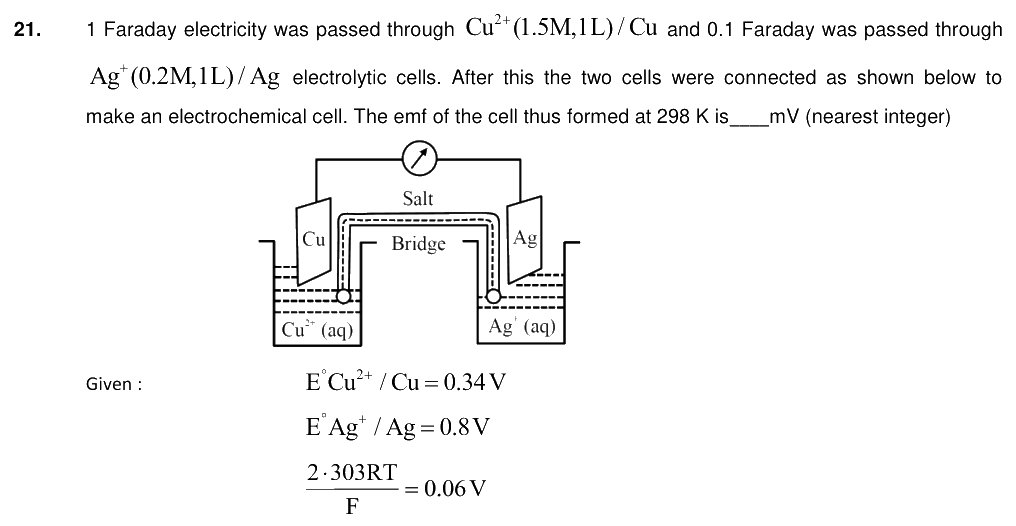
1 Faraday electricity was passed through $Cu^{2+}(1.5M, 1L)/Cu$ and 0.1 Faraday was passed through $Ag^+(0.2M, 1L)/Ag$ electrolytic cells. After this the two cells were connected as shown below to make an electrochemical cell. The emf of the cell thus formed at 298 K is ______ mV (nearest integer)
(see the figure above)
Given :
$E^\circ Cu^{2+}/Cu = 0.34V$
$E^\circ Ag^+/Ag = 0.8V$
$\frac{2.303RT}{F} = 0.06V$
The question as printed in the paper.
Numerical answer type: type your answer in EdLoop to check it
The molar conductance of an infinitely dilute solution of ammonium chloride was found to be $185\,S\,cm^2mol^{-1}$ and the ionic conductance of hydroxyl and chloride ions are 170 and $70\,S\,cm^2mol^{-1}$, respectively. If molar conductance of 0.02 M solution of ammonium hydroxide is $85.5\,S\,cm^2mol^{-1}$, its degree of dissociation is given by $x \times 10^{-1}$. The value of $x$ is ______ . (Nearest integer)
Numerical answer type: type your answer in EdLoop to check it
0.2%(w/v) solution of NaOH is measured to have resistivity $870.0m\Omega m$. The molar conductivity of the solution will be ______ $\times 10^2 mS\ dm^2 mol^{-1}$. (Nearest integer)
Numerical answer type: type your answer in EdLoop to check it
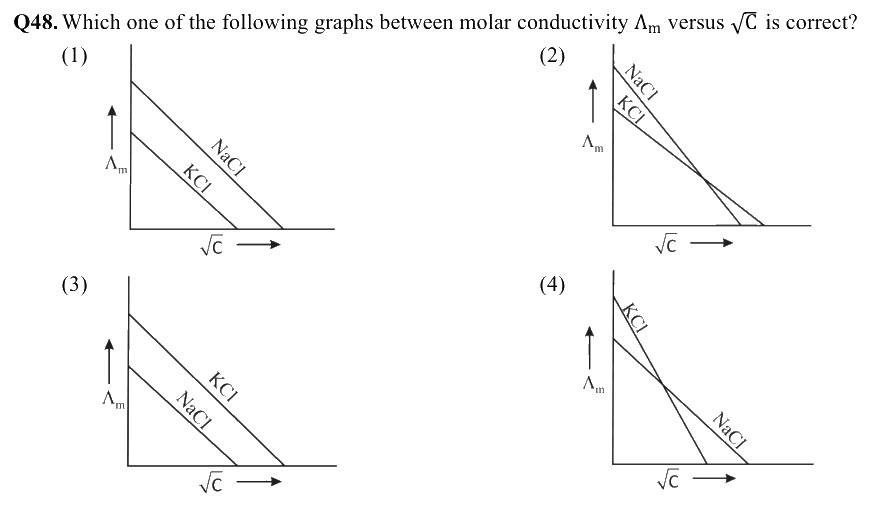
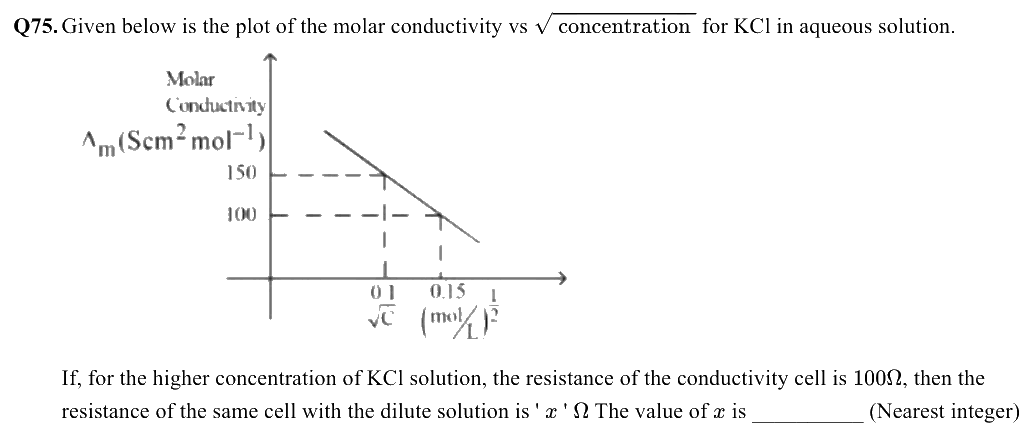
Given below is the plot of the molar conductivity vs $\sqrt{\text{concentration}}$ for KCl in aqueous solution.
(see the figure above)
If, for the higher concentration of KCl solution, the resistance of the conductivity cell is $100\Omega$, then the resistance of the same cell with the dilute solution is ' $x$ ' $\Omega$ The value of $x$ is ______ (Nearest integer)
The question as printed in the paper.
Numerical answer type: type your answer in EdLoop to check it
Electrolysis of 600 mL aqueous solution of NaCl for 5 min changes the pH of the solution to 12 . The current in Amperes used for the given electrolysis is ______ . (Nearest integer).
Numerical answer type: type your answer in EdLoop to check it
The values of conductivity of some materials at 298.15 K in Sm$^{-1}$ are $2.1 \times 10^3$, $1.0 \times 10^{-16}$, $1.2 \times 10$, 3.91, $1.5 \times 10^{-2}$, $1 \times 10^{-7}$, $1.0 \times 10^3$. The number of conductors among the materials is ______.
Numerical answer type: type your answer in EdLoop to check it
The mass of zinc produced by the electrolysis of zinc sulphate solution with a steady current of 0.015 $A$ for 15 minutes is ______ $\times 10^{-4}$ g. (Atomic mass of zinc = 65.4 amu)
Numerical answer type: type your answer in EdLoop to check it
A constant current was passed through a solution of $\mathrm{AuCl_4^-}$ ion between gold electrodes. After a period of 10.0 minutes, the increase in mass of cathode was 1.314 g. The total charge passed through the solution is ______ $\times 10^{-2}$ F. (Given atomic mass of Au = 197)
Numerical answer type: type your answer in EdLoop to check it
The mass of silver (Molar mass of Ag : 108 g mol$^{-1}$) displaced by a quantity of electricity which displaces 5600 mL of $\mathrm{O_2}$ at S.T.P. will be ______ g.
Numerical answer type: type your answer in EdLoop to check it
The hydrogen electrode is dipped in a solution of pH = 3 at $25°\mathrm{C}$. The potential of the electrode will be - ______ $\times 10^{-2}$ V. $\frac{2.303RT}{F} = 0.059$ V Round off the answer to the nearest integer.
Numerical answer type: type your answer in EdLoop to check it
The number of correct statements from the following is ______ (A) Conductivity always decreases with decrease in concentration for both strong and weak electrolytes. (B) The number of ions per unit volume that carry current in a solution increases on dilution. (C) Molar conductivity increases with decrease in concentration. (D) The variation in molar conductivity is different for strong and weak electrolytes. (E) For weak electrolytes, the change in molar conductivity with dilution is due to decrease in degree of dissociation.
Numerical answer type: type your answer in EdLoop to check it
A metal surface of 100 cm$^{2}$ area has to be coated with nickel layer of thickness 0.001 mm. A current of 2A was passed through a solution of $\mathrm{Ni\,(NO_3)_2}$ for x seconds to coat the desired layer. The value of x is ______. (Nearest integer) ($\rho$Ni (density of Nickel) is 10 g mL$^{-1}$, Molar mass of Nickel is 60 g mol$^{-1}$ F = 96500 Cmol$^{-1}$)
Numerical answer type: type your answer in EdLoop to check it
At 298 K, the standard reduction potential for $\mathrm{Cu^{2+}}$ / Cu electrode is 0.34 V. Given : $K_{sp}\mathrm{Cu(OH)_2}$ = $1 \times 10^{-20}$ Take $\frac{2.303RT}{F}$ = 0.059 V The reduction potential at pH = 14 for the above couple is $(-)x \times 10^{-2}$ V. The value of x is
Numerical answer type: type your answer in EdLoop to check it
In an electrochemical reaction of lead, at standard temperature, if $E^{o}_{\mathrm{Pb^{2+}/Pb}} = m$ Volt and $E^{o}_{\mathrm{Pb^{4+}/Pb}} = n$ Volt, then the value of $E^\circ\mathrm{Pb^{2+}}/\mathrm{Pb^{4+}}$ is given by $m - xn$. The value of x is ______ (Nearest integer)
Numerical answer type: type your answer in EdLoop to check it
The number of correct statements from the following is ______ A. $\mathrm{E_{cell}}$ is an intensive parameter B. A negative $\mathrm{E^o}$ means that the redox couple is a stronger reducing agent than the $\mathrm{H^+/H_2}$ couple. C. The amount of electricity required for oxidation or reduction depends on the stoichiometry of the electrode reaction. D. The amount of chemical reaction which occurs at any electrode during electrolysis by a current is proportional to the quantity of electricity passed through the electrolyte.
Numerical answer type: type your answer in EdLoop to check it
$\mathrm{FeO_4^{2-}} \xrightarrow{+2.2\ \mathrm{V}} \mathrm{Fe^{3+}} \xrightarrow{+0.70\ \mathrm{V}} \mathrm{Fe^{2+}} \xrightarrow{-0.45\ \mathrm{V}} \mathrm{Fe^{0}}$ $\mathrm{E^{\theta}_{FeO_4^{2-}/Fe^{2+}}}$ is $\mathrm{x} \times 10^{-3}$ V. The value of x is ______
Numerical answer type: type your answer in EdLoop to check it
The specific conductance of $0.0025$M acetic acid is $5 \times 10^{-5}\ \mathrm{S\,cm^{-1}}$ at a certain temperature. The dissociation constant of acetic acid is ______ $\times 10^{-7}$ (Nearest integer). Consider limiting molar conductivity of $\mathrm{CH_3COOH}$ as $400\ \mathrm{S\,cm^2\,mol^{-1}}$
Numerical answer type: type your answer in EdLoop to check it
At what pH, given half cell $\mathrm{MnO_4^-}$ (0.1M) | $\mathrm{Mn^{2+}}$ (0.001 M) will have electrode potential of 1.282 V ? (Nearest Integer) Given $\mathrm{E^o_{MnO_4^-/Mn^{2+}}}$ = 1.54 V, $\dfrac{2.303\mathrm{RT}}{\mathrm{F}}$ = 0.059 V
Numerical answer type: type your answer in EdLoop to check it
1 $\times$ $10^{-5}$ M $\mathrm{AgNO_3}$ is added to 1 L of saturated solution of AgBr. The conductivity of this solution at 298 K is ______ $\times$ $10^{-8}$ $\mathrm{S\ m^{-1}}$. [Given : $\mathrm{K_{sp}}$(AgBr) = 4. 9 $\times$ $10^{-13}$ at 298 K $\lambda^0_{\mathrm{Ag^+}}$ = 6 $\times$ $10^{-3}$ $\mathrm{Sm^2\ mol^{-1}}$ $\lambda^0_{\mathrm{Br^-}}$ = 8 $\times$ $10^{-3}$ $\mathrm{Sm^2\ mol^{-1}}$ $\lambda^0_{\mathrm{NO_3^-}}$ = 7 $\times$ $10^{-3}$ $\mathrm{Sm^2\ mol^{-1}}$]
Numerical answer type: type your answer in EdLoop to check it
The resistivity of a 0.8M solution of an electrolyte is $5 \times 10^{-3}\Omega$cm. Its molar conductivity is $10^4\Omega^{-1}$ cm$^2$ mol$^{-1}$. (Nearest integer)
Numerical answer type: type your answer in EdLoop to check it
Consider the cell $\mathrm{Pt_s}$ $\mathrm{H_{2g}}$, 1atm $\mathrm{H^+}$ aq, 1M | $\mathrm{Fe^{3+}}$ aq, $\mathrm{Fe^{2+}}$ aq Pt s When the potential of the cell is 0.712 V at 298 K, the ratio $\mathrm{Fe^{2+}}$ / $\mathrm{Fe^{3+}}$ is ______ (Nearest integer) Given: $\mathrm{Fe^{3+} + e^- = Fe^{2+}}$, $E^\circ \mathrm{Fe^{3+}, Fe^{2+}}$ Pt = 0.771, $\frac{2.303RT}{F}$ = 0.06 V
Numerical answer type: type your answer in EdLoop to check it
The electrode potential of the following half cell at 298 K $\mathrm{X|X^{2+}(0.001M)||Y^{2+}(0.01M)|Y}$ is ______ $\times 10^{-2}$ V (Nearest integer) Given : $\mathrm{E^0_{X^{2+}|X}}$ = $-2.36$ V $\mathrm{E^0_{Y^{2+}|Y}}$ = +0.36 V $\frac{2.303RT}{F}$ = 0.06 V
Numerical answer type: type your answer in EdLoop to check it
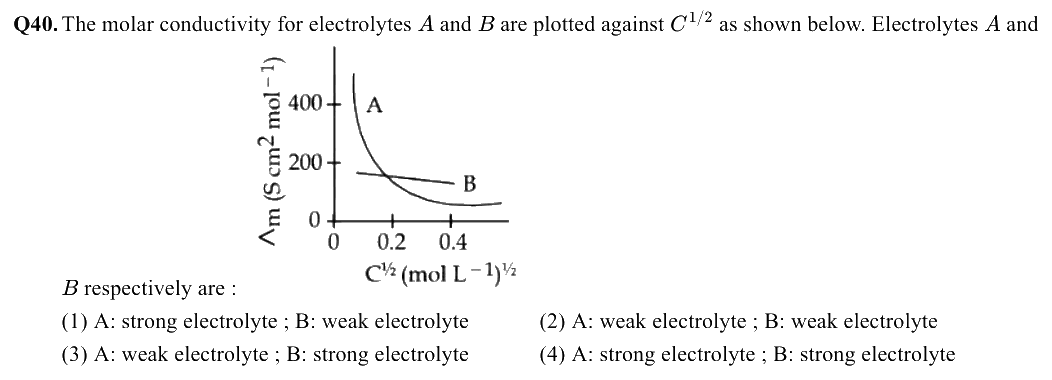
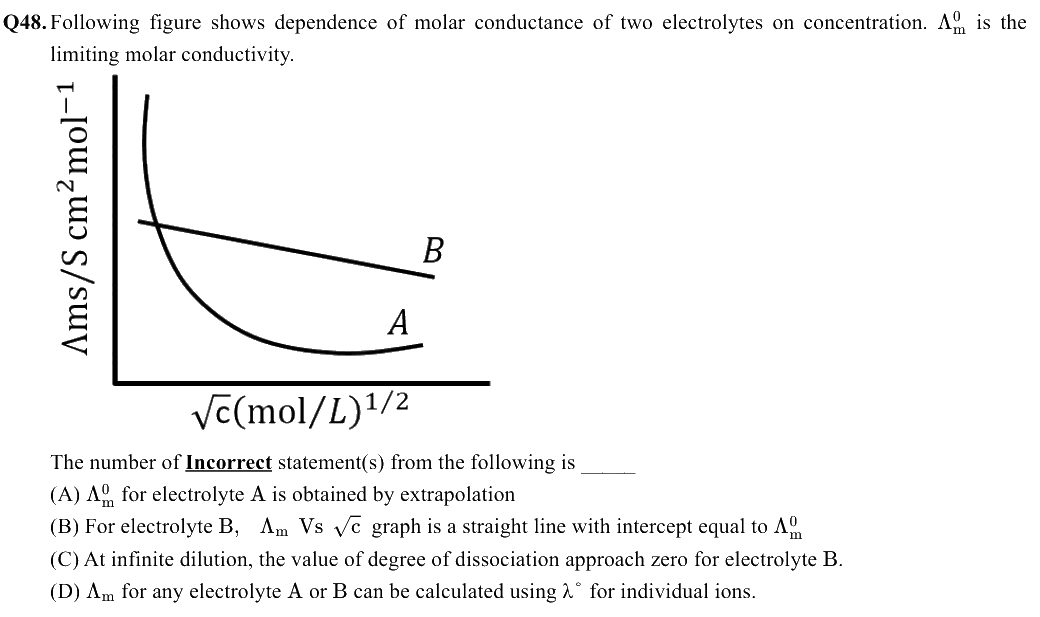
Following figure shows dependence of molar conductance of two electrolytes on concentration. $\Lambda_\mathrm{m}^0$ is the limiting molar conductivity.
(see the figure above)
The number of Incorrect statement(s) from the following is ______
(A) $\Lambda_\mathrm{m}^0$ for electrolyte A is obtained by extrapolation (B) For electrolyte B, $\Lambda_\mathrm{m}$ Vs $\sqrt{c}$ graph is a straight line with intercept equal to $\Lambda_\mathrm{m}^0$ (C) At infinite dilution, the value of degree of dissociation approach zero for electrolyte B. (D) $\Lambda_\mathrm{m}$ for any electrolyte A or B can be calculated using $\lambda^\circ$ for individual ions.
The question as printed in the paper.
Numerical answer type: type your answer in EdLoop to check it
The equilibrium constant for the reaction $\mathrm{Zn(s)} + \mathrm{Sn^{2+}(aq)} \rightleftharpoons \mathrm{Zn^{2+}(aq)} + \mathrm{Sn(s)}$ is $1 \times 10^{20}$ at 298 K. The magnitude of standard electrode potential of $\mathrm{Sn}/\mathrm{Sn^{2+}}$ if $\mathrm{E^0_{Zn^{2+}/Zn}} = -0.76$ V is ______ $\times 10^{-2}$ V. (Nearest integer) Given : $\frac{2.303\,\mathrm{RT}}{\mathrm{F}} = 0.059$ V
Numerical answer type: type your answer in EdLoop to check it
Consider the cell $\mathrm{Pt(s)|H_2(s)(1atm)|H^+(aq, [H^+] = 1)||Fe^{3+}(aq), Fe^{2+}(aq)|Pt(s)}$ Given: $E^\circ_{\mathrm{Fe^{3+}/Fe^{2+}}} = 0.771$ V and $E^\circ_{\mathrm{H^+/\frac{1}{2}H_2}} = 0$ V, T = 298 K If the potential of the cell is 0.712 V the ratio of concentration of $\mathrm{Fe^{2+}}$ to $\mathrm{Fe^{3+}}$ is ______ (Nearest integer)
Numerical answer type: type your answer in EdLoop to check it
At 298 K, a 1 litre solution containing 10 mmol of $\mathrm{Cr_2O_7^{2-}}$ and 100mmol of $\mathrm{Cr^{3+}}$ shows a pH of 3.0. Given : $\mathrm{Cr_2O_7^{2-}}\rightarrow\mathrm{Cr^{3+}}$; $E^{0}=1.330$ V and $\frac{2.303RT}{F}=0.059$ V
The potential for the half cell reaction is x $\times$ $10^{-3}$ V. The value of x is ______.
Numerical answer type: type your answer in EdLoop to check it
Resistance of a conductivity cell (cell constant 129 $\mathrm{m^{-1}}$) filled with 74.5 ppm solution of KCl is 100 $\Omega$ (labelled as solution 1). When the same cell is filled with KCl solution of 149 ppm, the resistance is 50 $\Omega$ (labelled as solution 2). The ratio of molar conductivity of solution 1 and solution 2 is i.e. $\frac{\Lambda_1}{\Lambda_2}$ = x $\times 10^{-3}$. The value of x is ______ Given, molar mass of KCl is 74.5 $\mathrm{g\ mol^{-1}}$)
Numerical answer type: type your answer in EdLoop to check it
For a cell, $\mathrm{Cu(s)|Cu^{2+}(0.001\ M)||Ag^{+}(0.01\ M)|Ag(s)}$ the cell potential is found to be 0.43 V at 298 K. The magnitude of standard electrode potential for $\mathrm{Cu^{2+} | Cu}$ is ______ $\times 10^{-2}$ V Given: $E^{\Theta}_{\mathrm{Ag^+/Ag}} = 0.80$ V and $\frac{2.303RT}{F} = 0.06$ V
Numerical answer type: type your answer in EdLoop to check it
The amount of charge in F (Faraday) required to obtain one mole of iron from $\mathrm{Fe_3\,O_4}$ is ______ . (Round off the answer to the nearest integer)
Numerical answer type: type your answer in EdLoop to check it
The cell potential for $\mathrm{Zn|Zn^{2+}(aq)\,\|\,Sn^{x+}|Sn}$ is $0.801$V at 298 K. The reaction quotient for the above reaction is $10^{-2}$. The number of electrons involved in the given electrochemical cell reaction is ______ . (Given $\mathrm{E^0_{Zn^{2+}|Zn}} = -0.763$ V, $\mathrm{E^0_{Sn^{x+}|Sn}} = +0.008$ V and $\frac{2.303RT}{F} = 0.06$ V)
Numerical answer type: type your answer in EdLoop to check it
A dilute solution of sulphuric acid is electrolysed using a current of $0.10\ \mathrm{A}$ for 2 hours to produce hydrogen and oxygen gas. The total volume of gases produced at STP is cm$^3$. (Nearest integer) [Given : Faraday constant $\mathrm{F} = 96500\ \mathrm{C\,mol^{-1}}$ at STP, molar volume of an ideal gas is $22.7\ \mathrm{L\,mol^{-1}}$]
Numerical answer type: type your answer in EdLoop to check it
The cell potential for the given cell at $298\ \mathrm{K}$ $\mathrm{Pt|H_2(g, 1\ bar)||H^+(aq)||\ Cu^{2+}(aq)|\ Cu(s)}$ is $0.31\ \mathrm{V}$. The pH of the acidic solution is found to be 3, whereas the concentration of $\mathrm{Cu^{2+}}$ is $10^x\ \mathrm{M}$. The value of x is ______. (Given: $\mathrm{E^{\ominus}_{Cu^{2+}/Cu}} = 0.34\ \mathrm{V}$ and $\dfrac{2.303\,RT}{F} = 0.06\ \mathrm{V}$)
Numerical answer type: type your answer in EdLoop to check it
The solubility product of a sparingly soluble salt $\mathrm{A_2X_3}$ is $1.1 \times 10^{-23}$. If specific conductance of the solution is $3 \times 10^{-5}\ \mathrm{S\,m^{-1}}$, the limiting molar conductivity of the solution is $\mathrm{x} \times 10^{-3}\ \mathrm{S\,m^2\,mol^{-1}}$. The value of x is
Numerical answer type: type your answer in EdLoop to check it
For the given reactions $\mathrm{Sn^{2+} + 2e^{-} \rightarrow Sn}$ $\mathrm{Sn^{4+} + 4e^{-} \rightarrow Sn}$ the electrode potentials are ; $\mathrm{E^{\circ}_{Sn^{2+}/Sn}} = -0.140\ \mathrm{V}$ and $\mathrm{E^{\circ}_{Sn^{4+}/Sn}} = 0.010\ \mathrm{V}$. The magnitude of standard electrode potential for $\mathrm{Sn^{4+}/Sn^{2+}}$ i.e. $\mathrm{E^{\circ}_{Sn^{4+}/Sn^{2+}}}$ is ______ $\times 10^{-2}$ V(Nearest integer)
Numerical answer type: type your answer in EdLoop to check it
The limiting molar conductivities of NaI, $\mathrm{NaNO_3}$ and $\mathrm{AgNO_3}$ are $12.7, 12.0$ and $13.3\ \mathrm{mSm^{2}\ mol^{-1}}$, respectively (all at $25\ ^{\circ}\mathrm{C}$). The limiting molar conductivity of AgI at this temperature is ______ $\mathrm{mSm^{2}\ mol^{-1}}$.
Numerical answer type: type your answer in EdLoop to check it
For the reaction taking place in the cell: $\mathrm{Pt(s)H_2(g)H^{+}(aq) \,||\, Ag^{+}(aq)|Ag(s)}$ $\mathrm{E_{cell}} = +0.5332\ \mathrm{V}$. The value of $\Delta_f G^{\ominus}$ is $\mathrm{kJ\,mol^{-1}}$. (in nearest integer)
Numerical answer type: type your answer in EdLoop to check it
$\mathrm{Cu(s)} + \mathrm{Sn}^{2+}(0.001\mathrm{M}) \rightarrow \mathrm{Cu}^{2+}(0.01\mathrm{M}) + \mathrm{Sn(s)}$ The Gibbs free energy change for the above reaction at $298 \mathrm{~K}$ is $x \times 10^{-1} \mathrm{~kJ} \mathrm{~mol}^{-1}$. The value of x is ______ [nearest integer] [Given : $\mathrm{E}^\ominus_{\mathrm{Cu^{2+}/Cu}} = 0.34 \mathrm{~V}$; $\mathrm{E}^\ominus_{\mathrm{Sn^{2+}/Sn}} = -0.14 \mathrm{~V}$; $\mathrm{F} = 96500 \mathrm{~C} \mathrm{mol}^{-1}$]
Numerical answer type: type your answer in EdLoop to check it
In a cell, the following reactions take place $\mathrm{Fe}^{2+} \rightarrow \mathrm{Fe}^{3+} + \mathrm{e}^-$ $E^\circ_{\mathrm{Fe}^{3+}/\mathrm{Fe}^{2+}} = 0.77 \mathrm{~V}$ $2\mathrm{I}^- \rightarrow \mathrm{I}_2 + 2\mathrm{e}^-$ $E^0_{\mathrm{I}_2/\mathrm{I}^-} = 0.54 \mathrm{~V}$ The standard electrode potential for the spontaneous reaction in the cell is $x \times 10^{-2} \mathrm{~V}$ at $298 \mathrm{~K}$. The value of x is - (Nearest Integer)
Numerical answer type: type your answer in EdLoop to check it
A solution of $\mathrm{Fe_2SO_{43}}$ is electrolyzed for 'x' min with a current of $1.5 \mathrm{~A}$ to deposit $0.3482 \mathrm{~g}$ of Fe. The value of x is - [nearest integer] Given : $1\ \mathrm{F} = 96500 \mathrm{~C~mol^{-1}}$. Atomic mass of Fe $= 56 \mathrm{~g~mol^{-1}}$
Numerical answer type: type your answer in EdLoop to check it
The cell potential for the following cell $\mathrm{Pt|H_2(g)|H^+(aq)||~Cu^{2+}(0.01~M)|~Cu(s)}$ is $0.576 \mathrm{~V}$ at $298 \mathrm{~K}$. The pH of the solution is (Nearest integer) (Given : $\mathrm{E^o_{Cu^{2+}/Cu}} = 0.34 \mathrm{~V}$ and $\frac{2.303\mathrm{RT}}{\mathrm{F}} = 0.06 \mathrm{~V}$)
Numerical answer type: type your answer in EdLoop to check it
The resistance of a conductivity cell containing $0.01 \mathrm{~M}$ KCl solution at $298 \mathrm{~K}$ is $1750\,\Omega$. If the conductivity of $0.01 \mathrm{~M}$ KCl solution at $298 \mathrm{~K}$ is $0.152 \times 10^{-3} \mathrm{~S~cm^{-1}}$, then the cell constant of the conductivity cell is ______ $\times 10^{-3} \mathrm{~cm^{-1}}$
Numerical answer type: type your answer in EdLoop to check it
If the conductivity of mercury at $0^\circ$C is $1.07 \times 10^6$ S m$^{-1}$ and the resistance of a cell containing mercury is $0.243\Omega$, then the cell constant of the cell is $x \times 10^4$ m$^{-1}$. The value of x is ______. (Nearest integer)
Numerical answer type: type your answer in EdLoop to check it
Consider the following cell reaction $\mathrm{Cd_{(s)} + Hg_2SO_{4(s)} + \frac{9}{5}H_2O_{(l)} \rightleftharpoons CdSO_4 \cdot \frac{9}{5}H_2O_{(s)} + 2Hg_{(l)}}$. The value of $\mathrm{E^0_{cell}}$ is $4.315$ V at $25^\circ$C. If $\Delta\mathrm{H}^\circ = -825.2$ kJ mol$^{-1}$, the standard entropy change $\Delta\mathrm{S}^\circ$ in J K$^{-1}$ is ______. (Nearest integer) [Given : Faraday constant = $96487$ C mol$^{-1}$]
Numerical answer type: type your answer in EdLoop to check it
The resistance of conductivity cell with cell constant $1.14\ \mathrm{cm^{-1}}$, containing $0.001\mathrm{M}$ KCl at $298\ \mathrm{K}$ is $1500\Omega$. The molar conductivity of $0.001\mathrm{M}$ KCl solution at $298\ \mathrm{K}$ in $\mathrm{S\ cm^{2}\ mol^{-1}}$ is (Integer answer)
Numerical answer type: type your answer in EdLoop to check it
The conductivity of a weak acid HA of concentration $0.001\ \mathrm{mol\ L^{-1}}$ is $2.0 \times 10^{-5}\ \mathrm{S\ cm^{-1}}$. If $\Lambda^0_{\mathrm{m}}(\mathrm{HA})$ = $190\ \mathrm{S\ cm^2\ mol^{-1}}$, the ionization constant ($\mathrm{K_a}$) of HA is equal to ______ $\times 10^{-6}$ (Round off to the Nearest Integer)
Numerical answer type: type your answer in EdLoop to check it
For the cell $\mathrm{Cu(s)|Cu^{2+}(aq)(0.1M)\|Ag^+(aq)(0.01M)|Ag(s)}$ the cell potential $\mathrm{E_1} = 0.3095\ \mathrm{V}$. For the cell $\mathrm{Cu(s)|Cu^{2+}(aq)(0.01M)\|Ag^+(aq)(0.001M)|Ag(s)}$ the cell potential $= \mathrm{x} \times 10^{-2}\ \mathrm{V}$. Find value of x (Round off to the Nearest Integer). [Use : $\frac{2.303\mathrm{RT}}{\mathrm{F}} = 0.059\ \mathrm{J}$ ]
Numerical answer type: type your answer in EdLoop to check it
Consider the cell at $25^\circ\mathrm{C}$ $\mathrm{ZnZn^{2+}\ aq,\ 1\ M \| Fe^{3+}\ (aq),Fe^{2+}\ aqPts}$ The fraction of total iron present as $\mathrm{Fe^{3+}}$ ion at the cell potential of $1.500\ \mathrm{V}$ is $\mathrm{x} \times 10^{-2}$. The value of x is ______. (Nearest integer) Given: $E^\circ_{\mathrm{Fe^{3+}|Fe^{2+}}} = 0.77\mathrm{V}$, $E^\circ_{\mathrm{Zn^{2+}|Zn}} = -0.76\mathrm{V}$
Numerical answer type: type your answer in EdLoop to check it
Assume a cell with the following reaction $\mathrm{Cu_{(s)}} + 2\,\mathrm{Ag^+}\left(1 \times 10^{-3}\mathrm{M}\right) \to \mathrm{Cu^{2+}}\left(0.250\mathrm{M}\right) + 2\,\mathrm{Ag_{(s)}}$ $\mathrm{E^\circ_{cell}} = 2.97\ \mathrm{V}$ $\mathrm{E_{cell}}$ for the above reaction is ______ V. (Nearest integer) [ Given : $\log 2.5 = 0.3979$, $\mathrm{T} = 298\ \mathrm{K}$]
Numerical answer type: type your answer in EdLoop to check it
Potassium chlorate is prepared by electrolysis of KCl in basic solution as shown by following equation. $6\,\mathrm{OH^-} + \mathrm{Cl^-} \rightarrow \mathrm{ClO_3^-} + 3\mathrm{H_2O} + 6\mathrm{e^-}$ A current of xA has to be passed for $10~\mathrm{h}$ to produce $10.0~\mathrm{g}$ of potassium chlorate. the value of x is ______ . (Nearest integer) (Molar mass of $\mathrm{KClO_3} = 122.6~\mathrm{g~mol^{-1}}$ $\mathrm{F} = 96500~\mathrm{C}$)
Numerical answer type: type your answer in EdLoop to check it
For the reaction $2\,\mathrm{Fe^{3+}(aq)} + 2\mathrm{I^-(aq)} \rightarrow 2\,\mathrm{Fe^{2+}(aq)} + \mathrm{I_2(s)}$ the magnitude of the standard molar free energy change, $\Delta_r\mathrm{G^\circ_m} = -$______ kJ (Round off to the Nearest Integer). $\left[\mathrm{E^\circ_{Fe^{2+}/Fe(s)}} = -0.440\mathrm{V};\ \mathrm{E^0_{Fe^{3+}/Fe(s)}} = -0.036\mathrm{V}\right.$ $\left.\mathrm{E^\circ_{I_2/2I^-}} = 0.539\mathrm{V};\ \ F = 96500\mathrm{C}\right]$
Numerical answer type: type your answer in EdLoop to check it
The molar conductivity at infinite dilution of barium chloride, sulphuric arid and hydrochloric acid are 280, 860 426 $\mathrm{Scm^2~mol^{-1}}$ respectively. The molar conductivity at infinite dilution of barium sulphate is ______ $\mathrm{Scm^2~mol^{-1}}$ ( Round off to the Nearest Integer).
Numerical answer type: type your answer in EdLoop to check it
A KCl solution of conductivity $0.14 \mathrm{~S} \mathrm{~m}^{-1}$ shows a resistance of $4.19 \Omega$ in a conductivity cell. If the same cell is filled with an HCl solution, the resistance drops to $1.03 \Omega$. The conductivity of the HCl solution is ______ $\times 10^{-2} \mathrm{~S} \mathrm{~m}^{-1}$. (Round off to the Nearest Integer).
Numerical answer type: type your answer in EdLoop to check it
A $5.0\ \mathrm{m\ mol\ dm^{-3}}$ aqueous solution of KCl has a conductance of $0.55\ \mathrm{mS}$ when measured in a cell constant $1.3\ \mathrm{cm^{-1}}$. The molar conductivity of this solution is ______ $\mathrm{mSm^2\ mol^{-1}}$. (Round off to the Nearest Integer)
Numerical answer type: type your answer in EdLoop to check it
Consider the following reaction $\mathrm{MnO_4^-} + 8\mathrm{H^+} + 5\mathrm{e^-} \rightarrow \mathrm{Mn^{+2}} + 4\mathrm{H_2O}\ ,\ \mathrm{E^{\circ}} = 1.51\ \mathrm{V}$ The quantity of electricity required in Faraday to reduce five moles of $\mathrm{MnO_4^-}$ is ______
Numerical answer type: type your answer in EdLoop to check it
Emf of the following cell at $298\ \mathrm{K}$ in V is x $\times\ 10^{-2}$ $\mathrm{Zn|Zn^{2+}(0.1M)||Ag^{+}(0.01M)|Ag}$ The value of x is ______ (Rounded off to the nearest integer) [Given : $\mathrm{E^{\theta}_{Zn^{2+}/Zn}} = -0.76\ \mathrm{V}$; $\mathrm{E^{\theta}_{Ag^{+}/Ag}} = +0.80\ \mathrm{V}$; $\frac{2.303\,\mathrm{RT}}{\mathrm{F}} = 0.059$]
Numerical answer type: type your answer in EdLoop to check it
Copper reduces $\mathrm{NO_3^-}$ into NO and $\mathrm{NO_2}$ depending upon the concentration of $\mathrm{HNO_3}$ in solution. (Assuming fixed $[\mathrm{Cu^{2+}}]$ and $\mathrm{P_{NO}} = \mathrm{P_{NO_2}}$), the $\mathrm{HNO_3}$ concentration at which the thermodynamic tendency for reduction of $\mathrm{NO_3^-}$ into NO and $\mathrm{NO_2}$ by copper is same is $10^x$ M. The value of $2x$ is ______. (Rounded-off to the nearest integer) [Given, $\mathrm{E^\circ_{Cu^{2+}/Cu}} = 0.34\ \mathrm{V}$, $\mathrm{E^\circ_{NO_3^-/NO}} = 0.96\ \mathrm{V}$, $\mathrm{E^\circ_{NO_3^-/NO_2}} = 0.79\ \mathrm{V}$ and at 298 K, $\frac{\mathrm{RT}}{\mathrm{F}}(2.303) = 0.059$]
Numerical answer type: type your answer in EdLoop to check it
The magnitude of the change in oxidising power of the $\mathrm{MnO_4^-/Mn^{2+}}$ couple is $\mathrm{x} \times 10^{-4}\ \mathrm{V}$ if the $\mathrm{H^+}$ concentration is decreased from $1\ \mathrm{M}$ to $10^{-4}\ \mathrm{M}$ at $25^\circ\mathrm{C}$. (Assume concentration of $\mathrm{MnO_4^-}$ and $\mathrm{Mn^{2+}}$ to be same on change in $\mathrm{H^+}$ concentration). The value of x is ______. (Rounded off to the nearest integer) [Given: $\frac{2.303\,\mathrm{RT}}{\mathrm{F}} = 0.059$]
Numerical answer type: type your answer in EdLoop to check it
Potassium chlorate is prepared by the electrolysis of KCl in basic solution $6\ \mathrm{OH^-} + \mathrm{Cl^-} \rightarrow \mathrm{ClO_3^-} + 3\mathrm{H_2O} + 6\mathrm{e^-}$ . If only 60% of the current is utilized in the reaction, the time (rounded to the nearest hour) required to produce10g of $\mathrm{KClO_3}$ using a current of 2A is ______ (Given : F = 96, 500Cmol; molar mass of $\mathrm{KClO_3}$ = 122 g $\mathrm{mol^{-1}}$)
Numerical answer type: type your answer in EdLoop to check it
An oxidation-reduction reaction in which 3 electrons are transferred has a $\Delta\mathrm{G}^0$ of 17. 37 kJ mol$^{-1}$ at 25$^{\circ}$C. The value of $\mathrm{E^{\circ}_{cell}}$ (in V) is ________$\times 10^{-2}$. (1F = 96500 C mol$^{-1}$)
Numerical answer type: type your answer in EdLoop to check it
The photoelectric current from Na (work function, $\mathrm{w_0} = 2.3\ \mathrm{eV}$) is stopped by the output voltage of the cell $\mathrm{Pt(s)||H_2(g,\,1\ bar)|HCl(aq.,\,pH = 1)|\,AgCl(s)\ |\ Ag(s)}$ the $pH$ of aq. HCl required to stop the photoelectric current from $\mathrm{K(w_0 = 2.25\ eV)}$, all other conditions remaining the same, is ______ $\times 10^{-2}$ (to the nearest integer). Given $2.303\frac{\mathrm{RT}}{\mathrm{F}} = 0.06\mathrm{V};\ \mathrm{E^{0}}_{\mathrm{AgCl/Ag/Cl}} = 0.22\mathrm{V}$
Numerical answer type: type your answer in EdLoop to check it
An acidic solution of dichromate is electrolyzed for 8 minutes using 2 A current. As per the following equation $\mathrm{Cr_2O_7^{2-}} + 14\mathrm{H^+} + 6\mathrm{e^-} \rightarrow 2\ \mathrm{Cr^{3+}} + 7\mathrm{H_2O}$ The amount of $\mathrm{Cr^{3+}}.$ obtained was 0.104g. The efficiency of the process (in %) is (Take : F = 960000C, At. mass of chromium = 52)
Numerical answer type: type your answer in EdLoop to check it
The Gibbs energy change (in J) for the given reaction at $\left[\mathrm{Cu}^{2+}\right] = \left[\mathrm{Sn}^{2}+\right] = 1\ \mathrm{M}$ and 298 K is : $\mathrm{Cu(s)} + \mathrm{Sn}^{2+}(\mathrm{aq.}) \rightarrow \mathrm{Cu}^{2+}(\mathrm{aq.}) + \mathrm{Sn(s)};$ $\left(\mathrm{E}^{0}_{\mathrm{Sn}^{2+}|\mathrm{Sn}} = -0.16\ \mathrm{V},\ \mathrm{E}^{0}_{\mathrm{Cu}^{2+}|\mathrm{Cu}} = 0.34\ \mathrm{V},\mathrm{Take\ F} = 96500\ \mathrm{C\ mol}^{-1}\right)$
Numerical answer type: type your answer in EdLoop to check it
For the disproportionation reaction $2\mathrm{Cu}^{+}(\mathrm{aq}) \rightleftharpoons \mathrm{Cu}(\mathrm{s}) + \mathrm{Cu}^{2+}(\mathrm{aq})$ at 298K,ln K (where K is the equilibrium constant) is ______ $\times 10^{-1}$ Given : $\left(\mathrm{E}^{\circ}_{\mathrm{Cu}^{2+}/\mathrm{Cu}^{+}} = 0.16\ V\ E^{\circ}_{\mathrm{Cu}^{+}/\mathrm{Cu}} = 0.52\mathrm{V}\ \frac{\mathrm{RT}}{\mathrm{F}} = 0.025\right)$
Numerical answer type: type your answer in EdLoop to check it
108 g of silver (molar mass 108 $\mathrm{gmol^{-1}}$ ) is deposited at cathode from $\mathrm{AgNO_3}$(aq) solution by a certain quantity of electricity. The volume (in L ) of oxygen gas produced at 273 K and 1 bar pressure from water by the same quantity of electricity is ______.
Numerical answer type: type your answer in EdLoop to check it
What would be the electrode potential for the given half-cell reaction at pH = 5? ____________. $2\mathrm{H_2O} \to \mathrm{O_2} + 4\mathrm{H}^{+} + 4\mathrm{e^-}; \mathrm{E^0_{red}} = 1.23\mathrm{V}$ ($\mathrm{R} = 8.314\mathrm{Jmol^{-1}K^{-1}}$; Temp = 298K; oxygen under standard atm. pressure of 1 bar)
Numerical answer type: type your answer in EdLoop to check it
For an electrochemical cell $\mathrm{Sn(s)|Sn^{2+}(aq,\ 1M)||Pb^{2+}(aq,\ 1M)|Pb(s)}$ the ratio $\frac{[\mathrm{Sn^{2+}}]}{[\mathrm{Pb^{2+}}]}$ when this cell attains equilibrium is _______ (Given: $\mathrm{E^0_{Sn^{2+}|Sn} = -0.14\ V, E^0_{Pb^{2+}|Pb} = -0.13\ V, \frac{2.303RT}{F} = 0.06}$)
Numerical answer type: type your answer in EdLoop to check it
Electrochemistry explores galvanic cells and electrolytic conductance under Unit 7: Redox Reactions and Electrochemistry in the Class 12 chemistry syllabus, holding rank 13 among all 31 chemistry chapters with a 3.7 percent share of total chemistry questions. In the computerized exam period from 2019 to 2026, candidates answered 170 electrochemistry questions across 162 test papers, delivering an average frequency of 1.0 question per shift. The chapter featured in 146 of those 162 papers, and questions appeared every single year throughout the cycle. During the recent 2024 to 2026 cycle, testing registered 72 questions across 58 papers, raising the average to 1.2 questions per shift and lifting its subject share to 4.6 percent. This marks a trend that is up compared to the 3.7 percent share from the full 2019 to 2026 baseline. When measured against the 2002 to 2018 window, which recorded 58 questions across 38 papers for a 4.3 percent share, the recent share has stayed about the same. In 2026 specifically, 20 questions were distributed across 19 papers, showing up in 16 test sessions. A staggering 90 questions between 2019 and 2026 appeared as numerical answer questions, meaning more than half of all modern electrochemistry questions require precise numerical computation of cell voltages, conductivities, or deposited masses.
Most-asked topics
Questions in this chapter concentrate across four defined areas:
Electrochemical Cells: 116 questions historically, with 85 asked between 2019 and 2026, tested up to 2026. This dominant area tests standard electrode potentials, electrochemical series rankings of oxidizing and reducing strength, galvanic cell notation, the Nernst equation for half-cells and full cells, concentration cells, equilibrium constants, and standard Gibbs free energy delta G standard equals minus n F E standard.
Conductance: 52 total problems, including 45 between 2019 and 2026, continuing in 2026. Focus areas assess electrolytic resistance, specific conductivity kappa, molar conductivity, Kohlrausch's law for weak electrolyte dissociation, degree of dissociation alpha equals molar conductivity over limiting molar conductivity, and Debye-Huckel-Onsager plots.
Electrolysis: 42 lifetime questions, with 28 from 2019 to 2026, tested through 2026. Concepts explore Faraday's first and second laws of electrolysis, quantitative mass and gas volume yields at standard temperature and pressure, overpotential considerations, and preferential discharge of competing ions during aqueous electrolysis.
Batteries & Corrosion: 18 questions overall, including 12 between 2019 and 2026, last asked in 2025. Topics evaluate primary and secondary cells such as lead storage batteries and dry cells, fuel cells, rust electrochemistry, sacrificial protection, and cathodic protection.
What the questions look like
JEE Main problems in electrochemistry blend stoichiometric electrical calculations with logarithmic cell potential equations:
Nernst equation potential shifts: Evaluating the non-standard electromotive force of a galvanic cell with specified reaction quotient Q, determining how varying pH or concentration influences cell voltage.
Kohlrausch limiting conductance and acid dissociation: Calculating the limiting molar conductivity of a weak organic acid from conductance measurements of its sodium salt and strong inorganic electrolytes.
Sequential multi-stage electrolysis: Determining the total volume of oxygen gas liberated at standard temperature and pressure after completing copper electrodeposition and continuing current flow for a designated duration.
Electrochemical series reduction strength ranking: Arranging metals and transition metal cations in order of reducing power using measured standard reduction potentials.
Master the Nernst equation at twenty-nine-eight Kelvin: E cell equals E standard minus zero point zero five nine one divided by n, multiplied by the logarithm to base ten of reaction quotient Q. Identify n as the total number of electrons transferred in the balanced cell reaction.
In conductance problems, watch out for units. Molar conductivity equals specific conductivity kappa multiplied by one thousand divided by molarity when kappa is in Siemens per centimeter, but equals kappa divided by one thousand times molarity when expressed in SI units with meters.
For electrolysis, connect Faraday's constant with the mole concept. One mole of electrons carries ninety-six thousand five hundred coulombs. Mass deposited equals atomic mass multiplied by current and time, divided by n multiplied by ninety-six thousand five hundred.
Frequently asked questions
Which concepts in electrochemistry appear most in Section B numerical questions?
Nernst equation cell potential calculations and molar conductance applications of Kohlrausch's law appear most frequently. These two areas account for the vast majority of the 90 numerical response items recorded since 2019.
How do I know whether an electrochemical reaction is feasible?
Calculate standard cell potential E standard equal to cathode reduction potential minus anode reduction potential. A positive E standard yields a negative delta G standard, confirming thermodynamic feasibility under standard state conditions.
Does standard cell potential change as a battery discharges?
No, standard cell potential E standard is an intensive property fixed by the chemical nature of the electrodes. However, the operating cell potential E cell steadily decreases toward zero as reactant concentrations deplete and equilibrium is approached. Step-by-step solutions for each one are in the EdLoop app.