Every s-Block Elements question from past JEE Main and AIEEE papers, with options and answers. Newest first.
130questions
111papers covered
2.3%of Chemistry questions, 2019–2026
2002–2023years
Guide at a glance
The s-block elements covers alkali and alkaline earth metals and was formerly in the Class 11 curriculum before being removed in 2024, ranking 20 of 31 chapters with a 2.3% share of the chemistry section.
Given below are two statements: One is labelled as Assertion A and the other is labelled as Reason R: Assertion (A) : $\mathrm{BeCl_2}$ and $\mathrm{MgCl_2}$ produce characteristic flame Reason (R) : The excitation energy is high in $\mathrm{BeCl_2}$ and $\mathrm{MgCl_2}$ In the light of the above statements, choose the correct answer from the options given below:
A
(A) is true but (R) is false
B
Both (A) and (R) are true but (R) is NOT the correct explanation of (A)
C
Both ((A) and (R) are true and (R) is the correct explanation of (A)
Match List-I with List-II: List-I A. K B. KCl C. KOH D. Li List-II I. Thermonuclear reactions II. Fertilizer III. Sodium potassium pump IV. Absorbent of $\mathrm{CO_2}$
Lime reacts exothermically with water to give 'A' which has low solubility in water. Aqueous solution of 'A' is often used for the test of $\mathrm{CO_2}$, a test in which insoluble B is formed. If B is further reacted with $\mathrm{CO_2}$ then soluble compound is formed. 'A' is
Given below are two statements : Statement I : Lithium and Magnesium do not form superoxide Statement II : The ionic radius of $\mathrm{Li^+}$ is larger than ionic radius of $\mathrm{Mg^{2+}}$ In the light of the above statements, choose the most appropriate answer from the questions given below : In the light of the above statements, choose the most appropriate answer from the questions given below :
A
Statement I is incorrect but Statement II is correct
B
Statement I is correct but Statement II is incorrect
Choose the correct statement(s): A. Beryllium oxide is purely acidic in nature. B. Beryllium carbonate is kept in the atmosphere of $\mathrm{CO_2}$. C. Beryllium sulphate is readily soluble in water. D. Beryllium shows anomalous behavior. Choose the correct answer from the options given below:
Given below are two statements : one is labelled as Assertion (A) and the other is labelled as Reason (R). Assertion (A): Gypsum is used for making fireproof wall boards. Reason (R): Gypsum is unstable at high temperatures. In the light of the above statements, choose the correct answer from the options given below:
A
Both (A) and (R) are correct but (R) is not the correct explanation of (A).
B
(A) is correct but (R) is not correct.
C
(A) is not correct but (R) is correct.
D
Both (A) and (R) are correct and (R) is the correct explanation of (A).
The alkaline earth metal sulphate(s) which are readily soluble in water is/are: (A) $\mathrm{BeSO_4}$ (B) $\mathrm{MgSO_4}$ (C) $\mathrm{CaSO_4}$ (D) $\mathrm{SrSO_4}$ (E) $\mathrm{BaSO_4}$ Choose the correct answer from the options given below:
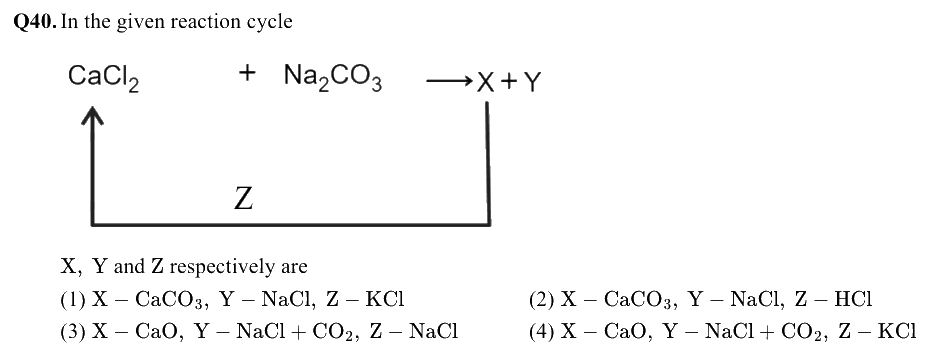
Compound A reacts with $\mathrm{NH_4Cl}$ and forms a compound B. Compound B reacts with $\mathrm{H_2O}$ and excess of $\mathrm{CO_2}$ to form compound C which on passing through or reaction with saturated NaCl solution forms sodium hydrogen carbonate. Compound A. B and C, are respectively.
Statement I: An alloy of lithium and magnesium is used to make aircraft plates. Statement II : The magnesium ions are important for cell-membrane integrity. In the light of the above statements, choose the correct answer from the options given below
Given below are two statements: Statement I : The chlorides of Be and Al have Cl-bridged structure. Both are soluble in organic solvents and act as Lewis bases. Statement II: Hydroxides of Be and Al dissolve in excess alkali to give beryllate and aluminate ions. In the light of the above statements. Choose the correct answer from the options given below.
Reaction of $\mathrm{BeCl_2}$ with $\mathrm{LiAlH_4}$ gives : (A) $\mathrm{AlCl_3}$ (B) $\mathrm{BeH_2}$ (C) $\mathrm{LiH}$ (D) $\mathrm{LiCl}$ (E) $\mathrm{BeAlH_4}$ Choose the correct answer from options given below
Given below are two statements: one is labelled as Assertion A and the other is labelled as Reason R. Assertion A : LiF is sparingly soluble in water. Reason R : The ionic radius of $\mathrm{Li^+}$ ion is smallest among its group members, hence has least hydration enthalpy. In the light of the above statements, choose the most appropriate answer from the options given below.
A
Both A and R are true and R is the correct explanation of A
B
Both A and R are true but R is NOT the correct explanation of A
Match List-I with Match List-II List-I (Metal) List-II (Emitted light wavelength (nm)) (A) Li (B) Na (C) Rb (D) Cs (I) $670.8$ (II) $589.2$ (III) $780.0$ (IV) $455.5$ Choose the most appropriate answer from the options given below
Which of the following statements are correct ? (A) Both LiCl and $\mathrm{MgCl_2}$ are soluble in ethanol. (B) The oxides $\mathrm{Li_2O}$ and MgO combine with excess of oxygen to give superoxide. (C) LiF is less soluble in water than other alkali metal fluorides. (D) $\mathrm{Li_2O}$ is more soluble in water than other alkali metal oxides. Choose the most appropriate answer from the options given below
Number of paramagnetic oxides among the following given oxides is ______. $\mathrm{Li_2O}$, $\mathrm{CaO}$, $\mathrm{Na_2O_2}$, $\mathrm{KO_2}$, $\mathrm{MgO}$ and $\mathrm{K_2O}$
Given below are two statements : one is labelled as Assertion (A) and the other is labelled as Reason (R). Assertion (A): Lithium salts are hydrated. Reason (R) : Lithium has higher polarising power than other alkali metal group members. In the light of the above statements, choose the most appropriate answer from the options given below :
A
(A) is not correct but (R) is correct.
B
(A) is correct but (R) is not correct.
C
Both (A) and (R) are correct but (R) is NOT the correct explanation of (A).
D
Both (A) and (R) are correct and (R) is the correct explanation of (A).
Given below are two statements : one is labelled as Assertion (A) and the other is labelled as Reason (R). Assertion (A): Barium carbonate is insoluble in water and is highly stable. Reason (R): The thermal stability of the carbonates increases with increasing cationic size. Choose the most appropriate answer from the options given below :
Given below are two statements: One is labelled as Assertion A and the other labelled as Reason R. Assertion A : Lithium halides are some what covalent in nature. Reason R : Lithium possess high polarisation capability. In the light of the above statements, choose the most appropriate answer from the options given below:
A
A is true but R is false
B
A is false but R is true
C
Both A and R are true but R is NOT the correct explanation of A
D
Both A and R are true and R is the correct explanation of A
Match List - I with List II : List-I: a Li; b Na; c K; d Cs List-II: i photoelectric cell; ii absorbent of $\mathrm{CO_2}$; iii coolant in fast breeder nuclear reactor; iv treatment of cancer; v bearings for motor engines Choose the correct answer from the options given below:
Given below are two statements: Statement I : None of the alkaline earth metal hydroxides dissolve in alkali. Srtatement II : Solubility of alkaline earth metal hydroxides in water increases down the group. In the light of the above statements, choose the most appropriate answer from the options given below:
A
Statement I is correct but Statement II is incorrect.
B
Statement I is incorrect but Statement II is correct.
Match List I with List II : List-I Elements | List-II Properties (a) Li | (i) Poor water solubility of $\mathrm{I^-}$ salt (b) Na | (ii) Most abundant element in cell fluid (c) K | (iii) Bicarbonate salt used in fire extinguisher (d) Cs | (iv) Carbonate salt decomposes easily on heating Choose the correct answer from the options given below.
Match List-I with List-II List - I (Elements) | List - II (Properties) (a) Ba | (i) Organic solvent soluble compounds (b) Ca | (ii) Outer electronic configuration $6\ \mathrm{s^2}$ (c) Li | (iii) Oxalate insoluble in water (d) Na | (iv) Formation of very strong monoacidic base Choose the correct answer from the options given below:
A s-block element (M) reacts with oxygen to form an oxide of the formula $\mathrm{MO_2}$. The oxide is pale yellow in colour and paramagnetic. The element (M) is:
Match List$-$I with List$-$ II List$-$I List$-$ II (a) $\mathrm{Ca(OCl)_2}$ (i) Antacid (b) $\mathrm{CaSO_4 \cdot \frac{1}{2}H_2O}$ (ii) Cement (c) $\mathrm{CaO}$ (iii) Bleach (d) $\mathrm{CaCO_3}$ (iv) Plaster of paris Choose the most appropriate answer from the
Match list-I with list-II : (a) Be (i) Treatment of cancer (b) Mg (ii) Extraction of metals (c) Ca (iii) Incendiary bombs and signals (d) Ra (iv) Windows of X-ray tubes (v) Bearings for motor engines. Choose the most appropriate answer, the option given below :
Given below are two statements: Statement I : Both $\mathrm{CaCl}_2 \cdot 6 \mathrm{H}_2 \mathrm{O}$ and $\mathrm{MgCl}_2 \cdot 8 \mathrm{H}_2 \mathrm{O}$ undergo dehydration on heating. Statement II : BeO is amphoteric, whereas the oxides of other elements in the same group are acidic. In the light of the above statements, choose the correct answer from the options given below:
Find A, B and C in the following reactions: $\mathrm{NH_3} + \mathrm{A} + \mathrm{CO_2} \rightarrow (\mathrm{NH_4})_2\mathrm{CO_3}$ $(\mathrm{NH_4})_2\mathrm{CO_3} + \mathrm{H_2O} + \mathrm{B} \rightarrow \mathrm{NH_4HCO_3}$ $\mathrm{NH_4HCO_3} + \mathrm{NaCl} \rightarrow \mathrm{NH_4Cl} + \mathrm{C}$
A
A $-$ $\mathrm{H_2O}$; B $-$ $\mathrm{CO_2}$; C $-$ $\mathrm{NaHCO_3}$
B
A $-$ $\mathrm{H_2O}$; B $-$ $\mathrm{O_2}$; C $-$ $\mathrm{Na_2CO_3}$
C
A $-$ $\mathrm{H_2O}$; B $-$ $\mathrm{O_2}$; C $-$ $\mathrm{NaHCO_3}$
D
A $-$ $\mathrm{O_2}$; B $-$ $\mathrm{CO_2}$; C $-$ $\mathrm{Na_2CO_3}$
Match List - I with List - II. List-I (Salt) (a) $\mathrm{LiCl}$ (b) $\mathrm{NaCl}$ (c) $\mathrm{RbCl}$ (d) $\mathrm{CsCl}$ List-II (Flame colour wavelength) (i) $455.5\ \mathrm{nm}$ (ii) $670.8\ \mathrm{nm}$ (iii) $780.0\ \mathrm{nm}$ (iv) $589.2\ \mathrm{nm}$ Choose the correct answer from the options given below:
Match the following compounds (Column-I) with their uses (Column-II) S. No. Column-I S.No. Column-II (I) $\mathrm{Ca\,(OH)_2}$ (A) casts of statues (II) $\mathrm{NaCl}$ (B) white wash (III) $\mathrm{CaSO_4 \cdot \frac{1}{2}H_2O}$ (C) antacid (IV) $\mathrm{CaCO_3}$ (D) washing soda preparation
An alkaline earth metal 'M' readily forms water soluble sulphate and water insoluble hydroxide. Its oxide MO is very stable to heat and does not have rock-salt structure. M is
Two elements A and B have similar chemical properties. They don't form solid hydrogencarbonates, but react with nitrogen to form nitrides. A and B, respectively, are :
Among the statements (a) $-$ (d), the correct ones are: (a) Lithium has the highest hydration enthalpy among the alkali metals. (b) Lithium chloride is insoluble in pyridine. (c) Lithium cannot form ethynide upon its reaction with ethyne. (d) Both lithium and magnesium react slowly with $\mathrm{H_2O}$ .
A metal $(A)$ on heating in nitrogen gas gives compound $B$. $B$ on treatment with $H_2O$ gives a colourless gas which when passed through $CuSO_4$ solution gives a dark blue-violet coloured solution. $A$ and $B$ respectively, are:
A hydrated solid X on heating initially gives a monohydrated compound Y. Y upon heating above 373 K leads to an anhydrous white powder Z. X and Z, respectively, are;
The correct statement(s) among I to III with respect to potassium ions that are abundant within the cell fluids, is/are I. They activate many enzymes. II. They participate in the oxidation of glucose to produce ATP. III. Along with sodium ions, they are responsible for the transmission of nerve signals.
Match the following items in column I with the corresponding items in column II. Column-I (i) Na$_2$CO$_3$.10H$_2$O (ii) Mg(HCO$_3$)$_2$ (iii) NaOH (iv) Ca$_3$Al$_2$O$_6$ Column-II (A) Portland cement ingredient (B) Castner-Kellner process (C) Solvay process (D) Temporary hardness
A metal M reacts with nitrogen gas to afford $\mathrm{M_3N}$, $\mathrm{M_3N}$ on heating at high temperature gives back M and on reaction with water produces a gas B. Gas B reacts with an aqueous solution of $\mathrm{CuSO_4}$ to form a deep blue compound. M and B respectively are
A metal $M$ on heating in nitrogen gas gives $Y$. $Y$ on treatment with $\mathrm{H_2O}$ gives a colourless gas which when passed through $\mathrm{CuSO_4}$ solution gives a blue colour. $Y$ is
A metal M readily forms its sulphate $\mathrm{MSO_4}$ which is water - soluble. It forms its oxide MO which becomes inert on heating. It forms an insoluble hydroxide $\mathrm{M(OH)_2}$ which is soluble in NaOH solution. Then $M$ is
$\mathrm{Mg(NO_3)_2 \cdot XH_2O}$ and $\mathrm{Ba(NO_3)_2 \cdot YH_2O}$, represent formula of the crystalline forms of nitrate salts. Sum of X and Y is ______
Numerical answer type: type your answer in EdLoop to check it
On heating, $\mathrm{LiNO_3}$ gives how many compounds among the following? $\mathrm{Li_2\,O}$, $\mathrm{N_2}$, $\mathrm{O_2}$, $\mathrm{LiNO_2}$, $\mathrm{NO_2}$
Numerical answer type: type your answer in EdLoop to check it
BeO reacts with HF in presence of ammonia to give [A] which on thermal decomposition produces [B] and ammonium fluoride. Oxidation state of Be in [A] is
Numerical answer type: type your answer in EdLoop to check it
Among the following, number of metal/s which can be used as electrodes in the photoelectric cell is ______. (Integer answer) (A) Li (B) Na (C) Rb (D) Cs
Numerical answer type: type your answer in EdLoop to check it
The s-block elements covers alkali and alkaline earth metals and was formerly in the Class 11 curriculum before being removed in 2024, ranking 20 of 31 chapters with a 2.3% share of the chemistry section. During the 2019 to 2026 exam window, s-Block Elements accounted for 104 questions across 162 test papers, taking a 2.3% share of the chemistry section and ranking 20 of 31 chapters. Prior to 2019, from 2002 to 2018, it registered 26 questions across 38 papers with a 1.9% share. In the recent 2024 to 2026 seasons, the chapter saw 0 questions across 58 papers, delivering a 0.0% share. The overall trajectory has trended down following curriculum reduction.
Because the topic was formally deleted, it was not asked in 2024, 2025, or 2026. Prior to removal, the chapter averaged 0.6 questions per paper between 2019 and 2026, including 5 numerical answer questions.
Most-asked topics
Historical questions were split nearly evenly between two groups:
Alkaline Earth Metals: Composed 68 total questions (52 during 2019 to 2026), last tested in 2023. Key topics involved hydration enthalpies, sulfate and carbonate thermal stabilities, solubility trends of hydroxides versus sulfates, anomalous covalent chemistry of beryllium, and industrial manufacturing of cement and quicklime.
Alkali Metals: Accounted for 62 total questions (52 during 2019 to 2026), last examined in 2023. Primary themes centered on standard reduction potentials, liquid ammonia solutions producing deep blue solvated electrons, oxide and superoxide formation (such as KO₂ paramagnetism), the Solvay ammonia-soda process, and thermal decomposition of nitrates.
What the questions look like
Exam items were heavily factual, checking specific chemical reactions and comparative physical trends. Standard patterns included ordering hydration enthalpies across monovalent and divalent cations, explaining why lithium carbonate decomposes on heating while other alkali metal carbonates remain stable, and identifying magnetic behaviors of normal oxides, peroxides, and superoxides.
Questions on industrial compounds evaluated raw materials and intermediate species formed during the Solvay process or reactions involved in setting plaster of Paris.
Questions to try first
Candidates consulting past question papers for broader competitive chemistry preparation can review these selections:
Oxide magnetic characteristics: Distinguishing diamagnetic normal oxides from paramagnetic superoxides across alkali metals.
How to practise it
Because this unit has been dropped from the active syllabus, streamline your focus appropriately:
1. Prioritize active chapters: Direct inorganic chemistry study hours into Coordination Compounds and p-Block Elements rather than obsolete units. 2. Maintain awareness of flame test colors: Characteristic flame emissions for sodium, potassium, and calcium occasionally intersect with qualitative salt analysis. 3. Review solubility rules: Grasping why alkaline earth metal sulfate solubility decreases down the group provides helpful chemical intuition.
Frequently asked questions
Is s-Block Elements part of the current JEE Main exam?
No, the National Testing Agency deleted the s-block chapter in the 2024 syllabus rationalization, with 0 questions asked across the 2024, 2025, and 2026 tests.
Do I need to know sodium and potassium compounds for other topics?
Basic chemical formulas like sodium hydroxide or sodium chloride appear as reagents across organic and physical chemistry, but isolated industrial manufacturing details are not examined.
Where can I check step-by-step solutions for past s-block questions?
Comprehensive solutions for all past year papers remain cataloged for reference. Step-by-step solutions for each one are in the EdLoop app.