Every Environmental Chemistry question from past JEE Main and AIEEE papers, with options and answers. Newest first.
119questions
113papers covered
2.2%of Chemistry questions, 2019–2026
2003–2024years
Guide at a glance
Environmental chemistry covers pollutants and atmospheric chemistry and was formerly in the Class 11 curriculum before being removed in 2024, standing at rank 23 of 31 chapters with a 2.2% share of the chemistry section.
The $\mathrm{F^-}$ ions make the enamel on teeth much harder by converting hydroxyapatite (the enamel on the surface of teeth) into much harder fluoroapatite having the formula.
Which of the following are the Green house gases? A. Water vapour B. Ozone C. $\mathrm{I_2}$ D. Molecular hydrogen Choose the most appropriate answer from the options given below :
Match List I with List II List I A. Nitrogen oxides in air B. Methane in air C. Carbon dioxide D. Phosphate fertilisers in water List II I. Eutrophication II. pH of rain water becomes 5.6 III. Global warming IV. Acid rain Choose the correct answer from the options given below :
Given below are two statements : Statement-I : If BOD is 4 ppm and dissolved oxygen is 8 ppm , then it is a good quality water. Statement-II : If the concentration of zinc and nitrate salts are 5 ppm each, then it can be a good quality water. In the light of the above statements, choose the most appropriate answer from the options given below :
A
Statement I is correct but Statement II is incorrect
B
Statement I is incorrect but Statement II is correct
Match List I with List II List I Industry List II Waste Generated (A) Steel plants (I) Gypsum (B) Thermal power plants (II) Fly ash (C) Fertilizer Industries (III) Slag (D) Paper mills (IV) Bio-degradable wastes Choose the correct answer from the options given below :
Match List I with List II List-I List-2 Species Maximum allowed concentration in ppm in drinking water A $\mathrm{F^-}$ I $< 50$ ppm B $\mathrm{SO_4^{2-}}$ II $< 5$ ppm C $\mathrm{NO_3^-}$ III $< 2$ ppm D Zn IV $< 500$ ppm Choose the correct answer from the options given below.
Identify X, Y and Z in the following reaction. (Equation not balanced) $\mathrm{Cl\dot{O}} + \mathrm{NO_2} \rightarrow \underline{X} \xrightarrow{\mathrm{H_2O}} \underline{Y} + \underline{Z}$
A
X = $\mathrm{ClONO_2}$, Y = HOCl, Z = $\mathrm{NO_2}$
B
X = $\mathrm{ClNO_2}$, Y = HCl, Z = $\mathrm{HNO_3}$
C
X = $\mathrm{ClONO_2}$, Y = HOCl, Z = $\mathrm{HNO_3}$
D
X = $\mathrm{ClNO_3}$, Y = $\mathrm{Cl_2}$, Z = $\mathrm{NO_2}$
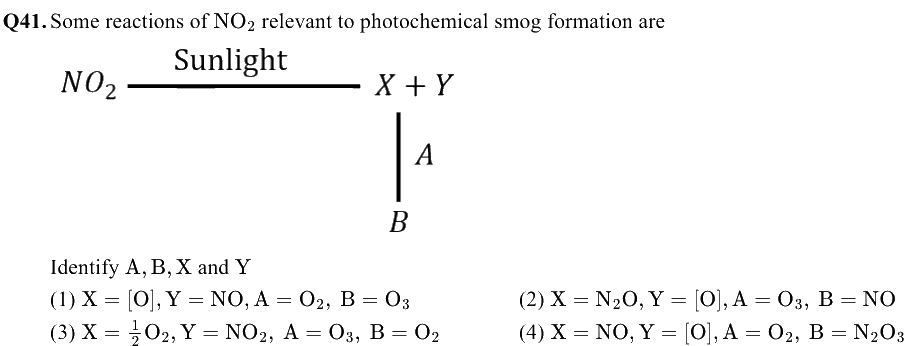
Formation of photochemical smog involves the following reaction in which A, B and C are respectively. (i) $\mathrm{NO_2} \xrightarrow{h\nu} \mathrm{A + B}$ (ii) $\mathrm{B + O_2 \rightarrow C}$ (iii) $\mathrm{A + C \rightarrow NO_2 + O_2}$ Choose the correct answer from the options given below:
The concentration of dissolved Oxygen in water for growth of fish should be more than $\underline{\mathrm{X}}$ ppm and Biochemical Oxygen Demand in clean water should be less than $\underline{\mathrm{Y}}$ ppm. X and Y in ppm are, respectively.
Dinitrogen is a robust compound, but reacts at hig altitude to form oxides. The oxide of nitrogen the can damage plant leaves and retard photosynthes is
Given below are two statements : Statement I : In polluted water values of both dissolved oxygen and BOD are very low. Statement II : Eutrophication results in decrease in the amount of dissolved oxygen. In the light of the above statements, choose the most appropriate answer from the options given below
Given below are two statements: Statement I : The non bio-degradable fly ash and slag from steel industry can be used by cement industry. Statement II : The fuel obtained from plastic waste is lead free. In the light of the above statements, choose the most appropriate answer from the options given below
A
Both Statement I and Statement II are correct
B
Both Statement I and Statement II are incorrect
C
Statement I is correct but Statement II is incorrect
D
Statement I is incorrect but Statement II is correct
Sulphur dioxide is one of the components of polluted air. $\mathrm{SO_2}$ is also a major contributor to acid rain. The correct and complete reaction to represent acid rain caused by $\mathrm{SO_2}$ is :
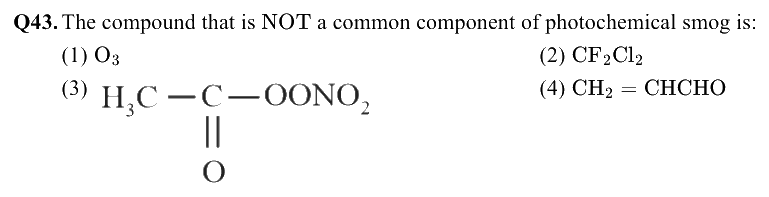
Given below are two Statements : Statement I : Classical smog occurs in cool humid climate. It is a reducing mixture of smoke, fog and sulphur dioxide. Statement II : Photochemical smog has components, ozone, nitric oxide, acrolein, formaldehyde, PAN etc. In the light of the above statements, choose the most appropriate answer from the options given below.
A
Both Statement I and Statement II are correct.
B
Both Statement I and Statement II are incorrect.
C
Statement I is incorrect but Statement II is correct.
D
Statement I is correct but Statement II is incorrect.
On the surface of polar stratospheric clouds, hydrolysis of chlorine nitrate gives A and B while its reaction with HCl produces B and C. A. B and C are respectively
The measured BOD values tor four difterent water samples (A - D) are as tollows: A = 3 ppm; B = 18 ppm; C = 21 ppm; D = 4 ppm. The water samples which can be called as highly polluted with organic wastes, are
Given below are two statements: one is labelled as Assertion and the other is labelled as Reason. Assertion: Polluted water may have a value of BOD of the order of 17ppm. Reason: BOD is a measure of oxygen required to oxidise both the biodegradable and non-biodegradable organic material in water. In the light of the above statements, choose the *most appropriate* answer from the options given below.
A
Both Assertion and Reason are true and Reason is the correct explanation of Assertion.
B
Both Assertion and Reason are true but Reason is NOT the correct explanation of Assertion.
The gas 'A' is having very low reactivity reaches to stratosphere. It is non-toxic and non-flammable but dissociated by UV-radiations in stratosphere. The intermediates formed initially from the gas 'A' are:
Given below are two statements : one is labelled as Assertion (A) and the other is labelled as Reason (R) Assertion (A) : Photochemical smog causes cracking of rubber. Reason (R): Presence of ozone, nitric oxide, acrolein, formaldehyde and peroxyacetyl nitrate in photochemical smog makes it oxidizing. Choose the most appropriate answer from the options given below :
A
(A) is false but (R) is true.
B
Both (A) and (R) are true but (R) is not the true explanation of (A).
C
Both (A) and (R) are true and (R) is the true explanation of (A).
Match List - I with List - II : List - I (compound): a Carbon monoxide; b Sulphur dioxide; c Polychlorinated biphenyls; d Oxides of Nitrogen List - II (effect/affected species): i Carcinogenic; ii Metabolized by pyrus plants; iii Haemoglobin; iv Stiffness of flower buds Choose the correct answer from the options given below:
Given below are two statements : Statement I : Chlorofluoro carbons breakdown by radiation in the visible energy region and release chlorine gas in the atmosphere which then reacts with stratospheric ozone. Statement II : Atmospheric ozone reacts with nitric oxide to give nitrogen and oxygen gases, which add to the atmosphere. For the above statements choose the correct answer from the options given below :
The satements that are TRUE: (A) Methane leads to both global warming and photochemical smog (B) Methane is generated from paddy fields (C) Methane is a stronger global warming gas than $\mathrm{CO_2}$ (D) Methane is a part of reducing smog Choose the most appropriate answer from the options given below:
Given below are two statements : Statement I : Non-biodegradable wastes are generated by the thermal power plants. Statement II : Bio-degradable detergents leads to eutrophication. In the light of the above statements, choose the most appropriate answer from the option given below:
Which of the following statement(s) is (are) incorrect reason for eutrophication? (A) excess usage of fertilisers (B) excess usage of detergents (C) dense plant population in water bodies (D) lack of nutrients in water bodies that prevent plant growth Choose the most appropriate answer from the options given below :
The green house gas/es is (are): (A) Carbon dioxide (B) Oxygen (C) Water vapour (D) Methane Choose the most appropriate answer from the options given below:
Given below are two statements: Statement I : An allotrope of oxygen is an important intermediate in the formation of reducing smog. Statement II : Gases such as oxides of nitrogen and sulphur present in troposphere contribute to the formation of photochemical smog. In the light of the above statements, choose the correct answer from the options given below:
Given below are two statements: Statement I: The pH of rain water is normally ~5.6. Statement II : If the pH of rain water drops below $5.6$, it is called acid rain. In the light of the above statements, choose the correct answer from the options given below:
Given below are two statements: Statement I: The value of the parameter "Biochemical Oxygen Demand (BOD)" is important for survival of aquatic life. Statement II: The optimum value of BOD is $6.5\ \mathrm{ppm}$. In the light of the above statements, choose the most appropriate answer from the options given below:
The incorrect statement(s) among (a) – (d) regarding acid rain is (are): a) It can corrode water pipes (b) It can damage structures made up of stone. (c) It cannot cause respiratory ailments in animals (d) It is not harmful for trees
Among the gases (a) $-$ (e), the gases that cause greenhouse effect are: (a)$\mathrm{CO_2}$ (b)$\mathrm{H_2O}$ (c)$\mathrm{CFCs}$ (d)$\mathrm{O_2}$ (e)$\mathrm{O_3}$
A water sample has ppm level concentration of the following metals: $\mathrm{Fe} = 0.2$ ; $\mathrm{Mn} = 5.0$ ; $\mathrm{Cu} = 3.0$ ; $\mathrm{Zn} = 5.0$ . The metal that makes the water sample unsuitable for drinking is
The recommended concentration of fluoride ion in drinking water is up to 1 ppm as fluoride ion is required to make teeth enamel harder by converting $[3\,\mathrm{Ca_3\,(PO_4)_2 . Ca\,(OH)_2}]$ to:
A water sample has ppm level concentration of following anions $\mathrm{F^{-}} = 10$; $\mathrm{SO_4^{2-}} = 100$; $\mathrm{NO_3^{-}} = 50$ The anion/anions that make/makes the water sample unsuitable for drinking is/are
The concentration of fluoride, lead, nitrate and iron in a water sample from an underground lake was found to be 1000 ppb, 40 ppb, 100 ppm and 0.2 ppm, respectively. This water is unsuitable for drinking due to high concentration of:
Which of the following statements about the depletion of ozone layer is correct?
A
The problem of ozone depletion is less serious at poles because $\mathrm{NO_2}$ solidifies and is not available for consuming $\mathrm{ClO}^{\circ}$ radicals.
B
The problem of ozone depletion is more serious at poles because ice crystals in the clouds over poles act as catalyst for photochemical reactions involving the decomposition of ozone of $\mathrm{Cl}^{\bullet}$ and $\mathrm{ClO}^{\bullet}$ radicals.
C
Freons, chlorofluorocarbons, are inert. Chemically, they do not react with ozone in stratosphere.
D
Oxides of nitrogen also do not react with ozone in stratosphere.
Answer: (B) The problem of ozone depletion is more serious at poles because ice crystals in the clouds over poles act as catalyst for photochemical reactions involving the decomposition of ozone of $\mathrm{Cl}^{\bullet}$ and $\mathrm{ClO}^{\bullet}$ radicals.· Checked by our team
Answer: (D) slightly lower than that of rain water without thunderstorm· Key from source paper
How to prepare Environmental Chemistry for JEE Main
How often it comes up
Environmental chemistry covers pollutants and atmospheric chemistry and was formerly in the Class 11 curriculum before being removed in 2024, standing at rank 23 of 31 chapters with a 2.2% share of the chemistry section. Across 2019 to 2026, Environmental Chemistry contributed 99 questions across 162 exam papers, delivering a 2.2% share of the chemistry section and standing at rank 23 of 31 chapters. During the 2002 to 2018 window, it accounted for 20 questions across 38 papers with a 1.5% share. In the 2024 to 2026 period, it recorded 1 question across 58 papers, capturing a 0.1% share. Its testing trajectory has trended down following curriculum rationalization.
The chapter was not asked in 2025 or 2026, though 1 isolated question appeared in 2024 before full syllabus alignment took effect. Between 2019 and 2026, it averaged 0.6 questions per paper. Numerical answer questions are absent here, with 0 numerical answer questions recorded across the entire 2019 to 2026 timeframe.
Most-asked topics
Historical test questions group under one primary topic:
Pollution: Encompasses 119 total questions (99 during 2019 to 2026), last asked in 2024. Core themes investigated the chemical differences between classical smog (reducing, SO₂) and photochemical smog (oxidizing, NO₂, ozone, PAN), free radical breakdown of ozone by chlorofluorocarbons in the stratosphere, permissible limits of ions in drinking water (fluoride, lead, nitrate causing methemoglobinemia), and BOD thresholds for clean versus polluted water.
What the questions look like
Exam items were purely conceptual, testing factual accuracy regarding environmental mechanisms. Regular patterns asked students to distinguish oxidizing smog from reducing smog based on primary chemical constituents, sunlight requirements, and temperature conditions.
Water quality problems tested standard values such as clean water BOD (less than 5 ppm) or health complications resulting from excessive nitrate intake (blue baby syndrome) and high fluoride concentrations exceeding prescribed thresholds.
Questions to try first
Candidates looking back at past year exams or reviewing general environmental science can explore these historical questions:
Because this unit has been excised from active JEE Main papers, adjust study priorities appropriately:
1. Prioritize active chapters: Direct revision time toward active inorganic and physical chemistry chapters that carry substantial marks. 2. Note basic water quality parameters: Knowing why nitrate causes methemoglobinemia and fluoride protects dental enamel at 1 ppm remains useful general chemical knowledge. 3. Understand free radical ozone depletion: The sequence where chlorine free radicals catalyze ozone decomposition connects with general radical reaction mechanisms.
Frequently asked questions
Is Environmental Chemistry tested in current JEE Main sessions?
No, the National Testing Agency dropped this chapter in 2024. After a single question appeared during the 2024 transition cycle, 0 questions were set in 2025 and 2026.
Why does normal unpolluted rain have a pH around 5.6?
Atmospheric carbon dioxide dissolves in moisture to generate weak carbonic acid, slightly lowering water pH to approximately 5.6 without representing acid rain.
Where can I access full explanations for past environmental questions?
Detailed step-by-step solutions for past papers are cataloged for practice. Step-by-step solutions for each one are in the EdLoop app.