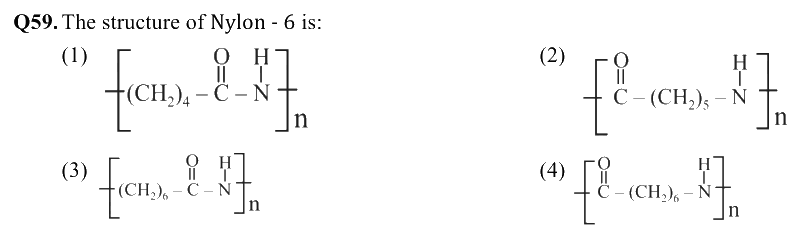
Every Polymers question from past JEE Main and AIEEE papers, with options and answers. Newest first.
89questions
87papers covered
1.3%of Chemistry questions, 2019–2026
2002–2023years
Guide at a glance
Polymers covers macromolecules and monomer linkages and was formerly in the Class 12 curriculum before being removed in 2024, standing at rank 30 of 31 chapters with a 1.3% share of the chemistry section.
Match List I with List II: List I (Monomer) | List II (Polymer) (A) Tetrafluoroethene | (I) Orlon (B) Acrylonitrile | (II) Natural rubber (C) Caprolactam | (III) Teflon (D) Isoprene | (IV) Nylon-6 Choose the correct answer from the options given below:
Match the following Column-A | Column-B a. Nylon 6 | I. Natural Rubber b. Vulcanized Rubber | II. Cross Linked c. cis-1,4-polyisoprene | III. Caprolactam d. Polychloroprene | IV. Neoprene Choose the correct answer from options given below:
A
a $\rightarrow$ III, b $\rightarrow$ II, c $\rightarrow$ I, d $\rightarrow$ IV
B
a $\rightarrow$ III, b $\rightarrow$ IV, c $\rightarrow$ I, d $\rightarrow$ II
C
a $\rightarrow$ IV, b $\rightarrow$ III, c $\rightarrow$ II, d $\rightarrow$ I
D
a $\rightarrow$ II, b $\rightarrow$ III, c $\rightarrow$ IV, d $\rightarrow$ I
Match Lis-I with List-II. List-1 | List-II A. Weak intermolecular forces of attraction | I. Hexamethylenediamine + adipic acid B. Hydrogen bonding | II. $\mathrm{AlEt_3}$ + $\mathrm{TiCl_4}$ C. Heavily branched polymer | III. 2 - chloro - 1, 3 - butadiene D. High density polymer | IV. Phenol + formaldehyde Choose the correct answer from the options given below
Match List I with List II List I (Example) A. 2-chloro-1, 3-butadiene B. Nylon 2-nylon 6 C. Polyacrylonitrile D. Dacron List II (Type) I. Biodegradable polymer II. Synthetic Rubber III. Polyester IV. Addition Polymer Choose the correct answer from the options given below:
The polymer X-consists of linear molecules and is closely packed. It is prepared in the presence of trimethylammoniumpropyl and titanium tetrachloride under low pressure. The polymer X is
Given below are two statements: Statement I: Ethane at 333 to 343 K and 6 - 7 atm pressure in the presence of $\mathrm{AlEt_3}$ and $\mathrm{TiCl_4}$ undergoes addition polymerization to give LDP. Statement II: Caprolactam at 533 - 543 K in $\mathrm{H_2O}$ through step growth polymerizes to give Nylon 6. In the light of the above statements, choose the correct answer from the options given below:
Match List-I with List-II. List-I Polymer List-II Type/Class A. Nylon-2-Nylon-6 I. Thermosetting polymer B. Buna-N II. Biodegradable polymer C. Ureaformaldehyde resin III. Synthetic rubber D. Dacron IV. Polyester Choose the correct answer from the options given below:
A
A $\rightarrow$ IV; B $\rightarrow$ I; C $\rightarrow$ II; D $\rightarrow$ II
B
A $\rightarrow$ II; B $\rightarrow$ III; C $\rightarrow$ I; D $\rightarrow$ IV
C
A $\rightarrow$ IV; B $\rightarrow$ III; C $\rightarrow$ I; D $\rightarrow$ II
D
A $\rightarrow$ II; B $\rightarrow$ I; C $\rightarrow$ IV; D $\rightarrow$ III
Match List-I and List-II. List-I A. Elastomeric polymer B. Fibre polymer C. Thermosetting polymer D. Thermoplastic polymer List-II I. Urea formaldehyde resin II. Polystyrene III. Polyester IV. Neoprene Choose the correct answer from the options given below:
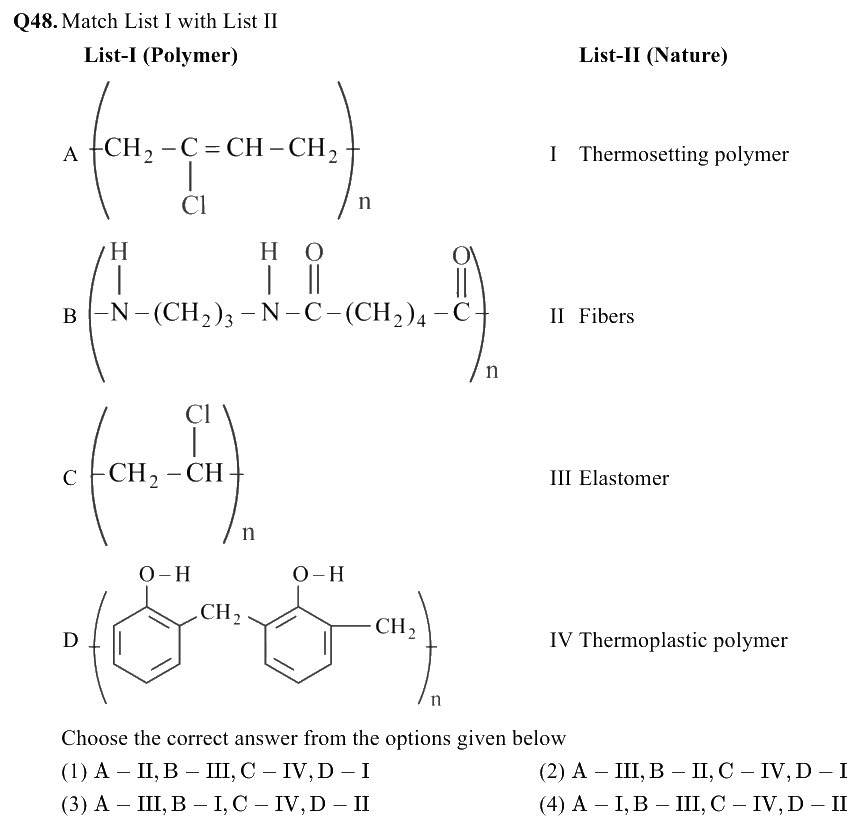
Match List I with List II List-I (Polymer) A. (see the figure above) B. (see the figure above) C. (see the figure above) D. (see the figure above) List-II (Nature) I. Thermosetting polymer II. Fibers III. Elastomer IV. Thermoplastic polymer Choose the correct answer from the options given below
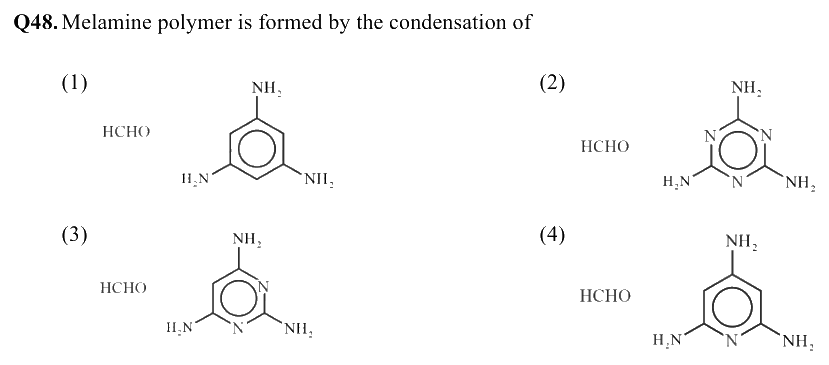
see figure HCHO and a benzene ring carrying three NH2 groups at alternate positions (1,3,5).
B
see figure HCHO and a six-membered ring with three ring nitrogen atoms at alternate positions and an NH2 group on each of the three carbons.
C
see figure HCHO and a six-membered ring with two ring nitrogen atoms, one at the right and one at the bottom of the ring, and three NH2 groups on the ring carbons.
D
see figure HCHO and a six-membered ring with one ring nitrogen atom at the bottom and three NH2 groups on the ring carbons.
Given below are two statements: one is labelled as Assertion A and the other is labelled as Reason R. Assertion A: Dacron is an example of polyester polymer. Reason R: Dacron is made up of ethylene glycol and terephthalic acid monomers. In the light of the above statements, choose the most appropriate answer from the options given below.
A
Both A and R are correct and R is the correct explanation of A
B
Both A and R are correct but R is NOT the correct explanation of A.
Given below are two statements, one is Assertion and other is Reason. Assertion: Natural rubber is a linear polymer of isoprene called cis-polyisoprene with elastic properties. Reason: The cis-polyisoprene molecules consist of various chains held together by strong polar interactions with coiled structure. In the light of the above statements, choose the correct one from the options given below
A
A Both Assertion and Reason are true and Reason is the correct explanation of Assertion
B
Both Assertion and Reason are true but Reason is not the correct explanation of Assertion.
Match List - I with List - II. List-I (Polymer) A Bakelite B Glyptal C PVC D Polystyrene List-II (Used in) I Radio and television cabinets II Electrical switches III Paints and Lacquers IV Water pipes Choose the correct answer from the options given below
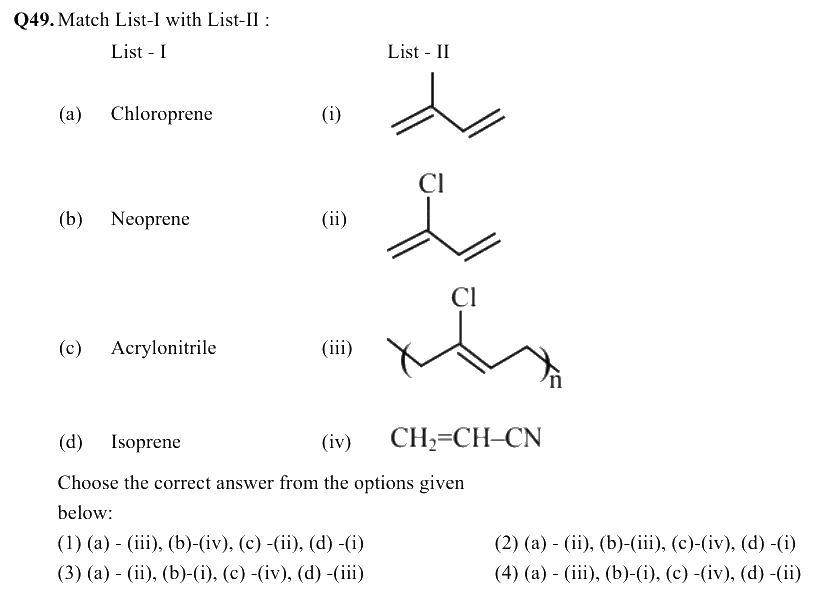
Match List-I with List-II : List - I | List - II (a) Chloroprene | (i) (see the figure above) (b) Neoprene | (ii) (see the figure above) (c) Acrylonitrile | (iii) (see the figure above) (d) Isoprene | (iv) $\mathrm{CH_2{=}CH{-}CN}$ Choose the correct answer from the options given below.
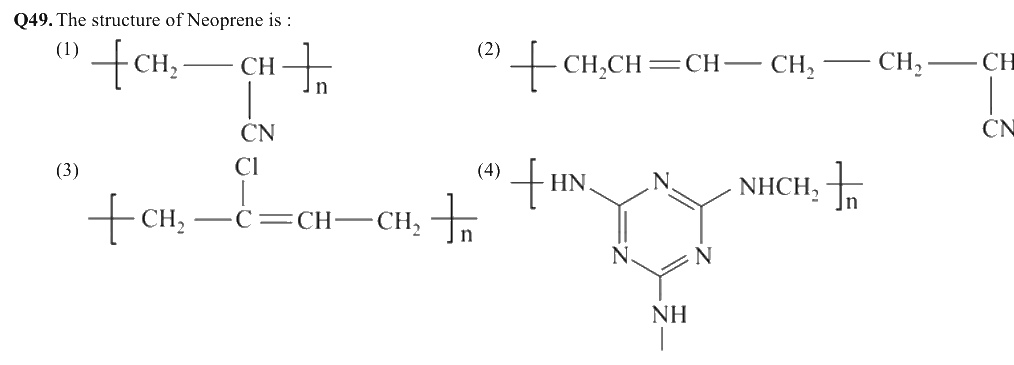
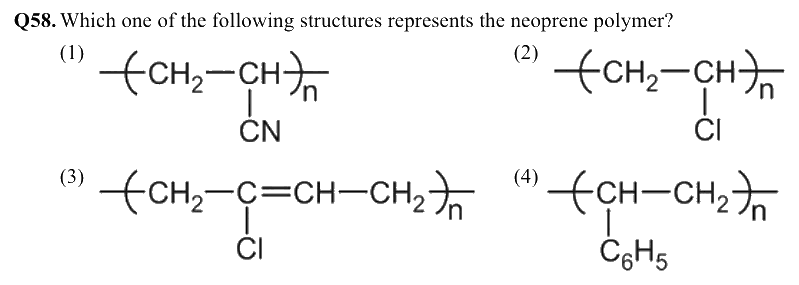
The structure of Neoprene is : (see the figure above)
The question as printed in the paper.
A
see figure Repeating unit in square brackets with subscript n: $-\mathrm{CH_2}-\mathrm{CH}(\mathrm{CN})-$ with CN below the CH.
B
see figure A repeating-unit chain beginning $\mathrm{CH_2CH{=}CH-CH_2-CH_2-CH}$ with CN drawn below the last CH; the crop ends at its right edge before the closing bracket.
C
see figure Repeating unit in square brackets with subscript n: $-\mathrm{CH_2}-\mathrm{C}(\mathrm{Cl}){=}\mathrm{CH}-\mathrm{CH_2}-$ with Cl above the C.
D
see figure Repeating unit in square brackets with subscript n: a 1,3,5-triazine ring with an HN- on the left, an NHCH2 on the right and an NH (with a line continuing downwards) at the bottom.
Match List I with List II. List I (Monomer Unit) (a) Caprolactum (b) 2 - Chloro-1, 3 - butadiene (c) Isoprene (d) Acrylonitrile List II (Polymer) (i) Natural rubber (ii) Buna-N (iii) Nylon 6 (iv) Neoprene Choose the correct answer from the options given below:
Consider the Assertion and Reason given below. Assertion (A) : Ethene polymerized in the presence of Ziegler Natta Catalyst at high temperature and pressure is used to make buckets and dustbins. Reason (R) : High density polymers are closely packed and are chemically inert. Choose the correct answer from the following:
A
(A) is correct but (R) is wrong.
B
Both (A) and (R) are correct but (R) is not the correct explanation of (A).
C
Both (A) and (R) are correct and (R) is the correct explanation of (A).
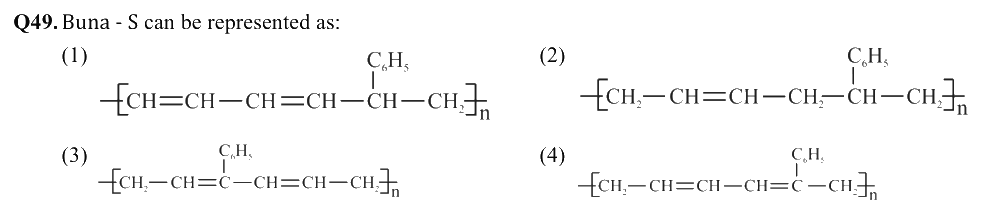
The correct match between item - I and item - II is : Item - I Item - II (a) Natural rubber (I) 1, 3-butadiene + styrene (b) Neoprene (II) 1, 3-butadiene (c) Buna-N (III) chloroprene (d) Buna-S (IV) Isoprene
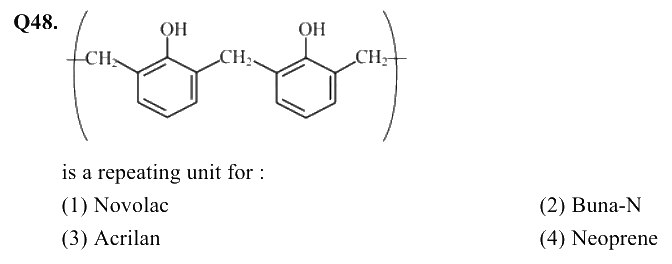
The correct match between Item - I and Item - II is: Item - I (a) High density polythene (b) Polyacrylonitrile (c) Novolac (d) Nylon 6 Item - II (I) Peroxide catalyst (II) Condensation at high temperature & pressure (III) Ziegler-Natta catalyst (IV) Acid or base catalyst
A
a $\rightarrow$ IV, b $\rightarrow$ (II), (c) $\rightarrow$ (I), (d) $\rightarrow$ (III)
B
(a) $\rightarrow$ III, (b) $\rightarrow$ (I), (c) $\rightarrow$ (IV), (d) $\rightarrow$ (II)
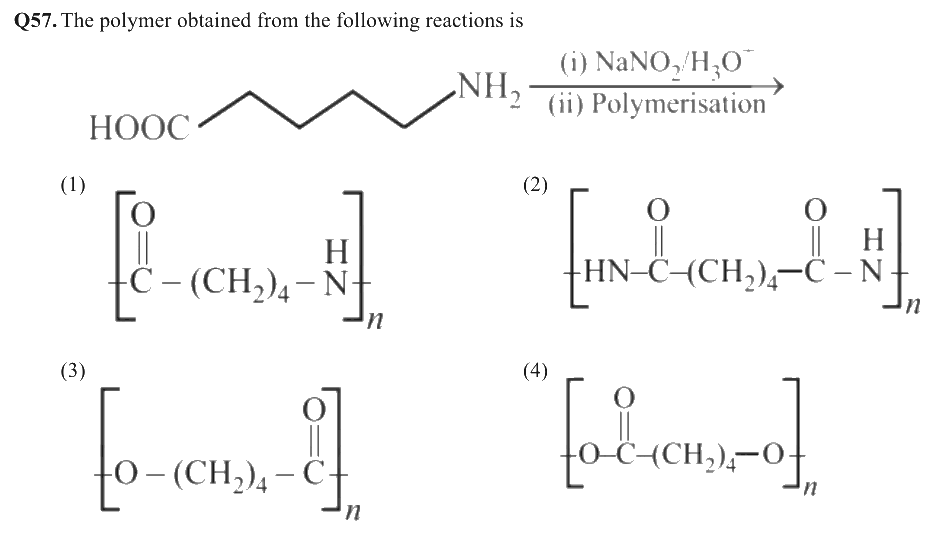
The polymer obtained from the following reactions is (see the figure above)
The question as printed in the paper.
A
see figure $\left[\text{C}(=\text{O})-(\text{CH}_2)_4-\text{NH}\right]_n$ in square brackets, carbonyl O above the C and H above the N
B
see figure $\left[\text{HN}-\text{C}(=\text{O})-(\text{CH}_2)_4-\text{C}(=\text{O})-\text{N(H)}\right]_n$ in square brackets, carbonyl O above each C and H above the N
C
see figure $\left[\text{O}-(\text{CH}_2)_4-\text{C}(=\text{O})\right]_n$ in square brackets
D
see figure $\left[\text{O}-\text{C}(=\text{O})-(\text{CH}_2)_4-\text{O}\right]_n$ in square brackets
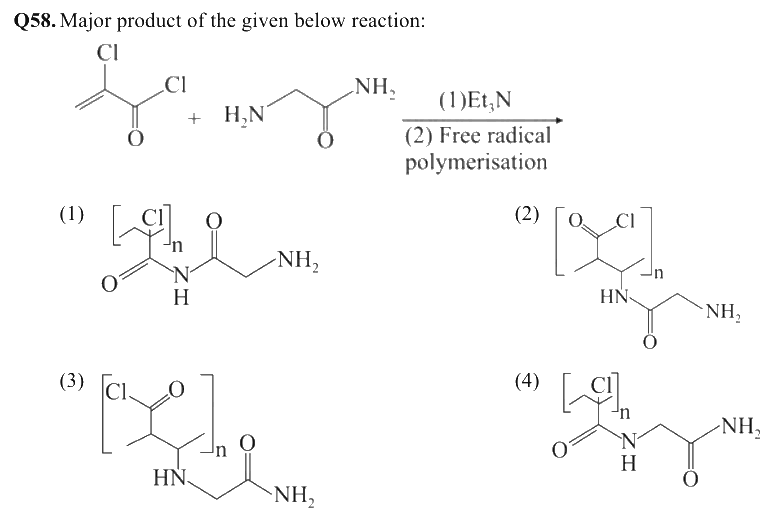
Major product of the given below reaction: (see the figure above)
The question as printed in the paper.
A
see figure Polymer repeat unit [ CH2-C(Cl) ]n whose side group is C(=O)-NH-C(=O)-CH2-NH2.
B
see figure Polymer repeat unit in square brackets (n): a saturated zigzag chain in which one carbon carries C(=O)Cl (O and Cl at the top) and a line to the left (a methyl), and the next carbon carries a line to the right (a methyl) and an NH that leaves the bracket downward; the NH is joined to C(=O)-CH2-NH2 (O at the bottom, NH2 at the right).
C
see figure The same kind of unit as option 2, but with Cl-C(=O) drawn with the Cl at the left and the O at the right of the carbonyl, the bracket enclosing the whole chain, and the NH leaving the bracket downward to C(=O)-CH2-NH2 (O above, NH2 at the lower right).
D
see figure Polymer repeat unit [ CH2-C(Cl) ]n whose side group is C(=O)-NH-CH2-C(=O)-NH2.
Assertion: Rayon is a semisynthetic polymer whose properties are better than natural cotton. Reason: Mechanical and aesthetic properties of cellulose can be improved by acetylation.
A
Both assertion and reason are correct, but the reason is not the correct explanation for the assertion.
B
Both assertion and reason are correct, and the reason is the correct explanation for the assertion.
C
Assertion in incorrect statement, but the reason is correct.
Match the polymers in column-A with their main uses in column-B and choose the correct answer: Column - A A. Polystyrene B. Glyptal C. Polyvinyl chloride D. Bakelite Column - B i. Paints and lacquers ii. Rain coats iii. Manufacture of toys iv. Computer discs
If a polythene sample contains two monodisperse fractions in the ratio 2 : 3 with degree of polymerization 100 and 200, respectively, then its weight average molecular weight will be :
Polymers covers macromolecules and monomer linkages and was formerly in the Class 12 curriculum before being removed in 2024, standing at rank 30 of 31 chapters with a 1.3% share of the chemistry section. In the 2019 to 2026 testing timeframe, Polymers contributed 60 questions across 162 exam papers, delivering a 1.3% share of the chemistry section and standing at rank 30 of 31 chapters. During the 2002 to 2018 period, it registered 29 questions across 38 papers with a 2.2% share. Across the 2024 to 2026 exam sessions, it recorded 0 questions across 58 papers, resulting in a 0.0% share. The overall testing trajectory has trended down following curriculum rationalization.
Because of its removal, the chapter was not asked in 2024, 2025, or 2026. Prior to deletion, the chapter averaged 0.4 questions per paper between 2019 and 2026, with only 1 numerical answer question recorded.
Most-asked topics
Historical test items concentrate under one comprehensive topic:
Polymers: Encompasses 89 total questions (60 in 2019 to 2026), last examined in 2023. Core themes focused on matching polymers with monomers (such as caprolactam for nylon 6, hexamethylenediamine and adipic acid for nylon 6,6, chloroprene for neoprene, acrylonitrile for Orlon/PAN, and ethylene glycol with terephthalic acid for Dacron), classification of intermolecular forces, Ziegler-Natta coordination polymerization producing high-density polyethylene, and biodegradable polymers like PHBV and nylon-2-nylon-6.
What the questions look like
Exam items were predominantly direct and factual. A very frequent pattern presented a matching column of commercial polymers (such as glyptal, Bakelite, neoprene, and Buna-S) and asked students to pair each with its monomer components, polymer type (addition or condensation), or common industrial application.
Other recurring questions evaluated mechanical categories, contrasting elastomers with weak intermolecular forces (such as vulcanized rubber) against fibers with strong intermolecular hydrogen bonding (such as polyamides and polyesters).
Questions to try first
Candidates reviewing past question archives or preparing for other assessments can examine these past questions:
Given that Polymers is excluded from the current syllabus, structure your study schedule accordingly:
1. Direct study time to active units: Focus on active organic chapters like Aldehydes, Ketones & Carboxylic Acids, and Biomolecules. 2. Note basic monomer formulas: Knowing monomers like caprolactam or chloroprene remains helpful for general chemical literacy and allied competitive tests. 3. Understand condensation versus addition: Addition polymers retain the complete formula of the monomer; condensation polymers eliminate small byproduct molecules like water or alcohol.
Frequently asked questions
Is Polymers included in the active JEE Main syllabus?
No, the National Testing Agency officially deleted Polymers from the syllabus in 2024, and 0 questions were set on it across 2024, 2025, and 2026.
What is the difference between Buna-S and Buna-N?
Both are synthetic addition copolymers using 1,3-butadiene; Buna-S copolyermizes butadiene with styrene, whereas Buna-N copolymerizes butadiene with acrylonitrile.
Where can I check full solutions to past Polymers questions?
Complete solutions to historical questions remain cataloged for reference. Step-by-step solutions for each one are in the EdLoop app.