EdLoop PYQs · free, no ads · questions and answers here, step-by-step solutions in the EdLoop app
PYQs · free, no adsOpen on the web (app.edloop.in)Get EdLoop – free on Google Play
ChemistryPeriodic Table & Periodicity

Periodic Table & Periodicity: JEE Main PYQs 2003–2026

Every Periodic Table & Periodicity question from past JEE Main and AIEEE papers, with options and answers. Newest first.

182questions
154papers covered
3.2%of Chemistry questions, 2019–2026
2003–2026years

Guide at a glance

Periodic table and periodicity establishes periodic trends under Unit 9: Classification of Elements and Periodicity in Properties in the Class 11 curriculum, holding rank 16 of 31 chapters with a 3.2% share of the chemistry section.

Most asked sub-topics

Periodic Trends157
Periodic Table25

Practise these in EdLoop

Attempt every Periodic Table & Periodicity question timed, see the step-by-step solution and track what you get wrong. Free.

Start practice

MCQ, single correct

174 questions
1JEE Main 2026 · 8 Apr · Shift 2MCQOpen question page ↗

Match List - I with List - II.

List - I Electronic configuration of neutral atom (where n = 2)List - II 1$^{\text{st}}$ Ionization Energy (kJ mol$^{-1}$)
A. $\mathrm{ns^2}$I. 2080
B. $\mathrm{ns^2np^1}$II. 899
C. $\mathrm{ns^2np^3}$III. 800
D. $\mathrm{ns^2np^6}$IV. 1402

Choose the correct answer from the options given below :

  • A

    A-II, B-III, C-IV, D-I

  • B

    A-IV, B-III, C-II, D-I

  • C

    A-III, B-II, C-IV, D-I

  • D

    A-III, B-II, C-I, D-IV

2JEE Main 2026 · 6 Apr · Shift 2MCQOpen question page ↗

In a period, the first ionisation enthalpy of the element at extreme left and the negative electron gain enthalpy of the extreme right element, except noble gases, are respectively.

  • A

    lowest and lowest

  • B

    highest and lowest

  • C

    lowest and highest

  • D

    highest and highest

3JEE Main 2026 · 5 Apr · Shift 1MCQOpen question page ↗

Given below are two statements:

Statement I: The correct order of electronegativity of fluorine, oxygen and nitrogen is F > O > N.

Statement II: The oxidation state of oxygen in $\mathrm{OF_2}$ is +2 and in $\mathrm{Na_2O}$ is $-2$.

In the light of the above statements, choose the *correct* answer from the options given below

  • A

    Both Statement I and Statement II are true

  • B

    Both Statement I and Statement II are false

  • C

    Statement I is true but Statement II is false

  • D

    Statement I is false but Statement II is true

4JEE Main 2026 · 5 Apr · Shift 2MCQOpen question page ↗

Given below are two statements :

Statement I : The number of pairs among $[\mathrm{Al_2O_3, Cr_2O_3}]$, $[\mathrm{Cl_2O_7, Mn_2O_7}]$, $[\mathrm{Na_2O, V_2O_3}]$ and $[\mathrm{CO, N_2O}]$ that contain oxides of same nature (acidic, basic, neutral or amphoteric) is 4.

Statement II : Among $\mathrm{Na_2O}$, $\mathrm{Al_2O_3}$, CO and $\mathrm{Cl_2O_7}$, the most basic and acidic oxides are $\mathrm{Na_2O}$ and $\mathrm{Cl_2O_7}$, respectively.

In the light of the above statements, choose the correct answer from the options given below :

  • A

    Both Statement I and Statement II are true

  • B

    Both Statement I and Statement II are false

  • C

    Statement I is true but Statement II is false

  • D

    Statement I is false but Statement II is true

5JEE Main 2026 · 4 Apr · Shift 2MCQOpen question page ↗

The 1$^{\text{st}}$ ionization enthalpy for Mg is +737 kJ/mol. The most probable estimated value of the 2$^{\text{nd}}$ ionization enthalpy of Mg is ________.

  • A

    $-906$ kJ/mol

  • B

    $-856$ kJ/mol

  • C

    +1450 kJ/mol

  • D

    +590 kJ/mol

6JEE Main 2026 · 2 Apr · Shift 1MCQOpen question page ↗

Given below are two statements :

Statement (I) : The first ionisation enthalpy of the elements Na, Mg, Cl and Ar follows the order Na > Mg > Cl > Ar.

Statement (II) : Among Ca, Al, Fe and B, the third ionisation enthalpy is very high for Ca.

In the light of the above statements, choose the correct answer from the options given below :

  • A

    Both Statement I and Statement II are true

  • B

    Both Statement I and Statement II are false

  • C

    Statement I is true but Statement II is false

  • D

    Statement I is false but Statement II is true

7JEE Main 2026 · 2 Apr · Shift 2MCQOpen question page ↗

The correct set that contains all kinds (basic, acidic, amphoteric and neutral) of oxides is :

  • A

    $\mathrm{Na_2O}$, $\mathrm{K_2O}$, $\mathrm{Al_2O_3}$ and $\mathrm{As_2O_3}$

  • B

    $\mathrm{Al_2O_3}$, $\mathrm{As_2O_3}$, CO and NO

  • C

    $\mathrm{K_2O}$, $\mathrm{Cl_2O_7}$, $\mathrm{As_2O_3}$ and NO

  • D

    $\mathrm{Na_2O}$, $\mathrm{N_2O}$, $\mathrm{Al_2O_3}$ and CO

8JEE Main 2026 · 2 Apr · Shift 2MCQOpen question page ↗

Given below are two statements :

Statement I : The second ionization enthalpy of B, Al and Ga is in the order of B > Al > Ga.

Statement II : The correct order in terms of first ionization enthalpy is Si < Ge < Pb < Sn.

In the light of the above statements, choose the correct answer from the options given below :

  • A

    Both Statement I and Statement II are true

  • B

    Both Statement I and Statement II are false

  • C

    Statement I is true but Statement II is false

  • D

    Statement I is false but Statement II is true

9JEE Main 2026 · 28 Jan · Shift 1MCQOpen question page ↗

In period 4 of the periodic table, the elements with highest and lowest atomic radii are respectively.

  • A

    K & Se

  • B

    K & Br

  • C

    Rb & Br

  • D

    Na & Cl

10JEE Main 2026 · 28 Jan · Shift 2MCQOpen question page ↗

Consider the elements N, P, O, S, Cl and F. The number of valence electrons present in the elements with most and least metallic character from the above list is respectively.

  • A

    7 and 5

  • B

    6 and 7

  • C

    5 and 6

  • D

    5 and 7

11JEE Main 2026 · 24 Jan · Shift 1MCQOpen question page ↗

Given below are two statements:

Statement I: K $>$ Mg $>$ Al $>$ B is the correct order in terms of metallic character.

Statement II: Atomic radius is always greater than the ionic radius for any element.

In the light of the above statements, choose the *correct* answer from the options given below

  • A

    Statement I is false but Statement II is true

  • B

    Statement I is true but Statement II is false

  • C

    Both Statement I and Statement II are false

  • D

    Both Statement I and Statement II are true

12JEE Main 2026 · 24 Jan · Shift 2MCQOpen question page ↗

The correct order of C, N, O and F in terms of second ionisation potential is

  • A

    C $<$ N $<$ F $<$ O

  • B

    F $<$ N $<$ C $<$ O

  • C

    C $<$ O $<$ N $<$ F

  • D

    C $<$ F $<$ N $<$ O

13JEE Main 2026 · 23 Jan · Shift 1MCQOpen question page ↗

The correct trend in the first ionization enthalpies of the elements in the 3$^{rd}$ period of periodic table is :

  • A

    Al<Si<S<P<Cl

  • B

    Si<S<Al<P<Cl

  • C

    S<Si<Al<P<Cl

  • D

    Al<S<P<Si<Cl

14JEE Main 2026 · 23 Jan · Shift 2MCQOpen question page ↗

Given below are two statements:

Statement I: The second ionisation enthalpy of Na is larger than the corresponding ionisation enthalpy of Mg.

Statement II: The ionic radius of $\mathrm{O^{2-}}$ is larger than that of $\mathrm{F^-}$.

In the light of the above statements, choose the correct answer from the options given below

  • A

    Statement I is true but Statement II is false

  • B

    Statement I is false but Statement II is true

  • C

    Both Statement I and Statement II are true

  • D

    Both Statement I and Statement II are false

15JEE Main 2026 · 22 Jan · Shift 2MCQOpen question page ↗

Given below are two statements :

Statement I : $\mathrm{C} < \mathrm{O} < \mathrm{N} < \mathrm{F}$ is the correct order in terms of first ionization enthalpy values.

Statement II : $\mathrm{S} > \mathrm{Se} > \mathrm{Te} > \mathrm{Po} > \mathrm{O}$ is the correct order in terms of the magnitude of electron gain enthalpy values.

In the light of the above statements, choose the correct answer from the options given below :

  • A

    Statement I is false but Statement II is true

  • B

    Both Statement I and Statement II are true

  • C

    Both Statement I and Statement II are false

  • D

    Statement I is true but Statement II is false

16JEE Main 2026 · 21 Jan · Shift 1MCQOpen question page ↗

Which of the following represents the correct trend for the mentioned property ?

A. $\mathrm{F} > \mathrm{P} > \mathrm{S} > \mathrm{B}$ - First Ionization Energy

B. $\mathrm{Cl} > \mathrm{F} > \mathrm{S} > \mathrm{P}$ - Electron Affinity

C. $\mathrm{K} > \mathrm{Al} > \mathrm{Mg} > \mathrm{B}$ - Metallic character

D. $\mathrm{K_2O} > \mathrm{Na_2O} > \mathrm{MgO} > \mathrm{Al_2O_3}$ - Basic character

Choose the correct answer from the options given below :

  • A

    A, B and D only

  • B

    A and B only

  • C

    B and C only

  • D

    A, B, C and D

17JEE Main 2026 · 21 Jan · Shift 2MCQOpen question page ↗

Given below are two statements :

Statement I : The correct order in terms of atomic/ionic radii is $\mathrm{Al} > \mathrm{Mg} > \mathrm{Mg^{2+}} > \mathrm{Al^{3+}}$.

Statement II : The correct order in terms of the magnitude of electron gain enthalpy is $\mathrm{Cl} > \mathrm{Br} > \mathrm{S} > \mathrm{O}$.

In the light of the above statements, choose the correct answer from the options given below :

  • A

    Both Statement I and Statement II are false

  • B

    Both Statement I and Statement II are true

  • C

    Statement I is false but Statement II is true

  • D

    Statement I is true but Statement II is false

19JEE Main 2025 · 7 Apr · Shift 2MCQOpen question page ↗

Choose the incorrect trend in the atomic radii (r) of the elements.

  • A

    $r_{At} < r_{CS}$

  • B

    $r_{Br} < r_K$

  • C

    $r_{Mg} < r_{Al}$

  • D

    $r_{Rb} < r_{Cs}$

20JEE Main 2025 · 3 Apr · Shift 1MCQOpen question page ↗

Which of the following statements are correct?

A. The process of adding an electron to a neutral gaseous atom is always exothermic.

B. The process of removing an electron from an isolated gaseous atom is always endothermic.

C. The $1^{st}$ ionization energy of boron is less than that of beryllium.

D. The electronegativity of C is 2.5 in $CH_4$ and $CCl_4$

E. $Li$ is the most electropositive among elements of group I .

Choose the correct answer from the options given below:

  • A

    B, C and E Only

  • B

    A, C and D Only

  • C

    B and C Only

  • D

    B and D Only

21JEE Main 2025 · 3 Apr · Shift 2MCQOpen question page ↗

Match the LIST-I with LIST-II

List-I (Family)List-II (Symbol of Element)
A.Pnictogen (group 15)I.Ts
B.ChalcogenII.Og
C.HalogenIII.Lv
D.Noble gasIV.Mc

Choose the correct answer from the options given below:

  • A

    A-IV, B-III, C-I, D-II

  • B

    A-II, B-III, C-IV, D-I

  • C

    A-IV, B-I, C-II, D-III

  • D

    A-III, B-I, C-IV, D-II

22JEE Main 2025 · 2 Apr · Shift 1MCQOpen question page ↗

The property/properties that show irregularity in first four elements of group-17 is/are :

(A) Covalent radius (B) Electron affinity (C) Ionic radius (D) First ionization energy

Choose the correct answer from the options given below :

  • A

    B only

  • B

    B and D only

  • C

    A and C only

  • D

    A, B, C and D

23JEE Main 2025 · 2 Apr · Shift 2MCQOpen question page ↗

Electronic configuration of four elements A,B,C and D are given below :

(A) $1s^22s^22p^3$ (B) $1s^22s^22p^4$ (C) $1s^22s^22p^5$ (D) $1s^22s^22p^2$

Which of the following is the correct order of increasing electronegativity (Pauling's scale) ?

  • A

    $A < C < B < D$

  • B

    $A < B < C < D$

  • C

    $A < D < B < C$

  • D

    $D < A < B < C$

24JEE Main 2025 · 29 Jan · Shift 1MCQOpen question page ↗

An element ' $E'$ has the ionisation enthalpy value of 374 kJ $\mathrm{mol^{-1}}$. ' E ' reacts with elements A, B, C and D with electron gain enthalpy values of $-328, -349, -325$ and $-295$ kJ $\mathrm{mol^{-1}}$, respectively. The correct order of the products EA, EB, EC and ED in terms of ionic character is :

  • A

    ED > EC > EB > EA

  • B

    EA > EB > EC > ED

  • C

    EB > EA > EC > ED

  • D

    ED > EC > EA > EB

25JEE Main 2025 · 29 Jan · Shift 1MCQOpen question page ↗

Given below are two statements : Statement (I): The radii of isoelectronic species increases in the order. $\mathrm{Mg^{2+} < Na^+ < F^- < O^{2-}}$ Statement (II): The magnitude of electron gain enthalpy of halogen decreases in the order. Cl > F > Br > I In the light of the above statements, choose the most appropriate answer from the options given below :

  • A

    Statement I is incorrect but Statement II is correct

  • B

    Statement I is correct but Statement II is incorrect

  • C

    Both Statement I and Statement II are incorrect

  • D

    Both Statement I and Statement II are correct

26JEE Main 2025 · 29 Jan · Shift 2MCQOpen question page ↗

The type of oxide formed by the element among Li, Na, Be, Mg, B and Al that has the least atomic radius is :

  • A

    $\mathrm{A_2O}$

  • B

    $\mathrm{A_2O_3}$

  • C

    $\mathrm{AO_2}$

  • D

    AO

27JEE Main 2025 · 28 Jan · Shift 1MCQOpen question page ↗

Consider the following elements In, Tl, Al, Pb, Sn and Ge . The most stable oxidation states of elements with highest and lowest first ionisation enthalpies, respectively, are

  • A

    +4 and +1

  • B

    +1 and +4

  • C

    +4 and +3

  • D

    +2 and +3

28JEE Main 2025 · 28 Jan · Shift 1MCQOpen question page ↗

The incorrect decreasing order of atomic radii is

  • A

    Si > P > Cl > F

  • B

    Be > Mg > Al > Si

  • C

    Al > B > N > F

  • D

    Mg > Al > C > O

29JEE Main 2025 · 28 Jan · Shift 2MCQOpen question page ↗

Given below are two statements : Statement (I): According to the Law of Octaves, the elements were arranged in the increasing order of their atomic number. Statement (II): Meyer observed a periodically repeated pattern upon plotting physical properties of certain elements against their respective atomic numbers. In the light of the above statements, choose the correct answer from the options given below :

  • A

    Both Statement (I) and Statement (II) are false.

  • B

    Both Statement (I) and Statement (II) are true.

  • C

    Statement (I) is false but Statement (II) is true.

  • D

    Statement (I) is true but Statement (II) is false.

30JEE Main 2025 · 24 Jan · Shift 1MCQOpen question page ↗

Which of the following statements are NOT true about the periodic table? A. The properties of elements are function of atomic weights. B. The properties of elements are function of atomic numbers. C. Elements having similar outer electronic configurations are arranged in same period. D. An element's location reflects the quantum numbers of the last filled orbital. E. The number of elements in a period is same as the number of atomic orbitals available in energy level that is being filled. Choose the correct answer from the options given below:

  • A

    A, C and E Only

  • B

    A and E Only

  • C

    B, C and E Only

  • D

    D and E Only

31JEE Main 2025 · 24 Jan · Shift 2MCQOpen question page ↗

Given below are two statements :

Statement (I) : The first ionization energy of Pb is greater than that of Sn .

Statement (II) : The first ionization energy of Ge is greater than that of Si .

In the light of the above statements, choose the correct answer from the options given below :

  • A

    Statement I is false but Statement II is true

  • B

    Statement I is true but Statement II is false

  • C

    Both Statement I and Statement II are true

  • D

    Both Statement I and Statement II are false

32JEE Main 2025 · 24 Jan · Shift 2MCQOpen question page ↗

The successive 5 ionisation energies of an element are 800, 2427, 3658, 25024 and 32824 kJ/mol, respectively. By using the above values predict the group in which the above element is present :

  • A

    Group 13

  • B

    Group 14

  • C

    Group 2

  • D

    Group 4

33JEE Main 2025 · 23 Jan · Shift 1MCQOpen question page ↗

The element that does not belong to the same period of the remaining elements (modern periodic table) is:

  • A

    Iridium

  • B

    Platinum

  • C

    Osmium

  • D

    Palladium

34JEE Main 2025 · 23 Jan · Shift 2MCQOpen question page ↗

Given below are two statements about X-ray spectra of elements : Statement (I) : A plot of $\sqrt{v}$ ( $v$ = frequency of $X$-rays emitted) vs atomic mass is a straight line. Statement (II) : A plot of $v$($v$ = frequency of $X$-rays emitted) vs atomic number is a straight line. In the light of the above statements, choose the correct answer from the options given below :

  • A

    Both Statement I and Statement II are true

  • B

    Statement I is false but Statement II is true

  • C

    Both Statement I and Statement II are false

  • D

    Statement I is true but Statement II is false

35JEE Main 2025 · 22 Jan · Shift 1MCQOpen question page ↗

Which of the following electronegativity order is incorrect?

  • A

    Mg < Be < B < N

  • B

    S < Cl < O < F

  • C

    Al < Si < C < N

  • D

    Al < Mg < B < N

36JEE Main 2025 · 22 Jan · Shift 1MCQOpen question page ↗

Match List-I with List-II.

List – IcList – II
(A)$\mathrm{Al^{3+}} < \mathrm{Mg^{2+}} < \mathrm{Na^+} < \mathrm{F^-}$(I)IonisationEnthalpy
(B)B < C < O < N(II)Metalliccharacter
(C)B < Al < Mg < K(III)Electronegativity
(D)Si < P < S < Cl(IV)Ionicradii

Choose the correct answer from the options given below :

  • A

    (A)-(IV), (B)-(I), (C)-(II), (D)-(III)

  • B

    (A)-(IV), (B)-(I), (C)- (III), (D)-(II)

  • C

    (A)-(III), (B)-(IV), (C)- (II), (D)-(I)

  • D

    (A)-(II), (B)-(III), (C)-(IV), (D)-(I)

37JEE Main 2025 · 22 Jan · Shift 2MCQOpen question page ↗

Given below are two statements : Statement (I) : An element in the extreme left of the periodic table forms acidic oxides. Statement (II) : Acid is formed during the reaction between water and oxide of a reactive element present in the extreme right of the periodic table. In the light of the above statements, choose the correct answer from the options given below :

  • A

    Statement I is true but Statement II is false

  • B

    Both Statement I and Statement II are true

  • C

    Both Statement I and Statement II are false

  • D

    Statement I is false but Statement II is true

38JEE Main 2024 · 9 Apr · Shift 1MCQOpen question page ↗

Given below are two statements : Statement (I) : The oxidation state of an element in a particular compound is the charge acquired by its atom on the basis of electron gain enthalpy consideration from other atoms in the molecule. Statement (II) : p$\pi - $p$\pi$ bond formation is more prevalent in second period elements over other periods. In the light of the above statements, choose the most appropriate answer from the options given below :

  • A

    Both Statement I and Statement II are correct

  • B

    Both Statement I and Statement II are incorrect

  • C

    Statement I is incorrect but Statement II is correct

  • D

    Statement I is correct but Statement II is incorrect

39JEE Main 2024 · 8 Apr · Shift 1MCQOpen question page ↗

Match List I with List II Choose the correct answer from the options given below:

List - I (Elements)List - II (Properties in their respective groups)
A.Cl, SI.Elements with highest electronegativity
B.Ge, AsII.Elements with largest atomic size
C.Fr, RaIII.Elements which show properties of both metals and non-metal
D.F, OIV.Elements with highest negative electron gain enthalpy
  • A

    A-II, B-I, C-IV, D-III

  • B

    A-III, B-II, C-I, D-IV

  • C

    A-IV, B-III, C-II, D-I

  • D

    A-II, B-III, C-IV, D-I

40JEE Main 2024 · 8 Apr · Shift 2MCQOpen question page ↗

Identify the correct statements about p-block elements and their compounds. (A) Non metals have higher electronegativity than metals. (B) Non metals have lower ionisation enthalpy than metals. (C) Compounds formed between highly reactive nonmetals and highly reactive metals are generally ionic. (D) The non-metal oxides are generally basic in nature. (E) The metal oxides are generally acidic or neutral in nature. Choose the correct answer from the options given below :

  • A

    (B) and (D) only

  • B

    (A) and (C) only

  • C

    (D) and (E) only

  • D

    (B) and (E) only

41JEE Main 2024 · 6 Apr · Shift 1MCQOpen question page ↗

The electron affinity value are negative for A. Be $\rightarrow$ $Be^{-}$ B. N $\rightarrow$ $N^{-}$ C. O $\rightarrow$ $O^{2-}$ D. Na $\rightarrow$ $Na^{-}$ E. Al $\rightarrow$ $Al^{-}$ Choose the most appropriate answer from the options given below :

  • A

    D and E only

  • B

    A, B and C only

  • C

    A and D only

  • D

    A, B, D and E only

42JEE Main 2024 · 5 Apr · Shift 1MCQOpen question page ↗

The statement(s) that are correct about the species $\mathrm{O^{2-}}$, $\mathrm{F^-}$, $\mathrm{Na^+}$ and $\mathrm{Mg^{2+}}$. (A) All are isoelectronic (B) All have the same nuclear charge (C) $\mathrm{O^{2-}}$ has the largest ionic radii (D) $\mathrm{Mg^{2+}}$ has the smallest ionic radii Choose the most appropriate answer from the options given below :

  • A

    (B), (C) and (D) only

  • B

    (C) and (D) only

  • C

    (A), (C) and (D) only

  • D

    (A), (B), (C) and (D)

43JEE Main 2024 · 5 Apr · Shift 2MCQOpen question page ↗

Given below are two statements : Statement I : The metallic radius of Na is 1.86 $\mathrm{A^\circ}$ and the ionic radius of $\mathrm{Na^+}$ is lesser than 1.86 $\mathrm{A^\circ}$. Statement II : Ions are always smaller in size than the corresponding elements. In the light of the above statements, choose the correct answer from the options given below :

  • A

    Both Statement I and Statement II are false

  • B

    Statement I is incorrect but Statement II is true

  • C

    Both Statement I and Statement II are true

  • D

    Statement I is correct but Statement II is false

44JEE Main 2024 · 4 Apr · Shift 1MCQOpen question page ↗

Number of elements from the following that CANNOT form compounds with valencies which match with their respective group valencies is ______. B, C, N, S, O, F, P, Al, Si

  • A

    7

  • B

    3

  • C

    5

  • D

    6

45JEE Main 2024 · 4 Apr · Shift 1MCQOpen question page ↗

The correct order of first ionization enthalpy values of the following elements is : (A) O (B) N (C) Be (D) F (E) B Choose the correct answer from the options given below :

  • A

    E < C < A < B < D

  • B

    C < E < A < B < D

  • C

    B < D < C < E < A

  • D

    A < B < D < C < E

46JEE Main 2024 · 4 Apr · Shift 2MCQOpen question page ↗

Given below are two statements : Statement I : The correct order of first ionization enthalpy values of Li, Na, F and Cl is Na < Li < Cl < F. Statement II : The correct order of negative electron gain enthalpy values of Li, Na, F and Cl is Na < Li < F < Cl In the light of the above statements, choose the correct answer from the options given below :

  • A

    Statement I is true but Statement II is false

  • B

    Statement I is false but Statement II is true

  • C

    Both Statement I and Statement II are false

  • D

    Both Statement I and Statement II are true

47JEE Main 2024 · 1 Feb · Shift 1MCQOpen question page ↗

In case of isoelectronic species the size of $\mathrm{F^-}$, Ne and $\mathrm{Na^+}$ is affected by:

  • A

    Principal quantum number n

  • B

    None of the factors because their size is the same

  • C

    Electron-electron interaction in the outer orbitals

  • D

    Nuclear charge z

48JEE Main 2024 · 1 Feb · Shift 2MCQOpen question page ↗

Given below are two statements :

Statement (I) : Both metal and non-metal exist in $\mathrm{p}$ and d-block elements.

Statement (II) : Non-metals have higher ionisation enthalpy and higher electronegativity than the metals.

In the light of the above statements, choose the most appropriate answer from the option given below:

  • A

    Both Statement I and Statement II are false

  • B

    Statement I is false but Statement II is true

  • C

    Statement I is true but Statement II is false

  • D

    Both Statement I and Statement II are true

49JEE Main 2024 · 31 Jan · Shift 1MCQOpen question page ↗

The correct sequence of electron gain enthalpy of the elements listed below is

A. Ar B. Br C. F D. S

Choose the most appropriate from the options given below:

  • A

    C > B > D > A

  • B

    A > D > B > C

  • C

    A > D > C > B

  • D

    D > C > B > A

50JEE Main 2024 · 31 Jan · Shift 2MCQOpen question page ↗

Consider the following elements.

(see the figure above)

Which of the following is/are true about $A'$, $B'$, $C'$ and $D'$ ?

A. Order of atomic radii: $B' < A' < D' < C'$

B. Order of metallic character : $B' < A' < D' < C'$

C. Size of the element : $D' < C' < B' < A'$

D. Order of ionic radii : $B'^{+} < A'^{+} < D'^{+} < C'^{+}$

Choose the correct answer from the options given below:

The question and its figure as printed in JEE Main 2024 31 Jan Shift 2.
The question as printed in the paper.
  • A

    A only

  • B

    A, B and D only

  • C

    A and B only

  • D

    B, C and D only

51JEE Main 2024 · 30 Jan · Shift 2MCQOpen question page ↗

Given below are two statements:

Statement - I: Along the period, the chemical reactivity of the element gradually increases from group 1 to group 18 .

Statement - II: The nature of oxides formed by group 1 element is basic while that of group 17 elements is acidic.

In the the light above statements, choose the most appropriate from the questions given below:

  • A

    Both statement I and Statement II are true.

  • B

    Statement I is true but Statement II is False.

  • C

    Statement I is false but Statement II is true.

  • D

    Both Statement I and Statement II are false.

52JEE Main 2024 · 29 Jan · Shift 1MCQOpen question page ↗

Given below are two statements : one is labelled as Assertion A and the other is labelled as Reason R:

Assertion A: The first ionisation enthalpy decreases across a period.

Reason R: The increasing nuclear charge outweighs the shielding across the period.

In the light of the above statements, choose the most appropriate from the options given below:

  • A

    Both A and R are true and R is the correct explanation of A

  • B

    A is true but R is false

  • C

    A is false but R is true

  • D

    Both A and R are true but R is NOT the correct explanation of A

54JEE Main 2024 · 29 Jan · Shift 2MCQOpen question page ↗

Given below are two statements:

Statement I: Fluorine has most negative electron gain enthalpy in its group.

Statement II: Oxygen has least negative electron gain enthalpy in its group.

In the light of the above statements, choose the most appropriate from the options given below.

  • A

    Both Statement I and Statement II are true

  • B

    Statement I is true but Statement II is false

  • C

    Both Statement I and Statement II are false

  • D

    Statement I is false but Statement II is true

55JEE Main 2024 · 27 Jan · Shift 1MCQOpen question page ↗

Given below are two statements :

Statement (I) : The 4f and 5f - series of elements are placed separately in the Periodic table to preserve the principle of classification.

Statement (II) : s-block elements can be found in pure form in nature.

In light of the above statements, choose the most appropriate answer from the options given below:

  • A

    Statement I is false but Statement II is true

  • B

    Both Statement I and Statement II are true

  • C

    Statement I is true but Statement II is false

  • D

    Both Statement I and Statement II are false

56JEE Main 2023 · 13 Apr · Shift 1MCQOpen question page ↗

Which of the following statements are not correct?
A. The electron gain enthalpy of F is more negative than that of Cl.
B. Ionization enthalpy decreases in a group of periodic table.
C. The electronegativity of an atom depends upon the atoms bonded to it.
D. $\mathrm{Al_2\,O_3}$ and NO are examples of amphoteric oxides.
Choose the most appropriate answer from the options given below:

  • A

    A, B, C and D

  • B

    A, B and D only

  • C

    B and D only

  • D

    A, C and D only

57JEE Main 2023 · 11 Apr · Shift 1MCQOpen question page ↗

For elements B, C, N Li, Be, O and F, the correct order of first ionisation enthalpy is

  • A

    Li < Be < B < C < O < N < F

  • B

    B < Li < Be < C < N < O < F

  • C

    Li < Be < B < C < N < O < F

  • D

    Li < B < Be < C < O < N < F

58JEE Main 2023 · 10 Apr · Shift 2MCQOpen question page ↗

Given below are two statements: one is labelled as Assertion A and the other is labelled as Reason R.
Assertion A : The energy required to form $\mathrm{Mg^{2+}}$ from Mg is much higher than that required to produce $\mathrm{Mg^{+}}$
Reason R: $\mathrm{Mg^{2+}}$ is small ion and carry more charge than $\mathrm{Mg^{+}}$
In the light of the above statements, choose the correct answer from the options given below.

  • A

    Both A and R are true but R is NOT the correct explanation of A

  • B

    A is true but R is false

  • C

    A is false but R is true

  • D

    Both A and R are true and R is the correct explanation of A

59JEE Main 2023 · 10 Apr · Shift 2MCQOpen question page ↗

The correct order of metallic character is

  • A

    $\mathrm{K} > \mathrm{Be} > \mathrm{Ca}$

  • B

    $\mathrm{Be} > \mathrm{Ca} > \mathrm{K}$

  • C

    $\mathrm{Ca} > \mathrm{K} > \mathrm{Be}$

  • D

    $\mathrm{K} > \mathrm{Ca} > \mathrm{Be}$

60JEE Main 2023 · 8 Apr · Shift 1MCQOpen question page ↗

The correct order of electronegativity for given elements is

  • A

    $\mathrm{P} > \mathrm{Br} > \mathrm{C} > \mathrm{At}$

  • B

    $\mathrm{Br} > \mathrm{P} > \mathrm{At} > \mathrm{C}$

  • C

    $\mathrm{Br} > \mathrm{C} > \mathrm{At} > \mathrm{P}$

  • D

    $\mathrm{C} > \mathrm{P} > \mathrm{At} > \mathrm{Br}$

61JEE Main 2023 · 8 Apr · Shift 2MCQOpen question page ↗

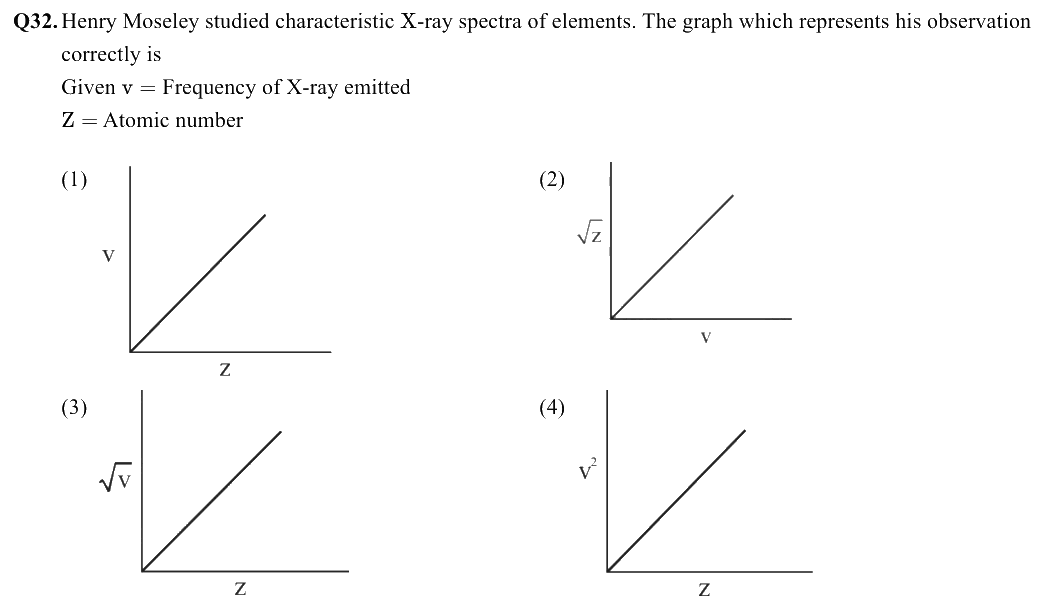
Henry Moseley studied characteristic X-ray spectra of elements. The graph which represents his observation correctly is

Given v = Frequency of X-ray emitted

Z = Atomic number

(see the figure above)

The question and its figure as printed in JEE Main 2023 08 Apr Shift 2. Option 1: Graph of v (vertical) against Z (horizontal): a straight line rising from the origin. Option 2: Graph of the square root of Z (vertical) against v (horizontal): a straight line rising from the origin. Option 3: Graph of the square root of v (vertical) against Z (horizontal): a straight line rising from the origin. Option 4: Graph of v squared (vertical) against Z (horizontal): a straight line rising from the origin.
The question as printed in the paper.
  • A

    see figure Graph of v (vertical) against Z (horizontal): a straight line rising from the origin.

  • B

    see figure Graph of the square root of Z (vertical) against v (horizontal): a straight line rising from the origin.

  • C

    see figure Graph of the square root of v (vertical) against Z (horizontal): a straight line rising from the origin.

  • D

    see figure Graph of v squared (vertical) against Z (horizontal): a straight line rising from the origin.

63JEE Main 2023 · 1 Feb · Shift 1MCQOpen question page ↗

Given below are two statements:
Statement I: Chlorine can easily combine with oxygen to from oxides: and the product has a tendency to explode.
Statement II: Chemical reactivity of an element can be determined by its reaction with oxygen and halogens.
In the light of the above statements, choose the correct answer from the options given below

  • A

    Both the statements I and II are true

  • B

    Statement I is true but Statement II is false

  • C

    Statement I is false but Statement II is true

  • D

    Both the Statements I and II are false

64JEE Main 2023 · 1 Feb · Shift 2MCQOpen question page ↗

For electron gain enthalpies of the elements denoted as $\Delta_{eg}$H, the incorrect option is :

  • A

    $\Delta_{eg}$H(Cl) < $\Delta_{eg}$H(F)

  • B

    $\Delta_{eg}$H(Se) < $\Delta_{eg}$H(S)

  • C

    $\Delta_{eg}$H(I) < $\Delta_{eg}$H(At)

  • D

    $\Delta_{eg}$H(Te) < $\Delta_{eg}$H(Po)

65JEE Main 2023 · 31 Jan · Shift 1MCQOpen question page ↗

The correct increasing order of the ionic radii is

  • A

    $\mathrm{Cl^-} < \mathrm{Ca^{2+}} < \mathrm{K^+} < \mathrm{S^{2-}}$

  • B

    $\mathrm{K^+} < \mathrm{S^{2-}} < \mathrm{Ca^{2+}} < \mathrm{Cl^-}$

  • C

    $\mathrm{S^{2-}} < \mathrm{Cl^-} < \mathrm{Ca^{2+}} < \mathrm{K^+}$

  • D

    $\mathrm{Ca^{2+}} < \mathrm{K^+} < \mathrm{Cl^-} < \mathrm{S^{2-}}$

66JEE Main 2023 · 31 Jan · Shift 1MCQOpen question page ↗

The correct order of basicity of oxides of vanadium is

  • A

    $\mathrm{V_2O_3} > \mathrm{V_2O_4} > \mathrm{V_2O_5}$

  • B

    $\mathrm{V_2O_3} > \mathrm{V_2O_5} > \mathrm{V_2O_4}$

  • C

    $\mathrm{V_2O_5} > \mathrm{V_2O_4} > \mathrm{V_2O_3}$

  • D

    $\mathrm{V_2O_4} > \mathrm{V_2O_3} > \mathrm{V_2O_5}$

67JEE Main 2023 · 30 Jan · Shift 1MCQOpen question page ↗

Match List - I with List - II

LIST-I (Atomic number)
(A) 37
(B) 78
(C) 52
(D) 65

LIST-II (Block of periodic table)
I. p-block
II. d-block
III. f-block
IV. s-block

Choose the correct answer from the options given below:

  • A

    A - II, B - IV, C - I, D - III

  • B

    A - I, B - III, C - IV, D - II

  • C

    A - IV, B - III, C - II, D - I

  • D

    A - IV, B - II, C - I, D - III

68JEE Main 2023 · 25 Jan · Shift 1MCQOpen question page ↗

Inert gases have positive electron gain enthalpy. Its correct order is

  • A

    Xe < Kr < Ne < He

  • B

    He < Ne < Kr < Xe

  • C

    He < Xe < Kr < Ne

  • D

    He < Kr < Xe < Ne

69JEE Main 2023 · 25 Jan · Shift 2MCQOpen question page ↗

Which of the following represents the correct order of metallic character of the given elements?

  • A

    Si < Be < Mg < K

  • B

    Be < Si < Mg < K

  • C

    K < Mg < Be < Si

  • D

    Be < Si < K < Mg

70JEE Main 2023 · 24 Jan · Shift 1MCQOpen question page ↗

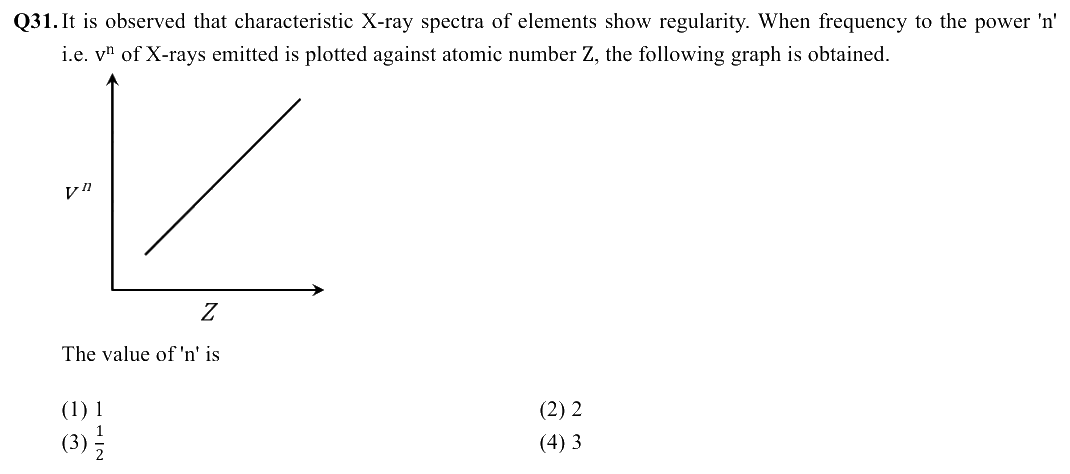
It is observed that characteristic X-ray spectra of elements show regularity. When frequency to the power 'n' i.e. $\nu^{n}$ of X-rays emitted is plotted against atomic number Z, the following graph is obtained.

(see the figure above)

The value of 'n' is

The question and its figure as printed in JEE Main 2023 24 Jan Shift 1.
The question as printed in the paper.
  • A

    1

  • B

    2

  • C

    $\frac{1}{2}$

  • D

    3

71JEE Main 2022 · 29 Jul · Shift 1MCQOpen question page ↗

The first ionization enthalpy of Na, Mg and Si, respectively, are: 496, 737 and 786 $\mathrm{kJ\ mol^{-1}}$. The first ionization enthalpy ($\mathrm{kJ mol^{-1}}$) of Al is

  • A

    487

  • B

    768

  • C

    577

  • D

    856

72JEE Main 2022 · 28 Jul · Shift 1MCQOpen question page ↗

In which of the following pairs, electron gain enthalpies of constituent elements are nearly the same or identical?
(A) Rb and Cs
(B) Na and K
(C) Ar and Kr
(D) I and At
Choose the correct answer from the options given below

  • A

    A & B only

  • B

    B & C only

  • C

    A & C only

  • D

    C & D only

73JEE Main 2022 · 28 Jul · Shift 2MCQOpen question page ↗

The correct decreasing order for metallic character is

  • A

    $\mathrm{Na>Mg>Be>Si>P}$

  • B

    $\mathrm{P>Si>Be>Mg>Na}$

  • C

    $\mathrm{Si>P>Be>Na>Mg}$

  • D

    $\mathrm{Be>Na>Mg>Si>P}$

74JEE Main 2022 · 27 Jul · Shift 1MCQOpen question page ↗

The incorrect statement is

  • A

    The first ionization enthalpy of K is less than that of Na and Li

  • B

    Xe does not have the lowest first ionization enthalpy in its group

  • C

    The first ionization enthalpy of element with atomic number 37 is lower than that of the element with atomic number 38.

  • D

    The first ionization enthalpy of Ga is higher than that of the d-block element with atomic number 30.

75JEE Main 2022 · 27 Jul · Shift 2MCQOpen question page ↗

Outermost electronic configurations of four elements A, B, C, D are given below:
(A) $3\ \mathrm{s^2}$
(B) $\mathrm{3s^2 3p^1}$
(C) $3\ \mathrm{s^2 3p^3}$
(D) $3\ \mathrm{s^2 3p^4}$
The correct order of first ionization enthalpy for them is

  • A

    A < B < C < D

  • B

    B < A < D < C

  • C

    B < D < A < C

  • D

    B < A < C < D

76JEE Main 2022 · 26 Jul · Shift 1MCQOpen question page ↗

Given two statements below :
Statement I : In $\mathrm{Cl_2}$ molecule the covalent radius is double of the atomic radius of chlorine.
Statement II : Radius of anionic species is always greater than their parent atomic radius.
Choose the most appropriate answer from options given below

  • A

    Both Statement I and Statement II are correct.

  • B

    Both Statement I and Statement II are incorrect.

  • C

    Statement I is correct but Statement II is incorrect.

  • D

    Statement I is incorrect but Statement II is correct.

77JEE Main 2022 · 25 Jul · Shift 1MCQOpen question page ↗

The IUPAC nomenclature of an element with electronic configuration $\mathrm{Rn5f^{14}6d^{1}7s^{2}}$ is

  • A

    Unnilunium

  • B

    Unnilbium

  • C

    Unniltrium

  • D

    Unnilquadium

78JEE Main 2022 · 25 Jul · Shift 2MCQOpen question page ↗

The first ionization enthalpies of Be, B, N and O follow the order

  • A

    $\mathrm{B < Be < O < N}$

  • B

    $\mathrm{O < N < B < Be}$

  • C

    $\mathrm{Be < B < N < O}$

  • D

    $\mathrm{B < Be < N < O}$

79JEE Main 2022 · 25 Jul · Shift 2MCQOpen question page ↗

The total number of acidic oxides from the following list is:
$\mathrm{NO,\ N_2O,\ B_2O_3,\ N_2O_5,\ CO,\ SO_3,\ P_4O_{10}}$

  • A

    $5$

  • B

    $4$

  • C

    $3$

  • D

    $6$

80JEE Main 2022 · 29 Jun · Shift 2MCQOpen question page ↗

Given below are two statements. One is labelled as Assertion A and the other is labelled as Reason R.
Assertion A : The first ionization enthalpy for oxygen is lower than that of nitrogen.
Reason R : The four electrons in 2p orbitals of oxygen experience more electron-electron repulsion.
In the light of the above statements, choose the correct answer from the options given below.

  • A

    Both A and R are correct and R is the correct explanation of A.

  • B

    Both A and R are correct but R is NOT the correct explanation of A.

  • C

    A is correct but R is not correct.

  • D

    A is not correct but R is correct

81JEE Main 2022 · 28 Jun · Shift 1MCQOpen question page ↗

Element "E" belongs to the period 4 and group 16 of the periodic table. The valence shell electron configuration of the element, which is just above "E" in the group is

  • A

    $2s^2 2p^4$

  • B

    $3d^{10}, 4s^2, 4p^4$

  • C

    $3s^2 3p^4$

  • D

    $4d^{10}, 5s^2, 5p^4$

82JEE Main 2022 · 28 Jun · Shift 2MCQOpen question page ↗

Match List-I with List-II
List-I
(A) $\mathrm{Cl_2\,O_7}$
(B) $\mathrm{Na_2\,O}$
(C) $\mathrm{Al_2\,O_3}$
(D) $\mathrm{N_2O}$
List-II
(I) Amphoteric
(II) Basic
(III) Neutral
(IV) Acidic
Choose the correct answer from the options given below

  • A

    (A) $-$ (IV), (B) $-$ (III), (C) $-$ (I), (D) $-$ (II)

  • B

    (A) $-$ (IV), (B) $-$ (II), (C) $-$ (I), (D) $-$ (III)

  • C

    (A) $-$ (II), (B) $-$ (IV), (C) $-$ (III), (D) $-$ (I)

  • D

    (A) $-$ (I), (B) $-$ (II), (C) $-$ (III), (D) $-$ (IV)

84JEE Main 2022 · 27 Jun · Shift 1MCQOpen question page ↗

Given below are two statements : one is labelled as Assertion and the other is labelled as Reason.
Assertion: The ionic radii of $\mathrm{O^{2-}}$ and $\mathrm{Mg^{2+}}$ are same.
Reason: Both $\mathrm{O^{2-}}$ and $\mathrm{Mg^{2+}}$ are isoelectronic species.
In the light of the above statements, choose the correct answer from the options given below.

  • A

    Both Assertion and Reason are true and Reason is the correct explanation of Assertion.

  • B

    Both Assertion and Reason are true but Reason is not the correct explanation of Assertion.

  • C

    Assertion is true but Reason is false.

  • D

    Assertion is false but Reason is true.

85JEE Main 2022 · 27 Jun · Shift 2MCQOpen question page ↗

The correct order of ionic size of $\mathrm{N^{3-}}, \mathrm{Na^{+}}, \mathrm{F^{-}}, \mathrm{Mg^{2+}}$ and $\mathrm{O^{2-}}$ is :

  • A

    $\mathrm{Mg^{2+} < Na^{+} < F^{-} < O^{2-} < N^{3-}}$

  • B

    $\mathrm{N^{3-} < O^{2-} < F < Na^{+} < Mg^{2+}}$

  • C

    $\mathrm{F^{-} < Na^{+} < O^{2-} < Mg^{2+} < N^{3-}}$

  • D

    $\mathrm{Na^{+} < F^{-} < Mg^{2+} < O^{2-} < N^{3-}}$

87JEE Main 2022 · 25 Jun · Shift 2MCQOpen question page ↗

What is the correct oder of electron gain enthalpy of Cl, F, Te, Po

  • A

    $\mathrm{F} > \mathrm{Cl} > \mathrm{Te} > \mathrm{Po}$

  • B

    $\mathrm{Cl} > \mathrm{F} > \mathrm{Te} > \mathrm{Po}$

  • C

    $\mathrm{Te} > \mathrm{Po} > \mathrm{Cl} > \mathrm{F}$

  • D

    $\mathrm{Po} > \mathrm{Te} > \mathrm{F} > \mathrm{Cl}$

88JEE Main 2022 · 24 Jun · Shift 1MCQOpen question page ↗

Given below are the oxides :
$\mathrm{Na_2O}$, $\mathrm{As_2O_3}$, $\mathrm{N_2O}$, NO and $\mathrm{Cl_2O_7}$ Number of amphoteric oxides is :

  • A

    $0$

  • B

    $1$

  • C

    $2$

  • D

    $3$

89JEE Main 2021 · 31 Aug · Shift 1MCQOpen question page ↗

Given below are two statements : one is labelled as Assertion (A) and the other is labelled as Reason (R).
Assertion (A) : Metallic character decreases and non-metallic character increases on moving from left to right in a period.
Reason (R): It is due to increase in ionisation enthalpy and decrease in electron gain enthalpy, when one moves from left to right in a period.
In the light of the above statements, choose the most appropriate answer from the options given below :

  • A

    (A) is false but (R) is true.

  • B

    Both (A) and (R) are correct and (R) is the correct explanation of (A)

  • C

    Both (A) and (R) are correct but (R) is not the correct explanation of (A).

  • D

    (A) is true but (R) is false.

90JEE Main 2021 · 27 Aug · Shift 2MCQOpen question page ↗

The correct order of ionic radii for the ions, $\mathrm{P^{3-}}$, $\mathrm{S^{2-}}$, $\mathrm{Ca^{2+}}$, $\mathrm{K^{+}}$, $\mathrm{Cl^{-}}$ is :

  • A

    $\mathrm{P^{3-}>S^{2-}>Cl^{-}>K^{+}>Ca^{2+}}$

  • B

    $\mathrm{P^{3-}>S^{2-}>Cl^{-}>Ca^{2+}>K^{+}}$

  • C

    $\mathrm{Cl^{-}>S^{2-}>P^{3-}>Ca^{2+}>K^{+}}$

  • D

    $\mathrm{K^{+}>Ca^{2+}>P^{3-}>S^{2-}>Cl^{-}}$

91JEE Main 2021 · 27 Jul · Shift 1MCQOpen question page ↗

Match List $-$ I with List $-$ II :
List $-$I: (a) NaOH; (b) $\mathrm{Be(OH)_2}$; (c) $\mathrm{Ca(OH)_2}$; (d) $\mathrm{B(OH)_3}$; (e) $\mathrm{Al(OH)_3}$
List$-$ II: (i) Acidic; (ii) Basic; (iii) Amphoteric
Choose the most appropriate answer from the options given below

  • A

    (a) $-$ (ii), (b) $-$ (ii), (c) $-$ (iii), (d) $-$ (ii), (e) $-$

  • B

    (a) $-$ (ii), (b) $-$ (iii), (c) $-$ (ii), (d) $-$ (i), (e) $-$ (iii)

  • C

    (a) $-$ (ii), (b) $-$ (ii), (c) $-$ (iii), (d) $-$ (i), (e) $-$

  • D

    (a) $-$ (ii), (b) $-$ (i), (c) $-$ (ii), (d) $-$ (iii), (e) $-$ (iii)

92JEE Main 2021 · 27 Jul · Shift 2MCQOpen question page ↗

The CORRECT order of first ionisation enthalpy is:

  • A

    $\mathrm{Mg < S < Al < P}$

  • B

    $\mathrm{Mg < Al < S < P}$

  • C

    $\mathrm{Al < Mg < S < P}$

  • D

    $\mathrm{Mg < Al < P < S}$

93JEE Main 2021 · 25 Jul · Shift 1MCQOpen question page ↗

The ionic radii of $\mathrm{K^+}$, $\mathrm{Na^+}$, $\mathrm{Al^{3+}}$ and $\mathrm{Mg^{2+}}$ are in the order :

  • A

    $\mathrm{Na^+ < K^+ < Mg^{2+} < Al^{3+}}$

  • B

    $\mathrm{Al^{3+} < Mg^{2+} < K^+ < Na^+}$

  • C

    $\mathrm{Al^{3+} < Mg^{2+} < Na^+ < K^+}$

  • D

    $\mathrm{K^+ < Al^{3+} < Mg^{2+} < Na^+}$

94JEE Main 2021 · 25 Jul · Shift 2MCQOpen question page ↗

The ionic radii of $\mathrm{F^-}$ and $\mathrm{O^{2-}}$ respectively are $1.33\ \mathrm{A}$ and $1.4\mathrm{A}$, while the covalent radius of N is $0.74\mathrm{A}$
The correct statement for the ionic radius of $\mathrm{N^{3-}}$ from the following is :

  • A

    It is smaller than $\mathrm{F^-}$ and N

  • B

    It is bigger than $\mathrm{O^{2-}}$ and $\mathrm{F^-}$

  • C

    It is bigger than $\mathrm{F^-}$ and N, but smaller than of $\mathrm{O^{2-}}$

  • D

    It is smaller than $\mathrm{O^{2-}}$ and $\mathrm{F^-}$, but bigger than of N

95JEE Main 2021 · 22 Jul · Shift 1MCQOpen question page ↗

Which one of the following statements for D.I. Mendeleeff, is incorrect ?

  • A

    He authored the textbook - Principles of Chemistry.

  • B

    At the time, he proposed Periodic Table of elements structure of atom was known.

  • C

    Element with atomic number 101 is named after him.

  • D

    He invented accurate barometer.

96JEE Main 2021 · 20 Jul · Shift 1MCQOpen question page ↗

The set in which compounds have different nature is:

  • A

    $\mathrm{B(OH)_3}$ and $\mathrm{H_3PO_3}$

  • B

    $\mathrm{B(OH)_3}$ and $\mathrm{Al(OH)_3}$

  • C

    $\mathrm{NaOH}$ and $\mathrm{Ca(OH)_2}$

  • D

    $\mathrm{Be(OH)_2}$ and $\mathrm{Al(OH)_3}$

97JEE Main 2021 · 20 Jul · Shift 2MCQOpen question page ↗

Outermost electronic configuration of a group 13 element, E, is $4~\mathrm{s^2}, 4\mathrm{p^1}$. The electronic configuration of an element of p-block period-five placed diagonally to element, E is:

  • A

    $[\mathrm{Kr}]\,3~\mathrm{d^{10}}4~\mathrm{s^2}4\mathrm{p^2}$

  • B

    $[\mathrm{Ar}]\,3~\mathrm{d^{10}}4~\mathrm{s^2}4\mathrm{p^2}$

  • C

    $[\mathrm{Xe}]\,5~\mathrm{d^{10}}6~\mathrm{s^2}6\mathrm{p^2}$

  • D

    $[\mathrm{Kr}]\,4~\mathrm{d^{10}}5~\mathrm{s^2}5\mathrm{p^2}$

98JEE Main 2021 · 18 Mar · Shift 1MCQOpen question page ↗

The ionic radius of $\mathrm{Na^+}$ ions is $1.02\,\mathrm{\AA}$. The ionic radii (in $\mathrm{\AA}$) of $\mathrm{Mg^{2+}}$ and $\mathrm{Al^{3+}}$, respectively, are

  • A

    1.05 and 0.99

  • B

    0.72 and 0.54

  • C

    0.85 and 0.99

  • D

    0.68 and 0.72

99JEE Main 2021 · 18 Mar · Shift 2MCQOpen question page ↗

The first ionization energy of magnesium is smaller, as compared to that of elements X and Y, but higher than that of Z. The elements X, Y and Z, respectively, are :

  • A

    chlorine, lithium and sodium

  • B

    argon, lithium and sodium

  • C

    argon, chlorine and sodium

  • D

    neon, sodium and chlorine

100JEE Main 2021 · 17 Mar · Shift 1MCQOpen question page ↗

The absolute value of the electron gain enthalpy of halogens satisfies:

  • A

    $\mathrm{I}>\mathrm{Br}>\mathrm{Cl}>\mathrm{F}$

  • B

    $\mathrm{Cl}>\mathrm{Br}>\mathrm{F}>\mathrm{I}$

  • C

    $\mathrm{Cl}>\mathrm{F}>\mathrm{Br}>\mathrm{I}$

  • D

    $\mathrm{F}>\mathrm{Cl}>\mathrm{Br}>\mathrm{I}$

101JEE Main 2021 · 17 Mar · Shift 2MCQOpen question page ↗

The set of elements that differ in mutual relationship from those of the other sets is:

  • A

    Li $-$ Mg

  • B

    B $-$ Si

  • C

    Be $-$ Al

  • D

    Li $-$ Na

102JEE Main 2021 · 16 Mar · Shift 2MCQOpen question page ↗

Identify the elements X and Y using the ionization energy values given below :

Ionization energy (kJ / mol) 1stIonization energy (kJ / mol) 2nd
X4954563
Y7311450
  • A

    X = Na; Y = Mg

  • B

    X = Mg; Y = F

  • C

    X = Mg; Y = Na

  • D

    X = F; Y = Mg

103JEE Main 2021 · 16 Mar · Shift 2MCQOpen question page ↗

The characteristics of elements X, Y and Z with atomic numbers, respectively, 33, 53 and 83 are:

  • A

    X and Y are metalloids and Z is a metal

  • B

    X is a metalloid, Y is a non-metal and Z is a metal.

  • C

    X, Y and Z are metals.

  • D

    Xand Z are non-metals and Y is a metalloid

104JEE Main 2021 · 26 Feb · Shift 1MCQOpen question page ↗

Match List-I with List-II.

List-I (Electronic configuration of elements)List-II ($\Delta_i H$ in $\mathrm{kJ\ mol^{-1}}$)
(a) $1s^2 2s^2$(p) 801
(b) $1s^2 2s^2 2p^4$(q) 899
(c) $1s^2 2s^2 2p^3$(r) 1314
(d) $1s^2 2s^2 2p^1$(s) 1402

Choose the most appropriate answer from the options given below:

  • A

    (a) $\rightarrow$ (q), (b) $\rightarrow$ (r), (c) $\rightarrow$ (s), (d) $\rightarrow$ (p)

  • B

    (a) $\rightarrow$ (p), (b) $\rightarrow$ (r), (c) $\rightarrow$ (s), (d) $\rightarrow$ (q)

  • C

    (a) $\rightarrow$ (p), (b) $\rightarrow$ (s), (c) $\rightarrow$ (r), (d) $\rightarrow$ (q)

  • D

    (a) $\rightarrow$ (s), (b) $\rightarrow$ (p), (c) $\rightarrow$ (q), (d) $\rightarrow$ (r)

105JEE Main 2021 · 26 Feb · Shift 2MCQOpen question page ↗

The correct order of electron gain enthalpy is:

  • A

    $\mathrm{S} > \mathrm{O} > \mathrm{Se} > \mathrm{Te}$

  • B

    $\mathrm{O} > \mathrm{S} > \mathrm{Se} > \mathrm{Te}$

  • C

    $\mathrm{S} > \mathrm{Se} > \mathrm{Te} > \mathrm{O}$

  • D

    $\mathrm{Te} > \mathrm{Se} > \mathrm{S} > \mathrm{O}$

106JEE Main 2021 · 26 Feb · Shift 2MCQOpen question page ↗

Which pair of oxides is acidic in nature?

  • A

    $\mathrm{B_2O_3},\ \mathrm{CaO}$

  • B

    $\mathrm{N_2O},\ \mathrm{BaO}$

  • C

    $\mathrm{CaO},\ \mathrm{SiO_2}$

  • D

    $\mathrm{B_2O_3},\ \mathrm{SiO_2}$

107JEE Main 2021 · 24 Feb · Shift 1MCQOpen question page ↗

Consider the elements Mg, Al, S, P and Si, the correct increasing order of their first ionisation enthalpy is:

  • A

    $\mathrm{Al} < \mathrm{Mg} < \mathrm{Si} < \mathrm{S} < \mathrm{P}$

  • B

    $\mathrm{Al} < \mathrm{Mg} < \mathrm{S} < \mathrm{Si} < \mathrm{P}$

  • C

    $\mathrm{Mg} < \mathrm{Al} < \mathrm{Si} < \mathrm{P} < \mathrm{S}$

  • D

    $\mathrm{Mg} < \mathrm{Al} < \mathrm{Si} < \mathrm{S} < \mathrm{P}$

108JEE Main 2020 · 6 Sep · Shift 1MCQOpen question page ↗

The set that contains atomic numbers of only transition elements, is :

  • A

    37,42,50,64

  • B

    21,25,42,72

  • C

    9,17,34,38

  • D

    21,32,53,64

109JEE Main 2020 · 5 Sep · Shift 1MCQOpen question page ↗

In the sixth period, the orbitals that are filled are :

  • A

    6s, 4f, 5d, 6p

  • B

    6s, 5d, 5f, 6p

  • C

    6s, 5f, 6d, 6p

  • D

    6s, 6p, 6d, 6f

110JEE Main 2020 · 5 Sep · Shift 2MCQOpen question page ↗

The correct order of the ionic radii of $\mathrm{O^{2-}}$, $\mathrm{N^{3-}}$, $\mathrm{F^{-}}$, $\mathrm{Mg^{2+}}$, $\mathrm{Na^{+}}$ and $\mathrm{Al^{3+}}$ is :

  • A

    $\mathrm{N^{3-} < O^{2-} < F^{-} < Na^{+} < Mg^{2+} < Al^{3+}}$

  • B

    $\mathrm{Al^{3+} < Na^{+} < Mg^{2+} < O^{2-} < F^{-} < N^{3-}}$

  • C

    $\mathrm{Al^{3+} < Mg^{2+} < Na^{+} < F^{-} < O^{2-} < N^{3-}}$

  • D

    $\mathrm{N^{3-} < F^{-} < O^{2-} < Mg^{2+} < Na^{+} < Al^{3+}}$

111JEE Main 2020 · 4 Sep · Shift 1MCQOpen question page ↗

The elements with atomic numbers 101 and 104 belong to, respectively:

  • A

    Group 11 and Group 4

  • B

    Actinoids and Group 6

  • C

    Actinoids and Group 4

  • D

    Group 6 and Actinoids

112JEE Main 2020 · 4 Sep · Shift 1MCQOpen question page ↗

The ionic radii of $\mathrm{O^{2-}}$, $\mathrm{F^{-}}$, $\mathrm{Na^{+}}$ and $\mathrm{Mg^{2+}}$ are in the order:

  • A

    $\mathrm{F^{-} > O^{2-} > Na^{+} > Mg^{2+}}$

  • B

    $\mathrm{O^{2-} > F^{-} > Na^{+} > Mg^{2+}}$

  • C

    $\mathrm{Mg^{2+} > Na^{+} > F^{-} > O^{2-}}$

  • D

    $\mathrm{O^{2-} > F^{-} > Mg^{2+} > Na^{+}}$

113JEE Main 2020 · 4 Sep · Shift 2MCQOpen question page ↗

The process that is NOT endothermic in nature is :

  • A

    $\mathrm{Ar_{(g)} + e^{-} \rightarrow Ar^{-}_{(g)}}$

  • B

    $\mathrm{H_{(g)} + e^{-} \rightarrow H^{-}_{(g)}}$

  • C

    $\mathrm{O^{-}_{(g)} + e^{-} \rightarrow O^{2-}_{(g)}}$

  • D

    $\mathrm{Na_{(g)} \rightarrow Na^{+}_{(g)} + e^{-}}$

115JEE Main 2020 · 3 Sep · Shift 2MCQOpen question page ↗

The five successive ionization enthalpies of an element are 800, 2427, 3658, 35024 32824 $\mathrm{kJ\ mol^{-1}}$. The number of valence electrons in the element is:

  • A

    5

  • B

    4

  • C

    3

  • D

    2

116JEE Main 2020 · 3 Sep · Shift 2MCQOpen question page ↗

Among the statement (I – IV), the correct ones are:
(I) Be has smaller atomic radius compared to Mg.
(II) Be has higher ionization enthalpy than AI.
(III) Charge/radius ratio of Be is greater than that of Al.
(IV) Both Be and Al form mainly covalent compounds

  • A

    (I), (II) and (IV)

  • B

    (I), (III) and (IV)

  • C

    (II), (III) and (IV)

  • D

    (I), (II) and (III)

117JEE Main 2020 · 2 Sep · Shift 1MCQOpen question page ↗

In general, the property (magnitudes only) that shows an opposite trend in comparison to other properties across a period is :

  • A

    Ionization enthalpy

  • B

    Electronegativity

  • C

    Electron gain enthalpy

  • D

    Atomic radius

118JEE Main 2020 · 2 Sep · Shift 2MCQOpen question page ↗

Three elements X, Y and Z are in the $3^{\mathrm{rd}}$ period of the periodic table. The oxides ofX, Y and Z, respectively, are basic, amphoteric and acidic. The correct order of the atomic numbers of X, Y and Z is:

  • A

    Z < Y < X

  • B

    X < Y < Z

  • C

    X < Z < Y

  • D

    Y < X < Z

119JEE Main 2020 · 9 Jan · Shift 1MCQOpen question page ↗

B has a smaller first ionization enthalpy than Be. Consider the following statement:
(I) it is easier to remove 2p electron than2s electron
(II) 2p electron of B is more shielded from the nucleus by the inner core of electrons than the 2s electrons of Be
(III) 2s electron has more penetration power than 2p electron
(IV) atomic radius of B is more than Be
(atomic number B : 5, Be = 4 )
The correct statements are.

  • A

    (I), (II) and (IV)

  • B

    (II), (III) and (IV)

  • C

    (I), (II) and (III)

  • D

    (I), (III) and (IV)

120JEE Main 2020 · 9 Jan · Shift 1MCQOpen question page ↗

The acidic, basic and amphoteric oxides, respectively, are

  • A

    $\mathrm{Na_2O}$, $\mathrm{SO_3}$, $\mathrm{Al_2O_3}$

  • B

    $\mathrm{Cl_2O}$, $\mathrm{CaO}$, $\mathrm{P_4O_{10}}$

  • C

    $\mathrm{N_2O_3}$, $\mathrm{Li_2O}$, $\mathrm{Al_2O_3}$

  • D

    $\mathrm{MgO}$, $\mathrm{Cl_2O}$, $\mathrm{Al_2O_3}$

121JEE Main 2020 · 9 Jan · Shift 2MCQOpen question page ↗

The first and second ionisation enthalpies of a metal are 496 and $4560\ \mathrm{kJ\ mol^{-1}}$, respectively. How many moles of $\mathrm{HCl}$ and $\mathrm{H_2SO_4}$, respectively, will be needed to react completely with 1 mole of the metal hydroxide?

  • A

    1 and 1

  • B

    2 and 0.5

  • C

    1 and 2

  • D

    1 and 0.5

122JEE Main 2020 · 8 Jan · Shift 1MCQOpen question page ↗

The first ionization energy (in $\mathrm{kJ/mol}$ ) of Na, Mg, Al $and$ Si respectively are:

  • A

    $496, 737, 577, 786$

  • B

    $496, 577, 737, 786$

  • C

    $786, 737, 577, 496$

  • D

    $496, 577, 786, 737$

123JEE Main 2020 · 8 Jan · Shift 2MCQOpen question page ↗

The increasing order of the atomic radii of the following elements is:
$(a) C$
$(b) O$
$(c) F$
$(d) Cl$
$(e) Br$

  • A

    $(b) < (c) < (d) < (a) < (e)$

  • B

    $(d) < (c) < (b) < (a) < (e)$

  • C

    $(c) < (b) < (a) < (d) < (e)$

  • D

    $(a) < (b) < (c) < (d) < (e)$

124JEE Main 2020 · 7 Jan · Shift 1MCQOpen question page ↗

The electron gain enthalpy (in $\frac{\mathrm{kJ}}{\mathrm{mol}}$ ) of fluorine, chlorine, bromine and iodine, respectively, are

  • A

    $-296, -325, -333$ and $-349$

  • B

    $-349, -333, -325$ and $-296$

  • C

    $-333, -349, -325$ and $-296$

  • D

    $-333, -325, -349$ and $-296$

125JEE Main 2020 · 7 Jan · Shift 2MCQOpen question page ↗

Within each pair of elements $\mathrm{F}$ and $\mathrm{Cl}$, $\mathrm{S}$ and $\mathrm{Se}$, and $\mathrm{Li}$ and $\mathrm{Na}$, respectively, the elements that release more energy upon an electron gain are

  • A

    $\mathrm{Cl}$, $\mathrm{Se}$ and $\mathrm{Na}$

  • B

    $\mathrm{Cl}$, $\mathrm{S}$ and $\mathrm{Li}$

  • C

    $\mathrm{F}$, $\mathrm{S}$ and $\mathrm{Li}$

  • D

    $\mathrm{F}$, $\mathrm{Se}$ and $\mathrm{Na}$

126JEE Main 2019 · 12 Apr · Shift 1MCQOpen question page ↗

The group number, number of valence electrons, and valency of an element with atomic number 15, respectively, are:

  • A

    15,6 and 2

  • B

    16,6 and 3

  • C

    16,5 and 2

  • D

    15,5 and 3

127JEE Main 2019 · 12 Apr · Shift 1MCQOpen question page ↗

The metal that gives hydrogen gas upon treatment with both the acid as well as the base is

  • A

    Zinc

  • B

    Magnesium

  • C

    Iron

  • D

    Mercury

128JEE Main 2019 · 12 Apr · Shift 2MCQOpen question page ↗

In comparison to boron, berylium has:

  • A

    greater nuclear charge and lesser first ionisation enthalpy

  • B

    lesser nuclear charge and greater first ionisation enthalpy

  • C

    lesser nuclear charge and lesser first ionisation enthalpy.

  • D

    greater nuclear charge and greater first ionisation enthalpy.

130JEE Main 2019 · 8 Apr · Shift 1MCQOpen question page ↗

The size of the iso-electronic species $\mathrm{Cl^-}$, Ar and $\mathrm{Ca^{2+}}$ is affected by:

  • A

    nuclear charge

  • B

    azimuthal quantum number of valence shell

  • C

    electron -electron interaction in the outer orbitals

  • D

    Principal quantum number of valence shell

132JEE Main 2019 · 12 Jan · Shift 1MCQOpen question page ↗

The element with Z = 120 (not yet discovered) will be a/an

  • A

    transition metal.

  • B

    alkaline earth metal.

  • C

    alkali metal.

  • D

    inner-transition metal.

133JEE Main 2019 · 11 Jan · Shift 1MCQOpen question page ↗

The correct order of the atomic radii of C, Cs, Al, and S is:

  • A

    C < S < Al < Cs

  • B

    S < C < Cs < Al

  • C

    S < C < Al < Cs

  • D

    C < S < Cs < Al

134JEE Main 2019 · 11 Jan · Shift 2MCQOpen question page ↗

The correct option with respect to the Pauling electronegativity values of the elements is:

  • A

    Te > Se

  • B

    Ga < Ge

  • C

    Si < Al

  • D

    P > S

136JEE Main 2019 · 9 Jan · Shift 1MCQOpen question page ↗

In general, the properties that decrease and increase down a group in the periodic table, respectively, are :

  • A

    Atomic radius and electronegativity

  • B

    Electronegativity and atomic radius

  • C

    Electronegativity and electron gain enthalpy

  • D

    Electron gain enthalpy and electronegativity

137JEE Main 2019 · 9 Jan · Shift 2MCQOpen question page ↗

When the first electron gain enthalpy $(\Delta H_{eg})$ of oxygen is $-141\ kJ/mol$ , its second electron gain enthalpy is:

  • A

    A positive value

  • B

    Almost the same as that of the first

  • C

    Negative, but less negative than the first

  • D

    A more negative value than the first

138JEE Main 2018 · 15 Apr · Shift 1MCQOpen question page ↗

For $\mathrm{Na^+}$, $\mathrm{Mg^{2+}}$, $\mathrm{F^-}$ and $\mathrm{O^{2-}}$; the correct order of increasing Ionic radii is :

  • A

    $\mathrm{O^{2-}} < \mathrm{F^-} < \mathrm{Na^+} < \mathrm{Mg^{2+}}$

  • B

    $\mathrm{Na^+} < \mathrm{Mg^{2+}} < \mathrm{F^-} < \mathrm{O^{2-}}$

  • C

    $\mathrm{Mg^{2+}} < \mathrm{Na^+} < \mathrm{F^-} < \mathrm{O^{2-}}$

  • D

    $\mathrm{Mg^{2+}} < \mathrm{O^{2-}} < \mathrm{Na^+} < \mathrm{F^-}$

139JEE Main 2018 · 15 Apr · Shift 2MCQOpen question page ↗

The correct order of electron affinity is:

  • A

    $\mathrm{O} > \mathrm{F} > \mathrm{Cl}$

  • B

    $\mathrm{F} > \mathrm{O} > \mathrm{Cl}$

  • C

    $\mathrm{F} > \mathrm{Cl} > \mathrm{O}$

  • D

    $\mathrm{Cl} > \mathrm{F} > \mathrm{O}$

140JEE Main 2017 · 9 Apr · OnlineMCQOpen question page ↗

The electronic configuration with the highest ionization enthalpy is:

  • A

    $[\mathrm{Ar}]\ 3d^{10}\ 4s^2\ 4p^3$

  • B

    $[\mathrm{Ne}]\ 3s^2\ 3p^1$

  • C

    $[\mathrm{Ne}]\ 3s^2\ 3p^3$

  • D

    $[\mathrm{Ne}]\ 3s^2\ 3p^2$

141JEE Main 2017 · 8 Apr · OnlineMCQOpen question page ↗

Consider the following ionization enthalpies of two elements 'A' and 'B'.
Element | Ionization enthalpy (kJ / mol): 1st | 2nd | 3rd
A | 899 | 1757 | 14847
B | 737 | 1450 | 7731
Which of the following statements is correct?

  • A

    Both 'A' and 'B' belong to group-1 where 'A' comes below 'B'.

  • B

    Both 'A' and 'B' belong to group-2 where 'A' comes below 'B'.

  • C

    Both 'A' and 'B' belong to group-1 where 'B' comes below 'A'.

  • D

    Both 'A' and 'B' belong to group-2 where 'B' comes below 'A'.

142JEE Main 2017 · 2 Apr · OfflineMCQOpen question page ↗

In the following reactions, $\mathrm{ZnO}$ is respectively acting as a/an,
(i) $\mathrm{ZnO + Na_2O \rightarrow Na_2ZnO_2}$
(ii) $\mathrm{ZnO + CO_2 \rightarrow ZnCO_3}$

  • A

    base and base.

  • B

    acid and acid.

  • C

    acid and base.

  • D

    base and acid.

143JEE Main 2016 · 10 Apr · OnlineMCQOpen question page ↗

The following statements concern elements in the periodic table. Which of the following is true?

  • A

    For group 15 elements, the stability of $+5$ oxidation state increases down the group.

  • B

    Elements of group 16 have lower ionization enthalpy values compared to those of group 15 in the corresponding periods.

  • C

    The group 13 elements are all metals.

  • D

    All the elements in group 17 are gases.

145JEE Main 2015 · 11 Apr · OnlineMCQOpen question page ↗

An element X shows +3, oxidation state in its compounds. Out of the four compounds given below, choose the incorrect formula for the element X.

  • A

    X$_2$O$_3$

  • B

    X$_2$(SO$_4$)$_3$

  • C

    XPO$_4$

  • D

    X$_2$Cl$_3$

146JEE Main 2015 · 10 Apr · OnlineMCQOpen question page ↗

In the long form of the periodic table, the valence shell electronic configuration of $5s^2 5p^4$ corresponds to the element present in:

  • A

    Group 16 and period 5

  • B

    Group 17 and period 5

  • C

    Group 16 and period 6

  • D

    Group 17 and period 6

147JEE Main 2015 · 4 Apr · OfflineMCQOpen question page ↗

The ionic radii (in Å) of $\mathrm{N^{3-}}$, $\mathrm{O^{2-}}$ and $\mathrm{F^-}$ are respectively:

  • A

    $1.71,\ 1.36$ and $1.40$

  • B

    $1.36,\ 1.40$ and $1.71$

  • C

    $1.36,\ 1.71$ and $1.40$

  • D

    $1.71,\ 1.40$ and $1.36$

148JEE Main 2014 · 19 Apr · OnlineMCQOpen question page ↗

Which one of the following has largest ionic radius ?

  • A

    $\mathrm{F^-}$

  • B

    $\mathrm{B^{3+}}$

  • C

    $\mathrm{O^{2-}}$

  • D

    $\mathrm{Li^+}$

149JEE Main 2014 · 12 Apr · OnlineMCQOpen question page ↗

Similarity in chemical properties of the atoms of elements in a group of the Periodic table is most closely related to:

  • A

    atomic numbers

  • B

    atomic masses

  • C

    number of principal energy levels

  • D

    number of valence electrons

150JEE Main 2014 · 12 Apr · OnlineMCQOpen question page ↗

Which of the following arrangements represents the increasing order (smallest to largest) of ionic radii of the given species $\mathrm{O^{2-}}, \mathrm{S^{2-}}, \mathrm{N^{3-}}, \mathrm{P^{3-}}$ ?

  • A

    $\mathrm{O^{2-}} < \mathrm{N^{3-}} < \mathrm{S^{2-}} < \mathrm{P^{3-}}$

  • B

    $\mathrm{O^{2-}} < \mathrm{P^{3-}} < \mathrm{N^{3-}} < \mathrm{S^{2-}}$

  • C

    $\mathrm{N^{3}} < \mathrm{O^{2-}} < \mathrm{P^{3-}} < \mathrm{S^{2-}}$

  • D

    $\mathrm{N^{3-}} < \mathrm{S^{2-}} < \mathrm{O^{2-}} < \mathrm{P^{3-}}$

151JEE Main 2014 · 11 Apr · OnlineMCQOpen question page ↗

Which of the following series correctly represents relations between the elements from X to Y ? $\mathrm{X} \rightarrow \mathrm{Y}$

  • A

    ${}_{3}\mathrm{Li} \rightarrow {}_{19}\mathrm{K}$ Ionization enthalpy increases

  • B

    ${}_{9}\mathrm{F} \rightarrow {}_{35}\mathrm{Br}$ Electron gain enthalpy (negative sign) increases

  • C

    ${}_{6}\mathrm{C} \rightarrow {}_{32}\mathrm{Ge}$ Atomic radii increases

  • D

    ${}_{18}\mathrm{Ar} \rightarrow {}_{54}\mathrm{Xe}$ Noble character increases

152JEE Main 2014 · 9 Apr · OnlineMCQOpen question page ↗

In the following sets of reactants which two sets best exhibit the amphoteric character of $\mathrm{Al_2O_3 \cdot xH_2O}$ ?
Set I $\mathrm{Al_2O_3 \cdot xH_2O_{(s)} + OH^-_{(aq)}}$
Set II $\mathrm{Al_2O_3x \cdot H_2O_{(s)} + H_2O_{(l)}}$
Set III $\mathrm{Al_2O_3x \cdot H_2O_{(s)} + H^+_{(aq)}}$
Set IV $\mathrm{Al_2O_3 \cdot xH_2O_{(s)} + NH_{3(aq)}}$

  • A

    2 and 4

  • B

    1 and 2

  • C

    1 and 3

  • D

    3 and 4

153JEE Main 2013 · 23 Apr · OnlineMCQOpen question page ↗

Which is the correct order of second ionization potential of C, N, O and F in the following ?

  • A

    O > N > F > C

  • B

    O > F > N > C

  • C

    F > O > N > C

  • D

    C > N > O > F

154JEE Main 2013 · 22 Apr · OnlineMCQOpen question page ↗

The order of increasing sizes of atomic radii among the elements O, S, Se and As is :

  • A

    As < S < O < Se

  • B

    Se < S < As < O

  • C

    O < S < As < Se

  • D

    O < S < Se < As

155JEE Main 2013 · 9 Apr · OnlineMCQOpen question page ↗

Electron gain enthalpy with negative sign of fluorine is less than that of chlorine due to :

  • A

    High ionization enthalpy of fluorine

  • B

    Smaller size of chlorine atom

  • C

    Smaller size of fluorine atom

  • D

    Bigger size of $2p$ orbital of fluorine

156JEE Main 2013 · 7 Apr · OfflineMCQOpen question page ↗

The first ionisation potential of Na is 5.1 eV. The value of electron gain enthalpy of $\mathrm{Na^{+}}$ will be :

  • A

    -10.2 eV

  • B

    +2.55 eV

  • C

    -2.55 eV

  • D

    -5.1 eV

157JEE Main 2013 · 7 Apr · OfflineMCQOpen question page ↗

Which of the following represents the correct order of increasing first ionization enthalpy for Ca, Ba, S, Se and Ar ?

  • A

    Ba < Ca < Se < S < Ar

  • B

    Ca < Ba < S < Se < Ar

  • C

    Ca < S < Ba < Se < Ar

  • D

    S < Se < Ca < Ba < Ar

158AIEEE 2012 · 26 May · OnlineMCQOpen question page ↗

Which of the following presents the correct order of second ionization enthalpies of C, N, O and F ?

  • A

    F > O > N > C

  • B

    O > N > F > C

  • C

    C > N > O > F

  • D

    O > F > N > C

160AIEEE 2012 · 7 May · OnlineMCQOpen question page ↗

The electron affinity of chlorine is 3.7eV.1 gram of chlorine is completely converted to $\mathrm{Cl}^{-}$ ion in a gaseous state. $(1\mathrm{eV} = 23.06\mathrm{kcalmol}^{-1})$. Energy released in the process is

  • A

    4.8kcal

  • B

    7.2kcal

  • C

    8.2kcal

  • D

    2.4kcal

161AIEEE 2012 · OfflineMCQOpen question page ↗

The increasing order of the ionic radii of the given isoelectronic species is :

  • A

    $\mathrm{Cl^-}, \mathrm{Ca^{2+}}, \mathrm{K^+}, \mathrm{S^{2-}}$

  • B

    $\mathrm{S^{2-}}, \mathrm{Cl^-}, \mathrm{Ca^{2+}}, \mathrm{K^+}$

  • C

    $\mathrm{Ca^{2+}}, \mathrm{K^+}, \mathrm{Cl^-}, \mathrm{S^{2-}}$

  • D

    $\mathrm{K^+}, \mathrm{S^{2-}}, \mathrm{Ca^{2+}}, \mathrm{Cl^-}$

162AIEEE 2011MCQOpen question page ↗

Which one of the following order represents the correct sequence of the increasing basic nature of the given oxides ?

  • A

    $\mathrm{MgO < K_2O < Al_2O_3 < Na_2O}$

  • B

    $\mathrm{Na_2O < K_2O < MgO < Al_2O_3}$

  • C

    $\mathrm{K_2O < Na_2O < Al_2O_3 < MgO}$

  • D

    $\mathrm{Al_2O_3 < MgO < Na_2O < K_2O}$

163AIEEE 2010MCQOpen question page ↗

The correct sequence which shows decreasing order of the ionic radii of the elements is

  • A

    $\mathrm{Al^{3+} > Mg^{2+} > Na^{+} > F^{-} > O^{2-}}$

  • B

    $\mathrm{Na^{+} > Mg^{2+} > Al^{3+} > O^{2-} > F}$ (sic)

  • C

    $\mathrm{Na^{+} > F > Mg^{2+} > O^{2-} > Al^{3+}}$ (sic)

  • D

    $\mathrm{O^{2-} > F > Na^{+} > Mg^{2+} > Al^{3+}}$ (sic)

164AIEEE 2009MCQOpen question page ↗

The set representing the correct order of ionic radius is :

  • A

    $\mathrm{Li^+ > Be^{2+} > Na^+ > Mg^{2+}}$

  • B

    $\mathrm{Na^+ > Li^+ > Mg^{2+} > Be^{2+}}$

  • C

    $\mathrm{Li^+ > Na^+ > Mg^{2+} > Be^{2+}}$

  • D

    $\mathrm{Mg^{2+} > Be^{2+} > Li^+ > Na^+}$

165AIEEE 2006MCQOpen question page ↗

The increasing order of the first ionization enthalpies of the elements B, P, S and F (lowest first) is

  • A

    F < S < P < B

  • B

    P < S < B < F

  • C

    B < P < S < F

  • D

    B < S < P < F

166AIEEE 2006MCQOpen question page ↗

Following statements regarding the periodic trends of chemical reactivity of the alkali metals and the halogens are given. Which of these statements gives the correct picture?

  • A

    The reactivity decreases in the alkali metals but increases in the halogens with increase in atomic number down the group

  • B

    In both the alkali metals and the halogens the chemical reactivity decreases with increase in atomic number down the group

  • C

    Chemical reactivity increases with increase in atomic number down the group in both the alkali metals and halogens

  • D

    In alkali metals the reactivity increases but in the halogens it decreases with increase in atomic number down the group

167AIEEE 2005MCQOpen question page ↗

In which of the following arrangements the order is NOT according to the property indicated against it?

  • A

    $\mathrm{Al^{3+} < Mg^{2+} < Na^{+} < F^{-}}$
    Increasing ionic size

  • B

    $\mathrm{B < C < N < O}$
    Increasing first ionization enthalpy

  • C

    $\mathrm{I < Br < F < Cl}$
    Increasing electron gain enthalpy (with negative sign)

  • D

    $\mathrm{Li < Na < K < Rb}$ Increasing metallic radius

169AIEEE 2004MCQOpen question page ↗

Which one the following ions has the highest value of ionic radius?

  • A

    $\mathrm{Li^+}$

  • B

    $\mathrm{F^-}$

  • C

    $\mathrm{O^{2-}}$

  • D

    $\mathrm{B^{3+}}$

170AIEEE 2004MCQOpen question page ↗

The formation of the oxide ion $\mathrm{O^{2-}}(\mathrm{g})$ requires first an exothermic and then an endothermic step as shown below $\mathrm{O(g)} + \mathrm{e^-}\ \mathrm{O^-(g)}\,\Delta\mathrm{H^\circ} = -142\,\mathrm{kJmol^{-1}}$ $\mathrm{O^-(g)} + \mathrm{e^-}\ \mathrm{O^{2-}(g)}\,\Delta\mathrm{H^\circ} = 844\,\mathrm{kJmol^{-1}}$

  • A

    Oxygen is more electronegative

  • B

    $\mathrm{O^-}$ ion has comparatively larger size than oxygen atom

  • C

    $\mathrm{O^-}$ ion will tend to resist the addition of another electron

  • D

    Oxygen has high electron affinity

171AIEEE 2004MCQOpen question page ↗

Among $\mathrm{Al_2O_3, SiO_2, P_2O_3}$ and $\mathrm{SO_2}$ the correct order of acid strength is

  • A

    $\mathrm{SO_2} < \mathrm{P_2O_3} < \mathrm{SiO_2} < \mathrm{Al_2O_3}$

  • B

    $\mathrm{Al_2O_3} < \mathrm{SiO_2} < \mathrm{P_2O_3} < \mathrm{SO_2}$

  • C

    $\mathrm{Al_2O_3} < \mathrm{SiO_2} < \mathrm{SO_2} < \mathrm{P_2O_3}$

  • D

    $\mathrm{SiO_2} < \mathrm{SO_2} < \mathrm{Al_2O_3} < \mathrm{P_2O_3}$

172AIEEE 2003MCQOpen question page ↗

According to the Periodic Law of elements, the variation in properties of elements is related to their

  • A

    nuclear masses

  • B

    atomic numbers

  • C

    nuclear neutron-proton number ratios

  • D

    atomic masses

174AIEEE 2003MCQOpen question page ↗

The atomic numbers of vanadium (V), Chromium (Cr), manganese (Mn) and iron (Fe) are respectively 23 , 24,25 and 26 . Which one of these may be expected to have the highest second ionization enthalpy?

  • A

    Cr

  • B

    Mn

  • C

    Fe

  • D

    V

Numerical value

8 questions
175JEE Main 2026 · 6 Apr · Shift 1NumericalOpen question page ↗

First and second ionization enthalpies of lithium are 520 kJ mol$^{-1}$ and 7297 kJ mol$^{-1}$ respectively. Energy required to convert 3.5 mg lithium (g) into $\mathrm{Li^{2+}}$(g) [Li(g) $\rightarrow$ $\mathrm{Li^{2+}}$(g)] is ________ kJ mol$^{-1}$. (nearest integer)
[Molar mass of Li = 7 g mol$^{-1}$]

Numerical answer type: type your answer in EdLoop to check it
176JEE Main 2024 · 1 Feb · Shift 1NumericalOpen question page ↗

Lowest Oxidation number of an atom in a compound $\mathrm{A_2B}$ is -2 . The number of an electron in its valence shell is

Numerical answer type: type your answer in EdLoop to check it
177JEE Main 2024 · 1 Feb · Shift 1NumericalOpen question page ↗

Among the following oxides of p-block elements, number of oxides having amphoteric nature is ______ :
$\mathrm{Cl_2O_7}$, CO, $\mathrm{PbO_2}$, $\mathrm{N_2O}$, NO, $\mathrm{Al_2O_3}$, $\mathrm{SiO_2}$, $\mathrm{N_2O_5}$, $\mathrm{SnO_2}$

Numerical answer type: type your answer in EdLoop to check it
178JEE Main 2024 · 30 Jan · Shift 1NumericalOpen question page ↗

If IUPAC name of an element is "Unununnium" then the element belongs to nth group of periodic table. The value of $n$ is ______.

Numerical answer type: type your answer in EdLoop to check it
179JEE Main 2023 · 10 Apr · Shift 1NumericalOpen question page ↗

In the following reaction, the total number of oxygen atoms in $X$ and $Y$ is ______
$\mathrm{Na_2O} + \mathrm{H_2O} \rightarrow 2\mathrm{X}$
$\mathrm{Cl_2O_7} + \mathrm{H_2O} \rightarrow 2\mathrm{Y}$

Numerical answer type: type your answer in EdLoop to check it
180JEE Main 2023 · 29 Jan · Shift 2NumericalOpen question page ↗

Total number of acidic oxides among $\mathrm{N_2O_3}$, $\mathrm{NO_2}$, $\mathrm{N_2O}$, $\mathrm{Cl_2\,O_7}$, $\mathrm{SO_2}$, CO, CaO, $\mathrm{Na_2\,O}$ and NO is ______ .

Numerical answer type: type your answer in EdLoop to check it
181JEE Main 2021 · 24 Feb · Shift 1NumericalOpen question page ↗

Number of amphoteric compounds among the following is
(A) BeO
(B) BaO
(C) $\mathrm{BeOH_2}$
(D) $\mathrm{Sr\ OH_2}$

Numerical answer type: type your answer in EdLoop to check it

How to prepare Periodic Table & Periodicity for JEE Main

How often it comes up

Periodic table and periodicity establishes periodic trends under Unit 9: Classification of Elements and Periodicity in Properties in the Class 11 curriculum, holding rank 16 of 31 chapters with a 3.2% share of the chemistry section. Between 2019 and 2026, Periodic Table & Periodicity yielded 145 questions across 162 exam papers, corresponding to a 3.2% share of the chemistry section and holding rank 16 of 31 chapters. In the earlier testing phase from 2002 to 2018, the chapter accounted for 37 questions across 38 papers, delivering a 2.8% share. Recent sessions from 2024 to 2026 saw 59 questions across 58 papers, representing a 3.8% share. The chapter's testing trend has moved up across recent exam sessions.

Questions have appeared every year from 2019 to 2026. Across the 2019 to 2026 span, it averaged 0.9 questions per paper, rising to 1.0 question per paper in the 2024 to 2026 interval. Because the subject matter is primarily qualitative, numerical answer questions are uncommon here, with only 8 recorded from 2019 to 2026.

Most-asked topics

The syllabus divides into two main topics:

  • Periodic Trends: Represents the overwhelming majority with 157 total questions (123 during 2019 to 2026), evaluated consistently through 2026. Subtopics feature first and successive ionisation enthalpy irregularities, isoelectronic species sizing, electron gain enthalpy anomalies, and acidic versus basic oxide characteristics.
  • Periodic Table: Accounted for 25 total questions (22 during 2019 to 2026), last tested in 2025. Coverage involves atomic number assignments, IUPAC nomenclature for super-heavy elements, electronic subshell assignments, and classifying elements into s, p, d, and f blocks.

What the questions look like

Test items frequently present four elements or ions and ask candidates to arrange them in order of an atomic property or identify the single incorrect sequence. Isoelectronic series (such as oxide, fluoride, sodium, and magnesium ions) appear regularly, where students determine size orders by comparing nuclear charge.

Another staple pattern involves successive ionisation energies, where a dramatic jump between consecutive removal steps signals valence shell emptying. Questions also evaluate anomalous electron affinity values in the second period compared to the third period, caused by interelectronic repulsions in compact valence shells.

Questions to try first

Begin your practice with these authentic recent exam questions:

How to practise it

Mastering periodicity requires memorizing both the regular baseline trends and their notable exceptions:

1. Learn electronic configurations thoroughly: Exceptional trends in ionisation enthalpy (such as nitrogen exceeding oxygen, or beryllium exceeding boron) stem directly from stable half-filled or completely filled subshells. 2. Master isoelectronic radii: For ions with identical electron counts, radius decreases strictly with increasing atomic number because the higher positive nuclear charge pulls the electron cloud closer. 3. Understand second-period electron affinity anomalies: Fluorine and oxygen possess lower electron gain enthalpies than chlorine and sulfur due to intense repulsions inside their compact valence shells. 4. Categorize oxides systematically: Memorize standard amphoteric oxides (such as those of zinc, aluminum, beryllium, and tin) and neutral oxides (carbon monoxide, nitric oxide, nitrous oxide). 5. Practise multi-statement matching problems: Modern papers often combine four separate periodic properties into one question.

Frequently asked questions

Why does nitrogen have a higher first ionisation enthalpy than oxygen?

Nitrogen possesses a stable half-filled 2p subshell, requiring significantly higher energy to remove an electron compared to oxygen, where removing one electron leaves a stable half-filled configuration.

How do I identify the group and period of an element from its atomic number?

Determine the nearest preceding noble gas core. Subtract its atomic number to find the remaining valence electrons, then distribute them into orbitals using the Aufbau principle to identify the highest principal quantum number for period and valence electrons for group.

Are questions from this chapter mostly memory-based or conceptual?

While foundational values need to be memorized, JEE Main tests the underlying concepts such as effective nuclear charge, shielding, and electronic configuration stability. Step-by-step solutions for each one are in the EdLoop app.

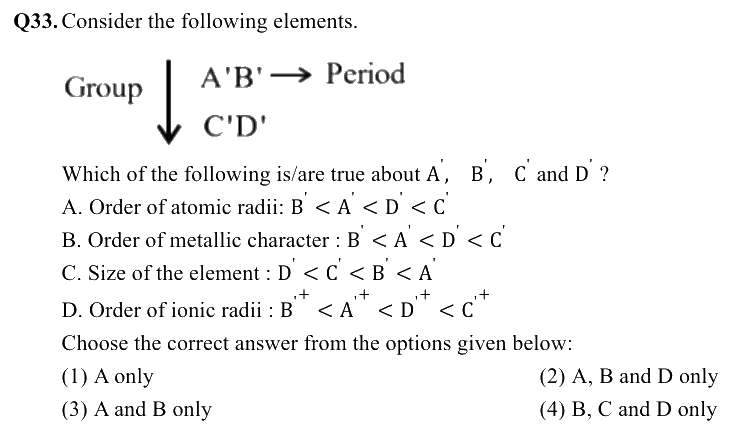
Get EdLoop – freeOpen on the web