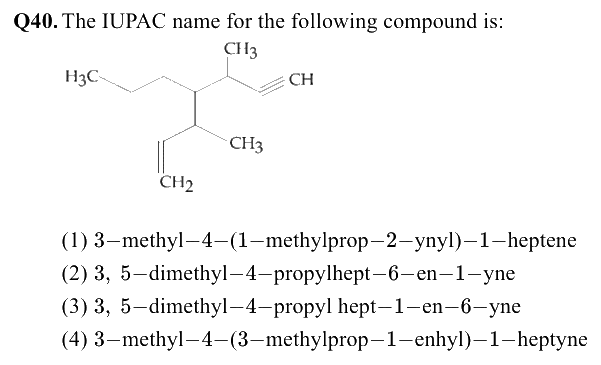
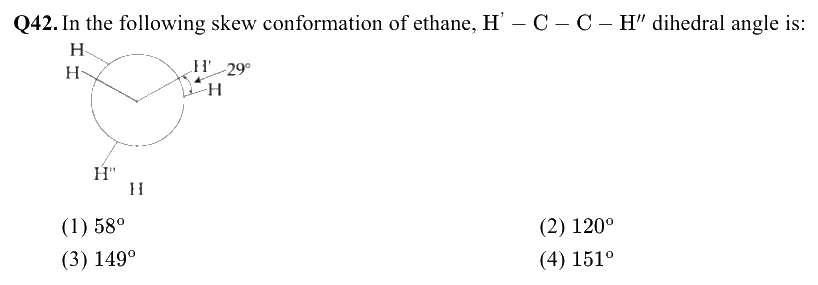
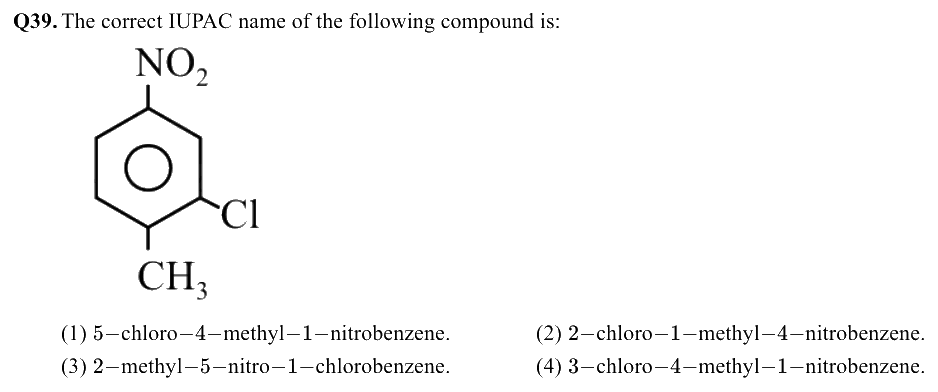
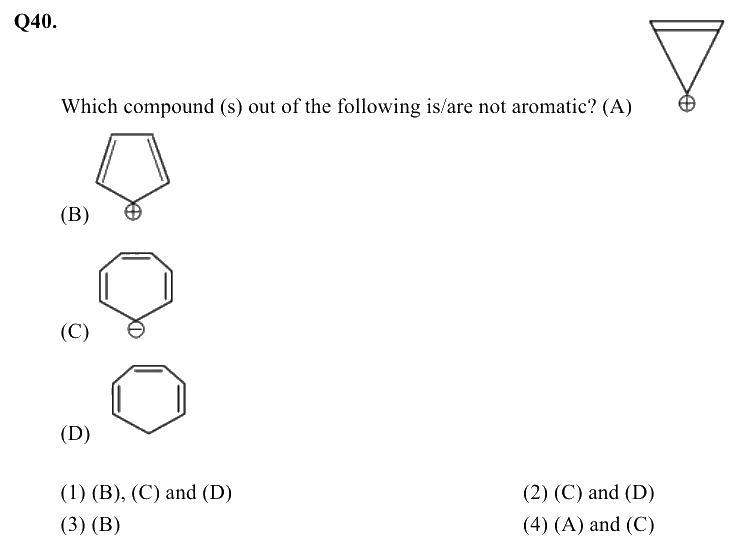
EdLoop PYQs · free, no ads · questions and answers here, step-by-step solutions in the EdLoop app
PYQs · free, no adsOpen on the web (app.edloop.in)Get EdLoop – free on Google Play
ChemistryGeneral Organic Chemistry

General Organic Chemistry: JEE Main PYQs 2002–2026

Every General Organic Chemistry question from past JEE Main and AIEEE papers, with options and answers. Newest first.

289questions
162papers covered
5.1%of Chemistry questions, 2019–2026
2002–2026years

Guide at a glance

General organic chemistry establishes principles of structure, isomerism, and electronic effects under Unit 14: Some Basic Principles of Organic Chemistry in the Class 11 curriculum, securing rank 2 of 31 chapters with a 5.1% share of all chemistry questions.

Most asked sub-topics

Isomerism97
Electronic Effects76
Nomenclature & Classification58
Reaction Intermediates & Mechanism58

Practise these in EdLoop

Attempt every General Organic Chemistry question timed, see the step-by-step solution and track what you get wrong. Free.

Start practice

MCQ, single correct

251 questions
1JEE Main 2026 · 8 Apr · Shift 2MCQOpen question page ↗

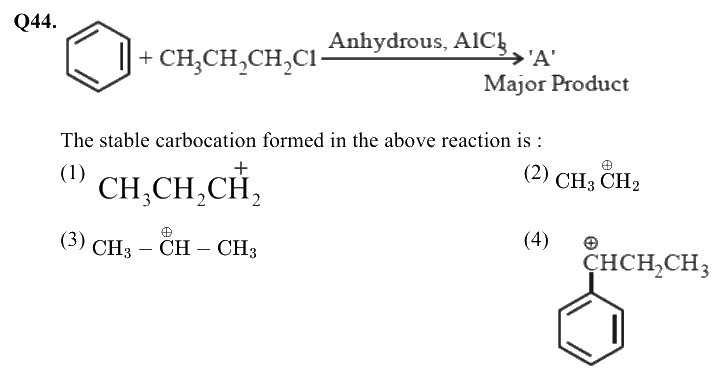
The major product of which of the following reaction is not obtained by rearrangement reaction ?

The question and its figure as printed in B Tech 8th Apr 2026 Shift 2. Option 1: a benzene ring + a zigzag line ending in Cl at the lower right, with 'Anhyd. AlCl3' over the arrow, giving a benzene ring with a branched side chain at the upper right (a carbon with two stubs). Option 2: a carbon drawn as a cross (vertical line through it, a stub to the left) with a bond to the right ending in 'OH'; 'H3O+' over the arrow; product: a carbon with two stubs on the left, double-bonded to a terminal CH2 on the right. Option 3: CH3(CH2)4CH3 with 'Anhyd. AlCl3 / HCl' over/under the arrow giving CH3-CH(CH3)(CH2)2CH3 (drawn with the CH bearing a CH3 branch below it). Option 4: a skeleton with a…
The question as printed in the paper.
  • A

    see figure a benzene ring + a zigzag line ending in Cl at the lower right, with 'Anhyd. AlCl3' over the arrow, giving a benzene ring with a branched side chain at the upper right (a carbon with two stubs).

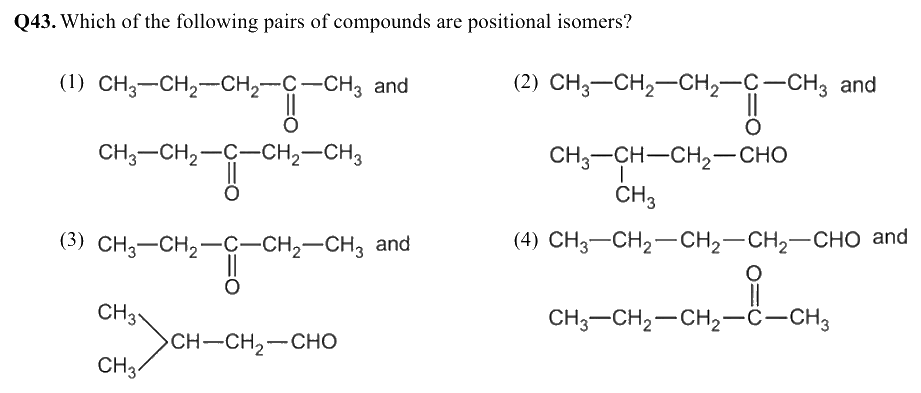
  • B

    see figure a carbon drawn as a cross (vertical line through it, a stub to the left) with a bond to the right ending in 'OH'; 'H3O+' over the arrow; product: a carbon with two stubs on the left, double-bonded to a terminal CH2 on the right.

  • C

    see figure CH3(CH2)4CH3 with 'Anhyd. AlCl3 / HCl' over/under the arrow giving CH3-CH(CH3)(CH2)2CH3 (drawn with the CH bearing a CH3 branch below it).

  • D

    see figure a skeleton with a vertical line at the top joined to a carbon bearing 'OH' below; 'H3O+' over the arrow; product: a carbon with two stubs on the left, double-bonded to a carbon carrying a methyl stub on the right.

2JEE Main 2026 · 8 Apr · Shift 2MCQOpen question page ↗

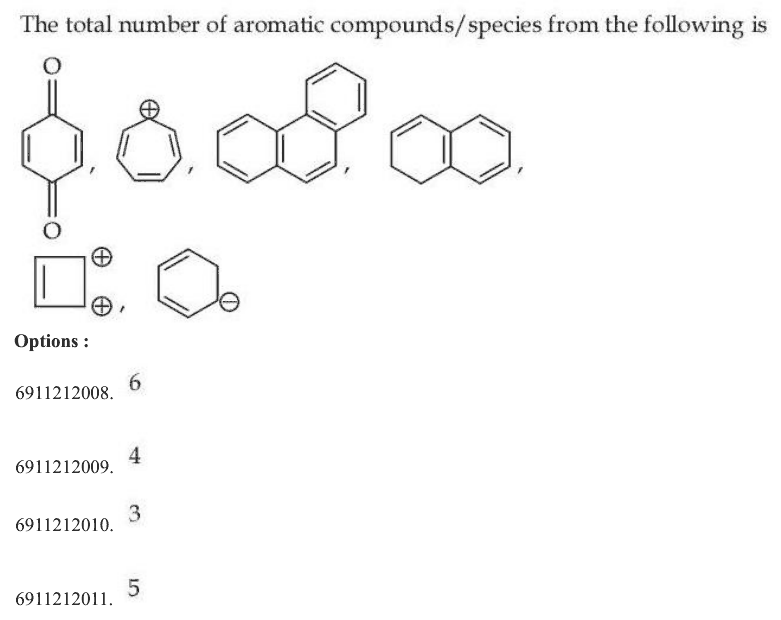
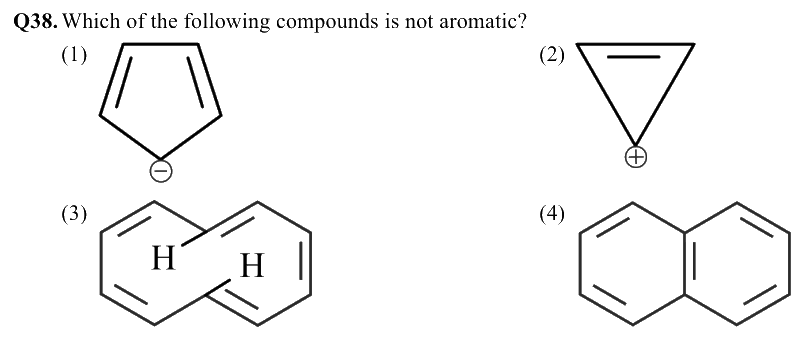
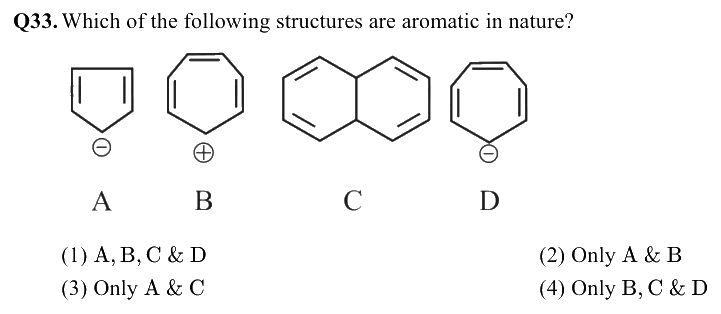
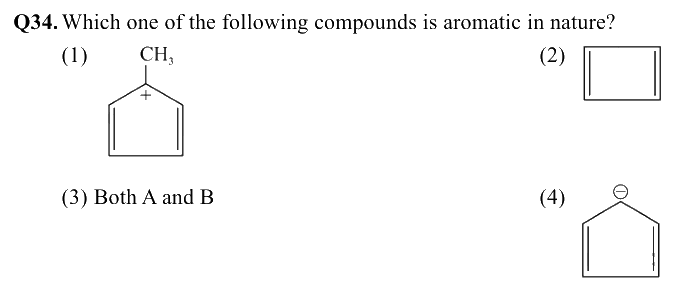
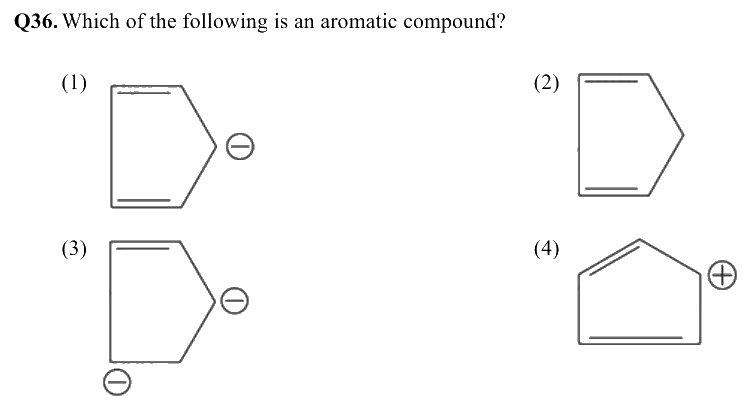
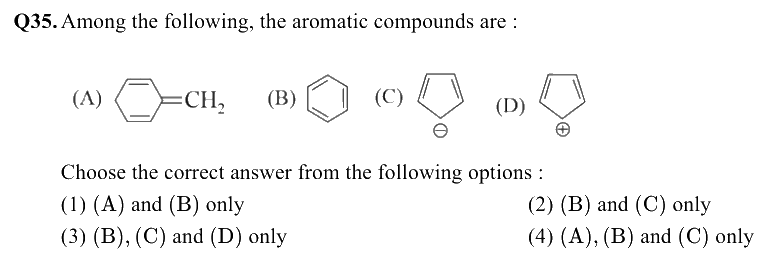
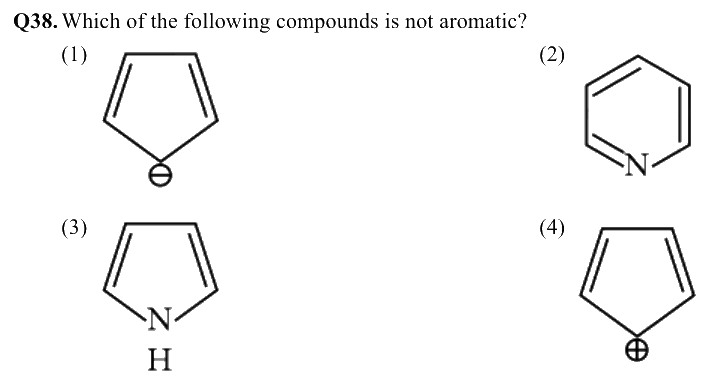
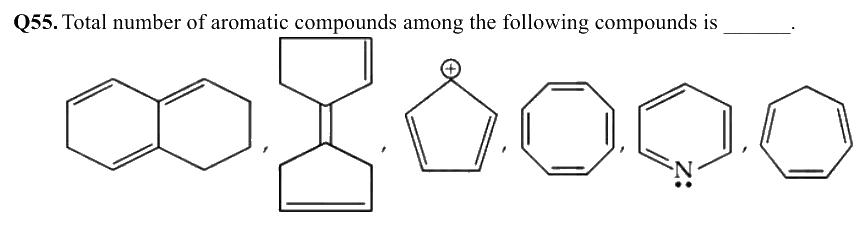
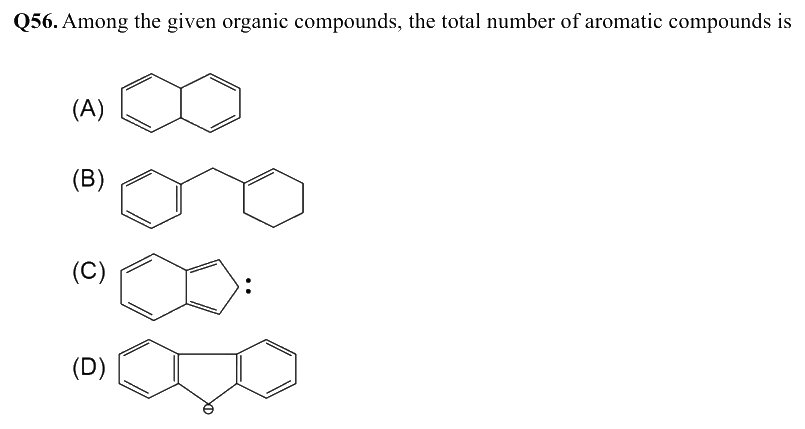
The total number of aromatic compounds/species from the following is

(see the figure above)

The question and its figure as printed in B Tech 8th Apr 2026 Shift 2.
The question as printed in the paper.
  • A

    6

  • B

    4

  • C

    3

  • D

    5

3JEE Main 2026 · 6 Apr · Shift 1MCQOpen question page ↗

Given below are two statements:

Statement I: 2,6-diethylcyclohexanone and 6-methyl-2-n-propylcyclohexanone are metamers.

Statement II: 2,2,6,6 - tetramethylcyclohexanone exhibits keto-enol tautomerism.

In the light of the above statements, choose the *correct* answer from the options given below

  • A

    Both Statement I and Statement II are true

  • B

    Both Statement I and Statement II are false

  • C

    Statement I is true but Statement II is false

  • D

    Statement I is false but Statement II is true

4JEE Main 2026 · 5 Apr · Shift 1MCQOpen question page ↗

Given below are two statements:

Statement I: On the basis of inductive effect, the order of stability of alkyl carbanions is $\mathrm{CH_3^-} > \mathrm{CH_3{-}CH_2^-} > (\mathrm{CH_3})_2\mathrm{CH^-} > (\mathrm{CH_3})_3\mathrm{C^-}$.

Statement II: Allyl and benzyl carbanions are more stabilised by inductive effect and not by resonance effect.

In the light of the above statements, choose the *correct* answer from the options given below

  • A

    Both Statement I and Statement II are correct

  • B

    Both Statement I and Statement II are incorrect

  • C

    Statement I is correct but Statement II is incorrect

  • D

    Statement I is incorrect but Statement II is correct

5JEE Main 2026 · 5 Apr · Shift 2MCQOpen question page ↗

IUPAC name of the some alkenes are given below.

Find out the correct stability order.

A. 2-Methylbut-2-ene

B. *cis*-But-2-ene

C. 2, 3-Dimethylbut-2-ene

D. Prop-1-ene

Choose the correct answer from the options given below :

  • A

    C > A > B > D

  • B

    C > A > D > B

  • C

    B > D > A > C

  • D

    A > B > C > D

6JEE Main 2026 · 5 Apr · Shift 2MCQOpen question page ↗

Identify the correct IUPAC name of hydrocarbon ($x$) containing three primary carbon atoms and with molar mass 72 g mol$^{-1}$.

  • A

    1, 1 - Dimethylcyclopropane

  • B

    2, 2 - Dimethylpropane

  • C

    2 - Methylbutane

  • D

    n-pentane

7JEE Main 2026 · 4 Apr · Shift 1MCQOpen question page ↗

Increasing order of electron withdrawing power of following functional groups is:

a. $-$CN

b. $-$COOH

c. $-\mathrm{NO_2}$

d. $-$I

  • A

    c < b < d < a

  • B

    c < a < b < d

  • C

    d < b < a < c

  • D

    a < b < c < d

8JEE Main 2026 · 4 Apr · Shift 1MCQOpen question page ↗

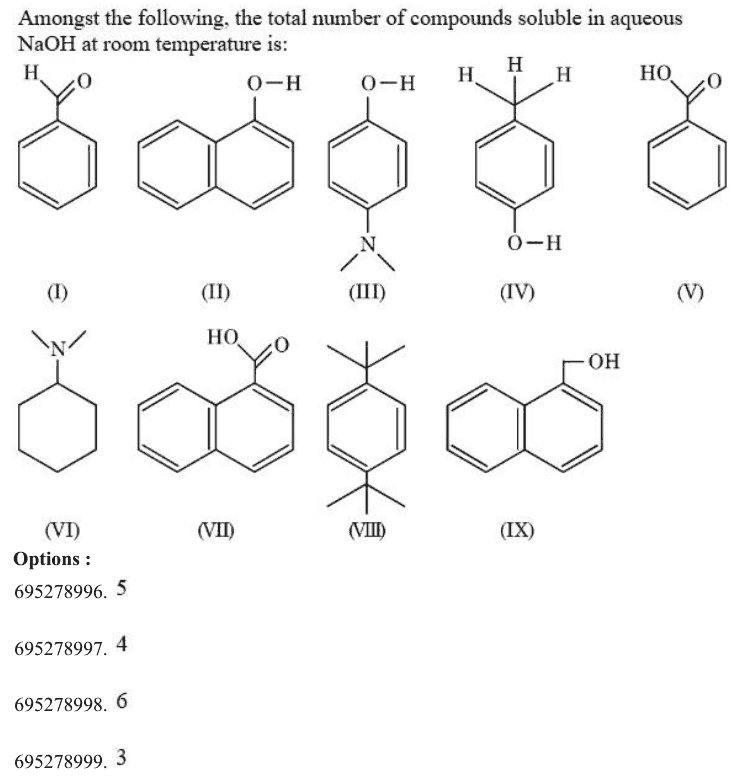
Amongst the following, the total number of compounds soluble in aqueous NaOH at room temperature is:

(see the figure above)

The question and its figure as printed in B Tech 4th Apr 2026 Shift 1.
The question as printed in the paper.
  • A

    5

  • B

    4

  • C

    6

  • D

    3

9JEE Main 2026 · 4 Apr · Shift 2MCQOpen question page ↗

Match the LIST-I with LIST-II

List-I ReactionList-II Mechanism
A. Williamson SynthesisI. Electrophilic addition
B. Friedel Craft ReactionII. Free radical substitution
C. Bromination of vinyl benzeneIII. Nucleophilic substitution
D. Chlorination of toluene in lightIV. Electrophilic substitution

Choose the *correct* answer from the options given below:

  • A

    A-III, B-I, C-II, D-IV

  • B

    A-III, B-IV, C-II, D-I

  • C

    A-III, B-IV, C-I, D-II

  • D

    A-I, B-III, C-IV, D-II

10JEE Main 2026 · 4 Apr · Shift 2MCQOpen question page ↗

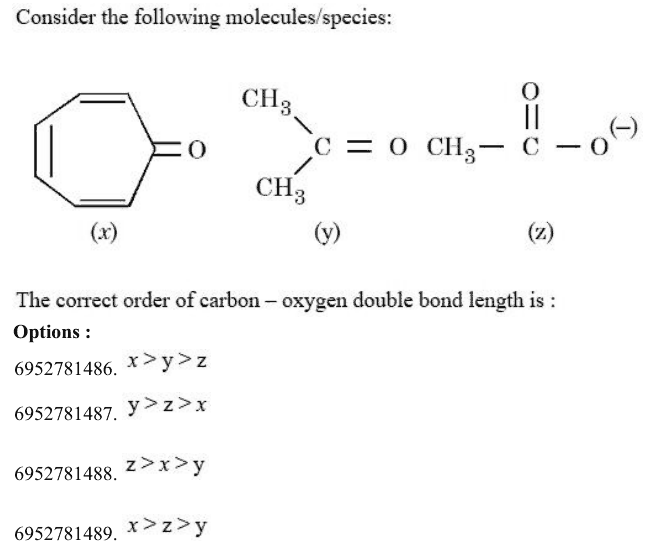
Consider the following molecules/species:

(see the figure above)

The correct order of carbon $-$ oxygen double bond length is :

The question and its figure as printed in B Tech 4th Apr 2026 Shift 2.
The question as printed in the paper.
  • A

    $x > y > z$

  • B

    $y > z > x$

  • C

    $z > x > y$

  • D

    $x > z > y$

11JEE Main 2026 · 4 Apr · Shift 2MCQOpen question page ↗

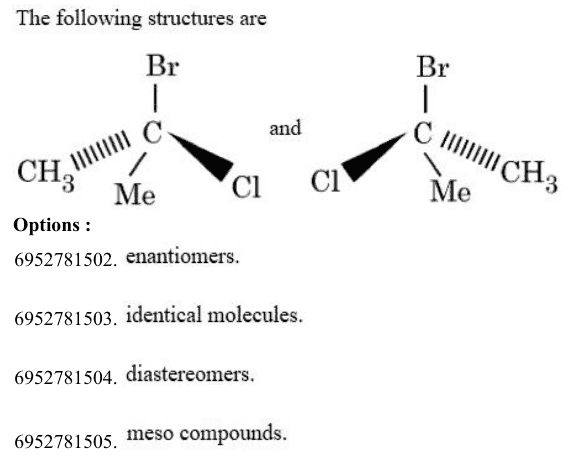
The following structures are

(see the figure above)

The question and its figure as printed in B Tech 4th Apr 2026 Shift 2.
The question as printed in the paper.
  • A

    enantiomers.

  • B

    identical molecules.

  • C

    diastereomers.

  • D

    meso compounds.

12JEE Main 2026 · 4 Apr · Shift 2MCQOpen question page ↗

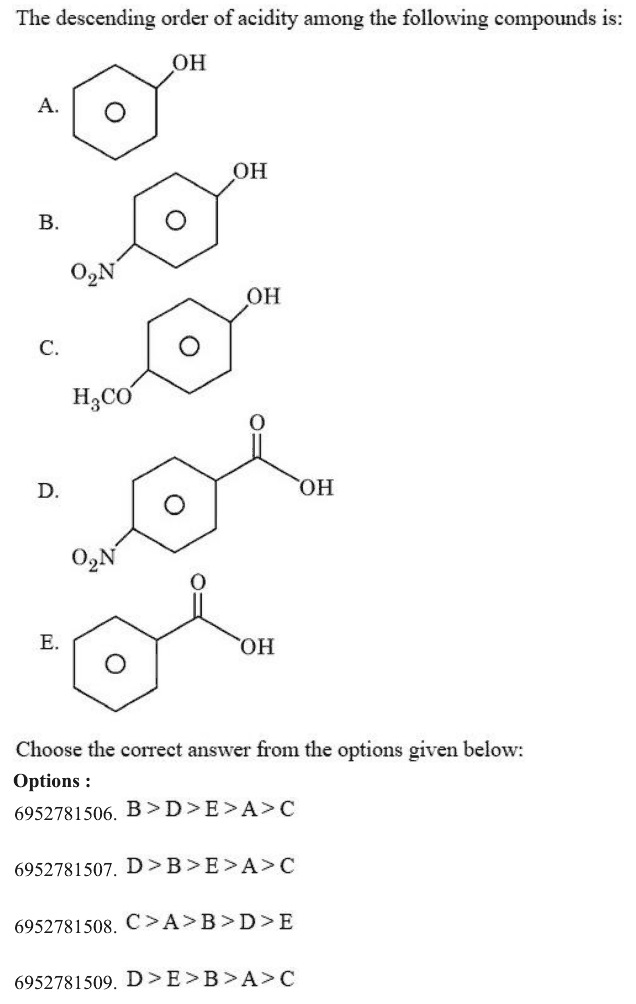
The descending order of acidity among the following compounds is:

A. (see the figure above)

B. (see the figure above)

C. (see the figure above)

D. (see the figure above)

E. (see the figure above)

Choose the correct answer from the options given below:

The question and its figure as printed in B Tech 4th Apr 2026 Shift 2.
The question as printed in the paper.
  • A

    B > D > E > A > C

  • B

    D > B > E > A > C

  • C

    C > A > B > D > E

  • D

    D > E > B > A > C

13JEE Main 2026 · 2 Apr · Shift 1MCQOpen question page ↗

In IUPAC nomenclature, the correct order of decreasing priority of functional group is :

  • A

    $-\mathrm{CONH_2}$, $>\mathrm{C=O}$, $-\mathrm{CHO}$, $-\mathrm{NH_2}$, $-\mathrm{C}\equiv\mathrm{C}-$

  • B

    $-\mathrm{CONH_2}$, $-\mathrm{COOCH_3}$, $-\mathrm{CHO}$, $-\mathrm{NH_2}$, $-\mathrm{OH}$

  • C

    $-\mathrm{CONH_2}$, $-\mathrm{CHO}$, $>\mathrm{C=O}$, $-\mathrm{NH_2}$, $-\mathrm{C}\equiv\mathrm{C}-$

  • D

    $-\mathrm{CONH_2}$, $-\mathrm{CHO}$, $-\mathrm{CN}$, $-\mathrm{NH_2}$, $-\mathrm{C}\equiv\mathrm{C}-$

14JEE Main 2026 · 2 Apr · Shift 1MCQOpen question page ↗

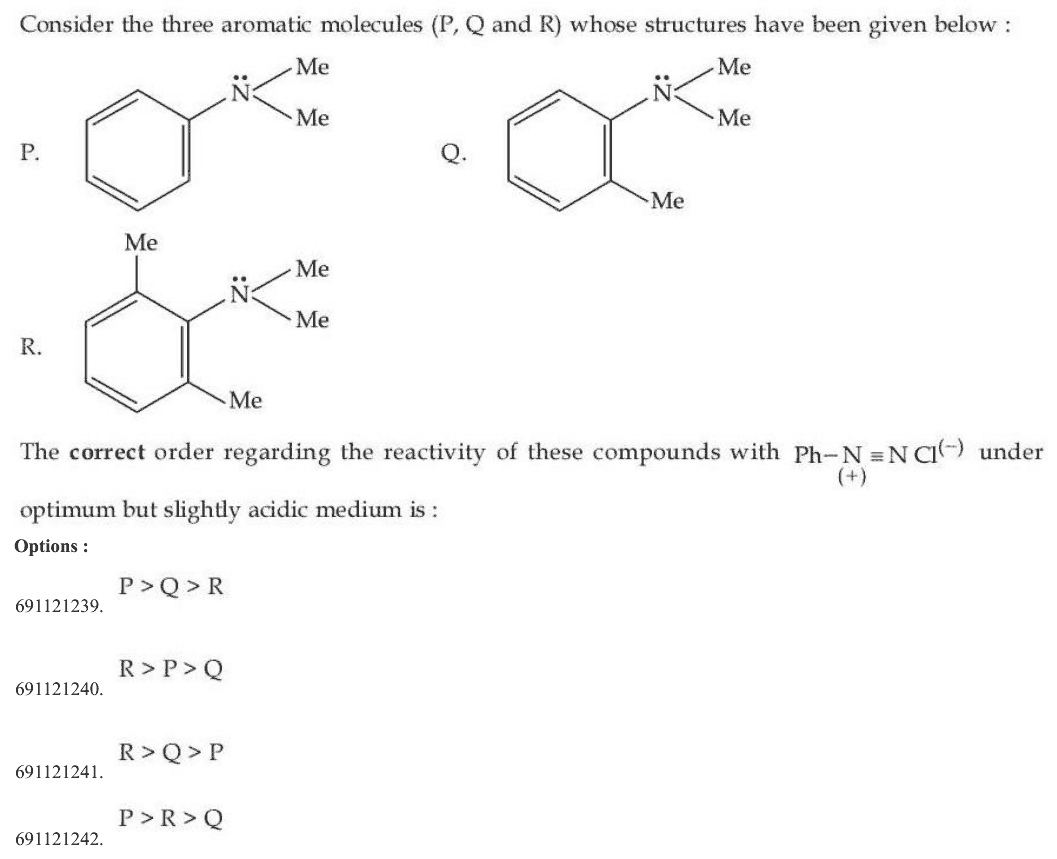
Consider the three aromatic molecules (P, Q and R) whose structures have been given below :

(see the figure above)

The correct order regarding the reactivity of these compounds with $\mathrm{Ph{-}\overset{(+)}{N}{\equiv}N\,Cl^{(-)}}$ under optimum but slightly acidic medium is :

The question and its figure as printed in B Tech 2nd Apr 2026 Shift 1.
The question as printed in the paper.
  • A

    P > Q > R

  • B

    R > P > Q

  • C

    R > Q > P

  • D

    P > R > Q

15JEE Main 2026 · 2 Apr · Shift 2MCQOpen question page ↗

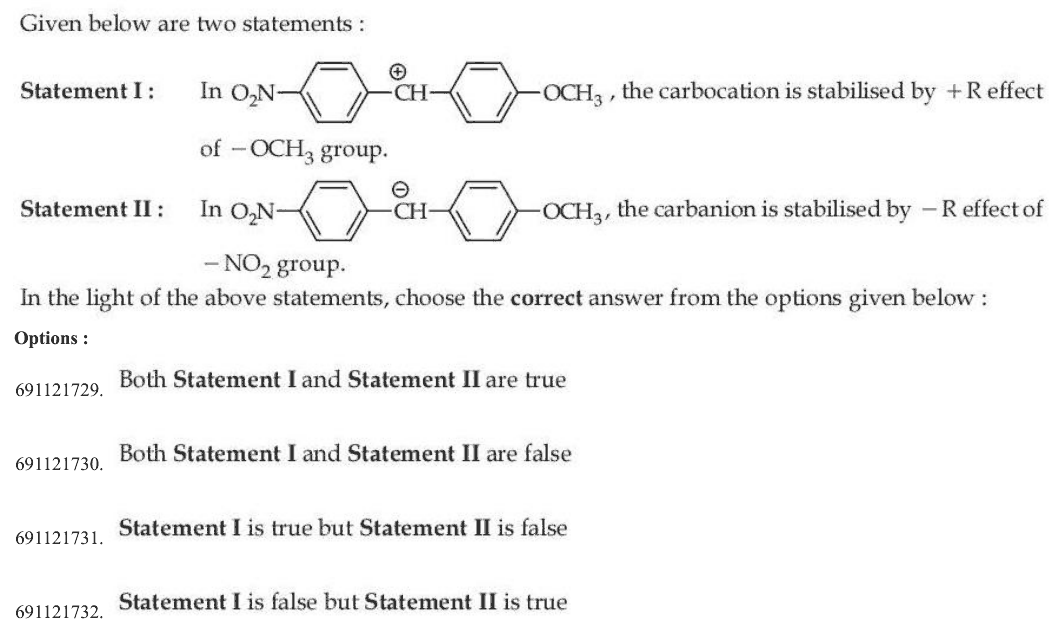
Given below are two statements :

Statement I : In (see the figure above), the carbocation is stabilised by +R effect of $-\mathrm{OCH_3}$ group.

Statement II : In (see the figure above), the carbanion is stabilised by $-$R effect of $-\mathrm{NO_2}$ group.

In the light of the above statements, choose the correct answer from the options given below :

The question and its figure as printed in B Tech 2nd Apr 2026 Shift 2.
The question as printed in the paper.
  • A

    Both Statement I and Statement II are true

  • B

    Both Statement I and Statement II are false

  • C

    Statement I is true but Statement II is false

  • D

    Statement I is false but Statement II is true

16JEE Main 2026 · 28 Jan · Shift 1MCQOpen question page ↗

CORRECT order of stability for the following is

$\mathrm{CH_2=CH^-}$, $\mathrm{CH_3-CH_2^-}$, $\mathrm{CH{\equiv}C^-}$

  • A

    $\mathrm{CH{\equiv}C^-} > \mathrm{CH_2=CH^-} > \mathrm{CH_3-CH_2^-}$

  • B

    $\mathrm{CH_3-CH_2^-} > \mathrm{CH_2=CH^-} > \mathrm{CH{\equiv}C^-}$

  • C

    $\mathrm{CH_2=CH^-} > \mathrm{CH{\equiv}C^-} > \mathrm{CH_3-CH_2^-}$

  • D

    $\mathrm{CH{\equiv}C^-} > \mathrm{CH_3-CH_2^-} > \mathrm{CH_2=CH^-}$

17JEE Main 2026 · 28 Jan · Shift 2MCQOpen question page ↗

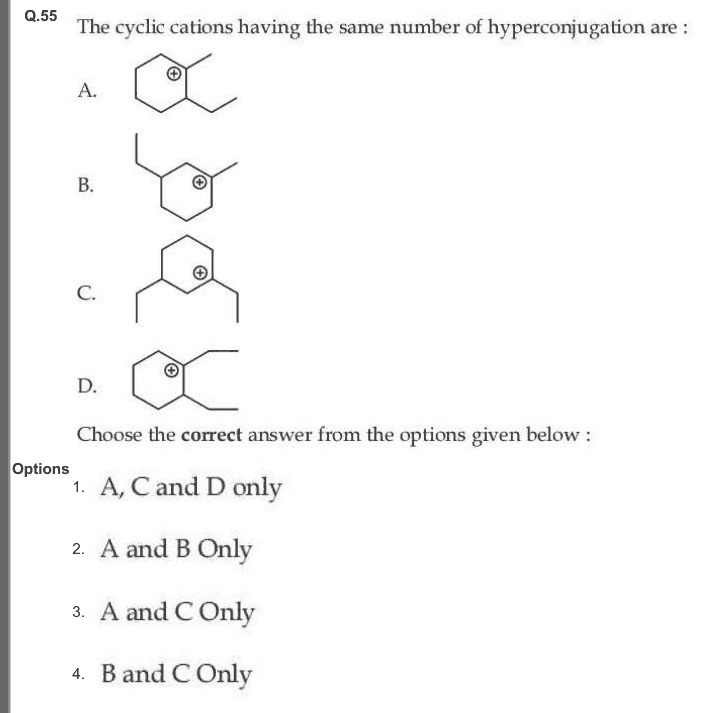
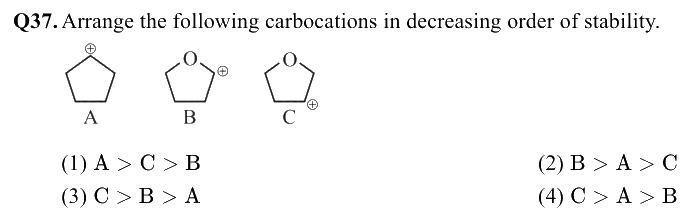
The cyclic cations having the same number of hyperconjugation are :

A. (see the figure above)

B. (see the figure above)

C. (see the figure above)

D. (see the figure above)

Choose the correct answer from the options given below :

The question and its figure as printed in JEE Main 2026 28 Jan Shift 2.
The question as printed in the paper.
  • A

    A, C and D only

  • B

    A and B Only

  • C

    A and C Only

  • D

    B and C Only

18JEE Main 2026 · 24 Jan · Shift 1MCQOpen question page ↗

Arrange the following carbanions in the decreasing order of stability.

I. $p-\mathrm{Br}-\mathrm{C_6H_4}-\ddot{\mathrm{C}}\mathrm{H_2}^{\ominus}$

II. $\mathrm{C_6H_5}-\ddot{\mathrm{C}}\mathrm{H_2}^{\ominus}$

III. $p-\mathrm{CH_3O}-\mathrm{C_6H_4}-\ddot{\mathrm{C}}\mathrm{H_2}^{\ominus}$

IV. $p-\mathrm{CHO}-\mathrm{C_6H_4}-\ddot{\mathrm{C}}\mathrm{H_2}^{\ominus}$

V. $p-\mathrm{CH_3}-\mathrm{C_6H_4}-\ddot{\mathrm{C}}\mathrm{H_2}^{\ominus}$

Choose the correct answer from the options given below:

  • A

    IV $>$ I $>$ II $>$ V $>$ III

  • B

    I $>$ IV $>$ II $>$ V $>$ III

  • C

    I $>$ II $>$ IV $>$ V $>$ III

  • D

    IV $>$ II $>$ I $>$ III $>$ V

19JEE Main 2026 · 24 Jan · Shift 2MCQOpen question page ↗

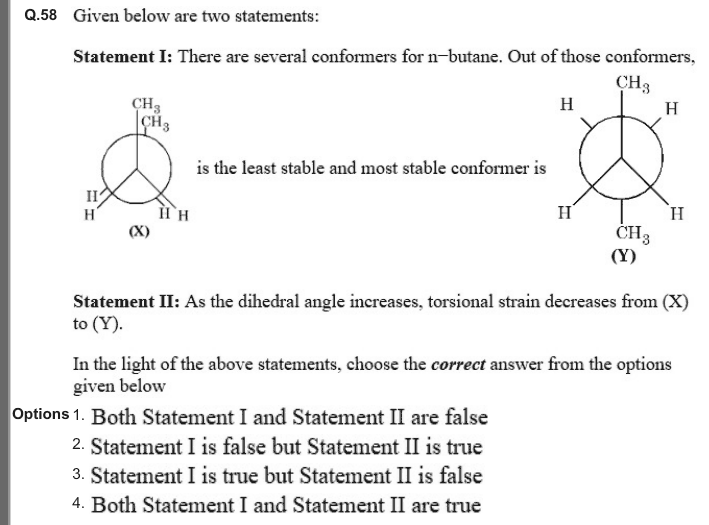
Given below are two statements:

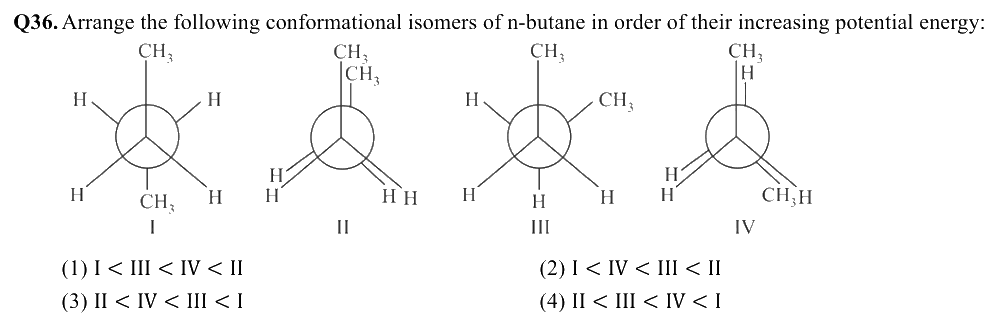
Statement I: There are several conformers for n$-$butane. Out of those conformers,

(see the figure above)

is the least stable and most stable conformer is

(see the figure above)

Statement II: As the dihedral angle increases, torsional strain decreases from (X) to (Y).

In the light of the above statements, choose the *correct* answer from the options given below

The question and its figure as printed in JEE Main 2026 24 Jan Shift 2.
The question as printed in the paper.
  • A

    Both Statement I and Statement II are false

  • B

    Statement I is false but Statement II is true

  • C

    Statement I is true but Statement II is false

  • D

    Both Statement I and Statement II are true

20JEE Main 2026 · 24 Jan · Shift 2MCQOpen question page ↗

Find out the statements which are not true.

A. Resonating structures with more number of covalent bonds and lesser charge separation are more stable.

B. In electromeric effect, an unsaturated system shows $+E$ effect with nucleophile and $-E$ effect with electrophile.

C. Inductive effect is responsible for high melting point, boiling point and dipole moment of polar compounds.

D. The greater the number of alkyl groups attached to the doubly bonded carbon atoms, higher is the heat of hydrogenation.

E. Stability of carbanion increases with the increase in s $-$ character of the carbon carrying the negative charge.

Choose the *correct* answer from the options given below:

  • A

    B, D & E only

  • B

    A, D & E only

  • C

    B & D only

  • D

    A, C & D only

21JEE Main 2026 · 23 Jan · Shift 2MCQOpen question page ↗

Given below are two statements:

Statement I: $(\mathrm{CH_3})_3\overset{\oplus}{\mathrm{C}}$ is more stable than $\overset{\oplus}{\mathrm{C}}\mathrm{H_3}$ as nine hyperconjugation interactions are possible in $(\mathrm{CH_3})_3\overset{\oplus}{\mathrm{C}}$.

Statement II: $\overset{\oplus}{\mathrm{C}}\mathrm{H_3}$ is less stable than $(\mathrm{CH_3})_3\overset{\oplus}{\mathrm{C}}$ as only three hyperconjugation interactions are possible in $\overset{\oplus}{\mathrm{C}}\mathrm{H_3}$.

In the light of the above statements, choose the correct answer from the options given below

  • A

    Both Statement I and Statement II are true

  • B

    Both Statement I and Statement II are false

  • C

    Statement I is false but Statement II is true

  • D

    Statement I is true but Statement II is false

22JEE Main 2026 · 22 Jan · Shift 2MCQOpen question page ↗

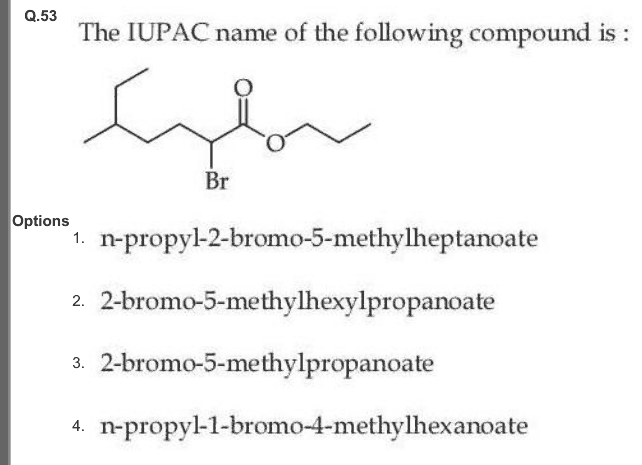
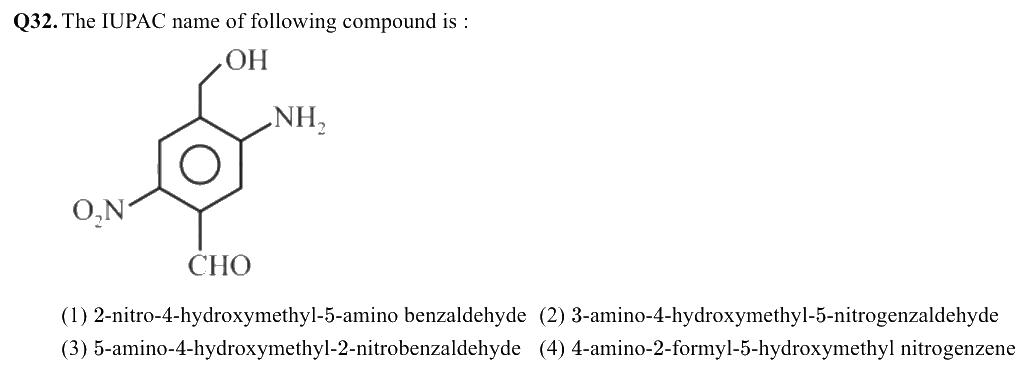
The IUPAC name of the following compound is :

(see the figure above)

The question and its figure as printed in JEE Main 2026 22 Jan Shift 2.
The question as printed in the paper.
  • A

    n-propyl-2-bromo-5-methylheptanoate

  • B

    2-bromo-5-methylhexylpropanoate

  • C

    2-bromo-5-methylpropanoate

  • D

    n-propyl-1-bromo-4-methylhexanoate

23JEE Main 2026 · 21 Jan · Shift 1MCQOpen question page ↗

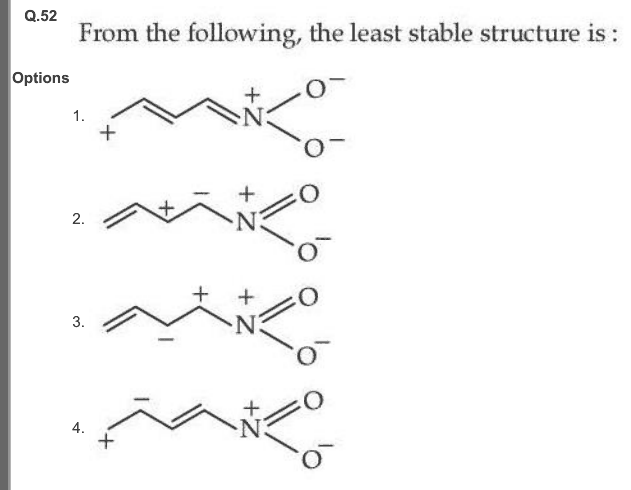
From the following, the least stable structure is :

The question and its figure as printed in JEE Main 2026 21 Jan Shift 1. Option 1: a zigzag chain with a double bond drawn near its left end and a '+' below the left end; at the right end an N bearing a '+' above it and a double bond (shown as '=N') from the chain; two single-bonded oxygens on N, each written 'O' with a '-' superscript (one upper right, one lower right). Option 2: a chain with a double bond at its left end; a '+' on the chain near the second carbon, a '-' above it to the right, and a '+' above the N; the N has a double-bonded 'O' (upper right) and a single-bonded 'O' with '-' (lower right). Option 3: a chain with a double bond at its left end; a '+' above the chain in the…
The question as printed in the paper.
  • A

    see figure a zigzag chain with a double bond drawn near its left end and a '+' below the left end; at the right end an N bearing a '+' above it and a double bond (shown as '=N') from the chain; two single-bonded oxygens on N, each written 'O' with a '-' superscript (one upper right, one lower right).

  • B

    see figure a chain with a double bond at its left end; a '+' on the chain near the second carbon, a '-' above it to the right, and a '+' above the N; the N has a double-bonded 'O' (upper right) and a single-bonded 'O' with '-' (lower right).

  • C

    see figure a chain with a double bond at its left end; a '+' above the chain in the middle and a '+' above the N; a '-' below the chain under the third carbon; the N has a double-bonded 'O' (upper right) and a single-bonded 'O' with '-' (lower right).

  • D

    see figure a chain with a '+' at its lower-left end, a double bond between its middle carbons, and a '-' above the chain near the second carbon; a '+' above the N; the N has a double-bonded 'O' (upper right) and a single-bonded 'O' with '-' (lower right).

24JEE Main 2026 · 21 Jan · Shift 1MCQOpen question page ↗

Identify correct statements from the following :

A. Propanal and propanone are functional isomers.

B. Ethoxyethane and methoxypropane are metamers.

C. But-2-ene shows optical isomerism.

D. But-1-ene and but-2-ene are functional isomers.

E. Pentane and 2, 2-dimethyl propane are chain isomers.

Choose the correct answer from the options given below :

  • A

    A, B and C only

  • B

    B, C and D only

  • C

    A, B and E only

  • D

    C, D and E only

25JEE Main 2026 · 21 Jan · Shift 2MCQOpen question page ↗

Given below are four compounds :

(a) n-propyl choride

(b) iso-propyl chloride

(c) sec-butyl chloride

(d) neo-pentyl chloride

Percentage of carbon in the one which exhibits optical isomerism is :

  • A

    56

  • B

    40

  • C

    46

  • D

    52

26JEE Main 2026 · 21 Jan · Shift 2MCQOpen question page ↗

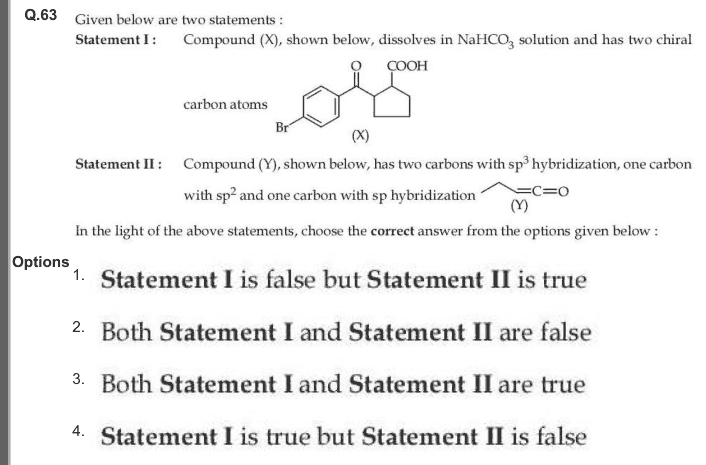
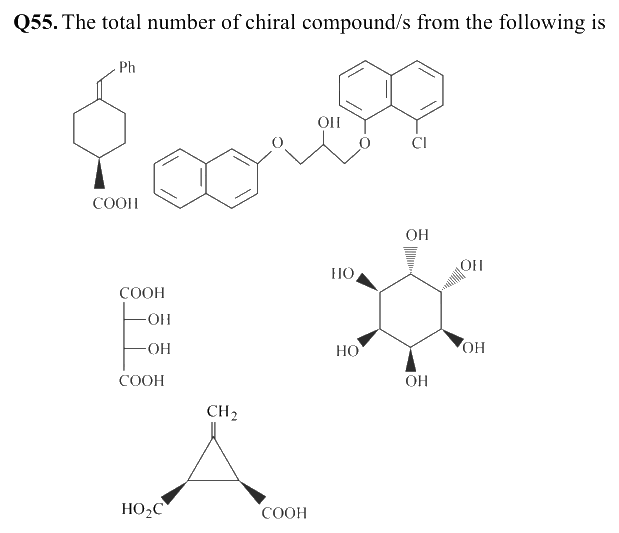
Given below are two statements :

Statement I : Compound (X), shown below, dissolves in $\mathrm{NaHCO_3}$ solution and has two chiral carbon atoms

(see the figure above)

Statement II : Compound (Y), shown below, has two carbons with $\mathrm{sp^3}$ hybridization, one carbon with $\mathrm{sp^2}$ and one carbon with sp hybridization

(see the figure above)

In the light of the above statements, choose the correct answer from the options given below :

The question and its figure as printed in JEE Main 2026 21 Jan Shift 2.
The question as printed in the paper.
  • A

    Statement I is false but Statement II is true

  • B

    Both Statement I and Statement II are false

  • C

    Both Statement I and Statement II are true

  • D

    Statement I is true but Statement II is false

27JEE Main 2026 · 21 Jan · Shift 2MCQOpen question page ↗

Match List - I with List - II.

List - I Pair of CompoundsList - II Type of Isomers
A.2-Methylpropene and but-1-eneI.Stereoisomers
B.Cis-but-2-ene and trans-but-2-eneII.Position isomers
C.2-Butanol and diethyl etherIII.Chain isomers
D.But-1-ene and but-2-eneIV.Functional group isomers

Choose the correct answer from the options given below :

  • A

    A-II, B-I, C-IV, D-III

  • B

    A-I, B-IV, C-III, D-II

  • C

    A-III, B-I, C-II, D-IV

  • D

    A-III, B-I, C-IV, D-II

28JEE Main 2025 · 8 Apr · Shift 2MCQOpen question page ↗

Match the LIST-I with LIST-II

LIST-ILIST-II
A.CarbocationI.Species that can supply a pair of electrons.
B.C-Free radicalII.Species that can receive a pair of electrons.
C.NucleophileIII.$sp^2$ hybridized carbon with empty p-orbital.
D.ElectrophileIV$sp^2/sp^3$ hybridized carbon with one unpaired electron.

Choose the correct answer from the options given below:

  • A

    A-IV, B-II, C-III, D-I

  • B

    A-III, B-IV, C-I, D-II

  • C

    A-II, B-III, C-II, D-IV

  • D

    A-III, B-IV, C-II, D-I

29JEE Main 2025 · 8 Apr · Shift 2MCQOpen question page ↗

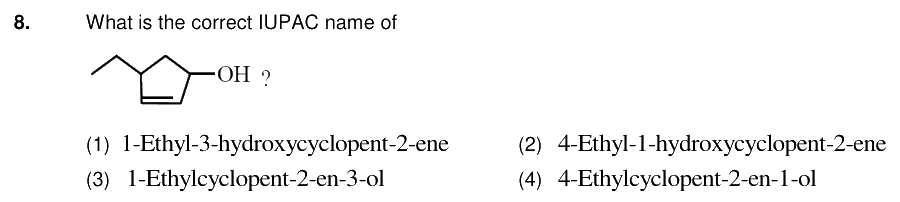
What is the correct IUPAC name of (see the figure above) ?

The question and its figure as printed in JEE Main 2025 08 Apr Shift 2.
The question as printed in the paper.
  • A

    1-Ethyl-3-hydroxycyclopent-2-ene

  • B

    4-Ethyl-1-hydroxycyclopent-2-ene

  • C

    1-Ethylcyclopent-2-en-3-ol

  • D

    4-Ethylcyclopent-2-en-1-ol

30JEE Main 2025 · 7 Apr · Shift 1MCQOpen question page ↗

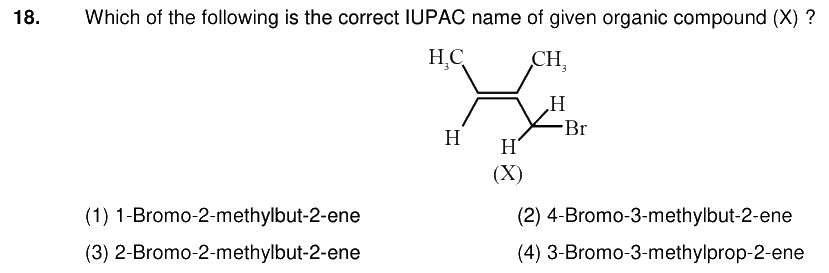
Which of the following is the correct IUPAC name of given organic compound (X) ?

(see the figure above)

The question and its figure as printed in JEE Main 2025 07 Apr Shift 1.
The question as printed in the paper.
  • A

    1-Bromo-2-methylbut-2-ene

  • B

    4-Bromo-3-methylbut-2-ene

  • C

    2-Bromo-2-methylbut-2-ene

  • D

    3-Bromo-3-methylprop-2-ene

31JEE Main 2025 · 7 Apr · Shift 2MCQOpen question page ↗

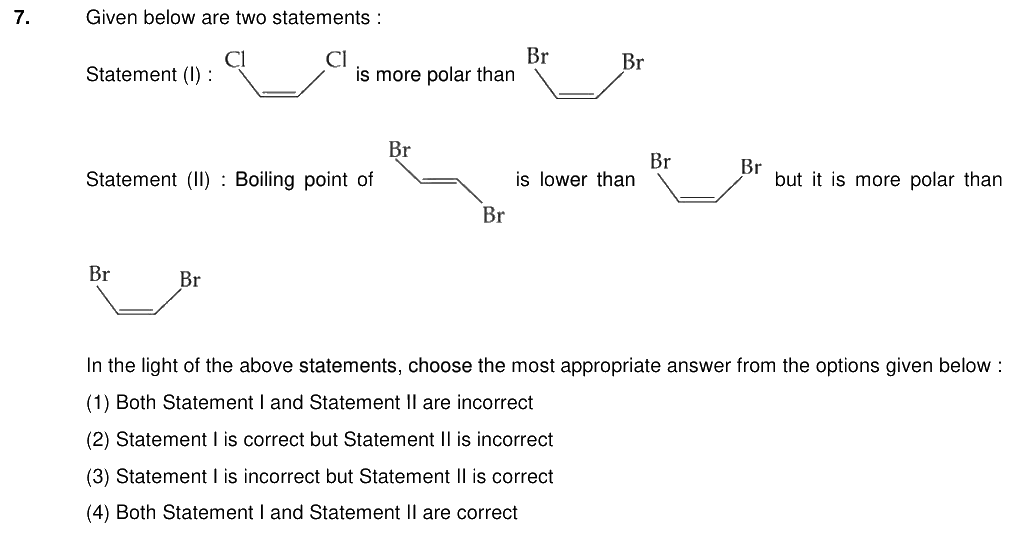
Given below are two statements :

Statement (I) : (see the figure above) is more polar than (see the figure above)

Statement (II) : Boiling point of (see the figure above) is lower than (see the figure above) but it is more polar than (see the figure above)

In the light of the above statements, choose the most appropriate answer from the options given below :

The question and its figure as printed in JEE Main 2025 07 Apr Shift 2.
The question as printed in the paper.
  • A

    Both Statement I and Statement II are incorrect

  • B

    Statement I is correct but Statement II is incorrect

  • C

    Statement I is incorrect but Statement II is correct

  • D

    Both Statement I and Statement II are correct

32JEE Main 2025 · 4 Apr · Shift 1MCQOpen question page ↗

Given below are two statements.

Statement I: The dipole moment of $\overset{4}{C}H_3 - \overset{3}{C}H = \overset{2}{C}H - \overset{1}{C}H = O$ is greater than $\overset{4}{C}H_3 - \overset{3}{C}H_2 - \overset{2}{C}H_2 - \overset{1}{C}H = O$

Statement II: $C_1 - C_2$ bond length of $CH_3 - CH = CH - CH = O$ is greater than $C_1 - C_2$ bond length of $CH_3 - CH_2 - CH_2 - CH = O$

In the light of the above statements, choose the correct answer from the options given below:

  • A

    Statement I is true but Statement II is false

  • B

    Both Statement I and Statement II are false

  • C

    Statement I is false but Statement II is true

  • D

    Both Statement I and Statement II are true

33JEE Main 2025 · 4 Apr · Shift 2MCQOpen question page ↗

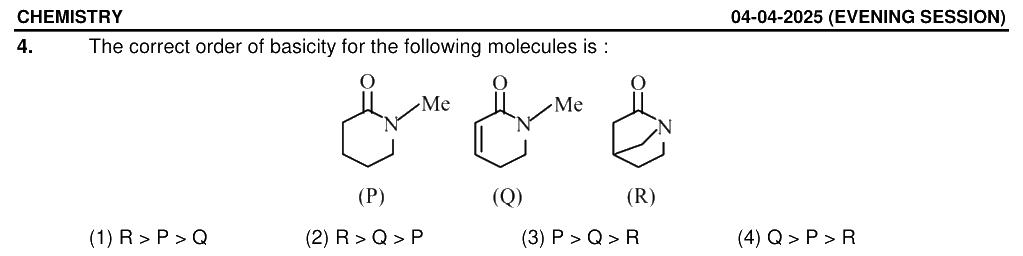
The correct order of basicity for the following molecules is :

(see the figure above)

The question and its figure as printed in JEE Main 2025 04 Apr Shift 2.
The question as printed in the paper.
  • A

    R > P > Q

  • B

    R > Q > P

  • C

    P > Q > R

  • D

    Q > P > R

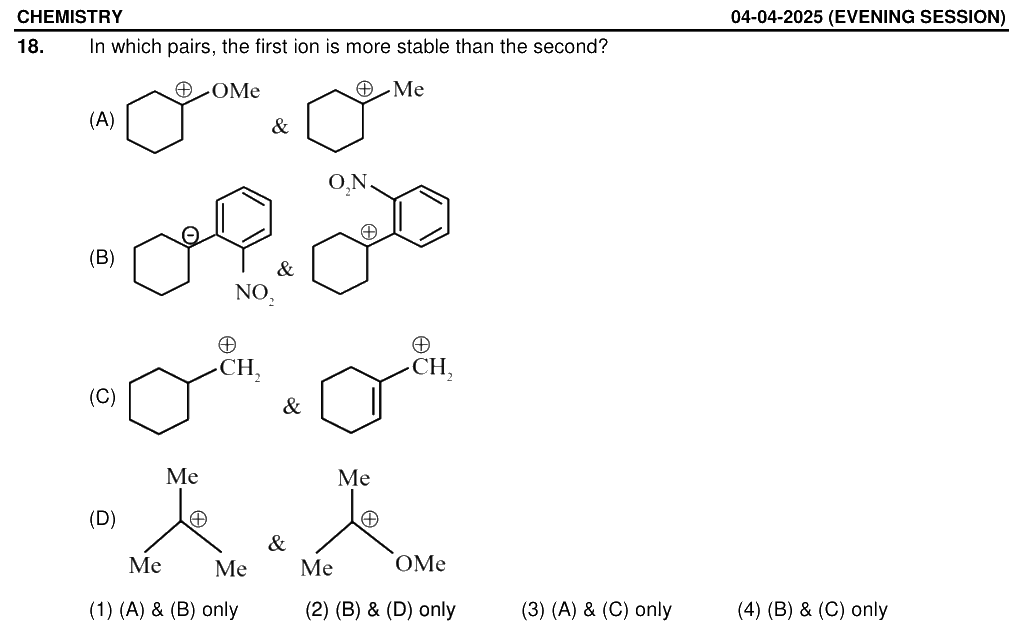
34JEE Main 2025 · 4 Apr · Shift 2MCQOpen question page ↗

In which pairs, the first ion is more stable than the second?

(see the figure above)

The question and its figure as printed in JEE Main 2025 04 Apr Shift 2.
The question as printed in the paper.
  • A

    (A) & (B) only

  • B

    (B) & (D) only

  • C

    (A) & (C) only

  • D

    (B) & (C) only

35JEE Main 2025 · 4 Apr · Shift 2MCQOpen question page ↗

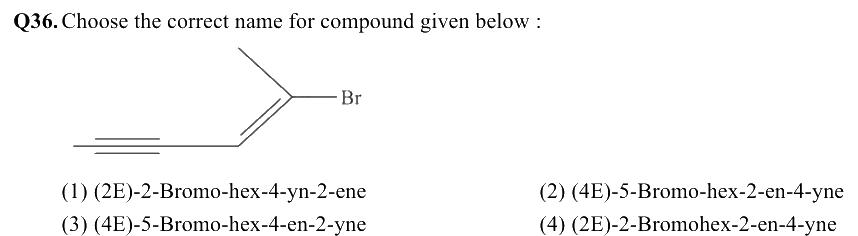
The IUPAC name of the following compound is :

$HC \equiv C - CH_2 - CH(OH) - CH_2 - CH = CH_2$ (the OH hangs above the CH)

  • A

    4-Hydroxyhept-1-en-6-yne

  • B

    4-Hydroxyhept-6-en-1-yne

  • C

    Hept-1-en-6-yn-4-ol

  • D

    Hept-6-en-1-yn-4-ol

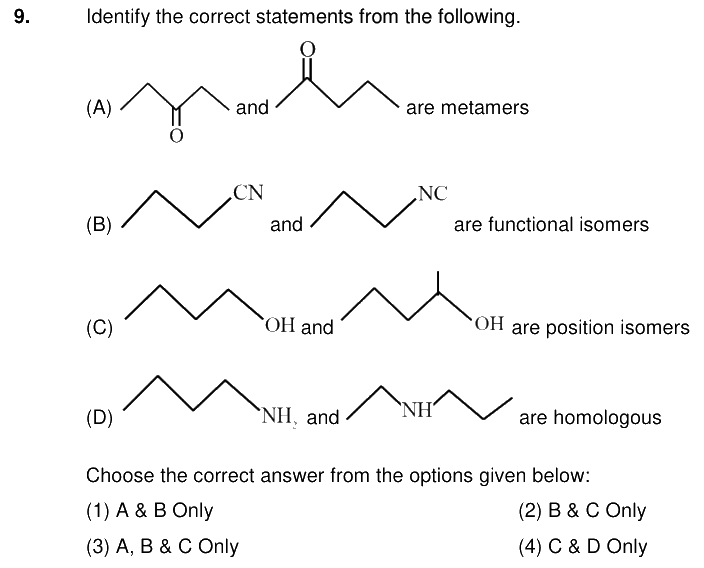
36JEE Main 2025 · 3 Apr · Shift 1MCQOpen question page ↗

Identify the correct statements from the following.

(see the figure above)

Choose the correct answer from the options given below:

The question and its figure as printed in JEE Main 2025 03 Apr Shift 1.
The question as printed in the paper.
  • A

    A & B Only

  • B

    B & C Only

  • C

    A, B & C Only

  • D

    C & D Only

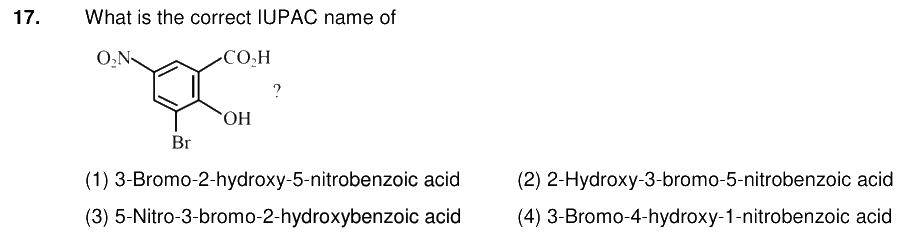
38JEE Main 2025 · 3 Apr · Shift 2MCQOpen question page ↗

What is the correct IUPAC name of

(see the figure above)
?

The question and its figure as printed in JEE Main 2025 03 Apr Shift 2.
The question as printed in the paper.
  • A

    3-Bromo-2-hydroxy-5-nitrobenzoic acid

  • B

    2-Hydroxy-3-bromo-5-nitrobenzoic acid

  • C

    5-Nitro-3-bromo-2-hydroxybenzoic acid

  • D

    3-Bromo-4-hydroxy-1-nitrobenzoic acid

39JEE Main 2025 · 3 Apr · Shift 2MCQOpen question page ↗

Given below are two statements:

Statement I : Hyperconjugation is not a permanent effect.

Statement II : In general, greater the number of alkyl groups attached to a positively charged Cation, greater is the hyperconjugation interaction and stabilization of the cation.

In the light of the above statements, choose the correct answer from the options given below

  • A

    Both Statement I and Statement II are false

  • B

    Statement I is false but Statement II is true

  • C

    Statement I is true but Statement II is false

  • D

    Both Statement I and Statement II are true

40JEE Main 2025 · 2 Apr · Shift 1MCQOpen question page ↗

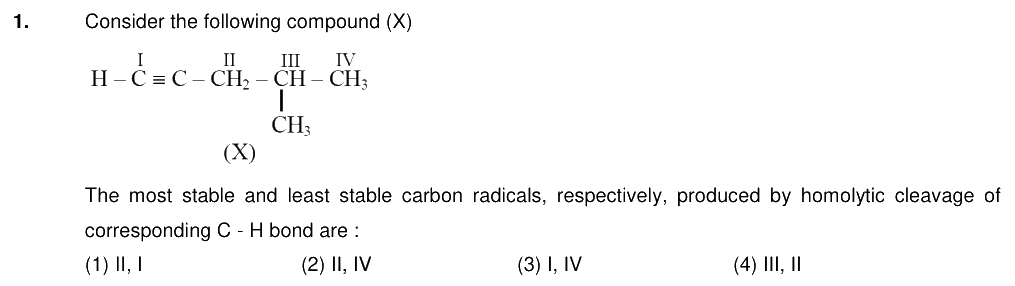
Consider the following compound (X)

(see the figure above)

The most stable and least stable carbon radicals, respectively, produced by homolytic cleavage of corresponding C - H bond are :

The question and its figure as printed in JEE Main 2025 02 Apr Shift 1.
The question as printed in the paper.
  • A

    II, I

  • B

    II, IV

  • C

    I, IV

  • D

    III, II

41JEE Main 2025 · 2 Apr · Shift 1MCQOpen question page ↗

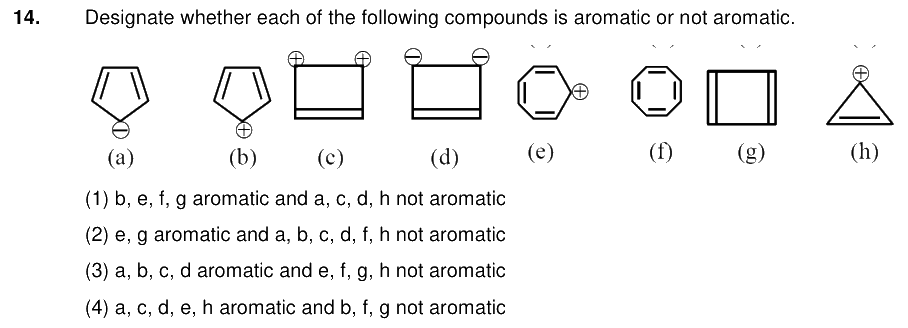
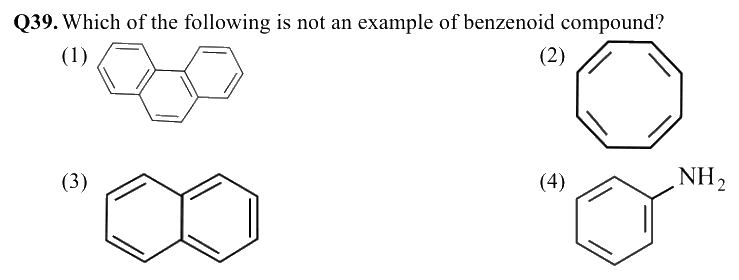
Designate whether each of the following compounds is aromatic or not aromatic.

(see the figure above)

The question and its figure as printed in JEE Main 2025 02 Apr Shift 1.
The question as printed in the paper.
  • A

    b, e, f, g aromatic and a, c, d, h not aromatic

  • B

    e, g aromatic and a, b, c, d, f, h not aromatic

  • C

    a, b, c, d aromatic and e, f, g, h not aromatic

  • D

    a, c, d, e, h aromatic and b, f, g not aromatic

42JEE Main 2025 · 2 Apr · Shift 2MCQOpen question page ↗

In 3,3-dimethylhex-1-en-4-yne, there are ______ $sp^3$, ______ $sp^2$ and ______ sp hybridised carbon atoms respectively.

  • A

    2, 4, 2

  • B

    4, 2, 2

  • C

    2, 2, 4

  • D

    3 ,3, 2

43JEE Main 2025 · 29 Jan · Shift 1MCQOpen question page ↗

Total number of nucleophiles from the following is : $\mathrm{NH_3}$, PhSH, $\mathrm{(H_3C)_2\,S}$, $\mathrm{H_2C = CH_2}$, $\overset{\ominus}{\mathrm{O}}$ H, $\mathrm{H_3O^\oplus}$, $\mathrm{(CH_3)_2CO}$, $\rightleftharpoons \mathrm{NCH_3}$

  • A

    7

  • B

    4

  • C

    6

  • D

    5

44JEE Main 2025 · 29 Jan · Shift 1MCQOpen question page ↗

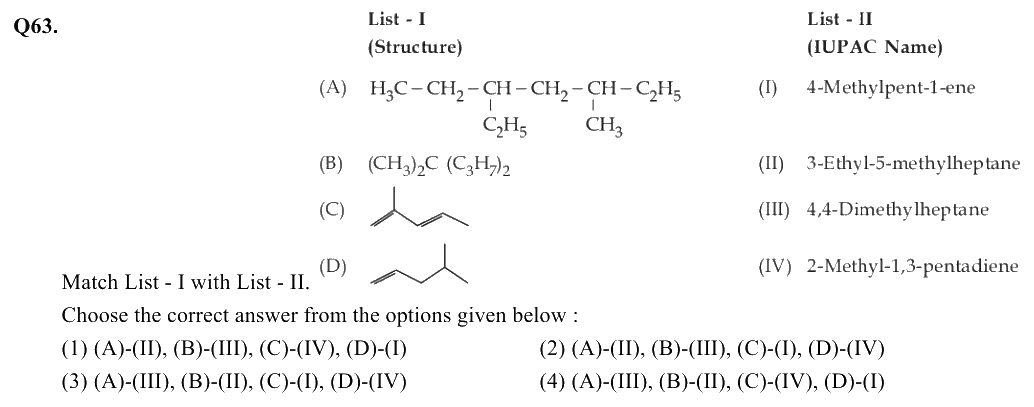
Match List - I with List - II.

List - I (Structure)List - II (IUPAC Name)
(A)$\mathrm{H_3C - CH_2 - CH - CH_2 - CH - C_2H_5}$ with $\mathrm{C_2H_5}$ below the first CH and $\mathrm{CH_3}$ below the second CH(I)4-Methylpent-1-ene
(B)$\mathrm{(CH_3)_2C\,(C_3H_7)_2}$(II)3-Ethyl-5-methylheptane
(C)(see the figure above) a zigzag chain with a double bond at the left end, a methyl branch on the second carbon (a second double bond further along)(III)4,4-Dimethylheptane
(D)(see the figure above) a zigzag chain with a double bond at the left end and a methyl branch on the third carbon(IV)2-Methyl-1,3-pentadiene

Choose the correct answer from the options given below :

The question and its figure as printed in JEE Main 2025 29 Jan Shift 1.
The question as printed in the paper.
  • A

    (A)-(II), (B)-(III), (C)-(IV), (D)-(I)

  • B

    (A)-(II), (B)-(III), (C)-(I), (D)-(IV)

  • C

    (A)-(III), (B)-(II), (C)-(I), (D)-(IV)

  • D

    (A)-(III), (B)-(II), (C)-(IV), (D)-(I)

45JEE Main 2025 · 29 Jan · Shift 2MCQOpen question page ↗

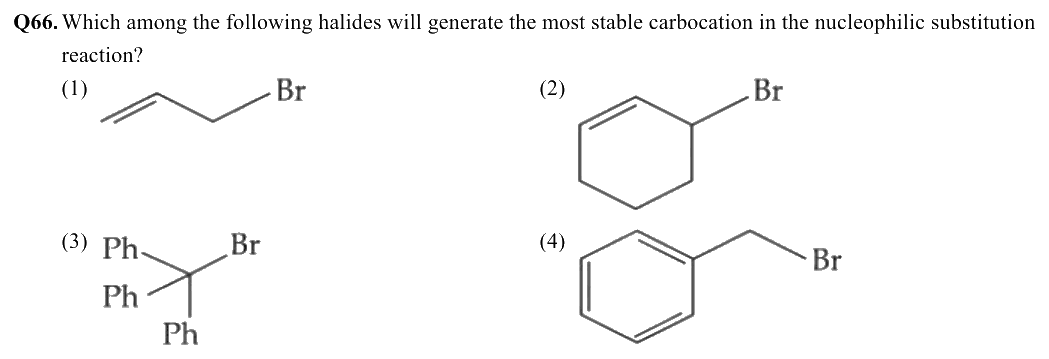
Which among the following halides will generate the most stable carbocation in the nucleophilic substitution reaction?

The question and its figure as printed in JEE Main 2025 29 Jan Shift 2. Option 1: a skeletal drawing of a short chain: a terminal double bond (drawn at the left) then a single bond to a CH2 and a bond going up-right to 'Br' (allyl bromide). Option 2: a six-membered ring with a double bond on its upper-left side and 'Br' on a bond going up-right from a ring carbon next to the double bond. Option 3: a carbon with three 'Ph' groups (one upper left, one lower left, one below) and 'Br' on a bond going up-right. Option 4: a benzene ring with a CH2 on a bond going up-right and 'Br' at the end of it (lower right): ring–CH2–Br.
The question as printed in the paper.
  • A

    see figure a skeletal drawing of a short chain: a terminal double bond (drawn at the left) then a single bond to a CH2 and a bond going up-right to 'Br' (allyl bromide).

  • B

    see figure a six-membered ring with a double bond on its upper-left side and 'Br' on a bond going up-right from a ring carbon next to the double bond.

  • C

    see figure a carbon with three 'Ph' groups (one upper left, one lower left, one below) and 'Br' on a bond going up-right.

  • D

    see figure a benzene ring with a CH2 on a bond going up-right and 'Br' at the end of it (lower right): ring–CH2–Br.

46JEE Main 2025 · 28 Jan · Shift 1MCQOpen question page ↗

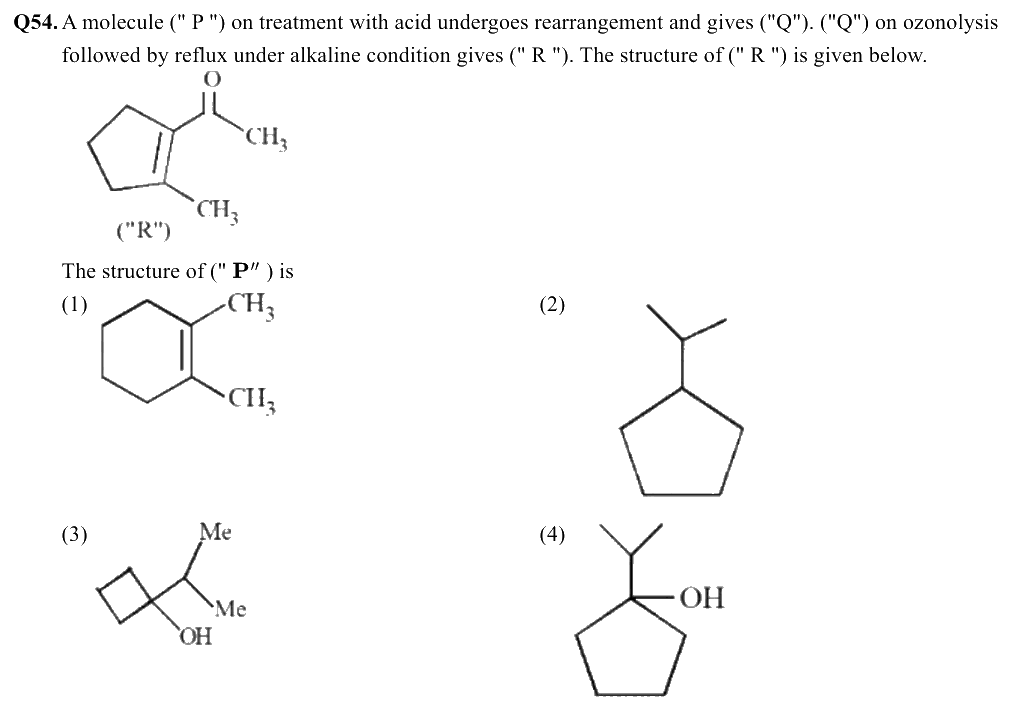
A molecule (" P ") on treatment with acid undergoes rearrangement and gives ("Q"). ("Q") on ozonolysis followed by reflux under alkaline condition gives (" R "). The structure of (" R ") is given below.

(see the figure above)

The structure of (" P" ) is

The question and its figure as printed in JEE Main 2025 28 Jan Shift 1. Option 1: a six-membered ring with a double bond on its right side; each of the two double-bonded carbons carries a 'CH3' (one at the upper right, one at the lower right). Option 2: a five-membered ring (cyclopentane, single bonds only) with a branched two-methyl carbon on its top corner (an isopropyl group, drawn as a short 'Y'). Option 3: a four-membered ring (square) whose right corner carries 'OH' (below) and is bonded to a carbon (up-right) that has two substituents labelled 'Me' (one above, one lower right). Option 4: a five-membered ring with 'OH' on its top-right ring carbon and, on the same carbon, a branched…
The question as printed in the paper.
  • A

    see figure a six-membered ring with a double bond on its right side; each of the two double-bonded carbons carries a 'CH3' (one at the upper right, one at the lower right).

  • B

    see figure a five-membered ring (cyclopentane, single bonds only) with a branched two-methyl carbon on its top corner (an isopropyl group, drawn as a short 'Y').

  • C

    see figure a four-membered ring (square) whose right corner carries 'OH' (below) and is bonded to a carbon (up-right) that has two substituents labelled 'Me' (one above, one lower right).

  • D

    see figure a five-membered ring with 'OH' on its top-right ring carbon and, on the same carbon, a branched two-methyl carbon going up (an isopropyl group, drawn as a short 'Y').

47JEE Main 2025 · 28 Jan · Shift 1MCQOpen question page ↗

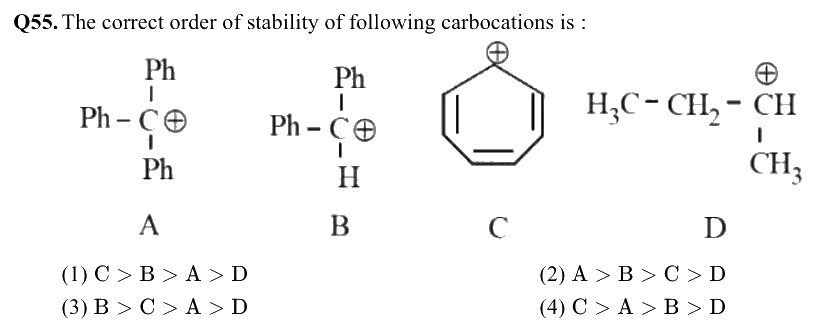
The correct order of stability of following carbocations is :

(see the figure above)

The question and its figure as printed in JEE Main 2025 28 Jan Shift 1.
The question as printed in the paper.
  • A

    C > B > A > D

  • B

    A > B > C > D

  • C

    B > C > A > D

  • D

    C > A > B > D

48JEE Main 2025 · 28 Jan · Shift 2MCQOpen question page ↗

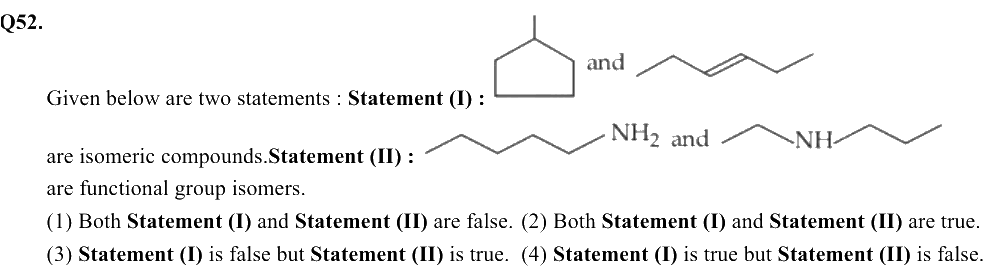
see figure Given below are two statements : Statement (I) : are isomeric compounds.Statement (II) : are functional group isomers.

The question and its figure as printed in JEE Main 2025 28 Jan Shift 2. Question: Given below are two statements : Statement (I) : are isomeric compounds.Statement (II) : are functional group isomers.
The question as printed in the paper.
  • A

    Both Statement (I) and Statement (II) are false.

  • B

    Both Statement (I) and Statement (II) are true.

  • C

    Statement (I) is false but Statement (II) is true.

  • D

    Statement (I) is true but Statement (II) is false.

49JEE Main 2025 · 24 Jan · Shift 1MCQOpen question page ↗

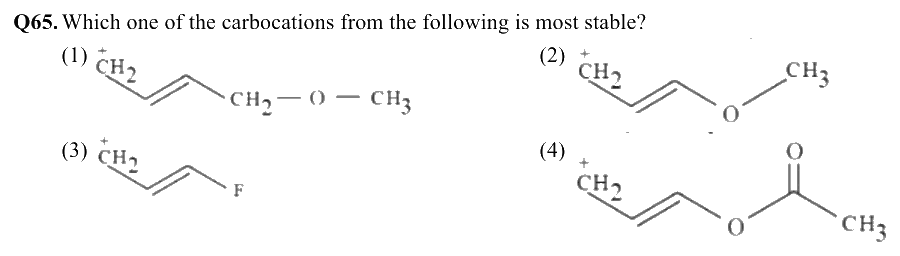
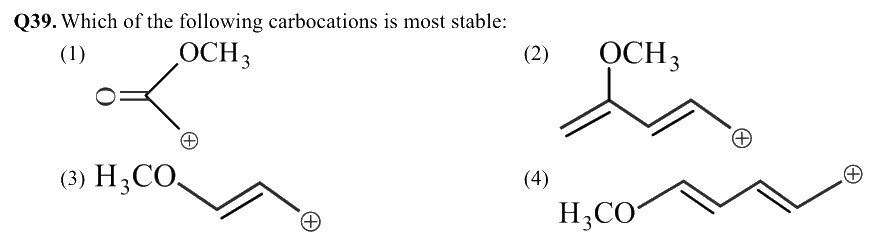
Which one of the carbocations from the following is most stable?

The question and its figure as printed in JEE Main 2025 24 Jan Shift 1. Option 1: CH2(+) at the upper left; from it a single bond goes down-right and a double bond goes up-right; the chain ends in 'CH2–O–CH3'. Option 2: CH2(+) at the upper left; from it a single bond goes down-right and a double bond goes up-right; the chain ends in 'O' bonded to 'CH3'. Option 3: CH2(+) at the upper left; from it a single bond goes down-right and a double bond goes up-right; the chain ends in 'F'. Option 4: CH2(+) at the upper left; from it a single bond goes down-right and a double bond goes up-right; the chain ends in 'O' bonded to a carbonyl carbon (a double-bonded 'O' above it) carrying 'CH3'.
The question as printed in the paper.
  • A

    see figure CH2(+) at the upper left; from it a single bond goes down-right and a double bond goes up-right; the chain ends in 'CH2–O–CH3'.

  • B

    see figure CH2(+) at the upper left; from it a single bond goes down-right and a double bond goes up-right; the chain ends in 'O' bonded to 'CH3'.

  • C

    see figure CH2(+) at the upper left; from it a single bond goes down-right and a double bond goes up-right; the chain ends in 'F'.

  • D

    see figure CH2(+) at the upper left; from it a single bond goes down-right and a double bond goes up-right; the chain ends in 'O' bonded to a carbonyl carbon (a double-bonded 'O' above it) carrying 'CH3'.

50JEE Main 2025 · 23 Jan · Shift 1MCQOpen question page ↗

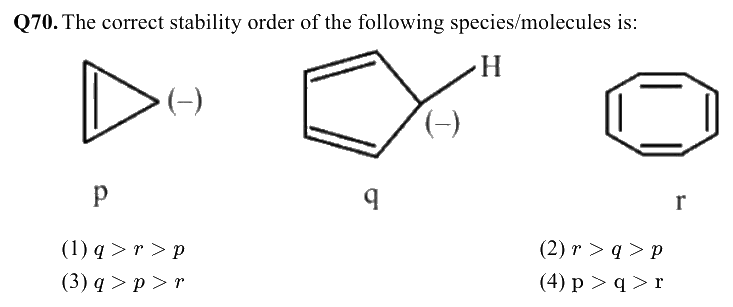
The correct stability order of the following species/molecules is:

(see the figure above)

The question and its figure as printed in JEE Main 2025 23 Jan Shift 1.
The question as printed in the paper.
  • A

    $q > r > p$

  • B

    $r > q > p$

  • C

    $q > p > r$

  • D

    p > q > r

51JEE Main 2025 · 22 Jan · Shift 1MCQOpen question page ↗

The incorrect statements regarding geometrical isomerism are : (A) Propene shows geometrical isomerism. (B) Trans isomer has identical atoms/groups on the opposite sides of the double bond. (C) Cis-but-2-ene has higher dipole moment than trans-but-2-ene. (D) 2-methylbut-2-ene shows two geometrical isomers. (E) Trans-isomer has lower melting point than cis isomer. Choose the correct answer from the options given below :

  • A

    (A) and (E) Only

  • B

    (A), (D) and (E) Only

  • C

    (B) and (C) Only

  • D

    (C), (D) and (E) Only

52JEE Main 2025 · 22 Jan · Shift 1MCQOpen question page ↗

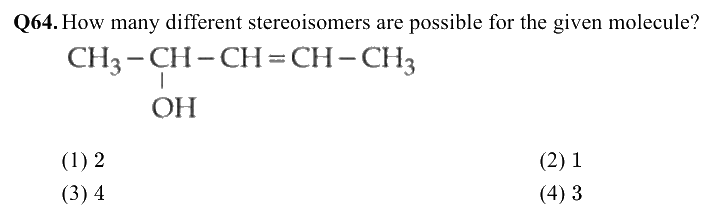
How many different stereoisomers are possible for the given molecule?

(see the figure above)

The question and its figure as printed in JEE Main 2025 22 Jan Shift 1.
The question as printed in the paper.
  • A

    2

  • B

    1

  • C

    4

  • D

    3

53JEE Main 2025 · 22 Jan · Shift 1MCQOpen question page ↗

The IUPAC name of the following compound is :

(see the figure above)

The question and its figure as printed in JEE Main 2025 22 Jan Shift 1.
The question as printed in the paper.
  • A

    Methyl-6-carboxy-2,5-dimethylhexanoate.

  • B

    2-Carboxy-5-methoxycarbonylhexane.

  • C

    6-Methoxycarbonyl-2,5-dimethylhexanoic acid.

  • D

    Methyl-5-carboxy-2-methylhexanoate.

54JEE Main 2025 · 22 Jan · Shift 2MCQOpen question page ↗

The alkane from below having two secondary hydrogens is :

  • A

    4-Ethyl-3,4-dimethyloctane

  • B

    2,2,3,3-Tetramethylpentane

  • C

    2,2,4,5-Tetramethylheptane

  • D

    2,2,4,4-Tetramethylhexane

55JEE Main 2025 · 22 Jan · Shift 2MCQOpen question page ↗

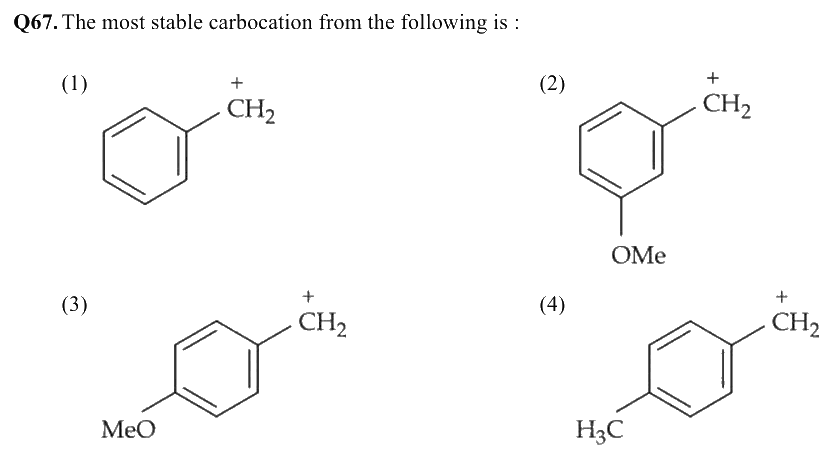
The most stable carbocation from the following is :

The question and its figure as printed in JEE Main 2025 22 Jan Shift 2. Option 1: a benzene ring with a CH2 group carrying a plus sign ('+' above 'CH2') on a bond going up-right. Option 2: a benzene ring with a CH2 group carrying a plus sign on a bond going up-right from its upper-right vertex, and 'OMe' on a bond going down from the ring's bottom vertex. Option 3: a benzene ring with a CH2 group carrying a plus sign on a bond going up-right from its upper-right vertex, and 'MeO' on a bond going down-left from the vertex at the opposite (lower-left) end of the ring. Option 4: a benzene ring with a CH2 group carrying a plus sign on a bond going up-right from its upper-right vertex, and…
The question as printed in the paper.
  • A

    see figure a benzene ring with a CH2 group carrying a plus sign ('+' above 'CH2') on a bond going up-right.

  • B

    see figure a benzene ring with a CH2 group carrying a plus sign on a bond going up-right from its upper-right vertex, and 'OMe' on a bond going down from the ring's bottom vertex.

  • C

    see figure a benzene ring with a CH2 group carrying a plus sign on a bond going up-right from its upper-right vertex, and 'MeO' on a bond going down-left from the vertex at the opposite (lower-left) end of the ring.

  • D

    see figure a benzene ring with a CH2 group carrying a plus sign on a bond going up-right from its upper-right vertex, and 'H3C' on a bond going down-left from the vertex at the opposite (lower-left) end of the ring.

56JEE Main 2024 · 9 Apr · Shift 1MCQOpen question page ↗

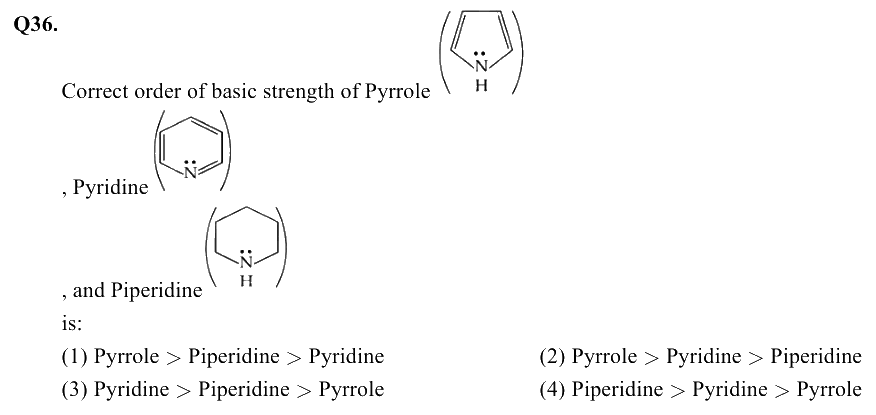
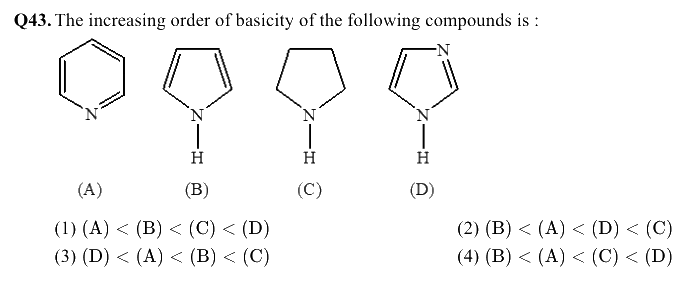
Correct order of basic strength of Pyrrole (see the figure above), Pyridine (see the figure above), and Piperidine (see the figure above) is:

The question and its figure as printed in JEE Main 2024 09 Apr Shift 1.
The question as printed in the paper.
  • A

    Pyrrole > Piperidine > Pyridine

  • B

    Pyrrole > Pyridine > Piperidine

  • C

    Pyridine > Piperidine > Pyrrole

  • D

    Piperidine > Pyridine > Pyrrole

57JEE Main 2024 · 9 Apr · Shift 1MCQOpen question page ↗

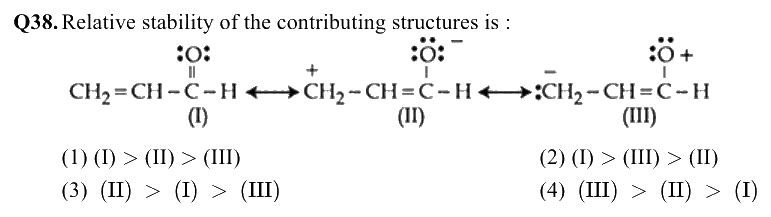
Relative stability of the contributing structures is :

(see the figure above)

The question and its figure as printed in JEE Main 2024 09 Apr Shift 1.
The question as printed in the paper.
  • A

    (I) > (II) > (III)

  • B

    (I) > (III) > (II)

  • C

    (II) > (I) > (III)

  • D

    (III) > (II) > (I)

58JEE Main 2024 · 9 Apr · Shift 2MCQOpen question page ↗

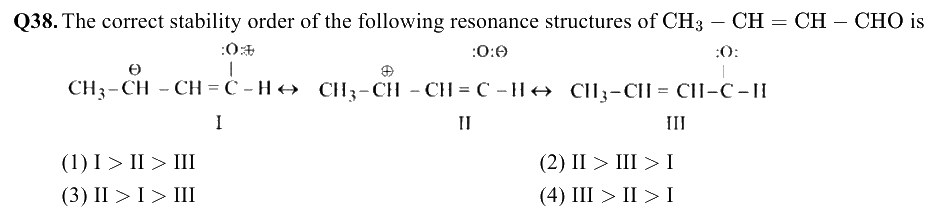
The correct stability order of the following resonance structures of $\mathrm{CH_3 - CH = CH - CHO}$ is

(see the figure above)

The question and its figure as printed in JEE Main 2024 09 Apr Shift 2.
The question as printed in the paper.
  • A

    I > II > III

  • B

    II > III > I

  • C

    II > I > III

  • D

    III > II > I

59JEE Main 2024 · 9 Apr · Shift 2MCQOpen question page ↗

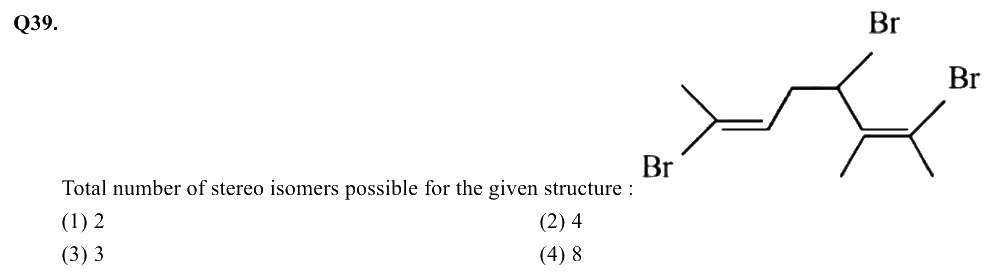
see figure Total number of stereo isomers possible for the given structure :

The question and its figure as printed in JEE Main 2024 09 Apr Shift 2. Question: Total number of stereo isomers possible for the given structure :
The question as printed in the paper.
  • A

    2

  • B

    4

  • C

    3

  • D

    8

60JEE Main 2024 · 8 Apr · Shift 1MCQOpen question page ↗

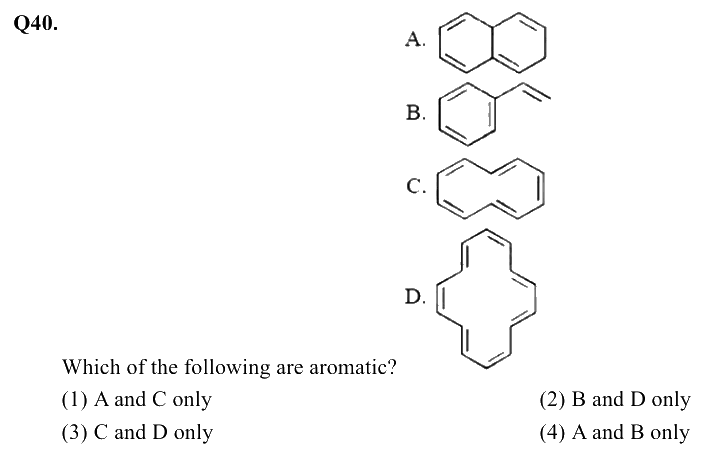
see figure Which of the following are aromatic?

The question and its figure as printed in JEE Main 2024 08 Apr Shift 1. Question: Which of the following are aromatic?
The question as printed in the paper.
  • A

    A and C only

  • B

    B and D only

  • C

    C and D only

  • D

    A and B only

61JEE Main 2024 · 8 Apr · Shift 1MCQOpen question page ↗

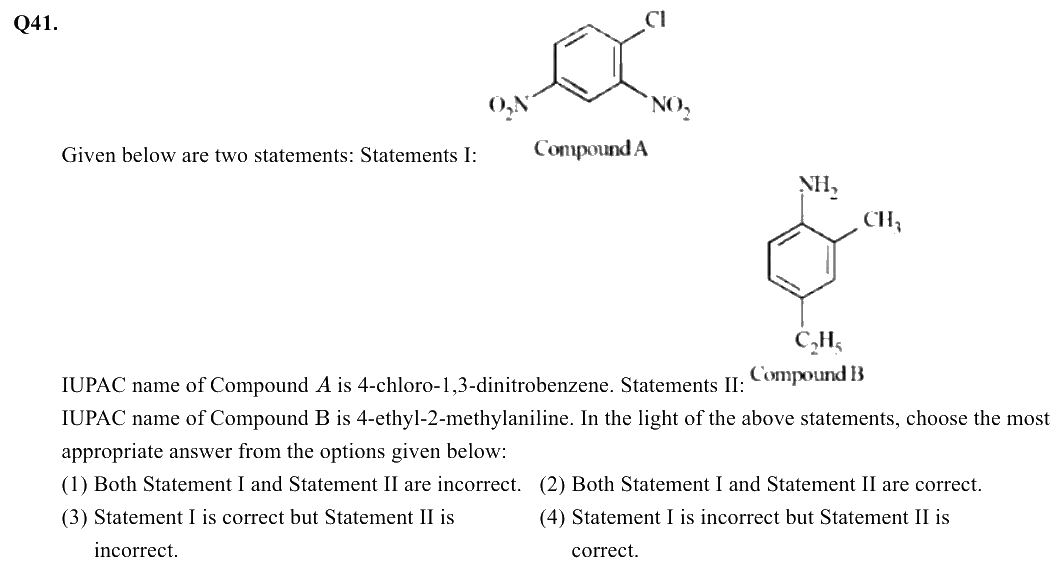
Given below are two statements: Statements I: (see the figure above) IUPAC name of Compound $A$ is 4-chloro-1,3-dinitrobenzene. Statements II: (see the figure above) IUPAC name of Compound B is 4-ethyl-2-methylaniline. In the light of the above statements, choose the most appropriate answer from the options given below:

The question and its figure as printed in JEE Main 2024 08 Apr Shift 1.
The question as printed in the paper.
  • A

    Both Statement I and Statement II are incorrect.

  • B

    Both Statement I and Statement II are correct.

  • C

    Statement I is correct but Statement II is incorrect.

  • D

    Statement I is incorrect but Statement II is correct.

62JEE Main 2024 · 8 Apr · Shift 1MCQOpen question page ↗

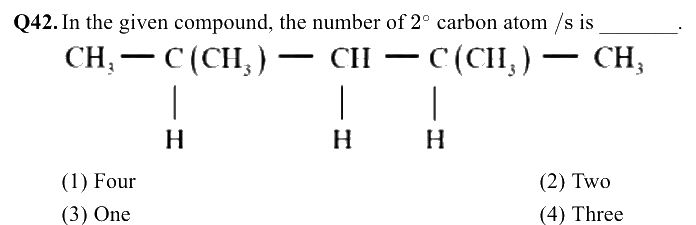
In the given compound, the number of $2^{\circ}$ carbon atom /s is ______ .

(see the figure above)

The question and its figure as printed in JEE Main 2024 08 Apr Shift 1.
The question as printed in the paper.
  • A

    Four

  • B

    Two

  • C

    One

  • D

    Three

64JEE Main 2024 · 8 Apr · Shift 2MCQOpen question page ↗

see figure IUPAC name of following hydrocarbon $(X)$ is :

The question and its figure as printed in JEE Main 2024 08 Apr Shift 2. Question: IUPAC name of following hydrocarbon (X) is :
The question as printed in the paper.
  • A

    2-Ethyl-3,6-dimethylheptane

  • B

    2,5,6-Trimethyloctane

  • C

    3,4,7-Trimethyloctane

  • D

    2-Ethyl-2,6-diethylheptane

65JEE Main 2024 · 6 Apr · Shift 1MCQOpen question page ↗

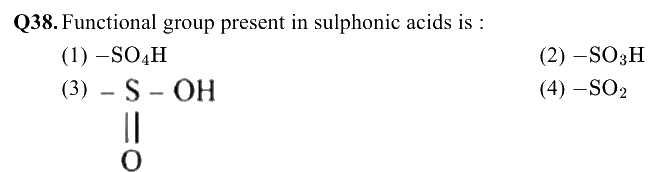
Functional group present in sulphonic acids is :

The question and its figure as printed in JEE Main 2024 06 Apr Shift 1. Option 3: a sulphur atom with a bond to OH on the right, a bond to a dash on the left, and a double bond to an O drawn below the sulphur (written as - S - OH with =O below).
The question as printed in the paper.
  • A

    $-SO_4H$

  • B

    $-SO_3H$

  • C

    see figure a sulphur atom with a bond to OH on the right, a bond to a dash on the left, and a double bond to an O drawn below the sulphur (written as - S - OH with =O below).

  • D

    $-SO_2$

66JEE Main 2024 · 6 Apr · Shift 1MCQOpen question page ↗

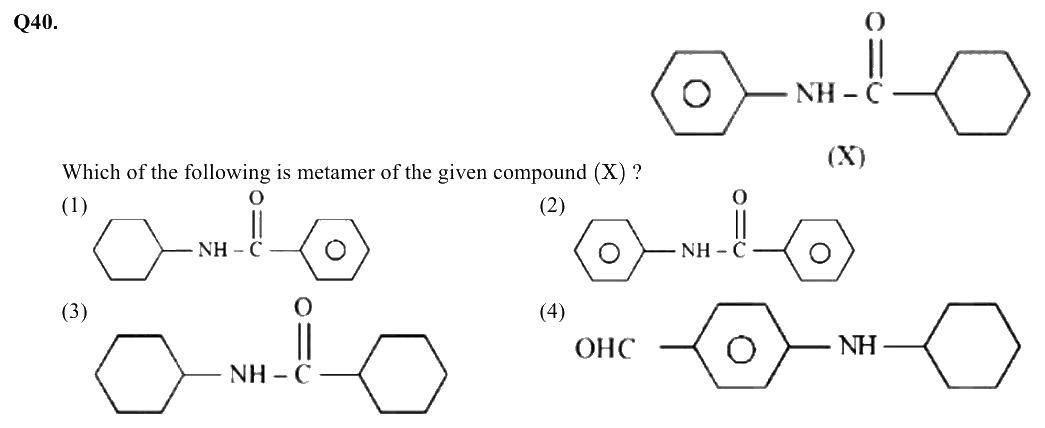
see figure Which of the following is metamer of the given compound (X) ?

The question and its figure as printed in JEE Main 2024 06 Apr Shift 1. Question: Which of the following is metamer of the given compound (X) ? Option 1: a cyclohexane ring (no inner circle) joined to NH, then to a C that has an O double-bonded above it, then to a benzene ring (hexagon with an inner circle). Option 2: a benzene ring (hexagon with an inner circle) joined to NH, then to a C that has an O double-bonded above it, then to a second benzene ring (with an inner circle). Option 3: a cyclohexane ring (no inner circle) joined to NH, then to a C that has an O double-bonded above it, then to a second cyclohexane ring (no inner circle). Option 4: OHC joined to the left of a benzene ring…
The question as printed in the paper.
  • A

    see figure a cyclohexane ring (no inner circle) joined to NH, then to a C that has an O double-bonded above it, then to a benzene ring (hexagon with an inner circle).

  • B

    see figure a benzene ring (hexagon with an inner circle) joined to NH, then to a C that has an O double-bonded above it, then to a second benzene ring (with an inner circle).

  • C

    see figure a cyclohexane ring (no inner circle) joined to NH, then to a C that has an O double-bonded above it, then to a second cyclohexane ring (no inner circle).

  • D

    see figure OHC joined to the left of a benzene ring (hexagon with an inner circle), whose right side is joined to NH, then to a cyclohexane ring (no inner circle).

67JEE Main 2024 · 6 Apr · Shift 2MCQOpen question page ↗

The incorrect statement regarding the geometrical isomers of 2-butene is :

  • A

    cis-2-butene and trans-2-butene are not interconvertible at room temperature.

  • B

    cis-2-butene and trans-2-butene are stereoisomers.

  • C

    cis-2-butene has less dipole moment than trans-2-butene.

  • D

    trans-2-butene is more stable than cis-2-butene.

68JEE Main 2024 · 5 Apr · Shift 1MCQOpen question page ↗

Given below are two statements : one is labelled as Assertion (A) and the other is labelled as Reason (R). Assertion (A) : Cis form of alkene is found to be more polar than the trans form. Reason (R): Dipole moment of trans isomer of 2-butene is zero. In the light of the above statements, choose the correct answer from the options given below :

  • A

    (A) is false but (R) is true

  • B

    Both (A) and (R) are true and (R) is the correct explanation of (A)

  • C

    (A) is true but (R) is false

  • D

    Both (A) and (R) are true but (R) is NOT the correct explanation of (A)

69JEE Main 2024 · 5 Apr · Shift 2MCQOpen question page ↗

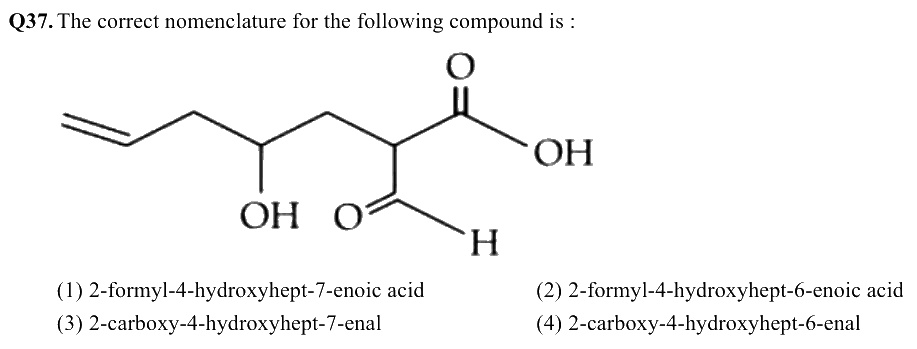
The correct nomenclature for the following compound is :

(see the figure above)

The question and its figure as printed in JEE Main 2024 05 Apr Shift 2.
The question as printed in the paper.
  • A

    2-formyl-4-hydroxyhept-7-enoic acid

  • B

    2-formyl-4-hydroxyhept-6-enoic acid

  • C

    2-carboxy-4-hydroxyhept-7-enal

  • D

    2-carboxy-4-hydroxyhept-6-enal

70JEE Main 2024 · 5 Apr · Shift 2MCQOpen question page ↗

Match List I with List II

List - I (Pair of compounds)List - II (Isomerism)
(A) n-propanol and Isopropanol(I) Metamerism
(B) Methoxypropane and ethoxyethane(II) Chain Isomerism
(C) Propanone and propanal(III) Position Isomerism
(D) Neopentane and Isopentane(IV) Functional Isomerism

Choose the correct answer from the options given below :

  • A

    (A)-(II), (B)-(I), (C)-(IV), (D)-(III)

  • B

    (A)-(III), (B)-(I), (C)-(II), (D)-(IV)

  • C

    (A)-(I), (B)-(III), (C)-(IV), (D)-(II)

  • D

    (A)-(III), (B)-(I), (C)-(IV), (D)-(II)

71JEE Main 2024 · 4 Apr · Shift 1MCQOpen question page ↗

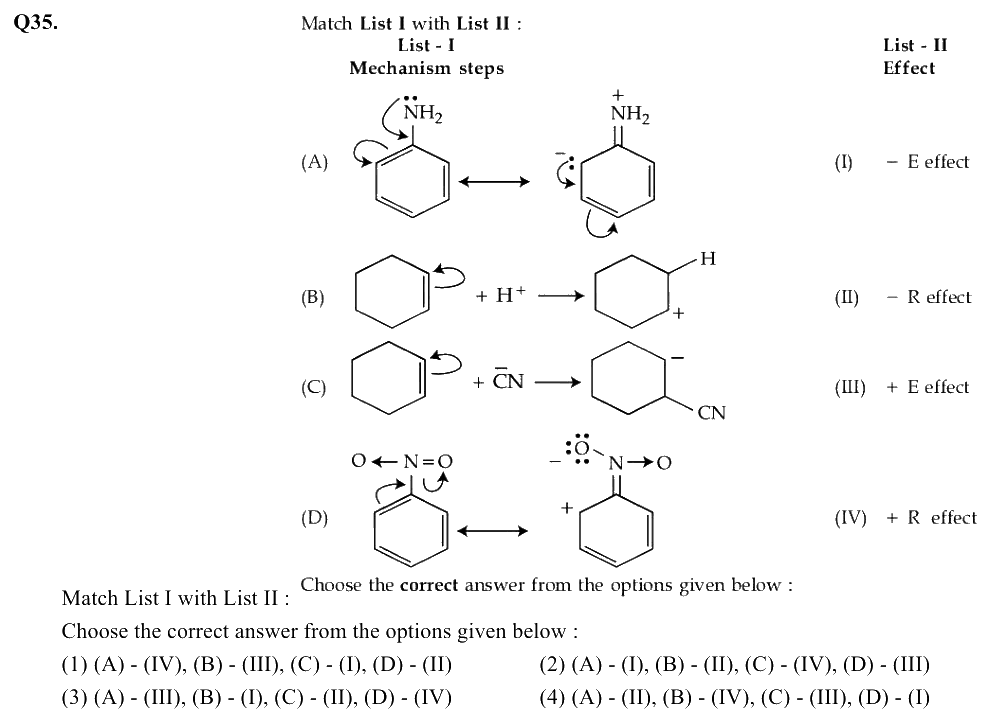
Match List I with List II :

List - I (Mechanism steps)List - II (Effect)
(A) [drawing, see figure](I) $-$ E effect
(B) [drawing, see figure](II) $-$ R effect
(C) [drawing, see figure](III) $+$ E effect
(D) [drawing, see figure](IV) $+$ R effect

(see the figure above)

Match List I with List II :

Choose the correct answer from the options given below :

The question and its figure as printed in JEE Main 2024 04 Apr Shift 1.
The question as printed in the paper.
  • A

    (A) - (IV), (B) - (III), (C) - (I), (D) - (II)

  • B

    (A) - (I), (B) - (II), (C) - (IV), (D) - (III)

  • C

    (A) - (III), (B) - (I), (C) - (II), (D) - (IV)

  • D

    (A) - (II), (B) - (IV), (C) - (III), (D) - (I)

72JEE Main 2024 · 4 Apr · Shift 1MCQOpen question page ↗

Which among the following is incorrect statement?

  • A

    Electromeric effect dominates over inductive effect

  • B

    The electromeric effect is, temporary effect

  • C

    Hydrogen ion ($\mathrm{H^+}$)shows negative electromeric effect

  • D

    The organic compound shows electromeric effect in the presence of the reagent only.

73JEE Main 2024 · 4 Apr · Shift 1MCQOpen question page ↗

What will be the decreasing order of basic strength of the following conjugate bases?

${}^{-}\mathrm{OH},\ \mathrm{R\overline{O}},\ \mathrm{CH_3CO\overline{O}},\ \mathrm{C\overline{l}}$

  • A

    $\mathrm{R\overline{O}} > {}^{-}\mathrm{OH} > \mathrm{CH_3CO\overline{O}} > \mathrm{C\overline{l}}$

  • B

    $\mathrm{C\overline{l}} > \mathrm{R\overline{O}} > {}^{-}\mathrm{OH} > \mathrm{CH_3CO\overline{O}}$

  • C

    ${}^{-}\mathrm{OH} > \mathrm{R\overline{O}} > \mathrm{CH_3CO\overline{O}} > \mathrm{C\overline{l}}$

  • D

    $\mathrm{C\overline{l}} > {}^{-}\mathrm{OH} > \mathrm{R\overline{O}} > \mathrm{CH_3CO\overline{O}}$

74JEE Main 2024 · 4 Apr · Shift 2MCQOpen question page ↗

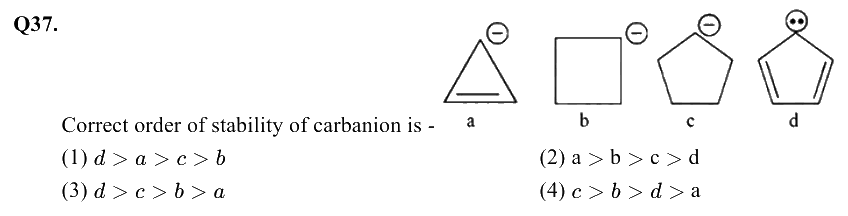
see figure Correct order of stability of carbanion is -

The question and its figure as printed in JEE Main 2024 04 Apr Shift 2. Question: Correct order of stability of carbanion is -
The question as printed in the paper.
  • A

    $d > a > c > b$

  • B

    a > b > c > d

  • C

    $d > c > b > a$

  • D

    $c > b > d > a$

76JEE Main 2024 · 1 Feb · Shift 1MCQOpen question page ↗

Ionic reactions with organic compounds proceed through:

(A) Homolytic bond cleavage (B) Heterolytic bond cleavage (C) Free radical formation (D) Primary free radical (E) Secondary free radical

Choose the correct answer from the options given below:

  • A

    (A) only

  • B

    (C) only

  • C

    (B) only

  • D

    (D) and (E) only

78JEE Main 2024 · 31 Jan · Shift 1MCQOpen question page ↗

A species having carbon with sextet of electrons and can act as electrophile is called

  • A

    carbon free radical

  • B

    carbanion

  • C

    carbocation

  • D

    pentavalent carbon

79JEE Main 2024 · 31 Jan · Shift 1MCQOpen question page ↗

Given below are two statements:

Statement I: IUPAC name of HO - CH$_2$ - (CH$_2$)$_3$ - CH$_2$ - COCH3 is 7-hydroxyheptan-2-one.

Statement II: 2-oxoheptan-7-ol is the correct IUPAC name for the above compound.

In the light of the above statements, Choose the most appropriate answer from the options given below:

  • A

    Statement I is correct but Statement II is incorrect.

  • B

    Both Statement I and Statement II are incorrect.

  • C

    Both Statement I and Statement II are correct.

  • D

    Statement I is incorrect but Statement II is correct.

80JEE Main 2024 · 31 Jan · Shift 2MCQOpen question page ↗

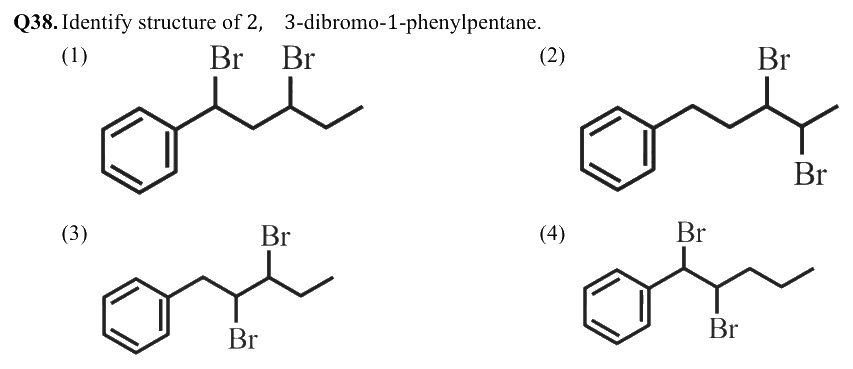
Identify structure of 2, 3-dibromo-1-phenylpentane.

The question and its figure as printed in JEE Main 2024 31 Jan Shift 2. Option 1: Skeletal structure: a benzene ring joined to a zig-zag chain of five carbons; Br on the first and the third chain carbons counted from the ring, the chain then continuing two more carbons to a terminal methyl Option 2: Skeletal structure: a benzene ring joined to a zig-zag chain of five carbons; Br on the third and the fourth chain carbons counted from the ring (the fourth carbon bears Br pointing down, and the fifth carbon is the terminal methyl) Option 3: Skeletal structure: a benzene ring joined to a zig-zag chain of five carbons; Br on the second (pointing down) and the third (pointing up) chain carbons…
The question as printed in the paper.
  • A

    see figure Skeletal structure: a benzene ring joined to a zig-zag chain of five carbons; Br on the first and the third chain carbons counted from the ring, the chain then continuing two more carbons to a terminal methyl

  • B

    see figure Skeletal structure: a benzene ring joined to a zig-zag chain of five carbons; Br on the third and the fourth chain carbons counted from the ring (the fourth carbon bears Br pointing down, and the fifth carbon is the terminal methyl)

  • C

    see figure Skeletal structure: a benzene ring joined to a zig-zag chain of five carbons; Br on the second (pointing down) and the third (pointing up) chain carbons counted from the ring, then two more carbons to a terminal methyl

  • D

    see figure Skeletal structure: a benzene ring joined to a zig-zag chain of five carbons; Br on the first (pointing up) and the second (pointing down) chain carbons counted from the ring, then three more carbons ending in a terminal methyl

81JEE Main 2024 · 30 Jan · Shift 1MCQOpen question page ↗

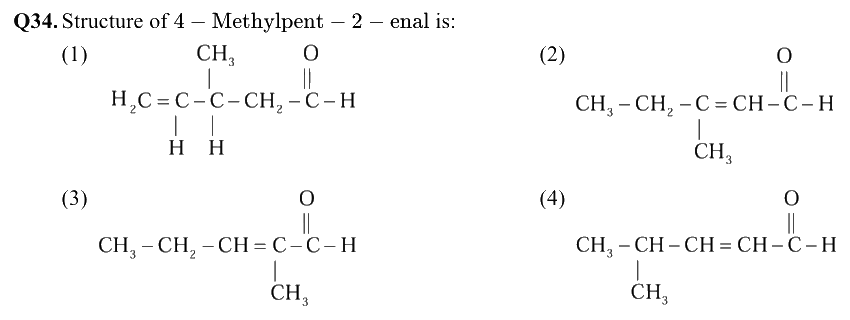
Structure of 4 – Methylpent – 2 – enal is:

(see the figure above)

The question and its figure as printed in JEE Main 2024 30 Jan Shift 1. Option 1: Drawn in a line: H2C=C–C–CH2–C(=O)–H; the second C (after the double bond) has an H below it; the third C has a CH3 above it and an H below it; the final C has O double-bonded above it. Option 2: Drawn in a line: CH3–CH2–C=CH–C(=O)–H, with a CH3 hanging below the C that is before the double bond (the first double-bonded C), and O double-bonded above the last C. Option 3: Drawn in a line: CH3–CH2–CH=C–C(=O)–H, with a CH3 hanging below the C that is after the double bond (the second double-bonded C), and O double-bonded above the last C. Option 4: Drawn in a line: CH3–CH–CH=CH–C(=O)–H, with a CH3 hanging below…
The question as printed in the paper.
  • A

    see figure Drawn in a line: $\mathrm{H_2C}$=C–C–$\mathrm{CH_2}$–C(=O)–H; the second C (after the double bond) has an H below it; the third C has a $\mathrm{CH_3}$ above it and an H below it; the final C has O double-bonded above it.

  • B

    see figure Drawn in a line: $\mathrm{CH_3}$–$\mathrm{CH_2}$–C=CH–C(=O)–H, with a $\mathrm{CH_3}$ hanging below the C that is before the double bond (the first double-bonded C), and O double-bonded above the last C.

  • C

    see figure Drawn in a line: $\mathrm{CH_3}$–$\mathrm{CH_2}$–CH=C–C(=O)–H, with a $\mathrm{CH_3}$ hanging below the C that is after the double bond (the second double-bonded C), and O double-bonded above the last C.

  • D

    see figure Drawn in a line: $\mathrm{CH_3}$–CH–CH=CH–C(=O)–H, with a $\mathrm{CH_3}$ hanging below the first CH, and O double-bonded above the last C.

82JEE Main 2024 · 30 Jan · Shift 1MCQOpen question page ↗

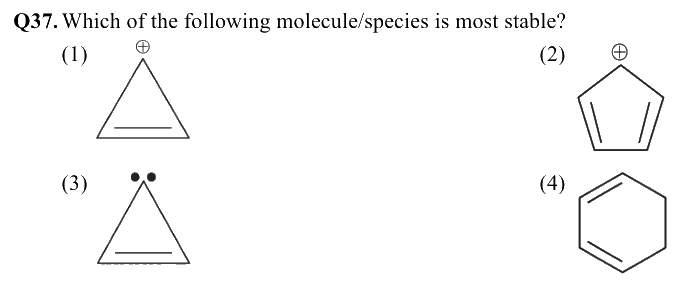
Which of the following molecule/species is most stable?

(see the figure above)

The question and its figure as printed in JEE Main 2024 30 Jan Shift 1. Option 1: An equilateral triangle (three-membered ring) with a circled plus sign at its top vertex and a short horizontal line inside near the base (a double bond on the base). Option 2: A five-membered ring (pentagon) with a circled plus sign at its top vertex and two double bonds drawn on the lower-left and lower-right sides. Option 3: A triangle with two dots (a lone pair) above its top vertex and a short horizontal line inside near the base (a double bond on the base). Option 4: A six-membered ring (hexagon) with two double bonds drawn on the upper-left and lower-left sides.
The question as printed in the paper.
  • A

    see figure An equilateral triangle (three-membered ring) with a circled plus sign at its top vertex and a short horizontal line inside near the base (a double bond on the base).

  • B

    see figure A five-membered ring (pentagon) with a circled plus sign at its top vertex and two double bonds drawn on the lower-left and lower-right sides.

  • C

    see figure A triangle with two dots (a lone pair) above its top vertex and a short horizontal line inside near the base (a double bond on the base).

  • D

    see figure A six-membered ring (hexagon) with two double bonds drawn on the upper-left and lower-left sides.

83JEE Main 2024 · 30 Jan · Shift 2MCQOpen question page ↗

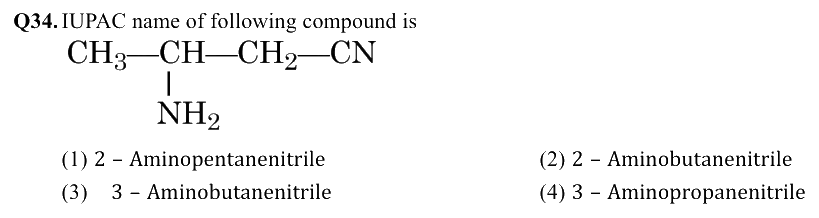
IUPAC name of following compound is

(see the figure above)

The question and its figure as printed in JEE Main 2024 30 Jan Shift 2.
The question as printed in the paper.
  • A

    2 – Aminopentanenitrile

  • B

    2 – Aminobutanenitrile

  • C

    3 – Aminobutanenitrile

  • D

    3 – Aminopropanenitrile

84JEE Main 2024 · 30 Jan · Shift 2MCQOpen question page ↗

The correct stability order of carbocations is

  • A

    $(\mathrm{CH_3})_3\mathrm{C}^{+} > \mathrm{CH_3}-\overset{+}{\mathrm{C}}\mathrm{H_2} > (\mathrm{CH_3})_2\overset{+}{\mathrm{C}}\mathrm{H} > \overset{+}{\mathrm{C}}\mathrm{H_3}$

  • B

    $\overset{+}{\mathrm{C}}\mathrm{H_3} > (\mathrm{CH_3})_2\overset{+}{\mathrm{C}}\mathrm{H} > \mathrm{CH_3}-\overset{+}{\mathrm{C}}\mathrm{H_2} > (\mathrm{CH_3})_3\overset{+}{\mathrm{C}}$

  • C

    $(\mathrm{CH_3})_3\overset{+}{\mathrm{C}} > (\mathrm{CH_3})_2\overset{+}{\mathrm{C}}\mathrm{H} > \mathrm{CH_3}-\overset{+}{\mathrm{C}}\mathrm{H_2} > \overset{+}{\mathrm{C}}\mathrm{H_3}$

  • D

    $\overset{+}{\mathrm{C}}\mathrm{H_3} > \mathrm{CH_3}-\overset{+}{\mathrm{C}}\mathrm{H_2} > (\mathrm{CH_3})_2\overset{+}{\mathrm{C}}\mathrm{H} > (\mathrm{CH_3})_3\mathrm{C}^{+}$

85JEE Main 2024 · 29 Jan · Shift 1MCQOpen question page ↗

The interaction between $\pi$ bond and lone pair of electrons present on an adjacent atom is responsible for

  • A

    Hyperconjugation

  • B

    Inductive effect

  • C

    Electromeric effect

  • D

    Resonance effect

86JEE Main 2024 · 29 Jan · Shift 1MCQOpen question page ↗

The difference in energy between the actual structure and the lowest energy resonance structure for the given compound is:

  • A

    electromeric energy

  • B

    resonance energy

  • C

    ionization energy

  • D

    hyperconjugation energy

87JEE Main 2024 · 29 Jan · Shift 2MCQOpen question page ↗

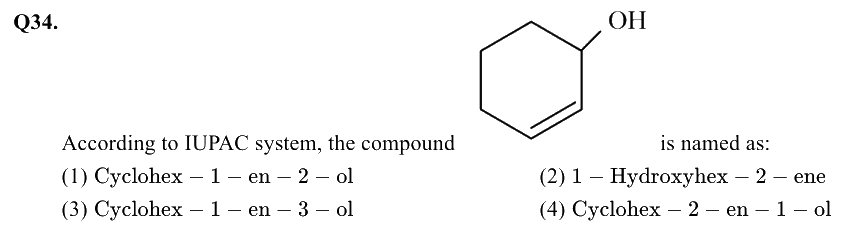
According to IUPAC system, the compound (see the figure above) is named as:

The question and its figure as printed in JEE Main 2024 29 Jan Shift 2.
The question as printed in the paper.
  • A

    Cyclohex $-$ 1 $-$ en $-$ 2 $-$ ol

  • B

    1 $-$ Hydroxyhex $-$ 2 $-$ ene

  • C

    Cyclohex $-$ 1 $-$ en $-$ 3 $-$ ol

  • D

    Cyclohex $-$ 2 $-$ en $-$ 1 $-$ ol

88JEE Main 2024 · 29 Jan · Shift 2MCQOpen question page ↗

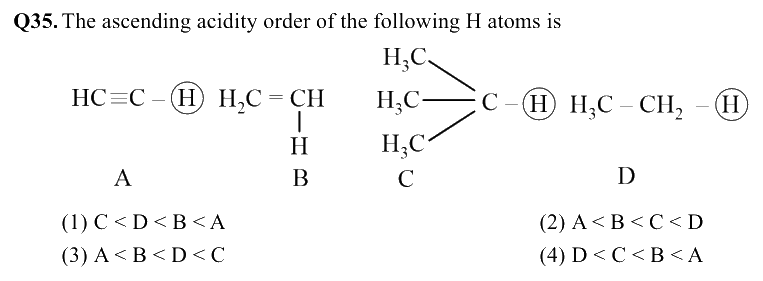
The ascending acidity order of the following H atoms is

(see the figure above)

The question and its figure as printed in JEE Main 2024 29 Jan Shift 2.
The question as printed in the paper.
  • A

    C < D < B < A

  • B

    A < B < C < D

  • C

    A < B < D < C

  • D

    D < C < B < A

89JEE Main 2024 · 29 Jan · Shift 2MCQOpen question page ↗

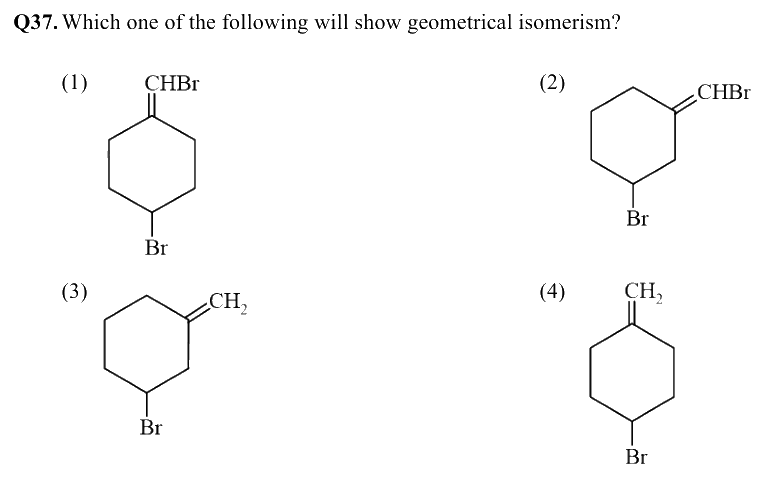
Which one of the following will show geometrical isomerism?

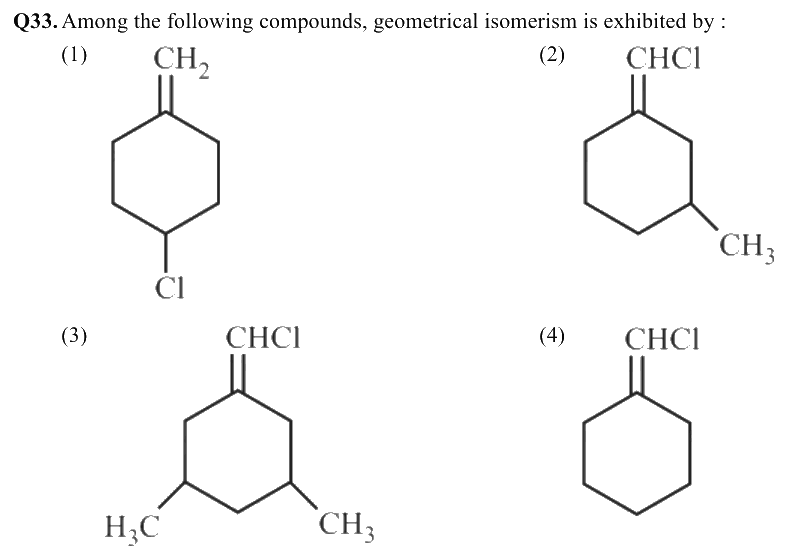
The question and its figure as printed in JEE Main 2024 29 Jan Shift 2. Option 1: A cyclohexane ring with a =CHBr group attached by a double bond at the top vertex and a Br at the bottom vertex (the two substituted carbons are opposite each other, 1,4). Option 2: A cyclohexane ring with a =CHBr group attached by a double bond at the upper-right vertex and a Br at the bottom vertex (the two substituted carbons are 1,3 to each other). Option 3: A cyclohexane ring with a =CH2 group attached by a double bond at the upper-right vertex and a Br at the bottom vertex (the two substituted carbons are 1,3 to each other). Option 4: A cyclohexane ring with a =CH2 group attached by a double bond at the…
The question as printed in the paper.
  • A

    see figure A cyclohexane ring with a =CHBr group attached by a double bond at the top vertex and a Br at the bottom vertex (the two substituted carbons are opposite each other, 1,4).

  • B

    see figure A cyclohexane ring with a =CHBr group attached by a double bond at the upper-right vertex and a Br at the bottom vertex (the two substituted carbons are 1,3 to each other).

  • C

    see figure A cyclohexane ring with a =CH$_2$ group attached by a double bond at the upper-right vertex and a Br at the bottom vertex (the two substituted carbons are 1,3 to each other).

  • D

    see figure A cyclohexane ring with a =CH$_2$ group attached by a double bond at the top vertex and a Br at the bottom vertex (the two substituted carbons are opposite each other, 1,4).

90JEE Main 2024 · 27 Jan · Shift 1MCQOpen question page ↗

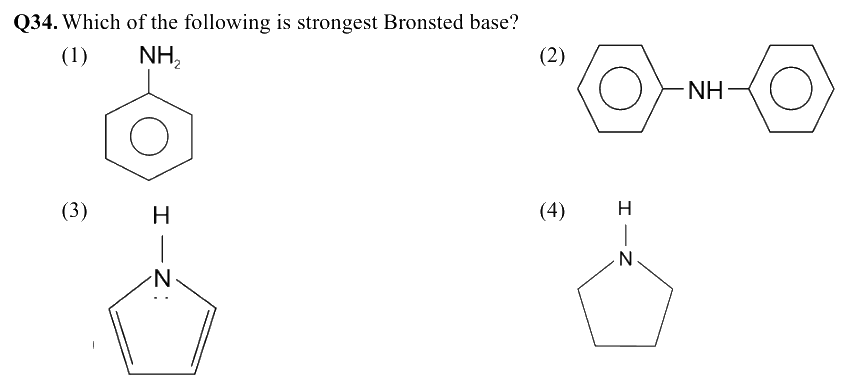
Which of the following is strongest Bronsted base?

The question and its figure as printed in JEE Main 2024 27 Jan Shift 1. Option 1: Benzene ring with an NH2 group on top (aniline drawing) Option 2: Two benzene rings joined through an NH, drawn horizontally as ring - NH - ring Option 3: Five-membered ring with N at the top bearing an H above it, a pair of dots (lone pair) below N, and two double bonds in the ring Option 4: Five-membered saturated ring with N at the top bearing an H above it
The question as printed in the paper.
  • A

    see figure Benzene ring with an NH2 group on top (aniline drawing)

  • B

    see figure Two benzene rings joined through an NH, drawn horizontally as ring - NH - ring

  • C

    see figure Five-membered ring with N at the top bearing an H above it, a pair of dots (lone pair) below N, and two double bonds in the ring

  • D

    see figure Five-membered saturated ring with N at the top bearing an H above it

91JEE Main 2024 · 27 Jan · Shift 1MCQOpen question page ↗

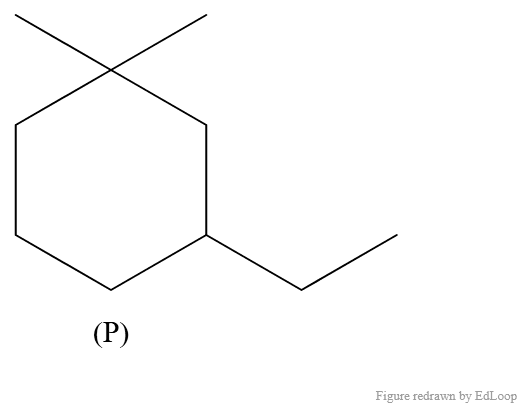
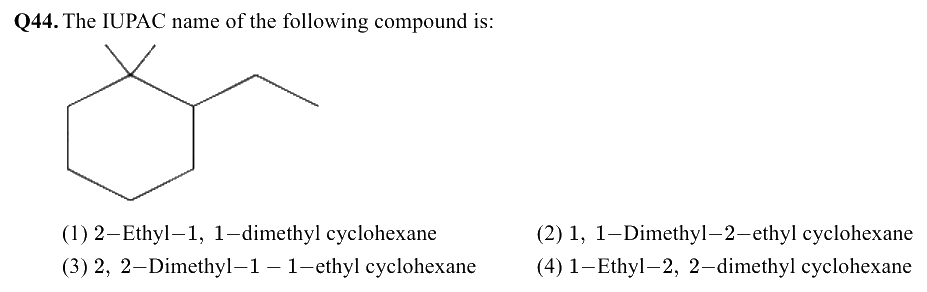
IUPAC name of following compound (P) is :

(see the figure above)

The question and its figure as printed in JEE Main 2024 27 Jan Shift 1.
The question as printed in the paper.
  • A

    1 $-$ Ethyl $-$ 5, 5 $-$ dimethylcyclohexane

  • B

    3 $-$ Ethyl $-$ 1, 1 $-$ dimethylcyclohexane

  • C

    1 $-$ Ethyl $-$ 3, 3 $-$ dimethylcyclohexane

  • D

    1, 1 $-$ Dimethyl $-$ 3 $-$ ethylcyclohexane

92JEE Main 2024 · 27 Jan · Shift 1MCQOpen question page ↗

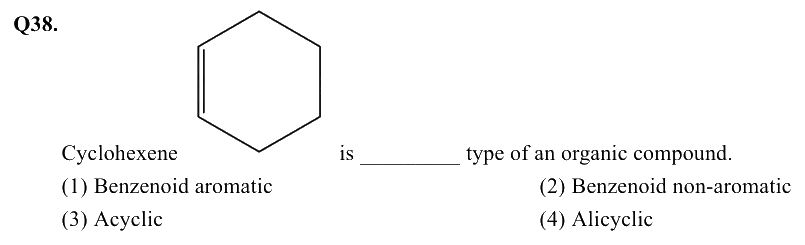
Cyclohexene (see the figure above) is ______ type of an organic compound.

The question and its figure as printed in JEE Main 2024 27 Jan Shift 1.
The question as printed in the paper.
  • A

    Benzenoid aromatic

  • B

    Benzenoid non-aromatic

  • C

    Acyclic

  • D

    Alicyclic

93JEE Main 2024 · 27 Jan · Shift 1MCQOpen question page ↗

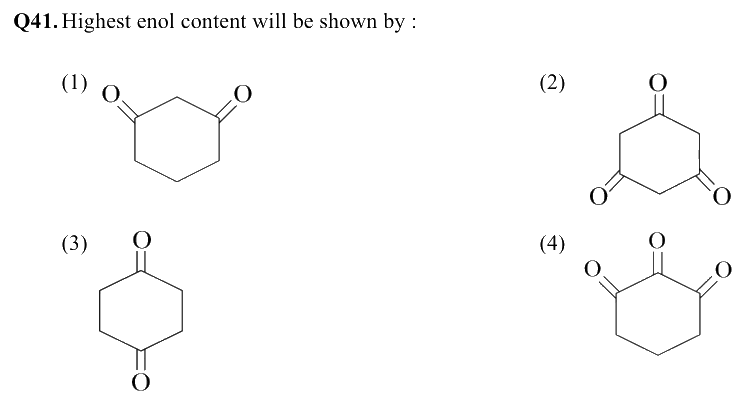
Highest enol content will be shown by :

The question and its figure as printed in JEE Main 2024 27 Jan Shift 1. Option 1: Six-membered ring with two C=O groups at the upper left and upper right vertices, separated by the top CH2 Option 2: Six-membered ring with three C=O groups: one at the top, one at the lower left and one at the lower right vertex Option 3: Six-membered ring with two C=O groups, one at the top and one at the bottom vertex Option 4: Six-membered ring with three adjacent C=O groups at the upper left, top and upper right vertices
The question as printed in the paper.
  • A

    see figure Six-membered ring with two C=O groups at the upper left and upper right vertices, separated by the top CH2

  • B

    see figure Six-membered ring with three C=O groups: one at the top, one at the lower left and one at the lower right vertex

  • C

    see figure Six-membered ring with two C=O groups, one at the top and one at the bottom vertex

  • D

    see figure Six-membered ring with three adjacent C=O groups at the upper left, top and upper right vertices

94JEE Main 2024 · 27 Jan · Shift 2MCQOpen question page ↗

The molecular formula of second homologue in the homologous series of mono carboxylic acids is ______.

  • A

    $\mathrm{C_3H_6O_2}$

  • B

    $\mathrm{C_2H_4O_2}$

  • C

    $\mathrm{CH_2O}$

  • D

    $\mathrm{C_2H_2O_2}$

95JEE Main 2024 · 27 Jan · Shift 2MCQOpen question page ↗

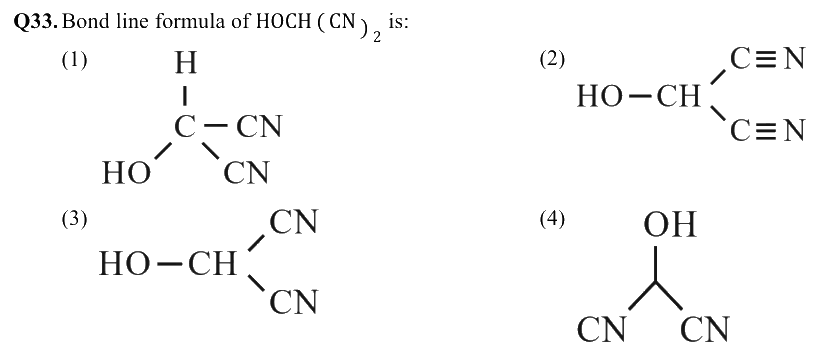
Bond line formula of $\mathrm{HOCH(CN)_2}$ is:

The question and its figure as printed in JEE Main 2024 27 Jan Shift 2. Option 1: Structure with H above C; C bonded to CN on the right and, below, HO on the lower left and CN on the lower right Option 2: HO-CH with two C≡N groups, one on the upper right and one on the lower right of the CH Option 3: HO-CH with two CN groups (single bonds), one on the upper right and one on the lower right of the CH Option 4: OH on top of a central carbon (zigzag apex) with CN on the lower left and CN on the lower right
The question as printed in the paper.
  • A

    see figure Structure with H above C; C bonded to CN on the right and, below, HO on the lower left and CN on the lower right

  • B

    see figure HO-CH with two C≡N groups, one on the upper right and one on the lower right of the CH

  • C

    see figure HO-CH with two CN groups (single bonds), one on the upper right and one on the lower right of the CH

  • D

    see figure OH on top of a central carbon (zigzag apex) with CN on the lower left and CN on the lower right

96JEE Main 2024 · 27 Jan · Shift 2MCQOpen question page ↗

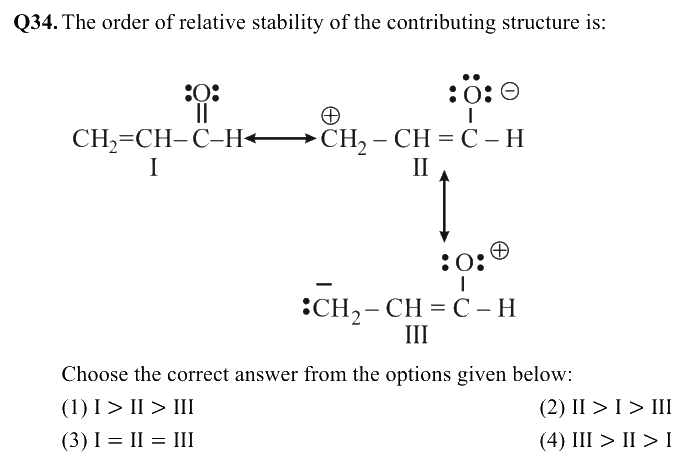
The order of relative stability of the contributing structure is:

(see the figure above)

Choose the correct answer from the options given below:

The question and its figure as printed in JEE Main 2024 27 Jan Shift 2.
The question as printed in the paper.
  • A

    I > II > III

  • B

    II > I > III

  • C

    I = II = III

  • D

    III > II > I

97JEE Main 2023 · 13 Apr · Shift 1MCQOpen question page ↗

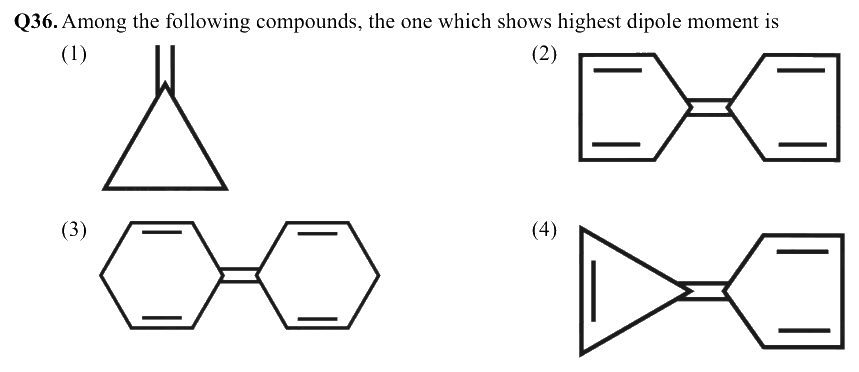
Among the following compounds, the one which shows highest dipole moment is

(see the figure above)

The question and its figure as printed in JEE Main 2023 13 Apr Shift 1.
The question as printed in the paper.
  • A

    (structure drawn, see figure)

  • B

    (structure drawn, see figure)

  • C

    (structure drawn, see figure)

  • D

    (structure drawn, see figure)

98JEE Main 2023 · 13 Apr · Shift 1MCQOpen question page ↗

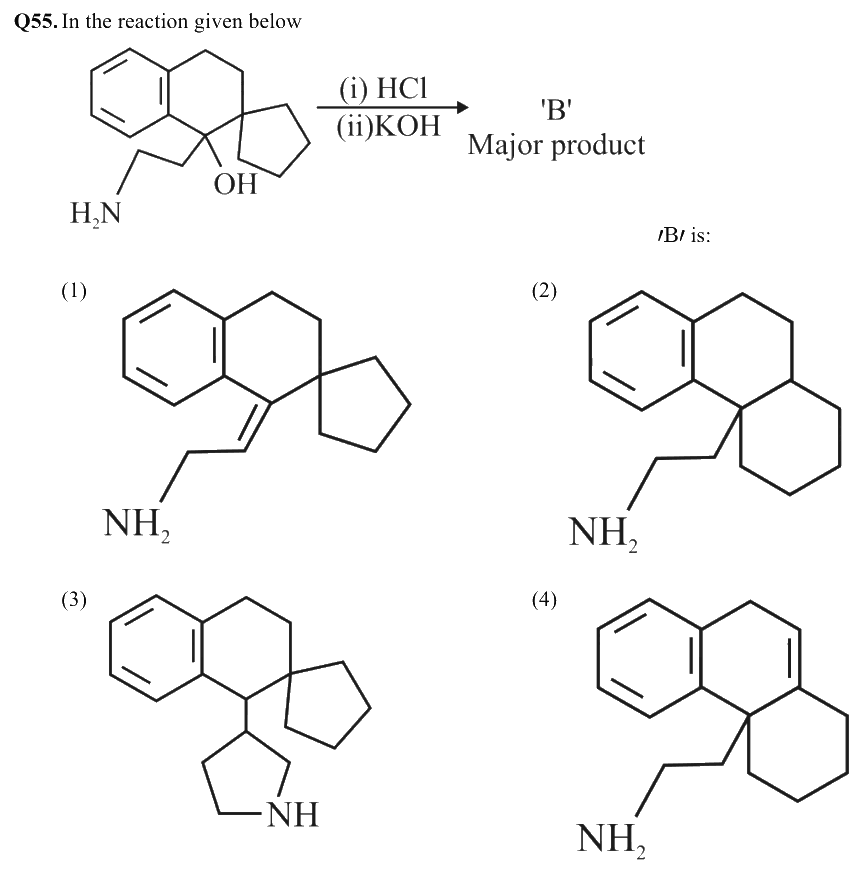
In the reaction given below

(see the figure above)
'B' is:

The question and its figure as printed in JEE Main 2023 13 Apr Shift 1.
The question as printed in the paper.
  • A

    (structure drawn, see figure)

  • B

    (structure drawn, see figure)

  • C

    (structure drawn, see figure)

  • D

    (structure drawn, see figure)

99JEE Main 2023 · 13 Apr · Shift 1MCQOpen question page ↗

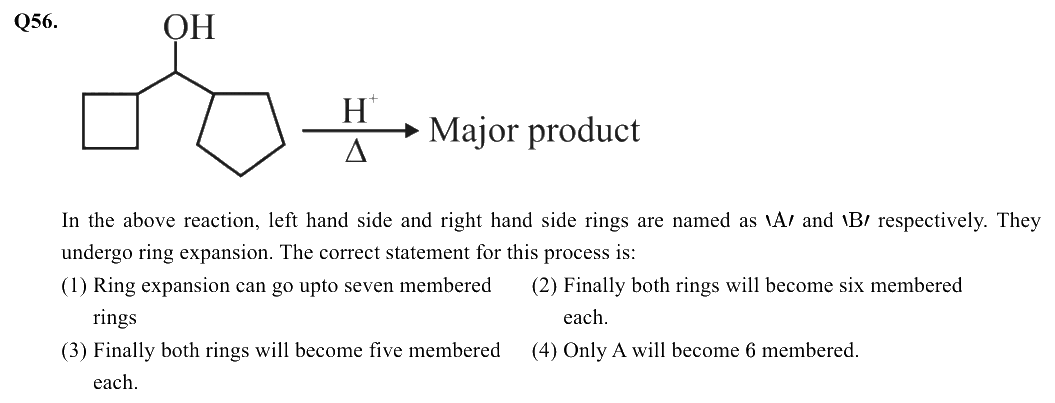
see figure In the above reaction, left hand side and right hand side rings are named as A and B respectively. They undergo ring expansion. The correct statement for this process is:

The question and its figure as printed in JEE Main 2023 13 Apr Shift 1. Question: In the above reaction, left hand side and right hand side rings are named as A and B respectively. They undergo ring expansion. The correct statement for this process is:
The question as printed in the paper.
  • A

    Ring expansion can go upto seven membered rings

  • B

    Finally both rings will become six membered each.

  • C

    Finally both rings will become five membered each.

  • D

    Only A will become 6 membered.

100JEE Main 2023 · 13 Apr · Shift 1MCQOpen question page ↗

D - (+) - Glyceraldehyde $\xrightarrow[\text{iii) HNO}_3]{\text{i) HCN}\;\;\text{ii) H}_2\text{O/H}^{+}}$
The products formed in the above reaction are

  • A

    One optically active and one meso product

  • B

    Two optically inactive products

  • C

    Two optically active products

  • D

    One optically inactive and one meso product

101JEE Main 2023 · 13 Apr · Shift 2MCQOpen question page ↗

The major product for the following reaction is :

(see the figure above)

The question and its figure as printed in JEE Main 2023 13 Apr Shift 2.
The question as printed in the paper.
  • A

    (structure drawn, see figure)

  • B

    (structure drawn, see figure)

  • C

    (structure drawn, see figure)

  • D

    (structure drawn, see figure)

102JEE Main 2023 · 13 Apr · Shift 2MCQOpen question page ↗

Given below are two statements :
Statement I : Tropolone is an aromatic compound and has $8\pi$ electrons.
Statement II : $\pi$ electrons of $>$C=O group in tropolone is involved in aromaticity. In the light of the above statements choose the correct answer from the options given below:

  • A

    Statement I is true but Statement II is false

  • B

    Statement I is false but Statement II is true

  • C

    Both Statement I and Statement II are false

  • D

    Both Statement I and Statement II are true

103JEE Main 2023 · 12 Apr · Shift 1MCQOpen question page ↗

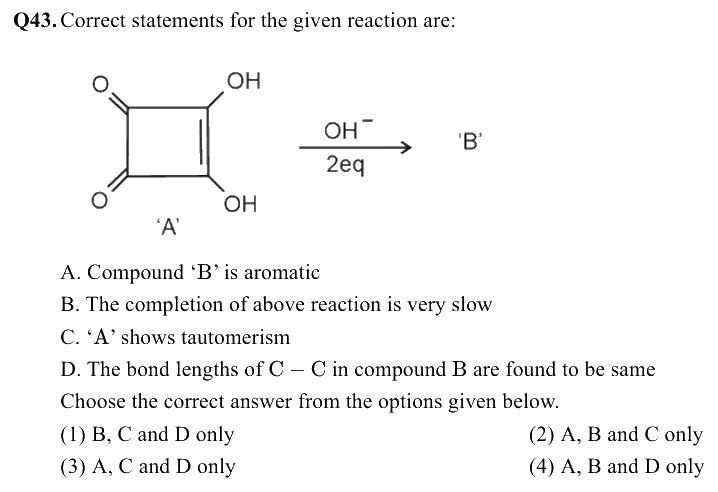
Correct statements for the given reaction are:
(see the figure above)
A. Compound 'B' is aromatic
B. The completion of above reaction is very slow
C. 'A' shows tautomerism
D. The bond lengths of C $-$ C in compound B are found to be same
Choose the correct answer from the options given below.

The question and its figure as printed in JEE Main 2023 12 Apr Shift 1.
The question as printed in the paper.
  • A

    B, C and D only

  • B

    A, B and C only

  • C

    A, C and D only

  • D

    A, B and D only

104JEE Main 2023 · 10 Apr · Shift 2MCQOpen question page ↗

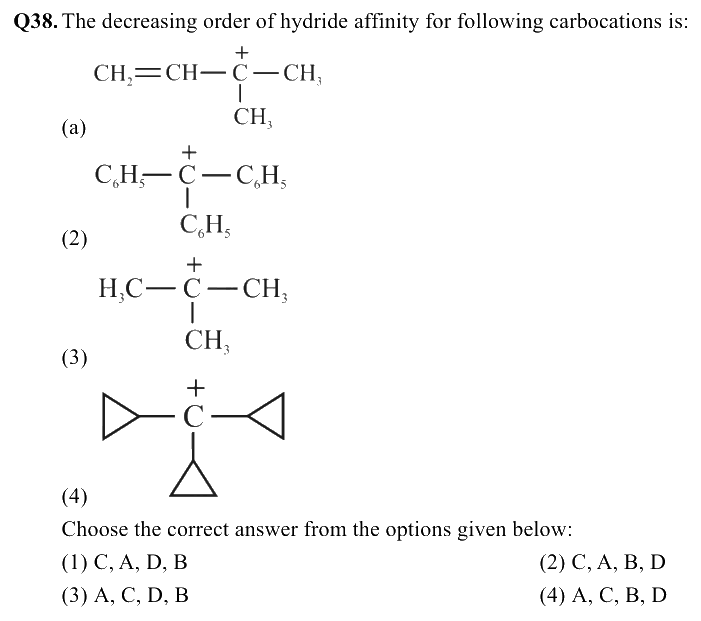
The decreasing order of hydride affinity for following carbocations is:
(a) (see the figure above)
(2) (see the figure above)
(3) (see the figure above)
(4) (see the figure above)
Choose the correct answer from the options given below:

The question and its figure as printed in JEE Main 2023 10 Apr Shift 2.
The question as printed in the paper.
  • A

    C, A, D, B

  • B

    C, A, B, D

  • C

    A, C, D, B

  • D

    A, C, B, D

105JEE Main 2023 · 10 Apr · Shift 2MCQOpen question page ↗

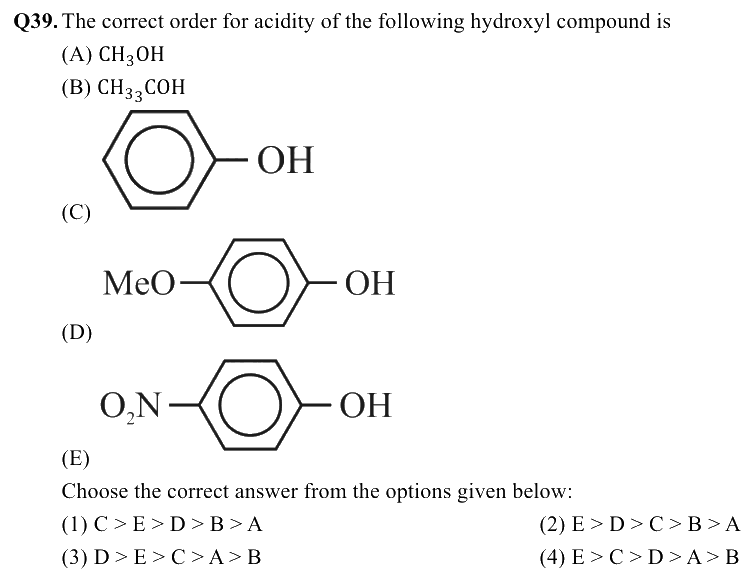
The correct order for acidity of the following hydroxyl compound is
(A) $\mathrm{CH_3OH}$
(B) $\mathrm{CH_{33}COH}$
(C) (see the figure above)
(D) (see the figure above)
(E) (see the figure above)
Choose the correct answer from the options given below:

The question and its figure as printed in JEE Main 2023 10 Apr Shift 2.
The question as printed in the paper.
  • A

    $\mathrm{C} > \mathrm{E} > \mathrm{D} > \mathrm{B} > \mathrm{A}$

  • B

    $\mathrm{E} > \mathrm{D} > \mathrm{C} > \mathrm{B} > \mathrm{A}$

  • C

    $\mathrm{D} > \mathrm{E} > \mathrm{C} > \mathrm{A} > \mathrm{B}$

  • D

    $\mathrm{E} > \mathrm{C} > \mathrm{D} > \mathrm{A} > \mathrm{B}$

106JEE Main 2023 · 8 Apr · Shift 2MCQOpen question page ↗

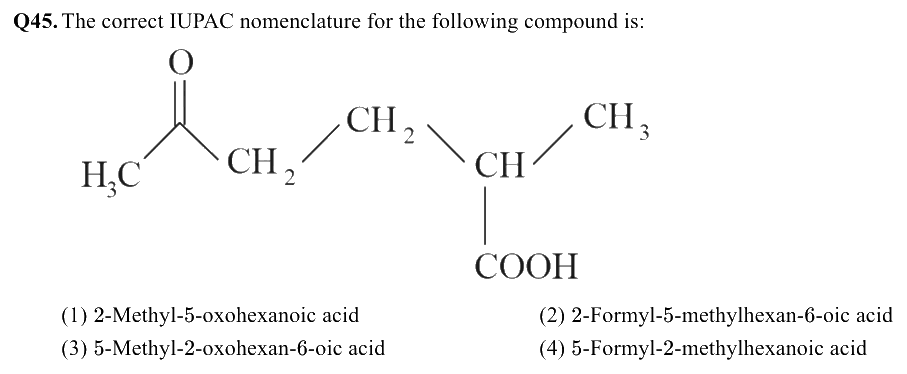
The correct IUPAC nomenclature for the following compound is:

(see the figure above)

The question and its figure as printed in JEE Main 2023 08 Apr Shift 2.
The question as printed in the paper.
  • A

    2-Methyl-5-oxohexanoic acid

  • B

    2-Formyl-5-methylhexan-6-oic acid

  • C

    5-Methyl-2-oxohexan-6-oic acid

  • D

    5-Formyl-2-methylhexanoic acid

107JEE Main 2023 · 6 Apr · Shift 2MCQOpen question page ↗

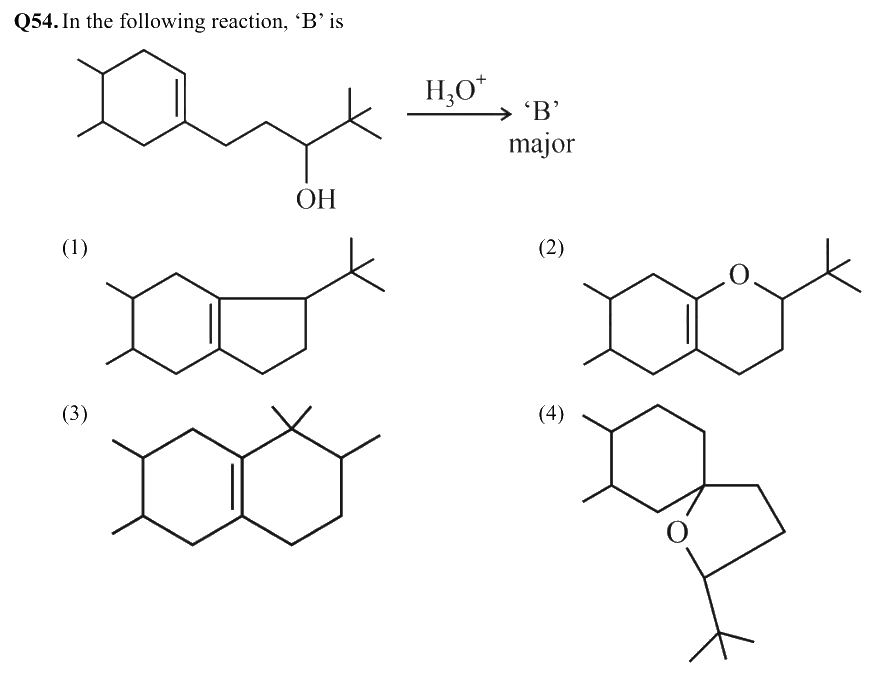
In the following reaction, 'B' is

(see the figure above)

The question and its figure as printed in JEE Main 2023 06 Apr Shift 2. Option 1: Bicyclic: a six-membered ring with a C=C shared with a fused five-membered ring (cyclohexene fused to cyclopentane); two methyl groups on adjacent carbons on the left of the six-membered ring; a tert-butyl group on the five-membered ring carbon next to the C=C. Option 2: Bicyclic: a six-membered carbocycle with a C=C shared with a fused six-membered ring that contains an oxygen (O attached to a carbon of the C=C); two methyl groups on adjacent carbons on the left of the carbocycle; a tert-butyl group on the ring carbon next to the O. Option 3: Bicyclic: two fused six-membered rings sharing a C=C…
The question as printed in the paper.
  • A

    see figure Bicyclic: a six-membered ring with a C=C shared with a fused five-membered ring (cyclohexene fused to cyclopentane); two methyl groups on adjacent carbons on the left of the six-membered ring; a tert-butyl group on the five-membered ring carbon next to the C=C.

  • B

    see figure Bicyclic: a six-membered carbocycle with a C=C shared with a fused six-membered ring that contains an oxygen (O attached to a carbon of the C=C); two methyl groups on adjacent carbons on the left of the carbocycle; a tert-butyl group on the ring carbon next to the O.

  • C

    see figure Bicyclic: two fused six-membered rings sharing a C=C (decalin-type, no heteroatom); two methyl groups on adjacent carbons on the left ring; on the right ring a carbon next to the C=C carries two methyls (gem-dimethyl, drawn as two short lines at the top) and the next ring carbon carries one more methyl.

  • D

    see figure Spiro compound: a six-membered carbocycle with two methyl groups on adjacent carbons on the left, sharing one spiro carbon with a five-membered ring that contains an oxygen; the carbon next to O in the five-membered ring carries a tert-butyl group.

108JEE Main 2023 · 30 Jan · Shift 1MCQOpen question page ↗

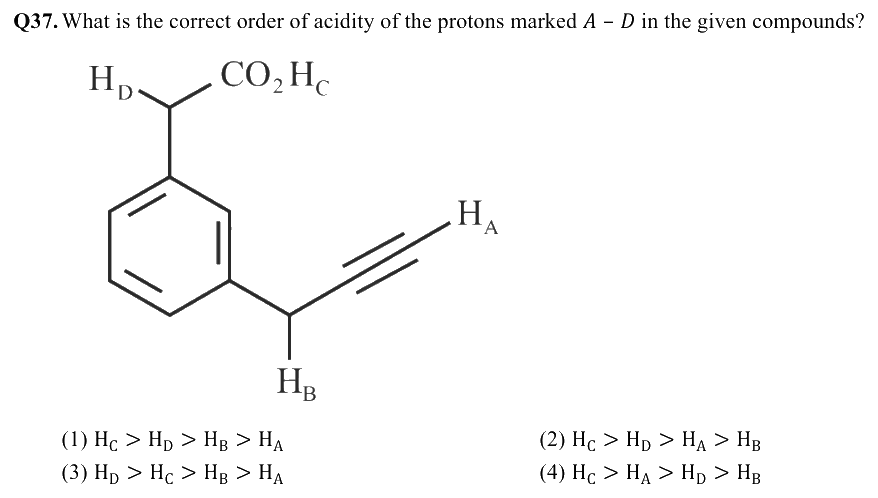
What is the correct order of acidity of the protons marked $A - D$ in the given compounds?

(see the figure above)

The question and its figure as printed in JEE Main 2023 30 Jan Shift 1.
The question as printed in the paper.
  • A

    $\mathrm{H_C > H_D > H_B > H_A}$

  • B

    $\mathrm{H_C > H_D > H_A > H_B}$

  • C

    $\mathrm{H_D > H_C > H_B > H_A}$

  • D

    $\mathrm{H_C > H_A > H_D > H_B}$

110JEE Main 2023 · 29 Jan · Shift 2MCQOpen question page ↗

Find out the major product for the following reaction
(see the figure above)

The question and its figure as printed in JEE Main 2023 29 Jan Shift 2.
The question as printed in the paper.
  • A

    see figure

  • B

    see figure

  • C

    see figure

  • D

    see figure

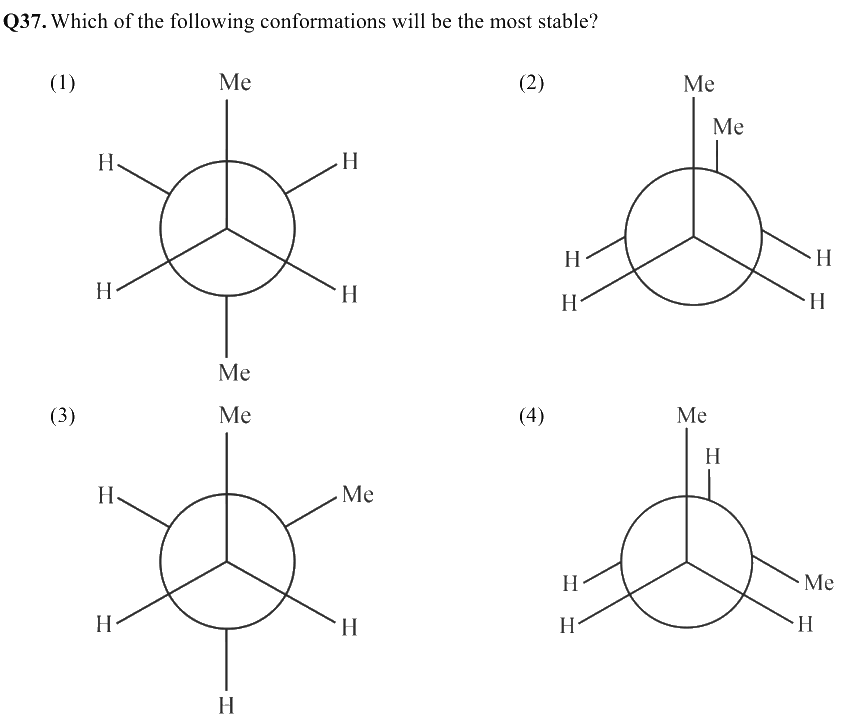
111JEE Main 2023 · 25 Jan · Shift 1MCQOpen question page ↗

Which of the following conformations will be the most stable?

The question and its figure as printed in JEE Main 2023 25 Jan Shift 1.
The question as printed in the paper.
  • A

    see figure

  • B

    see figure

  • C

    see figure

  • D

    see figure

112JEE Main 2023 · 25 Jan · Shift 2MCQOpen question page ↗

Match List I with List II.

Choose the correct answer from the options given below :-

List I Isomeric pairsList II Type of isomers
A. Propanamine and N-MethylethanamineI. Metamers
B. Hexan-2-one and Hexan-3-oneII. Positional isomers
C. Ethanamide and HydroxyethanimineIII. Functional isomers
D. o-nitrophenol and pnitrophenolIV. Tautomers
  • A

    A $-$ III, B $-$ IV, C $-$ I, D $-$ II

  • B

    A $-$ IV, B $-$ III, C $-$ I, D $-$ II

  • C

    A $-$ II, B $-$ III, C $-$ I, D $-$ IV

  • D

    A $-$ III, B $-$ I, C $-$ IV, D $-$ II

113JEE Main 2023 · 25 Jan · Shift 2MCQOpen question page ↗

The isomeric deuterated bromide with molecular formula $\mathrm{C_4H_8DBr}$ having two chiral carbon atoms is

  • A

    2-Bromo-1-deuterobutane

  • B

    2-Bromo-2-deuterobutane

  • C

    2-Bromo-3-deuterobutane

  • D

    2-Bromo-1-deutero-2-methylpropane

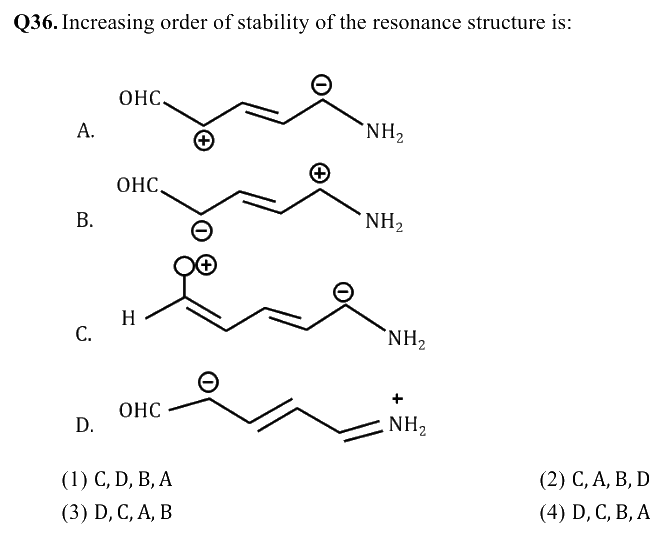
114JEE Main 2023 · 24 Jan · Shift 1MCQOpen question page ↗

Increasing order of stability of the resonance structure is:

(see the figure above)

The question and its figure as printed in JEE Main 2023 24 Jan Shift 1.
The question as printed in the paper.
  • A

    C, D, B, A

  • B

    C, A, B, D

  • C

    D, C, A, B

  • D

    D, C, B, A

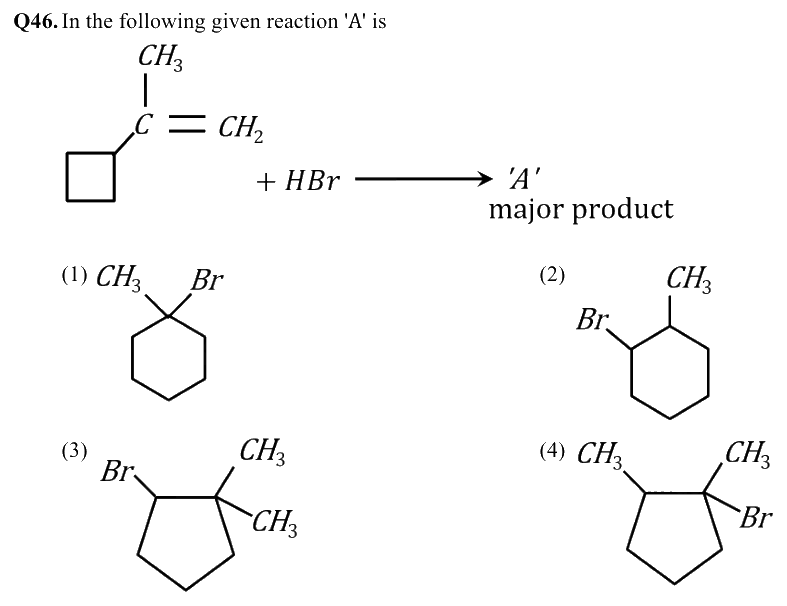
115JEE Main 2023 · 24 Jan · Shift 1MCQOpen question page ↗

In the following given reaction 'A' is

(see the figure above)

The question and its figure as printed in JEE Main 2023 24 Jan Shift 1. Option 1: cyclohexane with CH3 and Br on the same ring carbon Option 2: cyclohexane with Br on one ring carbon and CH3 on the next ring carbon Option 3: cyclopentane with Br on one ring carbon and, on the neighbouring ring carbon, two CH3 groups Option 4: cyclopentane with CH3 on one ring carbon and, on the neighbouring ring carbon, a CH3 and a Br
The question as printed in the paper.
  • A

    see figure cyclohexane with CH3 and Br on the same ring carbon

  • B

    see figure cyclohexane with Br on one ring carbon and CH3 on the next ring carbon

  • C

    see figure cyclopentane with Br on one ring carbon and, on the neighbouring ring carbon, two CH3 groups

  • D

    see figure cyclopentane with CH3 on one ring carbon and, on the neighbouring ring carbon, a CH3 and a Br

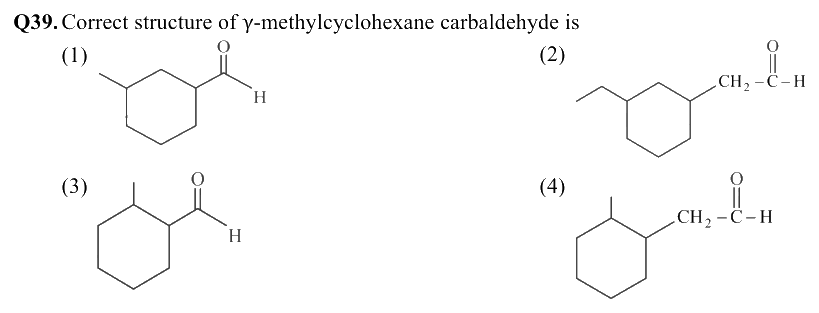
116JEE Main 2022 · 29 Jul · Shift 2MCQOpen question page ↗

Correct structure of $\gamma$-methylcyclohexane carbaldehyde is

The question and its figure as printed in JEE Main 2022 29 Jul Shift 2. Option 1: cyclohexane ring with a methyl group and a -CHO group on ring carbons separated by one ring carbon (1,3 positions) Option 2: cyclohexane ring with an ethyl group and a CH2-C(=O)-H group on ring carbons separated by one ring carbon (1,3 positions) Option 3: cyclohexane ring with a methyl group and a -CHO group on adjacent ring carbons (1,2 positions) Option 4: cyclohexane ring with a methyl group and a CH2-C(=O)-H group on adjacent ring carbons (1,2 positions)
The question as printed in the paper.
  • A

    see figure cyclohexane ring with a methyl group and a -CHO group on ring carbons separated by one ring carbon (1,3 positions)

  • B

    see figure cyclohexane ring with an ethyl group and a $\mathrm{CH_2-C(=O)-H}$ group on ring carbons separated by one ring carbon (1,3 positions)

  • C

    see figure cyclohexane ring with a methyl group and a -CHO group on adjacent ring carbons (1,2 positions)

  • D

    see figure cyclohexane ring with a methyl group and a $\mathrm{CH_2-C(=O)-H}$ group on adjacent ring carbons (1,2 positions)

117JEE Main 2022 · 29 Jul · Shift 2MCQOpen question page ↗

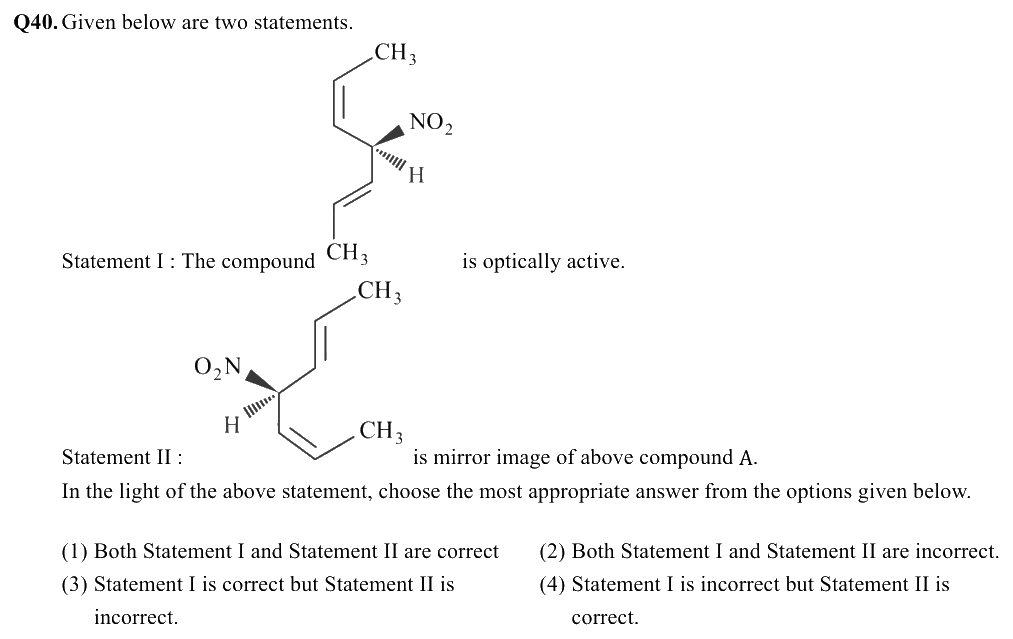
Given below are two statements.
Statement I : The compound (see the figure above) is optically active.
Statement II : (see the figure above) is mirror image of above compound A.
In the light of the above statement, choose the most appropriate answer from the options given below.

The question and its figure as printed in JEE Main 2022 29 Jul Shift 2.
The question as printed in the paper.
  • A

    Both Statement I and Statement II are correct

  • B

    Both Statement I and Statement II are incorrect.

  • C

    Statement I is correct but Statement II is incorrect.

  • D

    Statement I is incorrect but Statement II is correct.

118JEE Main 2022 · 28 Jul · Shift 1MCQOpen question page ↗

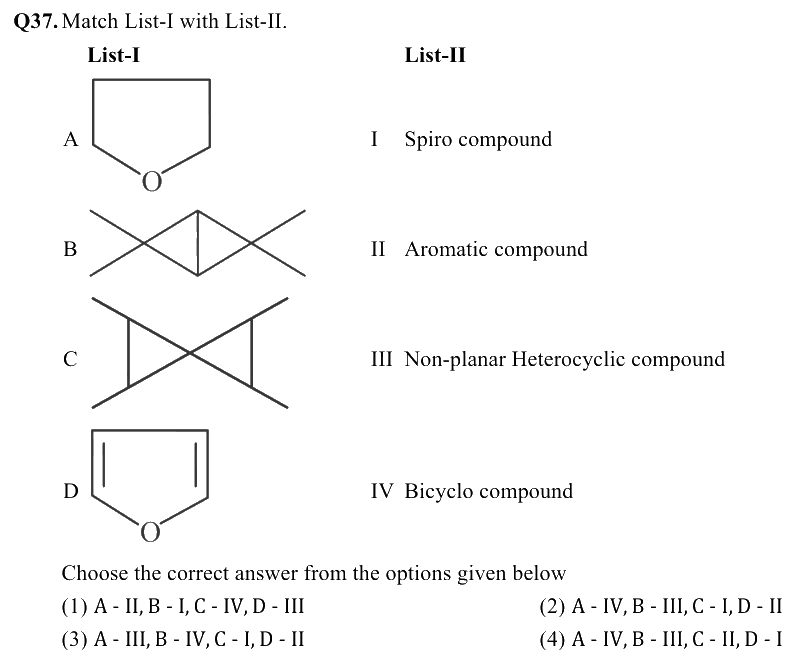
Match List-I with List-II.
List-I
A. (see the figure above)
B. (see the figure above)
C. (see the figure above)
D. (see the figure above)
List-II
I. Spiro compound
II. Aromatic compound
III. Non-planar Heterocyclic compound
IV. Bicyclo compound
Choose the correct answer from the options given below

The question and its figure as printed in JEE Main 2022 28 Jul Shift 1.
The question as printed in the paper.
  • A

    A - II, B - I, C - IV, D - III

  • B

    A - IV, B - III, C - I, D - II

  • C

    A - III, B - IV, C - I, D - II

  • D

    A - IV, B - III, C - II, D - I

119JEE Main 2022 · 28 Jul · Shift 2MCQOpen question page ↗

The major product in the given reaction is

(see the figure above)

The question and its figure as printed in JEE Main 2022 28 Jul Shift 2. Option 1: (CH3)2C=CH-CH2-CH2-CH2-C(CH3)2Br (the alkene is kept, Br on the tertiary carbon) Option 2: cyclopentane ring with a ring carbon bearing Br and one methyl, next to a ring carbon bearing two methyl groups Option 3: cyclopentane ring with a C(CH3)2Br group on a ring carbon, next to a ring carbon bearing two methyl groups Option 4: open chain (CH3)2CH-CHBr-CH2-CH2-CH2-CH(CH3)2 with Br on the carbon next to an isopropyl end
The question as printed in the paper.
  • A

    see figure $\mathrm{(CH_3)_2C=CH-CH_2-CH_2-CH_2-C(CH_3)_2Br}$ (the alkene is kept, Br on the tertiary carbon)

  • B

    see figure cyclopentane ring with a ring carbon bearing Br and one methyl, next to a ring carbon bearing two methyl groups

  • C

    see figure cyclopentane ring with a $\mathrm{C(CH_3)_2Br}$ group on a ring carbon, next to a ring carbon bearing two methyl groups

  • D

    see figure open chain $\mathrm{(CH_3)_2CH-CHBr-CH_2-CH_2-CH_2-CH(CH_3)_2}$ with Br on the carbon next to an isopropyl end

120JEE Main 2022 · 27 Jul · Shift 1MCQOpen question page ↗

Given below are two statements. One is labelled as Assertion A and the other is labelled as Reason R.
Assertion A : [6] Annulene. [8] Annulene and cis $-$[10] Annulene, are respectively aromatic, not-aromatic and aromatic.
(see the figure above)
Reason R: Planarity is one of the requirements of aromatic systems.
In the light of the above statements, choose the most appropriate answer from the options given below.

The question and its figure as printed in JEE Main 2022 27 Jul Shift 1.
The question as printed in the paper.
  • A

    Both A and R are correct and R is the correct explanation of A.

  • B

    Both A and R are correct but R is NOT the correct explanation of A.

  • C

    A is correct but R is not correct.

  • D

    A is not correct but R is correct.

121JEE Main 2022 · 26 Jul · Shift 1MCQOpen question page ↗

Which of the following compounds is not aromatic?
(see the figure above)

The question and its figure as printed in JEE Main 2022 26 Jul Shift 1. Option 1: A five-membered carbon ring with two C=C double bonds and a negative charge (circled minus) on the bottom carbon (cyclopentadienyl anion). Option 2: A three-membered carbon ring with one C=C double bond along the top edge and a positive charge (circled plus) on the bottom vertex (cyclopropenyl cation). Option 3: A ten-membered carbon ring with alternating double bonds drawn as an elongated ring and two H atoms written inside the ring, one at the upper left and one at the lower right (a bridged [10]annulene-type ring with two inner H). Option 4: Two fused six-membered rings (naphthalene) with alternating…
The question as printed in the paper.
  • A

    see figure A five-membered carbon ring with two C=C double bonds and a negative charge (circled minus) on the bottom carbon (cyclopentadienyl anion).

  • B

    see figure A three-membered carbon ring with one C=C double bond along the top edge and a positive charge (circled plus) on the bottom vertex (cyclopropenyl cation).

  • C

    see figure A ten-membered carbon ring with alternating double bonds drawn as an elongated ring and two H atoms written inside the ring, one at the upper left and one at the lower right (a bridged [10]annulene-type ring with two inner H).

  • D

    see figure Two fused six-membered rings (naphthalene) with alternating double bonds drawn.

122JEE Main 2022 · 26 Jul · Shift 2MCQOpen question page ↗

The correct decreasing order of priority of functional groups in naming an organic compound as per IUPAC system of nomenclature is

The question and its figure as printed in JEE Main 2022 26 Jul Shift 2.
The question as printed in the paper.
  • A

    $\mathrm{-COOH > -CONH_2 > -COCl > -CHO}$

  • B

    $\mathrm{-SO_3H > -COCl > -CONH_2 > -CN}$

  • C

    $\mathrm{-COOR > -COCl > NH_2 >}$ (see the figure above) a carbonyl group drawn as a carbon with a double bond to O and two open bonds (>C=O)

  • D

    $\mathrm{COOH > - -COOR > -CONH_2 > -COCl}$

123JEE Main 2022 · 26 Jul · Shift 2MCQOpen question page ↗

Which of the following is not an example of benzenoid compound?

(see the figure above)

The question and its figure as printed in JEE Main 2022 26 Jul Shift 2. Option 1: three fused six-membered rings in an angular arrangement (phenanthrene-type drawing, aromatic rings with double bonds) Option 2: a single eight-membered ring with four alternating double bonds Option 3: two fused six-membered rings (naphthalene-type drawing) Option 4: a benzene ring with an NH2 group
The question as printed in the paper.
  • A

    see figure three fused six-membered rings in an angular arrangement (phenanthrene-type drawing, aromatic rings with double bonds)

  • B

    see figure a single eight-membered ring with four alternating double bonds

  • C

    see figure two fused six-membered rings (naphthalene-type drawing)

  • D

    see figure a benzene ring with an NH2 group

124JEE Main 2022 · 29 Jun · Shift 2MCQOpen question page ↗

Which of the following carbocations is most stable:

The question and its figure as printed in JEE Main 2022 29 Jun Shift 2. Option 1: CH2^+ attached to a carbonyl carbon that carries =O and OCH3 (^+CH2-C(=O)-OCH3). Option 2: CH2=C(OCH3)-CH=CH-CH2^+ (skeletal, with OCH3 on the second carbon and the positive charge on the terminal carbon). Option 3: H3CO-CH=CH-CH2^+ (skeletal, one C=C double bond, positive charge on the terminal carbon). Option 4: H3CO-CH=CH-CH=CH-CH2^+ (skeletal, two C=C double bonds, positive charge on the terminal carbon).
The question as printed in the paper.
  • A

    see figure $\mathrm{CH_2^+}$ attached to a carbonyl carbon that carries $=\mathrm{O}$ and $\mathrm{OCH_3}$ ($^+\mathrm{CH_2-C(=O)-OCH_3}$).

  • B

    see figure $\mathrm{CH_2{=}C(OCH_3){-}CH{=}CH{-}CH_2^+}$ (skeletal, with $\mathrm{OCH_3}$ on the second carbon and the positive charge on the terminal carbon).

  • C

    see figure $\mathrm{H_3CO{-}CH{=}CH{-}CH_2^+}$ (skeletal, one C=C double bond, positive charge on the terminal carbon).

  • D

    see figure $\mathrm{H_3CO{-}CH{=}CH{-}CH{=}CH{-}CH_2^+}$ (skeletal, two C=C double bonds, positive charge on the terminal carbon).

125JEE Main 2022 · 29 Jun · Shift 2MCQOpen question page ↗

see figure $+\ \mathrm{CH_3CH_2CH_2Cl}\ \xrightarrow{\text{Anhydrous, }\mathrm{AlCl_3}}$ 'A'
Major Product The stable carbocation formed in the above reaction is :

The question and its figure as printed in JEE Main 2022 29 Jun Shift 2. Question: + CH3CH2CH2Cl Anhydrous, AlCl3 'A' Major Product The stable carbocation formed in the above reaction is : Option 1: CH3CH2+CH2 Option 4: A benzene ring carrying a CHCH2CH3 group (1-phenylpropyl cation).
The question as printed in the paper.
  • A

    see figure $\mathrm{CH_3CH_2\overset{+}{C}H_2}$

  • B

    $\mathrm{CH_3\,\overset{\oplus}{C}H_2}$

  • C

    $\mathrm{CH_3 - \overset{\oplus}{C}H - CH_3}$

  • D

    see figure A benzene ring carrying a $\mathrm{\overset{\oplus}{C}HCH_2CH_3}$ group (1-phenylpropyl cation).

126JEE Main 2022 · 28 Jun · Shift 1MCQOpen question page ↗

Which of the following structures are aromatic in nature?

(see the figure above)

The question and its figure as printed in JEE Main 2022 28 Jun Shift 1.
The question as printed in the paper.
  • A

    A, B, C & D

  • B

    Only A & B

  • C

    Only A & C

  • D

    Only B, C & D

127JEE Main 2022 · 28 Jun · Shift 2MCQOpen question page ↗

The correct IUPAC name of the following compound is
(see the figure above)

The question and its figure as printed in JEE Main 2022 28 Jun Shift 2.
The question as printed in the paper.
  • A

    4-methyl-2-nitro-5-oxohept-3-enal

  • B

    4-methyl-5-oxo-2-nitrohept-3-enal

  • C

    4-methyl-6-nitro-3-oxohept-4-enal

  • D

    6-formyl-4-methyl-2-nitrohex-3-enal

128JEE Main 2022 · 27 Jun · Shift 2MCQOpen question page ↗

Which of the following is most stable?

The question and its figure as printed in JEE Main 2022 27 Jun Shift 2. Option 1: A three-membered ring (triangle) with a double bond in the bottom side and a positive charge (circled plus) on the top carbon: a cyclopropenyl cation. Option 2: A three-membered ring (triangle) with a double bond in the bottom side and, on the top carbon, a circle with two dots inside (a lone pair, as an anionic centre): a cyclopropenyl anion. Option 3: A five-membered ring with two double bonds on the two lower sides and a positive charge (circled plus) on the top carbon: a cyclopentadienyl cation. Option 4: A six-membered ring with two double bonds (cyclohexadiene, no charge); the two double bonds are on…
The question as printed in the paper.
  • A

    see figure A three-membered ring (triangle) with a double bond in the bottom side and a positive charge (circled plus) on the top carbon: a cyclopropenyl cation.

  • B

    see figure A three-membered ring (triangle) with a double bond in the bottom side and, on the top carbon, a circle with two dots inside (a lone pair, as an anionic centre): a cyclopropenyl anion.

  • C

    see figure A five-membered ring with two double bonds on the two lower sides and a positive charge (circled plus) on the top carbon: a cyclopentadienyl cation.

  • D

    see figure A six-membered ring with two double bonds (cyclohexadiene, no charge); the two double bonds are on the left side of the ring, one on the upper left and one on the lower left.

129JEE Main 2022 · 26 Jun · Shift 1MCQOpen question page ↗

Which will have the highest enol content?
(see the figure above)

The question and its figure as printed in JEE Main 2022 26 Jun Shift 1. Option 1: cyclohexane-1,2-dione: six-membered ring with two C=O groups on adjacent carbons Option 2: cyclohexane-1,3-dione: six-membered ring with two C=O groups separated by one carbon (the O of the right carbonyl at the lower right) Option 3: cyclohexane-1,4-dione: six-membered ring with C=O at top and bottom Option 4: cyclohexane-1,3,5-trione: six-membered ring with C=O at the top, lower left and lower right carbons (alternate carbons)
The question as printed in the paper.
  • A

    see figure cyclohexane-1,2-dione: six-membered ring with two C=O groups on adjacent carbons

  • B

    see figure cyclohexane-1,3-dione: six-membered ring with two C=O groups separated by one carbon (the O of the right carbonyl at the lower right)

  • C

    see figure cyclohexane-1,4-dione: six-membered ring with C=O at top and bottom

  • D

    see figure cyclohexane-1,3,5-trione: six-membered ring with C=O at the top, lower left and lower right carbons (alternate carbons)

130JEE Main 2022 · 26 Jun · Shift 1MCQOpen question page ↗

$(\mathrm{C}_7\mathrm{H}_5\mathrm{O}_2)_2 \xrightarrow{\mathrm{h}\nu} [\mathrm{X}] \rightarrow 2\dot{\mathrm{C}}_6\mathrm{H}_5 + 2\,\mathrm{CO}_2$
Consider the above reaction and identify the intermediated 'X'

The question and its figure as printed in JEE Main 2022 26 Jun Shift 1. Option 1: C6H5-C(=O)-O with a negative charge on the oxygen (anion) Option 2: C6H5-C+=O: acylium cation, with the plus sign beside the carbon Option 3: C6H5-C(=O)-O with a single dot on the oxygen (radical) Option 4: C6H5-C(=O)-O with lone-pair dots drawn on the oxygen (two pairs of dots, no charge sign visible)
The question as printed in the paper.
  • A

    see figure C6H5-C(=O)-O with a negative charge on the oxygen (anion)

  • B

    see figure C6H5-C+=O: acylium cation, with the plus sign beside the carbon

  • C

    see figure C6H5-C(=O)-O with a single dot on the oxygen (radical)

  • D

    see figure C6H5-C(=O)-O with lone-pair dots drawn on the oxygen (two pairs of dots, no charge sign visible)

131JEE Main 2022 · 26 Jun · Shift 1MCQOpen question page ↗

Among the following structures, which will show the most stable enamine formation?
(Where Me is $-$ CH$_3$)
(see the figure above)

The question and its figure as printed in JEE Main 2022 26 Jun Shift 1. Option 1: pyrrolidine-2-carboxylic acid (proline) with the nitrogen bearing a C(Me)=CH(OMe) group: Me on the left of the substituent carbon, OMe at the lower end of the double bond Option 2: the same proline enamine: Me on the lower left of the substituent carbon, OMe at the right end of the double bond (double bond running up to the right) Option 3: the same proline enamine with Me on the lower right of the substituent carbon and OMe at the lower left end of the double bond Option 4: the same proline enamine with OMe at the left end of the double bond and Me on the lower right of the substituent carbon
The question as printed in the paper.
  • A

    see figure pyrrolidine-2-carboxylic acid (proline) with the nitrogen bearing a C(Me)=CH(OMe) group: Me on the left of the substituent carbon, OMe at the lower end of the double bond

  • B

    see figure the same proline enamine: Me on the lower left of the substituent carbon, OMe at the right end of the double bond (double bond running up to the right)

  • C

    see figure the same proline enamine with Me on the lower right of the substituent carbon and OMe at the lower left end of the double bond

  • D

    see figure the same proline enamine with OMe at the left end of the double bond and Me on the lower right of the substituent carbon

132JEE Main 2022 · 26 Jun · Shift 2MCQOpen question page ↗

The correct order of nucleophilicity is

  • A

    $\mathrm{F}^- > \mathrm{OH}^-$

  • B

    $\mathrm{H}_2\ddot{\mathrm{O}} > \mathrm{OH}^-$

  • C

    $\mathrm{ROH} > \mathrm{RO}^-$

  • D

    $\mathrm{NH}_2^- > \mathrm{NH}_3$

133JEE Main 2022 · 25 Jun · Shift 1MCQOpen question page ↗

In the following structures, which one is having staggered conformation with maximum dihedral angle?
(see the figure above)

The question and its figure as printed in JEE Main 2022 25 Jun Shift 1. Option 1: Newman projection (option 1) Option 2: Newman projection (option 2) Option 3: Newman projection (option 3) Option 4: Newman projection (option 4)
The question as printed in the paper.
  • A

    see figure Newman projection (option 1)

  • B

    see figure Newman projection (option 2)

  • C

    see figure Newman projection (option 3)

  • D

    see figure Newman projection (option 4)

134JEE Main 2022 · 25 Jun · Shift 1MCQOpen question page ↗

The IUPAC name of ethylidene chloride is

  • A

    1 - chloroethene

  • B

    1, 2-dichloroethane

  • C

    1, 1-dichloroethane

  • D

    1-chloroethyne

135JEE Main 2022 · 24 Jun · Shift 1MCQOpen question page ↗

Which of the following is an example of conjugated diketone?

The question and its figure as printed in JEE Main 2022 24 Jun Shift 1.
The question as printed in the paper.
  • A

    see figure

  • B

    see figure

  • C

    see figure

  • D

    see figure

136JEE Main 2022 · 24 Jun · Shift 2MCQOpen question page ↗

Arrange the following carbocations in decreasing order of stability.
(see the figure above)

The question and its figure as printed in JEE Main 2022 24 Jun Shift 2.
The question as printed in the paper.
  • A

    $\mathrm{A} > \mathrm{C} > \mathrm{B}$

  • B

    $\mathrm{B} > \mathrm{A} > \mathrm{C}$

  • C

    $\mathrm{C} > \mathrm{B} > \mathrm{A}$

  • D

    $\mathrm{C} > \mathrm{A} > \mathrm{B}$

137JEE Main 2021 · 1 Sep · Shift 2MCQOpen question page ↗

Which one of the following compounds is aromatic in nature?
(see the figure above)

The question and its figure as printed in JEE Main 2021 01 Sep Shift 2. Option 1: a five-membered ring with CH3 and a + sign on the top carbon, and two C=C double bonds drawn in the ring (cyclopentadienyl cation with CH3). Option 2: a square (four-membered ring) with two double bonds drawn (cyclobutadiene). Option 4: a five-membered ring with a minus charge (circled) on the top carbon and two C=C double bonds in the ring (cyclopentadienyl anion).
The question as printed in the paper.
  • A

    see figure a five-membered ring with CH3 and a + sign on the top carbon, and two C=C double bonds drawn in the ring (cyclopentadienyl cation with CH3).

  • B

    see figure a square (four-membered ring) with two double bonds drawn (cyclobutadiene).

  • C

    Both A and B

  • D

    see figure a five-membered ring with a minus charge (circled) on the top carbon and two C=C double bonds in the ring (cyclopentadienyl anion).

138JEE Main 2021 · 1 Sep · Shift 2MCQOpen question page ↗

The stereoisomers that are formed by electrophilic addition of bromine to trans - but - 2 - ene is/are :

  • A

    $2$ identical mesomers

  • B

    $2$ enantiomers

  • C

    $2$ enantiomers and $2$ mesomers

  • D

    $1$ racemic and $2$ enantiomers

139JEE Main 2021 · 31 Aug · Shift 1MCQOpen question page ↗

Choose the correct name for compound given below :
(see the figure above)

The question and its figure as printed in JEE Main 2021 31 Aug Shift 1.
The question as printed in the paper.
  • A

    (2E)-2-Bromo-hex-4-yn-2-ene

  • B

    (4E)-5-Bromo-hex-2-en-4-yne

  • C

    (4E)-5-Bromo-hex-4-en-2-yne

  • D

    (2E)-2-Bromohex-2-en-4-yne

140JEE Main 2021 · 31 Aug · Shift 2MCQOpen question page ↗

Arrange the following conformational isomers of n-butane in order of their increasing potential energy:
(see the figure above)

The question and its figure as printed in JEE Main 2021 31 Aug Shift 2.
The question as printed in the paper.
  • A

    $\mathrm{I} < \mathrm{III} < \mathrm{IV} < \mathrm{II}$

  • B

    $\mathrm{I} < \mathrm{IV} < \mathrm{III} < \mathrm{II}$

  • C

    $\mathrm{II} < \mathrm{IV} < \mathrm{III} < \mathrm{I}$

  • D

    $\mathrm{II} < \mathrm{III} < \mathrm{IV} < \mathrm{I}$

141JEE Main 2021 · 26 Aug · Shift 2MCQOpen question page ↗

Which one of the following compounds is not aromatic?

The question and its figure as printed in JEE Main 2021 26 Aug Shift 2. Option 1: Benzene ring bearing an OH group, drawn with two lone pairs on the O (phenol). Option 2: Eight-membered ring with four double bonds (cyclooctatetraene). Option 3: Five-membered ring with two double bonds and a carbanion carbon at the bottom carrying a lone pair and a minus sign (cyclopentadienyl anion). Option 4: Seven-membered ring with three double bonds and a plus charge on the carbon at the bottom (cycloheptatrienyl cation).
The question as printed in the paper.
  • A

    see figure Benzene ring bearing an OH group, drawn with two lone pairs on the O (phenol).

  • B

    see figure Eight-membered ring with four double bonds (cyclooctatetraene).

  • C

    see figure Five-membered ring with two double bonds and a carbanion carbon at the bottom carrying a lone pair and a minus sign (cyclopentadienyl anion).

  • D

    see figure Seven-membered ring with three double bonds and a plus charge on the carbon at the bottom (cycloheptatrienyl cation).

144JEE Main 2021 · 27 Jul · Shift 1MCQOpen question page ↗

see figure The correct order of stability of given carbocation is:

The question and its figure as printed in JEE Main 2021 27 Jul Shift 1. Question: The correct order of stability of given carbocation is:
The question as printed in the paper.
  • A

    A > C > B > D

  • B

    D > B > C > A

  • C

    D > B > A > C

  • D

    C > A > D > B

145JEE Main 2021 · 27 Jul · Shift 2MCQOpen question page ↗

Given below are two statements :
Statement I : Hyperconjugation is a permanent effect.
Statement II : Hyperconjugation in ethyl cation $\left(\mathrm{CH_3 - \overset{+}{C}H_2}\right)$ involves the overlapping of $\mathrm{C_{sp^2} - H_{1s}}$ bond with empty 2p orbital of other carbon.
Choose the correct option:

  • A

    Both statement I and statement II are false

  • B

    Statement I is incorrect but statement II is true

  • C

    Statement I is correct but statement II is false

  • D

    Both Statement I and statement II are true.

146JEE Main 2021 · 25 Jul · Shift 1MCQOpen question page ↗

Which one among the following resonating structures is not correct?

The question and its figure as printed in JEE Main 2021 25 Jul Shift 1. Option 1: resonance structure 1 Option 2: resonance structure 2 Option 3: resonance structure 3 Option 4: resonance structure 4
The question as printed in the paper.
  • A

    see figure resonance structure 1

  • B

    see figure resonance structure 2

  • C

    see figure resonance structure 3

  • D

    see figure resonance structure 4

147JEE Main 2021 · 25 Jul · Shift 2MCQOpen question page ↗

Which among the following is the strongest acid?

The question and its figure as printed in JEE Main 2021 25 Jul Shift 2. Option 2: benzene ring with a methyl group Option 3: three-membered ring with one C=C Option 4: five-membered ring with two C=C
The question as printed in the paper.
  • A

    $\mathrm{CH_3\ CH_2\ CH_2\ CH_3}$

  • B

    see figure benzene ring with a methyl group

  • C

    see figure three-membered ring with one C=C

  • D

    see figure five-membered ring with two C=C

148JEE Main 2021 · 22 Jul · Shift 1MCQOpen question page ↗

Which of the following compounds does not exhibit resonance ?

The question and its figure as printed in JEE Main 2021 22 Jul Shift 1. Option 2: benzene ring with a CH2OH group
The question as printed in the paper.
  • A

    $\mathrm{CH_3\ CH_2\ OCH = CH_2}$

  • B

    see figure benzene ring with a CH2OH group

  • C

    $\mathrm{CH_3\ CH_2\ CH_2\ CONH_2}$

  • D

    $\mathrm{CH_3\ CH_2\ CH = CHCH_2\ NH_2}$

149JEE Main 2021 · 22 Jul · Shift 1MCQOpen question page ↗

Which of the following molecules does not show stereo isomerism ?

  • A

    3, 4-Dimethylhex-3-ene

  • B

    3-Methylhex-1-ene

  • C

    3-Ethylhex-3-ene

  • D

    4-Methylhex-1-ene

150JEE Main 2021 · 20 Jul · Shift 1MCQOpen question page ↗

see figure Among the given species the Resonance stabilised carbocations are:

The question and its figure as printed in JEE Main 2021 20 Jul Shift 1. Question: Among the given species the Resonance stabilised carbocations are:
The question as printed in the paper.
  • A

    (C) and (D) only

  • B

    (A), (B) and (D) only

  • C

    (A) and (B) only

  • D

    (A), (B) and (C) only

151JEE Main 2021 · 20 Jul · Shift 2MCQOpen question page ↗

Which one of the following pairs of isomers is an example of metamerism?

The question and its figure as printed in JEE Main 2021 20 Jul Shift 2. Option 1: CH3CH2CH2CH2CH3 and a carbon bonded to four groups drawn as H3C-C-CH3 with a group labelled "CH" above and CH3 below (neopentane-like; the top group is printed as "CH" with no visible subscript) Option 2: a skeletal ketone with a carbonyl C(=O) joined to a methyl end on one side and to C6H5 on the other (acetophenone), and H5C6 joined through two CH2 steps to an aldehyde CHO (3-phenylpropanal) Option 3: H5C6 joined through two CH2 steps to OH (C6H5CH2CH2OH), and H5C6 on a carbon bearing OH and a methyl group (C6H5CH(OH)CH3) Option 4: two skeletal ketones: a seven-carbon chain with the carbonyl as the third…
The question as printed in the paper.
  • A

    see figure $\mathrm{CH_3CH_2CH_2CH_2CH_3}$ and a carbon bonded to four groups drawn as H3C-C-CH3 with a group labelled "CH" above and CH3 below (neopentane-like; the top group is printed as "CH" with no visible subscript)

  • B

    see figure a skeletal ketone with a carbonyl C(=O) joined to a methyl end on one side and to $\mathrm{C_6H_5}$ on the other (acetophenone), and $\mathrm{H_5C_6}$ joined through two CH2 steps to an aldehyde CHO (3-phenylpropanal)

  • C

    see figure $\mathrm{H_5C_6}$ joined through two CH2 steps to OH ($\mathrm{C_6H_5CH_2CH_2OH}$), and $\mathrm{H_5C_6}$ on a carbon bearing OH and a methyl group ($\mathrm{C_6H_5CH(OH)CH_3}$)

  • D

    see figure two skeletal ketones: a seven-carbon chain with the carbonyl as the third carbon from one end (heptan-3-one), and a seven-carbon chain with the carbonyl at the middle carbon (heptan-4-one)

152JEE Main 2021 · 18 Mar · Shift 1MCQOpen question page ↗

Compound with molecular formula $\mathrm{C_3H_6O}$ can show:

  • A

    Positional isomerism

  • B

    Both positional isomerism and metamerism

  • C

    Metamerism

  • D

    Functional group isomerism

153JEE Main 2021 · 18 Mar · Shift 2MCQOpen question page ↗

Given below are two statements :
Statement I : $\mathrm{C_2H_5\,OH}$ and $\mathrm{AgCN}$ both can generate nucleophile.
Statement II : $\mathrm{KCN}$ and $\mathrm{AgCN}$ both will generate nitrile nucleophile with all reaction conditions.
Choose the most appropriate option :

  • A

    Statement I is true but statement II is false

  • B

    Both statement I and statement II are true

  • C

    Statement I is false but statement II is true

  • D

    Both statement I and statement II are false

154JEE Main 2021 · 17 Mar · Shift 1MCQOpen question page ↗

Which of the following is an aromatic compound?

The question and its figure as printed in JEE Main 2021 17 Mar Shift 1. Option 1: A five-membered ring (drawn as a pentagon pointing right) with two C=C double bonds (on the top and bottom edges) and a circled minus sign (negative charge) at the right-hand vertex Option 2: A five-membered ring (drawn as a pentagon pointing right) with two C=C double bonds (on the top and bottom edges), no charge drawn Option 3: A five-membered ring (drawn as a pentagon pointing right) with one C=C double bond (top edge), a circled minus sign at the right-hand vertex and a second circled minus sign at the lower-left vertex Option 4: A five-membered ring (drawn as a pentagon pointing up) with two C=C double…
The question as printed in the paper.
  • A

    see figure A five-membered ring (drawn as a pentagon pointing right) with two C=C double bonds (on the top and bottom edges) and a circled minus sign (negative charge) at the right-hand vertex

  • B

    see figure A five-membered ring (drawn as a pentagon pointing right) with two C=C double bonds (on the top and bottom edges), no charge drawn

  • C

    see figure A five-membered ring (drawn as a pentagon pointing right) with one C=C double bond (top edge), a circled minus sign at the right-hand vertex and a second circled minus sign at the lower-left vertex

  • D

    see figure A five-membered ring (drawn as a pentagon pointing up) with two C=C double bonds (upper-left edge and bottom edge) and a circled plus sign (positive charge) at the right-hand vertex

155JEE Main 2021 · 17 Mar · Shift 1MCQOpen question page ↗

Mesityl oxide is a common name of:

  • A

    2, 4 -Dimethylpentan-3-one

  • B

    3-Methylcyclohexanecarbaldehyde

  • C

    2-Methylcyclohexanone

  • D

    4-Methylpent-3-en-2-one

156JEE Main 2021 · 17 Mar · Shift 1MCQOpen question page ↗

see figure

The question and its figure as printed in JEE Main 2021 17 Mar Shift 1. Option 1: 1-methylcyclohexane carrying a CH2CH2Br side chain on the same ring carbon as the methyl (a cyclohexane ring with CH3 and a CH2-CH2-Br group on one carbon) Option 2: A cyclohexane ring with Br and CH3 on the same ring carbon and a second CH3 on the adjacent ring carbon Option 3: A cyclohexane ring with a CH(Br)CH3 group on one carbon and a CH3 on the adjacent ring carbon Option 4: A cyclohexane ring with Br and a CH(CH3)2 (isopropyl) group on the same ring carbon
The question as printed in the paper.
  • A

    see figure 1-methylcyclohexane carrying a $\mathrm{CH_2CH_2Br}$ side chain on the same ring carbon as the methyl (a cyclohexane ring with CH3 and a $\mathrm{CH_2-CH_2-Br}$ group on one carbon)

  • B

    see figure A cyclohexane ring with Br and CH3 on the same ring carbon and a second CH3 on the adjacent ring carbon

  • C

    see figure A cyclohexane ring with a $\mathrm{CH(Br)CH_3}$ group on one carbon and a CH3 on the adjacent ring carbon

  • D

    see figure A cyclohexane ring with Br and a $\mathrm{CH(CH_3)_2}$ (isopropyl) group on the same ring carbon

157JEE Main 2021 · 17 Mar · Shift 2MCQOpen question page ↗

The correct pair(s) of the ambident nucleophiles is (are):
(A) $\mathrm{AgCN} / \mathrm{KCN}$
(B) $\mathrm{RCOOAg} / \mathrm{RCOOK}$
(C) $\mathrm{AgNO}_2 / \mathrm{KNO}_2$
(D) $\mathrm{AgI} / \mathrm{KI}$

  • A

    (B) and (C) only

  • B

    (A) only

  • C

    (A) and (C) only

  • D

    (B) only

158JEE Main 2021 · 17 Mar · Shift 2MCQOpen question page ↗

Choose the correct statement regarding the formation of carbocations A and B given :-
$\mathrm{CH}_3-\mathrm{CH}_2-\mathrm{CH}=\mathrm{CH}_2+\mathrm{HBr}$ gives
"A" : $\mathrm{CH}_3-\mathrm{CH}_2-\mathrm{CH}_2-\stackrel{+}{\mathrm{C}} \mathrm{H}_2+\mathrm{Br}^{-}$
"B" : $\mathrm{CH}_3-\mathrm{CH}_2-\stackrel{+}{\mathrm{C}} \mathrm{H}-\mathrm{CH}_3+\mathrm{Br}^{-}$

  • A

    Carbocation B is more stable and formed relatively at faster rate

  • B

    Carbocation A is more stable and formed relatively at slow rate

  • C

    Carbocation B is more stable and formed relatively at slow rate

  • D

    Carbocation A is more stable and formed relatively at faster rate

159JEE Main 2021 · 16 Mar · Shift 1MCQOpen question page ↗

Among the following, the aromatic compounds are :
(see the figure above)
Choose the correct answer from the following options :

The question and its figure as printed in JEE Main 2021 16 Mar Shift 1.
The question as printed in the paper.
  • A

    (A) and (B) only

  • B

    (B) and (C) only

  • C

    (B), (C) and (D) only

  • D

    (A), (B) and (C) only

160JEE Main 2021 · 16 Mar · Shift 1MCQOpen question page ↗

Assertion A : Enol form of acetone $\left[\mathrm{CH}_3 \mathrm{COCH}_3\right]$ exists in $<0.1 \%$ quantity. However, the enol form of acetyl acetone $\left[\mathrm{CH}_3 \mathrm{COCH}_2 \mathrm{OCCH}_3\right]$ exists in approximately $15 \%$ quantity.
Reason R : enol form of acetyl acetone is stabilized by intramolecular hydrogen bonding, which is not possible in enol form of acetone.
Choose the correct statement:

  • A

    A is false but R is true

  • B

    Both A and R are true and R is the correct explanation of A

  • C

    Both A and R are true but R is not the correct explanation of A

  • D

    A is true but R is false

161JEE Main 2021 · 24 Feb · Shift 1MCQOpen question page ↗

What is the final product (major) 'A' in the given reaction?
(see the figure above)
Major product among the following is?

The question and its figure as printed in JEE Main 2021 24 Feb Shift 1. Option 1: cyclohexane ring with CH3 on one ring carbon and, on the neighbouring ring carbon, both a Cl and an ethyl group (CH2-CH3) Option 2: cyclohexane ring with CH3 on one ring carbon and, on the neighbouring ring carbon, a CH(Cl)-CH3 group Option 3: cyclohexane ring with CH3 on one ring carbon and, on the neighbouring ring carbon, a double bond to an exocyclic CH-CH3 (=CH-CH3) Option 4: cyclohexane ring with CH3 on one ring carbon and, on the neighbouring ring carbon, a vinyl group (CH=CH2)
The question as printed in the paper.
  • A

    see figure cyclohexane ring with CH3 on one ring carbon and, on the neighbouring ring carbon, both a Cl and an ethyl group (CH2-CH3)

  • B

    see figure cyclohexane ring with CH3 on one ring carbon and, on the neighbouring ring carbon, a CH(Cl)-CH3 group

  • C

    see figure cyclohexane ring with CH3 on one ring carbon and, on the neighbouring ring carbon, a double bond to an exocyclic CH-CH3 (=CH-CH3)

  • D

    see figure cyclohexane ring with CH3 on one ring carbon and, on the neighbouring ring carbon, a vinyl group (CH=CH2)

162JEE Main 2021 · 24 Feb · Shift 2MCQOpen question page ↗

Which one of the following compounds is non-aromatic?
(see the figure above)

The question and its figure as printed in JEE Main 2021 24 Feb Shift 2. Option 1: five-membered ring with two C=C double bonds and an oxygen atom at the bottom (furan) Option 2: three fused six-membered rings in a linear arrangement, drawn with alternating double bonds (anthracene) Option 3: seven-membered ring with three C=C double bonds and one CH2 (sp3) carbon at the bottom (cycloheptatriene) Option 4: four-membered ring (square) with one C=C double bond on the right side and a positive charge (circled plus) at each of two left-hand corners (top-left and bottom-left)
The question as printed in the paper.
  • A

    see figure five-membered ring with two C=C double bonds and an oxygen atom at the bottom (furan)

  • B

    see figure three fused six-membered rings in a linear arrangement, drawn with alternating double bonds (anthracene)

  • C

    see figure seven-membered ring with three C=C double bonds and one CH2 (sp3) carbon at the bottom (cycloheptatriene)

  • D

    see figure four-membered ring (square) with one C=C double bond on the right side and a positive charge (circled plus) at each of two left-hand corners (top-left and bottom-left)

163JEE Main 2020 · 6 Sep · Shift 1MCQOpen question page ↗

Which of the following compounds shows geometrical isomerism?

  • A

    2-methylpent-2-ene

  • B

    4-methylpent-2-ene

  • C

    4-methylpent-1-ene

  • D

    2-methylpent-1-ene

164JEE Main 2020 · 6 Sep · Shift 2MCQOpen question page ↗

The IUPAC name of following compound is :
(see the figure above)

The question and its figure as printed in JEE Main 2020 06 Sep Shift 2.
The question as printed in the paper.
  • A

    2-nitro-4-hydroxymethyl-5-amino benzaldehyde

  • B

    3-amino-4-hydroxymethyl-5-nitrogenzaldehyde

  • C

    5-amino-4-hydroxymethyl-2-nitrobenzaldehyde

  • D

    4-amino-2-formyl-5-hydroxymethyl nitrogenzene

165JEE Main 2020 · 5 Sep · Shift 1MCQOpen question page ↗

The increasing order of basicity of the following compounds is :
(see the figure above)

The question and its figure as printed in JEE Main 2020 05 Sep Shift 1.
The question as printed in the paper.
  • A

    (A) < (B) < (C) < (D)

  • B

    (B) < (A) < (D) < (C)

  • C

    (D) < (A) < (B) < (C)

  • D

    (B) < (A) < (C) < (D)

166JEE Main 2020 · 5 Sep · Shift 2MCQOpen question page ↗

Among the following compounds, geometrical isomerism is exhibited by :
(see the figure above)

The question and its figure as printed in JEE Main 2020 05 Sep Shift 2. Option 1: cyclohexane ring with an exocyclic =CH2 at one carbon and Cl at the carbon directly opposite (1,4). Option 2: cyclohexane ring with an exocyclic =CHCl at one carbon and CH3 on the ring carbon in the 3-position (meta). Option 3: cyclohexane ring with an exocyclic =CHCl at one carbon and CH3 at each of the two 3,5-positions (H3C and CH3, both meta). Option 4: cyclohexane ring with an exocyclic =CHCl and no other substituent.
The question as printed in the paper.
  • A

    see figure cyclohexane ring with an exocyclic =CH2 at one carbon and Cl at the carbon directly opposite (1,4).

  • B

    see figure cyclohexane ring with an exocyclic =CHCl at one carbon and CH3 on the ring carbon in the 3-position (meta).

  • C

    see figure cyclohexane ring with an exocyclic =CHCl at one carbon and CH3 at each of the two 3,5-positions (H3C and CH3, both meta).

  • D

    see figure cyclohexane ring with an exocyclic =CHCl and no other substituent.

167JEE Main 2020 · 4 Sep · Shift 1MCQOpen question page ↗

The IUPAC name of the following compound is:
(see the figure above)

The question and its figure as printed in JEE Main 2020 04 Sep Shift 1.
The question as printed in the paper.
  • A

    5-Bromo-3-methylcyclopentanoic acid

  • B

    4-Bromo-2-methylcyclopentane carboxylic acid

  • C

    3-Bromo-5-methylcyclopentanoic acid

  • D

    3-Bromo-5-methylcyclopentanoic carboxylic acid

168JEE Main 2020 · 3 Sep · Shift 1MCQOpen question page ↗

Which one of the following compounds possesses the most acidic hydrogen?

The question and its figure as printed in JEE Main 2020 03 Sep Shift 1. Option 1: NC–CH2–CN drawn with two H atoms on the central carbon Option 3: acetone Option 4: dimethyl malonate
The question as printed in the paper.
  • A

    see figure $\mathrm{N{\equiv}C}$–$\mathrm{CH_2}$–$\mathrm{C{\equiv}N}$ drawn with two H atoms on the central carbon

  • B

    $\mathrm{H_3C - C \equiv C - H}$

  • C

    see figure acetone

  • D

    see figure dimethyl malonate

169JEE Main 2020 · 3 Sep · Shift 1MCQOpen question page ↗

Which of the following compounds produces an optically inactive compound on hydrogenation?

The question and its figure as printed in JEE Main 2020 03 Sep Shift 1. Option 1: skeletal structure Option 2: skeletal structure Option 3: skeletal structure Option 4: skeletal structure
The question as printed in the paper.
  • A

    see figure skeletal structure

  • B

    see figure skeletal structure

  • C

    see figure skeletal structure

  • D

    see figure skeletal structure

170JEE Main 2020 · 2 Sep · Shift 1MCQOpen question page ↗

The IUPAC name for the following compound is :
(see the figure above)

The question and its figure as printed in JEE Main 2020 02 Sep Shift 1.
The question as printed in the paper.
  • A

    2, 5-dimenthyl-5-carboxy-hex-3-enal

  • B

    2, 5-dimenthyl-6-carboxy-hex-3-enal

  • C

    2, 5-dimenthyl-6-carboxy-hex-3-enoic acid

  • D

    6-formyl-2-methy 1-hex-3-enoic acid

171JEE Main 2020 · 2 Sep · Shift 1MCQOpen question page ↗

The major product in the following reaction is :
(see the figure above)

The question and its figure as printed in JEE Main 2020 02 Sep Shift 1. Option 1: Cyclopentene ring (one C=C in the ring) with an isopropyl group, drawn as a carbon bearing two CH3 groups, attached to one of the double-bond carbons. Option 2: Cyclohexene ring with a C=C double bond whose two carbons each carry a CH3 (1,2-dimethylcyclohexene). Option 3: Cyclohexene ring with one ring carbon bearing both H3C and CH3, and a C=C double bond in the ring next to it. Option 4: Cyclopentane ring with a ring carbon bearing H3C and a side-chain carbon that carries OH (up) and CH3 (down).
The question as printed in the paper.
  • A

    see figure Cyclopentene ring (one C=C in the ring) with an isopropyl group, drawn as a carbon bearing two CH3 groups, attached to one of the double-bond carbons.

  • B

    see figure Cyclohexene ring with a C=C double bond whose two carbons each carry a CH3 (1,2-dimethylcyclohexene).

  • C

    see figure Cyclohexene ring with one ring carbon bearing both H3C and CH3, and a C=C double bond in the ring next to it.

  • D

    see figure Cyclopentane ring with a ring carbon bearing H3C and a side-chain carbon that carries OH (up) and CH3 (down).

172JEE Main 2020 · 2 Sep · Shift 2MCQOpen question page ↗

Arrange the following labelled hydrogens in decreasing order of acidity:
(see the figure above)

The question and its figure as printed in JEE Main 2020 02 Sep Shift 2.
The question as printed in the paper.
  • A

    $\mathrm{b} > \mathrm{a} > \mathrm{c} > \mathrm{d}$

  • B

    $\mathrm{c} > \mathrm{b} > \mathrm{a} > \mathrm{d}$

  • C

    $\mathrm{b} > \mathrm{c} > \mathrm{d} > \mathrm{a}$

  • D

    $\mathrm{c} > \mathrm{b} > \mathrm{d} > \mathrm{a}$

173JEE Main 2020 · 9 Jan · Shift 1MCQOpen question page ↗

The increasing order of basicity for the following intermediates is (from weak to strong)
(see the figure above)

The question and its figure as printed in JEE Main 2020 09 Jan Shift 1.
The question as printed in the paper.
  • A

    (iii) < (i) < (ii) < (iv) < (v)

  • B

    (v) < (i) < (iv) < (ii) < (iii)

  • C

    (v) < (iii) < (ii) < (iv) < (i)

  • D

    (iii) < (iv) < (ii) < (i) < (v)

174JEE Main 2020 · 9 Jan · Shift 1MCQOpen question page ↗

The correct order of heat of combustion for following alkadienes is:
(see the figure above)

The question and its figure as printed in JEE Main 2020 09 Jan Shift 1.
The question as printed in the paper.
  • A

    (a) < (b) < (c)

  • B

    (a) < (c) < (b)

  • C

    (c) < (b) < (a)

  • D

    (b) < (c) < (a)

175JEE Main 2020 · 9 Jan · Shift 2MCQOpen question page ↗

Which of the following has the shortest $\mathrm{C - Cl}$ bond?

  • A

    $\mathrm{Cl - CH = CH_2}$

  • B

    $\mathrm{Cl - CH = CH - NO_2}$

  • C

    $\mathrm{Cl - CH = CH - CH_3}$

  • D

    $\mathrm{Cl - CH = CH - OCH_3}$

176JEE Main 2020 · 8 Jan · Shift 1MCQOpen question page ↗

The major product of the following reaction is:
(see the figure above)

The question and its figure as printed in JEE Main 2020 08 Jan Shift 1. Option 1: cyclopentane ring bearing a CH3, a vinyl group and a C(OH)(CH3)2 group Option 2: open-chain triol with H3C, OH, CH3 groups and a terminal OH Option 3: cyclohexene ring with CH3 on the double-bond carbon and a C(OH)(CH3)2 group opposite Option 4: open-chain triol with H3C, OH, HO, CH3 groups and a terminal OH
The question as printed in the paper.
  • A

    see figure cyclopentane ring bearing a $\mathrm{CH_3}$, a vinyl group and a $\mathrm{C(OH)(CH_3)_2}$ group

  • B

    see figure open-chain triol with $\mathrm{H_3C}$, $\mathrm{OH}$, $\mathrm{CH_3}$ groups and a terminal OH

  • C

    see figure cyclohexene ring with $\mathrm{CH_3}$ on the double-bond carbon and a $\mathrm{C(OH)(CH_3)_2}$ group opposite

  • D

    see figure open-chain triol with $\mathrm{H_3C}$, $\mathrm{OH}$, $\mathrm{HO}$, $\mathrm{CH_3}$ groups and a terminal OH

177JEE Main 2020 · 8 Jan · Shift 1MCQOpen question page ↗

The major products A and B in the following reactions are
(see the figure above)

The question and its figure as printed in JEE Main 2020 08 Jan Shift 1. Option 1: A = carbocation (+) of the nitrile skeleton and B = a longer chain nitrile Option 2: A = radical (dot) on the CN-bearing carbon, (CH3)2CH-C(CH3)-CN; B = CH3CH2CH2CH(CH3)C(CH3)(CN)CH(CH3)2 Option 3: A = carbocation (+) on the quaternary-type carbon next to the CN carbon and B = a longer chain nitrile Option 4: A = the same radical as in option 2 (dot on the CN-bearing carbon); B = CH3CH2CH2CH2C(CH3)(CN)CH(CH3)2
The question as printed in the paper.
  • A

    see figure A = carbocation (+) of the nitrile skeleton and B = a longer chain nitrile

  • B

    see figure A = radical (dot) on the CN-bearing carbon, $\mathrm{(CH_3)_2CH-\dot{C}(CH_3)-CN}$; B = $\mathrm{CH_3CH_2CH_2CH(CH_3)C(CH_3)(CN)CH(CH_3)_2}$

  • C

    see figure A = carbocation (+) on the quaternary-type carbon next to the CN carbon and B = a longer chain nitrile

  • D

    see figure A = the same radical as in option 2 (dot on the CN-bearing carbon); B = $\mathrm{CH_3CH_2CH_2CH_2C(CH_3)(CN)CH(CH_3)_2}$

178JEE Main 2020 · 8 Jan · Shift 2MCQOpen question page ↗

The major product in the following reaction is:
(see the figure above)

The question and its figure as printed in JEE Main 2020 08 Jan Shift 2. Option 1: cyclopropanone with HO on the lower-left ring carbon and CH3 on the lower-right ring carbon Option 2: gem-diol: top ring carbon bearing two OH, ring C=C along the bottom, CH3 on the lower-right carbon Option 3: cyclopropanone (C=O at the top carbon) with OH and CH3 both on the lower-right ring carbon Option 4: cyclopropenyl cation: top ring carbon bearing OH and a positive charge, ring C=C along the bottom, CH3 on the lower-right carbon
The question as printed in the paper.
  • A

    see figure cyclopropanone with HO on the lower-left ring carbon and $\mathrm{CH_3}$ on the lower-right ring carbon

  • B

    see figure gem-diol: top ring carbon bearing two OH, ring C=C along the bottom, $\mathrm{CH_3}$ on the lower-right carbon

  • C

    see figure cyclopropanone (C=O at the top carbon) with OH and $\mathrm{CH_3}$ both on the lower-right ring carbon

  • D

    see figure cyclopropenyl cation: top ring carbon bearing OH and a positive charge, ring C=C along the bottom, $\mathrm{CH_3}$ on the lower-right carbon

179JEE Main 2020 · 7 Jan · Shift 1MCQOpen question page ↗

The increasing order of $\mathrm{pK_b}$ for the following compounds will be :
(see the figure above)

The question and its figure as printed in JEE Main 2020 07 Jan Shift 1.
The question as printed in the paper.
  • A

    (B) $<$ (C) $<$ (A)

  • B

    (A) $<$ (B) $<$ (C)

  • C

    (C) $<$ (A) $<$ (B)

  • D

    (B) $<$ (A) $<$ (C)

180JEE Main 2020 · 7 Jan · Shift 2MCQOpen question page ↗

The correct order of stability for the following alkoxides is:
(see the figure above)

The question and its figure as printed in JEE Main 2020 07 Jan Shift 2.
The question as printed in the paper.
  • A

    (B) > (A) > (C)

  • B

    (C) > (B) > (A)

  • C

    (C) > (A) > (B)

  • D

    (B) > (C) > (A)

181JEE Main 2019 · 12 Apr · Shift 1MCQOpen question page ↗

The increasing order of the $\mathrm{pK_b}$ of the following compund is:

  • A

    (B) < (D) < (C) < (A)

  • B

    (B) < (D) < (A) < (C)

  • C

    (C) < (A) < (D) < (B)

  • D

    (A) < (C) < (D) < (B)

182JEE Main 2019 · 12 Apr · Shift 2MCQOpen question page ↗

The IUPAC name for the following compound is:
(see the figure above)

The question and its figure as printed in JEE Main 2019 12 Apr Shift 2.
The question as printed in the paper.
  • A

    3$-$methyl$-$4$-$(1$-$methylprop$-$2$-$ynyl)$-$1$-$heptene

  • B

    3, 5$-$dimethyl$-$4$-$propylhept$-$6$-$en$-$1$-$yne

  • C

    3, 5$-$dimethyl$-$4$-$propyl hept$-$1$-$en$-$6$-$yne

  • D

    3$-$methyl$-$4$-$(3$-$methylprop$-$1$-$enhyl)$-$1$-$heptyne

183JEE Main 2019 · 12 Apr · Shift 2MCQOpen question page ↗

In the following skew conformation of ethane, $\mathrm{H' - C - C - H''}$ dihedral angle is:
(see the figure above)

The question and its figure as printed in JEE Main 2019 12 Apr Shift 2.
The question as printed in the paper.
  • A

    $58^o$

  • B

    $120^o$

  • C

    $149^o$

  • D

    $151^o$

184JEE Main 2019 · 10 Apr · Shift 2MCQOpen question page ↗

The increasing order of nucleophilicity of the following nucleophiles is;
(i) $\mathrm{CH_3CO_2^{\ominus}}$
(ii) $\mathrm{H_2O}$
(iii) $\mathrm{CH_3SO_3^{\ominus}}$
(iv) $\overset{\ominus}{\mathrm{O}}\mathrm{H}$

  • A

    (i) < (iv) < (iii) < (ii)

  • B

    (ii) < (iii) < (iv) < (i)

  • C

    iv < i < iii < ii

  • D

    (ii) < (iii) < (i) < (iv)

185JEE Main 2019 · 10 Apr · Shift 2MCQOpen question page ↗

Which of these factors does not govern the stability of a conformation in acyclic compounds?

  • A

    Steric interactions

  • B

    Angle strain

  • C

    Torsional strain

  • D

    Electrostatic forces of interaction

186JEE Main 2019 · 9 Apr · Shift 1MCQOpen question page ↗

The correct IUPAC name of the following compound is:
(see the figure above)

The question and its figure as printed in JEE Main 2019 09 Apr Shift 1.
The question as printed in the paper.
  • A

    5$-$chloro$-$4$-$methyl$-$1$-$nitrobenzene.

  • B

    2$-$chloro$-$1$-$methyl$-$4$-$nitrobenzene.

  • C

    2$-$methyl$-$5$-$nitro$-$1$-$chlorobenzene.

  • D

    3$-$chloro$-$4$-$methyl$-$1$-$nitrobenzene.

187JEE Main 2019 · 8 Apr · Shift 1MCQOpen question page ↗

The IUPAC name of the following compound is:
(see the figure above)

The question and its figure as printed in JEE Main 2019 08 Apr Shift 1.
The question as printed in the paper.
  • A

    4 - Methyl - 3 - hydroxypentanoic acid

  • B

    4, 4 - Dimethyl - 3 - hydroxybutanoic acid

  • C

    2 - Methyl - 3 - hydroxypentan - 5 - oic acid

  • D

    3 - Hydroxy - 4 - methylpentanoic acid

188JEE Main 2019 · 8 Apr · Shift 2MCQOpen question page ↗

Which of the following compounds will show the maximum 'enol' content?

  • A

    $\mathrm{CH_3COCH_2CONH_2}$

  • B

    $\mathrm{CH_3COCH_2COCH_3}$

  • C

    $\mathrm{CH_3COCH_2COOC_2H_5}$

  • D

    $\mathrm{CH_3COCH_3}$

189JEE Main 2019 · 11 Jan · Shift 1MCQOpen question page ↗

Which compound (s) out of the following is/are not aromatic? (A)
(see the figure above)
(B)
(C)
(D)

The question and its figure as printed in JEE Main 2019 11 Jan Shift 1.
The question as printed in the paper.
  • A

    (B), (C) and (D)

  • B

    (C) and (D)

  • C

    (B)

  • D

    (A) and (C)

190JEE Main 2019 · 11 Jan · Shift 1MCQOpen question page ↗

see figure The major product of the following reaction is

The question and its figure as printed in JEE Main 2019 11 Jan Shift 1. Question: The major product of the following reaction is Option 1: six-membered ring ketone with Cl on the carbon at the upper left and a ring C=C at the right (position next to C=O side, conjugated enone drawn with the double bond between the lower right carbons) Option 2: phenol (benzene ring with OH at the bottom) Option 3: six-membered ring ketone with a C=C bearing Cl at the top (Cl on a vinylic carbon) and C=O at the bottom Option 4: six-membered ring ketone with OH on the carbon at the upper left and a ring C=C at the right
The question as printed in the paper.
  • A

    see figure six-membered ring ketone with Cl on the carbon at the upper left and a ring C=C at the right (position next to C=O side, conjugated enone drawn with the double bond between the lower right carbons)

  • B

    see figure phenol (benzene ring with OH at the bottom)

  • C

    see figure six-membered ring ketone with a C=C bearing Cl at the top (Cl on a vinylic carbon) and C=O at the bottom

  • D

    see figure six-membered ring ketone with OH on the carbon at the upper left and a ring C=C at the right

191JEE Main 2019 · 11 Jan · Shift 2MCQOpen question page ↗

see figure In the following compound, the favourable site/s for protonation is/are :

The question and its figure as printed in JEE Main 2019 11 Jan Shift 2. Question: In the following compound, the favourable site/s for protonation is/are :
The question as printed in the paper.
  • A

    (a) and (e)

  • B

    (b), (c) and (d)

  • C

    (a) and (d)

  • D

    (a)

192JEE Main 2019 · 10 Jan · Shift 2MCQOpen question page ↗

What is the IUPAC name of the following compound?
(see the figure above)

The question and its figure as printed in JEE Main 2019 10 Jan Shift 2.
The question as printed in the paper.
  • A

    4-Bromo-3-methylpent-2-ene

  • B

    3-Bromo-3-methyl-1, 2-dimethylprop-1-ene

  • C

    2-Bromo-3-methyl pent-3-ene

  • D

    3-Bromo-1, 2-dimethylbut-1-ene

193JEE Main 2019 · 9 Jan · Shift 1MCQOpen question page ↗

Which amongst the following is the strongest acid?

  • A

    $\mathrm{CHCN_3}$

  • B

    $\mathrm{CHI_3}$

  • C

    $\mathrm{CHBr_3}$

  • D

    $\mathrm{CHCl_3}$

194JEE Main 2019 · 9 Jan · Shift 2MCQOpen question page ↗

Which of the following compounds is not aromatic?
(see the figure above)

The question and its figure as printed in JEE Main 2019 09 Jan Shift 2. Option 1: Five-membered carbocycle with two C=C double bonds and a negative charge on the carbon at the bottom (cyclopentadienyl anion). Option 2: Six-membered ring with three double bonds and one nitrogen atom at the lower right (pyridine). Option 3: Five-membered ring with two C=C double bonds and an N-H at the bottom (pyrrole). Option 4: Five-membered carbocycle with two C=C double bonds and a positive charge on the carbon at the bottom (cyclopentadienyl cation).
The question as printed in the paper.
  • A

    see figure Five-membered carbocycle with two C=C double bonds and a negative charge on the carbon at the bottom (cyclopentadienyl anion).

  • B

    see figure Six-membered ring with three double bonds and one nitrogen atom at the lower right (pyridine).

  • C

    see figure Five-membered ring with two C=C double bonds and an N-H at the bottom (pyrrole).

  • D

    see figure Five-membered carbocycle with two C=C double bonds and a positive charge on the carbon at the bottom (cyclopentadienyl cation).

195JEE Main 2018 · 15 Apr · Shift 1MCQOpen question page ↗

see figure The IUPAC name of the following compound is :

The question and its figure as printed in JEE Main 2018 15 Apr Shift 1 Online. Question: The IUPAC name of the following compound is :
The question as printed in the paper.
  • A

    3$-$ethyl$-$4$-$methylhex$-$4$-$ene

  • B

    4, 4$-$diethyl$-$3$-$methylbut$-$2$-$ene

  • C

    4$-$methyl$-$3$-$ethylhex$-$4$-$ene

  • D

    4$-$ethyl$-$3$-$methylhex$-$2$-$ene

196JEE Main 2017 · 9 Apr · OnlineMCQOpen question page ↗

Among the following compounds, the compound which shows the highest dipole-moment is
(see the figure above)

The question and its figure as printed in JEE Main 2017 09 Apr Online.
The question as printed in the paper.
  • A

    (II)

  • B

    (IV)

  • C

    (III)

  • D

    (I)

197JEE Main 2017 · 9 Apr · OnlineMCQOpen question page ↗

Which of the following compounds is most reactive to an aqueous solution of sodium carbonate?

The question and its figure as printed in JEE Main 2017 09 Apr Online. Option 1: ring structure Option 2: ring structure Option 3: ring structure Option 4: ring structure
The question as printed in the paper.
  • A

    see figure ring structure

  • B

    see figure ring structure

  • C

    see figure ring structure

  • D

    see figure ring structure

198JEE Main 2017 · 9 Apr · OnlineMCQOpen question page ↗

In the following structure, the double bonds are marked as I, II, III and IV.
(see the figure above)
Geometrical isomerism is not possible at the site(s):

The question and its figure as printed in JEE Main 2017 09 Apr Online.
The question as printed in the paper.
  • A

    I and III

  • B

    III

  • C

    I

  • D

    III and IV

199JEE Main 2017 · 8 Apr · OnlineMCQOpen question page ↗

The IUPAC name of the following compound is:
(see the figure above)

The question and its figure as printed in JEE Main 2017 08 Apr Online.
The question as printed in the paper.
  • A

    2−Ethyl−1, 1−dimethyl cyclohexane

  • B

    1, 1−Dimethyl−2−ethyl cyclohexane

  • C

    2, 2−Dimethyl−1 − 1−ethyl cyclohexane

  • D

    1−Ethyl−2, 2−dimethyl cyclohexane

200JEE Main 2017 · 2 Apr · OfflineMCQOpen question page ↗

Which of the following molecules is least resonance stabilized?

The question and its figure as printed in JEE Main 2017 02 Apr. Option 1: five-membered ring with O Option 2: six-membered ring with N Option 3: six-membered ring with C=O and gem-dimethyl Option 4: six-membered ring with three double bonds
The question as printed in the paper.
  • A

    see figure five-membered ring with O

  • B

    see figure six-membered ring with N

  • C

    see figure six-membered ring with C=O and gem-dimethyl

  • D

    see figure six-membered ring with three double bonds

201JEE Main 2016 · 10 Apr · OnlineMCQOpen question page ↗

The N which contribute least to the basicity of the compound is :
(see the figure above)

The question and its figure as printed in JEE Main 2016 10 Apr Online.
The question as printed in the paper.
  • A

    N -9

  • B

    N -3

  • C

    N -1

  • D

    N -7

202JEE Main 2016 · 9 Apr · OnlineMCQOpen question page ↗

The hydrocarbon with seven carbon atoms containing a neopentyl and a vinyl group is:

  • A

    2, 2 - dimethyl - 4 - pentene

  • B

    4, 4 - dimethylpent - 1 - ene

  • C

    Isopropyl - 2 - butene

  • D

    2, 2 - dimethyl - 3 - pentene

203JEE Main 2016 · 3 Apr · OfflineMCQOpen question page ↗

The absolute configuration of
(see the figure above)
is:

The question and its figure as printed in JEE Main 2016 03 Apr.
The question as printed in the paper.
  • A

    (2S, 3S)

  • B

    (2R, 3R)

  • C

    (2R, 3S)

  • D

    (2S, 3R)

205JEE Main 2015 · 11 Apr · OnlineMCQOpen question page ↗

Which of the following pairs of compounds are positional isomers?

The question and its figure as printed in JEE Main 2015 11 Apr Online. Option 1: CH3-CH2-CH2-C(=O)-CH3 and CH3-CH2-C(=O)-CH2-CH3 Option 2: CH3-CH2-CH2-C(=O)-CH3 and CH3-CH(CH3)-CH2-CHO Option 3: CH3-CH2-C(=O)-CH2-CH3 and (CH3)2CH-CH2-CHO Option 4: CH3-CH2-CH2-CH2-CHO and CH3-CH2-CH2-C(=O)-CH3
The question as printed in the paper.
  • A

    see figure CH3-CH2-CH2-C(=O)-CH3 and CH3-CH2-C(=O)-CH2-CH3

  • B

    see figure CH3-CH2-CH2-C(=O)-CH3 and CH3-CH(CH3)-CH2-CHO

  • C

    see figure CH3-CH2-C(=O)-CH2-CH3 and (CH3)2CH-CH2-CHO

  • D

    see figure CH3-CH2-CH2-CH2-CHO and CH3-CH2-CH2-C(=O)-CH3

206JEE Main 2015 · 10 Apr · OnlineMCQOpen question page ↗

The optically inactive compound from the following is:

  • A

    2-chloropropanal

  • B

    2-chloro-2-methylbutane

  • C

    2-chlorobutane

  • D

    2-chloropentane

207JEE Main 2015 · 4 Apr · OfflineMCQOpen question page ↗

Which of the following compounds will exhibit geometrical isomerism?

  • A

    1, 1 - Diphenyl - 1 - propane

  • B

    1 - Phenyl - 2 - butene

  • C

    3 - Phenyl - 1 - butene

  • D

    2 - Phenyl - 1 - butene

208JEE Main 2014 · 19 Apr · OnlineMCQOpen question page ↗

see figure The correct IUPAC name of the following compound is :

The question and its figure as printed in JEE Main 2014 19 Apr Online. Question: The correct IUPAC name of the following compound is :
The question as printed in the paper.
  • A

    4 - methyl - 3 - ethylhexane

  • B

    3 - ethyl - 4 - methylhexane

  • C

    4 - ethyl - 3 - methylhexane

  • D

    3, 4 - ethylmethylhexane

209JEE Main 2014 · 12 Apr · OnlineMCQOpen question page ↗

Which one of the following acids does not exhibit optical isomerism?

  • A

    Lactic acid

  • B

    Tartaric acid

  • C

    Maleic acid

  • D

    $\alpha$-amino acids

210JEE Main 2014 · 9 Apr · OnlineMCQOpen question page ↗

In which of the following pairs A is more stable than B?
(see the figure above)

The question and its figure as printed in JEE Main 2014 09 Apr Online. Option 1: A: cyclohexane ring drawn as a hexagon with a radical dot just outside its upper-right vertex (cyclohexyl radical). B: a hexagon with a short line (methyl) going up-right from its upper-right vertex and a radical dot at that same vertex (1-methylcyclohexyl radical, radical on the carbon that carries the methyl). Option 2: A: a triangle (cyclopropane ring) with a radical dot above its top apex (cyclopropyl radical). B: a hexagon with a radical dot above its top vertex (cyclohexyl radical). Option 3: A: a hexagon with a double bond on the right-hand vertical side and a radical dot just outside the upper-right…
The question as printed in the paper.
  • A

    see figure A: cyclohexane ring drawn as a hexagon with a radical dot just outside its upper-right vertex (cyclohexyl radical). B: a hexagon with a short line (methyl) going up-right from its upper-right vertex and a radical dot at that same vertex (1-methylcyclohexyl radical, radical on the carbon that carries the methyl).

  • B

    see figure A: a triangle (cyclopropane ring) with a radical dot above its top apex (cyclopropyl radical). B: a hexagon with a radical dot above its top vertex (cyclohexyl radical).

  • C

    see figure A: a hexagon with a double bond on the right-hand vertical side and a radical dot just outside the upper-right vertex, which is the upper end of that double bond (radical on a double-bond carbon). B: a hexagon with a double bond on the right-hand vertical side and a radical dot above the top vertex, which is the ring carbon next to the upper end of the double bond (radical on the carbon adjacent to the double bond).

  • D

    see figure A: $\mathrm{Ph_3C^\bullet}$ (radical dot at the upper right of C). B: $\mathrm{(CH_3)_3C^\bullet}$ (radical dot at the upper right of C).

212JEE Main 2013 · 22 Apr · OnlineMCQOpen question page ↗

Arrange in the correct order of stability (decreasing order) for the following molecules: (I)
(see the figure above)

The question and its figure as printed in JEE Main 2013 22 Apr Online.
The question as printed in the paper.
  • A

    (I) > (II) > (III) > (IV)

  • B

    (IV) > (III) > (II) $\approx$ (I)

  • C

    (I) > (II) $\approx$ (III) > (IV)

  • D

    (III) > (I) $\approx$ (II) > (IV)

Numerical value

38 questions
213JEE Main 2026 · 23 Jan · Shift 1NumericalOpen question page ↗

Consider all the structural isomers with molecular formula $\mathrm{C_5H_{11}Br}$ are separately treated with KOH(aq) to give respective substitution products, without any rearrangement. The number of products which can exhibit optical isomerism from these is ________.

Numerical answer type: type your answer in EdLoop to check it
214JEE Main 2025 · 3 Apr · Shift 2NumericalOpen question page ↗

The total number of structural isomers possible for the substituted benzene derivatives with the molecular formula $C_9H_{12}$ is ______ .

Numerical answer type: type your answer in EdLoop to check it
215JEE Main 2025 · 29 Jan · Shift 2NumericalOpen question page ↗

Isomeric hydrocarbons $\rightarrow$ negative Baeyer's test (Molecular formula $\mathrm{C_9H_{12}}$ ) The total number of isomers from above with four different non-aliphatic substitution sites is -

Numerical answer type: type your answer in EdLoop to check it
216JEE Main 2025 · 24 Jan · Shift 2NumericalOpen question page ↗

The possible number of stereoisomers for 5-phenylpent-4-en-2-ol is ______

Numerical answer type: type your answer in EdLoop to check it
217JEE Main 2025 · 24 Jan · Shift 2NumericalOpen question page ↗

The hydrocarbon ($X$) with molar mass 80 g $\mathrm{mol^{-1}}$ and 90% carbon has ______ degree of unsaturation.

Numerical answer type: type your answer in EdLoop to check it
218JEE Main 2024 · 9 Apr · Shift 1NumericalOpen question page ↗

How many compounds among the following compounds show inductive, mesomeric as well as

(see the figure above)

hyperconjugation effects?

The question and its figure as printed in JEE Main 2024 09 Apr Shift 1.
The question as printed in the paper.
Numerical answer type: type your answer in EdLoop to check it
219JEE Main 2024 · 8 Apr · Shift 1NumericalOpen question page ↗

The number of optical isomers in following compound is: ______

(see the figure above)

The question and its figure as printed in JEE Main 2024 08 Apr Shift 1.
The question as printed in the paper.
Numerical answer type: type your answer in EdLoop to check it
220JEE Main 2024 · 8 Apr · Shift 2NumericalOpen question page ↗

Total number of optically active compounds from the following is ______

(see the figure above)

The question and its figure as printed in JEE Main 2024 08 Apr Shift 2.
The question as printed in the paper.
Numerical answer type: type your answer in EdLoop to check it
221JEE Main 2024 · 8 Apr · Shift 2NumericalOpen question page ↗

Total number of aromatic compounds among the following compounds is ______

(see the figure above)

The question and its figure as printed in JEE Main 2024 08 Apr Shift 2.
The question as printed in the paper.
Numerical answer type: type your answer in EdLoop to check it
222JEE Main 2024 · 6 Apr · Shift 2NumericalOpen question page ↗

Number of carbocations from the following that are not stabilized by hyperconjugation is ______

(see the figure above)

The question and its figure as printed in JEE Main 2024 06 Apr Shift 2.
The question as printed in the paper.
Numerical answer type: type your answer in EdLoop to check it
223JEE Main 2024 · 4 Apr · Shift 1NumericalOpen question page ↗

The number of different chain isomers for $\mathrm{C_7H_{16}}$ is

Numerical answer type: type your answer in EdLoop to check it
224JEE Main 2024 · 4 Apr · Shift 2NumericalOpen question page ↗

Vanillin compound obtained from vanilla beans, has total sum of oxygen atoms and $\pi$ electrons is ______

Numerical answer type: type your answer in EdLoop to check it
225JEE Main 2024 · 1 Feb · Shift 1NumericalOpen question page ↗

Number of optical isomers possible for 2 – chlorobutane ........

Numerical answer type: type your answer in EdLoop to check it
226JEE Main 2024 · 30 Jan · Shift 2NumericalOpen question page ↗

Number of geometrical isomers possible for the given structure is/are ______.

(see the figure above)

The question and its figure as printed in JEE Main 2024 30 Jan Shift 2.
The question as printed in the paper.
Numerical answer type: type your answer in EdLoop to check it
227JEE Main 2024 · 30 Jan · Shift 2NumericalOpen question page ↗

2 - chlorobutane + $\mathrm{Cl_2}$ → $\mathrm{C_4H_8Cl_2}$ (isomers)

Total number of optically active isomers shown by $\mathrm{C_4H_8Cl_2}$, obtained in the above reaction is ______.

Numerical answer type: type your answer in EdLoop to check it
228JEE Main 2024 · 29 Jan · Shift 1NumericalOpen question page ↗

Number of compounds among the following which contain sulphur as heteroatom is ______.

Furan, Thiophene, Pyridine, Pyrrole, Cysteine, Tyrosine

Numerical answer type: type your answer in EdLoop to check it
229JEE Main 2024 · 27 Jan · Shift 1NumericalOpen question page ↗

Among the given organic compounds, the total number of aromatic compounds is

(see the figure above)

The question and its figure as printed in JEE Main 2024 27 Jan Shift 1.
The question as printed in the paper.
Numerical answer type: type your answer in EdLoop to check it
230JEE Main 2024 · 27 Jan · Shift 2NumericalOpen question page ↗

Total number of compounds with Chiral carbon atoms from following is

(see the figure above)

$\mathrm{CH_3 - CH_2 - CHNO_2 - COOH}$

$\mathrm{CH_3 - CH(I) - CH_2 - NO_2}$

$\mathrm{CH_3 - CH_2 - CHBr - CH_2 - CH_3}$

$\mathrm{CH_3 - CH_2 - CH(OH) - CH_2OH}$

(see the figure above)

The question and its figure as printed in JEE Main 2024 27 Jan Shift 2.
The question as printed in the paper.
Numerical answer type: type your answer in EdLoop to check it
231JEE Main 2023 · 11 Apr · Shift 1NumericalOpen question page ↗

see figure The number of hyperconjugation structures involved to stabilize carbocation formed in the above reaction is ______ .

The question and its figure as printed in JEE Main 2023 11 Apr Shift 1. Question: The number of hyperconjugation structures involved to stabilize carbocation formed in the above reaction is .
The question as printed in the paper.
Numerical answer type: type your answer in EdLoop to check it
232JEE Main 2023 · 11 Apr · Shift 2NumericalOpen question page ↗

The number of possible isomeric products formed when 3-chloro-1-butene reacts with HCl through carbocation formation is ______

Numerical answer type: type your answer in EdLoop to check it
233JEE Main 2023 · 1 Feb · Shift 1NumericalOpen question page ↗

The total number of chiral compound/s from the following is

(see the figure above)

The question and its figure as printed in JEE Main 2023 01 Feb Shift 1.
The question as printed in the paper.
Numerical answer type: type your answer in EdLoop to check it
234JEE Main 2023 · 1 Feb · Shift 1NumericalOpen question page ↗

Number of isomeric compounds with molecular formula $\mathrm{C_9H_{10}O}$ which
(i) do not dissolve in NaOH
(ii) do not dissolve in HCl.
(iii) do not give orange precipitate with 2, 4 - DNP
(iv) on hydrogenation give identical compound with molecular formula $\mathrm{C_9H_{12}O}$ is

Numerical answer type: type your answer in EdLoop to check it
235JEE Main 2023 · 1 Feb · Shift 2NumericalOpen question page ↗

Testosterone, which is a steroidal hormone, has the following structure.

(see the figure above)
The total number of asymmetric carbon atom/s in testosterone is ______.

The question and its figure as printed in JEE Main 2023 01 Feb Shift 2.
The question as printed in the paper.
Numerical answer type: type your answer in EdLoop to check it
236JEE Main 2022 · 29 Jul · Shift 2NumericalOpen question page ↗

The number of stereoisomers formed in a reaction of $\pm$ PhC = OCOHCNPh with HCN is

Numerical answer type: type your answer in EdLoop to check it
237JEE Main 2022 · 27 Jul · Shift 1NumericalOpen question page ↗

Optical activity of an enantiomeric mixture is +12.6$^\circ$ and the specific rotation of (+) isomer is +30$^\circ$. The optical purity is ______ %

Numerical answer type: type your answer in EdLoop to check it
238JEE Main 2022 · 29 Jun · Shift 1NumericalOpen question page ↗

Observe structures of the following compounds

(see the figure above)
The total number of structures/compounds which possess asymmetric carbon atoms is

The question and its figure as printed in JEE Main 2022 29 Jun Shift 1.
The question as printed in the paper.
Numerical answer type: type your answer in EdLoop to check it
239JEE Main 2022 · 29 Jun · Shift 2NumericalOpen question page ↗

The number of chiral alcohol(s) with molecular formula $\mathrm{C_4H_{10}O}$ is ______ (Assume stereoisomers as different chiral alcohols)

Numerical answer type: type your answer in EdLoop to check it
240JEE Main 2022 · 27 Jun · Shift 1NumericalOpen question page ↗

Total number of possible stereoisomers of dimethyl cyclopentane is

Numerical answer type: type your answer in EdLoop to check it
241JEE Main 2022 · 24 Jun · Shift 1NumericalOpen question page ↗

Number of electrophillic centres in the given compound is ______
(see the figure above)

The question and its figure as printed in JEE Main 2022 24 Jun Shift 1.
The question as printed in the paper.
Numerical answer type: type your answer in EdLoop to check it
242JEE Main 2022 · 24 Jun · Shift 1NumericalOpen question page ↗

The major product 'A' of the following given reaction has $\mathrm{sp^2}$ hybridized carbon atoms.
2, 7-Dimethyl-2, 6-octadiene $\xrightarrow{\mathrm{H^+}}$ A (Major Product)

Numerical answer type: type your answer in EdLoop to check it
243JEE Main 2021 · 27 Jul · Shift 2NumericalOpen question page ↗

The dihedral angle in staggered form of Newmann's projection of 1, 1, 1-Trichloro ethane is ______ degree. (Round off to the nearest integer) (Round off to the nearest integer)

Numerical answer type: type your answer in EdLoop to check it
244JEE Main 2021 · 25 Jul · Shift 2NumericalOpen question page ↗

see figure Consider the above chemical reaction. The total number of stereoisomers possible for Product "P" is ______

The question and its figure as printed in JEE Main 2021 25 Jul Shift 2. Question: Consider the above chemical reaction. The total number of stereoisomers possible for Product "P" is
The question as printed in the paper.
Numerical answer type: type your answer in EdLoop to check it
245JEE Main 2021 · 22 Jul · Shift 1NumericalOpen question page ↗

The number of acyclic structural isomers (including geometrical isomers) for pentene are ______

Numerical answer type: type your answer in EdLoop to check it
246JEE Main 2020 · 4 Sep · Shift 1NumericalOpen question page ↗

The number of chiral centres present in $[\mathrm{B}]$ is ______
(see the figure above)

The question and its figure as printed in JEE Main 2020 04 Sep Shift 1.
The question as printed in the paper.
Numerical answer type: type your answer in EdLoop to check it
247JEE Main 2020 · 4 Sep · Shift 2NumericalOpen question page ↗

The number of chiral centres present in threonine is ______

Numerical answer type: type your answer in EdLoop to check it
248JEE Main 2020 · 2 Sep · Shift 1NumericalOpen question page ↗

The number of chiral carbons present in the molecule given below is..............
(see the figure above)

The question and its figure as printed in JEE Main 2020 02 Sep Shift 1.
The question as printed in the paper.
Numerical answer type: type your answer in EdLoop to check it
249JEE Main 2020 · 8 Jan · Shift 1NumericalOpen question page ↗

The number of chiral centres in penicillin is ____________.

Numerical answer type: type your answer in EdLoop to check it
250JEE Main 2020 · 7 Jan · Shift 1NumericalOpen question page ↗

The number of chiral carbons in chloramphenicol is ______ .

Numerical answer type: type your answer in EdLoop to check it

Older questions

39 more, each opens its own page

How to prepare General Organic Chemistry for JEE Main

How often it comes up

General organic chemistry establishes principles of structure, isomerism, and electronic effects under Unit 14: Some Basic Principles of Organic Chemistry in the Class 11 curriculum, securing rank 2 of 31 chapters with a 5.1% share of all chemistry questions. Across 2019 to 2026, General Organic Chemistry yielded 232 questions across 162 exam papers, delivering 5.1% of all chemistry questions and securing rank 2 of 31 chapters. In the earlier 2002 to 2018 period, it accounted for 57 questions across 38 papers with a 4.2% share. Between 2024 and 2026, its prominence grew massively to 114 questions across 58 papers, capturing a 7.4% share. The chapter's appearance weight has trended up strongly across recent exam sessions.

Questions have appeared every year from 2019 to 2026. Students faced an average of 1.4 questions per paper across 2019 to 2026, climbing to 2.0 questions per paper in the 2024 to 2026 cycle. It contributed 38 numerical answer questions between 2019 and 2026, typically involving chiral center counts, hyperconjugation alpha hydrogens, or total isomers.

Most-asked topics

The syllabus organizes into four fundamental topics:

  • Isomerism: The leading topic with 97 total questions (69 in 2019 to 2026), examined extensively through 2026. Focuses on structural isomerism (chain, positional, functional, and metamerism), geometrical cis-trans relationships, conformational analysis (anti versus gauche and eclipsed butane), and optical isomerism (enantiomers, diastereomers, meso compounds, and chiral center counts).
  • Electronic Effects: Generated 76 total questions (68 in 2019 to 2026), active through 2026. Core concepts evaluate resonance structures, hyperconjugation stability contributions, inductive effects, comparative acidities of substituted carboxylic acids and phenols, and base strengths of aliphatic versus aromatic amines.
  • Reaction Intermediates & Mechanism: Contributed 58 total questions (51 in 2019 to 2026), evaluated through 2026. Focuses on relative stabilities of carbocations, carbanions, and carbon free radicals, nucleophile versus electrophile strengths, and aromaticity (aromatic, antiaromatic, and non-aromatic classifications).
  • Nomenclature & Classification: Produced 58 total questions (44 in 2019 to 2026), active through 2026. Evaluates IUPAC rules for polyfunctional organic molecules, principal functional group priority orders, and carbon hybridization.

What the questions look like

Examiners test both theoretical principles and rapid structural analysis. Stereochemistry questions frequently provide molecular structures and ask students to find the total count of chiral centers or stereoisomers.

Electronic effect problems routinely ask candidates to rank substituted phenols or benzoic acids in order of increasing acidity, identifying the interplay between resonance electron-withdrawing nitro groups and inductive electron-donating alkyl groups. Intermediate stability problems test hyperconjugation alpha hydrogen counts across isomeric carbocations.

Questions to try first

Strengthen your preparation with these authentic recent exam questions:

How to practise it

Because GOC is the second-ranked chapter across all chemistry, systematic mastery pays massive dividends:

1. Master priority rules for IUPAC: Memorize the official functional group seniority table from carboxylic acids and esters down to halides. 2. Calculate alpha hydrogens quickly: Practise determining hyperconjugation structures for alkenes, carbocations, and free radicals by counting hydrogens on adjacent sp3 carbons. 3. Understand resonance rules: Charges must align with electronegativities, complete octets take precedence, and greater numbers of covalent bonds confer higher stability. 4. Distinguish stereoisomers clearly: Be comfortable drawing Fischer projections, determining R/S configurations, and spotting planes or centers of symmetry in meso compounds. 5. Apply Hückel's rule: Ensure rings are planar, fully conjugated, and possess 4n+2 pi electrons for aromaticity, or 4n pi electrons for antiaromaticity.

Frequently asked questions

Why does General Organic Chemistry carry such massive weight in JEE Main?

GOC ranks second in subject weight because mastering its concepts (resonance, inductive effects, and intermediate stabilities) is required to understand reaction mechanisms across hydrocarbons, carbonyls, and amines.

How do I compare the acidities of organic acids?

Evaluate the relative stability of the conjugate base formed after losing a proton. Factors that disperse the resulting negative charge (such as resonance, -M and -I electron-withdrawing groups) increase conjugate base stability and raise acidity.

What causes antiaromatic compounds to be especially unstable?

Antiaromatic molecules are planar cyclic conjugated systems with 4n pi electrons, forcing electrons into degenerate non-bonding or anti-bonding molecular orbitals, which creates intense electronic instability. Step-by-step solutions for each one are in the EdLoop app.

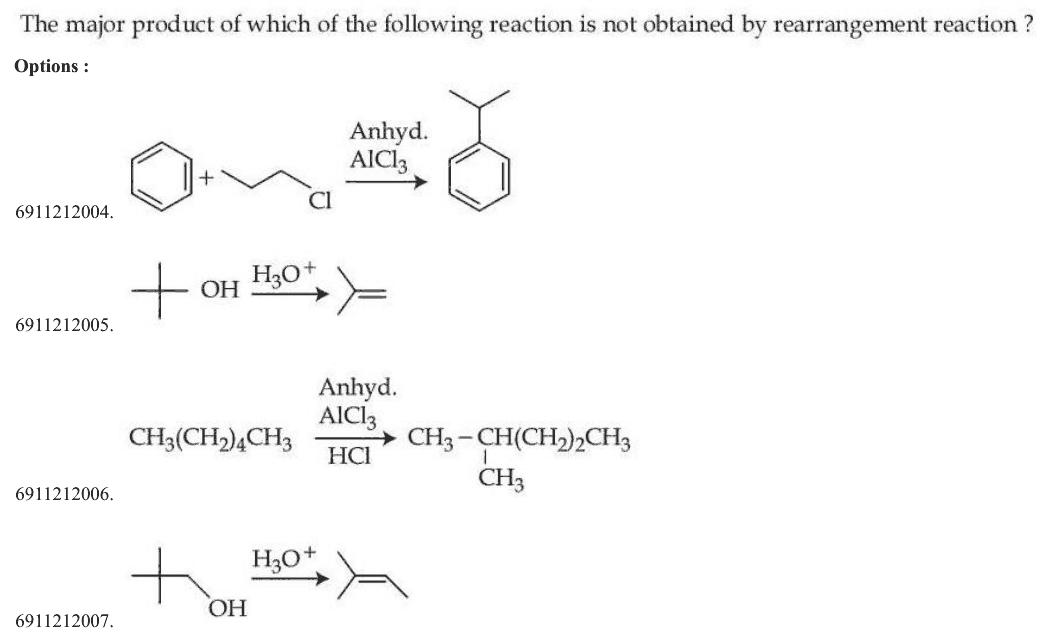
Get EdLoop – freeOpen on the web