Every Biomolecules question from past JEE Main and AIEEE papers, with options and answers. Newest first.
207questions
183papers covered
3.5%of Chemistry questions, 2019–2026
2002–2026years
Guide at a glance
Biomolecules bridges organic chemistry with biological structures under Unit 19: Biomolecules in the Class 12 curriculum, holding rank 14 of 31 chapters with a 3.5% share of the chemistry section.
Identify the incorrect statement about tertiary structure of proteins.
A
They can be fibrous or globular in structure.
B
The main forces that stabilize the structure are hydrogen bonding, disulphide links, van der Waals and electrostatic forces of attraction.
C
The structure remains intact when exposed to pH changes.
D
A linear polypeptide chain will convert to a secondary structure and then further folding of the secondary structure will convert to tertiary structure.
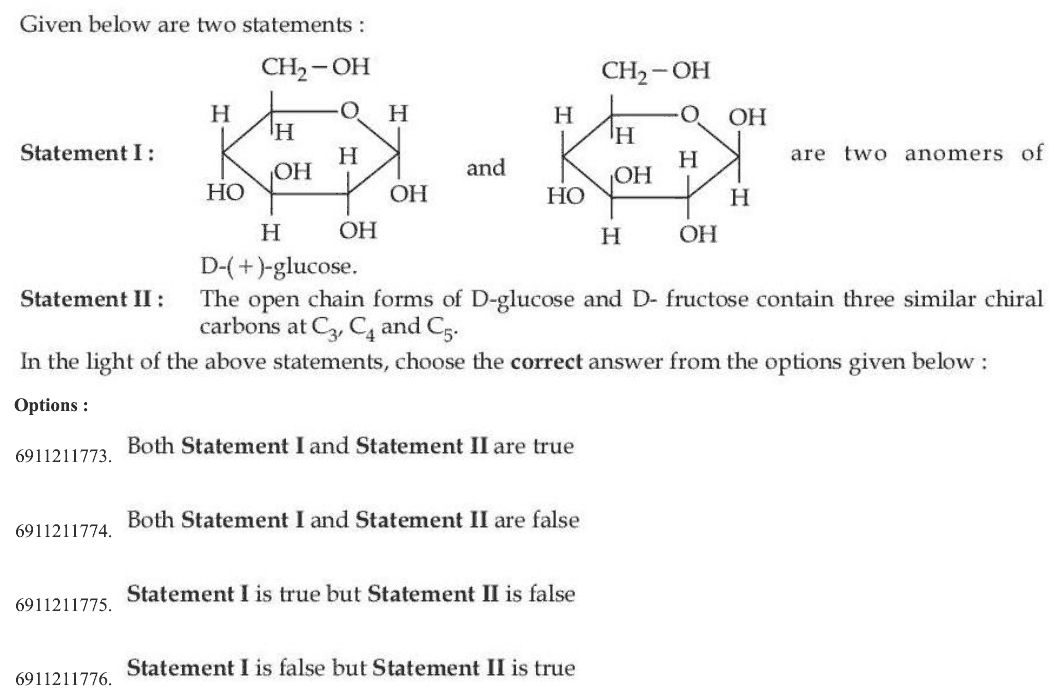
Statement I :(see the figure above) and (see the figure above) are two anomers of D-(+)-glucose.
Statement II : The open chain forms of D-glucose and D- fructose contain three similar chiral carbons at $\mathrm{C_3}$, $\mathrm{C_4}$ and $\mathrm{C_5}$.
In the light of the above statements, choose the correct answer from the options given below :
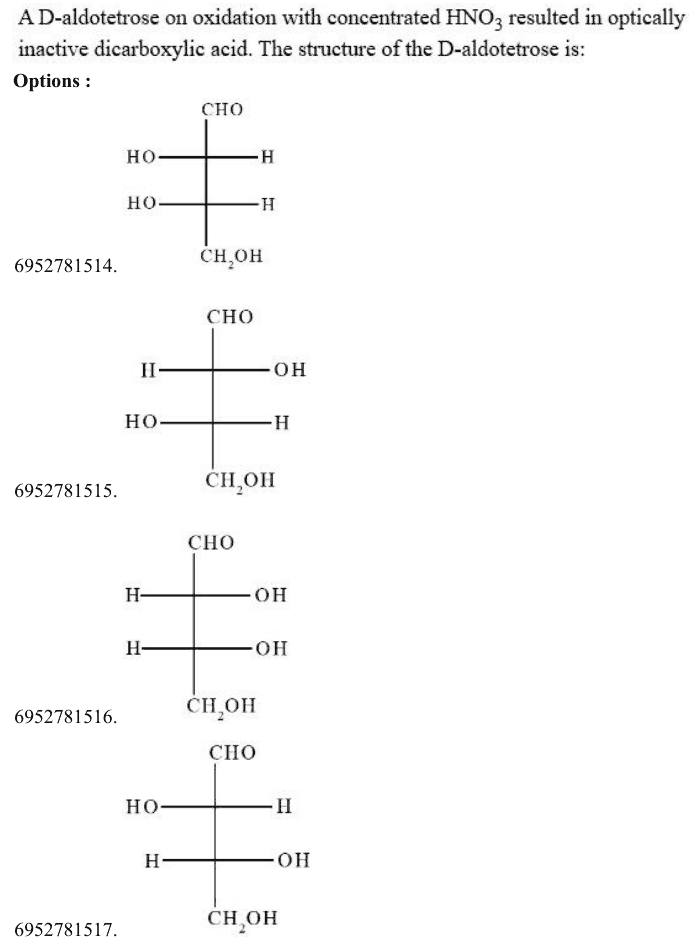
A D-aldotetrose on oxidation with concentrated $\mathrm{HNO_3}$ resulted in optically inactive dicarboxylic acid. The structure of the D-aldotetrose is:
The question as printed in the paper.
A
see figure Fischer projection: CHO at top; second carbon HO on the left, H on the right; third carbon HO on the left, H on the right; CH2OH at bottom.
B
see figure Fischer projection: CHO at top; second carbon H on the left, OH on the right; third carbon HO on the left, H on the right; CH2OH at bottom.
C
see figure Fischer projection: CHO at top; second carbon H on the left, OH on the right; third carbon H on the left, OH on the right; CH2OH at bottom.
D
see figure Fischer projection: CHO at top; second carbon HO on the left, H on the right; third carbon H on the left, OH on the right; CH2OH at bottom.
Identify the correct pair having amino acid (A) and the hormone (B) that is iodinated derivative of the amino acid (A). (T and Y represent one letter code for amino acids)
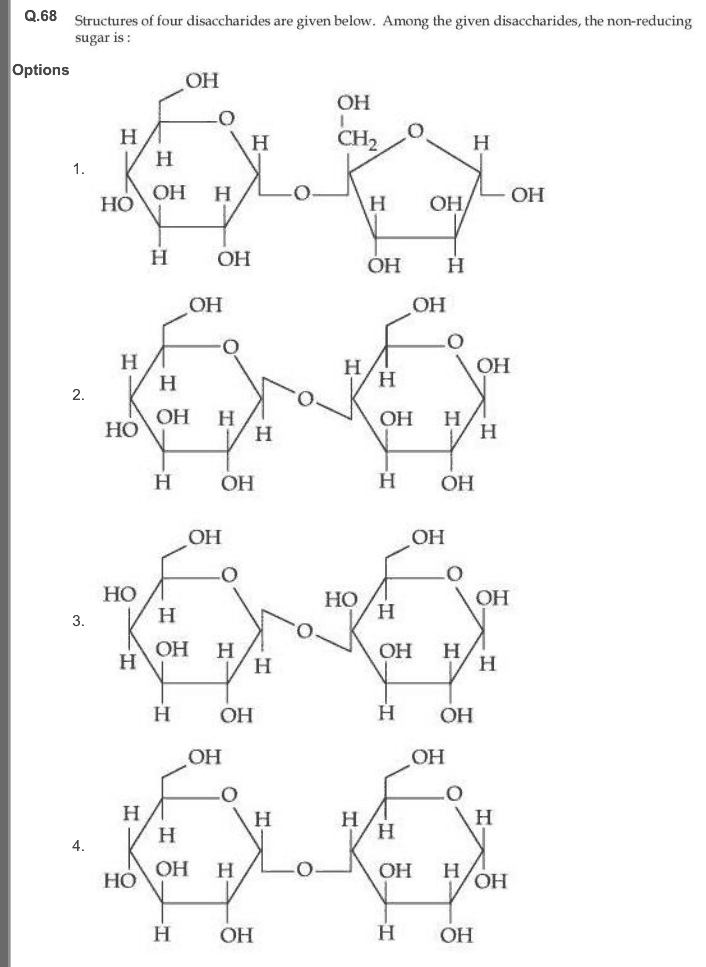
Structures of four disaccharides are given below. Among the given disaccharides, the non-reducing sugar is :
The question as printed in the paper.
A
see figure a six-membered ring (left) joined through a bridging 'O' to a five-membered ring (right). Left ring, going round from its top-left carbon: that carbon has an arm going up then right ending in 'OH' (CH2OH) and an 'H' below it; the ring O is at the upper right; the carbon at the left has 'H' above and 'HO' below; the bottom-left carbon has 'OH' above and 'H' below; the bottom-right carbon has 'H' above and 'OH' below; the carbon at the right (next to the ring O) has 'H' above, and its bond to the bridging O goes DOWN and then right. Right ring: its top-left carbon carries 'CH2' with 'OH' above it, and the bridging O is bonded to the carbon that carries it (bond goes left); the ring O is at the top; the right-hand carbon next to the ring O has 'H' above and a bond going down then right to 'OH'; the lower-left carbon has 'H' above and 'OH' below; the lower-right carbon has 'OH' above and 'H' below.
B
see figure two six-membered rings joined through a bridging 'O'. Left ring: top-left carbon with CH2OH arm (up then right ending in 'OH') and 'H' below; the carbon at the left has 'H' above and 'HO' below; the bottom-left carbon has 'OH' above and 'H' below; the bottom-right carbon has 'H' above and 'OH' below; the carbon at the right (next to the ring O) has 'H' BELOW it, and its bond to the bridging O goes UP and then down-right. Right ring: top-left carbon with CH2OH arm (up then right ending in 'OH') and 'H' below; the carbon at the left, which is bonded to the bridging O through a bond going down, has 'H' above; the bottom-left carbon has 'OH' above and 'H' below; the bottom-right carbon has 'H' above and 'OH' below; the carbon at the right (next to the ring O) has 'OH' above and 'H' below.
C
see figure two six-membered rings joined through a bridging 'O'. Left ring: top-left carbon with CH2OH arm (up then right ending in 'OH') and 'H' below; the carbon at the left has 'HO' above and 'H' below; the bottom-left carbon has 'OH' above and 'H' below; the bottom-right carbon has 'H' above and 'OH' below; the carbon at the right (next to the ring O) has 'H' BELOW it, and its bond to the bridging O goes UP and then down-right. Right ring: top-left carbon with CH2OH arm (up then right ending in 'OH') and 'H' below; the carbon at the left, which is bonded to the bridging O through a bond going down, has 'HO' above; the bottom-left carbon has 'OH' above and 'H' below; the bottom-right carbon has 'H' above and 'OH' below; the carbon at the right (next to the ring O) has 'OH' above and 'H' below.
D
see figure two six-membered rings joined through a bridging 'O'. Left ring: top-left carbon with CH2OH arm (up then right ending in 'OH') and 'H' below; the carbon at the left has 'H' above and 'HO' below; the bottom-left carbon has 'OH' above and 'H' below; the bottom-right carbon has 'H' above and 'OH' below; the carbon at the right (next to the ring O) has 'H' ABOVE it, and its bond to the bridging O goes DOWN and then right. Right ring: top-left carbon with CH2OH arm (up then right ending in 'OH') and 'H' below; the carbon at the left, bonded to the bridging O through a bond going down, has 'H' above; the bottom-left carbon has 'OH' above and 'H' below; the bottom-right carbon has 'H' above and 'OH' below; the carbon at the right (next to the ring O) has 'H' above and 'OH' below.
The number of possible tripeptides formed involving alanine (ala), glycine (gly) and valine (val), where no amino acid has been used more than once is:
Statement I: Sucrose is dextrorotatory. However, sucrose upon hydrolysis gives a solution having mixture of products. This solution shows laevorotation.
Statement II: Hydrolysis of sucrose gives glucose and fructose. Since the laevorotation of glucose is more than the dextrorotation of fructose, the resulting solution becomes laevorotatory.
In the light of the above statements, choose the correct answer from the options given below
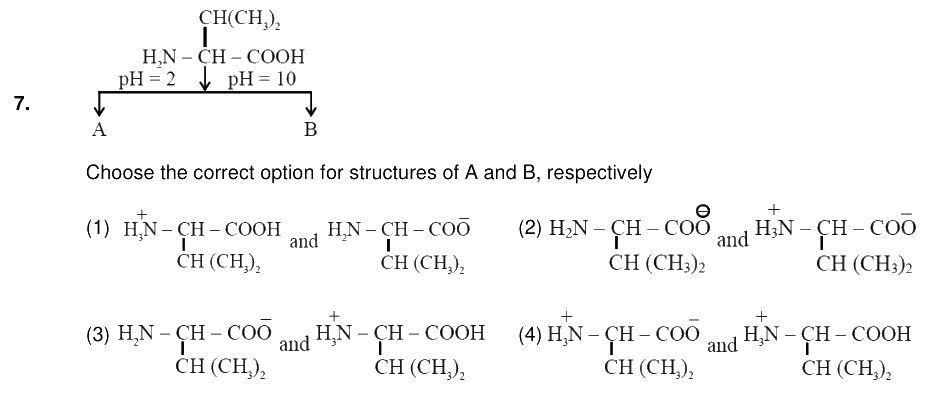
see figure Choose the correct option for structures of A and B, respectively
The question as printed in the paper.
A
see figure A = $\overset{+}{H_3N}-CH(CH(CH_3)_2)-COOH$ and B = $H_2N-CH(CH(CH_3)_2)-COO^-$ (the $CH(CH_3)_2$ group hangs below the CH)
B
see figure A = $H_2N-CH(CH(CH_3)_2)-COO^-$ (the minus is drawn as a circled minus) and B = $\overset{+}{H_3N}-CH(CH(CH_3)_2)-COO^-$ (the $CH(CH_3)_2$ group hangs below the CH)
C
see figure A = $H_2N-CH(CH(CH_3)_2)-COO^-$ and B = $\overset{+}{H_3N}-CH(CH(CH_3)_2)-COOH$ (the $CH(CH_3)_2$ group hangs below the CH)
D
see figure A = $\overset{+}{H_3N}-CH(CH(CH_3)_2)-COO^-$ and B = $\overset{+}{H_3N}-CH(CH(CH_3)_2)-COOH$ (the $CH(CH_3)_2$ group hangs below the CH)
Statement (I) : On hydrolysis, oligo peptides give rise to fewer number of $\alpha$ -amino acids while proteins give rise to a large number of $\beta$ -amino acids.
Statement (II) : Natural proteins are denatured by acids which convert the water soluble form of fibrous proteins to their water insoluble form.
In the light of the above statements, choose the most appropriate answer from the options given below :
A
Statement I is incorrect but Statement II is correct
B
Both Statement I and Statement II are correct
C
Statement I is correct but Statement II is incorrect
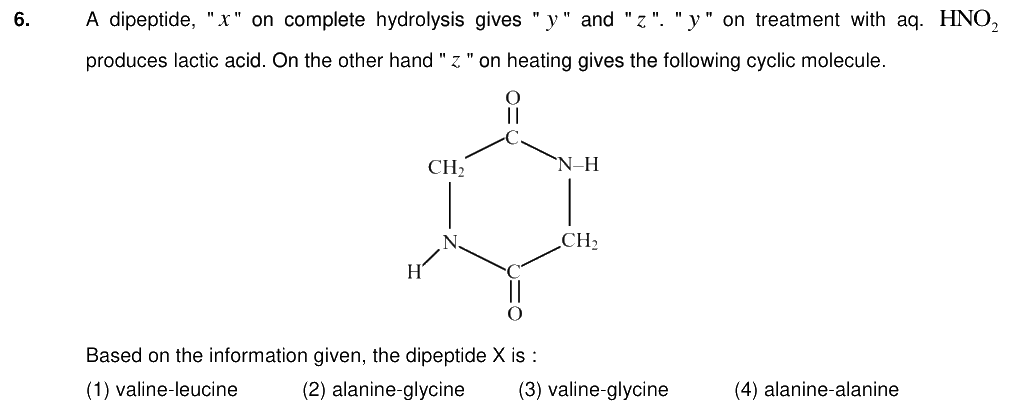
A dipeptide, " $x$ " on complete hydrolysis gives " $y$ " and " $z$ ". " $y$ " on treatment with aq. $HNO_2$ produces lactic acid. On the other hand " $z$ " on heating gives the following cyclic molecule.
(see the figure above)
Based on the information given, the dipeptide X is :
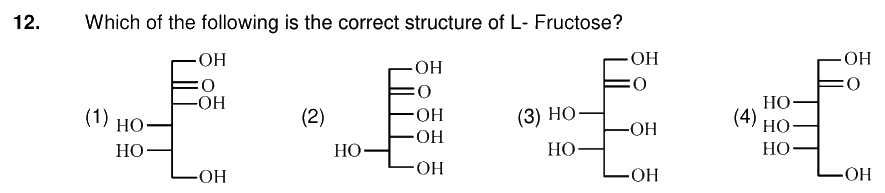
Which of the following is the correct structure of L- Fructose?
The question as printed in the paper.
A
see figure Fischer projection, top to bottom: 'OH' on the right of the top carbon; a carbonyl '=O' on the right of the second carbon; 'OH' on the right of the third carbon; 'HO' on the left of the fourth carbon; 'HO' on the left of the fifth carbon; 'OH' at the bottom (right).
B
see figure Fischer projection, top to bottom: 'OH' on the right of the top carbon; '=O' on the right of the second carbon; 'OH' on the right of the third carbon; 'OH' on the right of the fourth carbon; 'HO' on the left of the fifth carbon; 'OH' at the bottom (right).
C
see figure Fischer projection, top to bottom: 'OH' on the right of the top carbon; '=O' on the right of the second carbon; 'HO' on the left of the third carbon; 'OH' on the right of the fourth carbon; 'HO' on the left of the fifth carbon; 'OH' at the bottom (right).
D
see figure Fischer projection, top to bottom: 'OH' on the right of the top carbon; '=O' on the right of the second carbon; 'HO' on the left of the third carbon; 'HO' on the left of the fourth carbon; 'HO' on the left of the fifth carbon; 'OH' at the bottom (right).
A tetrapeptide, "x" on complete hydrolysis produced glycine (Gly), alanine (Ala), valine (Val), leucine (Leu) in equimolar proportion each. The number of tetrapeptides (sequences) possible involving each of these amino acids is :
Identify the essential amino acids from below : (A) Valine (B) Proline (C) Lysine (D) Threonine (E) Tyrosine Choose the correct answer from the options given below :
Given below are two statements: Statement I : D-glucose pentaacetate reacts with 2, 4-dinitrophenylhydrazine Statement II : Starch, on heating with concentrated sulfuric acid at $100^\circ$C and 2-3 atmosphere pressure produces glucose. In the light of the above statements, choose the correct answer from the options given below
Identify correct conversion during acidic hydrolysis from the following : (A) starch gives galactose. (B) cane sugar gives equal amount of glucose and fructose. (C) milk sugar gives glucose and galactose. (D) amylopectin gives glucose and fructose. (E) amylose gives only glucose. Choose the correct answer from the options given below :
The carbohydrate "Ribose" present in DNA, is A. A pentose sugar B. present in pyranose from C. in "D" configuration D. a reducing sugar, when free E. in $\alpha$-anomeric form Choose the correct answer from the options given below:
Given below are two statements: Statement I: Fructose does not contain an aldehydic group but still reduces Tollen's reagent Statement II: In the presence of base, fructose undergoes rearrangement to give glucose. In the light of the above statements, choose the correct answer from the options given below
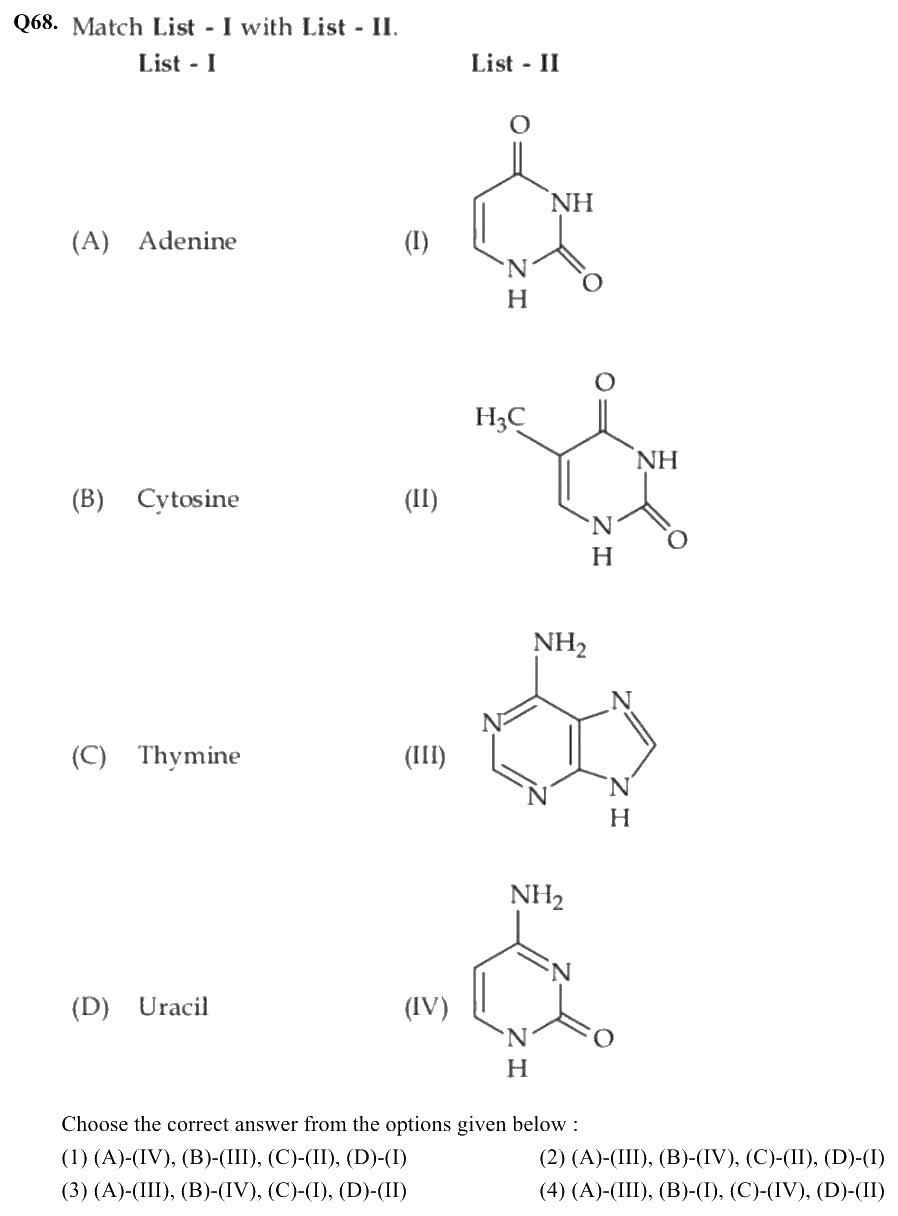
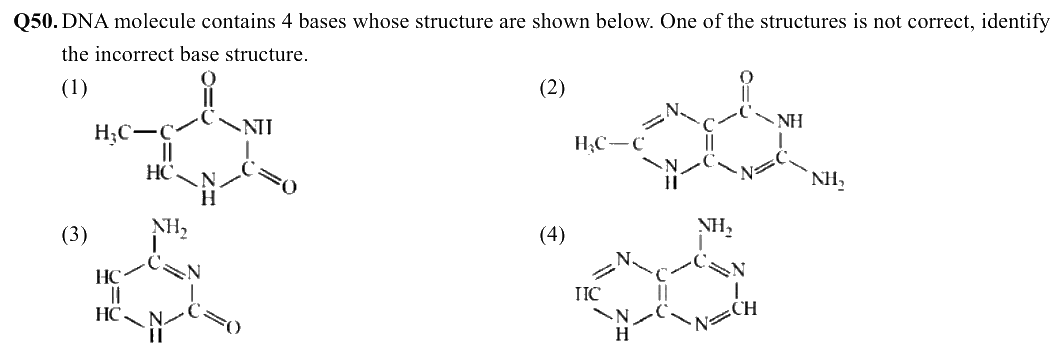
DNA molecule contains 4 bases whose structure are shown below. One of the structures is not correct, identify the incorrect base structure.
The question as printed in the paper.
A
see figure a six-membered ring drawn with H3C-C at the upper left, a C with O double-bonded above at the top, NH at the upper right, C=O at the lower right, N-H at the bottom and HC at the lower left, with a C=C between the H3C-C and HC carbons.
B
see figure a fused two-ring structure with H3C-C and N-H on the left ring, N=C and a C with O double-bonded above at the top, NH at the upper right, N= and C-NH2 at the lower right (NH2 below).
C
see figure a six-membered ring drawn with NH2 on a C at the top, N=C at the upper right, C=O at the lower right, N-H at the bottom, and HC=HC on the left side.
D
see figure a fused two-ring structure with NH2 on a C at the top, N atoms and an HC on the left ring, N-H at the lower left, and N=CH at the lower right.
The incorrect statements regarding enzymes are : (A) Enzymes are biocatalysts. (B) Enzymes are non-specific and can catalyse different kinds of reactions. (C) Most Enzymes are globular proteins. (D) Enzyme - oxidase catalyses the hydrolysis of maltose into glucose. Choose the correct answer from the option given below :
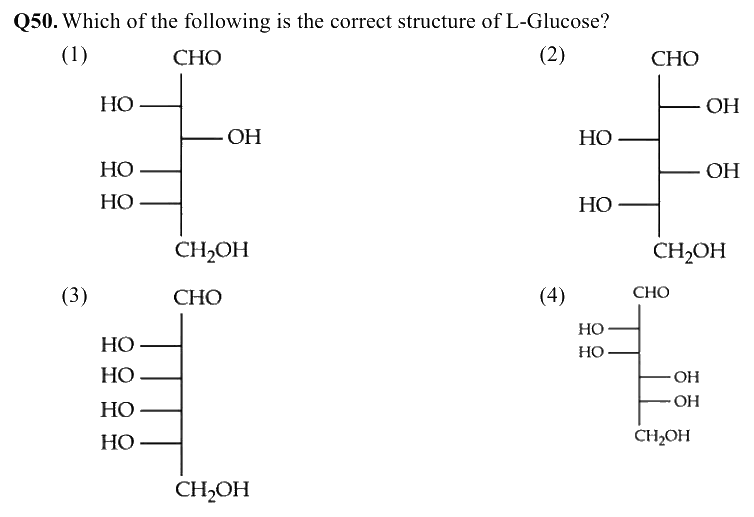
Which of the following is the correct structure of L-Glucose?
The question as printed in the paper.
A
see figure Fischer projection: CHO at the top, a vertical line, then four horizontal bonds from top to bottom: HO on the left, OH on the right, HO on the left, HO on the left; CH2OH at the bottom.
B
see figure Fischer projection: CHO at the top, a vertical line, then four horizontal bonds from top to bottom: OH on the right, HO on the left, OH on the right, HO on the left; CH2OH at the bottom.
C
see figure Fischer projection: CHO at the top, a vertical line, then four horizontal bonds from top to bottom: HO on the left, HO on the left, HO on the left, HO on the left; CH2OH at the bottom.
D
see figure Fischer projection (printed smaller than the others): CHO at the top, a vertical line, then four horizontal bonds from top to bottom: HO on the left, HO on the left, OH on the right, OH on the right; CH2OH at the bottom.
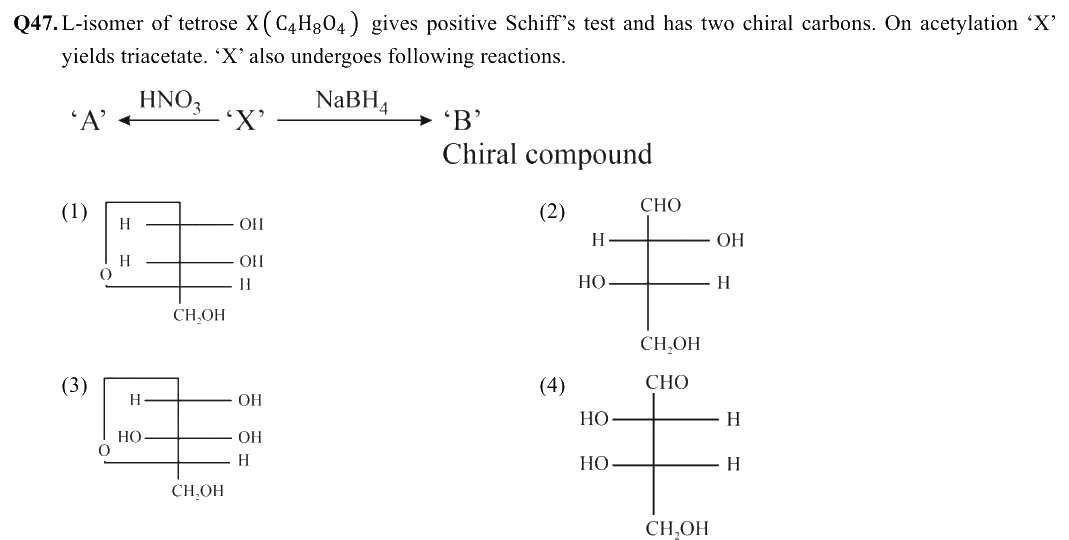
L-isomer of tetrose $\mathrm{X}\ (\mathrm{C_4H_8O_4})$ gives positive Schiff's test and has two chiral carbons. On acetylation 'X' yields triacetate. 'X' also undergoes following reactions. (see the figure above)
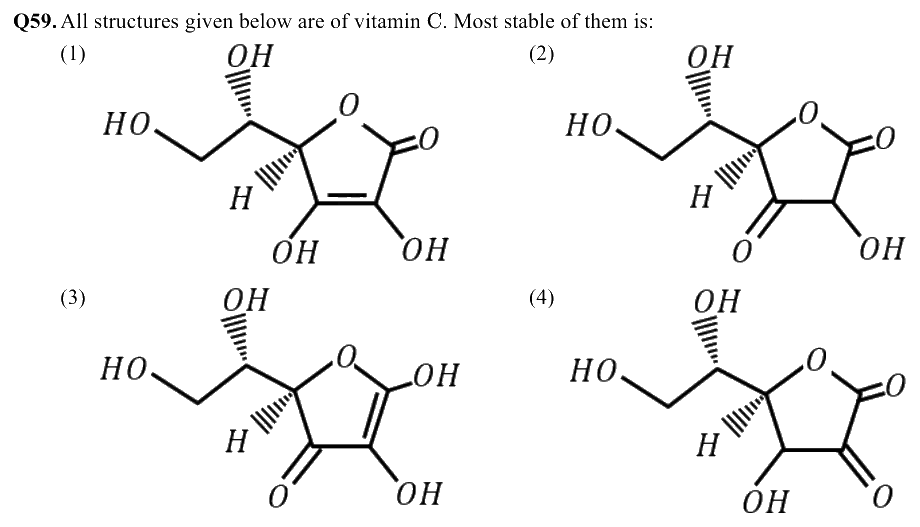
All structures given below are of vitamin C. Most stable of them is:
The question as printed in the paper.
A
see figure five-membered lactone ring (ring O at the top right, C=O at the right) with a C=C bearing an OH at the bottom right and an OH at the bottom left carbon; the ring carbon at the upper left carries H (hashed) and the side chain CH(OH)-$\mathrm{CH_2}$-OH (HO at left, OH above on a hashed bond).
B
see figure five-membered lactone ring (ring O at the top right, C=O at the right) with no ring C=C; the lower left ring carbon has a C=O (O at the bottom left) and the lower right ring carbon has OH; same H and side chain as in 1.
C
see figure five-membered ring with ring O at the top right; the carbon next to the O carries OH and is double-bonded to the next carbon, which carries OH; the lower left ring carbon has a C=O (O at the bottom); same H and side chain as in 1.
D
see figure five-membered lactone ring (ring O at the top right, C=O at the right) with a C=O on the next carbon (O at the bottom right) and OH on the lower left ring carbon; same H and side chain as in 1.
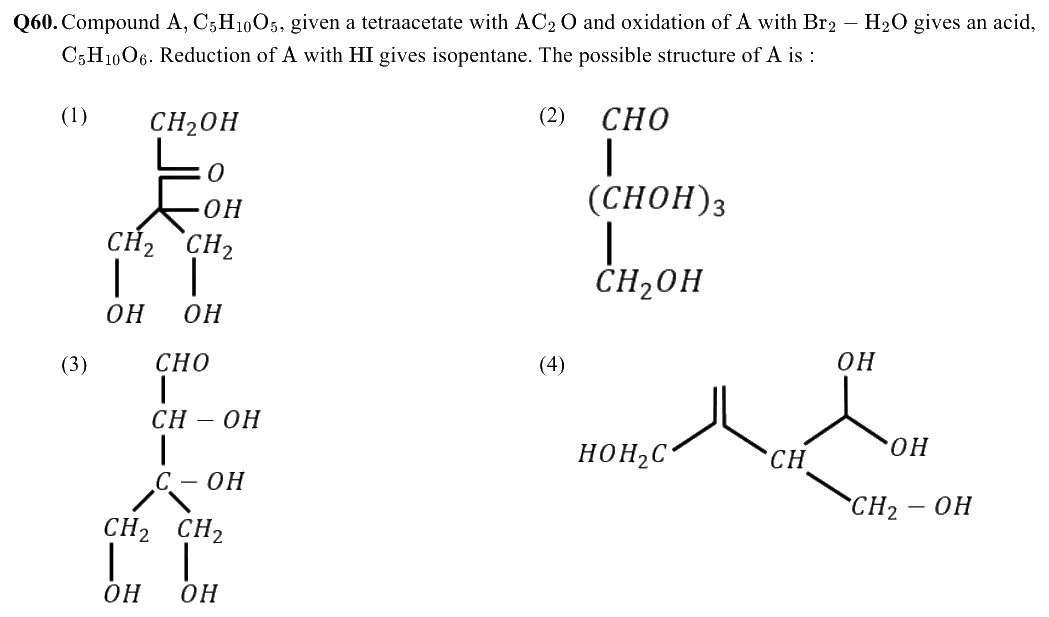
Compound A, $\mathrm{C_5H_{10}O_5}$, given a tetraacetate with $\mathrm{AC_2\,O}$ and oxidation of A with $\mathrm{Br_2 - H_2O}$ gives an acid, $\mathrm{C_5H_{10}O_6}$. Reduction of A with HI gives isopentane. The possible structure of A is :
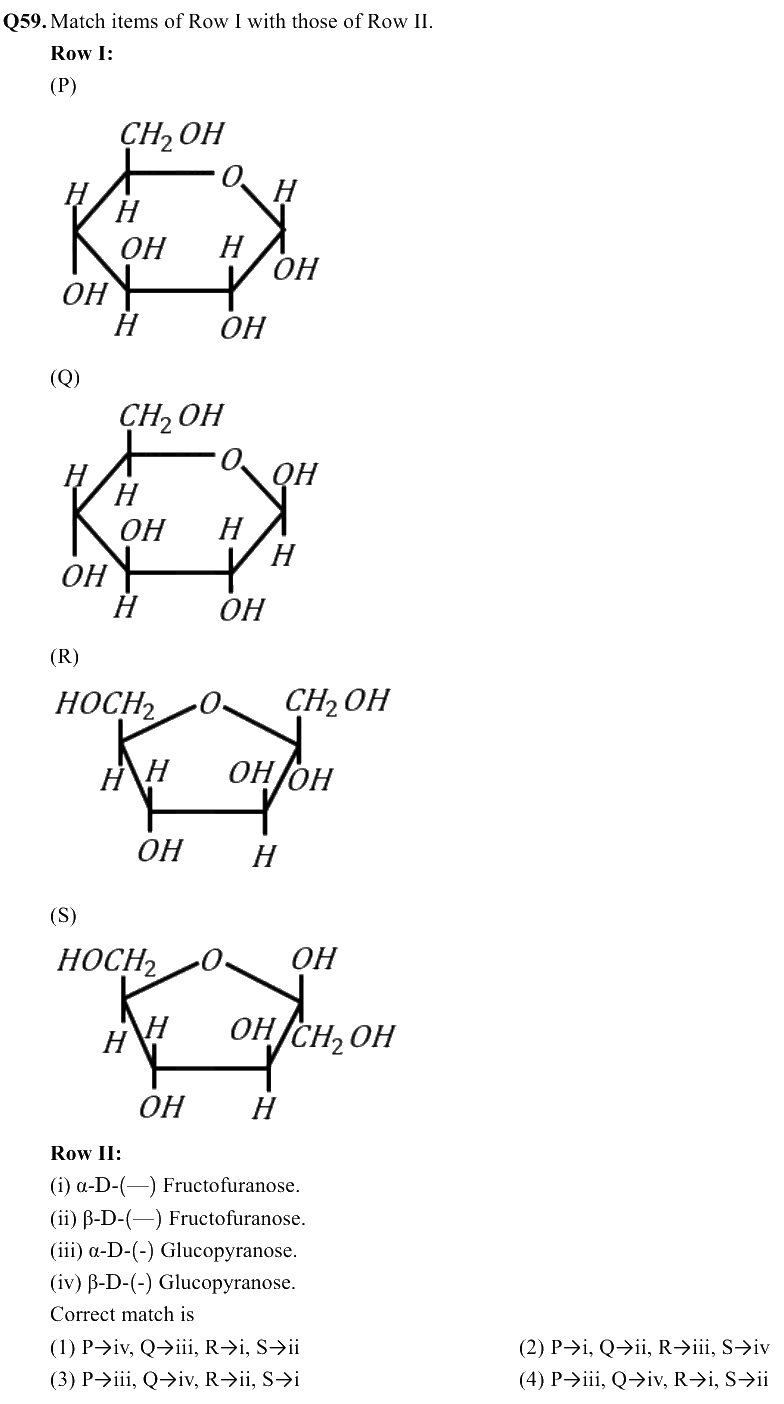
Match items of Row I with those of Row II. Row I: (P) (see the figure above) (Q) (see the figure above) (R) (see the figure above) (S) (see the figure above) Row II: (i) $\alpha$-D-(—) Fructofuranose. (ii) $\beta$-D-(—) Fructofuranose. (iii) $\alpha$-D-(-) Glucopyranose. (iv) $\beta$-D-(-) Glucopyranose. Correct match is
Given below are two statements. One is labelled as Assertion A and the other is labelled as Reason R. Assertion A : Amylose is insoluble in water. Reason R : Amylose is a long linear molecule with more than 200 glucose units. In the light of the above statements, choose the correct answer from the options given below.
A
Both A and R are correct and R is the correct explanation of A.
B
Both A and R are correct and R is NOT the correct explanation of A.
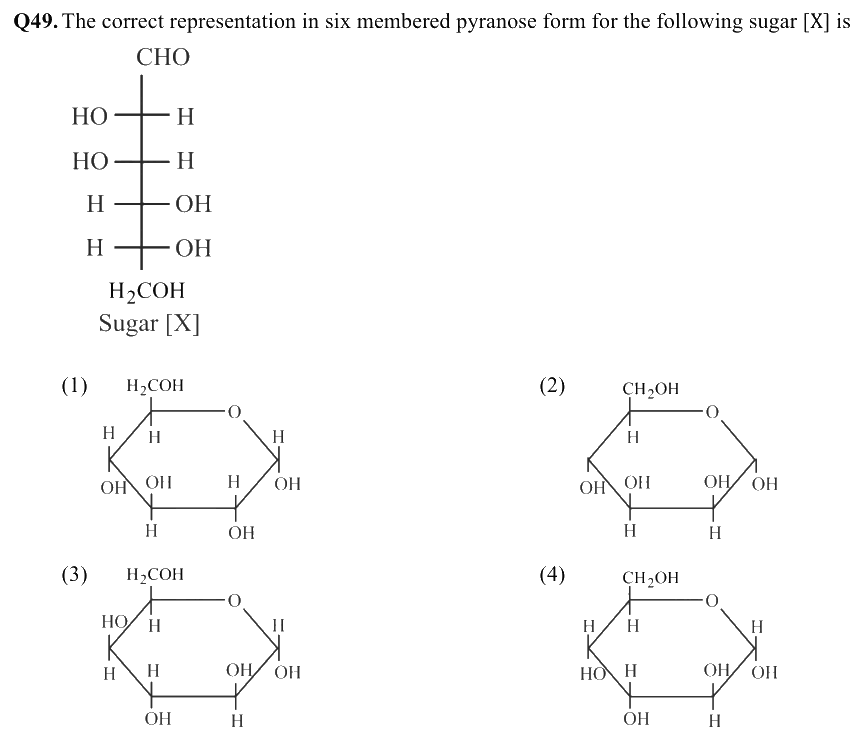
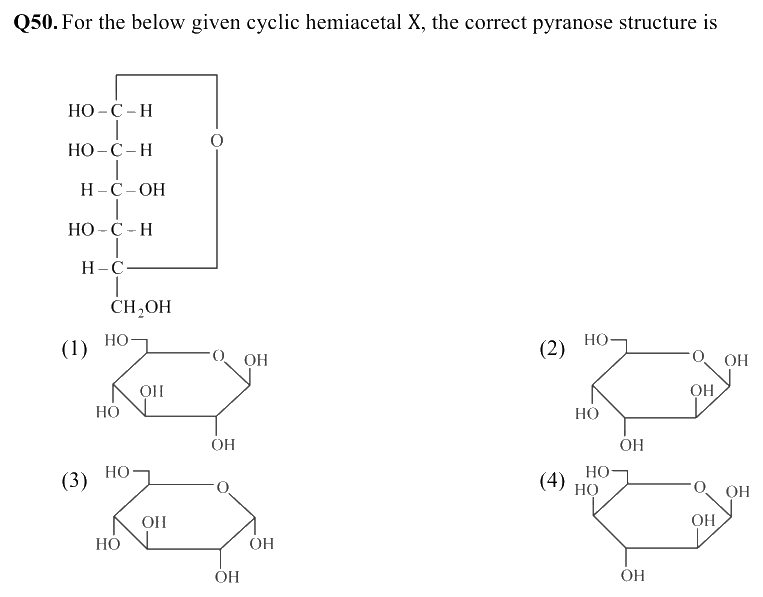
For the below given cyclic hemiacetal X, the correct pyranose structure is
(see the figure above)
The question as printed in the paper.
A
see figure Flat (Haworth-type) pyranose ring drawn in perspective: ring O at the top right, C1 at the right, C2 lower right, C3 lower left, C4 at the left, C5 top left carrying $\mathrm{HOCH_2}$ (up). C1 OH up, C2 OH down, C3 OH up, C4 HO down.
B
see figure Same flat ring and numbering as option 1, $\mathrm{HOCH_2}$ up on C5. C1 OH up, C2 OH up, C3 OH down, C4 HO down.
C
see figure Same flat ring and numbering as option 1, $\mathrm{HOCH_2}$ up on C5. C1 OH down, C2 OH down, C3 OH up, C4 HO down.
D
see figure Same flat ring and numbering as option 1, $\mathrm{HOCH_2}$ up on C5. C1 OH up, C2 OH up, C3 OH down, C4 HO up.
A sugar 'X' dehydrates very slowly under acidic condition to give furfural which on further reaction with resorcinol gives the coloured product after sometime. Sugar 'X' is
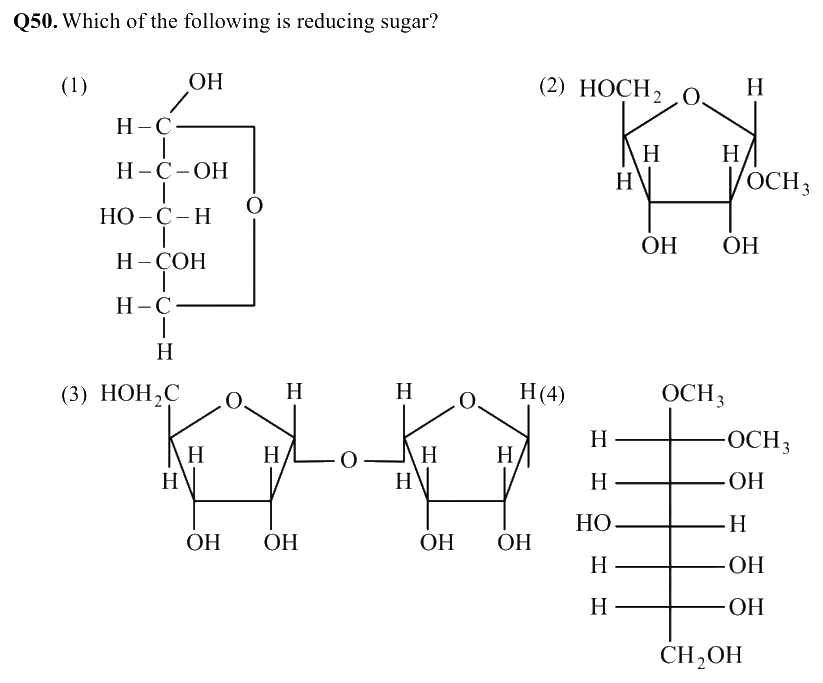
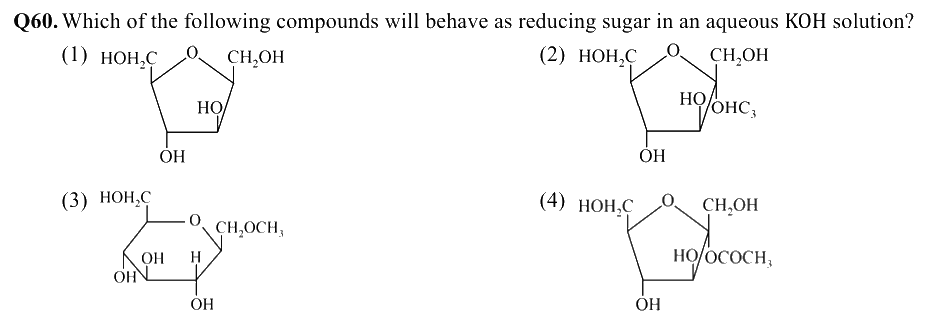
Which of the following is reducing sugar? (see the figure above)
The question as printed in the paper.
A
see figure Open-chain-like drawing of a sugar with a ring O bridge: a vertical chain from the top, with OH on the top carbon, then H-C, H-C-OH, HO-C-H, H-COH, H-C, H at the bottom, and an O drawn on the right joining the top carbon to the bottom carbon (a cyclic hemiacetal form of a hexose drawn in a chain style).
B
see figure A five-membered ring (furanose) with ring O at the top; $\mathrm{HOCH_2}$ at the upper left carbon, H and $\mathrm{OCH_3}$ at the right ring carbon (the carbon next to O), H, H on the upper ring carbons and OH, OH at the bottom two carbons (a methyl glycoside).
C
see figure Two five-membered rings (furanose) each with ring O at the top, joined by an O bridge between the right carbon of the left ring and the left carbon of the right ring; $\mathrm{HOCH_2}$ at the left end; OH, OH below each ring (a disaccharide).
D
see figure An open chain vertical (Fischer-style) structure with $\mathrm{OCH_3}$ at the top, then rows: H and $\mathrm{OCH_3}$, H and OH, HO and H, H and OH, H and OH, ending with $\mathrm{CH_2OH}$ at the bottom.
When sugar 'X' is boiled with dilute $\mathrm{H_2\,SO_4}$ in alcoholic solution, two isomers 'A' and 'B' are formed. 'A' on oxidation with $\mathrm{HNO_3}$ yields saccharic acid where as 'B' is laevorotatory. The compound 'X' is
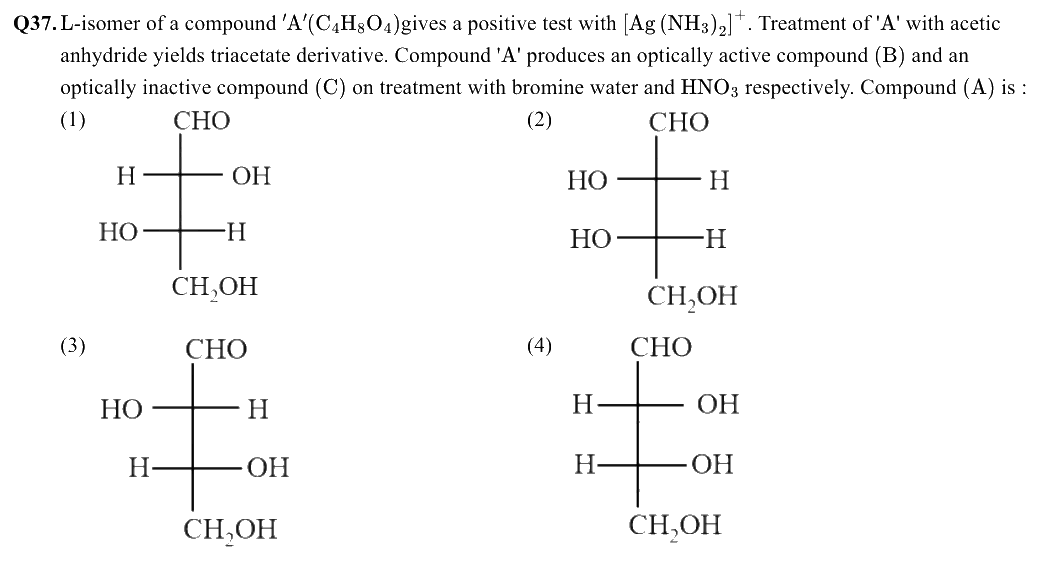
L-isomer of a compound 'A'($\mathrm{C_4H_8O_4}$)gives a positive test with $\mathrm{[Ag\,(NH_3)_2]^{+}}$. Treatment of 'A' with acetic anhydride yields triacetate derivative. Compound 'A' produces an optically active compound (B) and an optically inactive compound (C) on treatment with bromine water and $\mathrm{HNO_3}$ respectively. Compound (A) is :
The question as printed in the paper.
A
see figure Fischer projection: CHO at the top; first carbon with H on the left and OH on the right; second carbon with HO on the left and H on the right; CH_2OH at the bottom.
B
see figure Fischer projection: CHO at the top; first carbon with HO on the left and H on the right; second carbon with HO on the left and H on the right; CH_2OH at the bottom.
C
see figure Fischer projection: CHO at the top; first carbon with HO on the left and H on the right; second carbon with H on the left and OH on the right; CH_2OH at the bottom.
D
see figure Fischer projection: CHO at the top; first carbon with H on the left and OH on the right; second carbon with H on the left and OH on the right; CH_2OH at the bottom.
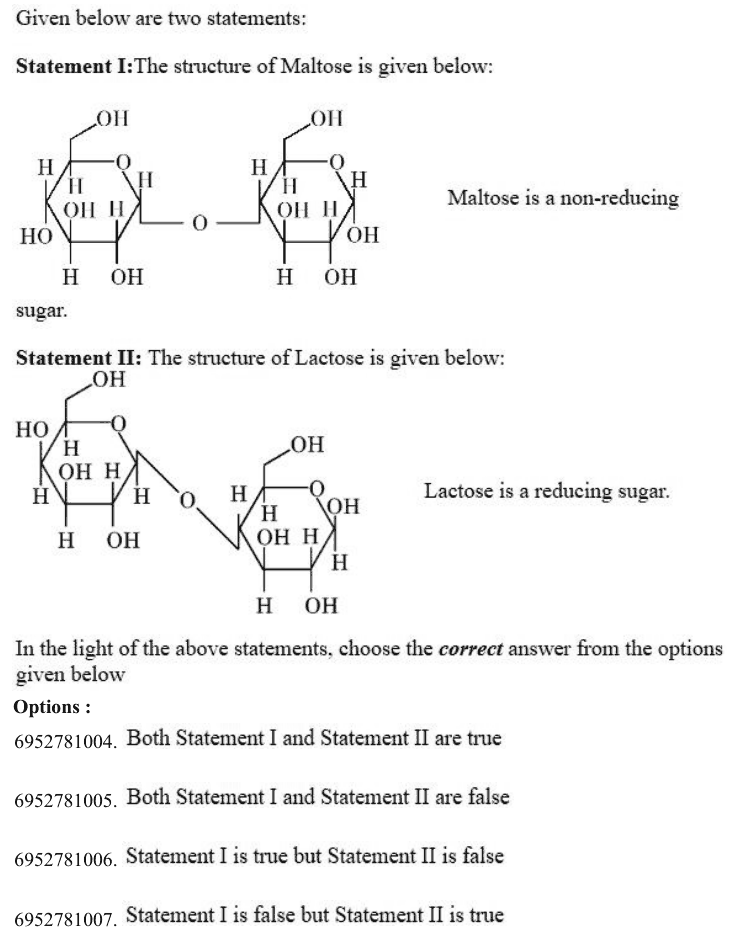
Given below are two statements. Statement I: Maltose has two $\alpha - D -$ glucose units linked at $\mathrm{C_1}$ and $\mathrm{C_4}$ and is a reducing sugar. Statement II: Maltose has two monosaccharides: $\alpha$-D-glucose and $\beta$-D-glucose linked at $\mathrm{C_1}$ and $\mathrm{C_6}$ and it is a non-reducing sugar. In the light of the above statements, choose the correct answer from the options given below.
A polysaccharide 'X' on boiling with dil $\mathrm{H_2SO_4}$ at $393 \mathrm{~K}$ under $2 - 3 \mathrm{~atm}$ pressure yields 'Y' 'Y' on treatment with bromine water gives gluconic acid. 'X' contains $\beta$-glycosidic linkages only. Compound 'X' is :
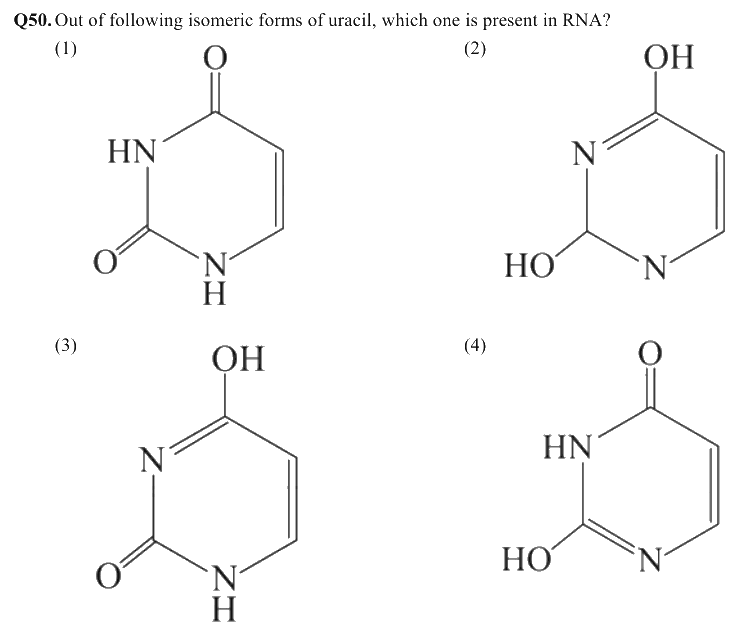
Out of following isomeric forms of uracil, which one is present in RNA?
The question as printed in the paper.
A
see figure six-membered ring: O= at the top, HN at the upper left, O= at the lower left (on the carbon between the two nitrogens), N-H at the bottom, C=C on the right side (diketo form).
B
see figure six-membered ring with OH at the top, ring N at the upper left, HO at the lower left, ring N at the bottom, C=C on the right (dihydroxy form, no N-H).
C
see figure six-membered ring with OH at the top, ring N at the upper left, O= at the lower left, N-H at the bottom, C=C on the right.
D
see figure six-membered ring with O= at the top, HN at the upper left, HO at the lower left, ring N at the bottom, C=C on the right.
Given below are two statements : one is labelled as Assertion (A) and the other is labelled as Reason (R). Assertion (A) : Sucrose is a disaccharide and a non-reducing sugar. Reason (R): Sucrose involves glycosidic linkage between $C_1$ of $\beta$-glucose and $C_2$ of $\alpha$-fructose. Choose the most appropriate answer from the options given below :
A
Both (A) and (R) are true and (R) is the true explanation of (A).
B
(A) is true but (R) is false.
C
(A) is false but (R) is true.
D
Both (A) and (R) are true but (R) is not the true explanation of (A).
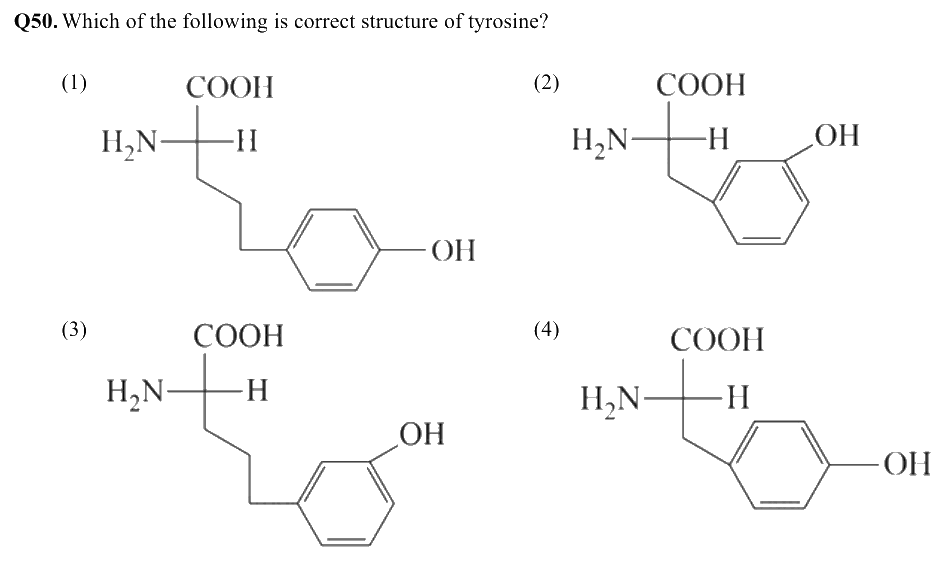
Which of the following is correct structure of tyrosine? (see the figure above)
The question as printed in the paper.
A
see figure Fischer-type drawing: $\mathrm{COOH}$ at the top, $\mathrm{H_2N}$ on the left and H on the right of the central carbon, then a two-carbon zigzag chain ($\mathrm{CH_2CH_2}$) leading to a benzene ring bearing OH para to the chain
B
see figure Same Fischer-type drawing, then a single $\mathrm{CH_2}$ leading to a benzene ring bearing OH meta to the chain (OH on the ring carbon at the upper right, as drawn)
C
see figure Same Fischer-type drawing, then a two-carbon zigzag chain ($\mathrm{CH_2CH_2}$) leading to a benzene ring bearing OH meta to the chain (as drawn)
D
see figure Same Fischer-type drawing, then a single $\mathrm{CH_2}$ leading to a benzene ring bearing OH para to the chain
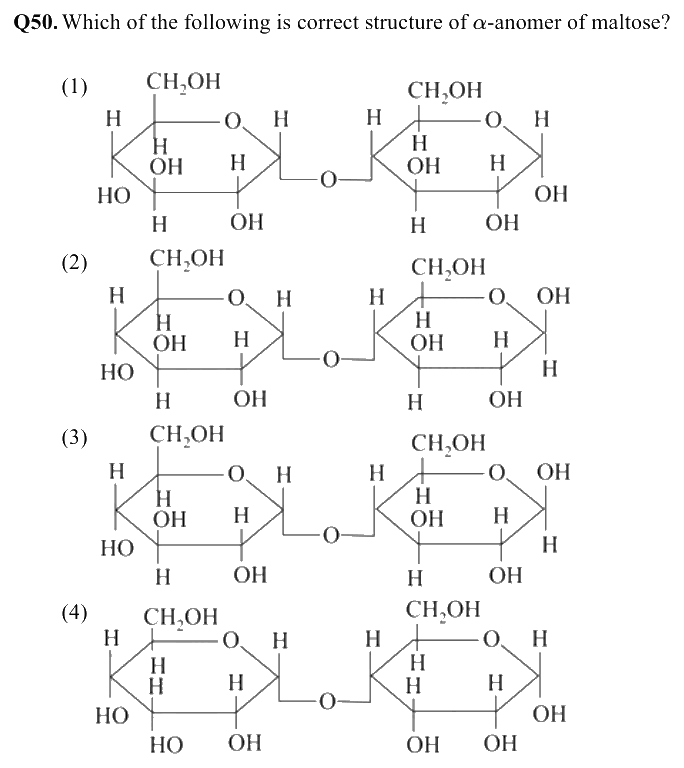
Which of the following is correct structure of $\alpha$-anomer of maltose?
The question as printed in the paper.
A
see figure two six-membered pyranose rings (ring oxygen at the top of each, CH2OH at the top, H and OH groups on the ring carbons) joined by a glycosidic oxygen bridge between the lower right carbon of the left ring and the lower left carbon of the right ring
B
see figure disaccharide drawing of the same kind as option 1 (two pyranose rings joined by an O bridge), with different positions of H and OH on the ring carbons
C
see figure disaccharide drawing of the same kind as option 1, with different positions of H and OH on the ring carbons
D
see figure disaccharide drawing of the same kind as option 1, with different positions of H and OH on the ring carbons
The correct observation in the following reaction is: Sucrose $\xrightarrow[\text{Cleavage (Hydrolysis)}]{\text{Glycosidic bond}} \mathrm{A} + \mathrm{B} \xrightarrow[\text{Reagent}]{\text{Seliwanoff}} ?$
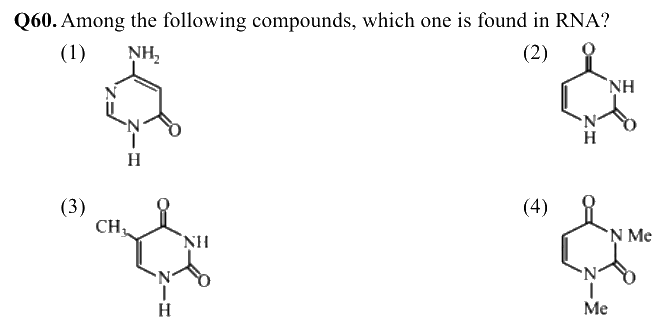
Among the following compounds, which one is found in RNA? (see the figure above)
The question as printed in the paper.
A
see figure six-membered ring with NH2 at the top, ring N at the upper left, ring N-H at the bottom and C=O at the lower right (cytosine-type structure)
B
see figure six-membered ring with C=O at the top, NH at the upper right, N-H at the bottom and C=O at the lower right (uracil-type structure)
C
see figure same ring as option 2 with a CH3 on the upper left carbon (thymine-type structure)
D
see figure same ring as option 2 with a methyl group on each ring nitrogen (N Me at the upper right, N-Me at the bottom)
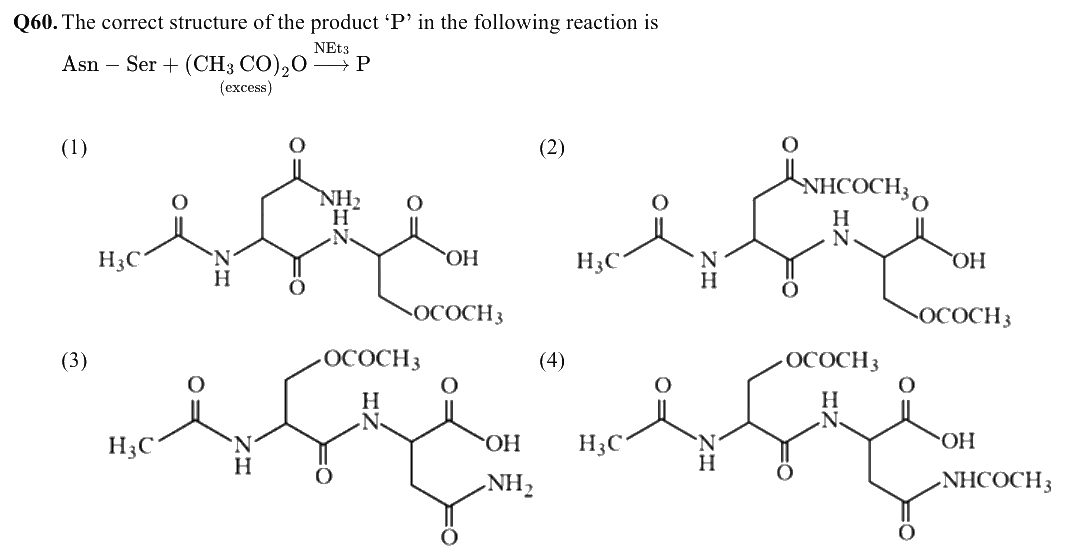
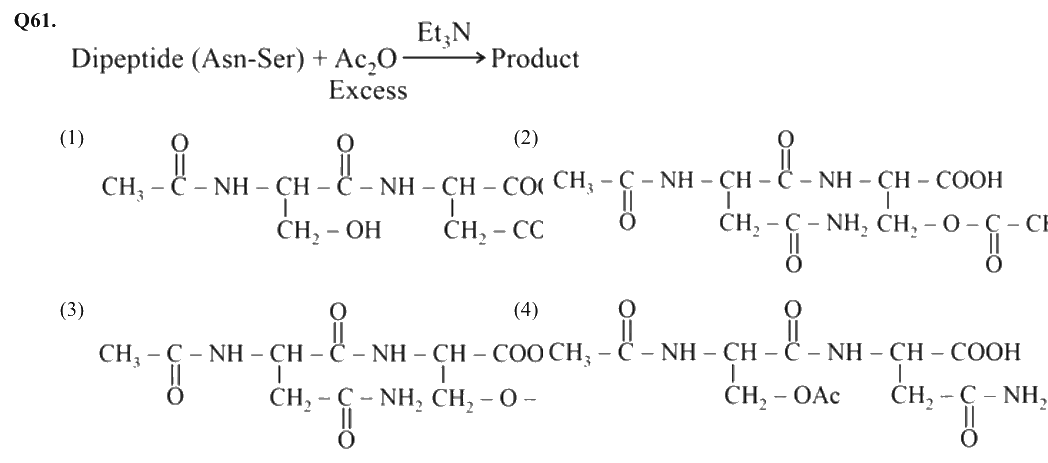
The correct structure of the product 'P' in the following reaction is $Asn - Ser + (CH_3\ CO)_2O \xrightarrow{NEt_3} P$ (excess) (see the figure above)
The question as printed in the paper.
A
see figure CH3C(=O)-NH-CH(CH2C(=O)NH2)-C(=O)-NH-CH(CH2OCOCH3)-COOH
B
see figure CH3C(=O)-NH-CH(CH2C(=O)NHCOCH3)-C(=O)-NH-CH(CH2OCOCH3)-COOH
C
see figure CH3C(=O)-NH-CH(CH2OCOCH3)-C(=O)-NH-CH(CH2C(=O)NH2)-COOH
D
see figure CH3C(=O)-NH-CH(CH2OCOCH3)-C(=O)-NH-CH(CH2C(=O)NHCOCH3)-COOH
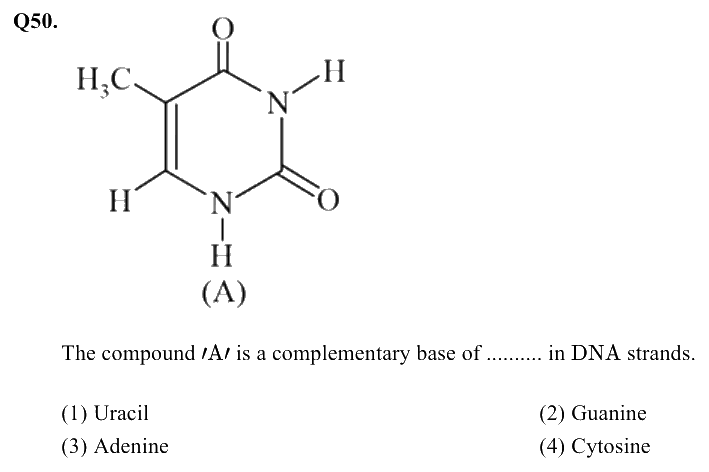
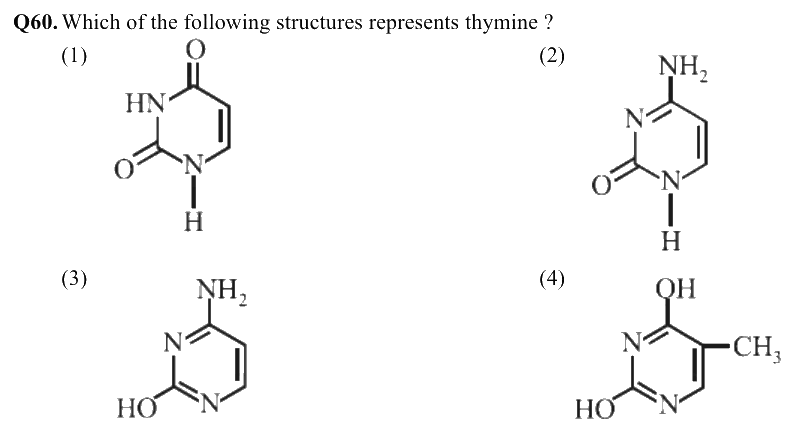
Which of the following structures represents thymine ? (see the figure above)
The question as printed in the paper.
A
see figure Six-membered ring: C=O at the top carbon, HN on the left, C=O (O at the lower left) between the two nitrogens, N with an H below it at the lower right, and a C=C double bond on the right side; no other substituent.
B
see figure Six-membered ring: NH2 on the top carbon, N on the left (double bond to the top carbon), C=O (O at the lower left) between the two nitrogens, N with an H below it at the lower right, and a C=C double bond on the right side; no other substituent.
C
see figure Six-membered ring: NH2 on the top carbon, N on the left (double bond to the top carbon), HO on the lower-left carbon between the two nitrogens, N (no H) at the bottom, and a C=C double bond on the right side.
D
see figure Six-membered ring: OH on the top carbon, N on the left (double bond to the top carbon), HO on the lower-left carbon between the two nitrogens, N (no H) at the bottom, a C=C double bond on the right side, and CH3 on the right-hand ring carbon next to the top carbon.
Total number of essential amino acid among the given list of amino acids is ______ Arginine, Phenylalanine, Aspartic acid, Cysteine, Histidine, Valine, Proline
Numerical answer type: type your answer in EdLoop to check it
Number of compounds from the following which will not produce orange red precipitate with Benedict solution is ______ Glucose, maltose, sucrose, ribose, 2-deoxyribose, amylose, lactose
Numerical answer type: type your answer in EdLoop to check it
A short peptide on complete hydrolysis produces 3 moles of glycine (G), two moles of leucine (L) and two moles of valine (V) per mole of peptide. The number of peptide linkages in it are ______ .
Numerical answer type: type your answer in EdLoop to check it
Biomolecules bridges organic chemistry with biological structures under Unit 19: Biomolecules in the Class 12 curriculum, holding rank 14 of 31 chapters with a 3.5% share of the chemistry section. During 2019 to 2026, Biomolecules accounted for 162 questions across 162 exam papers, delivering 3.5% of the chemistry section and holding rank 14 of 31 chapters. In the earlier 2002 to 2018 testing span, it contributed 45 questions across 38 papers with a 3.4% share. Over the recent 2024 to 2026 cycle, question numbers reached 60 questions across 58 papers, accounting for a 3.9% share. Comparing 2002 to 2018 against 2024 to 2026, the trend is up, while comparing 2019 to 2026 against 2024 to 2026, the testing share has remained about the same.
The chapter has appeared every year from 2019 to 2026. Across 2019 to 2026, students met an average of 1.0 question per paper, identical to the 1.0 question per paper recorded between 2024 and 2026. Nineteen numerical answer questions were presented from 2019 to 2026, often counting peptide bonds, chiral carbons, or stereoisomeric peptides.
Most-asked topics
The syllabus organizes across three core topics:
Carbohydrates: The leading topic with 91 total questions (73 in 2019 to 2026), evaluated continuously through 2026. Key areas investigate glucose chemical reactions (forming pentaacetate with acetic anhydride, saccharic acid with nitric acid, and n-hexane with HI and red phosphorus), cyclic alpha/beta anomers, mutarotation, Haworth projections, glycosidic linkages in maltose, lactose, and sucrose, and the structural basis of invert sugar.
Amino Acids & Proteins: Contributed 73 total questions (60 in 2019 to 2026), tested through 2026. Focuses on classification into essential and non-essential amino acids, acidic/basic/neutral side chains, zwitterionic forms, peptide bond formation, secondary protein stabilization via hydrogen bonding (alpha-helix and beta-pleated sheets), and protein denaturation disrupting secondary and tertiary conformations while preserving primary structure.
Vitamins, Nucleic Acids & Hormones: Produced 43 total questions (29 in 2019 to 2026), active through 2026. Examines water-soluble versus fat-soluble vitamins (deficiency diseases like scurvy, rickets, beriberi, and night blindness), chemical components of DNA versus RNA (purine and pyrimidine base pairing), chirality of the pentose sugar backbone, and thyroid/pancreatic hormones.
What the questions look like
Examiners test structural knowledge directly through diagrams and reaction matching. A recurring carbohydrate question presents four disaccharide structures and asks candidates to identify the non-reducing sugar by checking whether all anomeric carbons participate in glycosidic linkages (as in sucrose).
Protein questions often evaluate amino acid structures, asking students to identify essential amino acids, count peptide linkages in a drawn oligopeptide, or explain why glycine is the only standard proteinogenic amino acid lacking an asymmetric chiral alpha-carbon.
Questions to try first
Work through these authentic recent exam questions:
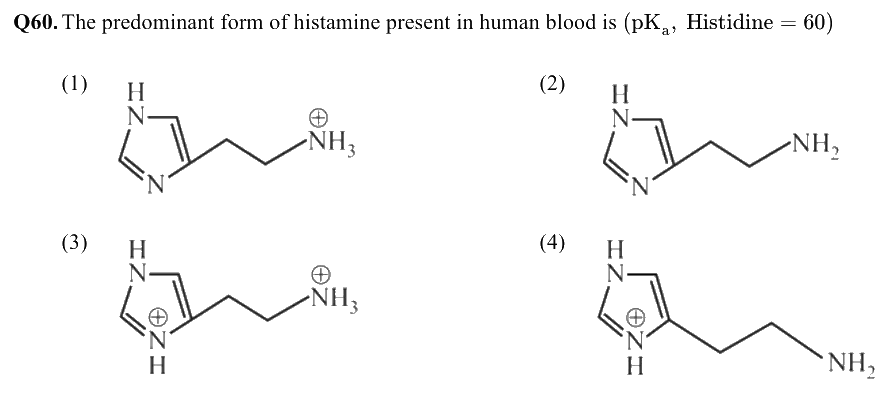
Sucrose optical inversion: Explaining the change in optical rotation sign when dextrorotatory sucrose hydrolyzes into glucose and strongly levorotatory fructose.
How to practise it
Prepare for biomolecules by memorizing exact chemical formulas, linkages, and test responses:
1. Memorize glucose chemical reactions: Glucose with bromine water gives gluconic acid (monocarboxylic); with concentrated nitric acid gives saccharic acid (dicarboxylic); with acetic anhydride gives pentaacetate confirming five hydroxyl groups. 2. Note why sucrose is a non-reducing sugar: In sucrose, the hemiacetal hydroxyl of alpha-D-glucose and the hemiketal hydroxyl of beta-D-fructose link together through a glycosidic bond, leaving no free anomeric carbon to reduce Tollens or Fehling solutions. 3. Classify vitamins by solubility: Vitamins B and C are water-soluble (excreted readily, requiring regular intake, except vitamin B12); vitamins A, D, E, and K are fat-soluble (stored in liver and adipose tissue). 4. Identify essential amino acids: Memorize the ten essential amino acids (valine, leucine, isoleucine, lysine, methionine, threonine, phenylalanine, tryptophan, histidine, arginine). 5. Understand nucleic acid structures: Adenine pairs with thymine via two hydrogen bonds; guanine pairs with cytosine via three hydrogen bonds. In RNA, uracil replaces thymine.
Frequently asked questions
Why is glycine optically inactive?
Glycine possesses two hydrogen atoms bonded to its alpha carbon, giving it an internal plane of symmetry and preventing it from having a chiral center, unlike all other natural amino acids.
What is invert sugar?
Sucrose is dextrorotatory, but upon acid hydrolysis it yields an equimolar mixture of dextrorotatory D-glucose and more strongly levorotatory D-fructose, resulting in an overall levorotatory mixture called invert sugar.
What remains intact when a protein undergoes denaturation?
Denaturation by heat or pH changes disrupts hydrogen bonding and hydrophobic interactions, destroying secondary, tertiary, and quaternary structures, but leaves the covalent primary peptide backbone completely intact. Step-by-step solutions for each one are in the EdLoop app.