Every Atomic Structure question from past JEE Main and AIEEE papers, with options and answers. Newest first.
242questions
193papers covered
3.9%of Chemistry questions, 2019–2026
2002–2026years
Guide at a glance
Atomic structure examines quantum mechanical models of atoms and electron address rules under Unit 2: Atomic Structure in the Class 11 curriculum, holding rank 11 among the 31 chemistry chapters with a 3.9 percent share of total chemistry questions.
The Bohr radius of a hydrogen like species is 70.53 pm. The species and the stationary state (n) are respectively (Given : Hydrogen atom Bohr radius is 52.9 pm)
Which of the following is correct set of 4 quantum numbers of 19$^{\text{th}}$ electron in Chromium (Atomic number = 24) in accordance with Aufbau principle?
A monoatomic anion ($\mathrm{A^-}$) has 45 neutrons and 36 electrons. Atomic mass, group in the periodic table and physical state at room temperature of the element (A) respectively are
The wavelength of photon 'A' is 400 nm. The frequency of photon 'B' is $10^{16}$ s$^{-1}$. The wave number of photon 'C' is $10^4$ cm$^{-1}$. The correct order of energy of these photons is :
The wavelength of spectral line obtained in the spectrum of $\mathrm{Li^{2+}}$ ion, when the transition takes place between two levels whose sum is 4 and difference is 2, is
The work functions of two metals ($\mathrm{M_A}$ and $\mathrm{M_B}$) are in the 1 : 2 ratio. When these metals are exposed to photons of energy 6 eV, the kinetic energy of liberated electrons of $\mathrm{M_A}$ : $\mathrm{M_B}$ is in the ratio of 2.642 : 1. The work functions (in eV) of $\mathrm{M_A}$ and $\mathrm{M_B}$ are respectively.
Identify the INCORRECT statements from the following:
A. Notation ${}^{24}_{12}\mathrm{Mg}$ represents 24 protons and 12 neutrons.
B. Wavelength of a radiation of frequency $4.5 \times 10^{15}$ s$^{-1}$ is $6.7 \times 10^{-8}$ m.
C. One radiation has wavelength = $\lambda_1$ (900 nm) and energy = $\mathrm{E_1}$. Other radiation has wavelength = $\lambda_2$ (300 nm) and energy = $\mathrm{E_2}$. $\mathrm{E_1} : \mathrm{E_2} = 3 : 1$.
D. Number of photons of light of wavelength 2000 pm that provides 1 J of energy is $1.006 \times 10^{16}$.
Choose the correct answer from the options given below:
Statement I : When an electric discharge is passed through gaseous hydrogen, the hydrogen molecules dissociate and the energetically excited hydrogen atoms produce electromagnetic radiation of discrete frequencies.
Statement II : The frequency of second line of Balmer series obtained from $\mathrm{He^+}$ is equal to that of first line of Lyman series obtained from hydrogen atom.
In the light of the above statements, choose the correct answer from the options given below :
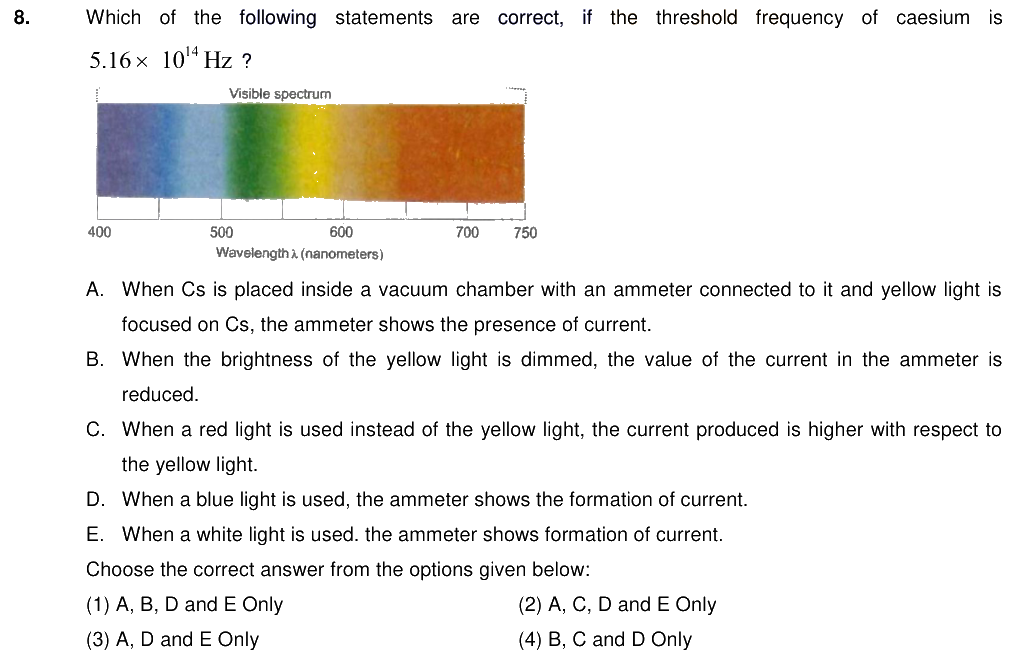
Which of the following statements are correct, if the threshold frequency of caesium is $5.16 \times 10^{14}$ Hz ?
(see the figure above)
A. When Cs is placed inside a vacuum chamber with an ammeter connected to it and yellow light is focused on Cs, the ammeter shows the presence of current.
B. When the brightness of the yellow light is dimmed, the value of the current in the ammeter is reduced.
C. When a red light is used instead of the yellow light, the current produced is higher with respect to the yellow light.
D. When a blue light is used, the ammeter shows the formation of current.
E. When a white light is used. the ammeter shows formation of current.
Choose the correct answer from the options given below:
Which of the following postulate of Bohr's model of hydrogen atom is not in agreement with quantum mechanical model of an atom?
A
An atom can take only certain distinct energies $E_1, E_2, E_3$, etc. These allowed states of constant energy are called the stationary states of atom.
B
The electron in a H atom's stationary state moves in a circle around the nucleus.
C
An atom in a stationary state does not emit electromagnetic radiation as long as it stays in the same state.
D
When an electron makes a transition from a higher energy stationary state to a lower energy stationary state, then it emits a photon of light.
If $\mathrm{a_0}$ is denoted as the Bohr radius of hydrogen atom, then what is the de-Broglie wavelength ($\lambda$) of the electron present in the second orbit of hydrogen atom? [n : any integer]
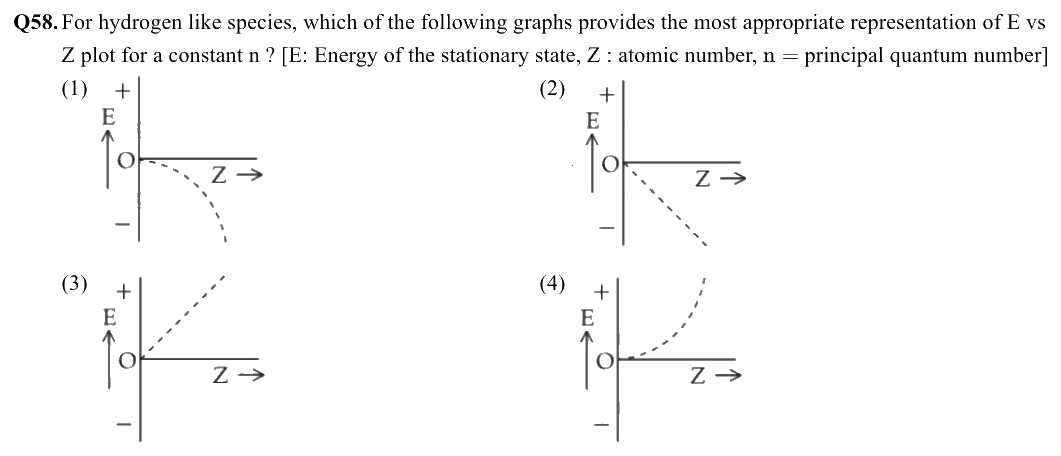
For hydrogen like species, which of the following graphs provides the most appropriate representation of E vs Z plot for a constant n ? [E: Energy of the stationary state, Z : atomic number, n = principal quantum number]
The question as printed in the paper.
A
see figure axes 'E' (vertical, arrow up, marked '+' above and '–' below the origin 'O') and 'Z' (horizontal, arrow right) crossing at 'O'; a dashed curve starting at O and going down to the lower right, bending so that it gets steeper as it goes (it ends nearly vertical, below the Z axis).
B
see figure same axes; a dashed straight line from O going down to the lower right.
C
see figure same axes; a dashed straight line from O going up to the upper right.
D
see figure same axes; a dashed curve starting at O, flat at first and then bending upward, getting steeper (it ends nearly vertical, above the Z axis).
Given below are two statements : Statement (I) : It is impossible to specify simultaneously with arbitrary precision, both the linear momentum and the position of a particle. Statement (II) : If the uncertainty in the measurement of position and uncertainty in measurement of momentum are equal for an electron, then the uncertainty in the measurement of velocity is $\geq \sqrt{\frac{\mathrm{h}}{\pi}} \times \frac{1}{2\,\mathrm{m}}$. In the light of the above statements, choose the correct answer from the options given below :
In a multielectron atom, which of the following orbitals described by three quantum numbers will have same energy in absence of electric and magnetic fields? A. n = 1,l = 0, $\mathrm{m_l}$ = 0 B. n = 2,l = 0, $\mathrm{m_l}$ = 0 C. n = 2,l = 1, $\mathrm{m_l}$ = 1 D. n = 3,l = 2, $\mathrm{m_l}$ = 1 E. n = 3,l = 2, $\mathrm{m_l}$ = 0 Choose the correct answer from the options given below:
Which of the following is/are not correct with respect to energy of atomic orbitals of hydrogen atom? (A) 1 s < 2p < 3 d < 4 s (B) 1 s < 2 s = 2p < 3 s = 3p (C) 1 s < 2 s < 2p < 3 s < 3p (D) 1 s < 2 s < 4 s < 3 d Choose the correct answer from the options given below :
For hydrogen atom, the orbital/s with lowest energy is/are : (A) 4 s (B) $3\mathrm{p}_x$ (C) $3\,\mathrm{d}_{x^2-y^2}$ (D) $3\,\mathrm{d}_{z^2}$ (E) $4\mathrm{p}_z$ Choose the correct answer from the options given below :
Heat treatment of muscular pain involves radiation of wavelength of about 900 nm . Which spectral line of H atom is suitable for this? Given : Rydberg constant $\mathrm{R_H} = 10^5\ \mathrm{cm^{-1}}$, $\mathrm{h} = 6.6 \times 10^{-34}\ \mathrm{J\ s}, \mathrm{c} = 3 \times 10^8\ \mathrm{m/s}$ )
Given below are two statements : Statement (I) : For a given shell, the total number of allowed orbitals is given by $\mathrm{n}^2$. Statement (II) : For any subshell, the spatial orientation of the orbitals is given by $-l$ to $+l$ values including zero. In the light of the above statements, choose the correct answer from the options given below :
Given below are two statements : Statement (I) : A spectral line will be observed for a $2\mathrm{p}_x \rightarrow 2\mathrm{p}_y$ transition. Statement (II) : $2P_x$ and $2\mathrm{p}_y$ are degenerate orbitals. In the light of the above statements, choose the correct answer from the options given below :
Compare the energies of following sets of quantum numbers for multielectron system. (A) n = 4, $l$ = 1 (B) n = 4, $l$ = 2 (C) n = 3, $l$ = 1 (D) n = 3, $l$ = 2 (E) n = 4, $l$ = 0 Choose the correct answer from the options given below :
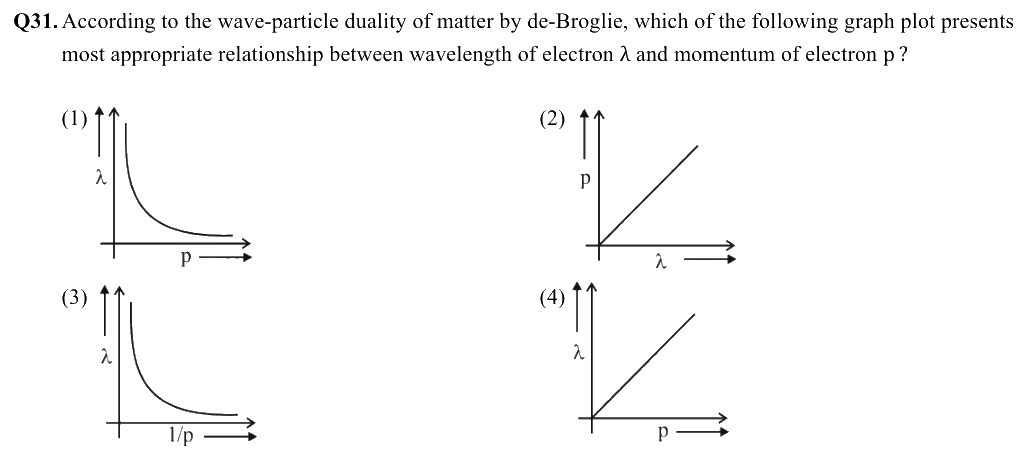
According to the wave-particle duality of matter by de-Broglie, which of the following graph plot presents most appropriate relationship between wavelength of electron $\lambda$ and momentum of electron p ?
The question as printed in the paper.
A
see figure graph of $\lambda$ (vertical) against p (horizontal): a curve that falls steeply from the top near the vertical axis and flattens out towards the horizontal axis (decreasing, hyperbola-like).
B
see figure graph of p (vertical) against $\lambda$ (horizontal): a straight line rising from the origin to the upper right.
C
see figure graph of $\lambda$ (vertical) against 1/p (horizontal): a curve that falls steeply from the top near the vertical axis and flattens out towards the horizontal axis (decreasing, hyperbola-like).
D
see figure graph of $\lambda$ (vertical) against p (horizontal): a straight line rising from the origin to the upper right.
Given below are two statements Statement I : According to Bohr's model of hydrogen atom, the angular momentum of an electron in a given stationary state is quantised. Statement II : The concept of electron in Bohr's orbit, violates the Heisenberg uncertainty principle. In the light of the above statements, choose the most appropriate answer from the options given below
A
Statement I is incorrect but Statement II is correct
B
Both Statement I and Statement II are correct
C
Both Statement I and Statement II are incorrect
D
Statement I is correct but Statement II is incorrect
Given below are two statements : one is labelled as Assertion A and the other is labelled as Reason R : Assertion A: In the photoelectric effect, the electrons are ejected from the metal surface as soon as the beam of light of frequency greater than threshold frequency strikes the surface. Reason R : When the photon of any energy strikes an electron in the atom, transfer of energy from the photon to the electron takes place. In the light of the above statements, choose the most appropriate answer from the options given below :
A
Both A and R are correct and R is the correct explanation of A
B
A is correct but R is not correct
C
Both A and R are correct but R is NOT the correct explanation of A
Which one of the following sets of ions represents a collection of isoelectronic species? (Given : Atomic Number : F : 9, Cl : 17, Na = 11 Mg = 12, Al = 13, K = 19, Ca = 20, Sc = 21)
Arrange the following orbitals in decreasing order of energy. A. n = 3, l = 0, m = 0 B. n = 4, l = 0, m = 0 C. n = 3, l = 1, m = 0 D. n = 3, l = 2, m = 1 The correct option for the order is:
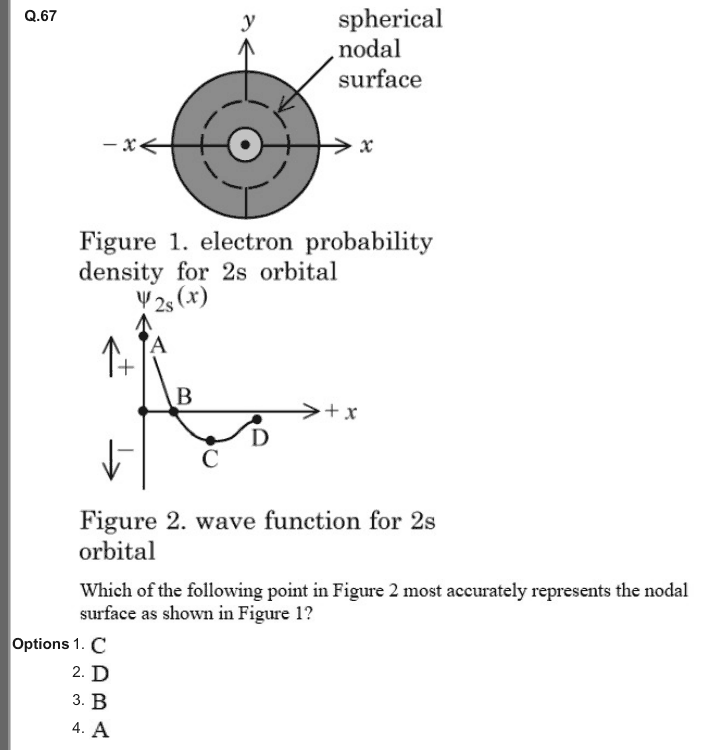
The wave function ($\Psi$) of 2 s is given by $\Psi_{2s} = \frac{1}{2\sqrt{2\pi}}\left(\frac{1}{a_0}\right)^{1/2}\left(2 - \frac{r}{a_0}\right)e^{-r/2a_0}$ At r = $\mathrm{r_0}$, radial node is formed. Thus, $\mathrm{r_0}$ in terms of $\mathrm{a_0}$
Given below are the quantum numbers for 4 electrons. A. $n = 3, l = 2, m_l = 1, m_s = +\frac{1}{2}$ B. $n = 4, l = 1, m_l = 0, m_s = +\frac{1}{2}$ C. $n = 4, l = 2, m_l = -2, m_s = -\frac{1}{2}$ D. $n = 3, l = 1, m_l = -1, m_s = +\frac{1}{2}$ The correct order of increasing energy is
Given below are two statements. One is labelled as Assertion A and the other is labelled as Reason R. Assertion A : Energy of 2 s orbital of hydrogen atom is greater than that of 2 s orbital of lithium. Reason R : Energies of the orbitals in the same subshell decrease with increase in the atomic number. In the light of the above statements, choose the correct answer from the options given below.
A
Both A and R are true and R is the correct explanation of A.
B
Both A and R are true but R is NOT the correct explanation of A.
The correct decreasing order of energy, for the orbitals having, following set of quantum numbers: (A) n = 3, l = 0, m = 0 (B) n = 4, l = 0, m = 0 (C) n = 3, l = 1, m = 0 (D) n = 3, l = 2, m = 1
Which of the following statements are correct? (A) The electronic configuration of Cr is $\mathrm{[Ar]\ 3d^5 4s^1}$. (B) The magnetic quantum number may have a negative value. (C) In the ground state of an atom, the orbitals are filled in order of their increasing energy order. (D) The total number of nodes are given by n $-$ 2. Choose the most appropriate answer from the options given below.
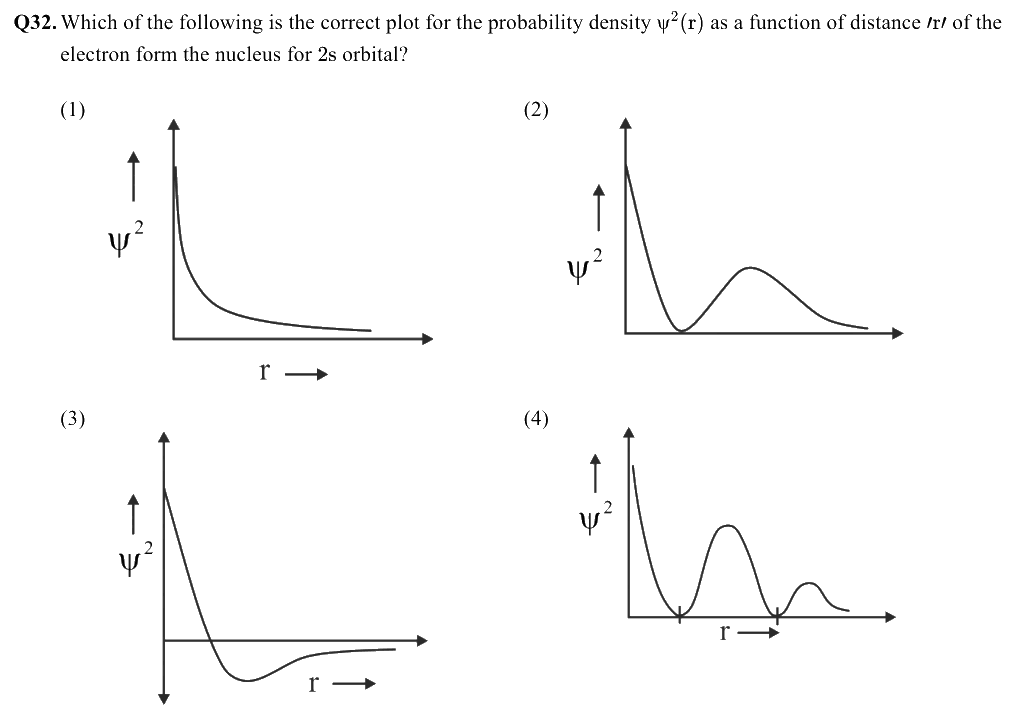
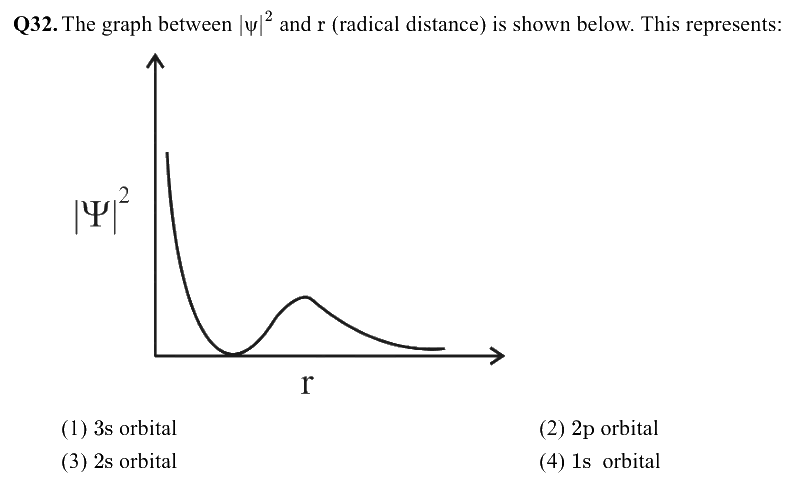
Which of the following is the correct plot for the probability density $\psi^2(\mathrm{r})$ as a function of distance 'r' of the electron form the nucleus for 2s orbital?
(see the figure above)
The question as printed in the paper.
A
see figure Graph of $\psi^2$ against $r$: a curve starting very high at $r = 0$ and falling steeply and smoothly towards the axis, never touching it (no node, no hump).
B
see figure Graph of $\psi^2$ against $r$: starts high at $r = 0$, falls to zero (touches the axis) at one point, then rises to a single broad hump and decays towards the axis.
C
see figure Graph of $\psi^2$ against $r$ with the $r$ axis drawn through the middle of the plot: the curve starts at a positive value at $r = 0$, falls linearly through the $r$ axis to negative values (below the axis), reaches a minimum and returns slowly towards the axis from below.
D
see figure Graph of $\psi^2$ against $r$: starts high at $r = 0$, falls to zero at a first point, rises to a hump, falls to zero again at a second point, then rises to a smaller second hump and decays towards the axis (two nodes).
Consider the following statements : (A) The principal quantum number 'n' is a positive integer with values of 'n' $= 1, 2, 3, \ldots$ (B) The azimuthal quantum number 'l' for a given 'n' (principal quantum number) can have values as 'l' $= 0, 1, 2, \ldots.n$ has $(2\,n + 1)$ values. (C) Magnetic orbital quantum number 'm' for a particular 'l' (azimuthal quantum number) has $(2l + 1)$ values. (D) $\pm\frac{1}{2}$ are the two possible orientations of electron spin. (E) For l = 5, there will be a total of 9 orbital Which of the above statements are correct?
If the radius of the $3^{\mathrm{rd}}$ Bohr's orbit of hydrogen atom is $\mathrm{r}_3$ and the radius of $4^{\mathrm{th}}$ Bohr's orbit is $\mathrm{r}_4$. Then
The minimum energy that must be possessed by photons in order to produce the photoelectric effect with platinum metal is: [Given: The threshold frequency of platinum is $1.3 \times 10^{15} \mathrm{~s^{-1}}$ and $\mathrm{h} = 6.6 \times 10^{-34} \mathrm{Js}$]
The energy of one mole of photons of radiation of wavelength $300 \mathrm{~nm}$ is (Given : $\mathrm{h} = 6.63 \times 10^{-34} \mathrm{~J~s}$, $\mathrm{N_A} = 6.02 \times 10^{23} \mathrm{~mol^{-1}}$ $\mathrm{c} = 3 \times 10^{8} \mathrm{~m~s^{-1}}$)
Given below are two statements : Statement I : According to Bohr's model of an atom, qualitatively the magnitude of velocity of electron increases with decrease in positive charges on the nucleus as there is no strong hold on the electron by the nucleus. Statement II : According to Bohr's model of an atom, qualitatively the magnitude of velocity of electron increases with decrease in principle quantum number. In the light of the above statements, choose the most appropriate answer from the options given below:
Given below are two statements : Statement I : Rutherford's gold foil experiment cannot explain the line spectrum of hydrogen atom. Statement II : Bohr's model of hydrogen atom contradicts Heisenberg's uncertainty principle. In the light of the above statements, choose the most appropriate answer from the options given below:
Given below are two statements: Statement I : Bohr's theory accounts for the stability and line spectrum of $\mathrm{Li^+}$ ion. Statement II : Bohr's theory was unable to explain the splitting of spectral lines in the presence of a magnetic field. In the light of the above statements, choose the most appropriate answer from the options given below:
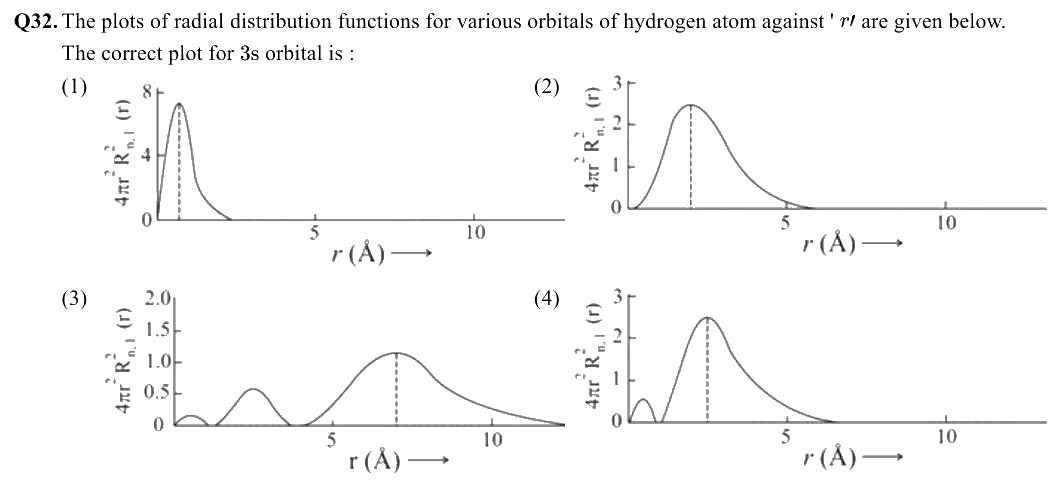
The plots of radial distribution functions for various orbitals of hydrogen atom against 'r' are given below. The correct plot for 3s orbital is : (see the figure above)
The question as printed in the paper.
A
see figure plot of $4\pi r^2 R_{n,1}^2(r)$ against $r$ (Å); y-axis marked up to 8 (ticks 4 and 8), x-axis marked 5 and 10; a single narrow tall peak (height about 7) very close to the origin (r about 0.5), falling to zero by about r = 3, no node
B
see figure plot of $4\pi r^2 R_{n,1}^2(r)$ against $r$ (Å); y-axis marked 0 to 3, x-axis marked 5 and 10; a single broad peak (height about 2.5) at about r = 2 to 3, falling to zero by about r = 7, no node
C
see figure plot of $4\pi r^2 R_{n,1}^2(r)$ against $r$ (Å); y-axis marked 0 to 2.0 (ticks 0.5, 1.0, 1.5, 2.0), x-axis marked 5 and 10; three peaks: a very small one near the origin (about 0.15), a second of height about 0.6 near r = 3, and a large third one of height about 1.1 near r = 7, with two nodes between them, falling to zero by about r = 12
D
see figure plot of $4\pi r^2 R_{n,1}^2(r)$ against $r$ (Å); y-axis marked 0 to 3, x-axis marked 5 and 10; a small first peak (height about 0.5) near the origin, a node, then a large peak (height about 2.5) at about r = 3, falling to zero by about r = 8
According to Bohr's atomic theory: (A) Kinetic energy of electron is $\propto \frac{Z^2}{n^2}$. (B) The product of velocity (v) of electron and principal quantum number (n), 'vn' $\propto Z^2$. (C) Frequency of revolution of electron in an orbit is $\propto \frac{Z^3}{n^3}$. (D) Coulombic force of attraction on the electron is $\propto \frac{Z^3}{n^4}$. Choose the most appropriate answer from the options given below:
The difference between the radii of 3$^{\mathrm{rd}}$ and 4$^{\mathrm{th}}$ orbits of $\mathrm{Li^{2+}}$ is $\Delta\mathrm{R_1}$. The difference between the radii of 3$^{\mathrm{rd}}$ and 4$^{\mathrm{th}}$ orbits of $\mathrm{He^{+}}$ $\Delta\mathrm{R_2}$. Ratio $\Delta\mathrm{R_1} : \Delta\mathrm{R_2}$ is :
Consider the hypothetical situation where the azimuthal quantum number, $\ell$, takes values $0,\ 1,\ 2,\ \ldots\ldots..n+1$. Where n is the principal quantum number. Then, the element with atomic number:
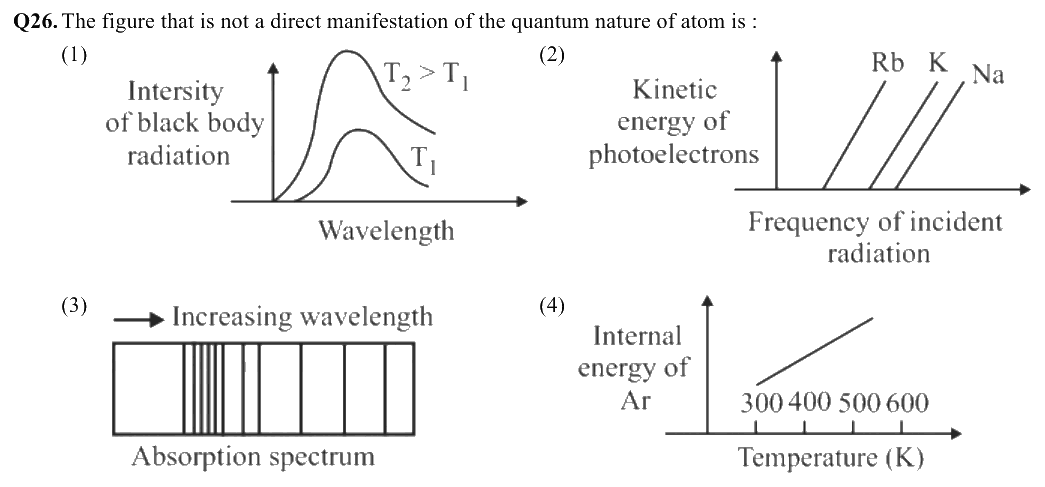
The figure that is not a direct manifestation of the quantum nature of atom is : (see the figure above)
The question as printed in the paper.
A
see figure Graph of intensity of black body radiation (vertical axis, labelled "Intersity of black body radiation") against wavelength (horizontal axis): two peaked curves, the higher one labelled $T_{2} > T_{1}$ and the lower one labelled $T_{1}$.
B
see figure Graph of kinetic energy of photoelectrons (vertical axis) against frequency of incident radiation (horizontal axis): three parallel rising straight lines that start on the frequency axis at increasing frequencies, labelled Rb, K and Na from left to right.
C
see figure An absorption spectrum: a rectangle crossed by vertical dark lines that are crowded together at the left and spaced further apart towards the right, with an arrow labelled "Increasing wavelength" above it and the caption "Absorption spectrum" below.
D
see figure Graph of internal energy of Ar (vertical axis) against temperature (K) (horizontal axis, tick marks 300, 400, 500, 600): a straight line rising to the right.
For the Balmer series, in the spectrum of H atom, $\bar{\mathrm{v}} = \mathrm{R_H}\left\{\frac{1}{\mathrm{n_1^2}} - \frac{1}{\mathrm{n_2^2}}\right\}$, the correct statements among (I) to (IV) are, (I) As wavelength decreases, the lines in the series converge. (II) The integer $\mathrm{n_1}$ is equal to 2/ (III) The lines of the longest wavelength correspond to $\mathrm{n_2}$ = 3. (IV) The ionization energy of hydrogen can be calculated from the wave number of these lines.
For any given series of spectral lines of atomic hydrogen, let $\Delta\bar{v} = \bar{v}_{\max} - \bar{v}_{\min}$ be the difference in maximum and minimum wave number in $\mathrm{cm^{-1}}$. The ratio $\Delta\bar{v}_{\mathrm{Lyman}} / \Delta\bar{v}_{\mathrm{Balmar}}$ is
The quantum number of four electrons are given below: I. n = 4, l = 2, $\mathrm{m_l}$ = - 2, $\mathrm{m_s}$ = - 1 / 2 II. n = 3, l = 2, $\mathrm{m_l}$ = 1, $\mathrm{m_s}$ = + 1 / 2 III. n = 4, l = 1, $\mathrm{m_l}$ = 0, $\mathrm{m_s}$ = + 1 / 2 IV. n = 3, l = 1, $\mathrm{m_l}$ = 1, $\mathrm{m_s}$ = - 1 / 2 The correct order of their increasing energies will be:
If p is the momentum of the fastest electron ejected from a metal surface after the irradiation of light having wavelength $\lambda$, then for 1.5 p momentum of the photoelectron, the wavelength of the light should be: (Assume kinetic energy of ejected photoelectron to be very high in comparison to work function)
What is the work function of the metal if the light of wavelength 4000 $\mathrm{\AA}$ generates photoelectrons of velocity $6 \times 10^5$ $\mathrm{ms^{-1}}$ from it? (Mass of electron = $9 \times 10^{-31}$ kg, velocity of light = $3 \times 10^{8}$ $\mathrm{ms^{-1}}$, Planck's constant = 6 .626 $\times 10^{-34}$ Js, Charge of electron = 6 .626 $\times 10^{-34}$ Js)
If the de Broglie wavelength of the electron in $n^{th}$ Bohr orbit in a hydrogenic atom is equal to $1.5\pi a_0$ ($a_0$ is Bohr radius), then the value of $\frac{n}{z}$ is:
Heat treatment of muscular pain involves radiation of wavelength of about 900nm. Which spectral line of H atom is suitable for this purpose? [R$_H$ = $1 \times 10^5$ cm$^{-1}$ $\cdot$ h = $6.6 \times 10^{-34}$Js, c = $3 \times 10^8$ ms$^{-1}$]
The de Broglie wavelength $(\lambda)$ associated with a photoelectron varies with the frequency $(v)$ of the incident radiation as,[$v_0$ is threshold frequency]:
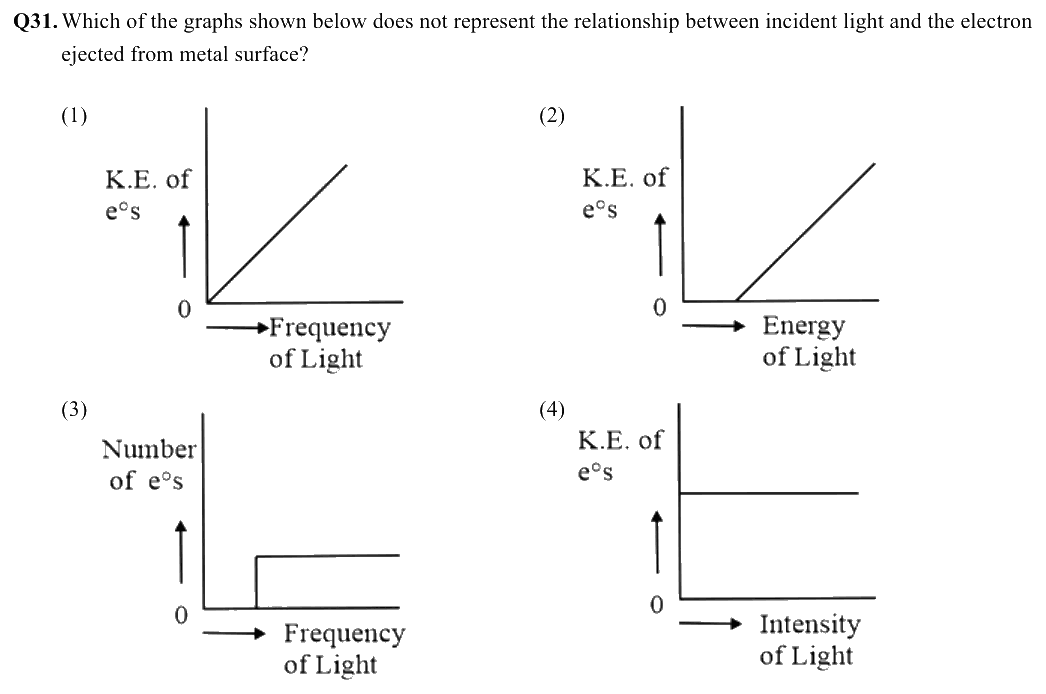
Which of the graphs shown below does not represent the relationship between incident light and the electron ejected from metal surface? (see the figure above)
The question as printed in the paper.
A
see figure K.E. of e°s versus Frequency of Light: a straight line rising from the origin
B
see figure K.E. of e°s versus Energy of Light: zero (flat on the axis) up to a threshold, then a straight line rising
C
see figure Number of e°s versus Frequency of Light: zero up to a threshold frequency, then a constant horizontal level
D
see figure K.E. of e°s versus Intensity of Light: a horizontal line at a constant height above the axis
For emission line of atomic hydrogen from $\mathrm{n_i} = 8$ to $\mathrm{n_f} = \mathrm{n}$, the plot of wave number $\tilde{\nu}$ against $\dfrac{1}{\mathrm{n}^2}$ will be: (The Rydberg constant, $\mathrm{R_H}$ is in wave number unit)
Which of the following combination of statements is true regarding the interpretation of the atomic orbitals? $(A)$ An electron in an orbital of high angular momentum stays away from the nucleus than an electron in the orbital of lower angular momentum. $(B)$ For a given value of the principal quantum number, the size of the orbit is inversely proportional to the azimuthal quantum number. $(C)$ According to wave mechanics, the ground state angular momentum is equal to $\dfrac{h}{2\pi}$. $(D)$ The plot of $\psi$ Vs $r$ for various azimuthal quantum numbers, shows peak shifting towards higher $r$ value.
Ejection of the photoelectron from metal in the photoelectric effect experiment can be stopped by applying $0.5\ \mathrm{V}$ when the radiation of $250\ \mathrm{nm}$ is used. The work function of the metal is :
The radius of the second Bohr orbit for hydrogen atom is (Planck's constant, $(\mathrm{h}) = 6.6262 \times 10^{-34}\ \mathrm{Js}$; mass of electron $= 9.1091 \times 10^{-31}\ \mathrm{kg}$; charge of electron $= 1.60210 \times 10^{-19}\ \mathrm{C}$; permittivity of vacuum, $(\epsilon_0) = 8.854185 \times 10^{-12}\ \mathrm{kg^{-1}\,m^{-3}A^{2}}$)
A stream of electrons from a heat filament was passed between two charge plates kept at a potential difference V esu. If e and m are charge and mass of an electron, respectively, then the value of $\frac{h}{\lambda}$ (where $\lambda$ is wavelength associated with the electron wave) is given by:
The ionization energy of gaseous Na atoms is $495.5\ \mathrm{kJ\ mol^{-1}}$. The lowest possible frequency of light that ionizes a sodium atom is $(\mathrm{h} = 6.626 \times 10^{-34}\ \mathrm{Js},\ \mathrm{N_A} = 6.022 \times 10^{23}\ \mathrm{mol^{-1}})$
If $m$ and $e$ are the mass and charge of the revolving electron in the orbit of radius $r$ for hydrogen atom, the total energy of the revolving electron will be:
Excited hydrogen atom emits light in the ultraviolet region at $2.47\times 10^{15}\ \mathrm{Hz}$. With this frequency, the energy of a single photon is: ($\mathrm{h} = 6.63\times 10^{-34}\mathrm{Js}$)
If $\lambda_0$ and $\lambda$ be threshold wavelength and wavelength of incident light, the velocity of photoelectron ejected from the metal surface is:
Based on the equation: $$\Delta\mathrm{E} = -2.0 \times 10^{-18}\ \mathrm{J}\left(\frac{1}{\mathrm{n}_2^2} - \frac{1}{\mathrm{n}_1^2}\right)$$ the wavelength of the light that must be absorbed to excite hydrogen electron from level $n = 1$ to level $\mathrm{n} = 2$ will be: ($\mathrm{h} = 6.625 \times 10^{-34}\mathrm{Js}$, $\mathrm{C} = 3 \times 10^8\ \mathrm{ms}^{-1}$)
The energy of an electron in first Bohr's orbit of H atom is $-13.6\,\mathrm{eV}$. The energy value of electron in the first excited state of $\mathrm{Li^{2+}}$ is :
Given (A) n = 5, $\mathrm{m_\ell}$ = +1 (B) n = 2, $\ell$ = 1, $\mathrm{m_\ell}$ = $-$1, $\mathrm{m_s}$ = $-$1/2 The maximum number of electron(s) in an atom that can have the quantum numbers as given in (A) and (B) are respectively:
Energy of an electron is given by $\mathrm{E} = -2.178 \times 10^{-18}\left(\frac{Z^{2}}{n^{2}}\right)$ J. Wavelength of light required to excite an electron in a hydrogen atom from level n=1 to n=2 will be : (h = $6.62 \times 10^{-34}$ Js and c = $3.0 \times 10^{8}\ \mathrm{ms^{-1}}$)
The following sets of quantum numbers represent four electrons in an atom. (i) $n = 4, l = 1$ (ii) $n = 4, l = 0$ (iii) $n = 3, l = 2$ (iv) $n = 3, l = 1$ The sequence representing increasing order of energy, is
The electrons identified by quantum numbers n and $l$ : (a) $n = 4, l = 1$ (b) $n = 4, l = 0$ (c) $n = 3, l = 2$ (d) $n = 3, l = 1$ Can be placed in order of increasing energy as:
Ionisation energy of $\mathrm{He^{+}}$ is $19.6 \times 10^{-18}$ $\mathrm{J\,atom^{-1}}$. The energy of the first stationary state (n = 1) of $\mathrm{Li^{2+}}$ is
The energy required to break one mole of $\mathrm{Cl - Cl}$ bonds in $\mathrm{Cl_2}$ is $242\ \mathrm{kJ\ mol^{-1}}$. The longest wavelength of light capable of breaking a single $\mathrm{Cl - Cl}$ bond is ($c = 3 \times 10^{8}\ \mathrm{ms^{-1}}$ and $N_A = 6.02 \times 10^{23}\ \mathrm{mol^{-1}}$)
In an atom, an electron is moving with a speed of 600 m/s with an accuracy of 0.005%. Certainty with which the position of the electron can be located is ($h = 6.6 \times 10^{-34}\ \mathrm{kg\ m^2\ s^{-1}}$, mass of electron, $e_m = 9.1 \times 10^{-31}$ kg )
Calculate the wavelength (in nanometer) associated with a proton moving at $1.0 \times 10^3\ \mathrm{ms^{-1}}$ (Mass of proton = $1.67 \times 10^{-27}$ kg and h = $6.63 \times 10^{-34}$ Js ):
The ionization enthalpy of hydrogen atom is $1.312 \times 10^{6}\,\mathrm{J\,mol^{-1}}$. The energy required to excite the electron in the atom from $n = 1$ to $n = 2$ is
In the transformation of ${}^{238}_{92}\mathrm{U}$ to ${}^{234}_{92}\mathrm{U}$, if one emission is an $\alpha$-particle, what should be the other emission(s)?
Uncertainty in the position of an electron (mass = $9.1 \times 10^{-31}$ kg ) moving with a velocity 300 $\mathrm{ms^{-1}}$, accurate upto 0.001%, will be
A
$19.2 \times 10^{-2}$ m
B
$5.76 \times 10^{-2}$ m
C
$1.92 \times 10^{-2}$ m
D
$3.84 \times 10^{-2}$ m (h = $6.63 \times 10^{-34}$ Js)
In a multi - electron atom, which of the following orbitals described by the three quantum numbers will have the same energy in the absence of magnetic acid (sic) and electric fields? (a) $n = 1, l = 0, m = 0$ (b) $n = 2, l = 0, m = 0$ (c) $n = 2, l = 1, m = 1$ (d) $n = 3, l = 2, m = 1$ (e) $n = 3, l = 2, m = 0$
The wavelength of the radiation emitted, when in hydrogen atom electron falls from infinity to stationary state 1, would be (Rydberg constant $= 1.097 \times 10^{7}\ \mathrm{m^{-1}}$)
The orbital angular momentum for an electron revolving in an orbit is given by $\sqrt{l(l+1)}\cdot\frac{h}{2\pi}$. This momentum for an s-electron will be given by
In Bohr series of lines of hydrogen spectrum, the third line from the red end corresponds to which one of the following inter-orbit jumps of the electron for Bohr orbits in an atom of hydrogen
The de Broglie wavelength of a tennis ball of mass 60 g moving with a velocity of 10 metres per second is approximately. Planck's constant, h = 6.63 × 10⁻³⁴ Js.
The radionucleide $^{234}_{90}\mathrm{Th}$ undergoes two successive $\beta$-decays followed by one $\alpha$-decay. The atomic number and the mass number respectively of the resulting radionucleide are
Uncertainty in position of a minute particle of mass 25 g in space is $10^{-5}$ m. What is the uncertainty in its velocity (in $\mathrm{ms^{-1}}$)? ( h = $6.6 \times 10^{-34}$ Js)
The surface of sodium metal is irradiated with radiation of wavelength $x$ nm. The kinetic energy of ejected electrons is $2.8\times10^{-20}$ J. The work function of sodium is 2.3 eV. The value of $x$ is ________ $\times10^2$ nm. (Nearest integer) (Given : $h = 6.6\times10^{-34}$ J s ; 1 eV $= 1.6\times10^{-19}$ J; c $= 3.0\times10^8$ m s$^{-1}$)
Numerical answer type: type your answer in EdLoop to check it
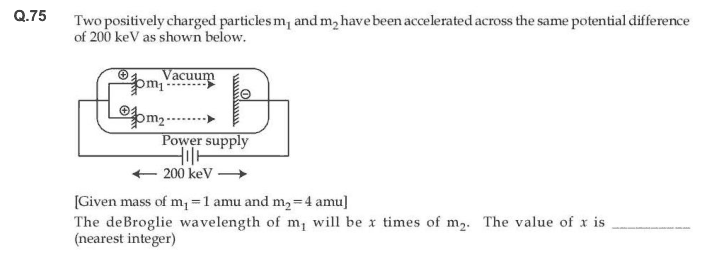
Two positively charged particles $\mathrm{m_1}$ and $\mathrm{m_2}$ have been accelerated across the same potential difference of 200 keV as shown below.
(see the figure above)
[Given mass of $\mathrm{m_1}$ = 1 amu and $\mathrm{m_2}$ = 4 amu]
The deBroglie wavelength of $\mathrm{m_1}$ will be $x$ times of $\mathrm{m_2}$. The value of $x$ is ________ (nearest integer)
The question as printed in the paper.
Numerical answer type: type your answer in EdLoop to check it
The hydrogen spectrum consists of several spectral lines in Lyman series ($\mathrm{L_1}$, $\mathrm{L_2}$, $\mathrm{L_3}$...; $\mathrm{L_1}$ has lowest energy among Lyman series). Similarly it consists of several spectral lines in Balmer series ($\mathrm{B_1}$, $\mathrm{B_2}$, $\mathrm{B_3}$ ... ; $\mathrm{B_1}$ has lowest energy among Balmer lines). The energy of $\mathrm{L_1}$ is $x$ times the energy of $\mathrm{B_1}$. The value of $x$ is ________ $\times 10^{-1}$. (Nearest integer)
Numerical answer type: type your answer in EdLoop to check it
The energy of an electron in first Bohr orbit of H -atom is -13.6 eV. The magnitude of energy value of electron in the first excited state of $Be^{3+}$ is ______ eV (nearest integer value)
Numerical answer type: type your answer in EdLoop to check it
Based on Heisenberg's uncertainty principle, the uncertainty in the velocity of the electron to be found within an atomic nucleus of diameter $10^{-15}$ m is ______ . $10^{9}$ ms$^{-1}$ (nearest integer) [Given : mass of electron = $9.1 \times 10^{-31}$ kg, Plank's constant ($h$) = $6.626 \times 10^{-34}$Js] (Value of $\pi$ = 3.14)
Numerical answer type: type your answer in EdLoop to check it
Frequency of the de-Broglie wave of electron in Bohr's first orbit of hydrogen atom is ______ $\times 10^{13}$ Hz (nearest integer). [Given : $R_H$( Rydberg constant ) = $2.18 \times 10^{-18}$ J, $h$ (Plank's constant ) = $6.6 \times 10^{-34}$ J.s.]
Numerical answer type: type your answer in EdLoop to check it
For hydrogen atom, energy of an electron in first excited state is $-3.4$eV, K. E. of the same electron of hydrogen atom is $x$eV. Value of $x$ is ______ $\times 10^{-1}$eV. (Nearest integer)
Numerical answer type: type your answer in EdLoop to check it
The value of Rydberg constant ($R_H$) is $2.18 \times 10^{-18}$ J. The velocity of electron having mass $9.1 \times 10^{-31}$ kg in Bohr's first orbit of hydrogen atom = ______ $\times 10^5$ $\mathrm{ms^{-1}}$ (nearest integer).
Numerical answer type: type your answer in EdLoop to check it
The ionization energy of sodium in kJ mol$^{-1}$. If electromagnetic radiation of wavelength 242 nm is just sufficient to ionize sodium atom is ______ (nearest integer).
Numerical answer type: type your answer in EdLoop to check it
Number of spectral lines obtained in $\mathrm{He^+}$ spectra, when an electron makes transition from fifth excited state to first excited state will be
Numerical answer type: type your answer in EdLoop to check it
Total number of ions from the following with noble gas configuration is
$\mathrm{Sr^{2+}}$ (Z = 38), $\mathrm{Cs^{+}}$ (Z = 55), $\mathrm{La^{2+}}$ (Z = 57), $\mathrm{Pb^{2+}}$ (Z = 82), $\mathrm{Yb^{2+}}$ (Z = 70) and $\mathrm{Fe^{2+}}$ (Z = 26)
Numerical answer type: type your answer in EdLoop to check it
The total number of isoelectronic species from the given set is ______. $\mathrm{O^{2-}}$, $\mathrm{F^{-}}$, Al, $\mathrm{Mg^{2+}}$, $\mathrm{Na^{+}}$, $\mathrm{O^{+}}$, Mg, $\mathrm{Al^{3+}}$, F
Numerical answer type: type your answer in EdLoop to check it
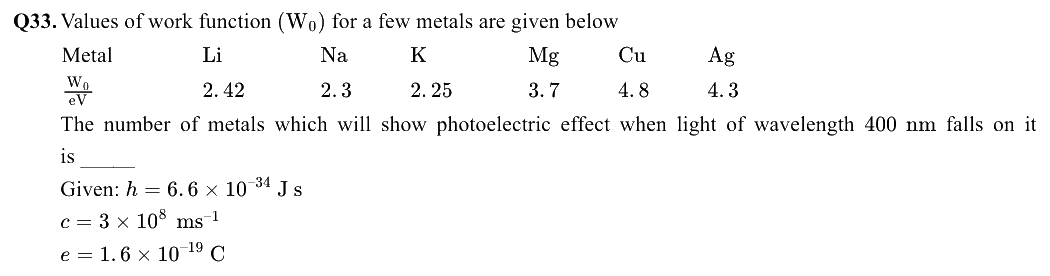
Values of work function $(\mathrm{W_0})$ for a few metals are given below (see the figure above) The number of metals which will show photoelectric effect when light of wavelength 400 nm falls on it is ______ Given: $h = 6.6 \times 10^{-34}$ J s $c = 3 \times 10^{8}\ \mathrm{ms^{-1}}$ $e = 1.6 \times 10^{-19}$ C
The question as printed in the paper.
Numerical answer type: type your answer in EdLoop to check it
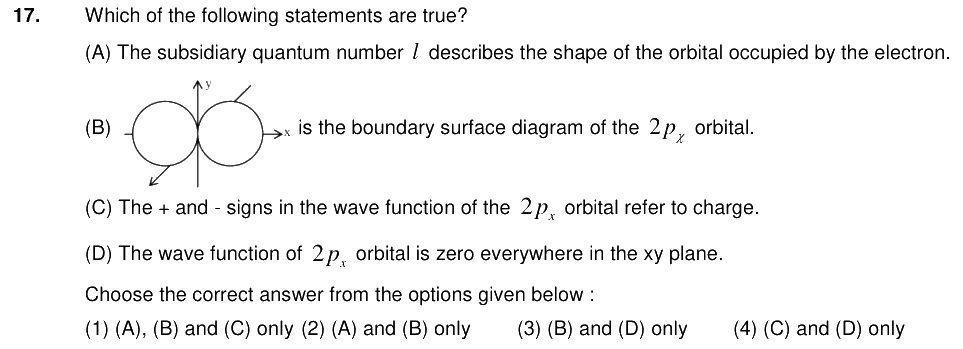
The number of correct statements from the following is ______ A. For 1s orbital, the probability density is maximum at the nucleus B. For 2s orbital, the probability density first increases to maximum and then decreases sharply to zero. C. Boundary surface diagrams of the orbitals encloses a region of 100% probability of finding the electron. D. p and d-orbitals have 1 and 2 angular nodes respectively E. probability density of p-orbital is zero at the nucleus
Numerical answer type: type your answer in EdLoop to check it
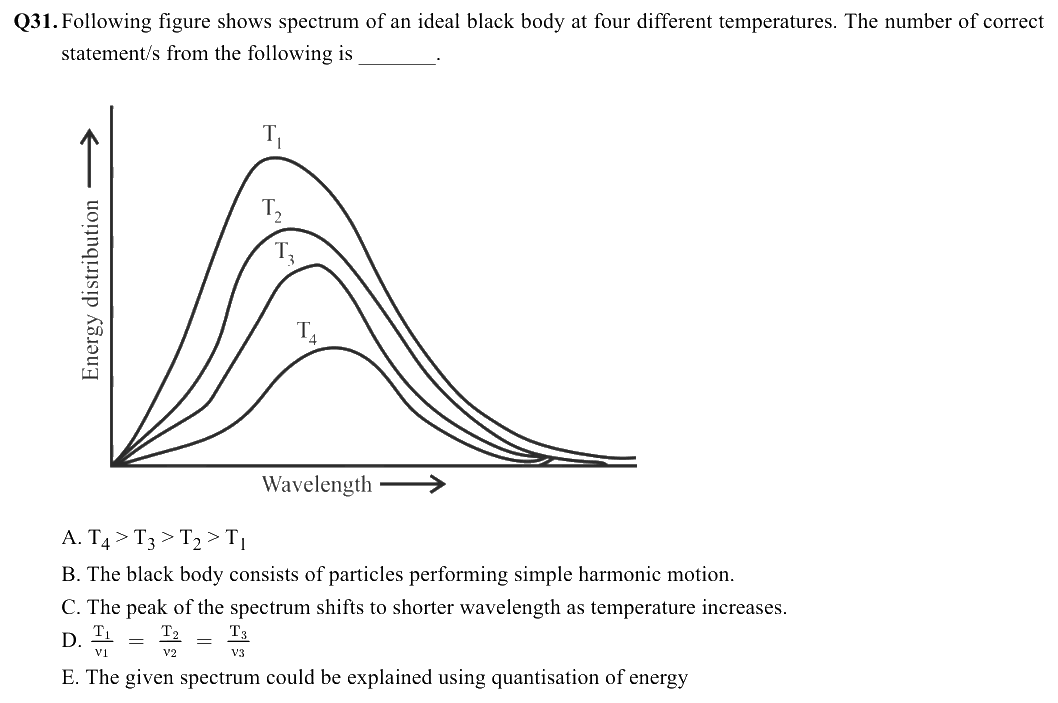
The number of incorrect statement/s about the black body from the following is ______ (A) Emit or absorb energy in the form of electromagnetic radiation. (B) Frequency distribution of the emitted radiation depends on temperature. (C) At a given temperature, intensity vs frequency curve passes through a maximum value. (D) The maximum of the intensity vs frequency curve is at a higher frequency at higher temperature compared to that at lower temperature.
Numerical answer type: type your answer in EdLoop to check it
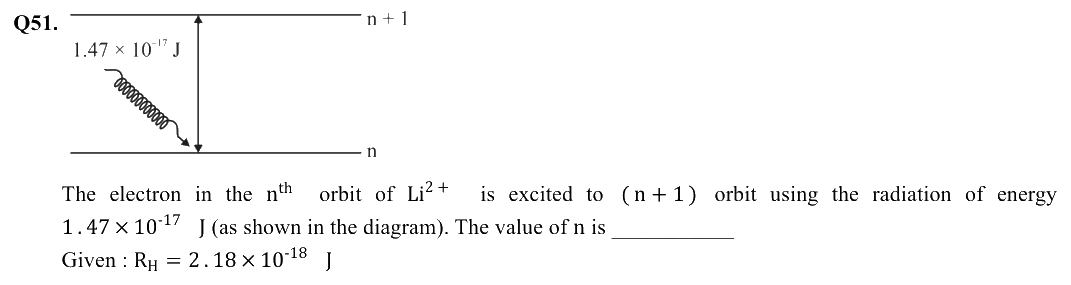
see figure The electron in the $n^{\mathrm{th}}$ orbit of $\mathrm{Li^{2+}}$ is excited to $(n + 1)$ orbit using the radiation of energy $1.47 \times 10^{-17}$ J (as shown in the diagram). The value of n is ______. Given : $\mathrm{R_H} = 2.18 \times 10^{-18}$ J
The question as printed in the paper.
Numerical answer type: type your answer in EdLoop to check it
The number of following statement/s which is/are incorrect is ______ A) Line emission spectra are used to study the electronic structure B) The emission spectra of atoms in the gas phase show a continuous spread of wavelength from red to violet. C) An absorption spectrum is like the photographic negative of an emission spectrum D) The element helium was discovered in the sun by spectroscopic method
Numerical answer type: type your answer in EdLoop to check it
Electrons in a cathode ray tube have been emitted with a velocity of 1000 $\mathrm{ms^{-1}}$. The number of following statements which is/are true about the emitted radiation is Given : h = $6 \times 10^{-34}$Js, $\mathrm{m_e}$ = $9 \times 10^{-31}$ kg (A ) The deBroglie wavelength of the electron emitted is 666.67 nm (B ) The characteristic of electrons emitted depend upon the material of the electrodes of the cathode ray tube. (C) The cathode rays start from cathode and move towards anode. (D ) The nature of the emitted electrons depends on the nature of the gas present in cathode ray tube..
Numerical answer type: type your answer in EdLoop to check it
The energy of one mole of photons of radiation of frequency $2 \times 10^{12}$ Hz in J mol$^{-1}$ is ______ . (Nearest integer) (Given: h = $6.626 \times 10^{-34}$ J s $\mathrm{N_A}$ = $6.022 \times 10^{23}$ mol$^{-1}$)
Numerical answer type: type your answer in EdLoop to check it
Assume that the radius of the first Bohr orbit of hydrogen atom is $0.6\,\mathrm{\AA}$. The radius of the third Bohr orbit of $\mathrm{He^+}$ is ______ picometer. (Nearest Integer)
Numerical answer type: type your answer in EdLoop to check it
If wavelength of the first line of the Paschen series of hydrogen atom is 720 nm, then the wavelength of the second line of this series is ______ nm. (Nearest integer)
Numerical answer type: type your answer in EdLoop to check it
The minimum uncertainty in the speed of an electron in one dimensional region of length $2\mathrm{a_o}$ (Where $\mathrm{a_o}$ = Bohr radius 52.9 pm) is ______ $\mathrm{kms^{-1}}$ (Nearest integer) (Given : Mass of electron = $9.1 \times 10^{-31}$ kg, Planck's constant h = $6.63 \times 10^{-34}$ Js)
Numerical answer type: type your answer in EdLoop to check it
If the wavelength for an electron emitted from $\mathrm{H-}$ atom is $3.3\times10^{-10}\ \mathrm{m}$, then energy absorbed by the electron in its ground state compared to minimum energy required for its escape from the atom, is ______ times. [Given : $\mathrm{h}=6.626\times10^{-34}\ \mathrm{Js}$, Mass of electron $=9.1\times10^{-31}$]
Numerical answer type: type your answer in EdLoop to check it
The wavelength of an electron and a neutron will become equal when the velocity of the electron is x times the velocity of neutron. The value of x is ______ (the nearest integer)(Mass of electron is $9.1 \times 10^{-31}$ kg and mass of neutron is $1.6 \times 10^{-27}$ kg)
Numerical answer type: type your answer in EdLoop to check it
Consider an imaginary ion $^{48}_{22}\mathrm{X}^{3-}$. The nucleus contains 'a' % more neutrons than the number of electrons in the ion. The value of 'a' is
Numerical answer type: type your answer in EdLoop to check it
If the work function of a metal is $6.63 \times 10^{-19}\ \mathrm{J}$, the maximum wavelength of the photon required to remove a photoelectron from the metal is ______ nm. Nearest integer) [Given : h $= 6.63 \times 10^{-34}\ \mathrm{J\,s}$, and c $= 3 \times 10^{8}\ \mathrm{m\,s^{-1}}$]
Numerical answer type: type your answer in EdLoop to check it
If the uncertainty in velocity and position of a minute particle in space are, $2.4 \times 10^{-26}\ \left(\mathrm{ms^{-1}}\right)$ and $10^{-7}\left(\mathrm{m}\right)$ respectively. The mass of the particle in g is ______ (Nearest integer) (Given : h = $6.626 \times 10^{-34}$ Js)
Numerical answer type: type your answer in EdLoop to check it
The longest wavelength of light that can be used for the ionisation of lithium ion $\mathrm{Li}^{2+}$ is $x \times 10^{-8} \mathrm{~m}$. The value of x is (Nearest Integer) (Given : Energy of the electron in the first shell of the hydrogen atom is $-2.2 \times 10^{-18} \mathrm{~J}$; $h = 6.63 \times 10^{-34} \mathrm{Js}$ and $c = 3 \times 10^8 \mathrm{~ms}^{-1}$)
Numerical answer type: type your answer in EdLoop to check it
A $50$ watt bulb emits monochromatic red light of wavelength of $795$ nm. The number of photons emitted per second by the bulb is $x \times 10^{20}$. The value of x is ______. (Nearest integer) [Given : h = $6.63 \times 10^{-34}$Js and $c = 3.0 \times 10^8$ ms$^{-1}$
Numerical answer type: type your answer in EdLoop to check it
The kinetic energy of an electron in the second Bohr orbit of a hydrogen atom is equal to $\frac{h^2}{x\ ma_0^2}$. The value of $10$ x is ($a_0$ is radius of Bohr's orbit) (Nearest integer) [Given: $\pi = 3.14$]
Numerical answer type: type your answer in EdLoop to check it
The number of photons emitted by a monochromatic (single frequency) infrared range finder of power $1\ \mathrm{mW}$ and wavelength of $1000\ \mathrm{nm}$, in $0.1$ second is $\mathrm{x}\times10^{13}$. The value of x is (Nearest integer) ($\mathrm{h}=6.63\times10^{-34}\ \mathrm{Js}$, $\mathrm{c}=3.00\times10^{8}\ \mathrm{ms^{-1}}$):
Numerical answer type: type your answer in EdLoop to check it
A metal surface is exposed to $500\ \mathrm{nm}$ radiation. The threshold frequency of the metal for photoelectric current is $4.3\times10^{14}\ \mathrm{Hz}$. The velocity of ejected electron is ___$\times10^{5}\ \mathrm{ms^{-1}}$ (Nearest integer) [Use : h $=6.63\times10^{-34}\ \mathrm{Js}$, $\mathrm{m_e}=9.0\times10^{-31}\ \mathrm{kg}$]
Numerical answer type: type your answer in EdLoop to check it
A source of monochromatic radiation wavelength $400\ \mathrm{nm}$ provides $1000\ \mathrm{J}$ of energy in 10 seconds. When this radiation falls on the surface of sodium, $\mathrm{x} \times 10^{20}$ electrons are ejected per second. Assume that wavelength $400\ \mathrm{nm}$ is sufficient for ejection of electron from the surface of sodium metal. The value of x is ______. (Nearest integer) $\mathrm{h} = 6.626 \times 10^{-34}\ \mathrm{Js}$
Numerical answer type: type your answer in EdLoop to check it
An accelerated electron has a speed of $5 \times 10^6\ \mathrm{ms^{-1}}$ with an uncertainty of $0.02\%$. The uncertainty in finding its location while in motion is $x \times 10^{-9}\ \mathrm{m}$. The value of $x$ is ______. (Nearest integer) [Use mass of electron$= 9.1 \times 10^{-31}\ \mathrm{kg}$, h $= 6.63 \times 10^{-34}\ \mathrm{Js}$, $\pi = 3.14$]
Numerical answer type: type your answer in EdLoop to check it
The wavelength of electrons accelerated from rest through a potential difference of $40\,\mathrm{kV}$ is $\mathrm{X} \times 10^{-12}$ m. The value of x is. (Nearest integer) Given: Mass of electron $= 9.1 \times 10^{-31}$ kg Charge on an electron $= 1.6 \times 10^{-19}\mathrm{C}$ Planck's constant $= 6.63 \times 10^{-34}$ Js
Numerical answer type: type your answer in EdLoop to check it
A certain orbital has $\mathrm{n}=4$ and $\mathrm{m}_{\mathrm{l}}=-3$. The number of radial nodes in this orbital is ______. (Round off to the Nearest Integer).
Numerical answer type: type your answer in EdLoop to check it
In the ground state of atomic $\mathrm{Fe}(\mathrm{Z}=26)$, the spin-only magnetic moment is $\times 10^{-1} \mathrm{BM}$. (Round off to the Nearest Integer). [ Given : $\sqrt{3}=1.73, \sqrt{2}=1.41$]
Numerical answer type: type your answer in EdLoop to check it
When light of wavelength 248 nm falls on a metal of threshold energy 3.0 eV, the de-Broglie wavelength of emitted electrons is ______ $\mathrm{\AA}$. (Round off to the Nearest Integer). [Use : $\sqrt{3}=1.73, \mathrm{~h}=6.63 \times 10^{-34} \mathrm{~Js} ; \mathrm{m}_{\mathrm{e}}=9.1 \times 10^{-31} \mathrm{~kg} ; \mathrm{c}=3.0 \times 10^8 \mathrm{~ms}^{-1} ; 1 \mathrm{eV}=1.6 \times 10^{-19} \mathrm{~J}$]
Numerical answer type: type your answer in EdLoop to check it
A ball weighing $10\ \mathrm{g}$ is moving with a velocity of $90\ \mathrm{m\,s^{-1}}$. If the uncertainty in its velocity is $5\%$, then the uncertainty in its position is ______ $\times 10^{-33}$ m. (Rounded off to the nearest integer) [Given: h = $6.63 \times 10^{-34}$ Js]
Numerical answer type: type your answer in EdLoop to check it
Electromagnetic radiation of wavelength $663\ \mathrm{nm}$ is just sufficient to ionise the atom of metal A. The ionization energy of metal A in $\mathrm{kJ\ mol^{-1}}$ is ______. (Rounded-off to the nearest integer) [h = $6.63 \times 10^{-34}\ \mathrm{Js}$, c = $3.00 \times 10^{8}\ \mathrm{ms^{-1}}$, $\mathrm{N_A} = 6.02 \times 10^{23}\ \mathrm{mol^{-1}}$]
Numerical answer type: type your answer in EdLoop to check it
A proton and a $\mathrm{Li^{3+}}$ nucleus are accelerated by the same potential. If $\lambda_{\mathrm{Li}}$ and $\lambda_{\mathrm{p}}$ denote the de Broglie wavelengths of $\mathrm{Li^{3+}}$ and proton respectively, then the value of $\frac{\lambda_{\mathrm{Li}}}{\lambda_{\mathrm{p}}}$ is $\mathrm{x} \times 10^{-1}$. The value of x is ______ (Rounded off to the nearest integer) [Mass of $\mathrm{Li^{3+}} = 8.3$ mass of proton]
Numerical answer type: type your answer in EdLoop to check it
The work function of sodium metal is $4.41 \times 10^{-19}\mathrm{J}$. If photons of wavelength $300\ \mathrm{nm}$ are incident on the metal, the kinetics energy of the ejected electrons will be ($\mathrm{h} = 6.63 \times 10^{-34}\mathrm{J\ s}$; $\mathrm{c} = 3 \times 10^{8}\ \mathrm{m\ s}^{-1}$) ______ $\times 10^{-21}\mathrm{J}$
Numerical answer type: type your answer in EdLoop to check it
Atomic structure examines quantum mechanical models of atoms and electron address rules under Unit 2: Atomic Structure in the Class 11 curriculum, holding rank 11 among the 31 chemistry chapters with a 3.9 percent share of total chemistry questions. In the computer-based testing era from 2019 to 2026, candidates answered 177 questions across 162 papers, delivering an average frequency of 1.1 questions per shift. The chapter appeared in 156 of those 162 papers, and questions were featured every single year without interruption. During the recent 2024 to 2026 cycle, testing registered 68 questions across 58 papers, raising the average to 1.2 questions per shift and lifting its subject share to 4.4 percent. This marks a trend that is up compared to the 3.9 percent share across the entire 2019 to 2026 window. When measured against the 2002 to 2018 era, which recorded 65 questions across 38 papers for a 4.8 percent share, the recent share has stayed about the same. In 2026 alone, examiners included 27 questions across 19 papers, showing up in 19 separate test shifts. A total of 62 questions from 2019 to 2026 required numerical answers, with candidates evaluating radial nodes, transition energies, and quantum number counts.
Most-asked topics
Questions in this chapter divide across five distinct areas:
Quantum Mechanical Model: 86 questions historically, with 68 between 2019 and 2026, tested up to 2026. This dominant topic assesses de Broglie matter waves, Heisenberg uncertainty principle, Schrodinger wave equations, radial and angular wave functions, radial probability distribution curves, and total node counting using n and l.
Bohr Model & Hydrogen Spectrum: 68 total problems, including 51 from 2019 to 2026, continuing in 2026. Core concepts evaluate orbital radii, electron velocities, ionization energies of hydrogen-like species such as helium and lithium ions, Rydberg transitions, and line energy comparisons across spectral series.
Electronic Configuration: 41 lifetime questions, with 27 asked between 2019 and 2026, tested through 2026. Problems assess the Aufbau principle, Hund's rule of maximum multiplicity, Pauli exclusion principle, orbital energy ordering by n plus l rules, and exceptional half-filled or fully-filled d-subshell configurations.
Electromagnetic Radiation & Quantum Theory: 35 questions overall, including 28 between 2019 and 2026, tested in 2026. Questions explore photoelectric effect parameters, threshold work functions, Planck's quantum theory, photon energy calculations, and radiation intensity.
Early Models & Subatomic Particles: 12 questions since 2002, with 3 asked between 2019 and 2026, tested in 2026. Themes evaluate Thomson and Rutherford atomic models, subatomic particle properties, neutron-to-electron ratios, and isotope or isobar classifications.
What the questions look like
JEE Main tests atomic structure through quantum number constraints and spectral line energy ratios:
Maximum electron counts from quantum numbers: Identifying how many electrons in an atom can simultaneously share specified sets of quantum numbers, such as a fixed principal quantum number and magnetic quantum number.
Spectral transition energy ordering: Arranging emission lines from different hydrogen series, such as the first and third Paschen lines alongside Balmer lines, in order of increasing photon energy.
Orbital energy comparison by Aufbau rules: Ranking a given collection of atomic subshells in order of increasing energy using the n plus l rule, resolving ties with principal quantum numbers.
Subatomic particle bookkeeping in ions: Deducing the mass number, periodic group, and chemical identity of a negative mono-anion from its stated neutron and electron counts.
Master the four quantum numbers and their allowed ranges. Principal quantum number n determines shell energy, azimuthal quantum number l runs from zero to n minus one, magnetic quantum number m runs from minus l to plus l, and spin quantum number s is either plus or minus one-half. Remember that each individual orbital holds a maximum of two electrons with opposite spins.
Learn the node counting formulas thoroughly. Spherical or radial nodes equal n minus l minus one, angular or planar nodes equal l, and total nodes equal n minus one. Practice sketching radial probability density plots psi squared against distance r, identifying where the function touches the axis.
For hydrogen spectral series, use Rydberg wavenumber formulas. The transition from n two to n one has energy proportional to Z squared multiplied by the difference of inverse squares of the quantum levels.
Frequently asked questions
Which topic in atomic structure appears most frequently?
The quantum mechanical model and Bohr hydrogen spectrum together represent over seventy-five percent of modern questions. Mastery of quantum number rules, nodes, and Rydberg transitions covers the majority of exam items.
How do I apply the n plus l rule to rank orbital energies?
Calculate the sum of n and l for each orbital. Lower sums correspond to lower energy. When two orbitals have identical n plus l values, the orbital with the lower principal quantum number n possesses lower energy.
Are the atomic structure questions in chemistry different from atoms in physics?
While both chapters share Bohr model calculations, chemistry places stronger emphasis on quantum numbers, orbital shapes, radial nodes, electronic configurations, and Hund's and Pauli's rules. Step-by-step solutions for each one are in the EdLoop app.