Every Chemical Kinetics question from past JEE Main and AIEEE papers, with options and answers. Newest first.
235questions
198papers covered
3.9%of Chemistry questions, 2019–2026
2002–2026years
Guide at a glance
Chemical kinetics deals with reaction speeds and reaction mechanisms under Unit 8: Chemical Kinetics in the Class 12 curriculum, holding rank 10 of 31 chemistry chapters with a 3.9% share of all chemistry questions.
Consider the first order reaction $\mathrm{R} \rightarrow \mathrm{P}$. The fraction of molecules decomposed in the given first order reaction can be expressed as
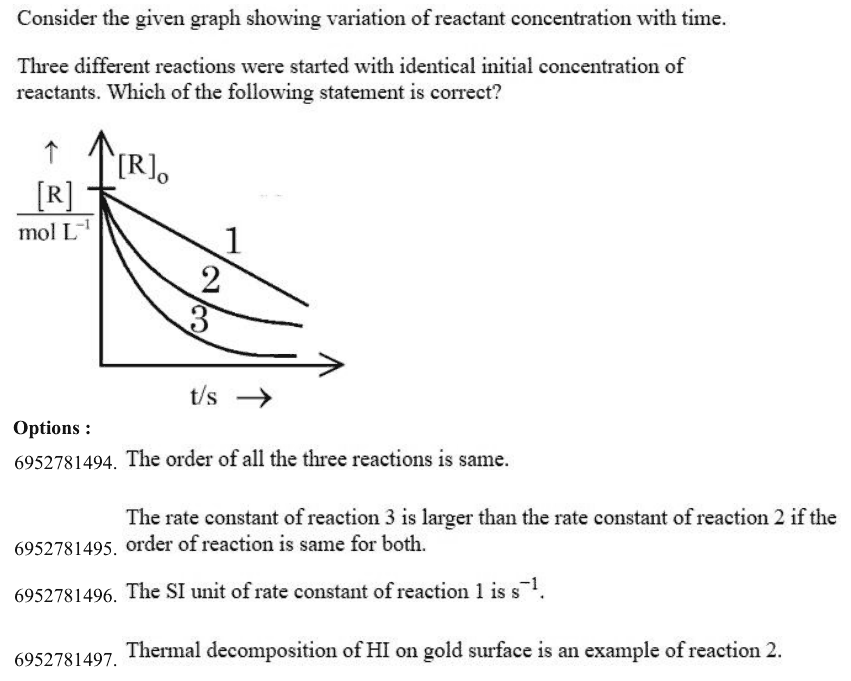
Answer: (B) The rate constant of reaction 3 is larger than the rate constant of reaction 2 if the order of reaction is same for both.· Official NTA final key
$\mathrm{t_{100\%}}$ is the time required for the 100% completion of the reaction while $\mathrm{t_{1/2}}$ is the time required for 50% of the reaction to be completed. Which of the following option correctly represents the relation between $\mathrm{t_{100\%}}$ and $\mathrm{t_{1/2}}$ for zero and first order reactions respectively ?
A
$\mathrm{t_{100\%}} = (\mathrm{t_{1/2}})^2$ and $\mathrm{t_{100\%}} = (\mathrm{t_{1/2}})^{-\infty}$
B
$\mathrm{t_{100\%}} = 2\mathrm{t_{1/2}}$ and $\mathrm{t_{100\%}} = (\mathrm{t_{1/2}})^{\infty}$
C
$\mathrm{t_{100\%}} = 2\mathrm{t_{1/2}}$ and $\mathrm{t_{100\%}} = (2\mathrm{t_{1/2}})^2$
D
$\mathrm{t_{100\%}} = (\mathrm{t_{1/2}})^{\infty}$ and $\mathrm{t_{100\%}} = 2\mathrm{t_{1/2}}$
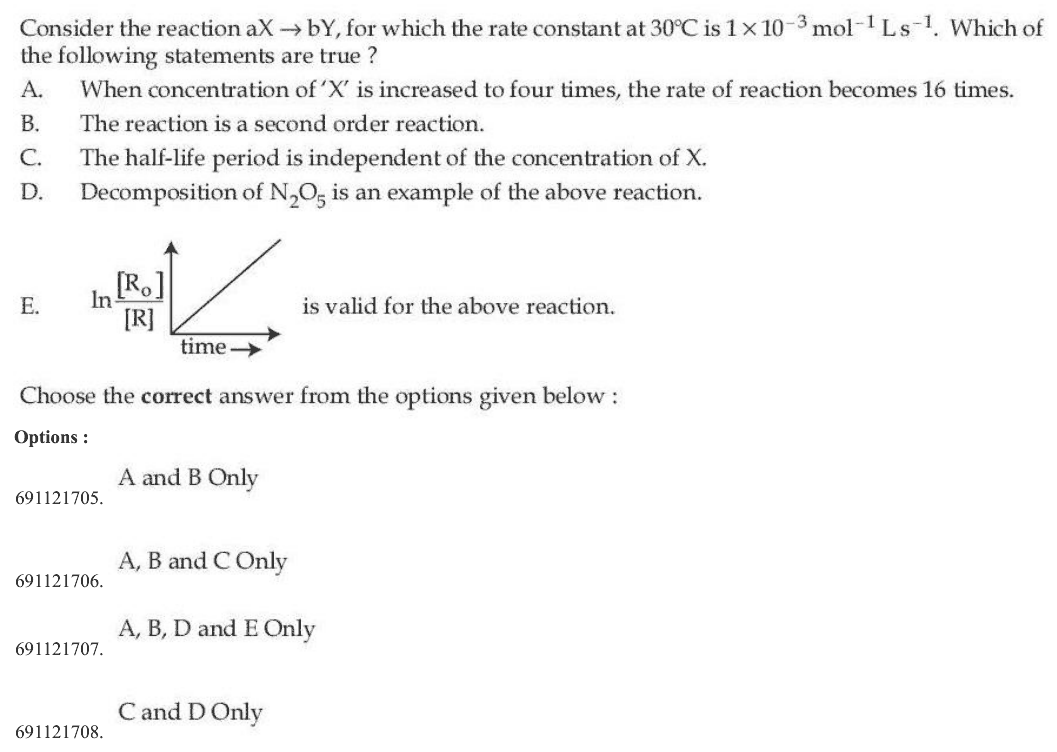
Consider the reaction $\mathrm{aX} \rightarrow \mathrm{bY}$, for which the rate constant at 30°C is $1\times10^{-3}$ mol$^{-1}$ L s$^{-1}$. Which of the following statements are true ?
A. When concentration of 'X' is increased to four times, the rate of reaction becomes 16 times.
B. The reaction is a second order reaction.
C. The half-life period is independent of the concentration of X.
D. Decomposition of $\mathrm{N_2O_5}$ is an example of the above reaction.
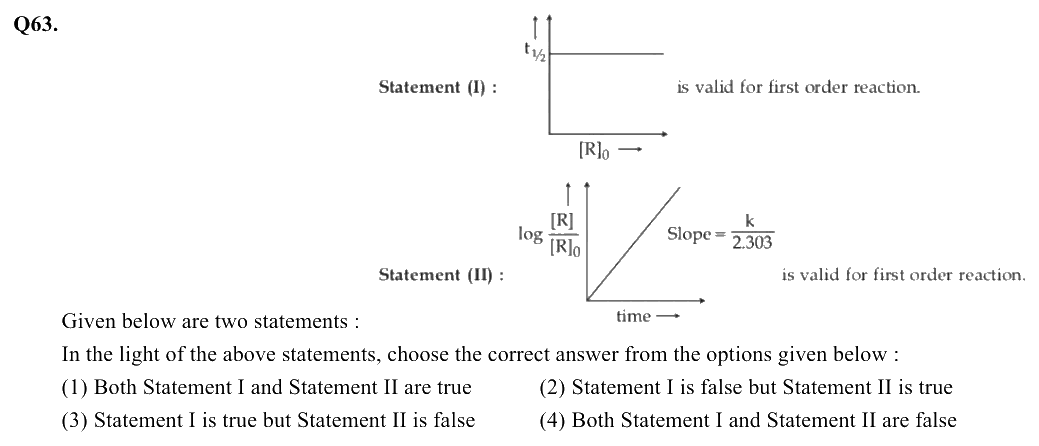
E. $\ln\frac{[\mathrm{R_o}]}{[\mathrm{R}]}$ (see the figure above) is valid for the above reaction.
Choose the correct answer from the options given below :
An organic compound undergoes first order decomposition. The time taken for decomposition to $\left(\dfrac{1}{8}\right)^{\mathrm{th}}$ and $\left(\dfrac{1}{10}\right)^{\mathrm{th}}$ of its initial concentration are $\mathrm{t_{1/8}}$ and $\mathrm{t_{1/10}}$ respectively.
What is the value of $\dfrac{\mathrm{t_{1/8}}}{\mathrm{t_{1/10}}} \times 10$ ?
At 27 °C in presence of a catalyst, activation energy of a reaction is lowered by 10 kJ mol$^{-1}$. The logarithm of ratio of $\dfrac{k(\text{catalysed})}{k(\text{uncatalysed})}$ is....
(Consider that the frequency factor for both the reactions is same)
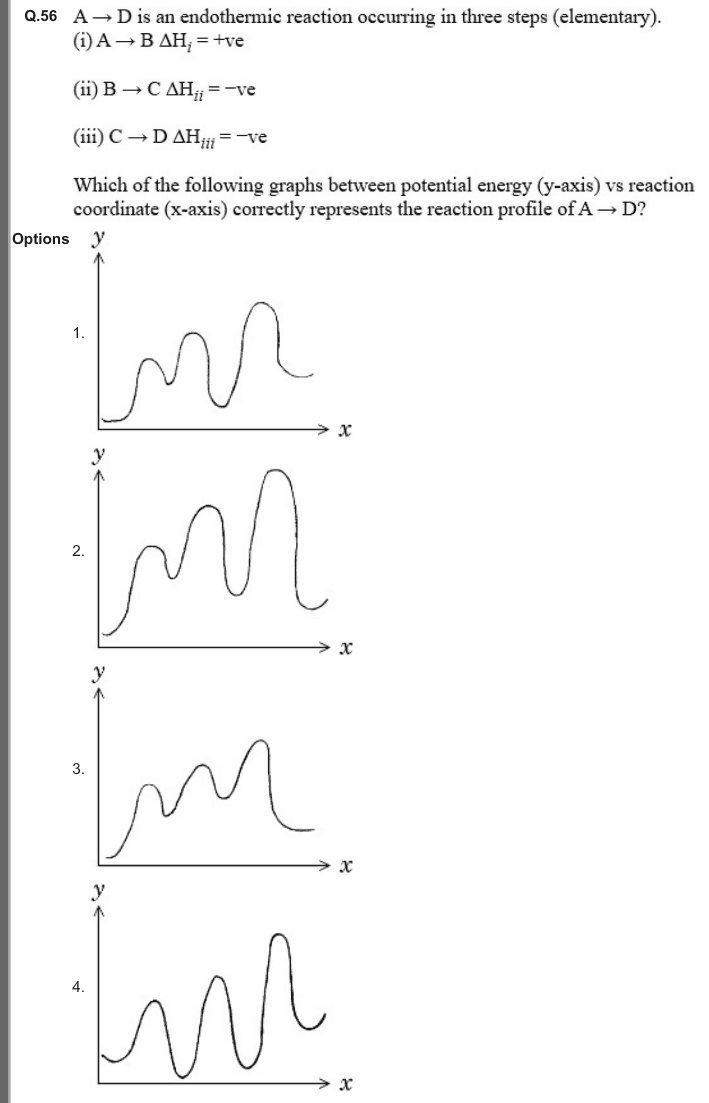
Which of the following graphs between potential energy (y-axis) vs reaction coordinate (x-axis) correctly represents the reaction profile of A$\rightarrow$D?
The question as printed in the paper.
A
see figure axes 'y' (up) and 'x' (right); a hand-drawn curve with three peaks. It starts low near the vertical axis (the start level, close to the x axis), rises to peak 1, falls to valley 1 (higher than the start level, much lower than peak 1), rises to peak 2 (higher than peak 1), falls to valley 2 (LOWER than valley 1, but still slightly above the start level), rises to peak 3 (the highest peak), then falls and flattens at a final level that is above valley 2, slightly above valley 1 and well above the start level.
B
see figure same axes; a hand-drawn curve with three peaks. It starts low (start level), rises to peak 1, falls to valley 1 (higher than the start level), rises to peak 2 (higher than peak 1), falls to valley 2 (LOWER than valley 1), rises to peak 3 (the highest peak, drawn at the top of the figure), then falls to a final valley that is LOWER than valley 2 but still ABOVE the start level, and rises slightly at the right end.
C
see figure same axes; a hand-drawn curve with three peaks. It starts low (start level), rises to peak 1, falls to valley 1 (higher than the start level), rises to peak 2 (higher than peak 1), falls to valley 2 (HIGHER than valley 1), rises to peak 3 (the highest peak, only a little above peak 2), then falls and flattens at a final level that is lower than valley 1 and valley 2 but above the start level.
D
see figure same axes; a hand-drawn curve with three peaks. It starts a little above the x axis with a slight dip, rises to peak 1, falls to valley 1 (the lowest point of the whole curve, below the start level), rises to peak 2 (higher than peak 1), falls to valley 2 (higher than valley 1, about the same as or slightly below the start level), rises to peak 3 (the highest peak), then falls to a final valley that is higher than valley 1, valley 2 and the start level, and rises slightly at the right end.
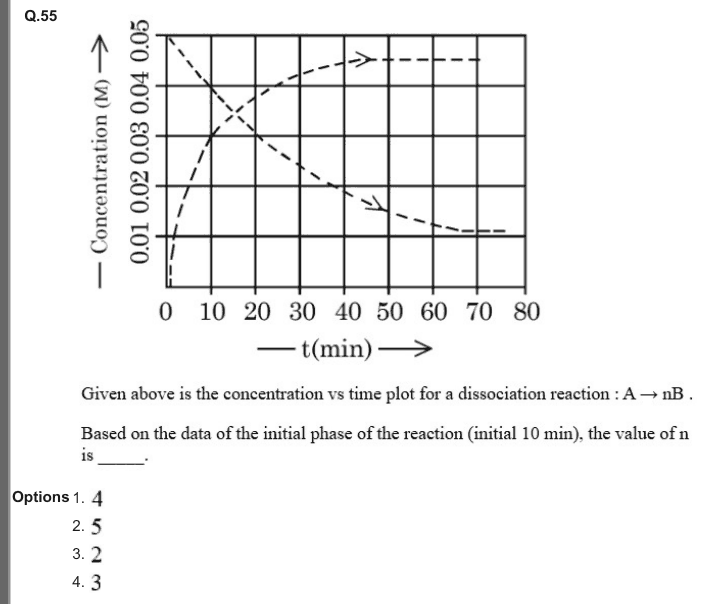
see figure Given above is the concentration vs time plot for a dissociation reaction : $\mathrm{A} \rightarrow n\mathrm{B}$.
Based on the data of the initial phase of the reaction (initial 10 min), the value of n is ________.
II. $5\mathrm{Br^-(aq)} + \mathrm{BrO_3^-(aq)} + 6\mathrm{H^+(aq)} \rightarrow 3\mathrm{Br_2(aq)} + 3\mathrm{H_2O(l)}$
Both the reactions are started at 10.00 am. The rates of these reactions at 10.10 am are same. The value of $-\dfrac{\Delta[\mathrm{Br^-}]}{\Delta t}$ at 10.10 am is $2 \times 10^{-4}$ mol L$^{-1}$ min$^{-1}$. The concentration of A at 10.10 am is $10^{-2}$ mol L$^{-1}$. What is the first order rate constant (in min$^{-1}$) of reaction I?
Decomposition of A is a first order reaction at T(K) and is given by $\mathrm{A(g)} \longrightarrow \mathrm{B(g)} + \mathrm{C(g)}$.
In a closed 1 L vessel, 1 bar A(g) is allowed to decompose at T(K). After 100 minutes, the total pressure was 1.5 bar. What is the rate constant (in min$^{-1}$) of the reaction ? ($\log 2 = 0.3$)
In a first order decomposition reaction, the time taken for the decomposition of reactant to one fourth and one eighth of its initial concentration are $t_1$ and $t_2$ (s), respectively. The ratio $t_1 / t_2$ will be:
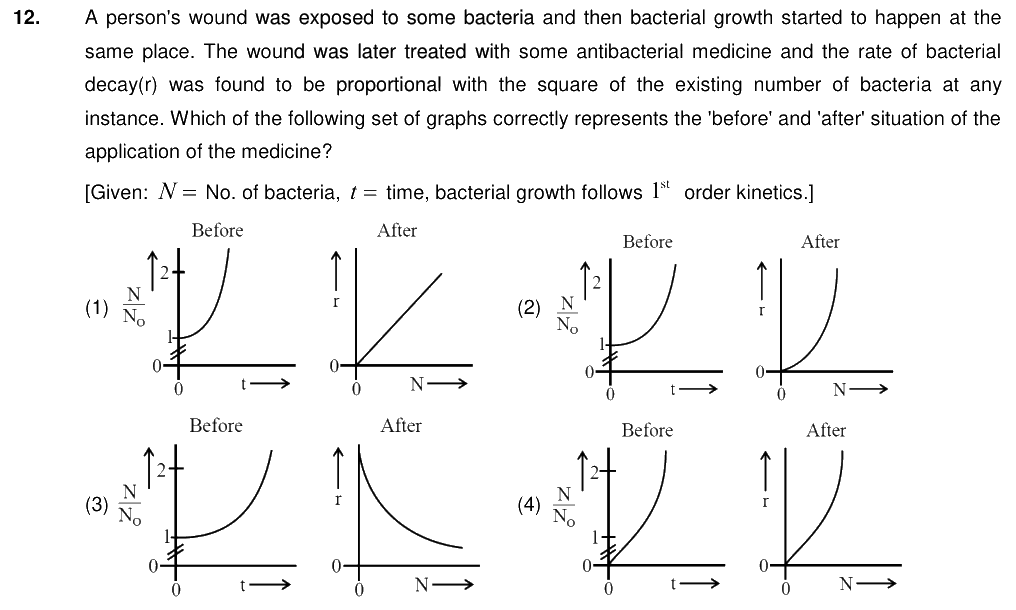
A person's wound was exposed to some bacteria and then bacterial growth started to happen at the same place. The wound was later treated with some antibacterial medicine and the rate of bacterial decay(r) was found to be proportional with the square of the existing number of bacteria at any instance. Which of the following set of graphs correctly represents the 'before' and 'after' situation of the application of the medicine?
[Given: $N =$ No. of bacteria, $t =$ time, bacterial growth follows $1^{st}$ order kinetics.]
The question as printed in the paper.
A
see figure 'Before': N/N0 against t, the curve starts on the N/N0 axis at 1 (axis break between 0 and 1) and rises, getting steeper (passing 2); 'After': r against N, a straight line from the origin rising to the upper right.
B
see figure 'Before': N/N0 against t, the curve starts at 1 on the vertical axis (axis break) and rises, getting steeper (passing 2); 'After': r against N, a curve from the origin starting flat and rising ever more steeply.
C
see figure 'Before': N/N0 against t, the curve starts at 1 on the vertical axis (axis break) and rises, getting steeper (passing 2); 'After': r against N, a curve starting high on the r axis and falling, flattening toward the N axis.
D
see figure 'Before': N/N0 against t, the curve starts at the origin (0) and rises through the marks 1 and 2 (the axis break sits between 0 and 1), turning steeper; 'After': r against N, a curve from the origin rising nearly straight first and then steeper.
Rate law for a reaction between $A$ and $B$ is given by
$r = k[A]^n[B]^m$
If concentration of $A$ is doubled and concentration of $B$ is halved from their initial value, the ratio of new rate of reaction to the initial rate of reaction $\left(\frac{r_2}{r_1}\right)$ is
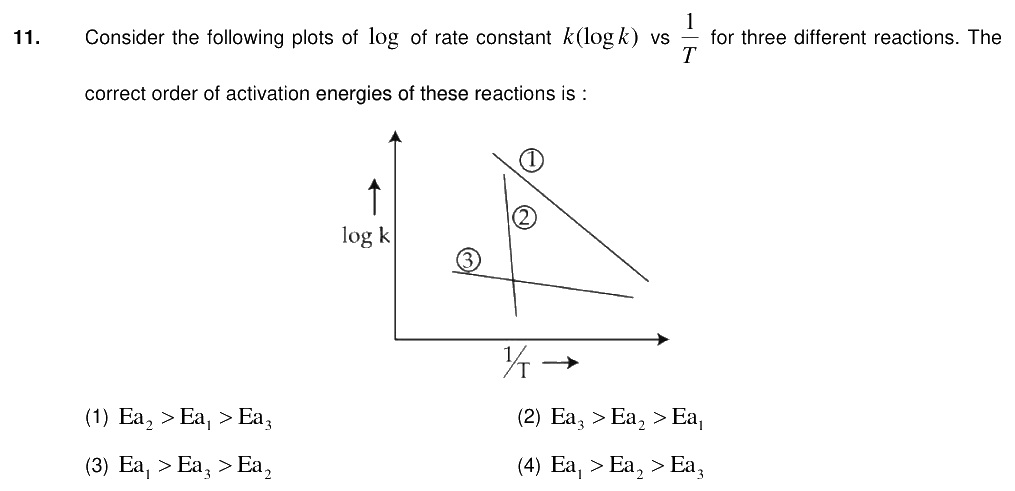
Consider the following plots of log of rate constant $k(\log k)$ vs $\frac{1}{T}$ for three different reactions. The correct order of activation energies of these reactions is :
Half life of zero order reaction $A \rightarrow$ product is 1 hour, when initial concentration of reactant is $2.0molL^{-1}$. The time required to decrease concentration of A from 0.50 to $0.25molL^{-1}$ is :
In a reaction $A + B \rightarrow C$, initial concentrations of $A$ and $B$ are related as $[A]_0 = 8[B]_0$. The half lives of $A$ and $B$ are 10 min and 40 min , respectively. If they start to disappear at the same time, both following first order kinetics, after how much time will the concentration of both the reactants be same?
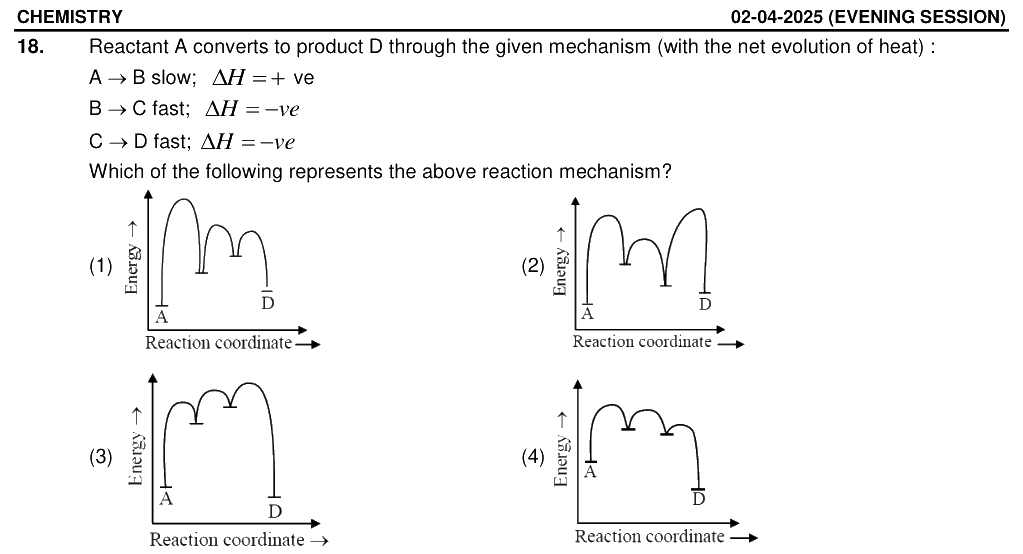
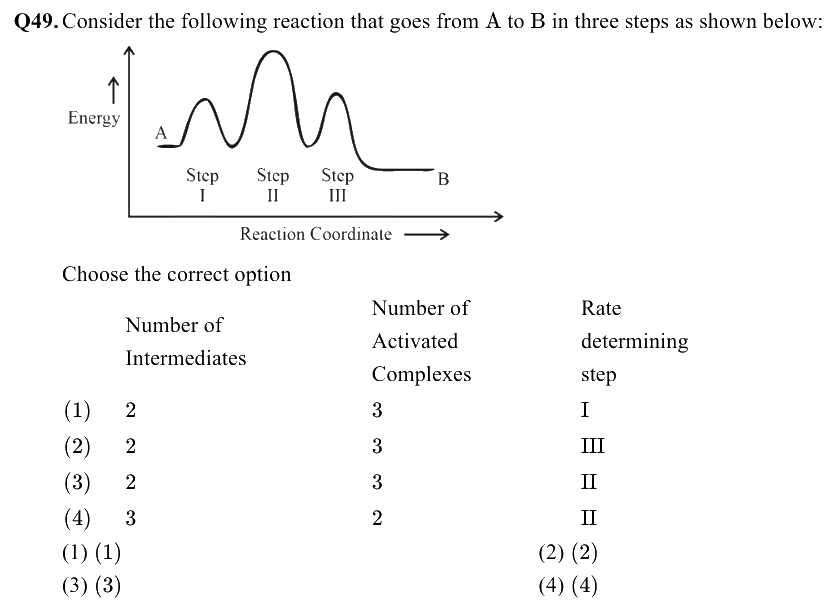
Reactant A converts to product D through the given mechanism (with the net evolution of heat) :
A → B slow; $\Delta H = + ve$
B → C fast; $\Delta H = -ve$
C → D fast; $\Delta H = -ve$
Which of the following represents the above reaction mechanism?
The question as printed in the paper.
A
see figure energy profile ('Energy' up, 'Reaction coordinate' right) with three humps: the first hump is the tallest of all; the second and third humps are much lower and about equal in height; level B sits above A, level C sits above B, and level D sits above A but below B and C.
B
see figure energy profile with three humps: the first hump is lower, the second hump is the lowest and the third hump is the tallest of all; level B sits above A, level C sits lower than B, and level D sits above A.
C
see figure energy profile with three humps: the humps rise in steps: the first hump is the lowest, the second is higher and the third is the tallest; level B and level C sit well above A (C slightly above B), and level D sits below A.
D
see figure energy profile with three humps: the first hump is the tallest, the second is slightly lower and the third is the lowest; level B and level C sit above A (about equal), and level D sits below A.
The reaction $\mathrm{A_2 + B_2 \rightarrow 2AB}$ follows the mechanism $\mathrm{A_2 \underset{k_{-1}}{\overset{k_1}{\rightleftharpoons}} A + A}$ (fast) $\mathrm{A + B_2 \xrightarrow{k_2} AB + B}$ (slow) $\mathrm{A + B \rightarrow AB}$ (fast) The overall order of the reaction is :
Drug $X$ becomes ineffective after 50% decomposition. The original concentration of drug in a bottle was 16mg/mL which becomes 4mg/mL in 12 months. The expiry time of the drug in months is ______ Assume that the decomposition of the drug follows first order kinetics.
For a given reaction R $\rightarrow$ P, $\mathrm{t_{1/2}}$ is related to $[\mathrm{A}]_0$ as given in table. Given: log 2 = 0.30 Which of the following is true? A. The order of the reaction is 1/2. B. If $[\mathrm{A}]_0$ is 1 M , then $\mathrm{t_{1/2}}$ is $200\sqrt{10}$ min C. The order of the reaction changes to 1 if the concentration of reactant changes from 0.100 M to 0.500 M . D. $\mathrm{t_{1/2}}$ is 800 min for $[\mathrm{A}]_0 = 1.6$M Choose the correct answer from the options given below: Options
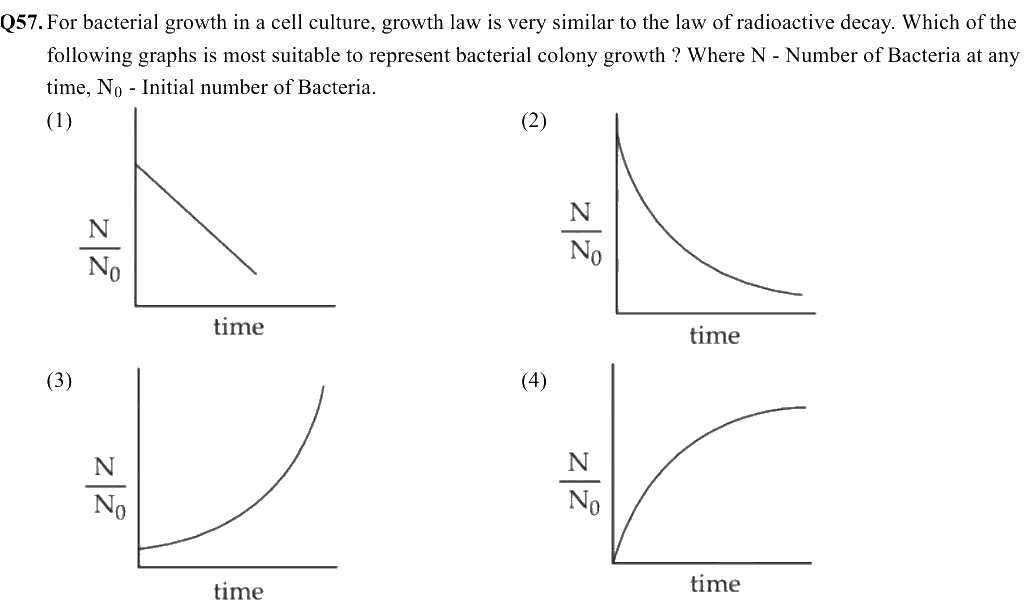
For bacterial growth in a cell culture, growth law is very similar to the law of radioactive decay. Which of the following graphs is most suitable to represent bacterial colony growth ? Where N - Number of Bacteria at any time, $\mathrm{N_0}$ - Initial number of Bacteria.
The question as printed in the paper.
A
see figure axes '$\mathrm{N/N_0}$' (vertical) and 'time' (horizontal); a straight line starting high on the vertical axis and falling to the lower right, not reaching the time axis.
B
see figure axes '$\mathrm{N/N_0}$' and 'time'; a smooth curve starting very high on the vertical axis, falling steeply at first and flattening out towards the time axis.
C
see figure axes '$\mathrm{N/N_0}$' and 'time'; a smooth curve starting low (above the time axis) and rising slowly at first, then steeper and steeper towards the upper right.
D
see figure axes '$\mathrm{N/N_0}$' and 'time'; a smooth curve starting at the origin, rising steeply at first and then flattening out to a plateau at the upper right.
Consider an elementary reaction $\mathrm{A(g) + B(g) \rightarrow C(g) + D(g)}$ If the volume of reaction mixture is suddenly reduced to $\frac{1}{3}$ of its initial volume, the reaction rate will become ' $x$ ' times of the original reaction rate. The value of $x$ is :
For a reaction, $\mathrm{N_2O_{5(\,g)} \rightarrow 2NO_{2(\,g)} + \frac{1}{2}O_{2(\,g)}}$ in a constant volume container, no products were present initially. The final pressure of the system when 50% of reaction gets completed is
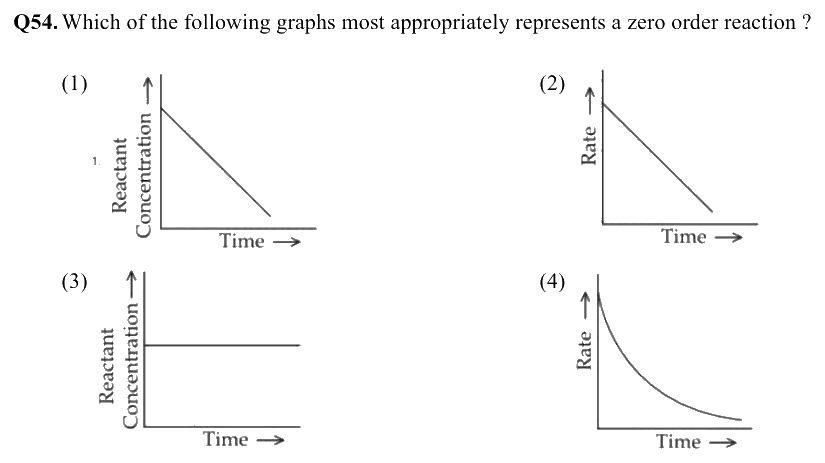
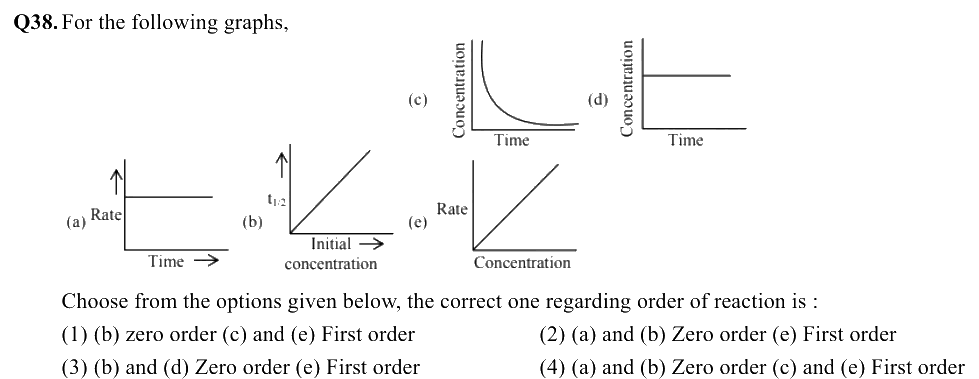
Which of the following graphs most appropriately represents a zero order reaction ?
The question as printed in the paper.
A
see figure axes 'Concentration' of 'Reactant' (vertical) and 'Time' (horizontal); a straight line starting high on the vertical axis and falling steadily to the right, ending above the time axis.
B
see figure axes 'Rate' (vertical) and 'Time' (horizontal); a straight line starting high on the vertical axis and falling steadily to the right, ending above the time axis.
C
see figure axes 'Reactant Concentration' (vertical) and 'Time' (horizontal); a horizontal straight line at constant height, about halfway up, starting at the vertical axis.
D
see figure axes 'Rate' (vertical) and 'Time' (horizontal); a curve starting high on the vertical axis, falling steeply and then flattening toward the time axis (exponential-decay shape), ending above the time axis.
For a reaction $\mathrm{A} \xrightarrow{K_1} \mathrm{B} \xrightarrow{K_2} \mathrm{C}$ If the rate of formation of $B$ is set to be zero then the concentration of $B$ is given by :
Integrated rate law equation for a first order gas phase reaction is given by (where $P_i$ is initial pressure and $P_t$ is total pressure at time $t$)
For a chemical reaction $A + B \rightarrow$ Product, the order is 1 with respect to $A$ and $B$. Rate ($\mathrm{mol\ L^{-1}\ S^{-1}}$) | [A] ($\mathrm{mol\ L^{-1}}$) | [B] ($\mathrm{mol\ L^{-1}}$) 0.10 | 20 | 0.5 0.40 | $x$ | 0.5 0.80 | 40 | $y$ What is the value of $x$ and $y$?
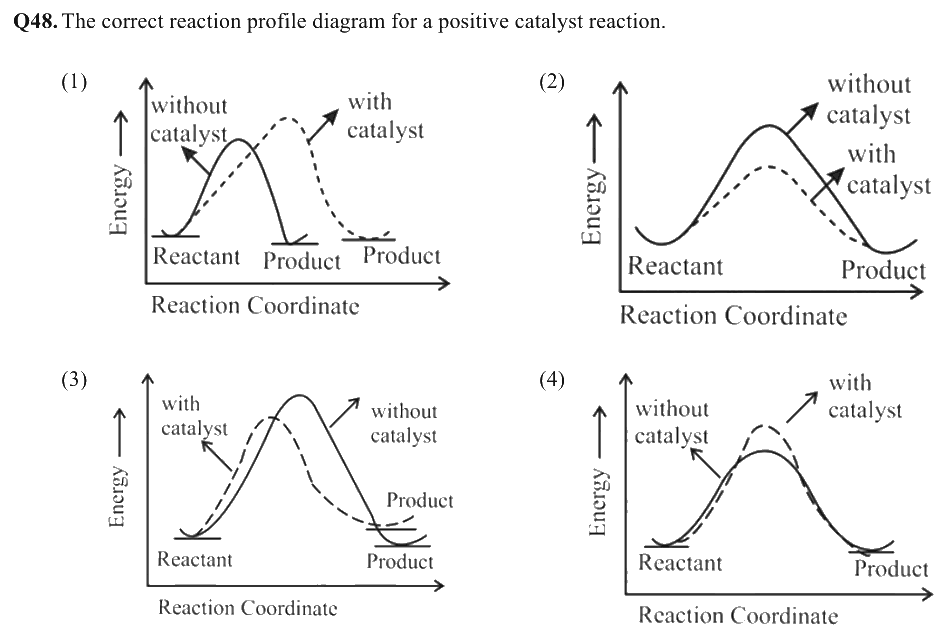
The correct reaction profile diagram for a positive catalyst reaction.
(see the figure above)
The question as printed in the paper.
A
see figure Energy-profile graph: a solid curve labelled 'without catalyst' rises from the Reactant level to a peak and falls to a product level (labelled Product, in the middle of the graph); a dashed curve labelled 'with catalyst' starts from the same Reactant level, rises along a slanting path to a higher peak that lies further to the right than the solid peak, then falls to a second product level on the right (also labelled Product). The reactant and both product levels are at about the same height.
B
see figure Energy-profile graph: a solid curve labelled 'without catalyst' rises from the Reactant level (left) to a high peak and falls to a Product level (right) that is a little lower than the reactant level; a dashed curve labelled 'with catalyst' follows the same start and end but has a clearly lower peak.
C
see figure Energy-profile graph: a solid curve labelled 'without catalyst' with a high peak, from Reactant (left) to Product (right); a dashed curve labelled 'with catalyst' with a lower peak that lies somewhat to the left of the solid peak and ends at a product level slightly above the solid curve's product level (two Product levels are drawn close together at the right).
D
see figure Energy-profile graph: a solid curve labelled 'without catalyst' with a lower, broad peak from Reactant (left) to Product (right); a dashed curve labelled 'with catalyst' with a slightly higher peak above the solid one; both start and end at about the same levels.
For kinetic study of the reaction of iodide ion with $\mathrm{H_2O_2}$ at room temperature : (A) Always use freshly prepared starch solution. (B) Always keep the concentration of sodium thiosulphate solution less than that of KI solution. (C) Record the time immediately after the appearance of blue colour. (D) Record the time immediately before the appearance of blue colour. (E) Always keep the concentration of sodium thiosulphate solution more than that of KI solution. Choose the correct answer from the options given below
At $30\ ^\circ$C, the half life for the decomposition of $\mathrm{AB_2}$ is $200\ \mathrm{s}$ and is independent of the initial concentration of $\mathrm{AB_2}$. The time required for $80\%$ of the $\mathrm{AB_2}$ to decompose is (Given: $\log2 = 0.30$; $\log3 = 0.48$)
For a first order reaction, the time required for completion of $90\%$ reaction is 'x' times the half life of the reaction. The value of 'x' is (Given: $\ln 10 = 2.303$ and $\log 2 = 0.3010$)
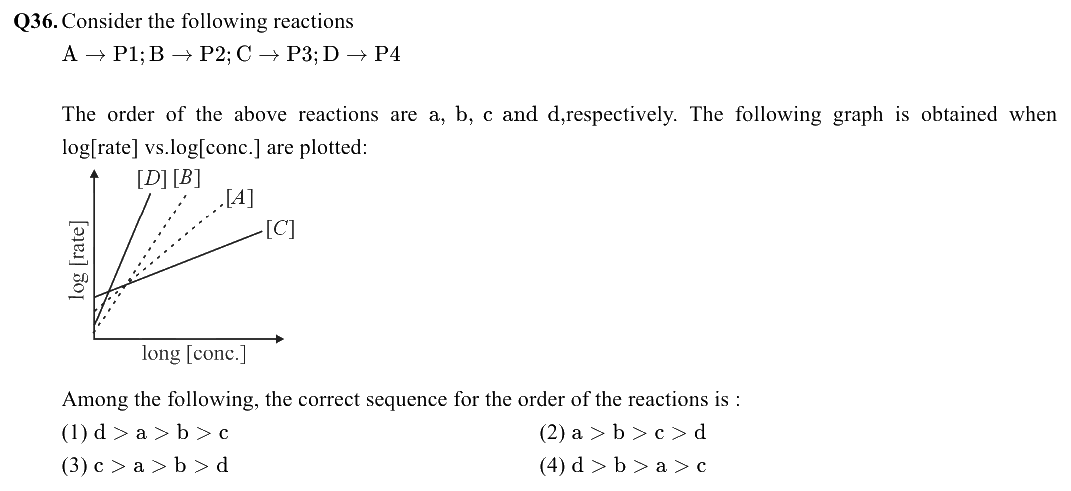
Consider the following reactions $\mathrm{A \rightarrow P1;\ B \rightarrow P2;\ C \rightarrow P3;\ D \rightarrow P4}$ The order of the above reactions are a, b, c and d,respectively. The following graph is obtained when log[rate] vs.log[conc.] are plotted: (see the figure above) Among the following, the correct sequence for the order of the reactions is :
A flask contains a mixture of compounds A and B. Both compounds decompose by first-order kinetics. The half-lives for A and B are 300 s and 180 s, respectively. If the concentrations of A and B are equal initially, the time required for the concentration of A to be four times that of B (in s) is : (Use $\ln 2$ = 0. 693)
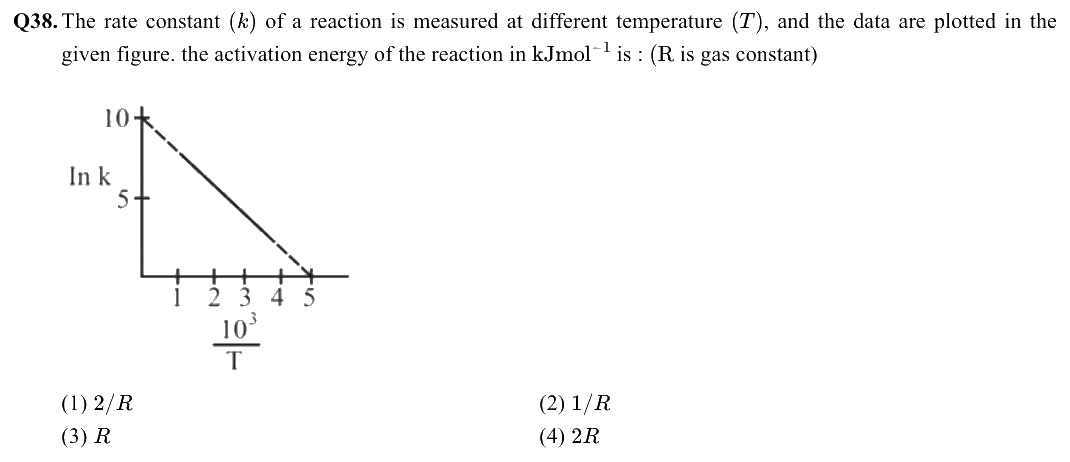
The rate constant ($k$) of a reaction is measured at different temperature ($T$), and the data are plotted in the given figure. the activation energy of the reaction in $\mathrm{kJmol^{-1}}$ is : (R is gas constant) (see the figure above)
For the following reactions A $\xrightarrow{700K}$ Product A $\xrightarrow[\text{catalyst}]{500K}$ Product It was found that the $\mathrm{E_a}$ is decreased by 30 KJ/mol in the presence of catalyst. If the rate remains unchanged, the activation energy for catalysed reaction is (Assume pre-exponential factor is same)
The rate of a certain biochemical reaction at physiological temperature $(\mathrm{T})$ occurs $10^6$ times faster with enzyme than without. The change in the activation energy upon adding enzyme is:
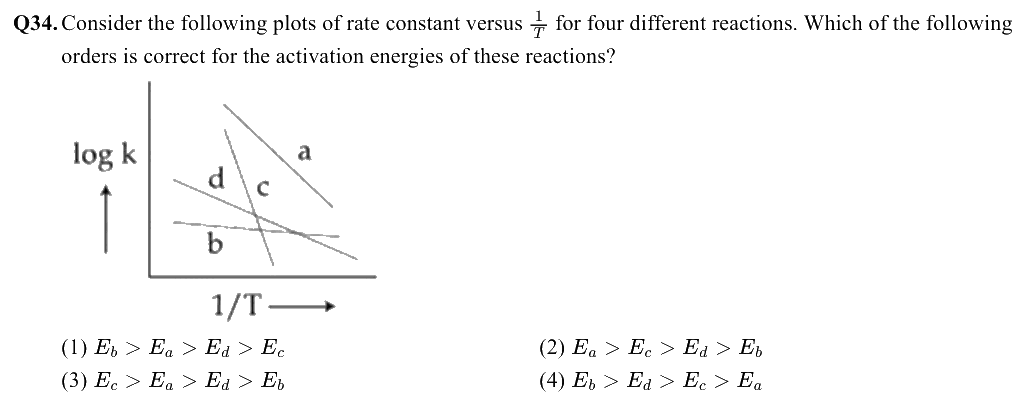
Consider the following plots of rate constant versus $\frac{1}{T}$ for four different reactions. Which of the following orders is correct for the activation energies of these reactions? (see the figure above)
For the reaction $2\mathrm{H_2(g)} + 2\mathrm{NO(g)} \rightarrow \mathrm{N_2(g)} + 2\mathrm{H_2O(g)}$ the observed rate expression is, rate $= \mathrm{k_f[NO]^2[H_2]}$. The rate expression for the reverse reaction is:
In the following reaction; $\mathrm{xA \rightarrow yB}$ $\log_{10}\text{-}\frac{\mathrm{dA}}{\mathrm{dt}} = \log_{10}\frac{\mathrm{dB}}{\mathrm{dt}} + 0.3010$ 'A' and 'B' respectively can be:
$\mathrm{NO_2}$ required for a reaction is produced by the decomposition of $\mathrm{N_2O_5}$ in $\mathrm{CCl_4}$ as per the equation, $2\mathrm{N_2O_5(g)} \rightarrow 4\mathrm{NO_2(g)} + \mathrm{O_2(g)}$. The initial concentration of $\mathrm{N_2O_5}$ is $3.00\ \mathrm{mol\ L^{-1}}$ and it is $2.75\ \mathrm{mol\ L^{-1}}$ after 30 minutes. The rate of formation of $\mathrm{NO_2}$ is:
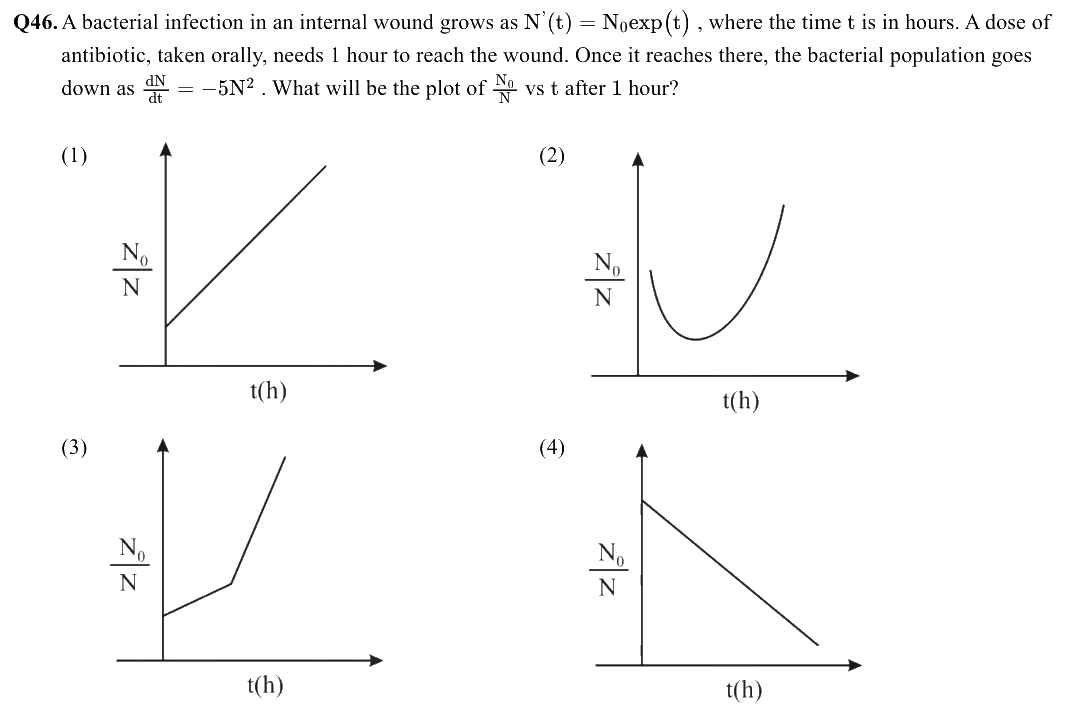
A bacterial infection in an internal wound grows as $N'(t) = N_0\exp(t)$ , where the time t is in hours. A dose of antibiotic, taken orally, needs 1 hour to reach the wound. Once it reaches there, the bacterial population goes down as $\frac{dN}{dt} = -5N^{2}$ . What will be the plot of $\frac{N_0}{N}$ vs t after 1 hour?
(see the figure above)
The question as printed in the paper.
A
see figure N_0/N versus t(h): a straight line with positive slope starting above the origin on the vertical axis
B
see figure N_0/N versus t(h): a U-shaped curve falling to a minimum and then rising
C
see figure N_0/N versus t(h): two straight segments, a gentle slope starting above the origin followed by a steeper slope
D
see figure N_0/N versus t(h): a straight line with negative slope, falling from a point on the vertical axis
For the reaction of $\mathrm{H_2}$ with $\mathrm{I_2}$, the rate constant is $2.5\times10^{-4}\ \mathrm{dm^3 mol^{-1}s^{-1}}$ at $327^\circ\mathrm{C}$ and $1.0\ \mathrm{dm^3}$ mol-1s-1 at $527^\circ\mathrm{C}$. The activation energy for the reaction, in kJ mol-1 is: $R = 8.314\ \mathrm{JK^{-1}mol^{-1}}$
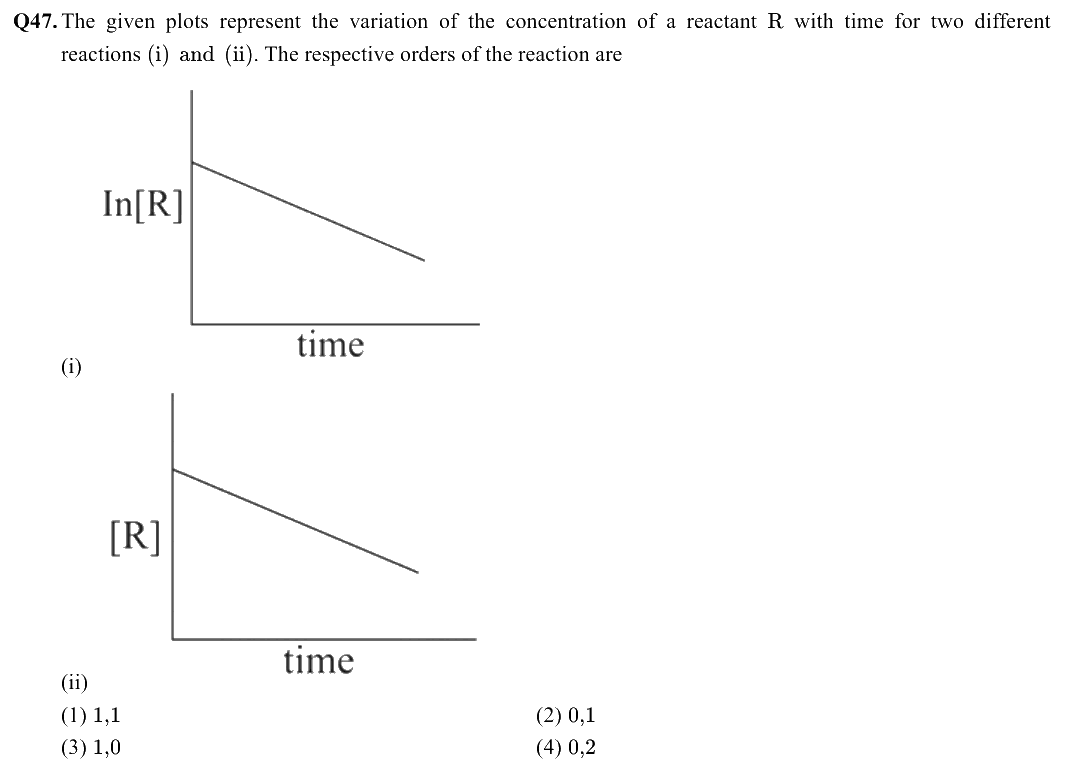
The given plots represent the variation of the concentration of a reactant R with time for two different reactions (i) and (ii). The respective orders of the reaction are (see the figure above)
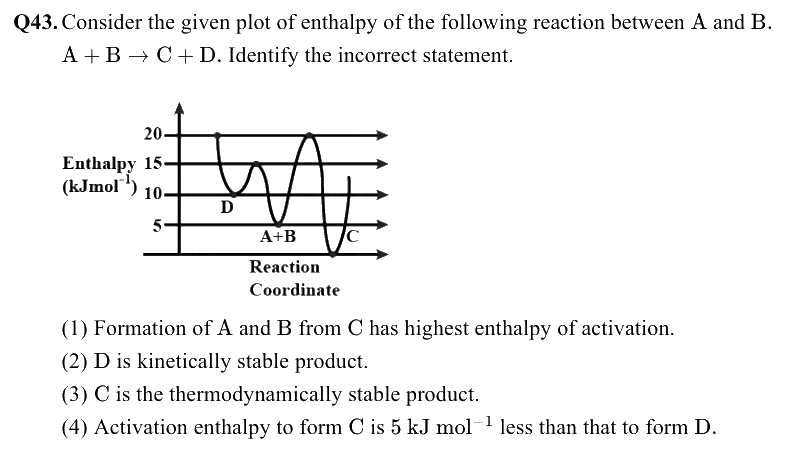
Consider the given plot of enthalpy of the following reaction between A and B. A + B $\rightarrow$ C + D. Identify the incorrect statement. (see the figure above)
The question as printed in the paper.
A
Formation of A and B from C has highest enthalpy of activation.
B
D is kinetically stable product.
C
C is the thermodynamically stable product.
D
Activation enthalpy to form C is 5 kJ $\mathrm{mol^{-1}}$ less than to form D.
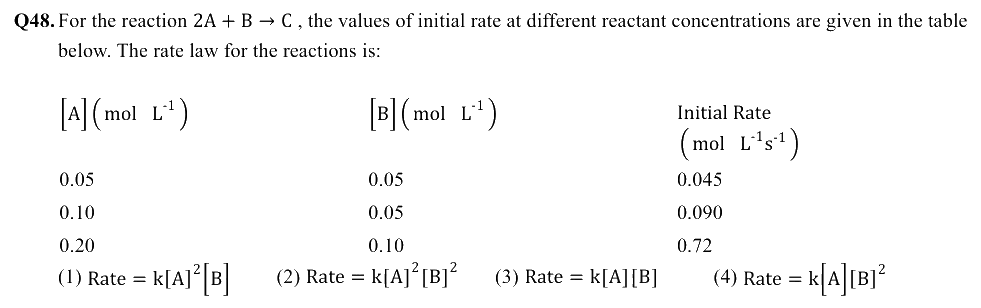
For the reaction $2A + B \rightarrow C$, the values of initial rate at different reactant concentrations are given in the table below. The rate law for the reactions is: (see the figure above)
For a reaction scheme A $\overset{k_1}{\longrightarrow}$ B $\overset{k_2}{\longrightarrow}$ C, if the net rate of formation of B is set to be zero then the concentration of B is given by:
Decomposition of X exhibits a rate constant of 0 .05 $\mu$g/ year. How many years are required for the decomposition of 5 $\mu$g of X into 2 .5 $\mu$g?
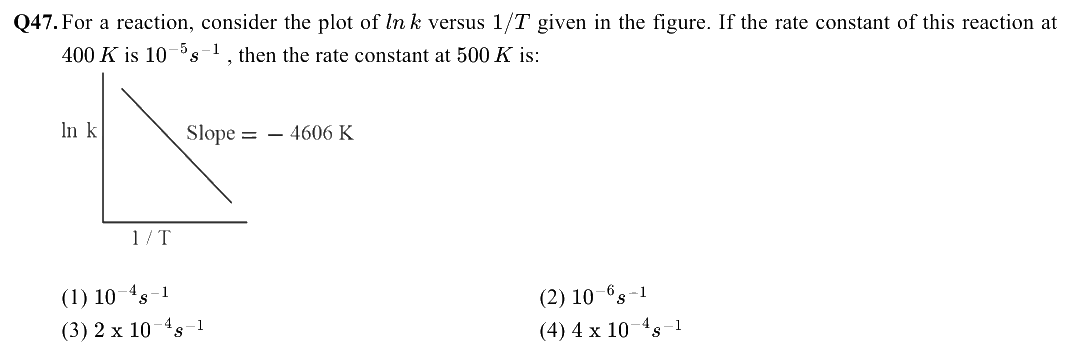
For a reaction, consider the plot of $ln\,k$ versus $1/T$ given in the figure. If the rate constant of this reaction at 400 $K$ is $10^{-5}s^{-1}$ , then the rate constant at 500 $K$ is:
If a reaction follows the Arrhenius equation, the plot ln $k$ vs $\frac{1}{(RT)}$ gives straight line with a gradient $(-y)$ unit. The energy required to activate the reactant is:
The reaction 2X $\rightarrow$ B is a zeroth order reaction. If the initial concentration of X is 0.2M, the half-life is 6 h. When the initial concentration of $X$ is 0.5M, the time required to reach its final concentration of 0.2M will be
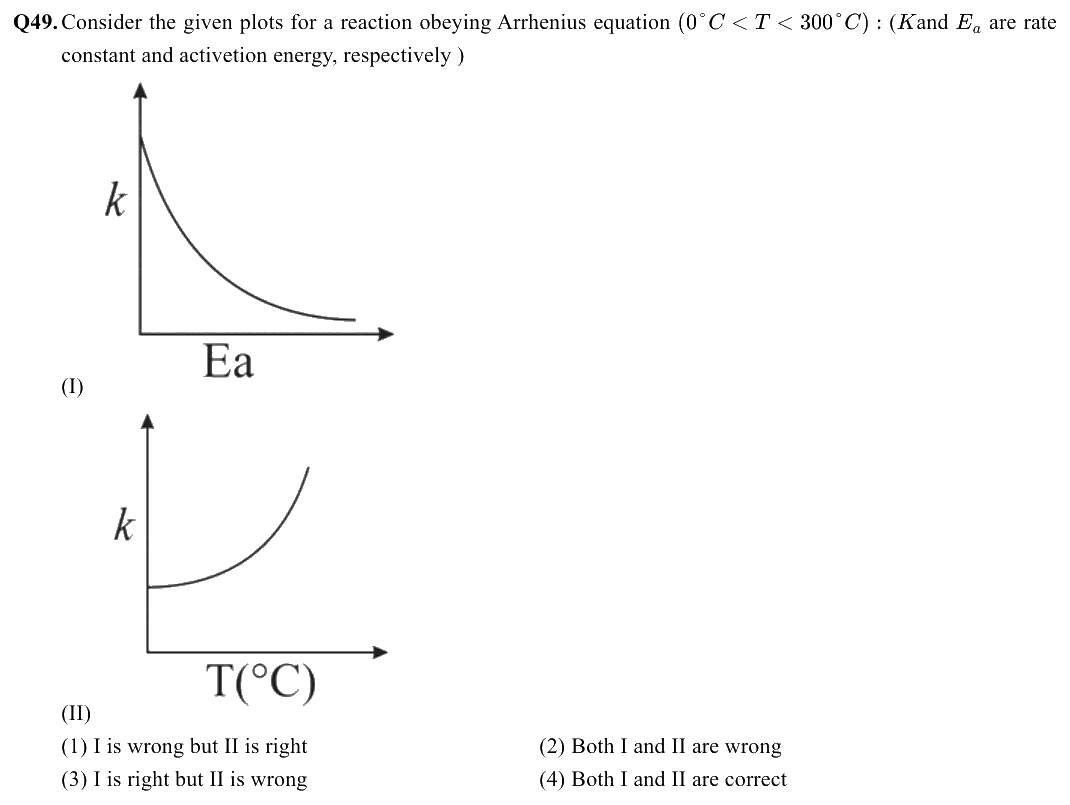
Consider the given plots for a reaction obeying Arrhenius equation $(0^\circ C < T < 300^\circ C)$ : ($K$and $E_a$ are rate constant and activetion energy, respectively ) (see the figure above) (I) (see the figure above) (II)
For an elementary chemical reaction, $\mathrm{A_2} \overset{\mathrm{k_1}}{\underset{\mathrm{k_{-1}}}{\rightleftharpoons}} 2\mathrm{A}$ , the expression for $\dfrac{\mathrm{d[A]}}{\mathrm{dt}}$ is:
The following results were obtained during kinetic studies of the reaction. $2\mathrm{A} + \mathrm{B} \rightarrow$ product Experiment | A in $\mathrm{mol\ L^{-1}}$ | B in $\mathrm{mol\ L^{-1}}$ | Initial rate of reaction in $\mathrm{mol\ L^{-1}\ min^{-1}}$ I | $0.10$ | $0.20$ | $6.93\times10^{-3}$ II | $0.10$ | $0.25$ | $6.93\times10^{-3}$ III | $0.20$ | $0.30$ | $1.386\times10^{-2}$ The time (in minutes) required to consume half of A is
For the reaction, $2A + B \rightarrow$ products, when the concentration of $A$ and $B$ both were doubled, the rate of the reaction increased from $0.3\ mol\ L^{-1}s^{-1}$ to $2.4\ mol\ L^{-1}s^{-1}$. When the concentration of $A$ alone is doubled, the rate increased from $0.3\ mol\ L^{-1}s^{-1}$ to $0.6\ mol\ L^{-1}s^{-1}$. Which one of the following statements is correct?
$\mathrm{N_2O_5}$ decomposes to $\mathrm{NO_2}$ and $\mathrm{O_2}$ and follows first order kinetics. After 50 minutes, the pressure inside the vessel increases from $50\ \mathrm{mm\ Hg}$ to $87.5\ \mathrm{mm\ Hg}$. The pressure of the gaseous mixture after 100 minutes at constant temperature will be ______.
For a first order reaction, $\mathrm{A \to P,\ t_{1/2}}$ (half-life) is 10 days. The time required for $\frac{1}{4}^{\mathrm{th}}$ conversion of A (in days) is: ($\ln 2 = 0.693$, $\ln 3 = 1.1$).
At $518^\circ\mathrm{C}$, the rate of decomposition of a sample of gaseous acetaldehyde, initially at a pressure of $363\ \text{Torr}$ was $1 .00\ \text{Torr s}^{-1}$ when $5\%$ had reacted and $0 .50\ \text{Torr s}^{-1}$ when $33\%$ had reacted. The order of the reaction is:
The rate of a reaction quadruples when the temperature changes from 300 to 310 K. The activation energy of this reaction is: (Assume Activation energy and pre-exponential factor are independent of temperature; $\ln(2) = 0.693$; $R = 8.314\ \mathrm{J\,mol^{-1}K^{-1}}$)
The rate of a reaction A doubles on increasing the temperature from 300 to 310 K. By how much, the temperature of reaction B should be increased from 300 K so that rate doubles if activation energy of the reaction B is twice to that of reaction A.
Two reactions $\mathrm{A_1}$ and $\mathrm{A_2}$ have identical pre-exponential factors. The activation energy of $\mathrm{A_1}$ is more than $\mathrm{A_2}$ by $10\ \mathrm{kJ\ mol^{-1}}$. If $\mathrm{k_1}$ and $\mathrm{k_2}$ are the rate constants for reactions $\mathrm{A_1}$ and $\mathrm{A_2}$, respectively at $300\ \mathrm{K}$, then $\ln\frac{\mathrm{k_2}}{\mathrm{k_1}}$ is equal to $\mathrm{R} = 8.314\ \mathrm{J\ mol^{-1}K^{-1}}$
The rate law for the reaction below is given by the expression $\mathrm{k[A][B]}$ $\mathrm{A + B \rightarrow Product}$ If the concentration of B is increased from $0.1$ to $0.3\ \mathrm{mol}$, keeping the value of A at $0.1\ \mathrm{mol}$, the rate constant will be:
The reaction of ozone with oxygen atoms in the presence of chlorine atoms can occur by a two step process shown below: $\mathrm{O_3(g) + Cl^{\bullet} \rightarrow O_2(g) + ClO^{\bullet}(g)}$ ...(i) $\mathrm{k_i} = 5.2 \times 10^{9}\ \mathrm{L\ mol^{-1}\ s^{-1}}$ $\mathrm{ClO^{\bullet}(g) + O^{\bullet}(g) \rightarrow O_2(g) + Cl^{\bullet}(g)}$ ...(ii) $\mathrm{k_{ii}} = 2.6 \times 10^{10}\ \mathrm{L\ mol^{-1}\ s^{-1}}$ The closest rate constant for the overall reaction $\mathrm{O_3(g) + O^{\bullet}(g) \rightarrow 2O_2(g)}$ is:
Decomposition of $\mathrm{H_2O_2}$ follows a first order reaction. In fifty minutes the concentration of $\mathrm{H_2O_2}$ decreases from 0.5 to 0.125 M in one such decomposition. When the concentration of $\mathrm{H_2O_2}$ reaches 0.05 M , the rate of formation of $\mathrm{O_2}$ will be:
A + 2B $\rightarrow$ C , the rate equation for the reaction is given as Rate $=$ k [A] [B] If the concentration of A is kept the same but that of B is doubled what will happen to the rate itself?
For the equilibrium, A(g) $\rightleftharpoons$ B(g), $\Delta$H is $-$ 40 kJ / mol . If the ratio of the activation energies of the forward ($\mathrm{E_f}$) and reverse ($\mathrm{E_b}$) reactions is $\frac{2}{3}$ then:
The reaction $\mathrm{2N_2O_5(g) \rightarrow 4NO_2(g) + O_2(g)}$ follows first order kinetics. The pressure of a vessel containing only $\mathrm{N_2O_5}$ was found to increase from 50 mm Hg to 87.5 mm Hg in 30 min. The pressure exerted by the gases after 60 min. Will be (Assume temperature remains constant) :
The rate coefficient $(k)$ for a particular reactions is $1.3\times 10^{-4}\mathrm{M^{-1}\ s^{-1}}$ at $100^{\circ}\mathrm{C}$, and $1.3\times 10^{-3}\ \mathrm{M^{-1}\ s^{-1}}$ at $150^{\circ}\mathrm{C}$. What is the energy of activation $(\mathrm{E_A})$ (in kJ) for this reaction? ($\mathrm{R} =$ molar gas constant $= 8.314\mathrm{JK^{-1}\ mol^{-1}}$ )
In the reaction of formation of sulphur trioxide by contact process $2\mathrm{SO_2} + \mathrm{O_2} \rightleftharpoons 2\mathrm{SO_3}$ the rate of reaction was measured as $\frac{\mathrm{d[O_2]}}{\mathrm{dt}} = -2.5 \times 10^{-4}\ \mathrm{mol\ L^{-1}\ s^{-1}}$. The rate of reaction is terms of $[\mathrm{SO_2}]$ in $\mathrm{molL^{-1}\ s^{-1}}$ will be:
For the reaction, $2\ \mathrm{N_2O_5} \rightarrow 4\mathrm{NO_2} + \mathrm{O_2}$, the rate equation can be expressed in two ways $-\frac{\mathrm{d[N_2O_5]}}{\mathrm{dt}} = \mathrm{k}\ [\mathrm{N_2O_5}]$ and $+\frac{\mathrm{d[NO_2]}}{\mathrm{dt}} = \mathrm{k'}\ [\mathrm{N_2O_5}]$ k and k' are related as:
For the non-stoichiometry reaction, 2A + B $\rightarrow$ C + D, the following kinetic data were obtained in three separate experiments, all at 298 K.
Initial Concentration (A) | Initial Concentration (B) | Initial rate of formation of C (mol L$^-$ S$^-$) 0.1 M | 0.1 M | $1.2 \times 10^{-3}$ 0.1 M | 0.2 M | $1.2 \times 10^{-3}$ 0.2 M | 0.1 M | $2.4 \times 10^{-3}$
A radioactive isotope having a half - life period of 3 days was received after 12 days. If 3 g of the isotope is left in the container, what would be the initial mass of the isotope ?
The rate constant of a zero order reaction is $2.0 \times 10^{-2}\ \mathrm{mol\ L^{-1}\ s^{-1}}$. If the concentration of the reactant after 25 seconds is 0.5M. What is the initial concentration?
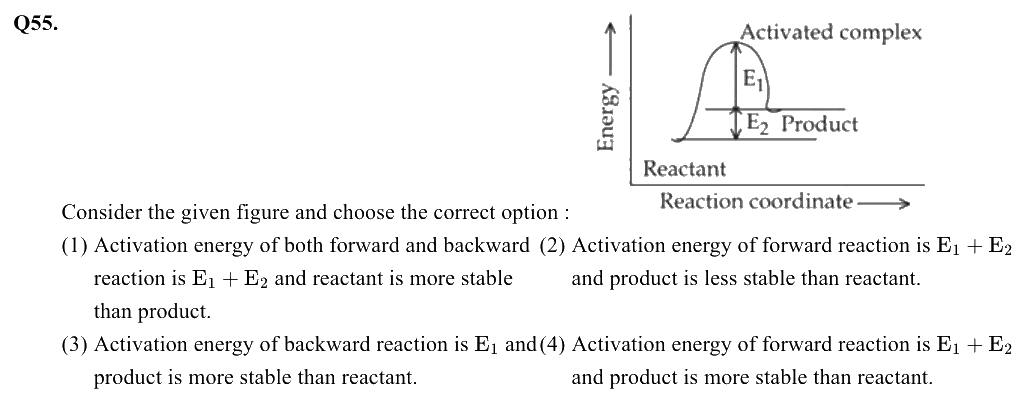
The reaction $\mathrm{X} \rightarrow \mathrm{Y}$ is an exothermic reaction. Activation energy of the reaction for X into Y is $150\ \mathrm{kJ\ mol^{-1}}$. Enthalpy of reaction is $135\ \mathrm{kJ\ mol^{-1}}$. The activation energy for the reverse reaction, $\mathrm{Y} \rightarrow \mathrm{X}$ will be :
The instantaneous rate of disappearance of $\mathrm{MnO_4^-}$ ion in the following reaction is $4.56 \times 10^{-3}\,\mathrm{Ms^{-1}}$ $2\mathrm{MnO_4^-} + 10\mathrm{I^-} + 16\mathrm{H^+} \rightarrow 2\mathrm{Mn^{2+}} + 5\mathrm{I_2} + 8\mathrm{H_2O}$ The rate of appearance $\mathrm{I_2}$ is :
The rate of a reaction doubles when its temperature changes from 300K to 310K. Activation energy of such a reaction will be: (R = 8.314 $\mathrm{JK^{-1}\ mol^{-1}}$ and log 2= 0.301)
For a reaction $A \rightarrow$ Products, a plot of $\log t_{1/2}$ versus $\log a_0$ is shown in the figure. If the initial concentration of $A$ is represented by $a_0$, the order of the reaction is
In a chemical reaction $A$ is converted into $B$. The rates of reaction, starting with initial concentrations of $A$ as $2 \times 10^{-3}\mathrm{M}$ and $1 \times 10^{-3}$ M, are equal to $2.40 \times 10^{-4}\mathrm{Ms^{-1}}$ and $0.60 \times 10^{-4}\mathrm{Ms^{-1}}$ respectively. The order of reaction with respect to reactant $A$ will be
Reaction rate between two substance $A$ and $B$ is expressed as following: rate = $k[A]^{n}[B]^{m}$ If the concentration of A is doubled and concentration of B is made half of initial concentration, the ratio of the new rate to the earlier rate will be:
For a first order reaction, $(A) \rightarrow$ products, the concentration of $A$ changes from $0.1\ \mathrm{M}$ to $0.025\ \mathrm{M}$ in $40$ minutes. The rate of reaction when the concentration of $A$ is $0.01\ \mathrm{M}$ is :
The rate of a chemical reaction doubles for every $10^\circ\mathrm{C}$ rise of temperature. If the temperature is raised by $50^\circ\mathrm{C}$, the rate of the reaction increases by about :
The time for half life period of a certain reaction $A \rightarrow$ products is 1 hour. When the initial concentration of the reactant ' $A$ ', is $2.0\ \mathrm{mol\ L^{-1}}$, how much time does it take for its concentration to come from 0.50 to $0.25\ \mathrm{mol\ L^{-1}}$ if it is a zero order reaction?
The half life period of a first order chemical reaction is 6.93 minutes. The time required for the completion of 99% of the chemical reaction will be (log 2 = 0.301) :
The energies of activation for forward and reverse reactions for $A_2 + B_2 \rightleftharpoons 2AB$ are 180 $\mathrm{kJ\ mol^{-1}}$ and 200 $\mathrm{kJ\ mol^{-1}}$ respectively. The presence of catalyst lowers the activation energy of both (forward and reverse) reactions by 100 $\mathrm{kJ\ mol^{-1}}$. The enthalpy change of the reaction ($\mathrm{A_2 + B_2 \longrightarrow 2AB}$) in the presence of catalyst will be (in $\mathrm{kJ\ mol^{-1}}$ )
Consider the reaction, $2\mathrm{A} + \mathrm{B} \rightarrow$ Products When concentration of B alone was doubled, the half-life did not change. When the concentration of A alone was doubled, the rate increased by two times. The unit of rate constant for this reaction is
A radioactive element gets spilled over the floor of a room. Its half-life period is 30 days. If the initial activity is ten times the permissible value, after how many days will it be safe to enter the room?
A reaction was found to be second order with respect to the concentration of carbon monoxide. If the concentration of carbon monoxide is doubled, with everything else kept the same, the rate of reaction will
The following mechanism has been proposed for the reaction of NO with $\mathrm{Br_2}$ to form NOBr : $\mathrm{NO(g) + Br_2(g) \rightleftharpoons NOBr_2(g)}$ $\mathrm{NOBr_2(g) + NO(g) \longrightarrow 2NOBr(g)}$ If the second step is the rate determining step, the order of the reaction with respect to $NO(g)$ is
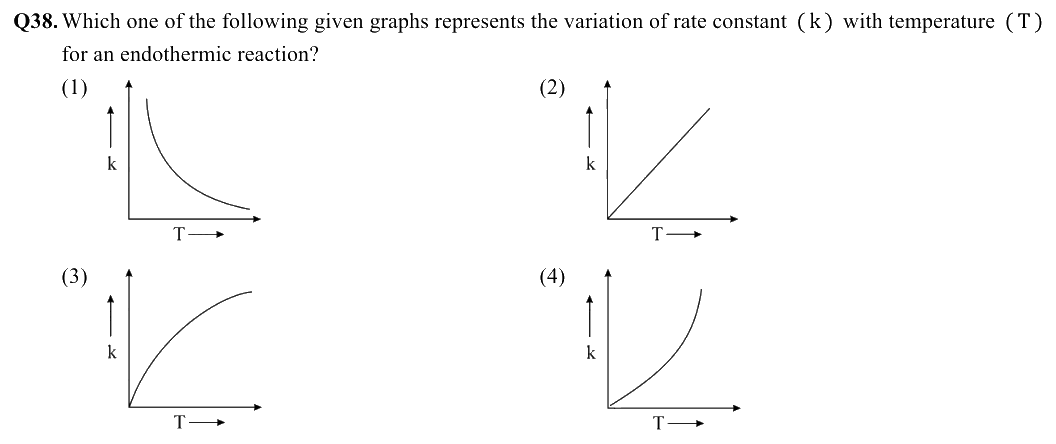
Consider an endothermic reaction, $X \longrightarrow Y$ with the activation energies $E_b$ and $E_f$ for the backward and forward reactions, respectively. In general
A
$\mathrm{E_b < E_f}$
B
$E_b > E_f$
C
$E_b = E_f$
D
There is no definite relation between $E_b$ and $E_f$
$\mathrm{t_{1/4}}$ can be taken as the time taken for the concentration of a reactant to drop to $\frac{3}{4}$ of its initial value. If the rate constant for a first order reaction is K, the $\mathrm{t_{1/4}}$ can be written as
In first order reaction, the concentration of the reactant decreases from 0.8M to 0.4M in 15 minutes. The time taken for the concentration to change from 0.1M to 0.025M is
The rate equation for the reaction $2\ \mathrm{A} + \mathrm{B} \longrightarrow \mathrm{C}$ is found to be: rate $\mathrm{k[A][B]}$. The correct statement in relation to this reaction is that the
A
unit of K must bes$^{-1}$
B
values of k is independent of the initial concentration of $A$ and $B$
C
rate of formation of $C$ is twice the rate of disappearance of $A$
The half-life of a radioactive isotope is three hours. If the initial mass of the isotope were 256 g, the mass of it remaining undecayed after 18 hours would be
The rate law for a reaction between the substances A and B is given by Rate $= k[A]^n[B]^m$ On doubling the concentration of A and halving the concentration of B, the ratio of the new rate to the earlier rate of the reaction will be as
For the reaction system: $\mathrm{2NO(g) + O_2(g) \rightarrow 2NO_2(g)}$ volume is suddenly reduce to half its value by increasing the pressure on it. If the reaction is of first order with respect to $\mathrm{O_2}$ and second order with respect to NO, the rate of reaction will
Sucrose hydrolyses in acidic medium into glucose and fructose by first order rate law with $\mathrm{t_{1/2}}$ = 3 hour. The percentage of sucrose remaining after 6 hours is ________. (Nearest integer) (Given : log 2 = 0.3010 and log 3 = 0.4771)
Numerical answer type: type your answer in EdLoop to check it
Decomposition of a hydrocarbon follows the equation $\mathrm{k} = (5.5\times10^{11}\,\mathrm{s^{-1}})\,e^{\frac{-28000\,\mathrm{K}}{T}}$. The activation energy of reaction is ________ kJ mol$^{-1}$. (Nearest Integer) Given : R = 8.3 J K$^{-1}$ mol$^{-1}$
Numerical answer type: type your answer in EdLoop to check it
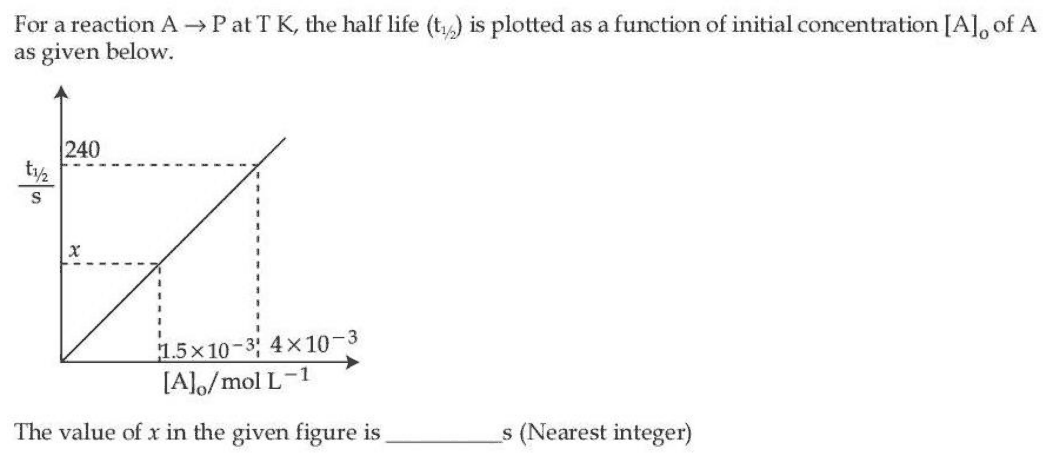
For a reaction $\mathrm{A \rightarrow P}$ at T K, the half life ($\mathrm{t_{1/2}}$) is plotted as a function of initial concentration $[\mathrm{A}]_o$ of A as given below.
(see the figure above)
The value of $x$ in the given figure is ________ s (Nearest integer)
The question as printed in the paper.
Numerical answer type: type your answer in EdLoop to check it
For reaction $\mathrm{A} \rightarrow \mathrm{P}$, rate constant $\mathrm{k} = 1.5\times10^3$ s$^{-1}$ at 27°C If activation energy for the above reaction is 60 kJ mol$^{-1}$, then the temperature (in °C) at which rate constant, $\mathrm{k} = 4.5\times10^3$ s$^{-1}$ is ________. (Nearest integer) Given : $\log 2 = 0.30$, $\log 3 = 0.48$, $\mathrm{R} = 8.3$ J K$^{-1}$ mol$^{-1}$, $\ln 10 = 2.3$
Numerical answer type: type your answer in EdLoop to check it
Consider the above two first-order reactions. The rate constant for first reaction at 500 K is double of the same at 300 K. At 500 K, 50% of the reaction becomes complete in 2 hour. The activation energy of the second reaction is half of that of first reaction. If the rate constant at 500 K of the second reaction becomes double of the rate constant of first reaction at the same temperature; then rate constant for the second reaction at 300 K is ________ $\times 10^{-1}$ hour$^{-1}$ (nearest integer).
Numerical answer type: type your answer in EdLoop to check it
The half-life of ${}^{65}\mathrm{Zn}$ is 245 days. After $x$ days, 75% of original activity remained. The value of $x$ in days is ________. (Nearest integer)
(Given: log 3 $= 0.4771$ and log 2 $= 0.3010$)
Numerical answer type: type your answer in EdLoop to check it
Consider $\mathrm{A} \xrightarrow{k_1} \mathrm{B}$ and $\mathrm{C} \xrightarrow{k_2} \mathrm{D}$ are two reactions. If the rate constant ($k_1$) of the $\mathrm{A} \longrightarrow \mathrm{B}$ reaction can be expressed by the following equation $\log_{10} k = 14.34 - \dfrac{1.5 \times 10^{4}}{T/\mathrm{K}}$ and activation energy of $\mathrm{C} \longrightarrow \mathrm{D}$ reaction ($\mathrm{Ea_2}$) is $\dfrac{1}{5}$th of the $\mathrm{A} \longrightarrow \mathrm{B}$ reaction ($\mathrm{Ea_1}$), then the value of ($\mathrm{Ea_2}$) is ________ kJ mol$^{-1}$. (Nearest Integer)
Numerical answer type: type your answer in EdLoop to check it
Pre-exponential factors of two different reactions of same order are identical. Let activation energy of first reaction exceeds the activation energy of second reaction by 20 kJ mol$^{-1}$. If $\mathrm{k_1}$ and $\mathrm{k_2}$ are the rate constants of first and second reaction respectively at 300 K, then $\ln\frac{\mathrm{k_2}}{\mathrm{k_1}}$ will be ________. (nearest integer) [R = 8.3 J K$^{-1}$ mol$^{-1}$]
Numerical answer type: type your answer in EdLoop to check it
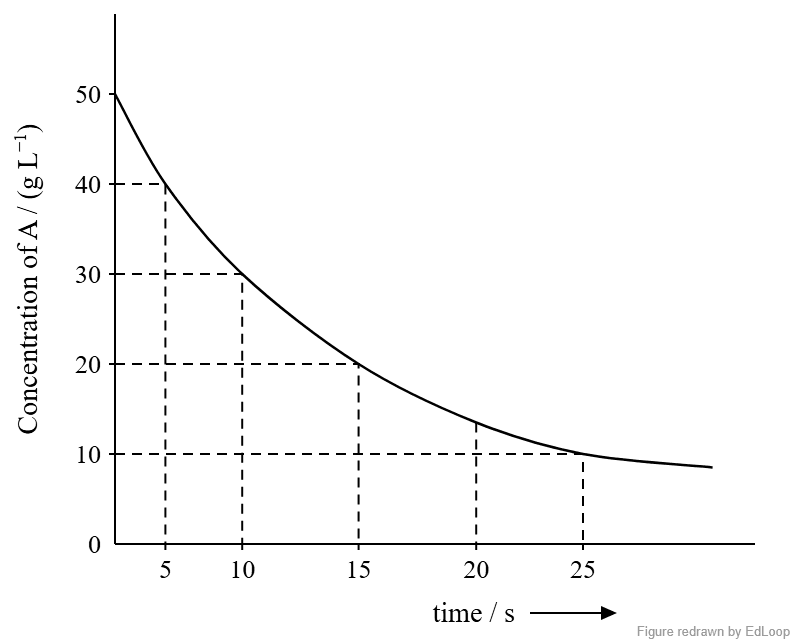
For the reaction $A \rightarrow B$ the following graph was obtained.
(see the figure above)
The time required (in seconds) for the concentration of $A$ to reduce to $2.5gL^{-1}$ (if the initial concentration of A was $50gL^{-1}$ ) is ______ . (Nearest integer)
Given : $\log 2 = 0.3010$
The question as printed in the paper.
Numerical answer type: type your answer in EdLoop to check it
Consider a complex reaction taking place in three steps with rate constants $k_1$, $k_2$ and $k_3$ respectively. The overall rate constant $k$ is given by the expression $k = \sqrt{\frac{k_1k_3}{k_2}}$. If the activation energies of the three steps are 60,30 and 10 kJ $\mathrm{mol^{-1}}$ respectively, then the overall energy of activation in $\mathrm{kJmol^{-1}}$ is ______ (Nearest integer).
Numerical answer type: type your answer in EdLoop to check it
For the thermal decomposition of $\mathrm{N_2O_5(\ g)}$ at constant volume, the following table can be formed, for the reaction mentioned below. $2\,\mathrm{N_2O_5(\ g)} \rightarrow 2\,\mathrm{N_2O_4(\ g)} + \mathrm{O_2(\ g)}$
Sr.No
Time/s
Total pressure/(atm)
1
0
0.6
2
100
'x'
$\mathrm{x} = \ldots \times 10^{-3}$ atm [nearest integer] Given : Rate constant of the reaction is $4.606 \times 10^{-2}\ \mathrm{s^{-1}}$.
Numerical answer type: type your answer in EdLoop to check it
A $\rightarrow$ B The molecule A changes into its isomeric form B by following a first order kinetics at a temperature of 1000 K . If the energy barrier with respect to reactant energy for such isomeric transformation is 191.48 kJ $\mathrm{mol^{-1}}$ and the frequency factor is $10^{20}$, the time required for 50% molecules of A to become $B$ is ______ picoseconds (nearest integer). $[\mathrm{R} = 8.314\ \mathrm{J\ K^{-1}\ mol^{-1}}]$
Numerical answer type: type your answer in EdLoop to check it
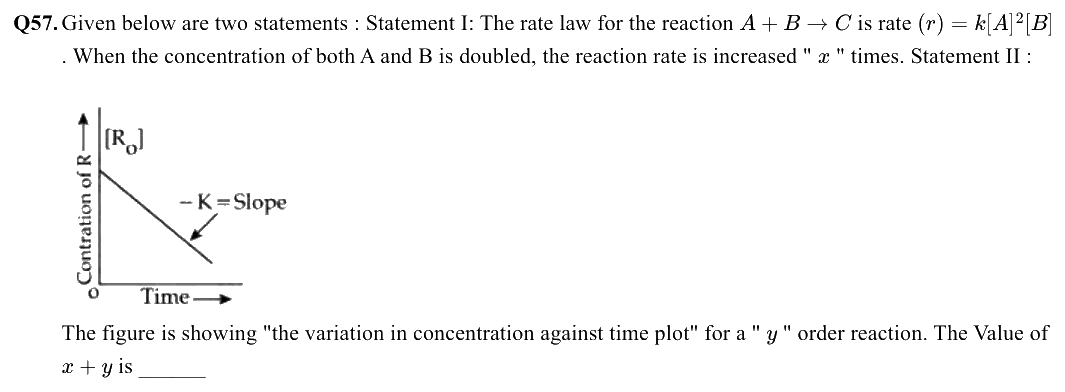
Given below are two statements: Statement I: The rate law for the reaction $A + B \rightarrow C$ is rate $(r) = k[A]^2[B]$. When the concentration of both A and B is doubled, the reaction rate is increased " $x$ " times. Statement II :
(see the figure above)
The figure is showing "the variation in concentration against time plot" for a " $y$ " order reaction. The Value of $x + y$ is ______
The question as printed in the paper.
Numerical answer type: type your answer in EdLoop to check it
Consider the following first order gas phase reaction at constant temperature $\mathrm{A(g) \rightarrow 2\,B(\,g) + C(g)}$ If the total pressure of the gases is found to be 200 torr after 23sec. and 300 torr upon the complete decomposition of A after a very long time, then the rate constant of the given reaction is ______ $\times 10^{-2}\ \mathrm{s^{-1}}$ (nearest integer) [Given : $\log_{10}(2) = 0.301$]
Numerical answer type: type your answer in EdLoop to check it
The time taken for A to become $1/4^{th}$ of its initial concentration is twice the time taken to become $1/2$ of the same. Also, when the change of concentration of $B$ is plotted against time, the resulting graph gives a straight line with a negative slope and a positive intercept on the concentration axis. The overall order of the reaction is ______
Numerical answer type: type your answer in EdLoop to check it
Consider the two different first order reactions given below $A + B \rightarrow C$ (Reaction 1) $P \rightarrow Q$ (Reaction 2) The ratio of the half life of Reaction 1 : Reaction 2 is 5 : 2. If $t_1$ and $t_2$ represent the time taken to complete $2/3^{rd}$ and $45^{th}$ of Reaction 1 and Reaction 2, respectively, then the value of the ratio $t_1 : t_2$ is ______ $\times 10^{-1}$ (nearest integer). [Given : $\log_{10}(3) = 0.477$ and $\log_{10}(5) = 0.699$]
Numerical answer type: type your answer in EdLoop to check it
Consider the following single step reaction in gas phase at constant temperature. $2\,\mathrm{A_{(g)}} + \mathrm{B_{(g)}} \rightarrow \mathrm{C_{(g)}}$ The initial rate of the reaction is recorded as $\mathrm{r_1}$ when the reaction starts with 1.5 atm pressure of A and 0.7 atm pressure of B. After some time, the rate $\mathrm{r_2}$ is recorded when the pressure of C becomes 0.5 atm. The ratio $\mathrm{r_1}$ : $\mathrm{r_2}$ is ______ $\times 10^{-1}$. (Nearest integer)
Numerical answer type: type your answer in EdLoop to check it
Consider the following transformation involving first order elementary reaction in each step at constant temperature as shown below. $A + B$ Step 1$C$ $\longrightarrow P$ Some details of the above reactions are listed below.
Step
Rate constant ($\mathrm{sec^{-1}}$)
Activation energy ($\mathrm{kJ\ mol^{-1}}$)
1
$\mathrm{k_1}$
300
2
$\mathrm{k_2}$
200
3
$\mathrm{k_3}$
$\mathrm{Ea_3}$
If the overall rate constant of the above transformation ($k$) is given as $k = \frac{k_1 k_2}{k_3}$ and the overall activation energy ($\mathrm{E_a}$) is 400 kJ mol$^{-1}$, then the value of $\mathrm{Ea_3}$ is ______ kJmol$^{-1}$ (nearest integer)
Numerical answer type: type your answer in EdLoop to check it
Consider the following reaction, the rate expression of which is given below
$\mathrm{A + B \rightarrow C}$
rate = k[A]$^{1/2}$[B]$^{1/2}$
The reaction is initiated by taking 1M concentration of A and B each. If the rate constant (k) is $4.6 \times 10^{-2}\,\mathrm{s^{-1}}$ , then the time taken for A to become 0.1M is ______ sec. (nearest integer)
Numerical answer type: type your answer in EdLoop to check it
The ratio of $\frac{^{14}\mathrm{C}}{^{12}\mathrm{C}}$ in a piece of wood is $\frac{1}{8}$ part that of atmosphere. If half life of $^{14}\mathrm{C}$ is 5730 years, the age of wood sample is ..... years.
Numerical answer type: type your answer in EdLoop to check it
The rate of first order reaction is 0. 04 mol L$^{-1}$ s$^{-1}$ at 10 minutes and 0. 03 mol L$^{-1}$ s$^{-1}$ at 20 minutes after initiation. Half life of the reaction is ______ minutes. (Given log 2 = 0. 3010, log 3 = 0. 4771) Round off your answer to the nearest integer.
Numerical answer type: type your answer in EdLoop to check it
The initial concentration of $\mathrm{N_2O_5}$ is 3 mol $\mathrm{L^{-1}}$ and it is 2.75 mol $\mathrm{L^{-1}}$ after 30 minutes. The rate of formation of $\mathrm{NO_2}$ is $x \times 10^{-3}$ mol $\mathrm{L^{-1}}$ min$_{-1}$, value of x is ______.
Numerical answer type: type your answer in EdLoop to check it
For a reaction taking place in three steps at same temperature, overall rate constant K = $\frac{K_1 K_2}{K_3}$. If $\mathrm{Ea_1}$, $\mathrm{Ea_2}$ and $\mathrm{Ea_3}$ are 40, 50 and 60 kJ / mol respectively, the overall Ea is ______ kJ / mol.
Numerical answer type: type your answer in EdLoop to check it
For a reversible reaction A $\rightleftharpoons$ B, the $\Delta$H forward reaction = 20 kJ mol$^{-1}$. The activation energy of the uncatalyzed forward reaction is 300 kJ mol$^{-1}$. When the reaction is catalysed keeping the reactant concentration same, the rate of the catalysed forward reaction at 27°C is found to be same as that of the uncatalyzed reaction at 327°C. The activation energy of the catalysed backward reaction is ______ kJ mol$^{-1}$
Numerical answer type: type your answer in EdLoop to check it
$\mathrm{t_{87.5}}$ is the time required for the reaction to undergo 87.5% completion and $\mathrm{t_{50}}$ is the time required for the reaction to undergo 50% completion. The relation between $\mathrm{t_{87.5}}$ and $\mathrm{t_{50}}$ for a first order reaction is $\mathrm{t_{87.5}}$ = x $\times$ $\mathrm{t_{50}}$ The value of x is ______. (Nearest integer)
Numerical answer type: type your answer in EdLoop to check it
$\mathrm{A(g) \rightarrow 2B(g) + C(g)}$ is a first order reaction. The initial pressure of the system was found to be 800 mm Hg which increased to 1600 mm Hg after 10 min. The total pressure of the system after 30 min will be mm Hg. (Nearest integer)
Numerical answer type: type your answer in EdLoop to check it
The reaction $2\mathrm{NO} + \mathrm{Br_2} \rightarrow 2\,\mathrm{NOBr}$ takes place through the mechanism given below $\mathrm{NO} + \mathrm{Br_2} \rightleftharpoons \mathrm{NOBr_2}$ (fast) $\mathrm{NOBr_2} + \mathrm{NO} \rightarrow 2\,\mathrm{NOBr}$ (slow) The overall order of the reaction is ______.
Numerical answer type: type your answer in EdLoop to check it
$\mathrm{KClO_3} + 6\mathrm{FeSO_4} + 3\mathrm{H_2SO_4} \rightarrow \mathrm{KCl} + 3\mathrm{Fe_2(SO_4)_3} + 3\mathrm{H_2O}$ The above reaction was studied at 300 K by monitoring the concentration of $\mathrm{FeSO_4}$ in which initial concentration was 10 M and after half an hour became 8.8 M. The rate of production of $\mathrm{Fe_2(SO_4)_3}$ is ______ $\times 10^{-6}\ \mathrm{mol\ L^{-1}\ s^{-1}}$ (Nearest integer)
Numerical answer type: type your answer in EdLoop to check it
A molecule undergoes two independent first order reactions whose respective half lives are 12 min and 3 min. If both the reactions are occurring then the time taken for the 50% consumption of the reactant is ______ min. (Nearest integer)
Numerical answer type: type your answer in EdLoop to check it
$\mathrm{A(g)} \rightleftharpoons 2\,\mathrm{B(g)} + \mathrm{C(g)}$ For the given reaction, if the initial pressure is 450 mmHg and the pressure at time t is 720 mmHg at a constant temperatureT and constant volume V. The fraction of $\mathrm{A(g)}$ decomposed under these conditions is $x \times 10^{-1}$. The value of x is (nearest integer)
Numerical answer type: type your answer in EdLoop to check it
The number of incorrect statement/s from the following is ______ A. The successive half lives of zero order reactions decreases with time. B. A substance appearing as reactant in the chemical equation may not affect the rate of reaction C. Order and molecularity of a chemical reaction can be fractional number D. The rate constant units of zero and second order reaction are $\mathrm{mol\,L^{-1}\,s^{-1}}$ and $\mathrm{mol^{-1}\,L\,s^{-1}}$ respectively
Numerical answer type: type your answer in EdLoop to check it
The number of given statement/s which is/are correct is ______ (A) The stronger the temperature dependence of the rate constant, the higher is the activation energy. (B) If a reaction has zero activation energy, its rate is independent of temperature. (C) The stronger the temperature dependence of the rate constant, the smaller is the activation energy. (D) If there is no correlation between the temperature and the rate constant then it means that the reaction has negative activation energy.
Numerical answer type: type your answer in EdLoop to check it
For the adsorption of hydrogen on platinum, the activation energy is $30\ \mathrm{kJ\ mol^{-1}}$ and for the adsorption of hydrogen on nickel, the activation energy is $41.4\ \mathrm{kJ\ mol^{-1}}$. The logarithm of the ratio of the rates of chemisorption on equal areas of the metals at $300\ \mathrm{K}$ is ______ (Nearest integer)
Given: $\ln 10 = 2.3$
$R = 8.3\ \mathrm{J\,K^{-1}\ mol^{-1}}$
Numerical answer type: type your answer in EdLoop to check it
A and B are two substances undergoing radioactive decay in a container. The half life of A is 15 min and that of B is 5 min. If the initial concentration of B is 4 times that of A and they both start decaying at the same time, how much time will it take for the concentration of both of them to be same? ______ min.
Numerical answer type: type your answer in EdLoop to check it
A $\rightarrow$ B The above reaction is of zero order. Half life of this reaction is 50 min. The time taken for the concentration of A to reduce to one-fourth of its initial value is ______ min . (Nearest integer)
Numerical answer type: type your answer in EdLoop to check it
$\mathrm{A} \rightarrow \mathrm{B}$ The rate constants of the above reaction at 200 $\mathrm{K}$ and 300 $\mathrm{K}$ are 0.03 $\mathrm{min^{-1}}$ and 0.05 $\mathrm{min^{-1}}$ respectively. The activation energy for the reaction is ______ J (Nearest integer) (Given : $\ln 10$ = 2.3 R = 8.3 $\mathrm{J\ K^{-1}\ mol^{-1}}$ $\log 5$ = 0.70 $\log 3$ = 0.48 $\log 2$ = 0.30
Numerical answer type: type your answer in EdLoop to check it
The rate constant for a first order reaction is 20 min$^{-1}$. The time required for the initial concentration of the reactant to reduce to its $\frac{1}{32}$ level is ______ $\times 10^{-2}$ min. (Nearest integer)
Numerical answer type: type your answer in EdLoop to check it
If compound A reacts with B following first order kinetics with rate constant $2.011 \times 10^{-3}$ s$^{-1}$. The time taken by A (in seconds) to reduce from 7 g to 2 g will be ______ . (Nearest Integer) log5 = 0.698, log7 = 0.845, log2 = 0.301
Numerical answer type: type your answer in EdLoop to check it
An organic compound undergoes first order decomposition. If the time taken for the 60% decomposition is 540 s, then the time required for 90% decomposition will be is ______ s. (Nearest integer). Given : ln 10 = 2.3; log 2 = 0.3
Numerical answer type: type your answer in EdLoop to check it
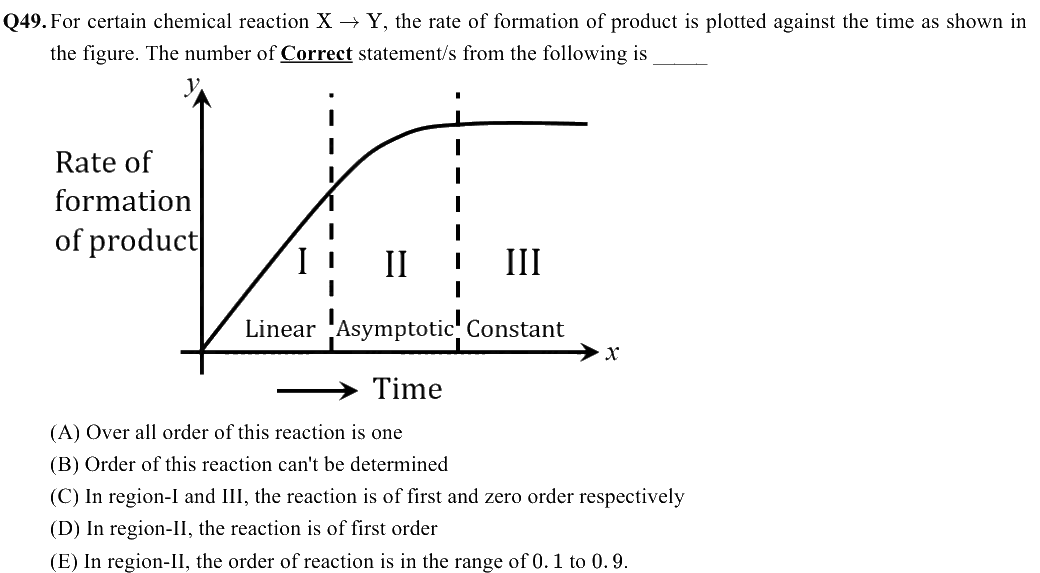
For certain chemical reaction $\mathrm{X \rightarrow Y}$, the rate of formation of product is plotted against the time as shown in the figure. The number of Correct statement/s from the following is ______
(see the figure above)
(A) Over all order of this reaction is one (B) Order of this reaction can't be determined (C) In region-I and III, the reaction is of first and zero order respectively (D) In region-II, the reaction is of first order (E) In region-II, the order of reaction is in the range of $0.1$ to $0.9$.
The question as printed in the paper.
Numerical answer type: type your answer in EdLoop to check it
For conversion of compound A $\rightarrow$ B, the rate constant of the reaction was found to be $4.6 \times 10^{-5}\ \mathrm{L\,mol^{-1}\,s^{-1}}$. The order of the reaction is ______ .
Numerical answer type: type your answer in EdLoop to check it
For the first order reaction A $\to$ B the half life is 30 min. The time taken for 75% completion of the reaction is ______ min. (Nearest integer) Given : $\log 2 = 0.3010$ $\log 3 = 0.4771$ $\log 5 = 0.6989$
Numerical answer type: type your answer in EdLoop to check it
A first order reaction has the rate constant, k = $4.6\times10^{-3}\ \mathrm{s^{-1}}$. The number of correct statement/s from the following is/are Given: log 3 = 0.48.
A. Reaction completes in 1000 s.
B. The reaction has a half-life of 500 s.
C. The time required for 10% completion is 25 times the time required for 90% completion.
D. The degree of dissociation is equal to $(1-e^{-kt})$.
E. The rate and the rate constant have the same unit.
Numerical answer type: type your answer in EdLoop to check it
The reaction between X and Y is first order with respect to X and zero order with respect to Y. Experiment | $\frac{[X]}{\mathrm{mol L^{-1}}}$ | $\frac{[Y]}{\mathrm{mol L^{-1}}}$ | $\frac{\text{Initial rate}}{\mathrm{mol L^{-1} min^{-1}}}$ I | 0.1 | 0.1 | $2 \times 10^{-3}$ II | L | 0.2 | $4 \times 10^{-3}$ III | 0.4 | 0.4 | M $\times 10^{-3}$ IV | 0.1 | 0.2 | $2 \times 10^{-3}$ Examine the data of table and calculate ratio of numerical values of M and L.
Numerical answer type: type your answer in EdLoop to check it
Assuming 1 $\mu$g of trace radioactive element X with a half life of 30 years is absorbed by a growing tree. The amount of X remaining in the tree after 100 years is ______ $\times 10^{-1}\ \mu$g. [Given : $\ln 10 = 2.303$; $\log 2 = 0.30$]
Numerical answer type: type your answer in EdLoop to check it
For the given first order reaction $\mathrm{A}\rightarrow\mathrm{B}$ the half life of the reaction is $0.3010\ \mathrm{min}$. The ratio of the initial concentration of reactant to the concentration of reactant at time $2.0\ \mathrm{min}$ will be equal to ______. (Nearest integer)
Numerical answer type: type your answer in EdLoop to check it
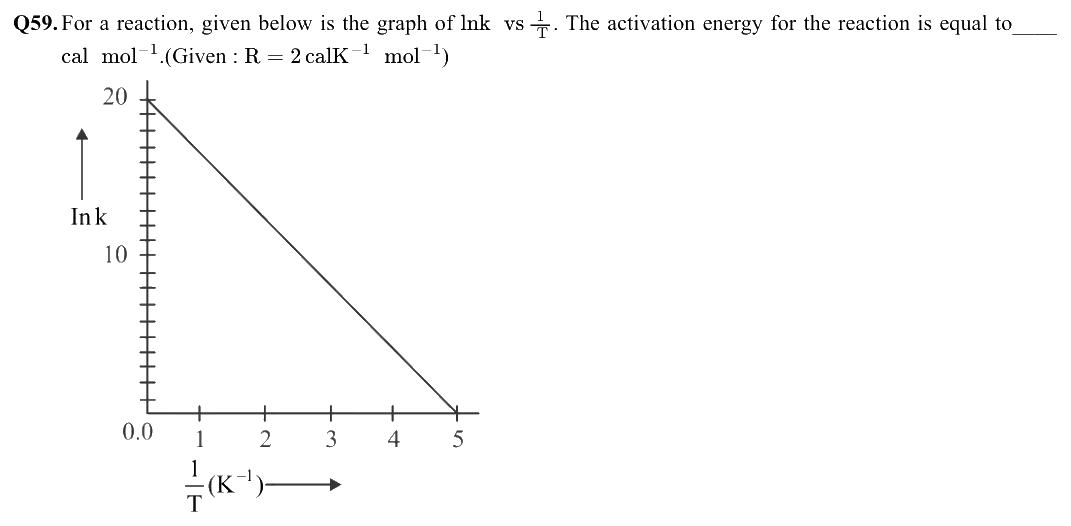
For a reaction, given below is the graph of $\ln k$ vs $\frac{1}{T}$. The activation energy for the reaction is equal to ______ $\mathrm{cal\ mol^{-1}}$.(Given : $\mathrm{R}=2\ \mathrm{cal K^{-1}\ mol^{-1}}$)
(see the figure above)
The question as printed in the paper.
Numerical answer type: type your answer in EdLoop to check it
$2\mathrm{NO} + 2\mathrm{H_2} \rightarrow \mathrm{N_2} + 2\mathrm{H_2O}$ The above reaction has been studied at 800 $^\circ$C. The related data are given in the table below
$[\mathrm{A}]$ $\rightarrow$ $[\mathrm{B}]$ Reactant Product If formation of compound [B] follows the first order of kinetics and after 70 minutes the concentration of [A] was found to be half of its initial concentration. Then the rate constant of the reaction is x $\times$ $10^{-6}$ $\mathrm{s^{-1}}$. The value of x is ______
Numerical answer type: type your answer in EdLoop to check it
For a reaction $\mathrm{A} \rightarrow 2\mathrm{B} + \mathrm{C}$ the half lives are 100 s and 50 s when the concentration of reactant A is 0.5 and 1.0 mol L = respectively. The order of the reaction is
Numerical answer type: type your answer in EdLoop to check it
The half life for the decomposition of gaseous compound A is 240 s when the gaseous pressure was 500 Torr initially. When the pressure was 250 Torr, the half life was found to be $4.0$ min. The order of the reaction is ______ (Nearest integer)
Numerical answer type: type your answer in EdLoop to check it
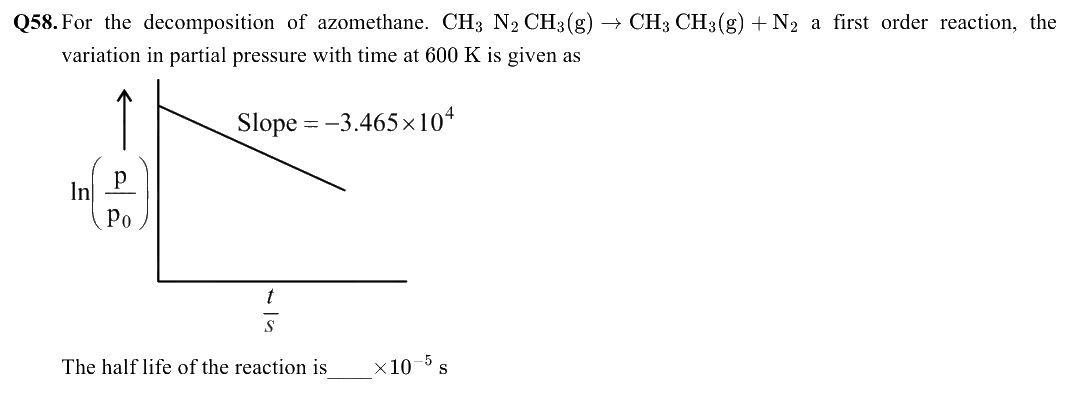
For the decomposition of azomethane. $\mathrm{CH_3\ N_2\ CH_3(g) \rightarrow CH_3\ CH_3(g) + N_2}$ a first order reaction, the variation in partial pressure with time at 600 K is given as
(see the figure above) The half life of the reaction is ______ $\times 10^{-5}$ s
The question as printed in the paper.
Numerical answer type: type your answer in EdLoop to check it
The activation energy of one of the reactions in a biochemical process is $532611\ \mathrm{J\ mol^{-1}}$. When the temperature falls from $310\ \mathrm{K}$ to $300\ \mathrm{K}$, the change in rate constant observed is $\mathrm{k_{300}} = \mathrm{x} \times 10^{-3}\mathrm{k_{310^\circ}}$. The value of x is [Given: $\ln 10 = 2.3\ \mathrm{R} = 8.3\ \mathrm{J\ K^{-1}\ mol^{-1}}$]
Numerical answer type: type your answer in EdLoop to check it
The equation $\mathrm{k} = \left(6.5 \times 10^{12}\ \mathrm{s^{-1}}\right)e^{-26000\ \mathrm{K/T}}$ is followed for the decomposition of compound A. The activation energy for the reaction is ______ $\mathrm{KJ\ mol^{-1}}$. [nearest integer] (Given: $\mathrm{R} = 8.314\ \mathrm{J\,K^{-1}\ mol^{-1}}$)
Numerical answer type: type your answer in EdLoop to check it
For a first order reaction $\mathrm{A \rightarrow B}$, the rate constant, k $= 5.5 \times 10^{-14}\ \mathrm{s^{-1}}$. The time required for 67% completion of reaction is x $\times 10^{-1}$ times the half life of reaction. The value of x is Nearest integer) (Given : $\log 3 = 0.4771$)
Numerical answer type: type your answer in EdLoop to check it
A radioactive element has a half life of 200 days. The percentage of original activity remaining after 83 days is ______ (Nearest integer) (Given : antilog 0.125 = 1.333, antilog 0.693 = 4.93)
Numerical answer type: type your answer in EdLoop to check it
The rate constant for a first order reaction is given by the following equation : $\ln k = 33.24 - \frac{2.0 \times 10^{4}\ \mathrm{K}}{T}$ The Activation energy for the reaction is given by ______ $\mathrm{kJ\,mol^{-1}}$. (In Nearest integer) (Given : $\mathrm{R} = 8.3\ \mathrm{J\ K^{-1}\ mol^{-1}}$)
Numerical answer type: type your answer in EdLoop to check it
It has been found that for a chemical reaction with rise in temperature by 9 K the rate constant gets doubled. Assuming a reaction to be occurring at 300 K, the value of activation energy is found to be $\mathrm{kJ\,mol^{-1}}$. [nearest integer] (Given $\ln 10 = 2.3, \mathrm{R} = 8.3\ \mathrm{J\ K^{-1}\ mol^{-1}}, \log 2 = 0.30$)
Numerical answer type: type your answer in EdLoop to check it
A flask is filled with equal moles of A and B. The half lives of A and B are $100 \mathrm{~s}$ and $50 \mathrm{~s}$ respectively and are independent of the initial concentration. The time required for the concentration of A to be four times that of B is ______ s. (Given : $\ln 2 = 0.693$)
Numerical answer type: type your answer in EdLoop to check it
Catalyst A reduces the activation energy for a reaction by $10 \mathrm{~kJ} \mathrm{~mol}^{-1}$ at $300 \mathrm{~K}$. The ratio of rate constants, $\frac{k_{T, \mathrm{Catalysed}}}{k_{T, \mathrm{Uncatalysed}}}$ is $\mathrm{e}^x$. The value of x is ______ [nearest integer] [Assume that the pre-exponential factor is same in both the cases. Given $\mathrm{R} = 8.31 \mathrm{~J} \mathrm{~K}^{-1} \mathrm{~mol}^{-1}$]
Numerical answer type: type your answer in EdLoop to check it
For a given chemical reaction $\gamma_1 \mathrm{A} + \gamma_2 \mathrm{B} \rightarrow \gamma_3 \mathrm{C} + \gamma_4 \mathrm{D}$. Concentration of C changes from $10 \mathrm{~mmol} \mathrm{~dm}^{-3}$ to $20 \mathrm{~mmol} \mathrm{~dm}^{-3}$ in $10 \mathrm{~s}$. Rate of appearance of D is $1.5$ times the rate of disappearance of B which is twice the rate of disappearance A. The rate of appearance of D has been experimentally determined to be $9 \mathrm{~mmol} \mathrm{~dm}^{-3}\mathrm{s}^{-1}$. Therefore the rate of reaction is ______ $\mathrm{mmol} \mathrm{~dm}^{-3}\mathrm{s}^{-1}$. (Nearest Integer)
Numerical answer type: type your answer in EdLoop to check it
At $345 \mathrm{~K}$, the half life for the decomposition of a sample of a gaseous compound initially at $55.5 \mathrm{~kPa}$ was $340 \mathrm{~s}$. When the pressure was $27.8 \mathrm{~kPa}$, the half life was found to be $170 \mathrm{~s}$. The order of the reaction is - [integer answer]
Numerical answer type: type your answer in EdLoop to check it
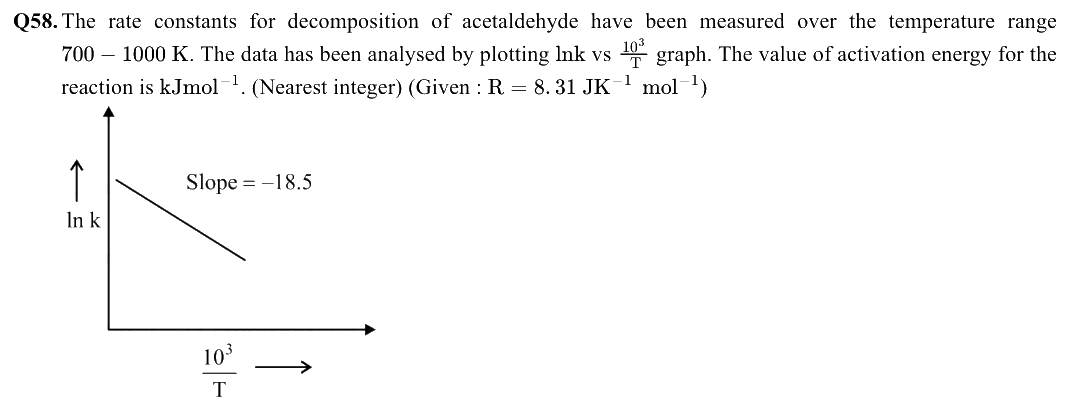
The rate constants for decomposition of acetaldehyde have been measured over the temperature range $700 - 1000 \mathrm{~K}$. The data has been analysed by plotting $\mathrm{ln k}$ vs $\frac{10^3}{\mathrm{T}}$ graph. The value of activation energy for the reaction is $\mathrm{kJ mol^{-1}}$. (Nearest integer) (Given : $\mathrm{R} = 8.31 \mathrm{~JK^{-1}~mol^{-1}}$) (see the figure above)
The question as printed in the paper.
Numerical answer type: type your answer in EdLoop to check it
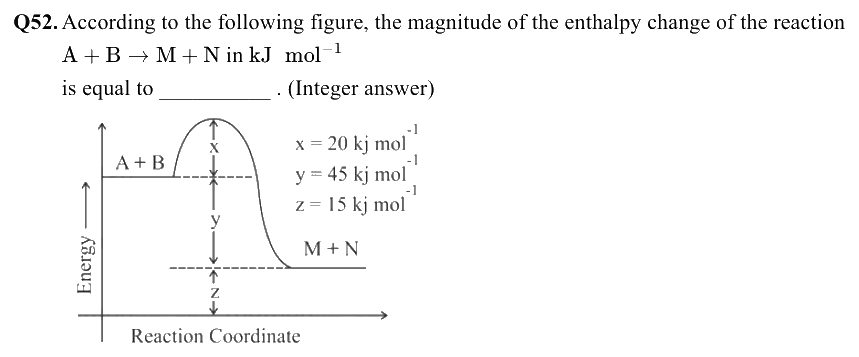
According to the following figure, the magnitude of the enthalpy change of the reaction $\mathrm{A} + \mathrm{B} \rightarrow \mathrm{M} + \mathrm{N}$ in kJ mol$^{-1}$ is equal to ______. (Integer answer) (see the figure above)
The question as printed in the paper.
Numerical answer type: type your answer in EdLoop to check it
For the reaction A $\rightarrow$ B, the rate constant k (in s$^{-1}$) is given by $\log_{10}\mathrm{k} = 20.35 - \frac{2.47 \times 10^3}{\mathrm{T}}$ The energy of activation in kJ mol$^{-1}$ is ______. (Nearest integer) [Given : R = $8.314$ J K$^{-1}$ mol$^{-1}$]
Numerical answer type: type your answer in EdLoop to check it
The reaction that occurs in a breath analyser, a device used to determine the alcohol level in a person's blood stream is $2\ \mathrm{K_2Cr_2O_7} + 8\mathrm{H_2SO_4} + 3\mathrm{C_2H_6O} \rightarrow 2\ \mathrm{Cr_2(SO_4)_3} + 3\mathrm{C_2H_4O_2} + 2\ \mathrm{K_2SO_4} + 11\mathrm{H_2O}$ If the rate of appearance of $\mathrm{Cr_2(SO_4)_3}$ is $2.67$ mol min$^{-1}$ at a particular time, the rate of disappearance of $\mathrm{C_2H_6O}$ at the same time is mol min$^{-1}$. (Nearest integer)
Numerical answer type: type your answer in EdLoop to check it
The first order rate constant for the decomposition of $\mathrm{CaCO_3}$ at $700\ \mathrm{K}$ is $6.36\times10^{-3}\ \mathrm{s^{-1}}$ and activation energy is $209\ \mathrm{kJ\ mol^{-1}}$. Its rate constant (in $\mathrm{s^{-1}}$) at $600\ \mathrm{K}$ is $\mathrm{x}\times10^{-6}$. The value of x is (Nearest integer) [Given $R=8.31\ \mathrm{J\ K^{-1}\ mol^{-1}}$; $\log6.36\times10^{-3}=-2.19$, $10^{-4.79}=1.62\times10^{-5}$]
Numerical answer type: type your answer in EdLoop to check it
The following data was obtained for chemical reaction given below at 975 K. $\mathrm{2\,NO_{(g)}+2H_{2(g)}\rightarrow N_{2(g)}+2H_2O_{(g)}}$ Table of three experiments, columns [NO] in $\mathrm{mol\ L^{-1}}$, $[\mathrm{H_2}]$ in $\mathrm{mol\ L^{-1}}$ and Rate in $\mathrm{mol L^{-1}\ s^{-1}}$: $(A)$ $8\times10^{-5}$, $8\times10^{-5}$, $7\times10^{-9}$ $(B)$ $24\times10^{-5}$, $8\times10^{-5}$, $2.1\times10^{-8}$ $(C)$ $24\times10^{-5}$, $32\times10^{-5}$, $8.4\times10^{-8}$ The order of the reaction with respect to NO_____ is [Integer answer]
Numerical answer type: type your answer in EdLoop to check it
For the first order reaction $\mathrm{A \rightarrow 2B}$, 1 mole of reactant A gives 0.2 moles of $B$ after 100 minutes. The half life of the reaction is ______ min. (Round off to the nearest integer). [Use : $\ln 2 = 0.69$, $\ln 10 = 2.3$ Properties of logarithms : $\ln x^y = y\ln x$ $\ln\left(\frac{x}{y}\right) = \ln x - \ln y$] (Round off to the nearest integer)
Numerical answer type: type your answer in EdLoop to check it
For a chemical reaction A $\to$ B, it was found that concentration of B is increased by $0.2\ \mathrm{mol\ L^{-1}}$ in $30\ \mathrm{min}$. The average rate of the reaction is ______ $\times 10^{-1}\ \mathrm{mol\ L^{-1}\ h^{-1}}$. (in nearest integer)
Numerical answer type: type your answer in EdLoop to check it
$\mathrm{N_2O_{5(g)}} \to 2\mathrm{NO_{2(g)}} + \frac{1}{2}\mathrm{O_{2(g)}}$ In the above first order reaction the initial concentration of $\mathrm{N_2O_5}$ is $2.40 \times 10^{-2}\ \mathrm{mol\ L^{-1}}$ at $318\ \mathrm{K}$. The concentration of $\mathrm{N_2O_5}$ after 1 hour was $1.60 \times 10^{-2}\ \mathrm{mol\ L^{-1}}$. The rate constant of the reaction at $318\ \mathrm{K}$ is ______ $\times 10^{-3}\ \mathrm{min^{-1}}$ (Nearest integer): [ Given : $\log 3 = 0.477$, $\log 5 = 0.699$]
Numerical answer type: type your answer in EdLoop to check it
The inactivation rate of a viral preparation is proportional to the amount of virus. In the first minute after preparation, $10\%$ of the virus is inactivated. The rate constant for viral inactivation is ______ $\times 10^{-3}\ \mathrm{min^{-1}}$. (Nearest integer) [Use : $\ln 10 = 2.303$; $\log_{10} 3 = 0.477$ property of logarithm: $\log x^y = y \log x$]
Numerical answer type: type your answer in EdLoop to check it
$\mathrm{PCl_5(g)} \rightarrow \mathrm{PCl_3(g)} + \mathrm{Cl_2(g)}$ In the above first order reaction the concentration of $\mathrm{PCl_5}$ reduces from initial concentration $50~\mathrm{mol~L^{-1}}$ to $10~\mathrm{mol~L^{-1}}$ in 120 minutes at 300 K. The rate constant for the reaction at 300 K is $\mathrm{x} \times 10^{-2}~\mathrm{min^{-1}}$. The value of x is ______ . [Given $\log 5 = 0.6989$]
Numerical answer type: type your answer in EdLoop to check it
$2\,\mathrm{NO(g)} + \mathrm{Cl_2(\,g)} \rightleftharpoons 2\,\mathrm{NOCl(s)}$ This reaction was studied at $-10^\circ\mathrm{C}$ and the following data was obtained run $[\mathrm{NO}]_0$ $[\mathrm{Cl_2}]_0$ $\mathrm{r_0}$ 1 0.10 0.10 0.18 2 0.10 0.20 0.35 3 0.20 0.20 1.40 $[\mathrm{NO}]_0$ and $[\mathrm{Cl_2}]_0$ are the initial concentrations and $\mathrm{r_0}$ is the initial reaction rate. The overall order of the reaction is (Round off to the Nearest Integer).
Numerical answer type: type your answer in EdLoop to check it
A reaction has a half life of $1~\mathrm{min}$. The time required for $99.9\%$ completion of the reaction is ______ min. (Round off to the Nearest integer) [Use : $\ln 2 = 0.69$, $\ln 10 = 2.3$]
Numerical answer type: type your answer in EdLoop to check it
For a certain first order reaction $32 \%$ of the reactant is left after 570 s. The rate constant of this reaction is $\times 10^{-3} \mathrm{~s}^{-1}$. (Round off to the Nearest Integer). [Given: $\log _{10} 2=0.301, \ln 10=2.303$]
Numerical answer type: type your answer in EdLoop to check it
The reaction $2 \mathrm{~A}+\mathrm{B}_2 \rightarrow 2 \mathrm{AB}$ is an elementary reaction. For a certain quantity of reactants, if the volume of the reaction vessel is reduced by a factor of 3, the rate of the reaction increases by a factor of ______. (Round off to the Nearest Integer).
Numerical answer type: type your answer in EdLoop to check it
The decomposition of formic acid on gold surface follows first order kinetics. If the rate constant at 300 K is $1.0 \times 10^{-3} \mathrm{~s}^{-1}$ and the activation energy $\mathrm{E}_{\mathrm{a}}=11.488 \mathrm{~kJ} \mathrm{~mol}^{-1}$, the rate constant at 200 K is ______ $\times 10^{-5} \mathrm{~s}^{-1}$. (Round of to the Nearest Integer). (Given $\mathrm{R}=8.314 \mathrm{~J} \mathrm{~mol}^{-1} \mathrm{~K}^{-1}$)
Numerical answer type: type your answer in EdLoop to check it
A and B decompose via first order kinetics with half-lives $54.0\ \mathrm{min}$ and $18.0\ \mathrm{min}$ respectively. Starting from an equimolar non-reactive mixture of A and B, the time taken for the concentration of A to become 16 times that of B is ______ min. (Round off to the Nearest Integer).
Numerical answer type: type your answer in EdLoop to check it
An exothermic reaction $\mathrm{X \rightarrow Y}$ has an activation energy $30\ \mathrm{kJ\ mol^{-1}}$. If energy change $\Delta\mathrm{E}$ during the reaction is $-20\ \mathrm{kJ}$, then the activation energy for the reverse reaction in kJ is ______ (Integer answer)
Numerical answer type: type your answer in EdLoop to check it
If the activation energy of a reaction is $80.9\ \mathrm{kJ\ mol^{-1}}$, the fraction of molecules at $700\ \mathrm{K}$, having enough energy to react to form products is $\mathrm{e^{-x}}$. The value of x is (Rounded off to the nearest integer) [Use R = $8.31\ \mathrm{J\ K^{-1}\ mol^{-1}}$]
Numerical answer type: type your answer in EdLoop to check it
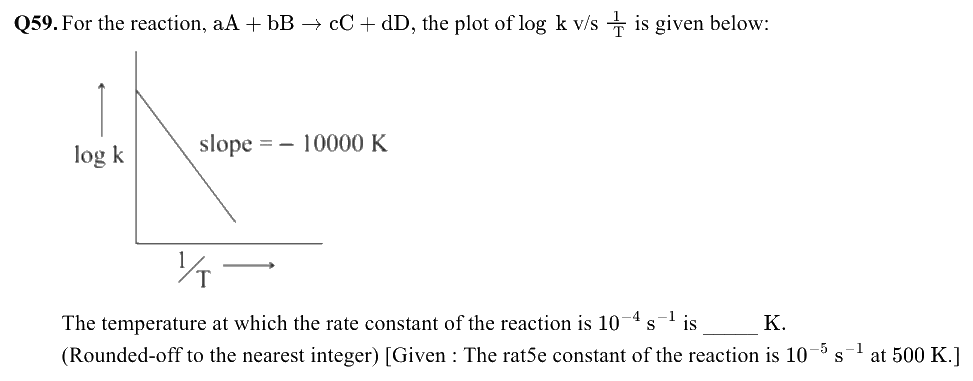
For the reaction, $\mathrm{aA + bB \rightarrow cC + dD}$, the plot of $\log\ \mathrm{k}$ v/s $\frac{1}{\mathrm{T}}$ is given below: (see the figure above) The temperature at which the rate constant of the reaction is $10^{-4}\ \mathrm{s^{-1}}$ is ______ K. (Rounded-off to the nearest integer) [Given : The rat5e constant of the reaction is $10^{-5}\ \mathrm{s^{-1}}$ at 500 K.]
The question as printed in the paper.
Numerical answer type: type your answer in EdLoop to check it
The rate constant of a reaction increases by five times on increase in temperature from $27^\circ\mathrm{C}$ to $52^\circ\mathrm{C}$. The value of activation energy in $\mathrm{kJmol^{-1}}$ is ______ .(Rounded-off to the nearest integer) $[R = 8.314\ \mathrm{J\ K^{-1}\ mol^{-1}}]$
Numerical answer type: type your answer in EdLoop to check it
Gaseous cyclobutene isomerizes to butadiene in a first order process which has a 'K' value of $3.3 \times 10^{-4}\ \mathrm{s^{-1}}$ at $153^\circ\mathrm{C}$. The time in minutes it takes for the isomerization to proceed $40\%$ to completion at this temperature is ______. (Rounded off to the nearest integer)
Numerical answer type: type your answer in EdLoop to check it
Sucrose hydrolyses in acid solution into glucose and fructose following first order rate law with a half-life of $3.33\ \mathrm{h}$ at $25^\circ\mathrm{C}$. After $9\ \mathrm{h}$, the fraction of sucrose remaining is f. The value of $\log_{10}\left(\frac{1}{\mathrm{f}}\right)$ is ______ $\times 10^{-2}$. (Rounded off to the nearest integer) [Assume: $\ln 10 = 2.303$, $\ln 2 = 0.693$]
Numerical answer type: type your answer in EdLoop to check it
The rate of a reaction decreased by 3.555 times when the temperature was changed from $40\ ^\circ\mathrm{C}$ to $30\ ^\circ\mathrm{C}$. the activation energy (in $\mathrm{kJ\ mol^{-1}}$) of the reaction is ______.
Numerical answer type: type your answer in EdLoop to check it
If $75\,\%$ of a first order reaction was completed in 90 minutes, $60\,\%$ of the same reaction would be completed in approximately (in minutes) ______ (Take: $\log 2\ =\ 0.30$ ; $\log 2.5\ =\ 0.40$)
Numerical answer type: type your answer in EdLoop to check it
The number of molecules with energy greater than the threshold energy for a reaction increases five fold by a rise of temperature from $27^{\circ}\mathrm{C}$ to $42^{\circ}\mathrm{C}$. Its energy of activation in J/ mol is ______ (Take $\ln\ 5 = 1.6094$; $\mathrm{R} = 8.314\ \mathrm{J\ mol^{-1}}$)
Numerical answer type: type your answer in EdLoop to check it
A sample of milk splits after 60min . at 300K and after 40min . at 400K when the population of lactobacillus acidophilus in it doubles. The activation energy (in kJ / mol ) for this process is closest to ______. (Given, R $= 8.3\mathrm{Jmol^{-1}K^{-1}}$, $\ln\left(\frac{2}{3}\right) = 0.4$, $\mathrm{e^{-3}} = 4.0$ )
Numerical answer type: type your answer in EdLoop to check it
During the nuclear explosion, one of the products is $^{90}\mathrm{Sr}$ with half life of $6.93$ years. If $1\mu\mathrm{g}$ of $^{90}\mathrm{Sr}$ was absorbed in the bones of a newly born baby in place of Ca, how much time, in years, is required to reduce it by $90\%$ if it is not lost metabolically ______ .
Numerical answer type: type your answer in EdLoop to check it
Chemical kinetics deals with reaction speeds and reaction mechanisms under Unit 8: Chemical Kinetics in the Class 12 curriculum, holding rank 10 of 31 chemistry chapters with a 3.9% share of all chemistry questions. In the 2019 to 2026 period, Chemical Kinetics accounted for 178 questions across 162 papers, holding a 3.9% share of all chemistry questions and ranking 10 of 31 chapters. During earlier testing between 2002 and 2018, it represented 57 questions across 38 papers with a 4.2% share. Looking at 2024 to 2026, the volume rose to 73 questions in 58 papers, taking a 4.7% subject share. The chapter's trajectory has trended up across recent shifts.
The topic has appeared every year from 2019 to 2026. Students routinely encounter at least one question per test, averaging 1.1 questions per paper across 2019 to 2026 and 1.3 per paper in the 2024 to 2026 window. Additionally, numerical value problems feature very heavily here: 105 numerical answer questions were presented between 2019 and 2026.
Most-asked topics
The syllabus divides into three core topics:
Integrated Rate Laws: The single largest area with 102 total questions (82 in 2019 to 2026), examined up through 2026. Focus areas include first-order rate equations, half-life relationships, fractional life calculations, graphical plots of concentration versus time, and gaseous decomposition reactions using partial pressures.
Temperature Dependence & Mechanism: Accounted for 75 total questions (59 in 2019 to 2026), continuing into 2026. This area centers on the Arrhenius equation, activation energy calculations, temperature coefficients, catalyst influences, and multi-step reaction mechanisms identifying the rate-determining step.
Rate of Reaction: Comprises 58 total questions (37 in 2019 to 2026), asked up through 2026. Key ideas involve average and instantaneous rates, stoichiometric rate expressions, rate laws, and overall reaction order determination from experimental rate tables.
What the questions look like
Examiners present clear mathematical problems and conceptual graphs. A significant portion tests first-order kinetics, such as finding the time required for a specific percentage completion or linking rate constants to half-lives. Gaseous reactions requiring total pressure data at various times frequently appear in numerical answer sections.
Temperature dependence problems typically involve comparing rate constants at two different temperatures or determining activation energies via Arrhenius plots. Mechanism questions usually give elementary steps and ask students to deduce the composite rate law or the order with respect to individual reactants.
Questions to try first
Work through these representative recent problems to benchmark your understanding:
Mastering Chemical Kinetics requires fluency in logarithmic calculations and graph sketching:
1. Memorize integrated rate laws: Be confident writing integrated forms for zero-order, first-order, and general nth-order processes, including their respective half-life expressions and units of rate constants. 2. Practise gas-phase kinetics: Work out problems where partial pressures replace molar concentrations. Track pressure changes carefully using stoichiometric tables. 3. Master Arrhenius calculations: Review logarithmic properties and algebraic steps needed to solve for activation energy or temperature when ratios of rate constants are provided. 4. Interpret graphs quickly: Sketch standard curves such as concentration against time, log concentration against time, and log k against reciprocal temperature so you can extract slopes and intercepts without hesitation. 5. Solve numerical PYQs: With 105 numerical questions in 2019 to 2026, regular calculation practice prevents algebraic and rounding mistakes under time constraints.
Frequently asked questions
Are zero-order and second-order reactions important for JEE Main?
Yes, zero-order reactions frequently show up in graphical and conceptual questions. While first-order kinetics dominates numerical items, knowing the general half-life dependence on initial concentration for zero and higher orders is essential.
How should I prepare for gaseous reaction kinetics?
Focus on setting up a table of initial, reacted, and equilibrium partial pressures in terms of the variable x. Express the total pressure in terms of x and substitute into the first-order rate formula.
Is nuclear decay included under chemical kinetics?
Radioactive decay follows first-order kinetics strictly. Questions regarding radioactive half-lives and isotopic decay percentages apply the identical integrated first-order rate law. Step-by-step solutions for each one are in the EdLoop app.