Chemical Bonding & Molecular Structure: JEE Main PYQs 2002–2026
Every Chemical Bonding & Molecular Structure question from past JEE Main and AIEEE papers, with options and answers. Newest first.
304questions
179papers covered
4.7%of Chemistry questions, 2019–2026
2002–2026years
Guide at a glance
Chemical bonding and molecular structure underpins inorganic and organic chemistry under Unit 3: Chemical Bonding and Molecular Structure in the Class 11 curriculum, holding rank 6 among all 31 chemistry chapters with a 4.7 percent share of the entire chemistry section.
Bromine trifluoride autoionizes to form $\mathrm{BrF_2^{\oplus}}$ and $\mathrm{BrF_4^{\ominus}}$. The shapes of the cation and anion are respectively ________, and ________.
Statement I : The number of compounds among $\mathrm{SO_2}$, $\mathrm{SO_3}$, $\mathrm{SF_4}$, $\mathrm{SF_6}$ and $\mathrm{H_2S}$ in which sulphur does not obey the Octet rule is 3.
Statement II : Among $[\mathrm{H_2O, ClF_3, SF_4}]$, $[\mathrm{NH_3, BrF_5, SF_4}]$, $[\mathrm{BrF_5, ClF_3, XeF_4}]$ and $[\mathrm{XeF_4, ClF_3, H_2O}]$, the number of sets in which all the molecules have one lone pair of electrons on the central atom is 1.
In the light of the above statements, choose the correct answer from the options given below :
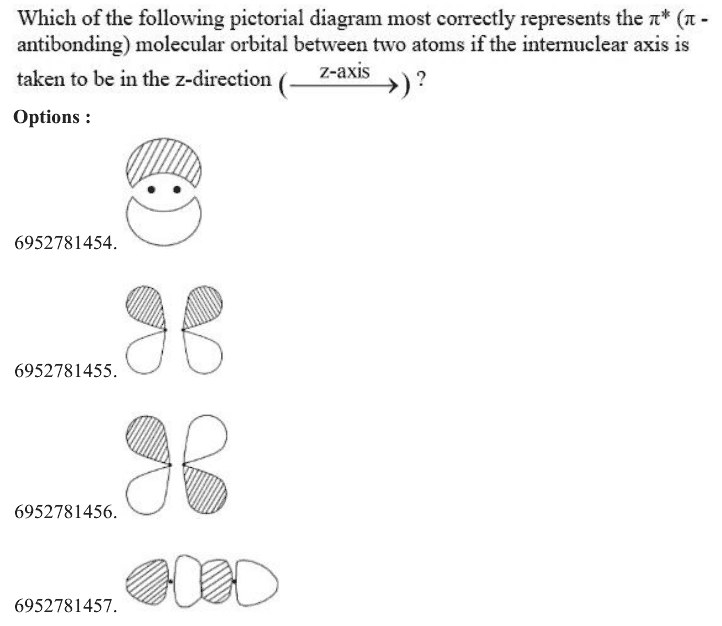
Which of the following pictorial diagram most correctly represents the $\pi^*$ ($\pi$ - antibonding) molecular orbital between two atoms if the internuclear axis is taken to be in the z-direction ($\xrightarrow{\text{z-axis}}$)?
The question as printed in the paper.
A
see figure one orbital drawn as two large crescent-shaped lobes stacked vertically: a hatched (shaded) lobe on top, an unshaded lobe below, with two dots (the two nuclei, side by side horizontally) in the gap between them.
B
see figure two p-type orbitals side by side, each a pair of lobes (hatched upper lobe, unshaded lower lobe) touching at a nuclear dot; both the left and the right pair have the hatched lobe above and the unshaded lobe below (same sign pattern on both).
C
see figure two p-type orbitals side by side, each a pair of lobes touching at a nuclear dot; the left pair has the hatched lobe above and unshaded below, the right pair has the unshaded lobe above and the hatched lobe below (opposite sign pattern).
D
see figure four lobes in a horizontal row along the internuclear axis with a nuclear dot between lobes 1-2 and between 3-4: hatched, unshaded, hatched, unshaded (left to right).
Statement I: The number of species among $\mathrm{BF_4^-}$, $\mathrm{SiF_4}$, $\mathrm{XeF_4}$ and $\mathrm{SF_4}$, that have unequal E$-$F bond lengths is two. Here, E is the central atom.
Statement II: Among $\mathrm{O_2^-}$, $\mathrm{O_2^{2-}}$, $\mathrm{F_2}$ and $\mathrm{O_2^+}$, $\mathrm{O_2^-}$ has the highest bond order.
In the light of the above statements, choose the *correct* answer from the options given below
Identify the molecule (X) with maximum number of lone pairs of electrons (obtained using Lewis dot structure) among $\mathrm{HNO_3}$, $\mathrm{H_2SO_4}$, $\mathrm{NF_3}$ and $\mathrm{O_3}$. Choose the correct bond angle made by the central atom of the molecule (X).
Two p-block elements X and Y form fluorides of the type $\mathrm{EF_3}$. The fluoride compound $\mathrm{XF_3}$ is a Lewis acid and $\mathrm{YF_3}$ is a Lewis base. The hybridizations of the central atoms of $\mathrm{XF_3}$ and $\mathrm{YF_3}$ respectively are
Among $\mathrm{H_2S}$, $\mathrm{H_2O}$, $\mathrm{NF_3}$, $\mathrm{NH_3}$ and $\mathrm{CHCl_3}$, identify the molecule (X) with lowest dipole moment value. The number of lone pairs of electrons present on the central atom of the molecule (X) is :
The number of species among $\mathrm{SF_4}$, $\mathrm{NH_4^+}$, $[\mathrm{NiCl_4}]^{2-}$, $\mathrm{XeF_4}$, $[\mathrm{PtCl_4}]^{2-}$, $\mathrm{SeF_4}$ and $[\mathrm{Ni(CN)_4}]^{2-}$, that have tetrahedral geometry is 3.
Statement II :
In the set $[\mathrm{NO_2}, \mathrm{BeH_2}, \mathrm{BF_3}, \mathrm{AlCl_3}]$, all the molecules have incomplete octet around central atom.
In the light of the above statements, choose the correct answer from the options given below :
The hydration energies of $K^+$ and $Cl^-$ are $-x$ and $-y\,kJ/mol$ respectively. If lattice energy of KCl is $-z\,kJ/mol$, then the heat of solution of KCl is :
Statement I : Wet cotton clothes made of cellulose based carbohydrate takes comparatively longer time to get dried than wet nylon polymer based clothes.
Statement II : Intermolecular hydrogen bonding with water molecule is more in nylon-based clothes than in the case of cotton clothes.
In the light of above statements, choose the correct answer from the options given below
Among $SO_2, NF_3, NH_3, XeF_2, ClF_3$ and $SF_4$, the hybridization of the molecule with nonzero dipole moment and highest number of lone-pairs of electrons on the central atom is
Which among the following molecules is (a) involved in $sp^3d$ hybridization, (b) has different bond lengths and (c) has lone pair of electrons on the central atom ?
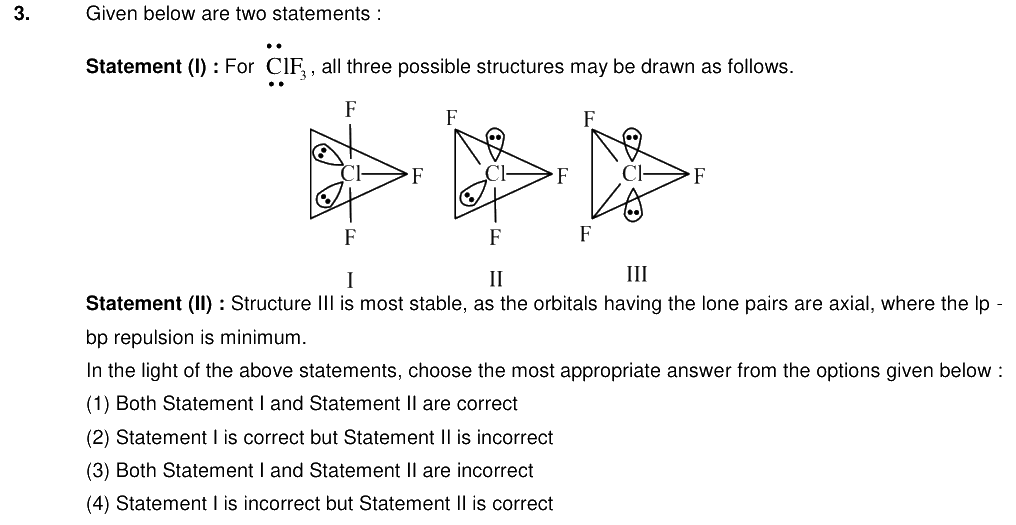
Consider ' $n$ ' is the number of lone pair of electrons present in the equatorial position of the most stable structure of $\mathrm{ClF_3}$. The ions from the following with ' $n$ ' number of unpaired electrons are A. $\mathrm{V^{3+}}$ B. $\mathrm{Ti^{3+}}$ C. $\mathrm{Cu^{2+}}$ D. $\mathrm{Ni^{2+}}$ E. $\mathrm{Ti^{2+}}$ Choose the correct answer from the options given below:
Which of the following statement is true with respect to $\mathrm{H_2O}$, $\mathrm{NH_3}$ and $\mathrm{CH_4}$ ? A. The central atoms of all the molecules are $\mathrm{sp^3}$ hybridized. B. The $\mathrm{H - O - H, H - N - H}$ and $\mathrm{H - C - H}$ angles in the above molecules are $104.5^\circ, 107.5^\circ$ and $109.5^\circ$, respectively. C. The increasing order of dipole moment is $\mathrm{CH_4 < NH_3 < H_2O}$. D. Both $\mathrm{H_2O}$ and $\mathrm{NH_3}$ are Lewis acids and $\mathrm{CH_4}$ is a Lewis base. E. A solution of $\mathrm{NH_3}$ in $\mathrm{H_2O}$ is basic. In this solution $\mathrm{NH_3}$ and $\mathrm{H_2O}$ act as Lowry-Bronsted acid and base respectively. Choose the correct answer from the options given below:
Which of the following linear combination of atomic orbitals will lead to formation of molecular orbitals in homonuclear diatomic molecules [internuclear axis in z-direction] ? A. $2\mathrm{p_z}$ and $2\mathrm{p_x}$ B. 2 s and $2\mathrm{p_x}$ C. 3 $\mathrm{d_{xy}}$ and 3 $\mathrm{d_{x^2-y^2}}$ D. 2 s and $2\mathrm{p_z}$ E. $2p_z$ and $3d_{x^2} - y^2$ Choose the correct answer from the options given below:
Given below are two statements : Statement (I): Experimentally determined oxygen-oxygen bond lengths in the $\mathrm{O_3}$ are found to be same and the bond length is greater than that of a O = O (double bond) but less than that of a single (O – O) bond. Statement (II) : The strong lone pair-lone pair repulsion between oxygen atoms is solely responsible for the fact that the bond length in ozone is smaller than that of a double bond (O = O) but more than that of a single bond (O – O). In the light of the above statements, choose the correct answer from the options given below :
Given below are two statements : Statement I : $PF_5$ and $BrF_5$ both exhibit $sp^3$ d hybridisation. Statement II : Both $SF_6$ and $[Co(NH_3)_6]^{3+}$ exhibit $sp^3$ $d^2$ hybridisation. In the light of the above statements, choose the correct answer from the options given below :
Given below are two statements : one is labelled as Assertion (A) and the other is labelled as Reason (R). Assertion (A) : $\mathrm{NH_3}$ and $\mathrm{NF_3}$ molecule have pyramidal shape with a lone pair of electrons on nitrogen atom. The resultant dipole moment of $\mathrm{NH_3}$ is greater than that of $\mathrm{NF_3}$. Reason (R) : In $\mathrm{NH_3}$, the orbital dipole due to lone pair is in the same direction as the resultant dipole moment of the $\mathrm{N - H}$ bonds. F is the most electronegative element. In the light of the above statements, choose the correct answer from the options given below :
A
Both (A) and (R) are true and (R) is the correct explanation of (A)
B
(A) is false but (R) is true
C
Both (A) and (R) are true but (R) is NOT the correct explanation of (A)
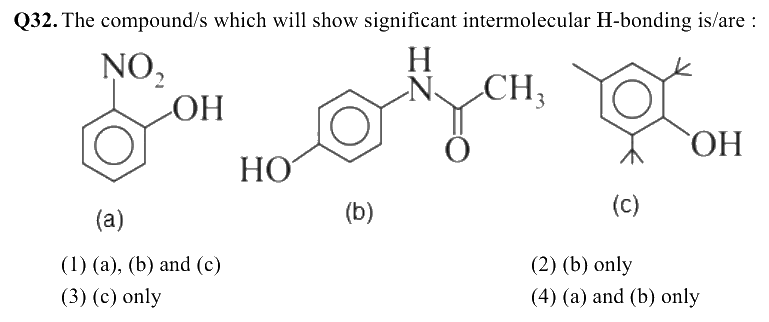
The correct statement/s about Hydrogen bonding is/are A. Hydrogen bonding exists when H is covalently bonded to the highly electro negative atom. B. Intermolecular H bonding is present in o-nitro phenol C. Intramolecular H bonding is present in HF. D. The magnitude of H bonding depends on the physical state of the compound. E. H-bonding has powerful effect on the structure and properties of compounds Choose the correct answer from the options given below:
Arrange the bonds in order of increasing ionic character in the molecules. LiF, $\mathrm{K_2O}$, $\mathrm{N_2}$, $\mathrm{SO_2}$ and $\mathrm{ClF_3}$ .
Given below are two statements: one is labelled as Assertion A and the other is labelled as Reason R.
Assertion A: $\mathrm{PH_3}$ has lower boiling point than $\mathrm{NH_3}$ .
Reason R: In liquid state $\mathrm{NH_3}$ molecules are associated through Vander Waal's forces, but $\mathrm{PH_3}$ molecules are associated through hydrogen bonding.
In the light of the above statements, choose the most appropriate answer from the options given below:
A
Both A and R are correct and R is not the correct explanation of A
B
A is not correct but R is correct
C
Both A and R are correct but R is the correct explanation of A
Select the compound from the following that will show intramolecular hydrogen bonding.
The question as printed in the paper.
A
$\mathrm{H_2O}$
B
$\mathrm{NH_3}$
C
$\mathrm{C_2H_5OH}$
D
see figure a benzene ring with a nitro group ($\mathrm{NO_2}$) on the upper-right carbon and an OH group on the carbon directly below it on the right (the two groups on adjacent ring carbons).
Statement-I: Since fluorine is more electronegative than nitrogen, the net dipole moment of $\mathrm{NF_3}$ is greater than $\mathrm{NH_3}$.
Statement-II: In $\mathrm{NH_3}$, the orbital dipole due to lone pair and the dipole moment of NH bonds are in opposite direction, but in $\mathrm{NF_3}$ the orbital dipole due to lone pair and dipole moments of N-F bonds are in same direction.
In the light of the above statements. Choose the most appropriate from the options given below.
A
Statement I is true but Statement II is false.
B
Both Statement I and Statement II are false.
C
Both statement I and Statement II is are true.
D
Statement I is false but Statement II is are true.
Consider the following statement (A) $\mathrm{NF_3}$ molecules has a trigonal planar structure. (B) Bond Length of $\mathrm{N_2}$ is shorter than $\mathrm{O_2}$. (C) Isoelectronic molecules or ions have identical bond order. (D) Dipole moment of $\mathrm{H_2S}$ is higher than that of water molecule. Choose the correct answer from the options given below:
Given below are two statements : Statement I : $\mathrm{SO_2}$ and $\mathrm{H_2O}$ both possess V-shaped structure Statement II : The bond angle of $\mathrm{SO_2}$ is less than that of $\mathrm{H_2O}$. In the light of the above statements, choose the most appropriate answer from the options given below:
A
Both Statement I and Statement II are incorrect
B
Both Statement I and Statement II are correct
C
Statement I is incorrect but Statement II is correct
D
Statement I is correct but Statement II is incorrect
Match List-I with List-II: List-I Species A. $\mathrm{H_3O^+}$ B. Acetylide anion C. $\mathrm{NH_4^+}$ D. $\mathrm{ClO_2^-}$ List-II Geometry/Shape I. Tetrahedral II. Linear III. Pyramidal IV. Bent Choose the correct answer from the options given below:
Given below are two statements : One is labelled as Assertion A and the other is labelled as Reason R. Assertion A : Butan–1–ol has higher boiling point than ethoxyethane. Reason R : Extensive hydrogen bonding leads to stronger association of molecules. In the light of the above statements, choose the correct answer from the options given below :
A
A is true but R is false
B
Both A and R are true and R is the correct explanation of A
C
Both A and R are true but R is not the correct explanation of A
O $-$ O bond length in $\mathrm{H_2O_2}$ is $\underline{X}$ than the O $-$ O bond length in $\mathrm{F_2O_2}$. The O $-$ H bond length in $\mathrm{H_2O_2}$ is $\underline{Y}$ than that of the O $-$ F bond in $\mathrm{F_2O_2}$. Choose the correct option for $\underline{X}$ and $\underline{Y}$ from the given below.
For $\mathrm{OF_2}$ molecule consider the following: (A) Number of lone pairs on oxygen is 2. (B) FOF angle is less than 104.5$^\circ$. (C) Oxidation state of O is -2. (D) Molecule is bent 'V' shaped. (E) Molecular geometry is linear. Correct options are:
Statement I:- Dipole moment is a vector quantity and by convention it is depicted by a small arrow with tail on the negative centre and head pointing towards the positive centre.
Statement II:- The crossed arrow of the dipole moment symbolizes the direction of the shift of charges in the molecules.
In the light of the above statements, choose the most appropriate answer from the options given below:-
A
Both Statement I and Statement II are correct.
B
Statement I is incorrect but Statement II is correct.
C
Both Statement I and Statement II are incorrect.
D
Statement I is correct but Statement II is incorrect.
Given below are two statements : One is labelled as Assertion A and the other is labelled as Reason R Assertion A : Zero orbital overlap is an out of phase overlap. Reason R : It results due to different orientation/ direction of approach of orbitals. In the light of the above statements. Choose the correct answer from the options given below
A
Both A and R are true and R is the correct explanation of A
B
Both A and R are true but R is NOT the correct explanation of A
Arrange the following in increasing order of their covalent character. (A) $\mathrm{CaF_2}$ (B) $\mathrm{CaCl_2}$ (C) $\mathrm{CaBr_2}$ (D) $\mathrm{CaI_2}$ Choose the correct answer from the options given below.
Arrange the following in the decreasing order of their covalent character : (A) LiCl (B) NaCl (C) KCl (D) CsCl Choose the most appropriate answer from the options given below
Based upon VSEPR theory, match the shape (geometry) of the molecules in List-I with the molecules in List - II and select the most appropriate option. List-I (Shape) A T-shaped B Trigonal planar C Square planar D See-saw List-II (Molecules) I. $\mathrm{XeF_4}$ II. $\mathrm{SF_4}$ III. $\mathrm{ClF_3}$ IV. $\mathrm{BF_3}$
Bonding in which of the following diatomic molecule(s) become(s) stronger, on the basis of MO Theory, by removal of an electron? (A) $\mathrm{NO}$ (B) $\mathrm{N}_2$ (C) $\mathrm{O}_2$ (D) $\mathrm{C}_2$ (E) $\mathrm{B}_2$ Choose the most appropriate answer from the options given below :
Number of electron deficient molecules among the following $\mathrm{PH}_3$, $\mathrm{B}_2\mathrm{H}_6$, $\mathrm{CCl}_4$, $\mathrm{NH}_3$, $\mathrm{LiH}$ and $\mathrm{BCl}_3$ is
Given below are two statements. Statement I: The presence of weaker $\pi$-bonds make alkenes less stable than alkanes Statement II: The strength of the double bond is greater than that of carbon-carbon single bond. In the light of the above statements, choose the correct answer from the options : given below.
A
Both Statement I and Statement II are correct.
B
Both Statement I and Statement II are incorrect.
C
Statement I is correct but Statement II is incorrect.
D
Statement I is incorrect but Statement II is correct.
Match List - I with List - II: List-I (Species) (a) $\mathrm{XeF_2}$ (b) $\mathrm{XeO_2F_2}$ (c) $\mathrm{XeO_3F_2}$ (d) $\mathrm{XeF_4}$ List-II (Number of lone pairs of electrons on the central atom) (i) $0$ (ii) $1$ (iii) $2$ (iv) $3$ Choose the most appropriate answer from the options given below:
The interaction energy of London forces between two particles is proportional to $\mathrm{r}^{x}$, where r is the distance between the particles. The value of x is :
Given below are two statements: one is labelled as Assertion A and the other is labelled as Reason R : Assertion A : The $\mathrm{H}-\mathrm{O}-\mathrm{H}$ bond angle in water molecule is $104.5^{\circ}$. Reason R : The lone pair $-$ lone pair repulsion of electrons is higher than the bond pair $-$ bond pair repulsion.
A
A is false but R is true
B
Both A and R are true, but R is not the correct explanation of A
C
A is true but R is false
D
Both A and R are true, and R is the correct explanation of A
Given below are two statements: Statement I : o-Nitrophenol is steam volatile due to intramolecular hydrogen bonding. Statement II : o-Nitrophenol has high melting due to hydrogen bonding. In the light of the above statements, choose the most appropriate answer from the options given below:
Given below are two statements: one is labelled as Assertion A and the other is labelled as Reason R. Assertion A : Dipole-dipole interactions are the only non-covalent interactions, resulting in hydrogen bond formation. Reason R : Fluorine is the most electronegative element and hydrogen bonds in HF are symmetrical. In the light of the above statements, choose the most appropriate answer from the options given below:
A
A is false but R is true
B
Both A and R are true but R is NOT the correct explanation of A
C
A is true but R is false
D
Both A and R are true and R is the correct explanation of A
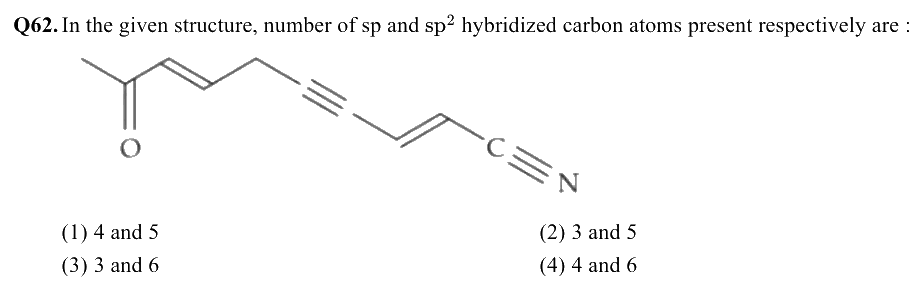
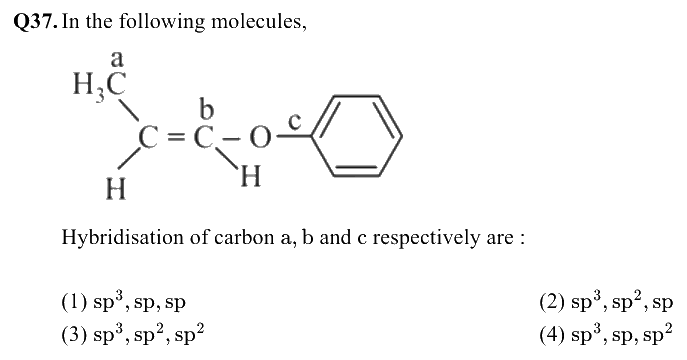
In $\overset{1}{\mathrm{C}}\mathrm{H_2} = \overset{2}{\mathrm{C}} = \overset{3}{\mathrm{C}}\mathrm{H} - \overset{4}{\mathrm{C}}\mathrm{H_3}$ molecule, the hybridization of carbon 1, 2, 3 and 4 respectively, are :
Which of the following are isostructural pairs? A. $\mathrm{SO_4^{2-}}$ and $\mathrm{CrO_4^{2-}}$ B. $\mathrm{SiCl_4}$ and $\mathrm{TiCl_4}$ C. $\mathrm{NH_3}$ and $\mathrm{NO_3^-}$ D. $\mathrm{BCl_3}$ and $\mathrm{BrCl_3}$
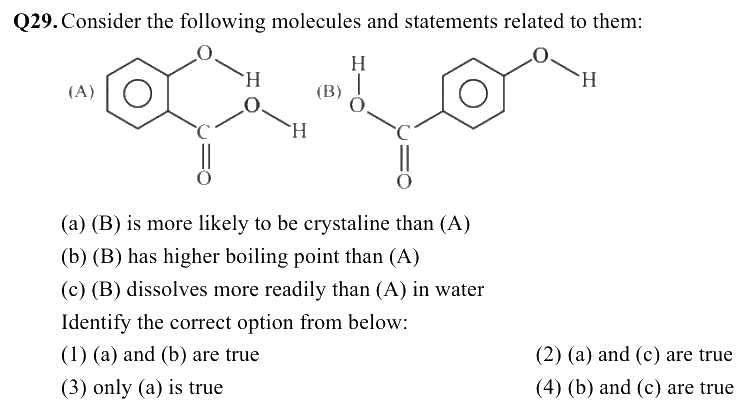
Consider the following molecules and statements related to them: (see the figure above) (a) (B) is more likely to be crystaline than (A) (b) (B) has higher boiling point than (A) (c) (B) dissolves more readily than (A) in water Identify the correct option from below:
Match the type of interaction in column A with the distance dependence of their interaction energy in column B : $\begin{array}{ll} \textbf{A} & \textbf{B} \\ \text{(i) ion - ion} & \text{(a) } \frac{1}{r} \\ \text{(ii) Dipole - dipole} & \text{(b) } \frac{1}{r^{2}} \\ \text{(iii) London dispersion} & \text{(c) } \frac{1}{r^{3}} \\ & \text{(iv) } \frac{1}{r^{6}} \end{array}$
Among the following molecules/ ions, $\mathrm{C_2^{2-}}$, $\mathrm{N_2^{2-}}$, $\mathrm{O_2^{2-}}$, $\mathrm{O_2}$ Which one is diamagnetic and has the shortest bond length?
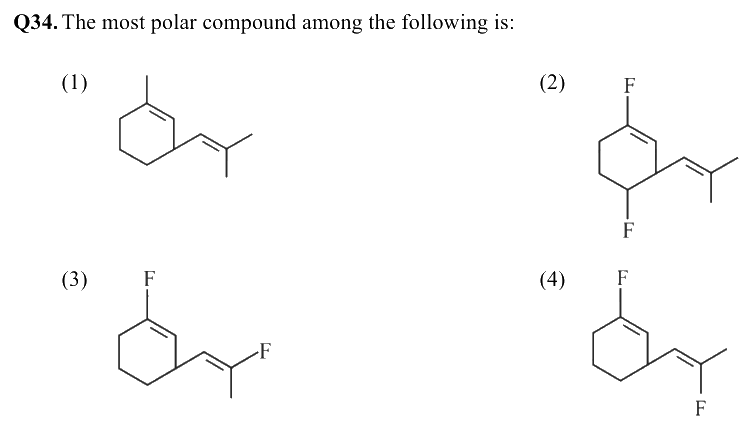
The most polar compound among the following is: (see the figure above)
The question as printed in the paper.
A
see figure cyclohexene ring bearing a methyl on one alkene carbon and the side chain $-CH=C(CH_3)_2$
B
see figure cyclohexene ring with F on one alkene carbon and F on a ring carbon, side chain $-CH=C(CH_3)_2$
C
see figure cyclohexene ring with F on one alkene carbon, side chain $-CH=C(F)CH_3$
D
see figure cyclohexene ring with F on one alkene carbon, side chain $-CH=C(F)CH_3$ (F and CH3 on the opposite sides of the chain terminus compared with option 3)
The increasing order of the boiling points for the following compounds is: (I) $\mathrm{C_2H_5\,OH}$ (II) $\mathrm{C_2H_5\,Cl}$ (III) $\mathrm{C_2H_5\,CH_3}$ (IV) $\mathrm{C_2H_5\,OCH_3}$
Molecule AB has a bond length of 1.617 Å and a dipole moment of 0.38 D. The fractional charge on each atom(absolute magnitude) is: ($\mathrm{e_0} = 4.802 \times 10^{-10}$ esu)
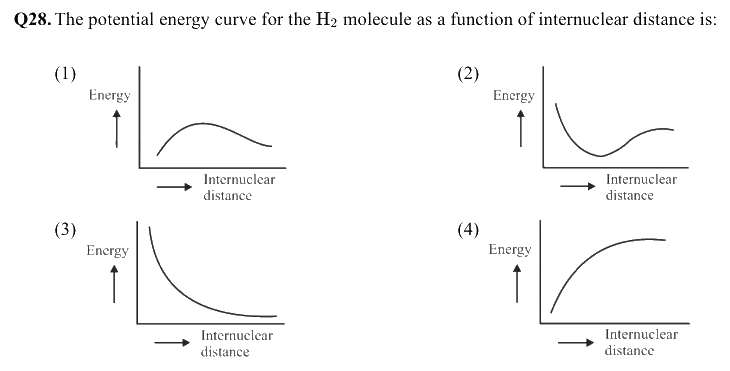
After understanding the assertion and reason, choose the correct option. Assertion: In the bonding molecular orbital (MO) of $\mathrm{H_2}$, electron density is increased between the nuclei. Reason: The bonding MO is $\psi_A + \psi_B$ , which shows destructive interference of the combining electron waves.
A
Assertion and Reason are correct, but Reason is not the correct explanation for the Assertion.
B
Assertion and Reason are correct and Reason is the correct explanation for the Assertion.
For the compounds $\mathrm{CH_3Cl}$, $\mathrm{CH_3Br}$, $\mathrm{CH_3I}$ and $\mathrm{CH_3F}$, the correct order of increasing C-halogen bond length is :
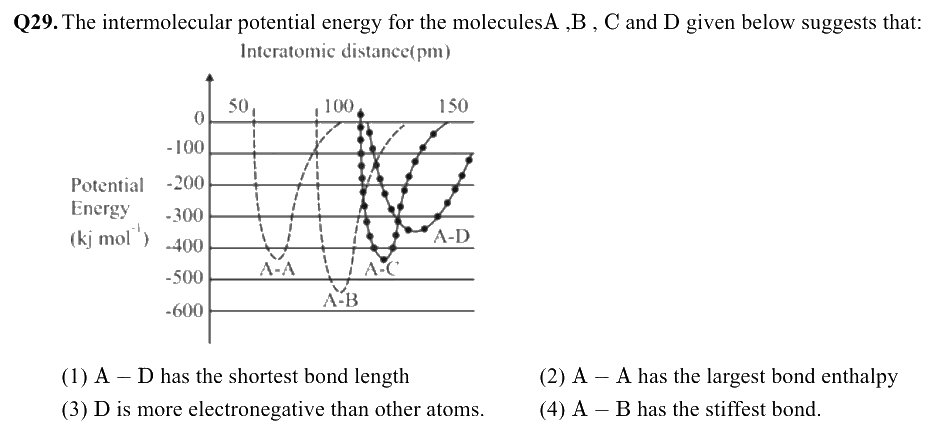
If the enthalpy of sublimation of Li is 155 kJ mol$^{-1}$, enthalpy of dissociation of $\mathrm{F_2}$ is 150 kJ mol$^{-1}$, ionization enthalpy of Li is 520 kJ mol$^{-1}$, electron gain enthalpy of F is $-313$ kJ mol$^{-1}$, standard enthalpy of formation of LiF is $-594$ kJ mol$^{-1}$. The magnitude of lattice enthalpy of LiF is ________ kJ mol$^{-1}$. (Nearest Integer)
Numerical answer type: type your answer in EdLoop to check it
Total number of molecules/species from following which will be paramagnetic is ______ . $\mathrm{O_2, O_2^+, O_2^-}$, NO, $\mathrm{NO_2}$, CO, $\mathrm{K_2\,[NiCl_4]}$, $\mathrm{[Co(NH_3)_6]Cl_3}$, $\mathrm{K_2\,[Ni(CN)_4]}$
Numerical answer type: type your answer in EdLoop to check it
The bond dissociation enthalpy of $\mathrm{X_2}$ $\Delta\mathrm{H_{bond}}$ calculated from the given data is ______ $\mathrm{kJmol^{-1}}$. (Nearest integer)
$\mathrm{M(\ s)} + \frac{1}{2}\mathrm{X_2(\ g)} \rightarrow \mathrm{M^+X^-(s)}\ \Delta\mathrm{H}^\circ_f = -400\ \mathrm{kJ\ mol^{-1}}$ [Given : $\mathrm{M^+X^-}$ is a pure ionic compound and X forms a diatomic molecule $\mathrm{X_2}$ in gaseous state]
Numerical answer type: type your answer in EdLoop to check it
The number of molecules/ions that show linear geometry among the following is ______ $\mathrm{SO_2}$, $\mathrm{BeCl_2}$, $\mathrm{CO_2}$, $\mathrm{N_3^-}$, $\mathrm{NO_2}$, $\mathrm{F_2O}$, $\mathrm{XeF_2}$, $\mathrm{NO_2^+}$, $\mathrm{I_3^-}$, $\mathrm{O_3}$
Numerical answer type: type your answer in EdLoop to check it
Total number of species from the following with central atom utilising $sp^2$ hybrid orbitals for bonding is ______ . $NH_3$, $SO_2$, $SiO_2$, $BeCl_2$, $C_2H_2$, $C_2H_4$, $BCl_3$, HCHO, $C_6H_6$, $BF_3$, $C_2H_4Cl_2$
Numerical answer type: type your answer in EdLoop to check it
A diatomic molecule has a dipole moment of 1.2 D. If the bond distance is 1Å, then fractional charge on each atom is ______ $\times 10^{-1}$ esu. (Given 1D = $10^{-18}$ esu cm)
Numerical answer type: type your answer in EdLoop to check it
The total number of molecules with zero dipole moment among $\mathrm{CH_4}$, $\mathrm{BF_3}$, $\mathrm{H_2O}$, HF, $\mathrm{NH_3}$, $\mathrm{CO_2}$ and $\mathrm{SO_2}$ is ______.
Numerical answer type: type your answer in EdLoop to check it
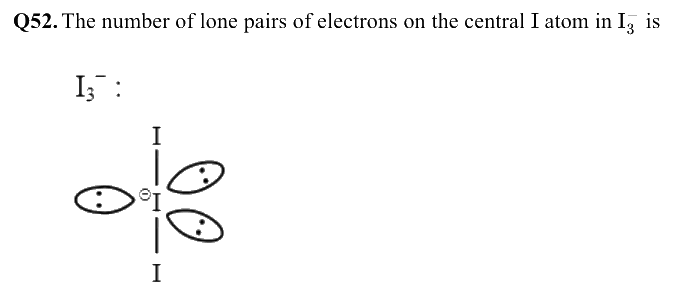
The maximum number of lone pairs of electron on the central atom from the following species is ______ $\mathrm{ClO_3^-}$, $\mathrm{XeF_4}$, $\mathrm{SF_4}$ and $\mathrm{I_3^-}$
Numerical answer type: type your answer in EdLoop to check it
The number of bent-shaped molecule/s from the following is ______ $\mathrm{N_3^-}$, $\mathrm{NO_2^-}$, $\mathrm{I_3^-}$, $\mathrm{O_3}$, $\mathrm{SO_2}$
Numerical answer type: type your answer in EdLoop to check it
The number of molecules from the following which contain only two lone pair of electrons is ______ $\mathrm{H_2O, N_2, CO, XeF_4, NH_3, NO, CO_2,\ F_2}$
Numerical answer type: type your answer in EdLoop to check it
The number of following factors which affect the percent covalent character of the ionic bond is ______ A) Polarising power of cation B) Extent of distortion of anion C) Polarisability of the anion D) Polarising power of anion
Numerical answer type: type your answer in EdLoop to check it
Amongst the following, the number of species having the linear shape is $\mathrm{XeF_2}$, $\mathrm{I_3^+}$, $\mathrm{C_3O_2}$, $\mathrm{I_3^-}$, $\mathrm{CO_2}$, $\mathrm{SO_2}$, $\mathrm{BeCl_2}$ and $\mathrm{BCl_2^{\ominus}}$
Numerical answer type: type your answer in EdLoop to check it
Consider, $\mathrm{PF_5}$, $\mathrm{BrF_5}$, $\mathrm{PCl_3}$, $\mathrm{SF_6}$, $\mathrm{ICl_4^-}$, $\mathrm{ClF_3}$ and $\mathrm{IF_5}$ Amongst the above molecule(s) ion(s), the number of molecule(s)/ion(s) having $sp^3d^2$ hybridisation is
Numerical answer type: type your answer in EdLoop to check it
Amongst the following the number of oxide(s) which are paramagnetic in nature is $\mathrm{Na_2\ O}$, $\mathrm{KO_2}$, $\mathrm{NO_2}$, $\mathrm{N_2O}$, $\mathrm{ClO_2}$, NO, $\mathrm{SO_2}$, $\mathrm{Cl_2\ O}$
Numerical answer type: type your answer in EdLoop to check it
According to MO theory, number of species/ions from the following having identical bond order is ______ $\mathrm{CN^-}$, $\mathrm{NO^+}$, $\mathrm{O_2}$, $\mathrm{O_2^+}$, $\mathrm{O_2^{2+}}$
Numerical answer type: type your answer in EdLoop to check it
The number of molecule(s) or ion(s) from the following having non-planar structure is ______ . $\mathrm{NO_3^-}$, $\mathrm{H_2O_2}$, $\mathrm{BF_3}$, $\mathrm{PCl_3}$, $\mathrm{XeF_4}$, $\mathrm{SF_4}$, $\mathrm{XeO_3}$, $\mathrm{PH_4^+}$, $\mathrm{SO_3}$, $[\mathrm{Al\,(OH)_4}]^-$
Numerical answer type: type your answer in EdLoop to check it
Among the following species $\mathrm{N_2}$, $\mathrm{N_2^+}$, $\mathrm{N_2^-}$, $\mathrm{N_2^{2-}}$, $\mathrm{O_2}$, $\mathrm{O_2^+}$, $\mathrm{O_2^-}$, $\mathrm{O_2^{2-}}$ the number of species showing diamagnetism is
Numerical answer type: type your answer in EdLoop to check it
How many of the following molecules are with non-zero net dipole moment, $\mathrm{NH_3}$ , HCl, $\mathrm{H_2O}$ , $\mathrm{BeF_2}$, $\mathrm{BH_3}$, $\mathrm{CCl_4}$
Numerical answer type: type your answer in EdLoop to check it
The number of species having non-pyramidal shape among the following is: (A) $\mathrm{SO_3}$ (B) $\mathrm{NO_3^{-}}$ (C) $\mathrm{PCl_3}$ (D) $\mathrm{CO_3^{2-}}$
Numerical answer type: type your answer in EdLoop to check it
The Born-Haber cycle for KCl is evaluated with the following data: $\Delta_f\mathrm{H}^{\ominus}$ for $\mathrm{KCl}=-436.7\ \mathrm{kJmol^{-1}}$; $\Delta_{\mathrm{sub}}\mathrm{H}^{\ominus}$ for $\mathrm{K}=89.2\ \mathrm{kJmol^{-1}}$; $\Delta_{\mathrm{ionization}}\ \mathrm{H}^{\ominus}$ for $\mathrm{K}=419.0\ \mathrm{kJ\ mol^{-1}}$; $\Delta_{\mathrm{electron\ gain}}\ \mathrm{H}^{\ominus}$ for $\mathrm{Cl_{(g)}}=-348.6\ \mathrm{kJmol^{-1}}$ $\Delta_{\mathrm{bond}}\ \mathrm{H}^{\ominus}$ for $\mathrm{Cl_2}=243.0\ \mathrm{kJmol^{-1}}$ The magnitude of lattice enthalpy of KCl in $\mathrm{kJmol^{-1}}$ is (Nearest integer)
Numerical answer type: type your answer in EdLoop to check it
$\mathrm{AX}$ is a covalent diatomic molecule where A and X are second row elements of periodic table. Based on Molecular orbital theory, the bond order of $\mathrm{AX}$ is $2.5$. The total number of electrons in $\mathrm{AX}$ is ______ . (Round off to the Nearest Integer).
Numerical answer type: type your answer in EdLoop to check it
The number of species below that have two lone pairs of electrons in their central atom is ______ (Round off to the Nearest integer) $\mathrm{SF_4}$, $\mathrm{BF_4^-}$, $\mathrm{ClF_3}$, $\mathrm{AsF_3}$, $\mathrm{PCl_5}$, $\mathrm{BrF_5}$, $\mathrm{XeF_4}$, $\mathrm{SF_6}$
Numerical answer type: type your answer in EdLoop to check it
The total number of $\mathrm{C}-\mathrm{C}$ sigma bond/s in mesityl oxide $\left(\mathrm{C}_6 \mathrm{H}_{10} \mathrm{O}\right)$ is (Round off to the Nearest Integer).
Numerical answer type: type your answer in EdLoop to check it
The ionization enthalpy of $\mathrm{Na^+}$ formation from $\mathrm{Na_{(g)}}$ is $495.8\ \mathrm{kJ\ mol^{-1}}$, while the electron gain enthalpy of Br is $-325.0\ \mathrm{kJ\ mol^{-1}}$. Given the lattice enthalpy of NaBr is $-728.4\ \mathrm{kJ\ mol^{-1}}$. The energy for the formation of NaBr ionic solid is $(-)$ ______ $10^{-1}\ \mathrm{kJ\ mol^{-1}}$.
Numerical answer type: type your answer in EdLoop to check it
Complexes ($ML_5$) of metals $Ni$ and $Fe$ have ideal square pyramidal and trigonal bipyramidal geometries, respectively. The sum of the $90^\circ, 120^\circ$ and $180^\circ$ $\mathrm{L - M - L}$ angles in the two complexes is_______
Numerical answer type: type your answer in EdLoop to check it
How to prepare Chemical Bonding & Molecular Structure for JEE Main
How often it comes up
Chemical bonding and molecular structure underpins inorganic and organic chemistry under Unit 3: Chemical Bonding and Molecular Structure in the Class 11 curriculum, holding rank 6 among all 31 chemistry chapters with a 4.7 percent share of the entire chemistry section. In the computerized testing window from 2019 to 2026, chemical bonding supplied 213 questions across 162 papers, representing an average rate of 1.3 questions per sitting. The chapter appeared in 142 of those 162 papers, and questions were asked every single year throughout the cycle. During the recent 2024 to 2026 examination seasons, candidates encountered 92 questions across 58 papers, lifting the average to 1.6 questions per shift and achieving a 5.9 percent subject share. This reflects a trend that is up relative to the 4.7 percent share from the full 2019 to 2026 baseline. When compared against the earlier 2002 to 2018 era, which recorded 91 questions across 38 papers for a 6.8 percent share, the recent share is down. In 2026 alone, examiners presented 21 questions across 19 papers, showing up in 16 individual shifts. A total of 63 questions between 2019 and 2026 were formatted as numerical answer questions, requiring students to count lone pairs, bond orders, or calculate Born-Haber lattice enthalpies without options.
Most-asked topics
Questions in this chapter span six major theoretical domains:
VSEPR & Molecular Shapes: 79 questions historically, with 59 appearing between 2019 and 2026, tested up to 2026. This leading topic evaluates steric numbers, electron geometry versus molecular shape, lone pair-bond pair repulsions, axial versus equatorial bond lengths in trigonal bipyramidal systems, and see-saw, T-shaped, and square planar geometries.
Molecular Orbital Theory: 76 problems overall, including 50 from 2019 to 2026, continuing into 2026. Focus areas assess electronic configurations of homonuclear and heteronuclear diatomic species, bond order calculations, stability comparisons across ions of oxygen and nitrogen, and magnetic properties like paramagnetism and diamagnetism.
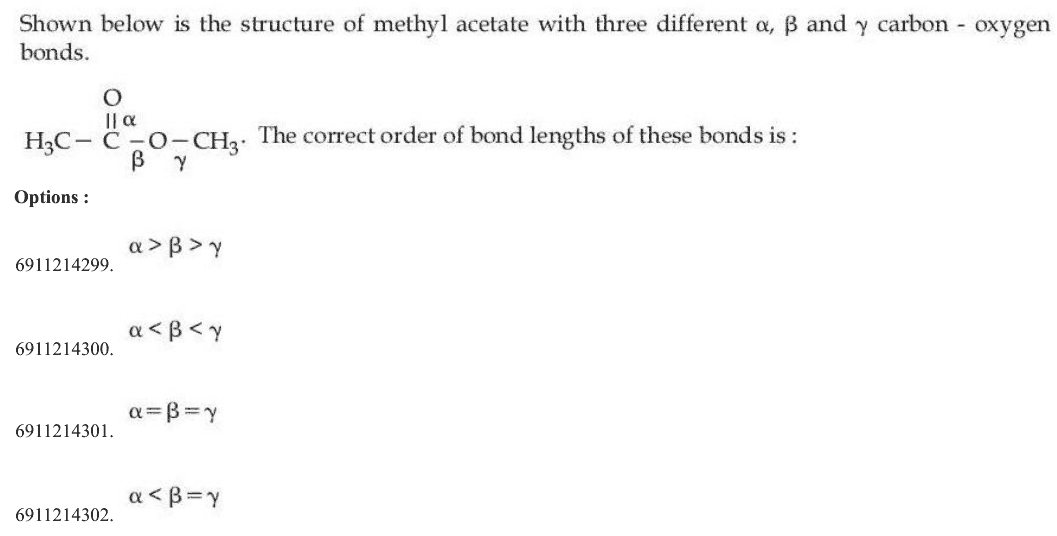
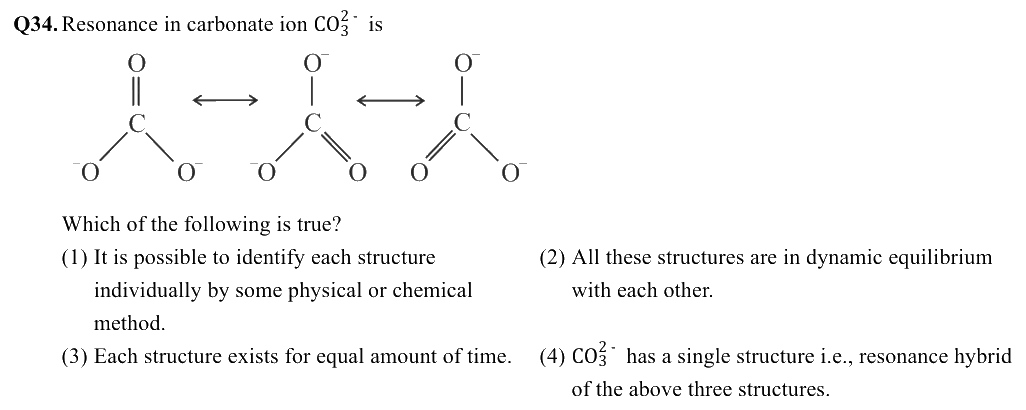
Covalent Bonding & Lewis Structures: 52 lifetime problems, with 36 between 2019 and 2026, tested in 2026. Concepts examine Lewis octet rules, formal charge calculation on constituent atoms, resonance hybrid structures, dipole moments, and bond length ordering.
Valence Bond Theory & Hybridisation: 45 questions since 2002, with 31 from 2019 to 2026, tested through 2026. Themes evaluate sp, sp2, sp3, sp3d, and sp3d2 hybridizations, percentage s-character influences on electronegativity and bond angles, and sigma and pi bond enumerations.
Hydrogen Bonding & Intermolecular Forces: 27 questions overall, including 21 between 2019 and 2026, tested in 2026. Questions explore intermolecular versus intramolecular hydrogen bonding, boiling point trends across alcohols, amines, and hydrocarbons, and London dispersion forces.
Ionic Bonding: 25 lifetime questions, with 16 asked between 2019 and 2026, tested in 2026. Areas cover Born-Haber cycle thermodynamic thermochemistry, lattice enthalpy, Fajan's rules of polarization, and covalent character in ionic compounds.
What the questions look like
JEE Main questions in chemical bonding combine structural drawings with molecular orbital rules:
Bond order and magnetic nature comparisons: Evaluating homonuclear diatomic ions like superoxide, peroxide, and dinitrogen cation to identify pairs possessing identical bond orders and unpaired electrons.
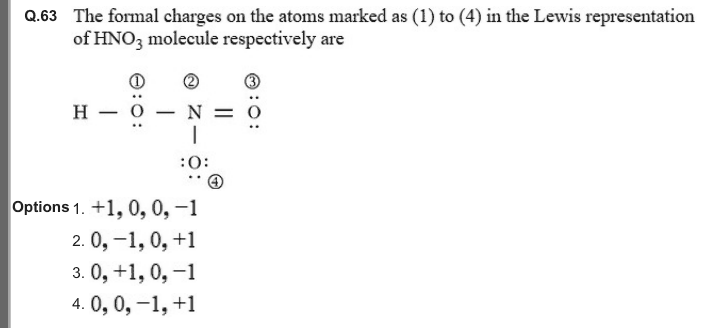
Lewis formal charge evaluation: Finding the formal charges on specific oxygen and nitrogen atoms within the Lewis electron dot representation of nitric acid or ozone.
Steric shape matching: Selecting which molecules from a given list share identical geometries, such as matching see-saw geometry with sulfur tetrafluoride.
Lattice enthalpy from Born-Haber cycles: Calculating the lattice energy of an alkali metal halide using sublimation, ionization, dissociation, and electron gain enthalpies.
Master Molecular Orbital Theory energy orderings. Remember that species with up to fourteen electrons follow the 2-1-2-1 filling pattern where pi 2px and pi 2py orbitals lie lower in energy than sigma 2pz. Species with more than fourteen electrons follow the 1-2-2-1 pattern where sigma 2pz is lower. Bond order equals one-half of bonding minus antibonding electrons.
For molecular shapes, calculate the steric number by summing sigma bonds and lone pairs on the central atom. Memorize the VSEPR geometry table thoroughly so you can instantly differentiate between electron pair geometry and actual molecular shape.
Use Fajan's rules to assess covalent character in ionic bonds: smaller cations, larger anions, higher charges, and pseudo-noble gas configurations favor greater polarization and higher covalent character.
Frequently asked questions
Which concepts in chemical bonding are tested most frequently?
VSEPR molecular geometries and Molecular Orbital Theory bond order calculations together represent more than half of all bonding questions. Mastering these two areas provides the greatest practical benefit.
What is the most common student pitfall in molecular geometry?
Reporting the overall electron pair geometry instead of the molecular shape. For example, water has tetrahedral electron arrangement but a bent molecular shape, and ammonia has tetrahedral arrangement but a trigonal pyramidal shape.
How do I remember which molecules have fractional bond orders?
Odd-electron species or molecules with unequal numbers of bonding and antibonding electrons produce fractional bond orders, such as superoxide ions and nitric oxide molecules. Step-by-step solutions for each one are in the EdLoop app.