Which of the following amino acid will give violet coloured complex with neutral ferric chloride solution ?
- A
Threonine
- B
Serine
- C
Tyrosine
- D
Cysteine
Answer: (C) Tyrosine · Official NTA final key
 PYQs · free, no adsOpen on the web (app.edloop.in)Get EdLoop – free on Google Play
Every Practical Chemistry & Qualitative Analysis question from past JEE Main and AIEEE papers, with options and answers. Newest first.
Practical chemistry and qualitative analysis covers salt analysis and titrimetric methods under Unit 20: Principles Related to Practical Chemistry in the Class 12 curriculum, holding rank 26 of 31 chapters with a 2.1% share of chemistry questions.
Attempt every Practical Chemistry & Qualitative Analysis question timed, see the step-by-step solution and track what you get wrong. Free.
Which of the following amino acid will give violet coloured complex with neutral ferric chloride solution ?
Threonine
Serine
Tyrosine
Cysteine
Match the LIST-I with LIST-II
| List-I Amino acid | List-II Positive reaction/Test for functional group present in side chain of amino acid |
|---|---|
| A. Glutamine | I. Hinsberg's test |
| B. Lysine | II. Neutral $\mathrm{FeCl_3}$ test |
| C. Tyrosine | III. Ceric ammonium nitrate test |
| D. Serine | IV. Hoffman bromamide degradation |
Choose the *correct* answer from the options given below:
A-IV, B-II, C-I, D-III
A-IV, B-I, C-II, D-III
A-III, B-II, C-I, D-IV
A-IV, B-I, C-III, D-II
Given below are two statements:
Statement I: Sodium dichromate and potassium dichromate are classified as primary standards in titrimetric analysis.
Statement II: Phenolphthalein is a weak base, therefore it dissociates in acidic medium.
In the light of the above statements, choose the *correct* answer from the options given below
Both Statement I and Statement II are ture
Both Statement I and Statement II are false
Statement I is true but Statement II is false
Statement I is false but Statement II is true
A paper dipped in a dil. $\mathrm{H_2SO_4}$ solution of 'X' upon treatment with $\mathrm{SO_2}$ gas turns into green. The compound 'X' is :
KI-starch
$\mathrm{KMnO_4}$
$\mathrm{Pb(CH_3COO)_2}$
$\mathrm{K_2Cr_2O_7}$
Identify the colour of compound 'X' in the sequence of the reaction.
(see the figure above)
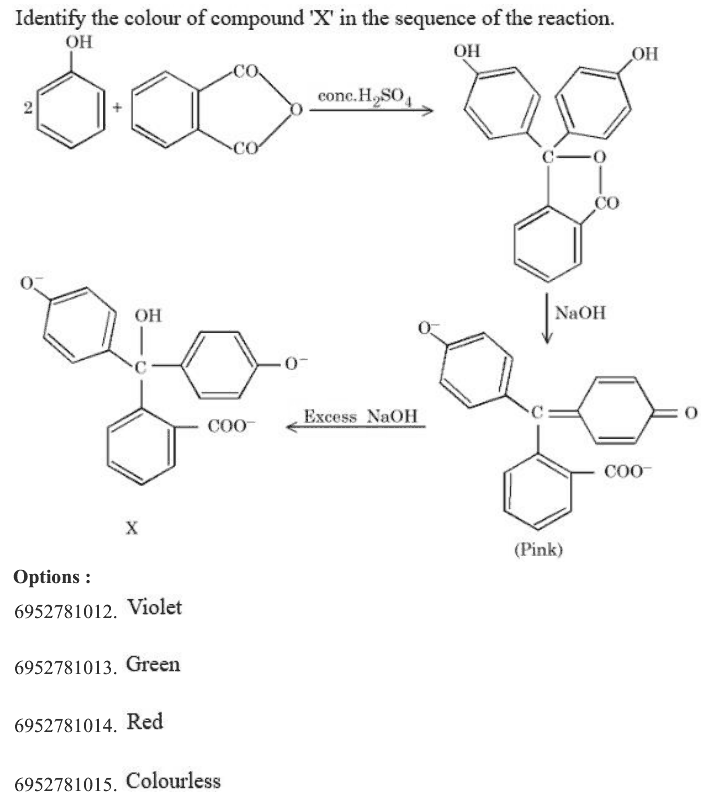
Violet
Green
Red
Colourless
Among $\mathrm{Fe^{3+}}$, $\mathrm{Pb^{2+}}$, $\mathrm{Cu^{2+}}$ and $\mathrm{Mn^{2+}}$, identify the one that gets precipitated out while passing $\mathrm{H_2S}$ in presence of $\mathrm{NH_4OH}$ as group reagent. The highest possible oxidation state of the corresponding metal is
+3
+4
+2
+7
Match the LIST-I with LIST-II
| List-I Compound | List-II Test |
|---|---|
| A. (see the figure above) | I. Hinsberg's reagent test |
| B. (see the figure above) | II. Phthalein dye test |
| C. (see the figure above) | III. Lucas test |
| D. (see the figure above) | IV. Tollen's test |
Choose the *correct* answer from the options given below:
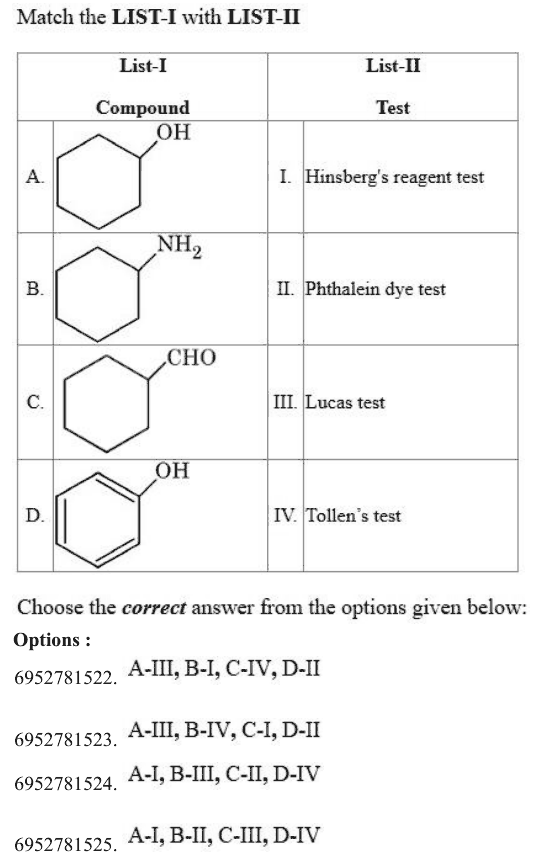
A-III, B-I, C-IV, D-II
A-III, B-IV, C-I, D-II
A-I, B-III, C-II, D-IV
A-I, B-II, C-III, D-IV
Match List - I with List - II.
| List - I Mixture of Compounds | List - II Reagent used to distinguish |
|---|---|
| A. Diethyl amine + Ethyl amine | I. Bromine water |
| B. Acetaldehyde + Acetone | II. $\mathrm{CHCl_3}$ + KOH, $\Delta$ |
| C. Ethanol + Phenol | III. Neutral $\mathrm{FeCl_3}$ |
| D. Benzoic acid + Cinnamic acid | IV. Ammonical silver nitrate |
Choose the correct answer from the options given below :
A-IV, B-II, C-I, D-III
A-IV, B-II, C-III, D-I
A-II, B-IV, C-I, D-III
A-II, B-IV, C-III, D-I
A salt with few drops of conc. HCl gives apple green colour in flame test. The group precipitate of the salt is dissolved in acetic acid and treated with $\mathrm{K_2CrO_4}$ to give yellow precipitate. When the sodium carbonate extract of the salt solution is heated with conc. $\mathrm{HNO_3}$ and ammonium molybdate, it resulted a canary yellow precipitate. The cation and anion present in the salt are respectively,
$\mathrm{Ca^{2+}}$ and $\mathrm{SO_4^{2-}}$
$\mathrm{Ba^{2+}}$ and $\mathrm{PO_4^{3-}}$
$\mathrm{Mn^{2+}}$ and $\mathrm{PO_4^{3-}}$
$\mathrm{Ba^{2+}}$ and $\mathrm{SO_4^{2-}}$
Among $\mathrm{Fe^{2+}}$, $\mathrm{Fe^{3+}}$, $\mathrm{Cr^{2+}}$ and $\mathrm{Zn^{2+}}$, the ion that shows positive borax bead test and with highest ionisation enthalpy is :
$\mathrm{Fe^{2+}}$
$\mathrm{Zn^{2+}}$
$\mathrm{Cr^{2+}}$
$\mathrm{Fe^{3+}}$
Given below are two statements:
Statement I: Griss$-$Ilosvay test is used for the detection of nitrite ion, which involves the use of sulphanilic acid and $\alpha$$-$naphthylamine reagent.
Statement II: In the above test, sulphanilic acid is diazotized by the acidified nitrite ion, which on further coupling with $\alpha$$-$naphthylamine forms an azo$-$dye.
In the light of the above statements, choose the *correct* answer from the options given below
Statement I is false but Statement II is true
Both Statement I and Statement II are true
Both Statement I and Statement II are false
Statement I is true but Statement II is false
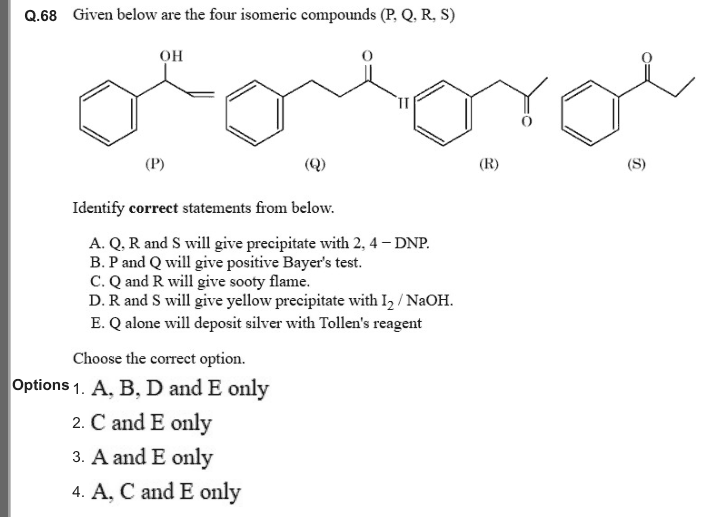
Given below are the four isomeric compounds (P, Q, R, S)
(see the figure above)
Identify correct statements from below.
A. Q, R and S will give precipitate with 2, 4 $-$ DNP.
B. P and Q will give positive Bayer's test.
C. Q and R will give sooty flame.
D. R and S will give yellow precipitate with $\mathrm{I_2}$ / NaOH.
E. Q alone will deposit silver with Tollen's reagent
Choose the correct option.
A, B, D and E only
C and E only
A and E only
A, C and E only
Consider the following reactions
$\mathrm{Na_2B_4O_7} \xrightarrow{\Delta} 2\mathrm{X} + \mathrm{Y}$
$\mathrm{CuSO_4} + \mathrm{Y} \xrightarrow{\text{Non-Luminous flame}} \mathrm{Z} + \mathrm{SO_3}$
$2\mathrm{Z} + 2\mathrm{X} + \text{Carbon} \xrightarrow{\text{Luminous flame}} 2\mathrm{Q} + \mathrm{Na_2B_4O_7} + \mathrm{CO}$
The oxidation states of Cu in Z and Q, respectively are :
$+2$ and $+1$
$+1$ and $+2$
$+2$ and $+2$
$+1$ and $+1$
Consider three metal chlorides x, y and z, where x is water soluble at room temperature, y is sparingly soluble in water at room temperature and z is soluble in hot water. x, y and z are respectively
$\mathrm{AlCl_3}$, $\mathrm{PbCl_2}$ and $\mathrm{BaCl_2}$
AgCl, $\mathrm{Hg_2Cl_2}$ and $\mathrm{PbCl_2}$
$\mathrm{CuCl_2}$, AgCl and $\mathrm{PbCl_2}$
$\mathrm{MgCl_2}$, AgCl and $\mathrm{AlCl_3}$
In the Group analysis of cations, $\mathrm{Ba^{2+}}$ & $\mathrm{Ca^{2+}}$ are precipitated respectively as
hydroxide & carbonate
sulphide & sulphide
chromate & sulphide
carbonate & carbonate
Match List - I with List - II.
| List - I Functional group (detection) | List - II Change observed during detection | ||
|---|---|---|---|
| A. | Unsaturation (Baeyer's test) | I. | Red colour appears |
| B. | Alcoholic group (Ceric ammonium nitrate test) | II. | Silver mirror appears |
| C. | Aldehyde group (Tollen's reagent) | III. | Violet colour appears |
| D. | Phenolic group ($\mathrm{FeCl_3}$ test) | IV. | Discharge of pink colour |
Choose the correct answer from the options given below :
A-IV, B-I, C-II, D-III
A-III, B-IV, C-II, D-I
A-IV, B-III, C-II, D-I
A-III, B-IV, C-I, D-II
Identify the correct statements :
A. Hydrated salts can be used as primary standard.
B. Primary standard should not undergo any reaction with air.
C. Reactions of primary standard with another substance should be instantaneous and stoichiometric.
D. Primary standard should not be soluble in water.
E. Primary standard should have low relative molar mass.
Choose the correct answer from the options given below :
A, B and C Only
A, B, C and E Only
A, B and E Only
D and E Only
Consider the following reactions.
$\mathrm{PbCl_2} + \mathrm{K_2CrO_4} \rightarrow \mathrm{A} + 2\mathrm{KCl}$
(Hot solution)
$\mathrm{A} + \mathrm{NaOH} \rightleftharpoons \mathrm{B} + \mathrm{Na_2CrO_4}$
$\mathrm{PbSO_4} + 4\mathrm{CH_3COONH_4} \rightarrow (\mathrm{NH_4})_2\mathrm{SO_4} + \mathrm{X}$
In the above reactions, A, B and X are respectively.
$\mathrm{Na_2[Pb(OH)_2]}$, $\mathrm{PbCrO_4}$ and $(\mathrm{NH_4})_2[\mathrm{Pb(CH_3COO)_4}]$
$\mathrm{Na_2[Pb(OH)_2]}$, $\mathrm{PbCrO_4}$ and $[\mathrm{Pb(NH_3)_4}]\mathrm{SO_4}$
$\mathrm{PbCrO_4}$, $\mathrm{Na_2[Pb(OH)_4]}$ and $[\mathrm{Pb(NH_3)_4}]\mathrm{SO_4}$
$\mathrm{PbCrO_4}$, $\mathrm{Na_2[Pb(OH)_4]}$ and $(\mathrm{NH_4})_2[\mathrm{Pb(CH_3COO)_4}]$
On heating a mixture of common salt and $\mathrm{K_2Cr_2O_7}$ in equal amount along with concentrated $\mathrm{H_2SO_4}$ in a test tube, a gas is evolved. Formula of the gas evolved and oxidation state of the central metal atom in the gas respectively are :
$\mathrm{CrO_2Cl_2}$ and $+6$
$\mathrm{CrO_2Cl_2}$ and $+5$
$\mathrm{Cr_2O_2Cl_2}$ and $+3$
$\mathrm{Cr_2O_2Cl_2}$ and $+6$
Match the LIST-I with LIST-II
| LIST-I (Reagent) | LIST-II (Functional Group detected) | ||
|---|---|---|---|
| A. | Sodium bicarbonate solution | I. | double bond/unsaturation |
| B. | Neutral ferric chloride | II. | carboxylic acid |
| C. | ceric ammonium nitrate | III. | phenolic - OH |
| D. | alkaline $KMnO_4$ | IV | alcoholic - OH |
Choose the correct answer from the options given below:
A-III, B-II, C-IV, D-I
A-II, B-IV, C-III, D-I
A-II, B-III, C-I, D-IV
A-II, B-III, C-IV, D-I
When a salt is treated with sodium hydroxide solution it gives gas $X$. On passing gas $X$ through reagent Y a brown coloured precipitate is formed. X and Y respectively, are
$X = NH_3$ and $Y = K_2HgI_4 + KOH$
$X = HCl$ and $Y = NH_4Cl$
$X = NH_3$ and $Y = HgO$
$X = NH_4Cl$ and $Y = KOH$
Compounds that should not be used as primary standards in titrimetric analysis are :
A. $Na_2Cr_2O_7$
B. Oxalic acid
C. NaOH
D. $FeSO_4 \cdot 6H_2O$
E. Sodium tetraborate
Choose the most appropriate answer from the options given below:
B and D Only
C, D and E Only
A, C and D Only
D and E Only
Choose the correct tests with respective observations.
(A) $CuSO_4$ (acidified with acetic acid) $+ K_4\left[Fe(CN)_6\right] \rightarrow$ Chocolate brown precipitate.
(B) $FeCl_3 + K_4\left[Fe(CN)_6\right] \rightarrow$ Prussian blue precipitate.
(C) $ZnCl_2 + K_4\left[Fe(CN)_6\right]$, neutralised with $NH_4OH \rightarrow$ White or bluish white precipitate.
(D) $MgCl_2 + K_4\left[Fe(CN)_6\right] \rightarrow$ Blue precipitate.
(E) $BaCl_2 + K_4\left[Fe(CN)_6\right]$, neutralised with $NaOH \rightarrow$ White precipitate.
Choose the correct answer from the options given below :
B, D and E only
C, D and E only
A, B and C only
A, D and E only
Formation of $Na_4\left[Fe(CN)_5NOS\right]$, a purple coloured complex formed by addition of sodium nitroprusside in sodium carbonate extract of salt indicates the presence of :
Sulphite ion
Sodium ion
Sulphate ion
Sulphide ion
Given below are two statements: Statement I: In the oxalic acid vs $\mathrm{KMnO_4}$ (in the presence of dil $\mathrm{H_2SO_4}$ ) titration the solution needs to be heated initially to $60^\circ$C, but no heating is required in Ferrous ammonium sulphate (FAS) vs $\mathrm{KMnO_4}$ titration (in the presence of dil $\mathrm{H_2SO_4}$ ) Statement II: In oxalic acid vs $\mathrm{KMnO_4}$ titration, the initial formation of $\mathrm{MnSO_4}$ takes place at high temperature, which then acts as catalyst for further reaction. In the case of FAS vs $\mathrm{KMnO_4}$, heating oxidizes $\mathrm{Fe^{2+}}$ into $\mathrm{Fe^{3+}}$ by oxygen of air and error may be introduced in the experiment. In the light of the above statements, choose the correct answer from the options given below
Both Statement I and Statement II are false
Both Statement I and Statement II are true
Statement I is false but Statement II is true
Statement I is true but Statement II is false
The metal ion whose electronic configuration is not affected by the nature of the ligand and which gives a violet colour in non-luminous flame under hot condition in borax bead test is
$\mathrm{Mn^{2+}}$
$\mathrm{Cr^{3+}}$
$\mathrm{Ni^{2+}}$
$\mathrm{Ti^{3+}}$
Identify the inorganic sulphides that are yellow in colour : (A) $\mathrm{(NH_4)_2\,S}$ (B) Pbs (C) Cus (D) $\mathrm{As_2\,S_3}$ (E) $\mathrm{As_2\,S_5}$ Choose the correct answer from the options given below :
(A), (D) and (E) only
(D) and (E) only
(A) and (B) only
(A) and (C) only
Find the compound ' A ' from the following reaction sequences. A $\xrightarrow{\text{aqua-regia}}$ B $\xrightarrow[\text{(2) AcOH}]{\text{(1) KNO}_2|\text{NH}_4\text{OH}}$ yellow ppt
CoS
ZnS
NiS
MnS
Identify A, B and C in the given below reaction sequence A $\xrightarrow{\mathrm{HNO_3}}$ $\mathrm{Pb(NO_3)_2}$ $\xrightarrow{\mathrm{H_2SO_4}}$ B $\xrightarrow[\substack{(2)\ \text{Acetic acid} \\ (3)\ \mathrm{K_2CrO_4}}]{(1)\ \text{Ammonium acetate}}$
$\mathrm{PbCl_2}, \mathrm{PbSO_4}, \mathrm{PbCrO_4}$
$\mathrm{PbS}, \mathrm{PbSO_4},\ \mathrm{Pb(CH_3COO)_2}$
$\mathrm{PbCl_2},\ \mathrm{Pb(SO_4)_2}, \mathrm{PbCrO_4}$
$\mathrm{PbS}, \mathrm{PbSO_4}, \mathrm{PbCrO_4}$
Identify the incorrect statements regarding primary standard of titrimetric analysis. (A) It should be purely available in dry form. (B) It should not undergo chemical change in air. (C) It should be hygroscopic and should react with another chemical instantaneously and stoichiometrically. (D) It should be readily soluble in water. (E) $\mathrm{KMnO_4}$ & NaOH can be used as primary standard. Choose the correct answer from the options given below :
(A) and (B) only
(C) and (E) only
(B) and (E) only
(C) and (D) only
Match List I with List II
| List - I (Test) | List - II (Observation) | ||
|---|---|---|---|
| A. | $\mathrm{Br_2}$ water test | I. | Yellow orange or orange red precipitate formed |
| B. | Ceric ammonium nitrate test | II. | Reddish orange colour disappears |
| C. | Ferric chloride test | III. | Red colour appears |
| D. | 2, 4 - DNP test | IV. | Blue, Green, Violet or Red colour appear |
Choose the correct answer from the options given below:
A-III, B-IV, C-I, D-II
A-I, B-II, C-III, D-IV
A-IV, B-I, C-II, D-III
A-II, B-III, C-IV, D-I
Match List I with List II Choose the correct answer from the options given below:
| List-I (Name of the test) | List-II (Reaction sequence involved) [M is metal] | ||
|---|---|---|---|
| A. | Borax bead test | I. | $\mathrm{MCO_3 \rightarrow MO \xrightarrow{Co(NO_3)_2} CoO \cdot MO}$ |
| B. | Charcoal cavity test | II. | $\mathrm{MCO_3 \rightarrow MCl_2 \rightarrow M^{2+}}$ |
| C | Cobalt nitrate test | III | $\mathrm{MSO_4 \xrightarrow[\Delta]{Na_2\,B_4O_7} M(BO_2)_2 \rightarrow MBO_2 \rightarrow M}$ |
| D. | Flame test | IV | $\mathrm{MSO_4 \xrightarrow[\Delta]{Na_2CO_3} MCO_3 \rightarrow MO \rightarrow M}$ |
A-III, B-II, C-IV, D-I
A-III, B-IV, C-I, D-II
A-III, B-I, C-II, D-IV
A-III, B-I, C-IV, D-II
Match List - I with List - II.
| (Test) | (Identification) | ||
|---|---|---|---|
| (A) | Bayer's test MARKS | (I) | Phenol VIARKS |
| (B) | Ceric ammonium nitrate test | (II) | Aldehyde |
| (C) | Phthalein dye test $R$ K | (III) | Alcoholic-OH group |
| (D) | Schiff's test | (IV) | Unsaturation |
Choose the correct answer from the options given below :
(A)-(IV), (B)-(III), (C)-(I), (D)-(II)
(A)-(II), (B)-(III), (C)-(IV), (D)-(I)
(A)-(IV), (B)-(I), (C)-(II), (D)-(III)
(A)-(III), (B)-(I), (C)-(IV), (D)-(II)
Match List I with List II Choose the correct answer from the options given below:
| List - I (Precipitating reagent and conditions) | List - II (Cation) | ||
|---|---|---|---|
| A. | $NH_4Cl + NH_4OH$/ARKS | I. | $Mn^{2+}$ |
| B. | $NH_4OH + Na_2CO_3$ | II. | $Pb^{2+}$ |
| C. | $NH_4OH + NH_4Cl + H_2$ S gas | III. | $Al^{3+}$ |
| D. | dilute HCl | IV. | $Sr^{2+}$ |
A-III, B-IV, C-I, D-II
A-III, B-IV, C-II, D-I
A-IV, B-III, C-II, D-I
A-IV, B-III, C-I, D-II
During the detection of acidic radical present in a salt, a student gets a pale yellow precipitate soluble with difficulty in $NH_4OH$ solution when sodium carbonate extract was first acidified with dil. $HNO_3$ and then $AgNO_3$ solution was added. This indicates presence of :
$Br^{-}$
$I^{-}$
$Cl^{-}$
$CO_3^{2-}$
Match List - I with List - II.
| List - I Reaction | List - II Type of redox reaction | ||
|---|---|---|---|
| (A) | Li | (I) | 589.2 |
| (B) | Na | (II) | 455.5 |
| (C) | Rb | (III) | 670.8 |
| (D) | Cs | (IV) | 780.0 |
Choose the correct answer from the options given below :
(A)-(II), (B)-(IV), (C)-(III), (D)-(I)
(A)-(I), (B)-(IV), (C)-(III), (D)-(II)
(A)-(IV), (B)-(II), (C)-(I), (D)-(III)
(A)-(III), (B)-(I), (C)-(IV), (D)-(II)
While preparing crystals of Mohr's salt, dil $\mathrm{H_2SO_4}$ is added to a mixture of ferrous sulphate and ammonium sulphate, before dissolving this mixture in water, dil $\mathrm{H_2SO_4}$ is added here to :
prevent the hydrolysis of ferrous sulphate
prevent the hydrolysis of ammonium sulphate
make the medium strongly acidic
increase the rate of formation of crystals
In the precipitation of the iron group (III) in qualitative analysis, ammonium chloride is added before adding ammonium hydroxide to :
increase concentration of $\mathrm{Cl^-}$ ions
increase concentration of $\mathrm{NH_4^+}$ ions
prevent interference by phosphate ions
decrease concentration of ${}^{-}\mathrm{OH}$ ions
Given below are two statements :
Statement (I) : Potassium hydrogen phthalate is a primary standard for standardisation of sodium hydroxide solution.
Statement (II) : In this titration phenolphthalein can be used as indicator.
In the light of the above statements, choose the most appropriate answer from the options given below:
Both Statement I and Statement II are correct
Statement I is correct but Statement II is incorrect
Statement I is incorrect but Statement II is correct
Both Statement I and Statement II are incorrect
The compound that is white in color is
ammonium sulphide
lead sulphate
lead iodide
ammonium arsinomolybdate
Given below are two statements:
Statement-I: The gas liberated on warming a salt with dil $\mathrm{H_2SO_4}$, turns a piece of paper dipped in lead acetate into black, it is a confirmatory test for sulphide ion.
Statement-II: In statement-I the colour of paper turns black because of formation of lead sulphite.
In the light of the above statements, choose the most appropriate answer from the options given below:
Both Statement-I and Statement-II are false
Statement-I is false but Statement-II is true
Statement-I is true but Statement-II is false
Both Statement-I and Statement-II are true.
On passing a gas, '$X$', through Nessler's reagent, a brown precipitate is obtained. The gas '$X$' is
$\mathrm{H_2S}$
$\mathrm{CO_2}$
$\mathrm{NH_3}$
$\mathrm{Cl_2}$
A reagent which gives brilliant red precipitate with Nickel ions in basic medium is
sodium nitroprusside
neutral $\mathrm{FeCl_3}$
meta-dinitrobenzene
dimethyl glyoxime
NaCl reacts with conc. $\mathrm{H_2\,SO_4}$ and $\mathrm{K_2\,Cr_2\,O_7}$ to give reddish fumes (B), which react with NaOH to give yellow solution (C). (B) and (C) respectively are ;
$\mathrm{CrO_2\,Cl_2}$, $\mathrm{Na_2\,CrO_4}$
$\mathrm{Na_2\,CrO_4}$, $\mathrm{CrO_2\,Cl_2}$
$\mathrm{CrO_2\,Cl_2}$, $\mathrm{KHSO_4}$
$\mathrm{CrO_2\,Cl_2}$, $\mathrm{Na_2\,Cr_2\,O_7}$
In the wet tests for detection of various cations by precipitation, $\mathrm{Ba^{2+}}$ cations are detected by obtaining precipitate of
Ba(ox) : Barium oxalate
$\mathrm{BaCO_3}$
$\mathrm{Ba(OAc)_2}$
$\mathrm{BaSO_4}$
When a solution of mixture having two inorganic salts was treated with freshly prepared ferrous sulphate in acidic medium, a dark brown ring was formed whereas on treatment with neutral $\mathrm{FeCl_3}$, it gave deep red colour which disappeared on boiling and a brown red ppt was formed. The mixture contains
$\mathrm{SO_3^{2-}}$ & $\mathrm{CH_3COO^-}$
$\mathrm{CH_3COO^-}$ & $\mathrm{NO_3^-}$
$\mathrm{SO_3^{2-}}$ & $\mathrm{C_2O_4^{2-}}$
$\mathrm{C_2O_4^{2-}}$ & $\mathrm{NO_3^-}$
Match List I with List II
LIST-I Complex
A. $\mathrm{Mg(NH_4)\ PO_4}$
B. $\mathrm{K_3[Co\ (NO_2)_6]}$
C. $\mathrm{MnO\ (OH)_2}$
D. $\mathrm{Fe_4\ [Fe\ (CN)_6]_3}$
LIST-II Colour
I. brown
II. white
III. yellow
IV. blue
Choose the correct answer from the options given below:
A-III, B-IV, C-II, D-I
A-II, B-III, C-I, D-IV
A-II, B-IV, C-I, D-III
A-II, B-III, C-IV, D-I
Prolonged heating is avoided during the preparation of ferrous ammonium sulphate to
Prevent hydrolysis
Prevent reduction
Prevent breaking
Prevent oxidation
Match List I with List II :
List I (Reagents used) List II (Compound with Functional group detected)
A. Alkaline solution of copper sulphate and sodium citrate I. (see the figure above)
B. Neutral $\mathrm{FeCl_3}$ solution II. (see the figure above)
C. Alkaline chloroform solution III. (see the figure above)
D. Potassium iodide and sodium hypochloride IV. (see the figure above)
Choose the correct answer from the options given below :
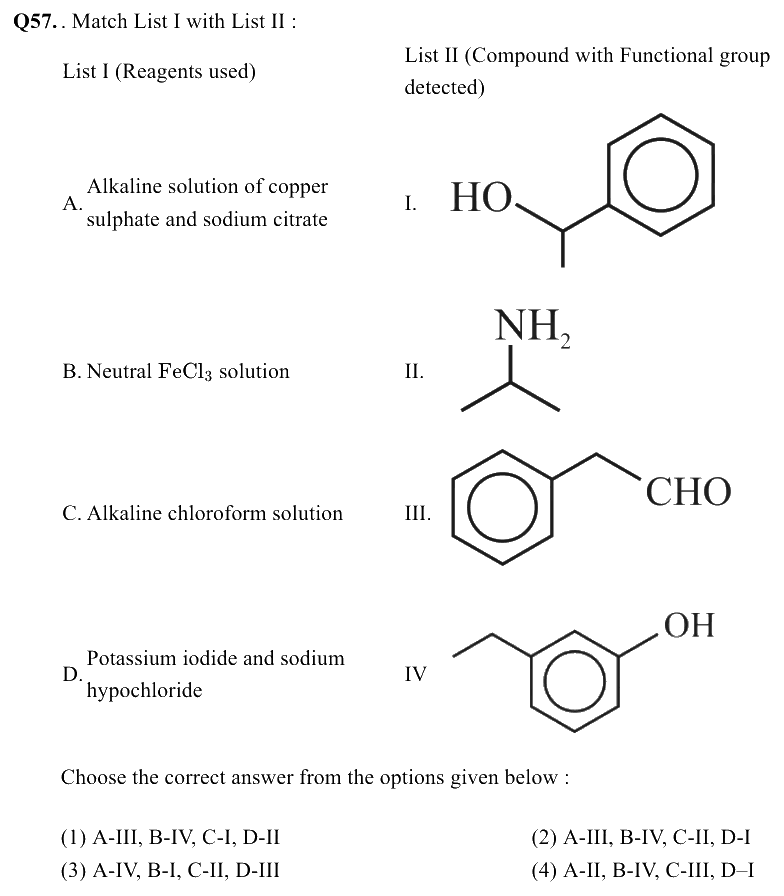
A-III, B-IV, C-I, D-II
A-III, B-IV, C-II, D-I
A-IV, B-I, C-II, D-III
A-II, B-IV, C-III, D–I
Given below are two statements:
Statement I: In redox titration, the indicators used are sensitive to change in pH of the solution.
Statement II: In acid-base titration, the indicators used are sensitive to change in oxidation potential.
In the light of the above statements, choose the most appropriate answer from the options given below
Statement I is correct but Statement II is incorrect
Both Statement I and Statement II are incorrect
Statement I is incorrect but Statement II is correct
Both Statement I and Statement II are correct
Element not present in Nessler's reagent is
N
Hg
I
K
Formation of which complex, among the following, is not a confirmatory test of $\mathrm{Pb^{2+}}$ ions
Lead sulphate
Lead nitrate
Lead chromate
Lead iodide
A solution of $\mathrm{FeCl_3}$ when treated with $\mathrm{K_4Fe(CN)_6}$ gives a prussian blue precipitate due to the formation of
$\mathrm{KFe_2(CN)_6}$
$\mathrm{FeFe(CN)_6}$
$\mathrm{Fe_3Fe(CN)_{62}}$
$\mathrm{Fe_4Fe(CN)_{63}}$
Match List I and List II
| List I (Test) | List II (Functional group / Class of Compound) | ||
|---|---|---|---|
| (A) | Molisch's Test | (I) | Peptide |
| (B) | Biuret Test | (II) | Carbohydrate |
| (C) | Carbylamine Test | (III) | Primary amine |
| (D) | Schiff's Test | (IV) | Aldehyde |
Choose the correct answer from the options given below:
(A) - I, (B) - II, (C) - III, (D) - IV
(A) - III, (B) - IV, (C) -I, (D) - II
(A) - II, (B) - I, (C) - III, (D) - IV
(A) - III, (B) - IV, (C) -II, (D) - I
Given below are two statements: one is labelled as Assertion (A) and the other is labelled as Reason (R).
Assertion (A) : An aqueous solution of KOH when for volumetric analysis, its concentration should be checked before the use.
Reason (R) : On aging,KOH solution absorbs atmospheric $\mathrm{CO_2}$.
In the light of the above statements, choose the correct answer from the options given below.
(A) is not correct but (R) is correct
Both (A) and (R) are correct but (R) is not the correct explanation of (A)
Both (A) and (R) are correct and (R) is the correct explanation of (A)
(A) is correct but (R) is not correct
Which element is not present in Nessler's reagent?
Mercury
Potassium
Iodine
Oxygen
Given below are two statements :
Statement I : Upon heating a borax bead dipped in cupric sulphate in a luminous flame, the colour of the bead becomes green.
Statement II : The green colour observed is due to the formation of copper(I) metaborate In the light of the above statements, choose the most appropriate answer from the options given below:
Both Statement I and Statement II are false
Both Statement I and Statement II are true
Statement I is false but Statement II is true
Statement I is true but Statement II is false
During the qualitative analysis of $\mathrm{SO_3^{2-}}$ using dilute $\mathrm{H_2SO_4}$, $\mathrm{SO_2}$ gas is evolved which turns $\mathrm{K_2Cr_2O_7}$ solution (acidified with dilute $\mathrm{H_2SO_4}$):
Black
Red
Green
Blue
In the wet tests for identification of various cations by precipitation, which transition element cation doesn't belong to group IV in qualitative inorganic analysis?
$\mathrm{Fe^{3+}}$
$\mathrm{Zn^{2+}}$
$\mathrm{Co^{2+}}$
$\mathrm{Ni^{2+}}$
Formulae for Nessler's reagent is:
$\mathrm{KHg_2\,I_2}$
$\mathrm{KHgI_3}$
$\mathrm{K_2\,HgI_4}$
$\mathrm{HgI_2}$
During the borax bead test with $\mathrm{CuSO_4}$, a blue green colour of the bead was observed in oxidising flame due to the formation of
$\mathrm{Cu_3\,B_2}$
$\mathrm{Cu}$
$\mathrm{Cu\,(BO_2)_2}$
$\mathrm{CuO}$
Match List I with List II
List I (Elements): A K; B Ca; C Sr; D Ba
List II (Colour imparted to the flame): I Brick Red; II Violet; III Apple Green; IV Crimson Red
Choose the correct answer from the options given below:
A-II, B-I, C-III, D-IV
A-II, B-IV, C-I, D-III
A-II, B-I, C-IV, D-III
A-IV, B-III, C-II, D-I
Match the List-I with List-II :
Cations
P $\to$ $\mathrm{Pb^{2+}, Cu^{2+}}$
Q $\to$ $\mathrm{Al^{3+}, Fe^{3+}}$
R $\to$ $\mathrm{Co^{2+}, Ni^{2+}}$
S $\to$ $\mathrm{Ba^{2+}, Ca^{2+}}$
Group reaction
$\mathrm{H_2S}$ gas in presence of dilute HCl
$\mathrm{(NH_4)_2CO_3}$ in presence of $\mathrm{NH_4OH}$
$\mathrm{NH_4OH}$ in presence of $\mathrm{NH_4Cl}$
$\mathrm{H_2S}$ in presence of $\mathrm{NH_4OH}$
P $\to$ i, Q $\to$ iii, R $\to$ ii, S $\to$ iv
P $\to$ iv, Q $\to$ ii, R $\to$ iii, S $\to$ i
P $\to$ iii, Q $\to$ i, R $\to$ iv, S $\to$ ii
P $\to$ i, Q $\to$ iii, R $\to$ iv, S $\to$ ii
A chloride salt solution acidified with dil. $\mathrm{HNO_3}$ gives a curdy white precipitate, [A], on addition of $\mathrm{AgNO_3}$. [A] on treatment with $\mathrm{NH_4OH}$ gives a clear solution, B.
$\mathrm{H[AgCl_3]\ \&\ [Ag(NH_3)_2]Cl}$
$\mathrm{H[AgCl_3]\ \&\ (NH_4)[Ag(OH)_2]}$
$\mathrm{AgCl\ \&\ [Ag(NH_3)_2]\ Cl}$
$\mathrm{AgCl\ \&\ (NH_4)[Ag(OH)_2]}$
An ammoniacal metal salt solution gives a brilliant red precipitate on addition of dimethylglyoxime. The metal ion is :
$Cu^{2+}$
$Ni^{2+}$
$Fe^{2+}$
$\mathrm{Co^{2+}}$
When borax is heated with CoO on a platinum loop, blue coloured bead formed is largely due to
$\mathrm{B_2O_3}$
$\mathrm{CoBO_{2_2}}$
$\mathrm{CoB_4O_7}$
$\mathrm{CoB_4O_5OH_4}$
$\mathrm{Fe^{3+}}$ cation gives a prussian blue precipitate on addition of potassium ferrocyanide solution due to the formation of
$[\mathrm{Fe\,(H_2O)_6}]_2[\mathrm{Fe\,(CN)_6}]$
$\mathrm{Fe_2\,[Fe\,(CN)_6]_2}$
$\mathrm{Fe_3\,[Fe\,(OH)_2(CN)_4]_2}$
$\mathrm{Fe_4\,[Fe\,(CN)_6]_3}$
A white precipitate was formed when $\mathrm{BaCl_2}$ was added to water extract of an inorganic salt. Further, a gas 'X' with characteristic odour was released when the formed white precipitate was dissolved in dilute HCl. The anion present in the inorganic salt is:
$\mathrm{I^-}$
$\mathrm{SO_3^{2-}}$
$\mathrm{S^{2-}}$
$\mathrm{NO_2^-}$
Match List I with List II.
List-I (Anion)
(A) $\mathrm{CO_3^{2-}}$
(B) $\mathrm{S^{2-}}$
(C) $\mathrm{SO_3^{2-}}$
(D) $\mathrm{NO_2^{-}}$
List-II (gas evolved on reaction with dil. $\mathrm{H_2SO_4}$)
(I) Colourless gas which turns lead acetate paper black.
(II) Colourless gas which turns acidified potassium dichromate solution green.
(III) Brown fumes which turns acidified KI solution containing starch blue.
(IV) Colourless gas evolved with brisk effervescence, which turns lime water milky.
Choose the correct answer from the options given below
A $-$ III, B $-$ I, C $-$ II, D $-$ IV
A $-$ II, B $-$ I, C $-$ IV, D $-$ III
A $-$ IV, B $-$ I, C $-$ III, D $-$ II
A $-$ IV, B $-$ I, C $-$ II, D $-$ III
Which statement is not true with respect to nitrate ion test?
A dark brown ring is formed at the junction of two solutions.
Ring is formed due to nitroferrous sulphate complex.
The brown complex is $[\mathrm{Fe(H_2O)_5(NO)}]\ \mathrm{SO}_4$
Heating the nitrate salt with conc. $\mathrm{H}_2\mathrm{SO}_4$, light brown fumes are evolved.
During the qualitative analysis of salt with cation $\mathrm{y^{2+}}$, addition of a reagent (X) to alkaline solution of the salt gives a bright red precipitate. The reagent (X) and the cation $\left(\mathrm{y^{2+}}\right)$ present respectively are :
Dimethylglyoxime and $\mathrm{Ni^{2+}}$
Dimethylglyoxime and $\mathrm{Co^{2+}}$
Nessler's reagent and $\mathrm{Hg^{2+}}$
Nessler's reagent and $\mathrm{Ni^{2+}}$
In the flame test of a mixture of salts, a green flame with blue centre was observed. Which one of the following cations may be present?
Calcium
Copper
Barium
Strontium
The potassium ferrocyanide solution gives a Prussian blue colour, when added to :
$\mathrm{CoCl_3}$
$\mathrm{CoCl_2}$
$\mathrm{FeCl_2}$
$\mathrm{FeCl_3}$
Match List - I with List - II :
List - I (Metal ion)
(a) $\mathrm{Mn^{2+}}$
(b) $\mathrm{As^{3+}}$
(c) $\mathrm{Cu^{2+}}$
(d) $\mathrm{Al^{3+}}$
List - II (Group in Qualitative analysis)
(i) Group - III
(ii) Group - IIA
(iii) Group - IV
(iv) Group - IIB
Choose the most appropriate answer from the options given below :
(a)-(iii), (b)-(iv), (c)-(ii), (d)-(i)
(a)-(iv), (b)-(ii), (c)-(iii), (d)-(i)
(a)-(i), (b)-(iv), (c)-(ii), (d)-(iii)
(a)-(i), (b)-(ii), (c)-(iii), (d)-(iv)
Acidic ferric chloride solution on treatment with excess of potassium ferrocyanide gives a Prussian blue coloured colloidal species. It is:
$\mathrm{HFe[Fe(CN)_6]}$
$\mathrm{K_5Fe[Fe(CN)_6]_2}$
$\mathrm{Fe_4[Fe(CN)_6]_3}$
$\mathrm{KFe[Fe(CN)_6]}$
To an aqueous solution containing ions such as $\mathrm{Al^{3+}}$, $\mathrm{Zn^{2+}}$, $\mathrm{Ca^{2+}}$, $\mathrm{Fe^{3+}}$, $\mathrm{Ni^{2+}}$, $\mathrm{Ba^{2+}}$ and $\mathrm{Cu^{2+}}$ was added conc. HCl, followed by $\mathrm{H_2S}$. The total number of cations precipitated during this reaction is/are :
1
3
4
2
An inorganic Compound 'X' on treatment with concentrated $\mathrm{H_2SO_4}$ produces brown fumes and gives dark brown ring with $\mathrm{FeSO_4}$ in presence of concentrated $\mathrm{H_2SO_4}$. Also Compound 'X' gives precipitate 'Y', when its solution in dilute HCl is treated with $\mathrm{H_2S}$ gas. The precipitate 'Y' on treatment with concentrated $\mathrm{HNO_3}$ followed by excess of $\mathrm{NH_4OH}$ further gives deep blue coloured solution, Compound 'X' is:
$\mathrm{Co(NO_3)_2}$
$\mathrm{Pb(NO_2)_2}$
$\mathrm{Cu(NO_3)_2}$
$\mathrm{Pb(NO_3)_2}$
Reagent, $1-$naphthylamine and sulphanilic acid in acetic acid is used for the detection of
$\mathrm{N_2O}$
$\mathrm{NO_3^-}$
$\mathrm{NO}$
$\mathrm{NO_2^-}$
On treating a compound with warm dil. $\mathrm{H_2SO_4}$, gas X is evolved which turns $\mathrm{K_2Cr_2O_7}$ paper acidified with dil. $\mathrm{H_2SO_4}$ to a green compound Y. X and Y respectively are :
$\mathrm{X} = \mathrm{SO_2},\ \mathrm{Y} = \mathrm{Cr_2O_3}$
$\mathrm{X} = \mathrm{SO_2},\ \mathrm{Y} = \mathrm{Cr_2(SO_4)_3}$
$\mathrm{X} = \mathrm{SO_3},\ \mathrm{Y} = \mathrm{Cr_2(SO_4)_3}$
$\mathrm{X} = \mathrm{SO_3},\ \mathrm{Y} = \mathrm{Cr_2O_3}$
Ceric ammonium nitrate and $\mathrm{CHCl_3}$ / alc. KOH are used for the identification of functional groups present in ______ and ______ respectively.
amine, phenol
alcohol, amine
amine, alcohol
alcohol, phenol
Which of the following compound gives pink colour on reaction with phthalic anhydride in conc. $\mathrm{H_2SO_4}$ followed by treatment with NaOH?
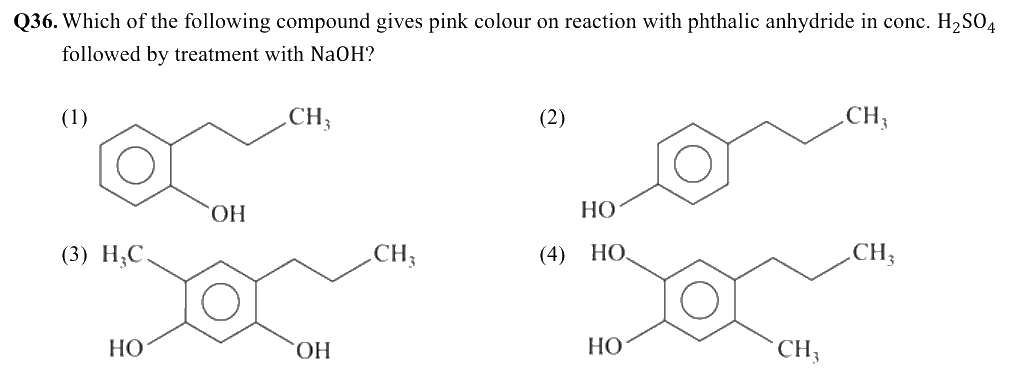
see figure benzene ring with a three-carbon chain ending in CH3 (n-propyl) on one carbon and an OH on the neighbouring carbon (ortho)
see figure benzene ring with an n-propyl chain (ending in CH3) on one carbon and an OH on the carbon opposite it (para)
see figure benzene ring with H3C on the upper left carbon, HO on the lower left carbon (next to the CH3 carbon), an n-propyl chain (ending in CH3) on the upper right carbon and HO on the lower right carbon (the two OH groups are separated by one ring CH)
see figure benzene ring with HO on the upper left carbon and a second HO on the lower left carbon (adjacent OH groups), an n-propyl chain (ending in CH3) on the upper right carbon and CH3 on the lower right carbon
Given below are two statements:
Statement I: Colourless cupric metaborate is reduced to cuprous metaborate in a luminous flame.
Statement II: Cuprous metaborate is obtained by heating boric anhydride and copper sulphate in a non-luminous flame.
In the light of the above statements, choose the most appropriate answer from the options given below.
Statement I is false but Statement II is true
Both Statement I and Statement II are false
Both Statement I and Statement II are true
Statement I is true but Statement II is false
While titration dilute HCl solution with aqueous NaOH, which of the following will not be required ?
Burette and porcelain tile
Pipette and distilled water
Clamp and phenolphthalein
Bunsen burner and measuring cylinder
The strength of an aqueous NaOH solution is most accurately determined by titrating: (Note: consider that an appropriate indicator is used)
Aq. NaOH in a pipette and aqueous oxalic acid in a burette
Aq. NaOH in a burette and aqueous oxalic acid in a conical flask
Aq. NaOH in a burette and concentrate $\mathrm{H_2SO_4}$ in a conical flask
Aq. NaOH in a volumetric flask and concentrated $\mathrm{H_2SO_4}$ in a conical flask
The peptide that gives positive ceric ammonium nitrate and carbylamine tests is:
Gln - Asp
Asp - Gln
Lys - Asp
Ser - Lys
The correct match between item I and item II is
Item I (Compound)
a. Lysine
b. Furfural
c. Benzyl alcohol
d. Styrene
Item II (Reagent)
p. 1-naphthol
q. Ninhydrin
r. $\mathrm{KMnO_4}$
s. Ceric ammonium nitrate
a $\rightarrow$ q, b $\rightarrow$ r, c $\rightarrow$ s, d $\rightarrow$ p
a $\rightarrow$ q, b $\rightarrow$ p, c $\rightarrow$ s, d $\rightarrow$ r
a $\rightarrow$ r, b $\rightarrow$ p, c $\rightarrow$ q, d $\rightarrow$ s
a $\rightarrow$ q, b $\rightarrow$ p, c $\rightarrow$ r, d $\rightarrow$ s
For standardizing NaOH solution, which of the following is used as a primary standard?
Sodium tetra borate
Ferrous Ammonium sulphate
Oxalic acid
Dil. HCl
The incorrect statement is:
$\mathrm{Cu^{2+}}$ ion gives chocolate coloured precipitate with potassium ferrocyanide solution
$\mathrm{Cu^{2+}}$ and $\mathrm{Ni^{2+}}$ ions give black precipitate with $\mathrm{H_2S}$ in presence of HCl solution
Ferric ion gives blood red colour with potassium thiocyanate
$\mathrm{Cu^{2+}}$ salts give red coloured borax bead test in reducing flame
In a complexometric titration of metal ion with ligand $M$ (Metal ion) $+$ $L$(Ligand) $\rightarrow C$ (Complex) end point is estimated spectrophotometrically (through light absorption). If 'M' and 'C' do not absorb light and only 'L' absorbs then the titration plot between absorbed light ($A$) versus volume of ligand 'L' ($V$) would look like:
(see the figure above)
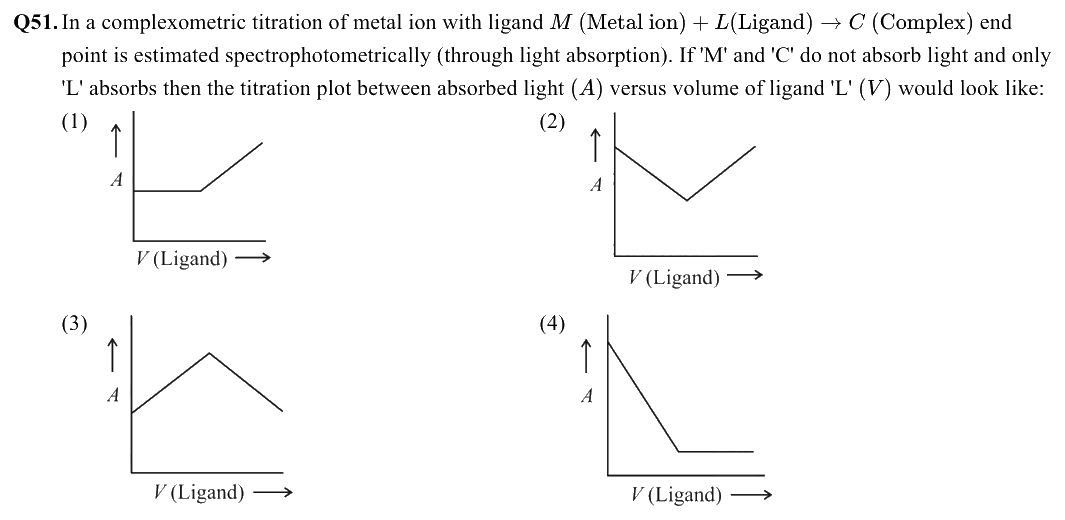
see figure flat horizontal line, then rising straight line
see figure falling line to a minimum, then rising line (V shape)
see figure rising line to a maximum, then falling line (inverted V)
see figure falling line, then flat horizontal line
A white sodium salt dissolves readily in water to give a solution which is neutral to litmus. When silver nitrate solution is added to the aforementioned solution, a white precipitate is obtained which does not dissolve in dil. nitric acid. The anion is :
$\mathrm{CO_3^{2-}}$
$\mathrm{SO_4^{2-}}$
$\mathrm{S^{2-}}$
$\mathrm{Cl^-}$
A solution containing a period$-$IV cation gives a precipitate on passing $\mathrm{H_2S}$. A solution of this precipitate in dil. HCl produces a white precipitate with NaOH solution and bluish-white precipitate with basic potassium ferrocyanide. The cation is
$\mathrm{Mn^{2+}}$
$\mathrm{Zn^{2+}}$
$\mathrm{Ni^{2+}}$
$\mathrm{Co^{2+}}$
The sodium salt of an organic acid X produces effervescence with concentrated $\mathrm{H_2SO_4}$. X reacts with the acidified aqueous $\mathrm{CaCl_2}$ solution to give a white precipitate which decolourises acidic solution of $\mathrm{KMnO_4}$. X is
$\mathrm{HCOONa}$
$\mathrm{CH_3COONa}$
$\mathrm{Na_2C_2O_4}$
$\mathrm{C_6H_5COONa}$
The hottest region of Bunsen flame shown in the figure below is:
(see the figure above)
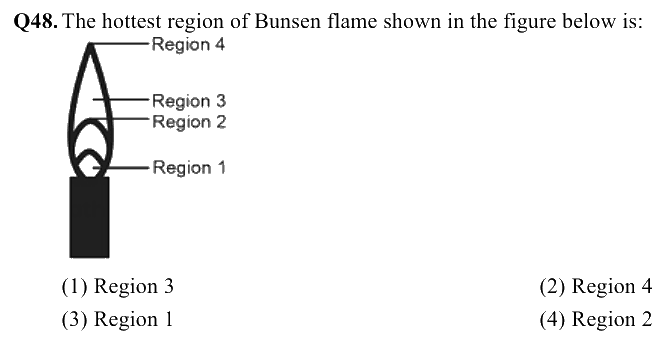
Region 3
Region 4
Region 1
Region 2
The cation that will not be precipitated by $\mathrm{H_2S}$ in the presence of dil HCl is:
$\mathrm{Co^{2+}}$
$\mathrm{As^{3+}}$
$\mathrm{Pb^{2+}}$
$\mathrm{Cu^{2+}}$
An aqueous solution of a salt X turns blood red on treatment with $\mathrm{SCN^{-}}$ and blue on treatment with $\mathrm{K_4[Fe(CN)_6]}$ , X also gives a positive chromyl chloride test. The salt X is:
$\mathrm{FeCl_3}$
$\mathrm{Fe(NO_3)_3}$
$\mathrm{CuCl_2}$
$\mathrm{Cu(NO_3)_2}$
Which one of the following compounds is not a yellow colored compound ?
$\mathrm{BaCrO_4}$
$\mathrm{Zn_2[Fe(CN)_6]}$
$\mathrm{K_3[Co(NO_2)_6]}$
$\mathrm{(NH_4)_3[As\,(Mo_3O_{10})_4]}$
Which of the following statements is incorrect?
$\mathrm{Fe^{2+}}$ ion also gives blood red colour with $\mathrm{SCN^{-}}$ ion.
$\mathrm{Fe^{3+}}$ ion also gives blood red colour with $\mathrm{SCN^{-}}$ ion.
On passing $\mathrm{H_2}$ S into $\mathrm{Na_2ZnO_2}$ solution a white ppt of ZnS is formed.
Cupric ion reacts with excess of ammonia solution to give deep blue colour of $[\mathrm{Cu(NH_3)_4}]^{2+}$ ion.
Sodium Carbonate cannot be used in place of $\mathrm{(NH_4)_2CO_3}$ for the identification of $\mathrm{Ca^{2+}}$, $\mathrm{Ba^{2+}}$ and $\mathrm{Sr^{2+}}$ ions (in group V ) during mixture analysis because :
$\mathrm{Mg^{2+}}$ ions will also be precipitated.
Concentration of $\mathrm{CO_3^{\,2-}}$ ions is very low.
Sodium ions will react with acid radicals.
$\mathrm{Na^+}$ ions will interfere with the detection of $\mathrm{Ca^{2+}}$, $\mathrm{Ba^{2+}}$, $\mathrm{Sr^{2+}}$ ions.
Calomel $(\mathrm{Hg_2Cl_2})$ on reaction with ammonium hydroxide gives
$\mathrm{HgNH_2Cl}$
$\mathrm{NH_2 - Hg - Hg - Cl}$
$\mathrm{Hg_2O}$
$\mathrm{HgO}$
Which one of the following statements is correct?
From a mixed precipitate of AgCl and AgI, ammonia solution dissolves only AgCl
Ferric ions give a deep green precipitate on adding potassium ferrocyanide solution
On boiling a solution having $\mathrm{K^+}$, $\mathrm{Ca^{2+}}$ and $\mathrm{HCO_3^-}$ ions we get a precipitate of $\mathrm{K_2Ca(CO_3)_2}$.
Manganese salts give a violet borax bead test in the reducing flame
A red solid is insoluble in water. However it becomes soluble if some KI is added to water. Heating the red solid in a test tube results in liberation of some violet coloured fumes and droplets of a metal appear on the cooler parts of the test tube. The red solid is
$\mathrm{HgI_2}$
$\mathrm{HgO}$
$\mathrm{Pb_3O_4}$
$\mathrm{(NH_4)_2Cr_2O_7}$
How do we differentiate between $\mathrm{Fe^{3+}}$ and $\mathrm{Cr^{3+}}$ in group III?
by taking excess of $\mathrm{NH_4OH}$ solution
by increasing $\mathrm{NH_4^+}$ ion concentration
by decreasing $\mathrm{OH^-}$ ion concentration
both (b) and (c)
Among the following cations, the number of cations which will give characteristic precipitate in their identification tests with $\mathrm{K_4\,[Fe(CN)_6]}$ is ______ . $\mathrm{Cu^{2+}, Fe^{3+}, Ba^{2+}, Ca^{2+}, NH_4^+, Mg^{2+}, Zn^{2+}}$
Consider the following test for a group-IV cation.
$\mathrm{M^{2+} + H_2\,S \rightarrow A}$ (Black precipitate) $+$ by product
$\mathrm{A +}$ aqua regia $\rightarrow \mathrm{B + NOCl + S + H_2O}$
$\mathrm{B + KNO_2 + CH_3COOH \rightarrow C +}$ by product
The spin-only magnetic moment value of the metal complex C is ______ BM (Nearest integer)
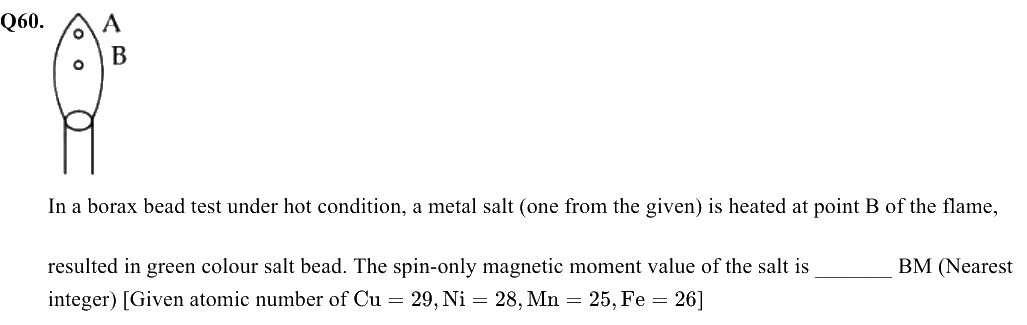
see figure In a borax bead test under hot condition, a metal salt (one from the given) is heated at point B of the flame, resulted in green colour salt bead. The spin-only magnetic moment value of the salt is ______ BM (Nearest integer) [Given atomic number of Cu = 29, Ni = 28, Mn = 25, Fe = 26]
The number of white coloured salts among the following is ......
A $\mathrm{SrSO_4}$ B $\mathrm{MgNH_4PO_4}$ C $\mathrm{BaCrO_4}$
D $\mathrm{Mn(OH)_2}$ E $\mathrm{PbSO_4}$ F $\mathrm{PbCrO_4}$
G AgBr H $\mathrm{PbI_2}$ I $\mathrm{CaC_2O_4}$
J $\mathrm{Fe(OH)_2CH_3COO}$
Molar mass of the salt from NaBr, NaNO$_3$, KI and CaF$_2$ which does not evolve coloured vapours on heating with concentrated H$_2$SO$_4$ is ______ g mol$^{-1}$, (Molar mass in g mol$^{-1}$ : Na : 23, N : 14, K : 39, O : 16, Br : 80, I : 127, F : 19, Ca : 40 )
In the reaction of potassium dichromate, potassium chloride and sulfuric acid (conc.), the oxidation state of the chromium in the product is + ______.
Number of metal ions characterized by flame test among the following is ______.
$\mathrm{Sr^{2+}}$, $\mathrm{Ba^{2+}}$, $\mathrm{Ca^{2+}}$, $\mathrm{Cu^{2+}}$, $\mathrm{Zn^{2+}}$, $\mathrm{Co^{2+}}$, $\mathrm{Fe^{2+}}$
Consider the sulphides HgS, PbS, CuS, $\mathrm{Sb_2S_3}$, $\mathrm{As_2S_3}$ and CdS. Number of these sulphides soluble in $50\%$ $\mathrm{HNO_3}$ is ______.
The ratio of number of water molecules in Mohr's salt and potash alum is $\times10^{-1}$. (Integer answer)
$10.0~\mathrm{ml}$ of $\mathrm{Na_2\,CO_3}$ solution is titrated against $0.2~\mathrm{M}$ HCl solution. The following values were obtained in 5 readings. $4.8~\mathrm{ml}, 4.9~\mathrm{ml}, 5.0~\mathrm{ml}, 5.0~\mathrm{ml}$ and $5.0~\mathrm{ml}$
Based on these readings, and convention of titrimetric estimation of concentration of $\mathrm{Na_2\,CO_3}$ solution is ______ mM.
(Round off to the Nearest integer)
$0.4\ \mathrm{g}$ mixture of NaOH, $\mathrm{Na_2\,CO_3}$ and some inert impurities was first titrated with $\frac{\mathrm{N}}{10}$ HCl using phenolphthalein as an indicator, $17.5\ \mathrm{mL}$ of HCl was required at the end point. After this methyl orange was added and titrated. $1.5\ \mathrm{mL}$ of same HCl was required for the next end point. The weight percentage of $\mathrm{Na_2\,CO_3}$ in the mixture is (Rounded-off to the nearest integer)
Practical chemistry and qualitative analysis covers salt analysis and titrimetric methods under Unit 20: Principles Related to Practical Chemistry in the Class 12 curriculum, holding rank 26 of 31 chapters with a 2.1% share of chemistry questions. During 2019 to 2026, Practical Chemistry & Qualitative Analysis registered 97 questions across 162 exam papers, accounting for 2.1% of chemistry questions and holding rank 26 of 31 chapters. In the earlier testing span from 2002 to 2018, it contributed 16 questions across 38 papers, delivering a 1.2% share. Across the recent 2024 to 2026 cycle, question counts rose sharply to 51 questions across 58 papers, capturing a 3.3% share. The testing weight has trended up across recent shifts.
The chapter has appeared every year from 2019 to 2026. Students met an average of 0.6 questions per paper over 2019 to 2026, rising to 0.9 questions per paper in the 2024 to 2026 period. Eleven numerical answer questions were included between 2019 and 2026.
The syllabus divides across four distinct areas:
Examiners test exact laboratory observations and chemical equations. Salt analysis questions frequently provide experimental sequences: adding specific group reagents, observing precipitate colors, and adding excess reagents to form soluble complex ions.
In organic functional testing, questions often present four isomeric compounds and ask which single test reagent can differentiate them. Titration questions evaluate indicator color changes and criteria that distinguish primary standards like oxalic acid from secondary standards like sodium hydroxide.
Begin with these authentic recent exam questions:
Because qualitative analysis tests exact laboratory details, structure revision around tables:
1. Memorize group separation reagents: Know the analytical group, added reagent, and precipitating form for cations from lead and silver up to magnesium. 2. Learn classic confirmatory colored complexes: Memorize formulas for Turnbull's blue, Prussian blue, brown ring complex, Nessler's precipitate, and nickel dimethylglyoxime. 3. Understand solubility mechanisms: Explain why lead chloride dissolves in hot water while silver chloride dissolves in aqueous ammonia. 4. Review standard organic tests: Maintain a quick reference chart for Lucas reagent, neutral ferric chloride, bromine water, and iodoform reactions. 5. Review titration stoichiometry: Practise n-factor calculations for permanganate and dichromate oxidations.
Following curriculum pruning in other theoretical inorganic topics, the National Testing Agency increased direct practical questions to test genuine laboratory understanding.
Dilute sulfuric acid prevents the premature hydrolysis of ferrous sulfate into insoluble basic iron salts during crystallization.
Focus on the wet tests for halides (chromyl chloride and silver nitrate), sulfate (barium chloride), and nitrate (brown ring test with freshly prepared ferrous sulfate). Step-by-step solutions for each one are in the EdLoop app.