Every Solutions question from past JEE Main and AIEEE papers, with options and answers. Newest first.
199questions
177papers covered
3.4%of Chemistry questions, 2019–2026
2002–2026years
Guide at a glance
Solutions explores liquid mixtures and colligative properties under Unit 5: Solutions in the Class 12 curriculum, holding rank 15 among the 31 chemistry chapters with a 3.4 percent share of total chemistry questions.
Which of the following statements are not correct ?
A. For water, magnitude of $\mathrm{K_b}$ is more than the magnitude of $\mathrm{K_f}$.
B. The elevation in boiling point of water when a non-volatile solute is added to it is larger in magnitude than its depression in freezing point.
C. Osmotic pressure measurement is preferred over any other colligative property to determine molar mass of proteins and polymers.
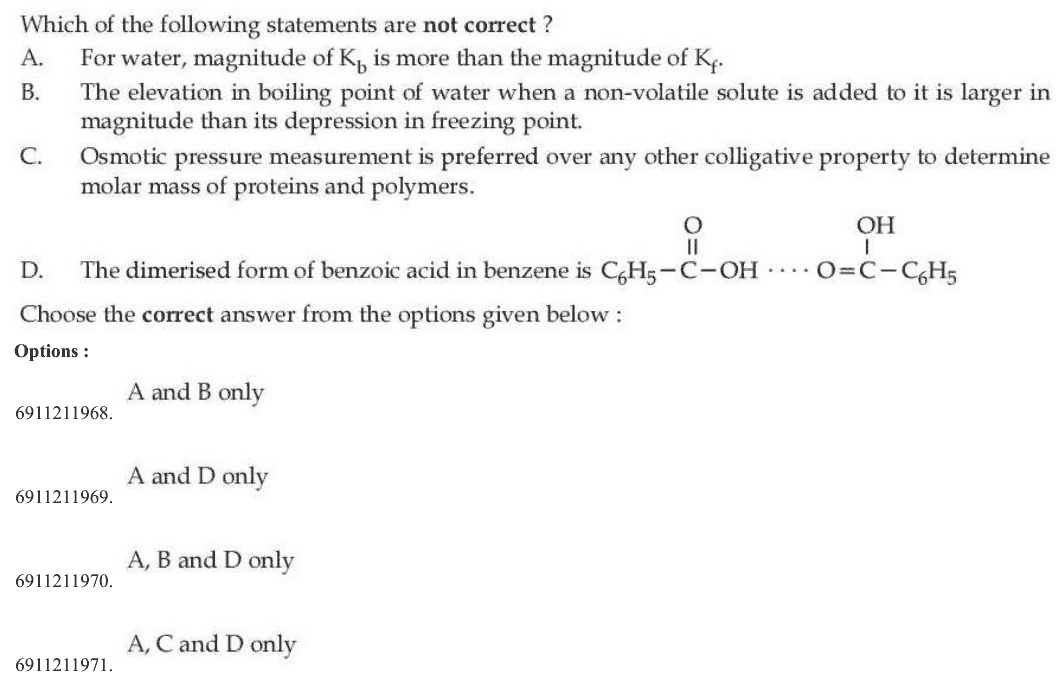
D. The dimerised form of benzoic acid in benzene is $\mathrm{C_6H_5{-}C{-}OH\cdots O{=}C{-}C_6H_5}$ (drawn with a carbonyl O above the first C and an OH above the second C; see figure).
Choose the correct answer from the options given below :
When 0.25 moles of a non-volatile, non-ionizable solute was dissolved in 1 mole of a solvent the vapor pressure of solution was $x$ % of vapor pressure of pure solvent. What is $x$ %?
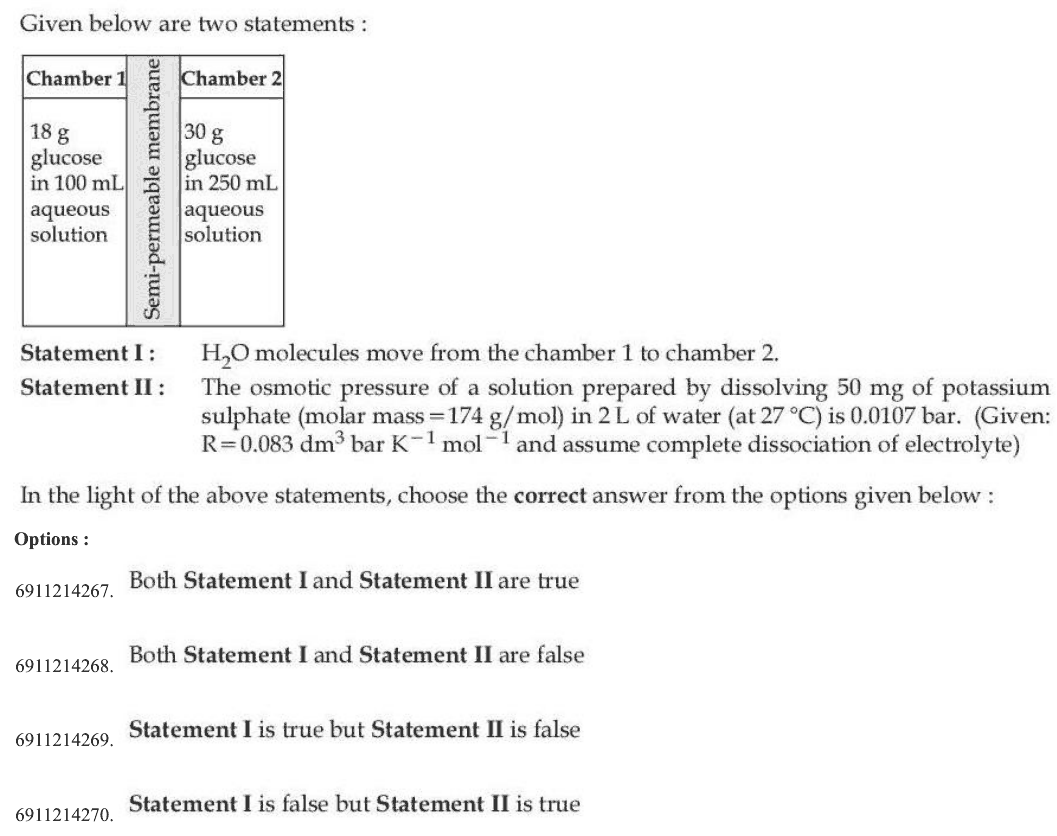
Statement I : $\mathrm{H_2O}$ molecules move from the chamber 1 to chamber 2.
Statement II : The osmotic pressure of a solution prepared by dissolving 50 mg of potassium sulphate (molar mass = 174 g/mol) in 2 L of water (at 27 °C) is 0.0107 bar. (Given: R = 0.083 dm$^3$ bar K$^{-1}$ mol$^{-1}$ and assume complete dissociation of electrolyte)
In the light of the above statements, choose the correct answer from the options given below :
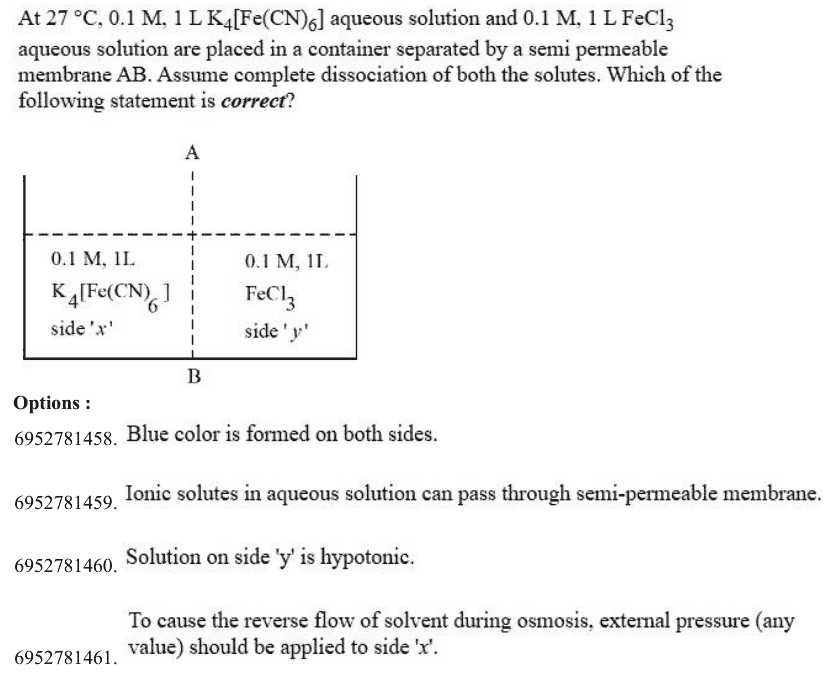
At 27 °C, 0.1 M, 1 L $\mathrm{K_4[Fe(CN)_6]}$ aqueous solution and 0.1 M, 1 L $\mathrm{FeCl_3}$ aqueous solution are placed in a container separated by a semi permeable membrane AB. Assume complete dissociation of both the solutes. Which of the following statement is *correct*?
(see the figure above)
The question as printed in the paper.
A
Blue color is formed on both sides.
B
Ionic solutes in aqueous solution can pass through semi-permeable membrane.
C
Solution on side 'y' is hypotonic.
D
To cause the reverse flow of solvent during osmosis, external pressure (any value) should be applied to side 'x'.
19.5 g of fluoro acetic acid (molar mass = 78 g mol$^{-1}$) is dissolved in 500 g of water at 298 K. The depression in the freezing point of water was 1°C. What is $\mathrm{K_a}$ of fluoro acetic acid ? (For water, $\mathrm{K_f} = 1.86$ K kg mol$^{-1}$). Assume molarity and molality to have same values.
Solution A is prepared by dissolving 1 g of a protein (molar mass = 50000 g mol$^{-1}$) in 0.5 L of water at 300 K. Its osmotic pressure is $x$ bar. Solution B is made by dissolving 2 g of same protein in 1 L of water at 300 K. Osmotic pressure of solution B is $y$ bar. Entire solution of A is mixed with entire solution of B at same temperature. The osmotic pressure of resultant solution is $z$ bar. $x$, $y$ and $z$ respectively are : (R = 0.083 L bar mol$^{-1}$ K$^{-1}$)
At T(K), 2 moles of liquid A and 3 moles of liquid B are mixed. The vapour pressure of ideal solution formed is 320 mm Hg. At this stage, one mole of A and one mole of B are added to the solution. The vapour pressure is now measured as 328.6 mm Hg. The vapour pressure (in mm Hg) of A and B are respectively:
'W' g of a non-volatile electrolyte solid solute of molar mass 'M' g mol$^{-1}$ when dissolved in 100 mL water, decreases vapour pressure of water from 640 mm Hg to 600 mm Hg. If aqueous solution of the electrolyte boils at 375 K and $\mathrm{K_b}$ for water is 0.52 K kg mol$^{-1}$, then the mole fraction of the electrolyte solute ($\mathrm{x_2}$) in the solution can be expressed as
(Given : density of water $=$ 1 g/mL and boiling point of water $=$ 373 K)
A solution is prepared by dissolving 0.3 g of a non-volatile non-electrolyte solute 'A' of molar mass 60 g mol$^{-1}$ and 0.9 g of a non-volatile non-electrolyte solute 'B' of molar mass 180 g mol$^{-1}$ in 100 mL $\mathrm{H_2O}$ at 27°C. Osmotic pressure of the solution will be
Two liquids A and B form an ideal solution at temperature T K. At T K, the vapour pressures of pure A and B are 55 and 15 kN m$^{-2}$ respectively. What is the mole fraction of A in solution of A and B in equilibrium with a vapour in which the mole fraction of A is 0.8?
At 298 K, the mole percentage of $\mathrm{N_2(g)}$ in air is 80%. Water is in equilibrium with air at a pressure of 10 atm. What is the mole fraction of $\mathrm{N_2(g)}$ in water at 298 K?
($\mathrm{K_H}$ for $\mathrm{N_2}$ is $6.5 \times 10^7$ mm Hg)
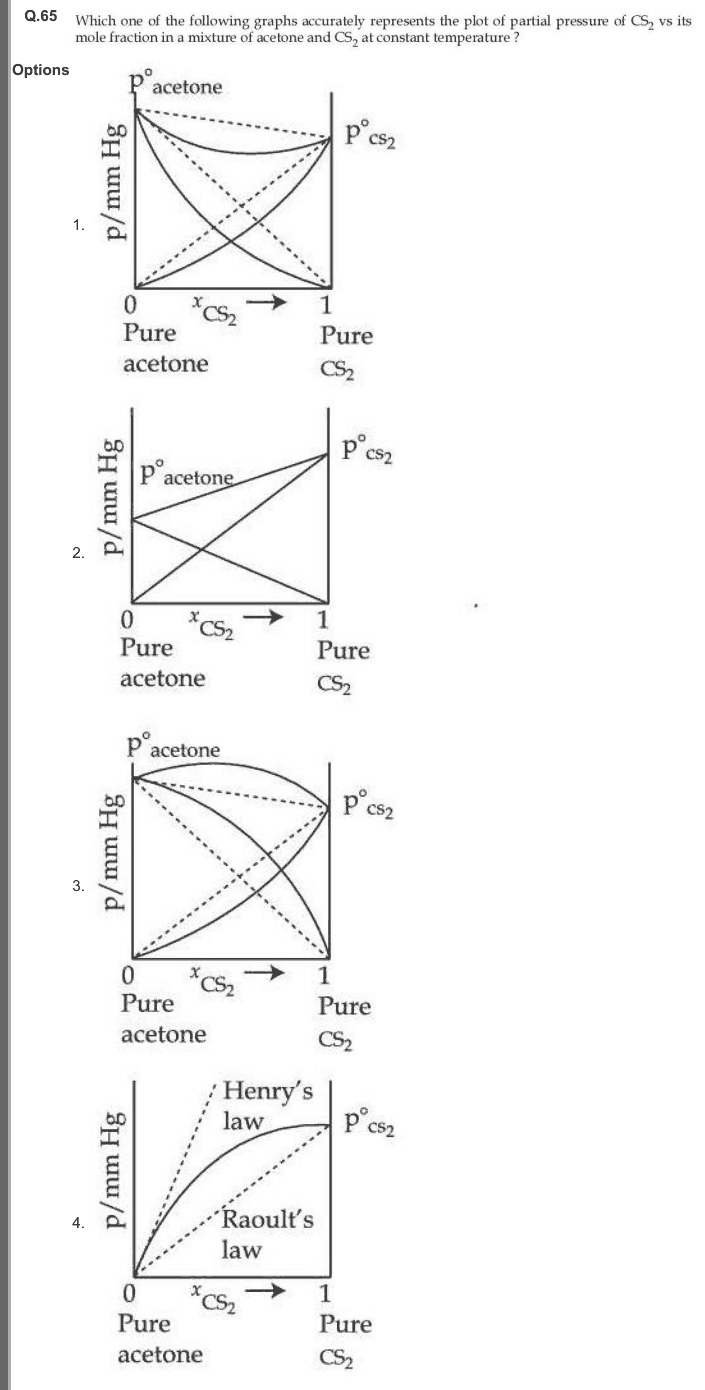
Which one of the following graphs accurately represents the plot of partial pressure of $\mathrm{CS_2}$ vs its mole fraction in a mixture of acetone and $\mathrm{CS_2}$ at constant temperature ?
The question as printed in the paper.
A
see figure axes 'p/mm Hg' (vertical) and 'x_CS2 →' (horizontal) from 0 (Pure acetone) to 1 (Pure CS2); 'p°acetone' at the top of the left axis and 'p°cs2' at the right end, lower than p°acetone. Dashed straight lines: one from the top of the left axis to the top of the right axis (p°acetone to p°cs2), one from the top of the left axis down to the bottom right, one from the bottom left up to the top right. Solid curves: one from p°acetone at the left sagging below the dashed top line to a shallow minimum in the middle and rising to meet p°cs2 at the right (a shallow U below the dashed top line); one from p°acetone at the top left falling to zero at the bottom right, lying BELOW the dashed falling diagonal; one from zero at the bottom left rising to p°cs2 at the right, lying BELOW the dashed rising diagonal. The two lower solid curves cross below the middle, to the left of the crossing of the dashed diagonals.
B
see figure same axes; 'p°acetone' written near the left axis at about mid height and 'p°cs2' on the right at the top (higher than p°acetone). Solid straight lines only, no dashed lines: one from the point on the left axis at about mid height (p°acetone) rising to p°cs2 at the top right; one from the same point falling to zero at the bottom right; one from zero at the bottom left rising to p°cs2 at the top right. The two rising lines meet at the top right.
C
see figure same axes with 'p°acetone' at the top of the left axis and 'p°cs2' at the right, lower than p°acetone. Dashed straight lines: top left to top right, top left to bottom right, bottom left to top right. Solid curves: one from p°acetone at the left arching up ABOVE the dashed top line and coming down to meet p°cs2 at the right (no dip); one from p°acetone at the top left falling to zero at the bottom right, lying ABOVE the dashed falling diagonal; one from zero at the bottom left rising to p°cs2 at the right, lying BELOW the dashed rising diagonal. The two lower solid curves cross to the right of the middle.
D
see figure same axes; 'p°cs2' at the right. A dotted line labelled "Henry's law" from the origin rising steeply to the top at about one quarter of the way along; a dotted line labelled "Raoult's law" from the origin rising gently in a straight line to p°cs2 at the right; and a solid curve from the origin rising along the Henry's law line at first, bending over and flattening to meet p°cs2 at the right, lying ABOVE the Raoult's law line.
Statement I: The Henry's law constant $\mathrm{K_H}$ is constant with respect to variations in solution's concentration over the range for which the solution is ideally dilute.
Statement II: $\mathrm{K_H}$ does not differ for the same solute in different solvents.
In the light of the above statements, choose the correct answer from the options given below
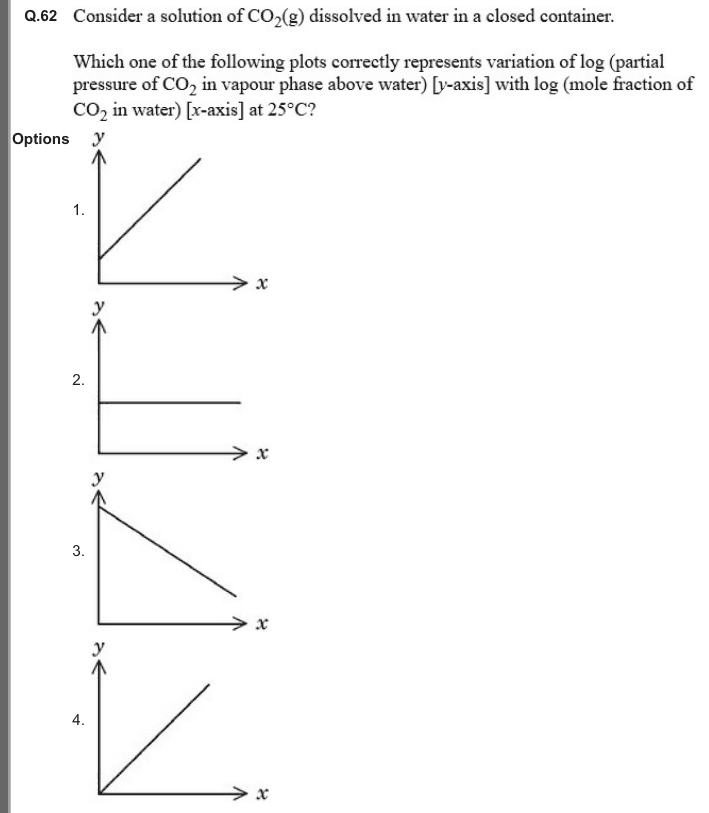
Consider a solution of $\mathrm{CO_2(g)}$ dissolved in water in a closed container.
Which one of the following plots correctly represents variation of log (partial pressure of $\mathrm{CO_2}$ in vapour phase above water) [$y$-axis] with log (mole fraction of $\mathrm{CO_2}$ in water) [$x$-axis] at $25°\mathrm{C}$?
The question as printed in the paper.
A
see figure axes labelled 'y' (vertical) and 'x' (horizontal); a straight line starting on the vertical axis a little above the origin (above the x axis) and rising to the upper right, ending at about two-thirds of the height of the vertical axis.
B
see figure same axes; a horizontal straight line at constant height, about halfway up the vertical axis, starting at the vertical axis.
C
see figure same axes; a straight line starting near the top of the vertical axis and falling to the lower right, ending above the horizontal axis.
D
see figure same axes; a straight line starting exactly at the origin (where the two axes meet) and rising to the upper right.
Elements P and Q form two types of non-volatile, non-ionizable compounds PQ and $\mathrm{PQ_2}$. When 1 g of PQ is dissolved in 50 g of solvent 'A', $\Delta\mathrm{T_b}$ was 1.176 K while when 1 g of $\mathrm{PQ_2}$ is dissolved in 50 g of solvent 'A', $\Delta\mathrm{T_b}$ was 0.689 K. ($\mathrm{K_b}$ of 'A' = 5 K kg mol$^{-1}$). The molar masses of elements P and Q (in g mol$^{-1}$) respectively, are :
Liquid $A$ and $B$ form an ideal solution. The vapour pressures of pure liquids $A$ and $B$ are 350 and 750 mm Hg respectively at the same temperature. If $x_A$ and $x_B$ are the mole fraction of $A$ and $B$ in solution while $y_A$ and $y_B$ are the mole fraction of $A$ and $B$ in vapour phase then,
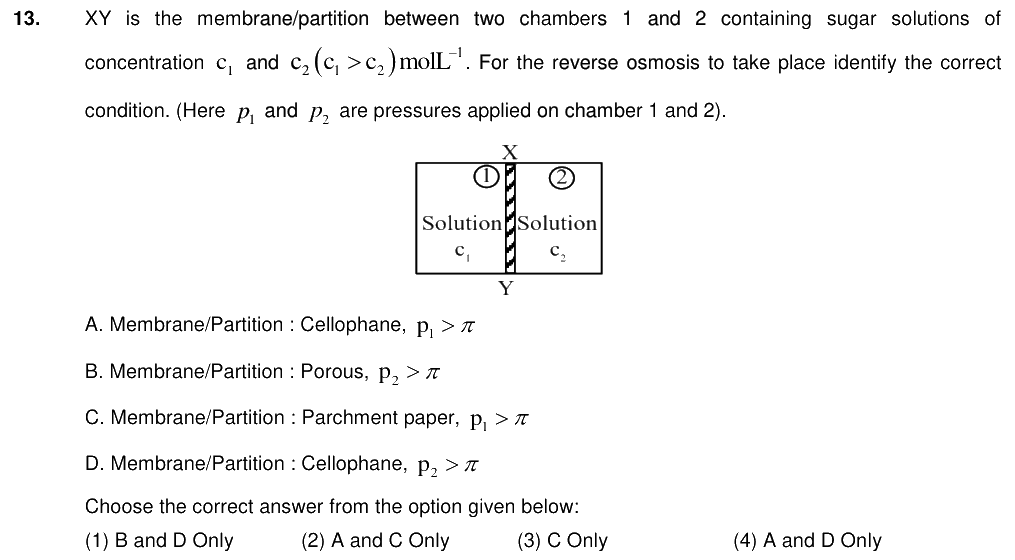
XY is the membrane/partition between two chambers 1 and 2 containing sugar solutions of concentration $c_1$ and $c_2(c_1 > c_2)molL^{-1}$. For the reverse osmosis to take place identify the correct condition. (Here $p_1$ and $p_2$ are pressures applied on chamber 1 and 2).
(see the figure above)
A. Membrane/Partition : Cellophane, $p_1 > \pi$
B. Membrane/Partition : Porous, $p_2 > \pi$
C. Membrane/Partition : Parchment paper, $p_1 > \pi$
D. Membrane/Partition : Cellophane, $p_2 > \pi$
Choose the correct answer from the option given below:
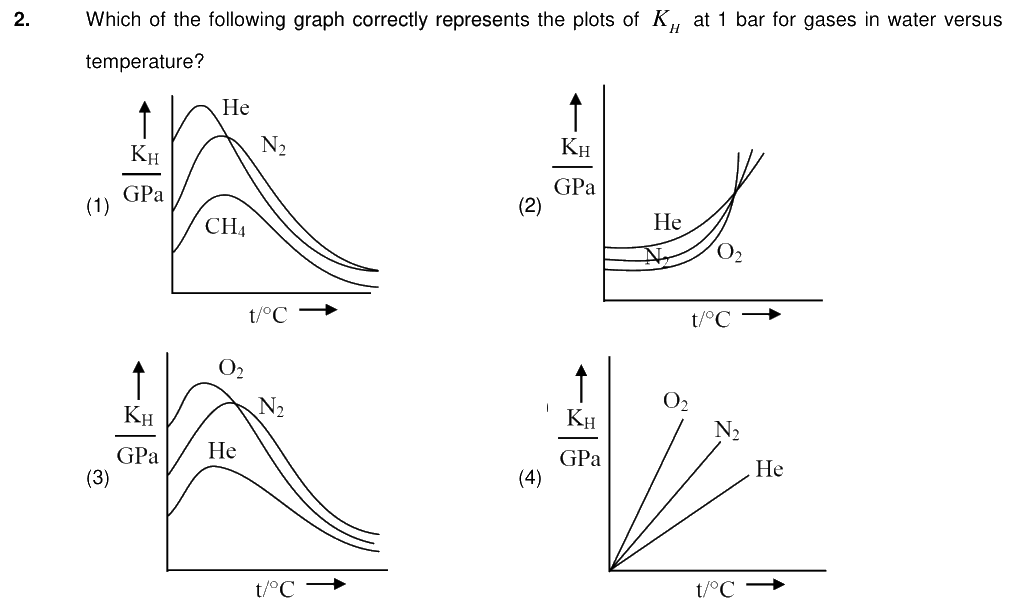
Which of the following graph correctly represents the plots of $K_H$ at 1 bar for gases in water versus temperature?
The question as printed in the paper.
A
see figure axes 'KH/GPa' (vertical) and 't/°C →' (horizontal); three curves labelled 'He' (top), 'N2' (middle) and 'CH4' (lowest), each rising from the left to a rounded maximum a short way from the vertical axis and then falling towards the right, the three curves drawing together near the right end.
B
see figure same axes; three curves labelled 'He', 'N2' and 'O2', each nearly flat at low t and then rising steeply at the right, all three crossing close together near the right end.
C
see figure same axes; three curves labelled 'O2' (top), 'N2' (middle) and 'He' (lowest), each rising to a rounded maximum near the left and falling towards the right, the three curves drawing together near the right end.
D
see figure same axes; three straight lines from the origin rising to the right, labelled 'O2' (steepest), 'N2' (middle) and 'He' (least steep).
A solution is made by mixing one mole of volatile liquid A with 3 moles of volatile liquid B. The vapour pressure of pure A is 200 mm Hg and that of the solution is 500 mm Hg . The vapour pressure of pure B and the least volatile component of the solution, respectively, are:
1.24 g of $\mathrm{AX_2}$ (molar mass 124 g $\mathrm{mol^{-1}}$ ) is dissolved in 1 kg of water to form a solution with boiling point of $100.0156^\circ$C, while 25.4 g$^\circ$ of $\mathrm{AY_2}$ (molar mass 250 g $\mathrm{mol^{-1}}$ ) in 2 kg of water constitutes a solution with a boiling point of $100.0260^\circ$C. $\mathrm{K_b\,(H_2O)}$ = 0.52 K kg $\mathrm{mol^{-1}}$ Which of the following is correct ?
A
$\mathrm{AX_2}$ is fully ionised while $\mathrm{AY_2}$ is completely unionised.
B
$\mathrm{AX_2}$ is completely unionised while $\mathrm{AY_2}$ is fully ionised.
C
$\mathrm{AX_2}$ and $\mathrm{AY_2}$ (both) are completely unionised.
D
$\mathrm{AX_2}$ and $\mathrm{AY_2}$ (both) are fully ionised.
Given below are two statements : Statement (I) : NaCl is added to the ice at $0^\circ$C, present in the ice cream box to prevent the melting of ice cream. Statement (II) : On addition of NaCl to ice at $0^\circ$C, there is a depression in freezing point. In the light of the above statements, choose the correct answer from the options given below :
What is the freezing point depression constant of a solvent, 50 g of which contain 1 g non volatile solute (molar mass 256 g $\mathrm{mol^{-1}}$ ) and the decrease in freezing point is 0.40 K ?
Assume a living cell with 0.9%($\omega/\omega$) of glucose solution (aqueous). This cell is immersed in another solution having equal mole fraction of glucose and water. (Consider the data upto first decimal place only) The cell will :
A
show no change in volume since solution is 0.9%($\omega/\omega$)
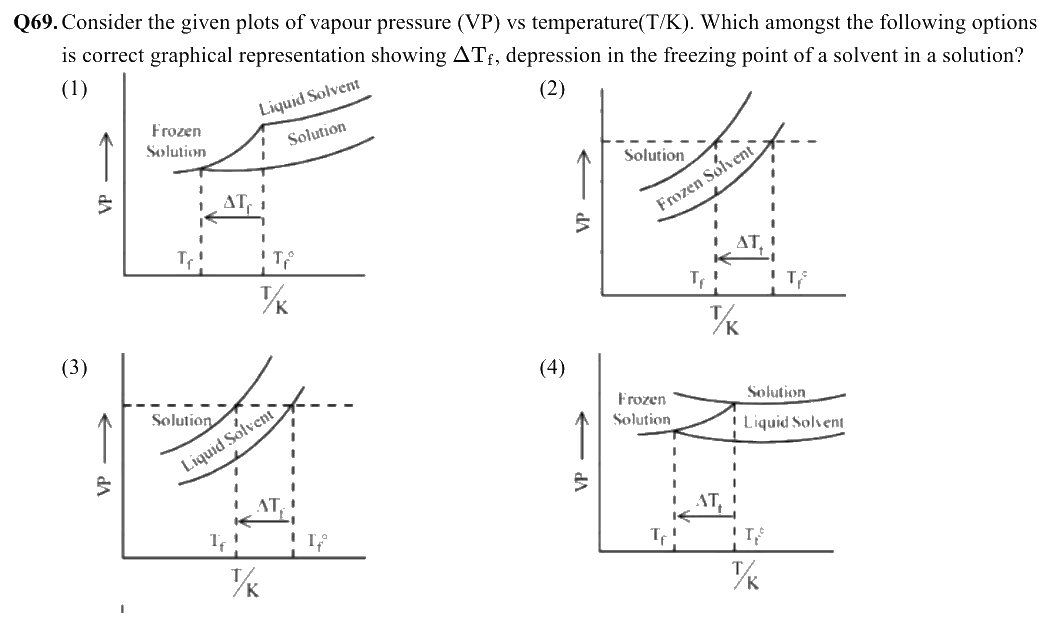
Consider the given plots of vapour pressure (VP) vs temperature(T/K). Which amongst the following options is correct graphical representation showing $\Delta\mathrm{T_f}$, depression in the freezing point of a solvent in a solution?
The question as printed in the paper.
A
see figure axes 'VP' (vertical, arrow up) and 'T/K' (horizontal); a curve labelled 'Liquid Solvent' rising to the right with a curve labelled 'Solution' below it, and a curve labelled 'Frozen Solution' at the left that meets them; dashed vertical lines drop to 'Tf' (left) and 'Tf°' (right), and a left-pointing arrow labelled 'ΔTf' between them.
B
see figure same axes; a horizontal dashed line across the top, with 'Solution' labelled on an upper curve at the upper left and 'Frozen Solvent' written along a lower curve, both rising to the right; dashed vertical lines drop to 'Tf' (left) and 'Tf°' (right) with a left-pointing arrow 'ΔTf' between them.
C
see figure same axes; a horizontal dashed line across the top, with 'Solution' labelled on a curve at the left and 'Liquid Solvent' written along another curve, both rising to the right; dashed vertical lines drop to 'Tf' (left) and 'Tf°' (right) with a left-pointing arrow 'ΔTf' between them.
D
see figure same axes; three curves: a curve labelled 'Solution' lies above a curve labelled 'Liquid Solvent' on the right, and a third curve at the left is labelled 'Frozen Solution' (one label, written on two lines); dashed vertical lines drop to 'Tf' (left) and 'Tf°' (right) with a left-pointing arrow 'ΔTf' between them. What separates it from option 1 is that the Solution curve lies above the Liquid Solvent curve.
$\mathrm{CrCl_3 \cdot xNH_3}$ can exist as a complex. 0.1 molal aqueous solution of this complex shows a depression in freezing point of $0.558^\circ$C. Assuming 100% ionisation of this complex and coordination number of Cr is 6 , the complex will be (Given $\mathrm{K_f} = 1.86\ \mathrm{K\ kg\ mol^{-1}}$ )
Consider a binary solution of two volatile liquid components 1 and 2. $x_1$ and $y_1$ are the mole fractions of component 1 in liquid and vapour phase, respectively. The slope and intercept of the linear plot of $\frac{1}{x_1}$ vs $\frac{1}{y_1}$ are given respectively as:
When a non-volatile solute is added to the solvent, the vapour pressure of the solvent decreases by 10 mm of Hg . The mole fraction of the solute in the solution is 0.2 . What would be the mole fraction of the solvent if decrease in vapour pressure is 20 mm of Hg ?
Arrange the following solutions in order of their increasing boiling points. (i) $10^{-4}$M NaCl (ii) $10^{-4}$M Urea (iii) $10^{-3}$M NaCl (iv) $10^{-2}$M NaCl
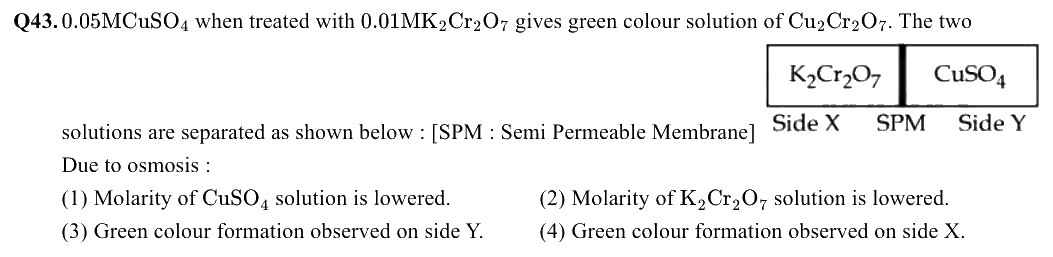
0.05M$\mathrm{CuSO_4}$ when treated with 0.01M$\mathrm{K_2Cr_2O_7}$ gives green colour solution of $\mathrm{Cu_2Cr_2O_7}$. The two solutions are separated as shown below : [SPM : Semi Permeable Membrane]
(see the figure above)
Due to osmosis :
The question as printed in the paper.
A
Molarity of $\mathrm{CuSO_4}$ solution is lowered.
B
Molarity of $\mathrm{K_2Cr_2O_7}$ solution is lowered.
We have three aqueous solutions of NaCl labelled as 'A', 'B' and 'C' with concentration 0.1 M, 0.01M and 0.001 M, respectively. The value of van t' Haft factor i for these solutions will be in the order.
What weight of glucose must be dissolved in 100 g of water to lower the vapour pressure by 0.20 mm Hg? (Assume dilute solution is being formed) Given: Vapour pressure of pure water is 54.2 mm Hg at room temperature. Molar mass of glucose is 180 $\mathrm{g\ mol^{-1}}$
Evaluate the following statements for their correctness. A. The elevation in boiling point temperature of water will be same for 0.1 M NaCl and 0.1 M urea. B. Azeotropic mixture boil without change in their composition. C. Osmosis always takes place from hypertonic to hypotonic solution. D. The density of 32% $\mathrm{H_2\,SO_4}$ solution having molarity 4.09 M is approximately 1.26 g mL$^{-1}$. E. A negatively charged sol is obtained when KI solution is added to silver nitrate solution. Choose the correct answer from the options given below:
Match List I with List II. List I A. van't Hoff factor, i B. $\mathrm{k_f}$ C. Solutions with same osmotic pressure D. Azeotropes List II I. Cryoscopic constant II. Isotonic solutions III. $\frac{\text{Normal molar mass}}{\text{Abnormal molar mas}}$ IV. Solutions with same composition of vapour above it Choose the correct answer from the options given below:
Boiling point of a 2% aqueous solution of a nonvolatile solute A is equal to the boiling point of 8% aqueous solution of a non-volatile solute B. The relation between molecular weights of A and B is.
The depression in freezing point observed for a formic acid solution of concentration $0.5\ \mathrm{mL\ L^{-1}}$ is $0.0405\ ^\circ$C. Density of formic acid is $1.05\ \mathrm{g\ mL^{-1}}$. The Van't Hoff factor of the formic acid solution is nearly: (Given for water $\mathrm{k_f} = 1.86\ \mathrm{K\ kg\ mol^{-1}}$)
Two solutions A and B are prepared by dissolving 1 g of non-volatile solutes X and Y. respectively in 1 kg of water. The ratio of depression in freezing points for A and B is found to be $1:4$. The ratio of molar masses of X and Y is
Solute A associates in water. When $0.7 \mathrm{~g}$ of solute A is dissolved in $42.0 \mathrm{~g}$ of water, it depresses the freezing point by $0.2\ ^\circ\mathrm{C}$. The percentage association of solute A in water, is [Given: Molar mass of $\mathrm{A} = 93 \mathrm{~g~mol^{-1}}$. Molal depression constant of water is $1.86 \mathrm{~K~kg~mol^{-1}}$]
A set of solutions is prepared using 180 g of water as a solvent and 10 g of different non-volatile solutes A, B and C. The relative lowering of vapour pressure in the presence of these solutes are in the order [Given, molar mass of A = $100\ \mathrm{g\ mol^{-1}}$ ; B = $200\ \mathrm{g\ mol^{-1}}$ ; C = $10,000\ \mathrm{g\ mol^{-1}}$]
An open beaker of water in equilibrium with water vapour is in a sealed container. When a few grams of glucose are added to the beaker of water, the rate at which water molecules :
At $35\ ^\circ\mathrm{C}$, the vapour pressure of $\mathrm{CS_2}$, is $512\mathrm{mm\ Hg}$ and that of acetone is $144\ \mathrm{mmHg}$. A solution of $\mathrm{CS_2}$ in acetone has a total vapour pressure of $600\ \mathrm{mmHg}$ . The false statement amongst the following is:
A
Raoult's law is not obeyed by this system
B
a mixture of $100\mathrm{mLCS_2}$ and $100\mathrm{mL}$ acetone has a volume $< 200\mathrm{mL}$
C
$\mathrm{CS_2}$ and acetone are less attracted to each other than to themselves
D
heat must be absorbed in order to produce the solution at $35^\circ\mathrm{C}$
Two open beakers one containing a solvent and the other containing a mixture of that solvent with a non volatile solute are together sealed in a container. Over time:
A
the volume of the solution increases and the volume of the solvent decreases
B
the volume of the solution decreases and the volume of the solvent increases
C
the volume of the solution and the solvent does not change
D
change and the volume of the solvent decreases the volume of the solution does not
A solution is prepared by dissolving 0.6 g of urea (molar mass $= 60\ \mathrm{g\ mol^{-1}}$) and 1.8 g of glucose (molar mass $= 180\ \mathrm{g\ mol^{-1}}$) in 100 mL of water at $27^o\mathrm{C}$. The osmotic pressure of the solution is: ($\mathrm{R = 0.08206\ L\,atm\ K^{-1}\ mol^{-1}}$)
At room temperature, a dilute solution of urea is prepared by dissolving 0.60 g of urea in 360 g of water. If the vapour pressure of pure water at this temperature is 35 mm Hg , lowering of vapour pressure will be: (molar mass of urea $= 60\ \mathrm{g\ mol^{-1}}$ )
1 g of a non-volatile non-electrolyte solute is dissolved in 100 g of two different solvents A and B whose ebullioscopic constants are in the ratio of 1: 5. The ratio of the elevation in their boiling points, $\frac{\Delta T_b A}{\Delta T_b B}$, is: (assuming they have the same molar mass)
The osmotic pressure of a dilute solution of an ionic compound XY in water is four times that of a solution 0.01 M $\mathrm{BaCl_2}$ in water. Assuming complete dissociation of the given ionic compounds in water, the concentration of XY ( in $\mathrm{mol\ L^{-1}}$ ) in solution is
Liquid M and liquid N form an ideal solution. The vapour pressures of pure liquids M and N are 450 and 700 mmHg, respectively, at the same temperature. Then correct statements is: ( $\mathrm{x_M}$ = Mole fraction of 'M' in solution; $\mathrm{x_N}$ = Mole fraction of 'N'in solution; $\mathrm{y_M}$ = Mole fraction of 'M' in vapour phase; $\mathrm{y_N}$ = Mole fraction of 'N' in vapour phase; )
Molal depression constant for a solvent is 4.0 $\mathrm{K\ kg\ mol^{-1}}$. The depression in the freezing point of the solvent for 0.03 $\mathrm{mol\ kg^{-1}}$ solution of $\mathrm{K_2SO_4}$ is: (Assume complete dissociation of the electrolyte)
The vapour pressures of pure liquids A and Bare 400 and 600 mm Hg respectively at 298 K. On mixing the two liquids, the sum of their volumes is equal to the volume of the final mixture. The mole fraction of liquid B is 0.5 in the mixture. The vapour pressure of the final solution, the mole fractions of components A and B in the vapour phase, respectively are
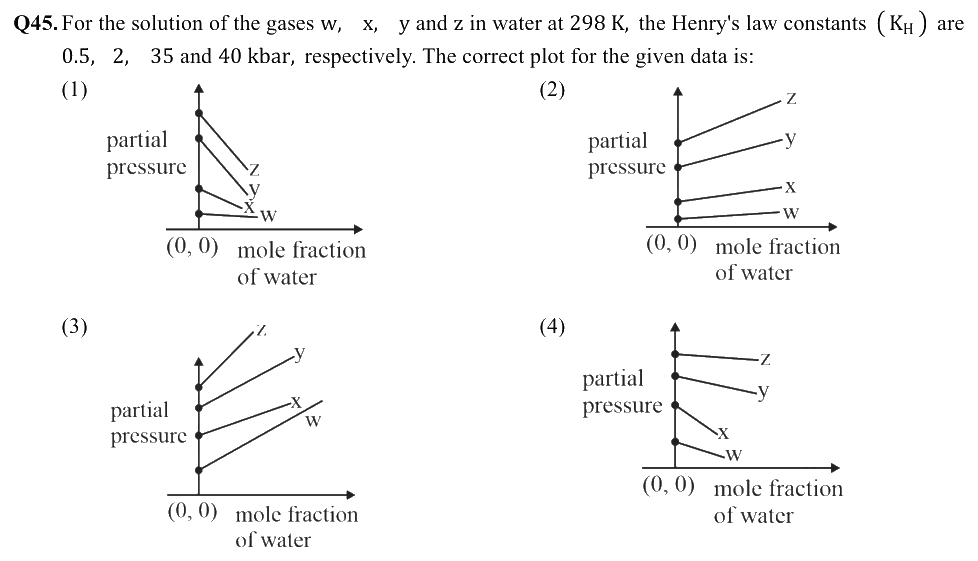
For the solution of the gases w, x, y and z in water at 298 K, the Henry's law constants ($\mathrm{K_H}$) are 0.5, 2, 35 and 40 kbar, respectively. The correct plot for the given data is:
(see the figure above)
The question as printed in the paper.
A
see figure partial pressure against mole fraction of water
B
see figure partial pressure against mole fraction of water
C
see figure partial pressure against mole fraction of water
D
see figure partial pressure against mole fraction of water
The freezing point of a $4\%$ aqueous solution of X is equal to the freezing point of a $12\%$ aqueous solution of Y . If the molecular weight of X is A, then the molecular weight of Y will be
Molecules of benzoic acid ($\mathrm{C_6H_5\ COOH}$) dimerise in 30 g of benzene. ' w ' g of benzoic acid shows a depression in freezing point equal to 2 K. If the percentage association of the acid to form dimer in the solution is 80, then w is: ( Given that $\mathrm{K_f}$ = 5 $\mathrm{Kmol^{-1}}$, molar mass of benzoic acid = 122 $\mathrm{gmol^{-1}}$)
The freezing point of a diluted milk sample is found to be $-0.2^{\circ}$C, while it should have been $-0.5^{\circ}$C for pure milk. How much water has been added to pure milk to make the diluted sample?
Liquids A and B form an ideal solution in the entire composition range. At 350K, the vapour pressure of pure A and pure B are $7 \times 10^3$ Pa and $12 \times 10^3$ Pa , respectively. The composition of the vapour in equilibrium with a solution containing 40 mole percent of A at this temperature is:
The elevation in boiling point for $1$ molal solution of glucose is $2\ \mathrm{K}$. The depression in freezing point for $2$ molal solution of glucose in the same solvent is $2\ \mathrm{K}$. The relation between $\mathrm{K_b}$ and $\mathrm{K_f}$ is:
A solution containing $62\ \mathrm{g}$ ethylene glycol in $250\ \mathrm{g}$ water is cooled to $-10^oC$ . If $\mathrm{K_f}$ for water is $1.86\ \mathrm{K\ kg\ mol^{-1}}$ , the amount of water (in $\mathrm{g}$ ) separated as ice is:
The mass of a non-volatile, non-electrolyte solute (molar mass $= 50\ \mathrm{g\ mol^{-1}}$) needed to be dissolved in 114 g octane to reduce its vapour pressure by $75\ \%$, is:
Two 5 molal solutions are prepared by dissolving a non-electrolyte, non-volatile solute separately in the solvents X and Y. The molecular weights of the solvents are $\mathrm{M_X}$ and $\mathrm{M_Y}$, respectively where $\mathrm{M_X} = \frac{3}{4}\mathrm{M_Y}$. The relative lowering of vapour pressure of the solution in X is " m " times that of the solution in Y. Given that the number of moles of solute is very small in comparison to that of solvent, the value of "m" is:
A solution is prepared by mixing 8.5 g of $\mathrm{CH_2Cl_2}$ and 11.95 g of $\mathrm{CHCl_3}$. If vapour pressure of $\mathrm{CH_2Cl_2}$ and $\mathrm{CHCl_3}$ at 298 K are 415 and 200 mm Hg respectively, the mole fraction of $\mathrm{CHCl_3}$ in vapour form is: (Molar mass of Cl = $35.5\ \mathrm{g\,mol^{-1}}$)
5g of $\mathrm{Na_2SO_4}$ was dissolved in x g of $\mathrm{H_2O}$. The change in freezing point was found to be $3.82^\circ\mathrm{C}$. If $\mathrm{Na_2SO_4}$ is 81.5% ionised, the value of x ($\mathrm{K_f}$ for water = $1.86^\circ\mathrm{C}$ kg $\mathrm{mol^{-1}}$) is approximately: (molar mass of S = 32 g $\mathrm{mol^{-1}}$ and that of Na = 23 g $\mathrm{mol^{-1}}$)
The freezing point of benzene decreases by $0.45^\circ\mathrm{C}$ on adding $0.2\,\mathrm{g}$ of acetic acid to $20\ \mathrm{g}$ of benzene. If acetic acid associates to form a dimer in benzene, then what is the percentage association of acetic acid in benzene? $\mathrm{K_f}$ for benzene $= 5.12\ \mathrm{K\ kg\ mol^{-1}}$
An aqueous solution of a salt $\mathrm{MX_2}$ at certain temperature has a Van't Hoff factor of 2. What is the degree of dissociation for this solution of the salt?
The solubility of $\mathrm{N_2}$ in water at 300 K and 500 torr partial pressure is 0.01 $\mathrm{g\ L^{-1}}$. The solubility (in $\mathrm{g\ L^{-1}}$ ) at 750 torr partial pressure is:
A solution at $20^{\circ}$C is composed of 1.5 mol of benzene and 3.5 mol of toluene. If the vapour pressure of pure benzene and pure toluene at this temperature are 74.7 torr and 22.3 torr respectively, then the total vapour pressure of the solution and the benzene mole fraction in equilibrium with it will be, respectively:
The vapour pressure of acetone at $20^\circ\mathrm{C}$ is $185\ \mathrm{torr}$. When $1.2\ \mathrm{g}$ of a non-volatile substance was dissolved in $100\ \mathrm{g}$ of acetone at $20^\circ\mathrm{C}$, its vapour pressure was $183\ \mathrm{torr}$. The molar mass ($\mathrm{g\ mol^{-1}}$) of the substance is:
The observed osmotic pressure for a $0.10\ \mathrm{M}$ solution of $\mathrm{Fe(NH_4)_2(SO_4)_2}$ at $25^\circ\mathrm{C}$ is $10.8\ \mathrm{atm}$. The expected and experimental (observed) values of Van't Hoff factor 'i' will be respectively; $(\mathrm{R} = 0.082\ \mathrm{L\ atm\ K^{-1}\ mol^{-1}})$
Consider separate solutions of 0.500 M $\mathrm{C_2H_5\ OH}$ (aq), 0.100 M $\mathrm{Mg_3\ (PO_4)_2}$ (aq), 0.250 M KBr (aq) and 0.125 M $\mathrm{Na_3\ PO_4}$ (aq) at $25^\circ$C. Which statement is true about these solutions, assuming all salts to be strong electrolytes?
A
They all have the same osmotic pressure.
B
0.100 M $\mathrm{Mg_3(PO_4)_2}$ (aq) has the highest osmotic pressure.
C
0.125 M $\mathrm{Na_3\ PO_4}$ (aq) has the highest osmotic pressure.
D
0.500 M $\mathrm{C_2H_5\ OH}$ (aq) has the highest osmotic pressure.
How many grams of methyl alcohol should be added to 10 litre tank of water to prevent its freezing at 268 K ? ( $\mathrm{K_f}$ for water is 1.86 K kg $\mathrm{mol^{-1}}$)
Vapour pressure of pure benzene is 119 torr and that of toluene is 37.0 torr at the same temperature. Mole fraction of toluene in vapour phase which is in equilibrium with a solution of benzene and toluene having a mole fraction of toluene 0.50, will be :
A molecule $M$ associates in a given solvent according to the equation $\mathrm{M} \rightleftharpoons (\mathrm{M})_n$. For a certain concentration of M, the van't Hoff factor was found to be 0.9 and the fraction of associated molecules was 0.2. The value of $n$ is:
12 g of a nonvolatile solute dissolved in 108 g of water produces the relative lowering of vapour pressure of 0.1. The molecular mass of the solute is :
The freezing point of a 1.00 m aqueous solution of HF is found to be $-1.91^{\circ}\mathrm{C}$. The freezing point constant of water, $K_f$ is 1.86 K kg $\mathrm{mol^{-1}}$. The percentage dissociation of HF at this concentration is
Liquids A and B form an ideal solution. At $30^\circ\mathrm{C}$, the total vapour pressure of a solution containing 1 mol of A and 2 mol of B is $250\ \mathrm{mmHg}$. The total vapour pressure becomes $300\ \mathrm{mmHg}$ when 1 more mol of A is added to the first solution. The vapour pressures of pure A and B at the same temperature are
A solution containing $0.85$ g of $\mathrm{ZnCl_2}$ in $125.0$ g of water freezes at $-0.23^\circ\mathrm{C}$. The apparent degree of dissociation of the salt is ($K_f$ for water $= 1.86\ \mathrm{K\,kg\,mol^{-1}}$, atomic mass: Zn $= 65.3$ and Cl $= 35.5$)
$\mathrm{K_f}$ for water is $1.86\ \mathrm{K\ kg\ mol^{-1}}$. If your automobile radiator holds $1.0\ \mathrm{kg}$ of water, how many grams of ethylene glycol ($\mathrm{C_2H_6O_2}$) must you add to get the freezing point of the solution lowered to $-2.8^\circ \mathrm{C}$ ?
Ethylene glycol is used as an antifreeze in a cold climate. Mass of ethylene glycol which should be added to 4 kg of water to prevent it from freezing at $-6^\circ\mathrm{C}$ will be : [$\mathrm{K_f}$ for water $= 1.86\ \mathrm{K\ kg\ mol^{-1}}$, and molar mass of ethylene glycol $= 62\ \mathrm{g\ mol^{-1}}$ )
If sodium sulphate is considered to be completely dissociated into cations and anions in aqueous solution, the change in freezing point of water ($\Delta \mathrm{T_f}$), when 0.01 mol of sodium sulphate is dissolved in 1 kg of water, is ($\mathrm{K_f} = 1.86\ \mathrm{K\ kg\ mol^{-1}}$)
On mixing, heptane and octane form an ideal solution. At 373 K, the vapour pressures of the two liquid components (heptane and octane) are 105kPa and 45kPa respectively. Vapour pressure of the solution obtained by mixing 25.0 g of heptane and 35 g of octane will be (molar mass of heptane = $100\ \mathrm{g\ mol^{-1}}$ an dof octane = $114\ \mathrm{g\ mol^{-1}}$ ).
Two liquids $X$ and $Y$ form an ideal solution. At 300 K, vapour pressure of the solution containing 1 mol of $X$ and 3 mol of $Y$ is 550 mmHg. At the same temperature, if 1 mol of $Y$ is further added to this solution, vapour pressure of the solution increases by 10 mmHg. Vapour pressure (in mmHg ) of $X$ and $Y$ in their pure states will be, respectively :
A binary liquid solution is prepared by mixing $n$-heptane and ethanol. Which one of the following statements is correct regarding the behaviour of the solution?
A
The solution formed is an ideal solution
B
The solution is non-ideal, showing +ve deviation from Raoult's law.
C
The solution is non-ideal, showing -ve deviation from Raoult's law.
D
n-heptane shows +ve deviation while ethanol shows -ve deviation from Raoult's law.
At $80^{\circ}\mathrm{C}$, the vapour pressure of pure liquid ' $A$ ' is $520\ \mathrm{mmHg}$ and that of pure liquid ' $B$ ' is $1000\ \mathrm{mm\ Hg}$. If a mixture solution of ' $A$ ' and ' $B$ ' boils at $80^{\circ}\mathrm{C}$ and 1 atm pressure, the amount of ' $A$ ' in the mixture is ($1\ \mathrm{atm} = 760\ \mathrm{mmHg}$)
The vapour pressure of water at $20^{\circ}\mathrm{C}$ is $17.5\ \mathrm{mmHg}$. If 18 g of glucose ($\mathrm{C_6H_{12}O_6}$) is added to $178.2$ g of water at $20^{\circ}\mathrm{C}$, the vapour pressure of the resulting solution will be
A 5.25% solution of a substance is isotonic with a 1.5% solution of urea ( molar mass = 60 $\mathrm{g\ mol^{-1}}$ ) in the same solvent. If the densities of both the solutions are assumed to be equal to 1.0 $\mathrm{g\ cm^{-3}}$, molar mass of the substance will be
A mixture of ethyl alcohol and propyl alcohol has a vapour pressure of 290 mm at 300 K. The vapour pressure of propyl alcohol is 200 mm. If the mole fraction of ethyl alcohol is 0.6, its vapour pressure (in mm) at the same temperature will be
Benzene and toluene form nearly ideal solutions. At $20^\circ\mathrm{C}$, the vapour pressure of benzene is 75 torr and that of toluene is 22 torr. The partial vapour pressure of benzene at $20^\circ\mathrm{C}$ for a solution containing 78 g of benzene and 46 g of toluene is in torr is
In a 0.2 molal aqueous solution of a weak acid HX the degree of ionization is 0.3. Taking $\mathrm{k_f}$ for water as 1.85 , the freezing point of the solution will be nearest to
Freezing point of an aqueous solution is $(-0.186)^\circ$C. Elevation of boiling point of the same solution is $\mathrm{K_b} = 0.512^\circ$C, $\mathrm{K_f} = 1.86^\circ$C, find the increase in boiling point.
20 g hemoglobin in a 1 L aqueous solution (A) at 300 K is separated from pure water by semi permeable membrane. At equilibrium the height of solution in a tube dipped in a solution (A) is found to be 80.0 mm higher than the tube dipped in water.
The molar mass of hemoglobin is ________ kg mol$^{-1}$. (Nearest integer)
(Given : g = 10 m s$^{-2}$, R = 8.3 kPa dm$^3$ K$^{-1}$mol$^{-1}$, density of solution = 1000 kg m$^{-3}$)
Numerical answer type: type your answer in EdLoop to check it
A non-volatile, non-electrolyte solid solute when dissolved in 40 g of a solvent, the vapour pressure of the solvent decreased from 760 mm Hg to 750 mm Hg. If the same solution boils at 320 K, then the number of moles of the solvent present in the solution is ________. (Nearest integer) [Given: boiling point of pure solvent = 319.5 K, $\mathrm{K_b}$ of the solvent = 0.3 K kg mol$^{-1}$]
Numerical answer type: type your answer in EdLoop to check it
Two liquids A and B form an ideal solution. At 320 K, the vapour pressure of the solution, containing 3 mol of A and 1 mol of B is 500 mm Hg. At the same temperature, if 1 mol of A is further added to this solution, vapour pressure of the solution increases by 20 mm Hg. Vapour pressure (in mm Hg) of B in pure state is ________. (Nearest integer)
Numerical answer type: type your answer in EdLoop to check it
The osmotic pressure of a living cell is 12 atm at 300 K. The strength of sodium chloride solution that is isotonic with the living cell at this temperature is ________ g L$^{-1}$. (Nearest integer) Given : R = 0.08 L atm K$^{-1}$ mol$^{-1}$ Assume complete dissociation of NaCl (Given : Molar mass of Na and Cl are 23 and 35.5 g mol$^{-1}$ respectively.)
Numerical answer type: type your answer in EdLoop to check it
A substance 'X' (1.5 g) dissolved in 150 g of a solvent 'Y' (molar mass $= 300$ g mol$^{-1}$) led to an elevation of the boiling point by 0.5 K. The relative lowering in the vapour pressure of the solvent 'Y' is ________ $\times10^{-2}$. (nearest integer) [Given : $\mathrm{K_b}$ of the solvent $= 5.0$ K kg mol$^{-1}$] Assume the solution to be dilute and no association or dissociation of X takes place in solution.
Numerical answer type: type your answer in EdLoop to check it
When 1 g each of compounds AB and $AB_2$ are dissolved in 15 g of water separately, they increased the boiling point of water by 2.7 K and 1.5 K respectively. The atomic mass of A (in amu) is ______ $\times 10^{-1}$ (Nearest integer)
(Given : Molal boiling point elevation constant is $0.5Kkgmol^{-1}$ )
Numerical answer type: type your answer in EdLoop to check it
The observed and normal molar masses of compound $\mathrm{MX_2}$ are 65.6 and 164 respectively. The percent degree of ionisation of $\mathrm{MX_2}$ is ______ %. (Nearest integer)
Numerical answer type: type your answer in EdLoop to check it
The vapour pressure of pure benzene and methyl benzene at $27^\circ$C is given as 80 Torr and 24 Torr, respectively. The mole fraction of methyl benzene in vapour phase, in equilibrium with an equimolar mixture of those two liquids (ideal solution) at the same temperature is ______ $\times 10^{-2}$ (nearest integer)
Numerical answer type: type your answer in EdLoop to check it
A solution containing 10 g of an electrolyte $\mathrm{AB_2}$ in 100 g of water boils at $100.52^{\circ}$C. The degree of ionization of the electrolyte $(\alpha)$ is ______ $\times 10^{-1}$. (nearest integer) [Given : Molar mass of $\mathrm{AB_2}$ = 200 g $\mathrm{mol^{-1}}$, $\mathrm{K_b}$ (molal boiling point elevation const. of water) = 0.52 K kg $\mathrm{mol^{-1}}$, boiling point of water = $100^{\circ}$C; $\mathrm{AB_2}$ ionises as $\mathrm{AB_2 \rightarrow A^{2+} + 2\,B^{-}}$]
Numerical answer type: type your answer in EdLoop to check it
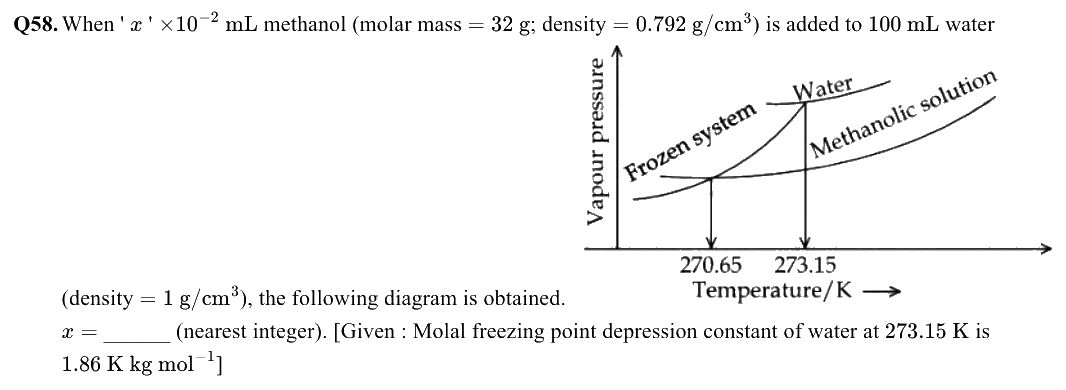
When ' $x$ ' $\times 10^{-2}$ mL methanol (molar mass = 32 g; density = 0.792 g/cm$^3$) is added to 100 mL water (density = 1 g/cm$^3$), the following diagram is obtained.
(see the figure above)
$x$ = ______ (nearest integer). [Given : Molal freezing point depression constant of water at 273.15 K is 1.86 K kg mol$^{-1}$]
The question as printed in the paper.
Numerical answer type: type your answer in EdLoop to check it
An artificial cell is made by encapsulating 0.2M glucose solution within a semipermeable membrane. The osmotic pressure developed when the artificial cell is placed within a 0.05M solution of NaCl at 300 K is ______ $\times 10^{-1}$ bar. (nearest integer). [Given : R = 0.083 $\mathrm{Lbarmol^{-1}\,K^{-1}}$] Assume complete dissociation of NaCl
Numerical answer type: type your answer in EdLoop to check it
Considering acetic acid dissociates in water, its dissociation constant is $6.25 \times 10^{-5}$. If 5 mL of acetic acid is dissolved in 1 litre water, the solution will freeze at $-x \times 10^{-2}$°C, provided pure water freezes at 0°C. $x$ = ______ . (Nearest integer) Given : $(K_f)_{\mathrm{water}}$ = 1.86 K kg $\mathrm{mol^{-1}}$. density of acetic acid is 1.2 g $\mathrm{mol^{-1}}$. molar mass of water = 18 g $\mathrm{mol^{-1}}$. Acetic acid dissociates as molar mass of acetic acid=60 g$\mathrm{mol^{-1}}$. density of water = 1 g $\mathrm{cm^{-3}}$ $\mathrm{CH_3COOH \rightleftharpoons CH_3COO^{\ominus} + H^{\oplus}}$
Numerical answer type: type your answer in EdLoop to check it
2.5 g of a non-volatile, non-electrolyte is dissolved in 100 g of water at $25^\circ$C. The solution showed a boiling point elevation by $2^\circ$C. Assuming the solute concentration is negligible with respect to the solvent concentration, the vapor pressure of the resulting aqueous solution is ______ mm of Hg (nearest integer) [Given : Molal boiling point elevation constant of water ($\mathrm{K_b}$) = 0.52 K. kgmol$^{-1}$, 1 atm pressure = 760 mm of Hg, molar mass of water = 18 g mol$^{-1}$]
Numerical answer type: type your answer in EdLoop to check it
2.7 kg of each of water and acetic acid are mixed. The freezing point of the solution will be $-x^\circ$C. Consider the acetic acid does not dimerise in water, nor dissociates in water. $x$ = ______ (nearest integer) [Given: Molar mass of water = 18 g mol$^{-1}$, acetic acid = 60 g mol$^{-1}$ $\mathrm{K_fH_2O}$ : 1.86 K kg mol$^{-1}$ $\mathrm{K_f}$ acetic acid: 3.90 K kg mol$^{-1}$ freezing point: $\mathrm{H_2O}$ = 273 K, acetic acid = 290 K]
Numerical answer type: type your answer in EdLoop to check it
Mass of ethylene glycol (antifreeze) to be added to 18.6 kg of water to protect the freezing point at -24°C is kg (Molar mass in $\text{gmol}^{-1}$ for ethylene glycol 62, $\text{K}_\text{f}$ of water = 1.86 K kg $\text{mol}^{-1}$)
Numerical answer type: type your answer in EdLoop to check it
The osmotic pressure of a dilute solution is $7 \times 10^5$ Pa at 273 K. Osmotic pressure of the same solution at 283 K is ______ $\times 10^4$ Nm$^{-2}$.(Nearest integer)
Numerical answer type: type your answer in EdLoop to check it
The vapour pressure of 30% (w/v), aqueous solution of glucose is ______ mm Hg at 25°C. [Given: The density of 30% (w/v), aqueous solution of glucose is 1.2 g cm$^{-3}$ and vapour pressure of pure water is 24 mm Hg.] (Molar mass of glucose is 180 g mol$^{-1}$)
Numerical answer type: type your answer in EdLoop to check it
Solution of 12 g of non-electrolyte (A) prepared by dissolving it in 1000 mL of water exerts the same osmotic pressure as that of 0.05 M glucose solution at the same temperature. The empirical formula of A is $\mathrm{CH_2\,O}$. The molecular mass of A is ______ g. (Nearest integer)
Numerical answer type: type your answer in EdLoop to check it
Sea water contains 29.25 % NaCl and 19 % $\mathrm{MgCl_2}$ by weight of solution. The normal boiling point of the sea water is °C (Nearest integer) Assume 100% ionization for both NaCl and $\mathrm{MgCl_2}$ Given: $K_b\mathrm{H_2O}$ = 0.52 K kg mol$^{-1}$ Molar mass of NaCl and $\mathrm{MgCl_2}$ is 58.5 and 95 g mol$^{-1}$ respectively.
Numerical answer type: type your answer in EdLoop to check it
80 mole percent of $\mathrm{MgCl_2}$ is dissociated in aqueous solution. The vapour pressure of 1.0 molal aqueous solution of $\mathrm{MgCl_2}$ at $38^\circ$C is ______ mm Hg. (Nearest integer) Given: Vapour pressure of water at $38^\circ$C is 50 mm Hg
Numerical answer type: type your answer in EdLoop to check it
$0.004$ M $\mathrm{K_2SO_4}$ solution is isotonic with $0.01$ M glucose solution. Percentage dissociation of $\mathrm{K_2SO_4}$ is ______ (Nearest integer)
Numerical answer type: type your answer in EdLoop to check it
If the degree of dissociation of aqueous solution of weak monobasic acid is determined to be $0.3$, then the observed freezing point will be ______ $\%$ higher than the expected/theoretical freezing point. (Nearest integer).
Numerical answer type: type your answer in EdLoop to check it
An aqueous solution of volume $300\ \mathrm{cm^3}$ contains $0.63$ g of protein. The osmotic pressure of the solution at 300 K is $1.29$ mbar. The molar mass of the protein is ______ $\mathrm{g\,mol^{-1}}$. Given : $\mathrm{R} = 0.083\ \mathrm{L\,bar\,K^{-1}\,mol^{-1}}$
Numerical answer type: type your answer in EdLoop to check it
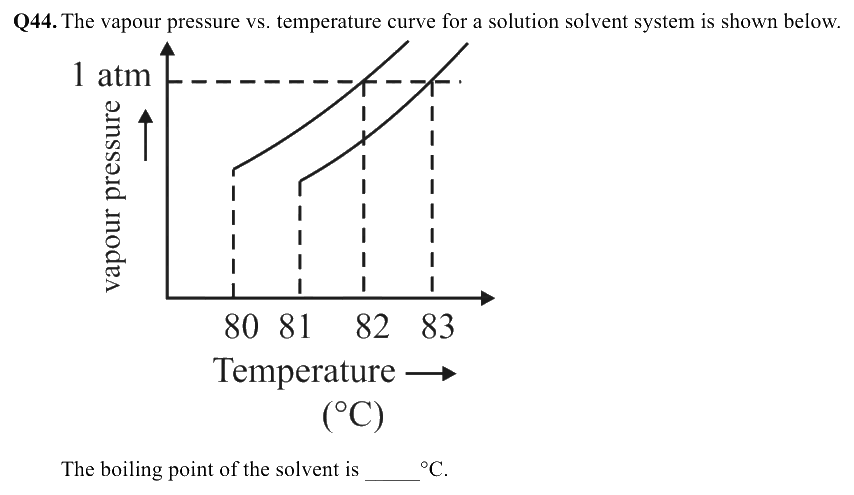
The vapour pressure vs. temperature curve for a solution solvent system is shown below. (see the figure above) The boiling point of the solvent is ______ $^\circ\mathrm{C}$.
The question as printed in the paper.
Numerical answer type: type your answer in EdLoop to check it
If the boiling points of two solvents X and Y (having same molecular weights) are in the ratio 2: 1 and their enthalpy of vaporizations are in the ratio 1 : 2, then the boiling point elevation constant of X is m times the boiling point elevation constant of Y. The value of m is (nearest integer).
Numerical answer type: type your answer in EdLoop to check it
Mass of Urea $\mathrm{NH_2CONH_2}$ required to be dissolved in $1000\ \mathrm{g}$ of water in order to reduce the vapour pressure of water by $25\%$ is ______ g. (Nearest integer)
Given : Molar mass of N, C, O and H are 14, 12, 16 and 1 $\mathrm{g\ mol^{-1}}$ respectively.
Numerical answer type: type your answer in EdLoop to check it
25 mL of an aqueous solution of KCl was found to require 20 mL of 1M $\mathrm{AgNO_3}$ solution when titrated using $\mathrm{K_2CrO_4}$ as an indicator. What is the depression in freezing point of KCl solution of the given concentration? (Nearest integer). (Given : $\mathrm{K_f}$ = 2.0 K kg $\mathrm{mol^{-1}}$ ) Assume 1) 100% ionization and 2) density of the aqueous solution as 1 g $\mathrm{mL^{-1}}$
Numerical answer type: type your answer in EdLoop to check it
20% of acetic acid is dissociated when its 5 g is added to 500 $\mathrm{mL}$ of water. The depression in freezing point of such water is ______ $\times$ $10^{-3}$$^\circ$C. Atomic mass of C, H and O are 12, 1 and 16 a.m.u. respectively. [Given : Molal depression constant and density of water are 1. 86 $\mathrm{K\ kg\ mol^{-1}}$ and 1 $\mathrm{g\ cm^{-3}}$ respectively]
Numerical answer type: type your answer in EdLoop to check it
At $27^\circ\mathrm{C}$, a solution containing 2.5 $\mathrm{g}$ of solute in 250.0 $\mathrm{mL}$ of solution exerts an osmotic pressure of 400 $\mathrm{Pa}$. The molar mass of the solute is ______ $\mathrm{g\ mol^{-1}}$ (Nearest integer) (Given : R = 0.083 $\mathrm{L\ bar\ K^{-1}\ mol^{-1}}$)
Numerical answer type: type your answer in EdLoop to check it
A solution containing 2 g of a non-volatile solute in 20 g of water boils at 373.52 K. The molecular mass of the solute is ______ g mol$^{-1}$. (Nearest integer) Given, water boils at 373 K, $K_b$ for water = 0.52 K kg mol$^{-1}$
Numerical answer type: type your answer in EdLoop to check it
Lead storage battery contains 38% by weight solution of $\mathrm{H_2\,SO_4}$. The van't Hoff factor is 2.67 at this concentration. The temperature in Kelvin at which the solution in the battery will freeze is ______ (Nearest integer). Given $\mathrm{K_f}$ = 1.8 K kg mol$^{-1}$
Numerical answer type: type your answer in EdLoop to check it
Solid Lead nitrate is dissolved in 1 litre of water. The solution was found to boil at $100.15^\circ\mathrm{C}$. When $0.2\ \mathrm{mol}$ of NaCl is added to the resulting solution, it was observed that the solution froze at $-0.8^\circ\mathrm{C}$. The solutbility product of $\mathrm{PbCl_2}$ formed is ______ $\times 10^{-6}$ at $298\ \mathrm{K}$. (Nearest integer) Given : $\mathrm{K_b} = 0.5\ \mathrm{K\,kg\,mol^{-1}}$ and $\mathrm{K_f} = 1.8\ \mathrm{kg\,mol^{-1}}$. Assume molality to be equal to molarity in all cases.
Numerical answer type: type your answer in EdLoop to check it
The Total pressure observed by mixing two liquid A and B is 350 mm Hg when their mole fractions are 0.7 and 0.3 respectively. The Total pressure becomes 410 mm Hg if the mole fractions are changed to 0.2 and 0.8 respectively for A and B. The vapour pressure of pure A is ______ mm Hg. (Nearest integer)
Consider the liquids and solutions behave ideally
Numerical answer type: type your answer in EdLoop to check it
If $\mathrm{O_2}$ gas is bubbled through water at 303 K, the number of millimoles of $\mathrm{O_2}$ gas that dissolve in 1 litre of water is ______ (Nearest integer) (Given : Henry's Law constant for $\mathrm{O_2}$ at 303 K is 46.82k bar and partial pressure of $\mathrm{O_2}$ = 0.920 bar) (Assume solubility of $\mathrm{O_2}$ in water is too small, nearly negligible)
Numerical answer type: type your answer in EdLoop to check it
1.80 g of solute A was dissolved in 62.5 $\mathrm{cm^3}$ of ethanol and freezing point of the solution was found to be 155.1 K. The molar mass of solute A is $\mathrm{g\ mol^{-1}}$. [Given: Freezing point of ethanol is 156.0 K. Density of ethanol is 0.80 $\mathrm{g\ cm^{-3}}$. Freezing point depression constant of ethanol is 2.00 $\mathrm{K\ kg\ mol^{-1}}$]
Numerical answer type: type your answer in EdLoop to check it
$150\ \mathrm{g}$ of acetic acid was contaminated with $10.2\ \mathrm{g}$ ascorbic acid $\mathrm{C_6H_8O_6}$ to lower down its freezing point by $x\times10^{-1}\,^{\circ}\mathrm{C}$. The value of x is ______ (Nearest integer). [Given $\mathrm{K_f}=3.9\ \mathrm{K\ kg\ mol^{-1}}$; Molar mass of ascorbic acid $=176\ \mathrm{g\ mol^{-1}}$]
Numerical answer type: type your answer in EdLoop to check it
A gaseous mixture of two substances A and B, under a total pressure of $0.8\ \mathrm{atm}$ is in equilibrium with an ideal liquid solution. The mole fraction of substance A is $0.5$ in the vapour phase and $0.2$ in the liquid phase. The vapour pressure of pure liquid A is ______ atm.(Nearest integer)
Numerical answer type: type your answer in EdLoop to check it
When a certain amount of solid A is dissolved in 100 g of water at 25 $^\circ$C to make a dilute solution, the vapour pressure of the solution is reduced to one-half of that of pure water. The vapour pressure of pure water is 23.76 mmHg. The number of moles of solute A added is
Numerical answer type: type your answer in EdLoop to check it
The elevation in boiling point for 1 molal solution of non-volatile solute A is 3 K. The depression in freezing point for 2 molal solution of A in the same solvent is 6 K. The ratio of $\mathrm{K_b}$ and $\mathrm{K_f}$ i.e., $\mathrm{K_b / K_f}$ is $1:\mathrm{X}$. The value of X is
Numerical answer type: type your answer in EdLoop to check it
$1.2\ \mathrm{mL}$ of acetic acid is dissolved in water to make $2.0\ \mathrm{L}$ of solution. The depression in freezing point observed for this strength of acid is $0.0198\ ^\circ\mathrm{C}$. The percentage of dissociation of the acid is (Nearest integer) [Given : Density of acetic acid is $1.02\ \mathrm{g\ mL^{-1}}$ Molar mass of acetic acid is $60\ \mathrm{g\,mol^{-1}}$ $\mathrm{K_f(H_2O)} = 1.85\ \mathrm{K\ kg\ mol^{-1}}$]
Numerical answer type: type your answer in EdLoop to check it
Elevation in boiling point for $1.5$ molal solution of glucose in water is $4\ \mathrm{K}$. The depression in freezing point for $4.5$ molal solution of glucose in water is $4\ \mathrm{K}$. The ratio of molal elevation constant to molal depression constant ($\mathrm{K_b/K_f}$) is
Numerical answer type: type your answer in EdLoop to check it
The vapour pressures of two volatile liquids A and B at $25\ ^\circ\mathrm{C}$ are 50 Torr and 100 Torr, respectively. If the liquid mixture contains $0.3$ mole fraction of A, then the mole fraction of liquid B in the vapour phase is $\dfrac{x}{17}$. The value of x is
Numerical answer type: type your answer in EdLoop to check it
2.5 g of protein containing only glycine ($\mathrm{C_2H_5\,NO_2}$) is dissolved in water to make 500 mL of solution. The osmotic pressure of this solution at 300 K is found to be $5.03 \times 10^{-3}$ bar. The total number of glycine units present in the protein is (Given : R $= 0.083\ \mathrm{L\ bar\ K^{-1}\ mol^{-1}}$)
Numerical answer type: type your answer in EdLoop to check it
2 g of a non-volatile non-electrolyte solute is disolved in 200 g of two different solvents A and B whose ebullioscopic constants are in the ratio of 1 : 8. The elevation in boiling points of A and B are in the ratio $\frac{x}{y}$ (x : y). The value of y is ______ (Nearest Integer)
Numerical answer type: type your answer in EdLoop to check it
A solution containing $2.5 \times 10^{-3}\ \mathrm{kg}$ of a solute dissolved in $75 \times 10^{-3}\ \mathrm{kg}$ of water boils at $373.535\ \mathrm{K}$. The molar mass of the solute is $\mathrm{mol^{-1}}$. [nearest integer] (Given : $\mathrm{K_b(H_2O)} = 0.52\ \mathrm{K\ kg\ mol^{-1}}$ and boiling point of water $= 373.15\ \mathrm{K}$)
Numerical answer type: type your answer in EdLoop to check it
A $0.5$ percent solution of potassium chloride was found to freeze at $-0.24^\circ\mathrm{C}$. The percentage dissociation of potassium chloride is (Nearest integer) (Molal depression constant for water is $1.80 \mathrm{~K} \mathrm{~kg} \mathrm{~mol}^{-1}$ and molar mass of KCl is $74.6 \mathrm{~g} \mathrm{~mol}^{-1}$)
Numerical answer type: type your answer in EdLoop to check it
The osmotic pressure exerted by a solution prepared by dissolving $2.0 \mathrm{~g}$ of protein of molar mass $60 \mathrm{~kg} \mathrm{~mol}^{-1}$ in $200 \mathrm{~mL}$ of water at $27^\circ\mathrm{C}$ is ______ Pa. [integer value] (use $\mathrm{R} = 0.083 \mathrm{~L} \mathrm{~bar} \mathrm{~mol}^{-1} \mathrm{~K}^{-1}$)
Numerical answer type: type your answer in EdLoop to check it
The osmotic pressure of blood is $7.47 \mathrm{~bar}$ at $300 \mathrm{~K}$. To inject glucose to a patient intravenously, it has to be isotonic with blood. The concentration of glucose solution in $\mathrm{gL^{-1}}$ is (Molar mass of glucose $= 180 \mathrm{~g~mol^{-1}}$, $\mathrm{R} = 0.083 \mathrm{~L~bar^{-1}~mol^{-1}}$) (Nearest integer)
Numerical answer type: type your answer in EdLoop to check it
A company dissolves 'x' amount of $\mathrm{CO_2}$ at $298 \mathrm{~K}$ in $1$ litre of water to prepare soda water. $\mathrm{X} = \times 10^{-3} \mathrm{~g}$. (nearest integer) (Given: partial pressure of $\mathrm{CO_2}$ at $298 \mathrm{~K} = 0.835 \mathrm{~bar}$. Henry's law constant of $\mathrm{CO_2}$ at $298 \mathrm{~K} = 1.67 \mathrm{~kbar}$. Atomic mass of H, C and O is $1$, $12$, and $6 \mathrm{~g~mol^{-1}}$, respectively)
Numerical answer type: type your answer in EdLoop to check it
$1.22$ g of an organic acid is separately dissolved in $100$ g of benzene $\mathrm{K_b} = 2.6$ K kg mol$^{-1}$ and $100$ g of acetone $\mathrm{K_b} = 1.7$ K kg mol$^{-1}$. The acid is known to dimerize in benzene but remain as a monomer in acetone. The boiling point of the solution in acetone increases by $0.17^\circ$C. The increase in boiling point of solution in benzene in$^\circ$C is x $\times 10^{-2}$. The value of x is (Nearest integer) [Atomic mass : C = $12.0$, H = $1.0$, O = $16.0$]
Numerical answer type: type your answer in EdLoop to check it
$1$ kg of $0.75$ molal aqueous solution of sucrose can be cooled up to $-4^\circ$C before freezing. The amount of ice (in g) that will be separated out is ______. (Nearest integer) [Given : $\mathrm{K}_f(\mathrm{H_2O}) = 1.86$ K kg mol$^{-1}$]
Numerical answer type: type your answer in EdLoop to check it
$40\ \mathrm{g}$ of glucose (Molar mass $=180$) is mixed with $200\ \mathrm{mL}$ of water. The freezing point of solution is __K. (Nearest integer) [Given : $\mathrm{K_f}=1.86\ \mathrm{K\ kg\ mol^{-1}}$; Density of water $=1.00\ \mathrm{g\ cm^{-3}}$; Freezing point of water $=273.15\ \mathrm{K}$]
Numerical answer type: type your answer in EdLoop to check it
Of the following four aqueous solutions, the total number of those solutions whose freezing point is lower than that of $0.10\ \mathrm{M}\ \mathrm{C_2H_5OH}$ is (Integer answer) (i) $0.10\ \mathrm{M}\ \mathrm{Ba_3\,(PO_4)_2}$ (ii) $0.10\ \mathrm{M}\ \mathrm{Na_2\,SO_4}$ (iii) $0.10\ \mathrm{M}\ \mathrm{KCl}$ (iv) $0.10\ \mathrm{M}\ \mathrm{Li_3\,PO_4}$
Numerical answer type: type your answer in EdLoop to check it
$83\ \mathrm{g}$ of ethylene glycol dissolved in $625\ \mathrm{g}$ of water. The freezing point of the solution is ..... K. (Nearest integer) [Use : Molal Freezing point depression constant of water $=1.86\ \mathrm{K\ kg\ mol^{-1}}$ Freezing point of water $=273\ \mathrm{K}$ Atomic masses : C : $12.0\mathrm{u}$, O : $16.0\mathrm{u}$, H : $1.0\mathrm{u}$]
Numerical answer type: type your answer in EdLoop to check it
1.46 g of a biopolymer dissolved in a 100 mL water at 300 K exerted an osmotic pressure of $2.42 \times 10^{-3}$ bar The molar mass of the biopolymer is — $\times 10^4\ \mathrm{g\ mol^{-1}}$. (Round off to the Nearest Integer) [Use: R = $0.083\ \mathrm{L\ bar\ mol^{-1}\ K^{-1}}$]
Numerical answer type: type your answer in EdLoop to check it
In a solvent 50% of an acid HA dimerizes and the rest dissociates. The van't Hoff factor of the acid is ______ $\times 10^{-2}$ (Round off to the nearest integer)
Numerical answer type: type your answer in EdLoop to check it
$\mathrm{CO_2}$ gas is bubbled through water during a soft drink manufacturing process at $298\ \mathrm{K}$. If $\mathrm{CO_2}$ exerts a partial pressure of $0.835\ \mathrm{bar}$ then x $\mathrm{m\ mol}$ of $\mathrm{CO_2}$ would dissolve in $0.9\ \mathrm{L}$ of water. The value of x is ______. (Nearest integer) (Henry's law constant for $\mathrm{CO_2}$ at $298\ \mathrm{K}$ is $1.67 \times 10^{3}\ \mathrm{bar}$)
Numerical answer type: type your answer in EdLoop to check it
When $3.00\ \mathrm{g}$ of a substance X' is dissolved in $100\ \mathrm{g}$ of $\mathrm{CCl_4}$, it raises the boiling point by $0.60\ \mathrm{K}$. The molar mass of the substance 'X' is ___ $\mathrm{g\ mol^{-1}}$. (Nearest integer). [Given $\mathrm{K_b}$ for $\mathrm{CCl_4}$ is $5.0\ \mathrm{K\ kg\ mol^{-1}}$]
Numerical answer type: type your answer in EdLoop to check it
At $20^\circ\mathrm{C}$, the vapour pressure of benzene is $70$ torr and that of methyl benzene is $20$ torr. The mole fraction of benzene in the vapour phase at $20^\circ\mathrm{C}$ above an equimolar mixture of benzene and methyl benzene is ______ $\times 10^{-2}$. (Nearest integer)
Numerical answer type: type your answer in EdLoop to check it
The vapour pressures of A and B at $25^\circ\mathrm{C}$ are $90~\mathrm{mmHg}$ and $15~\mathrm{mm}$ Hg respectively. If A and B are mixed such that the mole fraction of A in the mixture is $0.6$, then the mole fraction of B in the vapour phase is $x \times 10^{-1}$. The value of x is (Nearest integer)
Numerical answer type: type your answer in EdLoop to check it
2 molal solution of a weak acid HA has a freezing point of $-3.885^\circ\mathrm{C}$. The degree of dissociation of this acid is ______ $\times 10^{-3}$. (Round off to the Nearest Integer). [Given : Molal depression constant of water $= 1.85~\mathrm{K~kg~mol^{-1}}$ Freezing point of pure water$= 0^\circ\mathrm{C}$]
Numerical answer type: type your answer in EdLoop to check it
A solute A dimerizes in water. The boiling point of a 2 molal solution of A is $100.52^\circ\mathrm{C}$. The percentage association of A is ______ . (Round off to the Nearest integer) Use : $\mathrm{K_b}$ for water $= 0.52~\mathrm{K~kg~mol^{-1}}$ Boiling point of water $= 100^\circ\mathrm{C}$
Numerical answer type: type your answer in EdLoop to check it
The oxygen dissolved in water exerts a partial pressure of 20 kPa in the vapour above water. The molar solubility of oxygen in water is ______ $\times 10^{-5} \mathrm{~mol} \mathrm{dm}^{-3}$. (Round off to the Nearest Integer). [Given : Henry's law constant $=\mathrm{K}_{\mathrm{H}}=8.0 \times 10^4 \mathrm{kPa}$ for $\mathrm{O}_2$. Density of water with dissolved oxygen $=1.0 \mathrm{~kg} \mathrm{dm}^{-3}$]
Numerical answer type: type your answer in EdLoop to check it
A 1 molal $\mathrm{K}_4 \mathrm{Fe}(\mathrm{CN})_6$ solution has a degree of dissociation of 0.4 . Its boiling point is equal to that of another solution which contains 18.1 weight percent of a non electrolytic solute A. The molar mass of A is ______ u. (Round off to the Nearest Integer). [Density of water $=1.0 \mathrm{~g} \mathrm{~cm}^{-3}$]
Numerical answer type: type your answer in EdLoop to check it
$\mathrm{AB}_2$ is $10 \%$ dissociated in water to $\mathrm{A}^{2+}$ and $\mathrm{B}^{-}$. The boiling point of 10.0 molal aqueous solution of $\mathrm{AB}_2$ is-- $^{\circ} \mathrm{C}$. (Round off to the Nearest Integer). [Given : Molal elevation constant of water $\mathrm{K}_{\mathrm{b}}=0.5 \mathrm{~K} \mathrm{~kg} \mathrm{~mol}^{-1}$ boiling point of pure water$=100^{\circ} \mathrm{C}$]
Numerical answer type: type your answer in EdLoop to check it
At $363\ \mathrm{K}$, the vapour pressure of A is $21\ \mathrm{kPa}$ and that of B is $18\ \mathrm{kPa}$. One mole of A and 2 moles of B are mixed. Assuming that this solution is ideal, the vapour pressure of the mixture is ______ kPa. (Round to the Nearest Integer).
Numerical answer type: type your answer in EdLoop to check it
$224\ \mathrm{mL}$ of $\mathrm{SO_{2(g)}}$ at $298\ \mathrm{K}$ and $1\ \mathrm{atm}$ is passed through $100\ \mathrm{mL}$ of $0.1\ \mathrm{M}$ NaOH solution. The non-volatile solute produced is dissolved in $36\ \mathrm{g}$ of water. The lowering of vapour pressure of solution (assuming the solution is dilute) $(\mathrm{P^{\circ}_{(H_2O)}} = 24\ \mathrm{mm\ of\ Hg})$ is $\mathrm{x \times 10^{-2}}$ mm of Hg the value of x is ______ (Integer answer)
Numerical answer type: type your answer in EdLoop to check it
When $12.2\ \mathrm{g}$ of benzoic acid is dissolved in $100\ \mathrm{g}$ of water, the freezing point of solution was found to be $-0.93\ ^\circ\mathrm{C}$ $(\mathrm{K_f(H_2O)} = 1.86\ \mathrm{K\ kg\ mol^{-1}})$. The number (n) of benzoic acid molecules associated (assuming $100\%$ association) is ______.
Numerical answer type: type your answer in EdLoop to check it
$1$ molal aqueous solution of an electrolyte $\mathrm{A_2\,B_3}$ is $60\%$ ionised. The boiling point of the solution at $1$ atm is ______ K. (Rounded-off to the nearest integer) [Given $\mathrm{K_b}$ for $(\mathrm{H_2O}) = 0.52\ \mathrm{K\ kg\ mol^{-1}}$]
Numerical answer type: type your answer in EdLoop to check it
If a compound AB dissociates to the extent of $75\%$ in an aqueous solution, the molality of the solution which shows a $2.5\ \mathrm{K}$ rise in the boiling point of the solution is ______ molal. (Rounded-off to the nearest integer) [$K_b = 0.52\mathrm{K\ kg\ mol^{-1}}$].
Numerical answer type: type your answer in EdLoop to check it
When $9.45\ \mathrm{g}$ of $\mathrm{ClCH_2COOH}$ is added to $500\ \mathrm{mL}$ of water, its freezing point drops by $0.5^\circ\mathrm{C}$. The dissociation constant of $\mathrm{ClCH_2COOH}$ is $x \times 10^{-3}$. The value of x is off to the nearest integer) $\mathrm{K_{fH_2O}} = 1.86\ \mathrm{K\ kg\ mol^{-1}}$
Numerical answer type: type your answer in EdLoop to check it
$\mathrm{C_6H_6}$ freezes at $5.5^\circ\mathrm{C}$. The temperature at which a solution of $10\ \mathrm{g}$ of $\mathrm{C_4H_{10}}$ in $200\ \mathrm{g}$ of $\mathrm{C_6H_6}$ freeze is ______$^\circ\mathrm{C}$. (nearest integer value), (The molal freezing point depression constant of $\mathrm{C_6H_6}$ is $5.12^\circ\mathrm{C/m}$.)
Numerical answer type: type your answer in EdLoop to check it
The elevation of boiling point of 0.10m aqueous $\mathrm{CrCl_3.xNH_3}$ solution is two times that of 0.05 m aqueous $\mathrm{CaCl_2}$ solution. The value of $x$ is ______ [Assume 100% ionisation of the complex and $\mathrm{CaCl_2}$, coordination number of Cr as 6, and that all $\mathrm{NH_3}$ molecules are present inside the coordination sphere]
Numerical answer type: type your answer in EdLoop to check it
At 300 K, the vapour pressure of a solution containing 1 mole of n -hexane and 3 moles of n -heptane is 550 mm of Hg. At the same temperature, if one more mole of n -heptane is added to this solution, the vapour pressure of the solution increases by 10 mm of Hg. What is the vapour pressure in mmHg of n - heptane in its pure state ______ ?
Numerical answer type: type your answer in EdLoop to check it
The osmotic pressure of a solution of NaCl is $0.10\ \mathrm{atm}$ and that of a glucose solution is $0.20\ \mathrm{atm}$. The osmotic pressure of a solution formed by mixing 1 L of the sodium chloride solution with 2 L of the glucose solution is $\mathrm{x} \times 10^{-3}\ \mathrm{atm}$. x is ______ (nearest integer)
Numerical answer type: type your answer in EdLoop to check it
If $250\ \mathrm{cm}^{3}$of an aqueous solution containing 0.73g of a protein A is isotonic with one litre of another aqueous solution containing 1.65g of a protein B, at 298K, the ratio of the molecular masses of A and B is ______ $\times 10^{-2}$ (to the nearest integer).
Numerical answer type: type your answer in EdLoop to check it
How much amount of NaCl should be added to 600 g of water ($\rho = 1.00$g/mL) to decrease the freezing point of water to $-0.2\ ^oC$? ______. (The freezing point depression constant for water = 2 K $\mathrm{kgmol^{-1}}$ )
Numerical answer type: type your answer in EdLoop to check it
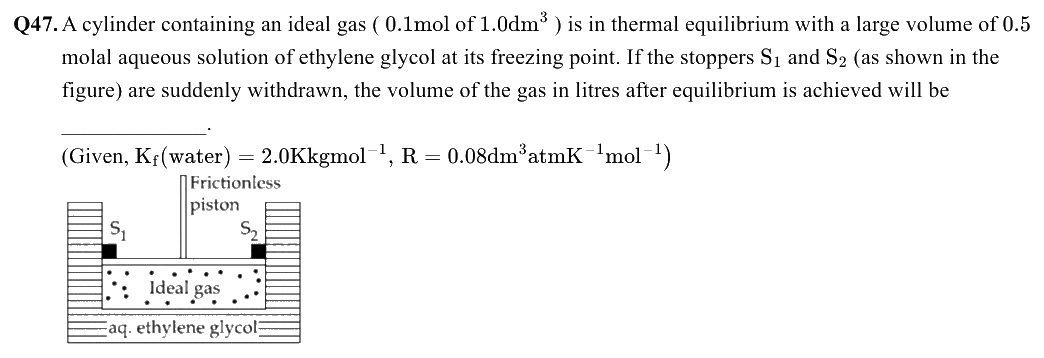
A cylinder containing an ideal gas ( $0.1\mathrm{mol}$ of $1.0\mathrm{dm^3}$ ) is in thermal equilibrium with a large volume of $0.5$ molal aqueous solution of ethylene glycol at its freezing point. If the stoppers $\mathrm{S_1}$ and $\mathrm{S_2}$ (as shown in the figure) are suddenly withdrawn, the volume of the gas in litres after equilibrium is achieved will be ______. (Given, $\mathrm{K_f}$(water) $= 2.0\mathrm{Kkg\,mol^{-1}}$, $\mathrm{R} = 0.08\mathrm{dm^3atm\,K^{-1}mol^{-1}}$) (see the figure above)
The question as printed in the paper.
Numerical answer type: type your answer in EdLoop to check it
Solutions explores liquid mixtures and colligative properties under Unit 5: Solutions in the Class 12 curriculum, holding rank 15 among the 31 chemistry chapters with a 3.4 percent share of total chemistry questions. In the computerized exam period from 2019 to 2026, candidates answered 156 questions across 162 papers, representing an average frequency of 1.0 question per shift. The chapter featured in 145 of those 162 papers, and questions appeared every single year throughout the cycle. During the recent 2024 to 2026 testing sessions, examiners set 60 questions across 58 papers, maintaining an average of 1.0 question per test and lifting its subject share to 3.9 percent. This demonstrates a trend that is up compared to both the 3.2 percent share from 43 questions in the 2002 to 2018 window and the 3.4 percent baseline across 2019 to 2026. In 2026 alone, examiners presented 22 questions across 19 papers, showing up in 17 separate shifts. Remarkably, 83 questions between 2019 and 2026 were formatted as numerical answer questions, meaning over half of all modern solutions questions require students to calculate numerical values for depression in freezing point, elevation in boiling point, or osmotic pressure.
Most-asked topics
Questions in this chapter concentrate across three defined areas:
Colligative Properties: 100 questions historically, with 83 delivered between 2019 and 2026, tested up to 2026. This dominant area tests elevation of boiling point delta T b equals i K b m, depression of freezing point delta T f equals i K f m, osmotic pressure pi equals i C R T, relative lowering of vapor pressure, and molar mass determinations of unknown solutes.
van't Hoff Factor: 49 total questions, including 37 from 2019 to 2026, tested in 2026. Problems assess degree of dissociation alpha equals i minus 1 divided by n minus 1, degree of association, anomalous molar masses, and comparisons of freezing or boiling points across equimolar electrolyte solutions.
Vapour Pressure & Raoult's Law: 50 lifetime problems, with 36 between 2019 and 2026, tested through 2026. Concepts explore total vapor pressure of binary ideal liquid mixtures, vapor phase mole fractions, positive and negative deviations from Raoult's law, minimum and maximum boiling azeotropes, and Henry's gas solubility law.
What the questions look like
JEE Main problems in solutions combine formulaic colligative equations with multi-component molar bookkeeping:
Molar mass determinations from boiling point elevation: Dissolving known masses of binary compounds PQ and PQ2 into identical solvent volumes results in measured temperature rises, from which students set up simultaneous equations to extract individual atomic weights.
Isotonic solutions and osmotic pressure: Finding the required concentration in grams per liter of a sodium chloride solution to render it isotonic with biological cellular fluids at a specified osmotic pressure and temperature.
Binary mixture vapor pressure equations: Adding incremental moles of volatile component A or B to an initial mixture increases total vapor pressure by a measured amount, requiring determination of pure component vapor pressures.
Henry's law gas solubility: Evaluating the dissolved mole fraction of atmospheric nitrogen in water under specified total pressure and Henry's law constant.
Always incorporate the van't Hoff factor i into every colligative property formula. For strong electrolytes like potassium chloride, barium chloride, or aluminum sulfate, write out complete ionic dissociation to find the theoretical factor unless a fractional degree of dissociation is explicitly provided.
Be careful with molality versus molarity. Boiling point elevation and freezing point depression depend strictly on molality, which uses kilograms of pure solvent in the denominator. Osmotic pressure depends on molarity, which uses liters of total solution.
For Raoult's law binary mixtures, relate liquid phase mole fractions x A and x B to vapor phase mole fractions y A and y B using Dalton's law of partial pressures: y A equals p A divided by total pressure.
Frequently asked questions
Which colligative property appears most often in JEE Main?
Depression of freezing point and elevation of boiling point appear most frequently, closely followed by osmotic pressure calculations. Together with van't Hoff factor determinations, they comprise over eighty percent of modern questions.
How do I identify positive versus negative deviations from Raoult's law?
Positive deviations occur when solute-solvent intermolecular attractions are weaker than pure component attractions (such as acetone and carbon disulfide), raising vapor pressure. Negative deviations occur when new hydrogen bonds or dipole attractions form (such as acetone and chloroform), lowering vapor pressure.
Why is osmotic pressure preferred for measuring molar masses of polymers?
Osmotic pressure generates measurable hydrostatic pressures even at extremely low molar concentrations, and measurements occur at room temperature without risking thermal degradation of delicate macromolecules. Step-by-step solutions for each one are in the EdLoop app.