Mole Concept & Stoichiometry: JEE Main PYQs 2002–2026
Every Mole Concept & Stoichiometry question from past JEE Main and AIEEE papers, with options and answers. Newest first.
253questions
181papers covered
4.4%of Chemistry questions, 2019–2026
2002–2026years
Guide at a glance
Mole concept and stoichiometry provides the quantitative foundation for chemical calculations under Unit 1: Some Basic Concepts in Chemistry in the Class 11 curriculum, holding rank 7 among 31 chemistry chapters with a 4.4 percent share of the entire chemistry section.
How many grams of residue is obtained by heating 2.76 g of silver carbonate? (Given : Molar mass of C, O and Ag are 12, 16 and 108 g mol$^{-1}$ respectively)
What volume of hydrogen gas at STP would be liberated by action of 50 mL of $\mathrm{H_2SO_4}$ of 50% purity (density = 1.3 g mL$^{-1}$) on 20 g of zinc ? Given : Molar mass of H, O, S, Zn are 1, 16, 32, 65 g mol$^{-1}$ respectively.
The mass of iron converted into $\mathrm{Fe_3O_4}$ by the action of 18 g of steam is : (Given : Molar mass of H, O and Fe are 1, 16 and 56 g mol$^{-1}$ respectively) Assume iron is present in excess :
The ratio of mass percentage (w/w) of C : H in a hydrocarbon is 12 : 1. It has two carbon atoms. The weight (in g) of $\mathrm{CO_2(g)}$ formed when 3.38 g of this hydrocarbon is completely burnt in oxygen is : (Given : Molar mass in g mol$^{-1}$ C : 12, H : 1, , O : 16)
If 90 g $\mathrm{CaCO_3}$ is added to 300 mL of HCl which contains 38.55% HCl by mass and has density 1.13 g mL$^{-1}$, then which of the following option is correct ?
Given molar mass of H, Cl, Ca and O are 1, 35.5, 40 and 16 g mol$^{-1}$ respectively.
At T(K), 100 g of 98% $\mathrm{H_2SO_4}$ (w/w) aqueous solution is mixed with 100 g of 49% $\mathrm{H_2SO_4}$ (w/w) aqueous solution. What is the mole fraction of $\mathrm{H_2SO_4}$ in the resultant solution ?
(Given : Atomic mass H = 1 u ; S = 32 u ; O = 16 u).
(Assume that temperature after mixing remains constant)
36.0 g of 'A' (Molar mass : 60 g mol$^{-1}$) and 56.0 g of 'B' (Molar mass : 80 g mol$^{-1}$) are allowed to react. Which of the following statements are correct ?
A. 'A' is the limiting reagent.
B. 77.0 g of $\mathrm{AB_2}$ is formed.
C. Molar mass of $\mathrm{AB_2}$ is 140 g mol$^{-1}$.
D. 15.0 g of A is left unreacted after the completion of reaction.
Choose the correct answer from the options given below :
80 mL of a hydrocarbon on mixing with 264 mL of oxygen in a closed U-tube undergoes complete combustion. The residual gases after cooling to 273 K occupy 224 mL. When the system is treated with KOH solution, the volume decreases to 64 mL. The formula of the hydrocarbon is :
14.0 g of calcium metal is allowed to react with excess HCl at 1.0 atm pressure and 273 K. Which of the following statements is incorrect ? [Given : Molar mass in g mol$^{-1}$ of Ca $-$ 40, Cl $-$ 35.5, H $-$ 1]
Aqueous HCl reacts with $\mathrm{MnO_2}$(s) to form $\mathrm{MnCl_2}$(aq), $\mathrm{Cl_2}$(g) and $\mathrm{H_2O}$(l). What is the weight (in g) of $\mathrm{Cl_2}$ liberated when 8.7 g of $\mathrm{MnO_2}$(s) is reacted with excess aqueous HCl solution ? (Given Molar mass in g mol$^{-1}$ Mn = 55, Cl = 35.5, O = 16, H = 1)
At the sea level, the dry air mass percentage composition is given as nitrogen gas: 70.0, oxygen gas: 27.0 and argon gas: 3.0. If total pressure is 1.15 atm, then calculate the ratio of following respectively:
(i) partial pressure of nitrogen gas to partial pressure of oxygen gas
(ii) partial pressure of oxygen gas to partial pressure of argon gas
(Given: Molar mass of N, O and Ar are 14, 16 and $40g\,mol^{-1}$ respectively.)
10 mL of 2 M NaOH solution is added to 20 mL of 1 M HCl solution kept in a beaker. Now, 10 mL of this mixture is poured into a volumetric flask of 100 mL containing 2 moles of HCl and made the volume upto the mark with distilled water. The solution in this flask is :
On complete combustion 1.0 g of an organic compound $(X)$ gave 1.46 g of $CO_2$ and 0.567 g of $H_2O$. The empirical formula mass of compound $(X)$ is ______
(Given molar mass in $gmol^{-1}C : 12, H : 1, O : 16$ )
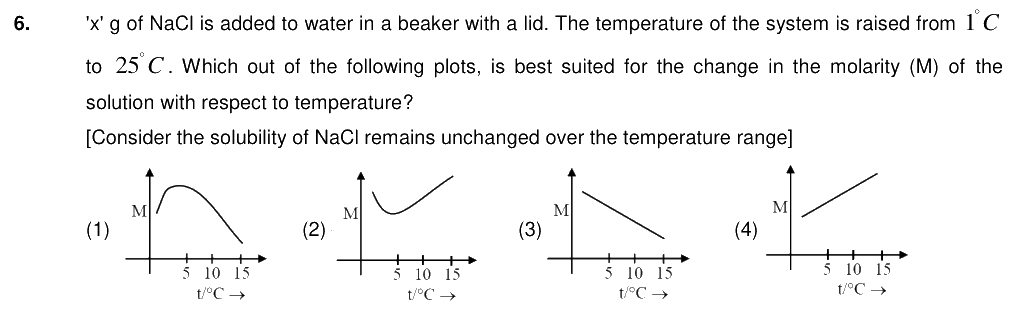
'x' g of NaCl is added to water in a beaker with a lid. The temperature of the system is raised from $1^\circ C$ to $25^\circ C$. Which out of the following plots, is best suited for the change in the molarity (M) of the solution with respect to temperature?
[Consider the solubility of NaCl remains unchanged over the temperature range]
The question as printed in the paper.
A
see figure axes 'M' (vertical) and 't/°C →' (horizontal, marked 5, 10, 15); a curve that starts near the vertical axis, rises to a rounded maximum at about t = 4 (just left of the 5 tick) and then falls, more and more steeply, to near the horizontal axis at about 15.
B
see figure same axes; a curve that starts high near the vertical axis, falls to a shallow minimum at about t = 4 (just left of the 5 tick) and then rises, ending high at the right.
C
see figure same axes; a straight line falling from the upper left to the lower right.
D
see figure same axes; a straight line rising from the left to the upper right.
Choose the correct statements. (A) Weight of a substance is the amount of matter present in it. (B) Mass is the force exerted by gravity on an object. (C) Volume is the amount of space occupied by a substance. (D) Temperatures below $0^\circ$C are possible in Celsius scale, but in Kelvin scale negative temperature is not possible. (E) Precision refers to the closeness of various measurements for the same quantity. Choose the correct answer from the options given below :
Concentrated nitric acid is labelled as 75% by mass. The volume in mL of the solution which contains 30 g of nitric acid is ______ . Given : Density of nitric acid solution is 1.25 g/mL.
The elemental composition of a compound is 54.2%C, 9.2%H and 36.6%O. If the molar mass of the compound is 132 g $\mathrm{mol^{-1}}$, the molecular formula of the compound is : [Given : The relative atomic mass of C : H : O = 12 : 1 : 16 ]
$2.8 \times 10^{-3}$ mol of $\mathrm{CO_2}$ is left after removing $10^{21}$ molecules from its ' $x$ ' mg sample. The mass of $\mathrm{CO_2}$ taken initially is Given: $\mathrm{N_A} = 6.02 \times 10^{23}\ \mathrm{mol^{-1}}$
The candela is the luminous intensity, in a given direction, of a source that emits monochromatic radiation of frequency ' A ' $\times 10^{12}$ hertz and that has a radiant intensity in that direction of $\frac{1}{'\,B\,'}$ watt per steradian. 'A' and 'B' are respectively
Combustion of glucose $(\mathrm{C_6H_{12}O_6})$ produces $\mathrm{CO_2}$ and water. The amount of oxygen (in g) required for the complete combustion of 900 g of glucose is : [Molar mass of glucose in $\mathrm{gmol^{-1}}$ = 180 ]
The density of ' $x$ ' M solution (' $X$ ' molar) of NaOH is 1.12 g mL$^{-1}$, while in molality, the concentration of the solution is 3 m(3molal). Then $x$ is (Given : Molar mass of NaOH is 40 g/mol )
Molality ( m ) of 3M aqueous solution of NaCl is : (Given : Density of solution = 1.25 g mL$^{-1}$, Molar mass in gmol$^{-1}$ : Na $-$ 23, Cl $-$ 35.5)
The incorrect postulates of the Dalton's atomic theory are : (A) Atoms of different elements differ in mass. (B) Matter consists of divisible atoms. (C) Compounds are formed when atoms of different element combine in a fixed ratio. (D) All the atoms of given element have different properties including mass. (E) Chemical reactions involve reorganisation of atoms. Choose the correct answer from the options given below :
The number of moles of methane required to produce 11 g$\mathrm{CO_2}$( g) after complete combustion is : (Given molar mass of methane in $\mathrm{gmol^{-1}}$ : 16)
Choose the Incorrect Statement about Dalton's Atomic Theory
A
chemical reactions involve reorganization of atoms
B
Matter consists of indivisible atoms.
C
Compounds are formed when atoms of different elements combine in any ratio.
D
Compounds are formed when atoms of different elements combine in any ratio. All the atoms of a given element have identical properties including identical mass.
A sample of CaCO$_3$ and MgCO$_3$ weighed 2.21 g is ignited to constant weight of 1.152 g. The composition of the mixture is: (Given molar mass in g mol$^{-1}$, CaCO$_3$: 100, MgCO$_3$: 84)
If a substance '$A$' dissolves in solution of a mixture of '$B$' and '$C$' with their respective number of moles as $n_A, n_B$ and $n_C$, mole fraction of $C$ in the solution is:
A metal chloride contains 55.0% of chlorine by weight. 100 mL vapours of the metal chloride at STP weigh 0.57 g. The molecular formula of the metal chloride is (Given: Atomic mass of chlorine is 35.5 u)
Given below are two statements: one is labelled as Assertion A and the other is labelled as Reason R. Assertion A: $3.1500\ g$ of hydrated oxalic acid dissolved in water to make $250.0\ mL$ solution will result in $0.1\ M$ oxalic acid solution. Reason R: Molar mass of hydrated oxalic acid is $126\ g\ mol^{-1}$. In the light of the above statements, choose the correct answer from the options given below:
A
Both A and R are true but R is NOT the correct explanation of A
B
A is true but R is false
C
Both A and R are true and R is the correct explanation of A
Match List-I with List-II List-I List-II A 16 g of $\mathrm{CH_4}$ (g) I Weighs 28g B 1 g of $\mathrm{H_2}$ (g) II $60.2 \times 10^{23}$ electrons C 1 mole of $\mathrm{N_2}$ (g) III Weighs 32g D 0.5 mol of $\mathrm{SO_2}$ (g) IV Occupies11.4 L volume at STP Choose the correct answer from the options given below:
The volume of $0.02\ \mathrm{M}$ aqueous HBr required to neutralize $10.0\ \mathrm{mL}$ of $0.01\ \mathrm{M}$ aqueous $\mathrm{Ba(OH)_2}$ is (Assume complete neutralization)
When a hydrocarbon A undergoes complete combustion it requires 11 equivalents of oxygen and produces 4 equivalents of water. What is the molecular formula of A?
When a hydrocarbon A undergoes combustion in the presence of air, it requires 9.5 equivalents of oxygen and produces 3 equivalents of water. What is the molecular formula of A?
What is the mass ratio of ethylene glycol ($\mathrm{C_2H_6O_2}$, molar mass = 62 g/ mol) required for making 500 g of 0.25 molal aqueous solution and 250 mL of 0.25 molar aqueous solution?
$\mathrm{N_{2(g)} + 3H_{2(g)} \rightleftharpoons 2NH_{3(g)}}$ 20 g 5 g Consider the above reaction. If 20g of dinitrogen reacts with 5g of dihydrogen, then the limiting reagent of the reaction and number of moles of $\mathrm{NH_3}$ formed respectively are
Consider the reaction $4\mathrm{HNO_3(l)} + 3\mathrm{KCl(s)} \to \mathrm{Cl_2(g)} + \mathrm{NOCl(g)} + 2\mathrm{H_2O(g)} + 3\mathrm{KNO_3(s)}$ The amount of $\mathrm{HNO_3}$ required to produce 110.0 g of $\mathrm{KNO_3}$ is (Given : Atomic masses of H, O, N and K are 1, 16, 14 and 39, respectively.)
250 g solution of D-glucose in water contains 10.8% of carbon by weight. The molality of the solution is nearest to (Given: Atomic Weights are H = 1u; C = 12 u; O = 16 u)
Hemoglobin contains $0.34\%$ of iron by mass. The number of Fe atoms in $3.3\ \mathrm{g}$ of hemoglobin is (Given : Atomic mass of Fe is 56u, $\mathrm{N_A}$ in$6.022\times10^{23}\ \mathrm{mol^{-1}}$)
$\mathrm{SO_2Cl_2}$ on reaction with excess of water results into acidic mixture $\mathrm{SO_2Cl_2 + 2H_2O \rightarrow H_2SO_4 + 2HCl}$ 16 moles of NaOH is required for the complete neutralisation of the resultant acidic mixture. The number of moles of $\mathrm{SO_2Cl_2}$ used is
Production of iron in blast furnace follows the following equation $\mathrm{Fe_3O_4(s) + 4CO(g) \rightarrow 3Fe(l) + 4CO_2(g)}$ when $4.640\ \mathrm{kg}$ of $\mathrm{Fe_3O_4}$ and $2.520\ \mathrm{kg}$ of CO are allowed to react then the amount of iror (in g) produced is : [Given: Molar Atomic mass $(\mathrm{gmol^{-1}})$ : Fe $= 56$ Molar Atomic mass $(\mathrm{gmolm^{-1}})$ : O $= 16$ Molar Atomic mass $(\mathrm{gmolm^{-1}})$ : C $= 12$]
Compound A contains $8.7\%$ Hydrogen, $74\%$ Carbon and $17.3\%$ Nitrogen. The molecular formula of the compound is, Given : Atomic masses of C, H and N are 12, 1 and 14 amu respectively. The molar mass of the compound A is $162\ \mathrm{g\ mol^{-1}}$.
Given below are two statements : one is labelled as Assertion and the other is labelled as Reason. Assertion: At $10\ ^{\circ}\mathrm{C}$, the density of a 5 M solution of KCl [atomic masses of K & Cl are $39$ & $35.5\ \mathrm{g\ mol^{-1}}$ respectively], is 'x' $\mathrm{gml^{-1}}$. The solution is cooled to $-21\ ^{\circ}\mathrm{C}$. The molality of the solution will remain unchanged. Reason: The molality of a solution does not change with temperature as mass remains unaffected with temperature. In the light of the above statements, choose the correct answer from the options given below.
A
Assertion is true but Reason is false.
B
Assertion is false but Reason is true.
C
Both Assertion and Reason are true and Reason is the correct explanation of Assertion.
D
Both Assertion and Reason are true but Reason is not the correct explanation of Assertion.
A commercially sold conc. HCl is $35\%$ HCl by mass. If the density of this commercial acid is $1.46 \mathrm{~g/~mL}$, the molarity of this solution is : (Atomic mass : Cl = $35.5 \mathrm{~amu}$, H = $1 \mathrm{~amu}$)
If a rocket runs on a fuel $(\mathrm{C_{15}H_{30}})$ and liquid oxygen, the weight of oxygen required and $\mathrm{CO_2}$ released for every litre of fuel respectively are : (Given : density of the fuel is $0.756 \mathrm{~g/mL}$)
A solution of two components containing $\mathrm{n_1}$ moles of the $1^{\mathrm{st}}$ component and $\mathrm{n_2}$ moles of the $2^{\mathrm{nd}}$ component is prepared. $\mathrm{M_1}$ and $\mathrm{M_2}$ are the molecular weights of component 1 and 2 respectively. If d is the density of the solution in $\mathrm{gmI^{-1}}$, $\mathrm{C_2}$ is the molarity and $\mathrm{x_2}$ is the mole fraction of the $2^{\mathrm{nd}}$ component, then $\mathrm{C_2}$ can be expressed as :
The average molar mass of chlorine is $35.5\ \mathrm{g\ mol^{-1}}$. The ratio of $^{35}\mathrm{Cl}$ to $^{37}\mathrm{Cl}$ in naturally occurring chlorine is close to :
The strengths of 5. 6 volume hydrogen peroxide (of density $1\ \mathrm{g/\,mL}$ ) in terms of mass percentage and molarity(M) respectively, are: (Take molar mass of hydrogen peroxide as $34\ \mathrm{g/\,mol}$)
Answer: (C) when gases combine or reproduced in a chemical reaction they do so in a simple ratio by volume provided all gases are at the same T & P.· Key from source paper
The ammonia $(\mathrm{NH_3})$ released on quantitative reaction of $0.6\ \mathrm{g}$ urea $(\mathrm{NH_2CONH_2})$ with sodium hydroxide $(\mathrm{NaOH})$ can be neutralized by
5 moles of $\mathrm{AB_2}$ weigh $125 \times 10^{-3}\ \mathrm{kg}$ and 10 moles of $\mathrm{A_2B_2}$ weigh $300 \times 10^{-3}\ \mathrm{kg}$ . The molar mass of A ( $\mathrm{M_A}$ ) in $\mathrm{kg\ mol^{-1}}$ are:
At 300 K and 1 atmospheric pressure, 10 mL of a hydrocarbon required 55 mL of $\mathrm{O_2}$ for complete combustion, and 40 mL of $\mathrm{CO_2}$ is formed. The formula of the hydrocarbon is:
The minimum amount of $\mathrm{O_2g}$ consumed per gram of reactant is for the reaction: (Given atomic mass: Fe = 56, O = 16, Mg = 24, P = 31, C = 12, H = 1 )
For a reaction, $\mathrm{N_2(g) + 3H_2(g) \longrightarrow 2NH_3(g)}$, identify di-hydrogen ($\mathrm{H_2}$) as a limiting reagent in the following reaction mixtures.
100 mL of a water sample contains 0.81 g of calcium bicarbonate and 0.73 g of magnesium bicarbonate. The hardness of this water sample expressed in terms of equivalents of $\mathrm{CaCO_3}$ is: (molar mass of calcium bicarbonate is 162 $\mathrm{gm\ mol^{-1}}$ and magnesium bicarbonate is 146 $\mathrm{g\ mol^{-1}}$)
0.27 g of a long chain fatty acid was dissolved in 100 $\mathrm{cm^3}$ of hexane. 10 mL of this solution was added dropwise to the surface of water in a round watch glass. Hexane evaporates and a monolayer is formed. The distance from edge to centre of the watch glass is 10 cm . What is the height of the monolayer? [Density of fatty acid = 0.9 g $\mathrm{cm^{-3}}$; $\pi$ = 3]
50 mL of 0 .5 M oxalic acid is needed to neutralize 25 mL of sodium hydroxide solution. What is the amount of NaOH in 50 mL of the given sodium hydroxide solution?
What is the hardness of a water sample (in terms of equivalents of $\mathrm{CaCO_3}$) containing $10^{-3}$M $\mathrm{CaSO_4}$? (Molar mass of $\mathrm{CaSO_4}$ = 136 g $\mathrm{mol^{-1}}$)
8 g of NaOH is dissolved in 18g of $\mathrm{H_2O}$. Mole fraction of NaOH in solution and molality (in mol kg$^{-1}$) of the solution respectively are:
A 10mg effervescent tablet containing sodium bicarbonate and oxalic acid releases 0.25 mL of CO$_2$ at T = 298.15 K and P = 1 bar. If molar volume of CO$_2$ is 25.0 L under such condition, what is the percentage of sodium bicarbonate in each tablet? [Molar mass of NaHCO$_3$ = 84 g mol$^{-1}$]
25 mL of the given HCl solution requires 30 mL of 0.1M sodium carbonate solution. What is the volume of this HCl solution required to titrate 30 mL of 0.2M aqueous NaOH solution?
A mixture of 100 m mol of Ca (OH)$_2$ and 2 g of sodium sulphate was dissolved in water and the volume was made up to 100 mL. What is the mass of calcium sulphate formed and the concentration of OH$^-$ in resulting solution, respectively? (Molar mass of Ca (OH)$_2$, Na$_2$ SO$_4$ and CaSO$_4$ are 74, 143 and 136 g mol$^{-1}$, respectively; K$_{sp}$ of Ca (OH)$_2$ is 5.5 $\times 10^{-6}$)
A solution of sodium sulphate contains $92\ g$ of $\mathrm{Na^+}$ ions per kilogram of water. The molality of $\mathrm{Na^+}$ ions in that solution in $\mathrm{mol\ kg^{-1}}$ is:
For the following reaction, the mass of water produced from $445\ \mathrm{g}$ of $\mathrm{C_{57}H_{110}O_6}$ is: $2\ \mathrm{C_{57}H_{110}O_6(s)} + 163\mathrm{O_2(g)} \rightarrow 114\ \mathrm{CO_2(g)} + 110\mathrm{H_2O(l)}$
An unknown chlorohydrocarbon has $3.55\ \%$ of chlorine. If each molecule of the hydrocarbon has one chlorine atom only; chlorine atoms present in 1 g of chlorohydrocarbon are :(Atomic wt. of Cl $= 35.5$ u; Avogadro constant $= 6.023 \times 10^{23}\ \mathrm{mol^{-1}}$)
A sample of $\mathrm{NaClO_3}$ is converted by heat to $\mathrm{NaCl}$ with a loss of $0.16\ \mathrm{g}$ of oxygen. The residue is dissolved in water and precipitated as $\mathrm{AgCl}$. The mass of $\mathrm{AgCl}$ (in g) obtained will be: (Given: Molar mass of $\mathrm{AgCl} = 143.5\ \mathrm{g\ mol^{-1}}$ )
For per gram of reactant, the maximum quantity of $\mathrm{N_2}$ gas is produced in which of the following thermal decomposition reactions? (Given: Atomic wt. : $\mathrm{Cr = 52u,\ Ba = 137u}$ ).
The ratio of mass percent of C and H of an organic compound $(\mathrm{C_XH_YO_Z})$ is $6 : 1$. If one molecule of the above compound $(\mathrm{C_XH_YO_Z})$ contains half as much oxygen as required to burn one molecule of compound $\mathrm{C_XH_Y}$ completely to $\mathrm{CO_2}$ and $\mathrm{H_2O}$. The empirical formula of the compound $\mathrm{C_XH_YO_Z}$ is
What quantity (in mL) of a 45% acid solution of a mono-protic strong acid must be mixed with a 20% solution of the same acid to produce 800 mL of a 29.875% acid solution?
Excess of $\mathrm{NaOH}$ (aq) was added to 100 mL of $\mathrm{FeCl_3}$ (aq) resulting into 2.14 g of $\mathrm{Fe(OH)_3}$. The molarity of $\mathrm{FeCl_3}$(aq) is: (Given the molar mass of Fe = 56 g $\mathrm{mol^{-1}}$ and molar mass of Cl = 35.5 g $\mathrm{mol^{-1}}$)
$1$ gram of a carbonate $\mathrm{M_2CO_3}$ on treatment with excess $\mathrm{HCl}$ produces $0.01186$ moles of $\mathrm{CO_2}$. The molar mass of $\mathrm{M_2CO_3}$ in $\mathrm{gmol^{-1}}$ is:
The most abundant elements by mass in the body of a healthy human adult are: Oxygen ($61.4\%$); Carbon ($22.9\%$), Hydrogen ($10.0\%$); and Nitrogen ($2.6\%$). The weight which a $75\mathrm{kg}$ person would gain if all $^{1}H$ atoms are replaced by $^{2}H$ atoms is:
The volume of $0.1\ \mathrm{M}$ strong dibasic acid sufficient to neutralize $1\mathrm{g}$ of a base that furnishes $0.04$ mole of $\mathrm{OH^-}$ in aqueous solution is :
The amount of arsenic pentasulphide that can be obtained when 35.5 g arsenic acid is treated with excess $\mathrm{H_2S}$ in the presence of conc. HCl (assuming 100% conversion) is
At 300 K and 1 atm, 15 mL of a gaseous hydrocarbon requires 375 mL air containing 20% $\mathrm{O_2}$ by volume, for complete combustion. After combustion, the gases occupy 345 mL. Assuming that the water formed is in liquid form and the volumes were measured at the same temperature and pressure, the formula of the hydrocarbon is: (Assume complete combustion of reactant)
In the following reaction: A + 2B + 3C $\rightleftharpoons$ AB$_2$C$_3$ 6.0 g of A, $6.0 \times 10^{23}$ atoms of B and 0.036 mol of C reacted and formed 4.8 g of compound AB$_2$C$_3$. If atomic mass of A and C are 60 and 80 amu, respectively. What is the atomic mass of B in amu? (Avogadro number$= 6 \times 10^{23}$)
A sample of a hydrate of barium chloride weighing 61 g was heated until all the water of hydration is removed. The dried sample weighed 52 g. The formula of the hydrated salt is: (atomic mass, Ba = 137 amu, Cl = 35.5 amu)
The molecular formula of a commercial resin used for exchanging ions in water softening is $\mathrm{C_8H_7SO_3Na}$ (molecular weight $= 206$). What would be the maximum uptake of $\mathrm{Ca^{2+}}$ ions by the resin if expressed in mol per gm?
The amount of $\mathrm{BaSO_4}$ formed upon mixing $100\ \mathrm{mL}$ of $20.8\%\mathrm{BaCl_2}$ solution with $50\ \mathrm{mL}$ of $9.8\%\ \mathrm{H_2SO_4}$ solution will be: ($\mathrm{Ba} = 137$, $\mathrm{Cl} = 35.5$, $\mathrm{S} = 32$, $\mathrm{H} = 1$ and $\mathrm{O} = 16$ )
A gaseous compound of nitrogen and hydrogen contains $12.5\%$ (by mass) of hydrogen. The density of the compound relative to hydrogen is 16. The molecular formula of the compound is:
The density of 3M solution of sodium chloride is $1.252\ \mathrm{g\ mL^{-1}}$. The molality of the solution will be : ( molar mass, $\mathrm{NaCl} = 58.5\ \mathrm{g\ mol^{-1}}$)
A transition metal $M$ forms a volatile chloride which has a vapour density of 94.8. If it contains 74.75% of chlorine the formula of the metal chloride will be
When $\mathrm{CO_{2(\ g)}}$ is passed over red hot coke it partially gets reduced to $\mathrm{CO}(g)$. Upon passing $0.5\ \mathrm{L}$ of $\mathrm{CO_2}(g)$ over red hot coke, the total volume of the gases increased to $700\ \mathrm{mL}$. The composition of the gaseous mixture at STP is
An aqueous solution of oxalic acid dihydrate contains its $6.3$ g in 250ml. The volume of $0.1$ N NaOH required to completely neutralize 10ml of this solution
The concentrated sulphuric acid that is peddled commercial is $95\%\mathrm{H_2SO_4}$ by weight. If the density of this commercial acid is $1.834\ \mathrm{g\ cm}^{-3}$, the molarity of this solution is
The ratio of number of oxygen atoms (O) in 16.0 g ozone $(\mathrm{O_3})$, 28.0 g carbon monoxide (CO) and 16.0 oxygen $(\mathrm{O_2})$ is (Atomic mass : C = 12, O = 16 and Avogadro's constant $\mathrm{N_A} = 6.0 \times 10^{23}\ \mathrm{mol}^{-1}$ )
The density of a solution prepared by dissolving $120\ \mathrm{g}$ of urea (mol. Mass = $60\mathrm{u}$ ) in $1000\ \mathrm{g}$ of water is $1.15\ \mathrm{g/mL}$. The molarity of this solution is :
The density (in $\mathrm{g\ mL^{-1}}$ ) of a 3.60 M sulphuric acid solution that is 29% $\mathrm{H_2SO_4}$ (Molar mass = 98 $\mathrm{g\ mol^{-1}}$ ) by mass will be
Two solutions of a substance (non electrolyte) are mixed in the following manner. 480 ml of 1.5 M first solution + 520 mL of 1.2 M second solution. What is the molarity of the final mixture?
If we consider that $\frac{1}{6}$, in place of $\frac{1}{12}$; mass of carbon atom is taken to be the relative atomic mass unit, the mass of one mole of a substance will
A
Decrease twice
B
Increase two fold
C
Remain unchanged
D
Be a function of the molecular mass of the substance
An organic compound having molecular mass 60 is found to contain C = 20%, H = 6.67% and N = 46.67% while rest is oxygen. On heating it gives $\mathrm{NH_3}$ alongwith a solid residue. The solid residue give violet colour with alkaline copper sulphate solution. The compound is
What volume of hydrogen gas, at 273 K and 1 atm, pressure will be consumed in obtaining 21.6 g of elemental boron (atomic mass $= 10.8$) from the reduction of boron trichloride by hydrogen?
25ml of a solution of barrium hydroxide on titration with a 0.1 molar solution of hydrochloric acid gave a litre value of 35ml. The molarity of barrium hydroxide solution was
$x$ mg of pure HCl was used to make an aqueous solution. 25.0 mL of 0.1 M $\mathrm{Ba(OH)_2}$ solution is used when the HCl solution was titrated against it. The numerical value of $x$ is ________ $\times 10^{-1}$. (Nearest integer)
Given : Molar mass of HCl and $\mathrm{Ba(OH)_2}$ are 36.5 and 171.0 g mol$^{-1}$ respectively.
Numerical answer type: type your answer in EdLoop to check it
20 mL of sodium iodide solution gave 4.74 g silver iodide when treated with excess of silver nitrate solution. The molarity of the sodium iodide solution is ______ M. (Nearest Integer value)
(Given : Na = 23, I = 127, Ag = 108, N = 14, O = 16 g mol$^{-1}$)
Numerical answer type: type your answer in EdLoop to check it
Fortification of food with iron is done using $FeSO_4 \cdot 7H_2O$. The mass in grams of the $FeSO_4 \cdot 7H_2O$ required to achieve 12 ppm of iron in 150 kg of wheat is ______ (Nearest integer)
[Given: Molar mass of $Fe, S$ and and O respectively are 56, 32 and $16g\,mol^{-1}$]
Numerical answer type: type your answer in EdLoop to check it
Sea water, which can be considered as a 6 molar (6 M) solution of NaCl, has a density of $2gmL^{-1}$. The concentration of dissolved oxygen $(O_2)$ in sea water is 5.8 ppm. Then the concentration of dissolved oxygen $(O_2)$ in sea water, is $x \times 10^{-4}$ m.
Numerical answer type: type your answer in EdLoop to check it
In the Claisen-Schmidt reaction to prepare, dibenzalacetone from 5.3 g of benzaldehyde, a total of 3.51 g of product was obtained. The percentage yield in this reaction was ______ %.
Numerical answer type: type your answer in EdLoop to check it
The molarity of a 70% (mass / mass) aqueous solution of a monobasic acid (X) is ______ $\times 10^{-1}$ M(Nearest integer) [Given: Density of aqueous solution of (X) is 1.25 g $\mathrm{mL^{-1}}$ Molar mass of the acid is 70 g $\mathrm{mol^{-1}}$ ]
Numerical answer type: type your answer in EdLoop to check it
Quantitative analysis of an organic compound (X) shows following % composition. C : 14.5% Cl : 64.46% H: 1.8 % (Empirical formula mass of the compound (X) is ______ $\times 10^{-1}$ (Given molar mass in $\mathrm{gmol^{-1}}$ of C : 12, H : 1, O : 16, Cl : 35.5 )
Numerical answer type: type your answer in EdLoop to check it
Consider the following reaction occurring in the blast furnace: $\mathrm{Fe_3O_{4(\,s)} + 4CO_{(g)} \rightarrow 3Fe_{(l)} + 4CO_{2(\,g)}}$ ' $x$ ' kg of iron is produced when $2.32 \times 10^3$ $\mathrm{kgFe_3O_4}$ and $2.8 \times 10^2$ kgCO are brought together in the furnace. The value of ' $x$ ' is ______ . (nearest integer) Given: molar mass of $\mathrm{Fe_3O_4}$ = 232 g $\mathrm{mol^{-1}}$ molar mass of CO = 28 g $\mathrm{mol^{-1}}$ molar mass of Fe = 56 g $\mathrm{mol^{-1}}$ }
Numerical answer type: type your answer in EdLoop to check it
0.01 mole of an organic compound ($X$) containing 10% hydrogen, on complete combustion produced 0.9 $\mathrm{gH_2O}$. Molar mass of ($X$) is ______ $\mathrm{gmol^{-1}}$.
Numerical answer type: type your answer in EdLoop to check it
When 81.0 g of aluminium is allowed to react with 128.0 g of oxygen gas, the mass of aluminium oxide produced in grams is ______ - (Nearest integer) Given : Molar mass of Al is 27.0 g $\mathrm{mol^{-1}}$ Molar mass of O is 16.0 g $\mathrm{mol^{-1}}$
Numerical answer type: type your answer in EdLoop to check it
Some $\mathrm{CO_2}$ gas was kept in a sealed container at a pressure of 1 atm and at 273 K . This entire amount of $\mathrm{CO_2}$ gas was later passed through an aqueous solution of $\mathrm{Ca(OH)_2}$. The excess unreacted $\mathrm{Ca(OH)_2}$ was later neutralized with 0.1 M of 40 mL HCl . If the volume of the sealed container of $\mathrm{CO_2}$ was $x$, then $x$ is ______ $\mathrm{cm^3}$ (nearest integer). [Given : The entire amount of $\mathrm{CO_2}$( g) reacted with exactly half of the initial amount of $\mathrm{Ca(OH)_2}$ present in the aqueous solution.]
Numerical answer type: type your answer in EdLoop to check it
20 mL of 2 M NaOH solution is added to 400 mL of 0.5 M NaOH solution. The final concentration of the solution is ______ $\times 10^{-2}$M. (Nearest integer)
Numerical answer type: type your answer in EdLoop to check it
Molarity (M) of an aqueous solution containing $x$ g of anhyd. $\mathrm{CuSO_4}$ in 500 mL solution at $32^\circ$C is $2 \times 10^{-1}$M. Its molality will be ______ $\times 10^{-3}$ m. (nearest integer). [Given density of the solution = 1.25 g/mL]
Numerical answer type: type your answer in EdLoop to check it
A solution is prepared by adding 1 mole ethyl alcohol in 9 mole water. The mass percent of solute in the solution is ______ (Integer answer) (Given : Molar mass in $\mathrm{gmol^{-1}}$ Ethyl alcohol : 46 water: 18)
Numerical answer type: type your answer in EdLoop to check it
9.3 g of pure aniline is treated with bromine water at room temperature to give a white precipitate of the product ' P '. The mass of product ' P ' obtained is 26.4 g. The percentage yield is ______ %.
Numerical answer type: type your answer in EdLoop to check it
In the Claisen-Schmidt reaction to prepare 351 g of dibenzalacetone using 87 g of acetone, the amount of benzaldehyde required is ______ g. (Nearest integer)
Numerical answer type: type your answer in EdLoop to check it
If 72 mmol $\mathrm{PbCl_2}$ is mixed with 50 mmol of $\mathrm{NH_{4\,3}PO_4}$, then amount of $\mathrm{Pb_3PO_{4\,2}}$ formed in mmol. (nearest integer)
Numerical answer type: type your answer in EdLoop to check it
10 mL of gaseous hydrocarbon on combustion gives 40 mL of $\mathrm{CO_2}$g and 50 mL of water vapour. Total number of carbon and hydrogen atoms in the hydrocarbon is ______.
Numerical answer type: type your answer in EdLoop to check it
The molarity of 1L orthophosphoric acid H$_3$PO$_4$ having 70% purity by weight (specific gravity 1.54 g cm$^{-3}$) is ______ M. (Molar mass of H$_3$PO$_4$ = 98 g mol$^{-1}$)
Numerical answer type: type your answer in EdLoop to check it
05 cm thick coating of silver is deposited on a plate of 0. 05 $\mathrm{m^2}$ area. The number of silver atoms deposited on plate are ______ $\times 10^{23}$. (At mass Ag = 108, d = 7. 9 g cm$^{-3}$) Round off to the nearest integer.
Numerical answer type: type your answer in EdLoop to check it
The mass of sodium acetate ($\mathrm{CH_3COONa}$) required to prepare 250 mL of 0. 35M aqueous solution is ______ g. ( Molar mass of $\mathrm{CH_3COONa}$ is 82. 02 g mol$^{-1}$) Round off to the nearest integer.
Numerical answer type: type your answer in EdLoop to check it
A solution of $\mathrm{H_2\,SO_4}$ is 31.4% $\mathrm{H_2\,SO_4}$ by mass and has a density of 1.25 g/ mL. The molarity of the $\mathrm{H_2\,SO_4}$ solution is M (nearest integer) [Given molar mass of $\mathrm{H_2\,SO_4}$ = 98 g mol$^{-1}$]
Numerical answer type: type your answer in EdLoop to check it
9.3 g of aniline is subjected to reaction with excess acetic anhydride to prepare acetanilide. The mass of acetanilide produced if the reaction is 100% completed is ______ $\times 10^{-1}$ g.
(Given molar mass in g mol$^{-1}$ N = 14, O = 16, C = 12, H = 1)
Numerical answer type: type your answer in EdLoop to check it
20 mL of calcium hydroxide was consumed when it was reacted with 10 mL of unknown solution of $\mathrm{H_2\,SO_4}$. Also 20 mL standard solution of 0.5 M HCl containing 2 drops of phenolphthalein was titrated with calcium hydroxide, the mixture showed pink colour when burette displayed the value of 35.5 mL whereas the burette showed 25.5 mL initially. The concentration of $\mathrm{H_2\,SO_4}$ is ______ M. (Nearest integer)
Numerical answer type: type your answer in EdLoop to check it
1 g of a carbonate $\mathrm{M_2CO_3}$ on treatment with excess HCl produces 0.01 mol of $\mathrm{CO_2}$. The molar mass of $\mathrm{M_2CO_3}$ is g mol$^{-1}$. (Nearest integer)
Numerical answer type: type your answer in EdLoop to check it
A solution of sugar is obtained by mixing 200 g of its 25% solution and 500 g of its 40 % solution (both by mass). The mass percentage of the resulting sugar solution is ______ (Nearest integer)
Numerical answer type: type your answer in EdLoop to check it
The volume of hydrogen liberated at STP by treating 2.4 g of magnesium with excess of hydrochloric acid is ______ $\times 10^{-2}$ L. Given Molar volume of gas is 22.4 L at STP. Molar mass of magnesium is 24 $\mathrm{g\ mol^{-1}}$
Numerical answer type: type your answer in EdLoop to check it
If 5 moles of $\mathrm{BaCl_2}$ is mixed with 2 moles of $\mathrm{Na_3PO_4}$, the maximum number of moles of $\mathrm{Ba_3(PO_4)_2}$ formed is ______ (Nearest integer)
Numerical answer type: type your answer in EdLoop to check it
The density of 3M solution of NaCl is 1.0 $\mathrm{g\ mL^{-1}}$. Molality of the solution is ______ $\times$ $10^{-2}$ m (Nearest integer). Given: Molar mass of Na and Cl is 23 and 35.5 $\mathrm{g\ mol^{-1}}$ respectively.
Numerical answer type: type your answer in EdLoop to check it
The molality of a 10%(v/V) solution of di-bromine solution in $\mathrm{CCl_4}$ (carbon tetrachloride) is $x$ '. $x$ = ______ $\times$ $10^{-2}$M. (Nearest integer) [Given : molar mass of $\mathrm{Br_2}$ = 160 $\mathrm{g\ mol^{-1}}$ atomic mass of C = 12 $\mathrm{g\ mol^{-1}}$ atomic mass of Cl = 35.5 $\mathrm{g\ mol^{-1}}$ density of dibromine = 3.2 $\mathrm{g\ cm^{-3}}$ density of $\mathrm{CCl_4}$ = 1.6 $\mathrm{g\ cm^{-3}}$]
Numerical answer type: type your answer in EdLoop to check it
Zinc reacts with hydrochloric acid to give hydrogen and zinc chloride. The volume of hydrogen gas produced at STP from the reaction of 11.5 $\mathrm{g}$ of zinc with excess HCl is ______ L (Nearest integer) (Given : Molar mass of Zn is 65.4 $\mathrm{g\ mol^{-1}}$ and Molar volume of $\mathrm{H_2}$ at STP = 22.7 $\mathrm{L}$)
Numerical answer type: type your answer in EdLoop to check it
Assume carbon burns according to following equation : $\mathrm{2C(s) + O_2(g) \rightarrow 2\,CO\ (g)}$ when 12 g carbon is burnt in 48 g of oxygen, the volume of carbon monoxide produced is ______ $\times 10^{-1}$ L at STP [nearest integer] [Given : Assume CO as ideal gas, Mass of C is 12 g mol$^{-1}$, mass of $O$ is 16 g mol$^{-1}$ and molar volume of an idal gas at STP is 22.7 L mol$^{-1}$ ]
Numerical answer type: type your answer in EdLoop to check it
A 300 mL bottle of soft drink has 0.2 M $\mathrm{CO_2}$ dissolved in it. Assuming $\mathrm{CO_2}$ behaves as an ideal gas, the volume of the dissolved $\mathrm{CO_2}$ at STP is ______ mL. (Nearest integer) Given: At STP, molar volume of an ideal gas is 22.7 L mol$^{-1}$
Numerical answer type: type your answer in EdLoop to check it
Some amount of dichloromethane $\mathrm{CH_2Cl_2}$ is added to 671.141 mL of chloroform $\mathrm{CHCl_3}$ to prepare $2.6 \times 10^{-3}$ M solution of $\mathrm{CH_2Cl_2}$ DCM. The concentration of DCM is ______ ppm (by mass). Given: Atomic mass : C = 12; H: 1; Cl = 35.5 density of $\mathrm{CHCl_3}$ = 1.49 g cm$^{-3}$
Numerical answer type: type your answer in EdLoop to check it
The volume of HCl, containing 73g $\mathrm{L^{-1}}$, required to completely neutralise NaOH obtained by reacting 0.69 g of metallic sodium with water, is ______ mL. (Nearest Integer) (Given : molar Masses of Na, Cl, O, H are 23, 35.5, 16 and 1g $\mathrm{mol^{-1}}$ respectively)
Numerical answer type: type your answer in EdLoop to check it
When 0.01 mol of an organic compound containing 60% carbon was burnt completely, 4.4 g of $\mathrm{CO_2}$ was produced. The molar mass of compound is ______ $\mathrm{g\,mol^{-1}}$ (Nearest integer)
Numerical answer type: type your answer in EdLoop to check it
The density of a monobasic strong acid (Molar mass 24.2 $\mathrm{g\ mol^{-1}}$) is 1.21 $\mathrm{kg\ L^{-1}}$. The volume of its solution required for the complete neutralization of 25 mL of 0.24 M NaOH is $10^{-2}$ mL (Nearest integer)
Numerical answer type: type your answer in EdLoop to check it
5 g of NaOH was dissolved in deionized water to prepare a 450 mL stock solution. What volume (in mL) of this solution would be required to prepare 500 mL of 0.1 M solution ? Given : Molar Mass of Na, O and H is 23, 16 and 1 g $\mathrm{mol^{-1}}$ respectively
Numerical answer type: type your answer in EdLoop to check it
In bromination of Propyne, with Bromine 1, 1, 2, 2-tetrabromopropane is obtained in 27% yield. The amount of 1, 1, 2, 2 tetrabromopropane obtained from 1 g of Bromine in this reaction is ______ $\times 10^{-1}$ g . (Molar Mass : Bromine = 80 g/ mol)
Numerical answer type: type your answer in EdLoop to check it
A 1.84 mg sample of polyhydric alcoholic compound 'X' of molar mass 92.0 g / mol gave 1.344 mL of $\mathrm{H_2}$ gas at STP. The number of alcoholic hydrogen present in compound 'X' is
Numerical answer type: type your answer in EdLoop to check it
In the given reaction, $\mathrm{X+Y+3Z\rightleftarrows XYZ_3}$ if one mole of each of X and Y with $0.05\ \mathrm{mol}$ of Z gives compound $\mathrm{XYZ_3}$. (Given : Atomic masses of X, Y and Z are 10,20 and 30amu, respectively). The yield of $\mathrm{XYZ_3}$ is ______ g.
Numerical answer type: type your answer in EdLoop to check it
$2\ \mathrm{L}$ of $0.2\ \mathrm{M}\ \mathrm{H_2SO_4}$ is reacted with $2\ \mathrm{L}$ of $0.1\ \mathrm{M}\ \mathrm{NaOH}$ solution, the molarity of the resulting product $\mathrm{Na_2SO_4}$ in the solution is ______ millimolar.
Numerical answer type: type your answer in EdLoop to check it
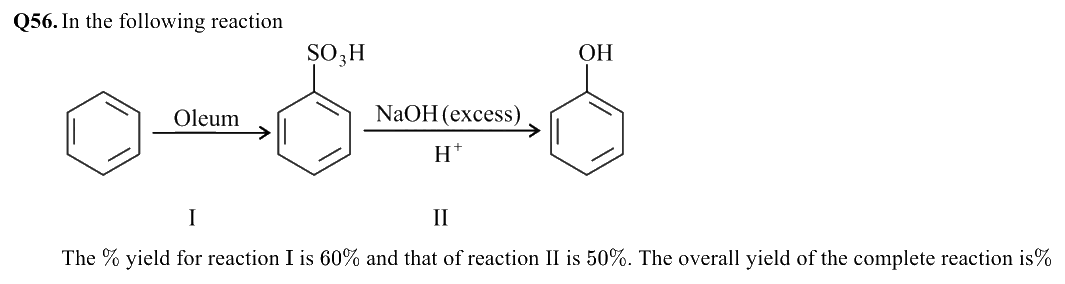
In the following reaction (see the figure above) The % yield for reaction I is 60% and that of reaction II is 50%. The overall yield of the complete reaction is%
The question as printed in the paper.
Numerical answer type: type your answer in EdLoop to check it
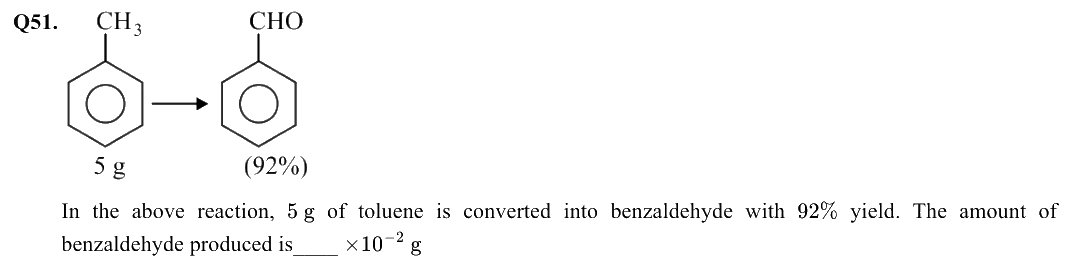
see figure In the above reaction, 5 g of toluene is converted into benzaldehyde with 92% yield. The amount of benzaldehyde produced is ______ $\times 10^{-2}$ g
The question as printed in the paper.
Numerical answer type: type your answer in EdLoop to check it
The normality of $\mathrm{H_2\ SO_4}$ in the solution obtained on mixing 100 mL of 0.1M $\mathrm{H_2\ SO_4}$ with 50 mL of 0.1M NaOH is ______ $\times 10^{-1}$ N.
Numerical answer type: type your answer in EdLoop to check it
Chlorophyll extracted from the crushed green leaves was dissolved in water to make 2 L solution of Mg of concentration 48ppm. The number of atoms of Mg in this solution is x $\times$ $10^{20}$ atoms. The value of x is (Nearest Integer) (Given : Atomic mass of Mg is 24 g $\mathrm{mol^{-1}}$, $\mathrm{N_A}$ = $6.02 \times 10^{23}$ $\mathrm{mol^{-1}}$)
Numerical answer type: type your answer in EdLoop to check it
When 800 mL of 0.5M nitric acid is heated in a beaker, its volume is reduced to half and 11.5 g of nitric acid is evaporated. The molarity of the remaining nitric acid solution is x $\times$ $10^{-2}$M. (Molar mass of nitric acid is 63 g $\mathrm{mol^{-1}}$)
Numerical answer type: type your answer in EdLoop to check it
$56.0$ L of nitrogen gas is mixed with excess of hydrogen gas and it is found that 20 L of ammonia gas is produced, The volume of unused nitrogen gas is found to be ______ L.
Numerical answer type: type your answer in EdLoop to check it
Two elements A and B which form 0.15 moles of $\mathrm{A_2B}$ and $\mathrm{AB_3}$ type compounds. If both $\mathrm{A_2B}$ and $\mathrm{AB_3}$ weigh equally, then the atomic weight of A is ______ times of atomic weight of B.
Numerical answer type: type your answer in EdLoop to check it
116 g of a substance upon dissociation reaction, yields $7.5\ \mathrm{g}$ of hydrogen, $60\ \mathrm{g}$ of oxygen and $48.5\ \mathrm{g}$ of carbon. Given that the atomic masses of $\mathrm{H, O}$ and $\mathrm{C}$ are $1, 16$ and $12$, respectively. The data agrees with how many formulae of the following? A. $\mathrm{CH_3\ COOH}$ B. $\mathrm{HCHO}$ C. $\mathrm{CH_3\ OOCH_3}$ D. $\mathrm{CH_3\ CHO}$
Numerical answer type: type your answer in EdLoop to check it
CNG is an important transportation fuel. When $100 \mathrm{~g}$ CNG is mixed with $208 \mathrm{~g}$ oxygen in vehicles, it leads to the formation of $\mathrm{CO}_2$ and $\mathrm{H}_2\mathrm{O}$ and produces large quantity of heat during this combustion, then the amount of carbon dioxide, produced in grams is [nearest integer] [Assume CNG to be methane]
Numerical answer type: type your answer in EdLoop to check it
The number of N atoms in $681 \mathrm{~g}$ of $\mathrm{C}_7\mathrm{H}_5\mathrm{N}_3\mathrm{O}_6$ is $x \times 10^{21}$. The value of x is $\mathrm{N}_\mathrm{A} = 6.02 \times 10^{23} \mathrm{~mol}^{-1}$ (Nearest Integer)
Numerical answer type: type your answer in EdLoop to check it
$1 \mathrm{~L}$ aqueous solution of $\mathrm{H}_2\mathrm{SO}_4$ contains $0.02 \mathrm{~m} \mathrm{~mol}$ $\mathrm{H}_2\mathrm{SO}_4$. $50\%$ of this solution is diluted with deionized water to give $1 \mathrm{~L}$ solution A. In solution A, $0.01 \mathrm{~m} \mathrm{~mol}$ of $\mathrm{H}_2\mathrm{SO}_4$ are added. Total m mols of $\mathrm{H}_2\mathrm{SO}_4$ in the final solution is ______ $\times 10^{-3} \mathrm{~m}$ moles.
Numerical answer type: type your answer in EdLoop to check it
Number of grams of bromine that will completely react with $5.0 \mathrm{~g}$ of pent-1-ene is ______ $\times 10^{-2} \mathrm{~g}$. (Atomic mass of Br = $80 \mathrm{~g} / \mathrm{mol}$) [Nearest integer]
Numerical answer type: type your answer in EdLoop to check it
A protein 'A' contains $0.30\%$ of glycine (molecular weight $75$). The minimum molar mass of the protein 'A' is ______ $\times 10^{3} \mathrm{~g~mol^{-1}}$ [nearest integer]
Numerical answer type: type your answer in EdLoop to check it
The neutralization occurs when $10 \mathrm{~mL}$ of $0.1 \mathrm{~M}$ acid 'A' is allowed to react with $30 \mathrm{~mL}$ of $0.05 \mathrm{~M}$ base $\mathrm{MOH_2}$. The basicity of the acid 'A' is [M is a metal]
Numerical answer type: type your answer in EdLoop to check it
The number of atoms in $8$ g of sodium is $x \times 10^{23}$. The value of x is ______. (Nearest integer) Given : $\mathrm{N_A} = 6.02 \times 10^{23}$ mol$^{-1}$ Atomic mass of Na = $23.0$u]
Numerical answer type: type your answer in EdLoop to check it
If $80$ g of copper sulphate $\mathrm{CuSO_4 \cdot 5H_2O}$ is dissolved in deionised water to make $5$ L of solution. The concentration of the copper sulphate solution is $x \times 10^{-3}$ mol $\mathrm{L^{-1}}$. The value of x is ______. [ Atomic masses Cu : $63.54$u, S : $32$u, O : $16$u, H : $1$u]
Numerical answer type: type your answer in EdLoop to check it
The molarity of the solution prepared by dissolving $6.3$ g of oxalic acid $(\mathrm{H_2C_2O_4 \cdot 2H_2O})$ in $250$ mL of water in mol L$^{-1}$ is x $\times 10^{-2}$. The value of x is ______. (Nearest integer) [Atomic mass : H : $1.0$, C : $12.0$, O : $16.0$ J]
Numerical answer type: type your answer in EdLoop to check it
Sodium oxide reacts with water to produce sodium hydroxide. $20.0$ g of sodium oxide is dissolved in $500$ mL of water. Neglecting the change in volume, the concentration of the resulting NaOH solution is ______ $\times 10^{-1}$M. (Nearest integer) [Atomic mass : Na = $23.0$, O = $16.0$, H = $1.0$]
Numerical answer type: type your answer in EdLoop to check it
$100\ \mathrm{g}$ of propane is completely reacted with $1000\ \mathrm{g}$ of oxygen. The mole fraction of carbon dioxide in the resulting mixture is $x\times10^{-2}$. The value of $x$ is (Nearest integer)
Numerical answer type: type your answer in EdLoop to check it
An aqueous KCl solution of density $1.20\ \mathrm{g\ mL^{-1}}$ has a molality of $3.30\ \mathrm{mol\ kg^{-1}}$. The molarity of the solution in $\mathrm{molL^{-1}}$ is_____.(The Nearest integer) [Molar mass of $\mathrm{KCl}=74.5\ \mathrm{g}$]
Numerical answer type: type your answer in EdLoop to check it
$100\ \mathrm{mL}$ of $\mathrm{Na_3PO_4}$ solution contains $3.45\ \mathrm{g}$ of sodium. The molarity of the solution is .....$\times10^{-2}\ \mathrm{mol\ L^{-1}}$. (Nearest integer) [Atomic Masses - Na : $23.0\mathrm{u}$, O : $16.0\mathrm{u}$, P : $31.0\mathrm{u}$]
Numerical answer type: type your answer in EdLoop to check it
$\mathrm{2\,SO_2(g) + O_2(g) \rightarrow 2\,SO_3(g)}$ The above reaction is carried out in a vessel starting with partial pressure $\mathrm{P_{SO_2}} = 250\ \mathrm{m\ bar}$, $\mathrm{P_{O_2}} = 750\ \mathrm{m\ bar}$ and $\mathrm{P_{SO_3}} = 0\ \mathrm{bar}$. When the reaction is complete, the total pressure in the reaction vessel is ______ $\mathrm{m\ bar}$. (Round off of the nearest integer).
Numerical answer type: type your answer in EdLoop to check it
Consider the complete combustion of butane, the amount of butane utilized to produce $72.0\ \mathrm{g}$ of water is ______ $\times 10^{-1}$ g. (in nearest integer)
Numerical answer type: type your answer in EdLoop to check it
If the concentration of glucose ($\mathrm{C_6H_{12}O_6}$) in blood is $0.72\ \mathrm{g L^{-1}}$, the molarity of glucose in blood is ______ $\times 10^{-3}\mathrm{M}$ (Nearest integer): [Given : Atomic mass of $\mathrm{C} = 12$, $\mathrm{H} = 1$, $\mathrm{O} = 16\ \mathrm{u}$]
Numerical answer type: type your answer in EdLoop to check it
$250\ \mathrm{mL}$ of $0.5\mathrm{M}$ NaOH was added to $500\ \mathrm{mL}$ of $1\mathrm{M}$ HCl. The number of unreacted HCl molecules in the solution after the complete reaction is $\mathrm{p} \times 10^{21}$. Find out p (Nearest integer) ($\mathrm{N_A} = 6.022 \times 10^{23}$)
Numerical answer type: type your answer in EdLoop to check it
4 g equimolar mixture of $\mathrm{NaOH}$ and $\mathrm{Na_2\,CO_3}$ contains xg of $\mathrm{NaOH}$ and yg of $\mathrm{Na_2\,CO_3}$. The value of x is g. (Nearest integer)
Numerical answer type: type your answer in EdLoop to check it
______ grams of $3-$Hydroxy propanal (MW = 74) must be dehydrated to produce $7.8~\mathrm{g}$ of acrolein (MW = 56)$(\mathrm{C_3H_4O})$ if the percentage yield is 64. (Round off to the Nearest Integer). [Given: Atomic masses : C : 12.0u, H : 1.0u, O : 16.0u]
Numerical answer type: type your answer in EdLoop to check it
Complete combustion of $3~\mathrm{g}$ of ethane gives $\mathrm{x} \times 10^{22}$ molecules of water. The value of x is ______ (Round off to the Nearest Integer). [Use : $\mathrm{N_A} = 6.023 \times 10^{23}$; Atomic masses in u : C: 12.0; O: 16.0; H: 1.0]
Numerical answer type: type your answer in EdLoop to check it
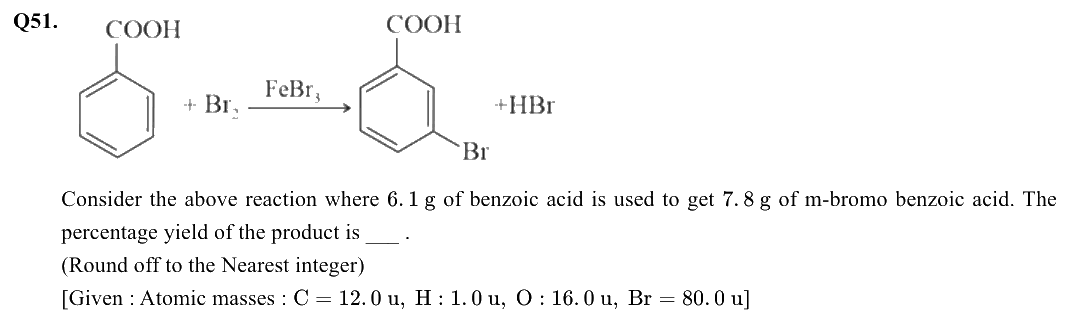
see figure Consider the above reaction where $6.1~\mathrm{g}$ of benzoic acid is used to get $7.8~\mathrm{g}$ of m-bromo benzoic acid. The percentage yield of the product is ______ . (Round off to the Nearest integer) [Given : Atomic masses : C = 12.0 u, H : 1.0 u, O : 16.0 u, Br = 80.0 u]
The question as printed in the paper.
Numerical answer type: type your answer in EdLoop to check it
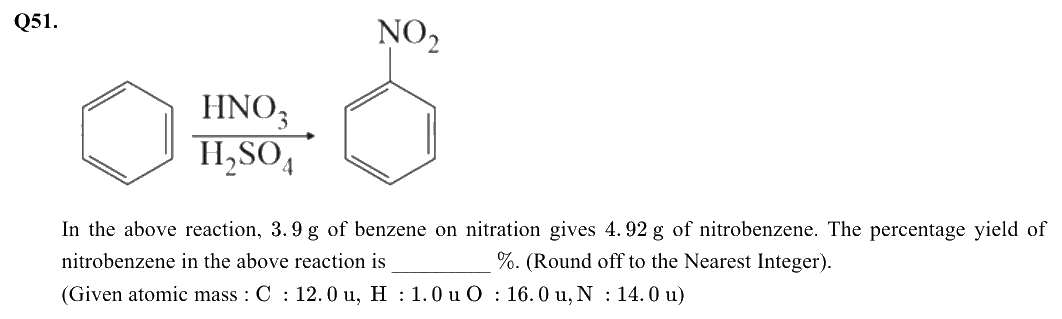
see figure In the above reaction, 3.9 g of benzene on nitration gives 4.92 g of nitrobenzene. The percentage yield of nitrobenzene in the above reaction is ______ %. (Round off to the Nearest Integer). (Given atomic mass : C : 12.0 u, H : 1.0 u O : 16.0 u, N : 14.0 u)
The question as printed in the paper.
Numerical answer type: type your answer in EdLoop to check it
The mole fraction of a solute in a 100 molal aqueous solution ______ $\times 10^{-2}$. (Round off to the Nearest Integer). [Given : Atomic masses: H : 1.0 u, O : 16.0 u]
Numerical answer type: type your answer in EdLoop to check it
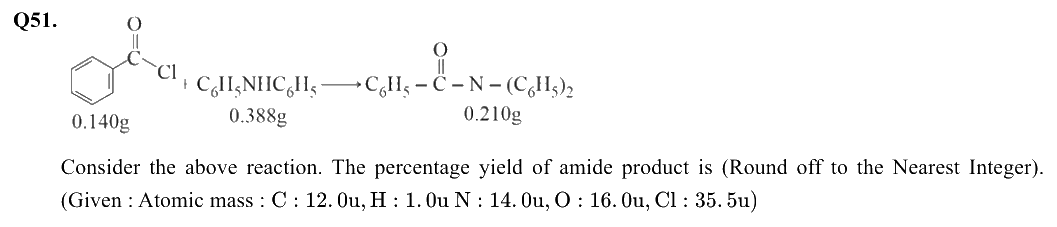
see figure Consider the above reaction. The percentage yield of amide product is (Round off to the Nearest Integer). (Given : Atomic mass : C : 12.0u, H : 1.0u N : 14.0u, O : 16.0u, Cl : 35.5u)
The question as printed in the paper.
Numerical answer type: type your answer in EdLoop to check it
The number of chlorine atoms in 20 mL of chlorine gas at STP is ______ $10^{21}$. (Round off to the Nearest Integer). [Assume chlorine is an ideal gas at STP $\mathrm{R}=0.083 \mathrm{~L}$ bar $\mathrm{mol}^{-1} \mathrm{~K}^{-1}, \mathrm{~N}_{\mathrm{A}}=6.023 \times 10^{23}$]
Numerical answer type: type your answer in EdLoop to check it
A 6.50 molal solution of $\mathrm{KOH}(\mathrm{aq}.)$ has a density of $1.89 \mathrm{~g} \mathrm{~cm}^{-3}$. The molarity of the solution is mol $\mathrm{dm}^{-3}$. (Round off to the Nearest Integer). [Atomic masses: $\mathrm{K}: 39.0 \mathrm{u} ; \mathrm{O}: 16.0 \mathrm{u} ; \mathrm{H}: 1.0 \mathrm{u}$]
Numerical answer type: type your answer in EdLoop to check it
When $35\ \mathrm{mL}$ of $0.15\ \mathrm{M}$ lead nitrate solution is mixed with $20\ \mathrm{mL}$ of $0.12\ \mathrm{M}$ chromic sulphate solution, ______ $\times 10^{-5}$ moles of lead sulphate precipitate out. (Round off to the Nearest Integer).
Numerical answer type: type your answer in EdLoop to check it
The $\mathrm{NaNO_3}$ weighed out to make $50\ \mathrm{mL}$ of an aqueous solution containing $70.0\ \mathrm{mg}$ $\mathrm{Na^+}$ per mL is ______ g. (Rounded off to the nearest integer) [Given : Atomic weight in $\mathrm{g\,mol^{-1}}$ $-$ Na : 23; N : 14; O : 16]
Numerical answer type: type your answer in EdLoop to check it
Consider titration of NaOH solution versus $1.25$ M oxalic acid solution. At the end point following burette readings were obtained. (i) $4.5\ \mathrm{mL}$ (ii) $4.5\ \mathrm{mL}$ (iii) $4.4\ \mathrm{mL}$ (iv) $4.4\ \mathrm{mL}$ (v) $4.4\ \mathrm{mL}$ If the volume of oxalic acid taken was $10.0\ \mathrm{mL}$ then the molarity of the NaOH solution is ______ M. (Rounded-off to the nearest integer)
Numerical answer type: type your answer in EdLoop to check it
$4.5\ \mathrm{g}$ of compound A M.W. = 90 was used to make $250\ \mathrm{mL}$ of its aqueous solution. The molarity of the solution in M is $\mathrm{x} \times 10^{-1}$. The value of x is ______ (Rounded off to the nearest integer)
Numerical answer type: type your answer in EdLoop to check it
The formula of a gaseous hydrocarbon which requires 6 times of its own volume of $\mathrm{O_2}$ for complete oxidation and produces 4 times its own volume of $\mathrm{CO_2}$ is $\mathrm{C_xH_y}$. The value of y is ______.
Numerical answer type: type your answer in EdLoop to check it
$1.86\ \mathrm{g}$ of aniline completely reacts to form acetanilide. $10\%$ of the product is lost during purification. Amount of acetanilide obtained after purification (in g) is ______ $\times 10^{-2}$.
Numerical answer type: type your answer in EdLoop to check it
A 100 mL solution was made by adding $1.43\ \mathrm{g}$ of $\mathrm{Na_{2}\ CO_{3}.xH_{2}\ O}$. The normality of the solution is $0.1\ \mathrm{N}$. The value of x is ______ (The atomic mass of Na is $23\mathrm{g/\ mol}$)
Numerical answer type: type your answer in EdLoop to check it
The mole fraction of glucose $(\mathrm{C_6H_{12}O_6})$ in an aqueous binary solution is $0.1$. The mass percentage of water in it, to the nearest integer, is ______ .
Numerical answer type: type your answer in EdLoop to check it
$0.023\times 10^{22}$ molecules are present in 10gof a substance 'x'. The molarity of a solution containing 5g of substance 'x' in 2 L solution is ______ $\times 10^{-3}$.
Numerical answer type: type your answer in EdLoop to check it
The ratio of the mass percentages of 'C & H' and 'C & O' of a saturated acyclic organic compound 'X' are $4:1$ and $3:4$ respectively. Then, the moles of oxygen gas required for complete combustion of two moles of organic compound 'X' is ______
Numerical answer type: type your answer in EdLoop to check it
The molarity of $\mathrm{HNO_3}$ in a sample which has density 1.4 g/mL and mass percentage of 63% is ______ (Molecular Weight of $\mathrm{HNO_3}$ = 63 )
Numerical answer type: type your answer in EdLoop to check it
The hardness of a water sample containing $10^{-3}$ M $\mathrm{MgSO_4}$ expressed as $\mathrm{CaCO_3}$ equivalents (in ppm ) is . (molar mass of $\mathrm{MgSO_4}$ is 120.37 g/mol )
Numerical answer type: type your answer in EdLoop to check it
10.30mg of $\mathrm{O_2}$ is dissolved into a liter of sea water of density $1.03\mathrm{g/mL}$ . The concentration of $\mathrm{O_2}$ in ppm is ______.
Numerical answer type: type your answer in EdLoop to check it
Ferrous sulphate heptahydrate is used to fortify foods with iron. The amount (in grams) of the salt required to achieve 10ppm of iron in 100kg of wheat is ____________. Atomic weight: Fe = 55.85; S = 32.00; O = 16.00
Numerical answer type: type your answer in EdLoop to check it
$\mathrm{NaClO_3}$ is used, even in spacecrafts, to produce $\mathrm{O_2}$. The daily consumption of pure $\mathrm{O_2}$ by a person in $492\ \mathrm{L}$ at $1\ \mathrm{atm}$, $300\mathrm{K}$. How much amount of $\mathrm{NaClO_3}$, in grams, is required to produce $\mathrm{O_2}$ for the daily consumption of a person at $1\ \mathrm{atm}$, $300\mathrm{K}$ ? _____ $\mathrm{NaClO_3(s) + Fe(s) \to O_2(g) + NaCl(s) + FeO(s)}$ $\mathrm{R = 0.082\ L\ atm\ mol^{-1}\ K^{-1}}$
Numerical answer type: type your answer in EdLoop to check it
How to prepare Mole Concept & Stoichiometry for JEE Main
How often it comes up
Mole concept and stoichiometry provides the quantitative foundation for chemical calculations under Unit 1: Some Basic Concepts in Chemistry in the Class 11 curriculum, holding rank 7 among 31 chemistry chapters with a 4.4 percent share of the entire chemistry section. In the computer-based testing era from 2019 to 2026, candidates faced 203 questions across 162 papers, representing an average rate of 1.3 questions per examination shift. The chapter featured in 148 of those 162 papers, and questions were set in every single year throughout the cycle. During the recent 2024 to 2026 period, testing recorded 79 questions across 58 papers, maintaining an average of 1.4 questions per shift and achieving a 5.1 percent subject share. The chapter's share is up compared to both the 3.7 percent share in the 2002 to 2018 window and the 4.4 percent baseline across 2019 to 2026. In 2026 alone, examiners presented 20 questions across 19 papers, showing up in 16 individual shifts. A remarkable 116 questions between 2019 and 2026 were formatted as numerical answer questions, meaning over half of all questions from this chapter demand exact arithmetic answers rather than multiple choice selection.
Most-asked topics
Questions in this chapter concentrate across five defined areas:
Stoichiometry: 98 questions historically, with 82 asked between 2019 and 2026, tested up to 2026. This dominant area tests gravimetric calculations, limiting reagents, theoretical and percentage yields, eudiometry gas combustion analysis, and sequential multi-step chemical reactions.
Concentration Terms: 85 total questions, including 70 from 2019 to 2026, tested in 2026. Problems assess molarity, molality, mole fraction, mass percentage, volume percentage, parts per million, mixing of solutions, and dilution calculations.
Mole & Molar Mass: 35 lifetime problems, with 26 between 2019 and 2026, continuing in 2026. Concepts explore Avogadro's number conversions, molar volume of ideal gases at standard temperature and pressure, total atom counting across compounds, and average atomic masses.
Empirical & Molecular Formula: 30 questions overall, with 22 from 2019 to 2026, tested through 2026. Themes evaluate percentage elemental compositions, simplest integer molar ratios, combustion analysis data, and determination of molecular formulas using molar masses.
Laws of Chemical Combination: 5 questions since 2002, with 3 asked between 2019 and 2026, last tested in 2024. Questions examine Dalton's atomic theory postulates, law of conservation of mass, definite proportions, and multiple proportions.
What the questions look like
JEE Main problems in mole concept emphasize multi-step numerical problem solving and quantitative reasoning:
Hydrocarbon combustion eudiometry: Gaseous hydrocarbons combusted with excess oxygen gas produce volume contractions before and after absorption by potassium hydroxide solutions, allowing deduction of the molecular formula.
Concentration conversion in acid mixtures: Combining concentrated aqueous solutions of known mass percentages to evaluate the resulting mole fraction, molarity, or molality of the solute.
Limiting reagent and unreacted residue: Two reactants mixed in non-stoichiometric proportions react to form a compound. Students determine which reactant is exhausted first, how much product forms, and what mass of excess reactant remains.
Titration neutralization stoichiometry: Calculating the exact mass or volume of an acid neutralized by a standard alkaline titrant solution.
Always write balanced chemical equations before performing arithmetic. Convert all given reactant quantities into moles, divide by respective stoichiometric coefficients, and identify the smallest ratio to find the limiting reagent.
Build automatic fluency with concentration conversions. Practice converting directly between mass percentage, molarity, and molality using solution density. Remember that molality depends on kilograms of solvent, while molarity depends on liters of total solution.
With 116 numerical response questions appearing between 2019 and 2026, train yourself to compute without intermediate rounding errors. Keep track of decimal points and units when calculating masses in milligrams versus grams.
Frequently asked questions
Why does mole concept have so many numerical answer questions?
Stoichiometry and concentration calculations produce unambiguous numerical values, making them ideal for Section B numerical answer questions where students enter calculated numbers directly.
What is the most common error in limiting reagent problems?
Comparing given masses directly rather than converting to moles, or failing to divide moles by the stoichiometric coefficients in the balanced chemical equation before identifying the limiting reagent.
How does mole concept link to other chapters in chemistry?
Stoichiometry and concentration terms serve as prerequisites for chemical equilibrium, ionic equilibrium, solutions, electrochemistry, and practical volumetric titrations. Step-by-step solutions for each one are in the EdLoop app.