
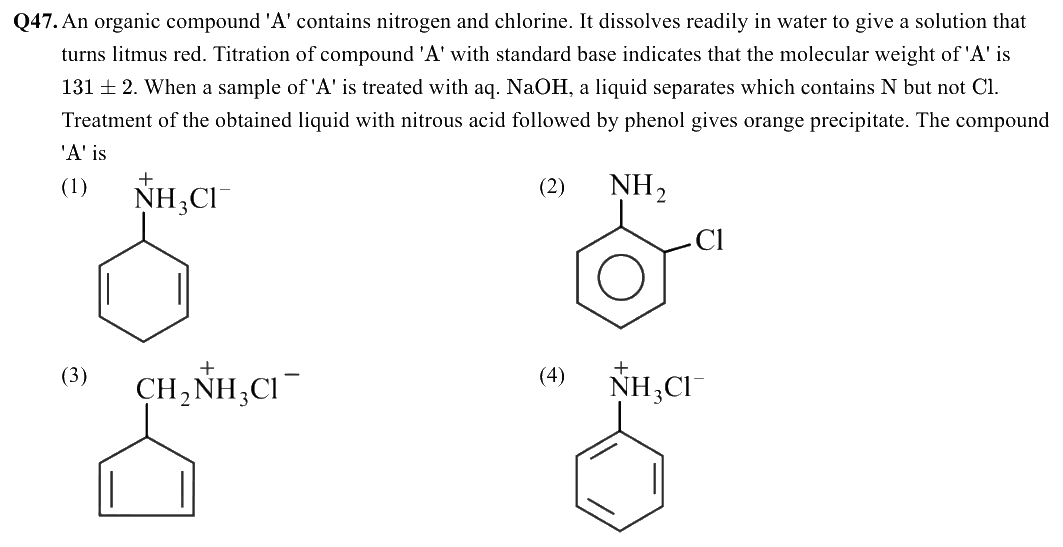
An organic compound 'A' contains nitrogen and chlorine. It dissolves readily in water to give a solution that turns litmus red. Titration of compound 'A' with standard base indicates that the molecular weight of 'A' is $131 \pm 2$. When a sample of 'A' is treated with aq. NaOH, a liquid separates which contains N but not Cl. Treatment of the obtained liquid with nitrous acid followed by phenol gives orange precipitate. The compound 'A' is
(see the figure above)
- (1)
see figure A six-membered carbon ring with two C=C double bonds (drawn as vertical double bonds on the left and right sides) and a $\mathrm{\overset{+}{N}H_3Cl^-}$ group at the top.
- (2)
see figure A benzene ring (drawn with a circle) with $\mathrm{NH_2}$ at the top and Cl on the adjacent upper-right carbon (2-chloroaniline).
- (3)
see figure A five-membered carbon ring with two C=C double bonds (drawn as vertical double bonds) and a $\mathrm{CH_2\overset{+}{N}H_3Cl^-}$ group at the top.
- (4)
see figure A benzene ring (alternating double bonds) with $\mathrm{\overset{+}{N}H_3Cl^-}$ at the top (anilinium chloride).
Show answer
Option (4) is correct.
Key from source paper