
The products A and B formed in the following reaction scheme are respectively
(see the figure above)
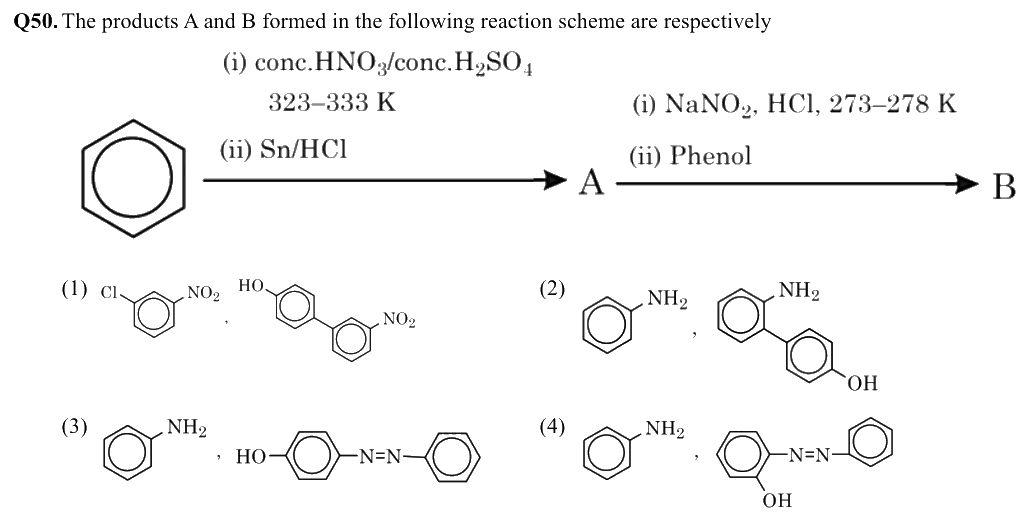
- (1)
see figure Two structures separated by a comma: a benzene ring with Cl at the upper left and $\mathrm{NO_2}$ at the upper right; and a biphenyl with HO on the top-left ring carbon of the left ring and, on the right ring, $\mathrm{NO_2}$ on the carbon at the right.
- (2)
see figure Two structures separated by a comma: aniline (benzene ring with $\mathrm{NH_2}$ at the upper right); and a biphenyl whose left ring carries $\mathrm{NH_2}$ at the top next to the ring-ring bond and whose right ring carries OH at the lower right.
- (3)
see figure Two structures separated by a comma: aniline (benzene ring with $\mathrm{NH_2}$ at the upper right); and a azo compound HO–C6H4–N=N–C6H5 drawn in a line: a ring with HO at its left end, then N=N, then a second benzene ring at the right.
- (4)
see figure Two structures separated by a comma: aniline (benzene ring with $\mathrm{NH_2}$ at the upper right); and an azo compound: a ring with N=N attached on its right (followed by a second benzene ring) and OH at the bottom of the same ring.
Show answer
Option (3) is correct.
Key from source paper