
EdLoop PYQs · free, no ads · questions and answers here, step-by-step solutions in the EdLoop app
PYQs · free, no adsOpen on the web (app.edloop.in)Get EdLoop – free on Google Play

JEE Main 2025 Question Paper with Answers (24 Jan, Shift 2)

JEE Main24 Jan 2025Shift 2Memory based
75questions
25 / 25 / 25Physics / Chemistry / Maths
180 minduration
5 of 75answers shown here

Physics

25 questions · Questions 1–25

Which of the following figure represents the relation between Celsius and Fahrenheit temperatures ?
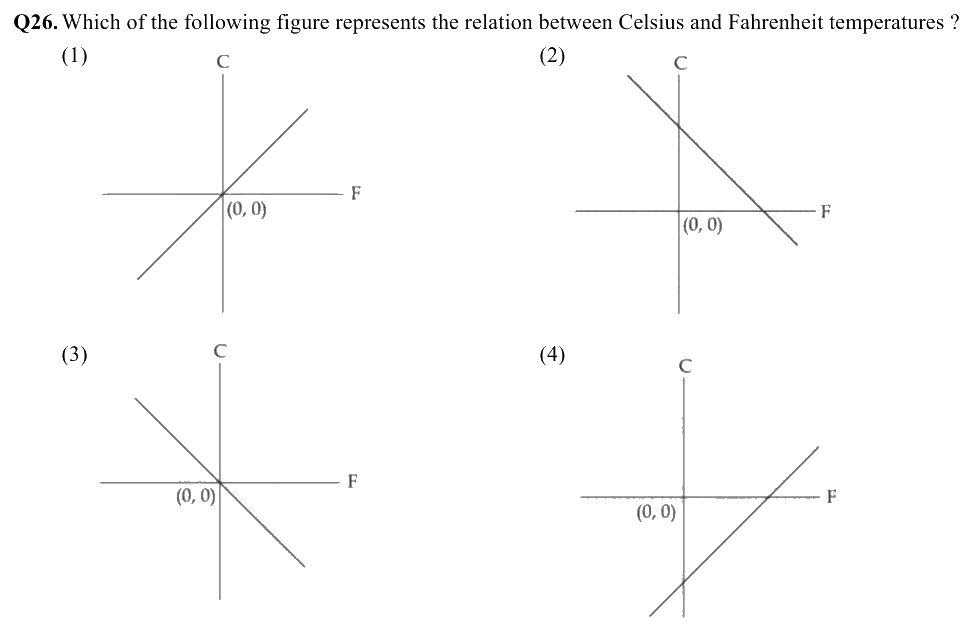
The question and its figure as printed in JEE Main 2025 24 Jan Shift 2. Option 1: axes 'C' (vertical) and 'F' (horizontal) crossing at '(0, 0)' in the middle of the drawing; a straight line passing through the origin and rising to the upper right. Option 2: axes 'C' and 'F' with '(0, 0)' labelled below-left of the crossing, the horizontal axis lying in the lower part of the drawing; a straight line falling from the upper left to the lower right, crossing the vertical axis above the horizontal axis and crossing the horizontal axis to the right of the vertical axis. Option 3: axes 'C' and 'F' with '(0, 0)' labelled below-left of the crossing; a straight line passing through the origin and…
The question as printed in the paper.
  • A

    see figure axes 'C' (vertical) and 'F' (horizontal) crossing at '(0, 0)' in the middle of the drawing; a straight line passing through the origin and rising to the upper right.

  • B

    see figure axes 'C' and 'F' with '(0, 0)' labelled below-left of the crossing, the horizontal axis lying in the lower part of the drawing; a straight line falling from the upper left to the lower right, crossing the vertical axis above the horizontal axis and crossing the horizontal axis to the right of the vertical axis.

  • C

    see figure axes 'C' and 'F' with '(0, 0)' labelled below-left of the crossing; a straight line passing through the origin and falling from the upper left to the lower right.

  • D

    see figure axes 'C' and 'F' with '(0, 0)' labelled below-left of the crossing, the horizontal axis lying in the upper part of the drawing; a straight line rising from the lower left to the upper right, crossing the vertical axis below the horizontal axis and crossing the horizontal axis to the right of the vertical axis.
The position vector of a moving body at any instant of time is given as $\vec{r} = \left(5t^2\hat{i} - 5t\hat{j}\right)$m. The magnitude and direction of velocity at $t = 2$ s is,

  • A

    $5\sqrt{15}$ m/s, making an angle of $\tan^{-1}4$ with - ve Y axis

  • B

    $5\sqrt{15}$ m/s, making an angle of $\tan^{-1}4$ with + ve X axis

  • C

    $5\sqrt{17}$ m/s, making an angle of $\tan^{-1}4$ with + ve X axis

  • D

    $5\sqrt{17}$ m/s, making an angle of $\tan^{-1}4$ with - ve Y axis

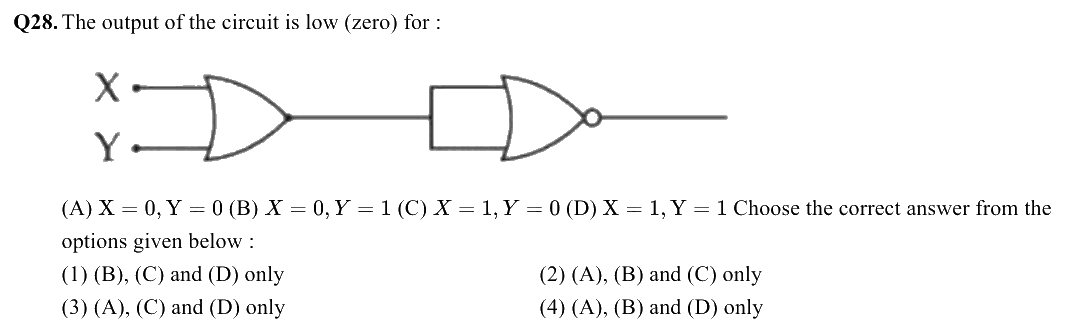
The output of the circuit is low (zero) for :

(see the figure above)

(A) $X = 0, Y = 0$ (B) $X = 0, Y = 1$ (C) $X = 1, Y = 0$ (D) $X = 1, Y = 1$ Choose the correct answer from the options given below :

The question and its figure as printed in JEE Main 2025 24 Jan Shift 2.
The question as printed in the paper.
  • A

    (B), (C) and (D) only

  • B

    (A), (B) and (C) only

  • C

    (A), (C) and (D) only

  • D

    (A), (B) and (D) only

Young's double slit inteference apparatus is immersed in a liquid of refractive index 1.44. It has slit separation of 1.5 mm . The slits are illuminated by a parallel beam of light whose wavelength in air is 690 nm . The fringe-width on a screen placed behind the plane of slits at a distance of 0.72 m , will be :

  • A

    0.23 mm

  • B

    0.33 mm

  • C

    0.63 mm

  • D

    0.46 mm

Sit the whole paper timed in EdLoop

You have seen the first 5 questions with answers. Questions 6–75 are listed below; their answers and step-by-step solutions are in the EdLoop app, free.

  1. 6Magnetic Effects of CurrentMagnetic field inside and outside a thick wire with uniform current
  2. 7Dual Nature of Matter &…Statements on the stopping potential against frequency graph
  3. 8Rotational MotionSolid and hollow spheres rolling down the same incline: which arrives first
  4. 9ElectrostaticsCharge shared between identical spheres, then repulsion of 9 mN: separation
  5. 10Magnetic Effects of CurrentRing of N rotating charges threading two Amperian loops: IA − IB
  6. 11Oscillations (SHM)x = sin²(t/2): kinetic energy as a function of position
  7. 12Ray OpticsDrone camera at 18 km photographing 400 km² onto a 2 cm film: focal length
  8. 13ElectrostaticsFour charges moved from the corners to the edge midpoints of a square: energy…
  9. 14Electromagnetic WavesMicrowaves, UV, IR and X-rays in ascending order of wavelength
  10. 15Dual Nature of Matter &…Relation between energy, momentum and mass of a moving body
  11. 16Thermal Properties of MatterBody cools 40 → 24 °C in 4 min in air at 16 °C: temperature after 4 more minutes
  12. 17Rotational MotionRolling solid sphere: translational to rotational kinetic energy
  13. 18Wave OpticsYDSE with crossed polarisers on the slits and a 45° polariser: intensity at…
  14. 19ThermodynamicsAdiabatic compression and the temperature; free expansion as irreversible
  15. 20Magnetic Effects of CurrentElectron moving straight with constant velocity in a uniform magnetic field
  16. 21Dual Nature of Matter &…Photon rates of two sources with power ratio 2 and wavelengths 600 and 300 nm
  17. 22Laws of MotionConical pendulum at 3/π revolutions per second: tension in terms of ML
  18. 23ElasticityPressure to compress water by 0.2% with bulk modulus 2.15 GPa
  19. 24Magnetic Effects of CurrentElectron circling inside a solenoid with period 75 ns: turns per metre
  20. 25GravitationEarth's diameter shrunk to a third at the same mass: new surface g

Chemistry

25 questions · Questions 26–50
  1. 26Atomic StructureLowest-energy orbitals of the hydrogen atom among 4s, 3p and 3d
  2. 27d- and f-Block ElementsMatch Ti³⁺, V²⁺, Ni²⁺, Sc³⁺ with spin-only magnetic moments
  3. 28Chemical Bonding &…Equal O–O bond lengths in ozone and the reason for them
  4. 29Coordination CompoundsColour sequence as ethane-1,2-diamine is added to aqueous NiCl₂
  5. 30Periodic Table & PeriodicityFirst ionisation energies of Pb vs Sn and Ge vs Si
  6. 31HydrocarbonsStatements on activating, deactivating and directing groups in benzene
  7. 32ElectrochemistryStrongest reducing agent from four standard reduction potentials
  8. 33Chemical EquilibriumConcentration–time graph for H₂ + I₂ ⇌ 2HI reaching equilibrium
  9. 34Practical Chemistry &…Sulphide dissolved in aqua regia gives a yellow precipitate with KNO₂/AcOH
  10. 35Mole Concept & Stoichiometry54.2% C, 9.2% H, 36.6% O and molar mass 132: molecular formula
  11. 36Coordination CompoundsLigand field and spin state that favour t₂g³eg¹
  12. 37Chemical Bonding &…Number of sp and sp² carbons in an enone–alkyne–nitrile chain
  13. 38Chemical KineticsFirst-order plots: t½ against [R]₀, and log([R]/[R]₀) against time
  14. 39Aldehydes, Ketones &…Match four aldehyde preparations with their named reactions
  15. 40Haloalkanes & HaloarenesBenzylic chloride with aryl iodide and bromide treated with AgCN
  16. 41Amines & Nitrogen CompoundsReagent sequence to make o-bromoaniline from aniline
  17. 42Periodic Table & PeriodicityGroup from five successive ionisation energies
  18. 43BiomoleculesMatch adenine, cytosine, thymine and uracil with their structures
  19. 44Chemical ThermodynamicsWhich 1 M acid–base mixture warms the most
  20. 45Chemical ThermodynamicsHeat of formation of SO₂ from the formation of SO₃ and the oxidation of SO₂
  21. 46Purification &…Carius method: 0.25 g compound gives 0.15 g AgBr, percentage of bromine
  22. 47SolutionsMX₂ with observed molar mass 65.6 and normal 164: percent ionisation
  23. 48Chemical Kineticsk = √(k₁k₃/k₂) with Ea 60, 30, 10 kJ/mol: overall activation energy
  24. 49General Organic ChemistryStereoisomers of 5-phenylpent-4-en-2-ol
  25. 50General Organic ChemistryHydrocarbon of molar mass 80 with 90% carbon: degree of unsaturation

Maths

25 questions · Questions 51–75
  1. 51Permutations & Combinations4 boys and 4 girls with 5 from group A and 3 from group B: number of ways
  2. 52MatricesInfinitely many solutions for a 3×3 system in λ and μ: λ + μ
  3. 53Quadratic EquationsLog-trig equation and a modulus equation in √x: size of the union of solution…
  4. 54Area Under CurvesArea enclosed by y = eˣ, y = |eˣ − 1| and the y-axis
  5. 55EllipseChord of x²/25 + y²/16 = 1 with midpoint (3, 1)
  6. 56Straight LinesPoints (11/2, α) on or inside a triangle bounded by three lines: range of α
  7. 57Differential Equationsx²f′(x) = 2xf(x) + 3 with f(1) = 4: value of 2f(2)
  8. 58Sequences & SeriesInfinite series 5 + (5 + α)/7 + (5 + 2α)/7² + … = 7: find α
  9. 59Limits, Continuity &…[x] + |x − 2| on (−2, 3): points of discontinuity and non-differentiability
  10. 60ProbabilityRandom 2×2 matrix with 0/1 entries: probability it is invertible
  11. 61Vector AlgebraCircumcentre from the orthocentre and centroid (Euler line) in vector form
  12. 62Vector Algebrab = a × (î − 2k̂), c = b × k̂: projection of c − 2ĵ on a
  13. 63Quadratic EquationsReal solutions of x² + 3x + 2 = min|x − 3|, |x + 2|
  14. 64Sets, Relations & Functionsf(x) = (2ˣ − 2⁻ˣ)/(2ˣ + 2⁻ˣ) from ℝ to (−∞, 1): one-one and/or onto
  15. 65Sequences & SeriesAP with S₄₀ = 1030 and S₁₂ = 57: S₃₀ − S₁₀
  16. 66Binomial TheoremCoefficients of the 30th and 12th terms of (1 + x)^(2n−1) with 2A = 5B: n
  17. 67Applications of Derivativesf increasing exactly on (2, 3) fixes a; then g = (x − 1)³(x − 2)² decreasing…
  18. 68DeterminantsLimit of a determinant with sin x/x added on the diagonal
  19. 69ParabolaParabola with vertex (3/2, 3) and directrix x + 2y = 0: coefficients
  20. 70Inverse Trigonometric…Sum of three cot⁻¹ expressions in α > β > γ > 0
  21. 71Three Dimensional GeometryImage P of Q in a line and a point R on it: square of the area of PQR
  22. 72Indefinite Integration∫(2x² + 5x + 9)/√(x² + x + 1) dx in a given form: α + 2β
  23. 73Differential Equations2cos x y′ = sin 2x − 4y sin x with y(π/3) = 0: y′(π/4) + y(π/4)
  24. 74Sets, Relations & FunctionsFunctions 1, …, 100 → 0, 1 with exactly one 1 among 1 to 98
  25. 75HyperbolaTwo hyperbolas with given latus recta and e₁: find 25e₂²

Chapters in this paper

Get EdLoop – freeOpen on the web