EdLoop PYQs · free, no ads · questions and answers here, step-by-step solutions in the EdLoop app
PYQs · free, no adsOpen on the web (app.edloop.in)Get EdLoop – free on Google Play

JEE Main 2025 Question Paper with Answers (29 Jan, Shift 1)

JEE Main29 Jan 2025Shift 1Memory based
75questions
25 / 25 / 25Physics / Chemistry / Maths
180 minduration
5 of 75answers shown here

Physics

25 questions · Questions 1–25

An electric dipole of mass m, charge q, and length $l$ is placed in a uniform electric field $\vec{\mathrm{E}} = \mathrm{E_0}\hat{i}$. When the dipole is rotated slightly from its equilibrium position and released, the time period of its oscillations will be:

  • A

    $\frac{1}{2\pi}\sqrt{\frac{ml}{2q\mathrm{E_0}}}$

  • B

    $2\pi\sqrt{\frac{ml}{q\mathrm{E_0}}}$

  • C

    $\frac{1}{2\pi}\sqrt{\frac{2\,ml}{q\mathrm{E_0}}}$

  • D

    $2\pi\sqrt{\frac{ml}{2q\mathrm{E_0}}}$

A coil of area A and N turns is rotating with angular velocity $\omega$ in a uniform magnetic field $\vec{B}$ about an axis perpendicular to $\vec{B}$. Magnetic flux $\varphi$ and induced emf $\varepsilon$ across it, at an instant when $\vec{B}$ is parallel to the plane of coil, are :

  • A

    $\varphi = \mathrm{AB}, \varepsilon = 0$

  • B

    $\varphi = 0, \varepsilon = 0$

  • C

    $\varphi = 0, \varepsilon = \mathrm{NAB}\omega$

  • D

    $\varphi = \mathrm{AB}, \varepsilon = \mathrm{NAB}\omega$

Given below are two statements : one is labelled as Assertion (A) and the other is labelled as Reason (R). Assertion (A) : Choke coil is simply a coil having a large inductance but a small resistance. Choke coils are used with fluorescent mercury-tube fittings. If household electric power is directly connected to a mercury tube, the tube will be damaged. Reason (R): By using the choke coil, the voltage across the tube is reduced by a factor $\left(R/\sqrt{R^2 + \omega^2L^2}\right)$, where $\omega$ is frequency of the supply across resistor $R$ and inductor L . If the choke coil were not used, the voltage across the resistor would be the same as the applied voltage. In the light of the above statements, choose the most appropriate answer from the options given below :

  • A

    (A) is true but (R) is false

  • B

    Both (A) and (R) are true and (R) is the correct explanation of (A)

  • C

    (A) is false but (R) is true

  • D

    Both (A) and (R) are true but (R) is not the correct explanation of (A)

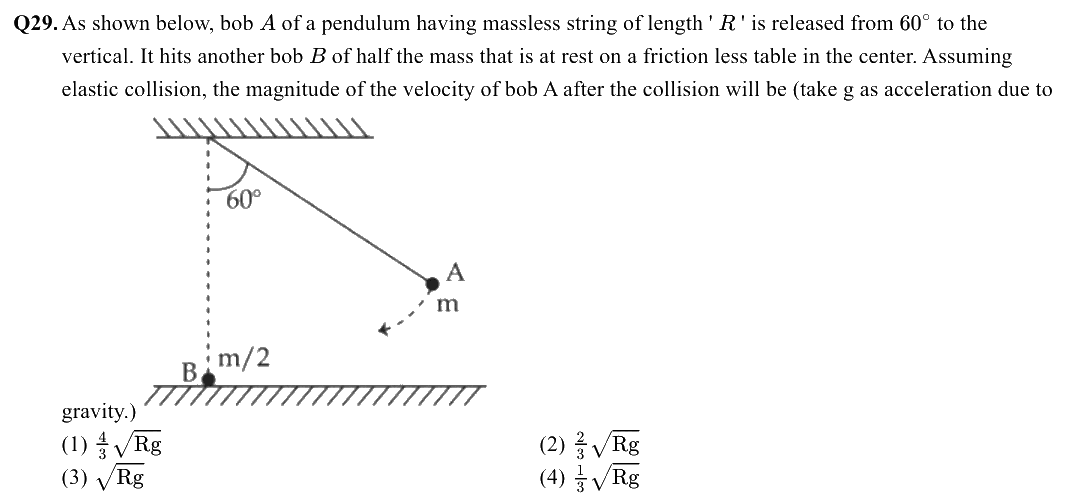
As shown below, bob $A$ of a pendulum having massless string of length ' $R$ ' is released from $60^\circ$ to the vertical. It hits another bob $B$ of half the mass that is at rest on a friction less table in the center. Assuming elastic collision, the magnitude of the velocity of bob A after the collision will be (take g as acceleration due to gravity.)

(see the figure above)

The question and its figure as printed in JEE Main 2025 29 Jan Shift 1.
The question as printed in the paper.
  • A

    $\frac{4}{3}\sqrt{\mathrm{Rg}}$

  • B

    $\frac{2}{3}\sqrt{\mathrm{Rg}}$

  • C

    $\sqrt{\mathrm{Rg}}$

  • D

    $\frac{1}{3}\sqrt{\mathrm{Rg}}$

Given below are two statements : one is labelled as Assertion (A) and the other is labelled as Reason (R). Assertion (A) : Electromagnetic waves carry energy but not momentum. Reason (R): Mass of a photon is zero. In the light of the above statements, choose the most appropriate answer from the options given below :

  • A

    Both (A) and (R) are true and (R) is the correct explanation of (A)

  • B

    Both (A) and (R) are true but (R) is not the correct explanation of (A)

  • C

    (A) is false but (R) is true

  • D

    (A) is true but (R) is false

Sit the whole paper timed in EdLoop

You have seen the first 5 questions with answers. Questions 6–75 are listed below; their answers and step-by-step solutions are in the EdLoop app, free.

  1. 6KinematicsProjectiles at 45° ∓ α with equal speed: ratio of maximum heights
  2. 7Dual Nature of Matter &…Graph of 1/K against de Broglie wavelength for a particle
  3. 8Dual Nature of Matter &…Suppressing photoemission with a negative potential; stopping potential vs…
  4. 9Magnetic Effects of CurrentThick wire with uniform current: points where B is half its maximum
  5. 10Ray OpticsCritical angles at n₁/n₂ and n₁/n₃ interfaces with given differences
  6. 11Ray OpticsGraph of image distance against object distance for a convex lens, |u| > f
  7. 12ElectrostaticsFields of a charged shell (inside, outside) and of one and two plane sheets
  8. 13Semiconductor ElectronicsNAND and NOR of A, B feeding a NAND: the equivalent gate
  9. 14Units, Dimensions & Errorsv = At² + Bt/(C + t): dimensions of ABC
  10. 15ThermodynamicsWork in an adiabatic process depends only on what
  11. 16ElasticityFractional compression of water 2.5 km under the sea
  12. 17Units, Dimensions & ErrorsPair of quantities with different dimensions
  13. 18Electromagnetic InductionEMF induced in coil 1 by its own and the neighbouring coil's current
  14. 19Oscillations (SHM)Pendulum period on a mountain top and its dependence on g
  15. 20Work, Energy & PowerVertical circle with speed n√(gR) at the top: KE at bottom over KE at top
  16. 21Fluid MechanicsHydraulic lift with pistons 6 cm² and 1500 cm²: work to raise the output 20 cm
  17. 22Rotational MotionTorque about the origin of F = î − ĵ + k̂ at (1, 1, 1): z-component
  18. 23Ray OpticsTwo refracted beams meeting at the far face of a block: thickness
  19. 24Kinetic Theory of GasesGas at 27 °C in a fixed volume: temperature to double the pressure
  20. 25KinematicsBall thrown straight up from a boat moving downstream: range seen from the bank

Chemistry

25 questions · Questions 26–50
  1. 26Coordination CompoundsMatch four complexes with hybridisation and magnetic behaviour
  2. 27Chemical ThermodynamicsHeat given to 0.5 mol argon at constant pressure: final temperature and ΔU
  3. 28Chemical EquilibriumAB₂ ⇌ AB + ½B₂ with small dissociation x: x in terms of Kp and p
  4. 29Periodic Table & PeriodicityIonic character of EA, EB, EC, ED from electron gain enthalpies
  5. 30General Organic ChemistryCounting nucleophiles in a list of eight species
  6. 31Purification &…Steam-volatile compounds among o- and p-nitrophenol / nitroaniline type isomers
  7. 32Periodic Table & PeriodicityIsoelectronic ion radii and the order of halogen electron gain enthalpies
  8. 33BiomoleculesMatch amylose, cellulose, glycogen and amylopectin with linkage and source
  9. 34ElectrochemistryMolar conductivity of a weak electrolyte against √c
  10. 35p-Block ElementsStrongest oxidising agent from p-block reduction potentials
  11. 36Aldehydes, Ketones &…Clemmensen reduction of a ring bearing acetyl, formyl and ester groups
  12. 37Atomic Structurede Broglie wavelength of the electron in hydrogen's second orbit
  13. 38General Organic ChemistryMatch four hydrocarbon structures with IUPAC names
  14. 39Chemical KineticsOrder of A₂ + B₂ → 2AB from a pre-equilibrium mechanism
  15. 40SolutionsBoiling points of AX₂ and AY₂ solutions: which is ionised
  16. 41Mole Concept & StoichiometryStatements on mass, weight, volume, temperature scales and precision
  17. 42d- and f-Block ElementsMelting point order within the pairs (Mn, Fe), (Tc, Ru), (Re, Os)
  18. 43ElectrochemistryNernst equation for the Mg | Mg²⁺ || Ag⁺ | Ag cell
  19. 44Haloalkanes & Haloarenes3,4-Dibromonitrobenzene with sodium ethoxide: which Br is replaced
  20. 45Coordination CompoundsIncreasing CFSE-based stability of four low-spin cyano complexes
  21. 46d- and f-Block ElementsWater-insoluble product of fusing chromite with Na₂CO₃ in air: molar mass
  22. 47Amines & Nitrogen CompoundsHCl consumed by 1 g of the most basic of four nitrogen compounds
  23. 48Chemical Bonding &…Sum of σ and π bonds in hexa-1,3-dien-5-yne
  24. 49Aldehydes, Ketones &…Oxidation, ketal protection, Grignard, deprotection and NaBH₄: mass of 0.1 mol…
  25. 50SolutionsA₂B 30% ionised: van't Hoff factor

Maths

25 questions · Questions 51–75
  1. 51StatisticsMean, β and variance of ten observations, then of 2(xᵢ − 1) + 4β: βμ/σ²
  2. 52Sequences & SeriesAP of positive integers with S₃ = 54 and S₂₀ between 1600 and 1800: 11th term
  3. 53Quadratic EquationsNumber of solutions of (9/x − 9/√x + 2)(2/x − 7/√x + 3) = 0
  4. 54Sets, Relations & FunctionsRelation sec²x − tan²y = 1 on [0, π/2): type
  5. 55ParabolaParabolas with focus (4, 3) and directrices the two axes: (AB)²
  6. 56Permutations & CombinationsSeven-digit numbers from digits 1, 2, 3 with digit sum 11
  7. 57Three Dimensional GeometryLine through the meeting point of two lines, parallel to a + b: a point on it
  8. 58Vector Algebrac with a × c = c × b and (a + c)·(b + c) = 168: largest |c|²
  9. 59Definite Integration80 ∫₀^(π/4) (sin θ + cos θ)/(9 + 16 sin 2θ) dθ
  10. 60EllipseHorizontal and vertical ellipses with e = 1/√3: area of their intersection…
  11. 61MatricesC = A·(cofactor matrix)ᵀ for a log matrix: 8|C|
  12. 62Complex NumbersMinimum |z₁ − z₂| for z₁, z₂ in two discs
  13. 63Three Dimensional GeometryLine perpendicular to two lines and meeting L₁: value of |5α − 11β − 8γ|
  14. 64DeterminantsDeterminant in sin²x, cos²x, 4 sin 4x: M⁴ − m⁴
  15. 65Straight LinesImage of a triangle's centroid in 3x + 6y − 53 = 0: h² + k² + hk
  16. 66Sequences & SeriesInfinite sum of (k³ + 6k² + 11k + 5)/(k + 3)!
  17. 67Binomial TheoremLeast n giving 183 integral terms in (7^(1/3) + 11^(1/12))ⁿ
  18. 68Differential EquationsDE in ln(cos x) with y(π/4) = −1/ln 2: y(π/6)
  19. 69CirclesChord of x² + y² = 4 on x + y = 1 and the perpendicular diameter: area of ADBC
  20. 70Area Under CurvesArea of 2y ≤ x² + 3, y + |x| ≤ 3, y ≥ |x − 1|: value of 6A
  21. 71Inverse Trigonometric…cos⁻¹x = π + sin⁻¹x + sin⁻¹(2x + 1): sum of (2x − 1)²
  22. 72Definite Integration∫₀¹ f(λx) dλ = a f(x) with f(1) = 1, f(16) = 1/8: 16 − f′(1/16)
  23. 73Permutations & Combinations6-letter words from MATHS where every letter used appears at least twice
  24. 74MatricesA = I + N with N² = 0: integers m with A^(m²) + A^m = 3I − A⁻⁶
  25. 75Limits, Continuity &…Least p with lim x(Σ[k/x]) − x²(Σ[k²/x²]) ≥ 1

Chapters in this paper

Get EdLoop – freeOpen on the web