Dimensional formula for thermal conductivity is (here $K$ denotes the temperature):
- A
$MLT^{-2}K$
- B
$MLT^{-2}K^{-2}$
- C
$MLT^{-3}K$
- D
$MLT^{-3}K^{-1}$
Answer: (D) $MLT^{-3}K^{-1}$ · Key from source paper
 PYQs · free, no adsOpen on the web (app.edloop.in)Get EdLoop – free on Google Play
Dimensional formula for thermal conductivity is (here $K$ denotes the temperature):
$MLT^{-2}K$
$MLT^{-2}K^{-2}$
$MLT^{-3}K$
$MLT^{-3}K^{-1}$
A tennis ball is released from a height h and after freely falling on a wooden floor it rebounds and reaches height h/2. The velocity versus height of the ball during its motion may be represented graphically by: (graphs are drawn schematically and on not to scale)
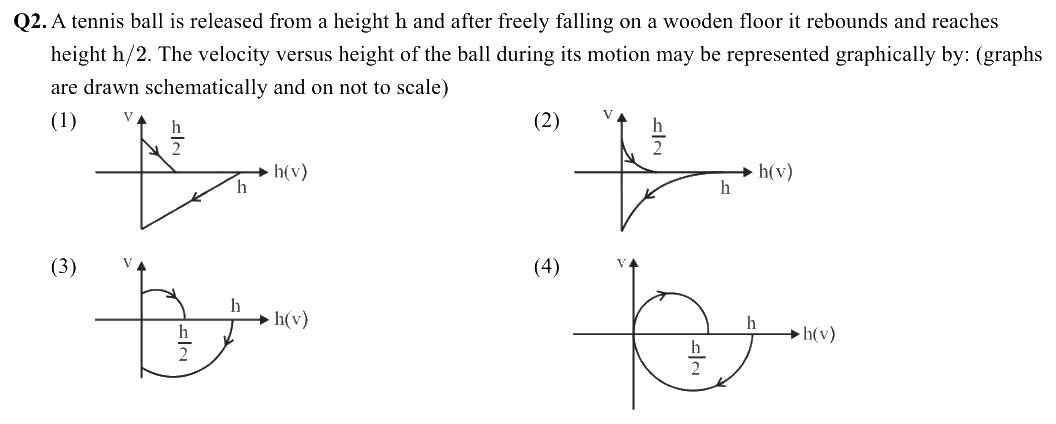
see figure v versus h(v) graph, two straight pieces
see figure v versus h(v) graph, two curved pieces
see figure v versus h(v) graph, two circular arcs
see figure v versus h(v) graph, one large looped curve
Starting from the origin at time $\mathrm{t} = 0$, with initial velocity $5\ \hat{j}\ \mathrm{ms^{-1}}$, a particle moves in the $x$ -$y$ plane with a constant acceleration of $\left(10\hat{i} + 4\hat{j}\right)\mathrm{ms^{-2}}$. At time t, its coordinates are $(20\ \mathrm{m}, \mathrm{y_{0}}\ \mathrm{m})$. The values of t and $\mathrm{y_{0}}$ are, respectively:
2 s and 18 m
4 s and 52 m
2 s and 24 m
5 s and 25 m
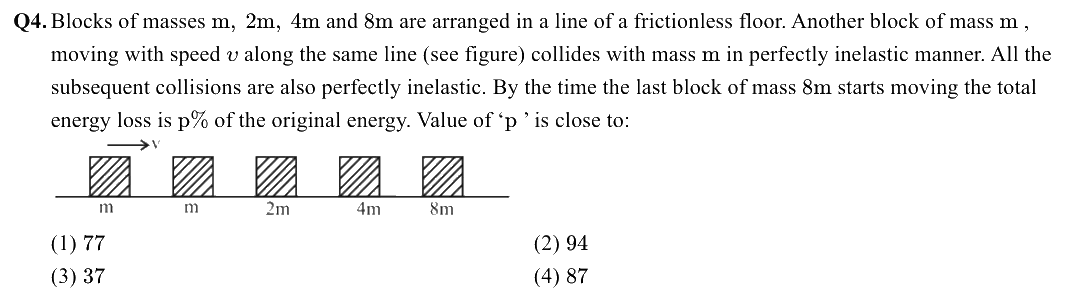
Blocks of masses m, 2m, 4m and 8m are arranged in a line of a frictionless floor. Another block of mass m , moving with speed $v$ along the same line (see figure) collides with mass m in perfectly inelastic manner. All subsequent collisions are also perfectly inelastic. By the time the last block of mass 8m starts moving the total energy loss is p% of the original energy. Value of 'p ' is close to:
(see the figure above)
77
94
37
87
On the $x$-axis and at a distance $x$ from the origin, the gravitational field due to a mass distribution is given by $\frac{Ax}{(x^{2}+a^{2})^{3/2}}$ in the $x$-direction. The magnitude of the gravitational potential on the $x$-axis at a distance $x$, taking its value to be zero at infinity is:
$\frac{A}{(x^{2}+a^{2})^{1/2}}$
$\frac{A}{(x^{2}+a^{2})^{3/2}}$
$A\left(x^{2}+a^{2}\right)^{1/2}$
$A\left(x^{2}+a^{2}\right)^{3/2}$
You have seen the first 5 questions with answers. Questions 6–75 are listed below; their answers and step-by-step solutions are in the EdLoop app, free.