If mass is written as $m = kc^{P}G^{-1/2}\,h^{1/2}$, then the value of $P$ will be : (Constants have their usual meaning with $k$ a dimensionless constant)
- A
$\frac{1}{2}$
- B
$\frac{1}{3}$
- C
2
- D
$-\frac{1}{3}$
If mass is written as $m = kc^{P}G^{-1/2}\,h^{1/2}$, then the value of $P$ will be : (Constants have their usual meaning with $k$ a dimensionless constant)
$\frac{1}{2}$
$\frac{1}{3}$
2
$-\frac{1}{3}$
Projectiles $A$ and $B$ are thrown at angles of $45^\circ$ and $60^\circ$ with vertical respectively from top of a 400 m high tower. If their times of flight are same, the ratio of their speeds of projection $v_A : v_B$ is:
$1 : \sqrt{3}$
$\sqrt{2} : 1$
1 : 2
$1 : \sqrt{2}$
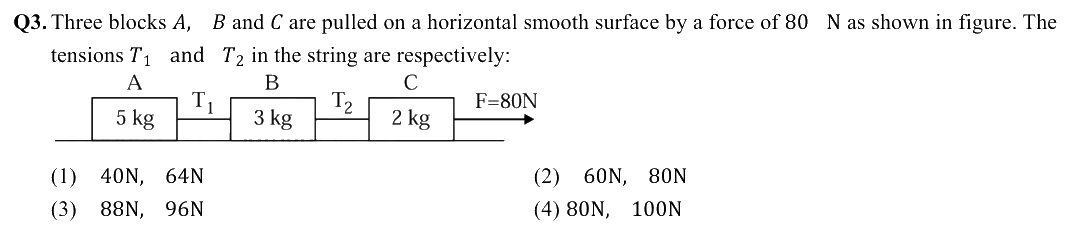
Three blocks $A$, $B$ and $C$ are pulled on a horizontal smooth surface by a force of 80 N as shown in figure. The tensions $T_1$ and $T_2$ in the string are respectively:
(see the figure above)

40 N, 64 N
60 N, 80 N
88 N, 96 N
80 N, 100 N
A block of mass $m$ is placed on a surface having vertical cross section given by $y = \frac{x^2}{4}$. If coefficient of friction is 0.5, the maximum height above the ground at which block can be placed without slipping is:
$\frac{1}{4}$ m
$\frac{1}{2}$ m
$\frac{1}{6}$ m
$\frac{1}{3}$ m
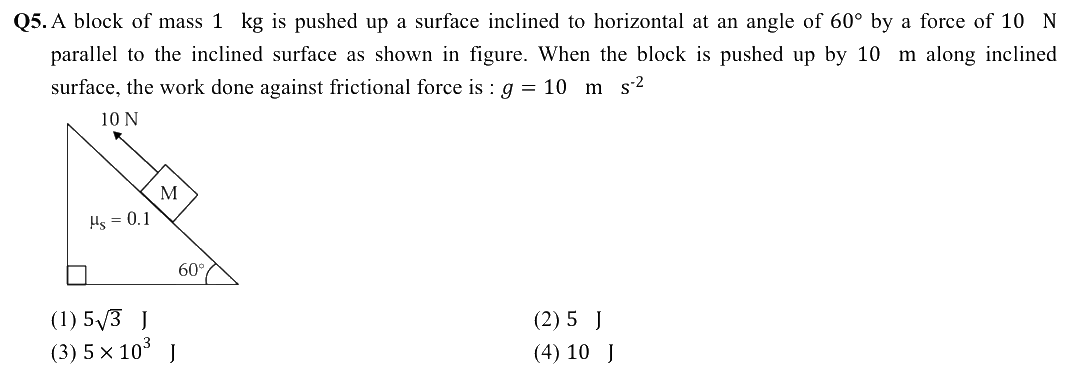
A block of mass 1 kg is pushed up a surface inclined to horizontal at an angle of $60^\circ$ by a force of 10 N parallel to the inclined surface as shown in figure. When the block is pushed up by 10 m along inclined surface, the work done against frictional force is : $g = 10\ \mathrm{m\,s^{-2}}$
(see the figure above)

$5\sqrt{3}$ J
5 J
$5 \times 10^{3}$ J
10 J
You have seen the first 5 questions with answers. Questions 6–90 are listed below; their answers and step-by-step solutions are in the EdLoop app, free.