The angle between vector $\vec{Q}$ and the resultant of $(2\vec{Q} + 2\vec{P})$ and $(2\vec{Q} - 2\vec{P})$ is :
- A
$\tan^{-1}\frac{(2\vec{Q} - 2\vec{P})}{2\vec{Q} + 2\vec{P}}$
- B
$0^\circ$
- C
$\tan^{-1}(P/Q)$
- D
$\tan^{-1}(2Q/P)$
The angle between vector $\vec{Q}$ and the resultant of $(2\vec{Q} + 2\vec{P})$ and $(2\vec{Q} - 2\vec{P})$ is :
$\tan^{-1}\frac{(2\vec{Q} - 2\vec{P})}{2\vec{Q} + 2\vec{P}}$
$0^\circ$
$\tan^{-1}(P/Q)$
$\tan^{-1}(2Q/P)$
Time periods of oscillation of the same simple pendulum measured using four different measuring clocks were recorded as 4.62 s, 4.632 s, 4.6 s and 4.64 s. The arithmetic mean of these readings in correct significant figure is :
5 s
4.623 s
4.6 s
4.62 s
If G be the gravitational constant and u be the energy density then which of the following quantity have the dimensions as that of the $\sqrt{uG}$ :
pressure gradient per unit mass
Gravitational potential
Energy per unit mass
Force per unit mass
A wooden block of mass 5 kg rests on a soft horizontal floor. When an iron cylinder of mass 25 kg is placed on the top of the block, the floor yields and the block and the cylinder together go down with an acceleration of 0.1 $\mathrm{ms^{-2}}$. The action force of the system on the floor is equal to:
196 N
291 N
294 N
297 N
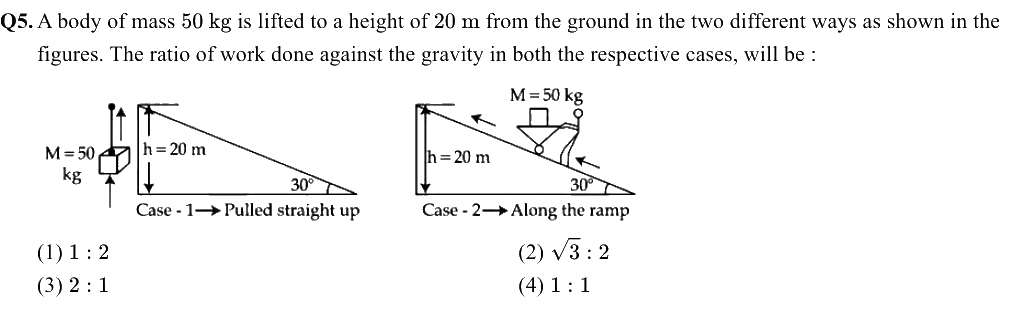
A body of mass 50 kg is lifted to a height of 20 m from the ground in the two different ways as shown in the figures. The ratio of work done against the gravity in both the respective cases, will be :
(see the figure above)

1 : 2
$\sqrt{3}$ : 2
2 : 1
1 : 1
You have seen the first 5 questions with answers. Questions 6–90 are listed below; their answers and step-by-step solutions are in the EdLoop app, free.