A student measured the diameter of a wire using a screw gauge with the least count $0.001$ cm and listed the measurements. The measured value should be recorded as
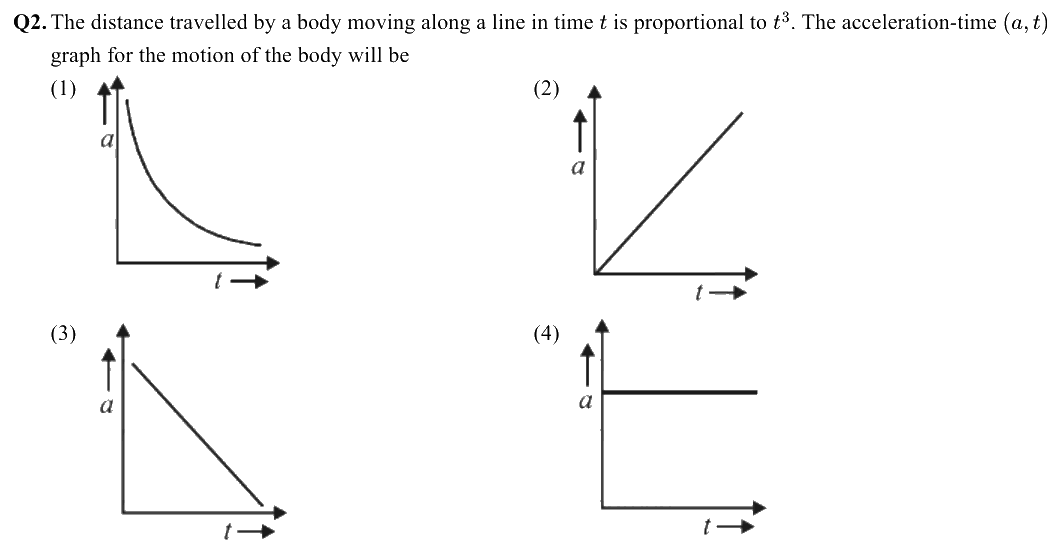
The distance travelled by a body moving along a line in time $t$ is proportional to $t^3$. The acceleration-time $(a, t)$ graph for the motion of the body will be
The question as printed in the paper.
A
see figure a-t graph: a decreasing convex curve, starting high on the a-axis and falling towards the t-axis without touching it
B
see figure a-t graph: a straight line through the origin with positive slope
C
see figure a-t graph: a straight line with negative slope, starting at a positive value on the a-axis and reaching zero on the t-axis
D
see figure a-t graph: a horizontal straight line at a positive constant value of a
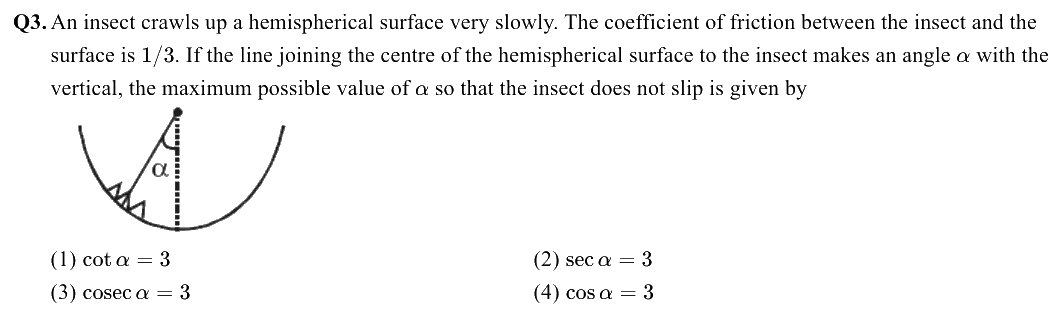
An insect crawls up a hemispherical surface very slowly. The coefficient of friction between the insect and the surface is $1/3$. If the line joining the centre of the hemispherical surface to the insect makes an angle $\alpha$ with the vertical, the maximum possible value of $\alpha$ so that the insect does not slip is given by (see the figure above)
A projectile moving vertically upwards with a velocity of $200\ \mathrm{ms^{-1}}$ breaks into two equal parts at a height of $490$ m. One part starts moving vertically upwards with a velocity of $400\ \mathrm{ms^{-1}}$. How much time it will take, after the break up with the other part to hit the ground?
Two bodies $A$ and $B$ of mass $m$ and $2m$ respectively are placed on a smooth floor. They are connected by a spring of negligible mass. A third body $C$ of mass $m$ is placed on the floor. The body $C$ moves with a velocity $v_0$ along the line joining $A$ and $B$ and collides elastically with $A$. At a certain time after the collision it is found that the instantaneous velocities of $A$ and $B$ are same and the compression of the spring is $x_0$. The spring constant $k$ will be
Answer: (D) $\dfrac{2}{3}m\left(\dfrac{v_0}{x_0}\right)^2$· Key from source paper
Sit the whole paper timed in EdLoop
You have seen the first 5 questions with answers. Questions 6–90 are listed below; their answers and step-by-step solutions are in the EdLoop app, free.