The electrical resistance $R$ of a conductor of length $l$ and area of cross section $a$ is given by $R = \frac{\rho l}{a}$ where '$\rho$' is the electrical resistivity. What is the dimensional formula for electrical conductivity '$\sigma$' which is reciprocal of resistivity?
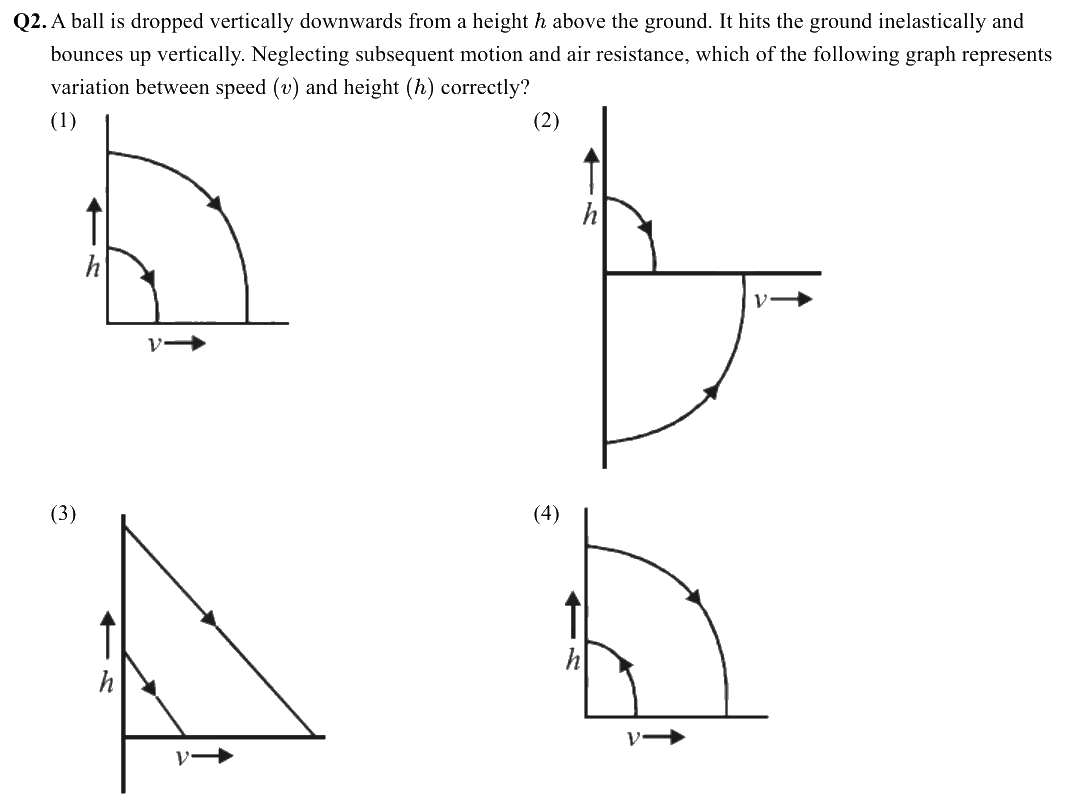
A ball is dropped vertically downwards from a height $h$ above the ground. It hits the ground inelastically and bounces up vertically. Neglecting subsequent motion and air resistance, which of the following graph represents variation between speed ($v$) and height ($h$) correctly?
The question as printed in the paper.
A
see figure Graph with $h$ on the vertical axis and $v$ on the horizontal axis, first quadrant only. Two curved arcs (quarter-ellipse like, convex away from the origin) run from a point on the $h$-axis down to a point on the $v$-axis; the outer arc starts higher and ends at larger $v$, the inner arc starts lower and ends at smaller $v$. Both arcs carry an arrowhead pointing downwards (towards the $v$-axis).
B
see figure Graph with $h$ on the vertical axis (pointing up) and $v$ on the horizontal axis; the horizontal axis sits at the middle of the vertical axis, so the vertical axis extends below it. Above the horizontal axis: a small arc from a point on the $h$-axis curving down to a small positive $v$ on the horizontal axis, arrowhead pointing downwards. Below the horizontal axis: a larger arc from a large positive $v$ on the horizontal axis curving down and to the left to a point far down on the $h$-axis, arrowhead pointing up and to the right (towards the horizontal axis).
C
see figure Graph with $h$ on the vertical axis and $v$ on the horizontal axis, first quadrant only. Two straight lines sloping down to the right, from points on the $h$-axis to points on the $v$-axis; the outer line starts higher and ends at larger $v$, the inner line starts lower and ends at smaller $v$. Both lines carry an arrowhead pointing down-right (towards the $v$-axis).
D
see figure Graph with $h$ on the vertical axis and $v$ on the horizontal axis, first quadrant only. Two curved arcs (quarter-ellipse like, convex away from the origin): the outer arc runs from a high point on the $h$-axis down to a large $v$ on the $v$-axis with an arrowhead pointing downwards; the inner arc is smaller, joining a lower point on the $h$-axis and a smaller $v$ on the $v$-axis, with its arrowhead pointing upwards (up and to the left, away from the $v$-axis).
A satellite moving with velocity $v$ in a force free space collects stationary interplanetary dust at a rate of $\frac{dM}{dt} = \alpha v$ where $M$ is the mass (of satellite + dust) at that instant. The instantaneous acceleration of the satellite is
This question has Statement 1 and Statement 2 . Of the four choices given after the Statements, choose the one that best describes the two Statements. Statement 1: If you push on a cart being pulled by a horse so that it does not move, the cart pushes you back with an equal and opposite force. Statement 2: The cart does not move because the force described in statement 1 cancel each other.
A
Statement 1 is true, Statement 2 is true, Statement 2 is the correct explanation of Statement 1.
B
Statement 1 is false, Statement 2 is true.
C
Statement 1 is true, Statement 2 is false.
D
Statement 1 is true, Statement 2 is true, Statement 2 is not the correct explanation of Statement 1.
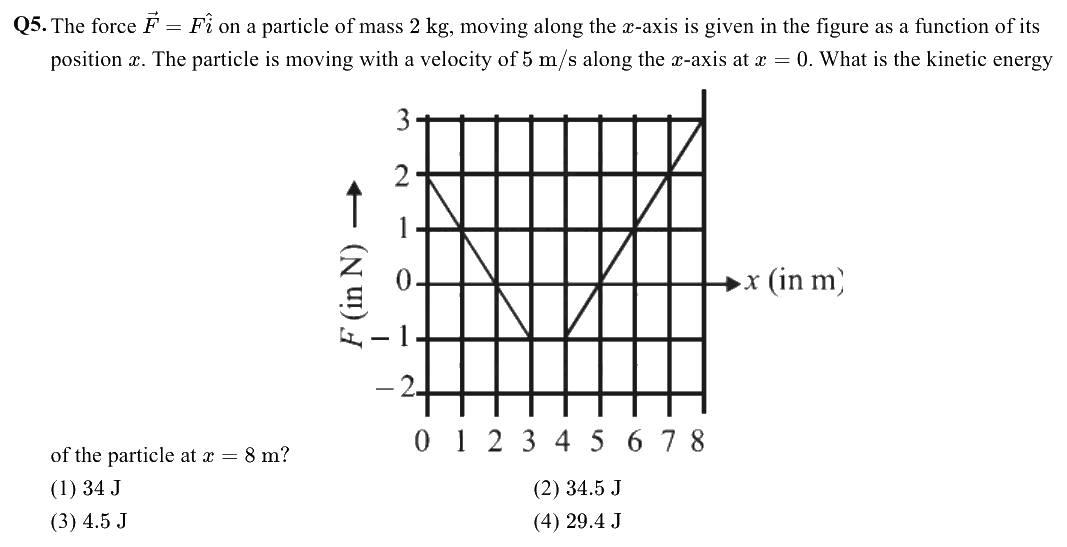
The force $\vec{F} = F\hat{i}$ on a particle of mass 2 kg, moving along the $x$-axis is given in the figure as a function of its position $x$. The particle is moving with a velocity of 5 m/s along the $x$-axis at $x = 0$. What is the kinetic energy (see the figure above) of the particle at $x = 8$ m?
You have seen the first 5 questions with answers. Questions 6–85 are listed below; their answers and step-by-step solutions are in the EdLoop app, free.