EdLoop PYQs · free, no ads · questions and answers here, step-by-step solutions in the EdLoop app
PYQs · free, no adsOpen on the web (app.edloop.in)Get EdLoop – free on Google Play

JEE Main 2021 Question Paper with Answers (24 Feb, Shift 1)

JEE Main24 Feb 2021Shift 1Memory based
89questions
30 / 30 / 29Physics / Chemistry / Maths
180 minduration
5 of 89answers shown here

Physics

30 questions · Questions 1–30

The work done by a gas molecule in an isolated system is given by, $W = \alpha\beta^2 e^{-\frac{x^2}{\alpha k T}}$, where $x$ is the displacement, $k$ is the Boltzmann constant and $T$ is the temperature. $\alpha$ and $\beta$ are constants. Then the dimensions of $\beta$ will be:

  • A

    $\mathrm{M^{2}\ L\ T^{2}}$

  • B

    $\mathrm{ML^{2}\ T^{-2}}$

  • C

    $\mathrm{MLT^{-2}}$

  • D

    $\mathrm{M^{0}\ L\ T^{0}}$

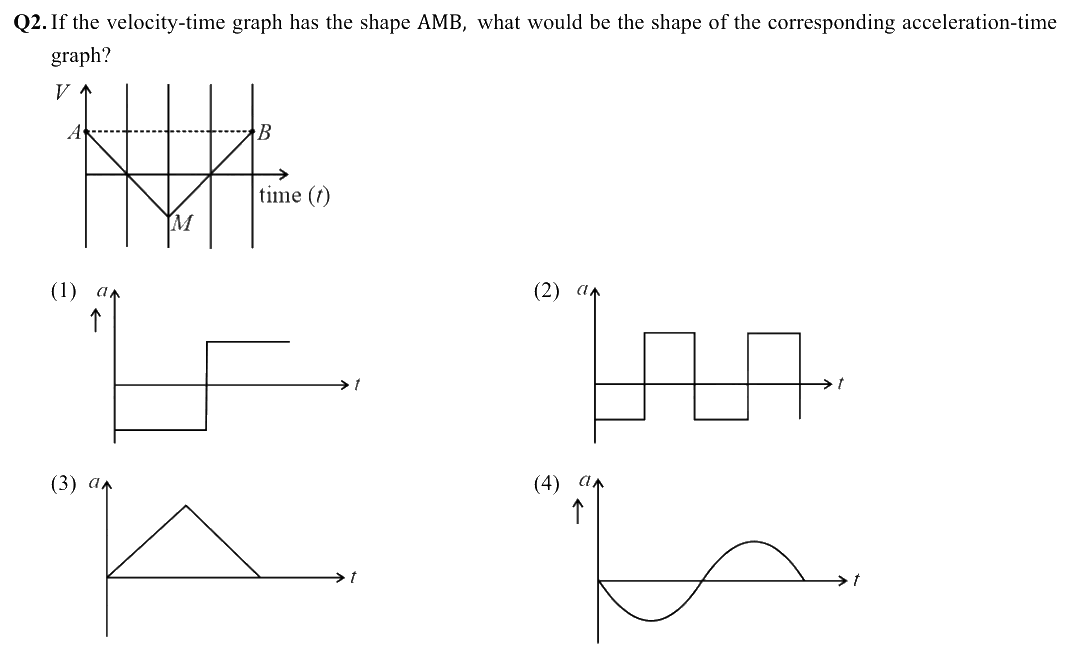
If the velocity-time graph has the shape AMB, what would be the shape of the corresponding acceleration-time graph?
(see the figure above)

The question and its figure as printed in JEE Main 2021 24 Feb Shift 1. Option 1: a-t graph: a constant negative value for the first part, then a jump to a constant positive value for the rest (a step from below the t-axis to above it) Option 2: a-t graph: a square wave alternating between a negative level and a positive level, two negative and two positive segments of equal width, starting negative Option 3: a-t graph: a triangular pulse above the t-axis, rising linearly from the origin to a peak and falling linearly back to the axis Option 4: a-t graph: a sine-like curve starting at the origin, going below the t-axis first (one trough) and then above it (one crest)
The question as printed in the paper.
  • A

    see figure a-t graph: a constant negative value for the first part, then a jump to a constant positive value for the rest (a step from below the t-axis to above it)

  • B

    see figure a-t graph: a square wave alternating between a negative level and a positive level, two negative and two positive segments of equal width, starting negative

  • C

    see figure a-t graph: a triangular pulse above the t-axis, rising linearly from the origin to a peak and falling linearly back to the axis

  • D

    see figure a-t graph: a sine-like curve starting at the origin, going below the t-axis first (one trough) and then above it (one crest)

Moment of inertia M.I. of four bodies, having same mass and radius, are reported as;
$I_1$ = M.I. of thin circular ring about its diameter,
$I_2$ = M.I. of circular disc about an axis perpendicular to disc and going through the centre,
$I_3$ = M.I. of solid cylinder about its axis and
$I_4$ = M.I. of solid sphere about its diameter.
Then:

  • A

    $I_1 + I_2 = I_3 + \frac{5}{2}I_4$.

  • B

    $I_1 + I_3 < I_2 + I_4$

  • C

    $I_1 = I_2 = I_3 > I_4$

  • D

    $I_1 = I_2 = I_3 < I_4$

Consider two satellites $S_1$ and $S_2$ with periods of revolution $1\,\mathrm{hr}$ and $8\,\mathrm{hr}$ respectively revolving around a planet in circular orbits. The ratio of angular velocity of satellite $S_1$ to the angular velocity of satellite $S_2$ is:

  • A

    $8 : 1$

  • B

    $2 : 1$

  • C

    $1 : 4$

  • D

    $1 : 8$

Four identical particles of equal masses $1\ \mathrm{kg}$ made to move along the circumference of a circle of radius $1\ \mathrm{m}$ under the action of their own mutual gravitational attraction. The speed of each particle will be:

  • A

    $\sqrt{G1 + 2\sqrt{2}}$

  • B

    $\sqrt{\frac{G}{2}1 + 2\sqrt{2}}$

  • C

    $\sqrt{\frac{G}{2}2\sqrt{2} - 1}$

  • D

    $\frac{\sqrt{1 + 2\sqrt{2}G}}{2}$

Sit the whole paper timed in EdLoop

You have seen the first 5 questions with answers. Questions 6–89 are listed below; their answers and step-by-step solutions are in the EdLoop app, free.

  1. 6GravitationPeriod of a binary star system of masses m and 2m
  2. 7ElasticityRelation between Young's modulus, bulk modulus and modulus of rigidity
  3. 8Thermal Properties of MatterIncrease in the volume of a hollow cubical metal box on heating
  4. 9ThermodynamicsMatch thermodynamic processes with the quantity kept constant
  5. 10ThermodynamicsNet work in a cycle of isothermal expansion, isobaric compression and…
  6. 11Oscillations (SHM)New amplitude when a mass is gently placed on a block in SHM at its mean…
  7. 12ElectrostaticsField at the centre of a cube with +Q at seven corners and −Q at the origin
  8. 13CapacitorsTwo equal capacitors in series and in parallel: ratio of equivalent capacitances
  9. 14Current ElectricityCharge through a wire in 15 s when the current grows as αt + βt²
  10. 15Current Electricity6 V and 4 V cells in opposition in a loop: potential difference across X and Y
  11. 16Ray OpticsRelation between focal length and radius of curvature of a convex mirror
  12. 17Wave OpticsImax : Imin in YDSE when one slit is three times as wide and amplitude ∝ width
  13. 18Dual Nature of Matter &…Photon momentum, energy and wavelength: two statements
  14. 19AtomsNaming marked transitions in a hydrogen energy-level diagram
  15. 20Semiconductor ElectronicsCurrent gain β from changes in emitter and collector currents
  16. 21Laws of MotionHorizontal push needed to hold a block against a rough vertical wall
  17. 22Laws of MotionHighest point a block can rest on the rough curve y = x²/4
  18. 23Work, Energy & PowerIdentical balls moving off at 30° on either side after a collision: speed ratio
  19. 24Fluid MechanicsHydraulic press: load lifted after changing both piston diameters
  20. 25Alternating CurrentPrimary turns of a step-down transformer for a 12 V radio supply from 220 V
  21. 26Alternating CurrentQuality factor of a resonant circuit from L, R and resonant frequency
  22. 27Electromagnetic WavesSpeed of an EM wave in a medium with relative permittivity and permeability 2
  23. 28Wave OpticsIntensity after rotating the analyser by 30° from its maximum-transmission…
  24. 29Semiconductor ElectronicsCurrent through a 2 kΩ load across a 5 V Zener fed from 10 V through 1 kΩ
  25. 30Communication SystemsPercent modulation from message and carrier amplitudes

Chemistry

30 questions · Questions 31–60
  1. 31Periodic Table & PeriodicityIncreasing first ionisation enthalpy of Mg, Al, Si, P and S
  2. 32Chemical Bonding &…Isostructural pairs among SO₄²⁻/CrO₄²⁻, SiCl₄/TiCl₄, NH₃/NO₃⁻ and BCl₃/BrCl₃
  3. 33Redox ReactionsRole of H₂O₂ in its reactions with HOCl and with I₂ in alkali
  4. 34General Principles of…Leaching of alumina with alkali and precipitation by a gas: identify X, Y and Z
  5. 35Hydrocarbons1-Methylcyclopentene with cold dilute KMnO₄, then CrO₃: products A and B
  6. 36Practical Chemistry &…Phenol that gives a pink phthalein dye with phthalic anhydride and alkali
  7. 37Amines & Nitrogen CompoundsWhy direct nitration of aniline gives a large amount of meta-nitroaniline
  8. 38Environmental ChemistryEffect of the gas released by anaerobic decay of vegetation
  9. 39Surface ChemistrySlope of the log(x/m) vs log P line in the Freundlich isotherm
  10. 40General Principles of…Ore concentrated with the help of sodium cyanide
  11. 41d- and f-Block ElementsMain components of gun metal
  12. 42d- and f-Block Elements3d metal with a positive M²⁺/M standard electrode potential
  13. 43Haloalkanes & HaloarenesFirst product of 2,4-dibromohexane with excess Mg in dry ether
  14. 44HydrocarbonsMajor product of HI with 3,3-dimethylbut-1-ene
  15. 45General Organic ChemistrySecondary alcohol on a methylcyclohexane ring with HCl: major product
  16. 46HydrocarbonsReagent for controlled oxidation of propane to propanal
  17. 47Amines & Nitrogen CompoundsAniline → diazotisation and cyanide → SnCl₂/HCl, H₃O⁺: identify A and B
  18. 48PolymersMatch monomers with polymers: caprolactam, chloroprene, isoprene, acrylonitrile
  19. 49Practical Chemistry &…Borax bead test for copper: cupric and cuprous metaborate in the two flames
  20. 50BiomoleculesInteraction that stabilises the α-helix of proteins
  21. 51Mole Concept & StoichiometryMolarity of 4.5 g of a compound (M = 90) in 250 mL of solution
  22. 52Atomic StructureRatio of de Broglie wavelengths of Li³⁺ and a proton through the same potential
  23. 53Chemical ThermodynamicsΔG° in units of R for K = 100 at 300 K
  24. 54Coordination CompoundsOverall dissociation constant of [Cu(NH₃)₄]²⁺ from four stepwise constants
  25. 55Chemical EquilibriumKp for Cl₂ ⇌ 2Cl at 1 atm when Cl₂ molecules and Cl atoms are equal in number
  26. 56Redox ReactionsCoefficient of OH⁻ in the disproportionation of S₈ to sulphide and thiosulphate
  27. 57Periodic Table & PeriodicityNumber of amphoteric species among BeO, BaO, Be(OH)₂ and Sr(OH)₂
  28. 58States of MatterCoordination number of an atom in a body-centred cubic lattice
  29. 59SolutionsKa of chloroacetic acid from the freezing-point depression of its solution
  30. 60Chemical KineticsTime for 40% isomerisation of cyclobutene with k = 3.3 × 10⁻⁴ s⁻¹

Maths

29 questions · Questions 61–89
  1. 61Quadratic EquationsQuadratic with roots p, q given p + q = 2 and p⁴ + q⁴ = 272
  2. 62Permutations & CombinationsCommittee from 6 Indians and 8 foreigners with twice as many foreigners
  3. 63TrigonometryExponent an infinite GP in cos²x, value a root of t² − 9t + 8: find a trig ratio
  4. 64Straight LinesLine whose reciprocal intercepts have mean 1/4: which given points lie on it
  5. 65Binomial TheoremAlternating weighted sum of ¹⁵Cᵣ plus odd ¹⁴Cᵣ up to ¹⁴C₁₁
  6. 66ParabolaLocus of the midpoint of focus and a point on y² = 4ax: its directrix
  7. 67Mathematical ReasoningWhich compound statement in A and B is a tautology
  8. 68TrigonometryTwo poles 150 m apart, one three times the other, complementary elevations
  9. 69MatricesValues of k and m that make a 3×3 linear system inconsistent
  10. 70Sets, Relations & FunctionsIs f∘g one-one or onto for f(x) = 2x − 1 and g(x) = (x − ½)/(x − 1)
  11. 71Limits, Continuity &…Continuity of [x − 1]·cos((2x − 1)π/2)
  12. 72Applications of DerivativesMonotonicity of (4x³ − 3x²)/6 − 2 sin x + (2x − 1) cos x
  13. 73Applications of DerivativesTangent to y = x³ at (t, t³) meets the curve again: point dividing PQ in 1 : 2
  14. 74Indefinite IntegrationIntegral of (cos x − sin x)/√(8 − sin 2x) in the form a sin⁻¹((sin x + cos x)/b)
  15. 75Limits, Continuity &…Limit of (∫₀^x² sin√t dt)/x³ as x → 0
  16. 76Area Under CurvesArea of the circle x² + y² = 36 lying outside the parabola y² = 9x
  17. 77Differential EquationsPopulation with dP/dt = 0.5P − 450 and P(0) = 850: time to reach zero
  18. 78Three Dimensional GeometryDistance of (1, 1, 9) from where a line meets the plane x + y + z = 17
  19. 79Three Dimensional GeometryPlane through (1, 2, −3) perpendicular to 3x + y − 2z = 5 and 2x − 5y − z = 7
  20. 80ProbabilityDie rolled n times with P(2 odd) = P(3 even): probability of an odd number of…
  21. 81CirclesRadius of a circle centred at (2, 1) having a diameter of another circle as…
  22. 82Sequences & SeriesSum of 3-digit numbers ≡ 2 or ≡ l (mod 9) equals 274 × 400: find l
  23. 83MatricesPQ = kI with q₂₃ = −k/8 and |Q| = k²/2: find α² + k²
  24. 84Permutations & Combinations3×3 matrices with entries 0, 1, 2 for which trace(MᵀM) = 7
  25. 85Inverse Trigonometric…Limit of tan of Σ tan⁻¹(1/(1 + r + r²))
  26. 86Applications of DerivativesLeast α for which 4/sin x + 1/(1 − sin x) = α has a solution in (0, π/2)
  27. 87Definite IntegrationFind a from ∫ (|x| + |x − 2|) = 22, then ∫ from a to −a of (x + [x])
  28. 88Vector Algebrac coplanar with a, b; a·c = 7, b ⊥ c: value of 2|a + b + c|²
  29. 89ProbabilityThree independent events, "only Bᵢ" probabilities linked to p: P(B₁)/P(B₃)

Chapters in this paper

Get EdLoop – freeOpen on the web