The dimension of magnetic field in M, L, T and C (Coulomb) is given as
- A
$\mathrm{MLT^{-1}C^{-1}}$
- B
$\mathrm{MT^{2}C^{-2}}$
- C
$\mathrm{MT^{-1}C^{-1}}$
- D
$\mathrm{MT^{-2}C^{-1}}$
Answer: (C) $\mathrm{MT^{-1}C^{-1}}$ · Key from source paper
 PYQs · free, no adsOpen on the web (app.edloop.in)Get EdLoop – free on Google Play
The dimension of magnetic field in M, L, T and C (Coulomb) is given as
$\mathrm{MLT^{-1}C^{-1}}$
$\mathrm{MT^{2}C^{-2}}$
$\mathrm{MT^{-1}C^{-1}}$
$\mathrm{MT^{-2}C^{-1}}$
A body is at rest at $x = 0$. At $t = 0$, it starts moving in the positive $x$-direction with a constant acceleration. At the same instant another body passes through $x = 0$ moving in the positive $x$ direction with a constant speed. The position of the first body is given by $x_1(t)$ after time ' t ' and that of the second body by $x_2(t)$ after the same time interval. Which of the following graphs correctly describes $(x_1 - x_2)$ as a function of time ' $t$ '?
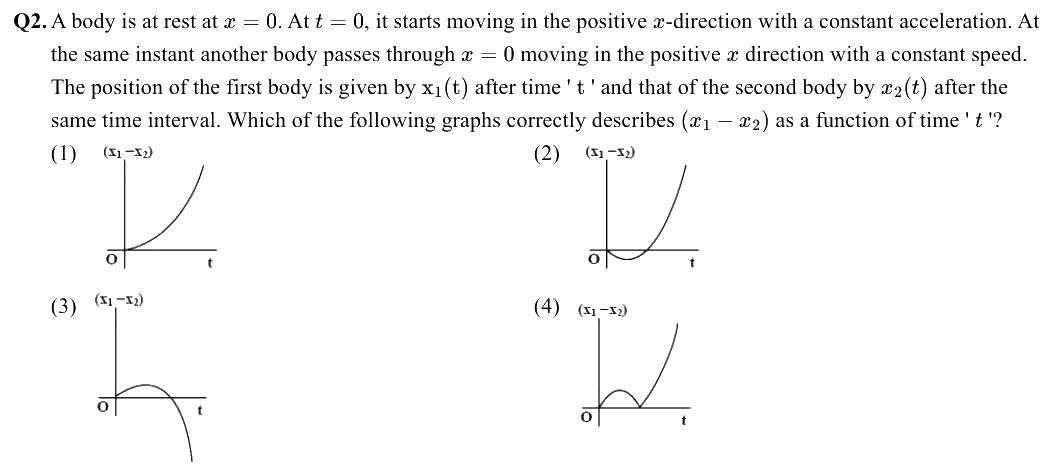
see figure graph of $(x_1-x_2)$ against $t$
see figure graph of $(x_1-x_2)$ against $t$
see figure graph of $(x_1-x_2)$ against $t$
see figure graph of $(x_1-x_2)$ against $t$
An athlete in the olympic games covers a distance of $100\ \mathrm{m}$ in $10\ \mathrm{s}$. His kinetic energy can be estimated to be in the range
$200\ \mathrm{J} - 500\ \mathrm{J}$
$2 \times 10^{5}\ \mathrm{J} - 3 \times 10^{5}\ \mathrm{J}$
$20,000\ \mathrm{J} - 50,000\ \mathrm{J}$
$2,000\ \mathrm{J} - 5,000\ \mathrm{J}$
A thin rod of length ' $L$ ' is lying along the $x$-axis with its ends at $x = 0$ and $x = L$. Its linear density (mass/length) varies with $x$ ask $\left(\frac{x}{L}\right)^{n}$, where $n$ can be zero or any positive number. If the position $x_{\mathrm{CM}}$ of the centre of mass of the rod is plotted against ' $n$ ', which of the following graphs best approximates the dependence of $x_{\mathrm{CM}}$ on $n$ ?
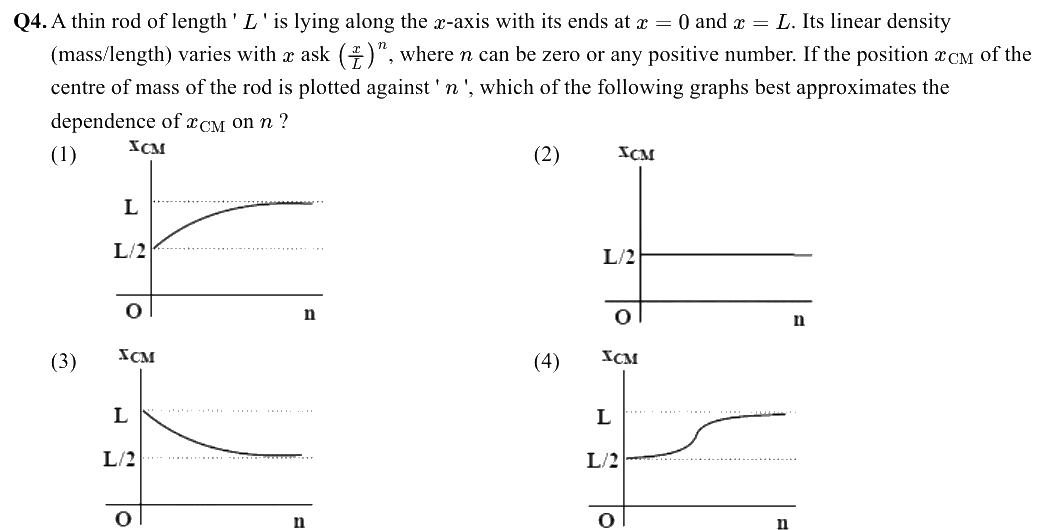
see figure graph of $x_{\mathrm{CM}}$ against $n$
see figure graph of $x_{\mathrm{CM}}$ against $n$
see figure graph of $x_{\mathrm{CM}}$ against $n$
see figure graph of $x_{\mathrm{CM}}$ against $n$
A body of mass $m = 3.513\ \mathrm{kg}$ is moving along the $x$-axis with a speed of $5.00\ \mathrm{ms^{-1}}$. The magnitude of its momentum is recorded as
$17.6\ \mathrm{kg\ ms^{-1}}$
$17.565\ \mathrm{kg\ ms^{-1}}$
$17.56\ \mathrm{kg\ ms^{-1}}$
$17.57\ \mathrm{kg\ ms^{-1}}$
You have seen the first 5 questions with answers. Questions 6–104 are listed below; their answers and step-by-step solutions are in the EdLoop app, free.