A particle has an initial velocity $3i + 4j$ and an acceleration of $0.4i + 0.3j$. Its speed after 10 s is
- A
10 units
- B
$7\sqrt{2}$ units
- C
7 units
- D
8.5 units
Answer: (B) $7\sqrt{2}$ units · Key from source paper
 PYQs · free, no adsOpen on the web (app.edloop.in)Get EdLoop – free on Google Play
A particle has an initial velocity $3i + 4j$ and an acceleration of $0.4i + 0.3j$. Its speed after 10 s is
10 units
$7\sqrt{2}$ units
7 units
8.5 units
Consider a rubber ball freely falling from a height $h = 4.9$ m onto a horizontal elastic plate. Assume that the duration of collision is negligible and the collision with the plate is totally elastic. Then the velocity as a function of time the height as function of time will be
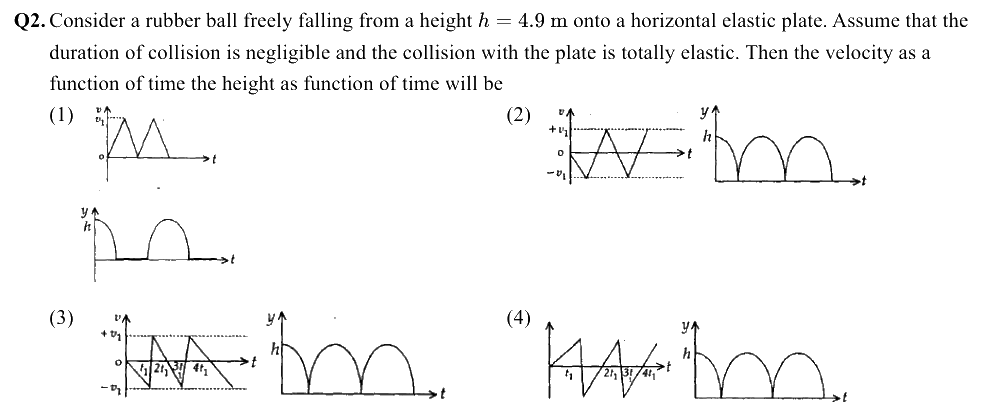
see figure Pair of graphs. Left: v against t, a series of triangular humps all above the t-axis (v from 0 up to v1, back to 0, up to v1, back to 0; v1 marked on the axis). Right (printed below the left graph): y against t, a falling arc from h down to 0, then flat at 0 for a while, then a separate arc up and down, again touching the axis.
see figure Pair of graphs. Left: v against t with dotted levels +v1 and -v1; a zig-zag that starts at 0, goes down to -v1, then up through 0 to +v1, down to -v1 and up again (symmetric triangular zig-zag between -v1 and +v1). Right: y against t, three arcs (first starting at h and descending to 0, then two full arches), each touching the t-axis.
see figure Pair of graphs. Left: v against t with dotted levels +v1 and -v1 and time marks t1, 2t1, 3t1, 4t1; saw-tooth: starts at 0, falls linearly to -v1, jumps vertically up to +v1, falls linearly through 0 to -v1, jumps up again to +v1, falls again. Right: y against t, three arcs (first from h down to 0, then two full arches).
see figure Pair of graphs. Left: v against t with time marks t1, 2t1, 3t1, 4t1; saw-tooth rising linearly from 0 to a positive peak, jumping vertically down to a negative value, rising linearly again through 0 to a positive peak, jumping down, rising again (positive slope segments). Right: y against t, three arcs (first from h down to 0, then two full arches).
A thin uniform rod of length $\ell$ and mass $m$ is swinging freely about a horizontal axis passing through its end. Its maximum angular speed is $\omega$. Its centre of mass rises to a maximum height of
$\frac{1}{3}\frac{\ell^2\omega^2}{g}$
$\frac{1}{6}\frac{\ell\omega}{g}$
$\frac{1}{2}\frac{\ell^2\omega^2}{g}$
$\frac{1}{6}\frac{\ell^2\omega^2}{g}$
The height at which the acceleration due to gravity becomes $\frac{g}{9}$ (where $g$ = the acceleration due to gravity on the surface of the earth) in terms of $R$, the radius of the earth is
$2R$
$\frac{R}{\sqrt{2}}$
$\frac{R}{2}$
$\sqrt{2}\mathrm{R}$
Two wires are made of the same material and have the same volume. However wire 1 has crosssectional area $A$ and wire-2 has cross-sectional area $3A$. If the length of wire 1 increases by $\Delta x$ on applying force $F$, how much force is needed to stretch wire 2 by the same amount?
F
4 F
6 F
9 F
You have seen the first 5 questions with answers. Questions 6–88 are listed below; their answers and step-by-step solutions are in the EdLoop app, free.