The relative error in the determination of the surface area of a sphere is $\alpha$. Then the relative error in the determination of its volume is
- A
$\frac{2}{3}\alpha$
- B
$\frac{2}{3}\alpha$
- C
$\frac{3}{2}\alpha$
- D
$\alpha$
The relative error in the determination of the surface area of a sphere is $\alpha$. Then the relative error in the determination of its volume is
$\frac{2}{3}\alpha$
$\frac{2}{3}\alpha$
$\frac{3}{2}\alpha$
$\alpha$
An automobile, travelling at $40\ \mathrm{km/h}$, can be stopped at a distance of $40\ \mathrm{m}$ by applying brakes. If the same automobile is travelling at $80\ \mathrm{km/h}$, the minimum stopping distance, in metres, is (assume no skidding)
$75\ \mathrm{m}$
$160\ \mathrm{m}$
$100\ \mathrm{m}$
$150\ \mathrm{m}$
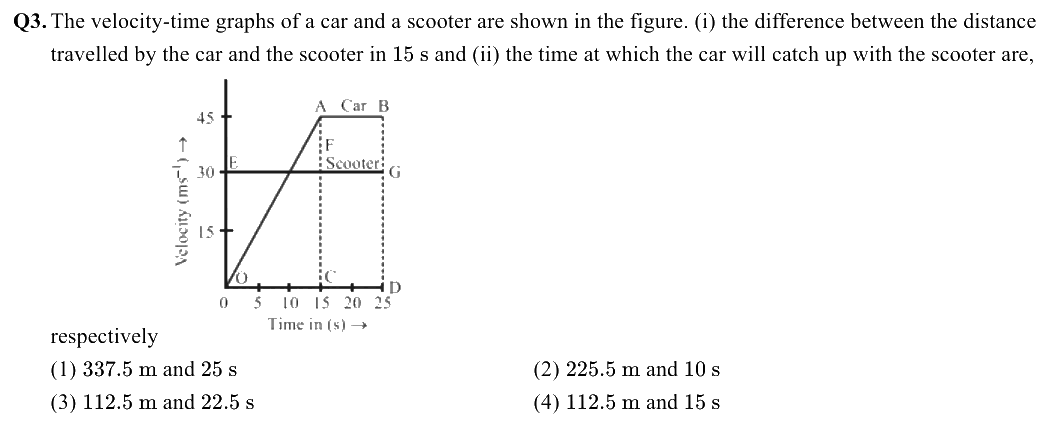
The velocity-time graphs of a car and a scooter are shown in the figure. (i) the difference between the distance travelled by the car and the scooter in 15 s and (ii) the time at which the car will catch up with the scooter are,
(see the figure above)
respectively

$337.5\ \mathrm{m}$ and $25\ \mathrm{s}$
$225.5\ \mathrm{m}$ and $10\ \mathrm{s}$
$112.5\ \mathrm{m}$ and $22.5\ \mathrm{s}$
$112.5\ \mathrm{m}$ and $15\ \mathrm{s}$
A given object takes $n$ times more time to slide down a $45^\circ$ rough inclined plane as it takes to slide down a perfectly smooth $45^\circ$ incline. The coefficient of kinetic friction between the object and the incline is :
$\sqrt{1-\frac{1}{n^2}}$
$1-\frac{1}{n^2}$
$\frac{1}{2-n^2}$
$\sqrt{\frac{1}{1-n^2}}$
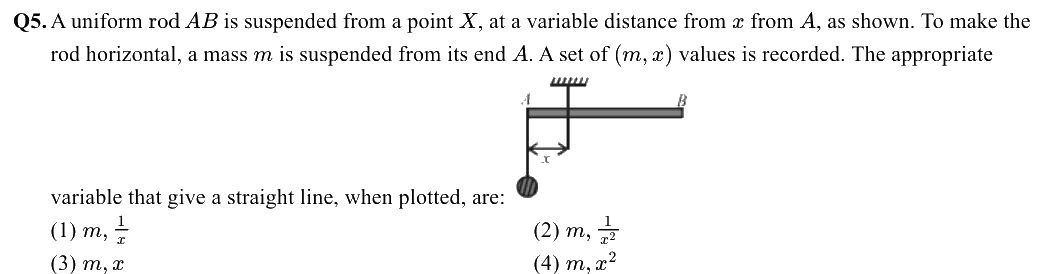
A uniform rod $AB$ is suspended from a point $X$, at a variable distance from $x$ from $A$, as shown. To make the rod horizontal, a mass $m$ is suspended from its end $A$. A set of $(m, x)$ values is recorded. The appropriate
(see the figure above)
variable that give a straight line, when plotted, are:

$m, \frac{1}{x}$
$m, \frac{1}{x^2}$
$m, x$
$m, x^2$
You have seen the first 5 questions with answers. Questions 6–90 are listed below; their answers and step-by-step solutions are in the EdLoop app, free.