Train A and train B are running on parallel tracks in the opposite directions with speed of $36\ \mathrm{km\ hour}^{-1}$ and $72\ \mathrm{km\ hour}^{-1}$, respectively. A person is walking in train A in the direction opposite to its motion with a speed of $1.8\ \mathrm{km\ hour}^{-1}$. Speed (in $\mathrm{m\ s}^{-1}$) of this person as observed from train B will be close to: (take the distance between the tracks as negligible)
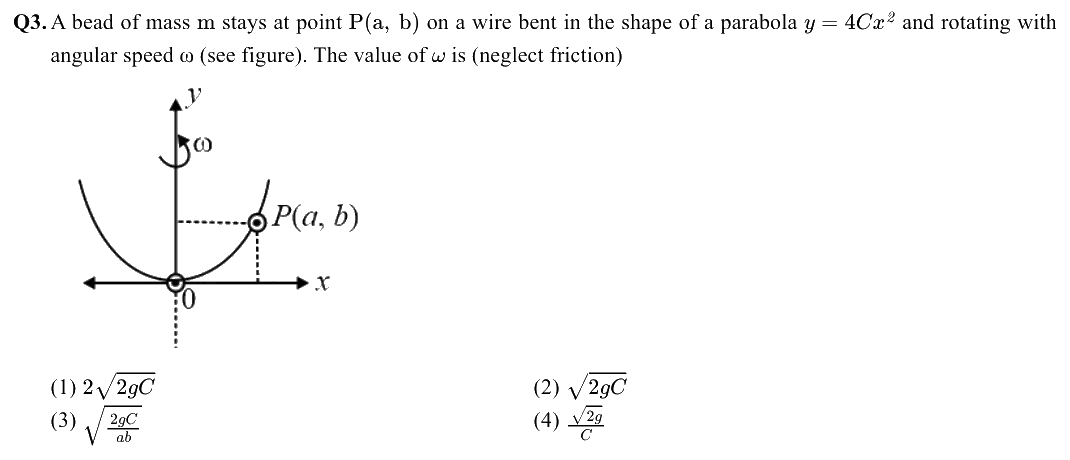
A bead of mass m stays at point P(a, b) on a wire bent in the shape of a parabola $y = 4Cx^{2}$ and rotating with angular speed $\omega$ (see figure). The value of $\omega$ is (neglect friction) (see the figure above)
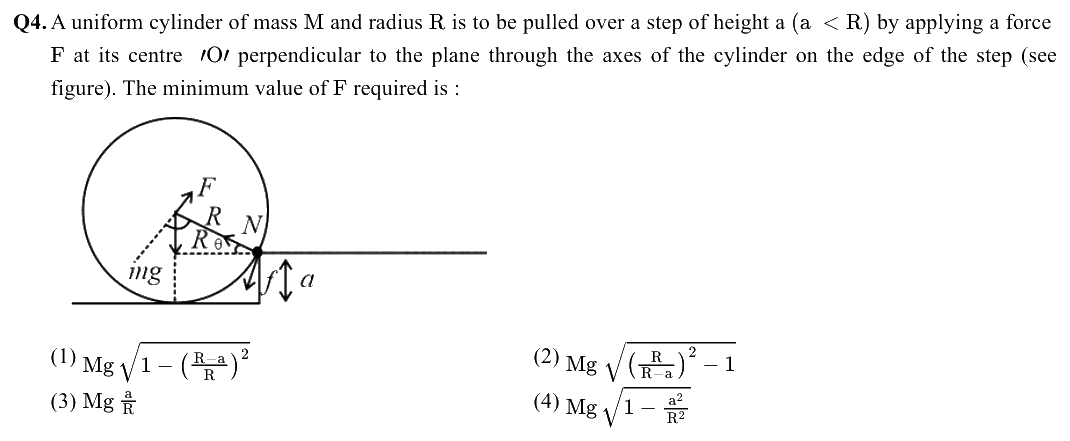
A uniform cylinder of mass M and radius R is to be pulled over a step of height a ($a < R$) by applying a force F at its centre 'O' perpendicular to the plane through the axes of the cylinder on the edge of the step (see figure). The minimum value of F required is : (see the figure above)
In a reactor, $2\ \mathrm{kg}$ of $_{92}\mathrm{U}^{235}$ fuel is fully used up in 30 days. The energy released fission is $200\ \mathrm{MeV}$. Given that the Avogadro number, $\mathrm{N} = 6.023 \times 10^{26}$ per kilo mole and $1\ \mathrm{eV} = 1.6 \times 10^{-19}\ \mathrm{J}$. The power output of the reactor is close to:
Answer: (B) $60\ \mathrm{MW}$· Key from source paper
Sit the whole paper timed in EdLoop
You have seen the first 5 questions with answers. Questions 6–75 are listed below; their answers and step-by-step solutions are in the EdLoop app, free.