A wire of $1\ \Omega$ has a length of $1\ \mathrm{m}$. It is stretched till its length increases by $25\%$. The percentage change in resistance to the nearest integer is :
- A
$12.5\%$
- B
$76\%$
- C
$25\%$
- D
$56\%$
A wire of $1\ \Omega$ has a length of $1\ \mathrm{m}$. It is stretched till its length increases by $25\%$. The percentage change in resistance to the nearest integer is :
$12.5\%$
$76\%$
$25\%$
$56\%$
If $C$ and $V$ represent capacity and voltage respectively then what are the dimensions of $\lambda$ where $C/V = \lambda$ ?
$[\mathrm{M}^{-2}\,\mathrm{L}^{-4}\,\mathrm{I}^{3}\,\mathrm{T}^{7}]$
$[\mathrm{M}^{-2}\,\mathrm{L}^{-3}\,\mathrm{I}^{2}\,\mathrm{T}^{6}]$
$[\mathrm{M}^{-1}\,\mathrm{L}^{-3}\,\mathrm{I}^{-2}\,\mathrm{T}^{-7}]$
$[\mathrm{M}^{-3}\,\mathrm{L}^{-4}\,\mathrm{I}^{3}\,\mathrm{T}^{7}]$
A scooter accelerates from rest for time $t_1$ at constant rate $a_1$ and then retards at constant rate $a_2$ for time $t_2$ and comes to rest. The correct value of $\frac{t_1}{t_2}$ will be :
$\frac{a_2}{a_1}$
$\frac{a_1}{a_2}$
$\frac{a_1+a_2}{a_1}$
$\frac{a_1+a_2}{a_2}$
The trajectory of a projectile in a vertical plane is $y = \alpha x - \beta x^2$, where $\alpha$ and $\beta$ are constants and $x$ & $y$ are respectively the horizontal and vertical distances of the projectile from the point of projection. The angle of projection $\theta$ and the maximum height attained $H$ are respectively given by
$\tan^{-1}\alpha,\ \frac{4\alpha^2}{\beta}$
$\tan^{-1}\left(\frac{\beta}{\alpha}\right),\ \frac{\alpha^2}{\beta}$
$\tan^{-1}\beta,\ \frac{\alpha^2}{2\beta}$
$\tan^{-1}\alpha,\ \frac{\alpha^2}{4\beta}$
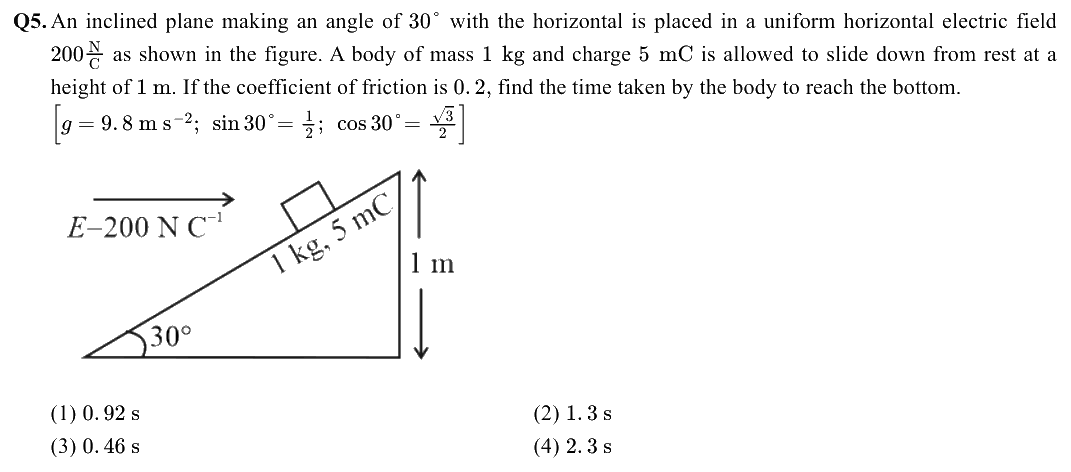
An inclined plane making an angle of $30^\circ$ with the horizontal is placed in a uniform horizontal electric field $200\,\frac{\mathrm{N}}{\mathrm{C}}$ as shown in the figure. A body of mass $1\ \mathrm{kg}$ and charge $5\ \mathrm{mC}$ is allowed to slide down from rest at a height of $1\ \mathrm{m}$. If the coefficient of friction is $0.2$, find the time taken by the body to reach the bottom. $\left[g = 9.8\ \mathrm{m\,s^{-2}};\ \sin 30^\circ = \frac{1}{2};\ \cos 30^\circ = \frac{\sqrt{3}}{2}\right]$
(see the figure above)

$0.92\ \mathrm{s}$
$1.3\ \mathrm{s}$
$0.46\ \mathrm{s}$
$2.3\ \mathrm{s}$
You have seen the first 5 questions with answers. Questions 6–90 are listed below; their answers and step-by-step solutions are in the EdLoop app, free.