Let $L$, $R$, $C$ and $V$ represent inductance, resistance, capacitance and voltage, respectively. The dimension of $\frac{L}{RCV}$ in $SI$ units will be:
- A
$[LTA]$
- B
$[A^{-1}]$
- C
$[LT^2]$
- D
$[LA^{-2}]$
Answer: (B) $[A^{-1}]$ · Key from source paper
 PYQs · free, no adsOpen on the web (app.edloop.in)Get EdLoop – free on Google Play
Let $L$, $R$, $C$ and $V$ represent inductance, resistance, capacitance and voltage, respectively. The dimension of $\frac{L}{RCV}$ in $SI$ units will be:
$[LTA]$
$[A^{-1}]$
$[LT^2]$
$[LA^{-2}]$
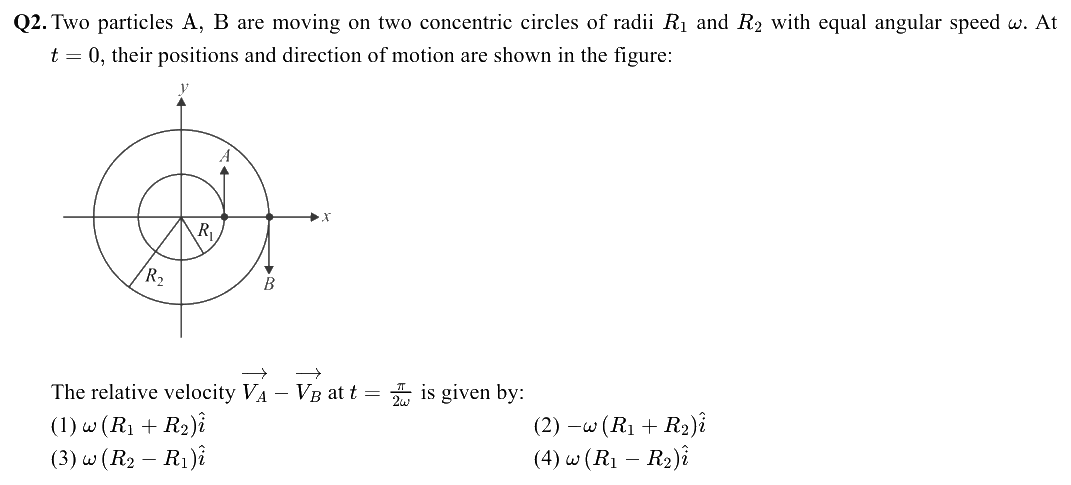
Two particles A, B are moving on two concentric circles of radii $R_1$ and $R_2$ with equal angular speed $\omega$. At $t = 0$, their positions and direction of motion are shown in the figure:
(see the figure above)
The relative velocity $\overrightarrow{V_A} - \overrightarrow{V_B}$ at $t = \frac{\pi}{2\omega}$ is given by:
$\omega\,(R_1 + R_2)\hat{i}$
$-\omega\,(R_1 + R_2)\hat{i}$
$\omega\,(R_2 - R_1)\hat{i}$
$\omega\,(R_1 - R_2)\hat{i}$
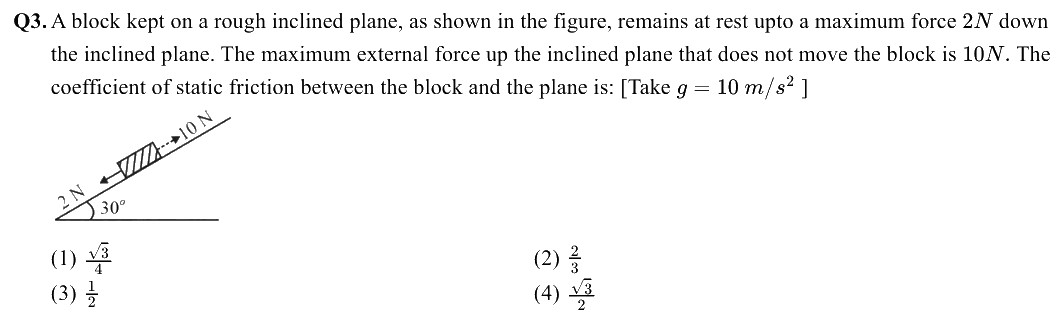
A block kept on a rough inclined plane, as shown in the figure, remains at rest upto a maximum force $2N$ down the inclined plane. The maximum external force up the inclined plane that does not move the block is $10N$. The coefficient of static friction between the block and the plane is: [Take $g = 10\ m/s^2$ ]
(see the figure above)
$\frac{\sqrt{3}}{4}$
$\frac{2}{3}$
$\frac{1}{2}$
$\frac{\sqrt{3}}{2}$
A vertical closed cylinder is separated into two parts by a frictionless piston of mass $m$ and of negligible thickness. The piston is free to move along the length of the cylinder. The length of the cylinder above piston is $l_1$, and that below the piston is $l_2$, such that $l_1 > l_2$. Each part of the cylinder contains $n$ moles of an ideal gas at equal temperature $T$. If the piston is stationary, its mass $m$ will be given by:
($R$ is universal gas constant and $g$ is the acceleration due to gravity)
$\frac{RT}{ng}\left[\frac{l_1 - 3l_2}{l_1 l_2}\right]$
$\frac{nRT}{g}\left[\frac{l_1 - l_2}{l_1 l_2}\right]$
$\frac{RT}{g}\left[\frac{2l_1 + l_2}{l_1 l_2}\right]$
$\frac{RT}{gl}\left[\frac{2l_1 + l_2}{l_1 l_2}\right]$
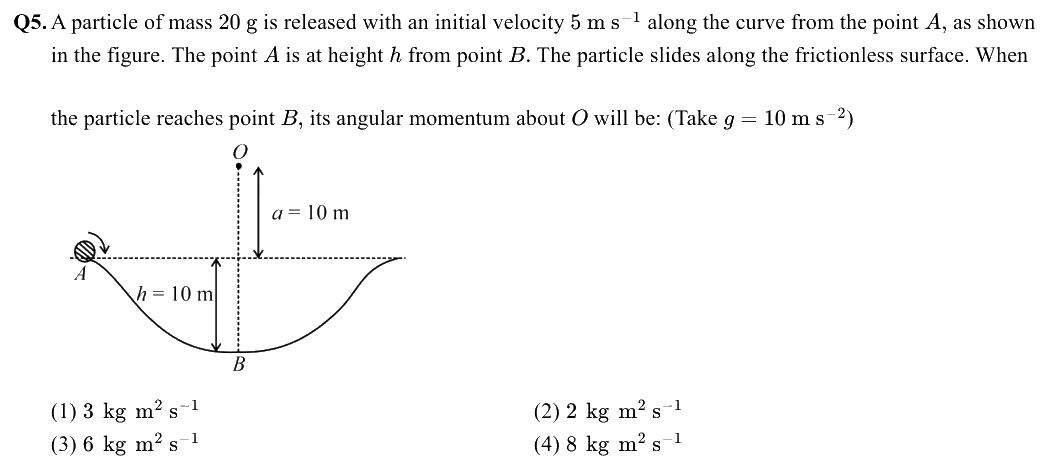
A particle of mass 20 g is released with an initial velocity 5 m s$^{-1}$ along the curve from the point $A$, as shown in the figure. The point $A$ is at height $h$ from point $B$. The particle slides along the frictionless surface. When the particle reaches point $B$, its angular momentum about $O$ will be: (Take $g = 10$ m s$^{-2}$)
(see the figure above)
3 kg m$^2$ s$^{-1}$
2 kg m$^2$ s$^{-1}$
6 kg m$^2$ s$^{-1}$
8 kg m$^2$ s$^{-1}$
You have seen the first 5 questions with answers. Questions 6–88 are listed below; their answers and step-by-step solutions are in the EdLoop app, free.