If the velocity of light $c$, universal gravitational constant $G$ and planck's constant $h$ are chosen as fundamental quantities. The dimensions of mass in the new system is:
For a train engine moving with speed of 20 $\mathrm{ms^{-1}}$, the driver must apply brakes at a distance of 500 $\mathrm{m}$ before the station for the train to come to rest at the station. If the brakes were applied at half of this distance, the train engine would cross the station with speed $\sqrt{x}$ $\mathrm{ms^{-1}}$. The value of $x$ is ______. (Assuming same retardation is produced by brakes)
Numerical answer type: type your answer in EdLoop to check it
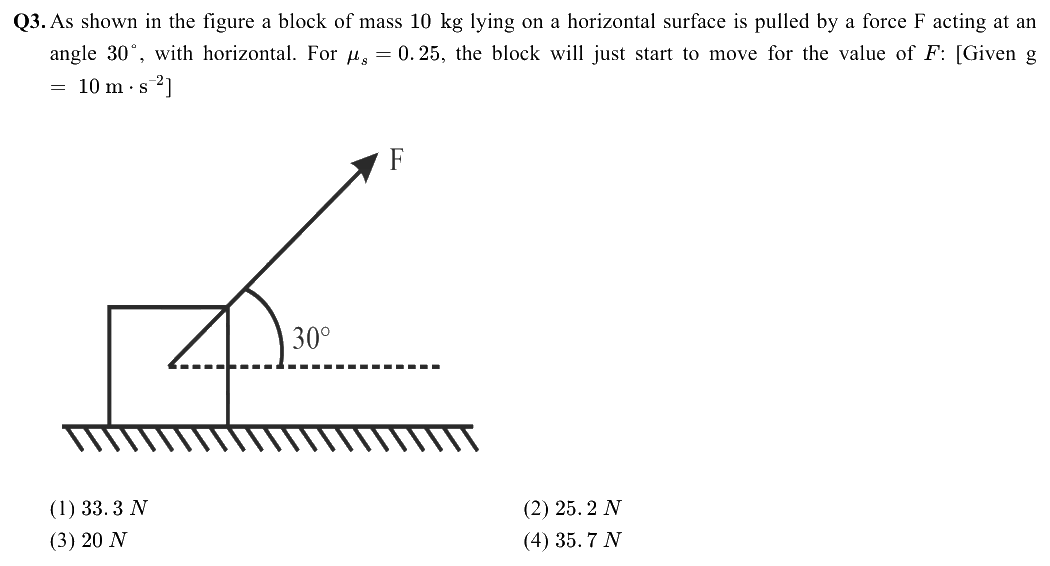
As shown in the figure a block of mass 10 $\mathrm{kg}$ lying on a horizontal surface is pulled by a force F acting at an angle $30^\circ$, with horizontal. For $\mu_s$ = 0.25, the block will just start to move for the value of $F$: [Given g = 10 $\mathrm{m \cdot s^{-2}}$]
A block is fastened to a horizontal spring. The block is pulled to a distance $x$ = 10 $\mathrm{cm}$ from its equilibrium position (at $x$ = 0) on a frictionless surface from rest. The energy of the block at $x$ = 5 $\mathrm{cm}$ is 0.25 J. The spring constant of the spring is ______ $\mathrm{N\ m^{-1}}$.
Numerical answer type: type your answer in EdLoop to check it
A force $F$ = $(5 + 3y^2)$ acts on a particle in the $y$-direction, where $F$ is newton and $y$ is in meter. The work done by the force during a displacement from $y$ = 2 m to $y$ = 5 m is ______ J.
Numerical answer type: type your answer in EdLoop to check it
You have seen the first 5 questions with answers. Questions 6–90 are listed below; their answers and step-by-step solutions are in the EdLoop app, free.