Two projectiles are thrown with same initial velocity making an angle of $45^\circ$ and $30^\circ$ with the horizontal respectively. The ratio of their respective ranges will be
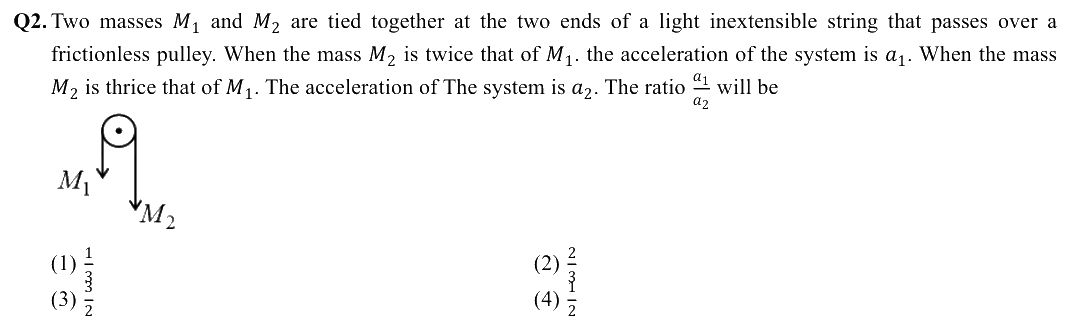
Two masses $M_1$ and $M_2$ are tied together at the two ends of a light inextensible string that passes over a frictionless pulley. When the mass $M_2$ is twice that of $M_1$. the acceleration of the system is $a_1$. When the mass $M_2$ is thrice that of $M_1$. The acceleration of The system is $a_2$. The ratio $\frac{a_1}{a_2}$ will be
A ball of mass $0.15\ \mathrm{kg}$ hits the wall with its initial speed of $12\ \mathrm{m\ s^{-1}}$ and bounces back without changing its initial speed. If the force applied by the wall on the ball during the contact is $100\ \mathrm{N}$. calculate the time duration of the contact of ball with the wall.
A body of mass $8\ \mathrm{kg}$ and another of mass $2\ \mathrm{kg}$ are moving with equal kinetic energy. The ratio of their respective momenta will be
A body is projected vertically upwards from the surface of earth with a velocity equal to one third of escape velocity. The maximum height attained by the body will be (Take radius of earth $= 6400\ \mathrm{km}$ and $g = 10\ \mathrm{ms^{-2}}$)
Answer: (A) $800\ \mathrm{km}$· Key from source paper
Sit the whole paper timed in EdLoop
You have seen the first 5 questions with answers. Questions 6–89 are listed below; their answers and step-by-step solutions are in the EdLoop app, free.